In the year 1565, Thomas Stapleton (1535–98) published The History of the Church of Englande, the first translation into modern English of Bede’s Historia Ecclesiastica Gentis Anglorum. As various scholars have now convincingly demonstrated, far from being a mere exercise in updating a medieval Latin text into the modern vernacular, Stapleton’s translation actually played a major role in establishing the parameters of debate in Elizabethan controversies about English religious and national identity, particularly as they related to the Anglo-Saxon past.Footnote 2 Yet to date no one has drawn ample, if any, attention to the considerable weight Stapleton placed on the image of the cross and its necessary role in these controversies.Footnote 3 Stapleton’s emphasis on the cross was intended as a polemical move, writing as he was in the midst of several waves of iconoclasm in early modern England that saw to the destruction of images in churches and municipalities for well over a century, from the 1530s through the 1640s, including attacks upon roods, crosses, and crucifixes, a strain of iconoclasm that left its mark not only on the physical church, but also on ecclesiastical historiography, most notably as we shall see, John Foxe’s Acts and Monuments.
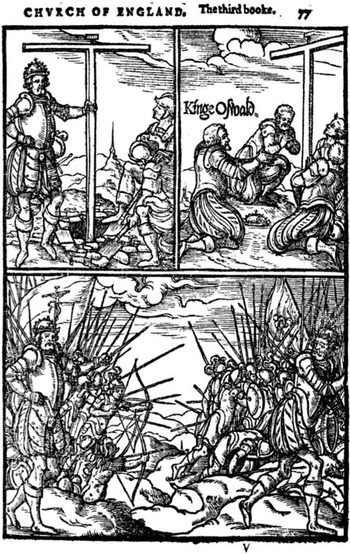
In Stapleton’s The History of the Church of Englande the magnitude of the cross looms so large that it is arguably greater than in the original Latin of Bede, for his narrative is highlighted by means of ancillary interpretative apparatuses intended to alert readers to the significance of various episodes in the history, but especially the legend of King Oswald and his cross. In the 1565 edition of The History, a panel of three illustrations accompanies the episode (see fig. 1), each separately portraying Oswald in the presence of a cross in one form or another. Yet as this episode is one of only three in the entire volume supplemented by any illustration whatsoever, much less three together at once, the panel is arguably a visual indicator that the episode was selected by the publisher John Laet, if not by Stapleton himself, to represent in a constitutive way the import of the entire volume.Footnote 4
Panel of illustrations in Thomas Stapleton’s The History of the Church of Englande (1565), depicting the Saxon king Oswald (1) setting up his cross; (2) praying with soldiers; and (3) routing the enemy at Heavenfield (fol. 77r). Image produced by ProQuest as part of Early Modern Books Online. www.proquest.com. Published courtesy of Harvard University, Houghton Library, STC 1778, and with permission of ProQuest. Further reproduction is prohibited without permission.

Besides the illustrations, printed guideposts also highlight the image of the cross, as for example, in the heading of the story, where primacy is given to the image and not the main character King Oswald, who is not even identified by name: ‘How by the sign of the Crosse, which the same king set up when he fought against the Barbarous Britons, he conquered them’.Footnote 5 A printed marginal note also conveys the cross’s primacy via its word arrangement, as it reads, ‘A crosse erected by king Oswald’,Footnote 6 and not the other way around with the person in the subject position as one might expect. Since this note appears in four successive lines in the margin (‘A crosse/ erected by/ king Os-/wald’), the words A crosse visually stand above king Oswald on the printed page. The index at the end of the volume, titled ‘A Table of Special Matters’, also prioritises the cross, listing the story alphabetically according to the letter C and not O.Footnote 7
Still, the centrality of the cross is no trick of Stapleton’s translation nor of Laet’s editorial packaging, but it is a function of Bede’s Latin text, which is fraught with the image, including diction which alludes to the cross cult, a fact that was already being recognised in ecclesiastical circles as early as the ninth century, within a century of Bede’s death.Footnote 8 In composing the Historia Ecclesiastica, Bede incorporated the cross into an Oswald legend that originally did not involve one, as his material differs from Adomnan’s seventh-century hagiographical Life of Columba, where the narrative makes no mention of any image whatsoever.Footnote 9 Much discussion has been given to Bede’s emendation, with all agreed that he is casting Oswald as a new Constantine.Footnote 10 In Stapleton’s translation the core of the narrative reads as follows:
The place is showed until this day, and is had in great reverence, where Oswald, when he should come to this battle, did set up a sign of the holy cross and beseeched God humbly upon his knees that with his heavenly help he would succour his servants being in so great a distress. The report also is that, the cross being made with quick speed, and the hole prepared wherein it should be set, the king being fervent in faith did take it in haste and did put it in the hole and held it with both his hands when it was set up, until it was fastened to the earth with dust which the soldiers heaped about it. Now when this was done he cried out aloud to his whole army, ‘Let us all kneel upon our knees, and let us all together pray earnestly the almighty, living, and true God mercifully to defend us from the proud and cruel enemy, for he knoweth that we enterprise war in a rightful quarrel for the safeguard of our subjects’. All did as he commanded them. And thus in the dawning of the day they marched forth, encountered with their enemy, and according to the merit of their faith, achieved and won the victory.Footnote 11
Here the man-made cross draws all attention to itself, both from the reader and from the characters in the story, as Oswald and his army turn to the image, making it the focal point of their prayer, with the cross standing in absentia for the Christian deity in a nearly equivalent mode. For a sixteenth-century Catholic apologist like Stapleton, the religious implications of the story could not have been more pronounced. When Oswald stations the cross, imploring his soldiers to pray before it, Stapleton and his readers would have been altogether aware that the communal supplication before the image was reminiscent of traditional ritualistic practices related to the cross cult. This cult had burgeoned in the fourth century with the legend of Helena and the Invention of the true cross in Jerusalem.Footnote 12 The earliest account of a formalized ritual can be found in Egeria’s Travels, or the Itinerarium, the late fourth-century narrative of a pilgrimage taken by a Western European nun to the holy sights in Jerusalem, probably occurring between the years 381 and 384.Footnote 13 Egeria provides details of a Good Friday liturgy in Jerusalem during which the congregation demonstrates communal obeisance before a reliquary containing the ‘holy wood of the cross’.Footnote 14 As Egeria writes, ‘It is the custom that one by one all the people come forth, both the faithful and the catechumens, incline themselves before the table, and kiss the holy wood’.Footnote 15
Sometime between the years 683 and 752, a similar Good Friday practice emerges in Rome, via either Jerusalem or Constantinople, and the oldest Roman codification of this ritual can be found in the Holy Week directives of Ordo Romanus XXIII, which dates to the first half of the eighth century.Footnote 16 According to the rubric of this ordo, a reliquary containing wood purportedly from the true cross is carried into the church, where it is venerated by the clergy and laity.Footnote 17 The first known ritual to use a replica as a substitute for a relic of the cross can be found in Ordo Romanus XXIV, a formulary from the second half of the eighth century.Footnote 18 Already in these early documents we find some of the same rubrics that appear in late medieval English formularies,Footnote 19 as well as in early modern Catholic liturgical books, including the 1570 Tridentine missal.Footnote 20
In The History of the Church of Englande, when Oswald ‘sets up’ the ‘sign of the holy cross’ and instructs his soldiers, ‘Let us all kneel upon our knees, and let us all together pray earnestly the almighty, living, and true God, mercifully to defend us from the proud and cruel enemy’, the language mimics that of rituals which Stapleton and his readership would have known from formularies prevalent in Tudor England such as the Sarum Use. For example, according to a 1555 Processional, as part of the liturgy of Parasceve (Good Friday) a veiled cross is carried into the church and set up just like Oswald’s cross in a conspicuous location, after which it is uncovered by the priests, who, similar to Oswald, chant, ‘Behold, the wood of the cross on which hung the saviour of the world. Come let us adore’.Footnote 21 In response the congregation genuflects much like Oswald’s soldiers and kisses the ground just before a prayer is offered, akin to the one Oswald recommends, seeking mercy and protection: ‘God have pity on us and bless us’.Footnote 22 The close mimicry of these rubrics would likely have triggered an emotional response in Stapleton’s audience, especially among the nominally Protestant who still recalled the Roman rite with nostalgia, that is, ‘Church Papists’ and others who did not fully conform to the Elizabethan settlement,Footnote 23 since many, if not all, would have had memories themselves of the catharsis elicited by participation in what arguably amounts to a theatrical experience.Footnote 24 In reflecting upon the ritual, Nicholas Sander intimates that pathos was indeed the aim of participation:
And to make us the better to think upon that we sing [the hymn Vexilla regis prodeunt], and to conceive it more devoutly, we are appointed at the singing of those words to kneel, and to turn ourselves toward the altar, to the end, we fastening our eye upon the Sign of the Cross, might print in our heart a more lively representation of the precious death of Christ.Footnote 25
The highly emotional purchase of the experience, combined with the fact that small personal crosses could be smuggled into Elizabethan England and easily hidden away, makes it not inconceivable that crosses, like other sacramentals such as rosary beads, came to be utilised as substitutes for the sacraments, especially among the poor.Footnote 26 In other words, in a country where the Roman mass had been outlawed and priests proscribed, the cross cult may have blossomed among Church Papists, providing a focal point of piety for the less affluent, especially in areas not served by missionary or clandestine Roman priests, that is, for those among the various stripes of Church Papists who lacked the resources of the aristocratic elite, who could, for example, harbour priests for their own private masses or, like the members of the Recusant community in exile, pack up and leave the country.Footnote 27 In an anti-Roman tract translated from Latin and titled The Bee Hiue of the Romishe Church, sacramentals like the cross are attacked for the very reason that they encroach upon legitimate sacraments based in scripture.Footnote 28
Besides the linguistic resonances, two of the three illustrations which accompany the Oswald narrative in Stapleton’s text also appear to be informed by the Sarum formularies.
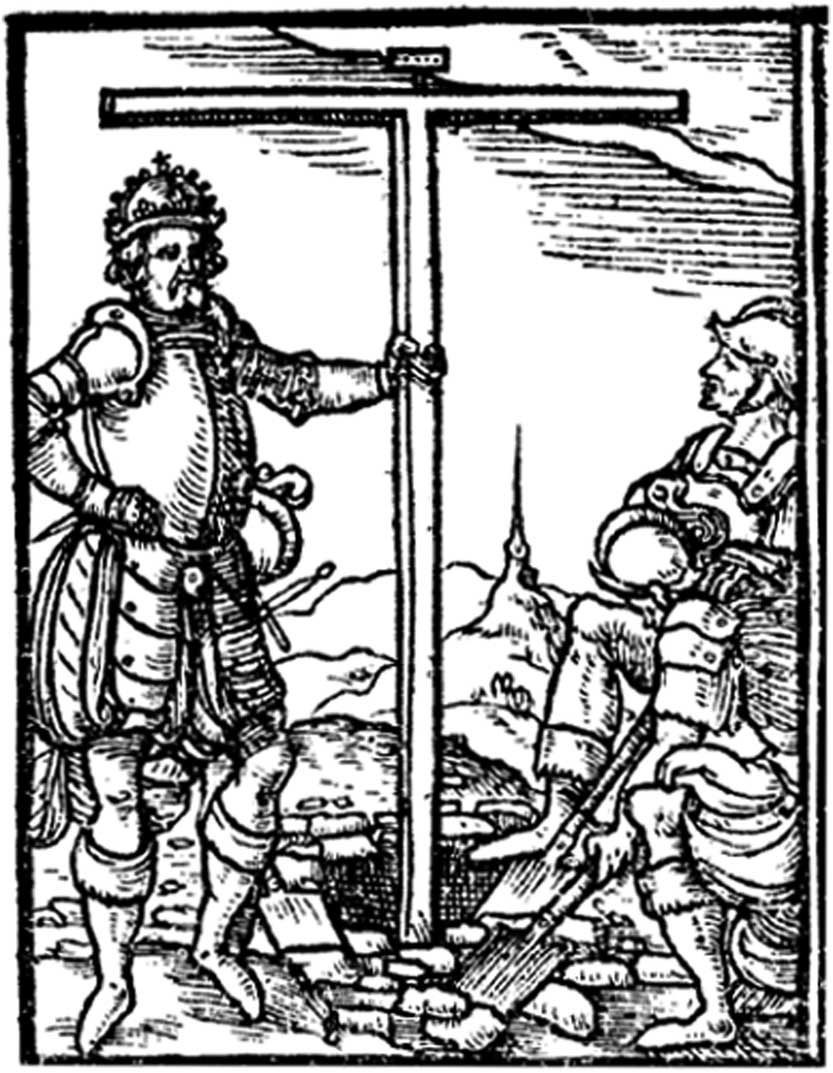
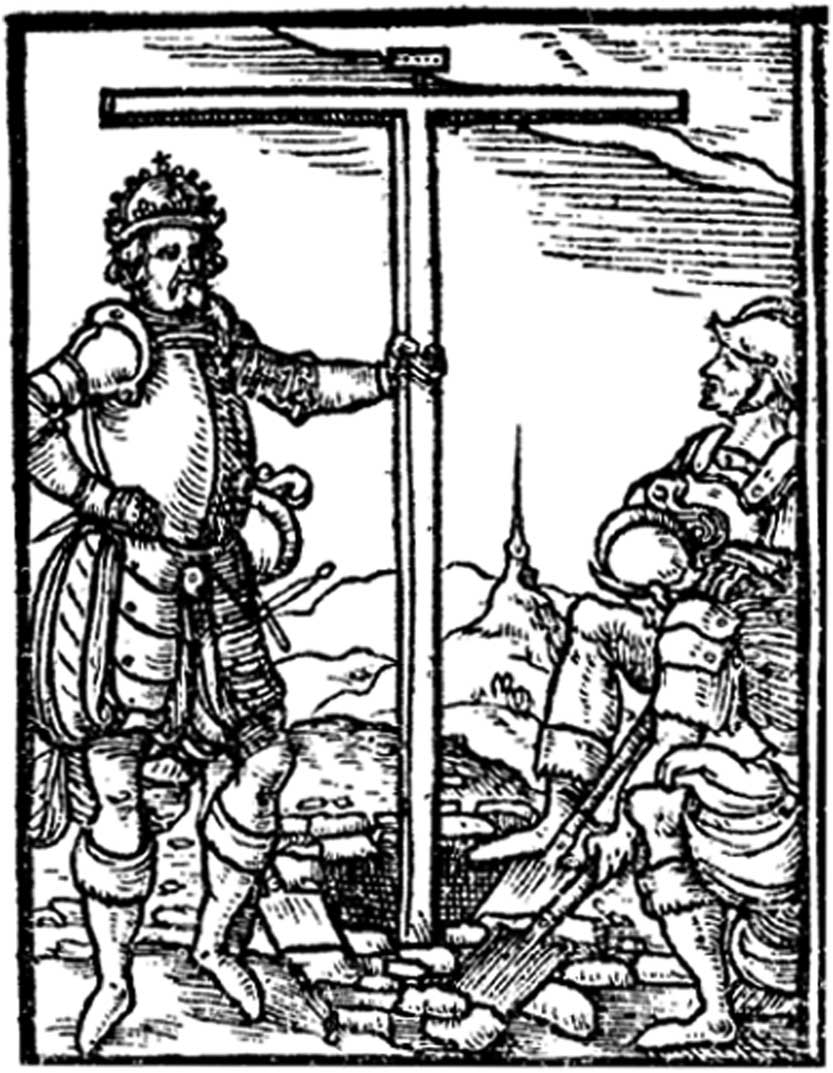
The first illustration (see fig. 2) shows Oswald presenting the cross to two soldiers in the process of digging a hole for its insertion, though both soldiers are figured with one knee bent in a posture similar to genuflection. While the sacerdotal-like Oswald holds up the cross, one of the soldiers admires it with head uplifted, while the other looks downward towards his work, his face lowered in such a way that if it were not for the presence of his shovel, he would appear to be striking a pose of humble prayer. The scene closely resembles the dramatic moment during the Good Friday ritual when the priests reveal the bare wooden cross to the congregation, immediately followed by the choir’s demonstration of obeisance. As the Sarum Missal relates, ‘Then the priests, uncovering the cross next to the altar on the right side, sing this antiphon, Behold, the wood [of the cross]. The choir with a genuflection, kissing their pews, should respond with the antiphon, We adore your cross, O Lord’.Footnote 29
Upper left illustration from Oswald panel in Stapleton’s The History of the Church of Englande, depicting the Saxon king Oswald setting up the cross at Heavenfield (fol. 77r). Published courtesy of Harvard University, Houghton Library, STC 1778, and with permission of ProQuest. Further reproduction is prohibited without permission.
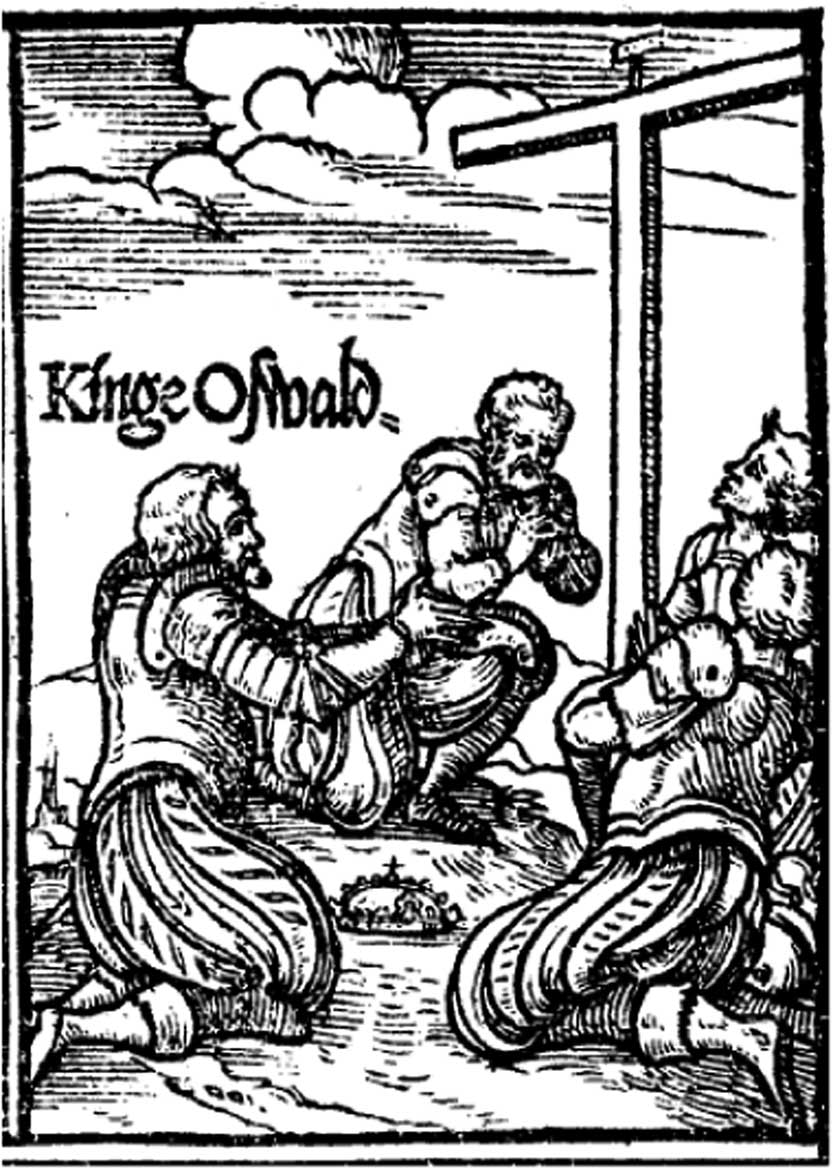
The second illustration (see fig. 3) captures the act of kneeling, prescribed at different junctures for the various participants in the adoration ceremony, as a single tableau. Oswald folds his hands together in the course of descending to his knees, one knee on the ground, the other still raised, while the soldiers accompanying him gaze upon the cross, already kneeling, their hands pressed together in prayer. Another detail in the picture may also be inspired by the ritual in that the two soldiers in the foreground are made to appear as if their feet are unshod,Footnote 30 a circumstance which would accord with the rubric calling for worshippers, including the priests and other members of the clergy, to approach the cross ‘with feet stripped bare’.Footnote 31
Upper right illustration from Oswald panel in Stapleton’s The History of the Church of Englande, depicting the Saxon king Oswald praying with soldiers before the cross at Heavenfield (fol. 77r). Published courtesy of Harvard University, Houghton Library, STC 1778, and with permission of ProQuest. Further reproduction is prohibited without permission.

The adoration ceremony echoed in the Oswald account and codified in the Sarum Use was often labeled in English religious discourse with the epithet ‘the creeping of the cross’, a term dating to the early thirteenth century but especially popular among sixteenth-century reformers.Footnote 32 We find the term explicitly defined in an Henrician royal proclamation, dated 26 February 1539, issued in defense of the practice: ‘On Good Friday it shall be declared, how creeping of the cross, signifyeth an humbling of ourselves to Christ, before the cross, and the kissing of it a memory of our redemption, made upon the cross’.Footnote 33 This proclamation, although tolerant of creeping to the cross, still warns against the superstitious abuse of cross adoration, wherein participation in the ceremony in and of itself is thought to bear spiritual fruit. As the proclamation advises, ‘And so it shall be well understood and known that neither [...] creeping [nor] kissing the cross be the workers or works of our salvation, but only be as outward signs and tokens whereby we remember Christ and his doctrine, his works, and his passion, from whence all good Christian men receive salvation’. So standard Reformation belief about the inefficacy of good works for securing salvation, as opposed to faith alone, applied to the cross cult as well.Footnote 34
In Henrician England toleration for Good Friday cross-adoration rituals, even when conducted with a theoretically orthodox mindset, increasingly fell under attack, and iconoclastic controversialists maintained that creeping to the cross was a practice intrinsically and irreparably flawed.Footnote 35 As William Turner (1509/1–68) explains in The Huntyng & Fyndyng out of the Romishe Fox (1543), ‘In creeping of the cross ye worship the cross but the worshipping of the cross is contrary to the word of God’; it is a practice patently idolatrous and strictly forbidden by the second commandment.Footnote 36 Turner, moreover, refutes a standard iconodule counterargument—that worship is transferred from the image per se to the spiritual entity it represents—by castigating the ostensible source of the controversy, the various formularies of the Roman church.Footnote 37 The problem lies in the rubrics, Turner argues, because the language in them is seemingly unambiguous about the intended object of worship, especially as articulated in some of the traditional Latin Good Friday antiphons, which in the Sarum Use say, for example, ‘Lord, we worship thy cross’ (‘Crucem tuam adoramus domine’).Footnote 38 For Turner, an insurmountable conflict arises between cross adoration and the authority of the word of God,Footnote 39 and by February 1548 sentiments like his were taken seriously enough to be converted into law, with an Edwardian proclamation explicitly banning creeping to the cross on Good Friday.Footnote 40
Not surprisingly, Mary Tudor allowed for the legal restoration of the creeping of the cross,Footnote 41 but with the Elizabethan Settlement the voices of dissent resounded once again. For example, the Marian exile John Jewel (1552–71), appointed bishop of Salisbury in 1559 and in light of his 1559 Challenge Sermon arguably the chief spokesperson for reform among early Elizabethan bishops, himself levels a critique against the cross cult in his 1565 A Replie vnto M. Hardinges Answeare.Footnote 42 In the Replie, although admitting to the sanctity of the original cross and to the authenticity of various cross apparitions like that to Constantine, Jewel expresses doubt about any real precedent—biblical, historical, or otherwise—for the adoration of man-made crosses.Footnote 43 Jewel considers unconvincing, too, any claims about transferred devotion, and as evidence he cites a verse from one of the traditional hymns of the cross cult, Vexilla regis prodeunt: ‘Ave Crux spes vnica: All hail, O Cross, our only hope’.Footnote 44 For Jewel, the invocation of the cross, seemingly to the exclusion of Christ, qualifies the hymn unequivocally as a form of ‘superstitious abuse’.Footnote 45
Similarly, in another early Elizabethan work, An Aunswere to the Treatise of the Crosse, the iconoclast James Calfhill (1529/30–70) lashes out against ‘the blockish Images, the dead Crosses, [which] have been crept to, been worshipped’.Footnote 46 Like Turner and Jewel, Calfhill finds fault with the transferred-devotion argument, considering it a cloaked form of idolatry.Footnote 47 For Calfhill the necessary distinction between an image and the entity it represents becomes obfuscated in actual cultic practice, with the upshot that for iconodules, he believes, ‘Crosses have displaced Christ’.Footnote 48 Calling to mind the medieval theological nuance first articulated by eighth-century Greek iconodules which distinguishes ‘λατρεία [latria]’ from ‘δουλεία [dulia]’, he dismisses the subtle distinction as an ‘absurdity’.Footnote 49
For Calfhill, an image first and foremost is a kind of visual metaphor, not in any way one and the same as the divine entity it represents and, therefore, not at all worthy of devotion. Like a metaphor it is a signpost, a bearer of meaning pointing beyond itself towards the unseen divine essence which alone should be worshipped. Citing Augustine’s commentary on Psalm 113, Calfhill claims that when engaged in the ‘pure’ form of religion, a believer neither worships an ‘image’ (simulachrum) nor cultivates its ‘power’ (daemonium), but instead, through the ‘corporal likeness’ (effigiem corporalem) manifested in the image, the believer is able to behold a ‘sign of the [very] thing’ (ejus rei signum) which he ‘ought to worship’ (debe[t] colere).Footnote 50 To worship the sign, in this case the cross, is equivalent, therefore, to a misdirected adoration because as Calfhill suggests, in worshiping the cross the ‘virtue’ inherent in ‘the signified Christ’ is falsely ‘attributed to the sign’.Footnote 51 Moreover, the ‘bare sign of the cross’, he maintains, is ‘in effect, nothing’.Footnote 52 This lack of inherent ‘virtue’ or divine ‘substance’ in the image vitiates all forms of worship like creeping to the cross, proving them to be nothing other than a form of idolatry because ‘the honour peculiar unto God is transferred to a creature’, an ‘idol’, a ‘dead image’.Footnote 53
Arguments like those of Turner, Jewel, and Calfhill would leave their mark on Elizabethan historiography, but even as early as the 1542 edition of The Chronicle of Fabyan, antagonism against the cross had already secured a foothold in the Oswald legend. The 1542 edition of Fabyan’s Chronicle was a revision of The Newe Cronycles of England and Fraunce, an annalistic British history encompassing a time frame beginning with the legendary Brute and ending with the monarchy of the Tudors and first published in the year 1516, then again in 1533 under the title Fabyans Cronycle Newly Prynted.Footnote 54 According to the title page of the 1542 edition, the text had been recently revised, ‘nowe newly printed, and in many places corrected, as to the diligent reader it may appear’.Footnote 55 These ‘corrections’ were in fact religiously biased emendations sponsored by the printer William Bonham, including revisions, marginal commentary, and deletions, all amounting to what one critic has called ‘a re-imagining of the national past in the light of reformed religion’.Footnote 56 For example, a marginal comment inserted beside the account of the ‘first Christian king of Britain’, the second-century King Lucius, advises the reader to ‘note that the fayth of Christ was received in England: four hundred years before the coming of saint Augustine’.Footnote 57 The comment is intended to redirect the reader away from any false notions about a Roman origin of the English church, no doubt since the very next chapter relates the story of the Roman mission to the Saxons led by Augustine in 597.Footnote 58
In the 1542 Chronicle of Fabyan, King Oswald too is ‘reformed’ as he is cast as an exemplar of the faith, who gains his victory mainly because of his prayerful humility and hope for salvation. The ‘corrected’ Oswald story reads as follows:
But Oswald when he was warned of the great strength of this Cadwan, he made his prayers to God and besought him meekly of help to withstand his enemy for the salvation of his people. Then after Oswald had prayed for the salvation of his people, the two hosts met in a field named then Denisburne or Denislake, where was fought a strong battle. But finally Cadwan, which the Polychronicon nameth Cedwalla, was slain and his people chased, which were far exceeding the number of Oswald’s host.Footnote 59
The most salient feature in this account, differentiating it from Bede’s Historia Ecclesiastica, is derived ironically from what it lacks: the cross.Footnote 60 Apparently, the printer Bonham, along with whomever else he employed as an editor, recognised that King Oswald offered too fitting an exemplar of secular holiness to be ignored in a country where the monarch exercised supreme authority over the national church.Footnote 61 For this reason, at the very least, Bonham must have deemed it imprudent, if not reckless, to depreciate a royal figure like Oswald, a compelling prototype of Henry VIII himself, by tossing him to the scrapheap of Saxon idolators. A much more shrewd strategy, therefore, was chosen for handling the theological unpleasantries posed by King Oswald’s adoration of the cross: the ‘idol’ was eliminated, but not the prayerful king. The cross was excised by means of the judicious removal of three sentences all too conspicuous in the earlier 1516 and 1533 editions. The original ‘idolatrous’ account reads as follows:
But Oswald, when he was warned of the great strength of this Cadwan, made his prayers to God and besought him meekly of help to withstand his enemies. And before he went to prayer, he erected a cross of tree, before which he kneeled a long while in a field which long after was called Heavenfield and to this day is had in great worship. That place is near unto the town or church of Agustald in Brennicia, which church was there builded by Oswald after the winning of that battle. And of the spones of that cross are told many wonders, which I over pass. Then, after Oswald had prayed for the salvation of his people, the two hosts met in a field named then Denisburne, or Denislake, where was fought a strong battle. But finally Cadwan, which the Polychronicon nameth Cedwalla, was slain and his people chased, which were far exceeding the number of Oswald’s host.Footnote 62
The narrative here is exactly the same as the 1542 version, except for the second, third, and fourth sentences, which concern, respectively, the ‘cross of tree’, the ‘church’ ‘builded by Oswald’, and the miraculous ‘spones’, all details found in Bede’s Historia Ecclesiastica.Footnote 63 This original account also failed to be recirculated when a fourth edition of the chronicle was published by John Kyngston in the spring of 1559 under the title The Chronicle of Fabian,Footnote 64 within months after the coronation of the new queen.Footnote 65 Instead, once again it was Bonham’s bowdlerised version of 1542 that took to the stage of Elizabethan religious controversy, with the three discredited sentences effaced.Footnote 66
In light of the redacted Fabyan text of 1559, the presentation of the Oswald story in Stapleton’s 1565 edition of The History of the Church of Englande appears to be intended as a corrective. The fact of the matter is that in The History the cross plays such a leading role in the unfolding of events that the episode would not cohere without its presence. This privileged status may be the reason for the cross’s highly theatrical entrance onto the scene, with the cast of human characters depicted as nearly frantic about the construction of the wooden simulacrum: ‘The report also is that, the crosse being made with quick speed, and the hole prepared wherein it should be set, the king being fervent in faith did take it in haste, did put it in the hole, and held it with both his hands when it was set up, vntil it was fastened to the earth with dust which the soldiers heaped about it’.Footnote 67 The cross is planted into the earth and so, too, into the narrative, and once it has been securely stationed there, it dominates the subsequent events nearly like a deity.
Only after the cross has been ‘set up’ does King Oswald deem it fitting to summon his soldiers to prayer: ‘Now when this was done he cried out aloud to his whole armie, “Let us all kneel upon our knees, and let us all together pray earnestly the almighty, living, and true God mercifully to defend us from the proud and cruel enemy”’. The implication is that the image is necessary for the act of worship to be effectual and for the army’s prayers even to be heard. The presence of the image mediates the divine presence, not just pointing towards it, but actually bringing it down to earth and setting it before the army. Thus, a kind of visual metonymy rather than a visual metaphor is invoked as the cross stands in absentia for ‘the almighty, liuing, and true God’.Footnote 68
Moreover, the relation between the image and deity is so intrinsically intimate that it infuses the cross with a power tantamount to divine. There is a potency in the cross that is quintessentially apotropaic since in light of their prayer and devotion Oswald’s army wins the battle. As The History tell us, ‘All did as he commanded them. And thus in the dawning of the day they marched forth, encountered with their enemy, and [...] won the victory’.Footnote 69 This is instantiated as a miraculous ‘heavenly victory’ as Oswald’s ‘small army’ is also described as having ‘vanquished’, in the face of great odds, a formidable, previously undefeated ‘victorious host’. The enemy captain, identified as ‘Kadwallader the king of Britons’, Footnote 70 had even boasted (‘made his avante’) that ‘nothing could be able to withstand it’.
The narrative takes measures, nonetheless, not to attribute the victory solely to the image, as attention is also drawn to the faith of Oswald and his troops, which is also presented as a necessary contributing factor to the ‘heavenly’ outcome.Footnote 71 When Oswald is first introduced, he is depicted in stark contrast to his immediate predecessors, the ‘apostate kings’ of Northumbria.Footnote 72 These kings are accused of ‘forsaking the religion of Christ’, turning to the ‘devil’, and resorting to the ‘old filth of Idolatry’.Footnote 73 Oswald, however, is described as ‘a man dearly beloved of God’, who erects the cross ‘fervent in faith’.Footnote 74 Oswald’s soldiers, too, are said to be ‘fenced with the faith of Christ’, and after the battle, the narrative pays tribute to the fact that ‘according to the merit of their faith, [they] achieved and won the victory’.
Still, the overriding thrust of the narrative is that divine power is inherent in the battle cross, and this belief is corroborated by other, subsequent events at Heavenfield. As The History relates, other ‘heavenly miracles’ began to occur in the years following Oswald’s triumph due to the cross’s thaumaturgic capabilities: ‘For even until this present day many men do customably cut chips out of the very tree of that holy cross, which casting into waters and giving thereof to sick men and beasts to drink, or sprinkling them therewith, many forthwith are restored to their health’.Footnote 75 As a consequence of this outpouring of miracles, The History designates Heavenfield as a ‘holy’ place, held ‘in greate reuerence’, a location, it says, which ‘is now much honoured of all men by the reason of the church that was lately builded and dedicated in the same place’.Footnote 76 The mentioning of a church building validates for Stapleton’s sixteenth-century audience—as it had for Bede’s in the eighth centuryFootnote 77 —that the cross had long been ordained as an image worthy of formal liturgical devotion.
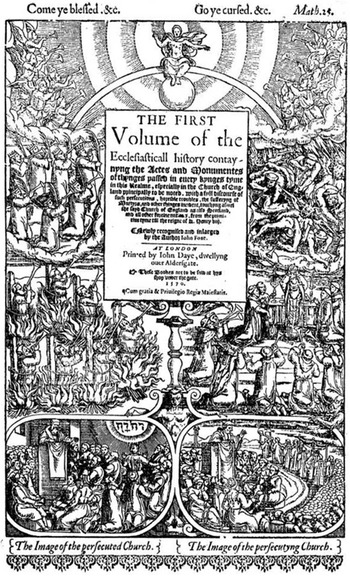
Stapleton’s promotion of the cross cult via the Oswald narrative, repackaged with the aforementioned appurtenances, did not fail to meet opposition from Elizabethan reformist historiographers. The strongest rebuttal appears in John Foxe’s 1570 edition of The Acts and Monuments.Footnote 78 This is not to say that Foxe had not already begun to undermine the cross cult before Stapleton’s translation of Bede. In the first edition of The Book of Martyrs, published in 1563, the cross falls victim to Foxe’s programme of reform, though without any mention whatsoever of Oswald. For example, in the panel of woodcut illustrations appearing on the title page (also used in later sixteenth-century editions, including the 1570), the cross is presented as an instrument of the damned.Footnote 79 On one side of the page, the woodcuts depict scenes characteristic of the ‘Persecuted Church’, such as figures listening to a preacher explicate scripture, and on the other side, scenes of the ‘Persecuting Church’, such as a priest at an altar, elevating the host during mass (see fig. 4).
Title page of John Foxe, The first Volume of the Ecclesiasticall History contaynyng the Actes and Monumentes (London: John Day, 1570). Image produced by ProQuest as part of Early Modern Books Online. www.proquest.com. Published courtesy of Harvard University, Houghton Library, Typ 505.70.404, and with permission of ProQuest. Further reproduction is prohibited without permission.

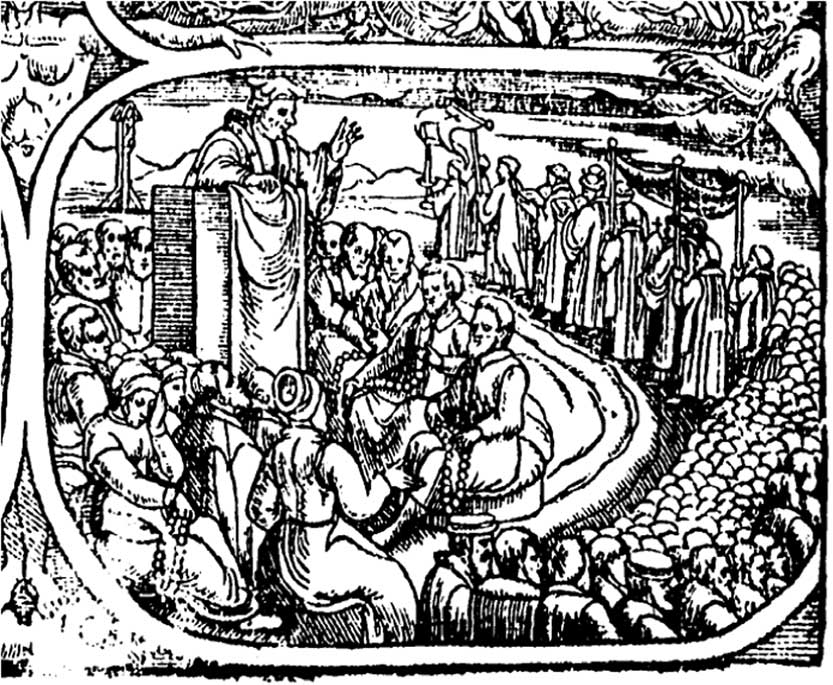
At the top of this diptych-like panel, Christ is centrally located, facing the reader and seated alone in the act of judgment, motioning with his right hand the figures of the ‘Persecuted Church’ towards their heavenly reward, and with his left, the figures of the ‘Persecuting Church’ towards their damnation. Included among the images of the damned is a scene of a congregation of Catholics reciting the rosary during a homily (see fig. 5).
Lower right panel from title page of Foxe’s Actes and Monumentes (1570), showing various practices for which the Roman church will be damned, including a cross procession. Published courtesy of Harvard University, Houghton Library, Typ 505.70.404, and with permission of ProQuest. Further reproduction is prohibited without permission.
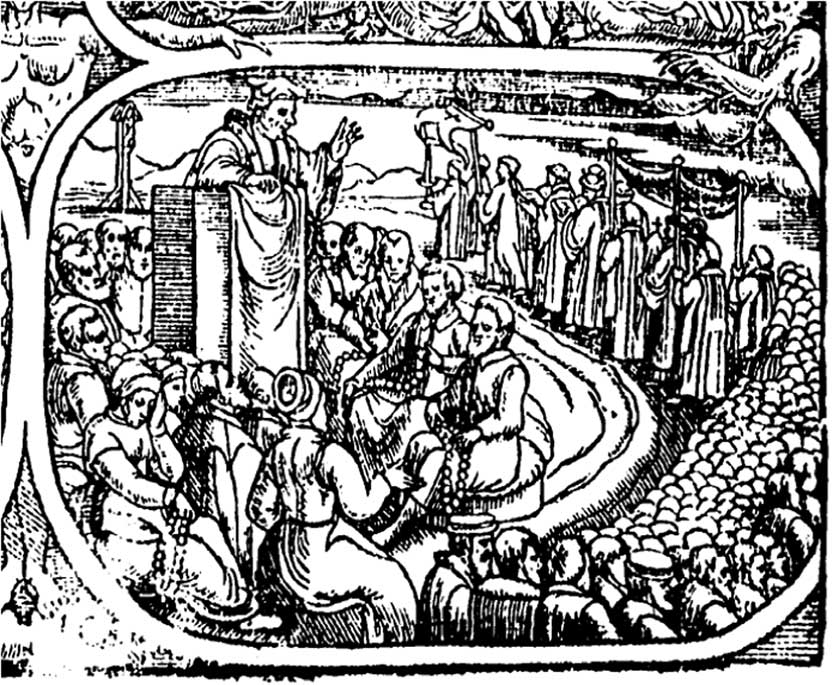
In the background of this scene there appears a liturgical procession winding its way seemingly towards a gibbet, headed by a clergyman carrying a large, elevated banner of the cross, with another cleric holding midway, beneath a canopy, a smaller cross statue.Footnote 80 The unspoken message is clear: the cross is the sign of the persecutors and not of the true, persecuted church.Footnote 81
In the 1570 edition of The Acts and Monuments Foxe’s critique becomes more explicit, and for the first time he directly addresses the Oswald legend. In the same year, moreover, Foxe delivered a Good Friday sermon at Paul’s Cross, published by John Day soon thereafter, in which he differentiates between false devotion towards images like the cross and true devotion, which is described as an internal experience: ‘To know Christ Jesus crucified, and to know him rightly, it is not sufficient to stay in these outward things: we must go further then the sensible man, we must looke inwardly with a spiritual eye into spiritual things’.Footnote 82 In a similar vein, the 1570 Acts and Monuments cites the letters of the Marian martyr John Philpot, who describes the gospel admonition to take up the cross (Matthew 16:24; Luke 9:23) as an internalised, personal experience (‘my cross’), one which calls for believers to be ‘joyful under the cross’, that is, in the face of hardships, ‘infirmities’, and other like sufferings such as ‘the loss of landes, goods, and life’, all endured in ‘the hope of a better reward’.Footnote 83 To keep an inner disposition of joyfulness in the face of personal suffering is rendered as true devotion to the cross: ‘O how glorious be the crosses of Christ, which bring the bearers of them unto so blessed an end’.Footnote 84
For Foxe, as with the controversialists Turner, Jewel, and Calfhill, adoration of the cross was hardly a godly practice, and for this reason in the 1570 Acts and Monuments the legend of Oswald is modified, though in a manner, it is not unfair to say, which is patently of two minds. After the publication of Stapleton’s translation of Bede and his ancillary text A Fortresse of the Faith First Planted amonge Us Englishmen (1565), where Stapleton glosses The History of the Church of Englande with further commentary on what he saw as the Saxon, and therefore Roman, origins of the English church, Foxe had no choice but to gainsay Stapleton by taking up the very same Saxon material Stapleton had so penetratingly introduced onto the stage of Elizabethan controversy.Footnote 85 At the same time, Archbishop of Canterbury Matthew Parker and his circle of Anglo-Saxon scholars, most famous among them John Joscelyn, were already beginning to deploy the Saxons in the cause of the English Reformation, capitalizing on Saxon texts to disprove the antiquity of sundry Roman doctrines, foremost among them the doctrine of transubstantiation, an endeavour which culminated in the publication of A Testimonie of Antiquitie in about the year 1566.Footnote 86 As a consequence of these two countervailing proof-text approaches, in the 1570 Acts and Monuments Foxe resorts to a bifurcated viewpoint towards Saxon history, the complexities of which he had not fully confronted in the 1563 Acts and Monuments, where the Saxons are apportioned a fairly cursory role, with Oswald not mentioned at all.Footnote 87 In 1570 Foxe found himself caught in the middle of two mutually exclusive enterprises to harvest the Saxons, the one seeking material to prop up a ‘Roman Catholic’ past, and the other, a ‘Reformation’ past; and these contradictory agenda leave their mark on Foxe’s presentation of King Oswald, about whom we are given nearly paradoxical information.
On one hand, Foxe counters Stapleton’s promotion of the cross cult by grouping Oswald’s cross together with other monuments of Saxon superstitution. In this vein, Foxe follows the suit of the historiographer John Bale in his Actes of Englysh Votaryes (1546), where Bale asserts that the Saxons were neither rightfully Christians nor even rightfully English, as he denigrates the Saxons, linking his contemporaries in England to the Britons as their true forebears. In similar fashion Foxe vilifies the Saxons in the 1570 edition of The Acts and Monuments, claiming that the Britons ‘were bereaved of their land by the cruel subtlety of the Saxons’, who ‘violently and falsely dispossessed the Britons of their right’, and having ‘untruly expulsed and chased out the Britains from their land’, he says, the Saxons were guilty of ‘blood, bloody violence, and unjust dealings’.Footnote 88
Besides these crimes, Foxe also accuses the Saxons of initiating the corruption of the native British church, albeit unintentionally. At first ‘Pagans,’ he says, the Saxons were eventually ‘converted to the Christian faith’ by the Britons and became ‘devout’ believers.Footnote 89 Yet in time, he says, they deviated and became ‘deceived’ in their religious practices, turning to the ‘church of Rome’: ‘For albeit in them there was a devotion and zeal of mind that thought well in this their doing, which I will not here reprehend; yet the end and cause of their deeds and buildings cannot be excused being contrary to the rule of Christ’s Gospel’.Footnote 90 As a result of misguided Saxon zeal, Foxe says, ‘first came in the Peter pence or Rome shots in this realm’ and, likewise, ‘most part of the greatest abbeys and nunneries in this realm were first begun and builded’.Footnote 91 For Foxe (‘so it seemeth again to me’), these markers of the Roman church were the foundations—elsewhere he calls them ‘monkish foundations’Footnote 92 —of the ecclesiastical corruption which would only be rectified by the Reformation in the sixteenth century. So in hindsight Foxe laments the lack of spiritual perspicacity on the part of the Saxons:
First, [I wish] that they, which began to erect these monasteries and cells of monks and nuns to live solely and single by themselves out of the holy state of matrimony, had foreseen what danger and what absurd enormities might and also did thereof ensue, both publicly to the Church of Christ and privately to their own souls.Footnote 93
To corroborate the gravity of his claims, Foxe calls attention to the tangible evidence of what he refers to in his preface as Saxon ‘superstition and ceremony’, providing a catalogue of ‘monkish monasteries’, a list which includes Oswald’s cross:Footnote 94
The first cross and altar within this realm was first set up in the north parts in Heavenfield upon the occasion of Oswald king of Northumberland fighting against Cadwalla, where he in the same place set up the sign of the cross, kneeling and praying there for victory. Polychronicon. Book 5, ch. 12. Anno 635.Footnote 95
In citing this example, seemingly derived from Ranulf Higden’s fourteenth-century Polychronicon, Foxe utilises the Oswald story as a counterpoise against Stapleton’s approbation of the cross cult.
At the same time that Foxe critiques the Oswald legend as part of his denunciation of Saxon ecclesiastical errors, he also appropriates it in a way that seems to support the work of the Parker circle and its cooptation of the Saxons for a reformed historiographical agenda.Footnote 96 The 1570 edition even includes a printed marginal note to prevent anyone from misconstruing the nexus of the Oswald story, one which contrasts sharply with that promoted in Stapleton’s text, where the cross is highlighted. Instead, Foxe’s marginal note downplays and even overlooks the cross, as it summarises the story with the sanitised quip, ‘Strength of prayer overcometh armies’.Footnote 97 Foxe is casting Oswald as a secular exemplum of pure, devout faith, much in the same way William Bonham presents Oswald in the 1542 edition of The Chronicle of Fabyan as a prayerful king who is not in any way associated with the messiness of iconodulia. For Foxe, too, Oswald is likely intended as a prototype of the monarch, in this case Elizabeth I, whom he characterises in his dedication as possessing, much like Oswald, ‘a zeal full of solicitude’.Footnote 98 Foxe’s narrative reads as follows:
But Oswald, when he was warned of the great strength of this Cadwall and Penda, made his prayers to God and besought him meekly of help to withstand his enemy, for the salvation of his people. Thus after Oswald had prayed for the saving of his people, the two hosts met in a field named Denisburne, some say, Heavenfield, where was faught a strong battle. But finally the army and power of Penda and Cedwal, which was far exceding the number of Oswald’s host, was chased and for the most part slain by Oswald.Footnote 99
Foxe cites several sources for this version of the Oswald story, including Geoffrey of Monmouth’s Historia Regum Britanniae,Footnote 100 Higden’s Polychronicon,Footnote 101 William of Malmesbury’s Gesta Regum Anglorum,Footnote 102 John Brompton’s Chronicon,Footnote 103 and ‘Fabian.’Footnote 104 In actuality, however, he is copying Bonham’s 1542 Fabyan nearly verbatim, with the exceptions being the naming of Penda as co-commander of the Britons and the mention of Heavenfield. The cross, however, has been expunged as it would be in later editions of The Book of Martyrs published in 1576 and 1583.
In closing, I would like to draw attention to another Elizabethan version of the Oswald legend, though one not found in a work of historiography, but instead in Book Three of Edmund Spenser’s The Faerie Queene (1590), where Merlin explains on behalf of Britomart his prophecies concerning the future history of the Britons.Footnote 105 In the course of his narration Merlin mentions King Oswald, who will be a foe in the conflicts pitting Britomart’s descendants against the invading Saxons, initiating a period of eight hundred years during which Briton supremacy in Britain will be suppressed.Footnote 106 The last of the primitive line of Briton kings will be Cadwallin, and his line will not be restored until the fifteenth century and, it is implied, the ascendancy of the Tudor dynasty.Footnote 107 In the final days of Cadwallin’s tottering and soon-to-be preempted hegemony, however, the Britons for a brief time will regain the upper hand over the Saxons.
It is during this temporary Briton resurgence that King Oswald appears in Merlin’s narrative as a champion of the Saxons. Although Oswald will ultimately be slain by Cadwallin in an unnamed battle in Northumberland, his death will occur only after he has first defeated, Merlin says, Cadwallin’s henchman, the perfidious Saxon turncoat Penda. Oswald’s victory will happen under the auspices of the Christian deity:
Him [Penda] shall he [Cadwallin] make his fatall Instrument, T’afflict the other Saxons vnsubdewd; He [Penda] marching forth with fury insolent Against the good king Oswald, who indewd With heauenly powre, and by Angels reskewd, All holding crosses in their hands on hye, Shall him defeate withouten bloud imbrewd: Of which, that field for endlesse memory, Shall Heuenfield be cald to all posterity.Footnote 108
I bring this version of the myth to our attention because it is unique, likely Spenser’s own invention,Footnote 109 although it matches up well with the Oswald of the 1542 Chronicle of Fabyan and 1570 Acts and Monuments since there is no adoration of the cross. Spenser has largely removed the elements which could be interpreted as allusions to the cross cult, and so, it seemingly aligns with iconoclast theology.
Unlike his reformist precursors, however, Spenser retains the cross image, and this factor presents us with theological complications that make it impossible to limit his Oswald account solely within the confines of a reformist Protestant iconoclasm. In The Faerie Queene crosses are present, they are in the hands of angels, and those angels are engaged in ‘rescuing’ the Saxons on behalf of the Christian God by means of those very crosses. From a theological perspective the crosses are functioning in accord with an iconodule logic: they are not merely visual metaphors of the deity, that is, they are not as William Turner suggests, ‘nothing’, empty signs of a distant divinity, but instead they are intrinsically linked to the deity by a relation of metonymy. Although no explicit adoration takes place, the crosses still serve as embodiments of the divine presence. Not even the angels are sufficient in and of themselves to manifest that presence, as the circumstance of their ‘holding crosses in their hands on hye’ is what allows them to act as the conduits of ‘heauenly power’.Footnote 110 The crosses, therefore, are not deployed as visual metaphors, but just as in Stapleton’s Bede, as visual metonyms. In this instance The Faerie Queene carries on Stapleton’s understanding of the cross and not that of reformist Protestants like Turner, Jewel, Calfhill, Bonham, or Foxe.