Introduction
This paper is concerned with an inquiry into Sámi cultural heritage, as a participant in an event held by the Sámi people of Finland in relation to Sámi culture, traditions and oral history. The article provides an example of the many challenges that the Sámi, as an indigenous people, face when artefacts representing their ancestral inheritance go missing from museums abroad.
The investigation addresses a number of issues related to Sámi shamanism, and the disappearance of a Sámi pre-Christian sacred drum, which the Sámi consider to be their cultural property and heritage. The main inquiry is centred on the whereabouts of one of two sacred Sámi divination drums sent to Paris. One of these drums was housed beforehand in the Nordiska Museum in Stockholm, Sweden and the second in the National Museum in Copenhagen, Denmark.
The drum from Denmark was sent to the ethnographical collection of the Musée de l’Homme in Paris, formerly Palais du Trocadéro, in 1849 (Manker, Reference Manker1938, p. 657), and the drum from Sweden in 1912 (Manker, Reference Manker1938, p. 581). Both drums had belonged to noaidi, who are the religious specialists in Sámi culture, and had originated from Swedish Sápmi, the Sámi homeland area in northern Sweden.
Within Sámi culture, these drums are traditionally known as Gievrie in south Sámi language. In Lule Sámi they are known as Goabdes, and in north Sámi as Goavddis or Meavrresgárri. Drum number 39, as catalogued in the scholarly works of Ernst Manker (Reference Manker1938), which was sent to Paris from Denmark, was declared lost 11 years ago, unbeknownst to the Sámi community. This also raised concern regarding the location and preservation of drum number 27, as catalogued in Manker’s inventory.
As an indigenous people, ‘the Saami, [are] living in the northern parts of Scandinavia and Finland and in the Kola Peninsula, [and] are the only indigenous people in the EU to have their own language, culture, means of livelihood and identity. The history of the Saami in the areas occupied by them dates far back to before the formation of the present states in the region. Sápmi, the present area settled by the Saami, extends from central Norway and Sweden through the northernmost parts of Finland and Norway to the Kola Peninsula in the Russian Federation. This region is approximately 300,000–400,000 square kilometers in area. At present, a survey carried out by the Saami Parliament of Finland estimates that over 45,000 Saami live in Norway, some 20,000 in Sweden, 2000 in Russia, and approximately 8000 in Finland. The Norwegian Saami population may in fact be considerably larger than 45,000. The total Saami population is calculated at present to be between 75,000 and 100,000. The estimates, however, vary greatly since no official estimates of the population have been made in the various states’ (Kulonen, Pulkkinen, & Seurujärvi-Kari, Reference Kulonen, Pulkkinen and Seurujärvi-Kari2005, p. 3).
Prior to visiting Paris, I spent four months investigating the status and current whereabouts of both drums after their relocation from Sweden and Denmark to France, via email and telephone. This was undertaken with members of staff at the Musée de l’Homme and Musée du Quai Branly Jacques Chirac in Paris and the Museum of European and Mediterranean Civilizations in Marseille (MuCEM).
This correspondence revealed that, according to initial information received from the museums, drum numbers 39 and 27 had been moved from the Musée de l’Homme in Paris to the Museum of European and Mediterranean Civilizations in Marseille. Initially, in communications with these museums, no mention was made of the missing drum. Therefore this discovery has brought into focus a series of critical questions concerning Sámi cultural heritage and its protection in general. Questions pertain not only to a loss of the richness of culture and history, but more importantly, to why there has been such a lack of protection for a revered sacred artefact. The circumstances surrounding the missing drum raise serious questions concerning both the standards and levels of competence of the institutions in France, regarding conservation, despite their modern facilities. The lack of care and safeguarding in this case brings into focus the roles and responsibilities of museums within such processes, providing an opportunity to reframe discussions on Sámi cultural artefacts and heritage.
The two drums are amongst the surviving drums preserved from what is known as the ‘burning times’ or ‘witchcraft persecutions’, when brutal, extensive and prolonged trials occurred throughout the northern areas of what was then the Kingdom of Sweden, which included Finland.
During the core of the missionising period throughout Sápmi, large numbers of drums were hunted down and subsequently destroyed, and the persons who used them were persecuted and faced the death penalty or other forms of punishment, depending on the area, in order to make them abandon their pre-Christian traditions and related practices. In terms of the persecution of noaidi for alleged acts of sorcery using a drum, more on this subject has been written by Swedish scholar Håkan Rydving, who makes the following points. ‘In both Norway and Sweden the penalty for ‘sorcery’ was death, but the use of capital punishment for the possession of a drum or for sacrifices was very uncommon’ (Rydving, Reference Rydving1993, p. 55). Additional studies concerning persecution of noaidi in relation to drum use in Norway, Sweden and Finland are encountered through the works of Norwegian scholar Live Helene Willumsen (Reference Willumsen2013, p. 318), who describes, for example, how during the famous court case of 1692 in Vadsø, Finnmark, Norwegian Sápmi of the old Sámi noaidi Anders Poulsen was given a death sentence for using a drum, and around the same time the trial of the Sámi Lars Nilsson from Piteå Lappmark took place in Arjeplog in Sweden. Lars Nilsson used a rune drum and wooden figures. He was sentenced to the stake, and both the drum and the wooden figures were burned before he himself was burned (Granquist ‘du skal inga andra gudar hava Jämta mig’, pp. 71–88). Another case from the Finnish Sámi area at the beginning of 1671 was the trial of Aikian Aikianpoika from Kitka in Kemi Lappmark. He was accused of using the rune drum and singing a special Sámi song called joik, (or in the traditional Sámi expression ‘juoigat – to chant; etmology: in North Saami the word for this traditional Saami was of singing in juoiggus (or luohti), which is a derivative of the verb juoigat, to sing in the traditional Saami way; Eidlitz, Reference Eidlitz, Kulonen, Pulkkinen and Seurujärvi-Kari2005, p. 154). The local court sentenced him to death but he died on the way to the place of execution, allegedly due to the use of sorcery (the court records are found in Fellman, I., Handlingar och uppsatsar angäande Finska lappmarken och lapparne, vol I; Fellman, Reference Fellman1910, pp. 383–386).
According to Risto Pulkkinen, with regard to the extent of Christian missionising against the Sámi religion, ‘towards the end of the eighteenth century all the Saami had come under at least the nominal control of a Christian Church. The most striking and communal rituals of the Saamis’ ethnic religion – shamanism and the associated use of the drum and cult of the sieidi shrines [sacrificial stones and wooden posts] by the siida communities – had been successfully eradicated from the whole of Lapland [Sápmi]’ (Pulkkinen, Reference Pulkkinen, Kulonen, Pulkkinen and Seurujärvi-Kari2005a, p. 220). Moreover, ‘the intent of Christian priests seems to have been the complete destruction of the old worldview, not just the shamanic practices’ (Lehtola, Reference Lehtola2002, p. 28). As a consequence, ‘the traditions and history of Sámi religious culture are difficult to trace [because] the religious culture underwent violent changes in connection with Christian missionising in the 1600s and 1700s’ (Lehtola, Reference Lehtola2002, p. 28).
Swedish ethnographer Ernst Manker, who was a former curator at the Nordiska Museet in Stockholm, Sweden, published the last extensive inventory of all the remaining sacred drums, their histories, what was known about their origins and where they were stored in museums throughout Europe in 1938, including the two sent to Paris. Details are found in his esteemed work Die lappische Zaubertrommel. Eine ethnologische Monographie 1, Die Trommel als Denkmal materieller Kultur (The Lappland magic drum. An ethnological monograph 1, the drum as a monument of material culture).
More recently, Swedish scholar Rolf Christoffersson (Reference Christoffersson2010, p. 265) has explained how from Ernst Manker’s inventory (Reference Manker1938) there are 71 drums that are considered to be authentic, and these are located in museums in the UK, Italy, France, Germany, Denmark, Norway and Sweden.
Each of the two drums sent to Paris from Sweden and Denmark as well as all other drums documented by Manker are decorated with intricate figures, metaphors and symbolism. The figures on these original drums are painted with red dye from alder tree bark. Additional information in Christoffersson (Reference Christoffersson2010, p. 260) reveals how, collectively, ‘the thousands of pictures refer to the circa 3100 figures drawn on the drumheads’, characterising the intricate cosmology of the Sámi and their traditions. These are related to hunting, fishing and trapping practices as well as religious observations and customs, which are recorded and memorialised through art and are representative of Sámi cosmology.
For the Sámi, the drum as a representation of culture can be understood as a symbol of identity and cultural memory, containing a variety of terrains, exhibiting various types of figures and symbols that are interconnected to formulate embedded knowledge systems made up of different language forms and meanings, which were passed on from generation to generation through oral traditions and narratives. To be more precise, the drums, which are oval in their construction, are representative of the cyclical nature of the Sámi cosmos, and were typically built using spruce and pinewood. Traditionally, a hairless reindeer skin was stretched over the drum frame, which was then painted with figures and symbols.
The different styles, layers and symbolism on drums were created to capture the history of Sámi culture in the areas where the drums were built. The images and landscapes convey shamanistic events and concepts that suggest how, for example, through sacrifice, interspecies communication takes place between the human world and worlds of divine beings and ancestors, and in what ways such events have characterised everyday affairs.
The sacred drum as a ritual artefact has also been revered with regard to religious practices as an object or vessel to which sacrifices were made. In some areas where the Sámi live today, these practices continue, indicating ongoing reverence and respect for such traditions and customs. I have often wondered whether or not one of the explanations for so many of the similarities between symbolism and figures on the drums from different areas is that they were inhabited by the spirits and powers of the culture, and this is what made the drum itself sacred. In addition, the scenery depicted on drums contained a sacred type of language consisting of silent knowledge, with regard to oral traditions. Images are intricately woven and are portrayed in such a manner they appear to communicate frameworks of intelligence that were commonplace amongst noaidi, who were trained to recognise and interpret the language of symbolism. This knowledge was unknown to outsiders.
With further reference to the dynamic nature of the Sámi cosmos, an examination of drum landscapes likewise demonstrates in what ways ‘nature was regarded as animated; meaning each important feature, mountain, hill, lake, waterfall, grazing area, etc., had its own local deity. The powers of nature, sun, thunder, wind, frost, etc., were personified in god-figures, sickness and death in evil spirits of demons’ (Whitaker, Reference Whitaker and Manker1957, p. 296).
In academic study of the sacred drums from the seventeenth and eighteenth centuries, there exists a fair amount of ambiguity concerning how the figures and symbolism painted on the drums should be approached and interpreted, because they are concerned with oral narratives. Such problems have been addressed by Rydving (Reference Rydving, Ahlbäck and Bergman1991, p. 28), who states how ‘as silent, non-written sources they are impossible to interpret and use without help from the written source material.’ Rydving (Reference Rydving, Ahlbäck and Bergman1991, p. 29) has also described to what degree ‘the role of the drums as symbols of Saami resistance is well attested in sources from the 17th and 18th centuries. For the Saamis, the drums represented their threatened culture, the resistance against the Christian claim to exclusiveness, and a striving to preserve traditional values; i.e. ‘the good’ that had to be saved. For the Church authorities, on the other hand, the drums symbolised the explicit nucleus of the elusive Saami ‘paganism’; i.e. ‘the evil’ that had to be annihilated.’
Additional scientific study on the Sámi drum describes how it acted as an oracle and has been referred to, for example, by Finnish scholar Juha Pentikäinen (Reference Pentikäinen1998, p. 26) as a cognitive map because the painted structures and monuments on the drumhead were representative of the sacred places where the noaidi had journeyed to whilst in a trance. These were often associated with sacrifice, worship and communication with the spirits, which were painted on the drumhead through the processes of remembering.
This paper addresses the missing drum catalogued by Manker as number 39, in order to convey a number of issues that bring into focus the kinds of complexities the Sámi people have endured in relation to the misappropriation and loss of their cultural heritage because they do not have control over its conservation and protection. This, I will argue, has contributed to the disappearance of segments of the cultural memory of the Sámi, their oral history and traditions.
In order to balance the research, and as a response to learning about the disappearance of the drum, I consider it beneficial to also include materials regarding discussions about repatriation from within the Sámi context, because they are also concerned with cultural heritage. This is undertaken through incorporating recent data received from both the Sámi Siida Museum in Inari, Finnish Sápmi and the Norsk Folkemuseum/The Norwegian Museum of Cultural History, located in Bygdøy, Oslo, Norway. The additional information is concerned with ongoing projects related to the repatriation of Sámi artefacts to both of the aforementioned Sámi museums, from museums in Finland and Norway. These new data are discussed in further detail in Supplementary Material 1–3. A decision by the National Museum of Finland in Helsinki to return approximately 4000 Sámi items to the Siida Museum in Inari, which have some 2600 inventory numbers, is another current development within these processes. It is important to note that there are also earlier studies and publications on Sámi cultural heritage and repatriation (e.g. Duoddaris, 2002; Harlin, Reference Harlin, Gabriel and Dahls2008a, b; Ojala, Reference Ojala2009), which highlight how it is only more recently that such processes have taken place.
The Suomi 100 project in Paris
The reason for making initial contact with the Musée de l’Homme in Paris was because 2017 marked Finland’s centenary year of independence; following more than a century of rule by Russia, it formed its own sovereignty on 6 December 1917. Before Russian rule, Finland was part of Sweden for approximately 600 years.
As various projects and events were organised throughout the country to mark this centenary year, the Sámi in Finland were to travel to Paris over the weekend of 3–6 March 2017, to the Musée du Quai Branly Jacques Chirac, as they also had cause to celebrate their culture and its traditions, as an indigenous people inhabiting the northern regions of Finland as well as the capital Helsinki. The proposed event was titled Laponie – Sur les traces des Samis de Finlande (Lapland – In the footsteps of the Sami in Finland).
The inspiration and initiative for organising the weekend event in Paris came from Madame Jeannette Bougrab, the director of the French Institute in Helsinki. Early in 2016 Madame Bougrab made contact with Liisa Holmberg, who, at the time, was the director of the Sámi Education Institute (Saamelaisalueen Koulutuskeskus), in Inari, which is located in Finnish Sápmi, as a way to facilitate discussions concerning the proposal for the event. Liisa Holmberg is now working at the International Sámi Film Institute, Kautokeino, Norway. Subsequently a series of meetings were held in the parliament hall (Sámediggi) at the Sámi Sajos centre in Inari to discuss the importance of having a Sámi cultural and scientific function in Paris and the value this would carry in terms of demonstrating abroad the ways in which Sámi culture and traditions are alive, flourishing and celebrated in Finland today.
Along with Sámi artists, poets, scholars and musicians, I was invited to present a lecture as part of the scientific event on Saturday, 4 March, with regard to Sámi shamanism and the worldview of Sámi culture. The presentation was the platform used for informing members of the audience about the whereabouts of the two sacred Sámi drums sent to Paris, including the new information recently received about the missing drum number 39, which had been lost. A brief content of the presentation is included below, characterised by photographs and illustrations of the two drums, as well as a short description of what is known concerning their origins and owners.
Approaches to the research and methods used in the analysis
My participation in the Paris event and subsequent collection of data from interviews with museum staff members in both Paris and Marseille, in addition to the examination of ethnographical materials regarding the drums and their histories, are presented to portray a multitude of contexts in relation to cultural heritage and Sámi histories. These include research into the study of Sámi shamanism, heritage studies, cultural history, art history and participant observation, before, during and after the event in Paris. At the same time, a number of ethical issues concerning the maintenance and subsequent use and representation of the property of the Sámi as an indigenous people are brought into focus within these contexts.
I have chosen the problem of missing drum number 39 to elaborate on how the loss took place, and the consequences of such a loss of cultural heritage. Voices from within Sámi scholarship have spoken about the ongoing debates regarding their heritage. For example, one particular authority on the subject is Gunvor Guttorm, who is an arts and handicrafts professor from the Sámi University College in Kautokeino, Norway. Guttorm has made a very clear point in detailing exactly how, for the Sámi, ‘rock carvings, drum symbolism, ornamentation on things like knives and spoons, and tin thread embroidered ornamentation are forms of expression created by our forefathers to cover different needs. Rock carvings, drum symbols and ornamentation are symbols that are tied to the spiritual. We regard these ornaments, drum symbols and rock carvings as a common heritage and property’ (Guttorm, Reference Guttorm and Solbakk2007, pp. 79–80).
Broader discussions pertaining to cultural heritage and exploitation of traditional knowledge by outsiders and outside institutions have emerged from within the Sámi community in more recent debates concerning the property of indigenous peoples, its management, storage and subsequent misuse. Such references are encountered within the works of the Sámi scholars Gunvor Guttorm and Jelena Porsanger, who have noted in their research a number of important points in relation to how ‘Indigenous peoples have experienced that their traditional knowledge has been exploited, misused and commercialised into a commodity to be bought and sold, and that academic knowledge is usually given priority and legitimacy, while the validity of traditional knowledge is viewed with suspicion. Recently, indigenous peoples have called the world’s attention to their right and obligation to control their own traditional knowledge. This requires effective control mechanisms. It also necessitates enhanced competence and professional skills in numerous fields’ (Porsanger & Guttorm, Reference Porsanger, Guttorm, Porsanger and Guttorm2011, p. 38).
As a method for formulating the research, I have applied a descriptive approach in this case, which describes the status of the two sacred drums sent to Paris, but also brings to light a number of ethical and cultural issues that indigenous peoples face concerning their history and heritage in relation to exploitation. The method also brings into focus how the materials have been gathered and analysed in such a way they raise further questions about what roles and responsibilities museums play in both recording and reporting changes in heritage storage and management, which help determine and conclude the results of the investigation.
As a method for helping to present a broader perspective on the case of the missing drum, I consider it necessary to place additional emphasis on the historical background of the Sámi in relation to Sámi religion. This procedure is undertaken by including two early literature sources pertaining to the mythology of the Sámi, for the purposes of helping to further characterise the links between the Kingdom of France and Sweden–Finland in a broader context with regard to sacred drums. To help accomplish this, I make reference to the works of Johannes Schefferus, Professor of Linguistics and Rhetoric at Uppsala University, Sweden, in the seventeenth century, whose well-known work Lapponia was published in French in 1678 under the title Histoire de la Laponie (The History of Lapland). Schefferus’s contribution is central to this particular study because the French translation portrays illustrations of two Sámi drums from the former Kemi Lappmark area in Finland and presents a series of descriptions of the religious practices undertaken by noaidi with regard to divination and sacrifice.
The value of discussing the works of Schefferus within this context is justified because in a broader sense his contribution is, in part, concerned with missionising, Sámi religion, and use of the sacred drums, which adds to an important chapter called Of the Magical Ceremonies of the Laplanders, in Lapponia. His reporting is illustrative of how, ‘in 1670, the High Chancellor of Sweden, Magnus de la Gardie, appointed German linguist Johannes Schefferus to investigate claims of sorcery and witchcraft amongst the Sami in the northern areas of Sweden, Norway and Finland, based on earlier claims in particular for example, by French scholar Jean Bodin and Swedish writer Olaus Magnus. The undertaking at the time by Schefferus was seen as an attempt to clarify the rumours of such hysteria and practices that had earlier been provided by pious priests and missionary workers whose main aim was to convert the Sámi to Christianity. The outcome of Schefferus’s investigation concluded that there was no basis for this so called witch hysteria in the north’ (Joy, Reference Joy2011, pp. 118–119). However, because of such a controversial subject matter the publication drew widespread interest throughout Europe, including from the French monarchy.
It must also be noted that there have been genuine concerns regarding the reliability of Schefferus’s works, but it describes very early accounts of Sámi religion and drum use and conveys attitudes and interpretations of both Sámi persons interviewed and outsiders, such as from the Swedish monarchy and clergy.
I also consider it necessary to include a brief overview of the work of Swedish Sámi minister and mythologist Lars Levi Laestadius (1800–1861), who was born in Jäkkvik near to Arjeplog, in Swedish Sápmi. Laestadius worked as a preacher in the parish of Karesuando, amongst other places, where he had a leading role when the Laestadian movement started. Laestadius adapted many of the spirits from Sámi cosmology, which were portrayed on the drums, to Christianity. Furthermore, Sámi pre-Christian religion inspired him to write his manuscript about Sámi cosmology, which was characterised by an extensive study of drums, their use and Sámi spirits. In addition, the French Admiralty admired his work as a botanist and mythologist and sought his help as a guide in an expedition that took place in 1838, when travelling between Finnmark and Spitsbergen.
Juha Pentikäinen published Laestadius’s work in 2002 under the title Fragments of Lappish Mythology. Both Schefferus and Laestadius have portrayed Sámi pre-Christian religion and culture in relation to drums and how they were used, in particular regarding the roles and functions of symbolism and figures, making their contributions relevant to this study.
The literature sources pertaining to the works of both Schefferus and Laestadius draw attention to some of the reasons why it is difficult for the Sámi to get access to their heritage in French museums because sacred drums and documentation of different oral narratives belonging to the Sámi have such long historical ties with France, as this narrative aims to demonstrate.
The noaidi and Sámi shamanism
Within a much broader context, the noaidi in Sámi society is portrayed extensively as the ritual and sacrificial specialist, who used a complex form of divination in order to make contact with, and determine the will of supernatural powers, divine beings and ancestors concerning sacrifice and, for example, the hunting of bears, wild reindeer and moose, as well as the trapping of birds, fish and other animals. His expertise was called upon too in matters of solving everyday problems.
Sámi historian Veli-Pekka Lehtola (Reference Lehtola2002, p. 28) describes in what ways ‘in the old culture, human relationships with the two realms of reality, the physical world (this side) and the spiritual world (the other side), were bridged by the activities of special men and women – noaidi. Just as the world was divided into the seen and the unseen, the tangible and the intangible, so human beings were composed of two parts: the body souls and free souls. In a non-active state – in dream, trance or coma – a free soul may leave the body and take on another form outside of the person. The noaidi had the skill to reach this state at will. It is described in different ways. The noaidi in trance leaves the body and moves as a spirit or breath of wind. They have the ability to change into a wild reindeer or hide under the reindeer’s neck or hoof; they can fly over the treetops or travel under the ground; they may swim in the shape of a fish; and the Sea Sámi recount that they may even move mountains. The traditional shamanism was an integral part of the hunting culture. Shamanic activities were related to crisis situations in a village or family; the noaidi attempted to find a remedy. The greatest crises for this people dependent on nature were illnesses and problems concerning livelihood: illness and disturbance of the balance between the two souls and between the two realms of reality. The noaidi in the spirit form leaves and goes to ‘the other side’ to restore harmony.’
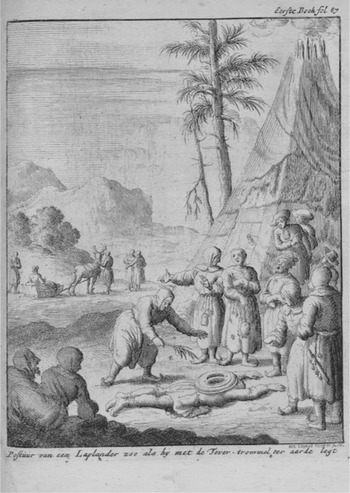
A Sámi noaidi in a trance, taken from the works of Schefferus in the Dutch edition of the history of Lapland published in 1682, titled Waarachtige en Aen-merkens-waardige Historie van Lapland (A True and Noteworthy History of Lapland). The caption depicts the ritual posture of a Sámi noaidi lying in an ecstatic trance during a religious séance, surrounded by singers who are joiking (singing) and thereby protecting and helping him.

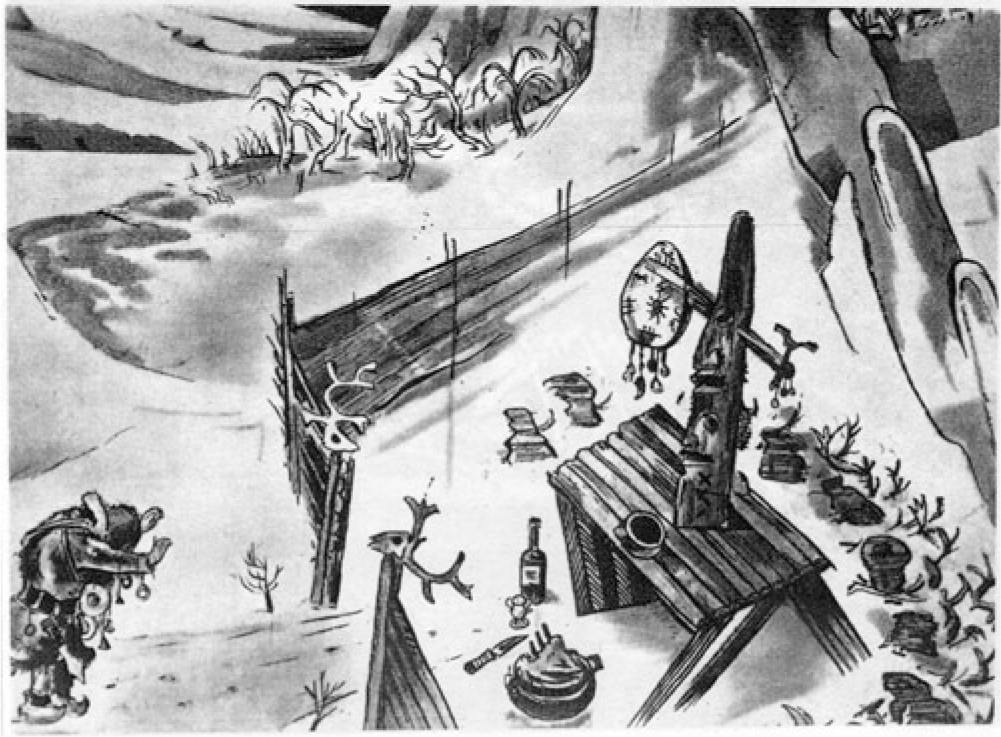
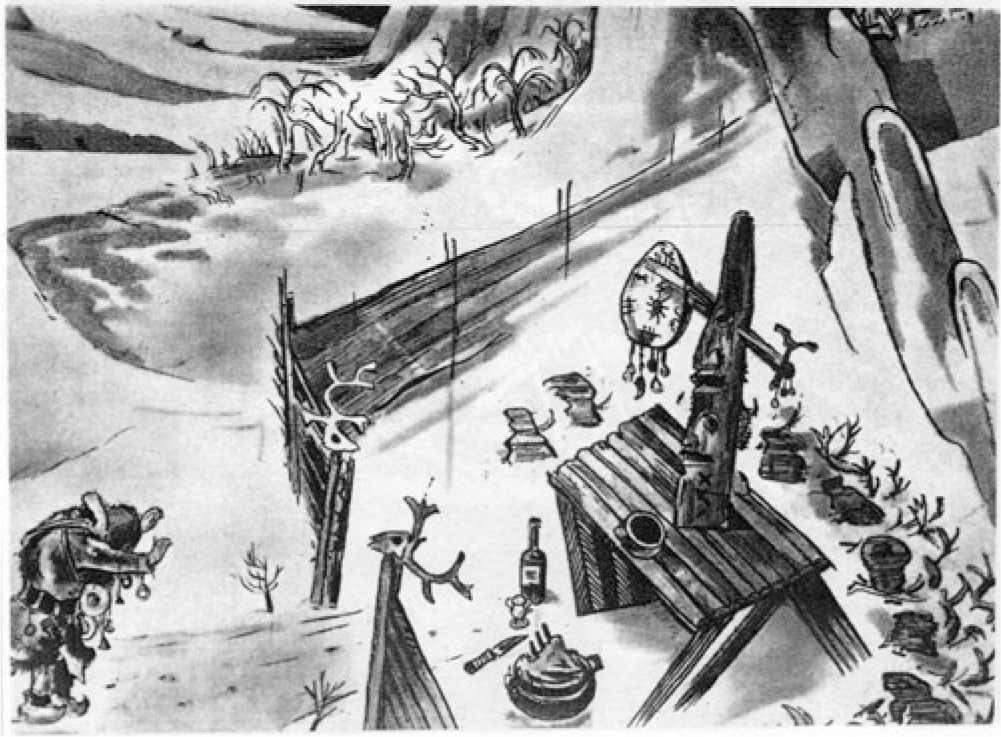
The ritualistic nature of sacrificial acts related to the use of the drum by the noaidi, showing a painted drum hanging above a man-made wooden sieidi, as a way to charge it with power. Note the offerings of food, drink and a knife, as well as the semicircle formed by reindeer antlers and small sieidi-stones surrounding the sacrificial platform. Part of a large watercolour by the Swedish artist and ethnographer Ossian Elgström (1883–1950), illustrating the different stages of a Saami bear-feast.
A presentation of the drums and their history
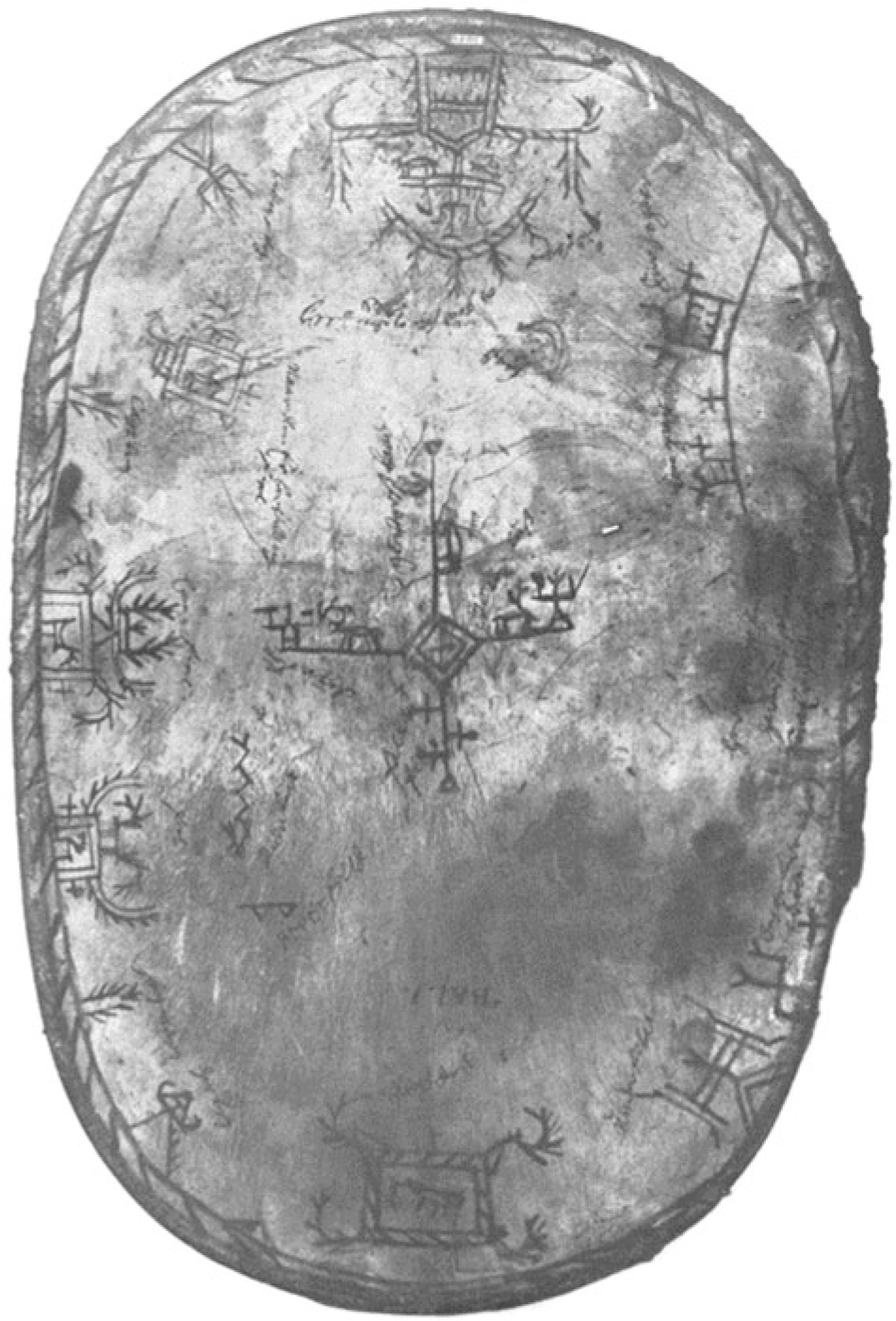
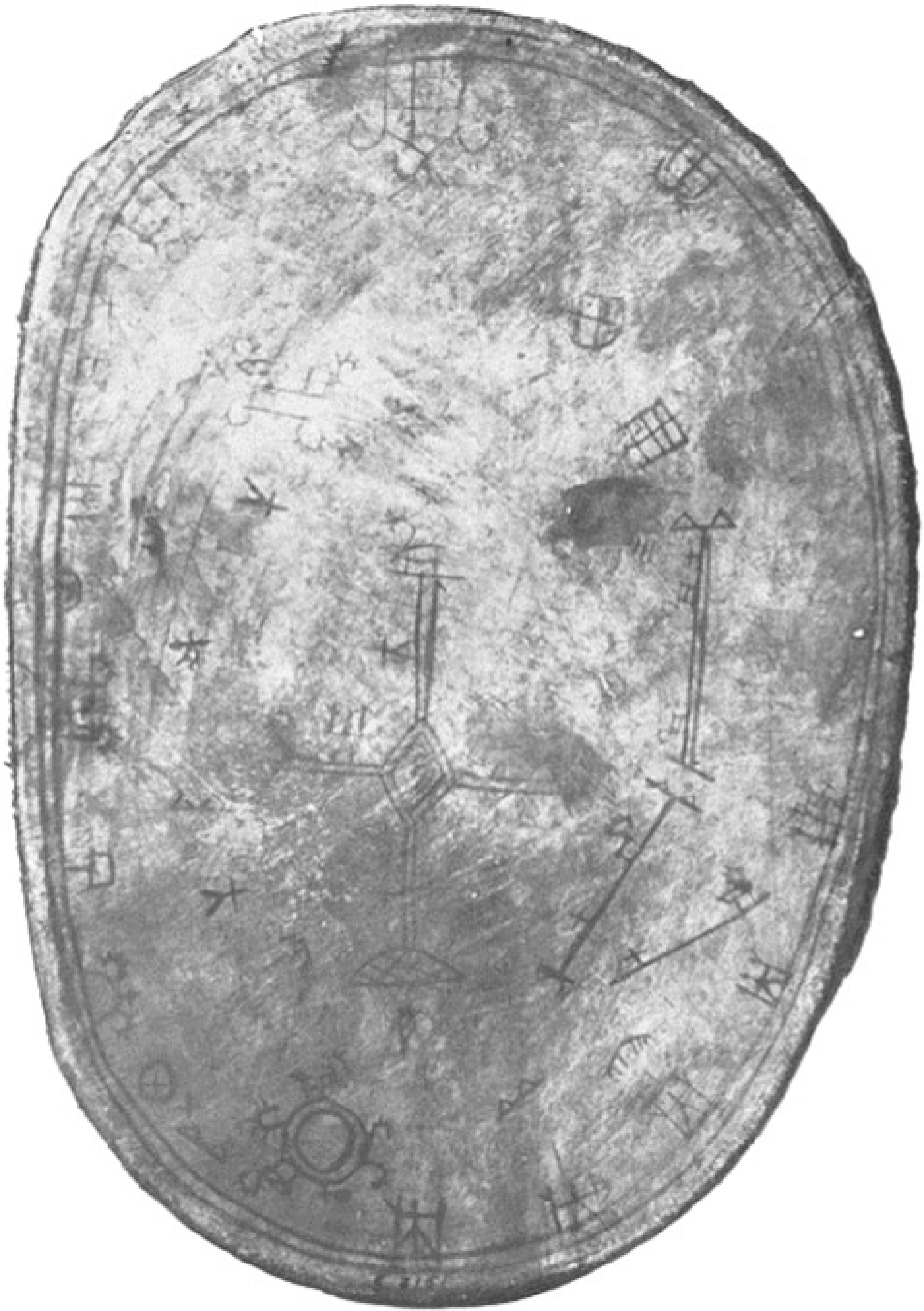
Front view of drum number 39. Around the edges of the drum are intricate networks portraying holy sacrificial places (sieidi) and spirits of the earth or middle world.

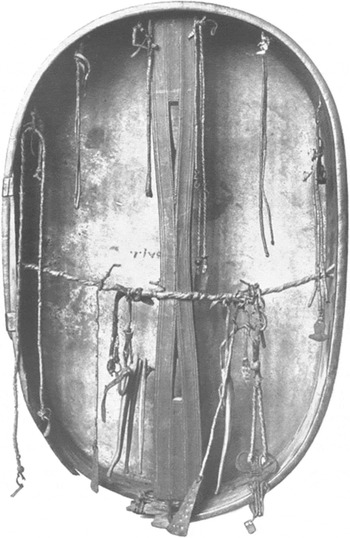
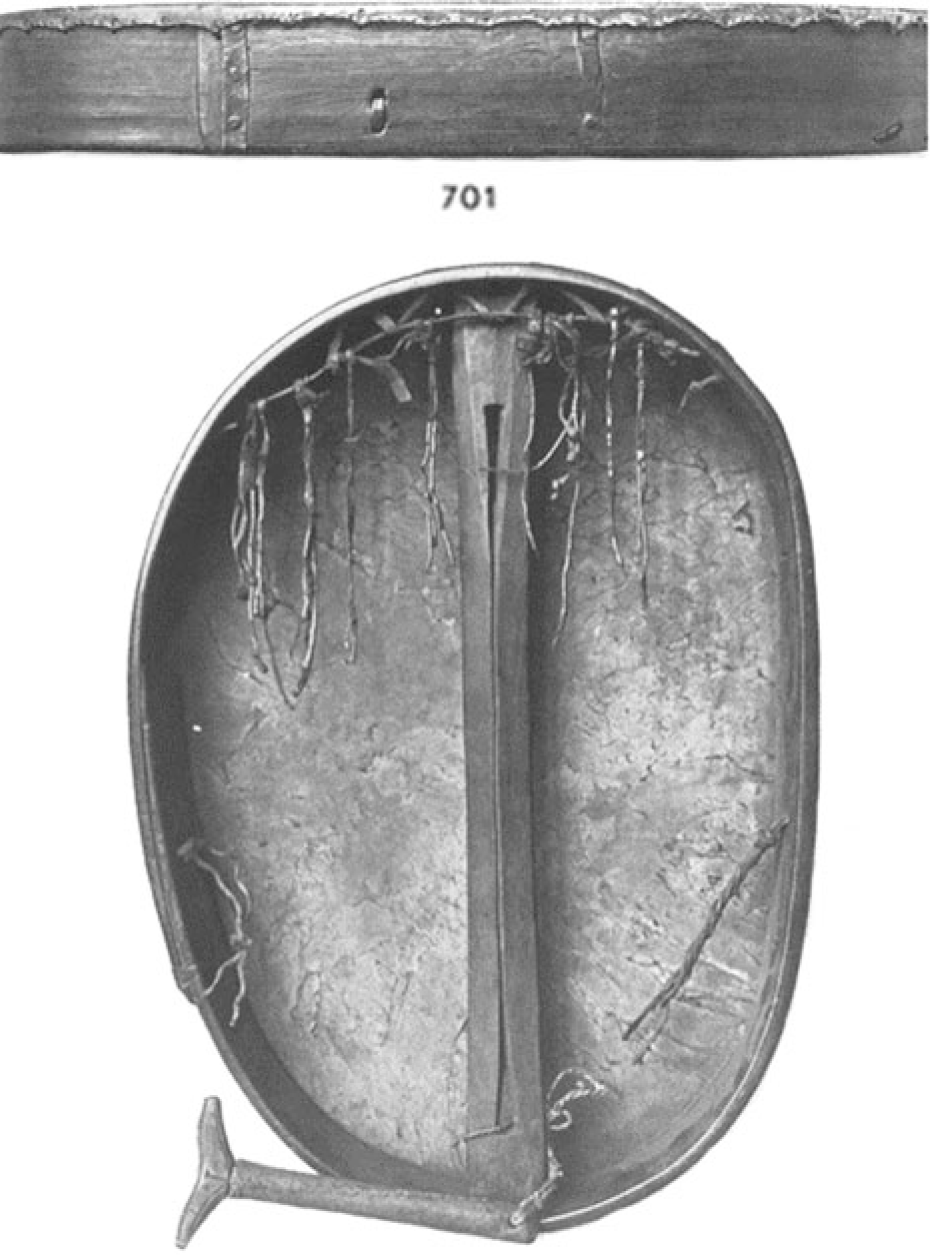
Rear view of drum number 39, depicting amulets and charms known as objects of power.

Manker (Reference Manker1938, p. 657) recorded the following details of the histories of the two drums sent to Paris: ‘Drum number 39 was exchanged from the Nordiska Museet in Stockholm to the National Museum in Copenhagen. It has been the property of Jon Anderson from Raan, Lycksele, Sweden. The drum was sent to Copenhagen by Thomas Von Westen (who was one of the missionaries that figured prominently because of his involvement in the conversion of the Sámi from their pre-Christian traditions to Christianity). He also sent 100 other drums there in 1723, which were destroyed in a fire.’ According to Manker, the drum was sent to Paris in 1849, as a donation from the National Museum in Copenhagen, Denmark. (Translated from German to English by Salla-Mari Koistinen)
Drum number 27.

Drum number 27, presented in the works of Manker (Reference Manker1938, p. 581), who recorded details of both its history and ownership.

According to Manker (Reference Manker1938, p. 657), ‘the catalogue number of the drum in Paris is 10181, and it was sent from the Nordiska Museet, Stockholm in 1912. The drum belonged to a collection acquired by the College of Antiquities, Sweden in 1726.’ (Translated from German to English by Salla-Mari Koistinen)
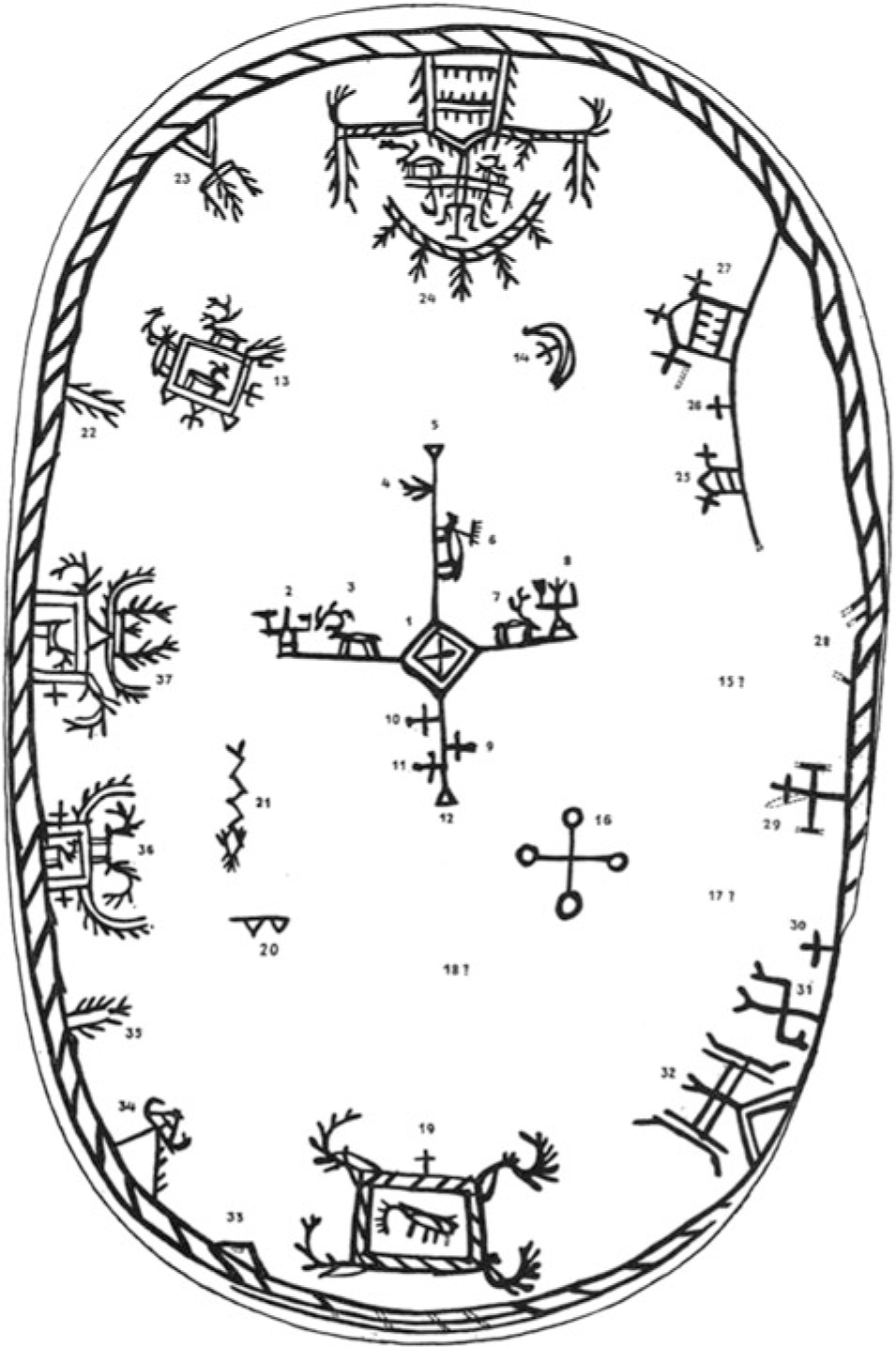
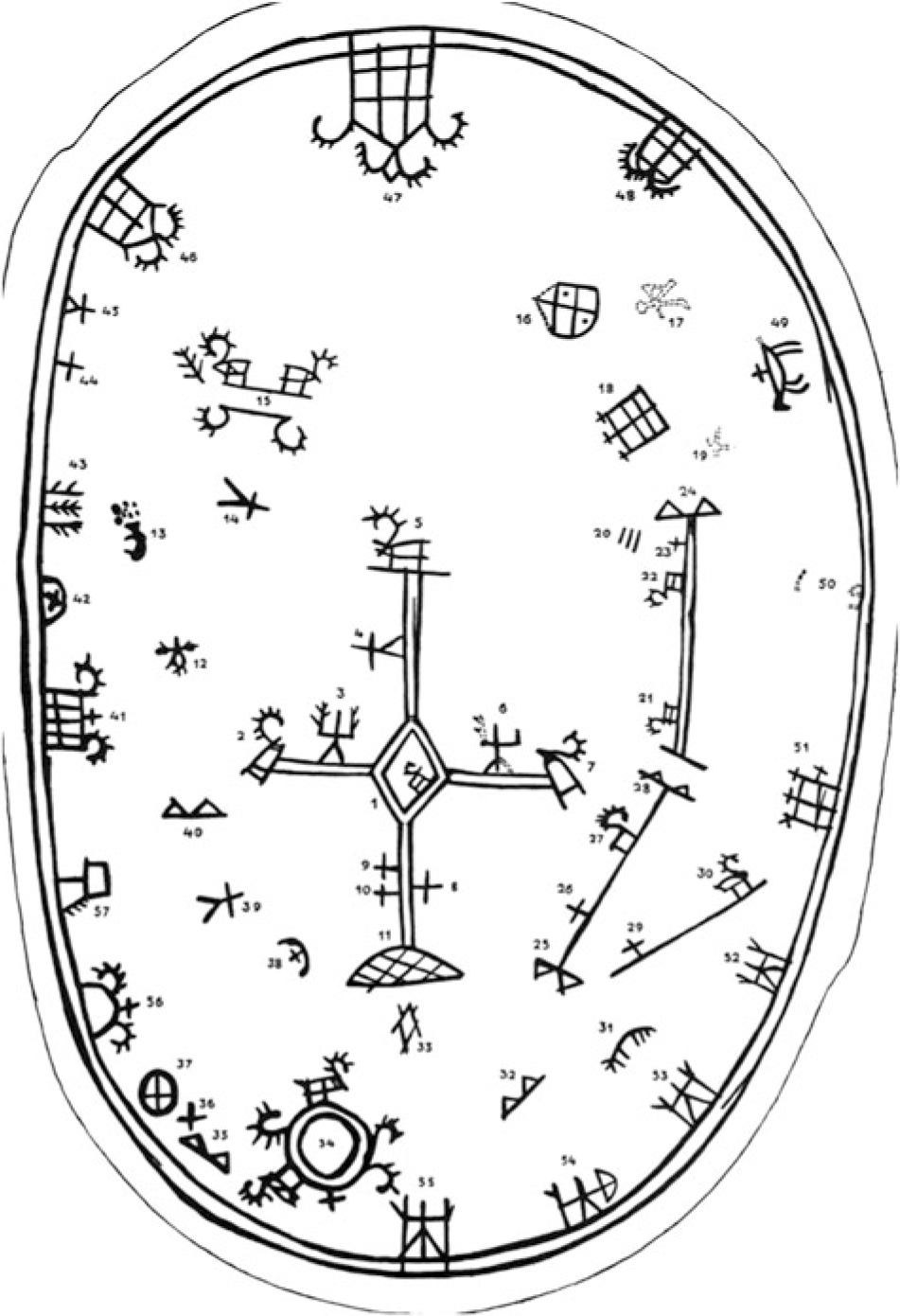
The cosmological landscape on drum 27 is akin to that of drum 39, presented in Fig. 3, with the rhomb symbol in the centre of the drum and the four rays of the sun as a pillar, extending outwards. Furthermore, painted on drum 27, the symbol of a drum is also evident, illustrated as a circle with a cross in the middle on the bottom left side, as well as a boat motif on the bottom right side. The rear of the drum also exhibits an identical handle to that seen on drum 39, thus confirming it is of the Åsele type, from Swedish Sápmi. In addition, the remains of pieces of intertwined reindeer skin (sisti), to which charms, amulets and objects used for divination would have been hung, are also evident. Drum 27 has also retained a ‘Y’ shaped hammer made from reindeer antler, used for playing the drum,.
Illustration of drum number 39, by Ernst Manker (Reference Manker1950, p. 341).
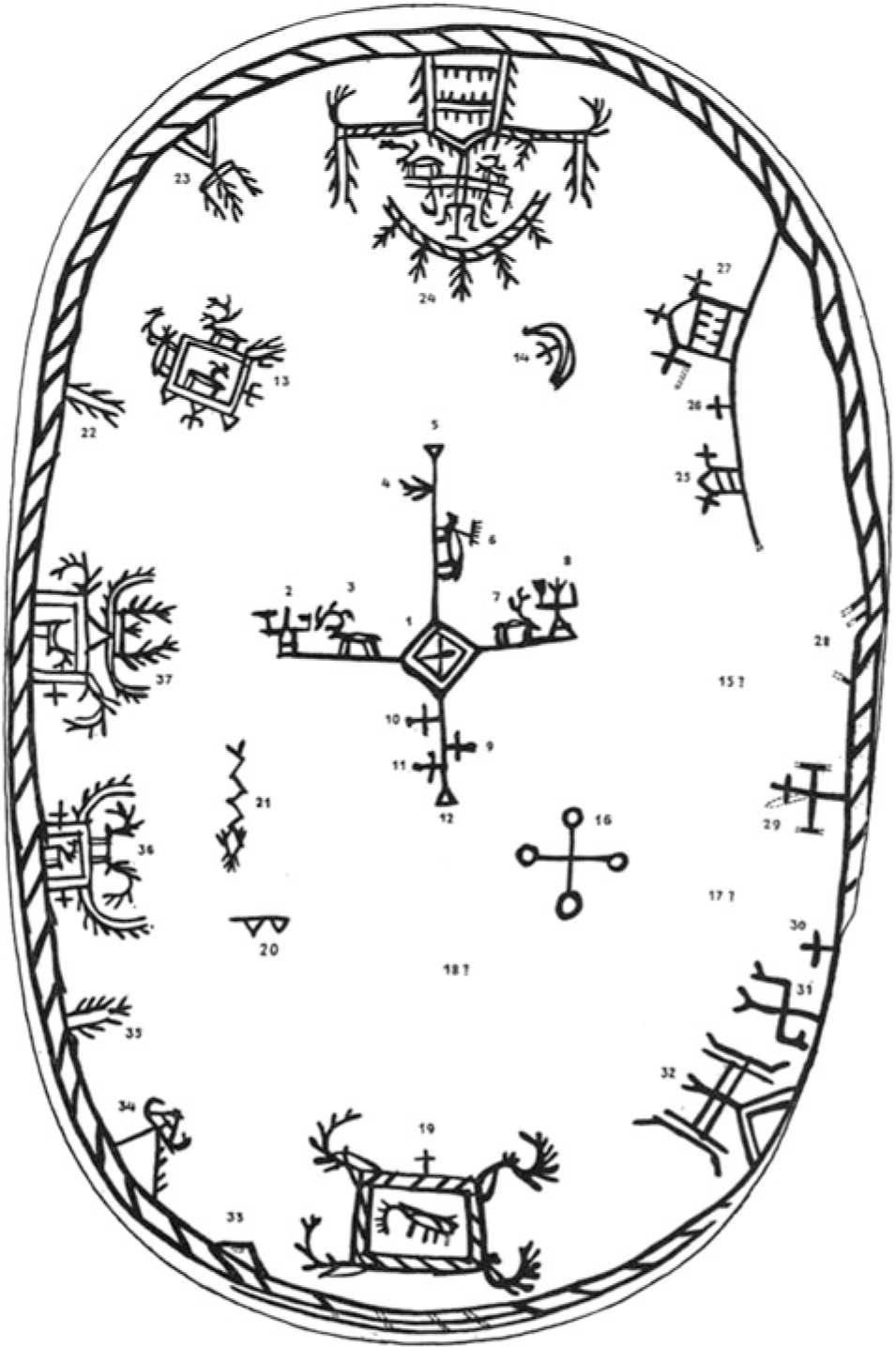
Illustration of drum number 27, by Ernst Manker (Reference Manker1950, p. 299).

Correspondence with museums in France regarding the two sacred Sámi drums sent to Paris
Prior to the event in Paris taking place and before the discovery of the loss of drum number 39, I had consulted with Liisa Holmberg and Sámi historian Veli-Pekka Lehtola about the idea of asking whoever had the drums in their archives if one of them could be displayed for a weekend at the event, as it would give both value and meaning to the Sámi and the overall event. Liisa Holmberg thought such a possibility would help further support the weekend event.
On 26 October 2016, I contacted the Musée de I’Homme in Paris to ask how they would feel about such a suggestion. I did not receive a reply until 11 November, when the following information was relayed by email from Lola Tregeur, who is the acting director of the museum. ‘I’m so sorry to reply so late. […] I had a doubt about the two Sámi shaman divination drums from the seventeenth century so I had to ask for it to be checked out but they are not in our collections’ (Lola Tregeur, personal communication). I responded, enquiring about the whereabouts of the drums but received no response to my message. I telephoned the institution on 4 February 2017 to seek further information on the matter. I also contacted one of my French colleagues, Dr Stéphanie Lefrére, who lives in Rovaniemi, Finland, but who studied ethnozoology of reindeer within the Department of Ethnobiology at the National Museum of Natural History in Paris between 1999 and 2003 (Stéphanie Lefrére, personal communication). I asked Dr Lefrére if she could contact the museum on my behalf as a means of further establishing the whereabouts of the drums.
On 15 February, Dr Lefrére wrote via email to the museum seeking further information concerning the drums. The same day, correspondence was received from a member of staff at the museum called Michel Guiraud, who informed us of the following points. ‘The collections of European ethnology are today deposited at the MuCEM. I think that it is best to contact Mrs Émilie Girard, who will be in a position to inform you’ (Michel Guiraud, personal communication). (Translated from French to English by Stéphanie Lefrére)
Following up on the direction provided by Michel Guiraud, I then wrote to Émilie Girard in Marseille, who replied that ‘at the MuCEM we keep a single drum, the one sent in 1912, and which I attach to this message. The drum is kept within the Conservation and Resource Centre and is not currently exhibited. I am not aware of the one sent in […] [1849] and admit not to have any idea where it could be, because the museum of ethnography of Trocadero, ancestor of the Museum of Man, did not exist during this time. By querying the Quai Branly Museum online database with the words ‘drum laponie’, you will see photos of the drum. I do not know if it is the one we keep and/or another. The Musée du Quai Branly preserves all the photographic documentation of the collections of the Musée de l’Homme, including that of the collections that are deposited with us’ (Emilie Girard, personal communication). (Translated from French to English by Stéphanie Lefrére)
After receiving the information from Ms Girard, I then wrote to the Quai Branly Museum in Paris to ask if they had information regarding the whereabouts of the missing drum. Ms Sarah Ligner, Heritage Curator and Head of Heritage Unit, Historical and Contemporary Globalization, responded by email in English on 1 March 2017, stating that ‘…the two drums were part of the collection of the Musée d’ethnographie du Trocadéro, which became in 1938 the Musée de I’Homme. At the creation of the Quai Branly Museum, the European ethnographic collection of the Musée de I’Homme came to the Quai Branly. But the European ethnographic collection of the Musée de l’Homme was transferred to the Musée des Civilisations de l’Europe et de la Méditerranée, created in Marseille in 2013, with the collection of the ancient national museum of the popular arts and traditions in Paris. So the two drums have probably been sent to the MuCEM, as you mentioned to me this morning. My colleague explains it below. For further information, you can ask Marie-Charlotte Calafat at the MuCEM’ (Sarah Ligner, personal communication).
Following Sarah Ligner’s direction, I then contacted the Museum of European and Mediterranean Civilizations in Marseille by telephone, and asked for a photograph of the 1912 drum for my presentation at the Quai Branly Museum. I received the following response in English on 1 March from documentarist Clair Dufour, who is responsible for the collection of the still images at the Department of Collections and Documentary Resources at the museum.
‘We regret to inform you that we only have one Sami drum in our collections. You will find attached a document from our database (unfortunately in French) about this drum. […] You will also find hereby attached this e-mail from Émilie Girard, an administrative form to complete in order to send you the photographs you need for your conference and a copy of the cover and the page from the catalog book Trésors du quotidien featuring this very same drum (‘Trésors du quotidien’ was an exhibition issued at the MuCEM in 2007. The book reference is Denis-Michel Boëll, Trésors du quotidien, RMN, 2007, Paris, 162p.). I will send you the photographs as soon as I receive the administration form’ (Clair Dufour, personal communication).
On 2 March, I wrote to Sarah Ligner by email, forwarding the above message from Clair Dufour. I received the following response: ‘Yes, the second remains a mystery for the moment. You should ask the MuCEM for further research because this object comes under its collection. The European ethnographic collection of the Musée de I’Homme is now on the inventory of the MuCEM’ (Sarah Ligner, personal communication).
After my return from Paris, I wrote again to the MuCEM as directed by Sarah Ligner, and received the following response from Emilie Girard on 20 March 2017: ‘…Here are the details I have about those drums. The drum we keep has been moved from the Musée de l’Homme to the MuCEM (first in Paris) in 2005. Only one drum has been moved, the other was declared lost by the Musée de l’Homme, but I do not know the exact date of this disappearance. In 2012, the moving to Marseille began and the remaining drum was transferred in our storage’ (Emilie Girard, personal communication).
Other links between Sámi shamanism and the Kingdom of France
In addition to the two drums from Swedish Sápmi that were sent to Paris, other links between Sámi religion, culture and interactions with France are also evident in historical materials and discourses from the seventeenth century onwards, which have been compiled by scholars Johannes Schefferus and Lars-Levi Laestadius. Written sources contain information about the history of the Sámi with regard to missionising, clergymen, and persecution of the Sámi for practising their pre-Christian religion.
My assessment of the works of both Schefferus and Laestadius leads me to believe that such was the interest among the French monarchy in the seventeenth century in the use and decoration of noaidi drums that knowledge and artistic portraits regarding Sámi pre-Christian religion were highly sought after at the time. This prized information, which has been influenced by earlier works from the sixteenth century, particularly that of French scholar Jean Bodin and Swedish writer Olaus Magnus, was well known through literature sources from Sweden and France, and therefore had been circulated within French royal circles.
Perhaps the essence of what interested the French in the pre-Christian religion of the Sámi people and use of the sacred drums comes from Norwegian scholar of religion Rune Blix Hagen (Reference Hagen and Golden2006, pp. 625–626), concerning how the Sámi were known to be skilled in wind magic: ‘The Lapland witches and the knotted winds had already become somewhat notorious by then (1591) because authors like Olaus Magnus and Jean Bodin had already told Europe that the Sámi were immensely dangerous magicians and sorcerers. The conjuring of the Lapland witches was so great that people believed they could use sorcery instead of weapons while in combat with their enemies. Rumours indicating that the Swedes used techniques of Sámi sorcery in warfare dogged Swedish military forces throughout the seventeenth century. When they won several significant battles and advanced deep into German territory during the Thirty Years’ War, it was insinuated that their success was due to sorcery by Sámi troops assisting them.’
It seems evident to me that ambiguous reports about the Sámi using witchcraft on the battlefield animated both the decoration and use of the sacred Sámi drums by noaidi, and therefore the works of Johannes Schefferus describing how such practices were undertaken were of much interest to the French. It is also important to acknowledge how in Schefferus’s original Latin edition published in 1673, the volume contained illustrations of the only two remaining sacred Sámi drums from what was then the Kemi Lappmark area in northern Finland.
The construction, design and decoration of each of the drums in the Latin edition made a strong impression on the French monarchy, in addition to what had been written earlier by Bodin and Magnus. The kind of fascination exhibited towards the magical arts of noaidi by the French Crown prior to and from the beginning of the seventeenth century can be seen in the way a French translation of The History of Lapland by Johannes Schefferus was subsequently published in Paris at Chez la Veuve by Olivier de Varennes, the widow of Oliver de Varennes, in 1678. The title of the edition was Histoire de la Laponie (the History of Lapland). In the French translation of Schefferus’s works, illustrations of the two sacred drums and their cosmological landscapes, belonging to the Sámi from the Kemi Lappmark area in Finland, were included.
According to what is written in the beginning of the book in terms of the value of the published material, ‘the King of France at the time Louis XIV made strict copyright laws declaring that there were to be no other publications made from the original for a period of ten years, and if any person was found to have produced a copy of the book unlawfully, the penalty was a 3,000 livre-pounds fine and confiscation of all material related to the book’ (Schefferus, Reference Schefferus1678). (Translated from French to English by Pascal Cotroux)
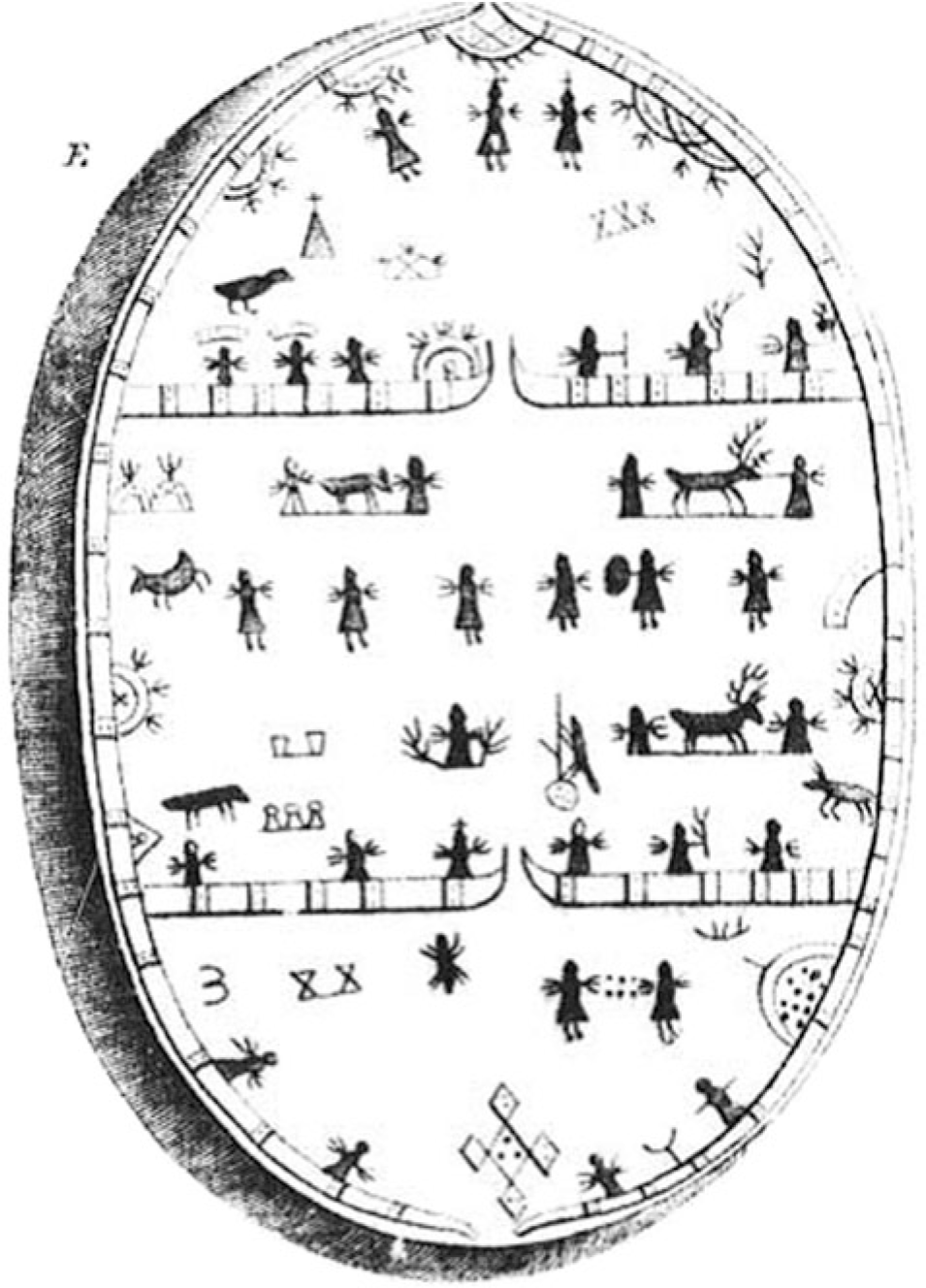
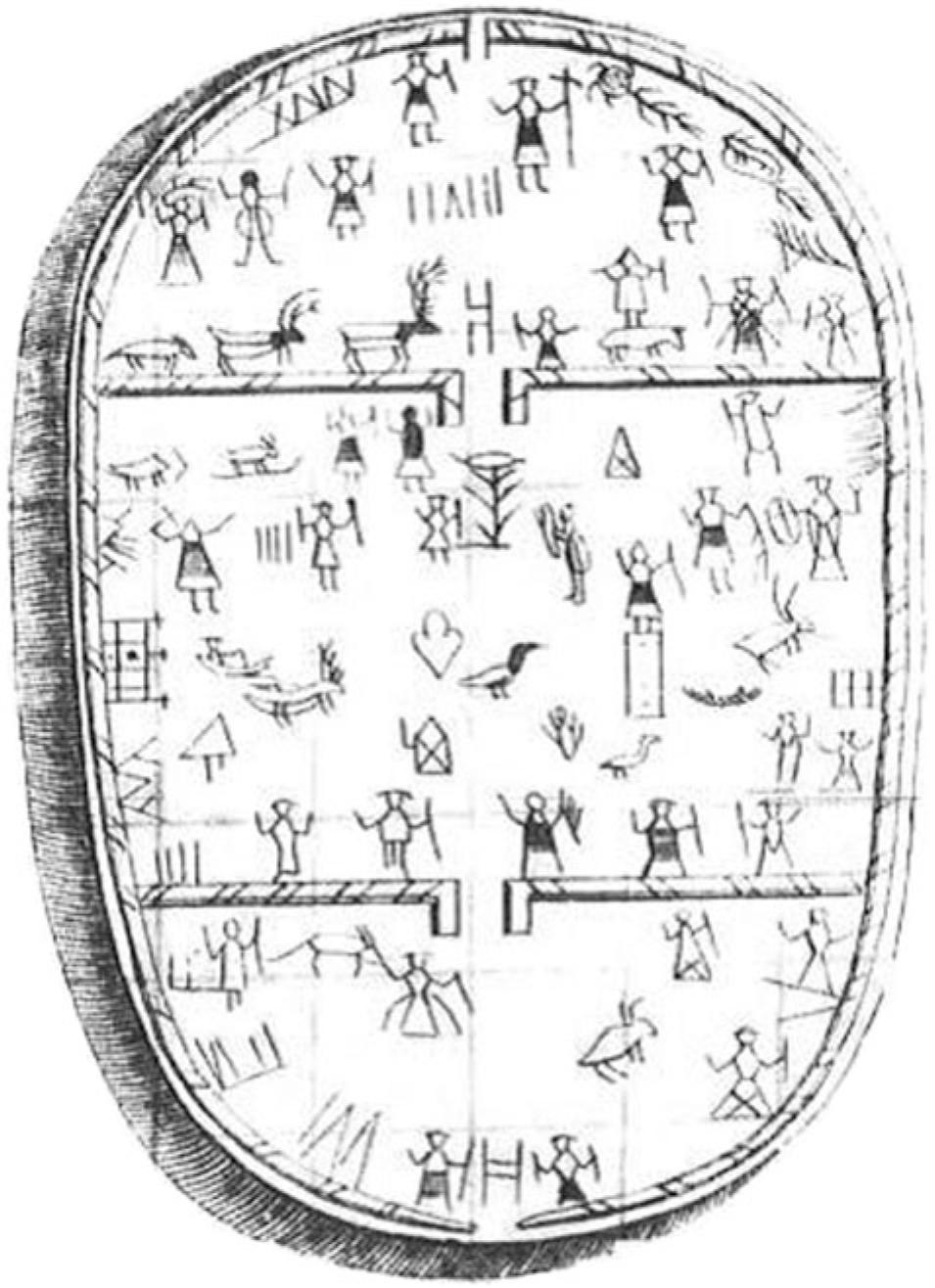
Illustration of one of the two remaining Kemi Sámi drums (Schefferus, Reference Schefferus1678), showing the Sámi cosmos divided into three levels or layers. This is not a true portrait but is reversed due to the ways the text and images were printed.
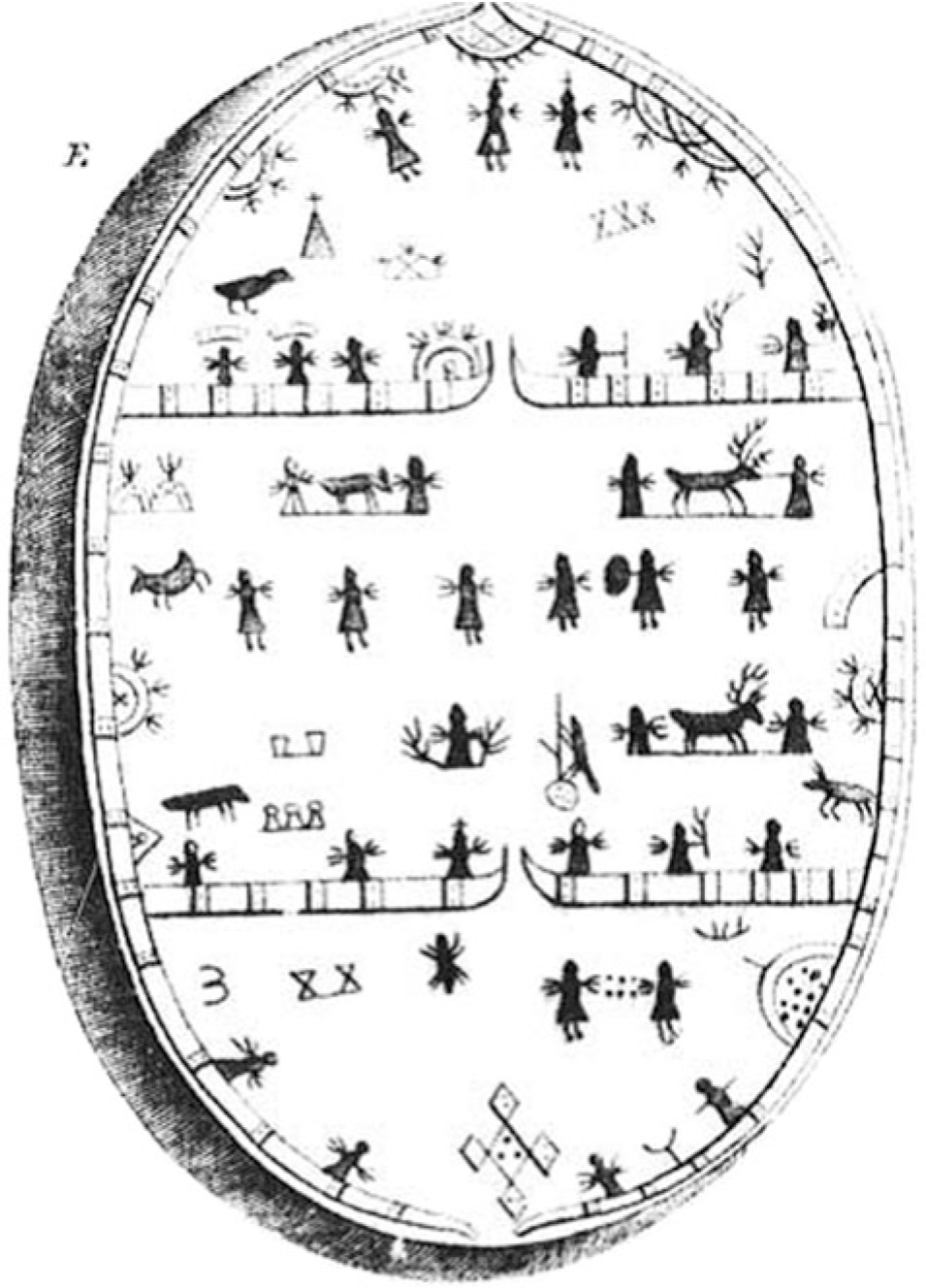
Illustration of one of the two remaining Kemi Sámi drums (Schefferus, Reference Schefferus1678), showing the Sámi cosmos divided into three levels or layers. This is not a true portrait but is reversed due to the ways the text and images were printed.

In Ernst Manker’s inventory of the surviving drums from the seventeenth and eighteenth centuries (1938), these are catalogued as 43 and 44. ‘Drum 43 was received by Schefferus from Magnus Gabriel de la Gardie, ‘the Chancellor of the Kingdom of Sweden’ (Schefferus, Reference Schefferus1674, p. 49). ‘Drum 44 is documented to have been received by Schefferus from Henrici Flemming, who was an officer in the Finnish cavalry’ (Manker, Reference Manker1938, p. 32). (Translated from German to English by Kristiina Nayho at the Finnish Literature Society). In Schefferus’s Reference Schefferus1673 Latin publication, the letters E and F identify the drums.
In terms of Sámi cultural heritage and property, it is important to note that the Sámi own neither of the two drums mentioned above. The larger of the two drums (Fig. 9) is currently exhibited at the Sámi museum Siida in Inari, but belongs to the National Museum of Antiquities in Sweden. The drum is on long-term loan to Siida. The second drum (Fig. 10) is currently the property of Museum für Völkerkunde zu Leipzig (Leipzig Museum of Ethnography), Germany, and is part of the collection of the Grassi Museum.
The history of these two drums can be viewed as being similar to that of the two drums sent to Paris, in terms of private ownership and a loss of legacy and right to culture. However, what makes the scope and focus of the case of the Sámi drums from Finland the focus for many studies is that these two drums are the only ones known to have survived from the Kemi Lappmark area, whereas the majority of the surviving drums in museums throughout Europe are from Swedish Sápmi.
These ‘segmental types’ pictured above from works of Schefferus are considered to be the oldest style with regard to the cosmological landscapes portrayed by the noaidi in Kemi Lappmark in relation to such drum designs. In terms of the loss of culture and heritage, as described by Pulkkinen, it is important to acknowledge how the Finnish clergyman Gabriel Tuderus, working throughout the Kemi Lappmark areas of Sápmi in Finland, converted the Kemi Sámi to Christianity. ‘As a result of Tuderus’ missionary work, the Kemi Saami renounced practices connected with their ethnic cosmology, including the use of the shaman’s drum…[In addition] in an intensive pastoral inspection that was carried out throughout the kingdom in the years 1686–89 not a single shaman’s drum was found in Kemi Lappmark’ (Pulkkinen, 2005, p. 418).
As a further method for broadening the field of study and thus continuing this discussion concerning literature sources that both describe and provide additional important links between the Sámi, their pre-Christian religion, drum usage, cultural history and the French, the focal point is now placed on a manuscript published as a book titled Fragments of Lappish Mythology (2002), edited by Juha Pentikäinen. However, it should be noted that an earlier publication of the works of Laestadius, called Katkelmia Lappalaisten Mythologiasta, [Excerpts from Lapp Mythology] was originally translated into Finnish by Sámi scholar and theologian Nilla Outakoski.
Pentikäinen’s publication contains extensive details of elements of the old worldview of the Sámi from prehistory up until the 1830s, as well as extracts taken from missionary sources from the seventeenth and eighteenth centuries. These sources pay special attention to the many dimensions of Sámi cosmology, the importance drums had as agencies of the sacred, and how the decorative artwork painted on them functioned in relation to reverence to supernatural powers and other worldly communication with ancestors within the scope of Sámi religion. In addition, Laestadius also writes about the clergyman Gabriel Tunderus working in Kemi Lappmark, Finland, converting the Kemi Sámi to Christianity.
In the introductory chapter, the book describes events concerning how Lars Levi Laestadius, who was invited by the French monarchy to take part in an expedition called La Rochelle (Pentikäinen, 2002, p. 9) travelled with the French admiralty during 1838–1840 (Pentikäinen, 2002, p. 9). During this period, Laestadius compiled a manuscript in Swedish about Sámi traditions and customs in relation to Sámi mythology and religious practices.
According to Pentikäinen (2002, p. 10), ‘Laestadius had served as a guide for the…Expedition across the tundra from Kåfjord to Karesuando, where he wrote his entire mythology in a small hut’, which was left unfinished. From Pentikäinen’s 2002 publication, translator Börje Vähämäki (Reference Vähämäki and Pentikäinen2002, p. 12) explains the following points. ‘One reason Laestadius did not put the finishing touches to the manuscript is the fact that it was originally to be translated into French and published in France. Laestadius apparently left it to the translator to edit and provide stylistic unity to the manuscript, or perchance he expected to work with the translator in the final polishing.’
As a method for further clarifying the links between Laestadius and the Kingdom of France in terms of the value of literature sources pertaining to the Sámi and their pre-Christian religion, I contacted Risto Pulkkinen, an associate professor of religious studies at the University of Helsinki. The purpose for my correspondence was to try to establish any additional information about the manuscript’s journey from Sweden to France and to ask Pulkkinen if he could provide me with clarification as to why Laestadius’s manuscript was not published after he had written it. Pulkkinen had ‘…translated the book from its original Swedish in to Finnish and assisted in the English language edition with the photographs and bibliography’ (Pentikäinen, 2002, p. 10).
These questions were important because it seems there was information in the Finnish edition in relation to the story behind the manuscript that was not explained fully in the English edition. Therefore, what follows below is what Pulkkinen had to say on the matter in this translation of part of the text by him, from Finnish to English.
‘The whole story is told – in Finnish – in my and Juha’s book LLL [Lars Levi Laestadius] – yksi mies, seitsemän elämää [one man, seven lives] (Pentikäinen – Pulkkinen, Kirjapaja 2011, Helsinki) and as a reference you can put pages 100–106’ (Risto Pulkkinen, personal communication).
[The story then continues] ‘Laestadius’ manuscript was sent to France via professor in botanics Carl Jacob Sundsvall. Part 1 ended up…[with] Xavier Marmier and the parts 2 to 4 (plus comments on Fellman’s manuscript) to Joseph Paul Gaimard. Part 1 was kept after Marmier’s death in the town library of Pontalier, where they were found by the Finnish librarian Eero K. Neuvonen in 1933. Parts 2 to 4 were sold after Gaimard’s death but were by accident found in Yale University library (Sic!) in USA, in 1946. After that the manuscript was first partly (“relevant parts”) published by the Swede Harald Grundström. First complete Finnish (not critical) version came out by Nilla Outakoski in 1995. Complete (as was known then). [The] Swedish original version was published by Juha Pentikäinen in 1997. A critical and scientific Finnish translation was made by me and published by Juha [Pentikäinen] in 2000. English version (on the basis of the former) by Börje Vähämäki in Canada, in 2002. The reason why the manuscript was not published in the 1840s was the fact that the whole project was based on the initiative of King Louis Philippe. Along with the revolution in 1848 the project was dropped. Even though the manuscript was lost, the existence of it was widely known, e.g. because it had been mentioned, commented on and partly loaned by the Norwegian scholar J.A. Friis, Finnish [scholar] Jacob Fellman and the Hungarian [scholar] Antál Reguly – who all had been permitted to read the text. Lars Levi Laestadius himself did not ask after the manuscript simply because he lost interest in it due to the religious conversion that took place in the middle of the 1840s. But – c. 30 pages of the 1st part were still missing and unpublished. The manuscript clearly was unfinished when it comes to part 1. The missing pages were finally found from Pontalier first time by the Norwegian scholar Per Posti in 2001, and published by him in 2003 in Norway – and second time by Juha Pentikäinen and Osmo Pekonen in 2009. The complete Finnish translation with the missing pages was finally published by me and Juha [Pentikäinen] in 2011’ (Risto Pulkkinen, personal communication).
The English edition of Fragments of Lappish Mythology contains within the publication three main chapters about Sámi cosmology and shamanism, titled the Doctrine of Deities, Doctrine of Sacrifice and Doctrine of Divination. There is also a chapter titled Selection of Lappish Tales.
The contributions to the study of Sámi culture and shamanism by Schefferus in his work Lapponia, which was translated into French, in addition to what French scholar Bodin had written about the Sámi noaidi in combat on the battlefields during the sixteenth century, to me suggests just how strong the military and political ties between the Kingdom of Sweden and France were, and may provide insight into why the French wanted to keep hold of the drums in their museums. One could argue that it has been the textual sources concerning the sacred drums of the Sámi and their pre-Christian worldview, compiled through missionising by the priests of the northern districts, which supplied Schefferus with information about the Sámi and their religious practices, which in turn generated a broader interest in the culture. The works of Laestadius also reflect a similar view.
Taking into account the historic contributions from Schefferus, Laestadius, and more recently from Pentikäinen in relation to the discovery of the manuscript in Paris, it is possible to determine the following points. My correspondence with the museums in France in 2017 has brought into focus some of the long historical processes regarding the handling and representation of Sámi pre-Christian religion and cultural heritage, in which the Sámi have not been involved. Instead, these events have been orchestrated by outsiders, highlighting a troubling point concerning sovereignty and the rights of the Sámi people to their culture. I would argue that these acts have a deep root in colonialism.
The story of the drums belonging to the Sámi echo in a broader sense the plight of other indigenous peoples regarding appropriation and loss of heritage. The example presented here illustrates what can happen when outside institutions trade and barter the cultural heritage and property of a minority population, thus compounding forced migration of sacred relics and adding, in this case, to assimilation and subsequent loss of Sámi culture by representatives of the imperial powers.
Results of the study
The investigation of the missing sacred Sámi drum from Swedish Sápmi (Figs 3 & 5) has demonstrated that the museum’s policies for protection and conservation of Sámi cultural heritage have failed significantly. The consequences for the Sámi can be seen in terms of the loss of customs, beliefs, understanding of ancient structures pertaining to their pre-Christian cosmology, and language surrounding use of the drum, its decoration and preservation. In turn, this loss impacts the history, legacy, cultural memory and traditional knowledge of the Sámi, in addition to how their future generations have been denied both inheritance and heritage. As a further consequence of this loss, the Sámi will have to rely on photographs of their lost heritage for identification purposes instead of being given access to the drum as a primary source of their culture and its history.
Given the results of the research, the evidence needs to be published and shared with all Sámi institutions, especially the Ájjte museum in Jokkmokk, Sweden as well as the Nordiska Museum in Stockholm, which has custody of 34 drums (Edbom, Reference Edbom2005; Silvén, Reference Silvén, Poulot, María, Guiral and Bodenstein2012, p. 179).
Bearing in mind what the nation states of Norway, Denmark, Sweden and Finland have previously sought to achieve with regard to the destruction of Sámi identity, cultural memory, shamanistic traditions, spiritual culture and worldview, the disappearance of the sacred drum reveals how critically important the surviving sacred drums in the custody of museums throughout Europe are, in terms of their preservation. Therefore, this loss of the sacred drum presents an opportunity for institutions to recalculate and recognise in what ways the drums they have in their archives are valued because of their links with pre-Christian origins, and illuminates their uniqueness regarding the oral history of the Sámi and their ancestors in terms of their irreplaceable nature and historical importance and significance.
From an ethical viewpoint, the lack of care exhibited towards the exiled drums from Sápmi can be seen as irresponsible actions that reflect further acts of destruction committed against the Sámi and their culture in modern times. Thus, the missing drum highlights the immediate need to better respect, protect and care for the remaining drums instead of them being hidden away in museums throughout Europe for political reasons. In light of the disappearance of drum number 39, there is a question as to whether or not the safety of the remaining drum number 27 in Marseille can be guaranteed. The exiled drums stored in museums come from a dark period in Sámi history, and therefore should be recognised for their outstanding cultural and historical value and importance for Sámi people, who consider them and their symbolism to be amongst the treasures of their culture.
Concluding remarks
Despite writing to the Musée de I’Homme in Paris and the Museum of European and Mediterranean Civilizations in Marseille, and making numerous telephone calls to each establishment concerning the whereabouts of the missing drum, after one year I have not received any response. Therefore, the declaration of the drum being lost has led me to question whether or not the artefact may have been stolen at some point in the past. On the other hand, it could be the case that the drum is missing, somewhere in the museum’s extensive archives. My basis for the theory of the drum being stolen is that nothing was said about it earlier by the museums, and the Sámi did not know anything about it previously. It also raises the question as to whether or not other Sámi artefacts have also been lost.
Whilst at the Quai Branly Museum in Paris during 4–5 March 2017, I observed perhaps as many as several hundred different types of drums belonging to indigenous peoples from around the world, stored in a large, dark glass display cabinet in the lower level of the building. The ones on the highest shelves could not be seen clearly because of the lack of light and height of the shelves, which were approximately 2 m from the floor level. A question came to my mind concerning what kind of benefits museums gain from having these artefacts locked away in such places, and by contrast, what benefit such items would have if they were returned to their places of origin for the purposes of restoring identity, tradition and empowering minority people such as the Sámi.
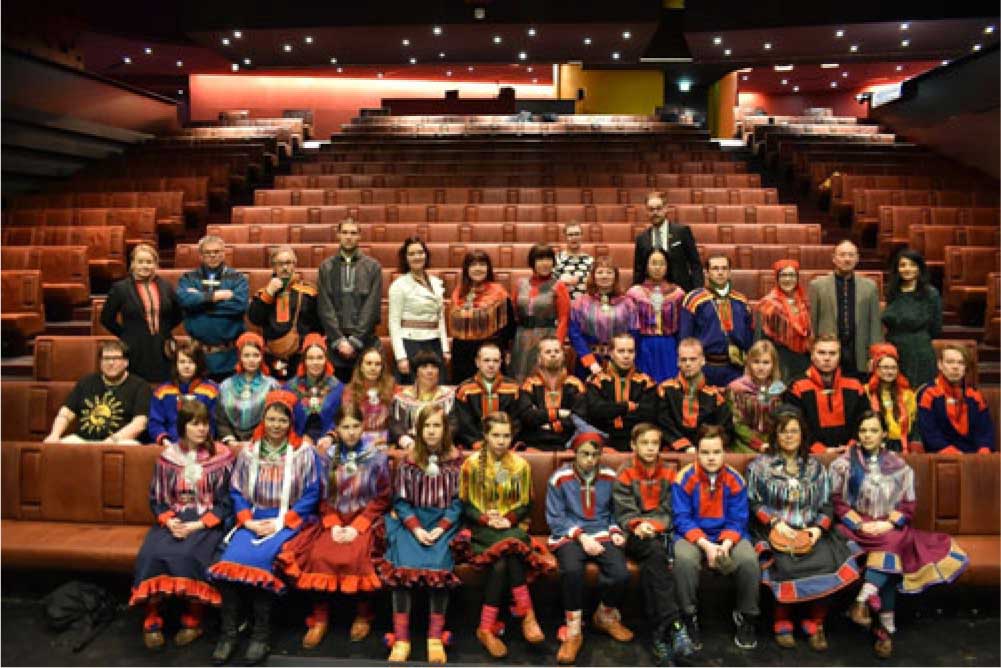
The author pictured with the group of Sámi and non-Sámi participants, organisers, musicians, artists, performers and contributors at the Musée du Quai Branly Jacques Chirac, Paris, 4 March 2017. Photograph and copyright: The French Institute, Helsinki, 2017.

Supplementary material
To view supplementary material for this article, please visit http://dx.doi.org/10.1017/S0032247418000438
Acknowledgements
I would like to thank the following people for their help and support in writing this paper: Docent Risto Pulkkinen from the University of Helsinki for the text about Lars Levi Laestadius; translator Stéphanie Lefrére for help in translating the French language correspondence with museums in France into English, and Pascal Cotroux for the French translation into English; Kristiina Nayho at the Finnish Literature Society for the translation from German to English; Salla-Mari Koistinen for the translations of German text into English; Jeannette Bougrab, the Director of the French Institute in Helsinki, for giving me the opportunity to present the case of the missing drum number 39, as well as the fate of drum number 27 to the audience at the Musée du Quai Branly Jacques Chirac in Paris; Liisa Holmberg, from the International Sámi Film Institute, Kautokeino, Norway for her support; Susanna Juvonen from the French Institute, Helsinki for photographic material and organisation of the event in Paris; Lola Tregeur and Michel Guiraud from the Musée de I’Homme in Paris, Emilie Girard and Clair Dufour from Musée des Civilisations d’Europe et de la Méditerranée in Marseille and Sarah Ligner from Musée de Quai Branly, Paris; and Anni Guttorm from the Siida Museum in Inari and Káren Elle Gaup from the Norsk Folkemuseum/The Norwegian Museum of Cultural History in Norway, for their contributions towards better understanding current issues related to repatriation and the return of cultural artefacts to Sámi museums.