Nomenclature
-
 $\vec{F}$
-
wrenches applied on the end effector
-
$\unicode[Vartau]{x1D6D5}$
-
joint space forces on the limbs
-
$\vec{A}$
-
matrix linking the joint space forces to the end effector’s wrench
- n
-
number of actuators
- m
-
end effector degrees of freedom
-
$\vec{J}$
-
Jacobian matrix
- r
-
redundancy degree
-
$\vec{N}$
-
null space matrix
-
$\vec{S}$
-
transfer matrix


1. Introduction
Redundant manipulators are extensively employed in various robotic structures to decrease both mechanical and structural constraints. Wire-driven robots, as a well-known member of this family, are widely utilized for their high acceleration and tracking speed, light limbs, reconfigurable attachments, and low power consumption actuators. Famous examples of wired robots are huge cranes in seashores, flying cameras in stadiums, and assistive robots for handicaps and gait rehabilitation [Reference Sanjeevi and Vashista1]. In wire-driven parallel manipulators, because of the cable’s inherent property, the system is obliged to be redundant. In such cases, redundancy can enhance the system’s feasible workspace and maneuverability. This property will affect the robot dynamics crucially, and much more investigation is needed to design the control strategy. As the cables can merely be pulled, positive force distribution is mandatory to track the desired route.
A simulation of four cable robotic crane is studied to apply the optimal force distribution in ref. [Reference Shiang, Cannon and Gorman2]. This method is used to reach the cable tensions for the desired route; besides, tight cables are avoided by excessive loadings. In Verhoeven and Hiller [Reference Verhoeven and Hiller3], optimized cable forces in tendon-based Stewart platforms are investigated offline for motion control as points of the minimum norm. The algorithm, developed for redundant manipulators, solves a polyhedral set in the force space. Fang [Reference Fang, Franitza, Torlo, Bekes and Hiller4] studied analytical solution for tension distribution due to the workspace condition, force constraints, and actuators’ limits, which results in optimal tension distribution. Then, outcomes are used in online computation to control the motion of the seven-cable-platform. Controlling the suspended planner wire-driven robot is performed by keeping all the tensions positive as well as tracking the trajectory. Tensions are modified using the null space of the system for numeral computation [Reference Oh and Agrawal5]. A complete analytical method for the wrench-feasible workspace (WFW) is expressed for planar and spatial cable robots by generating the boundaries. It is corroborated by comparing to the numeral results [Reference Bosscher, Riechel and Ebert-Uphoff6]. Two iterative algorithms are employed to plan the cable tensions for the wire-actuated Stewart platform Segesta in ref. [Reference Bruckmann, Pott and Hiller7]. They utilize interval analysis and gradient-based optimizers to solve the redundancy resolution of cable robots. For the high computational effort, it cannot assure the online solution in general. A continuous force distribution, robust against the possible model errors, along the path, is stated in ref. [Reference Mikelsons, Bruckmann, Hiller and Schramm8] to avoid steps in the actuator torques. The procedure is non-iterative, and its continuity is approved. To reduce the cost of the actuator, an optimization method is performed in a 3 degree of freedom (DoF) wire robot by applying Dykstra’s projection algorithm. Two various attitudes are investigated to minimize the second norms of either cable and redundant limbs force or the tension of the cable only [Reference Hassan and Khajepour9].
In ref. [Reference Gouttefarde, Daney and Merlet10], an approach is introduced based on the interval analysis to determine the WFW, and it is solved by branch-and-prune algorithms. Decreasing the undesirable wrapping effect will enhance the computational performance; additionally, this method can deal with geometric uncertainties.
Redundancy resolution for the wire-driven parallel manipulators is presented as a convex optimization problem in ref. [Reference Taghirad and Bedoustani11]. It is solved by the Karush–Kuhn–Tucker (KKT) theory; moreover, an iterative search algorithm is performed to present the optimal cable tensions.
In ref. [Reference Lim, Yeo and Yang12], the force indices are defined to provide a set of cable force levels. The solution is computed using a modified Gradient Projection Method (GMP) algorithm to achieve the optimized cable tensions. The boundaries are user-defined, far from tension limits, and possess enough stiffness for a particular pose. The proposed method is proved experimentally along the desired trajectories.
In ref. [Reference Notash13], a positive solution set is defined using null space of structure matrix in cable robot. The Moore–Penrose inverse of the structure matrix might result in an unreliable answer for the wire-driven robots. To demonstrate the proficiency of the explained algorithm, two simulated cable robots are employed.
The proposed algorithm in ref. [Reference Pott14] demonstrates an improved closed-form method that is modified to extend the WFW. The real-time theorem can be utilized for a high degree of redundancy, and some evidence is stated to compare with known methods.
In ref. [Reference Gouttefarde, Lamaury, Reichert and Bruckmann15], a real-time algorithm is proposed for n-DOF cable-driven parallel robots (CDPRs) powered by
 $n + 2$
cables. The set of applicable is determined by a 2D convex polygon. All the vertices are revealed and employed to define the cable forces. This method is proved with two eight-cable robots CABLAR and COGIRO.
Zhou et al. [Reference Zhou, Jun and Krovi16] investigated the analysis and optimization of completely restrained cable robots.
Yuan [Reference Yuan, Courteille and Deblaise17] presented a tension distribution scheme for redundant cable-driven robots. It considers the effects of cable sag on wires’ force. The position-dependent lower boundary of applied forces is investigated based on the cable’s basic frequency that affects the whole performance. Additionally, the method is utilized to design and analyze CDPRs.
The scheme for the non-negative cable forces is proposed in ref. [Reference Notash18] to keep the wires pulled in cable robots. It is studied while uncertainties in robot parameters are regarded; besides, the errors in data gathering are considered. The second minimum norm of the solution set is proposed and the approach is simulated to study its efficiency.
Ghanbari et al. [Reference Ghanbari, Mousavi, Moosavian, Nasr and Zarafshan19,Reference Ghanbari, Mousavi, Moosavian and Zarafshan20] proposed an optimal algorithm based on the null space of the Jacobin matrix; in addition, actuators safe operation is regarded to avoid any destructive actions. The explained scheme is proved by an experimental study on the spatial wire-driven robot by keeping the cables’ force in tension.
In ref. [Reference Yang, Yang, Wang, Zhang and Chen21], a distributed cable tension scheme is proposed to reach the optimal cable forces to get the desired stiffness. The computational algorithm is investigated based on the Lagrange multiplier method and KKT condition. The evaluation procedure is performed in a simulated way to demonstrate the efficiency of the method.
Hussein et al. [Reference Hussein, Santos, Izard and Gouttefarde22] investigated the smallest maximum cable tension vectors allowing a required wrench set to be feasible in CDPRs.
In ref. [Reference Jamshidifar, Khajepour and Korayem27], a force distribution method for overconstrained CDPRs is proposed that guarantees continuously differentiable cable forces.
A new proposal is defined for cable forces in portable CDPRs. Besides, it assures the applicable force distribution and firmness of moving bases. The real-time procedure calculates continuous response to perform the maneuver [Reference Rasheed, Long, Marquez-Gamez and Caro24].
Cui et al. [Reference Cui, Tang, Hou and Sun25] introduced a non-iterative geometric procedure to plan the tensions along with the cables in 2 degrees of redundancy for CDPRs. Safety, lower consumption, and highest stiffness are regarded to present the scheme. Different methods are taken into account to compare the aspects of distributed tensions and experimentally are proved.
Jamshidifar et al. [Reference Jamshidifar, Khajepour and Korayem27] investigated the tension interval of Unmanned Aerial Vehicle (UAV)-connected cables in the aerial cable towed robots with land-fixed winches. In this work, the maximum allowed tension in the cable is formulated as a nonlinear function of cable angle with winch and the connected UAVs’ orientation.
In ref. [Reference Mattioni, IdÀ and Carricato28], authors proposed a passive counterbalancing mechanism that enables the CDPRs’ platform to provide a desired minimum force magnitude in any arbitrary direction all over the wrench-closure workspace. In this optimization study, maximizing this force magnitude is considered as a performance index.
Mattioni et al. [Reference Mattioni, IdÀ and Carricato28] investigated the effect of tension error in one cable on the overall distribution of tensions in the other cables, by focusing on the planar overconstrained CDPRs with four cables. In ref. [Reference Rubio-GÓmez, JuÁrez-PÉrez, Gonzalez-Rodrguez, Rodrguez-Rosa, Corral-GÓmez, LÓpez-Daz, Payo and Castillo-Garca29], a novel sensor device based on the strain gauge is proposed to measure the cable tension to be applied in CDPR robots. In ref. [Reference Boschetti, Carbone and Passarini30], authors proposed a method to minimize the consequences of cable failures by detecting a cable failure and avoiding any consequent motion of the end effector. Hamida et al. [Reference Hamida, Laribi, Mlika, Romdhane, Zeghloul and Carbone31] studied the topological and dimensional synthesis of CDPRs for upper-limb rehabilitation exercises. Ouyang and Shang [Reference Ouyang and Shang32] proposed a method for rapid optimization by determining the optimal tension distribution based on the geometric properties of a polyhedron and convex analysis. Lamaury and Gouttefarde [Reference Lamaury and Gouttefarde33] proposed an optimized algorithm to plan wire tensions in CDPRs. However, they have only considered systems with two degrees of redundancy. A linear program for optimal safe tension is revealed to avoid slackness, remaining in the preferred limits in ref. [Reference Borgstrom, Jordan, Sukhatme, Batalin and Kaiser34]. Slack variable introduces the first starting point; moreover, fast convergence to the optimal point will lead to an effective computational process. The scheme is proved in both simulation procedure and real experimental set.
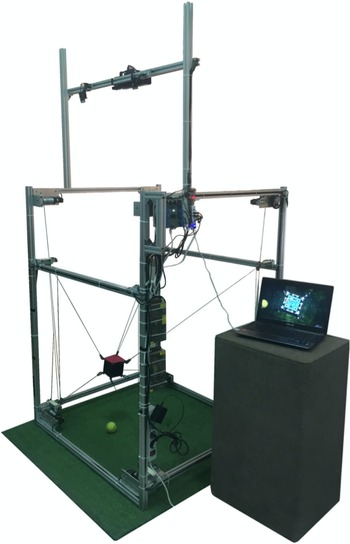
In this work, an optimal redundancy resolution is presented to keep the cable forces positive while the end effector is forced to chase the trajectory. In addition, this scheme will remain the actuators in a safe mood operating and lowers the consumption power during the maneuvers. Cables should be pulled while the system runs, and any non-tensile forces will cause failure in the procedure. The algorithm is applied to six DOF robotic manipulator, RoboCab, to validate the efficiency of the presented strategy. Figure 1 depicts the general structure of the robot which is investigated in our previous study [Reference Mousavi, Ghanbari, Moosavian and Zarafshan35]. An aluminum cubic end effector is implemented to track the desired trajectory in the cubic workspace. Two digital cameras are occupied for posture reporting, and a Bluetooth device will reveal the rotational stance in space. Installed load cells report the real tensions during the operation to ensure cables remain in positive stress. The rest of the paper is organized as follows. First, the problem of redundancy is explained concisely. Moreover, the proposed scheme is presented, and its procedure is defined in a nutshell. Besides, the n-degree of redundancy is studied for any standard available cable-driven prototypes. Finally, the experimental test is collaborated to check the algorithm, and the derived conclusion is discussed at least.
RoboCab redundant parallel cable-driven robot [Reference Mousavi, Ghanbari, Moosavian and Zarafshan35].

2. Redundancy resolution scheme
n dynamic analysis, force distribution along with the limbs and its possibility for actuators to create the planned force, is notably vital. The redundancy resolution problem deals with the systems which own more actuators than the manipulator’s DoF. Generally, redundant systems’ Jacobin matrix is non-squared. Studying the application and using this non-squared matrix lead to solving the redundancy resolution scheme. This matrix connects the velocity terms in joint space to the Cartesian space. Hence, it can be defined as a kinematic constraint in force distribution problem as shown in Eq. (1).
 \begin{equation}\vec{\textbf{F}}_{m\times 1} = \vec{\textbf{A}}_{m\times n} {\unicode[Vartau]{x1D6D5}}_{n\times 1}\end{equation}
where
 \begin{equation}\vec{\textbf{A}} = \vec{\textbf{J}}^T\end{equation}
It has been suggested by ref. [Reference Taghirad and Bedoustani11] using the pseudo-inverse matrix helps to reach the suitable answer for the redundancy resolution problem; this method leads to minimum force distribution along with the limbs. Pseudo-inverse is explained in the following equation:
 \begin{equation}\vec{\textbf{A}}^{+}_{n\times m} = \vec{\textbf{A}}^{T}(\vec{\textbf{A}}\vec{\textbf{A}}^T)^{-1}\end{equation}
In cable-driven robots, cables are the limbs transferring the actuators’ torque to the end effector. Considering the cable’s intrinsic property, it cannot be pushed in, and the force acting on the cable should be tensional. Therefore, the critical issue in such a problem is to keep the cables in tension all over the maneuver. The pseudo-inverse method minimizes the forces along with the cables, but it does not guarantee the cables to be kept in tension. During the robot’s maneuver, when the cable is loose, the end effector’s DoF decreases. In other words, the controllability of the robot is affected by the inner force of cables. Therefore, the most important priority for these types of robots is to obtain the minimum tensile force in cables to handle the task accurately. Based on the mentioned background, redundancy resolution problem as defined in Eq. (4) turns to an optimization problem with two constraints, one of them is derived from the robot structure, and the other is originated from the mechanical properties of cables.
 \begin{equation}\unicode[Vartau]{x1D6D5}_{n\times 1} = \bigg\{ \min \|\unicode[Vartau]{x1D6D5}\|_2 |\begin{Bmatrix}\vec{\textbf{F}} = \vec{\textbf{A}} \unicode[Vartau]{x1D6D5} \\\unicode[Vartau]{x03C4}_{\min} \leq \unicode[Vartau]{x03C4} \leq \unicode[Vartau]{x03C4}_{\max}\end{Bmatrix}, \unicode[Vartau]{x03C4} \subseteq \mathbb{R}^n\bigg\}\end{equation}
Based on Eq. (4), the cable’s inner force should satisfy the specified range at the second constraint. First, in that inequality, the maximum range determines the highest directional cable force that could be applied regarding the suitable safety factor. When the tensile force acts on a cable, while it exceeds the cable strength limit, it starts entering the plastic area, finally leading the cable to be torn. Second, considering the proper use of the instrument, such as actuators, would create another boundary like the cable tension limit. In terms of use, the actuator has a bounded nominal torque condition, so the generated tensile force along the cable is restricted. According to Eq. (4), to satisfy the force boundary for internal cable force, a null space solution should be added to the pseudo-inverse answer of the cable forces; this added part will rearrange the cable tensions based on the lowest and highest force limitation, while the total interaction of the cables on the end effector would be the same as the pseudo-inverse answer. The newly added segment results in the null space of Jacobin matrix, which will guarantee the force acceptable range for both the cable and actuators.
In cable-driven robots, the redundancy degree of a robot is defined as follows:
 \begin{equation}r = n - m\end{equation}
The pseudo-inverse solution is explained in Eq. (6).
 \begin{equation}{\unicode[Vartau]{x1D6D5}_P}_{n\times 1}= \vec{\textbf{A}}^{+}_{n\times m} \vec{\textbf{F}}_{m\times 1}\end{equation}
The previously revealed answer would fulfill the first constraint mentioned in Eq. (4); therefore, the null space answer should be added to keep the cables in tension. This part also has no effects on the dynamical behaviors of the end effector. It just creates an alternative order of cable force. Hence, the null space of
 $\vec{A}$
is explained as in the following:
 \begin{equation}\vec{\textbf{N}}_{n\times r} = Null (\vec{\textbf{A}}) = \{\vec{\textbf{X}} \subset \mathbb{R}^{n\times r} | \vec{\textbf{A}}\vec{\textbf{X}} = 0\}\end{equation}
Based on the rank-nullity theorem,
 \begin{equation}Rank (A) + Nullity (A) = n\end{equation}
 \begin{equation}Rank (A) \leq \min(m,n) \leq m\end{equation}
Hence, the nullity of the matrix, which expresses the dimension of Null(A), is defined as Eq. (10).
 \begin{equation}Nullity(A) \leq n-m \leq r\end{equation}
In robotic systems, where the robot’s workspace is nonsingular or the maneuvers are out of the singularity, the rank of matrix
 $\vec{A}$
is definitely m and also the nullity of the stated matrix is equal to r. As explained earlier, the redundancy resolution scheme possesses two parts, which come from the pseudo-inverse and null space as the following equation:
 \begin{equation}\unicode[Vartau]{x1D6D5}_{n\times 1} = {\unicode[Vartau]{x1D6D5}_P}_{n\times 1} + {\unicode[Vartau]{x1D6D5}_N}_{n\times 1}\end{equation}
The null space answer can be defined as the next equation.
 \begin{equation}{\unicode[Vartau]{x1D6D5}_N}_{n\times 1} = \vec{\textbf{N}}_{n\times r} \vec{\textbf{S}}_{r\times 1}\;,\; \vec{\textbf{S}}\subset\mathbb{R}^r\end{equation}
The null space answer modifies the total answer to fit both the boundary conditions and the kinematic constraint mentioned in Eq. (4). The validity of the mentioned claim is studied next.

3. Analytic method
To achieve the accessible n-dimensional area for force distribution in cables, two sets of real numbers are defined as Eqs. (14) and (15). So the intersection of these sets will present all possible answers for the cable force [Reference Verhoeven36–Reference Bouchard, Gosselin and Moore38].
 \begin{equation}\Delta = \{\unicode[Vartau]{x1D6D5}_P | \vec{\textbf{F}} = \vec{\textbf{A}} \unicode[Vartau]{x1D6D5}_P , \unicode[Vartau]{x1D6D5}_P \subset \mathbb{R}^n \}\end{equation}
The previously defined set based on kinematic constraint leads to the main answer for the redundancy resolution scheme. The second one follows the boundary condition for system and also is presented subsequently.
 \begin{equation}\Omega = \{ \unicode[Vartau]{x1D6D5} | \unicode[Vartau]{x1D6D5}_i \subset [ \unicode[Vartau]{x1D6D5}_{\min}\;\;\unicode[Vartau]{x1D6D5}_{\max} ], 1 \leq i \leq n \}\end{equation}
 $\Omega$
creates n-dimensional hyperspace set with minimum and maximum constraints. The intersection of these two sets reveals the possible answers as follows:
 \begin{equation}\Lambda = \Delta \cap \Omega\end{equation}
Eq. (16) can be defined as an inequality relation in which the maximum and minimum boundaries are denoted by
 $\unicode[Vartau]{x1D6D5}_{\max}$
and
 $\unicode[Vartau]{x1D6D5}_{\min}$
, respectively, as mentioned in the following:
 \begin{equation}\unicode[Vartau]{x1D6D5}_{\min} \leq \unicode[Vartau]{x1D6D5}_P + \unicode[Vartau]{x1D6D5}_N \leq \unicode[Vartau]{x1D6D5}_{\max}\end{equation}
To obtain the boundary area for the total answer, inequality splits into two equations.
 \begin{equation} \unicode[Vartau]{x1D6D5}_{\min} - \unicode[Vartau]{x1D6D5}_{P} = \vec{\textbf{N}} \vec{\textbf{S}}_{\min}\end{equation}
 \begin{equation} \unicode[Vartau]{x1D6D5}_{\max} - \unicode[Vartau]{x1D6D5}_{P} =\vec{\textbf{N}} \vec{\textbf{S}}_{\max}\end{equation}
According to Eq. (17),
 $\vec{\textbf{S}}$
is the matrix that solves the main problem. Hence, by the stated boundary situation,
 $\vec{\textbf{S}}$
varies during its range. To solve both equations of (18) and (19), there are 2n boundary subequations which finally lead to cable’s maximum and minimum force distribution. For a bit more simplification, either maximum or minimum of
 $\unicode[Vartau]{x1D6D5}$
is defined as
 $\unicode[Vartau]{x1D6D5}_B$
. So the previous two equations are rewritten again based on
 $\unicode[Vartau]{x1D6D5}_B$
.
 \begin{equation}\begin{bmatrix}{\unicode[Vartau]{x03C4}}_{B_1}-{\unicode[Vartau]{x03C4}}_{P_1}\\\vdots \\{\unicode[Vartau]{x03C4}}_{B_n}-{\unicode[Vartau]{x03C4}}_{P_n}\\\end{bmatrix}_{n\times 1}=\begin{bmatrix}N_{11} & \ldots & N_{1r} \\\vdots & \ddots & \vdots \\N_{n1} & \ldots & N_{nr} \\\end{bmatrix}_{n\times r}\begin{bmatrix}S_1 \\\vdots \\S_r\end{bmatrix}_{r\times 1}\;,\unicode[Vartau]{x1D6D5}_{B} = \unicode[Vartau]{x1D6D5}_{\min}\;or\;\unicode[Vartau]{x1D6D5}_{\max}\end{equation}
Thus, for each cable used in the robotic system, there are two boundary equations (Eq. (21)). Based on the robot’s degree of redundancy, these equations can express a pair of points in 1D space, when
 $r=1$
, parallel lines in 2D, when
 $r=2$
, or parallel planes in 3D, when
 $r=3,$
and so on [Reference Mikelsons, Bruckmann, Hiller and Schramm8].
 \begin{equation}{\unicode[Vartau]{x03C4}}_{B_i} - {\unicode[Vartau]{x03C4}}_{P_i} = N_{i1} S_1 + \ldots + N_{ir}S_r\;, \;\;i=1,2,3,\ldots,n, \;\;r=1,\ldots,n-m\end{equation}
According to Eq. (21), two pairs of equations belong to the
 $i{\rm th}$
cable are parallel, while the others, all equations, will definitely intersect each other as each row of matrix is linearly independent. If we have one degree of redundancy,
 $r=1$
, it will result in a 1D problem without any intersection point. Besides, the boundary equations express only the points. Thus, each equation comes from (21) has an intersection with the
 $r-1$
equation(s), which is not parallel to each other. This intersection point can be defined as the following equation:
 \begin{equation}\begin{bmatrix}S_1 \\\vdots \\S_r\end{bmatrix}_{int.\;sec.}=\begin{bmatrix}N_{11} & \ldots & N_{1r} \\\vdots & \ddots & \vdots \\N_{r1} & \ldots & N_{rr} \\\end{bmatrix}^{-1}\begin{bmatrix}{\unicode[Vartau]{x03C4}}_{B_1}-{\unicode[Vartau]{x03C4}}_{P_1}\\\vdots \\{\unicode[Vartau]{x03C4}}_{B_r}-{\unicode[Vartau]{x03C4}}_{P_r}\\\end{bmatrix}\;,\;\; r=2,3,\ldots\end{equation}
Regarding the previous equation, total intersection points for each of r equations are the combination of r objects from a set of n objects. Furthermore, the nullity matrix rank is equal to r. Thus, the submatrix of N is invertible. The main idea to calculate the intersection points is to find the definite point that satisfies all force constraints. As a result, all points derived from Eq. (22) are checked based on the force boundaries; if the point satisfies the condition, it is considered as a valuable point to save in the set of
 $\boldsymbol{\Psi}$
as the next equation.
 \begin{equation}\boldsymbol{\Psi} =\begin{Bmatrix}\begin{bmatrix}S_1 \\\vdots \\S_r\end{bmatrix}_{int.\;sec.}\rvert\;\;\unicode[Vartau]{x1D6D5}_{\min} - \unicode[Vartau]{x1D6D5}_{P}\leq N\begin{bmatrix}S_1 \\\vdots \\S_r\end{bmatrix}_{int.\;sec.}\leq\unicode[Vartau]{x1D6D5}_{\max} - \unicode[Vartau]{x1D6D5}_{P}\end{Bmatrix}\end{equation}
Connecting the points belong to
 $\boldsymbol{\Psi}$
, in r-dimensional space, creates the line, polygon, polyhedra, etc. Since the method is an optimized procedure, as the main index, the average magnitudes of vertices for inner geometry are computed as the final transfer point. This point transfers the answer to null space, whereas the general answer qualifies the kinematic and boundary constraints. This method is based on compromising between robot stiffness and applied power by the actuators. In cable robots, comparing cables with rigid limbs represents that the whole stiffness of cable-actuated systems is lower than the other robotic systems. Thus by increasing the cables’ inner force, the robot’s stiffness becomes higher. On the other hand, more cable force necessitates more actuator power. Hence, it diminishes the device’s life and increases the risk of failure. In this case, as the cable force increases, the probability of cable tearing is getting higher.
High cable force causes a change in the mechanical property of the cable. As the force increases, the cable crosses the elasticity and enters the plastic area. These changes cause the cable to face a residual deformation and minimize the strength limit in it. On the other side, the minimum force boundary reduces the performance too. Minimum force distribution in cables brings about the robot to lose enough stability against disturbances. By this reasoning, the average of internal intersection points as Eq. (24) is defined as the optimum point in r-dimensional space to keep the mechanical forces away from both maximum and minimum boundaries.
 \begin{equation}\textbf{S} =\begin{bmatrix}mean(\Psi(1)) \\\vdots \\mean(\Psi(r))\end{bmatrix}_{r\times 1}\end{equation}
Sometimes the set of
 $\boldsymbol{\Psi}$
is null, which means that by the specified range of cable force, the possibility of movement for moving platform does not exist. Therefore, as a first recommendation, the boundary conditions, especially the upper bound, should be increased. The minimum force for the lower bound could be zero, but in most maneuvers, the path is implemented by a non-zero tensile force. So, modifying the Boundary Condition (BC), let the robot reach a suitable cable force and lead to performing the command. Another idea for avoiding a null set is decreasing the run time of the robot. This suggestion is applicable and relates to hardware constraints. In this method, the cable forces are reduced. Thus, force distribution algorithm can run the trajectory with lower dynamic conditions.
Algorithm’s conceptual answer for
 $r=1$
.

Conceptual answer for optimum point in 2D space.

Considering the degree of redundancy for the cable robot is equal to one. So the transfer vector
 $\vec{\textbf{S}}$
is 1D and expresses the point. The boundaries in this condition are explained as points, and the optimum is the average of the inner boundary points. Figure 2 shows the conceptual answer and optimum point for
 $r=1$
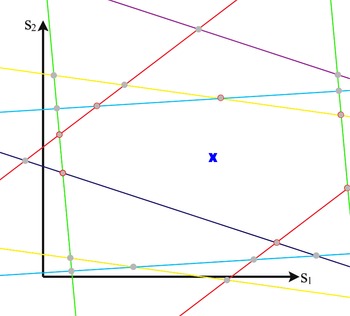
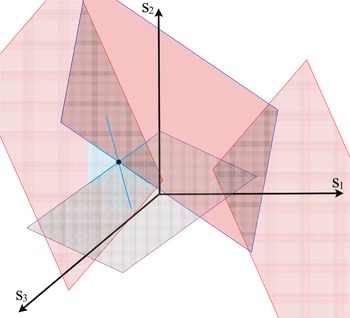
as the red point. According to Figure 3, for the system in which the degree of redundancy is two, the boundary equations are stated as lines in 2D space. Every two parallel lines belong to one cable, and they will intersect with other lines. The inner polygon is created from the boundary lines’ intersections; hence, the average of vertices represents the optimum point as the blue in Figure 3. When the redundancy is equal to three, the transfer vector is defined in 3D space. Referring to Eq. (22), any boundary equations demonstrate the plane in 3D space. The intersection of any three planes creates the points. The mean of internal polyhedral vertices, which are created by the planes, represents the optimum point for redundancy resolution problem in cable robots. Figure 4 clearly states the example of planes intersection in 3D space, which ends to the optimum transfer point.
Sample of intersection points in system with
 $r=3$
.

RoboCab’s general operating procedure.

Infinity path in the Cartesian space for testing the redundancy resolution method.

If the degree of redundancy is more than 3, the algorithm solves the problem as the main procedure planed before, and it is presented in hyperspace mode.
4. Experimental results
In this section, the modified redundancy resolution scheme is implemented on the 6-DoF redundant parallel cable robot, RoboCab [Reference Mousavi, Ghanbari, Moosavian and Zarafshan35]. This system possesses two degrees of redundancy in actuators. Hence, in the applied method, the redundancy degree is equal to
 $r=2$
. The block diagram of the open-loop control strategy, which is implemented on the RoboCab, is shown in Figure 5. By inverse kinematic formulation, cable length, rate of the changes, and Jacobin matrix are computed. Next, dynamics analysis is performed to prepare necessary inputs for the main redundancy resolution problem. The output is the computed cable forces for tracking the path. Boundary conditions keep the actuators’ failure risks away. Thus, a redundancy resolution scheme leads to the safe functioning of the system. An infinity path in the robot’s Cartesian workspace as shown in Figure 6 is desired for the experiment. To get the maneuver input for the robot, its kinematic and kinetics formulation should be determined; as a result, the necessary data are derived from calculating the internal cable force to run the desired trajectory. Redundancy resolution is regarded as the main concept of this operation, and so, the path is assumed to verify the force distribution algorithm. Therefore, no closed-loop control strategy is used to modify the implementation or at least force distribution. The mentioned algorithm’s strategy for computing the cable forces is depicted in Figure 7. This block diagram is for RoboCab and all redundant cable robotic systems whose degree of redundancy is equal to two (
 $r=2$
).
The proposed redundancy resolution algorithm for RoboCab.

The boundary lines, intersections, and middle point to compute the cable forces (
 $\unicode[Vartau]{x1D6D5}_{\min} = 1$
N,
 $\unicode[Vartau]{x1D6D5}_{\max} = 30\,{\rm N})$
).

Cable force distribution along the trajectory.

Proposed method’s elapsed time compared to other numerical methods to compute optimal force distribution.

The 6-DoF cubic manipulator with 2 degrees of redundancy uses 8 cables in which force boundaries could also be defined variously from one to the other. In this experiment, as all cables and actuators used in the robot are the same, relative force boundaries for each cable are the same. They are equal to
 $\unicode[Vartau]{x1D6D5}_{\min}=1$
N for minimum cable tension and
 $\unicode[Vartau]{x1D6D5}_{\max}=30$
N for the maximum one. Figure 8 demonstrates 16 boundary lines in which each pair of parallel lines is related to one cable with defined boundaries. The red spots are the points that come from the intersection of each two lines, and the blue spots are the inner intersections that satisfy the inequality constraints. As explained earlier, the middle point is the mean of blue spots, which is expressed in Figure 8 as the green spot.
As Figure 9 demonstrates, cables’ force meets the boundaries, and none of them exceed the expressed range. For each cable, there are two graphs. One of them is the base or pseudo-inverse solution that reaches the negative force area. For cable’s inherent property, it cannot be performed by cable-driven systems. However, mostly, the base answer cannot satisfy the boundaries, as shown in Figure 9. Thus, the proposed algorithm represents a method that keeps all of the cables within the desired boundaries. In this case, the force boundaries are between 1 and 30 N.
To evaluate the proposed algorithm’s performance, it is compared to several widely applied numerical redundancy resolution methods like Active-set, sequential quadratic programming (SQP), and interior-point. For each method, the average iteration time based on the same path is reported in Figure 10. As shown in this figure, various methods are used to solve the redundancy resolution problem. In all experiments, the moving platform passes through the planned infinity-shaped path, and the elapsed time for each method is reported. All implementations and simulations are computed by the PC with a Fusion APU A8-4500 1.9 GHz processor and 4 GB RAM. According to the results stated in Table 1, the average time taken to solve the problem in the proposed method is less than other usual methods. The average time for each calculation method is reported, and the speed of achieving the right boundary condition for each algorithm is compared with the other one. The ratios are also shown in Table 1, which represent the relative speed of others to the proposed algorithm.
Average elapsed times for redundancy resolution each method.

5. Conclusion
In this paper, a non-iterative wire tension distribution is presented, and its full procedure is explained to reach the desired solution. First, the problem definition is considered to find the cable force. Then the developed scheme is taken into account to investigate the best solution for the wire tension to track the path. In the mentioned algorithm, the idea is considered to keep the wires in the tensile limitation to avoid any tearing through the operation. This online scheme keeps all the actuators safe, and the chance of any failure enormously decreases. The efficiency is corroborated by a 2-degree redundant manipulator, namely RoboCab; however, the strategy is revealed for 1–3 degrees of redundancy. Besides, the rate of the computational process is compared with other custom methods that show how fast the written algorithm is running. The planned wire tensions illustrate that the maximum number of cable tensions that touches boundary limits does not exceed more than the degree of redundancy. As the results show, none of the cables pass the boundary limit, and the trajectory is performed as well as the wire tension is positively distributed. By considering the optimal method, the overall stiffness of the wire robot is acceptable, while it is on the opposite side of the safe operation of electromechanical instruments.