Introduction
Squamous cell carcinoma (SCC) of the head and neck is the sixth most common cancer in the world.Reference Schenker, Arnold and Bauer1 However, unlike some other more common cancers, such as breast and prostate cancers, a large proportion of patients with primary head and neck cancer are assigned to palliative intent treatment at the outset.Reference Irvin, Muss and Mayer2,Reference Sanford, Greene and Carroll3 The commonest reason is advanced disease at diagnosis, with more than 60 per cent of patients having an American Joint Committee on Cancer advanced stage of disease at the time of diagnosis.Reference Schenker, Arnold and Bauer1
Overall, the five-year survival rate of head and neck cancer patients remains relatively poor, at around 40–60 per cent.Reference Siegel, Miller and Jemal4 Indeed, as many as half of all patients with head and neck cancer die from the disease itself and will require some form of palliation.5 Predicting outcome in this patient group is difficult, and survival in patients managed palliatively from the outset is poorly reported and extremely variable. One study found that survival time could range from 1 day to over 4 years.Reference Kowalski and Carvalho6
There are a wide variety of palliative treatment options for head and neck cancer, but there is little consensus on which should be provided.Reference Cocks, Ah-See, Capel and Taylor7 Head and neck cancer, because of its anatomical location in the upper aerodigestive tract, is unique in its interference with many of the functions required to live a normal life, including breathing, speaking, eating and drinking. Head and neck cancer patients therefore pose unique challenges in the palliative setting. Acute airway obstruction or terminal bleeds from the head and neck can be devastating at the end of life, and involving the family in treatment plans from the beginning is crucial.
Palliative treatment can range from more general palliative care interventions, for example analgesia, to more specific interventions, including: those conducted for nutrition, such as gastrostomy or nasogastric (NG) tube feeding; those performed to protect the airway, such as tracheostomy; and those which reduce tumour burden, such as oncological therapies or debulking surgery.
Each intervention has its own potential for morbidity and mortality. It is therefore important to be able to share as much information as possible with patients about different treatment options. The present study sought to delineate local practice, morbidity and mortality in patients with head and neck cancer managed palliatively, in order to better inform clinicians and patients regarding decisions about care.
Materials and methods
A retrospective analysis of all new head and neck cancer patients who presented between April 2015 and April 2016 to the South Glasgow and Clyde Head and Neck Cancer Multidisciplinary Team (MDT) was undertaken. The MDT database was reviewed and all patients managed with curative intent were excluded. Case notes were reviewed for demographic and clinical data. Survival was calculated up until the time of the study.
Results
A total of 390 patients were referred to the South Glasgow and Clyde Head and Neck Cancer MDT over this one-year period. Eighty-four patients (21.5 per cent) were assigned to palliative intent treatment from the outset following MDT discussion. All patients included in the study had histologically confirmed SCC. Mean follow-up time was 510 days.
Demographic and clinical data
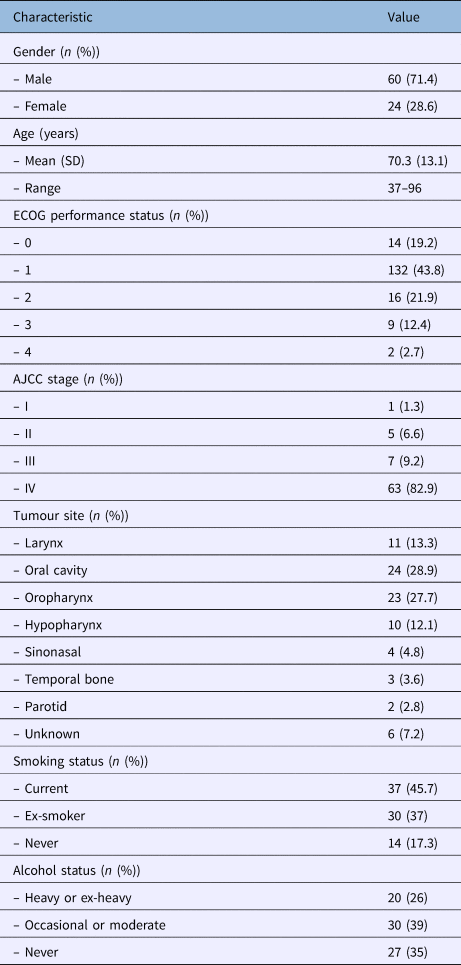
Sixty patients (71.4 per cent) were male. Age ranged from 37 to 96 years (mean = 70.3 years, standard deviation (SD) = 13.1).
The majority of patients had an Eastern Cooperative Oncology Group performance status of 1; 14 patients (19.2 per cent) had a status of 0, 132 (43.8 per cent) had a status of 1, 16 (21.9 per cent) had a status of 2, 9 (12.4 per cent) had a status of 3, and 2 (2.7 per cent) had a status of 4.
The most common tumour site was the oral cavity, in 24 patients (28.9 per cent), followed by the oropharynx, in 23 patients (27.7 per cent) (Table 1). The majority of patients had American Joint Committee on Cancer stage IV disease at the time of diagnosis; 1 patient (1.3 per cent) had stage I disease, 5 (6.6 per cent) had stage II disease, 7 (9.2 per cent) had stage III disease and 63 (82.9 per cent) had stage IV disease.
Demographic and clinical data

SD = standard deviation; ECOG = Eastern Cooperative Oncology Group; AJCC = American Joint Committee on Cancer
Thirty-seven patients (45.7 per cent) were current smokers, 30 (37 per cent) were ex-smokers and 14 (17.3 per cent) denied ever smoking. Twenty patients (26 per cent) drank alcohol to excess, 30 (39 per cent) drank alcohol in occasional or moderate quantities, and 27 (35 per cent) were tee-total (Table 1).
Survival
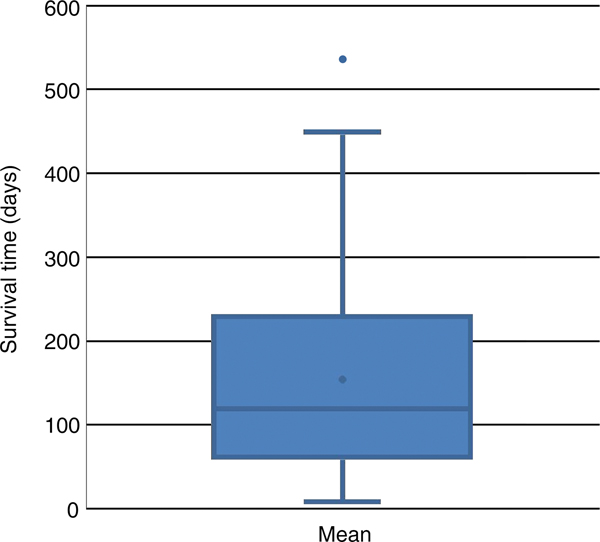
The patients’ mean survival time was 151 days (SD = 121.1; range, 8–536 days) (Figure 1). Fourteen patients (16.7 per cent) were still alive at the time of data collection. When outliers were removed, mean survival time was 136 days (SD = 100.1; range, 8–359 days).
Mean survival time.

Mean survival time varied according to tumour site, as follows: larynx, 166 days (SD = 122; range, 20–354 days); oral cavity, 162 days (SD = 116; range, 13–449 days); oropharynx, 120 days (SD = 122; range, 8–446 days); and hypopharynx, 142 days (SD = 93; range, 17–289 days).
Palliative interventions
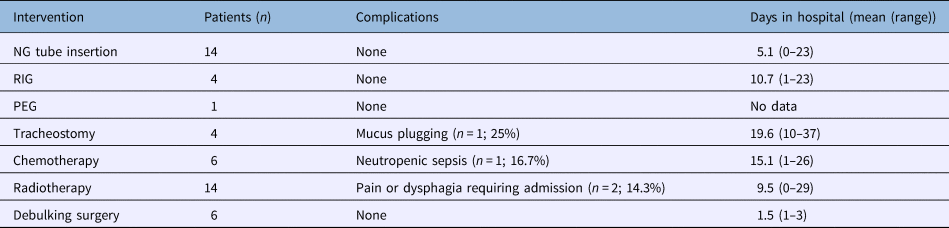
A number of palliative interventions were used in this cohort (Table 2). There were incomplete case records for 22 patients (35 per cent). Specific nutritional interventions included: NG tube insertion (n = 14), radiologically inserted gastrostomy (n = 4) and percutaneous endoscopic gastrostomy (PEG) (n = 1). Palliative tracheostomy was performed in four patients. The interventions used to reduce tumour burden were: chemotherapy (n = 6), radiotherapy (n = 14) and debulking surgery (n = 6).
Palliative interventions

NG = nasogastric; RIG = radiologically inserted gastrostomy; PEG = percutaneous endoscopic gastrostomy
The interventions were associated with complications in some cases. No complications were recorded as a result of a nutritional intervention or debulking surgery in this cohort. One patient who underwent a tracheostomy was admitted as an emergency with mucus plugging. One patient receiving palliative chemotherapy developed neutropenic sepsis. Two patients receiving radiotherapy required admission for severe pain or dysphagia.
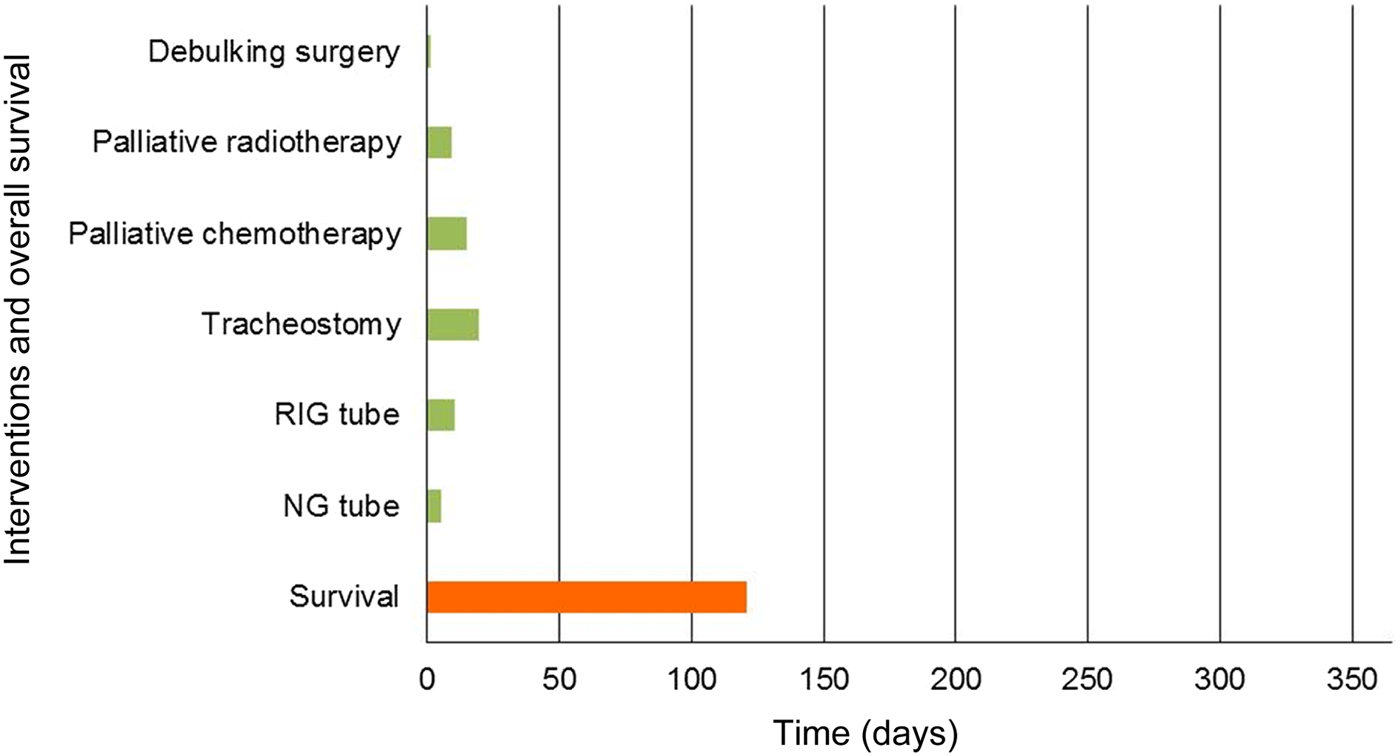
The mean number of days spent in hospital as a result of each intervention was as follows: NG tube insertion = 5.1 days (range, 0–23 days); radiologically inserted gastrostomy = 10.7 days (range, 1–23 days); tracheostomy = 19.6 days (range, 10–37 days); chemotherapy = 15.1 days (range, 1–26 days); radiotherapy = 9.5 days (range, 0–29 days); and debulking surgery = 1.5 days (range, 1–3 days) (Figure 2). The only patient with a PEG tube had no data available on length of hospital admission (Table 2).
Days in hospital as a result of each intervention, compared to overall survival. RIG = radiologically inserted gastrostomy; NG = nasogastric

We also monitored whether patients had been referred to in-patient specialist palliative care or to community palliative care or hospice services. Fifty-five patients (83.3 per cent) were referred to in-patient specialist palliative care; 11 (16.7 per cent) of the patients receiving this care had no referral. Forty-three patients (74.1 per cent) were referred to community palliative care or hospices; 15 (25.9 per cent) of the patients receiving this care had no referral.
Place of death
Site of death was as follows: nine patients (47.4 per cent) died in hospital, six (31.5 per cent) died in the hospice and four (21.1 per cent) died at home.
Discussion
Over the course of one year, 21.5 per cent of patients who presented to the MDT were assigned to a palliative intent pathway from the outset. Exact figures for treatment intent are hard to find in the literature. One study investigating oral and oropharyngeal cancers reported that 20.8 per cent of patients were managed palliatively from the outset. Another study, also based in Glasgow, focusing on hypopharyngeal cancer, reported a similar rate of 25 per cent.Reference McMahon, Robertson, Liew, McManners, Mackenzie and Hislop8,Reference Pracy, Loughran, Good, Parmar and Goranova9 Age, extent of locoregional disease, metastases, co-morbidity or refusal of surgery were important determinants of palliative management. Our local rate of over one-fifth of patients being assigned to palliative intent treatment at the outset is comparable.
The most important factor in this cohort was advanced disease at diagnosis; 83 per cent of patients presented with American Joint Committee on Cancer stage IV disease. This rate is much higher than the literature would suggest.Reference Schenker, Arnold and Bauer1,Reference Ledeboer, van der Schroeff and Pruyn10 There may be a number of possible reasons for this advanced state at presentation. Firstly, head and neck cancer symptoms may initially be non-specific, particularly for hypopharyngeal tumours. Symptoms such as sore throat may be ignored if patients feel that it is not a worrying symptom. In recent years, there has been a big public health drive underlining that sore throats are likely to be viral, and this may be a factor in patients ignoring throat pain as a red flag symptom.11 Education of the public regarding red flag symptoms may be helpful in improving earlier detection. Education of primary care clinicians may also have some benefit. Local ‘urgent suspicion of cancer’ referral guidelines to the head and neck clinic show that only a small percentage of cancers come through the urgent suspicion of cancer pathway.
Another factor in this cohort of patients may be their co-morbidities. This group of patients showed high levels of current or ex-smoking, and either current or previous alcohol excess. These factors, along with the associated co-morbidities, mean that patients are generally in a poorer overall condition, and they may seek healthcare later when curative treatment is less likely to be achieved. Additionally, a local review of head and neck cancer patients with respect to deprivation score has shown that more deprived patients present with more advanced disease.Reference Zeitler, Fingland, Tikka, Douglas and Montgomery12 This highlights the need for increased public education regarding the red flag symptoms, with the ultimate goal of early rather than late disease at presentation.
The three commonest reasons for a patient being assigned to palliative intent treatment at the outset when American Joint Committee on Cancer stage was less than IV were: age greater than 80 years, having a synchronous cancer and if it was deemed to be in the patient's best interests after MDT discussion.
Life expectancy is higher than ever in the UK and with that comes the burden of greater incidence of disease. However, while life expectancy rates improve overall, Glasgow has the lowest life expectancy in Scotland, with rates of 73.4 years for males and 78.9 years for females, compared to the national average of 77.4 years and 81.2 years, respectively.13 These important factors are likely to be associated with overall survival from head and neck cancer locally.
There has been some discussion in recent literature regarding the management of elderly patients, particularly octogenarians.Reference Perri, Ionna, Pavone, Longo and Caponigro14–Reference Hughley, Sperry, Thomsen, Charlton and Pagedar16 Age is not per se an exclusion criterion for primary curative treatment. Indeed, fit, elderly patients may derive a similar survival benefit as their younger counterparts.Reference Szturz and Vermorken15 However, higher complication rates in elderly patients and, for example, reduced survival benefit with chemotherapy, mean that treatment plans need to be carefully considered at MDT discussion.Reference Perri, Ionna, Pavone, Longo and Caponigro14 Decisions are made more difficult by a lack of high-quality evidence, mostly the result of an under-representation of elderly participants in studies and trials.
The commonest synchronous cancer was a lung primary in this cohort, which is unsurprising, given the high rate of smoking.
Age range was notably wide. Indeed, the youngest patient to be assigned to palliative intent at the outset was 37 years old, and this warrants further discussion. This patient's primary tumour was maxillary SCC. The patient smoked and consumed alcohol excessively, and was non-adherent with attending appointments and engaging with treatment. Curative treatment was not deemed possible after MDT discussion given the advanced tumour stage, co-morbidity and lifestyle issues.
Head and neck cancers are being seen in younger patients more frequently, particularly in males, with an increase in human papilloma virus associated cancers. It is likely that patients will continue to present in their fourth decade with head and neck cancer.Reference Young, Xiao, Murphy, Moore, Fakhry and Day17
At the other end of the age range was a 96-year-old patient whose primary tumour was an oral cavity SCC. It was a T2 stage tumour at diagnosis. The patient was deemed unfit for curative treatment in light of a poor performance status.
Mean survival time in this cohort was 151 days. This is comparable with survival findings reported in the literature.Reference Ledeboer, van der Schroeff and Pruyn10 Ledeboer et al. reported a slightly longer survival time of 177 days.Reference Ledeboer, van der Schroeff and Pruyn10 It is surprising that some patients lived with cancer for up to 18 months with a palliative diagnosis. This highlights the importance of good palliative and supportive care for patients given a terminal diagnosis. It also indicates the need for excellent communication with patients about their treatment options, as some may live for much longer than expected. It also potentially infers that the avoidance of toxic and morbid treatments may be associated with increased survival. This is one of the discussion points in Temel and colleagues’ study of patients with locally advanced non-small-cell lung cancer.Reference Temel, Greer, Muzikansky, Gallagher, Admane and Jackson18 Future local work aims to compare the mean survival of the palliative intent treatment patients with a curative intent treatment group.
There were a number of different palliative treatment interventions used in this cohort. Nutritional interventions were some of the commonest. Nasogastric tubes were inserted most frequently and were associated with no complications. Radiologically inserted gastrostomy tubes were made use of in four cases. This procedure is becoming more common. Although there were no complications in this cohort, there are significant potential risks with radiologically inserted gastrostomy, including perforation and abdominal sepsis. This highlights the importance of discussing both the pros and cons with patients before any intervention is undertaken. The PEG tube was only inserted in one patient, and again was associated with no complications. Of note, days in hospital were doubled for radiologically inserted gastrostomy compared to NG tube insertions. This again highlights the importance of communicating with patients about the time they may spend in hospital when undergoing an intervention. This may be an important factor to take into account for patients with a limited life expectancy.
Palliative oncological interventions were performed in some cases. Fourteen patients received radiotherapy, compared to just six who received chemotherapy. Chemotherapy was associated with almost double the number of days in hospital when compared to radiotherapy, but both treatments had similar complication rates. These data highlight the need to counsel patients regarding possible morbidities associated with interventions, particularly regarding what an intervention may mean for them in terms of days in hospital.
Surgical palliative interventions were performed fairly infrequently. Four patients had a tracheostomy (three elective and one emergency procedure). Of note, the mean number of days in hospital as a result was almost three weeks. This was a lower overall tracheostomy rate than expected.
We are interested in examining further data from recent years to identify trends in tracheostomy rate. We postulate that lower tracheostomy rates when compared to previous years may be the result of improved doctor–patient communication concerning patients’ wishes. Many patients choose not to have a tracheostomy; this preference is documented so that if they present in extremis, their wish is adhered to.
Early discussion of a patient's wishes with regard to airway emergency is crucial so that a management plan can be agreed upon. We suggest that this discussion should be approached and documented in a similar way to ‘do not resuscitate’ orders. In addition, explicit discussion with the patient and family regarding mode of death, if tracheostomy is not performed, is helpful. The use of active sedation proportional to any distress associated with dying due to airway compromise can be proposed as a management plan. If this is discussed well, it may be that death can occur peacefully, without an emergency procedure.
Debulking surgery was performed in six patients; there were no associated complications, with a mean hospital admission duration of just 1.5 days. Debulking procedures have been advocated elsewhere in the literature,Reference Chan, To, Wong and Wei19,Reference Paleri, Stafford and Sammut20 particularly because they often negate the need for a tracheostomy. Debulking procedures should perhaps be considered in more cases, given their favourable morbidity profile.
Interestingly, none of the palliative procedures except tracheostomy extended mean survival. This is intuitive, as the airway is protected with tracheostomy, and airway obstruction is often the final common incident when dying from head and neck cancer. However, this benefit needs to be balanced with the knowledge that a mean time of three weeks is required in hospital, which is almost one-fifth of the mean total survival time in those with a palliative diagnosis.
Of the data available, almost half of the patients died in hospital and just one-fifth died at home. These findings are similar to those of other studies, which also found that the elderly and those from more deprived areas were more likely to die in hospital.Reference Davies, Linklater and Jack21 Interestingly, despite more palliative care input in recent times, this has not translated into an increase in patients dying at home. However, the current orthodoxy that home is the best place of death for people has been questioned. Indeed, for patients who live alone, the lack of support at home may preclude this option altogether. Recent work in our department has shown that almost half of males with head and neck cancer live alone.Reference Zeitler, Fingland, Tikka, Douglas and Montgomery12 There are unique barriers to discharge from hospital in head and neck cancer cases. Managing tracheostomies and feeding tubes may pose a perceived challenge to relatively inexperienced healthcare staff and family members. One can see how home may not be the most suitable place for some patients. The aim should always be to allow the patient to die in the place of their choosing.
Based on our results, we feel it is possible to put our findings into practice and make some recommendations. In counselling patients, particularly in relation to prognosis, we can inform them that in our region, the average survival time is 151 days. Additionally, we can advise upon which interventions may take up a lesser proportion of their remaining life in hospital. The main interventions to sustain life in head and neck cancer are performed for nutrition and airway support. From this dataset, we can advise that NG tube insertion would be preferable to gastrostomy in terms of complications and time in hospital. However, there is rarely a ‘right’ choice and many patients may prefer not to have an NG tube. The right choice is the choice the patient makes, having weighed up all of the relevant information, in conjunction with the clinical team. There has been a huge effort in recent times to encourage the practice of so-called ‘realistic medicine;’22 at the heart of this philosophy is putting the patient at the centre of decisions about their healthcare.
Conversations with patients who have advanced head and neck cancer can be complex, emotive and ethically challenging, and pertain to key facets of daily life, including: speaking, breathing, eating and drinking. Having access to specialist palliative care support to guide these conversations in certain circumstances is hugely advantageous.
We suggest that airway debulking may be preferable to tracheostomy for patients who want to maximise their time outside of hospital. Airway debulking must come with the caveat that it provides only temporary airway support, but prevents an average of three weeks in hospital.
• There is a paucity of literature on, and little consensus regarding, how best to manage head and neck cancer patients with palliative intent
• This is the first study to look specifically at this patient group in terms of treatment, its associated morbidity and overall survival
• A significant proportion of patients are managed with palliative intent from the outset, and the majority have advanced disease at presentation
• A variety of palliative interventions are available and may be associated with significant morbidity
• Survival is variable, often several months; invention-associated morbidity must be considered, along with the patient's wishes
• Interventions that minimise time in hospital may be preferable in these patients; palliative care service involvement is advantageous
This was a descriptive study, and our results apply to a local, and likely specific, patient group. These data serve to give an indication of our own experiences in managing this difficult and poorly studied group. The authors hope that our findings may be used to inspire similar work elsewhere, and may help to inform conversations at the MDT meeting, and with patients and their families.
Competing interests
None declared