Introduction
With various population trends showing increasingly aging societies, the number of people with cognitive disabilities is rising and, concurrently, the numbers of potential family members and formal caregivers are decreasing. It has been predicted that these trends will ultimately lead to a care vacuum, thereby increasing the pressures on an already overburdened care system (Agree et al., Reference Agree, Freedman, Cornman, Wolf and Marcotte2005; Astell, Reference Astell2006). Technology has emerged as a potential solution to alleviate some of these pressures and meet the growing needs of an expanding population of seriously cognitively impaired people. However, it is often in relation to people with cognitive impairment or intellectual disabilities (ID) that the use of technology has provoked conflicting reactions (Cash, Reference Cash2003; Perry et al., Reference Perry, Beyer and Holm2008).
The application of technological interventions in the care for people with dementia or ID often serves two purposes: they can offer assistance and support in the daily life of residents, enabling a certain degree of independence and/or control over day to day activities; and they can be used to monitor and safeguard residents from (self-inflicted) harm. It is this latter application of technology in particular, exemplified by tagging and tracking devices, that has sparked considerable ethical debate among healthcare professionals, jurists and ethicists. Although the focus has predominantly been centered on the care of adults with dementia and ID dwelling in the community, application of technology is also taking place in residential facilities where the accent lies on surveillance and effective management of high risk behaviors. However, it is still not clear what the ethical and practical implications of these interventions would be in a formal residential care setting.
The main aim of this paper is thus to explore what is known about the moral and practical acceptability of surveillance technologies in the residential care of people with dementia and/or ID and to set out the current state of the ethical debate.
Although several excellent reports and guidelines can be found about (assistive) technologies for people with dementia and/or ID in homecare or independent living (Bjørneby et al., Reference Bjørneby, Topo and Holthe1999; Marshall, Reference Marshall2000) these are still sorely lacking with regard to residential care. This is all the more significant as technological applications in residential settings differ from those in homecare and tend to fall into the above mentioned latter category of technologies that aim to monitor and safeguard, rather than assist and support.
This paper therefore provides an overview of the international literature on the ethical and practical aspects of surveillance technologies in the residential care of people with dementia and ID.
Methods
We explored the available clinical and scientific literature on the moral and practical acceptability of using surveillance technologies in the residential care of people with dementia or intellectual disabilities.
Procedure
The international literature was searched through the following six literature databases: EMBASE.com (MEDLINE and EMBASE combined, search date 13 August 2009), PsycINFO (search date 13 August 2009), CINAHL (search date 13 August 12009), INSPEC (search date 17 August 2009), and ETHXweb (search date 17 August 2009). To identify as many articles as possible an extensive search without time limitations was conducted for all databases using combinations of multiple terms. Both “controlled terms” (EMTREE in EMBASE.com, Thesaurus of Psychological Index Terms in PsycINFO and Subject Headings in CINAHL) and “free text terms” were used, and placed into four categories. The first category involved terms that captured all forms of dementia or intellectual disability. The second category entailed all terms related to surveillance technology. The third category entailed terms related to the (potential) outcome or influence of this technology, either as something that could result in, for example, (more) “freedom”, “security”, “quality of life”, “needs” or “independence”, or as something that, for instance, “restricts”, “restrains” “limits” or “controls”. The last category entailed terms to include all articles written in Dutch, English, German and French. All databases were searched using “or-relations” within these categories, and “and-relations” between the categories (a detailed account of the searches can be obtained from the first author).
The search resulted in a vast amount of potentially relevant articles. Two of the authors independently assessed all of the identified articles by title and/or abstract, in order to determine their eligibility for inclusion. Owing to the explorative character of this overview, the following types of publication were also included: policy statements, briefing papers, clinical reports, case studies and scientific books.
It must be stipulated here that only publications describing aspects related to the above mentioned categories in residential healthcare settings were included. Accordingly, publications that focused solely on extramural care (i.e. home care or independent living) or did not also refer to residential healthcare were excluded.
In order to retrieve as many articles as possible, the reference lists of the identified articles were searched for additional articles. Also added were articles pointed out to us by colleague researchers. If at any time there was disagreement on the inclusion of articles, the authors who assessed the article deliberated until they reached consensus.
Data analysis
All the included articles were read closely and analyzed for examples, cases or discussions of surveillance technologies in the residential care of people with dementia or ID. Our main objective was not to give a full description of all details covered in these papers, but rather to provide a general thematic overview of all the (ethical) issues that arise in the articles. The relevant information was analyzed and classified into several themes. This classification was then discussed in the research group in order to reach consensus on comprehensiveness and lucidity. The names of these themes have mostly been terms that were used in the included articles or were themes that have also been categorized in a similar fashion in some of the included articles.
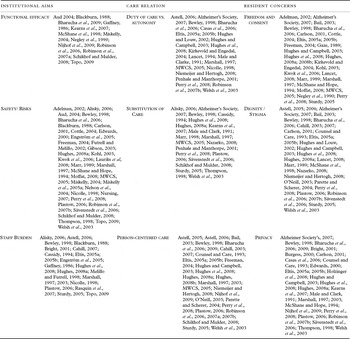
Careful analyses of all the topics by the authors have shown they all dealt, in one way or another, with three perspectives: that of the institution; the resident; and the care relation. Thus we see from the perspective of the institution that there are three main considerations or “aims” with regard to the use of surveillance technologies: whether the technology works, whether it might increase security or reduce risks, and whether it could relieve staff burden. With regard to the resident, the main considerations can be regarded in terms of how the surveillance technologies will effectively influence and/or improve the resident's freedom (of movement); autonomy and human rights, and/or will respect the resident's personhood, privacy and dignity. With regard to the care relation, the main considerations were the ethical dilemma of duty of care versus autonomy of the resident; whether technology would substitute care and whether technology would result in or take into account person-centered care. Consequently, these three central themes together with the subthemes have been used to provide a clear structure of the results as presented in this article.
Results
The initial literature search provided us with 2610 hits: 1647 from EMBASE.com; 300 from PsycINFO; 226 from CINAHL; 598 from INSPEC and 76 from ETHXweb. After careful selection only 49 could be included. Another 30 articles were added from other sources, such as reference lists, colleagues and other researchers, ultimately resulting in a total of 79 papers. Table 1 presents an overview of the three central themes and subthemes as covered in the articles. However, we would like to stress that owing to their close relatedness, the identified (sub)themes are not mutually exclusive. The majority of the articles included cover multiple themes, and are therefore cited more than once.
Central themes and subthemes on effectiveness and acceptability of surveillance technologies in residential care for people with dementia and ID as covered in the literature

Institutional aims
The main consideration with regard to surveillance technologies from the institution's point of view is whether they are effective. However, determining whether use of surveillance technologies is going to be effective is dependent on which effects one intends to measure. Here the literature indicates that from the perspective of the institution the desired effects can be measured in terms of functional efficacy, increased security or a reduction of risks, or in terms of a reduction of staff burden.
Functional efficacy
We found nine (non-randomized controlled trials; non-RCT) research or case studies that have examined whether surveillance technologies function effectively (Gaffney, Reference Gaffney1986; Blackburn, Reference Blackburn1988; Negley, Reference Negley, Molla and Obenchain1990; McShane et al., Reference McShane, Gedling, Kenward, Kenward, Hope and Jacoby1998; Freeman, Reference Freeman2004; Miskelly, Reference Miskelly2004; Miskelly et al., Reference Miskelly, Yeung, Hatt and McCafferty2005; Chen et al., 2007; Schikhof and Mulder, Reference Schikhof, Mulder and Holzinger2008). The earliest (research) articles to report on this topic go back as far as the 1980s and describe rather simplistic alarm systems or security devices, often with the aim of alerting staff to the presence of a resident in a restricted area (Gaffney, Reference Gaffney1986; Blackburn, Reference Blackburn1988; Negley, Reference Negley, Molla and Obenchain1990).
Almost a decade later, McShane et al. (Reference McShane, Gedling, Kenward, Kenward, Hope and Jacoby1998) designed a tracking system that was adapted from its widespread employment in animal research, but the author concluded that refinements were needed before the system could be called useful. Miskelly (Reference Miskelly2004) and Miskelly et al. (Reference Miskelly, Yeung, Hatt and McCafferty2005) tested tagging equipment more successfully. It was derived from a prisoner-tagging system and was tested for six months in a residential home. Since the installation of the system, no events where wandering has taken place have been missed.
Chen et al. (2007) demonstrated the application of an intelligent monitoring system where people going absent from dementia units were monitored using a camera network. The system was able to detect such absences with almost 100 % accuracy.
Schikhof and Mulder (Reference Schikhof, Mulder and Holzinger2008) designed and tested a system for monitoring people with dementia at night through the use of infrared sensors, a camera and personal digital assistants (PDAs). The nursing assistants working with the system rated it as satisfactory during the test.
Practical problems in these studies included removal of the device by the resident (Blackburn, Reference Blackburn1988; Thompson, Reference Thompson1998; Kearns et al., Reference Kearns, Rosenberg, West and Applegarth2007), system misses and false alarms (Chen et al., 2007; Schikhof and Mulder, Reference Schikhof, Mulder and Holzinger2008), a power failure (Schikhof and Mulder, Reference Schikhof, Mulder and Holzinger2008) or refusal by the resident (McShane et al., Reference McShane, Gedling, Kenward, Kenward, Hope and Jacoby1998).
Safety/risks
Many articles mention in passing that surveillance technologies could lead to a reduction of serious incidents or increased safety, but frequently they do not substantiate this claim (Marr, Reference Marr1989; Futrell and Melillo, Reference Futrell and Melillo2002; Welsh et al., Reference Welsh, Hassiotis, O'Mahoney and Deahl2003; Nelson et al., Reference Nelson2004; Mental Welfare Commission Scotland (MWCS), 2005; Plastow, Reference Plastow2006; Sävenstedt et al., Reference Sävenstedt, Sandman and Zingmark2006; Robinson et al., Reference Robinson2007b; Hughes, Reference Hughes2008a; Reference Hughes2008b; Moffat, Reference Moffat2008). However, an extensive RCT study by Lauriks et al. (Reference Lauriks, Osté, Hertogh and Dröes2008) concluded that the residents with surveillance technologies had significantly fewer falls than those without. In another RCT study, Kwok et al. (Reference Kwok, Mok, Tong Chien and Tam2006) concluded that technology (in the form of a bed-chair pressure sensor) enhances supervision by nursing staff and may therefore prevent falls. Other research papers/case studies all report that the (multiple) devices they have either examined or designed have the benefit of reducing (potentially) harmful incidents (Blackburn Reference Blackburn1988, Thompson, Reference Thompson1998; Gibson, Reference Gibson2003; Freeman et al., Reference Freeman2004; Chen et al., 2007, Miskelly et al., Reference Miskelly2004; Reference Miskelly, Yeung, Hatt and McCafferty2005; Schikhof and Mulder, Reference Schikhof, Mulder and Holzinger2008).
Nicolle (Reference Nicolle1998) surveyed professional experts working in the field of dementia, including care workers and administrators, and found that the reliability of the technological intervention and concomitant increase in safety of the resident was seen to be a key consideration when deciding whether or not to use technology. A survey by Engström et al. (Reference Engström, Ljunggren, Lindqvist and Carlsson2005) amongst staff members in a residential home for people with dementia showed that job satisfaction rose after an increase in technological support. Engström et al. argued this could be due to increased security and thus more staff control.
However, a certain vigilance is advised regarding the reliability of surveillance technologies, as technology which is not reliable is virtually useless and may introduce more dangers (Lancet, 1994; Marshall, Reference Marshall1997; Nicolle, Reference Nicolle1998). As several articles point out, technology does not remove risk completely, and with the implementation of new technologies intended to produce a more secure environment, there is a danger of creating a false sense of security among the staff (Mapp, 1994; Bewley, Reference Bewley1998; Nicolle, Reference Nicolle1998; MWCS, 2005; Eltis, Reference Eltis2005b; Alzheimer's Society, 2008; Hughes, Reference Hughes2008a).
Additionally, the introduction of new technologies might also create new risks, such as a delay in response by the staff (Perry et al., Reference Perry, Beyer and Holm2008). This is corroborated by one study (Aud, Reference Aud2004) that reviewed reports of unauthorized absences from long-term care facilities by elderly residents with dementia. Content analysis of the report identified patterns showing, among other things, ineffective use of alarm devices, such as staff not checking the alarm. This tended to happen when the alarm did not work consistently, something described by Schikhof and Mulder (Reference Schikhof, Mulder and Holzinger2008) as “alarm fatigue”. In addition, false alarms can be very time consuming (Nursing, 2007; Schikhof and Mulder, Reference Schikhof, Mulder and Holzinger2008).
Finally, surveillance technologies such as video surveillance can also serve as a tool to ensure proper care of residents, by protecting them from abuse in the nursing home (Edwards, Reference Edwards2000; Carlson, Reference Carlson2001; Adelman, Reference Adelman2002; Kohl, Reference Kohl2003; Cottle, Reference Cottle2004; Bharucha et al., Reference Bharucha, London, Barnard, Wactlar, Dew and Reynolds III2006). These “granny cams”, as they are irreverently referred to, have spurred a good deal of predominantly legal debate in the U.S.A., where the main tension is between safety and privacy (Edwards, Reference Edwards2000; Carlson, Reference Carlson2001; Adelman, Reference Adelman2002; Kohl, Reference Kohl2003; Cottle, Reference Cottle2004; Bharucha et al., Reference Bharucha, London, Barnard, Wactlar, Dew and Reynolds III2006), as will be discussed further below.
Staff burden
With the reduction of incidents (or worrying about the risk of incidents) through the use of surveillance technologies, staff burden or stress could decrease in several ways and lead to increased job satisfaction. Ultimately, reducing staff stress can result in extra time spent with residents, more person-centered care or other resident care activities (Blackburn, Reference Blackburn1988; Counsel and Care, 1993; Gaffney, 1997; Marshall, Reference Marshall1997; McShane et al., Reference McShane, Gedling, Kenward, Kenward, Hope and Jacoby1998; Melillo and Futrell, Reference Melillo and Futrell1998; Nicolle, Reference Nicolle1998; Marshall, Reference Marshall2003; Engström et al., Reference Engström, Ljunggren, Lindqvist and Carlsson2005; Sturdy, Reference Sturdy2005; Alisky, Reference Alisky2006; Hughes, Reference Hughes2008a).
Reducing staff stress and being able to provide more time and personal care to residents is often described as a “staff need” (Gaffney, Reference Gaffney1986; Cassidy, Reference Cassidy1994; Marshall, Reference Marshall1997; Melillo and Futrell, Reference Melillo and Futrell1998; Nicolle, Reference Nicolle1998; Cahill, Reference Cahill2007; Rasquin et al., Reference Rasquin, Willems, de Vlieger, Geers and Soede2007). Although Marshall (Reference Marshall1997) argues that these needs of caregivers are often neglected, others caution that too much priority might be given to these needs and so overshadow other (ethical) issues of using surveillance technologies for the care of people with dementia or ID (Bewley, Reference Bewley1998; Bright, Reference Bright2001; Eltis, Reference Eltis2005a; Reference Eltis2005b; Astell, Reference Astell2006; Plastow, Reference Plastow2006). Lauriks et al. (Reference Lauriks, Osté, Hertogh and Dröes2008), however, concluded that the use of surveillance technologies had no influence on the job satisfaction of nurse aides. In addition, a recent survey among those working in the field of dementia, including nurses, family carers and doctors, showed there was ambivalence as to whether tagging would mean less worry for carers. Moreover, there was a strong inclination that such use should be monitored, and ethical concerns were voiced by staff (Hughes et al., Reference Hughes, Newby, Louw, Campbell and Hutton2008).
Topo (Reference Topo2009), who conducted a review of studies that focused on technology, including monitoring systems, supporting people with dementia and their carers, found that most research on this subject was biased towards safety issues and caregiver well-being. The bias towards safety may be due to the fact that caregivers were the main source of information in the majority of studies he reviewed and the role of people with dementia was minimal (Topo, Reference Topo2009).
Care relation
This theme lies between the two central themes of “institutional aims” and “resident concerns” and involves the subthemes of duty of care vs autonomy; substitution of care and person-centered care.
Duty of care versus autonomy
Many articles have signaled an apparent conflict between the (rights of) autonomy of the resident and the duty of care by the staff when it comes to using surveillance technologies. Autonomy here is often understood as self control, freedom of choice or “self-rule” of the resident and duty of care as beneficence (doing good) and non-maleficence (doing no harm), often in the form of providing more security, i.e. safeguarding the residents (Male and Clark, Reference Male and Clarke1991; Lancet, 1994; Marshall, Reference Marshall1997; Bewley, Reference Bewley1998; Nicolle, Reference Nicolle1998; Penhale and Manthorpe, Reference Penhale and Manthorpe2001; Hughes and Louw, Reference Hughes and Louw2002; Hughes and Campbell, Reference Hughes and Campbell2003; Welsh et al., Reference Welsh, Hassiotis, O'Mahoney and Deahl2003; Kirkevold and Engedal, Reference Kirkevold and Engedal2004; Eltis, Reference Eltis2005a; Reference Agree, Freedman, Cornman, Wolf and Marcotte2005b; MWCS, 2005; Astell, Reference Astell2006; Bharucha et al., Reference Bharucha, London, Barnard, Wactlar, Dew and Reynolds III2006; Casas, Reference Casas, Marco, Falco, Artigas, Abascal and Miesenberger2006; Sävenstedt et al., Reference Sävenstedt, Sandman and Zingmark2006; Alzheimer's Society, 2007; Robinson et al., Reference Robinson2007b; Hughes et al., Reference Hughes, Newby, Louw, Campbell and Hutton2008; Niemeijer and Hertogh, Reference Niemeijer and Hertogh2008; Perry et al., Reference Perry, Beyer and Holm2008).
One survey found that professional carers exhibited less tolerance of risk than family carers, favoring resident safety over autonomy owing to a fear of litigation. Respondents felt society would regard them as negligent if they did not operate a locked-door policy in nursing homes (Robinson et al., Reference Robinson2007b). A way to deal with this problem is through an organizational risk assessment and management policy, for, as Bewley (Reference Bewley1998) suggests, if the care home is following good practice guidelines, it should not fear litigation.
However, the issue of autonomy is problematic in the case of people with dementia or ID because autonomy is often linked with rational decision-making and agency, whilst these people frequently have a diminished decision-making capacity (Kirkevold and Engedal, Reference Kirkevold and Engedal2004). There is a tendency to infantilize people with dementia, who can seem childish, but that does not mean we should not respect them as adults with some remaining skills however limited (Marshall, Reference Marshall1997; Bewley, Reference Bewley1998). Consequently, using technology to assist people with dementia becomes problematic if it takes away their ability to do things for themselves (Astell, Reference Astell2006). The resident's right to autonomy should also be balanced against the risk of harm both to themselves and to others (McShane and Hope, Reference McShane and Hope1994; Welsh et al., Reference Welsh, Hassiotis, O'Mahoney and Deahl2003). A clear risk policy could enable staff to encourage personal autonomy; it can clarify appropriate non-intervention by staff as well as occasions when they can and should intervene (Bewley, Reference Bewley1998).
Substitution of care
Alisky (Reference Alisky2006) has drawn attention to the mounting problem of populations who are becoming ever more dependent. In order to deal with this “demographic time bomb” part of the answer might lie in “technology taking the place of human supervision”. However, using technology in place of human supervision is something that many people oppose or warn against in the residential care of people with dementia or ID. Thus technology should not be used to substitute staffing or save staffing costs (Male and Clark, Reference Male and Clarke1991; Counsel and Care, 1993; Cassidy, Reference Cassidy1994; Marshall, Reference Marshall1997; Marr, 1998; Thompson, Reference Thompson1998; Welsh et al., Reference Welsh, Hassiotis, O'Mahoney and Deahl2003; MWCS, 2005; Hughes et al., Reference Hughes, Newby, Louw, Campbell and Hutton2008; Schikhof and Mulder, Reference Schikhof, Mulder and Holzinger2008).
What is more, surveillance technologies should not replace human contact or personal care (Cassidy, Reference Cassidy1994; Penhale and Manthorpe, Reference Penhale and Manthorpe2001; Sturdy, Reference Sturdy2005; Alzheimer's Society, 2007; Kearns et al., Reference Kearns, Rosenberg, West and Applegarth2007; Hughes, Reference Hughes2008a; Nazarko, Reference Nazarko2008; Perry et al., Reference Perry, Beyer and Holm2008). This was a concern identified by Sävenstedt et al. (Reference Sävenstedt, Sandman and Zingmark2006) in interviews with caregivers, who related actual physical presence to genuine care. Contact with staff is the main form of social interaction for many people with ID; if surveillance technologies potentially lead to reduced staff involvement, loss of this social contact might ultimately result in increased social isolation (Perry et al., Reference Perry, Beyer and Holm2008).
Technology as a substitute for personal care might also lead to a degrading and undervaluing of the skills that staff need to employ, or it might distract organizations from the need to provide better training to staff (Counsel and Care, 1993; Cassidy, Reference Cassidy1994; Hughes et al., Reference Hughes, Newby, Louw, Campbell and Hutton2008). What is more, if technology does lead to reduced staff levels, then the technology could itself cause or reinforce behavior which is seen as difficult for staff to handle (Bewley, Reference Bewley1998). On the other hand, proper use of technology is also demanding of staff time (Thompson, Reference Thompson1998; Lauriks et al., Reference Lauriks, Osté, Hertogh and Dröes2008); for example, an alarm system demands intervention, and staff are required to accompany residents who leave the building, rather than stop them leaving. According to one author, this would “contradict initial concerns about the technology being used as a device to cut staffing”(Thompson, Reference Thompson1998).
Person-centered care
According to Tom Kitwood any intervention in dementia care should be concerned primarily with maintenance and enhancement of personhood (Kitwood, Reference Kitwood1997). This view on personhood is reflected in the debate on surveillance technologies, often by positing that technology should put the needs of people with dementia or ID first, not only enabling but also maintaining them as human beings. Some authors also argue that technology denies personhood altogether (Hughes and Campbell, Reference Hughes and Campbell2003; O'Neill, Reference O'Neill2003; Astell, Reference Astell2005; Reference Astell2006; Eltis, Reference Eltis2005a; Reference Agree, Freedman, Cornman, Wolf and Marcotte2005b).
Bewley (Reference Bewley1998) notes that the demands of work can make staff feel anxious and stressed, leading them to become very task focused, instead of person focused. A reduction in staff stress through the use of surveillance technologies could then lead to more person-centered care (Marshall, Reference Marshall1997). However, Plastow (Reference Plastow2006) argues that surveillance technologies are not a replacement for staff providing good quality person-centered care.
Ideally, surveillance technologies should be tailored to the individual by recognizing the complex needs of those being cared for (Counsel and Care, 1993; McShane et al., Reference McShane, Gedling, Kenward, Kenward, Hope and Jacoby1998; Marshall, Reference Marshall2003; Welsh et al., Reference Welsh, Hassiotis, O'Mahoney and Deahl2003; Freeman, Reference Freeman2004; Parrette and Scherer, Reference Parette and Scherer2004; Sturdy, Reference Sturdy2005; Cahill, Reference Cahill2007; Robinson et al., Reference Robinson2007a; Hughes, Reference Hughes2008a; Perry et al., Reference Perry, Beyer and Holm2008). However, even at the design stage it is important to take a human-centered approach, i.e. a user-centered design that is based around the real and actual requirements of users and involves them from beginning to end (Schikhof and Mulder, Reference Schikhof, Mulder and Holzinger2008; Bharucha et al., Reference Bharucha2009) as was achieved in the study by Schikhof and Mulder. Because this study involved people with dementia, resident involvement remained difficult (Schikhof and Mulder, Reference Schikhof, Mulder and Holzinger2008). However, Nijhof et al. (Reference Nijhof, van Gemert-Pijnen, Dohmen and Seydel2009) maintain that for technology to be effective it is important that (in)formal caregivers and people with (mild) dementia are involved at the start of the design process.
Improving the quality of life of the resident is another aspect of person-centered care. Subsequently, several articles have stated that if surveillance technology is to be used, then quality of life either should or could be enhanced (Negley, Reference Negley, Molla and Obenchain1990; Counsel and Care, 1993; Marshall, Reference Marshall1997; Thompson, Reference Thompson1998; Cahill, Reference Cahill2003; Astell, Reference Astell2006; Hughes et al., Reference Hughes, Newby, Louw, Campbell and Hutton2008; Bharucha et al., Reference Bharucha2009). In a survey of staff, quality of life proved to be one of the key considerations when deciding whether or not to use technology (Nicolle, Reference Nicolle1998). Lauriks et al. (Reference Lauriks, Osté, Hertogh and Dröes2008) concluded that technology had a positive effect on the quality of life of the resident because of several factors, including increased freedom of movement and autonomy.
Resident concerns
As early as 1989 use of surveillance technologies in the residential care of people with dementia and ID was seen to both potentially uphold and interfere with human rights (Marr, Reference Marr1989). With regard to the central theme of “resident concerns”, three subthemes can be discerned from the literature: freedom and consent, privacy and dignity/ stigma.
Freedom and consent
According to Marshall (Reference Marshall1997), health authorities tend to demonstrate a knee-jerk reaction to technology, seeing it as a form of restraint. Correspondingly, several articles still regard surveillance technologies as a (possible) form of restraint (Hughes and Campbell, Reference Hughes and Campbell2003; Kirkevöld and Engedal, Reference Kirkevold and Engedal2004; MWCS, 2005; Sturdy, Reference Sturdy2005; Holzinger et al., Reference Holzinger, Schaupp, Eder-Halbedl and Miesenberger2008; Hughes, Reference Hughes2008a; Reference Hughes2008b). On the other hand, surveillance technologies are often viewed as a (more suitable) alternative to freedom restrictions or restraints (Gaze, Reference Gaze1989; Negley et al., Reference Negley, Molla and Obenchain1990; Marr, 1998; Bail, Reference Bail2003; Freeman, Reference Freeman2004; Alzheimer's Society, 2007; Hughes et al., Reference Hughes, Newby, Louw, Campbell and Hutton2008; Hughes, Reference Hughes2008b; Moffat, Reference Moffat2008).
However, even as an alternative to restraints, freedom is still curtailed (Gaze, Reference Gaze1989; Marr, 1998). Surveillance technologies might infringe on a “basic need for us all to access the world in which we live” (Sturdy, Reference Sturdy2005). According to Welsh et al. (Reference Welsh, Hassiotis, O'Mahoney and Deahl2003), the tenet that people should have access to space if they wish should be written into the care philosophy of every social and nursing home environment. Bewley (Reference Bewley1998) notes that in practice the use of restraints is often justified in the language of safety: i.e. without the restraint the individual is in danger of harming themselves, and sometimes, others. Protection is not only needed against the erosion of basic human rights (Hughes and Campbell, Reference Hughes and Campbell2003), but if technology is used in the longer term, there is the fear that rights to personal health and/or safety will be considered above rights to privacy and dignity (Eltis Reference Eltis2005a; Reference Eltis2005b; Plastow, Reference Plastow2006).
Several articles have pointed to the complex issue of consent, often stating that informed consent should always be obtained in some way or other, before implementing technology. Employing surveillance technologies without consent is considered by certain authors as either a civil wrong, illegal and/or tantamount to assault (Male and Clark, Reference Male and Clarke1991; Mapp, 1994; Marshall, Reference Marshall1997; Bewley, Reference Bewley1998; Thompson, Reference Thompson1998; Penhale and Manthorpe, Reference Penhale and Manthorpe2001; Marshall, Reference Marshall2003; Counsel and Care, 2003; Kirkevold and Engedal, Reference Kirkevold and Engedal2004; MWCS, 2005; Alzheimer's Society, 2007; Robinson et al., Reference Robinson2007b; Hughes, Reference Hughes2008b; Lancet, 2008; Perry et al., Reference Perry, Beyer and Holm2008).
What makes matters more difficult with regard to consent is the fact that vulnerable residents might be more prone to response bias, often in the form of acquiescence. For instance, answers provided by people with ID can not necessarily be taken at face value (Perry et al., Reference Perry, Beyer and Holm2008). A way of dealing with this might be through wide consultation, for instance to include residents’ relatives, the staff, the administration of unit and/or other agencies or through the use of a care contract that is drawn up on admission (Male and Clark, Reference Male and Clarke1991; Marshall, Reference Marshall1997; Thompson, Reference Thompson1998; Penhale and Manthorpe, Reference Penhale and Manthorpe2001; MWCS, 2005; Perry et al., Reference Perry, Beyer and Holm2008).
A complicating situation could arise when one individual consents to the use of surveillance technologies that are meant for all residents, whilst a second individual might withhold her consent (Bharucha et al., Reference Bharucha, London, Barnard, Wactlar, Dew and Reynolds III2006; Perry et al., Reference Perry, Beyer and Holm2008). A similar situation might develop when it is not the institution but the resident herself who seeks to monitor her room through the use of so called “granny cams”. This would seem to have (privacy) implications not only for the roommate who shares the room, but also for staff working in the nursing home. Residents cannot implicitly consent to surveillance, despite the fact that a roommate implicitly consents to a lower expectation of privacy by sharing a room (Carlson, Reference Carlson2001; Adelman, Reference Adelman2002; Kohl, Reference Kohl2003; Cottle, Reference Cottle2004; Bharucha et al., Reference Bharucha, London, Barnard, Wactlar, Dew and Reynolds III2006). Nursing home employees, in contrast, appear to be entitled to limited expectation of privacy. Here continued employment in the context of prior notification of electronic surveillance within the facility implies informed consent, which shows that the pivot point in the whole legal analysis of video surveillance in (U.S.A.) nursing homes is the taped individual's reasonable expectation of privacy or lack thereof (Carlson, Reference Carlson2001; Adelman Reference Adelman2002; Kohl, Reference Kohl2003; Cottle, Reference Cottle2004; Bharucha et al., Reference Bharucha, London, Barnard, Wactlar, Dew and Reynolds III2006).
Privacy
As mentioned above, there is a fear that with the implementation of technology, rights to health and safety will overshadow rights to privacy (Eltis, Reference Eltis2005a; Reference Eltis2005b; Plastow, Reference Plastow2006).
This seems to be particularly true when it comes to the above mentioned issues of video surveillance, although the main difference here is that it is the residents (or their representatives) themselves who waiver their rights to privacy in favor of more protection (Edwards, Reference Edwards2000; Carlson, Reference Carlson2001; Adelman Reference Adelman2002; Kohl, Reference Kohl2003; Cottle, Reference Cottle2004; Bharucha et al., Reference Bharucha, London, Barnard, Wactlar, Dew and Reynolds III2006).
Nevertheless, surveillance technologies are viewed by many as being (potentially) invasive of privacy (Counsel and Care, 1993; Bewley, Reference Bewley1998; Thompson, Reference Thompson1998; Bright, Reference Bright2001; Hughes and Campbell, Reference Hughes and Campbell2003; Welsh et al., Reference Welsh, Hassiotis, O'Mahoney and Deahl2003; Eltis, Reference Eltis2005a, Reference Eltis2005b; Casas, Reference Casas, Marco, Falco, Artigas, Abascal and Miesenberger2006; Plastow, Reference Plastow2006; Sävenstedt et al., Reference Sävenstedt, Sandman and Zingmark2006; Alzheimer's Society, 2007; Robinson et al., Reference Robinson2007b; Holzinger et al., Reference Holzinger, Schaupp, Eder-Halbedl and Miesenberger2008; Hughes, Reference Hughes2008a; Hughes et al., Reference Hughes, Newby, Louw, Campbell and Hutton2008; Perry et al., Reference Perry, Beyer and Holm2008; Bharucha et al., Reference Bharucha2009). Casas (Reference Casas, Marco, Falco, Artigas, Abascal and Miesenberger2006) warns of the psychological “Big Brother” effect of surveillance technologies on the resident. This is corroborated by a survey of people with dementia who spoke of their concern over carer surveillance and the identity of “Big Brother”, whereby it would depend to some extent who it was that monitored them (Robinson et al., Reference Robinson2007b).
McShane et al. (Reference McShane and Hope1994) argue that the argument that surveillance technologies might reduce privacy only has force if we imagine that the person involved is trying to hide. Similarly, Male and Clark (Reference Male and Clarke1991) state that the view that an electronic alert system would invade privacy can be countered by a substitute argument: the resident would wish staff to know of their decision to leave the unit so that the duty of care could be exercised to prevent any accidents occurring.
In a recent survey amongst caregivers in the U.S.A. there was total lack of concern for privacy among participants, to the surprise of the authors (Kearns et al., Reference Kearns, Rosenberg, West and Applegarth2007).
Dignity/ Stigma
Many articles have alluded to the protection of dignity in relation to surveillance technologies (Marr, Reference Marr1989; Nicolle, Reference Nicolle1998; Thompson, Reference Thompson1998; Hughes and Louw, Reference Hughes and Louw2002; Counsel and Care, 2003; Hughes and Campbell, Reference Hughes and Campbell2003; Welsh et al., Reference Welsh, Hassiotis, O'Mahoney and Deahl2003; Freeman, Reference Freeman2004; Eltis, Reference Eltis2005a; Reference Eltis2005b; MWCS, 2005; Sturdy, Reference Sturdy2005; Astell, Reference Astell2006; Bharucha et al., Reference Bharucha, London, Barnard, Wactlar, Dew and Reynolds III2006; Plastow, Reference Plastow2006; Sävenstedt, Reference Sävenstedt, Sandman and Zingmark2006; Hughes et al., Reference Hughes, Newby, Louw, Campbell and Hutton2008; Nazarko, Reference Nazarko2008). Dignity is also frequently mentioned in relation to the (potentially) stigmatizing effects of technology (Marr, Reference Marr1989; Counsel and Care, 1993; Bewley, Reference Bewley1998; McShane et al., Reference McShane, Gedling, Kenward, Kenward, Hope and Jacoby1998; Hughes and Louw, Reference Hughes and Louw2002; Bail, Reference Bail2003; Cahill, Reference Cahill2003; Reference Cahill2007; Hughes and Campbell, Reference Hughes and Campbell2003; O'Neill, Reference O'Neill2003; Welsh et al., Reference Welsh, Hassiotis, O'Mahoney and Deahl2003; Astell, Reference Astell2005; Reference Astell2006; Eltis, Reference Eltis2005a; Reference Eltis2005b; Sturdy, Reference Sturdy2005; Plastow, Reference Plastow2006; Alzheimer's Society, 2007; Robinson et al., Reference Robinson2007b; Hughes, Reference Hughes2008a; Hughes et al., Reference Hughes, Newby, Louw, Campbell and Hutton2008; Lancet, 2008; Perry et al., Reference Perry, Beyer and Holm2008; Niemeijer and Hertogh, Reference Niemeijer and Hertogh2008). Bail (Reference Bail2003) contends that residents intuitively understand the stigma attached to wearing a bracelet.
According to Eltis (Reference Eltis2005b) being “tagged” may reflect the social value attributed to that group. Thus there is the danger that surveillance technologies marginalize residents with dementia (Hughes, Reference Hughes2008a) or monopolize the resident's disability (Marr, Reference Marr1989). Moreover, by using a technology that is typically used to control people suggests that we view people with dementia as needing control and restraint (Astell, Reference Astell2006).
With regard to people with ID, social acceptability of surveillance technologies is described as having great influence on whether or not a particular device is being used by the person with developmental disabilities or their family (Parette and Scherer, Reference Parette and Scherer2004). One way of dealing with this could be through the principles of “universal design”, which can be conceived as a broad spectrum solution regarding products and environments. It strives to include and help everyone, not just people with disabilities and recognizes the social importance of how things look (Parette and Scherer, Reference Parette and Scherer2004; Perry et al., Reference Perry, Beyer and Holm2008).
Discussion
By describing all aspects of the moral and practical acceptability of surveillance technologies in the residential care for people with dementia and intellectual disabilities (ID), this paper is the first to give a thematic overview of the international literature. Covering all the different viewpoints surrounding this topic, it was our intention not only to set forth but also to elucidate the state of the ethical debate. So far our general conclusion with regard to both groups of care recipients is that no consensus has yet been reached on whether or not surveillance technologies are an ethically viable option in the formal care of people with dementia or ID, thus strengthening the opinion that there is a great need for clear(er) policies in the form of guidelines and/or protocols (Hughes and Campbell, Reference Hughes and Campbell2003; Marshall, Reference Marshall2003; Welsh et al., Reference Welsh, Hassiotis, O'Mahoney and Deahl2003; Plastow, Reference Plastow2006; Alzheimer's Society, 2007; Hughes, Reference Hughes2008a; Reference Hughes2008b).
What the literature does tell us is that the ethical debate centers not so much around the effects of this technology (although these effects have scarcely been studied), but rather around the moral acceptability of those effects, especially when a conflict arises between the interests (i.e. desired effects) of the institution and the interests of the resident. From the institution's point of view, safety appears to be a key issue when deciding whether or not to use surveillance technologies (Nicolle, Reference Nicolle1998; Robinson et al., Reference Robinson2007b). However, these interests become morally problematic when they influence or alter the care relation or are invasive of residents’ rights.
We further found that although many articles do touch upon this moral conflict and demonstrate a rudimentary recognition of the ethical issues involved, the majority of discussion articles tend to give a perfunctory summary of the views rather than an in-depth analysis, often sharing very similar content and referring to the same few articles that appear to be pivotal in the discussion. An example of this is the frequent and contradictory use of the concept of dignity, by proponents and critics alike of surveillance technologies, thus contributing to the further ambiguity that already surrounds the meaning of the concept in medical ethics (Macklin, Reference Macklin2003; Ashcroft, 2004). This is underlined by the study of Sävenstedt et al. (Reference Sävenstedt, Sandman and Zingmark2006) where the values and perceptions among interviewed carers revealed a duality in which carers viewed technology as a promoter of both inhumane and humane care. Another example of the lack of in-depth discussion is the assumption that either technology itself is “morally neutral” (as stated in Bewley, Reference Bewley1998; Welsh et al., Reference Welsh, Hassiotis, O'Mahoney and Deahl2003; Astell, Reference Astell2005), which suggests that only the use has moral implications, or that any technological innovation (in healthcare) should necessarily be greeted with suspicion. These frequently encountered but inadequate conceptions of technology overlook relevant insights with regard to the philosophy and ethics of technology. Bruno Latour for instance asserts that a substantial part of our everyday morality rests upon technological apparatuses. According to Latour, technology and moral life cannot simply be divided and reduced to two antagonistic realms of means (technology) and ends (morality). Rather, he views technology and morality as “indissolubly mingled because, in both cases the question of the relation of ends and means is profoundly problematized.” (Latour, Reference Latour2002). In a similar way, Casas et al. (Reference Casas, Marco, Falco, Artigas, Abascal and Miesenberger2006) claim that the technical design of many devices “include characteristics affecting the rights of the users that cannot be removed because they are substantially rooted in the conception of the application”.
We also found the ethical debate lacking with regard to discussion of distributive justice or equal access to these surveillance technologies, as most of the proposed technologies tend to be costly and thus cannot be afforded by every person or facility. However, because most surveillance technologies are still in their experimental (theoretical) phase, it could be that most authors found this less pressing.
In addition, our study also revealed noticeable cultural differences between the U.S.A. and Europe with regard to approaches and attitudes towards the use of electronic devices in dementia care. For instance, in the U.K. there seems to be much more discussion and debate combined with a more skeptical approach to technology, as opposed to the U.S.A. where the use of these technologies is often encouraged, resulting in an almost “mechanical acceptance” of technology (Eltis, Reference Eltis2005b; Astell, Reference Astell2006), the single exception being the legalistic debate around the so-called granny cams. What the exact reasons might be for this cultural difference is difficult to pinpoint, although Karen Eltis (who is Canadian) gives some clues: “North Americans’ . . . readiness to welcome assistive technologies, often in want of in-depth ethical debates, arguably speaks to our desire for expediency or quick fixes to multifaceted issues. American culture has been described as one which places great import on cost and public security” (Eltis, Reference Eltis2005b). Instead, Eltis, in agreement with the U.K.'s Alzheimer's Society advocates a different approach that acknowledges the need for serious reflection – rather than automatic acceptance – of these technologies in the dementia context (Eltis, Reference Eltis2005b; Alzheimer's Society, 2007).
The literature also shows a remarkable shortage of resident users’ perspectives, despite the substantial amount of literature on perspectives of staff or family members. However, certain articles do point to this lack in the literature and (only) two articles included resident perspectives (Robinson et al., Reference Robinson2006; Reference Robinson2007b). Certain authors justify this apparent lack by pointing to the gravity of the dementia of residents in residential care. However, this would not exclude people with mild(er) dementia or ID.
Another significant finding of our study is that, save for three articles (Male and Clark, Reference Male and Clarke1991; Welsh et al., Reference Welsh, Hassiotis, O'Mahoney and Deahl2003; Perry et al., Reference Perry, Beyer and Holm2008), there is hardly any mention of people with ID in the literature on the use of surveillance technologies in the care for vulnerable residents, despite the fact that surveillance technologies raise very similar ethical issues in people with dementia and ID. This is reflected in the fact that in several European countries, e.g. the Netherlands, there exists one judicial framework that pertains to the rights of both (institutionalized) groups.
Our study has certain limitations because the formulation of a clear definition of surveillance technologies in the care of people with dementia and/or ID has proven to be difficult. A variety of names has been used in the retrieved articles themselves, including telecare, electronic surveillance, information technology, wandering technologies, and tagging and tracking. Astell (Reference Astell2006) distinguishes between technological interventions that enable residents, and interventions that control residents, pointing out that assistive technologies will tend to fall in the first category and surveillance technologies in the latter. Whether or not Astell's latter distinction pertains wholly to surveillance technology being applied in residential care remains to be seen. Even though the featured technologies are predominantly interventions that aim to monitor and safeguard, certain articles have featured technologies aimed at assisting residents. Moreover, these two categories do not have to be mutually exclusive, as technology can have both an enabling and monitoring effect. In fact, this might ultimately prove to be the ideal residential application. However, with regard to this study we felt a broad formulation of “surveillance technologies” was necessary in order to encompass the majority of the technologies that were featured in the literature for purposes of clarity, focus and scope.
Secondly, although broad search terms were used in the formulation of the search strategy, 30 of the 79 articles included in this study still came from other sources, thus suggesting that these searches still omitted search terms necessary to retrieve all the relevant articles. A more comprehensive list of search terms would have probably retrieved a majority of the articles from other sources, as many of them were registered in the searched databases; however, this would also have resulted in many non relevant articles as well. Using strategies like citation tracking, alongside predefined, protocol-driven strategies, is a common occurrence in literature studies (Greenhalgh and Peacock, Reference Greenhalgh and Peacock2005). Accordingly, by combining strategies and thereby looking beyond the database, we anticipate to have covered most of the relevant literature.
In conclusion, it is our opinion that despite these limitations this literature review provides a clear representation of the ethical and practical aspects of the use of technology in the residential care of people with dementia and/or ID, thus providing an overview that was not previously available. Our overview has shown that there is a clear lack of consensus on how surveillance technologies can contribute to the quality of care for people with dementia or ID in an ethically viable way and has further pointed to omissions and lack of depth within the ethical debate.
By presenting a thematic categorization of the various ethical aspects we hope this review identifies some key elements for the development of clearer policies concerning the use of technology. Ideally, any guidelines for the use of surveillance technologies in the residential care of people with dementia and/or ID will not reduce all ethical and practical aspects to the single dilemma of safety versus autonomy, but will consider and balance all of the following (and sometimes competing) interests: avoiding stigmatization, enhancing freedom, respecting privacy, dignity and autonomy, and catering to the resident's individual needs. As some of the ethical values such as dignity, privacy and autonomy have proved difficult to delineate, further ethical research is needed to clarify and/or specify these concepts. To that end, both theoretical and empirical research is needed. In view of the signaled lack of the resident user's perspective in the literature, it seems imperative that empirical research should be specifically focused on the views of residents.
Conflict of interest
None.
Description of authors’ roles
C. M. P. M. Hertogh designed the study and, together with B. J. M. Frederiks, supervised the data collection and analysis, and assisted in writing the paper. A. R. Niemeijer carried out the data collection and analysis, and wrote the paper. Assistance in writing the paper was also obtained from J. A. Eefsting and J. Legemaate. I. I. Riphagen assisted in the formulation of the search strategy and preparation of the paper.
Acknowledgments
The study was funded by the following organizations: RVVZ, Nuts Ohra, ActiZ, “Vereniging Gehandicaptenzorg Nederland”, “Het Zonnehuis”, “Stichting Regionale Zorgverlening Zeeland.”