In 1994 the Chinese government introduced a fiscal reform that centralized much revenue collection without changing the expenditure responsibilities among different levels of government.Footnote 1 A series of subsequent reforms were implemented from the early 2000s that further centralized fiscal revenues. The measures included claiming a large share of the income tax that used to be a purely local tax, and a rural tax reform that gradually deprived governments at the township and county levels of revenues from agricultural taxes and fees. As a co-ordinated policy, the central government also increased the amount of intergovernmental fiscal transfers to compensate for local revenue shortfalls. Not only were more general purpose transfers allocated to localities with weak industrial and commercial tax bases, but also new types of earmarked transfers were allocated to local governments to finance public services such as education, healthcare and rural development. Much of this redistribution occurred under the policy banner of constructing a “harmonious society” (hexie shehui 和谐社会) and building a “new socialist countryside” (shehui zhuyi xin nongcun 社会主义新农村).
Existing research, though limited, claims that at least into the early 2000s China's intergovernmental fiscal transfer system was insufficient and disequalizing and that the diversion of earmarked funds was pervasive.Footnote 2 However, after the new Hu-Wen leadership came to power in 2002, not only has there been more equalization through the allocation of general transfers, but there has also been a significant strengthening of the supervision of how earmarked funds are used. The question we should therefore ask is: does an increase in general purpose transfers and a more stringent regulation of earmarked funds reduce the diversion of funds and improve the effectiveness of their usage?
Dali Yang has emphasized that internal regulatory reforms have helped to strengthen the discipline of lower-level agents within the Chinese party-state apparatus and encourage their compliance with central policy imperatives.Footnote 3 However these institutional reforms have not contributed significantly to the effective monitoring of local state agents. Rather, as some scholars have suggested, mechanisms for independent monitoring are also necessary to avoid unintended consequences of a decentralized fiscal system, such as local hoarding of revenue and official corruption.Footnote 4
The centralization of revenue collection and the increased internal monitoring of expenditure can therefore be seen as an effort to achieve more efficient fiscal functioning, whilst sidestepping a more fundamental reform of political institutions. In addition, recentralization is justified by a pervasive discourse about the good intentions of the central government versus the lack of discipline of local state agents. This discourse conceals the presence of many un(der)funded top-down policy mandates in the areas of health, education and social security.Footnote 5 Local governments' expenditure commitments indeed outweigh their revenue allocations: in 2002, for example, local governments were allocated only around 45 per cent of total budget revenue whilst shouldering 70 per cent of total budget expenditures, a situation that has persisted throughout the past decade.Footnote 6
Regardless of the central government's intentions behind the centralization of revenue collection and tightened expenditure monitoring, have these measures improved the effectiveness of fiscal functioning at the local level? Our analysis suggests that even when new formal regulatory mechanisms and official policies are in place, local officials still adopt informal strategies for coping with the complex mix of burdens, constraints and interests. Here our analysis and approach echo some other scholars who maintain that studying the informal coping strategies of subnational actors enables researchers to tease out the causes and the characteristics of the unintended consequences of changes in intergovernmental fiscal relations.Footnote 7
Specifically, through a case study of the local officials' usage of transfers in K county in north-western China, we show that owing to the increase in central government transfers and stricter regulation of their usage, the outright diversion of earmarked funds has indeed declined at the county level. But crucially our analysis demonstrates that the decline in the diversion rate does not necessarily imply real progress in ensuring that funds are used for their designated purpose. We show that local government actors offset China's top-down system of policy mandates mainly in two ways: expanding the number of staff and artificially creating budgetary shortfalls in those bureaus that receive subsidies.
Methodologically, this article diverges from the existing literature in two respects. First, numerous studies have relied on statistical analysis to illustrate the overall impact of China's fiscal transfers on local fiscal outcomes. But here we use an in-depth case study to show how one county has dealt with central policy changes. Second, this article engages in temporal rather than spatial comparison. A large body of existing studies emphasizes the persistence of cross-regional disparities in China's intergovernmental fiscal relationships.Footnote 8 In order to understand to what extent central fiscal transfers in general, and earmarked subsidies in particular, have shaped and reshaped local government incentives, an examination of changes in policies and transfer usage across time is illuminating. A rare and original data set – K county records of over 2,000 transfers that were allocated each year between 1998 and 2004 – forms the heart of both the in-depth case study and the temporal analysis. Meanwhile, contextual explanatory data are provided by local policy documents and by interviews conducted in 2004 and 2006 with officials in the county government and in a range of subordinate bureaus and agencies. But before presenting the case study, the first section reviews China's changing fiscal policies since the mid-1990s.
China's Fiscal System and Intergovernmental Transfers since the Mid-1990s
Fiscal recentralization and local transfer dependence since the mid-1990s
The basic framework of China's present central–local fiscal relations was laid out in 1994 when the central government introduced a tax sharing system (TSS) that replaced the fiscal contracting system of the 1980s and early 1990s.Footnote 9 In contrast to the old system that gave the central government only a set amount of revenue, the new system designates different categories of taxes to central and local governments with the latter reluctantly being forced to share lucrative allocations.Footnote 10 For example, after the TSS, the total share of the value-added tax (VAT) claimed by four levels of sub-national government – provincial, prefectural/city, county and township – accounted for only 25 per cent.Footnote 11 The TSS meant that the central government's share of budgetary revenue, relative to that of the provinces, increased by 33.7 percentage points in 1994 compared to 1993, reaching 55.7 per cent.Footnote 12
From the late 1990s to the early 2000s, the central government took further steps to centralize revenue. For example, the centre claimed 50 per cent of the stamp tax on securities transactions in 1994, raised to 97 per cent in 2002. In 2002, the centre retained 50 per cent of the income tax that used to belong exclusively to sub-provincial governments and this share was increased again to 60 per cent in 2003. Significantly, a rural tax-for-fee reform was initiated in 2002 and by 2006 local governments had been deprived of power to levy any agricultural taxes and fees.Footnote 13
However, the recentralization of tax revenues was not accompanied by revisions to expenditure responsibilities. To compensate for the sudden decrease in local income, the central government gradually introduced a complicated transfer payment system.Footnote 14 The main pillars of this system currently include: tax returned subsidies (shuishou fanhuan buzhu 税收返还补助), which provide each province with 30 per cent of the increase in VAT and consumption tax receipts over the 1993 base (prior to the TSS reform); general transfers (cailixing buzhu 财力型补助) which were put in place to enhance equity; and earmarked subsidies (zhuanxiang buzhu 专项补助), which are allocated on an ad hoc negotiated basis. A fourth type of upper level subsidy known as the original system subsidies (yuan tizhi buzhu 原体制补助) ensures that every province has a total revenue no lower than that in 1993.Footnote 15
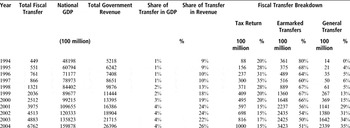
Table 1 shows figures for transfers from the centre to the provinces between 1994 and 2004. It shows that these transfers as a share of GDP grew from 1 per cent to 4 per cent during this period. Meanwhile the transfers as a share of total government revenue rose from 9 per cent to 26 per cent as the fiscal system became more centralized.
Centre-Provincial Intergovernmental Fiscal Transfers (1994–2004) (10,000 yuan)

Source:
China Fiscal Statistical Yearbooks.
Among the new categories of transfers introduced in 1994, the tax return subsidies are the ones that higher levels of government give to lower levels after the latter have collected and handed over taxes. Since the tax return is aimed at compensating local governments rather than redistributing funds, the growth in the total amount of returned tax has been limited to 0.3 times the growth rate of the revenue collected through VAT and consumption tax.Footnote 16 Over time, tax return as a share of total VAT and consumption tax will shrink. As shown in Table 1, the tax return subsidies as a share of total transfers reached their highest level of 35 per cent in 1997, falling to 15 per cent in 2004.
The second major category of fiscal subsidies is the general transfers. These include several types of transfer that aim to narrow regional disparity in expenditure through a formula-based approach. Their distribution is affected by variables such as provincial GDP, student–teacher ratios, number of civil servants and population density. Although under-funded at the start in 1995 with a share of only 4 per cent of total fiscal transfers, general transfers increased rapidly after 2001 as the central government paid more attention to the issue of regional disparity and as it grabbed more income tax revenue from local governments. As Table 1 shows, by 2004 general transfers already accounted for 35 per cent of total fiscal transfers.
General transfers include a variety of fiscal funds that are consistent with changes in central policy. In 1995 the “transitory period transfer” (guoduqi zhuanyi zhifu 过渡期转移支付) was introduced as the first formula-based grant in China's intergovernmental framework. Based on calculated local standard revenue and expenditure, this transfer was intended gradually to equalize fiscal expenditure across localities. After 2002 it became known as the “general purpose transfer,” and grew rapidly from 2.2 billion yuan in 1995 to 112.1 billion yuan by 2005.
Since 1999, a new type of general purpose grant known as “wage subsidies” was distributed and was the means by which the central government raised the salary and pensions of personnel in public institutions four times between 1998 and 2003.Footnote 17 Wage subsidies grew from 10.8 billion yuan in 1999 to 99.4 billion yuan in 2005. In 2000, a general transfer was also introduced to support minority regions (eight provincial units and eight prefectures), growing from 2.5 billion yuan in 2000 to 15.9 billion yuan in 2005. The “rural tax-for-fee reform fiscal transfer” (nongcun shuifei gaige zhuanyi zhifu 农村税费改革转移支付) is another important fiscal subsidy which came into being when the central government enacted the rural tax reform of 2003. It is calculated using “standard expenditure” and the difference in pre- and post-reform revenue collection.Footnote 18 This transfer increased from 8 billion yuan in 2001 to 65.4 billion yuan in 2005. Even though the names given to some of these transfers might suggest that they are special-purpose funds, in reality they are classified as general transfers because they are formula-based and local governments have significant discretion over their usage.
Unlike the general transfers, the earmarked subsidies (EMS) are delivered on an ad hoc negotiated basis and are designated for specific purposes. These range from infrastructure development, basic construction, education and healthcare to disaster relief as well as general operating funds for government administration and public service units. As Table 1 indicates, EMS accounted for over 80 per cent of all fiscal transfers in 1994 and this share remained as high as 51 per cent in 2004. At the county level, EMS took the form of numerous individual grants from either the centre or the provinces to the county-level governments, and then further to the designated bureaus and projects. In most cases, these grants required local matching funds (peitao zijin 配套资金).Footnote 19 Unlike the formula-based general transfers, the allocation of EMS is often contingent upon specific central policies as well as informal personal connections and patronage relations between local government agencies and upper levels of government. If approved, the funds are distributed to the province and the county and then finally to the designated bureaus and projects. Since central policies may change over time and personal relationships with officials at the provincial and central levels may vary, it is not unusual for the amount of EMS allocated to a locality to vary drastically year by year.
Local incentives under central mandates
While the general transfers indicate the centre's wish to correct for regional fiscal disparity, the earmarked transfers reveal its priority to realize certain policy targets in public service provisioning. Yet the diversion of funds to other uses has remained a persistent problem. China's National Audit Office reported that between 1997 and 1999 20.43 per cent of earmarked poverty relief funds, worth a total of 4.34 billion yuan (US$640 million) had been misallocated.Footnote 20 Most of the diverted funds had been used to support the expansion of the local bureaucracy, and this expansion has been one of the most serious problems facing the central government since the mid-1990s.Footnote 21 Despite the central government's downsizing efforts, the number of people working in county and township administration and public service units has continued to grow. Over the past decade, on average public sector employment in China has increased as much as one million per year.Footnote 22
Some scholars have suggested that the diversion of public funds tends to be most acute in political systems in which local governments are not accountable to the people. In the case of China, the seriousness of the local government's lack of accountablity to the people varies across regions according to their level of socio-economic development. In more developed regions revenue comes mainly from local businesses and so local governments must provide effective public services in order to maximize future revenue streams. However, in less developed regions, local governments are heavily dependent on upper-level transfers and so have relatively few incentives to serve their constituencies.Footnote 23
In less developed regions where local government's finances are transfer-based and where government employment ranks among the best local job opportunities, government expansion is especially pronounced. Transfer dependence not only gives perverse “soft budget constraint” signals to local governments, but may also easily turn the public sector's resources to uses that bear no relevance to their original purpose. This is because transfer dependence severs the link between taxes and benefits.Footnote 24 When local revenue and general transfers are not sufficient to meet the salary and operating costs of an expanding bureaucracy, the earmarked funds are diverted. This phenomenon is closely related to local corruption when officials pursue illegal gains by appropriating funds to selected groups. Yan Sun, for example, has noted how some local officials may allocate funding for personal gain by not going through the formal procedure.Footnote 25 Some Chinese scholars have provided evidence of systematic diversion of transfer funds. For example, Zhou found that after the rural tax reform, local governments at the township level diverted “tax-for-fee reform fiscal transfer” to raise salaries for township civil servants, even though the funds were supposed to be used to cover the shortfall of education expenditure and the operating costs for township government and village community organizations. Similarly, Zeng discovered that various earmarked transfers were diverted to pay wage arrears to township cadres.Footnote 26 China's central government adopted the general transfer system to compensate local governments' expenditure on staffing, operation, administration and public goods supply, so that social welfare could be improved without jeopardizing the payment of local bureaucrats and their loyalty towards the regime.Footnote 27 However, when local revenues and general transfers cannot satisfy local personnel and administrative expenses, disallocation of earmarked funds follows.
Not only does local government in China lack accountability to the people, it also lacks accountability to the upper levels of government. There is much discussion among China specialists about the persistence of a “policy implementation gap.” Scholars have noted how ambiguous policy content creates scope for local interpretation of central government intentionsFootnote 28; how the relatively low ranking of some policy areas on the central government's agenda creates possiblities for local governments to exercise discretionFootnote 29; and how local governments' ideas about what is desirable or feasible may affect what is implemented.Footnote 30 Such analysis suggests that local governments are able to conditionally ignore central government mandates.
Since 2002, in a bid to increase local government accountability in ways that would improve the usage of some types of earmarked funds, the central Ministry of Finance has required that county bureaus of finance establish designated accounts (zhuanhu guanli 专户管理) with closed circulation (fengbi yunxing 封闭管理). The idea is that, by separating out designated funds from other funds, the transfers become more amenable to auditing by upper levels. For instance, in 2002 the Ministry of Finance announced that social allowances were to be managed under designated accounts. Provincial governments have similarly required that the county bureaus of finance establish designated closed circulation accounts for distributing earmarked transfers.Footnote 31 But does mandating the use of transfers through stricter rules and regulations enable the centre to improve the use of funds at the lower administrative levels? Or do local bureaucrats find ways to evade central regulations when they conflict with local vested interests? We now turn to our case study to address these questions.
The Case of K County in a North-western Province
As one of China's 592 nationally designated poor counties, K county offers an appropriate case for exploring the effects of increased intergovernmental transfers and central government supervision on the usage of earmarked subsidies at the local level. K county receives large amounts of intergovernmental transfers including EMS and depends mainly on these funds for its fiscal functioning. In 2004, 96 per cent of K county's 242,300 residents were “rural.” The 2006 figure for farmers' per capita net income was 1,321 yuan, which represented only 36.8 per cent of the national average for that year (3,587 yuan). In 2006 the per capita disposable income of urban residents in K county was 4,784 yuan, only 40.7 per cent of the national average (11,759 yuan).
Our examination of the factors affecting EMS usage is based on a data set of the allocation and actual delivery of all earmarked funds in K county between 1998 and 2004. Further data collected in 2006 provide detailed information about all earmarked funds from the prefectural, provincial and central levels of government for each of the seven years. Under the current transfer system, most earmarked funds need to go through the county bureau of finance before being allocated to their designated bureaus and projects. The diversion of funds by the county administration usually occurs before the money has reached the designated bureaus or projects. With the help of the county bureau of finance we have been able to calculate the proportion of each earmarked transfer that was actually delivered. As mentioned above, we have further been able to calculate the delivery rate and the diversion rate of over 2,000 earmarked transfers that K county received during the period. To simplify the analysis, we have divided our sample period into before and after 2002. This division is justified because it was after 2002 that the regulation of earmarked funds tightened, and also when the new Hu-Wen leadership came to power and the amount of general transfers to less developed regions increased dramatically.
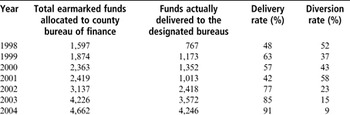
The data in Table 2 show the dramatic decline in the diversion rate of EMS after 2002 as compared to the earlier period. Before 2002, it ranged between 52 per cent in 1998 and 49 per cent in 2001. But it dropped to 26 per cent in 2002, futher to 18 per cent in 2003 and to only 13 per cent in 2004. If we calculate the diversion rate for the two periods, it was 48 per cent between 1998 and 2001, falling to 18 per cent between 2002 and 2004.
Earmarked Transfers in K county, 1998–2004

Source:
Bureau of finance, K county.
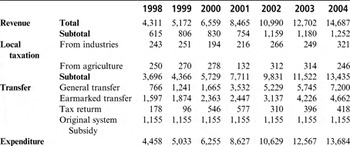
Below we explore in greater detail the two main factors underpinning the decline in the diversion rate: the overall increase in intergovernmental transfers and the increase in supervision of EMS usage. The increase in intergovernmental transfers has eased local budgetary pressures and thus reduced the need for local government officials to divert EMS. The strong and growing dependence of K county government on intergovernmental transfers can be seen in Table 3 which presents details of the composition of the county-level fiscal income, including subsidies and tax revenue, between 1998 and 2004. In 1998, locally collected revenue was around 6.15 million yuan, 14.3 per cent of the total revenue. By 2004, it had grown to 12.52 million yuan but as the total revenue was now 133.3 million, the local contribution had shrunk to only 8.52 per cent of the total.Footnote 32 Among the four types of transfers, earmarked transfers and general transfers dominated, with their combined share growing from 63.9 per cent to 88.3 per cent. In 1998, general transfers were less than half the total amount of earmarked transfers but subsequently they grew rapidly. By 2004 they totalled 720 million yuan, 154 per cent of earmarked transfers. As the use of these general transfers is mostly at the discretion of local governments, the impetus for them to divert earmarked transfers is reduced.
Sources of Revenue in K County, 1998–2004

Source:
Bureau of finance, K county.
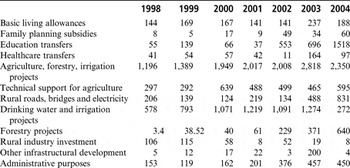
Second, the tightening of supervisory mechanisms across a range of policy areas further contributes to the decline in the EMS diversion rate. At this point it is useful to distinguish the amounts allocated for different types of EMS which may reveal possible variations in local responses to the tightened fiscal supervision arrangements. As shown in Table 4 the amount of EMS allocated to education has increased dramatically: it became the second largest category during the post-2002 period, accounting for approximately 23 per cent of total EMS. The allocation of funds for rural and agricultural infrastructure and technology has also grown year-on-year. In the subcategory of irrigation and water, however, a fall in EMS funds in 2004 is unlikely to reflect a shift in central government policy priorities: it is more likely that monies allocated for construction and maintenance in 2003 reduced the need for the subsequent allocation of funds for this purpose.
Annual Breakdown of Six Subcategories of Earmarked Funds in K County

Source:
Compiled by authors based upon data from bureau of finance, K county.
Table 5 shows the diversion rate for the six categories of earmarked funds by year and also for the two periods before and after 2002. A comparison between the two periods reveals that not only has the EMS diversion rate fallen from 48 per cent to 15 per cent overall, but that a decline has occurred across most categories of EMS. The steep decline in the categories which have a strong social and development component, including education, health, living allowances, and agricultural and rural development perhaps reflects at least in part the Hu-Wen administration's policy focus on remedying uneven development. The slight increase in the diversion rate of family planning EMS in the post 2002 period is puzzling, and may reflect the tightened regulations that have been applied to supervise EMS usage in other sectors, as discussed below.
Diversion Rates of Earmarked Funds for Six Sub-categories by Year (% of total line allocations)

Source:
Compiled by authors based upon data from bureau of finance, K county.
Tightened regulations to supervise EMS usage have greatly affected the areas of education, and rural and agricultural development. With regard to education, during the 1990s the township and villages dealt with their responsibility for teachers' salaries by collecting surcharges and levies (santi wutong 三提五统). The fiscal reform initiated in 2001 and re-emphasized in 2003 made the county-level government responsible for providing rural compulsory education and for paying teachers' salaries. But despite this reform, aimed in part at making education funds more amenable to monitoring, the central and provincial governments still found it necessary to devise further measures to reduce the diversion of funds from education projects. As an example, in 2002 the provincial government allocated a transfer of 3.96 million yuan for a “school distance education” project according to a method called “claim reimbursement at the provincial level” (shengji baozhangzhi 省级报账制). Under this system, the eligible school first needed to pay for the construction of facilities and then claim reimbursement directly from the provincial bureau of education. This system minimized the risk of diversion because the earmarked funds did not even need to go through the county bureau of finance.
As for the EMS for agricultural and rural development, these are usually classified as poverty relief funds and are therefore managed through the county poverty relief offices. These funds are used not only for agriculture and rural infrastructure development, but also for technical support and extension projects as well as forestry (such as the sloped land conversion programme); they currently represent part of the effort of the centre to reduce income inequalities across sectors and regions. In 2003 the provincial government urged the county poverty relief office to set up designated accounts to receive all poverty alleviation funds. It was required that the delivery rate of poverty relief funds to the designated accounts reach 80 per cent by 2003 and 100 per cent by June 2004.Footnote 33 The EMS for agricultural and rural development therefore became subject to the more stringent and closer monitoring that has applied to poverty alleviation funds more generally.
Making the Best of Transfers
The small body of existing literature contends that for the most part China's intergovernmental fiscal transfers have not been used to provide public goods. Drawing on a Ministry of Finance dataset covering every county-level unit in China in 1995 and 2000, Shih and Zhang explain the political incentives behind the use of these intergovernmental transfers. They argue that instead of financing local education or healthcare, subsidies from the centre to the county levels of government have been invested mainly in administration.Footnote 34 However, their research collapses all types of fiscal transfers into a single category, while our focus is on a particular subcategory, the EMS, which is specifically designated to finance local public goods, including infrastructure, education and healthcare. How have local governments taken advantage of the EMS? We find that they adopt a variety of strategies depending on the regulation of EMS usage. In some instances, the county government intervenes before the funds are distributed to the different bureaus and projects. In other instances, it tends to export fiscal burdens for public expenditure to different bureaus after the EMS is allocated to them.
Although the increase in general transfers from upper levels and the implementation of stricter rules governing fund management that occurred after 2002 raised the delivery rate of EMS, K county government still faced immense fiscal pressure. This was caused by rises in the salary and operating expenditures of public schools and public health institutions. From 1998 to 2004, public expenditure in K county grew from 10 million yuan to 25 million; of this, salary expenditure was 1.8 million yuan in 1998 but reached 6.3 million in 2004. To make matters worse, the total debt accumulated in K county reached 100 million yuan by 2004, 80 per cent of which was salaries.Footnote 35
Intervening before the EMS gets to the bureaus
The procedure for obtaining earmarked funds involves subordinate bureaus submitting their project applications to the county planning commission (now known as the development and reform commission). The commission submits all the applications to the finance bureau and the corresponding line bureaus at the provincial level and sometimes even directly to the central ministries. If the funding application is approved, both the initial notification and the approved funds go to the county finance bureau rather than to the subordinate bureaus that originally applied for the funds. When the funds arrive, the major county leaders then decide what proportion of the funds to allocate to which bureau.
Our interviews with officials in the county bureau of education suggest that, in some cases, they may not be aware of the exact amount of EMS allocated until much later. For example, one official told us that in 2002 a total amount of 1.65 million yuan in central subsidies was appropriated to the bureau for the specific purpose of “Renovating the ramshackle buildings of middle and primary schools” (weifang gaizao 危房改造). But it was not until the city audit office conducted an evaluation of the fund use that the education bureau found out that the total amount of EMS originally allocated for this purpose was 2.11 million yuan.Footnote 36 Indeed in 2005, only 30 per cent of the total 8.04 million yuan in central subsidies allocated for “Renovating the ramshackle buildings of middle and primary schools” ever reached the bureau of education.
The county leadership is selective in making decisions about fund diversion. There are some implicit rules pertaining to which EMS can be diverted and which cannot. For example, local government officials need to be particularly cautious in misappropriating the EMS designated for the centre's “political projects” that the current central leadership wants to showcase. One such project is the “two exemptions, one subsidy” initiated in 2004 to support rural education. Through this, the central government has provided earmarked subsidies for rural students from poor families for free tuition, textbooks and boarding. Diverting such funds, if ever discovered, would incur serious political consequences.Footnote 37
Yet other types of earmarked funds, in particular those which are largely contingent upon the strength of local connections in order to gain approval, are much more amenable to diversion. In China, different central departments and ministries have a variety of programmes to distribute funds based upon ill-defined and non-transparent mechanisms and standards. For example, in addition to the Fiscal Poverty Alleviation Funds, many central government ministries have their own programmes in skills training, micro-credit, infrastructure maintenance, village cultural activities, and outreach activities for women, youths and the elderly. The relevant ministries have the authority to target programme recipients and to allocate poverty relief funds to the localities they choose. Many county governments have set up liaison offices in Beijng (zhujingban 驻京办) so that they can collect information about EMS opportunities and contact officials in the central ministries that grant programmes. As a result, “running for programmes” (pao xiangmu 跑项目) has become a common method of competing for earmarked funds. It is reported that these liaison offices spend more than 20 billion yuan (US$2.5 billion) annually to build and nurture connections with central ministries, expenses deducted subsequently from any project funds they may obtain.Footnote 38
Distributing both EMS and fiscal burdens to designated bureaus
So far our analysis has suggested that by requiring that earmarked transfers are managed through “designated accounts” with closed circulation, upper levels of government have to some extent reduced the county bureaus of finance's opportunities to divert earmarked transfers. But does this mean that the funds which arrive at the bureaus are actually used for the designated purpose? Our fieldwork in K county indicates that the answer is probably no. The operation of designated accounts with closed circulation may help raise the delivery rate to the recipient bureaus. But even so, the county government may still be able to use the money indirectly by exporting fiscal burdens to the bureaus that receive the earmarked funds. In other words, the county government may either cut the operating funds (shiye fei 事业费) or else increase the numbers of personnel that need to be supported by the bureau that receives the funds. Either way, the bureaus are forced to divert the EMS by themselves in order to make ends meet (zixing pingheng shouzhi 自行平衡收支).
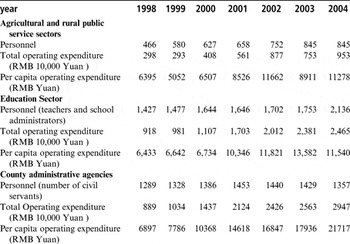
Table 6 presents the number of personnel and budgetary operating funds for two public service sectors that received a large amount of EMS in the post-2002 period: the public service units (PSUs) related to agricultural and rural development (agriculture, irrigation, forestry) and those related to education. In China's public employment, the employees hired in these two sectors are called the fiscal dependents of PSUs. These staff members are different from civil servants.Footnote 39 The personnel and operating expenditure information for government administrative agencies and Party organizations is also presented in Table 6. The operating expenditure for each sector is defined as the sum of staff salaries and office operating costs. Retirees are not included since they receive separate budget funds.
Growth in Operating Funds and Personnel in Three Sectors, 1998–2002

Source:
Data from bureau of finance, K county.
A comparison of the three sectors demonstrates the following: first, the number of personnel in the education sector grew distinctively faster than those in county administrative agencies and in the agricultural and rural development PSUs. In particular, after 2002, the education sector experienced an astonishing growth of over 400 personnel within two years. The agriculture and rural development PSUs also saw a steady growth of personnel between 1998 and 2004, while the number of civil servants – that is, the personnel in all county administrative agencies and Party organizations – in fact decreased in the post-2002 period.
Second, the per capita budgetary operating expenditure of the county administrative agencies grew much faster than those of the agricultural and rural development PSUs and the education sector. The three sectors started at a more or less similar level in 1998, yet ended up very differently. By 2004, the per capita operating expenditure for the education sector and the agricultural and rural development PSUs were 11,540 and 11,278 yuan respectively, while that of the county administrative agencies was 21,717 yuan. By 2004 the public service sectors that received the bulk of earmarked subsidies were therefore left far behind the county administrative offices with regard to their per capita operating expenditure. If we consider that the average monthly salary of employees in PSUs in K county was approximately 900–1,000 yuan, the operating expenditures for the two sectors were barely adequate to cover staff salaries, let alone office operating costs.
Table 6 shows a clear tendency in the overall picture of personnel and operating expenditure for the three sectors. From 2002 to 2004, the education sector received 22.5 per cent more budgetary operating funds. However, this could not offset the faster growth (25.5 per cent) in the number of its employees. The result was a reduction in the per capita operating expenditure in this sector. As for the agriculture and rural development PSUs, there was a 12.4 per cent growth in the number of employees but the budget operating funds grew by only 8.7 per cent. By contrast, since 2002 the county administrative agencies reduced the number of their fiscal dependents by 5.8 per cent but witnessed a growth in their total operating expenditure of 21.5 per cent.
The story suggested by the data in Table 6 is consistent with explanations offered in interviews with officials in different bureaus and at different administrative levels about how the county government diverts the EMS indirectly through the export of its fiscal burdens. If we view the upper-level earmarked transfers to the designated sectors as an exogenous “shock” to the existing balance of interests between the different government sectors within a locality, we see that the county government has reacted to this shock by redistributing the personnel and operating funds across bureaus. In order to cope with such external shocks, the county government has deployed more employees to certain sectors and has restricted the allocation of budgetary operating funds to others that have received EMS.
Officials in K county explained that the county government had chosen to deploy more employees into the education sector than to other sectors. There are two reasons that suggest that this is justified. First, during the post-2002 period the development of rural education has been one of the central government's top priorities: between 2002 and 2004, there was a more than 20 per cent growth in the number of primary and junior school students as the county government took steps to reach the national nine-year compulsory education target. Second, in aggregate terms, the within-roster (bianzhinei 编制内) quota of personnel in K county's education sector was unfilled.Footnote 40 But even though the quota was not ben filled in aggregate terms, at village and township levels the situation was more complex. According to an official from the K county bureau of education, only schools in remote and mountainous villages were understaffed: these schools faced recruitment problems because people were generally unwilling to take up posts with adverse and inconvenient living conditions. By contrast, after 2002 schools located in county seats and townships near transport connections faced the opposite problem of excess staff. In K county between 2002 and 2004, around 60 per cent of new employees were posted to schools that were already overstaffed and many were not even teachers but school administrators. To make matters worse, of the remaining 40 per cent of new employees that ended up being assigned to schools in remote and mountainous villages, many were subsequently able to arrange to be reassigned to schools in the county seat and major townships. Their reassignment to a more desirable location commonly required the payment of bribes to the county education bureau chiefs or even to key county leaders, with the amount ranging between 20,000 and 50,000 yuan. Indeed, expanding the number of school staff has become an important way for county leaders to obtain additional income.
In 2002, in contrast with the nominally understaffed education sector, the PSUs in the agriculture and rural development sector were deemed to be overquota. Such a designation made it difficult for the county government to place more people in these PSUs. It responded by cutting their operating funds so that they were forced to divert the EMS by themselves. To give a concrete example of fund diversion by individual bureaus that receive the EMS, in 2004 K county received an earmarked poverty relief fund of 1 million yuan to implement a comprehensive rural development project for a poor and remote village. This project was implemented by the county poverty relief office to build within-village roads, construct water conservancy infrastructure, install drinking water facilities for individual households and renovate school buildings in the village. In 2004 we found that there were as many as eight project administrators allocated from both the county and township level to oversee the work. The original poverty relief subsidy had been granted on the condition that the county government commited matching funds – indeed the county government had used EMS money from elsewhere to demonstrate to higher levels a willingness to match funds for this project, but then rediverted the money. In the absence of matching funds, the considerable miscellaneous expenses of the eight administrators (for vehicle fuel, mobile phones, dining and so on) were therefore all deducted from the poverty relief office's EMS.
We see therefore that the county government's response to the increase in the availability of EMS funds and to the tightened supervision of EMS usage has been to devise strategies which enable it to divert the EMS indirectly and retain resources for itself. The result is that whereas the education and agricultural/rural development PSUs have experienced a severe shortage in operating funds, the county administrative agencies have enjoyed a rapid increase in the sum of theirs. Interviewees in K county told us that in comparison with the personnel in PSUs, the civil servants in the county government administration and Party organizations enjoyed higher salaries. Further, as the operating funds of county administrative agencies have increased in the past few years the amount of money spent on buying and using new cars, for food bills and paying for networking to obtain more EMS has been growing rapidly. Thus, despite increased surveillance from the centre, the local government is able to deal with the presence of EMS in ways which dilute the centre's policy and budgetary intentions.
Conclusion
Some studies have attributed China's economic successes to forced and specified division of development responsibilities to lower levels of government. Rong et al., for instance, used the term “pressurized system” (yalixing tizhi 压力型体制) to refer to China's management mode of dividing up tasks, conducting assessment and giving material awards to officials at the county or township level in order to attain the targets set by the higher authorities.Footnote 41 However in this case study we find that lower levels of government counter central policies by successfully evading responsibilities and by shifting fiscal burdens of expansion to subsidy recipient bureaus.
In 1994, the central government initiated a series of reforms that explicitly centralized revenue whilst leaving expenditure decentralized. Under such a system, the provincial, municipal and county levels of government all rushed to devolve their burdens to subordinate government bodies. Bernstein and Lü, for instance, have argued that in the 1990s decentralization rendered the central regulation of local predatory behaviour ineffectual.Footnote 42 However, as mentioned above, the experience of many low and middle income countries suggests that it is possible to implement institutional arrangements to minimize the information asymmetry problems inherent in a decentralized fiscal system.Footnote 43 Scholars have suggested that these arrangements include clarity and transparency in delineating the responsibilities of different levels of government; government accountability in fulfilling these responsibilities; the upholding of such accountability through monitoring by independent institutions; and enhanced democratic representation at the lower levels of government.
In China the central party-state has preferred to avoid such fundamental institutional changesFootnote 44 and has instead adopted internal regulatory measures aimed at strengthening its supervision of funds usage. On initial consideration, tightening control at the cost of local discretion would seem to be a plausible way for the central government to improve the effectiveness with which its policies are implemented. Indeed if we were to look solely at the the decline in the diversion rates of EMS in the pre- and post-2002 periods it would be reasonable to conclude that increased internal monitoring had achieved considerable success. Yet, as we have shown, local government agents have been able to use indirect means to evade supervision and have ultimately behaved in ways that have diluted central government policy intentions. Meanwhile, and somewhat ironically, the very viability of the system – the capacity of each level to make ends meet – actually depends on the downward shift of fiscal burdens.
Even though unfunded policy mandates clearly force lower-level bodies to be creative in allocating their limited resources in ways that enable them to meet their expenses, there nevertheless remains the question of why these funds are diverted towards bureaucratic expansion and the funding of fiscal dependents rather than towards other uses that more directly serve the public good. For instance, why did the local government in K county not respond to the lack of funds by opting to provide more of one public good and less of another?
Clues for explaining the actions of K county officials may be found in comparative studies that identify an association between political institutions and the incentives that underpin the allocation of public resources.Footnote 45 According to Bueno de Mesquita and his co-authors, in circumstances in which political leaders depend on a wide coalition for their support, as is the case in democracies, turning public resources into private goods to sustain this support is not feasible because the largesse would be spread too thinly. But in circumstances in which the continued support of a relatively small number of administrators is central to government power, as is the case in an authoritarian system, public resources may buy loyalty; indeed loyalty is an important component of the normative foundation of such systems.Footnote 46
This insight sheds light on the public funding priorities of officials in K county. Jobs and posts in the public sector cemented the loyalty of administrative personnel, the leadership's key constituency. The jobs maintained the support of lower-level cadres for their leaders and recruited even more supporters into the system as a whole, thereby expanding their numbers. It also worked in another respect, in that maintaining social stability through employment provision was crucial for the political survival of county and township leaders. We could speculate that the central government leaders know only too well that diversion of funds occurs, because it guarantees the stability and survival of the system at relatively low fiscal cost. Yet they also avoid punishing local bureaucrats because they know that local governments' satisfaction depends on them obtaining some benefits.
This analysis has shown that increased fiscal supervision within an authoritarian system is inadequate to the task of ensuring more efficient fiscal functioning because it compels subordinates at each level to export their burdens, placing immense pressure on those below them. Further, in an authoritarian system, local people on the whole have relatively little leverage when they see that central government policy mandates associated with social development are not realized in their communities. In the absence of more fundamental institutional reforms, the strategies of local agents in indirectly diverting earmarked funds away from their designated purposes and towards bureaucratic expansion are likely to continue.