I. INTRODUCTION
In a large number of solid solutions based on binary and ternary compounds, in the range of small impurity concentrations (∼0.5–1.0 at.%), we observed anomalies in the property-composition dependences (e.g., see Refs. Reference Rogacheva1–Reference Rogacheva7) and attributed themReference Rogacheva8 to the manifestation of critical phenomena accompanying concentration phase transitions of percolation type occurring under the transition from diluted solid solutions, in which the interaction between impurities can be neglected, to concentrated ones, in which so-called infinite cluster is formed.Reference Stauffer and Aharony9
After the impurity continuum is formed, states with spatially correlated distribution of atoms (long- or short-range ordering) corresponding to the minimum in the crystal-free energy can be realized. If an impurity is introduced into the matrix in the form of a chemical compound, chemical interaction between the constituents of the compound may take place in the solid solution and lead to a short-range ordering, in particular the formation of neutral complexes whose composition corresponds to the composition of the introduced compound or that of intermediary phases. Analyzing the concentration dependences of properties and using the phenomenological method of cluster components, we made the conclusion about a microheterogeneous structure of semiconductor solid solutions based on SnTe.Reference Gorne, Zhigareva, Ivanova and Rogacheva10–Reference Rogacheva14 As percolation effects and ordering processes in solid solutions significantly influence structure and physical properties of crystals, it is of interest to expand the range of objects and properties to be studied.
PbTe-based solid solutions are widely applied in thermoelectricity, optoelectronics, IR devices, holography, and other fields of science and technology.Reference Fano and Rowe15–Reference Abrikosov and Shelimova17 Bismuth is one of the most important donor impurities in PbTe. Introducing bismuth, one can change electron concentration and thus maximize values of thermoelectric figure of merit in crystals and thin films, optimize parameters of p-n junctions in laser diodes, and so on. In this connection, it is necessary to know the defect-formation mechanisms and the behavior of properties under introduction of Bi.
Earlier,Reference Rogacheva and Lyubchenko18 we showed that the introduction of elementary bismuth into PbTe leads to a complex character of the concentration dependences of properties in the region of Bi solubility (∼1.5 at.% Bi), which was attributed to a change in the defect-formation mechanism under increasing Bi concentration. Studying the property-composition dependences in the PbTe-BiTe system (cation substitution), we established that in the range of small BiTe concentrations (∼1 mol%), there are concentration anomalies in structural and kinetic properties and interpreted them as a manifestation of critical phenomena associated with percolation-type transitions.Reference Tavrina, Rogacheva and Pinegin19 In Ref. Reference Rogacheva, Laptev, Ploskaya and Efimova20, it was shown that in the ternary system Pb-Bi-Te, the maximum extension of PbTe-based solid solutions region corresponds to the PbTe-Bi2Te3 section. In Refs. Reference Rogacheva7, Reference Rogacheva14, and Reference Rogacheva, Laptev, Ploskaya and Efimova20, the possibility of the formation of neutral chemical complexes at sufficiently large Bi2Te3 concentrations in PbTe-based solid solutions was suggested. To support that suggestion, detailed complex studies of properties of the above-indicated system are required.
The goal of this work is to reveal effects connected with the transition from diluted to concentrated solid solutions and with self-organization processes in PbTe-based solid solutions in the PbTe-Bi2Te3 system at considerably high impurity concentrations, by studying the dependences of unit cell parameter a, width of the x-ray diffraction lines B, and microhardness H on the Bi2Te3 concentration for alloys subjected to different types of heat treatment.
PbTe crystallizes in a NaCl-type lattice with unit cell parameter a = 0.645 nm.Reference Abrikosov and Shelimova17 Bi2Te3 has a tetradymite structure of trigonal singony (space group R3m–D Reference Rogacheva and Krivulkin53d) based on a nine-layer close packing of Te atoms in which two-thirds of octahedral voids are occupied by Bi atoms and the remaining one-third is vacant. The rhombohedral lattice of a tetradymite type can be considered as a hexagonal layered structure with unit cell parameters a = 0.438 nm and c = 3.04 nm.Reference Goltsman, Kudinov and Smirnov21 The phase diagram of the PbTe-Bi2Te3 system was studied by different authors (see for review Ref. Reference Shelimova, Karpinskii, Konstantinov, Avilov, Kretova, Nikhezina and Zemskov22). It was established that in that system, there are five ternary compounds: PbBi8Te13, PbBi6Te10, PbBi4Te7, Pb2Bi6Te11, and PbBi2Te4 having tetradymite-like structures with octahedral voids occupied by Pb and Bi atoms. Hexagonal lattices of those compounds are formed by multilayered stacks of different types alternating in a regular fashion in the direction of a hexagonal axis c. The solubility of Bi2Te3 in lead telluride according to different authors ranges from 5 to 10 mol%.Reference Rogacheva, Laptev, Ploskaya and Efimova20, Reference Shelimova, Karpinskii, Konstantinov, Avilov, Kretova, Nikhezina and Zemskov22, Reference Golovanova, Zlomanov, Tananaeva and Licheva23
As a result of investigations carried out in this work, it was established that the dependences of B and H on solid solution composition exhibit a complex behavior depending on the temperature and duration of annealing and indicating a decrease in the stress level in the crystal lattice in certain concentration intervals. The observed effects were attributed to percolation phenomena in the impurity subsystem of the crystal and the self-organization processes taking place in the solid solution.
II. EXPERIMENTAL
Polycrystalline samples of PbTe-Bi2Te3 alloys (0–10 mol% Bi2Te3) were synthesized from high purity (not less than 99.9999%) elements in quartz ampoules evacuated down to 10−3 Pa. The melt was kept at temperature ∼1300 K for 5– 6 h, then cooled down to 820 K, and annealed for 300 h. After that the samples were either quenched in ice water [heat treatment (HT) 1] or cooled down in the switched-off furnace (HT 2). All alloys were prepared at the same time to ensure identity of the preparation conditions.
Simultaneously, we studied the samples that had been subjected after HT 1 to aging for 18 years (HT 3) and 21 years (HT 4) at room temperature. The chemical composition and homogeneity of the samples were determined by electron-probe microanalysis and by energy dispersive x-ray spectroscopy using a scanning electron microscope. X-ray powder diffraction study was performed using DRON-2 diffractometer and Ni-filtered Cu Kα radiation. A precise determination of unit cell parameter a was performed for (644)α + (820)α. reflections with an accuracy of Δa = ±10−5 nm. The microhardness H was measured using a PMT-3 apparatus with a pyramidal diamond indentor at a load of 0.49 N. The H values were obtained as the mean value of the measurement of 30 indentations and the relative standard error being 0.5–1%.
III. EXPERIMENTAL RESULTS
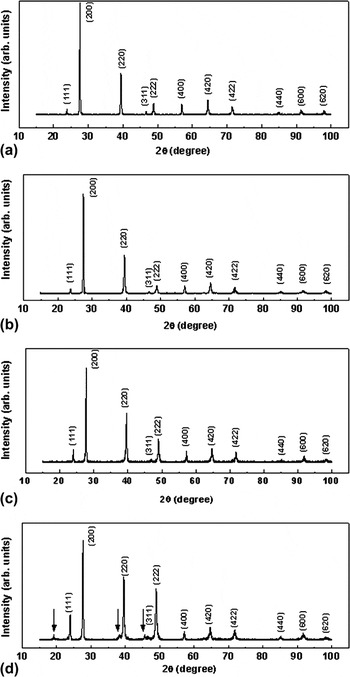
The analysis of the x-ray diffraction data showed that all samples crystallized in a NaCl-type structure, and no additional peaks were detected in x-ray diffraction patterns дo 7 mol% Bi2Te3 [Figs. 1(a)-1(d)]. Very weak additional reflections appeared only in the sample with the maximum concentration of Bi2Te3 (10 mol% Bi2Te3). The position of those reflections allows us to ascribe them to the ternary compound PbBi2Te4Reference Shelimova, Karpinskii, Konstantinov, Avilov, Kretova, Nikhezina and Zemskov22.
X-ray diffraction patterns of PbTe-Bi2Te3 alloys after HT 2 heat treatment: (a) PbTe; (b) 3 mol% Bi2Te3; (c) 5 mol% Bi2Te3; and (d) 10 mol% Bi2Te3.

The results of microstructural analysis confirmed the x-ray diffraction data: up to 7 mol% Bi2Te3, the PbTe-Bi2Te3 alloys had a monophase structure with the average grain size of 150 ± 10 μm, whereas in the sample containing 10 mol% Bi2Te3, the inclusions of a second phase were observed.
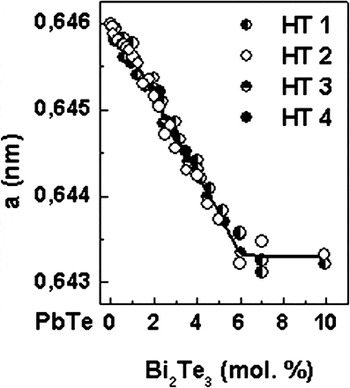
From Fig. 2, it is seen that an increase in Bi2Te3 concentration leads to the linear decrease in the unit cell parameter of PbTe-Bi2Te3 solid solutions up to 6.5 ± 0.5 mol% Bi2Te3. At higher concentrations, a does not change with changing composition, which indicates that the solubility limit is reached. For all types of heat treatment, the dependences of a on composition practically coincide.
Unit cell parameters a of the PbTe-Bi2Te3 alloys versus Bi2Te3 concentration for different types of heat treatment. The description of the types of heat treatment HT 1, HT 2, HT 3, and HT 4 is given in the text.

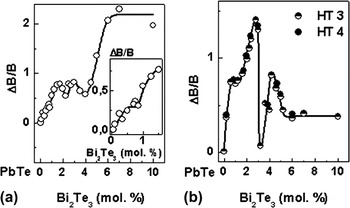
In Fig. 3, the dependence of the relative x-ray diffraction line width ΔB/B for (644)α + (820)α line (B is the PbTe line width) on Bi2Te3 concentration for different types of heat treatments is presented. After HT 1 and HT 2, under introduction of Bi2Te3 up to ∼2 mol%, ΔB/B increases; however, then, in the concentration range of 2–4 mol% Bi2Te3, in the dependence of ΔB/B on composition, a distinct step with oscillations is observed [Fig. 3(a)]. After that, starting from ∼4 mol% Bi2Te3, ΔB/B width increases again, and after 6.5 ± 0.5 mol% Bi2Te3, it remains constant, which can be explained by reaching the solubility limit at those compositions. After HT 2, in the dependence of ΔB/B on composition in the range of concentrations 0.5–0.9 mol% Bi2Te3, one can observe a section in which ΔB/B does not practically change. After HT 3 and HT 4, the behavior of the concentration dependence of ΔB/B becomes more complex [Fig. 3(b)]. A distinct step in the range of concentrations 0.5–1.5 mol% Bi2Te3 is observed. At higher concentrations, ΔB/B increases again up to ∼2.8 mol% Bi2Te3 and then abruptly drops almost to 0, i.e., the line width practically corresponds to B of the initial PbTe compound. Further increase in the Bi2Te3 concentration leads first to the growth in ΔB/B up to ∼4 mol% Bi2Te3 and then to its decrease up to the solubility limit. Thus, any significant increase in ΔB/B after 4 mol% Bi2Te3, like in case of HT 1 and HT 2, is not observed. For alloys after HT 3 and HT 4, the dependences of ΔB/B on composition are practically similar [Fig. 3(b)].
The dependence of the relative change of the (644)α + (820)α x-ray diffraction line width ΔB/B on Bi2Te3 concentration in PbTe-Bi2Te3 alloys for different types of heat treatment: (a) HT 2; (b) HT 3 and HT 4.

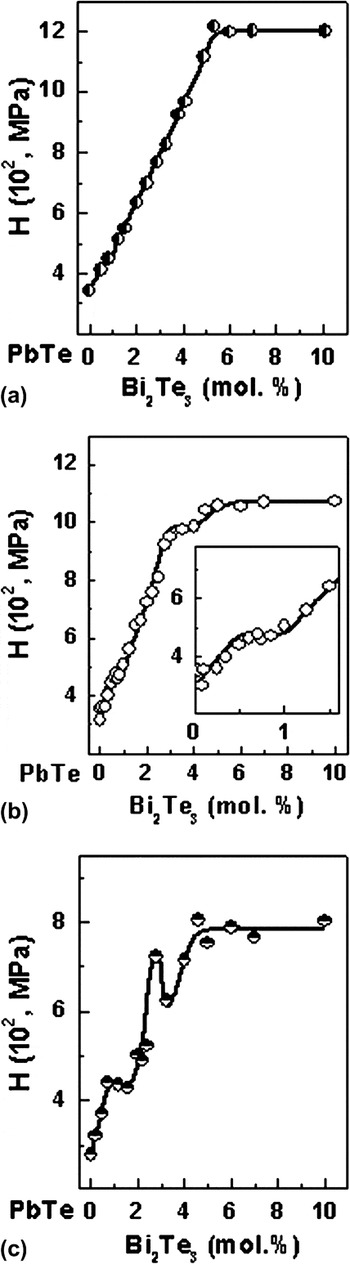
In Fig. 4, the dependences of H of the PbTe-Bi2Te3 solid solutions on composition after HT1, HT 2, and HT 3 are given. In alloys after HT 1, H increases practically linearly in the concentration range 0–6 mol% Bi2Te3 [Fig. 4(a)]. In case of HT 2, the behavior of the H versus composition dependences is different. Although the dependence of H on composition exhibits a general tendency to growth with increasing Bi2Te3 concentration up to the solubility limit (∼6 mol% Bi2Te3), there are sections (∼0.5–1 mol% and ∼3–4 mol% Bi2Te3), where microhardness remains practically constant [Fig. 4(b)]. After the long-term aging (HT 3), microhardness of all alloys sharply decreases, and in the H – composition dependences, a plateau in the concentration interval of 1–1.5 mol% Bi2Te3 and a drop in H in the vicinity of ∼3 mol% Bi2Te3 are clearly seen [Fig. 4(c)]. The similar behavior is observed for the samples after HT 4. It should be noted that the concentration ranges in which the anomalies are registered practically coincide for the ΔB/B and H dependences on composition.
Microhardness H of the PbTe-Bi2Te3 alloys versus Bi2Te3 composition for different types of heat treatment: (a) HT 1; (b) HT 2; and (c) HT 3.

IV. DISCUSSION
Thus, the studies of the crystal structure and mechanical properties as functions of the composition of PbTe-Bi2Te3 alloys showed that the region of PbTe-based solid solutions stretches up to ∼6 mol% Bi2Te3, and the extension of this region does not practically depend on the type of applied heat treatment. Besides, it was established that under introduction of Bi2Te3 in lead telluride, the dependences of ΔB/B and H on composition within the solid solution region have a nonmonotonic character, dependent on the type of heat treatment. The experimental data can be interpreted within the framework of our earlier suggestions regarding the existence of concentration phase transitions of percolation type in any solid solutions in the range of small impurity concentrations and regarding the possibility of a short- and long-range ordering under further increase in the impurity concentration.Reference Rogacheva7, Reference Rogacheva8, Reference Rogacheva14 Let us analyze the experimental results obtained for the PbTe-Bi2Te3 system in more detail based on the the above suggestions.
It is reasonable to attribute the increase in microhardness observed within the region of PbTe-based solid solutions under introduction of Bi2Te3 to the substitutional solution hardening, whose main mechanism is connected with the interaction between the elastic fields of dislocations and impurity atoms. As a result, the mobility of dislocations decreases, which leads to an increase in such mechanical properties as yield strength, microhardness, and others.Reference Suzuki, Yoshinaga and Takeuchi24 The classical theories of solid solution hardening consider the case of diluted solid solutions, i.e., it is assumed that the effective radii of elastic fields of local defects are much smaller than the average distance between defects. Under this condition, the functional relation between yield strength τ and microhardness on the one hand and concentration of impurity atoms c on the other hand represents a power function τ ∼ cn, where n = 0.5–1.Reference Suzuki, Yoshinaga and Takeuchi24
For concentrated solid solutions, the idea of additivity of defects is not applicable because of the defect interaction. Studying mechanical properties in concentrated solid solutions is much more complicated and requires using different approximations.
Impurity atoms are centers of local distortions of the crystal lattice, sources of internal stresses, and strains, which decrease in an inverse proportion to the cube of the distance.Reference Suzuki, Yoshinaga and Takeuchi24 Because noticeable displacements of atoms are created within one or two interatomic distances from an impurity atom, one can consider elastic fields as short range and introduce the radius of deformational interactions R0. Taking into account a short-range character of deformational fields created by impurity atoms and a high degree of charge screening in IV–VI compounds (because of high values of static dielectric permittivity),Reference Lyubchenko, Sal’kov and Sizov16, Reference Abrikosov and Shelimova17 one can use a short-range theory, e.g., percolation theory.Reference Stauffer and Aharony9 At small impurity concentrations, when distances between impurity atoms are much larger than R0, elastic fields created by separate atoms practically do not overlap and H ∼ c. As the impurity concentration increases, elastic fields of neighboring atoms begin to overlap, which leads to a partial compensation of elastic stresses of opposite signs. At a certain critical concentration XC (percolation thresholdReference Rogacheva, Laptev, Ploskaya and Efimova20), percolation channels via deformational fields of separate atoms are formed. The process of the microstress compensation intensifies, spreading over the entire crystal and leading to a sharp decrease in the overall level of elastic strains in the crystal lattice, which, in turn, results in a decrease in H. Earlier, we showed that these processes are usually accompanied by a decrease in the total level of elastic stresses in the crystal lattice and a drop in H.Reference Rogacheva1, Reference Rogacheva, Sologubenko and Krivulkin4 This situation is analogous to the Mott transition when the formation of percolation channels via electron shells of separate atoms leads to the appearance of electrical conductivity (metal-insulator transition). In the case under consideration, percolation channels are formed through deformational fields of separate impurity atoms.
This is a qualitative explanation of the appearance of the first anomalous section in the H –composition dependences in the concentration interval of 0.5–1.5 mol% Bi2Te3 after HT 2, HT 3, and HT 4. The constancy of H in the anomalous region is connected with increasing density of “the infinite cluster.”
Similarly, one can explain the nonmonotonic behavior of the ΔB/B dependence on composition. It is known that among the main factors that cause a broadening of x-ray diffraction, lines are the fluctuation of interatomic distances because of microstrains and a small size of coherent scattering regions.Reference Umanskii25 In homogeneous solid solutions, a broadening of x-ray diffraction lines can be caused by a disorder in the distribution of atoms of different sorts and static displacement of atoms surrounding an impurity atom relative to their positions in the ideal crystal lattice. That is why the broadening of x-ray diffraction lines we observed after the introduction of the first portions of the impurity (Fig. 2) is easy to explain. Because all samples for the x-ray study were prepared in the similar way and the experimental conditions in the x-ray diffraction studies were identical, the change in ΔB/B with changing concentration of impurity atoms can be attributed to internal structural changes caused by a disorder in the distribution of impurity atoms and microstrains induced by them in the crystal lattice. When the impurity concentration reaches the value at which a continuous chain of interconnected elastic fields penetrating the entire crystal is formed and the percolation threshold is reached, strains in the crystal are partially relaxed, and the behavior of the ΔB/B dependences changes: in the range of ∼0.5–1.5 mol% Bi2Te3, x-ray diffraction line width is practically constant.
Assuming short-range interactions and statistical distribution of impurity atoms, using one of the percolation theory problems, the problem of spheres,Reference Stauffer and Aharony9, Reference Shklovskii and Efros26 one can estimate the radius of a deformational sphere R0 formed by an impurity (Bi) atom, knowing the percolation threshold XC, i.e., the concentration at which “the infinite cluster” is formed:

where NC is the average number of centers of spheres with radius R0 per volume unit corresponding to XC. Assuming that XC corresponds to ∼0.5–1 mol% Bi2Te3, we obtain R0 = (1.25–1) a 0, where a 0 = 0.645 nm is the unit cell parameter of PbTe. The calculated value R0 indicates a short-range character of the deformation fields created by impurity atoms. Because of a short-range character of the impurity potential in IV–VI compounds,Reference Lyubchenko, Sal’kov and Sizov16 the percolation threshold is reached at a rather high level of doping and can be registered relatively easily in the concentration dependences of properties.
When the process of compensation of elastic stresses spreads over the entire crystal and the crystal is filled with “impurity liquid” (we introduced this termReference Rogacheva8 to designate the situation when all impurity atoms are involved in the processes of mutual interactions, which is similar to what happens under conversion of vapor into liquid), further increase in the impurity concentration leads to new lattice distortions and, consequently, to further growth in microhardness and x-ray diffraction line width (Figs. 3 and 4).
At the same time, the probability of the processes of correlated distribution of impurity, i.e., the processes of self-organization in the impurity subsystem of the crystal, increases. The formation of continuous chains of interacting impurity atoms on reaching the percolation threshold stimulates such redistribution of impurity atoms in the crystal lattice, which would lead to the realization of their configuration corresponding to a minimum of the thermodynamic potential. Elastic interactions between impurity atoms, similarly to Coulomb interactions, can lead to the formation of certain configurations of impurity atoms, which correspond to minima of the elastic energy. Possible self-organization processes may include a long-range ordering of impurity atoms (“crystallization of impurity liquid”), formation of complexes, a change in the localization of impurity atoms in the crystal lattice, etc.
It is the self-organization processes that cause the dramatic decrease in H and ΔB/B observed under further increase in the Bi2Te3 concentration in the solid solutions after HT 3. Those alloys were subjected to the long-term aging at room temperature for 18 years, and their state practically corresponds to the equilibrium at this temperature. The fact that the x-ray diffraction line width after such heat treatment is virtually equal to the line width in PbTe indicates that in the vicinity of 3 mol% Bi2Te3, the solid solution structure is ordered to a considerable degree. As the drastic decrease in the line width takes place in an extremely narrow range of concentrations, it may indicate the presence of a phase transition. Because no peculiarities in the unit cell parameter behavior are observed, it is probably a second-order phase transition. The fact that after HT 2, we did not register such a sharp decrease in ΔB/B, instead we observed the constancy of ΔB/B, points out that the transition is a low temperature process, and by applying a long-term homogenizing annealing at 820 K and then cooling samples down with a rate of a switched-off furnace, we cannot reach that state. However, as a result of cooling samples down with the furnace (HT 2), the restructuring of the crystal lattice starts, which is proved by the practical constancy of the x-ray line width instead of continuing growth [Fig. 2(a)], and more or less constant values of microhardness, in the same concentration interval [Fig. 3(b)].
For the realization of a long-range ordering of impurity atoms, the following conditions must be satisfied: (i) x ≥ X c; (ii) energy of ordering is much higher than kT; (iii) the average distance between impurity atoms corresponds to their regular distribution over the sites of the crystal lattice (d = nao and d = na o/41/3, respectively for cubic simple and fcc lattices formed by impurity atoms, n is integer, and a o denotes unit-cell parameter of matrix). At the critical concentrations, the probability of ordering of impurity atoms sharply grows. When the solid solution region is sufficiently wide, with increasing impurity concentration, different variants of ordering can be realized. A simple calculation shows that within the homogeneity region of PbTe, the formation of a superstructure with a fcc–lattice of impurity Bi atoms is possible at ∼0.8 mol% Bi2Te3 (n = 4) and at ∼2.0 mol% Bi2Te3 (n = 3). The ordered distribution of impurity Bi atoms in the nodes of a cubic lattice with unit cell parameter a = na 0 is possible in the vicinity of 1.5 mol% Bi2Te3 (n = 2). Certainly such estimates are very rough. They do not take into account such factors as the presence of cation vacancies that appear in the cation sublattice of solid solution (along with cation substitution Pb–Bi) under introduction of Bi2Te3 and can participate in the redistribution processes, a decrease in the unit cell parameter when Bi2Te3 is introduced. Besides, other types of ordering are possible. However, the estimated possible critical compositions are close to those at which the anomalies in H and ΔB/B are observed, so such possibility should be not ruled out. At the same time, to prove the fact of ordering and to determine its type, a special x-ray diffraction study is required, which is beyond the scope of the present work.
One should also consider possibilities of short-range ordering. The introduction of an impurity in the form of a stable chemical compound stimulates the formation of neutral chemical complexes corresponding to the composition of that compound. When a certain concentration of chemical complexes is reached, the formation of percolation channels linking complexes and accompanied by a decrease in internal stresses become possible.
Under the doping of PbTe with Bi2Te3, Bi atoms and vacancies are introduced into the cation sublattice simultaneously. The Coulomb attraction between charged defects of opposite signs stimulates processes of chemical interaction leading to the formation of neutral molecular complexes such as Bi2Te3, PbBi2Te4 and others (vacancies located next to bismuth atoms). Thus, in addition to separate impurity atoms, new structural elements appear, and the formation of percolation channels through these elements becomes possible. There is the “complex formation threshold,” which is somewhat similar to the percolation threshold but percolation occurs not via separate atoms but via complexes. The complex size is 3- to 5-unit cell parameters.
On the basis of the above considerations, one can suggest that the first anomaly in the ΔB/B dependence on the impurity content is connected with the formation of percolation channels linking Bi atoms, whereas the second anomaly is related to the formation of percolation channels through Bi2Te3 complexes. Note that it is after 3 mol% Bi2Te3 that the charge carrier concentration in the PbTe-Bi2Te3 system does not change any more.Reference Rogacheva, Laptev, Ploskaya and Efimova20
The drastic decrease in B and H after aging (HT 3 and HT 4) indicates that stresses in the crystal lattice are relaxed as a result of the fuller realization of processes of structure ordering (long or short range) and the formation of a more stable structure.
Thus, the obtained data allow us to suggest that the spatial correlation of impurity defects leads to either a long-range ordering or the formation of a cluster structure of solid solution. Based on this suggestion, the composition close to 3 mol% Bi2Te3 is either the optimal composition for ordering or corresponds to the complex formation threshold.
V. CONCLUSIONS
(1) It was established that the dependences of x-ray diffraction line width B and microhardness H on composition of the PbTe-Bi2Te3 alloys (0–10 mol% Bi2Te3) exhibit nonmonotonic behavior: within the PbTe-based solubility region (∼0–6 mol% Bi2Te3) in the concentration ranges ∼0.5–1.5 and 3–4 mol% Bi2Te3 anomalous constancy or decrease in B и H are registered. A long room temperature aging leads to a more distinct manifestation of the effects.
(2) We suggest that the first anomalous section in the dependences is connected with percolation phenomena and the second one with the processes of the defect self-organization in solid solution. The main reason for the decrease in B and H in the first case is the formation of a continuous chain of overlapping deformational fields (“the infinite cluster”) created by separate impurity atoms and penetrating the entire crystal, which reduces the level of stresses in the crystal lattice and facilitates the movement of dislocations. The main reason for the decrease in B and H in the second case is a decrease in the level of stresses in the crystal lattice as a result of redistribution of atoms and formation of the atom configuration corresponding to the minimum deformational energy.
(3) The results obtained in this work provide additional support to our suggestions as to the concentration-related processes occurring in any solid solution. On the one hand, under the transition from diluted to concentrate solid solution, critical phenomena accompanying phase transitions of percolation type must be observed. On the other hand, under further increase in the impurity concentration in a solid solution, self-organization processes preceding the precipitation of a second phase above the solubility limit must take place. The above-mentioned regularities should be taken into consideration when developing new materials based on solid solutions.
ACKNOWLEDGMENT
This work was supported by the Ukrainian Fundamental Research Foundation (Grant F25.2/189-2008).