INTRODUCTION
Merluccidae is a world-wide commercially important gadiform family which includes 19 species in two subfamilies: Merluccinae and Macruroninae (Cohen et al., Reference Cohen, Inada, Iwamoto and Scialabba1990; Lloris et al., Reference Lloris, Matallanus and Oliver2005; Matallanas & Lloris, Reference Matallanas and Lloris2006). Steindachneria argentea Goode & Bean, 1896, is actually placed in the family Steindachneriinae (McEachran & Fechhelm, Reference McEachran and Fechhelm1998; Lloris et al., Reference Lloris, Matallanus and Oliver2005; Fahay, Reference Fahay and Richards2006).
Eight species of Merluccidae are known from South American waters: the Pacific Merluccius angustimanus Garman, 1899 from California to Colombia; M. gayi (Guichenot, 1848) from Peru and Chile; the southern cone M. australis (Hutton, 1872), M. patagonicus Lloris & Matallanas Reference Lloris and Matallanus2003, M. tasmanicus Matallanas & Lloris, Reference Matallanas and Lloris2006 and Macruronus novaezelandiae (Hector, Reference Hector1871) from Chile through Patagonia to Argentina and southern Brazil (Macruronus); the Atlantic Merluccius hubbsi Marini, 1932 from Rio de Janeiro to southern Argentina and the Falkland Islands; and Merluccius albidus (Mitchill, 1818) from Florida to northern South America, including northern Brazil (Cohen et al., Reference Cohen, Inada, Iwamoto and Scialabba1990; Haimovici et al., Reference Haimovici, Martins, Figueiredo and Vieira1994; McEachran & Fechhelm, Reference McEachran and Fechhelm1998; Lloris & Matallanas, Reference Lloris and Matallanus2003; Menezes, Reference Menezes, Menezes, Buckup, Figueiredo and Moura2003; Mincarone et al., Reference Mincarone, Consulim, Kitahara, Lima, Lima e Silva, Neves, Soto and Souza Filho2004; Bernardes et al., Reference Bernardes, Figueiredo, Rodrigues, Fischer, Vooren, Haimovici and Rossi-Womgtschowski2005; Lloris et al., Reference Lloris, Matallanus and Oliver2005; Matallanas & Lloris, Reference Matallanas and Lloris2006; Costa et al., Reference Costa, Braga, Melo, Nunan, Martins, Olavo, Costa, Olavo and Martins2007; Melo et al., Reference Melo, Braga, Nunan and Costa2010).
Recent morphological and molecular studies revealed that Macruronus magellanicus Lönnberg, 1907, described from Chile, is a junior synonym of M. novazelandiae, which is considered to comprise two disjunctive populations (Lloris et al., Reference Lloris, Matallanus and Oliver2005; Olavarría et al., Reference Olavarría, Balbontín, Bernal and Baker2006). The same distribution is also observed in several other species of the family belonging to the genus Merluccius, already cited above.
To date, the northernmost specimen of Macruronus ever collected in the American Atlantic is deposited at the MOVI collection (MOVI 22606, one specimen, 354 mm total length (TL), 32°29′S 50°16′W to 32°36′S 50°19′W, depth 350–420 m, May 2002), obtained at the Rio Grande do Sul coast, southern Brazil (Mincarone et al., Reference Mincarone, Consulim, Kitahara, Lima, Lima e Silva, Neves, Soto and Souza Filho2004; Jules M.R. Soto, personal communication). The present record extends the range of the species to about 2500 km northwards along the Brazilian coastline and is the first ever reported from Atlantic tropical waters.
MATERIALS AND METHODS
Measurements were taken with a digital calliper to tenths of millimetres (mm); measurements over 150 mm to 300 mm were taken with a manual calliper to the nearest tenth of a mm; measurements over 300 mm were taken with a ruler to the nearest tenth of a mm. Length of specimen is given in standard length (SL). For details about capture techniques see Carvalho-Filho et al. (Reference Carvalho-Filho, Marcovaldi, Sampaio, Paiva and Duarte2009). Institutional abbreviations follow Sabaj Pérez (Reference Sabaj Pérez2010).
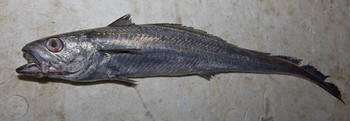
Macruronus novaezelandiae, TAMAR 045, 712.3 mm standard length, immediately after collected.

Coryphaenoides novae-zelandiae Hector Reference Hector1871, Transactions and Proceedings of the New Zealand Institute, v. 3 (1870), 1871: 103 (Port Nicholson, New Zealand).
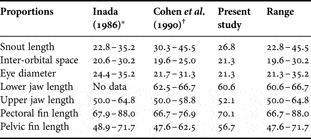
Measurements of Macruronus novaezelandiae expressed as a percentage of head length.

*, data adapted from given measurements; 18 specimens of Macruronus ‘magellanicus’, 338–654 mm standard length; †, data of M. ‘magellanicus’ plus M. novaezelandiae.
SYNONYMS
Coryphaenoides tasmaniae Johnston, 1883, Proceedings of the Royal Society of Tasmania: 143 (Kangaroo Bluff, Tasmania, Australia).
Macruronus magellanicus Lönnberg, 1907, Ergebnisse der Hamburger Magalhaensischen Sammelreise, 1, Fische: 15, figure 2 (Smyth Channel, Chile).
Macruronus argentinae Lahille, 1915, Anales del Museo Nacional de Historia Natural de Buenos Aires, 26: 22, p. v, figure 1.
COMMON NAMES
Blue grenadier, longtail hake, Patagonian grenadier, hoki (English, New Zealand, Australia), Merluza-azul (Portuguese, Brazil), Merluza de Cola (Spanish, Argentina, Chile), Huaica (Spanish, Chile).
MATERIAL EXAMINED
TAMAR 045 (1, 712.3 mm SL), Brazil, Bahia, São João da Mata, Praia do Forte, coll. G. Marcovaldi, depth 400 m, 17 May 2008.
SPECIES ACCOUNT
Based on TAMAR specimen, Hector (Reference Hector1871), Ayling (Reference Ayling1982), Inada (Reference Inada and Nakamura1986), Cohen et al. (Reference Cohen, Inada, Iwamoto and Scialabba1990), Cousseau & Perrotta (Reference Cousseau and Perrotta2000), Lloris et al. (Reference Lloris, Matallanus and Oliver2005) and Bernardes et al. (Reference Bernardes, Figueiredo, Rodrigues, Fischer, Vooren, Haimovici and Rossi-Womgtschowski2005); data of our specimen in parentheses; see also Table 1.
Body elongate, compressed, with a long tapering tail; first dorsal fin short, second and anal fin long, continuous with caudal fin; anal fin origin considerably backward of second dorsal fin origin; pectoral fin pointed, its origin slightly to well ahead than pelvic fin origin. Head moderate, mouth oblique and large; end of upper jaw about centre of eye; snout elongate and blunt; inter-orbital space flat. Upper jaw with two series of teeth, the outer larger; lower jaw with a single series of teeth; canine-like teeth present at upper jaw's tip; small teeth on vomer. Scales deciduous and large; lateral line running from upper body behind opercle, down to mid-body and to end of tail; lateral line scales 177–182 (179). Gill rakers slender, 6–8 (8) on upper limb, 21–27 (24), 27–35 (33) in total. First dorsal-fin rays I, 10–13 (12); second-fin rays 96–102 (101); anal-fin rays 83–95 (92); pectoral-fin rays 15–19 (19); pelvic-fin rays 8 (8). Blue overall, darker on dorsum, sometimes with a purplish cast; sides silvery light-blue to greenish-blue, belly whitish; fins dark; inner of mouth blackish; iris pale-bluish brown. Maximum length 120 cm, usually 60–100 cm; maximum weight 5 kg, usually 1.5 kg.
Body proportions are given in Table 1, and it is important to be reminded that comparisons against TL or SL might be dubious, since the tip of the tail is often damaged and regenerated; thus, the most trustful comparisons are against the head length. Other than that, the body proportions from Inada (Reference Inada and Nakamura1986) were done against SL, but that from Cohen et al. (Reference Cohen, Inada, Iwamoto and Scialabba1990) and Lloris et al. (Reference Lloris, Matallanus and Oliver2005) were compared against TL, thus leading us to not consider data other than those compared with the head length.
DISTRIBUTION
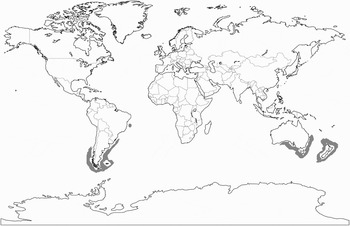
In Oceania from New Zealand, Tasmania and Australia; in South America from the southern Pacific and southern Atlantic northwards to Bahia, Brazil (present paper) (Figure 2).
Macruronus novaezelandiae, distribution map (grey).

ACKNOWLEDGEMENTS
The authors are grateful to Jules M. Soto, with the Museu Oceanográfico UNIVALI, for his support, review and comments; to both anonymous referees for their review and precious comments; to Domingos Dantas de Carvalho, Renildo Dantas de Carvalho and Adriano de Jesus Santos, captain and crew of the vessel ‘Tamar’; to Pedro Mariano Monteiro de Barros Cordeiro with the ‘Tamar’, for his fine pictures; and to Neca Marcovaldi and Eliane M. Pinto for their loving support.