1. Introduction: Bridging Policy and Process
While the on-going trade war has understandably been a flashpoint for Sino-American relations, the politics of that economic struggle extend beyond tariffs and trade deficits. Through legislative changes, tariff wars, and executive actions, the Trump Administration has injected a new urgency into international technology and supply chain management. On 13 August 2018, President Trump signed into law the Export Control Reform Act (ECRA) and the Foreign Investment Risk Reduction and Modernization Act (FIRRMA), as part of the John S. McCain National Defense Authorization Act of Fiscal Year 2019 (the 2019 NDAA). The 2019 NDAA was passed by overwhelming majorities of both parties in Congress and suggests that a bi-partisan ‘new normal’ has emerged in US–China trade relations (Tran, Reference Tran2019). Both ECRA and FIRRMA have the potential to greatly extend the scope and impact of controls over US technologies for export as well as foreign technology investment in the US. The passage of FIRRMA and ECRA have also been accompanied by a number of regulatory and enforcement actions, such as limiting technology exports to foreign nationals that may be working in the United States (Fitch, Reference Fitch2019), the placement of companies such as Huawei on the US ‘Entity List’ to restrict acquisitions of US technology, and restrictions on foreign investment such as Broadcom's proposed acquisition of Qualcomm or Chinese divestment in the US gay dating site Grindr.
Through ECRA on the one hand and FIRRMA on the other, the 2019 NDAA has intensified scrutiny on global technology flows, with China as the clear (and often explicitly referenced) rival. In particular, the Bureau of Industry and Security (BIS) at the US Department of Commerce has sought to expand export controls over ‘emerging technologies’ with potential dual use applications, and the Trump administration is expected to promulgate final rules regarding ‘foundational technologies’ to impose controls on dual use technology upstream from military or dual-use applications.Footnote 1 Such developments have notably coincided with the imposition tariffs on a wide range of goods from China. Critically, the geopolitical competition between China and the United States has put high-tech manufacturing in the spotlight alongside traditional manufacturing capabilities in a manner that is forcing importers to consider adjusting their supply chains to maintain customer relationships and profitability.
However, while the possibility of shifting production bases away from China in the wake of the trade war has received considerable attention, the precise implications of US technology protection and tariffs for this process remain under discussed. This article aims to bridge the gap between policy and process as commercial actors look to navigate a business environment that features increased techno-nationalism and trade friction between the world's two largest economies. Rather than investigate decoupling or engagement in an absolute sense, we instead focus on how supply chain restructuring may unfold with inclinations toward strategic diversification and risk mitigation. In this context, we highlight how the licensing of intellectual property (IP) affords companies a number of opportunities for pragmatically addressing the supply chain disruptions underway. While intellectual property concerns were a motivating factor behind the policy changes rattling global supply chains, they likewise can offer stabilizing solutions for supply chain management.
The article begins by summarizing the policy context and trade statistics necessary for understanding both the challenges posed to China-dependent supply chains and the challenges of rapidly restructuring them. To help bridge the gaps between policy and process, data on IP-intensive industries from global patent offices and concordance data on patent classifications illustrate the centrality of IP to extended supply chains. With this key relationship in mind, the article proceeds with a discussion of specific opportunities that intellectual property licensing provides for managing supply chain linkages between the United States and China in the current geopolitical environment. The conclusion remarks on how the preceding analysis can more fully inform our understanding of the bilateral and international trade environment.
2. Trade and Tech Tension: The Policy Context for Action-Based Analysis
The issues of IP theft and Chinese techno-nationalism were discussed at length in the initial Section 301 Report that initiated US tariffs against China; those tariffs were in a reaction to China's unfair activities in support of its efforts to implement its Made in China 2025 program.Footnote 2 Initial tariffs imposed by the Trump administration were based on recommendations from ‘trade analysts from several US Government agencies [who] identified products that benefit from Chinese industrial policies, including Made in China 2025’.Footnote 3 While we do not wish to minimize the economic impact of those sanctions or their potential for shifting international production bases, complementary policy measures in the form of export controls and stricter investment review are equally critical. As indicated in the introduction, the 2019 NDAA has provided a policy context in which technology, trade, and national security are inextricably linked as analytic considerations.
2.1 Emerging and Foundational Technologies as Key Elements of the Export Control Reform Act
ECRA provides statutory authority for the Export Administration Regulations (EAR), which had been repeatedly extended by Presidential order. The EAR governs dual use (military/civil) technology not otherwise regulated under other export control regimes such as the International Traffic in Arms Regulations administered by the State Department. The EAR is administered by the Bureau of Industry and Security (BIS) at the US Department of Commerce. Generally speaking, ECRA codifies long-standing BIS policies and does not change existing procedures or licensing practices that are attached to particular countries and existing regulated technologies. However, ECRA also mandates that BIS enact appropriate regulations over new areas of concern, particularly ‘foundational’ and ‘emerging technologies’.
On 19 November 2018, BIS published an Advanced Notice of Proposed Rulemaking seeking to expand export controls over ‘emerging technologies’ with potential dual use applications.Footnote 4 The technologies broadly cover many areas with significant civilian use, for example: nanobiology and synthetic biology; genomic and genetic engineering; artificial intelligence and machine learning technology such as neural networks and deep learning, computer vision, speech and audio processing, and natural language processing; microprocessor technology such as systems on a chip; and additive manufacturing and functional textiles. Although the list is potentially expansive, the new regulations should still conform to the existing framework of the EAR and the Commerce Control List. There were 232 comments formally submitted regarding the proposed rule, the majority of which expressed concerns about potential overreach of the expanded export control regime.Footnote 5 These concerns may have contributed to delays in quickly enacting a comprehensive final rule, which many industry participants hope will narrow down these broad categories into more manageable subjects of potential regulation when ultimately enacted.
The Trump Administration is expected to separately promulgate final rules regarding ‘foundational technologies’. The ‘foundational technology’ regulations will seek to impose controls on dual use technology upstream from any military application. ‘Foundational technology’ is distinct from ‘fundamental research’ of the type conducted by universities, which should remain exempt from export controls pursuant to long-standing BIS practice (USBIS, 2019),Footnote 6 but the 2019 NDAA and its legislative history give little guidance on what constitutes ‘foundational technology’. The 2019 NDAA provides that ‘The President shall establish and, in coordination with the Secretary [of Commerce], the Secretary of Defense, the Secretary of Energy, the Secretary of State, and the heads of other Federal agencies as appropriate, lead, a regular, ongoing interagency process to identify emerging and foundational technologies that (A) are essential to the national security of the United States; and (B) are not critical technologies described in [other enumerated legislation].’Footnote 7 Proposed regulations on ‘emerging technologies’ have not yet been published, but are expected in the future (Becker et al., Reference Becker, Fischer, Hafeez and Rabinowitz2019).
A public Department of Defense (DoD) report that influenced the drafting of ECRA identified ‘foundational technology’ risks as involving ‘early stage technology’, including ‘technologies that later become critical to key military systems, amounting over time to unintentional violations of US export control laws’ (Brown and Singh, Reference Brown and Singh2018). The DoD study in particular noted that Chinese students studying in the United States may become masters of such technology, thereby resulting in advertent export control violations through ‘deemed’ exports of the technology within the United States to unlicensed, non-US national recipients. A ‘deemed export’ is defined in the EAR to involve the ‘release’ of controlled technology to a foreign person in the United States or abroad, or the visual or other inspection by that person of the technology. It is a type of export that the Administration has been limiting directly through both deemed export license denials and indirectly through mechanisms such as visa restrictions.Footnote 8
The emerging and foundational technologies mandate are part of other efforts of the Trump Administration to ensure export control compliance and/or limit technology collaboration or restrict technology-intensive exports to China. Chinese telecom giants ZTE and Huawei have both been subject to US government scrutiny in this regard. In 2017, the Commerce Department placed ZTE on its Denied Party List due to its false statements to BIS during settlement discussions in 2016 and its probationary period in 2017 regarding prior export control violations (USBIS, 2017a). This action effectively banned most US exports to ZTE but was later rescinded in the context of on-going trade negotiations. In 2019, after those negotiations failed to resolve the US–China trade war, the US government placed Huawei and its subsidiaries on the Entity List, thereby immediately banning most US technology exports to China.Footnote 9 The Huawei ban extended to a range of collaborative activities, such as participation in standards-setting bodies. However, in addition to available license exceptions, temporary 90-day licenses were also granted to support existing products and participation in standards-setting bodies.Footnote 10 Moreover, certain license exceptions such as for products made outside the United States, which contain less than 25% or less by value of US-origin controlled technologies, facilitate the continued export of many US products.Footnote 11
Multilateral and unilateral export controls have been in place for US exports to China for decades.Footnote 12 However, the practical impact of these export controls had likely been limited. According to BIS data, export controls were implicated in only 2.1% of US exports to China, of which 1.9% were excepted from licensing requirements. The remaining 0.2% of licensed exports had a value of $299 million in 2017. Approximately 95% of the controlled exports not requiring a license concerned encryption technology and software primarily involving encryption technology (USBIS, 2017b). The data do not account for transactions that did not consummate due to export control concerns, and therefore understate the total volume of affected trade.Footnote 13 In addition, many exports to China occur pursuant to a range of licensing exceptions that permit the export of controlled items under certain conditions, such as licenses for civil uses.Footnote 14 Nonetheless, it strains credibility to view controlled exports as contributing significantly to a USD 419 billion trade deficit when licensed transactions only constitute about .095% of the trade deficit,Footnote 15 despite China's claims to the contrary.Footnote 16 Whether export controls have meaningfully contributed to trade deficits, ECRA provisions have increased the relevance (if not the clarity) of restrictions on technology exports in terms of national security.
2.2 Greater Scrutiny of Investment Flows under FIRRMA
On top of ECRA, FIRRMA instituted new controls over technology-driven foreign investments into the United States. These controls are implemented by the interagency Committee on Foreign Investment in the United States (CFIUS). CFIUS is chaired by the Treasury department, with voting members from eight other agenciesFootnote 17 and five additional agencies that serve as observersFootnote 18 who participate in CFIUS activities as appropriate. Due to a range of perceived crises,Footnote 19 CFIUS has evolved over the years from a mere reporting committee to one which can block or restructure (mitigate) a range of sensitive foreign investments affecting national and economic security, including investments by state actors, investments in critical infrastructure, and real estate investments in areas that have national security concerns.
Pursuant to the 2019 NDAA, CFIUS regulates technology investments that are co-extensive with US export controls.Footnote 20 However, in practice, CFIUS technology mandate also extends beyond the scope of ECRA-regulated investments as categorized by BIS Commerce Control List. Examples of such extensive regulation include CFIUS mandating that a Chinese entity, Kunlun Tech Co. Ltd., divest its interest in Grindr, a gay dating site. Additionally, following a review by CFIUS, the President completely blocked (without any mitigation agreement or proposal to mitigate) Broadcom's proposed acquisition of Qualcomm, which was likely due to a desire to maintain a competitive position for the United States and Qualcomm in 5G technology.Footnote 21
FIRRMA was enacted in 2018 in part due to warnings reported by the DoD about increasing Chinese investment in sensitive, potentially dual-use technologies. FIRRMA gives CFIUS additional resources and structure while at the same time expanding its mandate to technologies covered by ECRA and to a range of transactions, including over non-passive, non-controlling investments in technology companies by venture capital firms. CFIUS was also directed to seek international coordination of foreign investment restrictions with other countries, which has been taking place (Aggarwal and Reddie, Reference Aggarwal and Reddie2019).
CFIUS may also look at patents as a national security concern. As a source of competitive intelligence, CFIUS could look at publicly available patent portfolios as an indicator of the technological competitiveness of a targeted company, and the national security or economic security importance of a transaction. While published patents themselves should not be regulated as a disclosed technology, they may also be read by CFIUS as suggesting that there are underlying proprietary technologies that are of concern or that the patent portfolio is of concern to national economic security. As a publicly disclosed document, patent licenses should not be subject to US export controls. At least that is the traditional rule. But possible exceptions to this rule have recently arisen with respect to the placing of Huawei on the ‘entity list’ and banning it after three months have passed from participation in various standards-setting activities. In addition, US Senators Rubio and Cornyn have introduced a bill titled ‘Prevent Abuse of the Legal System Act’Footnote 22 which would, if passed into law, restrict the sale or exclusive licenses of patents issued by the US Patent and Trade Office (USPTO) if the sale or license is to a designated entity, amongst other restrictive provisions. BIS has thus far declined to address why it should ultimately be in the US national security or economic interests for Huawei to not disclose its otherwise published patents to standardization bodies. As BIS coordinates its position with stakeholder input as well as input from other Commerce Department agencies, such as the National Institute of Standards and Technology and USPTO, its position may soften. Having a putative ‘enemy’ such as Huawei participate in global standards-setting activities is also a ‘good thing’, as it requires Huawei to reveal its technological prowess. In this sense, a ‘window’ into another country's technology can also often be more valuable than a ‘wall’. Hopefully, this issue will be reconsidered over time. In any event, FIRMMA has intensified and quite possibly expanded the scope and scrutiny of CFIUS activity, especially with regard to China.
3. Rattling Supply Chains without Breaking Them: Pulls toward China Remain
The policy context outlined above presents a sort of double whammy. Not only have tariff actions necessitated a reassessment of supply chains from the standpoint of profitability; export restrictions and investment scrutiny in the name of US national security necessitate a reassessment of supply chains from the standpoint of feasibility. Continued discussions of decoupling are understandable and warranted under such circumstances. But it is also important to remember that production units of the value chain located in different countries normally specialize in specific tasks that are not directly substitutable for tasks undertaken elsewhere (Athukorala, Reference Athukorala, Song, Garnaut, Fang and Johnston2017, 380). It is likewise important to bear in mind the length and complexity of many supply chains. For example, while it may be relatively easy to move low-tech textile production from one country to another, even seemingly less complex technologies may not be easy to relocate. For example, bicycle manufacturing – which requires numerous parts and therefore multiple supply chain linkages – is a more complicated task. As a Chinese bicycle manufacturer explained in a South China Morning Post podcast (Watt et al., Reference Watt, Ng and Bermingham2019), buying a new factory outside of China for production is certainly happening, but production there would still inevitably involve sourcing parts from China for final assembly. Of course, the political volatility of on again/off again trade negotiations complicates the decision of whether such a move is even worthwhile, at least in the short run.
While longer-term shifts may certainly be underway, there is reason to believe that wholesale decoupling may be much easier said than done. As noted economist and China scholar Nicholas Lardy points out, many US firms like Caterpillar maintain a presence in China to produce goods to sell there, and such firms have no incentive to relocate elsewhere in Asia or the United States given the high costs of shipping relative to value (Lardy, Reference Lardy2019). In a similar vein, China represents an important base for US multi-nationals to expand their exports to the rest of the world, due in no small part to its shift to assembly operations with producer-driven production networks (Athukorala, Reference Athukorala, Song, Garnaut, Fang and Johnston2017, 366, 379). Finally, issues involving scalability can mitigate pulls away from China. As an example, Apple contracted to have 220 million iPhones produced in China in 2018, drawing on Taiwanese manufacturer Foxconn's network of more than 1,500 local suppliers and hundreds of thousands of factory workers in China; quickly replicating an operation of this magnitude in commonly mentioned alternatives like Vietnam and India is daunting and likely impossible (Lardy, Reference Lardy2019).
One approach for getting a general sense of the continued pull toward China is to look at the flows of key commodities using trade statistics. While trade statistics are more of a broad-brush tool than a scalpel when it comes to investigating supply chains, they can still provide a sense of how key items, including component materials, are flowing across borders. The operative question is which items to specifically investigate. The United Nations Department of Economic and Social Affairs Division (UNDESA, 2016) points to Prema-Chandra Athukorala's list of 525 parts and components across a variety of industries (Athukorala, Reference Athukorala2010) as a useful analytic starting point when it comes to intermediary goods, which lie at the heart of transnational production. Specifically, Athukorala's list consists of parts and components that encompass the entire spectrum of manufacturing trade based on entries in the UN Broad Economic Classification Registry and the product list in the World Trade Organization Information Technology Agreement. That is to say, Anthukorala's study focuses on specific items for which network trade is heavily concentrated.
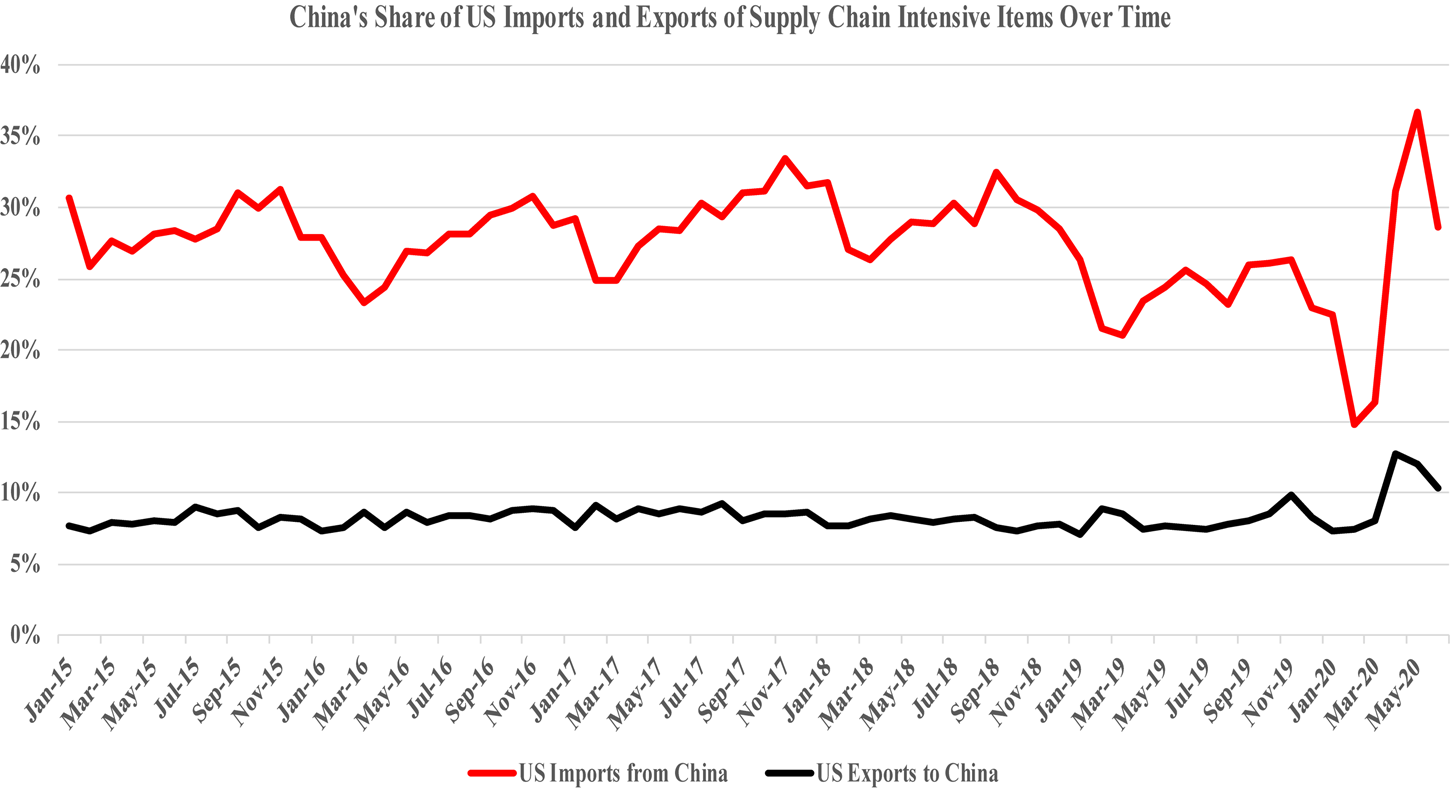
We apply this approach to an investigation of US Census Bureau Data between January 2015 and June 2020 for the major Standard International Trade Classification (SITC) categories that Athukorala identifies as being especially concentrated in network trade, i.e. categories that are especially supply chain intensive: office machines and equipment (SITC 75), telecommunication and sound recording equipment (SITC 76), electrical machinery (SITC 77), road vehicles (SITC 78), professional/scientific instruments (SITC 87), and photographic apparatus (SITC 88). Figure 1 charts the Chinese share of US imports/exports by aggregating data from these SITC categories.
China's share of US imports and exports of supply chain intensive items over time

These data suggest that even in the midst of a trade war and a global pandemic, the flow of supply chain-intensive goods between the United States and China has been relatively resilient. To be sure, the flows experienced periods of volatility since Donald Trump took office, but there have consistently been bounce backs within a band (albeit quite large in purely monetary terms). This aggregate pattern does not indicate uniform resiliency in trade flows across all areas; as one might expect from headlines surrounding Huawei and ZTE, the flows for telecommunication equipment have fallen considerably from mid to late 2017 levels.Footnote 23 Moreover, China's share of imports of supply chain intensive items as a whole had dropped off considerably before spiking at the outset of the COVID pandemic. But exports – the purview of policies discussed in the opening sections of this article – have proven remarkably stable. Through it all though, China's share of imports and exports of supply chain intensive goods is comparable to what it was prior to Trump taking office.
These data are by no means meant as a dismissal of observations that an adjustment toward greater decoupling is underway. Indeed, China's share of imports in February of 2020 had dropped to approximately half of what it was in 2015 before spiking in the spring as the COVID 19 pandemic progressed. Long-term shifts are certainly underway, though the data indicate that a complete break from China makes for an easier political talking point than a policy outcome. China-dependent supply chains have very much been rattled, but they have by no means been broken. Indeed, a more robust decoupling that includes greater substitution by commonly mentioned but much smaller Asian alternatives like Vietnam and India could take time. For actors engaging in global supply chains who prioritize profits rather than a particular state's national interests, it would not be surprising to observe short-/medium-term efforts to mitigate politically induced disruptions and continued leaning on Chinese production to a certain extent. At a practical level, then, it is worthwhile considering the structural opportunities that may facilitate such an outcome.
4. The IP-Intensive Nature of Network Trade
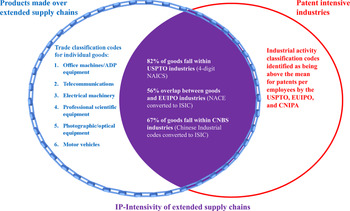
Given the policy context discussed in the first section, it is valuable to bring intellectual property to the table as a possible starting point for supply chain managers looking to maintain aspects of the status quo, at least temporarily. Notably, the STIC categories identified in the previous section overlap considerably with industrial categories that three of the largest patent offices in the world have identified as IP-intensive. The United States Patent and Trade Office (USPTO), the European Union Intellectual Property Office (EUIPO), and China's National Bureau of Statistics (CNBS), in cooperation with China's State Intellectual Property Office, have each published lists of patent-intensive industries.Footnote 24 The USPTO and EUIPO both define an industrial category as patent intensive when it has an above average ratio of patents to employees. The CNBS further defines an industrial category as IP-intensive if it exceeds the national average for discovery patent scopeFootnote 25 and discovery patent concentration;Footnote 26 discovery patent scope and R&D intensity;Footnote 27 or discovery patent concentration and R&D intensity.Footnote 28 Using concordance tables and software,Footnote 29 we calculated the proportion of five-digit SITC codes in the previously defined supply chain intensive categories that fall within the USPTO, EUIPO, and CNBS specified industrial categories. Figure 2 illustrates this approach and our findings.
Extended supply chain products falling within patent intensive industries

Though this exercise requires a reasonable degree of translating between concordances, and there are possibilities that categories of goods may be omitted from the generalized categories set forth in the concordances, our data suggest considerable overlap between goods that are associated with extended supply chains and industrial categories that major intellectual property offices have identified as patent intensive: we found an 82% fall within USPTO patent-intensive categories, 56% fall within the top 20 EUIPO patent-intensive industries, and 67% fall within CNBS patent-intensive industries. Though these findings may be intuitive, given the sorts of products involved, they underscore the connection between IP and supply chain management that has become a political hotspot in the broader race for technological leadership.
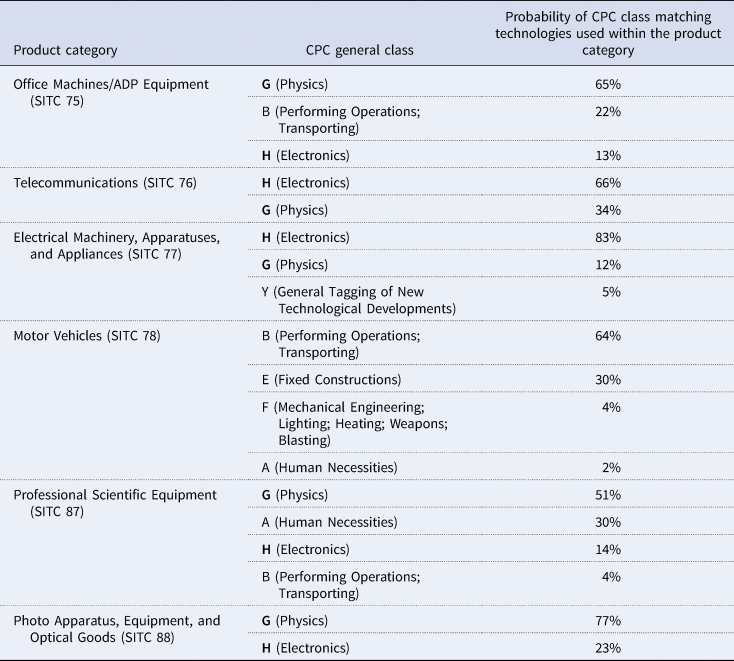
Moreover, it is possible to get a sense of the specific patent families most associated with these major categories of supply chain-oriented goods. Using data mining and computer algorithms to detect matches between the language in descriptions of international trade categories and international patent classes, Lybbert and Zolas (Reference Lybbert and Zolas2014) have constructed a dataset that estimates conditional probabilities to describe the concordance between patent and economic data.Footnote 30 This dataset provides, inter alia, an estimate of the probability that a certain patent classification matches the technologies utilized within a given trade classification; such an ‘industry to technology’ probability can be interpreted as the proportion of technologies matching the trade classification that are from a given patent class (Lybbert and Zolas, Reference Lybbert and Zolas2014, 535). The dataset includes concordances between SITC codes and the Cooperative Patent Classification systems developed by the United States Patent and Trademark Office and the European Patent Office (CPC) patent families at a variety of levels. We can, for example, use the dataset's reported probabilities to gauge the degree to which technologies falling under patent class H (electronics) are representative of the various technologies used in telecommunications (STIC 76).Footnote 31 The concordance measures for each of the extended supply chain categories introduced above are indicated in Table 1. As one might expect from the nature of the goods involved, class G (physics) and class H (electronics) match with a rather significant share of the technologies used in the extended supply chain categories.
Trade classification and patent classification concordance for extended supply chain items

Source: Lybbert and Zolas ALP Concordance Database (see footnote 30). Percentages may not sum to 100% exactly due to rounding from the original dataset.
Notably, patent applications for these patent classes are typically filed on a global scale. Because all patents are territorial, in order for a product to benefit from patent protection in its extended supply chain, the relevant patent rights would need to be secured in key markets of concern. According to 2019 data from the World Intellectual Property Organization (‘WIPO’), computer technology, digital communication, electrical machinery, medical technology, and measurement accounted for the largest shares of published applications under the Patent Cooperation Treaty (‘PCT’) System (WIPO, 2020), which allows filers to simultaneously seek patent protection in a large number of countries. Indeed, the top 10 categories of PCT applications in 2019 were dominated by technical fields falling under the umbrella of electrical engineering or instruments (WIPO, 2020).
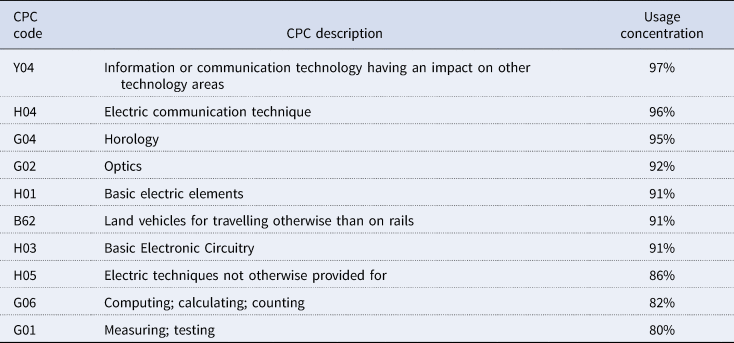
Finally, the concordance dataset referenced above also provides estimates of the probability that there is a match with a certain trade classification given a specific patent classification. Such a ‘technology to industry’ probability can be interpreted as the proportion of a specific patent class technology that is utilized by a certain product or product class (Lybbert and Zolas, Reference Lybbert and Zolas2014, 535). It is therefore possible to calculate an estimate of the extent to which the SITC codes for extended supply chain categories identified in this section dominate the application of more detailed three-digit CPC classes. Table 2 presents the 10 most prevalent usage concentrations after running this calculation.Footnote 32 The data suggest that items associated with extended supply chains not only involve technical fields with a considerable volume of patent grants but also account for a substantial degree of the application of those patents in key sub-fields.
Top-ten concentrations of cpc usage by extended supply chain categories collectively

Source: Author calculations using the Lybbert and Zolas ALP Concordance database (see footnote 32).
A thornier problem, however, arises in trying to assess the impact of national security controls upon US exports to China. As previously noted, the full impact of the national security controls for emerging and foundational technologies is not yet available, due to delays in rule making. In addition, the impact of these controls has historically been hard to calculate. Export control restrictions may affect decisions to purchase goods at the outset. However, they can also materialize in the form of cancelled transactions if licenses are denied. Tariff classifications and national security classifications also address markedly different concerns, with national security controls directed to military or ‘dual use’ (military/civil) technologies, that may represent more advanced forms of technology or products than are otherwise currently available, which may not be manifested on tariff schedules. Moreover, the underlying technologies may also be controlled and are the subject of secret patents,Footnote 33 making it difficult to determine if there is publicly available technology that can be tracked. Finally, the tools for correlating national security-controlled exports with trade classification codes are limited, even if they might be helpful in order to assess the trade impact of such controls or if such exports should be controlled (Chatelus and Heine, Reference Chatelus and Heine2016). We leave this issue to future researchers, including those with relevant security clearances, to investigate.
Nevertheless, a number of perspectives support the notion that supply chains involve patent-dense and technologically sophisticated areas of the global economy. The centrality of intellectual property in global supply chains lends a degree of traction to US charges of IP-theft by China used as a justification for a more contentious trade and foreign investment policy. But this centrality also enables intellectual property to be a key a consideration in supply chain managers’ strategies, as we describe in the sections below.
5. Opportunities to Consider: Liberalization of China's Tech Transfer Regime
Chinese legal and policy reforms now provide increased flexibility for foreign licensors negotiating technology transfer transactions with China. These new laws and policies offer opportunities to restructure existing license agreements as well as to reduce some of the trade risks already noted. China accelerated its liberalization efforts in response to the 301 investigation into China's ‘forced technology transfer’ policies, including the filing of a WTO case regarding China's regulation of inbound technology transfer. The WTO case is now suspended in light of the legislative reforms China has made to its tech transfer regime (Cohen, Reference Cohen2019b).
Among the important recent changes in China's tech transfer regime are the elimination of certain non-negotiable licensing terms in China's Administration of Technology Import–Export Regulations (‘TIER’). These non-negotiable terms included requiring that foreign licensors indemnify Chinese licensees against third party risks; that Chinese licensees own improvements to any transferred technology; and that Chinese licensees should have reasonable access to foreign markets.
There have been other legislative changes to improve the condition of tech transfer to China. China's Foreign Investment Law now mandates that technology transfer cannot be made a condition of foreign investment approval. Amendments to the joint venture (JV) regulations have also abrogated provisions that required ownership by Chinese joint ventures of technology licensed to the JV by a foreigner after a 10-year period had elapsed. There have also been other changes in laws that have facilitated tech transfer to China, including: (a) the reduction of the ‘negative list’ of prohibited investments, and (b) the opening of certain sectors of the Chinese economy to majority or exclusive foreign investment, such as new energy vehicles. Finally, there remain tax incentives through tax credits and recognition of ‘high and new technology enterprise’ status to transfer technology into China or develop technology in China. Other improvements have also been made to China's trade secret laws, and additional reforms are expected in other IP laws and enforcement practices. Taken together, these steps should serve to encourage more foreign technology transfer to China as well as to promote technology development provided that the new laws are implemented in a non-discriminatory fashion and in a manner that protects licensor's expectations, including expectations of being able to protect their IP in China.
The TIER extended to a range of activities including for-profit licensing, non-profit licensing, scientific collaboration, and open source licensing. The indemnity requirement was particularly problematic for smaller start-up companies seeking to license their technology to large Chinese companies, particularly in litigation-dense areas such as cell phone technology. The impact on non-profit licensing was documented in an appendix to the 301 report, where the University of California at Berkeley stated that it had declined to directly license technology to China because these requirements – particularly ownership of improvements – were inconsistent with standard practice of Berkeley as well as the University's mandate to promote dissemination of technology. A Government Accountability Office (GAO) report on clean energy research similarly highlighted serious concerns about the ability of the US government to own any improvements to US licensed technology when research is conducted in China (USGAO, 2016, 27).
While the TIER should no longer apply to newly negotiated licenses, its retroactive impact is uncertain. The amendments do not require the invalidation of offending terms in previously concluded license or collaboration agreements. It is also unclear how the Chinese courts and antitrust authorities will handle licensing practices that were previously considered illegal per se under the TIER.
China has also taken steps to help improve IP protection, which may contribute to higher IP valuations in the long run. These steps include: the establishment of a new national appellate IP court, which has jurisdiction over technology contracts (Cohen, Reference Cohen2019a); relatively stable and liberal treatment of software, fintech, and genetic inventions; and the continuing availability of injunctive relief without an ‘eBay’ type doctrine to limit the availability of injunctions. The courts and legislative authorities have also taken steps to increase damage determinations, through increased statutory or punitive (quintuple) damages. However, damage calculations remain low. To be sure, the country's rapidly growing and highly litigious IP environment may also pose challenges. According to the recent report ‘Intellectual Property Protection by Chinese Courts in 2018’ prepared by China's Supreme People's Court, Chinese courts heard 334,951 civil, administrative and criminal IP cases in 2018. This caseload was an increase of 41.19% over 2019 and is huge both relatively and in absolute volume. Civil patent cases of first instance increased to 21,699 or by 35.53%. Technology contract cases increased at a less rapid rate, by 27.74% to 2,680 cases. Despite Guangdong's efforts to establish norms for standard essential patent litigation and improve the environment for commercialization of IP in China's technological hotbed, the 2018 data suggest limited progress. Overall IP case filings for the entire province did increase by 40.04% to over 100,000 case filings.Footnote 34 However, cases involving Hong Kong, Macao, and Taiwan were only 1,514 cases of this total, an increase of 56.40%, but only about 1.5% of the IP docket. Footnote 35 Nonetheless, foreign companies do appear more interested in litigating cases than in prior years. Moreover, judicial data may understate the amount of licensing-related litigation occurring, as the courts do not provide extensive data on settled cases.
The improved environment for technology licensing in China may help mitigate some of the other challenges that foreign tech companies are facing from US regulations and pressure put on their supply chains. Foreign licensors may wish to examine their license agreements to ensure that their license agreements benefit from the flexibility afforded by the new regulatory regime and to investigate whether they should restructure their license agreements with the current partners in China or in third countries in light of disrupted supply chains. China's emergence as an important technology licensor may also facilitate new opportunities in collaboration through participation in technology standardization or creation of patent pools.
6. Practical Solutions: IP Licensing and the Supply Chain
While commercial actors may indeed pursue long-term relocations, the legal framework in China provides opportunities even amidst weaponization of trade and tech policy. Companies can readjust their approaches in handling the issues detailed in the first several sections of this article. We now turn to a discussion of how to translate those opportunities into action with respect to the dynamics identified in the preceding sections: export control and investment regulation under the 2019 NDAA and punitive tariffs brought on by the trade war.
6.1 Responding to the 2019 NDAA: Attention to Timing of Foreign Filing Licenses
Intellectual property practitioners are most likely to encounter BIS’ expanded mandate when new regulations are final and they apply for foreign filing licenses (FFLs) to file a US patent applications overseas. As of September 2020, the US Patent and Trademark Office (USPTO) had not promulgated new regulations regarding emerging or foundational technologies. These newly regulated technologies could not only affect future patent applications but also require export licenses for existing technology collaboration with China. In addition, these additional burdens have the potential to alter sequencing for patent applications on technologies developed between the United States and other countries, especially China.Footnote 36
US FFL's are issued within three days of the application for an expedited foreign filing license by USPTO if there is no national security concernFootnote 37 and typically include licenses for accompanying data.Footnote 38 By comparison, China's FFL regime may take longer, and may not include the accompanying data. The United States will grant license retroactively where an application has been filed abroad through error and the application does not disclose an invention that would otherwise be prohibited from filing overseas.Footnote 39 Under US law, a patent application sent overseas for signature by a foreign co-inventor does not of itself require an export license.Footnote 40 However, FFL regimes vary from country to country, and there are few cases in the courts, contributing a general sense of uncertainty over how best to sequence a multinational patent application involving foreign inventors. In several months of discussing FFL practice involving China with counsel in different sectors, we have found no consistent approach towards sequencing US and Chinese FFL's based on existing regulations.
FFL regulation has long been complicated by the standards that are applied regarding what constitutes an invention created in a given jurisdiction. US law focuses on an invention ‘made in’ the United States while China focuses on where the ‘essence of the technical scheme’ of the invention was created.Footnote 41 The location of the research rather than the nationality of the inventor appears to be determinative. Given these differences, a potentially practical strategy might involve relocating final stages of research to one jurisdiction or another. Consider, for example, a new pharmaceutical invention that was first conceived in the United States and involved considerable valuable testing failures there prior to a final successful experiment in China for which the US research was necessary. In this scenario, it might make more sense for the Chinese researcher to conduct his final experiments in the US so that the ‘essence of the technical scheme’ is not made in China. However, discussions one of the authors has had with counsel prosecuting pharma patent applications did not reveal any efforts to structure research and development to limit FFL requirements, perhaps because of the overall lack of certainty around FFL regulations and potentially severe penalties for their violation.
Based on similar discussions with law firms and in-house counsel, applicants for FFL's for research jointly conducted between the United States and China had often first applied for licenses in China because of the higher transparency, speed, and possibility for retroactive licenses in the US. This situation could change in light of the more extensive controls proposed in the United States. Moreover, if the concerned technology has both proprietary and patentable elements, applicants may also wish to sequence their export control applications between the USPTO and the relevant US export control agency (generally the Bureau of Industry Security). USPTO likely has greater resources to evaluate whether an emerging or foundational technology is publicly disclosed than BIS and may therefore render a more informed decision that can facilitate the FFL. A USPTO FFL might thereby also create a favorable precedent for any additional license that BIS may require for any proprietary technology.
In addition to FFL's, both the US and China have rules regarding international collaboration and alienation of locally registered IP rights. China has long had regulatory requirements on overseas licensing, including new regimes established with the onset of the current trade war (Cohen, Reference Cohen2018), as well as long-standing approval requirements from universities, state-run research arms, and the State Assets Administration, that may require approvals for technology transfer.Footnote 42 US research funding organizations such as the National Science Foundation, National Institutes of Health, and others may also restrict researchers from accepting foreign funds. Governments, universities, and non-profit research organizations may also have rules that limit the type of licenses or assignments that may be undertaken. UC Berkeley, for example, may not agree to licensing requirements that the licensee own any improvements to licensed technology, as it contravenes university policy promoting the dissemination of knowledgeFootnote 43
With regard to how technology managers should approach CFIUS, the current environment makes it unlikely that US authorities would approve an investment in a controlled technology differently from one involving licensing of controlled technology for export. Companies in sensitive technology or data sectors should consider giving notification to CFIUS to ensure that transaction will not risk presidentially mandated prohibition or divestment in the US business. There may also be important strategic concerns around decisions to patent or disclose a technology and/or the sequencing of US or foreign FFL's, export control licensing, and CFIUS approvals that might help minimize concerns over the security implications of a proposed export or investment in technology.
6.2 Responding to Tariffs: Country of Origin, License Agreements and Dutiable Value
Renegotiation of license agreements to minimize duties should be contemplated as part of the process for changing supply chains. Companies can reduce Chinese tariff risks for goods exported to the United States in two principal ways: (a) by relocating manufacturing from China to change the country of origin of the product, and (b) reducing the valuation of goods exported from China through adjustment of inputs into manufacturing process, including IP-related inputs.
Relocating, of course, does not merely happen at the snap of a finger. Trying to avoid its monetary and temporal costs with more links in the supply chain requires considerable attention to detail. Under US law, an import is deemed to originate from an exporting country if it is wholly the product of that country and directly exported to the United States, or if materials and components from third countries have undergone a ‘substantial transformation’ in the exporting country. Certain higher standards may apply under free trade agreements or preferential tariff arrangements. Under long standing case law in the United States, substantial transformation generally means that components must be transformed into a product having a different ‘name, character or use’. Anheuser Busch v. US, 207 US 556 (1908).
Unless manufacturers are careful, inappropriately declaring these products as originating from a third country could result in the imposition of a range of penalties under US Customs law, with the imports potentially viewed as originating from China despite having undergone an expensive relocation process. A 10% duty is imposed on goods that falsely identify the country of origin of a product.Footnote 44 Such fraud is subject to the False Claims ActFootnote 45 and may be the subject of a qui tam or whistleblower action if detected by a third party. The remedy in a False Claims Act case is triple damages. If the government intervenes and prosecutes the case, the private party is entitled to 15–25% of any recovery. If the government does not decide to prosecute the case, the private party will be entitled to 25 to 30% of any recovery. The Moiety StatuteFootnote 46 also provides for compensation of up to 25% from the US government of any amount the US government recovers from an illegal transshipment, which leads to recovery of any duties withheld or any fine, penalty or forfeiture of property based on information provided to any Customs officer or US attorney. The maximum amount recoverable is $250,000 (Perry, Reference Perry2019).
According to Customs practice, minimal changes in packaging or labeling in a third country are unlikely to result in a ‘substantial transformation’ of Chinese origin goods in a third country. Generally, of the three Anheuser Busch tests, a change in ‘name’ is least convincing to Customs or the courts. Setting up a ‘screwdriver’ operation where only minimal processing is applied to imported components will also generally not suffice.
Substantial transformation cases are highly fact specific. In certain instances, however, migrating intellectual property ownership may also help.Footnote 47 If a key component of a product is copied or embedded into a product (such as software or cultural content), that may change the ‘name, character or use’ and may result in a substantial transformation of that product from a memory device to a cultural or business product. Similarly, if an essential component is manufactured in a country other than the country of final manufacture, the product may be deemed to be originating from that country. Even if the software rights are not determinative in transforming the goods, the additional value added to the manufacturing in that country can help advance the argument for ‘substantial transformation’ (Broullard and Terwilliger, Reference Broullard and Terwilliger2013).
If the relocation of manufacturing is not possible, a second strategy is to restructure IP ownership in China to reduce the valuation of the goods as imported. Companies that import goods from unrelated parties usually pay duties based on the ‘transaction value’ defined as ‘the price actually paid or payable for the merchandise when sold for exportation to the United States’, plus certain enumerated additions. Among those additions are ‘assists’ which are defined as ‘any royalty or license fee related to the imported merchandise that the buyer is required to pay, directly or indirectly, as a condition of the sale of the imported merchandise for exportation to the United States’.Footnote 48 If these goods originate from China and are within the purview of the Trump tariffs, these royalties will be taxed at the new 25% duty rate. In such circumstances, a company may find it advantageous to restructure the IP rights to minimize the dutiable value.
One way to reduce ‘assists’ is to conduct design work in the United States. The cost of design work done in the United States for manufacturing or 3-D printing in China may not be dutiable as an assist.Footnote 49 Licenses to US trademark rights are not considered assists but are non-dutiable selling expenses. Importers may therefore wish to ensure that trademark costs are not incorporated into the price paid for the merchandise. In appropriate circumstances, it may also be more advantageous to pay license fees directly to third party licensors than have the manufacturer incorporate the license fees into the costs of goods sold to an importer. This strategy may be helpful in IP and license-dense high-tech products.
Assignment to the US importer of IP rights rather than payment of running royalties to a Chinese manufacturer may also, in appropriate circumstances, eliminate the assist if the payment is not considered a ‘condition of sale’. However, assigning IP rights to a Chinese entity is not a risk- free proposition. Royalty payments would likely incur a 10% withholding tax rate. Transferring the IP outright to a Chinese group might lead to complex transfer pricing implications, potentially requiring more of a multinational enterprise's profits to be booked in Chinese entities. There may be other considerations, such as tax incentives available in China for ownership of core IP for high tech enterprises (KPMG, 2018). In the end, commercial considerations will likely predominate over tax considerations.
Software licensing can also offer opportunities to revalue products. If the software is not ‘sold’ with the medium but the customer is only granted a right to use, the software may not be factored into the valuation of the product. In certain instances, embedded imported software products may also only be valued based on the carrier medium rather than the software.
US Customs laws and regulations regarding these valuation ‘assists’ are quite complicated and will require the assistance of experts in Customs valuation, including possibly obtaining a binding ruling from Customs to ensure that the country of origin is accurately declared and valuations declared upon entry into the United States that incorporate IP rights held by foreigners are accurately reported to reflect the price ‘actually paid’ or ‘payable’. Customs’ overall approach is to ensure that the fair value of a transaction between unrelated parties is dutied and that IP transfers are not undertaken to reduce the overall value of the assets. At the same time, US design and engineering work is generally exempt from duty calculations, as are US selling costs (such as trademarks). Valuation issues may also need to be periodically reevaluated. Even if there is certainty at a particular point in time about the valuation of the imported goods, valuations may change from time to time according to market circumstances.
With the reform of the TIER and other Chinese technology investment laws, there may be an opportunity to restructure license agreements. Transferring IP ownership from the manufacturer to a third country partner or the importer may be considerably less expensive than moving ‘hard’ manufacturing operations. If the transfer of the technology or a key high-tech component help contribute to the creation of a substantially transformed article, it may enable that article to qualify for a non-Chinese country of origin (USCBP, 2018).
Separate from these foreign efforts to restructure their supply chains in China, Chinese companies are also looking to restructure some of their industrial operations outside of China into Belt and Road Initiative countries. In addition, US companies may be seeking to restructure their sales to China to minimize Chinese tariffs on US imports.Footnote 50 Intel, for example, increased its exports of semiconductors from Israel to China by approximately 80% in 2018 (Cohen and Scheer, Reference Cohen and Scheer2019; Gal, Reference Gal2019). Different countries also have different taxation and customs regimes that may affect the ultimate value of any restructuring. Customs concepts of ‘substantial transformation’, ‘transaction value’, and ‘assists’ will vary from country to country and may need to be taken into account in terms of processing US goods in third countries to reduce Chinese customs duties.
The imposition or threat of imposition of high tariffs on Chinese origin goods, as well as on goods originating from other countries is requiring companies based in China that export to the United State to reconsider their supply chain structure. Our recommendation is that companies weigh all competing considerations before developing an expensive new supply chain. In the interim, they may also wish to consider ways to reduce the valuation of goods being directly imported from China and leverage the increased flexibilities afforded by China's tech transfer regime to restructure their licensing arrangements.
7. Concluding Remarks: IP as Driver and a Solution
Analytically, this paper has considered in detail how the trade environment emerging from the combination of ECRA, FIRRMA, and Trump administration tariffs relates to global supply chains and China's liberalized tech transfer regime. At a higher level of abstraction, approaching the issue from the perspective of commercial actors also presents crucial insights that warrant articulation given their relevance to business and policy decisions.
Intellectual property is at the heart of the matter, both on the grounds of national security and economic competitiveness. The use and protection of intellectual property is a driving force behind the adoption of the US policies that have created real implications for global supply chain managers. But in a world where relocation and radical alterations to the supply chain are more likely to respond gradually even amidst sudden political shocks, intellectual property may likewise be thought of as a solution. Our analysis highlights the very real connection between intellectual property and supply chains, and the licensing and filing possibilities sketched above suggest a broader set of considerations are on the table for commercial actors who prioritize profits and who may wish to preserve aspects of the status quo. The manner by which those solutions are pursued is in a very real sense the true measure of how the politics driving the environment play out. It is therefore critical to be open to acknowledging that intellectual property can in fact be an element of Chinese industrial policy. Categorically scoffing at China's intellectual property regime can blind analysis to more nuanced possibilities for re-working supply chains, which in turn narrows the perspective on the range of possible outcomes that could emerge from current Sino-American frictions. While there are many factors to consider in a complete analysis of the subject, attention to the interactions between intellectual property as both a driver and a solution is a fruitful place to start.
While our analysis has focused on the relationship between the United States and China, this perspective extends to the global trading system. Keeping in mind how IP intensive supply chains actually are, emerging markets have much to gain from establishing a robust regime for intellectual property licensing above and beyond the minimum standards in the TRIPS Agreement. As supply chains from China are disrupted, companies may look to the environment for licensing in other markets, and opportunistic actors may proceed accordingly as this process diffuses. Future research may thus engage the prospect of regulatory arbitrage through intellectual property licensing vis-à-vis supply chains. Moreover, the emergence of local networks around manufactured goods warrants attention moving forward. One prime example will be the international licensing environment that may emerge as Chinese companies look to restructure industrial operations through the Belt and Road Initiative, though others may likewise emerge in line with the previous points in this paragraph. Finally, viewing intellectual property as a solution as well as a driver of trade friction suggests that it presents avenues for easing trade tensions. While the global trade regime may or may not formally incorporate such avenues, they may nevertheless become an important feature of bilateral and international trade relations.
Acknowledgements
The authors wish to thank Robert Merges (University of California, Berkeley Law School), Jeannette Chu (PriceWaterhouseCoopers), Conrad Turley (KPMG) and Richard Miller (Office of the Chief Economist, US Patent and Trade Office) as well as and the many friends and supporters of the Berkeley Center for Law and Technology's Asia IP Project, conference participants at ‘Great Power Competition in the 21st Century: Linking Economics and Security’ (University of California, Berkeley, 24 October 2019) and the anonymous reviewers for their contributions to this article.