Implications
In the United Kingdom, mastitis is a very common cause of early culling and reduced production in suckler sheep, with 30% of ewes with intramammary masses (IMM) and 8% of ewes culled for mastitis each year. Currently, there is no strategy to reduce the occurrence of mastitis in pedigree suckler sheep. The results from the current study suggest that it might be possible to improve resilience to mastitis in Texel sheep and, by analogy, other meat producing pedigree breeds of sheep, through selection of desirable phenotypic udder traits.
Introduction
There are 18 million breeding ewes in the United Kingdom. Most ewes suckle lambs either for meat production or replacement stock; dairy sheep flocks producing milk are rare. Mastitis is one of the most prevalent and costly endemic diseases in suckler ewes. Farmers have estimated that acute mastitis occurs in 0% to 5% of suckler ewes per annum (Cooper et al., Reference Cooper, Huntley, Crump, Lovatt and Green2016), however, this is probably an under-estimate because mastitis is typically detected when it is chronic, as IMM that are typically abscesses that contain a range of bacterial species, although Staphylococcal species dominate (Smith et al., Reference Smith, Willis, Blakeley, Lovatt, Purdy and Green2015). Intramammary masses are strongly associated with an increased risk of acute mastitis and IMM also result from acute mastitis (Grant et al., Reference Grant, Smith and Green2016). Detection of IMM occurs when udders are palpated at weaning or before mating and, in a recent study, approximately 30% of ewes had an IMM (Grant et al., Reference Grant, Smith and Green2016). They cause reduction in milk production and consequently reduced lamb growth rates (Huntley et al., Reference Huntley, Cooper, Bradley and Green2012). It is possible that ~8% of the national flock is culled each year because of mastitis (Cooper et al., Reference Cooper, Huntley, Crump, Lovatt and Green2016). There is no estimate of the cost of mastitis to the commercial sheep industry in the United Kingdom, however, using parallels with dairy cattle, Conington et al. (Reference Conington, Cao, Stott and Bünger2008), estimated that mastitis cost the UK Texel sheep breed of ~100 000 ewes £2.7 million per annum.
The majority of studies of heritability of mastitis in sheep have been done in dairy ewes (e.g. Fernandez et al., Reference Fernandez, Alvarez, San Primitivo and de la Fuente1995; Legarra and Ugarte, Reference Legarra and Ugarte2005; Casu et al., Reference Casu, Pernazza and Carta2010; de la Fuente et al., Reference de la Fuente, Gonzalo, Sànchez, Rodríguez, Carriedo and Primitivo2011; Makovický et al., Reference Makovický, Margetín and Makovický2015), where udder and teat traits were heritable and genetically correlated with somatic cell count (SCC) or somatic cell score. In crossbred suckler ewes, udder and teat phenotype are associated with raised SCC, indicative of subclinical mastitis (Huntley et al., Reference Huntley, Cooper, Bradley and Green2012), and traumatic teat lesions (Cooper et al., Reference Cooper, Huntley and Green2013).
It is likely that udder conformation in Texel ewes is heritable, as it is in dairy sheep, however, there is a dearth of information on the heritability of traits associated with mastitis in any breed of suckler ewes (Conington et al., Reference Conington, Cao, Stott and Bünger2008). Anecdotally, farmers comment that acute mastitis and IMM are also common in pedigree suckler sheep. In a recent on-farm study the farmer-recorded rate of acute clinical mastitis in four Texel flocks was 2 to 42 cases/100 ewes p.a. and the percentage of ewes with IMM at whole flock inspections ranged from 8% to 43% (Grant et al., Reference Grant, Smith and Green2016). In that study, the prevalence of IMM was higher in pedigree flocks than commercial flocks, possibly because lambs born to high genetic merit ewes with IMM or non-functioning glands are not culled because lambs can be reared by surrogate ewes.
The hypothesis for the current study was that suckler ewe resilience to mastitis could be improved through selective breeding of heritable traits associated with chronic mastitis to reduce its occurrence and that of acute mastitis. The aim of this study was to investigate the feasibility of collecting observations of udder phenotype and IMM to assess whether udder and teat traits are heritable in Texel sheep.
Material and methods
Selection of flocks and ewes and data collection
Ten pedigree Texel flocks, with individual ewe identification and which performance-recorded using the Beef and Sheep Company database (BASCO) database, were convenience selected based on recommendation and farmer interest in participating in the study. The flocks were located in England, Scotland and Wales. All Texel ewes in each flock were included in the study, which took place between 2012 and 2014. Each flock was visited on one occasion each year; eight flocks were visited once, one twice and one three times depending on farmer compliance and when they joined the study. Ewes lambed between January and May and data collection occurred in mid-lactation with the majority of ewes 7 to 14 weeks into lactation (Table 1). All measurements were performed by two authors (E.M.S. and C.G.) and data were recorded into a custom-designed data logger. Four flocks contributed data to Grant et al. (Reference Grant, Smith and Green2016) and these flocks also recorded acute mastitis, however, the other six Texel flocks did not record acute mastitis.
Number of observations by age and week of lactation for 740 ewes

Data collected on udder and teat traits
Linear scores with nine categories were used to characterise teat angle, udder depth and the degree of separation of udder halves as described previously (Marie-Etancelin et al., Reference Marie-Etancelin, Astruc, Porte, Larroque and Robert-Granié2005; Casu et al., Reference Casu, Pernazza and Carta2006; Grant et al., Reference Grant, Smith and Green2016). A tape measure was used to record udder width at the widest point as viewed from the rear. Only the left teat length was recorded because there was a very strong positive correlation between left and right teat length and width (Smith, unpublished data). Palpable masses in the udder were defined as IMM and recorded as present or absent. Teat lesions were defined as any lesion present on the teat including bites, tears, grazes, spots, warts and proliferative scabs (Cooper et al., Reference Cooper, Huntley and Green2013) and were also recorded as present or absent.
Data preparation
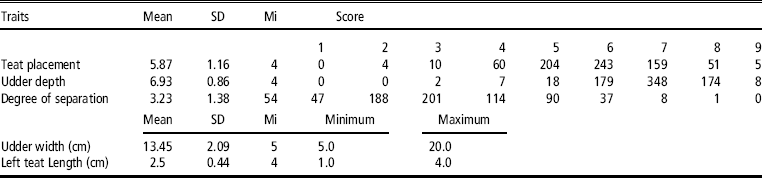
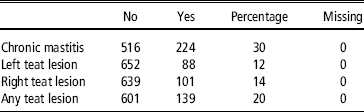
Data collected on farms were entered into Microsoft Excel spreadsheets. Ewe age (EA) in years at the time of observation was calculated as the difference between birth date and data collection date, and number of days in milk (DIM) was calculated as the difference between lambing date and data collection date. Traits recorded on a continuous scale, or with nine categories, were treated as normally distributed (Table 2). Teat lesions and IMM were considered as binary data (Table 3). The principal fixed effects were flock-score observation date (FSD) which included the effect of the flock and scorer on that day, EA in years (2, 3, 4, 5 and >5), and a linear regression of DIM. Litter size was coded into single or multiple births and ‘observed on farm’ or sourced from ‘BASCO-derived’ data (Table 4). Both estimates were prone to error because the former might have had fostered lambs recorded to their foster ewe and the latter because farmers only enter lambs into BASCO that they intend to monitor. Litter size was included in the fixed effect model for some analyses. Records from 1-year old ewes and those with no observation date, lambing date or unknown sire were removed. This left 817 udder trait records from 740 ewes; 665, 73 and 2 with one, two or three observations, respectively.
Summary statistics for continuous udder traits for 740 ewes

Mi=missing; Score=trait linear score.
Number and percentage of binary udder traits for 740 ewes

Litter size for 713 ewes from farmer records and the Beef and Sheep Company database (BASCO) database

Pedigree records from the BASCO database were concatenated to provide a pedigree file for the 740 ewes. The pedigree was pruned to remove uninformative members leaving 2270 sheep in the pedigree that were included in the animal model analyses (see below). There were 188 sires and maternal grandsires that were used to create the sire-maternal grandsire relationship matrix for the sire models. The 740 ewes were the offspring of 145 sires with an average of 5.6 ewe records/sire; there were 39 rams with only one recorded ewe offspring in the data set.
Data analysis
Three data sets were used; all 817 records which included repeated observations on some ewes, 740 single records per ewe using the last observation for each ewe and 713 records with information on litter size (a subset of the 740 single ewe record data set). Univariate quantitative genetic analyses were performed using individual animal models (IAM) for continuous traits and both IAM and sire models for binary traits. Bayesian Integrated Nested Laplace Approximation (INLA) (Rue et al., Reference Rue, Martino and Chopin2009) in the inla R package (http://r-inla.org) was used for all genetic analyses, the fitting of IAM with INLA having been demonstrated previously by Holand et al. (Reference Holand, Steinsland, Martino and Jensen2013). The fixed effects model (with FSD only or FSD plus EA or DIM or both) which resulted in the lowest deviance information criterion (DIC) (Spiegelhalter et al., Reference Spiegelhalter, Best, Carlin and van der Linde2002) was used in the reported analyses for that trait.
The following IAM were considered:
 $$y{\equals}Xb{\plus}Za{\plus}e$$
 $$y{\equals}Xb{\plus}Za{\plus}Zu{\plus}e$$
where y is a vector of phenotypic observations; b a vector of fixed effects; a is a vector of random animal effects; u a vector of random permanent environmental effects associated with ewes; X and Z are design matrices relating observations to fixed effect levels or animals, respectively; and e a vector of random residual effects. The variance of a is
 ${\rm var}\left( {\bf a} \right){\equals}{\bf A}\sigma _{a}^{2} $
, where A is the numerator relationship matrix, the variance of u is
 ${\rm var}\left( {\bf u} \right){\equals}{\bf I}\sigma _{{pe}}^{2} $
and the variance of e is
 ${\rm var}\left( {\bf e} \right){\equals}{\bf I}\sigma _{e}^{2} $
.
There is evidence that sire models provide better estimates of variance components than animal models for binary traits (Ødegard et al., Reference Ødegard, Meuwissen, Heringstad and Madsen2010). Consequently, a sire model with relationships was considered for the binary traits.
The following sire model was used:
 $${\bf y}{\equals}{\bf Xb}{\plus}{\bf Zs}{\plus}{\bf e}$$
where y is a vector of phenotypic observations; b a vector of fixed effects; s a vector of random sire effects; X and Z are design matrices relating observations to fixed effect levels or sires, respectively; and e a vector of random residual effects. The variance of s is
 ${\rm var}\left( {\bf s} \right){\equals}{\bf A}_{{\bf s}} \sigma _{s}^{2} $
(
 $\sigma _{s}^{2} {\equals}0.25\sigma _{a}^{2} $
), where A
s is the sire-maternal grandsire numerator relationship matrix pertaining to the 188 animal sire-maternal grandsire pedigree. A binomial GLMM with logit link function was fitted, therefore with a fixed residual variance,
 $\sigma _{e}^{2} {\equals}{{\pi ^{2} } \over 3}$
.
The same prior probability distribution was assumed for the heritability of all traits: a β distribution with a mode of 0.15 and in which 95% of the distribution fell below a heritability of 0.7. To obtain priors for genetic and residual precisions of continuous traits, random samples were taken from the prior distribution for heritability, which were converted to precisions assuming a phenotypic variance of 1, and a γ distribution was fitted to the resulting samples. To obtain trait-specific priors, the rate parameters of the fitted γ distributions were scaled by an approximation of the phenotypic variance for each trait. For the sire model of binary traits, the sire effect precision must be
 $\tau _{s} \geq {9 \over {\pi ^{2} }}$
. The R ‘logspline’ procedure (Kooperberg, Reference Kooperberg2013) was used to approximate the prior distribution taking account of this truncation. Priors for models incorporating repeated observations of ewes were determined by extending the method above to include the precision of ewe permanent environment effects. The power of the data set to estimate genetic correlations was limited, because of its small size and many sires with <5 offspring, and so Pearson’s correlations between the maximum a posteriori (MAP) estimated breeding value (EBV) of the 45 sires with more than five ewe offspring in the dataset were used as a robust subset to investigate genetic correlations between traits.
Results
Descriptive analyses
The following summary statistics contextualise the data used in the model and the types of flocks and sheep studied. The number of recorded ewes per flock ranged from 32 to 152. The median data collection was done ten weeks into lactation, range 1 to 18 weeks. Two- and 3-year-old ewes were most frequently observed. The average litter size for researcher-recorded records was 1.59 lambs per ewe, and for records obtained through BASCO 1.66 lambs per ewe (Table 4). There were 224/740 (30%) ewes with an IMM and 139 (20%) ewes with one or more teat lesion (Table 3). Teat placement and udder depth were normally distributed, whereas degree of separation was positively skewed and udder width was negatively skewed (Table 2).
Multivariable models of heritability
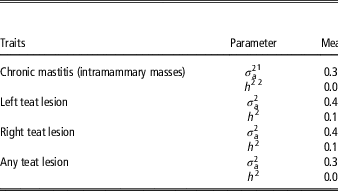
The combination of fixed effects with the lowest DIC value was used for each trait modelled in all analyses (Supplementary Table S1). For teat placement and udder width the selected fixed effect model included FSD, EA and DIM. For udder depth DIM was omitted while EA was omitted for the left teat length model. For the binary traits and degree of separation, FSD was the only fixed effect included. Teat placement and teat length heritabilities (h 2) were=0.35 (SD 0.04) and 0.42 (SD 0.04), respectively. Udder width, drop and separation heritabilities were lower than this and varied with udder volume. The continuous udder traits MAP estimates ranged from 0.10 (for udder width) to 0.42 (left teat length) (Table 5). Heritability estimates for the binary traits were lower than the continuous traits, the heritability of IMM and teat lesions in the sire model was 0.18 (SD 0.12) and 0.17 (SD 0.11), respectively. The sire model MAP estimates (Table 6) were higher than those from the animal model (Table 7) for three out of four traits. All heritabilities were sufficiently high that they could be used in a selection programme to increase resilience to mastitis in the population of Texel sheep, they were generally slightly higher when repeated scores were included (Supplementary Table S2).
Marginal distributions of variance components and heritabilities of continuous udder traits of 740 ewes from an individual animal model Bayesian Integrated Nested Laplace Approximation analyses

MAP=maximum a posteriori probability.
1
 $\sigma _{e}^{2} $
=variance of e=vector of random residual effects.
2
 $\sigma _{a}^{2} $
=variance of a=vector of random animal effects.
3 h 2=heritability.
Marginal distributions of heritabilities from sire model Bayesian Integrated Nested Laplace Approximation analyses of binary udder traits of 740 ewes

MAP=maximum a posteriori probability.
1
$\sigma _{e}^{2} $
= variance of e=vector of random residual effects.
2
$\sigma _{a}^{2} $
=variance of a=vector of random animal effects.
3 h 2=heritability.
Marginal distributions of heritabilities from the individual animal model Bayesian Integrated Nested Laplace Approximation analyses of binary udder traits of 740 ewes

MAP=maximum a posteriori probability.
1
$\sigma _{a}^{2} $
= variance of a=vector of random animal effects.
2 h 2=heritability.
Non-zero estimates of the permanent environmental variance were obtained for udder depth, degree of separation and udder width (Supplementary Tables S2 and S3), indicating that these variables varied by flock. The modal heritability was generally slightly lower when litter size was included in the model, except for teat placement and chronic mastitis (Supplementary Tables S4 and S5). The mode and 95% credible intervals for the chosen prior were similar to those obtained when a uniform prior for the heritability was used. For the continuous traits (Supplementary Figure S1), the credible interval of the heritability was reasonably consistent across priors. For the binary traits (Supplementary Figure S2) the 95% credible interval varied with the width of the prior distribution. The estimates of Pearson’s correlations between MAP estimates of EBV of sires with at least five recorded ewe offspring indicated that non-zero genetic correlations may exist between the traits (Supplementary Table S6).
Discussion
This is the first study to investigate the heritability of udder traits in pedigree suckler ewes. The continuous udder traits were heritable (Table 5), as in studies of dairy sheep (de la Fuente et al., Reference de la Fuente, Gonzalo, Sànchez, Rodríguez, Carriedo and Primitivo2011; Fernandez et al., Reference Fernandez, Alvarez, San Primitivo and de la Fuente1995; Makovický et al., Reference Makovický, Margetín and Makovický2015). However, because udder width and degree of separation are influenced by udder fullness, their inclusion in a selection programme would require care, taking account of any relationships with, for example, maternal effects on lamb growth. The heritability of binary traits such as teat lesions and IMM (Table 6) was lower than continuous traits and consequently direct selection for these traits would progress more slowly than for the continuous traits. The difference in heritability of teat lesions (Table 6) highlights the influence of random error in our small dataset, a future study would require more observations on binary traits to reduce random error. Overall, the phenotypic trait estimates of heritability were similar to those reported in several breeds of dairy sheep (de la Fuente et al., Reference de la Fuente, Gonzalo, Sànchez, Rodríguez, Carriedo and Primitivo2011; Fernandez et al., Reference Fernandez, Alvarez, San Primitivo and de la Fuente1995; Makovický et al., Reference Makovický, Margetín and Makovický2015) and, with large standard deviations observed, any differences in heritability estimates are likely to be non-significant. It is therefore likely that udder traits would be heritable in other pedigree suckler breeds of sheep.
Several approaches to the analysis of the data were taken in an attempt to maximise the confidence in the results from the relatively small dataset. The heritability of binary traits was slightly higher in the sire model (Table 6) than the animal model (Table 7), with the posterior distributions more skewed towards higher values but with posterior modes that were similar to those from the animal model. Previous literature indicates that the sire model estimates of heritability for binary traits may be better estimates of the true h 2 than IAM estimates, see Ødegard et al. (Reference Ødegard, Meuwissen, Heringstad and Madsen2010) for a discussion and a proposed solution for estimation of genetic parameters using Markov chain Monte Carlo.
The data set was too small to perform multivariate quantitative genetic analysis to investigate the genetic relationships of udder traits to resilience to IMM. Measuring indirect traits might be a route to improve resilience to IMM should traits be correlated with IMM as suggested by our crude analysis (Supplementary Table S6) and previously in suckler ewes (Huntley et al., Reference Huntley, Cooper, Bradley and Green2012) and dairy ewes (Casu et al., Reference Casu, Pernazza and Carta2010; Legarra and Ugarte, Reference Legarra and Ugarte2005). If udder traits are not linked to IMM selection for resilience to IMM would have to be done through direct observation and recording of IMM.
We focused on the Texel breed because farmers were compliant with the study and the flocks in our study had good pedigree information stored electronically in the (BASCO). It is important to consider that it would only be cost-effective to initiate a programme to record such data if the prevalence of undesirable phenotypes in Texel ewes was sufficiently high to make such selection useful. The prevalence of poor udder and teat conformation was low in Grant et al. (Reference Grant, Smith and Green2016) where several breeds and crossbreeds were studied. Consequently, the prevalence of undesirable phenotypes in Texel ewes needs to be established from a random sample of Texel flocks before a selection programme is started.
Covariates that influenced the estimates and precision of heritabilities included EA, DIM and litter size whether using the observed or BASCO recorded estimates. These data are collected routinely in BASCO and could be included in future analyses. There was also evidence that repeated observations of traits the same ewe across years increased the precision of estimates of heritability for some traits. So, ideally a ewe’s phenotype should be measured several times over her life. This adds to the challenge of collecting phenotypic trait data because the time spent recording udder phenotype data would be considerable. In addition, farmers have been reluctant to record disease traits because they are disadvantageous to record unless all farmers recorded mastitis. A strategy to collect robust data would be required so that all flocks are recorded to a good standard and farmers can make informed choices on the genetic merit of sheep with regard to resilience to IMM.
In conclusion, results from this study of 740 Texel ewes indicate that udder traits were heritable although binary traits had lower heritability, with less precision, than continuous traits. These are new and useful results. The next stages are to use a larger data set to perform multivariate analysis to estimate the genetic relationships between udder traits and of udder traits with IMM and to estimate the proportion of Texel ewes with poor udder conformation before a programme to improve resilience to mastitis through selection is implemented. Finally, a robust selection programme would require repeated observations of ewes within a flock and for many, preferably all, BASCO recorded Texel flocks to record mastitis traits.
Acknowledgements
This study was funded by The Texel Society an Innovate SPARK award and AHDB. S.C. was funded by a BBSRC CASE studentship with AHDB. The authors are grateful to all the farmers who participated in this project and to John Yates for his support encouraging farmers to participate. The authors thank Amy KilBride, Dan Franklin, Emma Monaghan and Rebecca Mitchell for technical assistance.
Declaration of interest
There are no conflicts of interest to declare.
Ethics statement
This study was approved by the University of Warwick biomedical and scientific research ethics committee.
Software and data repository resources
There is no software from this study. None of the data were deposited in an official repository.
Supplementary material
To view supplementary material for this article, please visit https://doi.org/10.1017/S1751731118002951