One of the most significant changes in established democracies over the last two decades has been the emergence of political parties that are right wing in terms of ideology and restrictive in terms of immigration policy.Footnote 1 In the relevant literature these parties are commonly referred to either in terms of ideology – as right wingFootnote 2 – or in terms of policy – most importantly, in favour of immigration restriction.Footnote 3 These labels appear to pertain to very similar, if not identical, sets of parties.Footnote 4 This brings us to the question: does it matter whether we define these parties in terms of ideology or in terms of policy? In other words, how similar or dissimilar is the group of ‘far right’ parties to that of ‘anti-immigration’ ones? This is the main question addressed in this article.
This question is important because the lack of conceptual clarity that currently plagues the research fieldFootnote 5 largely prevents us from drawing valid inferences on this topic. Furthermore, it would be useful to have an appropriate label for the parties that, taken together, have been increasingly successful in electoral terms in recent decades.Footnote 6 Good conceptualization and operationalization are also indispensible if we are to find the answer to the question of why these parties have emerged – a question that is central to much research in the field (but not to this article as such). This is not only important from a scientific perspective, but also because the rise of some of these parties, such as the Freedom Party of Austria (FPÖ) and the German Republikaner, have sent shockwaves through society.
In this article I compare far right parties, selected on the basis of their ideologies, and anti-immigration parties, selected based on their immigration policies. I argue and empirically demonstrate that these two groups of parties are not identical. This runs counter to what the extant literature suggests, as scholars tend to use these terms interchangeably, and/or refer to work on far right parties when studying anti-immigration parties, and vice versa, implying that these terms are equivalent. Based on data derived from several expert surveys, I discuss similarities and dissimilarities between these two types of party, showing why it is useful to distinguish between them. The article concludes by discussing the implications of my findings.
PREVIOUS WORK: LACK OF CONCEPTUAL CLARITY
All over the Western world, parties have emerged that are both right wing and opposed to the idea of the multicultural society, and a groundswell of writings has been devoted to them. Scholars from several disciplines – mainly political science, psychology and sociology – have studied them from various perspectives. By and large, these scholars have taken into account the same set of parties; there seems to be a broad consensus regarding which parties to study – with the exception of a few cases including the Swiss People's Party (SVP) and the National Alliance (AN) in Italy.
This similarity is remarkable, as there is no apparent consensus on the concept under study. The absence of conceptual clarity is reflected by the fact that there is no agreement on what to call these parties in the first place. The name given to the parties as a group varies from study to study. Mudde also observes this ‘terminological chaos’ resulting from ‘a lack of clear definitions’.Footnote 7 Thus, whereas every researcher seems to know which objects to study, no one seems to know what exactly defines this set of objects. As Von Beyme notes, ‘Though formal definitions or derivations based on the history of ideas largely failed to provide a convincing concept for “right-wing extremism”, research work on political parties of the right has not had serious problems in selecting appropriate cases.’Footnote 8
This lack of conceptual clarity leads to several problems of scientific inference. These difficulties include both theoretical and practical ones. For instance, any discussion between scholars regarding the borderline cases mentioned above is nonsensical as long as they disagree on conceptualization. If it remains unclear which characteristics are sufficient and/or necessary for a party in order to call it ‘anti-immigration’, for example, how can one tell whether or not a party belongs to this category? This explains the seemingly never-ending debates about whether or not specific parties such as the SVP and AN fall into this category.Footnote 9 The absence of conceptual clarity also increases the chances of neglecting other parties where good reasons exist to take them into account, and of including parties that do not meet the relevant criteria.
Furthermore, such conceptual problems create methodological difficulties. For example, they are conducive to the violation of the assumption of unit homogeneity, which is a key assumption for drawing valid causal inferences.Footnote 10 Without clearly defined concepts underpinning the research, the unit homogeneity assertion can easily be at risk.
If there is no agreement on the underlying concept, what guides case selection in the existing literature?Footnote 11 Some scholars do not seem to question which parties to study – perhaps because in their eyes it is obvious. Other researchers select their cases on an ad oculum basis. Most scholars, however, avoid this tricky question by pointing to work by other researchers when they have to decide which parties to include in or exclude from their analyses.Footnote 12 Although there is consensus among social scientists regarding the point that the method of case selection should be made explicit and accessible to everyone for replication purposes,Footnote 13 this advice is generally not closely followed in the existing literature. As Mudde notes, ‘few scholars have established a clear method for categorizing political parties’.Footnote 14 Some researchers even explicitly claim that there is such a party family that can be distinguished from the other parties, without making it clear how such a distinction can be made.Footnote 15 I think that this is an unfortunate state of affairs, and this article aims to select cases in such a way that my research is replicable.
CLASSIFICATIONS IN TERMS OF IDEOLOGY
Arguably the most frequently applied classifications are those based on party ideology, usually expressed in terms of ‘left’ and ‘right’. The concept of ‘the right’ has its problems, however. The right is commonly associated with socio-economic issues. For example, an emphasis on the need to combat inflation is usually considered ‘right wing’, as is a position against government influence in the economy. Yet, the right can also relate to other topics, such as immigration or family values. As Kitschelt and McGann put it, the right pole brings together positions on several issues, ‘linked in ways contingent upon time and place’.Footnote 16 Apart from issues, ‘right wing’ may refer to broader orientations such as authoritarianism, traditionalism or conservatism. This implies that a party can, quite confusingly, be ‘left wing’ and ‘right wing’ at the same time. The Dutch List Pim Fortuyn (LPF), for example, combined libertarian (‘leftist’) views on moral issues such as same-sex marriage with a very restrictive (‘rightist’) stance on immigration.Footnote 17
That said, the concepts of the ‘left’ and the ‘right’ are well established in the relevant literature.Footnote 18 In addition, research shows that the vast majority of voters in contemporary Western Europe agree on where the major parties in their political system should be placed in terms of left and right,Footnote 19 regardless of the meaning that voters attach to ‘left’ and ‘right’. Indeed, a (not exclusively socio-economic) left–right axis structures electoral competition in contemporary Western Europe more than any other dimension.Footnote 20 Notwithstanding potential problems with the concept of ‘the right’, I thus think it makes sense to measure the extent to which a party is ‘rightist’– and, therefore, whether or not it is ‘far right’.
The ‘Far Right Party’: An Operationalization
How has the concept of the far/radical/extreme right party been measured thus far? Only in exceptional cases, such as in work by Lubbers and Norris, is a definition given together with an explicit operationalization of the concept.Footnote 21 Lubbers defines ‘extreme right-wing parties primarily as ethnic out-group exclusionistic parties, without marking them as single-issue parties’.Footnote 22 In order to select the parties for this study, Lubbers conducts an expert survey, asking experts to indicate the position of 142 parties in 17 countries in terms of left and rightFootnote 23 and in terms of immigration policy,Footnote 24 both on a 0–10 scale. Based on the results of this survey, Lubbers notes that those parties commonly considered ‘extreme right’ all have a mean immigration restriction score of over 8.5. The exception to this rule is the National Alliance (AN) in Italy, which he does not include in his study, although it received a very right-wing score (8.17) from the experts. Lubbers does, however, take parties into account that score over 8.5 on the immigration restriction scale but are less right wing than the AN – namely the Progress Party (FrP) in Norway (8.14) and the Northern League (LN) in Italy (7.55). He thus selects ‘extreme right-wing parties’ on the basis of attitudes towards the immigration issue.
Interestingly, Norris uses Lubbers's data in a different way, using the immigration restriction scores in combination with positioning on a left–right scale (at least, concerning the Western European cases).Footnote 25 In Norris's study, parties were classified as part of the ‘radical right’ if their mean score on the combined left–right and immigration 10-point scales in the Lubbers survey were greater than 8.0. In sum, Norris uses both immigration and left–right party placement in order to identify ‘radical right’ parties. Advantages of the case selection procedure applied by Norris are that her procedure is clear and replicable, and that the data used are made as comparable over time and place as possible. It is evident that the use of comparable data underlying case selection is necessary in order to be able to tell to what extent units are homogeneous. A disadvantage of her approach is that it remains unclear why the ‘immigration restriction score’ was the criterion for selecting ‘radical right’ parties, and not only left–right placement. In this article I intend to select far right parties on the basis of their ideologies, and anti-immigration parties based on their immigration policies. I use data from expert surveys for this purpose.Footnote 26
Of course, there are many different ways in which to measure the relevant party characteristics other than by means of expert surveys, including judgements on the basis of party origins, secondary reading, mass surveys, elite studies and the analysis of party manifestos.Footnote 27 However, Mair points out that the use of an expert survey has at least four advantages over the alternatives.Footnote 28 First, participants' expert status gives their judgements a certain weight and validity. A second advantage of an expert survey is that the experts' judgements are based on the present behaviour of the party rather than on its past actions. Third, expert surveys usually generate highly comparable and standardized data across countries. Finally, these surveys result in precise numerical measures, thus facilitating empirical analysis. The use of expert surveys does, however, have certain limits, as Mair also argues.Footnote 29 The most relevant problem in our case is that experts base their perceptions to some extent on secondary sources such as the mass media. To the extent that those sources are biased, the judgements of the experts could be biased as well.Footnote 30 We have to be aware that such a bias may exist in the expert judgements. Unfortunately, there is no known way to correct adequately for this.
Benoit and Laver mention three other advantages of the use of expert surveys.Footnote 31 When conducting an expert survey one can increase the number of observations by asking more experts. In this way, the information can relatively easily be made more accurate. Moreover, one can estimate the uncertainty of the estimates based on the information obtained. Secondly, Benoit and Laver argue that the discipline of political science is in need of the consensus of well-established experts. By way of conducting an expert survey, the problems associated with using information provided by only one or a small number of country experts can be circumvented. According to Benoit and Laver, this allows for the best possible measurements of unobservable phenomena in political science. Finally, a more mundane argument concerns the availability of data. Other data of a similar accuracy from a large number of countries simply do not exist on contemporary Western European party politics.
When is a party labelled ‘far right’? No theoretical reason has been provided thus far as for why, for example, 8.0 should be taken, as in Norris's study. I would argue that the common qualification of the group of parties under study as ‘new’ in the sense that these parties date back four decades at the most suggests that parties founded before that time should be filtered out on the basis of the criteria. Close examination of the list used by Lubbers and Norris, a list that combines ideological and immigration policy positions for all major parties in 17 Western European countries, reveals that none of the parties founded before 1960 scores higher than 8.0 on either dimension.Footnote 32 Thus, any party scoring higher than 8.0 on a left–right scale is more right wing than any ‘old’ party, and any party receiving an immigration restriction score higher than 8.0 qualifies as more ‘anti-immigration’ than the parties founded in the pre-mass immigration era. It is the lowest score that is still higher than any established party has ever scored. I proceed with this cut-off point as my criterion. That is, the party is considered far right at the time that the attributed score refers to. I explicitly take into account the fact that parties' ideologies may change. I will get back to this important point later on.
Selecting Far Right Parties
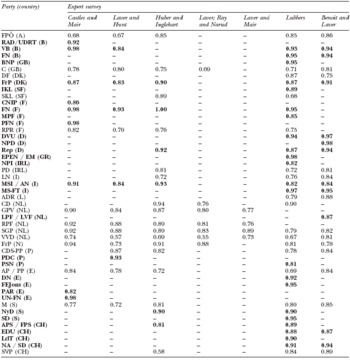
In this article, I apply the aforementioned criterion to as many parties as possible. In order to measure party ideological positions, I use all expert surveys that have been conducted since 1980 in which parties were positioned on a left–right axis.Footnote 33 All data were recoded into a 0–1 scale to facilitate assessment of how far to the right each party actually is. Thanks to these expert surveys, we have comparable data on left–right party placements in 17 Western European countries. These countries are Austria, Belgium, Britain, Denmark, Finland, France, Germany, Greece, Ireland, Italy, Luxembourg, the Netherlands, Norway, Portugal, Spain, Sweden and Switzerland. See Table 1 for the selected parties in these countries that met the far right criterion (>0.8) at least once.
Parties Scoring Higher than 0.80 on a 0–1 left–right scale in 17 Western European countries, 1982–2004

Source:-Various expert surveys (see main text); recoded into 0–1 scores; – = no data. In bold: party meets the relevant criterion at all available time points. See Appendix for full party names.
In each of the 17 countries, one or several parties existed that are labelled ‘far right’. No fewer than 48 parties met the criterion of a left–right score higher than 0.8 on a 0–1 scale at one time point at least. The data suggest that there was some significant change in parties' ideological position over time, as 18 of the 48 parties shifted from the far right box to the non-far right one, or vice versa. The 30 remaining parties, indicated in bold in Table 1, are consistently coded ‘far right’. These are the RAD-UDRT, VB and FN in Belgium, the BNP in Britain, the Danish FrP, the IKL in Finland, the French CNIP, FN, MPF and PFN, the DVU, NPD and Rep in Germany, the Greek EPEN/EM, the Irish NPI, the MSI/AN and MS-FT in Italy, the Dutch LPF/LVF, the PDC and PSN in Portugal, the Spanish DN, FEJons, PAR and UN-FN, the Swedish NyD and SD, and the APS/FPS, EDU, LdT and NA/SD in Switzerland (see Appendix for full party names).Footnote 34 In the remainder of this article I stick to this set of clear-cut examples when making my case. In doing so, we should keep in mind that there are other parties that were far right for only part of this period, and yet other parties that were difficult to classify because of lack of adequate data.
Let us now turn to the work of scholars who study ‘anti-immigration’ parties.
CLASSIFICATIONS IN TERMS OF POLICY
Here is the means of showing that the immigrant communities can organise to consolidate their members, to agitate and campaign against their fellow citizens, and to overawe and dominate the rest with the legal weapons which the ignorant and the ill-informed have provided. As I look ahead, I am filled with foreboding. Like the Roman, I seem to see the River Tiber foaming with much blood.
These are the words with which UK Conservative Party MP Enoch Powell concluded his Birmingham speech on 20 April 1968. The speech was given considerable attention in the national British media in the years to follow.Footnote 35
Powell was among the first politicians who warned of the potential dangers of mass immigration to Western Europe. Until the early 1960s, mass immigration had generally not been viewed as problematic in post-war Western Europe. Since then, however, many political parties across the region have attempted to mobilize support on the basis of issues linked to immigration. Unlike the UK Conservative Party – the leader of which at the time, Edward Heath, sacked Powell from his shadow cabinet after the speech – these parties are often referred to as ‘anti-immigration’ parties.
Fennema defines as ‘anti-immigrant’ parties those that employ the immigration issue as their core political concern in electoral campaigns, or are considered by elites of other political parties to do so.Footnote 36 Fennema has recently changed the concept from ‘anti-immigrant’ to ‘anti-immigration’, arguing that these parties are not against immigrants per se, but rather seek to reduce the influx of immigrants to their respective countries. In addition, these parties attract many votes from successfully integrated immigrants.Footnote 37
That parties are ‘anti-immigration’ does not necessarily mean that they should be considered single-issue parties. In fact, evidence points in the direction that these parties do not focus on one issue only.Footnote 38 Indeed, they are rather supported on the basis of broader ideological considerations.Footnote 39 Nor does this terminology preclude considerations other than policy or ideological ones, such as anti-establishment feelings, from playing a role in the vote for these parties as well.Footnote 40
Furthermore, within some ‘anti-immigration’ parties there are competing factions, not all of which focus on the immigration issue. This was the case, for example, in the former Flemish Bloc (VB) in Belgium, where Filip Dewinter headed an anti-immigration faction while a rival subgroup was represented by Gerolf Annemans. Annemans focused on Flemish separatism rather than on immigration issues, which can be illustrated by his statement: ‘Mustafa who slaughters sheep in his bath tub is not my worst enemy. My worst enemy is the Belgian state.’Footnote 41 Eventually, Dewinter won the struggle and the party became predominantly anti-immigration around 1984.Footnote 42
The label ‘anti-immigration’, then, is used as a minimal definition here, identifying a lowest common denominator.Footnote 43 Other ways to classify parties, such as those based on a greatest common denominator – identifying the greatest possible number of similarities – are rarely used.Footnote 44 In contrast with that of the ‘far right’ party, the concept and measurement of the ‘anti-immigration’ party has never received the attention it deserves. In order to compare case selection based on the concept of the ‘far/radical/extreme right’ party with case selection on the basis of the ‘anti-immigration’ party concept, I therefore have to elaborate a conceptualization and operationalization of the ‘anti-immigration’ party.
I take Fennema's definition as a starting point.Footnote 45 A solid empirical grounding requires a slightly different definition of the concept to Fennema's, however. A definition in terms of position only (such as Lubbers's ‘extreme right-wing’ party definition, or case selection by Norris) would not be valid. This is because immigration is a policy dimension that – unlike the ideological ‘left versus right’ dimension – is not always salient to all parties. The importance a party attaches to particular policy dimensions varies over time and place.Footnote 46 In accordance with the relevant literature,Footnote 47 a party's position regarding a specific issue on the one hand should be distinguished from the salience it attributes to the issue on the other.Footnote 48 It would be nonsensical to take into account the position of a party on this issue if that party does not stress the issue at all. Thus, compatible with Fennema's definition, the one suggested in this article is designed in accordance with the mainstream notion in electoral studies that a distinction should be made between issue salience and issue position.
In line with the existing literature, I define as an ‘anti-immigration’ party a party that meets the following two criteria. First, the measures it requires aim to restrict immigration. The second criterion is that it has to stress the urgency of taking measures regarding immigration. In sum, a party is considered ‘anti-immigration’ if its position regarding immigration is more restrictive than that of any party founded before the relevant era (the current period of mass immigration to Western Europe), and if it attributes more salience to the issue than any party founded before this.
The ‘Anti-Immigration’ Party: An Operationalization
Whether or not a given party meets the two criteria mentioned above is measured in the following way. The first criterion, concerning a party's immigration policy, is assessed by way of party placement on a 0–10 scale of immigration restriction, which was included in expert surveys for all main parties in 17 countries for 1990Footnote 49 and 2000 by Lubbers and for 2004 by Van Spanje et al.Footnote 50 The ‘immigration restriction’ scale ranges from 0 (‘not very restrictive’) to 10 (‘very restrictive’).
In addition, a database compiled by Benoit and Laver is used for the first criterion. Benoit and Laver use a scale of 1 (‘favors policies designed to help asylum seekers and immigrants integrate into [nationality] society’) to 20 (‘favors policies designed to help asylum seekers and immigrants return to their country of origin’) to position parties.Footnote 51 These data were recoded into a 0–10 scale in order to make it possible to compare them to the Lubbers and Van Spanje et al. data. The data pertain to national-level elections held between 2001 and 2004, the time span between the survey conducted by Lubbers and the one by Van Spanje et al. They are available for all 17 countries that were covered by the Lubbers and Van Spanje et al. expert surveys.
Using Lubbers's scale from 0 to 10, I first have to select a cut-off point. There is no obvious reason why Norris's cut-off point of 8.0 is to be preferred over 8.5 (Lubbers) or vice versa, or if a different cut-off point should be used. I use the cut-off point of 8.0, as any party receiving an immigration restriction score higher than 8.0 qualifies as more ‘anti-immigration’ than the parties founded in the pre-mass immigration era (see also above for a discussion of this cut-off point).
The assessment regarding the second criterion, the extent to which the party stresses the immigration issue, is based on the results of an expert survey by Benoit and Laver only.Footnote 52 This is because, to the best of my knowledge, no other data exist on this point. In the expert survey, experts were asked to rate parties in the country of their expertise on a 1–20 scale regarding the salience they attribute to the issue. They did so in each of the 17 countries under study here.
I use this conceptualization and operationalization of the ‘anti-immigration’ party for the process of case selection in this article. Beginning with the first criterion, party positions on immigration, I turn to the data derived from the expert surveys conducted by Lubbers and by Van Spanje et al.
Selecting Anti-Immigration Parties
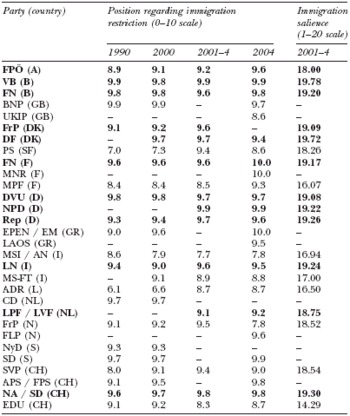
As mentioned earlier, I include parties scoring higher than 8.0 on this 0–10 immigration scale at, at least, one point in time. Concerning the 17 countries for which data for all four time points are available, this leads to 30 parties meeting the first criterion – see Table 2's four middle columns.
Parties Scoring Higher than 8.0 on a 0–10 Immigration Scale, 17 Western European Countries, 1990–2004

Source:-Various expert surveys (see main text). In bold: party meets both relevant criteria at all available time points. See Appendix for full party names.
In the 17 countries, 10 parties favoured very restrictive immigration policiesFootnote 53 in 1990, 2000 and 2001–4, as well as 2004. Hence, it can be assumed that these parties were anti-immigration throughout this entire period. In addition, 20 other parties met the criterion of an immigration restriction score of over 8.0 at least once in this time span of 15 years (see the previous section for why 8.0 was chosen as the criterion). The selection includes all the usual suspects: the National Front (FN) in France, as well as some less well-known parties such as the Fatherland Party (FLP) in Norway. In three of the 17 countries on which data are available – Ireland, Spain and Portugal – none of the parties represented in the national parliament was perceived as ‘anti-immigration’ at any of the measurement points. In sum, experts considered 30 parties very restrictive on immigration at least once in these parties' existence.
Five of these 30 parties met the criterion at some point, yet failed to meet it at another during the 15 years of study. Two parties, the Norwegian Progress Party (FrP) and the National Alliance (AN) in Italy, seem to have considerably toned down their anti-immigration rhetoric. Three others appear to have significantly shifted towards immigration restriction in recent years – the True Finns (PS), the Action Committee for Democracy and Pensions Justice (ADR) in Luxembourg, and the Swiss People's Party (SVP). My definition allows for such dynamism. To the debate on whether or not to include specific parties, one can now add solid arguments based on easily accessible, numerical data. Just for the sake of the argument, I will leave these five parties aside for the moment and concentrate on the 25 remaining parties that fiercely opposed immigration at all time points for which we have data.
I now turn to the second criterion. I argue that the positions of the parties should be interpreted in the light of the importance that parties attach to the immigration issue. In a recent expert survey, Benoit and Laver collected data on the importance of immigration for parties.Footnote 54 Every expert was asked to indicate parties in the country of his or her expertise on a 1–20 scale regarding the importance they attribute to the issue of immigration. The second criterion for labelling a party as ‘anti-immigration’ is that the party scores at least 18 on the 1–20 immigration importance scale. Just as for the first criterion – as well as the far-right criterion – this cut-off point was chosen on the basis of the scores of parties founded before the era of mass immigration to Western Europe, the lowest score still being higher than any of the established parties' scores. The survey covered 15 of the 25 parties that adamantly opposed immigration according to all available data sources – see the last column of Table 2.
Table 2's last column shows that most parties that have a very restrictive position towards immigration also attach considerable importance to the issue: 12 of the 15 parties with a position higher than 8.0 on the 0–10 immigration restriction scale at all time points measured also score 18 or higher on the 1–20 immigration importance scale (for the reason to choose the cut-off point of 18, see above). These 12 parties can be considered as sending out a restrictive and urgent message concerning immigration issues. The three exceptions are the Movement for France (MPF), the Italian Social Movement (MSFT), and the Federal Democratic Union (EDU) in Switzerland. These parties consistently meet the anti-immigration position criterion yet do not meet the salience criterion of at least 18 on a 1–20 scale. The fact that no fewer than three of the 15 parties under investigation (20 per cent) that have a very restrictive immigration position attach relatively low importance to the issue underlines my call for taking into account the salience in categorizing anti-immigration parties. Thus, 12 parties from eight different countries, indicated in bold in Table 2, can safely be characterized as anti-immigration parties.
THE DYNAMICS OF BEING FAR RIGHT AND/OR ANTI-IMMIGRATION
The definitions outlined above imply a departure from the commonly used static conceptualizations and operationalizations. Instead of the starting point that all parties are to be classified according to their roots and under a specific party family, as determined at the party's emergence,Footnote 55 the ‘far right’ party and the ‘anti-immigration’ party are described in a dynamic way in this article. This means that parties can become far right or anti-immigration and can also stop being far right or anti-immigration. For example, the Swiss People's Party adopted an anti-immigration stance in the mid-1990s, whereas the Italian National Alliance's rhetoric had become less anti-immigration before it merged with the main right-wing party Forza Italia (FI). Evidence for these examples has not only been derived from the literature on these parties but has also resulted from expert surveys conducted by Lubbers in 2000, and by Van Spanje et al. in 2005. The status of these two parties has been disputed time and again in the relevant literature.Footnote 56
Another interesting case under investigation here, that of the True Finns, is usually below the radar of scholars who study ‘anti-immigration’ parties. This means that it is usually lumped into the category of ‘mainstream’ (not anti-immigration) parties. This is problematic as there are good reasons to take the True Finns into account in studies on anti-immigration parties. Nowadays, the party comfortably meets both anti-immigration party criteria mentioned in this article, as can be seen in Table 2. Thus, whether a party is ‘far right’ and/or ‘anti-immigration’ is not considered time invariant, but should be (re)assessed at each relevant point in time. Note that Golder recognizes that the classification of parties as ‘neofascist’, ‘populist’ or ‘mainstream’ can change over time.Footnote 57
The importance of taking change into account when considering a party's anti-immigration status can be illustrated with the case of the MSI/AN. This party combined a gradually less restrictive position on immigration policy with a salience of the issue of less than 18. Could the low salience the party attached to the issue in 2001 have been considerably higher before? This is likely. This party, then called the Italian Social Movement-National Right (MSI-DN), had an anti-immigration stance, at least until late 1992, as both Lubbers and Ignazi note,Footnote 58 and there is evidence pointing to it attaching more importance to the issue at that point in time than a decade later.Footnote 59 The party underwent a major restructuring following the collapse of the Italian party system in the early 1990s. Renamed AN, its leader, Fini, had abandoned his fierce anti-immigration stance by 1995.Footnote 60 In view of the fact that the party comfortably met the first anti-immigration criterion (immigration restriction score = 8.6) before, and just fails to meet either criterion after the party's restructuring and toning down reported by Ignazi as well as Lubbers (immigration restriction score = 7.9), it is likely that before 1995 the party actually met the criteria. More generally, one should be aware of the fact that parties may make considerable shifts regarding immigration issues, which may alter their classification.
The notion that some parties were far right and/or anti-immigration at some points in time but not at others is important for my comparison of party categories, as we will see. This said, I first proceed with 30 parties that have clearly been far right throughout the period of study, and 12 parties that are clear cases of anti-immigration parties during the entire period (see parties indicated in bold in Tables 1 and 2). Based on these sets of parties, I investigate how many far right parties are anti-immigration, and how many anti-immigration parties are far right.
Are Far Right Parties Also Anti-Immigration?
I now address the question of how much overlap this selection of anti-immigration parties has with a selection on the basis of the notion of the ‘far right’ party. I first address the question of how many of the 30 far right parties are also anti-immigration. After this, I turn to the question of how many of the 12 anti-immigration parties are also far right.
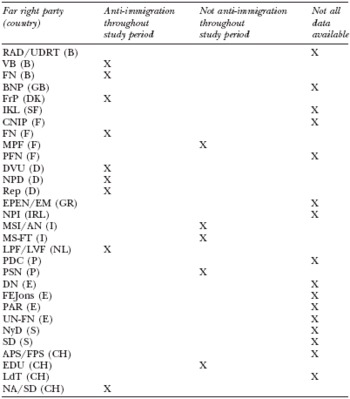
Are there any indications that there are many far right parties that do not attempt to mobilize on the immigration issue? See Table 3 for a classification of the 30 far right parties into three classes – anti-immigration, not anti-immigration and unknown.
Far Right Parties in 17 Western European Countries, 1990–2004: Anti-Immigration or Not?

Source: Various expert surveys (see main text). See Appendix for full party names.
We see in Table 3 that of the 30 parties that were consistently judged far right, the situation is unclear in 16 cases. Of the other 14 parties, nine (64 per cent) were also anti-immigration throughout the period under study, whereas five (36 per cent) were not. These five are the MSI/AN in Italy, the Portuguese PSN (both with no very restrictive immigration position), the French MPF, the MS-FT in Italy and the Swiss EDU (all three with a very restrictive immigration position but not very salient).
Are Anti-Immigration Parties Also Far Right?
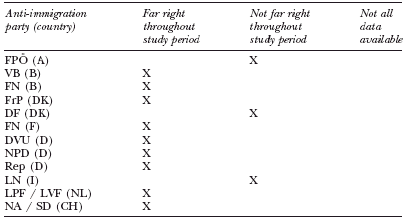
How about anti-immigration parties – are there any that are not far right? For left–right positions of the 12 anti-immigration parties selected in this article, see Table 4. It turns out that 9 out of 12 (75 per cent) anti-immigration parties meet the ‘far right’ criterion of experts rating them higher than 0.8 on a 0–1 left–right scale throughout the period of study. Case selection based on ideology instead of policy, then, would make a difference for 3 out of 12 parties. Thus, here we find yet other notable exceptions to the general rule that far right parties are anti-immigration, and anti-immigration parties far right.
Anti-Immigration Parties in 17 Western European Countries, 1982–2004: Far Right or Not?

Source: Various expert surveys (see main text). See Appendix for full party names.
The three exceptions are the Austrian FPÖ, the DF in Denmark, and the LN in Italy. All three have been judged far right at least once in their lifetime, however: the FPÖ in the Huber and Inglehart, Lubbers, and Benoit and Laver studies, the DF in Lubbers, and the LN in Benoit and Laver.Footnote 61 The FPÖ radicalized after 1986,Footnote 62 the DF has mellowed its tone in recent yearsFootnote 63 and the LN shifted back and forth between radicalization and moderation.Footnote 64 This illustrates, once again, that it is important to examine each party at the relevant time(s) rather than in general.
Finally, I perform an additional analysis to illustrate to what extent far right and anti-immigration parties are (dis)similar. Ignoring the salience criterion for a moment (because of the small number of observations concerning salience), taking all parties into account for which we have left–right placement and immigration position (not salience) at our disposal (N = 109) results in a chance-adjusted agreement measure of Cohen's kappa = 0.66. This indicates that substantial agreement exists. This means that, on the one hand, we have no reason to suspect that it matters much whether the parties under study are classified in terms of policy or in terms of ideology. This finding is robust to slight changes in cut-off points, and does not depend on the inclusion of particular countries in my analyses. On the other hand, though, I should emphasize that the two sets of parties are not identical, as the agreement is far from perfect (which would be indicated by kappa = 1.00).
CONCLUSION
In the vast literature on the topic, case selection has typically been very casual. ‘Far right’ parties have sometimes been classified on the basis of their immigration policy positions, and ‘anti-immigration’ parties based on their right-wing positions. In most studies, the case selection was discussed only briefly, or not at all.
Interestingly, though, the lack of conceptual clarity in most of the existing literature has generally not resulted in large differences between case selections. While the labels attached to these parties have varied, usually the same parties were selected in each study. This said, there have been long-standing debates about the classification of specific cases such as the National Alliance (AN) in Italy, which is an undesirable result of this absence of clarity regarding concepts used. I have therefore aimed to apply strict and clear criteria in this article based on empirical evidence. In contrast to a few previous studies, far right parties have been classified on the basis of clear criteria regarding their ideologies, and anti-immigration parties based on their immigration policy.
Furthermore, I argue that, where the concept of the anti-immigration party is used, perhaps some attention should be paid to the salience a party attaches to the immigration issue. We find that whether or not the importance a party attaches to the issue is taken into account makes a substantial difference for case selection. I have taken the salience of the immigration issue to the party into account when selecting anti-immigration parties, as among parties that have restrictive immigration positions, this salience varies considerably. Three out of 15 (20 per cent) of the parties with a very restrictive immigration position for which I have data at my disposal turned out not to attach more importance to the issue than parties established before the era of mass immigration.
I conclude that it matters whether parties are classified based on the ‘anti-immigration’ or the ‘far right’ label. Based on information on 109 parties in 17 Western European countries, I conclude that the results of case selection based on the one concept is similar to case selection on the basis of the other. This said, the agreement between the two case selection procedures is not perfect (Cohen's kappa = 0.66), which indicates that the two party groups are not identical. Just to illustrate my point, I found that 36 per cent of far right parties were not anti-immigration throughout the period under study (1990–2004). Conversely, a quarter of anti-immigration parties were not consistently far right during the period of 1982–2004. Scholars might therefore want to consider stating up front which group of parties they study, and why they have chosen that one; perhaps the reasons for studying one party type rather than the other should be made explicit.Footnote 65
The fact that parties can change both their ideological and immigration policy profiles means that the differences between these groups are bound to change over time. The Danish People's Party (DF), for example, has become less right wing over time, but has not become less anti-immigration. It may be that this party will combine a centrist ideological profile with a very restrictive immigration position one day. As another case in point, the French Communists (PCF) have become more anti-immigration in recent years.Footnote 66 As the combination of these two party characteristics becomes less obvious, it constitutes yet another reason to give explicit reasons for studying far right parties, on the one hand, or anti-immigration ones, on the other.
More generally, extending the body of knowledge about any party type is unthinkable without more rigorous case selection procedures than the ones used in the relevant literature thus far. I consider this study a modest step towards improving case selection. In light of the scarcity of available data, and problems associated with the data used, this study is certainly not the last word in the academic debate concerning these notorious parties.
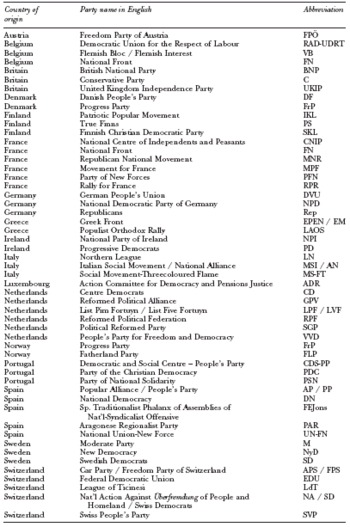
Country of Origin, Full Name and Abbreviation of Political Parties Mentioned