He who lasts the longest wins…. Sadly, with the impatience of democracies and their volatile voters committed to electoral contortions every four or five years, the extremist generally triumphs over the moderate.
—Alastair HorneFootnote 1Do democracies make inferior counterinsurgents? To date, a near consensus exists among scholars, policymakers, and journalists around the belief that democracies are uniquely deficient when fighting counterinsurgency (COIN) campaigns. It is commonly argued, for example, that democratic publics are cost-intolerant and highly casualty-sensitive, especially if the war turns protracted.Footnote 2 Voters are also thought highly responsive to spectacular attacks that, when amplified by a democracy's media freedoms, can shift voting patterns while enabling insurgents to fan the flames of public dissent over the war's course.Footnote 3 Indeed, terrorists have targeted democracies with disproportionate frequency.Footnote 4 Democratic leaders, held accountable to their publics through the specter of electoral defeat, are thus constrained in their ability to wage war, resulting in higher and faster rates of defeat than those attained by autocratic states.Footnote 5
What makes the apparent ineffectiveness of democracies so puzzling is that these same attributes—namely, rational publics, accountable leaders, and open media—are cited as responsible for democracies' unmatched success rate in conventional wars. Democracies have won a staggering 93 percent of the interstate wars they initiated since 1815, a trend due largely to democratic leaders choosing to fight wars only when the odds of victory are high.Footnote 6
Why this same selectivity is not operative in COIN wars remains unclear. The empirical implications are, however, stark. If the prevailing wisdom is correct, we should observe two trends: (1) democracies should, on average, lose wars at a higher rate relative to nondemocracies, and (2) they should fight wars of shorter duration as their impatient publics withdraw support from protracted conflicts.
Yet we should remain skeptical of this consensus, for two reasons. First, nearly every study of democracies fighting counterinsurgency campaigns rests on a no-variance research design. By examining only democracies, these studies cannot by definition assess whether democracies fare worse than other political systems or whether audience costs are only found in democracies. Second, these studies have not addressed important methodological issues that arise from the nonrandom assignment of democracy among combatants. A host of inferential threats, including selection effects and multiple confounding factors, arise from democracy's nonrandomness, threatening our ability to derive appropriate estimates of democracy's causal effect if left uncorrected.
This research note corrects for these two inferential problems by combining a new dataset of 286 insurgencies (1800–2005) with matched sampling that pairs democratic combatants with similar “control” nondemocracies. The findings are counterintuitive: democracy appears to exert almost no causal effect on either war outcomes or duration. The note is organized as follows. The first section details the evidence for the claim that democracies are prone to higher rates of defeat than nondemocracies. The second section examines the two limitations of existing studies. The third section outlines the research design, including data, six measures of democracy, alternative explanations, and control variables. The fourth section consists of three empirical tests: regression analysis with all 286 cases and multiple measures of democracy; a matched analysis using democracy as a treatment; and event analysis of war duration. A final section concludes.
Flawed by Design? Democracies and COIN
The claim that democracies are systematically prone to higher and swifter relative rates of defeat rests on three premises. First, democratic publics are typically viewed as cost-intolerant and sensitive to the loss of their soldiers, two traits that undermine the ability of democracies to sustain protracted COIN campaigns. Fearing electoral loss for continuing an unpopular war, democratic leaders are forced to accede to public opinion, resulting in shorter wars and a diminished probability of defeating the insurgency.Footnote 7 Autocratic leaders, by contrast, do not labor under such restraints since they are unaccountable and are free to utilize censorship and repression to manage, if not eliminate, mounting domestic opposition to the war effort.Footnote 8
Second, democracies are often viewed as hobbled in their use of coercion by international and domestic public opinion. Democratic leaders are thought aware of the solution to the insurgency—escalate violence to levels that can ensure victory—but are unable to do so given widespread human rights concern among educated middle classes.Footnote 9 Similarly, these leaders may place limits on their war efforts to avoid reputation costs that arise from open violation of international treaty obligations (such as the Geneva Convention) or more diffuse notions of morality.Footnote 10 Interestingly, however, the evidence for democratic restraint is mixed at best. Downes, for example, has found that democracies are more likely to target civilians deliberately in interstate wars of attrition, while Valentino, Huth, and Balch-Lindsay find that democracies are less likely to engage in mass killing during COIN wars than nondemocracies.Footnote 11
The combination of a desire to protect one's soldiers and a need to avoid reputation costs may conspire to impose additional battlefield restraints on a democracy's military. Overly restrictive rules of engagement, along with a chronic unwillingness to deploy soldiers in sufficient numbers, have been cited as two deficiencies of democratic COIN operations.Footnote 12
Revealingly, the concern that democracies are “soft” has even crept into military field manuals. The U.S. Army/Marine Corps's highly regarded new Manual, for example, opens with the frank admission that insurgents “will try to exhaust U.S. national will, aiming to win by undermining and outlasting public opinion.” Haunted by the specter of past democratic defeats in Algeria and Vietnam, the Manual is replete with injunctions against excessive violence—“the more force you use, the less effective it is”—since these actions provide the grisly images that erode public support for a prolonged war effort.Footnote 13
Finally, the third vulnerability of democracies is thought to reside in their commitment to media freedoms. Strategic insurgents can open a second front against democracies by staging spectacular attacks that influence electoral outcomes. Insurgents can also exploit media freedoms by orchestrating high-profile attacks that lead to the “political attrition” of a democracy's willingness to remain in a protracted war.Footnote 14 Moreover, signs of dissent, whether they take the form of elite disunity, public questioning of the war, or the emergence of antiwar movements, are thought to embolden insurgents by providing evidence that popular support is flagging.Footnote 15
Problems with Existing Studies
Despite their insights, nearly all existing studies share the same two flaws that restrict their ability to assess the relationship between democracy and outcomes. First, these studies typically only examine democracies, a no-variance research design that is unable to assess the performance of democracies relative to other regime types. Second, these no-variance studies have not, by definition, addressed the issue of confounding factors that arises due to nonrandom differences between democracies and nondemocracies. Democracies are not only typically much more powerful than nondemocracies but are also much more likely to be external occupiers. As a result, we need to identify the relevant counterfactuals for democratic combatants in order to isolate the causal effects that regime type has on war outcomes independent of these potentially confounding differences.
No-Variance Designs
Sparked by decolonization during the 1950s and 1960s, the first generation of research on internal wars was shaped by Cold War anxieties over the apparent inability of democracies to defeat weaker insurgents during protracted “wars of national liberation.” Fearing that these Soviet-inspired and -supported insurgencies presaged the future of warfare, scholars quickly moved to chronicle democratic deficiencies. Highly influential case studies of France's defeat in Algeria and the U.S. loss in Vietnam not only established the claim that democracies were prone to defeat but provided the empirical base for early efforts at theorizing why these strong states were nonetheless incapable of defeating weaker insurgents.Footnote 16
Second-generation research, written with an eye toward post–Cold War concern over civil wars in “failed states,” largely accepted the premise of democratic vulnerability as unproblematic. These scholars also followed the template created by their predecessors in their choice of no-variance designs that, in many cases, vary neither regime type nor outcomes. Merom's influential study of small wars, for example, examines French, American, and Israeli defeats in Algeria, Vietnam, and Lebanon, respectively.Footnote 17
This methodological focus extends to the work of both scholars and practitioners writing in the post–11 September 2001 era.Footnote 18 Three recent edited volumes with contributions from leading scholars illustrate this democracy-only selection criterion: ten of eleven chapters in InbarFootnote 19 focus solely on democratic combatants, for example, as do twelve of thirteen chapters in Marston and MalkasianFootnote 20 and all fourteen chapters in Art and Richardson.Footnote 21 Perhaps understandably, research on the current Iraq war has meshed the belief that democracies are uniquely vulnerable with democracy-only case selection.Footnote 22
This democracy-only focus has been reinforced inadvertently by scholars using public opinion and electoral data to test how cost and casualty-aversion translates into declining wartime support. While these studies have contributed useful insights, their reliance on data found only in democracies means that they cannot rule out the possibility that similar audience costs are present in nondemocracies as well.Footnote 23 Indeed, public pressure may work through regime-specific channels yet may still constrain policymakers in equal fashion. Without studying authoritarian regimes, we cannot be sure that casualty sensitivity or cost intolerance operate only in democracies.
By holding the explanatory variable constant, these studies cannot assess the relative causal impact of democracy on war outcomes and thus are unable to support the claim that democracies are associated with a higher risk of defeat than nondemocracies. We therefore require explicitly comparative research designs that vary regime type and, preferably, encompass the universe of cases or some representative subset. More specifically, we need two pieces of information to assess the risk of defeat that is attributable to democracy: the probability that a state is a democracy; and the probability of defeat. This information allows us to determine the conditional probability of defeat given that a state is democratic.Footnote 24
Formally, attributable risk is defined:

Without an estimate of how nondemocracies (∼democracy) fare, we cannot estimate the attributable risk of defeat given that a state is democratic. Note that research focusing solely on defeats suffered by democracies, including some of the most seminal texts,Footnote 25 are in a particularly severe bind since they can neither estimate the probability that a state is democratic nor the probability of defeat. Briefly put, the conditional probability of defeat given that a state is democratic is out of reach for studies that do not vary regime type.Footnote 26
The Limits of Observational Data: Selection Effects and Confounding Variables
We might imagine that the solution to these no-variance designs is a straightforward one: simply adopt research designs that maximize variation across both dependent and independent variables, including regime type. Surprisingly, however, few studies have done so, and no consensus exists among them on the relationship between democracy and war duration or outcomes.
Engelhardt, for example, compared ten countries (five democracies) in twenty-five post-1945 cases and concluded that, despite authoritarian states' greater willingness to sustain casualties, victory was “elusive” for all regime types.Footnote 27 More recently, Abrahms contrasted twenty democracies with twenty authoritarian states—all of which had been targeted by terrorists—and used bivariate analysis to conclude that democracies, by dint of their greater restraint and low tolerance for civilian casualties, made better counterterrorists.Footnote 28 By contrast, Stephan and Chenoweth studied 267 cases of opposition to state authorities and found that as regimes become more democratic, they also become more likely to offer concessions when confronted with either violent or nonviolent campaigns.Footnote 29
Unfortunately, simply expanding the sample to include nondemocracies, while a welcome step, does not address the inferential threats that arise from the nonrandom assignment of democracy itself. Following the “gold standard” of experimental design, we would ideally distribute our treatment (here, democracy) among the population of combatants randomly, thereby ensuring that observed differences in outcomes are due to the treatment itself rather than preexisting differences in these populations. This, of course, is impossible.
Yet without controlling for these potentially confounding differences, we risk mistaken causal inferences. Indeed, if these populations remain too “disjoint,” then our estimates will remain sensitive to functional form assumptions about how to treat observations that lie outside the portion of the variable's empirical distribution that is shared by the treated and control groups (the “common support space”).Footnote 30
Take, for example, the fact that stable democracies face far less risk of internal war than other regime types.Footnote 31 As a result, democratic leaders are much more likely to be waging wars of choice as external occupiers than autocrats, who, in turn, are confronted by wars of necessity against domestic challengers. This raises the issue of selection effects: democracies may be selecting themselves into wars with different probabilities of victory than those fought by nondemocracies. It may be, for example, that democracies will enjoy a higher rate of relative success because they choose to fight only in situations where their leaders have judged the rewards and costs of war favorably. On the other hand, since these foreign wars are not likely to pose an existential threat, most democracies may possess a lower rate of success because they are free to withdraw in ways that nondemocracies simply cannot.
To separate out these logics, I estimate the attributable risk of defeat in a COIN war given that a state is a democracy. I therefore estimate:

where w represents the confounding factors that influence outcomes in COIN efforts, including the manner in which the state selected itself into the pool of combatants.Footnote 32
Confounding factors are variables that are causally prior to the treatment but that are correlated with the treatment and influence the dependent variable conditional on the treatment itself. We can obtain reliable estimates of democracy's causal effect by controlling for w. Unfortunately, existing large-N studies have failed to do so and thus implicitly assume that (1) all regime types enter the pool of combatants via the same selection process, and (2) that important confounding variables such as levels of state power and development are uncorrelated with regime type. Both assumptions are empirically dubious, as demonstrated below.
We can, however, control explicitly for w using matched sampling, which pairs a treated case (here, a democracy) with a control case (a nondemocracy) that is similar along all of these confounding factors.Footnote 33 More specifically, matching has two key advantages in these conditions. First, it improves casual estimates by controlling for differences that arise due to the nonrandom nature of a treatment. It achieves this result by pairing treated cases with similar control cases, thereby creating a data subset in which the two populations are identical, or nearly so, along all relevant confounding variables. This pairing avoids conflating treatment effects with preexisting population differences and enables researchers to ascribe any observed differences in the dependent variable to the treatment itself. Second, matching improves the robustness of estimates by removing “extreme counterfactuals” that arise when treated and control populations are too disjoint. Matching removes the “gaps” between these populations and, in so doing, reduces the effect that modeling assumptions have on causal estimates.Footnote 34
Research Design
A three-stage research design is adopted here. The first stage tests the relationship between six measures of democracy and war outcomes using (ordered) logistic regression. The second stage draws on matching to control for selection effects and confounding variables that may compromise the estimates. The third stage consists of event history analysis using Weibull regression to estimate the relationship between democracy and war duration.
Data: War Outcomes and Duration
The dataset consists of 286 insurgencies fought between 1 January 1800 and 1 January 2006. A further twenty-one conflicts still ongoing by 1 January 2006 were dropped from the analysis of outcomes but were added to the duration analysis as right-censored observations.Footnote 35 An insurgency is defined as a violent, often protracted, struggle by nonstate actors to obtain political objectives such as independence, greater autonomy, or subversion of the existing political authority (the “incumbent”).
Two rules for identifying cases were chosen. First, a minimum threshold of 1,000 battle deaths was established, with at least 100 casualties suffered on each side. Second, the nonstate actor must have adopted a guerrilla warfare strategy. Guerrilla warfare is defined as a strategy of armed resistance that (1) uses small, mobile groups to inflict punishment through hit-and-run strikes while avoiding direct battle when possible and (2) seeks to win the allegiance of at least some portion of the noncombatant population. Insurgencies are not necessarily synonymous with “civil wars” since these can be fought conventionally between opposing armies, with guerrilla tactics, or through nonviolence.
War outcomes are coded from the incumbent's perspective. A win occurs when the insurgency is militarily defeated and its organization destroyed or the war ends without any political concessions granted to insurgent forces. A loss occurs when the incumbent unilaterally concedes to all, or nearly all, insurgent demands, including the granting of independence or the deposition of current leaders. A draw occurs when an incumbent is forced to concede to some, but not all, insurgent demands, and neither side obtains its maximal aims. Typical examples of concessions include the voluntary disarmament of insurgents in exchange for greater participation in the state's political affairs (that is, as a political party or as members of a power-sharing government) or the granting of greater regional autonomy (but not independence). Draws have assumed a greater share of war outcomes since 1945.Footnote 36
Draws can be difficult to code, however. It is possible that some “concessions” extracted by insurgents are in practice fairly minor demands that arise endogenously from the war itself as a losing insurgent group scrambles to save face (or itself). In these situations, few, if any, real costs are born by the incumbent.Footnote 37 I therefore also adopt a second, more strict, definition of draws (restrictive draws). Restrictive draws are observed when an insurgency is able to strike a formal territorial or power-sharing agreement (or both) via negotiation with the incumbent. If such a settlement is absent, I recode these erstwhile draws as insurgent defeats.Footnote 38
War outcomes are operationalized in three ways: as an ordered win-draw-loss variable (w/d/l); as an ordered variable with restrictive draws (restrictive w/d/l); and as a binary variable with draws omitted entirely (w/l). Finally, war duration measures the length of the conflict in months (logged). Pre-1945 war data are drawn from multiple sources, including Clodfelter;Footnote 39 Eggenberger,Footnote 40 and case-specific histories, while post-1945 data are taken from the UCDP-PRIO Armed Conflict Dataset (Version 4).Footnote 41 War start dates are coded from the first large-scale insurgent attack, open declaration of hostilities, or the date of occupation. War termination dates are identified by several means, including the last day of war-related fatalities and the date of a peace settlement.
Measuring Democracy
democracy is defined as a political system with regular and contested elections for executive and legislative institutions. These elections create the genuine threat of nonviolent removal of those elected from their positions, thus ensuring a high degree of accountability to the broader electorate. No measure of democracy has achieved consensus status, however, and a lively debate persists over how to best capture the concept.Footnote 42 Rather than take a stand in these debates, I adopt six different measures drawn from three widely cited datasets: Polity IV, Geddes's regime typology, and Freedom House's index of political freedoms.Footnote 43
First, democracy follows standard practice in international relations and treats democracy as a binary variable. Specifically, a regime is coded as a democracy if its Polity2 score is ≥ 7 in the Polity IV dataset.Footnote 44 Polity2 is a 21-point scale that ranges from a −10 (a totalitarian regime) to a 10 (a consolidated democracy). There are eighty-four observations of democratic combatants according to this measure.
I then code whether a regime was a fully or partially consolidated democracy. To be considered “fully” consolidated, a regime needed to possess a Polity2 score of ≥ 6, while a “partially” consolidated democracy held Polity2 values of 1–5. If existing studies are correct, then fully institutionalized democracies, as the “most” democratic of all regimes, should lose or draw their conflicts at a higher rate than both nondemocracies and partial democracies. There are eighty-nine countries coded as full demo and forty-two as partial demo.
I also code relative levels of democracy by using a regime's 21-point Polity2 score, as favored by some scholars.Footnote 45 The mean value of this variable (polity2) is −0.05, ranges from ±10, and has a standard deviation of 6.99. alt demo adopts Geddes's regime typology and codes democracy as a binary variable.
This measure generates eighty-six observations of democratic combatants and is highly, though not perfectly, correlated with democracy at .88. Finally, I draw on Freedom House's threefold index of political freedoms in which 2 denotes fully free, 1 partly free, and 0 a nonfree political system (FH). There are seventy observations over the 1972–2005 era, with only eight combatants ranked as fully free and another thirty as partly free. FH is correlated with democracy at .63 and with alt demo at .58.
All measures were taken one year prior to the war to minimize endogeneity concerns. It is possible, however, that this lag is insufficient if the state itself is the prize being contested. For example, low-level conflict may exist well before the war reaches the 1,000-battle deaths threshold used here. If this is the case, then a “creeping endogeneity” problem may exist in which a democratic government, anticipating greater conflict in the future, adopts restrictive measures that drives it from the democracy category prior to the coding of a war's beginning. Regime type would thus be partly a function of the conflict itself. This is especially problematic if democracies escape their fate by becoming more authoritarian, thereby leading to underestimates of democracy's negative effects since these cases of likely failure are removed from the pool of democratic observations.
To address this concern, I remeasure democracy, full democracy, partial democracy and polity2 five years before war's outbreak to examine the degree of movement from the democratic to nondemocratic camp. Surprisingly, there was little difference between the one- and five-year indicators. Only two democracies shifted toward authoritarianism in the five years preceding a conflict.Footnote 46 Moreover, there are only six instances of a partial democracy slipping into the authoritarian ranks five years prior to the war.Footnote 47 There are no instances of a full democracy backsliding into partial democracy status. Since these results presented below are robust both to dropping these cases and flagging them with a dummy variable, I retain the one-year lag for all indicators.Footnote 48
Alternative Explanations and Control Variables
Identifying democracy's causal effects requires testing regime type explanations against other plausible explanations for war outcomes. This section details four alternative explanations and introduces five control variables.
First, external occupiers are thought to be severely disadvantaged in COIN wars because their very presence sparks nationalism that facilitates insurgent recruitment and bolsters their resolve.Footnote 49 Put simply, military occupation is typically a losing proposition.Footnote 50 I therefore record whether a state was an external occupying power or not (occupy).
Second, the existing literature heavily emphasizes the degree of support received by an insurgency in shaping the fortunes of a state's war effort. In general, the more aid received by insurgents, the lower the probability that a state will defeat the insurgents. I measure support using a scaled variable that records whether insurgents received material aid (including weapons) and possessed a sanctuary in a neighboring state. A score of 2 is obtained if insurgents had both types of aid; a 1 if only one type of aid was received; and a 0 if no aid or sanctuary was present. Data were taken from Lyall and Wilson III;Footnote 51 Record;Footnote 52 Regan,Footnote 53 and individual case histories.
Third, an incumbent's power should affect its probability of victory: all else being equal, the weaker the state, the more likely it is to suffer defeat (and perhaps to be challenged in the first place). I measure power using the Correlates of War's Composite Index of National Capabilities (CINC) data to estimate a country's share of global military and economic capabilities. CINC values are taken one year prior to the war.Footnote 54
Finally, research has demonstrated that states whose militaries are highly mechanized are most likely to be defeated by insurgents.Footnote 55 Mechanization is thought to isolate soldiers from local populations while reducing the number of infantry available for obtaining the intelligence necessary to wield a military's power selectively. Mechanized armies therefore typically fuel, rather than, deter, insurgencies. Drawing on data from Lyall and Wilson III, mechanization (mech) is defined as the ratio of soldiers per motorized vehicle, is measured one year prior to war, and takes five values, with 1 representing the lowest level of mechanization and a 4 the highest.Footnote 56 Values are provided for every combatant since 1917, the dawn of the mechanized era; pre-1917 observations are assigned a 0.
Five control variables are also introduced. terrain records the roughness of the terrain—often cited as favoring insurgent successFootnote 57—using the average of five altitude measures (in meters) in the conflict area itself. Second, we might anticipate that as the distance increases between the state's capital and the war zone, the odds of state victory decrease as logistical difficulties multiply. distance therefore measures the distance between the capital city and the principal fighting area in logged kilometers. A cold war dummy variable was also added for the years 1946–89 to control for the willingness of both superpowers to supply proxies with small arms.
Following Fearon and Laitin,Footnote 58new state was included to denote whether war onset occurred during the first two years of a new state's postcolonial existence. It is likely that the combination of colonialism's delegitimization in the 1950s and surging nationalism rendered wavering colonial states and weak successor governments especially likely to be challenged and to suffer defeat. Finally, states may also face increased difficulties in defeating insurgents in linguistically complicated areas due to challenges associated with acquiring information. language records the number of languages spoken in each conflict era for all post-1945 wars. Data are drawn from Fearon and Laitin.Footnote 59
Empirical Analysis, Part One: Full Sample
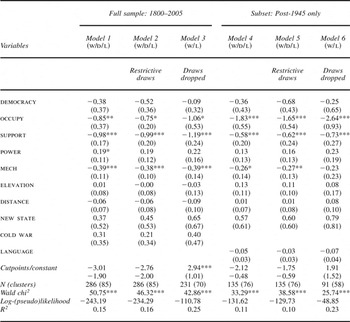
Is democracy correlated with defeat? In brief, while democracy is consistently negatively correlated with victory, this relationship never reaches conventional levels of significance in either the full sample or the post-1945 subset of cases with any measure of war outcomes (Table 1). Models 1 and 2 use ordered logistic regression with w/d/l and restrictve w/d/l, while Model 3 derived its estimates using logistic regression with the binary w/l that omits draws. Models 4 to 6 repeat these estimations on the restricted sample of post-1945 cases.
democracy and war outcomes

Notes:
* significant at 10%;
** significant at 5%;
*** significant at 1%.
Although in the predicted direction, the fact that the relationship between democracy and defeat is not significant is worrisome, especially since the post-1945 era represents the “most likely”Footnote 60 case for the “vulnerable democracy” thesis. Instead, this study finds that the level of mechanization within a state's military is negatively correlated with victory: the more mechanized a state's military, the higher the probability that it will suffer defeat. Two context-specific variables—whether insurgents received external support, and whether the incumbent was an external occupier—are also negatively associated with state victory.
We might imagine, however, that democracy's causal impact is conditional on being an external occupier: that is, democratic occupiers are much more likely to suffer defeat than either democracies facing domestic challengers (that is, India) or autocracies more generally. To test for this possibility, I interact democracy and occupy to create docc, which signifies whether an occupier was also a democracy. Adding docc to Models 1 to 6 did not change the results significantly. While occupy remained significant in all models but Model 3, the sum of coefficients for occupy, democracy, and docc is not significant in any model.Footnote 61 These results suggest that it is the fact of being an external occupier, rather than democracy itself, that is pivotal in shaping COIN outcomes.
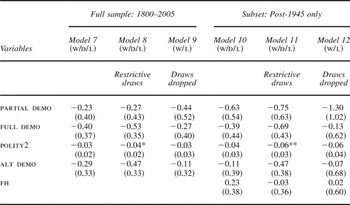
Perhaps democracy is not capturing the full extent of the relationship between democracy and war outcomes, however. I therefore re-estimate Models 1 to 6 with the five alternative measures of democracy detailed above (Table 2). The results are surprising, for none of these measures return stronger results than those obtained by democracy. For example, neither partial demo, which denotes all states with a Polity2 score of 1–5, nor full demo, where Polity2 is ≥ 6, are significant. The variable polity2 only reaches conventional levels of significance in Models 8 and 11. alt demo, based on Geddes's regime typology, is also not significant. Finally, Freedom House values (FH) are not significantly correlated with any outcome and, indeed, are positively associated with victory in the post-1972 era.
Alternative democracy indicators

Notes:
Estimates obtained from the identical Models 1–6 presented in Table 1.
* significant at 10%;
** significant at 5%;
*** significant at 1%.
Put simply, it is difficult to square these (non)findings with the near consensus view that democracies fare much worse than their autocratic counterparts in COIN wars. To minimize the possibility of mistaken causal inference, however, we must also control for selection issues and extreme counterfactuals that may be obscuring the actual relationship between democracy and war outcomes.
Empirical Analysis, Part Two: Matching
To obtain more accurate estimates through matching, I take democracy as a treatment. All eighty-four combatants with a Polity2 score of ≥ 7 were therefore considered “treated” cases, leaving 202 observations as possible “control” cases.
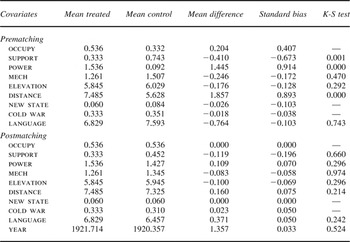
Table 3 reveals that severe imbalances do in fact exist between democratic and nondemocratic combatants in the full dataset, justifying the use of matching.Footnote 62 Democracies, for example, are external occupiers in over half of their conflicts (45/84, or 54 percent); nondemocracies, by contrast, are occupiers in only one-third of their wars (67/202, or 33 percent).Footnote 63 This trend is particularly pronounced in the post-1945 era, where democracies intervened in 54 percent of their wars (19/35) compared with only 14 percent (14/100) of the time with nondemocracies.Footnote 64As a consequence, the average distance between a state's capital city and the conflict area is markedly higher for democratic combatants.Footnote 65 These differences may stem in part from the fact that democracies are typically much more powerful than nondemocracies. The average democratic combatant possessed 8.5 percent of global capabilities, against only 6.4 percent by their nondemocratic counterparts.Footnote 66
Balance summary statistics

MatchIt was used to conduct one-to-one nearest neighbor matching with replacement, creating eighty-four pairs of observations.Footnote 67 No control case was used more than three times. Cases were matched on all of the variables detailed above. I also add one additional variable, year, which is simply the year that the war began. This helps control for secular trends that are unconnected to the treatment itself by ensuring that these matched combatants are fighting nearly simultaneously (about 1.3 years apart on average).Footnote 68
Since no standard has yet emerged for assessing balance across treated and control populations, I report several measures, including mean differences between treated and control populations, standardized bias, and corrected p values for Kolmogorov-Smirnov goodness of fit tests (Table 3).Footnote 69 These tests illustrate that balance is excellent: all mean differences are small, all standardized biases are well under the .25 threshold considered a “good fit,”Footnote 70 and the K-S test detects no significant differences in the distribution of variable values across treated and control populations. The K-S test is especially strict since it is sensitive to the location and shape of the cumulative distribution functions of these populations.
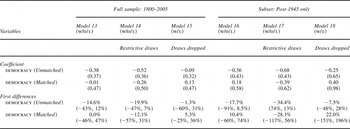
Once I minimize differences across these samples, what causal effect does democracy have on war outcomes? Very little, it turns out. Table 4 reports estimates from the same models as Table 1 with the full and matched datasets. Once again, democracy is not correlated with defeat at conventional levels of significance, and the estimates returned from the matched sample have typically become even smaller. Table 4 also reports the substantive effects of democracy using first differences.Footnote 71
democracy and war outcomes: Full and matched datasets compared

Notes:
First difference estimates record the expected change in probability of victory associated with a shift from nondemocratic to democratic states. 95% confidence intervals are reported for first differences. Robust standard errors clustered on country.
* significant at 10%;
** significant at 5%;
*** significant at 1%.
These are helpful for underscoring a largely negative conclusion: democracy has no substantively important or, indeed, even clear, relationship with outcomes. Every single estimate of the expected change in probability associated with victory when shifting from nondemocracy to democracy possesses 95 percent confidence intervals that straddle positive and negative values. In other words, we cannot even estimate the predicted direction of the change in probability associated with moving from nondemocratic to democratic combatants. These findings suggest that there is no direct relationship between democracy and outcomes in COIN wars, a fact obscured by no-variance designs and inattention to important differences between democracies and nondemocracies.
Empirical Analysis, Part Three: War Duration
The mechanism underpinning the belief that democracies are uniquely vulnerable in COIN wars—namely, that voting publics become increasingly likely to withhold their consent from a war as it grows more protracted—can be tested indirectly with duration data. If democracies possess a lower tolerance for protracted wars, we should observe two trends: democracies should fight shorter wars on average and, conditional on defeat, should lose their wars in less time than their autocratic counterparts. Indeed, we find exactly this pattern in studies of conventional war outcomes, where democracies not only select themselves into relatively shorter wars to avoid debilitating domestic audience costs but prove less likely to continue fighting, and thus more likely to lose, as war duration increases.Footnote 72
To test the argument that democracies “cut and run,” I use war duration in months (logged) for all 286 terminated wars. An additional twenty-one wars still ongoing by 1 January 2006 were included as right-censored observations. Contrary to expectations, simple bivariate analysis reveals that democracies and autocracies have fought wars of mostly similar duration during 1800–2005. Mean war duration for nondemocracies was 83.9 months, for example, compared with an almost identical 82.6 months for democracies. Remarkably, democracies are actually fighting longer wars—137 months on average—in the post-1945 era than are autocracies (about 104 months).Footnote 73 The matched dataset (N = 168) yields similar results: mean war duration for nondemocracies was almost sixty-nine months, compared with seventy months for democracies in the 1800–2005 era. Mean duration increases to 107 and 110 months for autocracies and democracies, respectively, in the post-1945 era. In short, wars have become longer over time, and democracies almost always have been fighting longer wars than their autocratic counterparts, although these differences have not been statistically significant at conventional levels.
When the sample is restricted to defeats only, however, I find that democracies lose their wars at a faster rate—51.5 months compared to 64 months—than autocracies.Footnote 74 In the post-1945 era, democracies lost their wars in an average of fifty-five months, while autocracies sustained their losing war efforts nearly 54 percent longer (at eighty-five months).Footnote 75 This trend extends to the matched dataset, where democracies lost in an average 51.5 months while nearly identical autocracies took 85 months to concede defeat during 1800–2005.Footnote 76 The collapse of democratic war-fighting efforts is especially apparent in the post-1945 era, where democracies took 55 months to concede defeat while their autocratic matches held on for an average of 121 months.Footnote 77
We need more sophisticated methods, however, if we are to test the correlation between regime type, war duration, and defeat. I therefore employ parametric Weibull hazard regression to examine the relationship between democracy and war outcomes in the 1800–2006 and post-1945 eras.Footnote 78 I also examine the relationship between democracy and time-to-defeat by restricting the sample to defeats only.Footnote 79 Since the hazard rate for both war termination generally and defeats specifically is monotonically increasing—that is, the risk of termination and defeat increases over time—I have a choice of several different estimators.Footnote 80 I chose Weibull regression because it provides the smallest Akaike Information Criterion value, meaning that Weibull offers the most efficient estimation. All regressions were run with shared frailty terms centered on individual country codes to account for unobserved heterogeneity that may lead certain states to “fail” at higher rates than others.Footnote 81
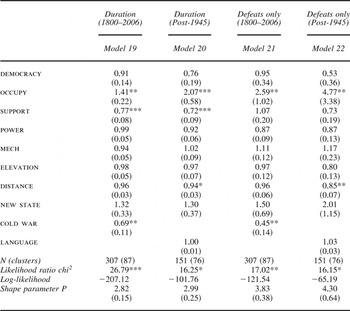
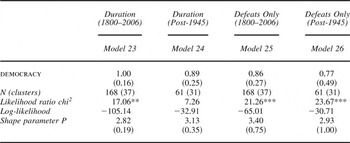
Table 5 reports hazard ratios for these Weibull regression models by time period and dependent variable. Estimates of hazard ratios are interpreted relative to a baseline of 1. Ratios higher than 1 indicate that a variable increases the risk of war termination (that is, the war is shortened) and defeat (that is, a greater likelihood of defeat), while a ratio lower than 1 indicates that a variable reduces the risk of these events. In all of these models, democracy does not reach conventional levels of statistical significance, and its estimated hazard ratio is in the “wrong” direction. Re-estimating these models with the matched data (Table 6) yields similar results: democracy is not associated with either shorter wars or faster time-to-defeat.Footnote 82
democracy and war duration by era

Notes:
Hazard estimates derived from Weibull regression with gamma shared frailty terms (clustered on individual country codes) are reported; standard errors in parentheses. All models include 21 right-censored observations that represent wars not concluded by 1 January 2006.
* significant at 10%;
** significant at 5%;
*** significant at 1%.
democracy and war duration by era: Matched sample

Notes:
Hazard estimates derived from Weibull regression with gamma shared frailty terms (clustered on individual country codes) are reported; standard errors in parentheses. Models 23 and 24 only includes wars that had concluded by 2006.
* significant at 10%;
** significant at 5%;
*** significant at 1%.
Instead, occupy has a substantial impact on war duration: the shift from a nonoccupier to occupier is associated with a 41 to 377 percent increase in the risk of war termination—that is, the fact of occupation shortens wars—and state defeat, depending on the particular model specification. By contrast, support is associated with a decrease in the risk of war termination (though not state defeat), meaning that external support typically lengthens wars. Similarly, cold war is also associated with a decreased risk of both war termination and state defeat. Draws were dropped.
Put briefly, there is only modest evidence supporting the contention that democracies differ substantially from autocracies in either their mean war duration or their time-to-defeat. While simple summary data suggest that democracies are actually fighting longer wars on average and that they are typically defeated faster than autocracies, these results do not hold once I introduce control variables and match to avoid selection issues. It appears that prior studies have conflated the risks of occupation with the risk of being a democracy; while democracies are much more likely to be external occupiers than are comparable autocracies, it is the act of occupation itself, rather than the fact of being a democracy, that is most influential in shaping war duration.
Conclusion
Drawing on 286 insurgencies since 1800, this research note presents new evidence that challenges the persistent belief that democracies are especially prone to losing counterinsurgency wars. Though ostensibly bolstered by decades of research, the view that democracies suffer higher and swifter rates of defeat relative to autocracies finds little empirical support once regime type is varied and inferential threats arising from selection effects and disjoint combatant characteristics are addressed.
While these findings center on war outcomes and duration, they nonetheless suggest new avenues of research for the study of war initiation among the subset of combatants that fought as external occupiers. It remains unclear, for example, why powerful democracies represent such a disproportionate share of this subset and why their leaders have apparently proved incapable of “selecting” into wars with a higher probability of success.Footnote 83 Indeed, democratic occupiers typically possess militaries with significantly higher levels of mechanization, suggesting that democratic leaders neither invest ex ante in force structures suitable for COIN wars nor commit to the necessary reforms to increase the odds of victory after suffering defeat.
Before drawing policy conclusions, however, these findings require additional studies that not only vary regime type but also the decision to intervene itself. Perhaps most importantly, future studies should expand their scope to include cases of nonintervention, enabling researchers to test whether democracies and their autocratic counterparts are driven by the same motives and policy goals when choosing to intervene militarily.
While better measures of democracy may lead to a reassessment, it appears that regime type has little analytical utility for explaining COIN war outcomes and duration. Instead, emphasizing battlefield dynamics (the “how” of fighting) may prove a better theoretical bet than focusing on regime-specific variables (the “who” of fighting). Indeed, the degree of a military's mechanization, its status as an external occupier, and the level of material support for insurgents all proved more consequential for explaining outcomes and duration. In short, democracies do struggle to defeat insurgents—but not because they are democracies.