INTRODUCTION
Perhaps the most important result of the 1992 Convention on Biological Diversity (CBD) in Rio de Janeiro has been the endorsement of the now widely accepted realization that biodiversity loss and poverty are linked problems (Adams et al. Reference Adams, Aveling, Brockington, Dickson, Elliott, Hutton, Roe, Vira and Wolmer2004). Hence, conservation and poverty reduction should be tackled together, aiming to reach a balance between three objectives of the CBD: conservation, sustainable use, and the fair and equitable sharing of the benefits arising from the use of natural resources. The forest canopy may thus be exploited by local communities as a source of non-timber forest products (NTFPs) (Wolf & Konings Reference Wolf and Konings2001).
NTFPs have been harvested worldwide since ancient times, forming a substantial contribution to the livelihoods of millions of people (Shackleton & Shackleton Reference Shackleton and Shackleton2004; Belcher et al. Reference Belcher, Ruíz Pérez and Achdiawan2005; Burgener & Walter Reference Burgener and Walter2007). During the last decades, exploitation of many NTFPs has been intensified by commercialization (Upreti et al. Reference Upreti, Divakar and Nayaka2005; Marshall et al. Reference Marshall, Schreckenberg and Newton2006), raising questions about the sustainability of harvesting (Ticktin Reference Ticktin2004). A range of studies showed that harvesting of NTFPs, such as bromeliads, Brazil nuts and cinnamon (Edwards Reference Edwards1996; Wolf & Konings Reference Wolf and Konings2001; Peres et al. Reference Peres, Baider, Zuidema, Wadt, Kainer, Gomes-Silva, Salomão, Simões, Franciosi, Valverde, Gribel, Shepard, Kanashiro, Coventry, Yu, Watkinson and Freckleton2003) adversely affected ecological processes at the level of individuals, populations, communities and ecosystems (Peters Reference Peters1996; Putz et al. Reference Putz, Blate, Redford, Fimbel and Robinson2001; Ticktin Reference Ticktin2004).
Here, we investigate for the first time in situ the impacts of harvesting epiphytic macrolichens from natural forests in India, where they constitute an important NTFP. In 1997, the national lichen harvest was c, 1000 metric tonnes (Shah Reference Shah1997). Lichens are a major spice in Indian dishes and form the raw material for industries that manufacture medicine, perfume and paint (Kumar & Upreti Reference Kumar and Upreti2001). As lichens have a low specific weight, tremendous volumes are being extracted from the wild.
Within India, epiphytic macrolichens are harvested on a commercial basis from many areas. In the Palni Hills, lichen harvesting is especially intensive, contributing most to the livelihood of the Paliyan tribes living there. The Palni Hills are part of the Western Ghats biodiversity hotspot, which is also known for its varied and abundant lichen flora (Awasthi Reference Awasthi2000). There is no consensus about the quantity of the annual lichen harvest from the Palni Hills.
Paliyan harvesters do not employ an explicit harvesting pattern and do not keep track of earlier visitations to specific host trees. During daily harvest expeditions, host tree selection depends on visual examination of lichen quantities. Harvesters climb the trees and remove the lichens from the tree stems and inner canopy branches with filling knives and sell their harvest to wholesalers per unit weight. Paliyans apply two harvesting methods: (1) ‘shallow harvesting’, during which lichens are removed with a minimum of bark-substrate, yielding a high quality product, and (2) ‘deep harvesting’, when lichens are removed together with bark and part of the underlying sapwood, thereby producing a heavier but poorer quality product. Both methods damage the tree, leaving scars that are typically rectangular and approximately 10 cm2 in area (up to 50 cm2). Lichens are collected in 10–15 kg trading bags, of which the bottom half is filled with the poor-quality but heavy deep harvesting product and the top with top-quality pieces obtained by shallow harvesting. This apparent ‘business trick’ aims to increase the collector's revenues in the weight-based trade.
Extraction of NTFPs potentially contributes to conservation of tropical forests and rural development (Ros-Tonen Reference Ros-Tonen2000; Ticktin Reference Ticktin2004). The value of the ecosystem for forest-dwelling people depending on NTFPs may outweigh the relatively small ecological impact of exploitation. In the Palni Hills area, lichens are currently sold at a price of Rs 50 (≈US$ 1.15) per kg. On average, a harvester can collect 1–2 kg a day, resulting in a daily wage of about Rs 75. This is just below local minimum wage in the agricultural sector of Rs 80 per day in 2010 (Anon. 2010). Lichen collection is the main source of cash income for the Paliyan communities in the area and virtually all males who are able to climb work as lichen harvesters. Salaried agricultural work, mainly done by women, generates supplementary income.
Although removal of epiphytic macrolichens for commercial purposes has been recognized as a threat to the local lichen flora (Moxham Reference Moxham1981; Upreti Reference Upreti1995; Upreti et al. Reference Upreti, Divakar and Nayaka2005), to our knowledge no in situ quantitative studies on lichen harvesting are available. In this study, we examined the regeneration after harvesting of epiphytic macrolichen communities in the Palni Hills, India. We addressed the following questions: (1) what is the local intensity of epiphytic macrolichen harvesting? (2) what is the macrolichen regeneration capacity in terms of abundance, species richness and composition? and (3) is regeneration related to ecological factors and harvesting method?
METHODS
Study area
This study was conducted in mixed sub-montane evergreen forests of the Palni Hills around the Paliyan settlement Vadakaraiparai (Pannaikadu region) in the state of Tamil Nadu, India (10°16’ N and 77°35’ E; 1200–1600 m above sea level). The heterogeneous forest is dominated by Viburnum punctatum Buch.-Ham. ex G. Don and Toona ciliata M. Roem., attaining a height of c. 25 m. The Palni Hills hills form an eastward spur of the Western Ghats. The climate is strongly seasonal, with an average annual rainfall of 1650 mm, mostly falling during the north-east monsoon season from June until September. The 7 × 7 km study area consists of a mosaic of forest, agricultural fields and small Paliyan settlements. For centuries, tribes in the area lived directly from the forests. In 1984, the community started trading epiphytic macrolichens on a commercial basis (ActIndia, personal communication 2008).
Intensity of harvesting
To evaluate the intensity of macrolichen harvesting, we established three transects, one at the summit of a hill, one in a depression and one on a slope, to obtain a good representation of the forest types in the area. In each transect we sampled 30 trees, at c. 50 m intervals, irrespective of tree species. For each tree we visually estimated the percentage coverage of the macrolichens and that of removed lichens, visible as harvesting scars. Visually estimating percentage lichen cover is a reliable and rapid method of evaluating abundance of lichen epiphytes on branches (McCune Reference McCune1990). We assumed that the original lichen coverage consisted of the sum of the removed lichens and the present lichen coverage. We divided the percentage cover of removed lichens by this sum to obtain a per cent estimate of total lichen removal. Additional control variables included tree height, trunk diameter at breast height (DBH), and per cent cover of crustose lichens, moss and vascular epiphytes.
Lichen regeneration
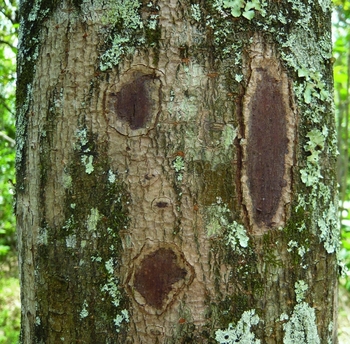
To assess the regeneration rates of lichens, we sampled previously harvested patches, varying in time since harvesting from less than one to more than eight years. Patches varied in size from one to 50 cm2. Time since harvesting was estimated by our field assistant, an experienced harvester, on the basis of bark discolouration and scraping marks (Fig. 1). Samples were pooled in one-year intervals of time since harvesting. The estimations of our field assistant were validated by comparing his assessment with those of 19 experienced tribal harvesters from the community. Test subjects had to estimate time since harvesting of eight exam patches that varied in harvesting method (shallow or deep), tree species and time since harvesting estimated by our field assistant. Any lichens were previously removed from the exam patches.
Scrape marks on a Toona ciliata tree, showing shallowly and deeply (dark areas) harvested patches.

From January to April 2008, we collected 360 (320 previously harvested + 40 unharvested) samples from 100 individual trees, distributed over four common phorophyte species in the area. Average tree height was 11.2 (± 5.7) m. The trees, Olea dioica Roxb. Syzygium cumini L., Toona ciliata M. Roem. and Viburnum punctatum Buch.-Ham ex D.Don, were all evergreen species, except for T. ciliata, which is semi-deciduous. Bark properties varied from smooth (V. punctatum and O. dioica) to relatively coarse (S. cumini and T. ciliata).
We sampled five harvested patches for each one-year time since harvesting interval for each of the two harvesting methods and for each of the four tree species. This resulted in a total sample size of 320 (5 × 8 × 2 × 4). The eight-year time-interval included patches that were harvested more than eight years ago because no bark-distinctions could be made between these elderly patches. To avoid interdependence between samples, we did not take more than two samples per treatment per year interval per tree. The position of a sample within a tree was left to chance, but was recorded.
In each of the 320 samples, we identified all macrolichens to species and for each species we recorded percentage lichen cover, following McCune (Reference McCune1990), and number of individuals. All lichens were collected to check field identifications. We assessed the effects of harvesting on species composition by attributing importance values (IVs) to each species: IV = (frequency × mean cover when present)/(group size × mean group IV), where groups represented samples with the same treatment; the denominator makes comparisons between harvesting methods and unharvested patches possible. In addition to harvesting method (shallow or deep), host tree species and time since harvesting, we recorded a number of environmental control variables that are described below.
Finally, we sampled an additional 40 (10 per host tree species) samples of 150 cm2 from trees in nearby privately owned forests where no lichen harvesting occurs for comparison with the lichen community in the Paliyan communal forests where lichens are commercially exploited. We deposited the lichen vouchers in the herbarium of ATREE (Ashoka Trust for Research in Ecology and the Environment), Bangalore, India.
Ecological factors
Environmental variables might affect lichen regeneration and species composition. Following Barkman (Reference Barkman1958), we recorded soil humidity (on a 1–5 scale), hill slope and exposition, dominant tree species, maximum tree height, human influences such as cutting and burning, visibility and height and coverage of canopy, sub-canopy, shrub and herb layer in the forest. With respect to the phorophyte, we recorded height, DBH, height until first branch, number of nodes with diameter >5 cm, height of the crown base, crown diameter and evidence of animal activity such as bark damage. We also estimated crown volume and total per cent cover of lichens and other epiphytes. For each individual harvested patch, we recorded height above the ground and patch exposition, diameter and inclination of the trunk/branch, and position thereon (top, side or bottom). Light conditions at each sample were estimated employing a fisheye lens (Sigma 8 mm F3.5) to capture a hemispherical canopy photograph. The images were processed and energy influx measures were calculated with the imaging software Gap Light Analyzer 2.0 (Frazer et al. Reference Frazer, Canham and Lertzman1999). In addition, we determined the sample size (with a pushpin as a reference) and per cent cover of bryophytes and crustose lichens by means of a digital photograph of each sample at the same distance of 70 cm.
Statistical analyses
Lichen removal intensity between the three transects was compared using a one-way ANOVA. Additionally, we checked for relationships between lichen removal and the series of environmental and tree variables using Pearson's correlation coefficient.
In the test of our field assistant by his peers, we started with an inspection for outliers, employing a stepwise exclusion of subjects (19) with more than one exam sample estimation outside of a 2 SD interval of the group's mean (excluding focal subject). Four outliers were thus excluded after three iterative steps. Next, we used student's t-tests to analyse differences in community's estimates between successive years of the sample age.
The influence of ecological factors on lichen regeneration after harvesting in terms of percentage cover was analysed in a stepwise multiple linear regression (stepping method criteria: entry probability of F = 0.05; removal probability of F = 0.10). Where possible, we performed a data reduction with a principal component analysis (PCA) restraining the number of control variables and avoiding collinearity. A PCA summarizing (with variable loadings between brackets) tree height (0.92), DBH (0.66), height till first branch (0.79), height crown base (0.89), number of nodes (0.78), crown diameter (0.77) and crown volume (0.70) yielded a first ‘tree’ axis explaining 64% of total variance; all variables had a positive correlation with this main axis. A second PCA reduced maximum height (0.88), sub-canopy coverage (0.70), sub-canopy height (0.50), canopy coverage (0.36) and canopy height (0.87) to one ‘forest’ axis explaining 44% of the total variance; again all variables had a positive correlation with this axis except sub-canopy cover. All variables were checked for independence and normality of their residuals. Subsequently, a general linear model was applied to obtain a model for the relationship between time since harvesting and total per cent lichen cover, with the identified important factors as covariates.
We followed a similar procedure to obtain a model for the relationship between time since harvesting and species richness. We calculated species richness per unit area to control for differences in sample surface areas, which were slightly larger under shallow harvesting than those generated under deep harvesting (shallow: μ = 11.6 cm2, SE = 0.70; deep: μ = 9.7 cm2, SE = 0.52; ANOVA: F = 5.077, p = 0.025). A linear species-area relationship was assumed, which is justified here because of the small sample areas. The analyses were performed using SPSS 15.0.1.1.
The influence of ecological factors on lichen species composition in the patches was analysed with a multivariate ordination analysis: canonical correspondence analysis (CCA), using CANOCO (Ter Braak Reference Ter Braak1986, Reference Ter Braak1988). In this analysis, generated ordination axes were constrained to correlate with the entered environmental variables. To assess if lichen composition was related to environmental factors other than harvesting, we entered all available forest-, tree- and sample variables, including the PCA generated ‘forest’ and ‘tree’ axes, except those variables related to harvesting history and method. The response of the lichen community to harvesting was evaluated in a subsequent analysis where all other than harvesting variables were entered as co-variables. Species cover values were square root transformed. For both analyses, we performed Monte Carlo significance tests of the first axis, optional in CANOCO. No sample outliers were detected on the extracted first ordination axis.
RESULTS
Harvesting intensity
In the transect study, harvesting marks were observed on 63.3% of the trees in the forest. On harvested trees 29.5% (±16.2%) of all lichens were removed on average and no differences between the three transects in varying forest types were found (ANOVA: p = 0.146). Lichen removal was negatively correlated with tree height (r = −0.298, p = 0.007).
Lichen regeneration
The time since harvesting estimates of the samples made by our field assistant were corroborated by his peers. The group estimates of time since harvesting in adjacent year-intervals were significantly different (t-test: p < 0.05), and no significant difference in the estimates of two trial samples of the same time since harvesting was observed (p = 0.745). The estimates of our field assistant on the eight trial patches were all within 1 SD from the means of the homogenized community estimates. This result strongly suggests that our field assistant as well as the other community members are capable of estimating the age of a regeneration patch at one-year intervals up to eight years old, independent of the harvesting method used.
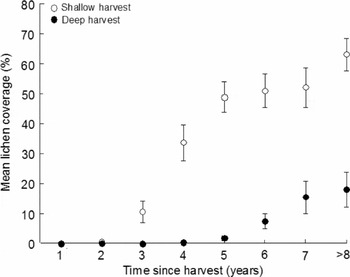
The regeneration of epiphytic macrolichens after harvesting started about 2–3 years after shallow harvesting, and about five years after deep harvesting (Fig. 2). After this initial time lag, lichen coverage increased faster on shallowly harvested than on deeply harvested patches. In the ≥8 year time since harvesting, coverage on the shallowly harvested patches was 40% higher. All four phorophyte species showed similar regeneration patterns (data not shown).
Macrolichen cover regeneration after shallow and deep harvesting. Error bars represent 1 standard error. Results were pooled over four host tree species. Each data point is based on 20 samples.

A stepwise multiple linear regression identified our focal variables of time since harvesting and harvesting method as the two most important factors affecting lichen coverage. In addition, four covariables significantly influenced lichen coverage: hill slope, soil humidity, position at branch and total coverage of other epiphytes. A general linear model, with time since harvesting and the harvesting method as fixed factors and these four covariates yielded a significant model for lichen regeneration after harvesting (Adj R 2 = 0.617; p < 0.001).
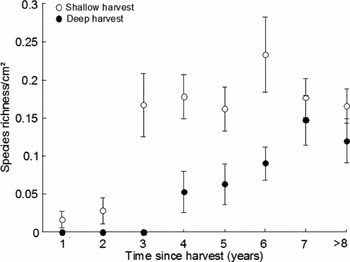
We also found a difference in the mean number of species per unit area for each time since harvesting-interval between the two harvesting methods (Fig. 3). In the first six years, the species richness per unit area was significantly lower on patches that were harvested deeply (ANOVA: df = 1, F = 33,04, p < 0.001). After eight years, on average fewer species had established on deeply harvested patches than on shallowly harvested ones, 0.12 and 0.17 species per cm2, respectively, even though this difference was no longer significant (ANOVA: df = 1, F = 1.183, p = 0.282).
Macrolichen species regeneration (expressed as species richness per cm2) after shallow and deep harvesting. Error bars represent 1 standard error. Samples of four host tree species were pooled.

In a stepwise multiple linear regression, time since harvesting and harvesting method were identified as the dominant factors influencing the species richness per cm2. Furthermore, the ‘forest’ PCA-axis, inclination and diameter of the trunk/branch, and shrub coverage had a significant effect upon the species richness per cm2. A general linear model with time since harvesting and the harvesting method as the fixed factors and the identified environmental variables as covariates was significant (Adj R 2 = 0.273; p < 0.001).
In total, we identified 30 different lichen species. Canonical correspondence analysis (CCA) showed that the lichen species composition in the patches was not explained by any of the entered environmental variables other than time since harvesting or harvesting method (Monte Carlo test first canonical axis: p > 0.05).Time since harvesting also had no affect on species composition (first axis p > 0.1), however, harvesting method significantly affected species composition (first axis p < 0.05) and, independent from any variation that was related to the other variables, the co-variables in the analysis. In this analysis, however, the first ordination axis explained less than 1% of the total variation in the species data, leaving most variation unexplained.
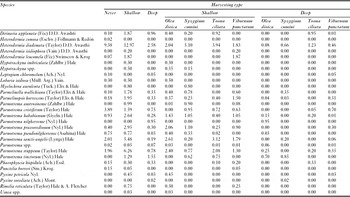
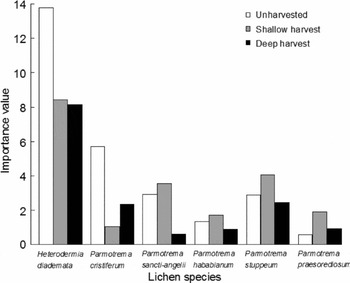
A species-specific response was also evident from the IVs after both shallow and deep harvesting (Table 1, Fig. 4). Some species become less (for example Heterodermia diademata [Taylor] D.D. Awasthi) and others more important (for example Parmotrema praesorediosum [Nyl.] Hale) in the lichen assemblage. No species-specific colonization patterns were observed on harvested patches, thus no pioneer species could be identified.
Importance values (IV's) of the observed lichen species occupying never, shallow and deep harvested patches, divided between the four host tree species. IV = (frequency × mean cover when present)/(group size × mean group values).

Importance values (expressing relative importance of the species in the lichen assemblage) of six dominant lichen species occupying never, shallow and deep harvested patches, pooled over four host trees.

DISCUSSION
Although selective removal of epiphytic macrolichens probably has minor effects on the forest ecosystem as a whole, the transect study shows that harvesting in the Palni Hills is reducing lichen abundance. Lichen removal was observed on a majority of the trees throughout the entire area inhabited by the Paliyans. Hence, lichen removal seems to occur extensively in the Palni Hills, which is in line with assessments from the Himalayas (Shah Reference Shah1997). Although a large proportion of the trees (63%) were subjected to lichen harvesting, tall trees were significantly less affected by harvesting owing to their lower suitability for climbing. Such trees may function as a refuge for lichen species (Sillett et al. Reference Sillett, McCune, Peck, Rambo and Ruchty2000).
Three phases of regeneration can be distinguished after harvesting (Figs 2, 3). In the first phase, lichens begin to regenerate 2–3 years after shallow harvesting and 4–5 years after deep harvesting. Epiphytic macrolichens require tree bark as substratum (Awasthi Reference Awasthi2000). Our data suggest that the lichen colonization pattern is related to bark recovery, that is the time it takes a tree to re-grow a bark layer after damage by harvesting. Lichens often require substrate characteristics that take time to develop (Selva Reference Selva1994) and bark recovery takes longer after deep harvesting. In the second phase, lichens grow faster on patches that have been shallowly harvested where species richness is also consistently higher. Again, we attribute this to bark characteristics. Deep harvesting removes the bark completely, exposing the underlying sapwood. This leads to smooth scars on the bark, lacking texture and foothold, complicating the establishment of lichens. During shallow harvesting, the bark retains more of its texture, which presumably facilitates the establishment of propagules (Barkman Reference Barkman1958). Fissures in the bark provide lichens a better opportunity to recolonize shallowly harvested patches faster from within, where deeply harvested patches are generally recolonized vegetatively from the edges (L. Molleman & S. Boeve, personal observation 2008). With a typical patch size of 20 cm2 and a maximum growth speed of 2 cm yr−1 (Upreti et al. Reference Upreti, Divakar and Nayaka2005), it takes lichens several years to reach high per cent cover on harvested patches. Furthermore, microscopic thallus particles may remain in the grooves after shallow harvesting. Other factors explaining the difference in lichen regeneration rate after shallow and deep harvesting may include bark chemistry and retention of nutrients and moisture. In the third phase, 5–6 years after shallow harvesting, a flattening of the regeneration is observed around a 55% coverage, possibly owing to allelopathic effects (Lawrey Reference Lawrey1995) and crowding (Armstrong Reference Armstrong2003). Here, after deep harvesting, species richness approaches that of shallowly harvested patches, nevertheless, percentage lichen cover was still only c. 15% after eight years. It is possible that the deeply harvested patches will regenerate completely with time, but eight years was insufficient to detect complete recovery. Similar regeneration patterns were observed on all four phorophyte species, indicating that this is a common response of the lichen populations in the whole forest.
Apart from harvesting method and time since harvesting, the PCA showed that hill slope, soil humidity, position on the branch and coverage of other epiphytes exert an influence on total lichen coverage. Forest variables (bundled in a PCA axis) had a positive effect on species richness, suggesting that more lichen species occur in forests with tall trees, probably due to lower harvesting intensity. Hill slope is related to the wind dynamics, which is an important vector for lichen dispersal (Awasthi Reference Awasthi2000). Moreover, trees on a slope are likely to receive more direct sunlight, which promotes lichen growth. Wind and sun desiccate the soil and forest, which is important for poikilohydric lichens that lack mechanisms for regulating uptake and loss of water (Green & Lange Reference Green, Lange, Schulze and Caldwell1994). The position on the branch is connected with light influx, favouring lichen growth at the top side (Renhorn et al. Reference Renhorn, Esseen, Palmqvist and Sundberg1997; Awasthi Reference Awasthi2000), direct precipitation and stem-flow. Coverage by other epiphytes is a measure of competition for light and space. Remarkably, light (namely diffuse site factors) had no effect. This may be explained by the lack of variation in the light data, partly owing to the mistakenly underexposure of the film.
Lichen regeneration was unrelated to host tree species. Hence, we found no evidence of substrate preference amongst the four phorophyte species. For practical reasons, we did not measure pH, nutrient status and water-holding capacity of each sample. Since the species of host tree did not explain the variation amongst samples, these factors will only exert an influence on lichen regeneration if they are not correlated with phorophyte species, which is unlikely (Barkman Reference Barkman1958).
The positive forest variables-lichen richness relation may reflect a more diverse background propagule supply in the tall forest (Sillett et al. Reference Sillett, McCune, Peck, Rambo and Ruchty2000). In this view, dispersal primarily assembles lichen communities as opposed to local conditions (see for example Löbel et al. Reference Löbel, Snäll and Rydin2006).
Whereas forest, tree and local patch parameters influence total lichen coverage and species richness in the samples, the CCA detected no such relation with the species composition of the samples. In addition, time since harvesting had no effect on species composition. Possibly any correlation was masked by the small area of the samples, causing great variability (Wolf Reference Wolf1994). Interestingly, CCA did detect a significant influence of harvesting method on lichen assemblages, although harvesters do not appear to distinguish between species of harvestable macrolichens (see also Fig. 4). Species-intrinsic differences in dispersal, establishment and growth may be responsible for changes in species composition. Since our study is a one-time inventory only, albeit based on a chronosequence of samples rather than the monitoring of species establishment and growth over time, no claims can be made with respect to the causes of the compositional changes. More research is needed to assess why some species appeared particularly vulnerable where other species gained in importance.
In summary, we found lichen removal in the Palni Hills to be intensive, affecting epiphytic macrolichens in their abundance, diversity and composition. However, we did not observe any negative effects of commercial macrolichen harvesting on the host trees and, after eight years, we found the lichen community had good regeneration capacity in terms of species richness and abundance in shallowly harvested patches. Our study indicates that sustainable harvesting of the epiphytic lichens in the ecosystem is possible, with a rotation cycle of approximately 10 years. Nevertheless, prudence is dictated, since our study is a one-time assessment only and does not address possible changes in the species composition of the lichen community. More information is needed on the, presumably spatially dependent, process of lichen regeneration, to evaluate the risk of local loss of species. Therefore, we stress that any sustainable harvesting management plan should include a detailed monitoring programme on lichen regeneration after harvesting. Preferably, monitoring should also include vascular epiphytes. Vascular epiphyte populations were not included in our assessment, but their densities are nevertheless also likely reduced by the harvesting practices. Finally, we recommend harvesters cease to employ the deep harvesting method, because the deep harvesting ‘business trick’ adversely affects lichen recovery in terms of abundance and richness. The higher quality NTFPs obtained by meticulous shallow harvesting should be rewarded by an increase in the price paid per unit weight, leading to higher overall returns. Tracking down trading routes, middlemen and sorting stations may provide a comprehensive insight in the quantities and mechanisms involved in this trade (Maraseni et al. Reference Maraseni, Shivakoti, Cockfield and Apan2006).
ACKNOWLEDGEMENTS
This project was funded by the STUNT- and AUV-scholarship, the Dr Hendrik Muller's Vaderlandsch Fund, the Schuurman-Schimmel van Outeren Fund and the Stichting Het Kronendak. We thank Harry Sipman for his training in lichen identification and we thank C. Shackleton for his comments on the manuscript. We are also thankful for the support and hospitality of ACT India Foundation, particularly P.R. Ashok Raja and Manohari, and Vanaraj for translation services. This study would have been impossible without the kind cooperation of the Paliyan community of Vadakaraiparai, and our guide Sankar Solei in particular. We would like to thank them warmly for their generous help and hospitality.