1 Introduction
During the past 1,000 years the English language has undergone numerous morphological, syntactic and semantic changes that now distinguish it from its more conservative West Germanic relatives, such as German. Sapir (Reference Sapir1921) talked of the ‘drift’ of English and proposed three interrelated changes. The first covered the loss of most inflectional morphology including case marking. The second was the fixing of SVO word order. The third, which he regarded as the most significant, was ‘the drift towards the invariable word’ (Sapir Reference Sapir1921: 168):
This striving for a simple, unnuanced correspondence between idea and word, as invariable as may be, is very strong in English. It accounts for a number of tendencies which at first sight seem unconnected. (Sapir Reference Sapir1921: 169)
These tendencies went beyond the loss of inflectional suffixes, and also of derivational affixes, and resulted in many invariable words and often in the loss of semantic oppositions that had been productive earlier. Sapir mentions where vs whence vs whither that have been reduced to where in Modern English. The corresponding forms of German (wo vs woher vs wohin) are still productive.
Hawkins (Reference Hawkins1986) developed Sapir's insights further by pointing to the greater ambiguity and vagueness of many other Modern English surface forms and structures compared with their German counterparts. Large numbers of words became ambiguous in syntactic category as a result of these inflectional losses, for example run, play, hit are both verbs and nouns. A greater range of semantic combinations of thematic roles came to be assigned to transitive clauses with NP–V–NP in addition to the prototypical Agent–Verb–Patient of the boy hit the ball. Raising and control ambiguities became possible for common surface structures.
As English drifted to shorter individual words with greater syntactic and semantic generality, it increased what Leisi (Reference Leisi1967) called its ‘Wortverband’, or word combinations. Major types included phrasal verbs (take up a hobby), prepositional verbs (count on your father), and light verb constructions with e.g. take, make, give and put. The light verb meaning of make a mistake is quite different from its more basic and literal meaning in make a dress. Similarly the meaning of take on its own is different from its meaning within the phrasal verb take up, as is the meaning of count from count on. Traugott & Trousdale (Reference Traugott and Trousdale2013) talk of ‘constructionalization’ and describe the development of many new multi-word constructions like this in the history of English.
Sapir's discussion of drift covered only some of the major changes that took place in English, however. Attempts to formulate larger unifying generalizations for the contrasts with German (Hawkins Reference Hawkins1986, Reference Hawkins, Rauch and Carr1995; Leisi Reference Leisi1967; and most recently Berg Reference Berg2014) have also not accounted for certain changes or been faced with counterexamples (see e.g. Rohdenburg Reference Rohdenburg and Gnutzmann1990; Kortmann & Meyer Reference Kortmann and Meyer1992; König & Gast Reference König and Gast2012 in relation to Hawkins Reference Hawkins1986, Reference Hawkins, Rauch and Carr1995). The present article proposes a new larger generalization that can unify major contrasts with German. It has greater coverage than my earlier proposals, and it avoids and subsumes previous counterexamples. It also links the insight about the unique features of multi-word grammatical constructions to other changes in English that have taken place in compositional syntax as well, leading to contrasts with German.
The key distinction to be proposed will involve how many linguistic properties, syntactic, semantic and lexical, can be assigned to individual words considered in isolation, i.e. word-internally, as opposed to requiring access to neighboring words. All languages involve both word-internal and word-external properties, depending inter alia on the richness and complexity of their words and the degree of morphological synthesis within them (see Sapir Reference Sapir1921; Comrie Reference Comrie1989). What varies is the balance between the two, and the degree of the reliance that words have on one another for the assignment of grammatical and lexical properties such as basic syntactic category, theta-role and lexical meaning, in addition to any constructional idiosyncrasies. The changes in English and major contrasts with German can be profitably viewed, I will argue, as systematic expansions in word-external properties.
The order of presentation is as follows. Section 2 summarizes major patterns in the English–German contrasts. Section 3 defines word-external property. Section 4 compares Modern English and German in more detail from this perspective. Section 5 considers the implications for psycholinguistics, especially parsing, and section 6 presents the conclusions of this study.
2 Patterns in the English–German contrasts
Hawkins (Reference Hawkins1986) laid out some of the major grammatical and lexical patterns that can be seen in the contrasts between Modern English and German, most of them the result of innovations in Middle and Early Modern English. A dozen of these can be summarized here as background to the present article.
(1) Modern English has lost its case marking on NPs other than pronouns (he vs him, etc.). German retains Nominative/Accusative/Dative productively on all NPs.
(2) Subject and direct object now have fixed positions in English, pre- and post-verbal respectively, but not in German (The boy beat the horse corresponds to Der Junge schlug das Pferd, but Das Pferd schlug der Junge is also grammatical).
(3) The position of finite and lexical verbs is regularly final in German, except when moved to second or first position in main clauses that lack an auxiliary, whereas English has no corresponding verb-final structures (The boy will beat the horse corresponds to Der Junge wird das Pferd schlagen with verb-final schlagen).
(4) Subjects and objects in English transitive clauses have become ‘semantically diverse’, e.g. more thematic roles such as Locative, Instrumental and Theme can be assigned to subjects that are without parallel in Old English and Modern German (My guitar broke a string, A pound once bought more goods, The book sold 10,000 copies are all possible in Modern English but impossible in German, cf. e.g. *Das Buch verkaufte 10,000 Exemplare).
(5) Modern English verbs regularly have a broader set of selectional restrictions than their German counterparts (one can break both a branch and a rope in English, whereas German requires lexical differentiation, brechen for the former, zerreissen for the latter).
(6) Modern English verbs also have a broader set of subcategorization frames, e.g. they are often both transitive and intransitive (The roof seeped water and Water seeped through the roof) whereas corresponding German verbs are one or the other (transitive *Die Decke sickerte Wasser is ungrammatical in addition to the intransitive Wasser sickerte durch die Decke).
(7) Modern English has a productive set of Subject-to-Subject Raising constructions with resulting structural ambiguity between raising and control interpretations (Mary happened to win the prize [raising], Mary tried to win the prize [control]). Such raisings are extremely limited in German while control structures are fully productive (Maria versuchte, den Preis zu gewinnen).
(8) Modern English has a productive set of Subject-to-Object Raising constructions with resulting structural ambiguity again (I believe the farmer to have killed the cow [raising], I persuaded the farmer to kill the cow [control]). Such raisings are completely impossible in German (*Ich glaube den Bauern, die Kuh geschlachtet zu haben) while control structures are fully productive.
(9) Modern English has a productive set of Tough Movement constructions with resulting structural ambiguity (John is easy to please [tough], John is eager to please [control]), such raisings being much more limited in German (e.g. there is no *Dieses Werkzeug ist gefährlich zu benutzen corresponding to This tool is dangerous to use).
(10) Modern English has more WH-movement, e.g. more clause-external linking of fillers to gaps or subcategorizers in relative clauses (see Hawkins Reference Hawkins1999, Reference Hawkins2004) (the book which you believe that you need in which book and which are linked as direct object to the verb need has no grammatical counterpart in German, *das Buch, das du glaubst, dass du brauchst).
(11) A great many verbs and nouns in Modern English have become category-ambiguous and require co-occurring articles or finite morphology and infinitival to for disambiguation (I want the run vs to run), whereas the richer morphosyntax of German means that predicates corresponding to run, play, try are regularly disambiguated (Spiel = N vs spielen = V for play).
(12) Numerous semantic distinctions have been eroded in the history of English as in where/whither/whence. Corresponding German WH-forms are still productive.
The comparative typology proposed by Hawkins (Reference Hawkins1986: 121–2) for these contrasts included the following generalization:
(13) There is greater ambiguity (and/or vagueness) of surface forms in English, i.e. greater collapsing of semantic distinctions and of different semantic types onto common surface forms. The result is more of a one-to-one mapping between form and meaning in German, with distinct forms carrying distinct meanings to a greater extent.
This is exemplified by the inflectional leveling in case marking (1), the part-of-speech ambiguities between nouns and verbs in (11), and the reduction in WH-word distinctions (where/whither/whence) in (12). The added semantic diversity of basic grammatical relations in (4) means that NP–V–NP transitive clauses can be mapped onto more thematic role combinations in Modern English than in German. The broader selectional restrictions in (5) mean that verbs like break have become vaguer and less specific in meaning with respect to the type of action they describe and compatible with more direct objects. The broader subcategorization frames for verbs like seep in (6) makes them compatible with more argument co-occurrence possibilities. The raising contrasts in (7), (8) and (9) produce structural ambiguities between raising and control, and sometimes full ambiguities as well when one and the same verb like begin is compatible with both interpretations, e.g. John began to cough (Perlmutter Reference Perlmutter, Jacobs and Rosenbaum1970).
Hawkins (Reference Hawkins, Rauch and Carr1995, Reference Hawkins, Nevalainen and Traugott2012) pointed out that Modern English has also increased its ‘temporary ambiguity’ structures and ‘garden paths’. Temporary ambiguity means that two or more grammatical analyses can be assigned to a string of words in online parsing, before subsequent material disambiguates. A garden path means that the first reading selected turns out to be wrong when later material is encountered, leading to backtracking and reanalysis. Some classic examples taken from Frazier (Reference Frazier, Dowty, Karttunen and Zwicky1985) are Bill knew the answer was correct and While Mary was reading the book fell down. The portions in bold are temporarily ambiguous and garden-path the hearer. Frazier (Reference Frazier, Dowty, Karttunen and Zwicky1985) notes that none of these would be temporarily ambiguous if English possessed grammatical means to force the intended reading online, like an obligatory that complementizer (Bill knew that the answer was correct) or verb-final word order (While Mary reading was, the book fell down vs While Mary the book reading was . . .).
Exactly such devices were present in earlier English and are still present in German. The German sentences corresponding to the unambiguous English ones are Bill wusste, dass die Antwort richtig war and Während Maria las, fiel das Buch herunter vs Während Maria das Buch las, . . . respectively. Other contrasts listed in (1)–(12) also lead to frequent temporary ambiguities and garden paths in English. Subject-to-Subject Raising structures like The noise ceased to get on his nerves involve a temporary ambiguity and garden path with respect to whether the noise ceased altogether or only with respect to the event described in the infinitival VP (getting on his nerves). Subject-to-Object Raising structures like I believe the farmer to have killed the cow and expanded WH-movements (the professor who I believe that you know) also introduce temporary ambiguities and garden paths that are without counterparts in German.
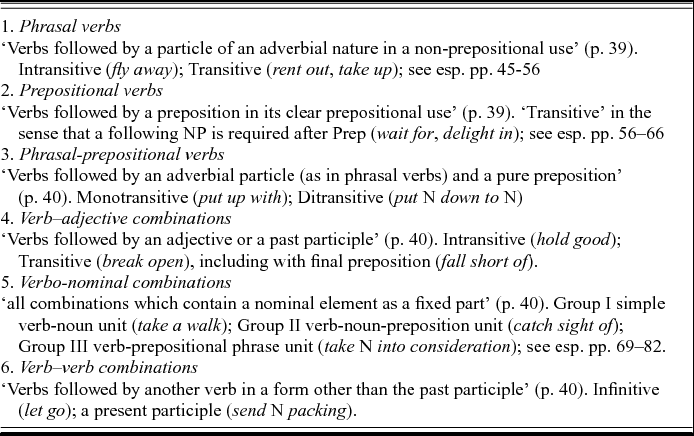
These full and temporary ambiguities in Modern English require disambiguation in language use through following or preceding words, or through other contextual cues (see section 5.2 below). So too do the many ‘multi-word’ verbs of English that have expanded significantly since early Middle English. Claridge's (Reference Claridge2000) book Multi-word Verbs in Early Modern English gives a historical overview and a classification of the different types, in addition to a detailed empirical study of the Lampeter Corpus from 1640 to 1740. Her classification is summarized in table 1, with relevant examples and page references. Her Appendix lists almost 1,300 examples that she identified in the corpus using criteria summarized in the table.
Claridge's (Reference Claridge2000) classification of multi-word verbs in Early Modern English

One way of distinguishing type 1 phrasal verbs from type 2 prepositional verbs is through the permutability of the particle around full NP objects (rent out a room vs rent a room out). Prepositions have a fixed position before NP (wait for my friend). This doesn't help with intransitive phrasal verbs like fly away, where any analysis of English faces the problem of distinguishing between particles, prepositions and adverbs (cf. Quirk et al. Reference Quirk, Greenbaum, Leech and Svartvik1985). Claridge's type 3 phrasal-prepositional verbs involve a combination of particle and preposition, put up with (e.g. the noise). Type 4 defines various verb–adjective combinations, including the transitive break open. Type 5, verbo-nominal combinations are often called ‘light’ verb constructions. Claridge subclassifies them into three groups: simple verb–noun units take a walk (I); verb–noun-preposition units catch sight of (II); and verb–prepositional phrase units like take this into consideration (III). Type 6 consists of verb–verb combinations.
German has retained a productive set of prefix verbs corresponding to those of Old English. It has no post-verbal particle placement alternations like turn off the light and turn the light off, though prefixes can alternate with clause-final particles when prefixes are separable and the finite verb moves to second or first position (Eisenberg Reference Eisenberg1999; Durrell Reference Durrell2011). German also has light verb constructions, but they are not as extensive as those of English. After comparing the light verbs do, have, go, give and make in English and their equivalents in German, Berg (Reference Berg2014: 502) concludes that ‘light verb + direct object constructions occur much less often in German than in English’, and ‘Some English light verbs have no real counterpart in German. By contrast, there are apparently no light verbs in German which lack an English counterpart.’
Prepositional verbs, Claridge's type 2, occur in German too (warten auf jemanden ‘wait for someone’), as do verb–adjective combinations (type 4, e.g. totschlagen ‘beat dead’), but not phrasal prepositional verbs (type 3, e.g. put up with). It remains to be quantified for each of these types how extensive the multi-word verbs of German are exactly compared with English. What is clear is that German is syntactically and lexically more conservative than Modern English and has many fewer multi-word verbs overall.
3 Word-external properties
The drift towards invariable words in English had one very general consequence. Properties that were once inherent in a word, and assignable to it independently of its linguistic context and on the basis of lexical and grammatical knowledge about that word, were no longer so assignable. Instead, neighboring words have come to play an increasing role in providing the information once contained in lexical stems or inflectional and derivational affixes. A preceding determiner (the play) or infinitival to (to play) now gives the information that the invariable play is a noun or verb. Similarly, the directional element differentiating where/whither/whence must be supplied elsewhere in the sentence, by verbs such as go and come.
The inherent case value of inflectional suffixes was lost when these suffixes were lost, and corresponding cases must now be assigned to invariable nouns and noun phrases by reference to a following or preceding verb. Only pronouns in Modern English retain an inherent case; see (1). Derivatively, the thematic roles assigned to subjects and objects must also make reference to the verb in question and its precise semantics, and the range of these thematic role possibilities has expanded in English; see (4). Multi-word verbs fit into this picture of Modern English as a language in which individual words rely more on neighboring words. Take has a distinct meaning and syntax with the particle up (take up a hobby), with the preposition on (take on a difficult assignment) and as a light verb (take effect).
I propose the following definition:
(14) Word-external property
For A, B, distinct constituents (words or phrases) of an expression we say there is a word-external property P assigned to one or the other or to their combinatorial product iff (i) P is zero-specified or ambiguously or polysemously specified in the grammar or lexicon for the relevant A or B considered on its own, and (ii) the co-occurrence of A with B makes possible the assignment of P.
The prerequisite for a word-external property, given in (14i), is that this property must not be inherent or unambiguous in the grammar or lexical listing of the word or phrase in question and assignable independently of co-occurring words. (14) specifies two possible ways in which word-external properties are assigned. Either this property applies to A or B directly, e.g. a word is assigned syntactic category N or V which it does not convey unambiguously on its own, or it receives a particular lexical meaning by reference to a subject or object NP, or a theta-role by reference to the verb. Alternatively the property is more constructional in nature and applies to the combinatorial product of A with B (see Goldberg Reference Goldberg1995, Reference Goldberg2006 and Culicover & Jackendoff Reference Culicover and Jackendoff2005 for general theoretical discussion of ‘constructions’). E.g. in chew out (the students) the presence of the particle out does not result in a different meaning being assigned to chew alone, but in the recognition of a multi-word unit chew out with a distinct meaning conveyed by that combination. For light verb constructions like take effect and make amends, light verb status can be assigned to V, but the constructional meaning must be assigned to the combination as a whole and not just to V.
What is implicit in (14) is that the actual assignment of these word-external properties is carried out in language use by a parser that accompanies the grammar and lexicon. The linguistic and comparative work presented in this article has numerous implications for language processing, and these will be spelled out in section 5. In the meantime I proceed on the basis of grammatical and lexical generalizations before considering the consequences, and some hypotheses, for psycholinguistics and experimental testing.
The general drift in the history of English, I propose, has been towards more word-external properties. This provides an improved unifying generalization for the major contrasts with German and is summarized in (15):
(15) Given the definition of word-external property in (14):
(i) There is now a larger set of properties P assigned word-externally in Modern English compared with German (and a smaller set P´ assigned to individual words/phrases);
(ii) these properties P being assignable to a larger set of words/phrases A and B through their co-occurrence.
Hawkins (Reference Hawkins2004) talked of one word being ‘dependent’ on another when discussing some of the data to be considered here. In this context I talk of word-external property assignments rather than dependencies in order to distinguish these multi-word patterns from dependencies in the grammatical sense, as pioneered by Tesnière (Reference Tesnière1959) and Hays (Reference Hays1964) in their Dependency Grammars. Such grammars have become widely used in psycholinguistics (see e.g. Gibson Reference Gibson1998, Reference Gibson, Miyashita, Marantz and O'Neil2000) and in ‘dependency treebanks’, e.g. Gildea & Temperley (Reference Gildea and Temperley2010), Futrell, Mahowald & Gibson (Reference Futrell, Mahowald and Gibson2015).
Dependencies in grammars and treebanks cover a large number of links that hold between words (subject-of, object-of, complement of, adjunct modifier of head, specifier of, filler-gap dependency, and so on). The word-external property assignments of (14) define a partially overlapping but distinct set of relationships, based crucially on the amount of information inherent in individual words and phrases within their grammatical and lexical representations. The subject and object relations in English and in a rich case-marking language would be the same from the perspective of Dependency Grammar, whether the Nominative and Accusative are expressed overtly and unambiguously or not. But their morphosyntactic expression is crucial for the definition of word-external property here. Explicit and unambiguous case marking (as with pronouns he vs him) removes the need to access the verb, meaning that the pronoun is not dependent on it in our sense for assignment of case.
Consider a relevant case-marking alternation in Kannada, a Dravidian SOV language with morphological case marking on a Nominative–Accusative basis. Bhat (Reference Bhat1991) points out that an Accusative-marked pustaka-vannu (book-ACC) can occur without case marking when it stands adjacent to the transitive verb, giving the structural alternation in (16).
(16)


We can say that pustaka in (16b) receives Accusative case as a word-external property by accessing the following verb. Accusative case in (16a), by contrast, can be assigned without accessing the verb, based on its explicit form. Word-external assignments of case depend on the degree of grammatical richness within a word, therefore.
Similarly, there can be property assignments in our terms both from head to dependent and from dependent to head. A verb (as head) can assign case and theta-role to its subject and object dependents. Conversely, the appropriate lexical meaning is assigned to an intransitive verb from its large polysemy range by accessing the subject NP (compare the meanings of ran in John ran/The water ran/The stocking ran/The advertisement ran), while an object NP selects the meaning of ran in ran the race/ran the water/ran the company/ran the ad); cf. Keenan (Reference Keenan1979). The precise properties assigned in verb + particle and verb + preposition constructions also depend on whether each component of the combination can be understood with the meaning it has in isolation (lift the child up makes the same claim as lift the child and the child went up; chew the students out does not make the same claim as chew the students or the students went out; John waited for his child entails John waited, John counted on his child does not entail John counted, and so on); see section 4.5.
Notice finally in this section that languages can make morpheme-external property assignments within a word, as well as word-external assignments, by extending the definition in (14). Morphemes can show more or less reliance on the morphemes they combine with. Consider inflectional -s in English. When combined with a morpheme or morpheme combination of syntactic category N, it is assigned the property Plural (boys, builders). When combined with V it receives 3rd Person + Singular (eats). (When -s is a clitic and attaches to a whole NP, it is Possessive, the boy's). Similarly, derivational -er in English when added to V yields Agentive Noun (builder), when added to Adj it is Comparative (smaller). These can be considered property assignments to morphemes by reference to the morphemes they combine with. Contrast these with the agglutinative Turkish adam-lar-dan where adam is recognizable as the lexical noun ‘man’, -lar is consistently plural, and -dan is consistently ablative case, i.e. regardless of the word-internal combination.
4 Illustrating and extending the unifying generalization
In this section it will be shown in greater detail how the comparative generalization of (15) applies to the English–German contrasts considered hitherto and this generalization will be extended to further instances.
4.1 Theta-role assignments
Non-pronominal NP subjects and objects in Modern English receive their cases, Nominative and Accusative (or non-Nominative), as word-external properties by accessing the verb, looking right and left respectively. Theta-roles are also assigned by accessing the verb or whole VP. In a large empirical study, Rohdenburg (Reference Rohdenburg1974) showed just how varied the semantic combinations of theta-roles have become in transitive clauses with NP-V-NP in Modern English. These include Instrumental subjects, A few years ago a pfennig would buy two or three pins, Locatives, The roof of the tunnel was seeping water and This tent sleeps four, and Themes, The book sold 10,000 copies. Literal translations of these into German are all ungrammatical, cf. *Vor einigen Jahren kaufte ein Pfennig zwei bis drei Stecknadeln, *Die Tunneldecke sickerte Wasser, *Dieses Zelt schläft vier, and *Das Buch verkaufte 10,000 Exemplare respectively.
Instead German uses prepositional phrases for these non-agentive roles, and this is an option that is still productive in English too, resulting in structural alternations that are without German parallels. This is illustrated in (17) from Rohdenburg (Reference Rohdenburg1974) in which the (a) sentence gives the (italicized) Locative subject in English, the (b) sentence is the most natural German translation using an (italicized) PP (with the Nominative subject in capitals), and (c) is a literal translation into English of (b):
(17)
(a) The roof of the tunnel was seeping water.
(b) Durch die Tunneldecke sickerte wasser (durch).
(c) water seeped through the tunnel roof.
Levin (Reference Levin1993) gives a systematic account of alternating co-occurrence frames like this for large numbers of verb classes in Modern English. Particularly extreme cases are those discussed also by Berg (Reference Berg2014) in which a passive-type meaning with a Patient subject can be assigned to an active verb, as well as to the subject of a passive verb, and to the object of the active verb, as shown for screen in (18a), (b) and (c) respectively:
(18)
(a) The new film screens next week at the Odeon.
(b) The new film is being screened next week at the Odeon.
(c) The Odeon is screening the new film next week.
The Patient or Theme role can now be assigned to more NPs (pre-verbal subjects and post-verbal objects) by reference to more verb types (active and passive). Patient theta-role assignments to active verbs as in (18a) are completely unattested in German (Berg Reference Berg2014). More generally, these examples show that a greater range of theta-roles (i.e. the P properties in (15i)) can be assigned to more subject and object NPs in English by reference to more verbs and VPs (see (15ii)). German does not have this range of word-external theta-role assignments.
Interestingly, theta-role assignments have continued to expand in Modern English, and more ‘ambitransitivity’ (Berg Reference Berg2014) is now seen e.g. in technological contexts (This information will display on your screen, Wait while Windows 98 installs on your computer; see Fan Reference Fan2008; Fritz Newmeyer p.c.).
4.2 Syntactic category ambiguities and word class selections
I pointed out in (11) that English words have quantifiably more ambiguities between different parts of speech compared with German and often rely on preceding articles (the play) and infinitival to (to play) for their noun and verb status. These categories are reminiscent of the articles and particles of Polynesian languages like Tongan and Maori that disambiguate between general word classes (Broschart Reference Broschart1997). German regularly keeps word classes separate in its word-internal morphology, which means that these categories are not assigned word-externally.
A striking case of category ambiguity in English can be seen in verbs with the suffix -ing. There are numerous deverbal categories and grammatical meanings here that are systematically disambiguated by their sister words and phrases. König & Gast (Reference König and Gast2012: 72–7) distinguish ‘deverbal adjective’ (This is very amusing), ‘adverbial participle’ (Walking along the river, I saw a crane), ‘gerundive nominal’ (Not reading poetry impoverishes your life), ‘non-finite relative clause’ (the guy talking to George), ‘action nominalization’ (No reading of poetry is good enough for Mary) and ‘deverbal preposition’ (concerning your recent proposal), in addition to the ‘progressive aspect’ on verbs (I am not talking to you). The derived syntactic categories and meanings of verb + ing are word-external properties in our terms, looking left or right to the words and phrases on the basis of which the relevant deverbal category can be assigned. German has no such systematic ambiguity in its translation equivalents for these and employs distinct forms and structures for the expression of these meanings (see König & Gast Reference König and Gast2012).
Consider now the auxiliary verbs of English, and let us assume a key change proposed for them in Early Modern English by Lightfoot (Reference Lightfoot1979) (without committing ourselves to many of the other details in that work; see Warner Reference Warner1983 for critique): syntactic auxiliaries became differentiated from lexical verbs and were generated by a new PS-rule,
Aux → Tense (Modal)
distinct from the rule generating nonfinite and lexical verbs (VP → V . . ..). This new auxiliary rule introduced the Tense category that led to do Support in sentences with Tense separated from V by e.g. negation (John does not like carrots). It also provided a distinct dominating node for the future auxiliary will, the modal auxiliaries can, may, must, might, etc., and also for finite perfective have (John has eaten carrots), passive be (the carrots were eaten) and progressive be (John is eating carrots).
This differentiation of auxiliaries from lexical verbs had a sweeping set of consequences, among them the fact that modals could no longer function as main verbs taking direct objects, as they still can in German, Ich kann Dänisch (literally ‘I can Danish’, i.e. ‘I can speak Danish’). Similarly, the future will regularly contrasts with the present tense in German (Fritz will buy a newspaper tomorrow vs Fritz kauft morgen eine Zeitung, literally ‘Fritz buys a newspaper tomorrow’) and introduced a systematic distinction between present and future tense into English. The obligatory progressive in Fritz is reading now is another example where the more ambiguous present tense is generally used in German (Fritz liest jetzt, literally ‘Fritz reads now’). This disambiguation in English goes against the grain of so many other changes in its history, which had the reverse effect of collapsing syntactic and semantic distinctions.
The auxiliary system of English provides a productive set of counterexamples, therefore, to the comparative generalization for English and German proposed in Hawkins (Reference Hawkins1986) and summarized in section 2 to the effect that it is generally German that makes more explicit distinctions in surface forms and has less ambiguity and more semantic transparency (see Rohdenburg Reference Rohdenburg and Gnutzmann1990, Reference Rohdenburg1992; Kortmann & Meyer Reference Kortmann and Meyer1992; König & Gast Reference König and Gast2012). It also goes against Sapir's (Reference Sapir1921) drifts involving the loss of semantic and syntactic distinctions in English, and against a generalization proposed in Berg (Reference Berg2014) about English having ‘softer’ and ‘more permeable’ boundaries for its syntactic, morphological and semantic categories compared with German (see Berg Reference Berg2014: 499–500 for discussion and recognition of this counterexample).
It is significant now to point out that these changes in the English auxiliary system are no longer counterexamples to the comparative generalization proposed here. For they involve the same expanded use of neighboring words for disambiguation and property selections, both syntactic and semantic. The addition of the new Aux rule created a whole extra layer of word class ambiguity that did not exist before.
Specifically, do is now syntactically ambiguous between Aux and V (John does not like the movie and John does his homework respectively). There is also an additional Emphasis property added when do immediately precedes V, John does like the movie, i.e. this is a semantic word-external property assignment, just as selection of the appropriate word class is a syntactic word-external property.
Will is also ambiguous between Aux (I will sing) and V (He willed it to happen), with N a lexical possibility as well (my last will and testament). Disambiguation proceeds through word-external property assignments, looking right or left to the relevant categories on which these assignments depend. The lexical can is syntactically an Aux of the subtype M or Modal. It is no longer a V in English, but it can be a noun (a can). Might is similar: an Aux or an N (his great might). So is must. May is an Aux or the proper name for a month.
Finite have in Modern English is assigned the properties Aux and Perfective when it precedes a past particle (has seen), but it is assigned V and the relevant lexical semantics (involving possession) when it precedes a direct object NP (John has a house). Likewise the verb be can be Aux or V (Mary is singing and Mary is a teacher respectively), and with the former the semantic property Progressive is assigned when Aux immediately precedes a verb in -ing. Passive is assigned when be precedes a past participle (Mary was seen).
The point about these auxiliaries of Modern English is that although the grammar now systematically differentiates Aux from V, with new tense and aspect distinctions and also a new division of labor between the original modals and periphrastic modals such as be able to generated under VP, and although this is at first sight hard to reconcile with the many other changes in the grammar and lexicon that involved a general loss of surface distinctions, yet when all this is viewed from the perspective of the present article we see the very same pattern as before. The actual words generated under Aux have become even more ambiguous than they were, and they rely to a greater extent on the assignment of word-external properties that disambiguate their syntactic category status and lead to related syntactic and semantic properties being assigned when neighboring words are accessed.
4.3 Property assignments in fixed word orders and their directionality
Sapir (Reference Sapir1921) had the insight that the new fixed SVO word order of Middle English was intimately connected with the loss of case inflections on nouns. The verb now serves as a fixed anchor between subjects and objects. The perspective of the present article leads to a more general hypothesis about fixed word order. The loss of word order freedom and the conventionalization of typologically consistent ordering patterns (Hawkins Reference Hawkins1983; Dryer Reference Dryer1992) appears to be intimately linked to the extent to which languages rely on neighboring words and phrases for assigning properties that are not inherent or unambiguous within individual words. When case marking is removed, there is a property assignment by reference to the verb (recall the fixed adjacency of the direct object to the verb in the Kannada (16b)). Fixed word order is correlated, I propose, with the number of word-external properties that must be assigned. When individual words are less explicit and rich in content, and word-external access is needed, an associated parser has to know where to look, rapidly and correctly, in order to assign the properties that are missing from the words themselves. And this makes it advantageous to have fixed and consistent positions for these words so that the parser can readily find one while processing the other (see further section 5.1).
Cross-linguistic support for this comes from Hengeveld et al.’s (Reference Hengeveld, Rijkhoff and Siewierska2004) study of word order in the noun phrase. They found that languages with more ambiguous word classes (like Polynesian; see Broschart Reference Broschart1997) had more fixed word orders. For example, languages with lexically general predicates and without a separate productive Adjective category generally position their semantic adjectives in a fixed order consistent with the basic head ordering of the language, following the head noun in VO languages (like Samoan) and preceding it in OV languages (e.g. Quechua). In our terms, assigning Adjective or noun-modifier status to a general predicate within an NP is a word-external property, looking left to the nominal head in Samoan, and looking right in Quechua. And crucially, whereas languages with general predicates and undifferentiated adjectives typically have fixed NP order, those with a differentiated class of adjectives, permitting this property to be assigned independently of access to the noun, have variable positioning and frequently order their adjectives in a way that is at variance with the general head ordering typology of the language (e.g. basic NAdj orders in Basque and Abkhaz orders co-occurring with OV, these languages having differentiated adjectives, and Arapesh AdjNAdj co-occurring with VO, again with differentiated adjectives); see Hawkins (Reference Hawkins2014: 132–5) for a summary.
4.4 Word-external properties in more complex environments containing A or B
The assignment of a theta-role to a subject NP can proceed rapidly when the verb follows immediately. Ran assigns Agent in The girl ran, and fell assigns Patient in The girl fell. On other occasions the theta-role property requires access to the whole VP. This tent sleeps is unprocessable without the following . . . four, whereupon the Locative theta-role can be assigned to the subject (section 4.1). Even for Agents and Patients accessing the verb alone may not be enough. Contrast The soldiers fell upon hard times (Patient subject) and The soldiers fell upon their enemy (Agent), where the intended sense of fell upon and the corresponding theta-role of the subject is not made clear until the final N (times vs enemy). We can say that a word-external property P assigned to a subject, which is normally possible by reference to the verb alone, requires access in these examples to a more complex environment (VP) containing the verb and extending to its postverbal PP and NP.
Word-external properties requiring access to categories in more complex environments have systematically increased in English. Raising constructions are extremely limited in German (see (7)–(9) and Hawkins Reference Hawkins1986: 75–84). Raising examples like The girl appears to have fallen vs The girl appears to have run show that Modern English has expanded the distance between matrix subject and theta-role assigner (fallen vs run). Disambiguation and polysemy reduction for these verbs also proceeds over larger structural distances: compare The girl appears to have run badly with The stocking appears to have run badly, in which resolution of the intended sense of run requires access to the (raised) subject in the higher clause. Compare also John is easy to help with John is easy to hurt, where different theta-roles are assigned to John by reference to help (Benefactive) vs hurt (Patient) within an embedded environment containing these verbs, and even within unbounded movement environments such as This boy is easy for me to persuade Bill to help (Postal Reference Postal1974).
Modern English has similarly expanded the structural environments in which properties are assigned in WH-movement structures (see (10) above and Hawkins Reference Hawkins1986: 87–106). WH-questions like What package did he come in order to pick up? in which What package is linked to the infinitival verb pick up in an embedded adjunct purpose clause are grammatical in English, but corresponding sentences in German are ungrammatical. A theta-role is assigned to What package here by accessing pick up, and similarly selection and assignment of the appropriate sense of pick up from its large polysemy range requires access to What package. The A and B categories in these word-external property assignments occur in larger domains of processing than in German (see further Hawkins Reference Hawkins1999, Reference Hawkins2004). Modern English is also one of those rare languages that allows Preposition Stranding, e.g. Who did you go to the movies with?, in which the precise interpretation of the initial Who must remain unspecified until the distant subcategorizing preposition with is encountered, and this latter must in turn look to the distant WH-word for its governed NP. German uses only local ‘pied-piped’ structures here corresponding to With whom did you go to the movies?
The word-external properties assigned in these expanded movement structures of Modern English are made to more words or phrases by reference to other words or phrases in more complex environments, in accordance with (15).
4.5 Multi-word verbs
The phrasal verbs of Modern English generally replaced earlier prefix verbs with prefixes such as for- (forniman ‘carry off’), tō- (tōbrecan ‘break up’), ā- (ālecgan ‘lay down’), of- (offerian ‘carry off) and ūt- (ūtgān ‘go out’). Some of these were to survive in e.g. outlive and overcome, some in contrasting pairs such as overtake and take over. But the decline in prefix verbs was extensive and it is generally agreed by historians of English that the phrasal verbs can be dated to Early Middle English (Denison Reference Denison1981; Hiltunen Reference Hiltunen1983; Claridge Reference Claridge2000; Brinton & Traugott Reference Brinton and Traugott2005). For prepositional verbs and verbo-nominal types (see table 1) Claridge (Reference Claridge2000: 89, 94) points out that their historical expansion was similar to that of phrasal verbs. As noted in section 2, multi-word verbs are much less extensive in German (see Berg Reference Berg2014), though this remains to be quantified for the different subtypes defined in Claridge (Reference Claridge2000).
What we see in this systematic expansion of multi-word verbs in English is increasing exploitation of neighboring words to provide properties to sister words and to whole combinations.
Consider Claridge's type 5 verbo-nominal combinations Group 1 exemplified by take a walk. Common examples listed in her Appendix are take (take care, take effect), make (make amends, make an escape), give (give battle, give offence), do (do harm), plus numerous combinations with less frequent verbs, e.g. cast a look, keep pace, pick a quarrel. Light verbs rely crucially on their following N or NP for the assignment of a meaning to the combination. Very few retain a more literal meaning that could be assigned out of context, and most do not entail corresponding sentences in which the pronoun something replaces the following NP. Mary made a dress entails Mary made something, but Mary made an escape does not entail Mary made something, nor does Mary made amends. Mary took a walk does not entail Mary took something. In short, a basic and literal meaning can be assigned to make in Mary made a dress, which includes the general meaning of make in Mary made something, but this is not usually possible for light verbs.
Claridge's verbo-nominal Group II in type 5 exemplified by catch sight of has a similar set of light verbs listed in her Appendix including take (take care of), make (make mention of), and give (give rise to), also have (have need of), put (put an end to) and set (set fire to). Her Group III includes take into consideration, put to death and set on fire. As with Group I, the meanings of most light verbs in Groups II and III require access to the following N, NP or PP.
Consider next prepositional verbs, Claridge's type 2 in table 1. Examples from her Appendix include wait for, aspire to, dispense with, engage in, launch into. What is significant about most of these is that either the verb needs access to the preposition for a meaning assignment, or the preposition needs access to the verb, or both. We can make this more precise using the entailment tests proposed in Hawkins (Reference Hawkins2000: 242), which are similar to those just illustrated for light verbs.
(19) Verb Entailment Test: does the meaning assigned to V require access to a following PP or is a sentence entailed with V alone? E.g. The man waited for his son entails The man waited; The man counted on his son does not entail The man counted.
(20) Pro-Verb Entailment Test: does a PP require that particular V for its interpretation or can V be replaced by some general Pro-verb? E.g. The boy played on the playground entails The boy did something on the playground, but The boy depended on his father does not entail The boy did something on his father!
If V needs access to a following preposition by the test in (19), or a preposition to the V by the test in (20), then we are dealing with a word-external property assignment made to the combination of A with B (see the definition in (14)).
Hawkins (Reference Hawkins2000) examined permutable sequences of two PPs following V in a written corpus of fiction and non-fiction texts comprising 394 such sequences. A majority of these (211, or 54 percent) could be shown to involve a property assignment to either the verb, or the preposition or both. Their lexical meanings could not be assigned without accessing the other. This shows how commonplace these lexical assignments have become to the combinations in question.
The phrasal verbs of Claridge's Appendix, type 1, are her largest group. Many of the ‘intransitive phrasal verbs’ have compositional semantics, like fly away, and do not need lexical listing. But she also gives numerous transitive ones including cast off, rent out, put up and win over, most of which do require lexical listing and/or analysis as a construction.
Lohse et al. (Reference Lohse, Hawkins and Wasow2004) proposed entailment tests distinguishing among phrasal verbs that do or do not involve word-external property assignments. John rented the apartment out entails John rented the apartment (without the particle) but it does not entail The apartment was out or The apartment went out (with some alternative semantically general verb like be or go used as a predicate). Rent is accordingly classified as an independent verb, not requiring word-external access for its lexical meaning, and out as a dependent particle requiring access to the verb. John turned the light off, by contrast, entails the light went off, but not John turned the light, making the particle independent of the verb while the verb needs access to the particle for its interpretation. In John lifted the child up, both John lifted the child and the child went up are entailed, making both verb and particle independent of each other, while in John carried out the plan neither entailment goes through and both need access to the other. Empirically over three-quarters of the 1,684 verb–particle sequences in their corpus had a verb that required access to the particle, or a particle requiring access to the verb, indicating again how extensive word-external property assignments have become in these Modern English word combinations.
4.6 Verb co-occurrences and selectional restrictions
Leisi (Reference Leisi1975) examined many basic lexical verbs of English and German and argued that those of English exhibit a greater reliance on accompanying direct objects for their precise semantics. Verbs like break X, shoot X, put on X, paint X are compatible with many different kinds of breaking (brittle and non-brittle objects), of shooting (human and animal), of putting on (different types of clothing) and of painting (affected and effected objects), and the selection of the appropriate meaning relies crucially on the following X. In German separate verbs are regularly used for these different activities in combination with different objects, i.e. these German verbs have less polysemy and ambiguity. Leisi's key insight was that the ‘Wortinhalt’ or semantic content of verbs depends on their Wortverband with the following X to a greater extent in Modern English than it does in German. In our terms, English verbs are semantically more general and polysemous than their German counterparts and require more word-external access for lexical property assignments, providing further support for (15).
Plank (Reference Plank1984) has confirmed this in an examination of some fifteen semantic areas. English break applies to brittle objects like bones and branches, but also to ropes, strings and tendons. German brechen and zerbrechen apply only to the former. For non-brittle things other verbs have to be used like zerreissen. Corresponding to shoot in English, German has both schiessen and erschiessen. Schiessen is used for animals hunted for sport or food and evokes the game-hunting sense of shoot. But if the victim is human (or a pet animal) then erschiessen is used. English shoot covers both types of victims and events.
German verbs also differentiate regularly between effected objects (where the object is brought into existence by the action described in the predicate) and affected objects (where the object exists in advance of the action described in the predicate). Paint a picture involves the creation of an object and is effected, but in paint the wall the wall generally exists already and is affected. English uses paint for both. German has malen for pictures, but streichen (or anmalen or bemalen) for affected objects like walls. A particularly striking set of contrasts can be seen in verbs for putting on clothes. English uses put on for just about any item of clothing and personal adornment, a coat, gloves, shoes, a hat, a crown, jewelry, a tie, a belt, a necklace, a brooch, and so on, whereas German employs numerous verbs that distinguish between the different types of putting-on-activities, often in a semantically transparent way (see Plank Reference Plank1984 and Hawkins Reference Hawkins1986: 28–35).
Plank (Reference Plank1984: 331) summarizes by observing that it is regularly the case that ‘two or more verbs in German . . . correspond to a single English verb lacking the object-oriented meaning component found with its German counterparts’. Alternatively, English and German may have verbs with similar object-agreement requirements, but English ‘may have additional, and perhaps more commonly used, verbs which neutralize this object-oriented meaning opposition’, as with put on. These ‘object-oriented meaning components’ of German verbs are inherent in the verbs themselves and in their selectional restrictions (Chomsky Reference Chomsky1965). For English many of these semantic properties are assigned word-externally by accessing accompanying NPs.
Plank's and Leisi's generalization for English and German has been corroborated for the semantic area of cutting and breaking in an experimental study in which native speakers of various languages described video clips depicting a wide variety of these actions (Majid et al. Reference Majid, Gullberg, Staden and Bowerman2007). The issue they addressed was how speakers partition the different types of cutting and breaking actions based on the verbs available to them. Four Germanic languages were compared in this paper, English, German, Dutch and Swedish, and the greater semantic generality of English was confirmed.
English verbs have also generalized their syntactic subcategorization frames. Berg (Reference Berg2014) gives sample figures suggesting that over half of Modern English verbs are ‘ambitransitive’, i.e. ambiguous between transitive and intransitive, like obey (you have to learn to obey vs . . . obey your parents), and that there are two or three times more such verbs than are found in German. For these the accompanying NPs need to be consulted in order to ascertain which subcategorization frame is intended, and we are dealing with a word-external property again.
5 Psycholinguistic implications
The last section presented what is in effect a descriptive linguistic generalization for major English–German contrasts in terms of word-external properties. This proposal has clear implications for the psycholinguistic mechanisms that operate in online processing, as speakers and hearers make the relevant property assignments in realtime, activating and supplementing their grammatical and lexical representations for individual words and phrases. In this section we consider some of these implications. Many of these contrasts have not been studied experimentally, but there are some findings that are very suggestive, and it is my hope that the linguistic patterns described here will encourage further experimentation. A fuller understanding of their online processing will lead to an improved explanation for the comparative typology than can be offered on the basis of grammatical and lexical patterns alone. I first present a preliminary general hypothesis regarding competing efficiencies in language processing for the contrasts we have seen (section 5.1), before outlining issues for testing in online experiments (section 5.2).
5.1 Competing efficiencies
Some recent experimental work on multi-word verbs is very revealing. In a series of online psycholinguistic and neurolinguistic studies of light verb constructions in both English and German, Wittenberg and colleagues have shown that they are associated with higher processing demands compared with matched verbs with literal meanings (Wittenberg & Pinango Reference Wittenberg and Pinango2011; Wittenberg, Paczynski, Wiese, Jackendoff & Kuperberg Reference Wittenberg, Paczynski, Wiese, Jackendoff and Kuperberg2014; Wittenberg, Jackendoff, Kuperberg, Paczynski, Snedeker & Wiese Reference Wittenberg, Jackendoff, Kuperberg, Paczynski, Snedeker, Wiese, Bachrach, Roy and Stockall2014). The constructions with non-literal interpretations of make, take and give, and requiring word-external access and property assignments as defined here were harder to process than their literal counterparts, despite being more frequent. For example, there were longer reaction times when making a cross-modal lexical decision after light verb constructions than after their non-light counterparts. The authors argue that light verb constructions are harder to process because of their more complex argument structure, and they propose a ‘co-event’ analysis for them in semantic interpretation.
Further relevant experimental work on multi-word verbs has been reported in Gonnerman & Hayes’ (Reference Gonnerman and Hayes2005) study of verb–particle processing. They found that online decision latencies and self-paced reading times were significantly longer for phrasal verbs requiring word-external properties as defined here, i.e. for those in which either the verb or the particle required access to the other for assignment of its lexical meaning (by the entailment tests of Lohse et al. Reference Lohse, Hawkins and Wasow2004; see section 4.5). Similarly, experimental support for extra processing demands in V–PP sequences such as count on my father, in which either verb or preposition required access to the other (by the entailment tests of (19) and (20)), is given in Marblestone (Reference Marblestone2007). She found evidence for greater difficulty in sentence construction and repetition tasks when V and P involved word-external properties, especially when task demands were increased through their non-adjacency.
Corpus data support these experimental findings of extra task demands in processing word-external properties. For light verb constructions like take X into account Wasow (Reference Wasow1997, Reference Wasow2002) found that 60 percent were shifted to take into account X in his corpus, putting the verb adjacent to the PP on which its light verb interpretation depends, compared with just 15 percent of shifts when take was interpreted literally in take X to the library. The much greater frequency of these ‘Heavy NP Shifts’ away from basic V–NP–PP order and into a position that gives the light verb a smaller Lexical Combination Domain (Hawkins Reference Hawkins2004) supports their proposed greater processing difficulty in the Wittenberg et al. experiments.
For the V–PP–PP sequences in Hawkins’ (Reference Hawkins2000) data, almost three-quarters (73 percent) of those with one independent PP and one requiring word-external access placed the latter adjacent to the verb, making the domain for lexical-semantic processing smaller and suggesting that the processing of count on is indeed more demanding than that of play on, which the Marblestone (Reference Marblestone2007) experimental study has now confirmed. For PPs requiring such access that were also shorter (in word length) than the independent PP, the adjacency rate to V in the corpus was even higher at 96 percent, on account of the additional short-before-long preference (reducing Phrasal Combination Domains in Hawkins Reference Hawkins2004), again matching Marblestone's findings. The particles of phrasal verbs that were not independently processable (e.g. look up the number) also resulted in significantly more adjacency to the verb compared with independent particles (lift the child up) in the corpus data of Lohse et al. (Reference Lohse, Hawkins and Wasow2004), matching their greater processing difficulty in the experiments of Gonnerman & Hayes (Reference Gonnerman and Hayes2005).
Word-external properties appear to require more processing effort, therefore, than corresponding structures with word-internal properties, and they prefer tighter adjacency between interlinked words in order to keep processing domains as short as possible. If this result can be replicated in further experimental studies, we will have an explanation for many phenomena involving linear ordering that have been observed in grammars and cross-linguistic variation conventions. It will explain why word-external case assignment to a direct object in SOV languages like Kannada (see (16b) above) only takes place when that object is immediately adjacent to its verb; why zero-marked dependents (e.g. relative clauses without relativizers, complement clauses without complementizers) generally stand closer to their heads than explicitly marked ones (Hawkins Reference Hawkins, Rohdenburg and Mondorf2003); why complements are closer to their verbs than adjuncts (Hawkins Reference Hawkins2001); and numerous other cases of adjacency (Hawkins Reference Hawkins2004, Reference Hawkins2014). We would also have support for the fixed word order hypothesis given in section 4.3 above, whereby more word-external processing demands result in fixed and consistent orderings. More controlled experiments manipulating alternating structures of all these types are now needed, along the lines of the Wittenberg et al. studies.
On the other hand, Sapir's drift to invariable words in English has clearly made processing easier in some respects, plausibly offsetting some of these added costs from word-external processing. Specifically, English has reduced the size and complexity of its words and increased their syntactic and semantic generality. Having fewer phonemes and morphemes to process, fewer and more general semantic properties to assign, and more frequently used shorter forms, makes processing easier according to the Minimize Forms principle of Hawkins (Reference Hawkins2004, Reference Hawkins2014). A larger viewing window is then required, however, for property assignments beyond the word itself. In addition, when word-external processing must look forward to later categories in the parse string there will be delays in the assignment of correct properties, temporary ambiguities and frequent garden paths, recall section 2.
Modern English is often inefficient according to the principle of Maximize Online Processing proposed in Hawkins (Reference Hawkins2004, Reference Hawkins2014), therefore, which asserts that there is a preference for selecting and arranging linguistic forms so as to provide the earliest possible online access to as much of the ultimate syntactic and semantic representation as possible. Modern English has also extended many parsing domains, both forward-looking and backward-looking ones, the most extreme cases being the complex environments containing categories A or B summarized in section 4.4. These changes result in less minimal domains for processing (Hawkins Reference Hawkins2004, Reference Hawkins2014), but as I have said Modern English does have more minimal forms (though see further section 5.2).
Conversely, languages with syntactically and semantically richer and more complex words, and with fewer word-external properties like German will have the reverse efficiencies and inefficiencies to those of Modern English. Their longer and more explicit words do not minimize forms, but German does have more minimal domains of processing in many structures and more maximal online processing. Richer and more explicit words result in faster and more error-free online processing at each word. The kind of trade-off I am suggesting here in processing advantages and disadvantages is in the spirit of competing motivation theories; see MacWhinney et al. (Reference MacWhinney, Malchukov and Moravcsik2014) for an interdisciplinary synthesis.
5.2 Relevant issues in online processing
The verb is known to play a central role in parsing. It activates alternative co-occurrence frames online (see e.g. Tanenhaus & Carlson Reference Tanenhaus, Carlson and Marslen-Wilson1989; Melinger et al. Reference Melinger, Pechmann, Pappert, Malchukov and Spencer2009) and these alternatives are ultimately what lead to temporary ambiguities and garden paths in a verb-early language like English (section 2). But what exactly happens online with verb–preposition and particle verb constructions (count on my son and take up a new hobby), and with highly polysemous verbs (run, break, put on)? Do we get a preference for more frequent and more predictable assignments at the verb (e.g. in favor of physical run rather than the management run in run the company)? Or is some minimally specified general meaning first assigned to break and put on, leaving more specific interpretations until following objects are encountered? If so, what about the light verbs (have, take, make) that have almost no general meaning in common across all their lexical entries? Is there a preference for assigning the literal and non-light interpretation first and is this part of the greater processing difficulty for these structures found by Wittenberg and her colleagues, in addition to their co-event semantics? What about a verb like count that is so different in its mathematical and relying-on senses that no lowest common denominator is possible for its different uses in an early parse?
In all these cases we need to know whether the multiple meanings and co-occurrence possibilities of verbs are held active prior to disambiguation, whether the parser commits to a contextual or default interpretation, or whether it adopts a wait-and-see approach and looks ahead without overloading working memory. Swinney (Reference Swinney1979) found evidence for different lexical meanings of ambiguous words being momentarily activated, even when one interpretation was more frequent, or when context restricted the interpretation. More recently Shetreet et al. (Reference Shetreet, Linzen and Friedman2016) have shown that alternative argument structure and co-occurrence frames for a verb are activated at the verb, even when disambiguating information regarding these arguments precedes the verb. Ambiguities can increase processing load and require more processing effort, therefore, and the more minimal words of English may be adding to processing effort in some respects while reducing it in others. Even though fewer phonological and morphological units need to be recognized and many meanings have become more general and frequently used, more possible interpretations are initially activated and may be held active. More experimental research is needed on the precise processing benefits and costs of the more minimal words of English compared with less minimal alternatives.
More generally, for all the forward-looking property assignments discussed in this article we need to understand exactly how and when the relevant properties are actually assigned online. Much work in psycholinguistics and neurolinguistics has been concerned with identifying the various factors that lead to preferred meanings and structural assignments prior to their subsequent confirmation or elimination later in the parse string. These factors include frequency effects, pragmatic context, real-world knowledge, structural simplicity, grammatical and semantic preferences such as ‘prominence hierarchies’ for argument selections favoring Agent over Patient, good-enough parsing, also entropy and probability-based predictive processing. The reader is referred to Frazier (Reference Frazier1979, Reference Frazier, Dowty, Karttunen and Zwicky1985), Ferreira (Reference Ferreira2003), Ferreira et al. (Reference Ferreira, Foucart and Engelhardt2013), Marslen-Wilson & Tyler (Reference Marslen-Wilson and Tyler1980), MacDonald et al. (Reference MacDonald, Pearlmutter and Seidenberg1994), Patson & Ferreira (Reference Patson and Ferreira2009), Gibson (Reference Gibson1998, Reference Gibson, Miyashita, Marantz and O'Neil2000), Bornkessel & Schlesewsky (Reference Bornkessel and Shlesewsky2006), Levy (Reference Levy2008) and Hale (Reference Hale2001) for a small but representative sample of work exemplifying these different factors, and to Traxler (Reference Traxler2011) for a general overview. The preferences resulting from these various factors may succeed in speeding up processing on numerous occasions, e.g. when an Agent is assigned prior to the verb, or when the basic and frequent physical motion sense of transitive run is assigned prior to accessing the race.
Early preferences are often wrong, however, when a Patient theta-role or other less expected theta-role is subsequently required by the verb (Bornkessel & Schlesewsky Reference Bornkessel and Shlesewsky2006), or when run combines with the company and receives the less expected and less frequent sense of ‘manage’ (section 4.6). Sometimes one general factor (e.g. frequency or structural simplicity) is at variance with another (pragmatic context) (see MacDonald et al. Reference MacDonald, Pearlmutter and Seidenberg1994), leading to a weaker, or no clear online preference. In any case since word-external properties as defined here go beyond the grammatical and lexical knowledge associated with individual words, one word must always be accessed when parsing another whenever a word-external property is defined between them, if only to confirm any properties assigned by general preferences, or to disconfirm them when they are incompatible with later material, resulting in a garden path. General parsing preferences of this sort interact with many of the word-external properties defined here, therefore, in ways that need to be further clarified experimentally.
Also relevant in this context is the relationship between parsing and language production (see Levelt Reference Levelt1989; Kempen et al. Reference Kempen, Olsthoorn and Sprenger2012; MacDonald Reference MacDonald2013). Word-external properties assigned in parsing must also be an integral part of production mechanisms, since they shape production as well as comprehension, both corpus data (Hawkins Reference Hawkins2000; Lohse et al. Reference Lohse, Hawkins and Wasow2004) and experimental production data (Gonnerman & Hayes Reference Gonnerman and Hayes2005; Marblestone Reference Marblestone2007). There are arguably factors unique to production that have shaped grammars and language change (see Bybee Reference Bybee2006, also Himmelmann Reference Himmelmann2014 and McDaniel et al. Reference McDaniel, McKee, Cowart and Garrett2015), but there are also many processing principles shared by both speakers and hearers (see especially Kempen et al. Reference Kempen, Olsthoorn and Sprenger2012). There is still unclarity over the extent to which speakers’ and hearers’ needs overlap. Research on parsing is more advanced than production, so I have chosen to focus more on parsing in this context.
6 Conclusions
I have argued for a new unifying generalization for the major contrasts between Modern English and German summarized in sections 2 and 4, specifically for one that incorporates the notion of a word-external property defined in (14). The drift of English has involved more properties P being assigned word-externally to a larger set of words and phrases A and B by reference to one another (15). The psycholinguistic implications of this linguistic generalization were spelled out in section 5, along with questions and issues for further testing.
This contrastive generalization unifies many grammatical and lexical changes that introduced greater ambiguity and generality, and it can also account for those that led to more differentiation in grammatical forms and their meanings (section 4.2). Many words and phrases lost their inherent properties as word-external property assignments increased, both in lexically listed non-compositional combinations of multi-word verbs and in their more compositional counterparts (section 4.5), and in other compositional combinations as well summarized throughout section 4. A new general theory of fixed word order has been proposed going beyond Sapir's SVO explanation (section 4.3).
More generally, we see in this distribution of changes and contrasts within West Germanic a typological continuum from independently processable words at one end to those at the other that rely on neighboring words for properties as diverse as case and theta-role (sections 4.1 and 4.4), syntactic category (section 4.2), basic lexical meanings (sections 4.5 and 4.6), and selectional restrictions and subcategorization properties of verbs (section 4.6). We have also seen more constructions with idiosyncratic properties in Modern English throughout section 4 (cf. also Traugott & Trousdale Reference Traugott and Trousdale2013), but as I have stressed, this is just the tip of an iceberg consisting of many fully compositional word-external property assignments as well.
A possible explanation for this typology has appealed to competing efficiencies (section 5.1). Minimal surface forms with fewer phonemes and morphemes and with more general semantic properties and greater frequency of usage require less processing effort in significant respects than richer and more complex words, and they benefit from the co-occurrence of sister words and phrases and their properties, albeit in computationally demanding ways. Richer words with more word-internal properties, by contrast, permit more rapid and error-free online processing, with fewer word-external property assignments, but they involve more processing at and within each word. Both language types may be as efficient as they can be (Hawkins Reference Hawkins2004, Reference Hawkins2014), but their respective efficiencies cannot be satisfied at the same time. Whether this kind of explanation is ultimately viable will require more psycholinguistic research on the issues raised in section 5.2.
Modern English is near the word-external end of this typological continuum, and it contrasts sharply with closely related West Germanic languages. Interestingly, the North Germanic languages Danish, Norwegian and Swedish are much more like Modern English in structural and lexical features that are associated with word-external property assignments. They all share inflectional reductions, phrasal verbs, light verbs, auxiliary verbs, raising constructions, more WH-movements, preposition stranding, and many other features that are laid out in detail in Emonds & Faarlund (Reference Emonds and Faarlund2014). It is quite plausible to suggest that the Scandinavian settlers in the Danelaw had a strong influence on Anglo-Saxon and Middle English as a consequence of extensive bilingualism. There may have been a language contact, social trigger for this shift of English towards more word-external property assignments, therefore, with the largely lexical borrowings from Norman French added later as Norman French of the political elite became widely used by Anglo-Norse speakers (see further Trudgill Reference Trudgill, Kytö and Pahta2016). Considerations of space preclude a fuller discussion of this important social and language contact aspect of the typology of Modern English, for which the grammatical and psycholinguistic aspects discussed here may be of some relevance.