Introduction
A new competitive environment facing unexpected and emergent issues has made organizational change as a norm. Whereas proactive behavior is a key factor that sustains organizational survival and success (Xu, Loi, & Chow, Reference Xu, Loi and Chow2023). Scholars proposed that the proactive behaviors of employees can enhance organizational performance (Segarra, Escrig-Tena, & García-Juan, Reference Segarra, Escrig-Tena and García-Juan2019), success (Rouzi & Wang, Reference Rouzi and Wang2021; Xu, Loi, & Chow, Reference Xu, Loi and Chow2023), and effectiveness (Kim, Park, & Son, Reference Kim, Park and Son2023). While change-oriented behaviors are highly valued, organizations face the challenge of understanding their emergence and sustainability (Liu, Mao, Zheng, Ni, & Harms, Reference Liu, Mao, Zheng, Ni and Harms2022; Lyu, Wu, Kwan, Lee, & Deng, Reference Lyu, Wu, Kwan, Lee and Deng2022; Marinova, Peng, Lorinkova, Dyne, & Chiaburu, Reference Marinova, Peng, Lorinkova, Dyne and Chiaburu2015). Taking charge behavior (TCB), as a proactive behavior, refers to employees’ constructive endeavors to initiate self-enhancement, enhance organizational functioning, and foster functional modifications in the workplace (Morrison & Phelps, Reference Morrison and Phelps1999). This behavior encompasses both implementation and communication aspects, making it a comprehensive representation of proactive behavior (Liu et al., Reference Liu, Mao, Zheng, Ni and Harms2022; Xu, Loi, & Chow, Reference Xu, Loi and Chow2022).
Previous studies on the TCB of team members are still in their infancy (Ngo, Mustafa, & Butt, Reference Ngo, Mustafa and Butt2022; Xu, Loi, & Chow, Reference Xu, Loi and Chow2023). Discussion on its causes mainly focuses on two aspects, namely individual-level factors and contextual factors. The former focuses on individuals’ personality (Liu et al., Reference Liu, Mao, Zheng, Ni and Harms2022; Kim, Liu, & Diefendorff, Reference Kim, Liu and Diefendorff2015), motivation (Xu, Loi, & Chow, Reference Xu, Loi and Chow2022; Cai, Huo, Lan, Chen, & Lam, Reference Cai, Huo, Lan, Chen and Lam2018), ability (Zhou, Liu, Li, Cheng, & Hu, Reference Zhou, Liu, Li, Cheng and Hu2020), and values (Marinova, Cao, & Park, Reference Marinova, Cao and Park2019). The latter pays attention to contextual factors including leadership (Xu, Loi, & Chow, Reference Xu, Loi and Chow2022; Wang et al., Reference Wang, Wang, Li and Wang2020; Zhang, Law, & Wang, Reference Zhang, Law and Wang2020), organizational support (Burnett, Chiaburu, Shapiro, & Li, Reference Burnett, Chiaburu, Shapiro and Li2015), working conditions (Dysvik, Kuvaas, & Buch, Reference Dysvik, Kuvaas and Buch2016), procedural justice (Moon, Kamdar, Mayer, & Takeuchi, Reference Moon, Kamdar, Mayer and Takeuchi2008), and so on. For example, leadership-related factors such as benevolent leadership (Xu, Zhao, Xi, & Zhao, Reference Xu, Zhao, Xi and Zhao2018), servant leadership (Xu, Loi, & Chow, Reference Xu, Loi and Chow2022), inclusive leadership (Wang et al., Reference Zhang, Law and Wang2020), transformational leadership (Li, Dan, Kirkman, & Xie, Reference Li, Dan, Kirkman and Xie2013), self-sacrificial leadership (Li, Zhang, & Tian, Reference Li, Zhang and Tian2016), and empowering leadership (Zhang, Qian, Wang, & Chen, Reference Zhang, Qian, Wang and Chen2020) had been discussed. TCB emphasizes challenging the status quo, which presents potential costs, so engaging in TCB can be risky for followers. Consequently, it becomes imperative for leadership to foster inclusiveness and provide support as a fundamental condition for followers to actively embrace TCB. This behavior not only focuses on providing opinions for change but also on implementing it through employees’ own actions. Besides, TCB often challenges the existing management status of the organization, which may lead to challenges or conflicts. Therefore, traditional leadership cannot meet the requirements for employees to implement TCB (Kim, Park, & Son, Reference Kim, Park and Son2023; Liu, Yuan, Yang, Liu, & Xu, Reference Liu, Yuan, Yang, Liu and Xu2023). A novel leadership style is needed to encourage employees to participate spontaneously and proactively in team management, identify problems, and find solutions (Wang & Peng, Reference Wang and Peng2022). Therefore, shared leadership (SL), unlike traditional vertical leadership, may have a significant impact on employees’ TCB. In SL teams, actions and decisions are no longer taken by a single leader but by the team itself (Carson, Tesluk, & Marrone, Reference Carson, Tesluk and Marrone2007; Han, Yoon, Choi, & Hong, Reference Han, Yoon, Choi and Hong2021). Team members switch between ‘leader’ and ‘follower’ roles, sharing authority and responsibility to achieve team goals (Conger & Pearce, Reference Conger and Pearce2004), thus bringing high autonomy, high ability perception, and mutual cooperation, which is conducive to individuals’ TCB (Lyndon, Pandey, & Navare, Reference Lyndon, Pandey and Navare2020). Accordingly, we conceptualize a cross-level theoretical model to better comprehend how SL, as informal leadership, influences members’ shared cognition and inspires them to actively engage in TCB, which is the first objective of our study.
As the implementation process of SL is both dynamic and complex, it is not comprehensive enough to explain the effectiveness of SL from a single perspective (Ali, Wang, & Boekhorst, Reference Ali, Wang and Boekhorst2021; Yuan & Knippenberg, Reference Yuan and Knippenberg2022). Based on the cognitive–affective system theory (Mischel & Shoda, Reference Mischel and Shoda1995), individual behavior is the result of the interaction between cognitive–emotional factors and external situational factors. It states that the cognitive and emotional units in the personality system act as the driving force between external situations and behaviors. According to this theory, there are two processes between original information and behavior. The first process is coding, in which the original information is interpreted and encoded within the cognitive–affective unit. The second process involves behavior generation, which yields various behavioral outcomes through the cognitive–emotion units. Therefore, this study investigates the effect of SL on TCB from the dual path of cognition and emotion, drawing on cognitive–affective system theory. Perceived insider status (PIS) refers to the extent to which employees believe that they are insiders in a specific organization (Stamper & Masterson, Reference Stamper and Masterson2002). PIS starts from the cognitive state of team members and plays a vital role in explaining the internal mechanisms of members’ cognitive processes under SL (Aryee & Chen, Reference Aryee and Chen2002). That is, SL influences the innovative behavior of team members by improving team members’ PIS (Wang & Kim, Reference Wang and Kim2013). Emotional intelligence (EI) is the capacity of an individual to regulate their own emotions and those of others, recognize various emotions, and use emotional information to guide their thoughts and actions (Lam & Kirby, Reference Lam and Kirby2002). SL has the potential to effectively stimulate team members’ development of emotional cognition, comprehension, application, and management abilities, ultimately resulting in the enhancement of their EI. This, in turn, promotes the consistent display of TCB (Wang et al., Reference Wang, Waldman and Zhang2014). Therefore, according to the cognitive–affective system theory, the current study incorporates PIS and EI into the research model and investigates the mediating mechanism of SL promoting TCB from the dual path perspectives of the cognitive path (SL–PIS–TCB) and emotional path (SL–EI–TCB).
The third objective of this study is to investigate the boundary conditions that illuminate the effect of SL on TCB. Drawing from cognitive–affective system theory, individual behavior is influenced by both cognitive–affective factors and external situational factors. Social media has significant implications for team collaboration and knowledge sharing, with approximately two-thirds of Fortune Global 500 organizations adopting it (Schlagwein & Hu, Reference Schlagwein and Hu2017). Scholars also agree on its potential to influence individual, team, and organizational behavior (Peppler, Reference Peppler and Lemish2011; Pitafi et al., Reference Pitafi, Liu and Cai2018), as well as its increasing importance in communication and knowledge work within organizations (Nisar et al., Reference Nisar, Prabhakar and Strakova2019). The use of social media, in line with the development of SL through social interactions (D’Innocenzo, Mathieu, & Kukenberger, Reference D’Innocenzo, Mathieu and Kukenberger2016), can impact social dynamics, facilitate teamwork, and influence interactions among team members (Lord et al., Reference Lord, Day, Zaccaro, Avolio and Eagly2017). Therefore, a shared understanding of the expertise of each team member when supported with social media use (SMU) will increase the effectiveness of the leadership role within the team. We follow Ding, Liu, and Huang (Reference Ding, Liu and Huang2019) to position SMU as an online context and propose that such a context can affect how SL impacts TCB. However, most previous studies have viewed SMU as a single-dimensional construct rather than a multidimensional construct (Ali, Wang, & Khan, Reference Ali, Wang and Khan2018; Van Zoonen, Verhoeven, & Vliegenthart, Reference Van Zoonen, Verhoeven and Vliegenthart2017). Furthermore, previous research overlooked the impact of different uses of social media on members’ proactive behavior, which resulted in inconsistent research findings (Ali, Wang, & Khan, Reference Ali, Wang and Khan2018; Cao & Ali, Reference Cao and Ali2018; Mcfarland & Ployhart, Reference Mcfarland and Ployhart2015). Therefore, by integrating the technology-related environment in the form of SMU, this study explores how the influence of SL on TCB changes under different boundary conditions of three usage patterns of SMU (social use [SU], cognitive use [CU], and hedonic use [HU]).
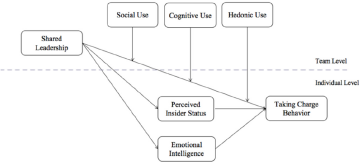
These three research objectives culminate in our theoretical model, as shown in Fig. 1.
Theoretical model.

The current paper makes three theoretical contributions to the literature. First, based on cognitive–affective system theory, we contextualized a cross-level model to shed light on the relationship between SL and TCB from a social network perspective, which can advance our understanding of how SL results in individual and team effectiveness. Second, we established dual cognitive and emotional paths to fully describe how PIS and EI mediate the link between SL and TCB. While most previous studies concentrated on a single theoretical perspective, this study selected both psychological cognition and EI into the research framework from the dual perspective of cognition and emotion. Third, by examining SMU, the IT-related contextual conditions that influence how SL appraises TCB in a cross-level model, this study answers Mcfarland and Ployhart’s (Reference Mcfarland and Ployhart2015) call for focusing on how digitization alters the way of employees’ cognition, affection, and behavior, thus enriching the social media literature by further differentiating three usage patterns of social media (SU, CU, and HU) in terms of their effects. Lastly, our study also provides suggestions for practitioners who aim to use social media to utilize members to implement TCB.
Theory and hypotheses
Cognitive–affective system theory
The cognitive–affective system theory was proposed by Mischel and Shoda (Reference Mischel and Shoda1995) in the 1990s, which suggests that the processing of original information into behavior encompasses two processes. The first process is encoding, in which the original information is interpreted and encoded within the cognitive–affective unit. The second process involves behavior generation, where interactions within the cognitive–affective units lead to the behavioral outcomes. This theory highlights that individuals’ reactions to situations are not passive or apathetic; instead, they are active, goal-oriented, and capable of planning and making changes on their own (Ali, Wang, & Boekhorst, Reference Ali, Wang and Boekhorst2021). These foundational assumptions align with the formation mechanism of TCB. Thus, the present paper considers individuals and their teams as rational and emotional entities and explores the underlying mechanism of TCB through the lens of cognition and emotion pathways.
SL and TCB
TCB is an important challenging organizational behavior, which is characterized by collaborative interactions among team members (Ali, Wang, & Boekhorst, Reference Ali, Wang and Boekhorst2021), the use of technologies such as social media has the potential to influence social dynamics, foster collaboration, and impact social interactions within the team (Morrison & Phelps, Reference Morrison and Phelps1999). TCB will bring new ideas and new changes to the organization, thus it has attracted more and more attention from theorists and practitioners (Zhang, Law, & Wang, Reference Zhang, Law and Wang2020; Kim & Liu, Reference Kim and Liu2017). As such, how to make this kind of behavior outside the work role as the behavior within the scope of work role is the focus of managers (Xu, Loi, & Chow, 2022; Li, Zhang, & Tian, Reference Li, Zhang and Tian2016). The existing studies on TCB of team members are still in infancy (Ngo, Mustafa, & Butt, Reference Ngo, Mustafa and Butt2022; Xu, Loi, & Chow, Reference Xu, Loi and Chow2023). The discussion on its causes mainly focuses on two aspects, individual factors and contextual factors (Xu, Loi, & Chow, Reference Xu, Loi and Chow2022; Zhou et al., Reference Zhou, Liu, Li, Cheng and Hu2020; Wang et al., Reference Wang, Wang, Li and Wang2020; Kim & Liu, Reference Kim and Liu2017; Cai et al., Reference Cai, Huo, Lan, Chen and Lam2018). For example, leadership-related factors such as benevolent leadership (Xu et al., Reference Xu, Zhao, Xi and Zhao2018), servant leadership (Xu, Loi, & Chow, Reference Xu, Loi and Chow2022), inclusive leadership (Wang et al., Reference Wang, Wang, Li and Wang2020), transformational leadership (Li et al., Reference Li, Dan, Kirkman and Xie2013), self-sacrificial leadership (Li, Zhang, & Tian, Reference Li, Zhang and Tian2016), and empowering leadership had been discussed (Zhang et al., Reference Zhang, Qian, Wang and Chen2020). However, less is known about the relationship between informal leadership and TCB. With the increasing emphasis on teammate cooperation and coordination in current organizations, the practice of informal leadership (e.g., SL) has increasingly become more prevalent (Wang & Peng, Reference Wang and Peng2022; Liang et al., Reference Liang, van Knippenberg and Gu2021).
The era of information technology and knowledge economy as the pivotal competitive advantage has made the nature of corporate work change (Cao & Ali, Reference Cao and Ali2018; Mcfarland & Ployhart, Reference Mcfarland and Ployhart2015). Within this context, organizational work has shifted to a team-based structure, especially focusing on self-managing teams (Lyndon, Pandey, & Navare, Reference Lyndon, Pandey and Navare2020). Leadership research has been moving toward a dynamic and complex adaptation process, hence the concept of SL came into being (Asa & Ajbr, Reference Asa and Ajbr2016; Carson, Tesluk, & Marrone, Reference Carson, Tesluk and Marrone2007). The advantage of SL is precisely that it breaks down the rigid identity boundaries of traditional formal leadership, inspires enthusiasm, and gives full play to the knowledge and ability of team members, which effectively makes up for the shortcomings of formal leadership (Liang et al., Reference Liang, van Knippenberg and Gu2021; Asa & Ajbr, Reference Asa and Ajbr2016). Research on the concept of SL can be summarized into three perspectives: process, capability, and structure. From the perspective of process, scholars suggested that SL is a dynamic interactive influence process in which team members lead each other to achieve team or organizational goals (Conger & Pearce, Reference Conger and Pearce2004; Derue & Ashford, Reference Derue and Ashford2010). According to Nicolaides et al. (Reference Nicolaides, Laport, Chen, Tomassetti, Weis, Zaccaro and Cortina2014), SL is a sequence of interactive influence processes in which team leadership is willingly shared among team members to achieve team goals. From the perspective of capability, scholars advocate that SL is a team capability formed by the mutual influence of team members (Pitelis & Wagner, Reference Pitelis and Wagner2019). Lastly, from the perspective of structure, scholars consider SL as a leadership structure attribute that spreads leadership across multiple team members. For instance, Carson, Tesluk, and Marrone (Reference Carson, Tesluk and Marrone2007) proposed that SL is a team emergent network attribute formed by the distribution of leadership influence among multiple team members. This study draws on the definition from the structural perspective and proposes that SL is an interactive relationship network in which each member interacts, coordinates, and switches between the roles of ‘leader and follower’ to attain team objectives. SL, as opposed to the typical centralized system in which only one person serves as the leader, allows them to transition between the positions of ‘leader and follower’ (Lee, Lee, Seo, & Choi, Reference Lee, Lee, Seo and Choi2015; Lyndon, Pandey, & Navare, Reference Lyndon, Pandey and Navare2020), thus bringing high autonomy, high ability perception, and mutual cooperation to them, which is conducive to individuals’ TCB (Chiu, Owens, & Tesluk, Reference Chiu, Owens and Tesluk2016; Zhang, Law, & Wang, Reference Zhang, Law and Wang2020).
Based on cognitive–affective system theory, leadership and other contextual factors improve or reduce team members’ performance through individual cognition and behavior (Mischel & Shoda, Reference Mischel and Shoda1995). We use it as a theoretical basis to better understand how SL, a contextual influencer, affects members to engage in TCB. TCB is characterized by actively confronting and changing the status quo with certain risks (Morrison & Phelps, Reference Morrison and Phelps1999). Participation in this behavior, therefore, depends on their perceptions of the safety of the work environment, and this belief depends largely on leadership style. Specifically, SL may motivate TCB among team members in two ways. First, SL, in contrast to traditional vertical leadership, promotes team members’ active and voluntary involvement in team management, taking up leadership responsibilities and finding solutions to problems (Chiu, Owens, & Tesluk, Reference Chiu, Owens and Tesluk2016; Nicolaides et al., Reference Nicolaides, Laport, Chen, Tomassetti, Weis, Zaccaro and Cortina2014). Along the way, those who assume the role of ‘leader’ take on the role of formal leadership, guide the team to achieve goals, and take a proactive approach to improve team effectiveness (Lee et al., Reference Lee, Lee, Seo and Choi2015). Meanwhile, members who take on the position of ‘follower’ will actively participate in team management in order to help the team develop (Derue & Ashford, Reference Derue and Ashford2010; Jonsson, Reference Jonsson2012). Second, SL focuses on mutual leadership, which promotes mutual trust among team members (Carson, Tesluk, & Marrone, Reference Carson, Tesluk and Marrone2007). Individuals have more confidence to try new things when they perceive a high degree of trust and support from other members, because others will accept and understand their mistakes (Dufour, Maoret, & Montani, Reference Dufour, Maoret and Montani2020). In addition, as members lead each other, they will also try to trust the ‘leader’ members, thereby motivating those leaders to engage more openly in TCB (Zhang, Law, & Wang, Reference Zhang, Law and Wang2020). Therefore, we propose the first hypothesis:
Hypothesis 1: SL is positively related to TCB.
The mediating role of PIS
TCB is characterized by actively confronting and changing the status quo with certain risks (Morrison & Phelps, Reference Morrison and Phelps1999). Participation in this behavior, therefore, depends on their perceptions of the safety of the work environment, and this belief depends largely on leadership style. According to cognitive–affective system theory, individuals are proactive and goal-oriented, taking the initiative to plan and make changes. This aligns with the formation mechanism of TCB, which views individuals and their teams as both rational and emotional entities, and the underlying mechanism of TCB is established through the cognition path. PIS refers to employees’ belief in being insiders within a specific organization (Stamper & Masterson, Reference Stamper and Masterson2002). Within the organization, leadership will have an impact on the strength of team members’ PIS. Furthermore, leadership influences the innovative behavior of team members by improving team members’ PIS (Wang & Kim, Reference Wang and Kim2013). PIS starts from the cognitive state of team members and plays a vital role in explaining the internal mechanism of members’ cognitive process under SL (Aryee & Chen, Reference Aryee and Chen2002). SL decentralizes leadership rights and obligations to team members, so that they can establish a psychological contract with the team, thus perceiving themselves as ‘insiders’ (Asa & Ajbr, Reference Asa and Ajbr2016). When team members view themselves as ‘insiders’ of the organization through self-cognition, they will generate corresponding role identities and assume their proactive behaviors (Brown, Reference Brown2020; Mustafa, Badri, & Ramos, Reference Mustafa, Badri and Ramos2022). Team members will also continuously improve themselves and strengthen their self-efficacy, thus increasing their self-cognition (Yang & Shi, Reference Yang and Shi2020).
In addition, according to the positive distinctiveness of social identity theory, individuals tend to seek out performance in groups in order to reinforce their self-concepts (Hogg, Abrams, & Brewer, Reference Hogg, Abrams and Brewer2017). SL leads to a higher sense of insider identity (Shao, Feng & Wang, Reference Shao, Feng and Wang2016). In order to reinforce this concept of identity, they contribute more actively to the team (Hogg, Abrams, & Brewer, Reference Hogg, Abrams and Brewer2017). That is, SL leads to a higher sense of insider identity, thereby exhibiting more TCBs and forming their own personal identity position (Carson, Tesluk, & Marrone, Reference Carson, Tesluk and Marrone2007; Conger & Pearce, Reference Conger and Pearce2004). Moreover, members who regard themselves as ‘insiders’ will have a more positive emotional relationship with the team, and they are more willing to contribute time and energy to fulfill job requirements (Wang & Kim, Reference Wang and Kim2013). As such, they will consciously assume the job responsibilities, accept challenging tasks, and eventually implement more TCB. Consequently, we hypothesize:
Hypothesis 2a: PIS mediates the relationship between SL and TCB.
The mediating role of EI
EI refers to an individual’s ability to regulate their own emotions and the emotions of others, as well as differentiate between different emotions. It also involves using emotional information to guide one’s thinking and actions (Mayer et al., Reference Mayer, Salovey, Caruso and Sitarenios2003; Lam & Kirby, Reference Lam and Kirby2002). Self-determination theory provides a useful framework to explain why people have different emotional states when faced with the same task activity (Deci & Ryan, Reference Deci and Ryan2000). It believes that autonomy, ability, and belonging are the three basic psychological needs of individuals, which can best satisfy the internal motivation of an individual’s work, thereby enhancing the initiative of work. Based on the above theory, we propose that, first, SL encourages individual thinking and empowers team members to thoroughly deconstruct the cognitive model, and uses a more autonomous workspace, which is conducive for team members to handle the sense of conflict (Jamshed & Majeed, Reference Jamshed and Majeed2019). Second, SL demonstrates TCB that deviates from established norms by breaking rules, constraints, and routines (Li, Zhang, & Tian, Reference Li, Zhang and Tian2016). Meanwhile, SL inspires team members to bear the responsibility, find the best solutions, and challenge the status quo (Asa & Ajbr, Reference Asa and Ajbr2016). Thereby, members enhanced their confidence and ability to work in difficult situations and acquired additional basic psychological needs ability (Hogg, Abrams, & Brewer, Reference Hogg, Abrams and Brewer2017). Under the above circumstances, the three basic psychological needs of team members are all satisfied, so that team members tend to conduct emotion cognition, emotion understanding, emotion application, and emotion management independently rather than passively, which is conducive to shaping a high level of EI (Deci & Ryan, Reference Deci and Ryan2000; Zhang et al., Reference Zhang, Qian, Wang and Chen2020).
Meanwhile, EI can effectively enhance team members’ TCB. First, EI can help team members understand their own feelings and handle them well. The tension and conflict of implementing TCB can be stressful. Thus, high EI can help team members better and faster control their emotions, muster the courage to face problems, encourage themselves to challenge obstacles, and proactively implement TCB. Second, EI can help team members better perceive others’ emotions and the surrounding environment. Team members with high EI have stronger empathy, will interact smoothly with other members in critical moments from the perspective of others and team interests, and will implement TCB that is beneficial to the team. Members with high EI do not complain about their environment and can provide help and encouragement when team members feel frustrated. Finally, EI can motivate team members to be more creative and in better shape to complete their work. This can ensure that team members are persistent and think about using more flexible solutions when encountering difficulties during the implementation of TCB and continue to adopt TCB in order to achieve the common goals of the team.
In conclusion, SL promotes the development of team members’ emotional cognition, understanding, application, and management skills, ultimately enhancing their EI (Shariq, Mukhtar, & Anwar, Reference Shariq, Mukhtar and Anwar2019). Consequently, team members gain the ability to effectively utilize emotional resources during dynamic and complex change situations. They proactively challenge the status quo, fostering a continuous inclination toward taking charge. Thus:
Hypothesis 2b: EI mediates the relationship between SL and TCB.
The moderating role of SMU
As a lightweight means of communication, team social media is not only a work platform but also a social tool for team members (Ali-Hassan, Nevo, & Wade, Reference Ali-Hassan, Nevo and Wade2015). It provides a forum for knowledge and information sharing, discussion, and co-creation (Zhou & Mou, Reference Zhou and Mou2021). SMU allows multiple members to participate in the same conversation at the same time, resulting in a network of shared understanding (Ali-Hassan, Nevo, & Wade, Reference Ali-Hassan, Nevo and Wade2015). SMU, as a prominent IT context, may instigate the effectiveness of SL in teams. Studies suggest that team members have specific goals in their choice of SMU, including seeking information and knowledge, enhancing social interaction and enjoyment needs (Quan-Haase & Young, Reference Quan-Haase and Young2010; Whiting & Williams, Reference Whiting and Williams2013). Thus, we follow Ding et al. to position SMU as a vital online context and explore its moderating effect. Existing studies have discussed the moderating impact of SMU on employee performance, creativity, job satisfaction, work–life conflict, emotional exhaustion, and psychological outcomes. However, these studies have not reached consistent conclusions. These inconsistent findings may be due to the fact that most previous studies have viewed SMU as a single-dimensional construct rather than a multidimensional construct, and the impact of different SMU purposes is not differentiated (Van Zoonen, Verhoeven, & Vliegenthart, Reference Van Zoonen, Verhoeven and Vliegenthart2017). Ali-Hassan, Nevo, and Wade (Reference Ali-Hassan, Nevo and Wade2015) described the three components that comprise SMU, namely SU, CU, and HU. Social use is related to the development of team social networks and the maintenance of team relationships; CU is related to team-sharing activities and knowledge creation; and HU refers to using social media for fun, passing time, relaxing, escaping, and entertainment (Ali-Hassan, Nevo, & Wade, Reference Ali-Hassan, Nevo and Wade2015; Papacharissi & Mendelson, Reference Papacharissi, Mendelson and Papathanassopoulos2011; Quan-Haase & Young, Reference Quan-Haase and Young2010). Therefore, we follow Ding, Liu, and Huang (Reference Ding, Liu and Huang2019) to consider SMU as an IT-related contextual factor and validate its moderator effect, which can serve as a counterweight to performance-centric research (Ali, Wang, & Boekhorst, Reference Ali, Wang and Boekhorst2021).
The moderating role of SU
The SU of social media refers to team members’ contact and interaction with other members, sharing social activities and personal information, expanding their social network, and keeping in touch with existing network members through social media (Ali-Hassan, Nevo, & Wade, Reference Ali-Hassan, Nevo and Wade2015; Papacharissi & Mendelson, Reference Papacharissi, Mendelson and Papathanassopoulos2011). The moderating effect of SU is reflected in that it provides interpersonal and emotional support for team members to implement TCB under SL.
The SU of social media provides a platform for team members to instantly share information, ideas, and resources. Smooth interaction can enhance the effectiveness of team members’ collective awareness of SL tasks, thereby encouraging team members to take proactive action to solve problems (Cao & Ali, Reference Cao and Ali2018). Based on the principle of reciprocal norms of social exchange, a higher level of SU helps team members get more support from the workplace (Goh, Ling, Huang, & Liew, Reference Goh, Ling, Huang and Liew2019), so they will have a sense of obligation to the team and give back to the team. Besides, the SU of social media encourages team members to share personal and general information (Ali, Wang, & Boekhorst, Reference Ali, Wang and Boekhorst2021) and promotes frequent interaction and informal communication among members with similar hobbies (Mcfarland & Ployhart, Reference Mcfarland and Ployhart2015), so that the team can form stronger social ties. Furthermore, under a strong level of SU, SL can better promote communication and collaboration among team members, and this real-time collaboration helps reduce misunderstandings and provide good interpersonal support for team members to implement TCB (Ali-Hassan, Nevo, & Wade, Reference Ali-Hassan, Nevo and Wade2015; Quan-Haase & Young, Reference Quan-Haase and Young2010). Therefore:
Hypothesis 3a: The SU of SMU moderates the relationship between SL and TCB. Specifically, the relationship is stronger when SU is higher.
The moderating role of CU
The CU of social media provides information and knowledge support for team members to implement TCB under SL (Papacharissi & Mendelson, Reference Papacharissi, Mendelson and Papathanassopoulos2011). Social interaction of personal information promote the sharing of information and knowledge within the team, which will help SL to communicate change goals, visions, and strategies, and promotes understanding and engagement among team members (Ali, Wang, & Boekhorst, Reference Ali, Wang and Boekhorst2021; Ali-Hassan, Nevo, & Wade, Reference Ali-Hassan, Nevo and Wade2015). Thus, team members can obtain information support related to the implementation of TCB. The CU gives a platform for team members to simply and effectively communicate with each other, which will enhance the effect of SL and improve team members’ common perception of SL tasks. Team members who know each other well are more likely to share specialized knowledge and expertise than those who do not (Zhou & Mou, Reference Zhou and Mou2021). Therefore, CU can help team members carry out collaborative knowledge retrieval, sharing, and creation, and help them better understand existing information and knowledge, in order to strengthen the effectiveness of SL and thus build on it to create and change.
Besides, from the view of knowledge complementarity, SL gives team members the ‘leader’ role to encourage them to share information and knowledge (Ali-Hassan, Nevo, & Wade, Reference Ali-Hassan, Nevo and Wade2015). In conjunction with that, CU establishes an instrumental link for knowledge integration, promotes the positioning and mutual understanding of team members’ knowledge, and reduces conflicts and misunderstandings in the process of SL (Sinha, Chiu, & Srinivas, Reference Sinha, Chiu and Srinivas2021). Under a high level of CU, SL will help team members generate more knowledge-sharing behaviors, thus enhancing team members’ cognitive awareness of work situations and cognitive trust in each other, as well as strengthening team members’ transformation and knowledge-creation behaviors (Lyndon, Pandey, & Navare, Reference Lyndon, Pandey and Navare2020). Then the following hypothesis is put forward:
Hypothesis 3b: The CU of SMU moderates the relationship between SL and TCB. Specifically, the relationship is stronger when CU is higher.
The moderating role of HU
The HU of social media is the social network-based entertainment use of team members, which refers to using social media for fun, passing time, relaxing, escaping, and entertainment (Ali-Hassan, Nevo, & Wade, Reference Ali-Hassan, Nevo and Wade2015). Thus, HU can be a problem when team members experience the fun of performing habitual reward behaviors (Ali-Hassan, Nevo, & Wade, Reference Ali-Hassan, Nevo and Wade2015; Lai & Chong, Reference Lai and Chong2021).
High-level HU will weaken the impact of SL on TCB. That is, for one thing, SL within high-level HU settings leads team members to reduce the working time to complete tasks, thus reducing the work input of assuming the role of ‘leader’ or ‘follower’, which weakens the effectiveness of SL, and thus resulting in the reduction of TCB (Luqman, Cao, Ali, Masood, & Yu, Reference Luqman, Cao, Ali, Masood and Yu2017). In such circumstances, team members may acquire a persistent urge to undervalue long-term risk, overemphasize short-term pleasure, and reduce TCB (Lai & Chong, Reference Lai and Chong2021; Luqman et al., Reference Luqman, Cao, Ali, Masood and Yu2017). For another, SL within high-level HU settings can lead to team member distraction and work interruptions. This effect is particularly significant in knowledge-intensive teams, where even minimal levels of distraction can cause individuals to lose focus on their work, resulting in reduced innovation investment and shifts in their roles as ‘leaders’ or ‘followers’. Consequently, the implementation of TCB is diminished (Ali, Wang, & Boekhorst, Reference Ali, Wang and Boekhorst2021). Then the following hypothesis is put forward:
Hypothesis 3c: The HU of SMU moderates the relationship between SL and TCB. Specifically, the relationship is weaker when HU is higher.
Method
Participants and procedure
We adopted a team-member matching questionnaire. First, we utilized alumni resources to identify 60 companies operating in a team-based structure across various industries, such as finance, electronics, Internet, services, and manufacturing. Each company formed a self-managing work team consisting of 4–10 members who were responsible for coordinating their task plans. Before formal research, the semi-structured online interviews were conducted with a team representative to gain further insights of their leadership styles and the SMU within the team. In order to ensure the correct matching of the team, we sent a specific questionnaire link belonging to this team to the representative of each team, and then he/she sent this link to other members of his/her team.
After confirming the SL structure and social media usage of the samples, we proceeded to collect a three-wave dataset. In the first wave (T1), demographic variables such as gender, age, educational background, team experience, SL, and social media usage were recorded by team members. The questionnaires were sent to 60 teams in the first wave, resulting in an effective collection of responses from 51 teams. Each valid questionnaire was assigned a number for ease of reference in the second wave. One month later, in the second wave (T2), the previous respondents were contacted and requested to report their input on PIS and EI. Again, we collected valid questionnaires from the same 51 teams. Following a 1-month gap, the third wave (T3) involved sending questionnaires to teams from the first two waves, with 47 teams ultimately submitting their responses on TCB. After removing invalid questionnaires with incomplete or irregular answers, the final effective data consisted of 40 teams and 258 individual members. With the help of alumni, we ensured a 90% response rate for each team because a high response is recommended to conduct network analysis that we use to measure SL (Stanley, Reference Stanley and Katherine1994), thus meeting the needs of calculating network analysis. The average team size in the sample was 6.45. Among the participants, 50.39% were male, 38.76% held a bachelor’s degree, 20.93% held a master’s degree, and 21.32% held a PhD degree.
Measures
The variables measured include SL, PIS, EI, TCB, and SMU. The scales were translated from English into Chinese through Brislin’s (Reference Brislin, Lonner and Berry1986) translation approach. All variables were measured with a 7-point Likert scale (ranging from 1 = strongly disagree to 7 = strongly agree).
SL
To quantify SL among each team, we employ a social network approach established by Mathieu, Kukenberger, D’Innocenzo, and Reilly (Reference Mathieu, Kukenberger, D’Innocenzo and Reilly2015). According to their claim, a greater density is associated with increased SL. To assess this, we requested each team member to rate their teammates on a 7-point Likert scale using a single-item question: ‘To what extent does your team depend on this individual for leadership?’ We then summed up all the ratings and divided them by the total potential number of connections among team members. Equation (1) demonstrates the calculation method for determining the density of SL:
 \begin{equation}Density = \frac{S}{N}\left( {N - 1} \right)\end{equation}
where S represents the sum of all leadership ratings given by team members, N denotes the total number of team members, and N(N − 1) indicates the total number of potential ties within the team.
PIS
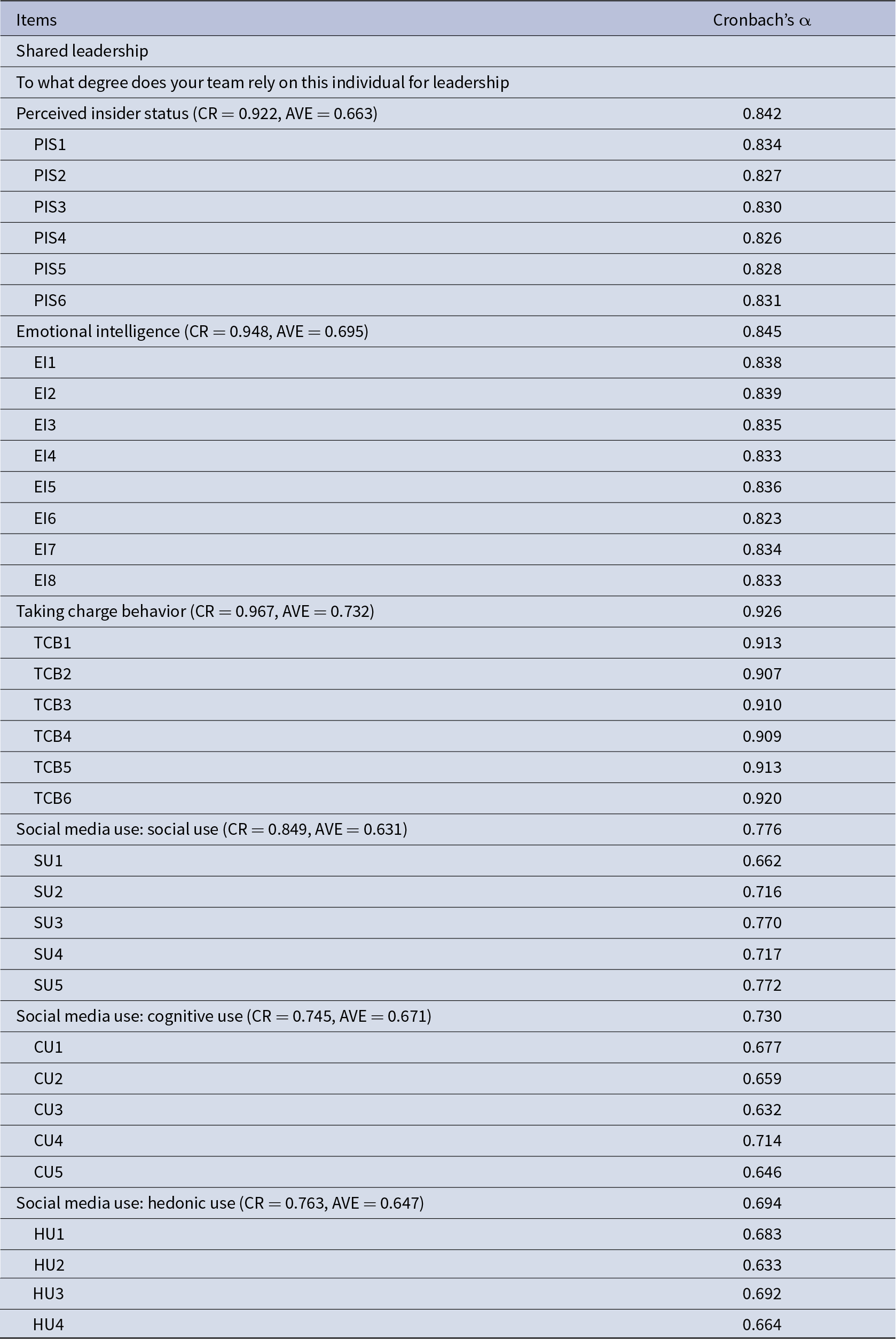
We used six items developed by Stamper and Masterson (Reference Stamper and Masterson2002) to measure PIS, including ‘I feel strongly that I am part of the team’, ‘My team makes me believe that I belong to this team’, ‘I feel that within my team, I am an “outsider”’. Among these, the third, fourth, and sixth questions are reverse scoring questions, and we used SPSS 22.0 to process them and adopt forward scoring. The Cronbach’s α was 0.842 (see Table 1).
Reliability and validity analysis

Note. PIS = perceived insider status; EI = emotional intelligence; TCB = taking charge behavior; SU = social use; CU = cognitive use; HU = hedonic use; SMU = social media use; CR = Composite Reliability; AVE = Average Variance Extracted.
EI
To assess the EI of team members, we utilized Goleman and Boyatzis’s (Reference Goleman and Boyatzis2008) scale, which consists of eight items. These items include statements such as ‘I possess a strong awareness of my own emotions’ and ‘I am adept at discerning others’ emotions through their actions’. The Cronbach’s α of the scale in this study was 0.845 (see Table 1).
TCB
We used six items with the highest loading from Morrison and Phelps’ scale (Reference Morrison and Phelps1999), and the sample items are ‘I often try to institute new work methods that are more effective’ and ‘I often try to bring about improved procedures for the team’. The Cronbach’s α of the scale in this study was 0.926 (see Table 1).
SMU
The SMU measurement scale utilized in this study was adopted by Ali-Hassan, Nevo, and Wade (Reference Ali-Hassan, Nevo and Wade2015). This scale consists of three dimensions: SU, CU, and HU, encompassing a total of 14 measurement items. Social use was measured by five items; CU was measured by five items; and HU was measured by four items (see Table 1).
Control variables
In line with prior studies, we employed individual-level controls, including gender, age, and educational background, as well as team-level controls, such as team size and time of establishment.
Results
Data aggregation
To justify the aggregate of individual answers to team-level constructs, the within-group agreement and between-group variability were investigated. SL and SMU are team-level variables, but these two variables were rated by individual members; therefore, we justified aggregation to the team level by calculating the values of R wg, ICC(1), which stands for reliability of score within group, and ICC(2), which stands for reliability of mean group score. The results provided aggregation for SU of SMU (R wg = 0.872, ICC(1) = 0.241, and ICC(2) = 0.879), for CU of SMU (R wg = 0.881, ICC(1) = 0.276, and ICC(2) = 0.714), and for HU of SMU (R wg = 0.810, ICC(1) = 0.144, and ICC(2) = 0.775). The mean values of R wg were all greater than 0.7, indicating that the variables had high intra-group consistency. The mean values of ICC(1) were greater than the critical value of 0.12, and the mean values of ICC(2) were greater than the critical value of 0.5, indicating that the variables have high inter-group variability, which supported the aggregation of individual team member responses to generate a team-level measure (Glick, Reference Glick1985; Schneider, White, & Paul, Reference Schneider, White and Paul1998).
Measurement model
In order to evaluate and confirm each variable’s convergent and discriminant validity, we conducted the confirmatory factor analysis via MPLUS. From the results of Table 2, the expected seven-factor model (including SL, PIS, EI, SU, CU, HU, and TCB) was acceptable and better fitted the data set than other models. In this model, CFI is slightly less than the critical value of 0.90, which may be due to the small sample size at the population level. Besides, we calculated the AVE and CR values of seven variables to examine convergent validity. The AVE values were all greater than 0.6, and the CR values were all greater than 0.7. The square roots of these seven variables’ AVE values were all greater than their correlation coefficients, showing strong discrimination validity.
The result of confirmatory factor analysis

Note. Model A: full measurement model. Model B: PIS and EI load on one factor. Model C: PIS and EI load on one factor; SU, CU, and HU load on another factor; and other constructs represent separate factors. Model D: all items load on one factor.
PIS = perceived insider status; EI = emotional intelligence; SU = social use; CU = cognitive use; HU = hedonic use; CFI = comparative fit index; RMSEA = root mean square error of approximation; TLI = Tucker-Lewis index; SRMR = standardized residual mean root.
Common method bias
There was a possibility of common method bias because all of the measures we used were self-reported (Podsakoff, Mackenzie, Lee, & Podsakoff, Reference Podsakoff, Mackenzie, Lee and Podsakoff2003). Therefore, we used Harman’s single-factor test to check for possible common method bias. The test findings showed that the first component in the EFA only explained 30.11% (<40%) loading, proving the absence of common method bias. Besides, a multilevel CFA was performed. The analysis revealed (χ2 = 609.60, df = 441, RMSEA = 0.078, CFI = 0.896, TLI = 0.911, SRMR = 0.039) a reasonable fit to the data. These results validate the empirical distinctiveness of the variables. In addition, the poor fit of the single-factor model limited the possibility of common method variance (Table 2). Thus, the results indicated that the common method bias was unlikely to threaten our study (Podsakoff et al., Reference Podsakoff, Mackenzie, Lee and Podsakoff2003).
Descriptive statistics
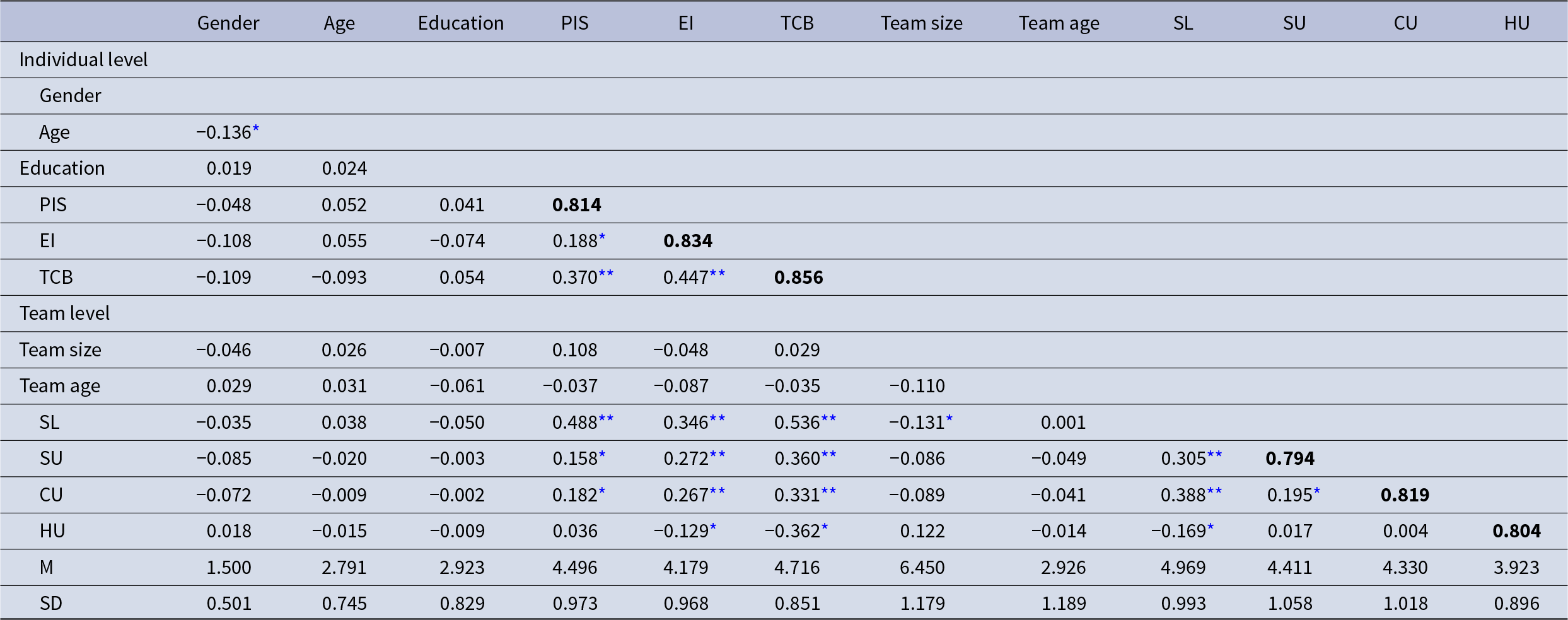
In Table 3, as we expected, SL is positively associated with PIS, EI, and TCB; PIS and EI are positively associated with TCB; SU and CU are positively associated with TCB; HU is negatively associated with TCB, which provides initial support for our hypothesized relationships.
Means, standard deviations, and correlations among variables

Note. The square root of AVE of each variable is shown in bold along the diagonal. SL = shared leadership; PIS = perceived insider status; EI = emotional intelligence; TCB = taking charge behavior; SU = social use; CU = cognitive use; HU = hedonic use.
* p < .05, **p < .01.
Hypotheses testing
MPLUS version 8.0 was used to test the cross-level hypotheses. As depicted in Table 4, results show that after including all of the control variables, there is a significant positive relationship between SL and TCB (supporting H1). To assess the mediating effects of PIS and EI, bootstrap analysis was employed with 5,000 Monte Carlo replications. The results demonstrated that the indirect effects of SL on TCB through PIS and EI were statistically significant. Specifically, the 95% confidence intervals, as displayed in Table 5, were [0.026, 0.142] and [0.048, 0.157], both of which excluded zero. Consequently, this supports the validity of Hypotheses 2a and 2b.
Results of regression analyses

Note. SL = shared leadership; PIS = perceived insider status; EI = emotional intelligence; TCB = taking charge behavior; SU = social use; CU = cognitive use; HU = hedonic use.
* p < .05, **p < .01, ***p < .001; t statistics are in parentheses; the values are standard errors.
Results of mediation of PIS and EI in the relationship between SL and TCB

SL = shared leadership; PIS = perceived insider status; EI = emotional intelligence; TCB = taking charge behavior.
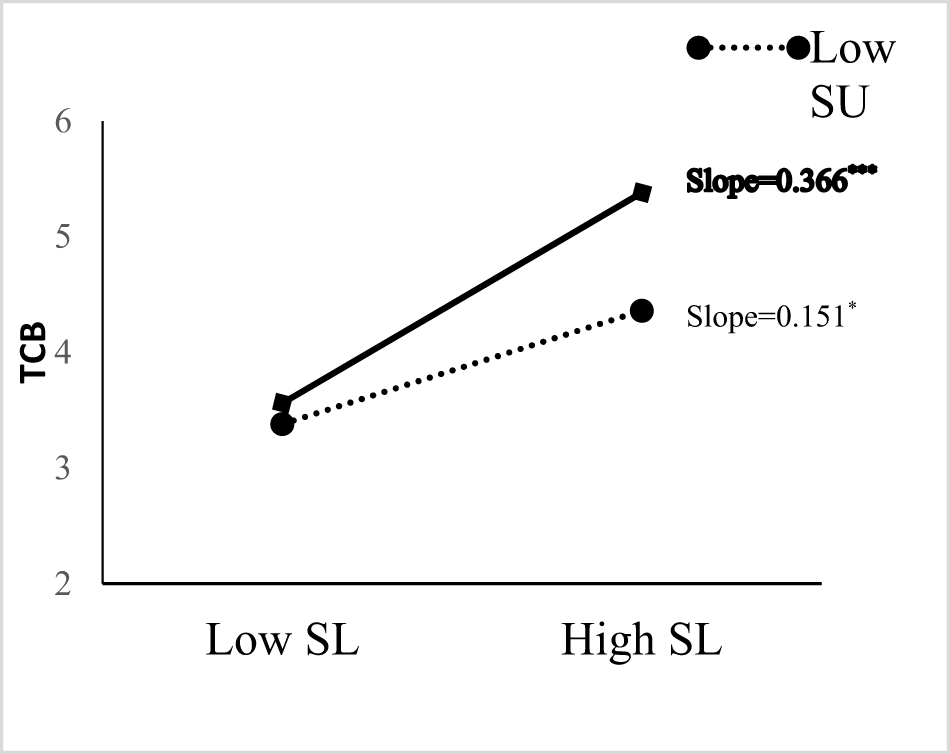
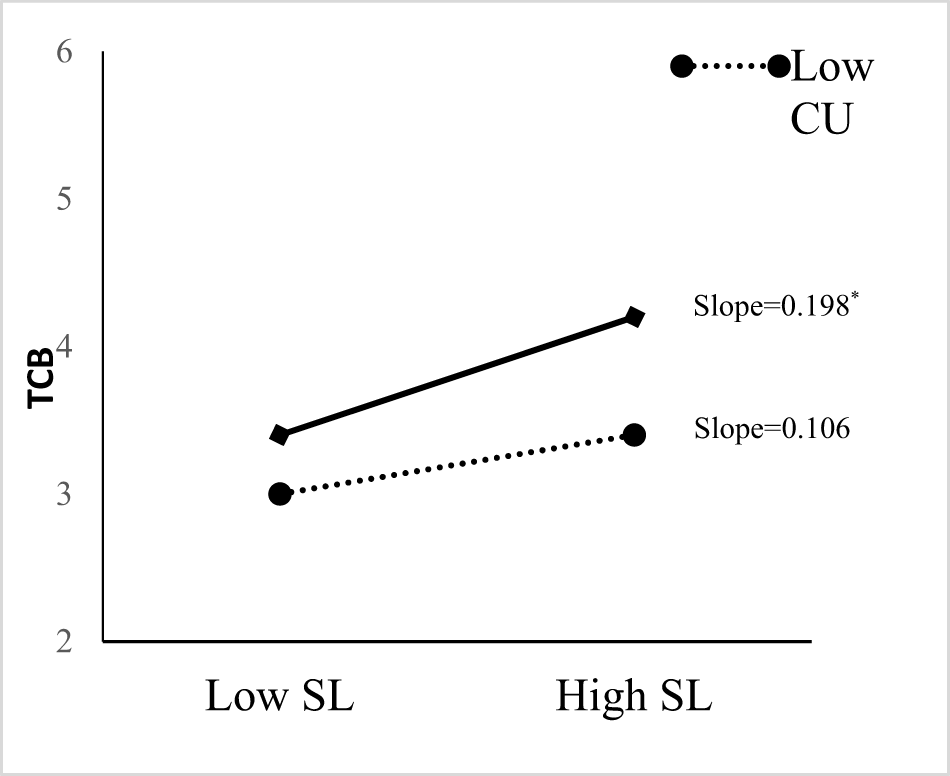
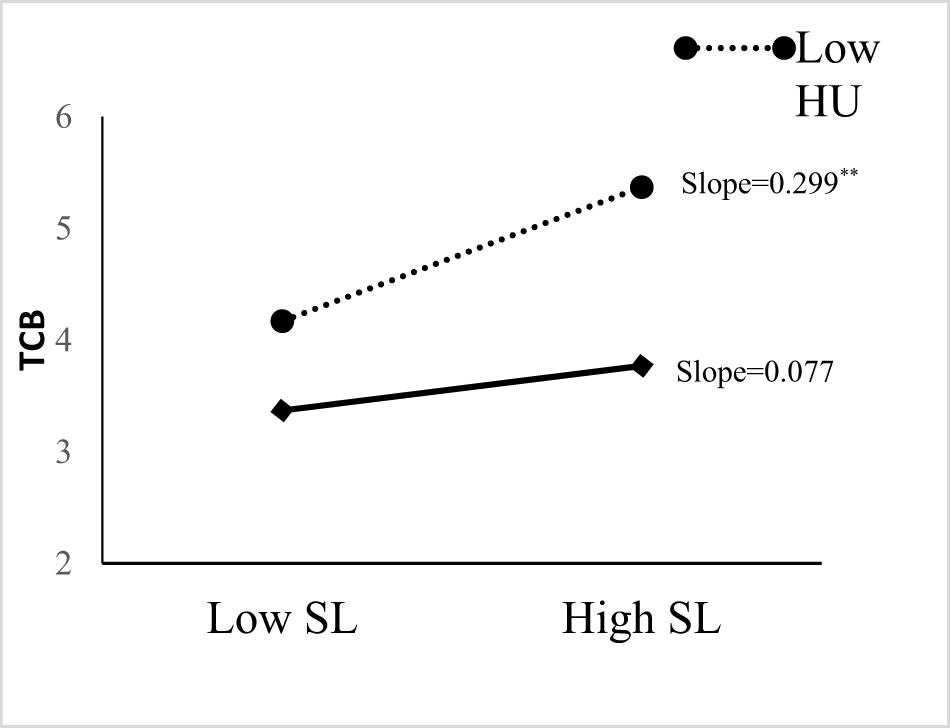
Hypotheses 3a, 3b, and 3c examine the cross-level moderating effects of SU, CU, and HU. Following the approach proposed by Aiken and West (Reference Aiken and West1991), as displayed in Table 4, after controlling for all relevant variables, we found significant interaction effects. Specifically, the interaction between SL and SU on TCB was significant (Model 2: γ = 0.211, p < .001), as was the interaction between SL and CU on TCB (Model 3: γ = 0.186, p < .05), and the interaction between SL and HU on TCB (Model 4: γ = −0.287, p < .001). These findings provide support for Hypotheses 3a, 3b, and 3c.
To further elucidate the moderating effects of SU, CU, and HU, we conducted a simple effect analysis, following the guidelines outlined by Aiken and West (Reference Aiken and West1991). We divided the sample into high and low groups based on one standard deviation above or below the mean values of SU, CU, and HU. The resulting figures (Figs. 2–4) illustrate the differences in the relationship between SL and TCB across varying levels of SU, CU, and HU. Notably, Fig. 2 demonstrates that a higher level of SU strengthens the positive relationship between SL and TCB. Similarly, Fig. 3 shows that a higher level of CU enhances the positive relationship between SL and TCB. Conversely, Fig. 4 reveals that a higher level of HU weakens the positive relationship between SL and TCB.
The moderating role of SU on the relationship between SL and TCB.

The moderating role of CU on the relationship between SL and TCB.

The moderating role of HU on the relationship between SL and TCB.

Robustness test
In this study, the parameters generated by MPLUS program were used to test the robustness of the mediating effect of PIS and EI and the cross-level moderating effect of SU, CU, and HU. The parameter self-help method was used to set sampling for 5,000 times, and the 95% confidence interval did not include 0, indicating that the results were significant and the hypotheses were further verified.
Discussion
Our study sought to examine the effect of SL on TCB. Positive association of SL and TCB and mediation of PIS and EI provide an answer to the research questions being addressed by this study. In addition, we differentiated three usage patterns of social media in terms of their moderating effects of SL on TCB.
Drawing on cognitive–affective system theory, the current study found that PIS and EI mediate the positive relationship between SL and TCB. While previous studies about the influencing mechanism of SL on TCB mostly focused on a single theoretical perspective, we proposed and examined the mediating roles of PIS and EI from the dual perspective of cognition and emotion. For the cognitive path, results show that PIS mediates the relationship between SL and TCB. For the affective path, we found that EI mediates the relationship between SL and TCB. In terms of the cognitive path, PIS plays a pivotal role in the internal mechanism governing individuals’ cognitive processes under SL. By establishing a psychological contract with the team, team members perceive themselves as integral ‘insiders’ (Asa & Ajbr, Reference Asa and Ajbr2016), thereby fostering their engagement in TCB. In terms of the affective path, we found that EI acts as a mediator in the relationship between SL and TCB. SL effectively stimulates team members to transcend existing norms and satisfy their psychological needs, thereby enhancing their confidence and ability to navigate challenging situations.
This study further validated the moderating effect of SMU on the relationship between SL and TCB. Integrating SMU as a contingency factor under which SL may better relate to TCB, this study is among the first to investigate SL and TCB by examining social and technological factors. Given the nature of SL that develops through social interactions (Ali, Wang, & Boekhorst, Reference Ali, Wang and Boekhorst2021), the adoption of technologies like social media might affect social interactions among team members (D’Innocenzo, Kukenberger, Farro, & Griffith, Reference D’Innocenzo, Kukenberger, Farro and Griffith2021). Thus, we followed Ding, Liu, and Huang (Reference Ding, Liu and Huang2019) to position SMU as an online context and respond to Ali, Wang, and Boekhorst’s (Reference Ali, Wang and Boekhorst2021) call to distinguish the social media usage patterns of SMU. Specifically, we found that SU and CU play a positive moderating role by providing interpersonal and emotional support, information, and knowledge support for team members to engage in TCB. The findings of this study show evidence of how SU of SMU can help promote SL in teams by increasing the efficiency of team members’ interactions. Besides, we found that CU can help improve the common perception of team members on SL tasks, thus amplify the impact of SL on TCB. Conversely, this study found that the use of social media for HU had a negative moderating effect between SL and TCB; thus, the relationship is weaker when HU is higher. While HU can lead to happiness and satisfaction in the short term, research shows that HU can lead to more social isolation and distraction for team members (Ali-Hassan, Nevo, & Wade, Reference Ali-Hassan, Nevo and Wade2015). In SL teams, it is necessary for team members to form a strong social connection and network, but high HU will cause individuals to feel lonely and disconnected from others in the team, ignoring important tasks and activities of the team, thus weakening the impact of SL on TCB. Our findings are in line with Lim (Reference Lim2018), who claim that information technology facilitates awareness, which has a variety of implications for leadership. Besides, any excessive or insufficient consideration of SMU might result in vigorous disagreement (Ali, Wang, & Boekhorst, Reference Ali, Wang and Boekhorst2021; Wang et al., Reference Wang, Wang, Li and Wang2020).
Theoretical contributions
First, this study provides a novel lens for investigating the multilevel impacts of SL on TCB. Although existing studies have discussed the effect of formal vertical leadership on TCB, the role of informal leadership in a team is rarely addressed. Principally, this study enriches the theoretical perspective of leadership style to motivate employee TCB. A multilevel investigation by Zhang et al. (Reference Zhang, Qian, Wang and Chen2020) found that such an informal control system within a team also plays an important role in stimulating individual performance, thus the current study shed light on the relationship between SL and TCB from a social network perspective, which can advance our understanding of how SL results in individual and team effectiveness (Li, Zhang, & Tian, Reference Li, Zhang and Tian2016; Zhang et al., Reference Zhang, Qian, Wang and Chen2020).
Second, this study aims to examine the effectiveness of SL by adopting a cognitive–affective dual perspective, which overcomes the limitations of previous research conducted solely from a single perspective (Xu, Ghahremani, Lemoine, & Tesluk, Reference Xu, Ghahremani, Lemoine and Tesluk2022; Zhang, Law, & Wang, Reference Zhang, Law and Wang2020; Kim & Liu, Reference Kim and Liu2017; Li, Zhang, & Tian, Reference Li, Zhang and Tian2016; Derue & Ashford, Reference Derue and Ashford2010). To understand the formation mechanism of TCB, we establish two paths: cognition and affection (Ali, Wang, & Khan, Reference Ali, Wang and Khan2018; Yuan & Knippenberg, Reference Yuan and Knippenberg2022). By drawing on the cognitive–affective system theory, this study integrates PIS and EI to further explore the mediating mechanism of SL’s impact on TCB through these dual paths. This expands our understanding of how SL promotes TCB and provides a novel theoretical perspective on the influence of leadership structure on individual behaviors.
Third, this study examines how SMU influences the relationship between SL and TCB and provides important support for the differentiated view of SMU. Our study found that the moderating effect of SMU on the relationship between SL and TCB varied for the different purposes of use and explained the reasons for the inconsistent conclusions of previous studies. Our findings show that SU and CU positively moderate the relationship of SL with TCB. In contrast, HU negatively moderates the relationship of SL with TCB. Is the HU of SMU in the workplace good or bad? Scholars have given mixed results (Ali, Wang, & Boekhorst, Reference Ali, Wang and Boekhorst2021; Ali-Hassan, Nevo, & Wade, Reference Ali-Hassan, Nevo and Wade2015). This study provides evidence that the association between SL and TCB is weaker when team members adopt more social media for fun, passing time, relaxing, escaping, and entertainment (Ali-Hassan, Nevo, & Wade, Reference Ali-Hassan, Nevo and Wade2015). Any excessive or insufficient consideration of SMU might result in vigorous disagreement (Ali, Wang, & Boekhorst, Reference Ali, Wang and Boekhorst2021; Wang et al., Reference Wang, Wang, Li and Wang2020).
Practical contributions
First, organizations can conduct SL training, which integrates leadership training in tandem with team development interventions to facilitate and encourage SL. In training, organizations can explain the benefits of SL to team members. Our study demonstrates that SL has a significant positive effect on TCB. Combined with the research of D’Innocenzo et al. (Reference D’Innocenzo, Kukenberger, Farro and Griffith2021), we highlight the importance of each team process and the SL function required to execute the process. Using the structure of SL within the team can give members more autonomy, fully mobilize their enthusiasm, and stimulate the behavior practice of members’ active creation and taking charge, which is conducive to improving performance (D’Innocenzo et al., Reference D’Innocenzo, Kukenberger, Farro and Griffith2021). Enterprises can implement SL within the team according to the actual situation of the team. SL is made up of shared leaders and shared followers. Thus, through training, team members learn how to use each member’s leadership to adapt to the different needs of the team process (Asa & Ajbr, Reference Asa and Ajbr2016).
Second, the crucial point of SL in fostering team members’ TCB lies in grasping team members’ cognitive and emotional patterns. To effectively motivate team members through SL, it is crucial to have a comprehensive understanding of how their psychological patterns interact with SL structures. This involves shaping the intricate cognitive patterns of team members to optimize the efficacy of SL practices. Moreover, cultivating a heightened level of EI among team members equips them with the capacity to navigate risks and uncertainties in the innovation process with optimism and resilience.
Third, enterprises should be cautious about SMU by the team and distinguish the uses of different purposes (Ali, Wang, & Boekhorst, Reference Ali, Wang and Boekhorst2021). SMU makes it simpler to connect and communicate with team members, share ideas, and receive feedback, which is claimed to boost the information flow. Using a social platform to do so highlights team members’ abilities and expertise, making them more likely to display TCB. However, in this paper, we found that different dimensions of SMU have significantly different effects on team members’ TCB under SL. Therefore, enterprises should create a more reasonable SMU manual in the team workplace, which needs to combine with the characteristics of tasks and team members, and implementing SMU in a formalized form, i.e., social media governance could assist team members in reducing negative work.
Limitations and future research
Although our contributions are significant, several limitations should also be noted. First is the utilization of a survey method in our study. The questionnaire data obtained in this study are self-reported. Such a design may introduce common method bias, as participants might engage in hypothesis guessing when completing the questionnaire (Podsakoff et al., Reference Podsakoff, Mackenzie, Lee and Podsakoff2003). We suggest that future research should collect the data of various research variables from the employees themselves or workmates, in an effort to further minimize the problem of common method bias (Podsakoff et al., Reference Podsakoff, Mackenzie, Lee and Podsakoff2003).
Second, in our study, SMU is presented as moderating the direct effect of SL on TCB, without consideration of whether it influences the mediated paths. First, due to the immediacy and real-time feedback characteristics of SMU, social media platforms provide instant information transmission and interaction capabilities, enabling team members to quickly access and share content. This immediacy and real-time feedback features a more direct impact on behavior. Therefore, when team members use social media for SU, CU, and HU, they can take immediate action, usually without the need for complex cognitive and affective processing. Second, while SMU can convey information, trigger thinking, and elicit emotional responses, SMU is more focused on superficial content and emotion. When the level of SMU is high, team members are involved in real time, and this direct communication of information allows team members to take direct action quickly.
Third, another consideration is the limited size and scope of the sample, which focuses solely on China. This raises doubts about the generalizability of the paper’s conclusions to other cultural contexts. Therefore, expanding the sample size and including participants from diverse cultural backgrounds would enhance the external validity of the study, enabling a more comprehensive understanding of our conclusion under investigation.
Lastly, although our research demonstrated the effectiveness of SL in influencing TCB, we did not examine the individual and joint impacts of hierarchical leadership and SL (Gu, Chen, Huang, Liu, & Huang, Reference Gu, Chen, Huang, Liu and Huang2016). Therefore, future studies investigating the combined influence of these two unique leadership styles will make further advancements in the field of SL research.
Author Contributions
Dixuan Zhang and Xiaohong Wang are co-first authors of the article.
Dixuan Zhang: 1993, female, Jiamusi, Heilongjiang, PhD candidate at the School of Economics and Management, Harbin Institute of Technology. Her research interests include innovation and entrepreneurship management. Email: 20b910048@stu.hit.edu.cn. Address: Harbin, Heilongjiang 150001, China.
Xiaohong Wang: 1968, female, Harbin, Heilongjiang, PhD, professor at the School of Economics and Management, Harbin Institute of Technology, and also doctoral supervisor. Her research interests include performance evaluation and knowledge management. Email: hitwangxh@163.com; Fax: 0451-87656943. Address: No. 92, Xidazhi Street, Nangang, Harbin, Heilongjiang 150001, China.
Shaopeng Zhang: 1994, male, Xingtai, Hebei, PhD, associate professor at the School of Economics and Management, Northeast Forestry University, Harbin, China. His research interests include university–industry cooperation and knowledge management. Email: 13251610878@163.com. Address: Harbin, Heilongjiang 150001, China.