“They have some special powers, like springs on their shoes, to make them jump high and climb into houses from the upstairs.” He went on, dropping his voice down to a conspiratorial whisper: “I have heard that it is the Chinese that are behind it. The president is dying and he doesn't trust the Western doctors. So he has gone to the Chinese. Their doctors are asking for a special medicine made from the blood of virgins and they got a special military group trained to get this. That is why they only scratch the women, and don't rape. They want to get the blood from them and take it back.”
Later that night, on August 25, 2011, the same man telephoned me to say that there was an attack going on right then by the “grease man” in his own neighborhood near the railway station in Batticaloa, a town in eastern Sri Lanka. Shortly after 10:00 p.m., a police van had been seen driving past slowly, and had stopped to let someone out. Suddenly, there was a power cut and a few minutes later, the whole neighborhood awoke to the sound of a woman screaming in terror. It was from a house two down from his own, occupied by three women. After the power cut, one of the women saw the silhouette of a man outside her first-floor bedroom window, and heard him rattling the bars.
In response to the alarm, neighbors rushed to the house to find out what happened, but were too late to catch the culprit. An impromptu posse of young men armed with flashlights, sticks, and cricket bats assembled to patrol the area and hunt out the assailant. In the course of the telephone conversation during which this was being narrated to me, about an hour after the incident, the police arrived, and ordered the neighborhood vigilantes to go home.
The anecdote recounted above from fieldwork in Batticaloa occurred during an extraordinary episode of mass tension and anxiety in Sri Lanka over attacks on women by a mystery male predator known as the “grease devil.” Reports of widespread attacks on women by this shadowy, ubiquitous, powerful, and vaguely supernatural being led to heightened levels of vigilance and fear across rural and peri-urban Sri Lanka for several months in the third quarter of 2011.
The impact of the grease devil anxiety was felt particularly acutely in areas occupied by Sri Lanka's ethnic minorities—the central provinces and the formerly war-torn northeast, where it reached crisis proportions for the period of about five weeks from August 8 to September 10, 2011. During this period, there were hundreds of daily sightings and attacks reported and a palpable sense of fear, tension, and anger. It led to violent confrontations between affected communities and the police and military, who were widely held to be both unresponsive and complicit.
The onset of the grease devil crisis in the northeast must also be seen in the context of the recent end of the thirty-year-long civil war, the festering and unresolved ethnic conflict, the continuing deep alienation of the Tamil population from the Sri Lankan state and the ruling government of President Mahinda Rajapaksa, and the long-standing day-to-day tensions in the northeast between the overwhelmingly Sinhalese military forces and the Tamil-speaking civilian population.
This paper attempts a two-fold task of reconstructing the sequence of events as they unfolded during the crisis period, and evaluating how they can be analyzed, interpreted, and understood. It draws upon fieldwork conducted serendipitously in Batticaloa, Sri Lanka, during the grease devil crisis in August 2011, and also during previous (December 2010) and subsequent (August 2012) periods. In addition, it also draws extensively upon English, Tamil, and Sinhala newspaper coverage of the incidents.
In interpreting the crisis, this paper engages with three nested questions and discusses their consequences: (1) What happened? (2) Who was responsible? (3) What does it reveal? The first question relates to the very simple and simplistic quest for the “truth,” and explores the available primary evidence on whether the grease devil was real or imagined. The second question explores the possible instrumentalities and the way that different actors attached a variety of different rationalizations to these events. The third question explores the grease devil as a metaphor, and considers three different ways in which this episode could be said to have revealed some deeper condition: unhealed trauma relived, structural violence enacted, and hegemony undone. In doing so, it draws upon and engages with a variety of different strands of literature across anthropology, sociology, social history, comparative religion, psychology, and political science that investigate mass hysteria, witchcraft, magic, rumors, demonology, and ethnic conflict.
Crisis
The grease devil, variously referred to also as grease man, grease yakka, grease monster, grease demon, grease boothaya, grease peyi, or grease pootham, is a shadowy and ambiguous figure who inhabits the cosmos of rural and small-town Sri Lanka. Much has been written about demons; spirits; and malign, powerful, paranormal beings in the Sinhalese village, but the grease devil appears to be an innovation of uncertain provenance. There is no mention of the grease devil in any of the studies and compendia of Sinhalese demonology during the nineteenth or twentieth centuries, and the very use of the English word “grease” as a prefix suggests that it does not belong to the precolonial period. There is also much uncertainty and confusion about the exact nature of the grease devil's powers and its relationship to the more familiar demons that animate the historical and ethnographic literature, such as the terrible Maha Sona (Barnett Reference Barnett1916; Gooneratne [1865] Reference Gooneratne1998; Kapferer Reference Kapferer1991; Obeyesekere Reference Obeyesekere1970; Scott Reference Scott1994; Wirz Reference Wirz1954; Yalman Reference Yalman1964).
While there is widespread recognition and belief in the grease devil, as was evident from the events described below, there is also widespread disbelief and cynicism about its magical nature. This disbelief is strongest in urban, middle-class Sri Lanka, where, as the work of Gananath Obeyesekere, Richard Gombrich, Martin Southwold, and Michael Ames have described, the “little traditions” of magical animism, folk religion, and village demons have long been viewed with condescension and disdain.
But widespread disbelief in the grease devil prevails even in the rural and small-town milieu where belief in it is the highest.Footnote 1 In that context, the grease devil is widely known as the identity and disguise adopted by burglars who preemptively smear their bodies with grease in order to escape capture. The figure of the grease devil is also associated with the antics of adolescent males after dark, either in trying to frighten people, or, more frequently, as an opportunistic disguise adopted by voyeurs while prying into women's homes.
In other words, the grease devil is a figure of some ambiguity: it is held to be deeply rooted in tradition, but upon closer inspection is of recent origin. There is widespread belief in its magical and demonic powers, but also equally widespread disbelief. The ambiguity and fluid coexistence of a diverse range of understandings of the grease devil play an important role in understanding and attaching meaning to the events that followed.
The grease devil crisis arose in mid-2011, in the context of a series of unsolved murders that happened in the largely Sinhalese town of Kahawatte in the central district of Ratnapura. Seven elderly women had been found murdered over the time-span of a few months in that town, and the increasingly hyperbolic newspaper, television, and radio coverage of those crimes radiated fear and tension well beyond the local villages and into the national arena.
In July 2011, the police finally announced the arrest of two suspects. Paradoxically, the news of those arrests served not to diminish tensions, but rather to escalate them. The recapitulation and replaying of the news and circumstances of the crimes served to broaden the national consciousness of the macabre nature of the murders, leading to a wave of anxiety about the safety of women. These fears appear to have become connected and fused at some point with the preexisting figure of the grease devil, so that rumors circulating in the countryside increasingly identified the problem as something more terrifying than just a serial killer, but as part of a larger, more demonically connected project of violence and bloodshed.
Partly in response to these growing fears, the police announced the arrest of seven youths from the Kandy area on August 2. The news report goes on to explain: “Police said these youths known as ‘Grease devils’, peeped into homes while roaming the streets at nights after consuming liquor” (Daily News August 5, 2011). Once again, rather than quelling fears, the news of these arrests only confirmed the widespread concerns that there was some deeper, more organized enterprise at work, and that other such grease devils could still be at large and waiting to strike.
By August 5, the level of public disquiet required the police to call a press conference to announce that the grease devil was a myth and that it had created an unwarranted public hysteria. Somewhat contradictorily, the same police spokesman also announced that all grease devils had been arrested, so that they no longer roamed the countryside (Daily News August 5, 2011; Virakesari August 5, 2011).
Rumors and reports of the grease devil grew rapidly throughout Sri Lanka in the weeks of July and August 2011, but they gained much greater traction and prominence in the Tamil-language media, and had far more impact in the predominantly Tamil-speaking parts of the island. This meant, among other things, that the grease devil crisis was at its most acute in areas that had been affected by the recently concluded civil war.
Sri Lanka's civil war of 1983–2009 between separatist Tamil insurgents and state security forces was fought largely in the terrain of the Tamil-speaking northeast of the island, and was embedded in a longer political history of ethnic conflict. In broad terms, the ethnic conflict took shape in the late colonial and early postcolonial periods around the rival claims of the Sinhala majority (75 percent of the island-wide population as of the 2011 census), and the northeast Tamil minority (11 percent). Two other Tamil-speaking ethnic minorities, the Muslims (9 percent) and the upcountry or “Indian” Tamils (5 percent) were affected indirectly by the conflict to varying degrees.
In the last phase of the war, between 2006 and 2009, the Sri Lankan military steadily encircled and advanced into the territory held by the separatist insurgents, the Liberation Tigers of Tamil Eelam (LTTE), first in the east, and later in the north. Government forces eventually won a crushing victory in May 2009 in which the entire leadership of the LTTE was killed, while virtually all the surviving cadres, numbering over 10,000, were captured. In addition, an indeterminate number of Tamil civilians, widely assumed to be in the tens of thousands, who were trapped and sandbagged between the two sides in the final confrontation were also killed.
The end of the civil war had not, however, ended the larger political problems of the ethnic conflict and majority-minority relations within which it arose. On the contrary, the minorities, particularly the northeast Tamils, remained deeply alienated from the Sri Lankan state, and viewed the government of President Mahinda Rajapaksa with particular suspicion and hostility (Goodhand Reference Goodhand2010; International Crisis Group 2012; Walton Reference Walton2011).
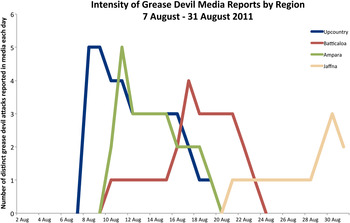
News reports of grease devil incidents tended to be clustered spatially, and traveled from the upcountry tea estates of central Sri Lanka on August 8 to the Muslim parts of the east coast on August 10; the Tamil towns and villages of Batticaloa, Mannar, and Mullativu on August 15; and finally to the overwhelmingly Tamil villages of the Jaffna peninsula on August 21 (see figure 1).
Intensity of media reports on grease devil activity by region. Underlying data for this chart was collated from the frequency of grease devil incidents reported in Virakesari, Lakbima, Divaina, Lankadiva, Daily Mirror, Sunday Leader, Sunday Times, and Tamilnet.

The crisis per se began on August 8, when Tamil-language news media first gave prominent coverage to a series of attacks on women in the Central Province. That day, a “mysterious man” attacked thirty-year-old Devika Joseph at her home in Badulla, after which she was admitted to hospital with nail marks and scratches all over her body. A female plantation worker in Nuwara Eliya was threatened by a man with a knife, and a twenty-eight-year-old woman in Gampola was admitted to hospital after being strangled by a man while on her way to the toilet. News of grease devil incidents involving sightings, attacks, scratches, and stolen jewelry were so widespread that day across Nuwara Eliya and Badulla districts that it provoked an impromptu demonstration in Badulla town by women demanding that it be brought to an end (Virakesari August 9 and 10, 2011).
Two days later in Vazhachenai on the east coast, Ushanar Marzuka, a thirty-one-year-old Muslim woman, was confronted outside her home at 11:00 a.m. by two men with their faces painted black. She recounted to the newspaper that “they asked me where I was heading. As I responded one man tried to grab me by my hand. I freed myself and pushed him back. In the process one of them scratched me with a sharp object.” Hearing her cries, more than a hundred local residents gathered to search for the assailant, and subsequently found a man who, after a thorough beating, was handed over to the police. The police arrested the suspect, but to the immense anger of the local community, released him shortly afterwards. This led to a heated confrontation and a violent clash between the villagers and the police, resulting in two policemen and two civilians being admitted to hospital with injuries (Sunday Times August 14, 2011; Virakesari August 11, 2011).
On the same day, 150 kilometers down the east coast in Pottuvil, another Muslim woman, Aashika, aged twenty-two, was attacked by a stranger at 8:30 p.m. outside her house. When she managed to struggle free and raise the alarm, her family arrived to find a man running away dressed in black, although Aashika suspected that there may have been two men (Sunday Leader August 21, 2011).
Grease devil sightings intensified in the next few days. There was an atmosphere of thick tension and fear in many towns and villages: outsiders were viewed with suspicion and liable to be attacked; women frequently stayed at home, under male guard, particularly after dark. Attendance at evening prayers in mosques thinned out significantly, a matter that was viewed with particular regret given that this was the holy month of Ramadan. The tea estates of the Central Province became economically and administratively paralyzed for days as men and women refused to leave home for work and kept their children from school.
The panic, stampedes, and angry chases generated by the grease devil scare caused a number of accidents, including deaths. On August 10, a young man chasing a suspected grease devil in Gampola was killed when he fell into an animal trap (Virakesari August 12, 2011). On August 16, a forty-two-year-old woman was struck dead by the Batticaloa-Colombo train while attempting to run to safety after hearing that there was a grease devil in the area (Virakesari August 17, 2011).
A frightened and desperate populace demanded that the administration and political leaders respond firmly and bring an end to the attacks, but to no avail. Police spokesmen held meetings and made numerous announcements at the local and national levels that the grease devil was a figment of the public imagination and that people should not take the law into their own hands. As before, the attempts by the police to defuse public concerns and dismiss the problem perversely served to aggravate and fuel anxiety. It provided evidence either of official apathy or complicity. There was a collapse in public confidence in the security forces, and the emergence of a growing number of community vigilante groups who assembled to keep watch and give chase. Those suspected or identified as grease devils were often violently attacked, and sometimes handed over to the police.
In an early incident that brought the crisis into the spotlight of the national media, two suspected grease devils were killed in an upcountry estate on August 11. News reports stated that a group of six unidentified men who entered the Dambetenna tea estate in Haputale (Badulla) were attacked by a large group of estate workers, said to number twenty-eight people. Four of the intruders managed to escape, but two were killed. Following this, there was such “great unrest” in the area that even the relatives of the two dead men were attacked with stones when they came to claim their corpses from the hospital (Daily Mirror August 12, 2011; Sunday Times August 14, 2011; Virakesari August 12, 2011).
In the next few days, from August 11 to August 17, there was an explosive increase in grease devil activity in the east, as well as numerous violent confrontations with the security forces. Unlike the tea estates of the Central Province, which are largely populated by Tamils of Indian extraction, who were only indirectly affected by the ethnic conflict, the east was directly and deeply affected by the decades of civil war. Amidst a complex three-sided communal confrontation overlaid by the violence of militant and state forces, the population of the east suffered extended periods of grave physical insecurity, enduring constant displacement, and thousands of unresolved disappearances. In mid-2011, more than two years after the end of the war, life in the east continued to be dominated by a highly militarized administration and a large, predominantly Sinhalese military presence amidst a Tamil and Muslim civilian population (Korf Reference Korf and Müller-Mahn2012; Lawrence Reference Lawrence, Das, Kleinman, Ramphele and Reynolds2000; McGilvray Reference McGilvray1997, Reference McGilvray2008; Walker Reference Walker2013; Whitaker Reference Whitaker1997).
When the grease devil crisis unfolded in the east, its effects were magnified on the one hand by the long history of civil-military tensions in the area, but also by its timing during Ramadan, which led many in the large Muslim population in the east to believe that this was a deliberate religious affront and provocation.
It is also important to bear in mind that although the focus of this narrative is on grease devil attacks in ethnic minority-dominated areas, grease devil anxiety and incidents were reported around the island, and many elements of the phenomenon and its consequences were very similar across regions and ethnicities. The big difference, however, is that the grease devil provoked widespread acts of public disorder and confrontations with the security forces only among the minorities. It created a rippling crisis of governability in those areas, and particularly in the heavily militarized north and east, many parts of which had only recently returned to government control.
On August 11, there appeared to have been an overnight invasion of grease devils into the southeastern district of Ampara, with a surge of attacks and sightings in the mostly Muslim towns and villages of Sammanthurai, Karaitivu, Akkaraipattu, Kalmunai, Maruthamunai, and Pottuvil (Virakesari August 13, 2011). In a number of cases, local villagers who had captured suspected grease devils and handed them over to the police were incensed to learn that these men were subsequently released without charge. In many other cases, those identified as grease devils had, upon pursuit, run into police stations, military camps, or Buddhist temples, confirming widely held suspicions that the state security forces were in fact behind the attacks and that the grease devils were none other than soldiers in disguise.
Over the next two days, anger at the grease devils led to furious demonstrations and attacks against the security forces by angry mobs across Ampara district. In Sammanthurai, two policemen were set upon and chased into the police station by a large group of villagers. In Pottuvil, three wildlife officers conducting an elephant census were attacked, and in nearby Urady, several army officers were assaulted by a group of villagers. In the sequence of events and the escalation that ensued between the army and a deeply agitated local population in the Pottuvil area, an army officer shot dead a man who turned out to be a local politician of the Muslim Congress party (Sunday Leader August 21, 2011; Sunday Times August 14, 2011; Virakesari August 12 and 13, 2011).
Two days later on August 14, in the town of Kinniya further north in Trincomalee district, another serious and violent confrontation occurred outside the navy base, into which a suspected grease devil had run. When the navy refused to hand the suspect over to the group chasing him, it triggered public disturbances that lasted over two days. A large and highly charged crowd of demonstrators assembled, burning down a military checkpoint, and encircling and hurling stones at the base. The situation was ultimately defused and the crowd dispersed only after twenty-four men were arrested following the arrival of paramilitary troops from the Special Task Force, and with the deployment of armed helicopters from the base. But the disturbances carried on to the next day when another group of demonstrators surrounded the local Divisional Secretariat office and prevented the military commander of the Eastern Province, Major General Boniface Perera, and the Trincomalee Government Agent, Major General V. R. D. Silva, from leaving the building for several hours. It eventually required the arrival in person of the three most powerful Muslim ministers from Colombo, Rauff Hakeem, A. H. M. Fowzie, and Rishard Bathiudeen, to negotiate a peaceful end to the standoff (Daily Mirror August 16, 2011; Virakesari August 16, 2011).
As the crisis rolled on to its second week, the focus of media attention and reports of grease devil incidents shifted towards newer areas of Batticaloa, Mullaitivu, and Mannar. In contrast to the upcountry Tamils of the Central Province and the Muslims of Ampara and Kinniya, these newer areas have a predominance of northeastern Tamils, the ethnic group most directly and deeply affected by the war and its aftermath. On August 16, residents of Puthoor in Batticaloa gave chase to a “mysterious man” who ran into the Sethukuda police station, prompting a demonstration demanding the removal of that police station (Virakesari August 17, 2011). The next day in nearby Urani, a grease devil who had escaped after assaulting a young woman was seen entering a nearby police post, triggering angry demonstrations by local residents who burned tires and shut down the main Trincomalee-Batticaloa artery road (Tamilnet August 17, 2011; Virakesari August 18, 2011). Batticaloa remained in the grip of tension and deep fear with a string of incidents, including an attack on a girl in Chenkaladi by a man later discovered to be an army sergeant (Virakesari August 22, 2011), and the discovery of men lurking in the women's toilets and the roof of the Nurses Training Institute, which forced the institute to send all 180 of its terrified students back home (Tamilnet August 21, 2011; Virakesari August 20, 2011). In Thandiyadi village, an area in the hinterland formerly under LTTE control, two policemen who were suspected to be grease devils were assaulted by a large group of men, following which “police retaliatory action” resulted in eighteen persons being admitted to Batticaloa Hospital (Sunday Times August 21, 2011).
In its third and fourth weeks, the grease devil crisis moved to Jaffna, where a predictable pattern of events unfolded yet again. There were multiple sightings of the grease devil, several attacks on women, vigilante groups of local residents who chased and attacked suspects, the escape of such suspects into police stations or army camps, aggressive confrontations between residents and security forces, followed ultimately by arrests, and even violent reprisals by the security forces against those communities.
By the second week of September, the grease devil issue had died down, almost as suddenly as it started. There is no ready explanation at hand for why or how it finally came to an end except perhaps that it had exhausted itself after having covered virtually the entire geography of the Tamil- and Muslim-dominated parts of Sri Lanka. In each locality (see figure 1), grease devil sightings followed a familiar pattern and life cycle, starting suddenly and intensifying quickly to its peak in the first two to three days, and then subsiding gradually over the next ten days.
While there were far fewer sightings and vigilante attacks once this cycle came to an end, the memory of the terror endured in that relatively short span of time was vividly felt and recalled many months later. In interviews conducted a year after the episode in August 2012 in Batticaloa, Kattankudy, and Eravur, Tamil and Muslim respondents uniformly described the fear and paralysis caused by the grease devil as worse than what they had to endure during the decades of civil war.
Were the Grease Devils Real or Just Rumors?
What sense can be made of the grease devil crisis? The events that transpired and the rich body of evidence available to reconstruct it makes it possible to bring a variety of different approaches and analytical vehicles to bear. At the same time, the very idiosyncratic, contingent, and counterintuitive nature of the events makes it challenging to take any one of these different approaches forward very far in identifying causality or explaining its specific form and timing.
A rudimentary way to understand the grease devil crisis would be to evaluate the available evidence to unravel and explain what happened. Did these bizarre attacks actually take place in the manner claimed, and if so, who or what was responsible? Or were they instead the product of a febrile collective imagination? In a narrative that frequently evoked the stereotypical confrontation in South Asia between the rational modern state and an irrational premodern society, the Sri Lankan government and security forces insisted that the grease devil did not exist, and that it was the product of an unfounded and irrational fear psychosis. Defense Secretary Gotabaya Rajapaksa spoke out on several occasions, dismissing the issue as “a myth,” and “just rumours” (Daily News August 25, 2011; Tamilnet August 24, 2011; Virakesari August 25, 2011). Numerous police spokesmen at the national and local levels appeared frequently in the media and at community meetings to deny the existence of any grease devils (Virakesari August 20, 2011). The military commander of Jaffna, Major General Mahinda Hathurusinghe, explained that “the grease devils and mysterious men are just imaginary tales.” Another senior army commander asserted: “There is absolutely no evidence to support the grease yaka [sic] theory. It has been created out of thin air by an atmosphere of fear” (Sunday Leader August 21, 2011).
Indeed, all the suspected grease devils caught, arrested, or lynched turned out on further investigation to be innocent, luckless passersby. For example, it later emerged from media and police investigations that the two men killed by estate workers in Haputale on August 11 were in fact traveling salesmen from a nearby village (Daily Mirror August 12, 2011; Sunday Times August 14, 2011; Virakesari August 12, 2011). In the Sinhalese village of Ambagamuwa near Hatton, two strangers assaulted by local villagers were later discovered to be Indian engineers working in a nearby hospital project (Tamilnet August 25, 2011).
Similarly, when officials from the Batticaloa regional office of the Human Rights Commission of Sri Lanka visited the nine persons remanded in custody as grease devils as of August 16, they determined that three were mentally disturbed, one was a beggar, and two were door-to-door Sinhalese trinket sellers. Two others were unavailable for interview, as they were in hospital recovering from serious injuries received at the hands of community vigilantes. The last one turned out to be a young Muslim man from another town who had alighted the bus and was waiting by the side of a school for a rendezvous with his “lover.” When she failed to appear, he approached and sought information from a passing woman, who, mistaking him for a grease devil, became alarmed and shouted for help. Local residents and passersby promptly rushed to her assistance and assaulted the young man before handing him over to the police (interview, August 29, 2011; Daily Mirror August 13, 2011; Sunday Observer August 14, 2011).
A significant and sophisticated body of literature on similar-sounding episodes has conceptualized the role of rumors (Das Reference Das1998; Spencer Reference Spencer, Das, Kleinman, Ramphele and Reynolds2000), many of which also involve violent biomedical intrusion, including the theft of bodily fluids (White Reference White2000), the theft of body parts (Scheper-Hughes Reference Scheper-Hughes1996), or the forcible sterilization of women (Bass Reference Bass2008). The sociological literature on “moral panic” (Cohen Reference Cohen1973; Goode and Ben-Yehuda Reference Goode and Ben-Yehuda1994) also provides a way to understand this episode and describes how the media plays a central role in the construction of “folk devils.” Indeed, there is much to be said of the role of the vernacular-language media in the creation and dissemination of the grease devil fear, and also in accounting for its patterns of transmission across the country. The comparative literature from psychology and the anthropology of spirit possession and mass hysteria also provide plausible accounts of the contagion and transmission mechanisms that were manifest. More importantly, they suggest that those in the grip of extreme anxiety can be deeply convinced that they have endured a paranormal encounter, and can exhibit the emotional and even physical symptoms that result from it. All of these remain plausible explanations that fit some elements of the evidence available, but their role is perhaps more significant in lending this phenomenon a conceptual vocabulary and comparative insights, rather than an explanation and a satisfying analytical endpoint as such.
In contrast, the weight of evidence from numerous victims would suggest that the grease devil was indeed real. There was a recognizable pattern of attacks on women across the country in this period, and the women described assailants with similar types of attire and behavior. Many victims were hospitalized with characteristic scratches and cuts. They explained the details of their encounters in person, and in detail to journalists, police, and hospital staff, with images of scratched bodies displayed widely on television and in print and electronic media.
Indeed, any explanation of the grease devils must take into account the sheer number and diversity of similar incidents that were reported. Even if the large majority of the encounters were imagined, invented, or the result of mistaken identity, it would seem improbable that hundreds of different, unconnected people in different parts of the country had, in a synchronized manner, enacted the same hoax, or had imagined the same kinds of attacks from the same kind of assailant.
In sum, any quest for the definitive truth about the grease devils that draws on the primary evidence available to establish its causation is quickly frustrated by the inconclusive or contradictory testimony of the witnesses and those accused of involvement. Perhaps the only such finding that can be established on this basis and about which there is no dispute is that there was indeed a crisis, and that people did genuinely feel terrified and vulnerable—numerous women reported being attacked, and were hospitalized with evident injuries. In other words, what is verifiable and can be explained without ambiguity or contradiction is often trivial, itself in need of explanation, or is at best only a fragment of a larger chain of explanation.
In order to go beyond this, it becomes necessary to examine not just what meager facts can be established, but what rationale might exist and what meaning it might contain. In other words, what plausible explanations can be attached to these reports that might provide a cause or culprit for this apparently inexplicable episode of social breakdown? Or else, can these rudimentary findings be extended and made more meaningful by placing them within a larger context, in order to view them not as an isolated case of mass hysteria, but as symptomatic of some broader condition, or as a lens with which to view the world at large?
Who Did It and Why?
In the absence of any self-evident answers to the mystery of the grease devil, can an understanding of the hidden functionality or instrumentality of the crisis shed any light? Is it possible to identify a political, economic, social, or even sexual rationale for the grease devil attacks that can help explain them? This search for a deeper logic within illogic, functionality to dysfunction, and rationale for the irrational is a well-established tradition in the critical social sciences. It has particular bearing in the study of violence and developing societies, not just because irrationality and dysfunction are the norm there, but because this juxtaposition is embedded in the confrontation between the elements under study (the state versus society), and is also embodied in the relationship between the scholar and the object of scholarly research.
David Keen's (Reference Keen1997) analysis of famine and civil war, for example, searches for political and economic agendas that profit and thrive in that environment, and whose interests it serves to perpetuate. Chabal and Daloz's (Reference Chabal and Daloz1999) monograph on African politics describes “disorder as political instrument.” Paul Brass (Reference Brass2003) suggests a similar elite instrumentality at play in his work on communal violence in India. There is also a rich tradition within the historical and anthropological literature that seeks (and rarely fails to find) hidden instrumentality behind witchcraft accusations (De Certau Reference De Certau2000), and that has successfully uncovered the presence of wrath, greed, sloth, pride, lust, envy, or gluttony among the accusers.
In the case of the grease devil crisis, however, any academic exercise aimed at identifying instrumentality or some rationale quickly confronts the reality that the field of study is itself replete with numerous competing rationalizations of the crisis. It was almost impossible to engage in conversation in Batticaloa (or elsewhere in Sri Lanka) in that period without reference to the grease devil, its likely culprits, and their hidden motives, which ranged from the complex and biopolitical to the trivial and parochial. While the ghostliness of the grease devil remained present throughout the crisis and lent it a terrifying supernatural edge, most people were, upon reflection, quick to dismiss that element and reached instead for very grounded, this-worldly explanations. Moreover, these explanations were often strongly polarized and clustered different actors on the basis of their ethnicity and their relationship to the state.
Tamils and Muslims
Tamils and Muslims of the northeast were overwhelmingly of the opinion that the grease devil attacks were organized by the government, and that they were military men in disguise. As the Tamil National Alliance (TNA) member of parliament for Batticaloa, S. Yogeswaran said, “It is obvious that there is government involvement in the grease man phenomenon. If not why has the government, which has control, done nothing about it?” (Virakesari August 25, 2011). Speaking in parliament, the MP for Jaffna, S. Sridharan, charged that “the people of the North have more than enough proof that the military is involved in the mysterious men issue” (Virakesari August 24, 2011). The TNA General Secretary, Mavai Senathirajah, similarly charged that “it is clear that the military and grease men are interlinked. Therefore the President can control this if he so wishes” (Virakesari September 3, 2011).
It was frequently remarked that the attacks happened only in areas occupied by non-Sinhalese ethnic minorities, in the proximity of military camps, and that suspects often ran into police stations or military camps when identified. A Muslim interviewee noted that “there were no incidents in Ariyampathy because there is no army camp there, so nowhere to escape.” A Tamil NGO worker remarked (in a conversation otherwise unrelated to the grease devils) that “the Muslims managed to get it stopped in their areas when their ministers talked to the president.” One anecdote that was widely recounted during the crisis was that a policeman was seen saluting a grease devil when asked to arrest him, the implication being that the grease devil was a superior officer in the security forces.
In terms of rationale, Tamils in particular tended to view the grease devils as part of the long history of military surveillance, harassment, and violent subjugation, stretching back over three decades of civil war. Several Tamils remarked that “they just don't want to let us live in peace.” Indeed, reports of sexual harassment by soldiers in the northeast, particularly in the vicinity of military camps, were commonplace and long-standing, so that the grease devils were self-evidently assumed to be soldiers.
Several Muslim respondents from the east described the grease devil attacks as a deliberate ploy by the government to provoke anger, and thus to flush out hidden weapons. As one man, a student at the Eastern University, elaborated:
The government suspected Muslim people to have armed groups and guns and they wanted to check. When people are very agitated, they will use whatever weapons they have to fight back, no? … After the Kinniya incident, they searched all the houses for guns. When they realized there were no guns, they stopped it [the grease devil attacks].
There were also more ambitious and demanding explanations of the type described at the beginning of this paper, and of which there were many versions: that the grease devils were a special black-ops army unit technically equipped with springs on their feet, and claws, nozzles, and tubes on their arms to collect the blood of virgins, lactating mothers, and those who abstained from pork. According to some versions, this was needed in order to perform a black magic ritual to ward off bad luck for the president, who had also ordered a search in tandem for the crown and sword of the ancient Sinhalese king Dutugemunu under the irrigation tanks of the Rajarata region. Elsewhere it was to concoct a special Chinese medicine to cure the president of a terminal affliction. This particular genre of explanation had many subscribers among the Tamils and Muslims of the northeast, but also circulated widely among many Sinhalese, and in the country at large.
Finally, in place of the more top-down, organized, and grander theories at play, the grease devils were also explained in terms of a number of far more parochial actors and trivial agendas. For example, in response to reports that twenty grease devils had entered the women's hostel of the South Eastern University in Oluvil on August 11, Professor F. M. Ashroff of the university dismissed this as a false rumor, spread presumably by his students, designed to postpone that day's examinations (Virakesari August 12, 2011). Similarly, a Muslim shopkeeper in Batticaloa opined that the “Army may or may not be involved, but many are just perverts from the locality who want to molest women.”
Government and Security Forces
The Sri Lankan government and security forces remained largely on the defensive in this period in the face of an avalanche of accusations, particularly from the northeast, that they were either failing to act or that they were actually behind the attacks. Their response for the most part, apart from denying the existence of any grease devils, was to stress their innocence and to ridicule the absurdity of the accusations against them. As Defense Secretary Gotabaya Rajapaksa argued, “The President does not need any [blood] rituals, because he has the people's support. … To suggest that they [the military] would carry out acts such as these is ridiculous.” He went on to remark (in jest) that the grease devil might well be the ghost of dead LTTE leader Velupillai Prabakaran (Lankadeepa August 24, 2011; Virakesari August 25, 2011).
But in the face of intense pressure and scrutiny, government ministers, spokesmen, pro-government newspapers, police, and military officers often went on to provide a range of alternative explanations that centered on criminal gangs, foreign forces, LTTE revivalists, Tamil political parties, the Janatha Vimukthi Peramuna (JVP), and promiscuous women.
At the height of the crisis, Deputy Commissioner of Police Pujitha Jayasundara explained to an audience of concerned notables in Batticaloa that the rumors were circulated by thieves and people carrying out illegal activities (Virakesari August 17, 2011). Former police spokesman I. M. Karunaratne blamed drug traffickers, illegal cow smugglers, and illicit liquor dealers. Minister Dulles Alahapperuma blamed illegal gem miners and loggers (Virakesari August 19, 2011). Several military spokesmen argued that the turmoil was motivated by those seeking the removal of army and navy camps from the northeast in order to pursue their criminality with greater ease (Virakesari August 16, 2011). Major General Boniface Perera argued that the protests in Kinniya that he had endured were instigated by drug traffickers and fishermen using illegal methods such as dynamite, who would benefit from a removal of the navy camp (Sunday Leader August 21, 2011).
The search for the identity of the grease devils became embroiled within domestic partisan politics, with both the government and opposition parties articulating reasons why each other had organized and benefited from it. An article in the pro-government Sinhala newspaper Divaina described the turmoil as the handiwork of an unnamed Tamil political party that wished to depict the Sri Lankan armed forces as molesters and rapists to the international community (Divaina August 21, 2011). Blame was also occasionally placed on the pro-LTTE Tamil diaspora (Sunday Times August 21, 2011), “dormant LTTE aggravators” (Sunday Leader August 21, 2011), and unspecified “terrorists” for instigating attacks on the security forces.
State media and several police spokesmen charged that the JVP, an opposition party with a history of underground violence in the 1970s and 1980s (Venugopal Reference Venugopal2010), was behind the grease devil episode in a bid to embarrass the government (Daily Mirror August 17, 2011; Daily News August 15, 2011; Lakbima August 23, 2011). The JVP, for its part, retorted that it was the government that had organized it to cover up its failures (Lankaviews.com August 15, 2011), while the main parliamentary opposition, the United National Party, alleged that the government was promoting disorder in the country in order to justify the continuation of a state of emergency (Daily Mirror August 23, 2011).
Foreign Forces
On the government side, a vaguely articulated set of accusations targeted foreign countries. The military commander of Jaffna, Major General Mahinda Hathurusinghe, argued that “it was an effort by foreign forces to disturb the peoples' peace. These forces give money to people to carry out these acts” (Virakesari September 7, 2011). An editorial in Divaina argued that the grease devils were part of a larger plot to reignite bloodshed in Sri Lanka, linking them to the then ongoing Western bombing of Libya (Divaina August 24, 2011). President Mahinda Rajapaksa himself also speculated in a press conference as to whether there was an ulterior motive to the grease devils, and perhaps a conspiracy similar to what was happening (with Western intervention) in Libya and other Middle Eastern countries (Virakesari August 29, 2011).
Adulterous Women
Finally, a far simpler and more localized rationale for the grease devil rumors from the government side placed the blame on the promiscuity of the women who made the accusations. One senior army officer explained to a reporter that the women who claimed to have been attacked were “either divorced, widows, or prostitutes” (Sunday Leader August 21, 2011). The director of the Media Centre for National Security, Lakshman Hulugalle, argued that the grease devil rumors began when an adulterous woman lied to her husband to cover up the truth about her “paramour.” Instead, he held, “the medical reports proved that she had a clandestine affair with someone elsewhere which she admitted to the Police later” (Daily News August 23, 2011).
In summary, the interpretation of the grease devil crisis presents itself as a problem of increasing complexity. Not only is it difficult to plainly establish whether it happened or not, but the traditional approach that social science adopts in such circumstances—of seeking to tear away the mask of mysticism and irrationality to uncover a deeper, logically satisfying core—is itself of little help, as the public realm was already replete with rationalist unmaskers of the grease devils. Whereas the classic interpretation (Evans-Pritchard Reference Evans-Pritchard1937) holds that witchcraft accusations—and by extension, the recourse to the supernatural in general—should be seen as a way to explain inexplicable acts of mundane misfortune, we have here in this case the converse. While the normal sequence would be for the real world (inexplicable tragedies) to be explained by invoking the magical, here we have the magical world (grease devils) explained widely in terms of real world instrumentalities, be it sexual predation, exam angst, ethnic hostility, criminal intent, Western neocolonialism, or adultery.
Under such circumstances, there are grounds to turn the spotlight of scrutiny around, as it were, and question this very act of identifying and affixing blame and instrumentality. This impulsive search for a deeper, sordid, narrow, economic, political, or sexual purpose—whether for something as complex as the deployment of military personnel to collect the blood of vegetarian virgins, or as trivial as the students seeking to postpone an exam—cannot be the endpoint of any explanation of the grease devils, for it is itself a phenomenon in need of greater reflection and explanation, albeit one that is sadly beyond the scope of this paper.
What Does It Reveal?
If it is impossible to ascertain whether the grease devils were real or not, or even who the culprits were, what then, beyond the immediately self-evident, can be said about these mysterious and violent events? Rather than looking deeper within the crisis to try to understand its truth or the identity of its instigators, can it instead be more fruitful to look beyond it to understand what it might be a metaphor for, or symptomatic of? Can this moment of temporary breakdown and collapse provide, as Zygmunt Bauman (Reference Bauman1989) describes of the Holocaust literature, a window that allows a glimpse into the pathologies of normal everyday existence otherwise hidden from view? This section examines three ways of going beyond the micro-evidence of the attacks, to distill out a larger meaning from the crisis.
Unhealed Trauma Relived
The most ready interpretation at hand of the grease devil crisis is that it reflects accumulated stress and unhealed psychological trauma, and that it should be seen as some form of cathartic collective response by a society deeply scarred by fear and violence. This diagnosis connects broadly with Freud and also speaks closely to the literature on mass hysteria (or epidemic hysteria, or mass sociogenic/psychogenic illness) in psychology and medical anthropology. In case studies ranging from demonic possession in Sri Lanka (Obeyesekere Reference Obeyesekere1970) to dancing plagues in medieval European convents, laughing epidemics in East African schoolchildren (Bartholomew and Sirois Reference Bartholomew and Sirois1996; Bartholomew and Wessely Reference Bartholomew and Wessely2002) and spirit possession in Malaysian garment workers in the 1990s (Ong Reference Ong1998), the underlying problem is identified as some form of pent-up psychosocial stress. John Waller's historical account of mass hysteria in medieval convents describes how “the dancing plagues and the experiences of demonic nuns still have something to tell us about human responses to stress. For these events place in bold relief the extraordinary power of context to shape how anguish and fear are expressed” (Waller Reference Waller2009, 647).
In many instances, mass hysteria or demonic possession occur in the context of rapid socioeconomic changes or oppressive forms of discipline and control (Wessely Reference Wessely1987). There is also an emerging body of literature to support the idea that violence-affected communities experience greater instances of demonic sightings and possession (Nakalawa et al. Reference Nakalawa, Musisi, Kinyanda and Okello2010). For example, a study on spirit possession among former child soldiers in northern Uganda found that psychological damage from violence is frequently explained in terms of “transcendent phenomena” (Neuner et al. Reference Neuner, Pfeiffer, Schauer-Kaiser, Odenwald, Elbert and Ertl2012, 6). Similarly, the ninja scare in Timor-Leste mirrors the grease devils in many respects, and similarly affected a people deeply brutalized by violence (Martin Reference Martin2010; Myrttinen Reference Myrttinen2010).
Indeed, the people of the northeast of Sri Lanka lived with very high levels of fear and anxiety for decades, with the normal rhythms of daily life, and of entire life-spans, unfolding amidst a regular drumbeat of political murders, disappearances, bomb blasts, and bus massacres, as well as everyday incidents of violence short of death, including torture, intimidation, extortion, and the abduction of children. Many of these shadowy deaths and disappearances during the war years were never accounted for, but were instead superseded by the constant stream of other, fresher atrocities. As a result, there has been little accounting, much less accountability, for the massive loss of life.
This interpretation of the grease devil crisis as an outcome of unresolved collective trauma and as a lens into the brutalized psyche of the northeastern Tamils is appealing at many levels. It is well supported by the available psychosocial evidence (Somasundaram Reference Somasundaram2007), and also by two compelling ethnographies of the role of oracles and traditional healing rituals amongst Tamils in the northeast (Derges Reference Derges2012; Lawrence Reference Lawrence, Das, Kleinman, Ramphele and Reynolds2000).
Structural Violence Enacted
A second and related way of interpreting the crisis is as a metaphor for latent forms of “structural” violence in society, so that the improbable reports of grease devil attacks are in essence coded reenactments of something deeper. As with spirit possession, issues that cannot normally be spoken of for reasons of propriety are brought out into the public realm under extraordinary circumstances and in a highly charged manner. The grease devil attacks become a way in which the experience of violence, discussion of which is suppressed, finds an outlet through the anguished narration of an attack by a mysterious, powerful, male stranger. As Bartholomew and Sirois (Reference Bartholomew and Sirois1996, 292) describe, mass hysteria episodes are endemic among females in schools and factories facing “repressive, intolerable social situations. … While female redress is culturally unacceptable in these societies, males typically believe that those affected are possessed by spirits.”
There are two operative dimensions to note here that overlap, but are otherwise distinct: gender and ethnicity. On the one hand, the grease devil attack is a narrative of sexual violence, and is indicative of the extent to which women of all ethnicities around the island, particularly in small towns and villages of the periphery, are vulnerable to predatory male aggression. In this interpretation, the colorful descriptions of this lithe, lecherous spiderman are not to be dismissed as the paranoid fantasies of shrinking violets and sheltered village damsels, or even as the alibis spun by adulterous wives and promiscuous widows, but provide vivid insights into the pervasive, unpredictable, sexual aggression that women routinely face.
War and militarization are very important elements of this gendered interpretation, as they have resulted in the transfer of tens of thousands of young males into the northeast, and have in parallel depleted many Sinhalese areas outside the northeast of their men, rendering women more vulnerable in both parts. Indeed, the men who were eventually charged with the serial murders in Kahawatte turned out to be army deserters.
A second dimension of latent violence is along lines of ethnicity, and signifies the contentious confrontation between the Sinhala-dominated state and the minorities. While women of all ethnicities around the island reported grease devil attacks and anxiety, it assumed the dimensions of a crisis only where minorities were predominant. The image of the muscular and predatory grease devil in this interpretation corresponds to the army soldier, roaming, occupying, and aggressively encroaching on the physical and social terrain of the northeast.
In this postwar dystopia, the LTTE as a putative alternative provider of security and protector of Tamils no longer exists, such that they are left at the complete mercy of the vast Sinhala-dominated state security forces. The grease devil thus signifies the totalizing encroachment of the military in the northeast into the public, material sphere, and even beyond, into the more private and intimate sphere of the Tamil and Muslim home, which as Partha Chatterjee (Reference Chatterjee1993) might describe, is the domain of the nation's uncolonized, spiritual, female core.
Nancy Scheper-Hughes (Reference Scheper-Hughes1996) provides an important insight in her analysis of the body parts theft rumors in South America during the 1990s: these rumors and the widespread hysteria they generated occurred in the aftermath of a period of authoritarian violence in the region. By that time, public enquiries and truth commission reports had publicly exposed the macabre mechanics of disappearances, illegal adoptions, and the extraction of body parts for transplants from the bodies of dead dissidents and criminals. She describes how “the rumours have appeared, then, during a time when ordinary people finally became aware of the magnitude of the atrocities practised by the state” (Scheper-Hughes Reference Scheper-Hughes1996, 9).
In much the same way, the grease devil rumors emerged in the aftermath of the Sri Lanka war and more than two years after its extraordinarily brutal conclusion in May 2009 (Weiss Reference Weiss2011). The specific rumors that circulated, and the grease devil encounters described, may well turn out to lack substance. Nevertheless, the crisis erupted at a time (and this is particularly with reference to northeastern Tamils rather than Muslims or upcountry Tamils) when the enormity of the civilian death toll in 2009 became apparent in the public domain and had become lodged in the (Tamil) public consciousness.
What is common to both the gender and ethnic variants of the structural violence interpretation is that they imply the aggression and one-sided violence of males and soldiers, and the passivity of their victims: women and minorities. Though speculative and interpretive, and based on creative inference rather than verifiable data, there is much that is convincing and intellectually satisfying about this interpretation.
What it does not do, however, is account for the counter-reaction that ensued. What made it a crisis as such was not the depth of anxiety or the frequency and ferocity of the reported violence, which occurred throughout the country, but the breakdown in the state's authority that it precipitated in the non-Sinhala areas. The crisis was marked not just by one-sided attacks on cowed victims, but by the extraordinary fury with which the affected communities responded and took on the state.
Hegemony Undone
There is thus a third interpretation of the grease devil crisis: that it demonstrated not the power or aggression of the state in controlling the minorities, but its weakness. As Scheper-Hughes describes (of the body parts theft rumors), this is “a classic ‘weapon of the weak.’ The rumors have shown their ability to challenge and interrupt the designs of medicine and the state” (Scheper-Hughes Reference Scheper-Hughes2000, 202).
What made it a crisis was not just that people were afraid, but that there was a breakdown in the sphere of governance and administration. Angry crowds all across the northeast confronted, accosted, and even attacked the police and army. The state either lost or had diminished control of parts of northeast Sri Lanka for several days. In Puttalam, a policeman was killed by a furious mob. The statements and actions of the police and security forces in this period were not those of a confident, victorious oppressor at rest. Rather, they indicated an executive that was desperate, perplexed, and even paralyzed, having been suddenly confronted with the reality that its ability to control an agitated and uncooperative population was limited.
What I suggest is that the nature of the crisis that the grease devil provoked was a temporary breakdown in the implicit contract that governs state-minority relations. Drawing on the conceptualization of “hegemonic control” in “ethnic democracies” from Northern Ireland, Israel, and India (O'Leary and McGarry Reference O'Leary, McGarry, Breton, Galeotti, Salmon and Wintrobe1995; Singh Reference Singh and Baruah2010; Smooha Reference Smooha2002), Sri Lanka can similarly be understood as a case where juridically enshrined rights to equal citizenship on an individual basis are layered onto and rest upon what are perhaps a more important set of unwritten rules that stratify state-society relations based on collective identity.
In Sri Lanka, the sectarian ideology of the majority community (Sinhala nationalism) is closely incorporated into the legitimacy and practices of the state, such that it constitutes the register of political morality that regulates state-society relations (Venugopal Reference Venugopal2008). This close identification of the state with one dominant community creates self-evident problems in the constitution of legitimacy and the exercise of power over non-Sinhalese minority groups. In practice, this is addressed through an implicit bargain where minorities seek to limit their vulnerability and insecurity by accepting subordinate status within a dependable and regulated ethnic hierarchy. Through a combination of elite cooption and mass cooperation, minorities are thus drawn in and become complicit in a process designed to control them, and through which their nominally equal citizenship rights at the individual level are undermined by manifestly inferior collective claims on, and access to, an ethnically segmented state.
In postwar northeastern Sri Lanka, the pervasive presence and influence of the military lends the impression that “order” is maintained largely by coercion. However, coercion is in reality rarely explicit, as it is expensive, and can have unpredictable consequences. Instead, following Gramsci very loosely, the idea of hegemonic control suggests that the exercise of power requires some ideological persuasion to win consent and cooperation. There are of course elements here that are debatable: for example, whether this collective exercise of cooperation is based more on pragmatism and the imperatives of collective self-preservation rather than the docile “consent” wrought by the acceptance of a ruling ideology. But regardless, neither cooperation nor consent are unconditional. They rest on an implicit expectation of reciprocity from the state and contain unwritten moral red lines, which, if crossed, precipitate a breakdown and crisis in minority-state relations.
This crucial element of the Sri Lankan state's exercise of power in the northeast is internalized so widely that it is not apparent even to the individuals who are involved in performing it on both sides. It is only in rare instances, such as the grease devil crisis, that its role becomes apparent: when legitimacy turns into illegitimacy, cooperation turns into confrontation, and the consent to rule evaporates. Under such circumstances in mid-2011, the state became incapacitated and its power was, however briefly, rendered ephemeral.
For the first time in several decades, the grease devil triggered a series of spontaneous popular demonstrations in the Tamil areas of Batticaloa and Jaffna (spontaneous in the sense that it was not directly instigated or coerced into being by an armed militant group), where people did the unthinkable in openly confronting the military in an aggressive and provocative manner. As a sequitur to Jonathan Spencer's (Reference Spencer2008, 618) account of the “moment that the political died in northern Sri Lanka,” when violence overtook politics in 1983, this display of uncoerced popular political action may have been a moment when the political sprang back to life. It occurred at a time when people felt that the state had crossed all bounds of acceptable behavior, and had launched an intolerable attack on them.
I will conclude with a note of caution—that it is important to not overstate the case. This was a fleeting instant of resistance through the withdrawal of consent, not a revolution. It served, however briefly, to render bare the ontology of power, but in a way that did not obviously suggest how a challenge to it could be generated or sustained. Furthermore, following the line of argument pursued above, the identification of weapons of the weak and latent forms of resistance to an oppressive, militarized regime does not imply that there was a conscious functionality at work: Tamils and Muslims did not invent the grease devils and wind themselves up into a frenzy of anger in order to create chaos in the northeast.
Conclusions
This paper has sought to reconstruct and understand the events of Sri Lanka's grease devil crisis of 2011. Drawing on the available evidence at hand, it has explored three different approaches that seek to explain and attach meaning to the crisis.
The first such approach to parsing the evidence to understand what happened corresponds to an understanding of the grease devil as a self-contained phenomenon amenable to causal explanations. The second approach goes one step further, to situate the phenomenon beyond itself, as a constituent instrumental or functional element within some larger rationale or system. In effect, this approach downgrades the grease devil from a dependent variable that is to be explained in its own right, to an independent variable that forms only a part of some other explanation.
Both of these approaches resulted in answers that were either inconclusive, unverifiable, or trivial. Furthermore, the possibility of drawing analytical insights from instrumental or functional explanations became seriously compromised by the way in which such explanations—in the form of rumors and conspiracy theories—proliferated in that context, and were in themselves an important part of the anatomy of the crisis.
The third approach goes even one step further to situate the grease devil entirely outside the primary frame of analysis, either as the object of explanation or as an explanatory factor. Instead, it is an event that is relevant insofar as it briefly serves to illuminate and delineate the features of some other larger phenomenon: in this case, unhealed trauma, structural violence, or contested hegemony. All three are plausible, and they provide the grease devil crisis with a greater degree of meaning, context, and analytical richness than the first two approaches.
They are, however, ultimately based on reasoned speculation, rather than hard evidence, so that the preference for any one over the other will depend on the taste and predisposition of the reader. It should be obvious from the last part of the paper that while I have sympathy with all three, my own preference is for the third interpretation, and that I view this to be a case where a fleeting, unanticipated moment of crisis provided a glimpse into the way that state power operates, and how state-minority relations are ordered.
Finally, this argument has important implications for Sinhala nationalism. In recent work, Rampton (Reference Rampton2011) and Venugopal (Reference Venugopal2008) have argued against the idea of elite instrumentalism, and suggest that Sinhala nationalism poses limits to the exercise of power by state elites. In other words, hegemony sprang not from above, but from below, through the ironclad grip that Sinhala nationalism held on popular conceptions of political morality: that is, on what constitutes the legitimate role of the state, and what the state ought to do. Whereas aspiring political elites often toyed with and pandered to Sinhala nationalism (the so-called “ethnic outbidding”) in order to claw their way into power, they were, until Mahinda Rajapaksa, pusillanimous about it once they actually assumed power.
The success of the Rajapaksas was due to the fact that they continued to embrace Sinhala nationalism well after the election campaign, and as such, tamed the turbulent sea of hegemony to gain an unassailable command of the political realm. However, as the grease devil crisis demonstrated, the task of accessing this hegemonic control and winning the consent of the ruled in the Sinhala south can well mean disturbing it in grave and entirely unpredictable ways in the non-Sinhala areas of the north, east, and center.
Acknowledgments
Thanks are due to the LSE's Department of International Development for support that made this research possible, and to Verite Research for research assistance. I am particularly grateful to Jonathan Spencer, Jayadeva Uyangoda, Jonathan Goodhand, Dave Rampton, Nishan De Mel, and four anonymous reviewers at the JAS for their thoughtful engagement, insight, and feedback at various stages. Earlier drafts of this paper were presented at seminars and workshops at LSE, Oxford, Yale, JNU, and SOAS, and thanks are due to the organizers of those events for inviting me, and to the participants and respondents for their feedback.