The concepts of quality of life and health-related quality of life have been gaining importance in the present society since lethal diseases have become chronic, even though they often compromise the lifestyle of patients who are admitted to more intensive and invasive treatments.Reference Almeida1
Technological progress has enabled earlier diagnosis, the enhancement of surgical techniques, and the consequent improvement in therapy results, thus increasing patients’ survival.Reference Horowitz2, Reference Vaz, Silva and Gomes3
The increase in the survival rate of individuals with congenital heart disease created the need to analyse the quality of life in this group of patients as a way to assess treatment and also to prepare patients, relatives, and medical and social services to the potential difficulties encountered while confronting disease or while carrying out treatment along the patients’ lifetime.Reference Almeida1 The study of the quality of life in this group of patients also aims at assessing how and when clinical changes and/or health procedures can interfere in the life of the patients.Reference Vaz, Silva and Gomes3
Congenital heart disease includes a wide array of heart defects with different degrees of severity and a reported prevalence of eight per 1000 live births. The type of defect may affect the evolution of the disease, its prognosis, and the patients’ ability to carry out their normal functions,Reference Moons, Van Deyk and Marquet4 thereby affecting their quality of life. Moreover, advances in paediatric cardiac care have resulted in an increasing number of adolescents and adults with congenital heart disease.
Taking into account the different levels of severity, there are studies that suggest that patients with congenital heart disease have a worse quality of life compared with the general population.Reference Vaz, Silva and Gomes3, Reference Latal, Helfricht, Fischer, Bauersfeld and Landolt5, Reference Lawoko and Soares6 However, others state that a deficient quality of life is found only in those with severe congenital heart disease and that the quality of life of patients with moderate cardiac disease is the same as that of the population in general.Reference Goldbeck and Melches7 Still other researchers refer to a worse quality of life in only a few areas: motor functioning,Reference Vaz, Silva and Gomes3, Reference Kamphuis, Ottenkamp and Vliegen8–Reference Spijkerboer, Utens, De Koning, Bogers, Helbing and Verhulst11 cognitive functioning,Reference Krol, Grootenhuis, DestrÉe-Vonk, Lubbers, Koopman and Last9 emotional functioning,Reference Spijkerboer, Utens, De Koning, Bogers, Helbing and Verhulst11 general health,Reference Lane, Lip and Millane10 and autonomy.Reference Krol, Grootenhuis, DestrÉe-Vonk, Lubbers, Koopman and Last9
Some findings are contradictory, with researchers advocating that quality of life and cardiac disease are not significantly related,Reference Moons, Van Deyk and Marquet4, Reference Fekkes, Kamphuis and Ottenkamp12, Reference Moons, Van Devk and Marquet13 sustaining that cardiac diseases do not influence the quality of life of patients.
Taking into account the contradictions of previous studies, the objective of our work was to verify whether the quality of life of our patients suffers the influence of different factors, whether or not caused by cardiac disease.
Methods
Participants
In all, 40 congenital heart disease patients, 22 male and 18 female, 27 submitted to surgery and 13 not submitted, were included in the study. They were recruited at the Outpatient Cardiology and Paediatric Cardiology Units of Hospital São João. The participants were selected randomly earlier by cardiologists, taking into account the goals of the study and its inclusion criteria.
Data collection tools
We have used an identification sheet comprising demographic data, namely age, marital status, educational level, profession, and household, and a clinical file with disease-related information, such as the diagnosis, severity, and type of cardiac disease, the need for surgical intervention and pharmacological therapy, as well as residual lesions. We have also used a semi-structured interview and a questionnaire, WHOQOL-Bref, on the perceived quality of life.
The interview was an original one, designed specifically for this study, based on a bibliographic research that allowed us to organise it around specific areas and to build up the items within each area.
The interview comprised 27 questions, some of which were multiple-choice and others short-answer, addressing different areas of the individual's life, such as the family environment, the social support network, functional limitations, progression through school, and satisfaction with body image.
The WHOQOL-Bref questionnaire includes 26 questions, with the first two being general – quality of life general – and the remaining 24 being divided into four different domains: physical (questions 3, 4, 10, 15, 16, 17, and 18), psychological (questions 5, 6, 7, 11, 19, and 26), social relationships (questions 20, 21, and 22), and environment (questions 8, 9, 12, 13, 14, 23, 24, and 25).
Each question can be scored from 1 to 5, where a higher score of 5 indicates a better quality of life, except for those questions that are not formulated in a positive manner (questions 3, 4, and 26), for which higher scores indicate a worse quality of life.
For each domain, the average of the questions has to be calculated and finally the results have to be transformed into a scale from 0 to 100; the user manual and the syntax for the WHOQOL-Bref tool in Portuguese may be obtained at http://www.fpce.uc.pt/saude/whoqolbref.htm.
Statistical procedures
Statistical processing and analysis were carried out with the help of the Statistical Package for the Social Sciences (SPSS) software, version 16.
We used a set of procedures according to the goals of the study to carry out statistical processing: Student's t-test; the Mann–Whitney test, and the Chi-square.
Results
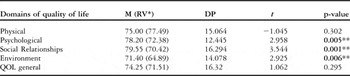
We characterised our patients on the basis of the several domains of the quality of life. Table 1 presents the values obtained for each of the domains, comparing them with the reference values obtained for a healthy Portuguese population – article from the psychometric studies using the WHOQOL-Bref Tool for the Portuguese PopulationReference Vaz Serra, Canavarro and Simão14 – using the one-sample “t”-test procedure.
Means and standard deviations for the four domains of quality of life and quality of life general.

DP = standard deviations; M = means; QOL = quality of life; t = degrees of freedom
*Reference values for the Portuguese population without disease
**p < 0.01
The congenital heart disease patients of our sample showed a better perception of quality of life for the psychological, social relationship, and environment domains, when compared with the healthy Portuguese population (Table 1).
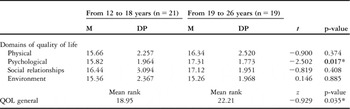
Regarding the demographic variables, our patients have shown differences in age for the psychological domain, with older patients presenting a better perception of quality of life (Table 2). No differences were found in the perceived quality of life between male and female patients in the sample.
Student's t-test for the four domains of quality of life and Mann–Whitney test for the general quality of life in different age groups.

DP = standard deviations; M = means; QOL = quality of life; t and z = degrees of freedom
*p < 0.05
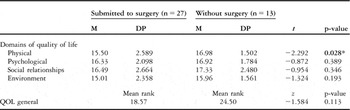
With regard to clinical variables, patients who were not admitted to surgery reported a better perception of quality of life for the physical domain (Table 3).
Student's t-test for the four domains of quality of life and Mann–Whitney test for the general quality of life according to the need for surgical intervention.

DP = standard deviations; M = means; QOL = quality of life; t and z = degrees of freedom
*p < 0.05
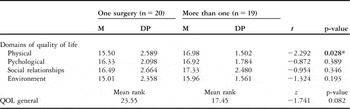
When we compare the quality of life among patients by considering the number of surgical procedures, and using one surgery as cutoff point (see Table 4), patients who were admitted to more than one surgery reported a worse quality of life for the physical domain as well.
Student's t-test for the four domains of quality of life and Mann–Whitney test for quality of life in general according to the number of surgeries.

DP = standard deviations; M = means; QOL = quality of life; t and z = degrees of freedom
*p < 0.05
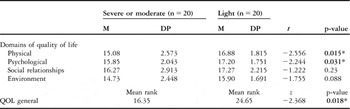
With regard to residual lesions, patients with severe-to-moderate lesions exhibited a worse perception of quality of life when compared with individuals with light residual lesion differences, for the physical and psychological domains and for the general quality of life (Table 5).
Student's t test for the four domains of quality of life and Mann–Whitney test for quality of life general according to severity of residual lesions.

DP = standard deviations; M = means; QOL = quality of life; t and z = degrees of freedom
*p < 0.05
No other clinical variable – presence or absence of cyanosis, severity of disease, and need for pharmacological therapy – showed any influence on the perceived quality of life in our congenital heart disease patients.
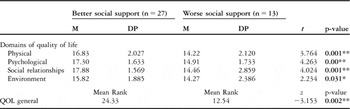
Finally, with regard to psychosocial variables – personal resources, family environment, and social support – differences in all quality of life domains could be found only for the social support variable, with individuals who had better social support reporting a better quality of life (Table 6).
Student's t-test for the four domains of quality of life and Mann–Whitney test for general quality of life according to different degrees of social support.

DP = standard deviations; M = means; QOL = quality of life; tand z = degrees of freedom
*p < 0.05; **p < 0.01
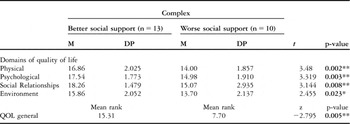
With regard to the considerable impact of social support on the quality of life shown by our congenital heart disease patients, we decided to further analyse the relationship between this variable and the severity of the disease. Thus, Table 7 shows that patients with complex congenital heart disease and a better social support presented a better perception of quality of life in every domain, highlighting once again the importance of this variable, social support, on the adaptation to the disease.
Student's t-test for the four domains of quality of life and Mann–Whitney test for quality of life general taking into account the influence of social support in congenital heart disease severity complex.

DP = standard deviations; M = means; QOL = quality of life; t and z = degrees of freedom
*p < 0.05; **p < 0.01
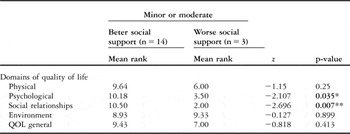
When the severity of congenital heart disease was minor to moderate, social support only influenced the psychological and social relationship domains, with patients with better social support having a better perception of quality of life in these domains (see Table 8).
Mann–Whitney U-test for the four domains of quality of life and the quality of life general taking into account the influence of social support in congenital heart disease severity minor or moderate.

QOL = quality of life; z = degrees of freedom
*p < 0.05; **p < 0.01
Discussion
An intriguing finding of our study is that our patients presented a better perception of quality of life for the psychological, social relationship, and environment scales, when compared with the healthy population. This may be striking, especially when we consider the severity of congenital heart disease and its symbolic impact on the patient and family. However, in previously conducted studies as well, congenital heart disease patients showed better or an identical quality of life as compared with the normal population.Reference Fekkes, Kamphuis and Ottenkamp12, Reference Moons, Van Devk and Marquet13
This resulting pattern can be probably explained by the mediating effect of several other factors, such as the family environment, social support, and personal resources. The fact that these patients require a significant amount of additional care as a consequence of their disease and its underlying implications gives rise to a protective and cohesive family environment that favours adaptation and acceptance of the disease, having a positive relationship with quality of life.Reference Goldbeck and Melches7, Reference Landolt, Buechel and Latal15 They may also be surrounded by efficient social resources, namely social support, health resources, and opportunities to acquire new skills, during different time periods, considering the limitations they may have.
Both family environment and social support have a strong influence over personal resources, namely in the coping dimension and in the subjective well-being.Reference Landolt, Buechel and Latal15, Reference Coelho and Ribeiro16 A positive family environment with high cohesion, good expressiveness, and little conflict within the family, as well as an efficient social support, makes it easier for the individual to develop coping mechanisms focused on problem solving and on the positive reassessment of events, functioning as a factor of adaptation to the disease,Reference Coelho and Ribeiro16 which contributes to a satisfactory quality of life. However, adverse family relationships and parental stress are negatively related to the psychosocial dimensions of quality of life;Reference Landolt, Buechel and Latal15, Reference Majnemer, Limperopoulos, Shevell, Rohlicek, Rosenblatt and Tchervenkov17 therefore, the side effects of cardiac diseases can be compensated by a socially integrated family environment, with enough resources to provide a better quality of life for patients.Reference Goldbeck and Melches7
Family environment and social support also have a strong impact on the patient's psychological adjustment. Previous studies stressed social resources as determinant factors for understanding the individual instability regarding the incidence of depressive symptoms and the reduction of disease-related distress.Reference Coelho and Ribeiro16
As far as demographic variables are concerned, older patients in our study presented a better perception of quality of life in the psychological domain. This finding is not consistent with data from other authors which suggests that older age is associated with a decrease in quality of life. These data are probably caused by rising concerns about the influence of congenital heart disease on matters such as employment, financial sustainability, and autonomy, as life goes on, leading to a stronger feeling of vulnerability.Reference Saliba, Butera and Bonnet18, Reference Ternestedt, Wall, Oddsson, Riesenfeld, Groth and Schollin19
A possible explanation for the inconsistency between our findings and those mentioned in the literature may be related to the fact that the age range in our study was restricted to adolescence and young adulthood; the younger patients were in adolescence, 12–18 years of age, a life stage characterised by irreverence and the will to experience new feelings, and focused on activities with the peer group and on the conquest of independence from parents. Congenital heart disease patients have some limitations, such as reduced physical ability, that prevent them from performing certain activities; therefore, they may present with lower self-esteemReference Saliba, Butera and Bonnet18, Reference Ternestedt, Wall, Oddsson, Riesenfeld, Groth and Schollin19 and a worse perception of quality of life for the psychological domain.
On the other hand, the patients’ vulnerability encourages their parents to adopt overprotective educational styles that limit their social experiences, resulting in an impoverishment of their quality of life when compared with their peer group,Reference Kamphuis, Ottenkamp and Vliegen8, Reference Uzark, Jones, Slusher, Limbers, Burwinkle and Varni20, Reference Daliento, Mapelli and Volpe21 which has an added importance in these age groups.
With regard to clinical variables, our findings show that the patients admitted to surgery presented a worse perception of quality of life for the physical domain when compared with those who had not been admitted to surgery. This association may be explained by the daily life restrictions and side effects that usually appear after the surgery and that limit physical performance, thus preventing physical activity.Reference Lane, Lip and Millane10 Yet, patients admitted to more than one surgery had a lower perception of quality of life in the same domain, physical, which can be explained by the fact that they feel more fragile because they need a greater amount of additional careReference Lane, Lip and Millane10 and experience a higher number of situations of pain and discomfort, as well as restrictions to their daily life activities, because of hospital admissions.
As far as the residual lesions are concerned, patients who had severe-to-moderate lesions had a worse perception of the general quality of life for the physical and psychological domains, when compared with individuals with light residual lesions. Other authors advocate that the severity of disease has a negative impact on the patients’ lives only when it is measured in terms of functional capacity.Reference Moons, Van Deyk and Marquet4 Patients with severe residual lesions are perhaps those who are functionally more compromised, whose daily routines are more limited, and are hence possibly invaded by negative feelings, low self-esteem, and frustration, which has implications on quality of life.
Finally, regarding psychosocial variables, which may function as compensatory mediating factors for the severity of disease, we have found that social support has a substantial positive influence in the perceived quality of life in every domain, and this variable is particularly important in the more severe congenital heart disease, a fact that is backed by literature.
Previously published papers state that the side effects of cardiac diseases can be compensated for by a socially integrated family environment.Reference Goldbeck and Melches7 Others explain that social resources are determinant factors for understanding the individual instability regarding the incidence of depressive symptoms and the reduction of disease-related distress.Reference Coelho and Ribeiro16 Social support, however, has a strong influence over personal resources, namely on the coping dimension and on the subjective well-being.Reference Coelho and Ribeiro16
Consistent with this hypothesis we found that, in spite of the complex severity of the cardiac disease, patients with good social support presented a satisfactory perception of quality of life. Social support, however, does not have the same impact on cardiac diseases with minor-to-moderate severity, although it still has a strong positive influence on the perceived quality of life in the psychological and social relationship domains. These findings allow us to assume that our congenital heart disease patients have an efficient social support system functioning as a compensatory factor for the severity of congenital heart disease and that social support also contributes to these patients developing internal mechanisms that allow them to face the adversities of the disease.
Conclusion
The congenital heart disease patients of our study had a better perception of quality of life for the psychological, social relationship, and environment domains compared with the general healthy population. Regarding the demographic variables, older individuals had a better perception of quality of life for the psychological domain. As far as the clinical variables are concerned, only severe and moderate lesions, and the need and greater number of surgical procedures, had a negative impact on the perceived quality of life for these patients.
Finally, it may be concluded that social support functioned as a resilience factor in the acceptance and adaptation to the disease, with a special contribution in cardiac diseases of higher severity.
Acknowledgements
This work was supported by a grant from CESPU – Cooperativa de Ensino Superior, Politécnico e Universitário.