


Introduction
Mental health literacy is a term used to describe an individual's understanding of various aspects of mental illness. This can include knowledge about early warning signs for common psychological disorders, or understanding treatment options. One important target of mental health literacy with regards to obsessive-compulsive disorder (OCD) is improving community awareness of the phenomenon of intrusive thoughts.
Cognitive theories of OCD argue that maladaptive appraisals of intrusive thoughts lead to a spiral into clinical disorder (Clark, Reference Clark2004) whereby individuals who judge intrusive thoughts to imply threat (Rachman, Reference Rachman1997) or responsibility (Salkovskis, Reference Salkovskis and Rapee1996) are likely to experience stress and anxiety, and act to control and suppress these thoughts, or circumvent feared outcomes. The Obsessive Compulsive Cognitions Working Group (OCCWG) identified Over-importance of Thoughts as one of the hallmark cognitive features of OCD. Many individuals with OCD believe that merely having a thought signals that the thought is important, particularly if that thought recurs (OCCWG, 2003, 2005). This can include the belief that the thought signals the individual's true desires or intentions (i.e. to cause harm) and is therefore revealing of hidden, but evil, personality traits (Teachman, Woody and Magee, Reference Teachman, Woody and Magee2006). It follows that if individuals are provided with corrective information about these processes they will be able to form a balanced interpretation of what might otherwise be a disturbing and worrisome experience. The provision of corrective psychoeducational information aims to address such maladaptive beliefs and appraisals as outlined in cognitive theories of OCD (Salkovskis, Reference Salkovskis and Rapee1996).
Three studies to date have explored the impact of information-giving on obsessive-compulsive related beliefs and symptoms. An experimental study in a sample of 156 undergraduate students by Teachman et al. (Reference Teachman, Woody and Magee2006) demonstrated that appraisals of intrusive thoughts could be modified by information. Participants were provided with information that intrusive thoughts were either: significant (indicative of their true values); meaningless; or neutral (no instruction). Results indicated that hearing information about the importance of intrusive thoughts led to stronger evaluations of the self as dangerous, with a stronger effect for individuals with higher levels of preexisting OCD beliefs. Interestingly, this result was only found for implicit appraisals as measured by a reaction-time task but not for explicit appraisals using a self-report measure.
Two other studies (Marino-Carper, Negy, Burns and Lunt, Reference Marino-Carper, Negy, Burns and Lunt2010; Zucker, Craske, Barrios and Holguin, Reference Zucker, Craske, Barrios and Holguin2002) have investigated the role of psychoeducation or corrective information on subsequent thought action fusion (TAF) beliefs in non-clinical samples. Both studies found that the provision of information was effective in reducing TAF beliefs. In addition, the study by Marino-Carper and colleagues found evidence that the changes in TAF occurred following information that provided specific corrective information about TAF as opposed to a group who received information about intrusive thoughts in general. The authors argue that this result suggests that targeted provision of information may act as a form of cognitive restructuring and therefore is associated with a greater reduction in TAF.
The aim of this study is to build on the existing literature (Marino-Carper et al., Reference Marino-Carper, Negy, Burns and Lunt2010; Teachman et al., Reference Teachman, Woody and Magee2006; Zucker et al., Reference Zucker, Craske, Barrios and Holguin2002) by investigating whether the provision of brief, targeted corrective information about the nature of intrusive thoughts can reduce faulty explicit appraisals of intrusions in a community sample. If faulty appraisals can be reduced this will provide further justification for the development of primary prevention programs, including mental health literacy campaigns, targeting intrusive thoughts. In addition, we will investigate the relationship between initial appraisals and obsessive-compulsive symptoms. It is hypothesized that:
-
1) Compared to those in the control condition, participants in the intervention condition who receive corrective information regarding intrusive thoughts will report lower levels of maladaptive interpretations at post-test.
-
2) Initial appraisal scores will have a moderate positive correlation with obsessive-compulsive symptoms.
Method
Participants
There were 148 participants (71% female) and 82% were aged between 18–29 years. Half of the sample (50%) were students, 27% were employed full-time, 18% part-time and 5% unemployed. In terms of education qualifications, 32% completed secondary school only, 50% had a Bachelor's degree, 6% a postgraduate degree and 12% had other training.
Procedure
Ethics approval was received from the School of Psychology and Speech Pathology at Curtin University. Recruitment of participants from the community occurred via the use of convenience sampling via an online survey. Individuals were directed to either intervention or control versions of the web-based survey through a random link mechanism; both groups read instructions for the survey, then completed symptom and appraisal measures. The intervention group then read the corrective information text, whereas the control group read the control text; following this, participants from both groups completed the appraisal measure again.
The instrument for this study was a brief corrective information text that was based on a longer psychoeducational text (Rees, Reference Rees2009), incorporating: the normalization of intrusive thoughts, the explanation that they do not reflect on character and morality, and the provision of an alternative explanation of intrusive thoughts. The control group was administered a neutral text of similar length, in order to counter any potential Hawthorne effect.
Measures
The Obsessive Compulsive Inventory- Revised (OCI-R; Foa, Sacks, Tolin, Prezworski and Amir, Reference Foa, Sacks, Tolin, Prezworski and Amir2002), an 18-item self-report scale, was implemented to measure OCD symptoms. A modified version of the 31-item self-report Interpretations of Intrusions Inventory [III] (OCCWG, 2003, 2005) was also implemented. The original scale asked participants to consider an intrusive thought they have had in the recent past, and respond to a set of statements about it. Our version provided participants with a vignette of an intrusive thought to consider, so overcoming prior difficulties noted with research participants recalling a recent past intrusion.
Results
Descriptive statistics and mean comparisons
No significant difference was found between the two groups using independent samples t-tests in terms of their pre-test scores on either the OCI-R (t = 1.24, p > .05) or III (t = .80, p > .05).
Correlation analysis
Spearman's rho (r s) was calculated in order to assess the relationship between symptoms and appraisals. There was a moderate, positive correlation between total OCI-R scores and III scores at pre-test (r s = 0.34, p < .001).
Repeated measures ANOVA
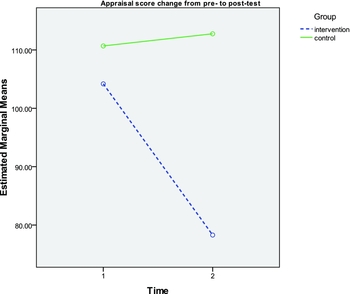
A one-way repeated measures ANOVA was conducted in order to examine whether there was a significant difference between participants in the intervention group and the control, in terms of change in appraisal scores from time one to time two. Significant main effects of group were found F(1,146) = 6.240, p = .014, partial η2 = 0.04 (0, 0.1); as well as for time F(1,146) = 23.19, p ≤ .001, partial η2 = .14 (0.06, 0.22). This analysis also detected a significant interaction effect for group and time F(1,146) = 32.0, p ≤ .001, partial η2 = 0.18 (0.09, 0.27). This interaction effect indicates that individuals in the intervention group experienced significant change in their appraisal scores from pre- to post-test and this was a large effect. This is because there was no significant difference at time one, while the intervention group experienced a significantly greater reduction than the control in the post-test condition as seen in Figure 1.
Change in mean appraisal scores by group, from pre- to post-test

Examination of demographic and methodological variables
In order to examine whether demographic and methodological variables meaningfully influenced appraisal scores, covariate analysis was conducted. Psychology student status did not produce a significant sr 2 value when entered into the main regression, nor a significant increase in r 2. This suggests that although psychology students reported lower post-test appraisal scores, the influence of this variable was spurious when shared variance with symptoms and appraisals was accounted for.
Discussion
The finding that providing participants with corrective information about intrusive thoughts was effective in reducing their maladaptive appraisals of those thoughts is in line with existing research. In the only other known study of this type, Teachman et al. (Reference Teachman, Woody and Magee2006) demonstrated that implicit appraisals of significance could be reduced by providing participants with information about the insignificance of intrusive thoughts. Our findings are consistent and further extend this finding as we found that the provision of information effected explicit appraisals of the significance of intrusive thoughts.
In demonstrating that psychoeducation can significantly reduce maladaptive appraisals of intrusive thoughts, the present study provides support for further investigation of the role of psychoeducation in the prevention of OCD. Also, the finding that there was a moderate, positive correlation between appraisals and symptoms makes a significant contribution to the extant literature surrounding cognitive theories of OCD. This result confirms existing research on the relationship between appraisals and symptoms, with both the direction and magnitude of the observed effect being similar to previous studies (OCCWG, 2003, 2005).
Despite a largely sound experimental design, there are some limitations. The nature of the sample and sampling technique may limit the internal and external validity of these results. Women comprised the majority of the sample, and a disproportionate number of participants had studied psychology. In addition, it is possible that results were affected by demand characteristics, such that participants in the intervention condition were aware of how they were “supposed” to respond to the thoughts. These biases are problematic, as they limit the extent the present findings can be said to represent the general population. The finding that a brief psychoeducational intervention was effective in reducing maladaptive appraisals of intrusive thoughts does, however, provide important support for future research to investigate whether psychoeducation can prevent OCD. Further studies utilizing additional measures of negative thought appraisal as well as studies including follow-up periods are warranted.




Comments
No Comments have been published for this article.