


A comprehensive study by Smits and Monden (Reference Smits and Monden2011) analyzed data from 76 countries (1987–2010), primarily in the developing world, to assess twin birth rates. Using Demographic and Health Surveys (DHS), the study found the lowest rates in Asia (6–9 per 1000 births) and the highest in Africa (over 18 per 1000 births), with Latin America exhibiting comparatively low and stable levels. An updated analysis by Monden et al. (Reference Monden, Pison and Smits2021) expanded the scope to 165 countries (2010–2015), reporting a global increase in twin birth rates from 9.1 to 12.0 per 1000 deliveries since the 1980s, corresponding to approximately 1.6 million twin pairs born annually. Twin birth rates increased in most regions, particularly in Europe, North America, and parts of Asia, where 74 of 112 countries experienced increases exceeding 10%. In contrast, rates remained low in South America and persistently high in Africa.
The rise in twin birth rates may appear paradoxical in the context of global fertility decline. However, it reflects a central feature of contemporary demographic transitions: the postponement of childbearing (Lee & Barclay, Reference Lee and Barclay2025). As births become increasingly concentrated at older maternal ages, when the probability of dizygotic (DZ) twinning is higher, a compositional shift occurs that elevates overall twin birth rates despite declining total fertility (Pison et al., Reference Pison, Monden and Smits2015). In addition, the expansion of assisted reproductive technologies (ART) has disproportionately increased the frequency of DZ twinning. In contrast, monozygotic (MZ) twin birth rates remain relatively stable across populations and maternal age groups over time and are generally considered to result largely from a random event (Beemsterboer et al., Reference Beemsterboer, Homburg, Gorter, Schats, Hompes and Lambalk2006; Bulmer, Reference Bulmer1970; Hall, Reference Hall2003; Hoekstra et al., Reference Hoekstra, Zhao, Lambalk, Willemsen, Martin, Boomsma and Montgomery2008). MZ twinning occurs when a single zygote splits during the early stages of embryonic development. Recent research has suggested a possible epigenomic component: Beck et al. (Reference Beck, Bruins, Mbarek, Davies, Boomsma, Khalil, Lewi and Lopriore2021) identified a stable DNA methylation signature in MZ twins that persists from conception into adulthood. However, it remains unclear whether these epigenetic marks play a causal role in the twinning event or instead arise as a consequence of the zygotic split.
Within this global context, Brazil represents a particularly informative case. The largest country in Latin America, both in territory (≈8.5 million km2) and population (≈212 million in 2024), Brazil exhibits marked regional socioeconomic inequalities. According to 2023 data from the Instituto Brasileiro de Geografia e Estatística (IBGE), Gross Domestic Product (GDP) per capita varies substantially across Brazilian regions, ranging from approximately R$27,700 in the Northeast and R$36,700 in the North to R$61,300 in the South, R$68,400 in the Southeast, and R$71,200 in the Central-West. The Human Development Index (HDI) follows a similar gradient, varying from about 0.702 in the North and Northeast to 0.757 in the Central-West, 0.777 in the South, and 0.780 in the Southeast. These structural disparities are highly relevant to demographic behavior, including patterns of multiple gestation.
Earlier Brazilian estimates of twin birth rates relied on the National Survey on Demography and Health (PNDS), a household survey comparable to DHS studies. While informative, sample-based surveys lack the precision of population-level administrative records. A more robust source is the Sistema de Informações sobre Nascidos Vivos (SINASC), a nationwide registry based on mandatory Live Birth Certificates that has provided near-complete annual coverage since 1994.
Using SINASC data, previous studies documented clear regional variation in twin birth rates. Analyses conducted by the Painel USP de Gêmeos [USP Twin Panel] Research Group between 2002 and 2013 (Otta et al., Reference Otta, de Souza Fernandes, Bueno, Dos Santos, Segal, Lucci, Ferreira, Cesar, David, Tatit, Short, Fernandes, Crispim, Moretto, Andrade, Corte, Tobo, Barrichello, de Sousa and Ribeiro2019; Varella et al., Reference Varella, Fernandes, Arantes, Acquaviva, Lucci, Hsu, David, Bussab, Valentova, Segal, Otta and Elito2019) found higher rates in more socioeconomically developed regions — Southeast (10.34‰) and South (10.06‰) — compared with the North (7.32‰) and Northeast (8.68‰), while the Central-West exhibited intermediate levels (9.05‰). Another study covering 2001–2014 reported a national mean twin birth rate of 9.41‰, increasing from 8.65‰ in 2001 to 10.15‰ in 2014 (Cardoso-dos-Santos et al., Reference Cardoso-dos-Santos, Boquett, Oliveira, Callegari-Jacques, Barbian, Sanseverino, Matte and Schuler-Faccini2018).
Regional disparities in Brazil extend beyond socioeconomic indicators to reproductive technologies and perinatal healthcare capacity. Data from SisEmbrio, compiled by the Agência Nacional de Vigilância Sanitária (ANVISA, 2024), indicate substantial growth in assisted reproductive technologies (ART) use. In vitro fertilization (IVF) cycles increased from 27,781 in 2014 to 43,098 in 2018 and exceeded 56,000 in 2023. ANVISA’s January 2026 report further documented a 10.2% increase in IVF pregnancies between 2020 and 2025 (+1,291 pregnancies). However, ART services were highly concentrated: in 2025 46.8% of IVF pregnancies occurred in the Southeast and 31.85% in the South, compared with 10.66% in the Midwest, 7.87% in the Northeast, and 2.78% in the North. This geographic concentration, combined with a higher prevalence of advanced maternal age in developed regions, likely contributes to regional differences in twin birth rates.
Perinatal healthcare capacity also varies substantially. The South and Southeast have greater availability of high-complexity obstetric services and Type III Neonatal Intensive Care Units (NICUs), which are essential for managing the elevated risks associated with twin pregnancies, including prematurity and low birth weight. Access to such services remains more limited in parts of the North and Northeast. Together, socioeconomic development, maternal age structure, ART utilization, and neonatal care capacity shape regional differences in twin birth rates and twin-specific infant survival. Beyond overall birth rates, the sex composition of births provides additional insight into reproductive dynamics and potential biological or environmental stressors.
The sex ratio at birth (male divided by total births: SRB = M/T) typically favors males (∼0.515), reflecting an evolutionary adaptation to offset higher male vulnerability (Trivers & Willard, Reference Trivers and Willard1973; Wells, Reference Wells2000). Male fetuses are biologically more susceptible to prenatal complications and diseases, resulting in higher rates of preterm birth and neonatal mortality (Drevenstedt et al., Reference Drevenstedt, Crimmins, Vasunilashorn and Finch2008; McCarthy, Reference McCarthy2019; Pongou, Reference Pongou2013; Murray et al., Reference Murray, MacKay, Stock, Pell and Norman2020; Wenstrom & Gall, Reference Wenstrom and Gall1988). Twin and higher order multiple births exhibit lower male biases, with triplets showing the lowest SRB (Bulmer, Reference Bulmer1970; James, Reference James1975). Male-male twins have the highest preterm birth rates, followed by opposite-sex twins, while female-female twins have the lowest rates (Buekens et al., Reference Buekens, MacGillivray, Campbell, Dramaix, Darquennes, Derom and Thiery1991; Cooperstock & Campbell, Reference Cooperstock and Campbell1996; Cooperstock et al., Reference Cooperstock, Bakewell, Herman and Schramm1998; Haghighi et al., Reference Haghighi, Najmi, Barzegar and Barzegar2013).
Study Objectives
This study provides a comprehensive analysis of birth rates and infant mortality rates in Brazil from 2010 to 2023, spanning national and regional levels. Our primary objective was to evaluate trends across singletons, twins, and higher order multiples, with specific stratification by maternal age and sex. Furthermore, we estimated temporal changes in the frequencies of MZ and DZ twin birth rates to distinguish between stable biological and shifting demographic drivers. We hypothesized that while MZ twinning rates would remain relatively constant, DZ twinning rates would show a significant temporal increase, reflecting the dual influence of delayed childbearing and the expanded use of ART.
Materials and Methods
Birth-rate data for singletons, twins, and higher order multiples among mothers residing in Brazil were derived from national health information systems maintained by the Brazilian Ministry of Health. Data were accessed through the Departamento de Informática do SUS (DATASUS) online platform and obtained from the Sistema de Informações sobre Nascidos Vivos (SINASC; Live Birth Information System http://tabnet.datasus.gov.br/cgi/tabcgi.exe?sinasc/cnv/nvuf.def) and the Sistema de Informações sobre Mortalidade (SIM; Mortality Information System http://tabnet.datasus.gov.br/cgi/tabcgi.exe?sim/cnv/inf10uf.def). These systems provide official, publicly available and anonymized data on live births and infant deaths, respectively, including information categorized by type of gestation (singleton, twin, or higher order multiple) and sex. Births with unknown gestational type were excluded from the analyses. The study period spanned from 2010 to 2023.
Statistical Analysis
Initial analyses of reproductive outcomes included the total number of live-born infants and infant deaths occurring within the first year of life between 2010 and 2023. Because the database records live-born infants rather than delivery events, the number of delivery events was estimated by dividing the number of live-born twin infants by two and the number of higher order multiple infants by three. This procedure assumes that the majority of higher order multiple deliveries consist of triplets, while quadruplet and higher order births are rare (Colletto et al., Reference Colletto, Segre, Rielli and Rosário2003; Otta et al., Reference Otta, Fernandes, Acquaviva, Lucci, Kiehl, Varella, Segal and Valentova2016). This approximation introduces negligible bias because quadruplet and higher order multiple births represent an extremely small proportion of all births and of higher order multiple deliveries in population-level datasets. The conversion allowed infant counts to be expressed as estimated delivery events. The estimated numbers of singleton, twin, and higher order multiple deliveries were then used to calculate delivery rates per 1000 live births (‰) according to the following formula:
Delivery rate (‰) = (Number of deliveries/Total live births) × 1000.
Expressing rates per 1000 live births is standard in demographic and epidemiological analyses of multiple births, as it facilitates comparisons across populations and time periods while maintaining sensitivity to relatively rare events such as twin and higher order multiple deliveries. The same denominator (total live births) was used for singleton, twin, and higher order multiple deliveries to ensure comparability across gestation types.
To calculate infant mortality rates (IMR) separately for singletons, twins, and higher order multiples, we calculated annual IMRs for each category. The IMR was defined as the number of infant deaths (deaths occurring before 1 year of age) divided by the number of live births in the corresponding category (singleton, twin, and multiples), multiplied by 1000
IMR = (Number of infant deaths/Number of live births) × 1000.
The sex ratio at birth (SRB) is defined as the number of male live births divided by the number of female live births. In addition, male-to-female mortality ratios were calculated to assess sex-specific differences in infant survival during the first year of life.
As an additional tool for within-pair analyses, we developed an algorithm to identify cotwins in the SINASC database. The procedure employed exact matching across a predefined set of key variables, linking records only when all selected fields were identical. The linkage process utilized several key matching variables: place of birth (LOCNASC), health establishment code (CODESTAB), municipality of birth (CODMUNNASC), and mother’s education level (ESCMAE). Additional criteria included the mother’s municipality of residence (CODMUNRES), infant’s date of birth (DTNASC), mother’s date of birth (DTNASCMAE), mother’s municipality of birth (CODMUNNATU), mother’s race/skin color (RACACORMAE), and maternal marital status (ESTCIVMAE). During the study period, 815,655 individual twin birth records were identified. Of these, 668,336 records were successfully paired with their corresponding cotwin, resulting in an individual-level linkage rate of 81.9%. The remaining 18.1% of records could not be linked, primarily due to missing or inconsistent data across the matching variables, which precluded an exact match.
To estimate the relative frequencies of DZ and MZ twin pairs, we applied Weinberg’s differential method. This method assumes a sex ratio of .5, and the sex ratio in Brazil (.496) closely meets this assumption. This approach draws on the sex composition of twin pairs and the underlying probability of male and female births in the general population. Specifically, the method first identifies the number of opposite-sex twin pairs, which are classified as DZ pairs. Given the approximately equal sex ratio, the number of same-sex DZ pairs is assumed to be equal to the number of opposite-sex pairs. By subtracting the estimated number of DZ pairs (same-sex + opposite-sex) from the total number of twin pairs, the remainder can be classified as MZ pairs. Weinberg’s rule has been shown to be a generally robust and reliable estimator for zygosity rates, particularly when large birth registry data are considered (Fellman & Eriksson, Reference Fellman and Eriksson2006).
Temporal variability in birth rates was assessed using Pearson correlations between calendar year and the number of births per 1000 live births, analyzed separately for singleton, twin, and higher order multiple births. Maternal age was categorized into eight groups (<15, 15–19, 20–24, 25–29, 30–34, 35–39, 40–44, and ≥45 years). Birth rates for each gestation type were stratified by maternal age group, and correlational analyses were conducted separately within each category.
To examine the influence of time period on birth rates according to gestation type, we fitted linear regression models with birth rate as the dependent variable and calendar year as the independent variable. Additionally, we fitted regression models to twin birth rates by calendar year stratified by zygosity, with DZ and MZ twin birth rates estimated using Weinberg’s differential rule.
Ethical Approval
Our research relied on anonymous and publicly available data, ensuring compliance with relevant guidelines without the need for ethical approval.
Results
Birth Patterns (2010–2023)
National trends in birth rates by gestation type. Figure 1 shows temporal trends in singleton, twin, and higher order multiple birth rates per 1000 live births (‰) in Brazil between 2010 and 2023. Across 39,663,928 live births, the mean birth rates were 989.33‰ for singletons, 10.49‰ for twins, and 0.17‰ for higher order multiples.
Temporal trends in birth rates per 1000 live births in Brazil for singletons, twins, and higher order multiples from 2010 to 2023.

Linear regression analyses were conducted to examine temporal trends in birth rates by gestation type. For singleton birth rates, the regression model indicated a significant decline over time, F(1, 12) = 242.32, p < .001, with an R 2 of .953. The singleton birth rate decreased by 0.119‰ per year (b = −0.119), indicating a a strong negative association with calendar year (r = −.978). In contrast, twin birth rates showed a significant increasing trend, F(1, 12) = 255.70, p < .001, R 2 = .955. The twin birth rate increased by 0.122‰ per year (b = 0.122), reflecting a very strong positive association with year (r = .982). Higher-order multiple birth rates exhibited a weaker temporal pattern. Although a slight decline was observed (b = −0.003‰ per year), the model explained substantially less variance (R 2 = .391), indicating that calendar year was a relatively weak predictor of higher order multiple birth rates (r = −.625).
Regional variation in birth rates by gestation type. Figures 2a–c illustrate regional variation in these patterns across Brazil’s five macroregions from 2010 to 2023. Twin birth rates were highest in the Southeast (11.64‰) and South (11.47‰), whereas the lowest rates were observed in the North (7.81‰) and Northeast (9.23‰); the Central-West showed an intermediate rate (10.31‰).
Temporal trends in birth rates per 1000 live births from 2010 to 2023 across the five macro-regions of Brazil (N = North, NE = Northeast, SE = Southeast, S = South, CO = Central-West) for (a) singletons, (b) twins, and (c) higher order multiples.

Across all macroregions, twin birth rates were strongly positively correlated with calendar year (North: r = .91; Northeast: r = .93; Southeast: r = .97; South: r = .93; Central-West: r = .91; all p < .001). Conversely, singleton birth rates were strongly negatively correlated with time in every region (North: r = −.91; Northeast: r = −.93; Southeast: r = −.98; South: r = −.92; Central-West: r = −.89; all p < .001). Higher-order multiple birth rates showed moderate negative correlations with time in four of the five regions (North: r = −.74; Northeast: r = −.74; Southeast: r = −.75; Central-West: r = −.74; all p < .001), whereas in the South the correlation was negative but did not reach statistical significance (r = −.35, p = .071).
Trends in birth rates by gestation type and maternal age. Table 1 presents Pearson correlation coefficients describing the association between calendar year (2010–2023) and birth rates, stratified by maternal age and gestation type. Positive coefficients indicate increasing birth rates over time, whereas negative coefficients indicate declining trends. Correlations were calculated for singleton and twin births but were not estimated for higher order multiple births, as the rarity of these events within specific maternal age strata would render the coefficients statistically unreliable and potentially misleading.
Pearson correlation coefficients (r) between time period 2010–2023 and birth rates stratified by maternal age categories for singletons and twins

Table 1 Long description
The table presents Pearson correlation coefficients (r) between the time period 2010-2023 and birth rates, stratified by maternal age categories for singletons and twins. The table has 2 rows and 8 columns. The row labels are Singletons and Twins. The column headers are Mothers' age <15, 15-19, 20-24, 25-29, 30-34, 35-39, 40-44, and 45+. Row 1: Singletons: Mothers' age <15, -0.95***; 15-19, -0.95***; 20-24, -0.95***; 25-29, -0.91***; 30-34, 0.19; 35-39, 0.90***; 40-44, 0.99***; 45+, 0.99***. Row 2: Twins: Mothers' age <15, -0.88***; 15-19, -0.91***; 20-24, -0.92***; 25-29, -0.79***; 30-34, 0.31; 35-39, 0.91***; 40-44, 0.98***; 45+, 0.91***. The table shows correlation coefficients indicating the association between calendar year and birth rates, with positive coefficients indicating increasing birth rates over time and negative coefficients indicating declining trends.
Note: ***denotes p values less than .001.
For singleton births, a clear divergence in temporal trends emerged around the age of 30 years. Mothers younger than 30 exhibited very strong and statistically significant negative correlations, with coefficients below −.90 (p < .001) across the <15, 15–19, 20–24, and 25–29 age groups. In contrast, mothers aged 35–39 (r = .90), 40–44 (r = .99), and 45+ (r = .99) showed strong positive correlations (all p < .001), indicating increasing birth rates over time in these age groups. The 30–34 age group showed only a weak and nonsignificant positive association with time (r = .19).
Twin births followed a broadly similar pattern. Significant declines were observed among mothers younger than 30, with the strongest negative correlation in the 20–24 age group (r = −.92, p < .001). Conversely, very strong positive correlations were observed among mothers aged 35–39 (r = .91), 40–44 (r = .98), and 45+ (r = .91), all p < .001, indicating increasing twin birth rates among older mothers over the study period.
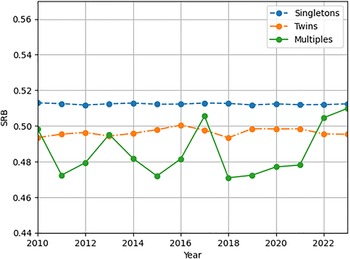
Sex ratio at birth by gestation type. The overall sex ratio at birth in Brazil between 2010 and 2023 was 0.512. A one-way analysis of variance (ANOVA) revealed a significant effect of gestation type on sex ratio, F(2, 81) = 37.78, p < .001, with a large effect size (η2 = .656). As shown in Figure 3, singleton births exhibited a consistent male bias (mean = 0.512), whereas twins showed a slightly lower male proportion (mean = 0.496). Higher order multiples (triplets) displayed the lowest male proportion (mean = 0.486) and the greatest variability. This pattern is consistent with the reduced male bias commonly observed in multiple gestations.
Sex ratio at birth (proportion of male live births) by gestation type (singletons, twins, and higher order multiples) in Brazil from 2010 to 2023.

Estimated DZ and MZ twin birth rates. The analysis of annual twin birth rates between 2010 and 2023 revealed distinct trajectories for MZ and DZ twins (Figure 4). Linear regression analyses indicated that both zygosity groups exhibited significant upward trends over the study period; however, the increase in DZ twin birth rates was substantially more pronounced. Specifically, the DZ birth rate increased at an estimated slope of .085 per 1000 births per year (R 2 = .846, p < .001), indicating that approximately 85% of the variance in annual DZ twin birth rates was explained by calendar year. In contrast, the MZ twin birth rate remained comparatively stable, showing only a modest annual increase of .024 per 1000 births (R 2 = .507, p = .004). Although this trend was statistically significant, the more moderate R 2 value indicates greater year-to-year variability around the regression line relative to the more consistent increase observed for DZ twin births.
Estimated monozygotic (MZ) and dizygotic (DZ) twin birth rates per 1,000 live births (2010–2023).

Infant Mortality Patterns (2013–2023)
National trends in IMR by gestation type. Between 2010 and 2023, a total of 464,843 infants died within the first year of life in Brazil. The IMR, calculated as deaths per 1000 live births, averaged 10.62 for singletons, 50.45 for twins, and 140.46 for higher order multiples, indicating substantially higher mortality among multiple births (Figure 5).
Temporal trends in infant mortality rates per 1000 live births among singletons, twins, and higher order multiples in Brazil from 2010 to 2023.

Linear regression analyses of IMR trends between 2010 and 2023 revealed distinct trajectories according to gestation type. For singletons, the model indicated a modest decline over time (slope = −0.06), with the regression explaining 43% of the variance in annual IMR (R 2 = .43). The decline was more pronounced among twins, with an estimated slope of −0.65 and a higher proportion of explained variance (R 2 = .69), indicating a more consistent downward trend in mortality in this group. In contrast, higher order multiples showed a smaller estimated decline (slope = −0.51) but extremely low explanatory power (R 2 = .03), indicating that the linear model accounted for very little of the year-to-year variation in this group’s highly unstable mortality pattern. A temporary decrease in mortality rates across all gestation types was observed in 2020, followed by an increase in subsequent years.
Regional differences in infant mortality rates. As shown in Figure 6, significant regional differences in IMR were observed for singletons (F[4, 135] = 29.74, p < .001), twins (F[4, 135] = 20.90, p < .001), and higher order multiples (F[4, 135] = 3.61, p = .008).
Temporal trends in infant mortality rates per 1000 live births among (a) singletons, (b) twins, and (c) higher order multiples across Brazilian regions.

Figure 6 Long description
Panel A: A line graph shows singleton mortality rates in Brazilian regions from 2010 to 2023. The x-axis represents the year, and the y-axis represents the mortality rate. The graph includes five lines representing different regions: N (blue dashed), NE (orange dashed), SE (green dotted), S (red solid), and CO (purple solid). The lines show varying trends with some fluctuations over the years. Panel B: A line graph displays twin mortality rates in Brazilian regions from 2010 to 2023. The x-axis represents the year, and the y-axis represents the mortality rate. The graph includes five lines representing different regions: N (blue dashed), NE (orange dashed), SE (green dotted), S (red solid), and CO (purple solid). The lines show varying trends with some fluctuations over the years. Panel C: A line graph illustrates multiple mortality rates in Brazilian regions from 2010 to 2023. The x-axis represents the year, and the y-axis represents the mortality rate. The graph includes five lines representing different regions: N (blue dashed), NE (orange dashed), SE (green dotted), S (red solid), and CO (purple solid). The lines show varying trends with some fluctuations over the years.
For singletons, IMR was highest in the North (13.33) and Northeast (11.87), and lowest in the South (8.94) and Southeast (9.52), with the Central-West showing intermediate levels (10.57). Twin IMR, which was approximately five times higher than that of singletons, followed a similar geographic pattern, with the highest rates in the North (64.36) and Northeast (59.07), and lower rates in the Southeast (44.63), South (46.25), and Central-West (48.62). Infant mortality among higher order multiples was even higher, reaching values roughly three times those observed for twins. The highest rates were recorded in the North (183.92) and the lowest in the Southeast (128.08), while the South (144.18), Central-West (149.46), and Northeast (146.93) exhibited intermediate values.
Male-to-female infant mortality rates by gestation type. As shown in Figure 7, male-to-female infant mortality rates varied across gestation types. Among singletons, the rates remained relatively stable, ranging from 1.24 to 1.32, with a slight downward trend in recent years. Twin rates fluctuated more widely (1.09–1.27), with occasional peaks across the study period. Higher order multiples exhibited the greatest variability, with rates occasionally falling below 1.0 (e.g., 2012 and 2020) and reaching peaks in 2016. Overall, male infants consistently experienced higher mortality than females across gestation types; however, the magnitude and variability of this disparity were greatest among higher order multiples.
male-to-female infant mortality rates in singleton, twin, and multiple births over the years.

Discussion
This study provides a comprehensive analysis of temporal, regional, and demographic patterns in singleton, twin, and higher order multiple births in Brazil from 2010 to 2023, based on a national dataset including nearly 40 million live births. Several key findings emerge. Twin birth rates increased significantly over the study period, whereas singleton birth rates declined and higher order multiple births remained rare and relatively stable. Clear regional disparities were observed, with the highest twinning rates in the South and Southeast, intermediate levels in the Central-West, and the lowest rates in the North and Northeast. In addition, birth rates declined steadily among younger women, particularly those under 30 years of age, while increasing among women aged 35 years and older, indicating a shift in childbearing toward later reproductive ages. Finally, multiple gestations were associated with substantially higher infant mortality, especially among higher order multiples, and a consistent male disadvantage in infant survival was observed across gestation types.
Twin birth rates increased from 9.53 per 1000 deliveries in 2010 to 11.31 per 1000 in 2023, extending a pattern previously documented in Brazil (Cardoso-dos-Santos et al., Reference Cardoso-dos-Santos, Boquett, Oliveira, Callegari-Jacques, Barbian, Sanseverino, Matte and Schuler-Faccini2018; Monden et al., Reference Monden, Pison and Smits2021; Santana et al., Reference Santana, Souza, Surita, Argenton, Silva and Cecatti2018; Smits & Monden, Reference Smits and Monden2011; Varella et al., Reference Varella, Fernandes, Arantes, Acquaviva, Lucci, Hsu, David, Bussab, Valentova, Segal, Otta and Elito2019). Earlier global analyses reported that Brazil’s twin birth rate rose from 8.5 per 1000 deliveries in the early 1980s to 9.5 per 1000 by 2015 (Monden et al., Reference Monden, Pison and Smits2021). The present findings indicate that this upward trajectory has continued into the most recent decade.
The increase in twin birth rates in Brazil mirrors broader international trends associated with delayed childbearing and the expanded use of medically assisted reproduction (Monden et al., Reference Monden, Pison and Smits2021; Pison et al., Reference Pison, Monden and Smits2015). Age-specific patterns observed in this study support the importance of delayed motherhood: birth rates declined among younger women while increasing steadily among women aged 35 years and older. Because advanced maternal age is strongly associated with increased dizygotic twinning through hormonal mechanisms that raise the likelihood of multiple ovulation (Beemsterboer et al., Reference Beemsterboer, Homburg, Gorter, Schats, Hompes and Lambalk2006; Hoekstra et al., Reference Hoekstra, Zhao, Lambalk, Willemsen, Martin, Boomsma and Montgomery2008), this demographic shift likely contributed to the observed rise in twin births.
The distinct trajectories observed for MZ and DZ twin birth rates, estimated using Weinberg’s method, further support this interpretation. Although both showed statistically significant increases, the rise in DZ birth rates was considerably more pronounced, whereas MZ rates remained comparatively stable. This pattern aligns with the long-standing view that MZ twinning occurs largely at random and is less influenced by maternal age or environmental factors (Bulmer, Reference Bulmer1970; Hoekstra et al., Reference Hoekstra, Zhao, Lambalk, Willemsen, Martin, Boomsma and Montgomery2008). In contrast, DZ twinning is strongly associated with maternal age, parity, and the use of assisted reproductive technologies (Pison et al., Reference Pison, Monden and Smits2015; Reynolds et al., Reference Reynolds, Schieve, Martin, Jeng and Macaluso2003). Although direct data on fertility treatments were unavailable in this study, the rising estimated DZ birth rate is consistent with the expanding availability of assisted reproductive technologies in Brazil.
Regional variation in twin birth rates likely reflects differences in socioeconomic conditions, maternal age distribution, and access to reproductive technologies. Higher rates in the Southeast and South, Brazil’s most economically developed regions, may be associated with older maternal age profiles and greater access to fertility treatments and specialized reproductive services. In contrast, lower twin birth rates in the North and Northeast may reflect younger maternal age distributions and more limited access to assisted reproduction. Similar geographic variation has been documented internationally (Smits & Monden, Reference Smits and Monden2011).
Sex ratios at birth also varied by gestation type, with the strongest male bias among singletons and progressively lower male proportions among twins and higher order multiples. This pattern is widely reported and is generally attributed to greater male vulnerability during prenatal development. Male fetuses tend to be more susceptible to adverse intrauterine conditions, which may increase fetal loss in multiple gestations and reduce the proportion of males among surviving births (Lee et al., Reference Lee, Andrade, Kim and Anumba2025; Voskamp et al., Reference Voskamp, Peelen, Ravelli, van der Lee, Mol, Pajkrt and Kazemier2020).
Infant mortality analyses revealed substantial disparities by gestation type. Infant mortality rates among twins were approximately five times higher than those among singletons, while rates among higher order multiples were markedly higher still. These findings are consistent with the well-documented risks associated with multiple pregnancies, including prematurity, low birth weight, and neonatal complications (Lee et al., Reference Lee, Andrade, Kim and Anumba2025; Voskamp et al., Reference Voskamp, Peelen, Ravelli, van der Lee, Mol, Pajkrt and Kazemier2020). Nevertheless, declining mortality trends among singletons and twins suggest gradual improvements in maternal and neonatal care during the study period. The more variable patterns observed among higher order multiples likely reflect the rarity of these births and the statistical fluctuations inherent in small sample sizes.
Regional disparities in infant mortality mirrored broader patterns of health inequality within Brazil. Higher mortality rates in the North and Northeast, compared with the South and Southeast, are consistent with longstanding differences in socioeconomic development, healthcare infrastructure, and access to specialized neonatal services (Almeida & Szwarcwald, Reference Almeida and Szwarcwald2012; Victora et al., Reference Victora, Barreto, do Carmo Leal, Monteiro, Schmidt, Paim, Bastos, Almeida, Bahia, Travassos, Reichenheim and Barros2011). Such inequalities likely have disproportionate consequences for high-risk pregnancies, including multiple gestations, which require more intensive obstetric and neonatal care (França et al., Reference França, Restrepo-Méndez, Maia, Victora and Barros2016). Since its establishment in 1990, Brazil’s Unified Health System (Sistema Único de Saúde [SUS]) has expanded healthcare access to nearly the entire population (Castro et al., Reference Castro, Massuda, Almeida, Menezes-Filho, Andrade, de Souza Noronha, Rocha, Macinko, Hone, Tasca, Giovanella, Malik, Werneck, Fachini and Atun2019). This system likely contributed to the overall decline in infant mortality observed in this study, although the persistent regional disparities suggest that specialized services such as neonatal intensive care remain unevenly distributed.
Sex-specific analyses further showed that male infants experienced higher mortality rates than females in both singleton and twin gestations, a pattern consistent with the well-documented ‘male disadvantage’ in early-life survival (Drevenstedt et al., Reference Drevenstedt, Crimmins, Vasunilashorn and Finch2008; Wells, Reference Wells2000). Greater male vulnerability may also contribute to the lower male proportions observed among multiple births, as adverse intrauterine conditions and prematurity disproportionately affect male fetuses and newborns.
Several limitations should be considered when interpreting these findings. First, the estimation of MZ and DZ birth rates relied on Weinberg’s indirect method rather than biological confirmation of zygosity. Second, the dataset lacked individual-level variables such as parity, socioeconomic status, and the use of assisted reproductive technologies, all of which are known to influence multiple birth patterns. Third, because higher order multiples are rare events, analyses involving these groups are more susceptible to random fluctuations.
Despite these limitations, the study benefits from an exceptionally large and nationally representative dataset comprising nearly 40 million live births. This scale provides substantial statistical power to identify temporal and regional patterns in multiple births across Brazil. The findings illustrate how demographic changes, particularly delayed childbearing and access to reproductive technologies, are shaping contemporary multiple birth trends while highlighting the persistent health risks and regional inequalities associated with multiple gestations.
Conclusion
Between 2010 and 2023, twin birth rates in Brazil increased, reflecting significant shifts in reproductive behavior. While MZ rates remained stable, the rise in DZ births aligns with global trends linked to delayed childbearing and the expansion of assisted reproductive technologies. Marked regional variations further suggest that these trends are influenced by disparate maternal age distributions, socioeconomic conditions, and access to healthcare. Despite these demographic transitions, multiple gestations continue to present substantially higher risks of infant mortality, with a persistent male disadvantage in early-life survival, underscoring the importance of large national registries for monitoring perinatal outcomes and informing public health policy.
These findings suggest several potential avenues for further investigation into Brazilian reproductive dynamics. First, more precisely delineating the contribution of ART to shifting twin rates is essential. As the current lack of integrated databases hinders the direct identification of ART-related pregnancies, linking clinical registries with national health information systems could offer more nuanced estimates. Such integration would also enhance the monitoring of gestations requiring specialized care within the Brazilian Unified Health System (SUS).
Additionally, longitudinal research into reproductive trajectories associated with delayed motherhood is warranted. Studies incorporating socioeconomic and behavioral variables may clarify how evolving fertility patterns influence twinning — a critical consideration for public health planning, given the associated risks of prematurity and neonatal complications. Finally, future research should examine the long-term outcomes of children from multiple gestations, specifically how developmental trajectories and lifelong health may be mediated by social inequalities. Such a multidimensional approach would broaden the understanding of the population-level implications of the increasing prevalence of twin pregnancies in Brazil.