Approximately 80 percent of American cities today hold their general elections on days other than national Election Day—the first Tuesday after the first Monday in November of even-numbered years. Voter turnout in most city elections is consistently low, usually less than 35 percent of registered voters, and yet turnout in the average city would more than double if its elections were simply rescheduled to coincide with national elections.Footnote 1 Recent work also suggests that the lowering of voter turnout that accompanies off-cycle election timing enhances the influence of organized interest groups in elections.Footnote 2 Why, then, do the vast majority of American local governments hold off-cycle elections?
Existing work suggests that the modern American local election schedule has its origins in the Progressive Era, when municipal reformers promoted a number of institutional changes designed to undermine the electoral dominance of urban political machines.Footnote 3 As of 1890, centralized machines controlled half of the twenty largest cities in the United States.Footnote 4 Even in cities where the dominant party did not have centralized control, it was common practice for party leaders to reward loyal voters and businesses with city patronage and contracts. In an attempt to loosen the grip of machine politics on American government, Progressive Era municipal reformers promoted institutions such as nonpartisan elections, commission and council-manager government, direct primaries, and at-large elections. Off-cycle election timing is sometimes mentioned as one of the institutions they endorsed.
Still, in spite of the fact that off-cycle election timing became the norm in American local government as a result of this movement and is a major contributor to low voter turnout in modern local elections, its origins have received little scholarly attention. Why did reformers insist on separating local elections from state and national elections?
Scholars disagree about what the general motives of the Progressive reformers actually were, but regardless of whether they truly wanted good government or simply sought to promote the interests of the white middle and upper classes,Footnote 5 they had to win city elections. As of the 1890s, they had rarely been successful in doing so. Thus, one of the main points of consensus that emerged from the gathering of the National Municipal League in 1894 was that the simultaneous holding of city, state, and national elections worked to the advantage of the machines, which were local organizations of the major parties. It was argued that the major parties won city offices easily when the elections were on the same day as state and national elections, purely because of their popularity in state and national politics. Delegates such as Frank J. Goodnow suspected that the election dates of many large cities had been changed from the spring to the autumn months “at the behest of the parties, which felt that with the two elections at the same time they stood a better chance to get control of the city government because state and city issues would be confused.”Footnote 6
The National Municipal League's decision to promote off-cycle city election timing therefore preceded by several years the league's endorsement of nonpartisan ballots and commission government. Moreover, the delegates accused the major political parties of having manipulated city election timing to their advantage. This suggests that by 1894, city election timing already had a history of being manipulated, a history that has not been explored in the political science literature. In fact, aside from studies of individual cities, which occasionally mention the dates of city elections, we do not even have basic information about when cities held their elections prior to the 1930s.
In this paper, I start by developing a theoretical framework that identifies the main considerations that should factor into a group's preferences for on-cycle or off-cycle local elections. First, when two groups work at cross-purposes in an election, the potential for a certain election schedule to help one group secure an electoral edge over the other depends on the group loyalties of voters who only participate in local elections when they are held concurrently with state and national elections. Second, a group's election timing preference should depend on which group has greater organizational capacity, because the low turnout that results from off-cycle election timing enhances the influence of the group that is better equipped to mobilize voters. Lastly, because the local election schedule in the nineteenth century could affect interparty and intraparty coordination, parties' decisions to favor on-cycle or off-cycle local elections should have depended on whether there were threats from intraparty factions or efforts by multiple parties to fuse their tickets. These three considerations describe why party elites might have been motivated to change the local election schedule, but ultimately, success in making such a change in the nineteenth century depended on having a friendly government at the state level.
I use this theoretical framework to analyze party competition over election timing in American cities during the nineteenth century. Because there is no existing dataset with information on when cities held elections during this period, I have collected data on the timing of elections for three major American cities—New York, San Francisco, and Philadelphia—for the whole of the nineteenth century. The data collection effort revealed that city election schedules were altered at least three times in each city prior to 1900. Thus, in spite of the fact that city election timing is rarely discussed in studies of nineteenth-century politics, election timing manipulation was a common event, occurring at a frequency close to what one would expect on the basis of the parameters I identify in the theoretical framework. I also demonstrate that even in the 1800s, delinking city elections from national and state elections decreased voter turnout in city elections. Using a combination of historical narrative and quantitative analysis of city election data, I then show that the political actors who combined and separated city elections from state and national elections did so with an expectation that they would realize electoral gains from the switch.
This study is important because it demonstrates that the manipulation of election timing was a regular feature of political party strategy in the nineteenth century, and one that has largely been overlooked by existing work. At the dawn of mass political party organization, as restrictions on white male suffrage crumbled and party elites sought patronage to build their organizations, election timing manipulation emerged as one way to exert some control over the electorate. By changing the time at which city elections were held, party elites could increase or decrease the number of voters who participated in city elections, potentially tipping the balance of party vote share in their favor. This finding lends support to the claim that even in the early nineteenth century, political parties were organized to win elections, and they actively worked to create electoral rules that helped them do so.Footnote 7 Not only did election timing have a role in shaping the American party system, but the parties, in turn, had a role in shaping electoral institutions.
Furthermore, this paper contributes to the literature by providing a richer historical account of an electoral institution that has been shown to have consequences for election outcomes today. The manipulation of election timing, although commonly credited to the Progressive reformers, actually has much deeper roots. By promoting off-cycle city elections, municipal reformers were using a well-worn political party strategy to increase their chances of winning elections. As we evaluate the merits of off-cycle local election scheduling today, it is thus appropriate to think of it not only in terms of the high-minded rhetoric espoused by the municipal reformers, but also as the lasting achievement of strategic politicians who, a hundred years ago, wanted to write the rules to improve their chances of winning.
1. LITERATURE
In the United States today, local government elections tend to attract far fewer voters to the polls than elections for president or governor.Footnote 8 Much of this trend has to do with the timing of local elections, meaning whether they are held on the same day as state and national elections or on different days: most local elections in the United States are held off-cycle, and it is well established that voter turnout in off-cycle elections is far lower than turnout in on-cycle elections.Footnote 9 Although the near-consensus in the American politics literature is that low voter turnout does little to affect the outcomes of elections,Footnote 10 almost all studies that draw such conclusions examine voters and nonvoters in presidential and congressional elections—when turnout is at its highest.Footnote 11
Moreover, a developing body of evidence suggests that the low turnout that comes with off-cycle local election timing does affect the composition of the electorate. Dunne, Reed, and Wilbanks and Berry and Gersen argue that when elections are held off-cycle, the voters who stand to benefit most from the election outcome make up a greater proportion of the electorate.Footnote 12 In separate work, I have argued that off-cycle elections enhance the ability of organized interest groups to affect election outcomes, both because interest group members with a large stake in the election outcome cast a greater proportion of ballots, and because interest groups' efforts to strategically mobilize supportive voters are more likely to tip the election outcome when turnout is low.Footnote 13 These latter studies show that school district policies are more favorable to teacher unions in districts that hold nonconcurrent elections, consistent with the argument that organized interest groups have greater influence when elections are off-cycle.Footnote 14
If the timing of elections has consequences for election outcomes and policy, one would expect political actors to clash over election scheduling. However, there is very little existing work on the origins of election schedules in the United States. There is some evidence that state and local politicians strategically schedule tax and bond referenda off-cycle or on-cycle depending on whether a low-turnout or a high-turnout electorate would be more likely to approve the measure.Footnote 15 Referenda aside, however, most local governments throughout the history of the United States have not had a great deal of flexibility in choosing a date for the election of their public officials. For most local governments, the timing of elections is decided at the state level,Footnote 16 and for those that do have discretion over when to hold elections, most are limited in how often and how easily they can change their election dates.
Both Bridges and Trounstine have given some attention to this question, and they explain that off-cycle election timing was one component of a package of institutional changes promoted and successfully implemented by Progressive Era municipal reformers. They argue that this package of reform-style institutions, which included nonpartisan elections, commission and council-manager government, and at-large elections, was crafted by reformers to weaken the influence of immigrants and the lower classes—groups that typically constituted a core constituency of the urban machines.Footnote 17 Trounstine as well as Bridges and Kronick suggest that the reformers' motivations were not all that different from those of party bosses: they wanted to win elections, and they were willing to tweak the rules to do so.Footnote 18
However, this literature makes only limited mention of local election timing, and there are several reasons to study the origins of the modern election schedule more closely. First, the National Municipal League widely promoted the separation of city elections from state and national elections several years before the nonpartisan ballot and commission government worked their way onto the reform agenda. This suggests that by 1894, city election timing already had a track record of being manipulated for political gain. However, the literature on nineteenth-century city politics rarely discusses changes to city election timing as politically interesting features of the landscape, if it discusses them at all.Footnote 19 Moreover, at least by appearances, the reformers' advocacy of off-cycle elections in the 1890s had as much to do with political parties as it did with class or ethnicity. Reformers complained that the reason they had so much trouble electing their own municipal party candidates to local office was that local elections, concurrent with national elections, were dominated by the national political parties. Thus, at least in part, they advocated off-cycle city elections as a way to help their candidates compete with the national parties.
2. A THEORETICAL FRAMEWORK
In this section, I develop a theoretical framework that explains why we should expect political groups to invest effort in securing and maintaining favorable local election timing. The framework builds on an existing idea, which is that in modern American politics, off-cycle election timing tends to enhance the electoral influence of the largest and best organized interest groups active in elections.Footnote 20 In nineteenth-century city politics, of course, there were few special interest groups in the way that we think about them today, as groups outside government that pursue their policy aims by lobbying elected officials and endorsing and contributing funds to candidates. Rather, the organized groups involved in nineteenth-century city politics were political parties, and their competition was zero-sum.
Typically, the dominant group in city contests was one of the major national parties, but major party factions, state and national third parties, and municipal parties were also active competitors for city offices. For purely municipal parties, such as urban reform parties, gaining control of city government was necessary for controlling city policy. The stakes for state and national parties were high as well, although for different reasons: starting in the 1830s, the major political parties were structured as hierarchies with sub-organizations at the state, county, city, district, and precinct levels, and the spoils of office helped party leaders hold those hierarchies together.Footnote 21 As urban populations grew throughout the nineteenth century, cities became increasingly important to national political parties as sources of votes and sources of patronage.Footnote 22 Therefore, control of city governments gave the parties patronage that they could use to strengthen their larger organizations, which helped them win state and national elections.
The core argument of this paper is that the timing of city elections was as important in the nineteenth century as it is today and that, when possible, political parties manipulated city election timing for electoral gain. I specify three considerations that, I argue, shaped a political party's preference for on-cycle or off-cycle city election timing. The first two considerations are as relevant today as they were in the nineteenth century: First, a group's election timing preference should depend on whether it has a stronger organizational capacity at the local level than its main competitor. Second, it should depend on the loyalties of voters who vote in local elections only if they are held on the same day as state and national elections. The third consideration, which became less important after the nineteenth century, was that election timing could exacerbate or lessen interparty and intraparty coordination problems. I elaborate on each of these conditions below.
Consider a simplified scenario in which two political parties, Party A and Party B, compete for city office. Assume that Party A has greater organizational resources at its disposal than Party B, which we can take to mean that Party A has greater financial resources, a larger network of members who volunteer to get out the vote, or a more disciplined set of ward organizations. By lowering turnout, off-cycle election timing creates an advantage for whichever group is better equipped to mobilize voters, because each supportive voter successfully mobilized by a party increases the vote share of that party by a greater amount when overall turnout is low. In terms of its capacity to mobilize voters, therefore, Party A stands to win greater vote share under off-cycle elections than it would under on-cycle elections,Footnote 23 and based on this dimension alone, we would expect Party A to favor off-cycle election timing.
Separating local elections from state and national elections also demobilizes voters whose interests lie primarily in state and national politics: many voters who cast a vote in local races when they are held on the same day as state and national races abstain from voting when local elections are held on an entirely different day. Throughout this paper, I refer to these voters as State and National Voters. Assume that the difference in the proportion of voters who favor Party B over Party A is greater among State and National Voters than among the voters who turn out in local elections regardless of timing. Then, Party B stands to win greater vote share in on-cycle elections than in off-cycle elections. In that case, Party A prefers off-cycle city elections both because State and National Voters do not vote and because it can dominate the smaller electorate by mobilizing more supportive voters. In other words, both conditions imply that Party A's vote share will be greater under off-cycle elections. Party B, on the other hand, prefers the on-cycle arrangement because it will bring the supportive State and National Voters to the polls and because it is organizationally weaker than Party A.
If Party A is the dominant organizational force in the local polity and commands a larger percentage of support from State and National Voters than from the voters who vote in local elections regardless of timing, its preferences over the election schedule are mixed. Party A leaders might favor off-cycle election timing if they anticipate that the party could win greater vote share by controlling the small, off-cycle electorate and closing the floodgates to State and National Voters. However, if the participation of State and National Voters would bring fairly certain victory to the party, then on-cycle elections might be the less costly path to success, considering that to mount a mobilization effort, the party has to spend scarce financial resources and make demands on its membership. Likewise, Party B's election timing preference depends on the relative size of its vote share in off-cycle versus on-cycle elections. If Party B is likely to lose under either scenario, it might prefer off-cycle elections, which at least forces Party A to use up its resources to get out the vote.
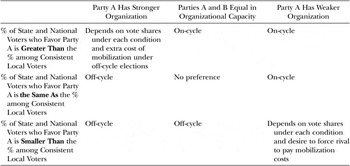
Table 1 summarizes the predictions for the election timing preferences of Party A on the basis of these first two considerations. The vertical dimension characterizes the preferences of State and National Voters, and the horizontal dimension depicts the strength of Party A's organizational capacity relative to that of Party B. In the middle category, where the parties are equally well organized and equally favored by State and National Voters, Party A is indifferent to the timing of elections. Wherever Party A is either weaker than or equal to Party B in organizational capacity but favored by State and National Voters, Party A prefers on-cycle elections. In cases where Party A is stronger than or equal to Party B in organizational capacity and not favored by State and National Voters, Party A favors off-cycle elections. When Party A's vote share among State and National Voters is equal to its vote share among consistent local voters, it favors an on-cycle election when it is organizationally weaker and an off-cycle election when it is organizationally stronger. Party A's election timing preference in the situations depicted in the top left and bottom right corners depends on the certainty and extent of success expected under each schedule.
Local Election Timing Preferences of Party A

Both of these general dimensions fit nicely into the highly partisan context of nineteenth-century city politics. First, the participation of State and National Voters could affect the parties' vote shares in a way that was likely observable and predictable by party leaders: most voters at that time had strong ties of loyalty to one or the other of the major national political parties, and the parties that competed in state and national elections also competed in most local elections. Furthermore, the balloting system encouraged straight-ticket voting: political parties printed their own ballots on strips of paper that contained only the names of their candidates, and most Americans voted by simply depositing the ballots of their preferred party into boxes at their polling place.Footnote 24 It is therefore safe to assume that State and National Voters generally voted for the municipal candidates of the same party that commanded their loyalty at the level of state and national politics. If so, then party leaders would be able to roughly approximate the impact of State and National Voter participation on their vote shares by comparing their shares in off-cycle city elections to their city-level vote shares in state and national elections.Footnote 25
The horizontal dimension of the framework is more difficult to capture empirically but likely still factored into parties' considerations of whether they would fare better under on-cycle or off-cycle elections. The dimension can depict the balance of organizational power between any two types of parties, whether they are the two major national parties, a dominant party with a centralized machine versus a reform party, two local parties, or some other combination of groups. For example, the major national parties might be relatively balanced in their ability to get out the vote for their respective slates of city candidates, or one party might command a more disciplined army of precinct and ward workers and thus be able to turn out more supporters on city election day. Notably, a defining characteristic of most machines was that they were dominant in organizational capacity relative to opposition parties.Footnote 26
In the nineteenth century, there was also a third consideration that could shape the political parties' preferences over election schedules. Prior to the wave of anti-fusion laws passed around the turn of the century, it was possible for two or more political parties to unite behind a single slate of candidates.Footnote 27 Most often, fusion was a strategy employed by weaker parties to put forth a unified opposition to the dominant party. However, parties' willingness to fuse depended on the timing of the local elections: when elections were held on different days than state and national elections, weaker parties were usually eager to combine their efforts in order to defeat the dominant party. However, when city elections were held on the same day as a presidential or gubernatorial election, parties that fielded candidates in those larger races were reluctant to combine efforts with other parties for fear that sharing a slate of local candidates would undermine their local organization— and thereby their state and national candidates.Footnote 28 As a result, on-cycle election timing decreased the likelihood of fusion among opposition parties.
Furthermore, the dominant party benefited from the on-cycle schedule because it minimized the risk of intraparty factionalism. When the presidency or the governorship was at stake, a dominant party faction would think twice before running its own candidate against the main dominant party candidate, because the party split might carry over to state and national races. The same could be true of third-party efforts as well: a local party whose members were, for example, strongly Republican in state and national races would be reluctant to run a separate slate of candidates in local elections if those elections were held on-cycle. For these reasons, the concurrence of city, state, and national elections had the potential to affect the nature of party competition in local elections—which parties would fuse, which factions would run separate slates of candidates, and which third parties would emerge on the local scene.
Thus far, I have focused on the conditions under which we should expect political parties to have had incentive to change city election timing, but to make predictions about when election timing changes should have occurred, it is necessary to specify how city election timing was actually changed during this period. Even more so than today, before the home rule movement of the late nineteenth and early twentieth centuries, it was the state government that had the authority to determine the timing of municipal elections. Throughout the nineteenth century, state governments set precise bounds for what city governments could and could not do, and they did so using special legislation—laws designed to apply to specific localities—rather than by the passage of general laws that applied uniformly to all localities in the state.Footnote 29 Therefore, in order for city political leaders to secure favorable election timing laws, they had to have the support of the state legislature and governor. Moreover, state officials could meddle with city election timing if the controlling party in the state wished to do so. Therefore, local incentives to alter election timing were not sufficient for election timing to be changed. To successfully change a city's election timing, the political party desiring the change needed to have the support of the state government.
3. EMPIRICAL STRATEGY
My first goal for the empirical analysis is simply to describe when cities held elections during the nineteenth century. Second, if there were cases in which the timing of city elections was changed, what process produced that change? Was it politically motivated, and if so, what was at stake in the alteration of election timing? The third goal is to examine whether the pattern of voter turnout in city elections varied by election timing during the nineteenth century. Has the separation of local elections from state and national elections always resulted in lower turnout in local elections, or did that phenomenon arise in the twentieth century? Lastly, to the extent possible, I examine the electoral conditions before and after election timing changes to explore whether the crafters of election timing measures benefited from the changes.
To achieve these goals, one would want longitudinal election data for a large panel of American cities during the nineteenth century. However, the study of nineteenth-century city election timing is a new endeavor, and collecting historical city election data is difficult. I therefore adopt the strategy of examining a small number of cities in detail over the whole of the nineteenth century. At the outset, I did not know whether I would actually discover cases in which city election timing was changed, so I chose three cities where I expected it would be most likely that politicians would have tampered with city election timing prior to the Progressive Era. The delegates to the National Municipal League were most concerned about the largest American cities, and New York, San Francisco, and Philadelphia were all among the top ten largest urban places in terms of population in 1890 according to the United States Census.Footnote 30 Each city also had experience with machines: New York was ruled by the Tammany Hall Democrats, Philadelphia was governed by a Republican machine, and San Francisco had waves of Democratic hegemony.Footnote 31
I relied on a variety of data sources to develop both the qualitative and quantitative aspects of the narratives, including the Tribune Almanac and Political Register, San Francisco municipal reports, and historical newspapers such as the New York Times, the San Francisco Chronicle, and the Philadelphia Inquirer. A complete list of sources can be found in the online appendix, which can be viewed at www.journals.cambridge.org/sap2012001. Within these three cities, I found a total of ten election timing switches between the start of the Second American Party System and the turn of the century: four in New York, three in San Francisco, and three in Philadelphia. Although the secondary literature on nineteenth-century local politics and machines does not discuss election timing changes specifically,Footnote 32 city election timing was often changed at the same time that other city institutions were altered, and some of those latter institutional changes are discussed in literature. To understand the context of these institutional changes, I rely heavily on existing work by Bridges, Erie, Ethington, and McCaffery.Footnote 33 For specifics on election timing decisions, I also probed newspapers and, where available and applicable, legislative journals and constitutional convention proceedings.Footnote 34
If the theoretical framework presented above is relevant for this period, we should expect to find that decisions about the timing of elections in these cities were contentious and partisan. We should expect that even in the nineteenth century, voter turnout was higher in city elections held concurrently with state and national elections than in city elections held on separate days. Moreover, I should be able to account for both the successful election timing changes as well as the phases of continuity in election timing by examining variation in the four conditions I described above. Without a clear control case, I cannot make inference about the effect of election timing changes on the vote shares of the parties, because the conditions that led to a successful election timing change could also be those that led to a party's increase in vote share in subsequent elections. In spite of this, I do complete the picture by discussing the parties' fortunes before and after election timing changes in order to provide a preliminary evaluation of whether the parties that engineered the changes experienced electoral gains afterward.
4. NEW YORK
Prior to 1850, New York City elections were held in April, separately from state and national elections in November. The Whigs and Democrats were the main contenders for city offices, and their competition was fierce: control of city government not only meant control of local economic policy, but it also brought with it control of city jobs and finances that could be used to build the broader party organization. In terms of their organization within the city, the two major parties were fairly equally matched. The Tammany Hall Democrats had a strong ward-based organization thanks to their history of mass party mobilization in New York City and a greater number of years in control of city patronage, but the Whigs consistently put up a strong opposition, commanding a large portion of the state government patronage that was available for distribution in the city.
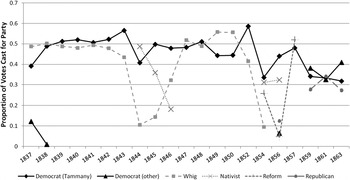
Figure 1, which I have replicated from Bridges's study of antebellum New York,Footnote 35 presents the partisan breakdown of the vote for mayor in New York City from 1837 to 1863. With the exception of 1837 and 1838, when factionalism within the Democratic Party helped the Whigs to win the mayoralty, the Democrats had a consistent edge in city elections prior to the mid-1840s. The Democrats won especially large victories in elections in which nativist parties ran their own candidates and drained support from the Whigs. By the late 1840s, however, the Whigs competed with the Democrats on relatively even terms. The Whigs won the mayoralty by a hair in April 1847, only to lose the mayoralty and half the city council to the Democrats in April 1848.Footnote 36
Partisan Breakdown of Votes Cast for Mayor in New York City, 1837–1863. Notes: This is a replication of Figure 1 on page 19 of Bridges, Morning Glories. Sources differ slightly from those used by Bridges: Whig Almanac 1841, 1844, 1846, 1847, 1848, 1855; Weekly Herald, 16 Apr. 1842, 14 Apr. 1849; New York Herald, 19 Apr. 1841, 6 Nov. 1850, 5 Nov. 1852, 8 Nov. 1856, 7 Dec. 1859; New York Times, 2 Dec. 1857; David T. Valentine, Manual of the Corporation of the City of New York (New York: Edmund Jones, 1862, 1864).

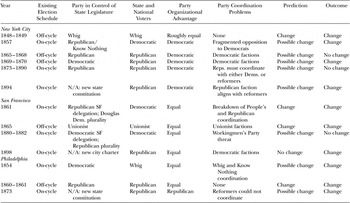
In the early and mid-1840s, turnout in the spring city elections fell far below citywide turnout in autumn presidential and gubernatorial elections.Footnote 37 In spite of this turnout differential, however, there was little incentive for either party to tamper with city election timing because their vote shares in the city were roughly the same in April and November. Even if the Whigs would have liked to move city elections to November in the mid-1840s to encourage the nativists to fuse a ticket with them, the Democrats controlled the state legislature at the time. The situation changed in the late 1840s, however. As I show in Table 2, there was a clear opportunity in 1848–1849 for the Whigs to gain an advantage by changing the timing of city elections. First, State and National Voters favored the Whigs in 1847 and 1848: not only did 17 percent more city voters participate in the November 1848 election than in the April city election seven months earlier, but the Whig candidate for president that year, Zachary Taylor, won 57 percent of the citywide vote in a three-way race compared to the 48 percent that had gone to the Whig mayoral candidate in a two-way race in April 1848. Importantly, the Whigs also commanded large majorities in the state legislature in 1848 and 1849—even within the New York City delegation.Footnote 38
Opportunities for Election Timing Change

For the Whigs, therefore, 1848–1849 was a propitious moment for combining the city election with state and national elections in November. The state legislature drafted a series of revisions to the New York City charter in April 1849,Footnote 39 which contained the provision that “the election for charter [city] officers shall be held on the day of the general State election, when all charter offices elected by the people shall be chosen.”Footnote 40 Whig political elites in the city rallied in support of the measure,Footnote 41 and city voters approved the charter revisions in the April 1849 election.Footnote 42 The first on-cycle election in New York City was held in November of 1850, and the Whigs won the mayoralty by a majority of more than 4,000 votes out of 40,000 cast. They also sent three (out of four) Whigs to Congress and selected ten (out of twelve) Whig members for the Assembly.Footnote 43 Although city turnout in April 1848 had lagged far behind citywide turnout in the November 1848 presidential election, turnout for city elections was much higher in 1852 and 1856, which, in the short run, worked in favor of the Whigs.Footnote 44
The Whigs did not enjoy the advantages of on-cycle city election scheduling for long, however. Within a few years of the election timing switch, the party divided into factions over the slavery issue and disappeared. Its disintegration left the Democrats temporarily unobstructed in their effort to organize the New York City electorate, and by the late 1850s, the Democratic Party commanded an organizational edge in the city and a reliable base of loyal voters, thus marking the beginning of the city's fledgling machine under the leadership of Mayor Fernando Wood.Footnote 45
Not coincidentally, the 1850s also witnessed the city's first coordinated reform movement, led by a group of businessmen and social notables who protested the city's high tax rates and corrupt officeholders. As a municipal political party fielding candidates for city offices, the City Reformers were at a severe disadvantage. Its members had attachments to one of the major national parties, and because city elections were held concurrently with state and national elections, many of them were reluctant to stray from the major party tickets to vote for the reform slate in the city. They also lacked the ward and precinct organizations of the Democrats and were opposed to using patronage to build them. As a purely local party, the City Reformers had no way to appeal to the State and National Voters who came to the polls during on-cycle city elections. The reformers faced the stark reality that they could not win unless they coordinated with one of the national parties. In 1853, an election year in which there was no presidential or gubernatorial race on the ballot, the reformers managed to combine a ticket with the nativist Know Nothing party, and the fused ticket won a slight majority of the city's aldermanic seats. In 1854 and 1856, however, the Know Nothings had gubernatorial and presidential candidates at stake and feared that combining a local slate with the reformers would undermine their local party organization for state and national races.Footnote 46 The reformers won only 26 percent and 5 percent, respectively, of the vote in those years.Footnote 47
In an attempt to enhance discipline within its own ranks, enable coordination with other parties, and prevent the participation of State and National Voters (who, by this time, leaned Democratic), the City Reformers lobbied the state legislature to move city elections back to off-cycle. Their initial effort in 1853 proved unsuccessful in the Whig-dominated legislature, because most Whigs were not eager to coordinate with the local reform group.Footnote 48 In 1857, the City Reformers proposed the change again, this time promoting the idea of city elections in December, a month after national elections.Footnote 49 That year, as I show in Table 2, the idea found a sympathetic audience in the Know Nothing- and Republican-controlled state legislature, which was in the midst of devising a new charter for New York City in response to Mayor Wood's heavily corrupt 1856 reelection campaign.Footnote 50 The state legislature included the reformers' proposed switch to December city elections in that city charter and passed it in a near perfect party-line vote: every Know Nothing legislator voted in favor of the revised charter, and almost all Republicans—still a new party—voted with the Know Nothings. All of the Democrats voted in opposition.Footnote 51
The first election under the new off-cycle schedule, held in December 1857, was a contentious one, but reformers were optimistic and anticipated beforehand that “whether Mayor Wood be reelected or not, his vote will be far behind that cast for the Democratic ticket a month ago.”Footnote 52 They were correct. In the November 1857 state election, city voters elected all Democrats to their delegation of the assembly, and the Democratic candidate for the highest office on the state ticket—the secretary of state—received a much higher percentage of the city vote in every ward than did Fernando Wood one month later. In the December 1857 city election, all parties opposed to Wood (including the reformers) took advantage of the off-cycle schedule and united behind a single mayoral candidate, Daniel Tiemann, who won with a small majority. Reformers rejoiced in the victory, claiming that “the result . . . vindicates the wisdom of the law which changed the time of our municipal election from November to December.”Footnote 53
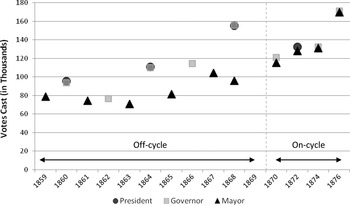
With the sole exception of the 1857 election itself, the switch to December elections also had a large negative impact on voter turnout in city elections. To illustrate this, Figure 2 shows the number of votes cast in national, state, and city elections in New York City from 1859 to 1876. Throughout the period of off-cycle elections, voter turnout in city elections consistently fell far below turnout levels in gubernatorial and presidential elections. In November 1860, over 93,000 New York City residents turned out to vote for president and governor, but only 74,000 people voted for mayor 13 months later. In 1864–1865, about 30,000 more voters participated in the presidential and gubernatorial election than in the mayoral election a year later. By 1868, this gap had widened even further: over 155,000 votes were cast for governor in November, but fewer than 96,000 people voted for mayor a month later. By contrast, when city elections were once again rescheduled to coincide with state and national races in the 1870s, the gap between turnout in local and state elections narrowed substantially. In the November 1874 election, for example, there were 132,000 votes cast for governor and 131,000 cast for mayor.
Turnout in National, State, and City Elections, NYC, 1859–1876.

Moreover, as Figure 1 shows, factionalism within the Democratic Party increased following the shift to off-cycle elections, which both hurt the Democrats and helped the reformers. Moreover, this increased factionalism was not a reflection of divisions within the party at the state or national levels. From 1860 to 1874, with the sole exception of the governor's race in 1860, every gubernatorial and presidential race held during the period of off-cycle city elections presented New York City voters with only a single Democratic candidate. In every December mayoral race, with the exception of 1868, two or more Democratic organizations put forward separate, competitive candidates. Not only did this split the Democratic vote, but it also gave reformers the opportunity to fuse with one of the anti-Tammany Democratic factions, as they often did during the 1860s.
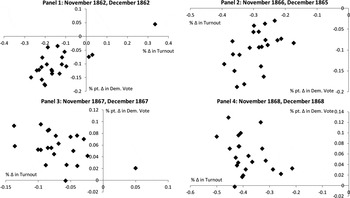
Even if we ignore for a moment the effect of election timing on inter- and intraparty coordination and combine the vote shares of all the city Democratic factions in each election, we can see that for the first several years of off-cycle elections, the low December voter turnout worked to the disadvantage of the Democrats. Figure 3 presents a series of comparisons between voter turnout and vote share for Democrats by ward in pairs of November and December elections. The horizontal axis in each scatter plot is the percentage change in voter turnout in the ward from the November election to the December election. The vertical axis in each plot is the percentage point change in ward-level vote share for Democratic candidates from the November to the December election.
Voter Turnout and Vote Share for Democrats in New York City Elections, 1860s. Notes: Horizontal axes are the percentage change (.02 = 2% change) in turnout from the November election to the December election (even where the December election came first, chronologically). Vertical axes are the percentage point change in vote share for Democratic candidates from the November election to the December election (for example, .05 means a 5-percentage-point increase in vote share). Each data point is an observation from a city ward. Panel 1 compares vote share for governor to vote share for city controller. Panels 2 and 4 compare vote share for governor to vote share for mayor. Panel 3 compares vote share for secretary of state to vote share for mayor. All data are from the Tribune Almanac, 1860–1870, except for the 1862 vote for governor by ward, which is from: “The State Election,” New York Times, 6 Nov. 1862, p. 8.

The first panel compares the gubernatorial election of November 1862 to the city election in December 1862.Footnote 54 In all wards where turnout decreased from November to December, the vote share for the Democratic candidate decreased as well.Footnote 55 Moreover, in the wards where turnout dropped the most from the gubernatorial election to the city election, the decrease in vote share for the Democrats was the largest. Panel 2, which compares the mayoral race of December 1865 to the gubernatorial election of November 1866, displays a similar pattern. The increase in turnout from December to the following November—an increase of 40 percent from December 1865—was associated with a universal increase in vote share for the Democrats, and the wards with the largest increases in turnout also saw the largest increases in votes for the Democrats. Thus, in New York City in the early to mid-1860s, the decrease in voter turnout that came with off-cycle city election timing worked against the combined vote share of Democratic candidates. It is therefore not surprising that the Republican majority in the state legislature kept city election timing as it was during the first part of that decade.
It is less clear what to expect of the late 1860s, at which time the organizational prowess of the Democratic Party in New York City reached new heights. Under the famous William Marcy Tweed, “Tammany Hall . . . received a lesson in organization for plunder on a scale undreamed of before.”Footnote 56 By Erie's account, Tweed “cranked up Tammany's naturalization mill” and registered thousands of immigrants, who then gave their votes to the Democratic candidates for city offices.Footnote 57 The Democrats enlarged city payroll to reward these voters, financing the swelling public sector with a massive new program of deficit financing. On the basis of the organizational capacity dimension of the theoretical framework, we should expect that this increase in the Democratic Party's organizational strength would make the low turnout of off-cycle elections work to its advantage.
Panel 3 of Figure 3 suggests that this was the case. Specifically, the two elections held in November and December of 1867 featured a reversal of the pattern shown in panels 1 and 2: turnout still dropped from November to December, but the drop in turnout was associated with a greater proportion of votes for Democrats. Moreover, in the wards where turnout dropped the most relative to what it had been in November, the Democratic mayoral candidates received the greatest gains compared to the state Democratic candidate. Panel 4 shows that this trend was repeated in 1868: turnout decreased dramatically from the gubernatorial election of November to the mayoral election of December, and the result was greater vote share for the Democrats.Footnote 58 Therefore, the Tweed organization dominated the smaller off-cycle city electorate, winning an even larger vote share for Democratic city candidates than Democratic state and national candidates won in November elections.
As I show in Table 2, in the late 1860s, Republicans controlled the state legislature, and Democrats were performing better in December elections than in November elections, so there was an opportunity for Republicans to gain an advantage by changing city elections to on-cycle. However, they took no such action. The most likely explanation is that off-cycle election scheduling did carry some advantages for the Republicans. First, it required Tweed and the Democrats to mobilize their supporters twice in each year,Footnote 59 which was probably not optimal considering that by the late 1860s, more than 60 percent of New York City voters were loyal Democrats anyway: regardless of timing, if the Democrats presented voters with a unified Democratic slate of candidates, they were likely to win in New York City. However, the main challenge the Democrats faced was intraparty factionalism. As long as there was more than one slate of candidates who called themselves Democrats, it was not guaranteed that Tammany would win. Thus, the opposition's best chance at depriving Tammany of control of city government was by splitting the Democratic vote, which was more likely under off-cycle city elections.
This dynamic likely explains the events of 1870 as well. That year, yet another disgruntled group of Democrats calling themselves the Young Democracy mounted an effort to oust Tammany from power.Footnote 60 It was also the first year since the mid-1840s that the Democrats had control of both chambers of the state legislature—and the governorship. In 1870, Tweed proposed to the state legislature a new charter for New York City, and included in the final version of the bill was a provision that the city's elections be moved to November of even-numbered years.Footnote 61 The main opposition to the new charter came from the legislators who claimed allegiance to the Young Democracy, who tried to amend the election provision so that city elections would be held in the spring rather than in November.Footnote 62 Tweed spent hundreds of thousands of dollars in bribes to move his charter and new election law through the legislature,Footnote 63 and it passed with few opposing votes.Footnote 64 Republicans, who had left off-cycle elections in place throughout the 1860s, put up little opposition to the change. Starting in 1870, New York City elections were once again held at the same time as presidential and gubernatorial elections, and the Tammany victory in the November 1870 election was a large one.
The reformers' Committee of Seventy came out fully and consistently in favor of off-cycle elections in 1871 and in future years, but Republicans shifted back and forth on the issue. In 1872, the general sentiment was that the Republicans had been duped into supporting Tweed's so-called “reform” city charter of 1870,Footnote 65 and so when the Committee of Seventy proposed a new city charter that would shift city election timing back to the spring, Republicans in both chambers of the legislature passed it enthusiastically on a near party-line vote (Republicans in favor, Democrats opposed).Footnote 66 However, the Democratic governor vetoed that bill.Footnote 67 Republicans then reversed course yet again the following year. Following Tweed's arrest on corruption charges, public outrage in New York City was sufficient to bring the Republican-Reform mayoral candidate to victory in 1872. After that successful on-cycle election, Republicans did not renew their attempt to change city elections to off-cycle.Footnote 68 In 1873, they enthusiastically passed the Committee of Seventy's proposed city charter but removed a few provisions they disliked, one of which was the section that would have changed city election timing to off-cycle.Footnote 69
Even in the mid-1870s, by which time the mayoralty was back in the hands of Tammany, Republicans appeared resolved that there was little to be gained by changing the city election schedule. On the one hand, they sensed that their constituents—even in New York City—had a stronger presence in November elections and that the Democrats had a better organization in the city with which to mobilize voters.Footnote 70 On the other hand, a switch to off-cycle elections would have made intraparty coordination more difficult for their rivals. The Republican motive to change election timing was therefore mixed. Even reformers, who consistently pushed in favor of off-cycle city elections, recognized that there were a number of potential consequences to consider. As a New York Times piece put it in 1875:
It is undoubtedly true that a Spring election would help to familiarize people with the necessity of judging candidates for local office simply with a view to their honesty and capacity, apart altogether from their political affiliations. But there is this obvious danger, that in seeking to destroy the power of the trading ward politicians, the advocates of a Spring election might find themselves working into the hands of that class. The vote at an election held say in April would almost certainly be light, and the people who staid away would be the class whose absence would be a loss to the cause of good government. It requires a great deal of hard work, as our readers may have observed, to get out the better class of voters in this City at any “off” election.Footnote 71
There were many attempts to change the timing of city elections during the 1870s and 1880s, but the proposals lacked unified support of Republicans in the state legislature and faced opposition from the Democratic governors of the 1880s. Further complicating the alignment of interests for and against changes in election timing was the fact that the Republican Party was partially complicit in the Tammany machine during the 1880s. Because there was very little chance that a Republican slate could win in New York City,Footnote 72 the Republican Party often made deals with Tammany under which it would help Tammany win control of city offices in exchange for either some of the spoils of city government or votes for Republican candidates for state offices.Footnote 73 Such exchanges fueled the complaints of the reformers, who argued that the deals between Republicans and Democrats would be more likely to break down if city elections were divorced from state and national elections.Footnote 74
Thus, as I show in Table 2, there was potential in the late 1870s and 1880s for the Republicans to make a change to city election timing, but no such change occurred. Instead, the 1880s in New York City were years in which Republicans played along with the Democratic machine to get a slice of the patronage and support for their state and national candidates. True opposition to the machine came primarily from reform organizations.Footnote 75 It is no wonder that reformers became increasingly convinced that concurrent city elections were an important basis of the dominance of the two major parties, because it made it easier for them to make mutually beneficial deals with each other and to undercut reformers' ability to create a bipartisan reform coalition in city elections. The classic reform rhetoric began to flourish in the 1880s, with the following argument being typical of the period:
There is no reason why general politics should enter at all into the contest for city offices . . . There are no questions of policy dependent upon the position of parties, and there is every reason why the people should vote at the city elections with entire independence of party affiliations. But so long as the city canvass is mixed up with that which is dominated by party feeling it will be impossible to prevent party nominations and their support, in a great measure, on party grounds . . . If the city election were held in the Spring and conducted by itself on the merits of candidates and of the questions affecting municipal administration alone there would be a much greater chance of independence in voting and of the success of movements headed by citizens irrespective of party to secure honesty, economy, and efficiency.Footnote 76
Importantly, however, underneath reformers' push for nonpartisanship in city elections was a desire to win city elections. To win city elections, they needed to build an organization that could nominate candidates, secure the allegiance of city voters (including some Democrats), and get out the vote on election day. To this end, reformers even tried to imitate the organizational structure of the Democrats by setting up social clubs for the purpose of turning out voters, much as saloons served as mobilization centers for the Democrats in the wards and precincts.Footnote 77 Reformers claimed that their movement transcended party and could not be characterized as a third-party movement,Footnote 78 but their goals, activities, and tactics were the same as those of a political party in all but the name.Footnote 79 At the most basic level, they wanted to win city elections, and they sought to craft institutions that would help them do so.
5. SAN FRANCISCO
Competition over election timing in San Francisco worked somewhat differently than in New York City, largely because San Francisco never experienced persistent supermajorities of voters favoring one party over the others.Footnote 80 The politics of city election timing were therefore different as well, but the parties' motives were the same: they sought to tamper with election timing when they thought it would help them gain an edge over their rivals.
California had only recently been admitted to the union when San Francisco had its first experience with a Democratic Party boss. David Broderick, an Irishman from New York who was well trained in Tammany tactics, had come to California during the Gold Rush, and by 1850, he had become the most powerful figure in the state senate. It was his senate that granted San Francisco its first city charter, which stipulated that city elections were to be held concurrently with state elections. For its first decade as a chartered city, therefore, San Francisco held municipal elections in the first week of September of each year except in presidential years, when both city and state elections were held concurrently with the presidential election in November.Footnote 81 Party competition at the local level closely mirrored state and national politics, with the Whigs competing against the Democrats. However, prior to 1855, thanks to Broderick's mobilization of the city's Irish and German working class, the Democrats tended to be more successful. A true Tammany man, Broderick tripled municipal expenditures to reward Democratic loyalists with material payoffs.Footnote 82
The financial extravagance and political corruption of the fledgling Democratic machine in San Francisco spurred the organization of the People's Party in 1856. The People's Party, a creation of the city's commercial and financial elite, entered San Francisco politics at a time when the Whigs were defunct, the Democrats were divided over the slavery issue, and the Republicans were just developing a state party organization. Its platform of honesty in city government appealed primarily to voters who supported Republican candidates in state and national races but also to some upper class Democrats.Footnote 83 The leaders of the People's Party were committed to preserving the organization as a purely municipal party and resolved to stay out of the fray of state and national contests. In the mid-1850s, they agreed to support Republicans for state offices,Footnote 84 and in turn, the new Republican Nominating Committee voted to endorse the People's candidates for San Francisco offices.Footnote 85
By 1859, this informal ticket sharing with the Republicans began to crumble under the pressure of the slavery issue. Debate over the Lecompton Constitution of Kansas split the Democrats at the national level, and the issue rose to the fore in San Francisco politics as well. The Lecompton and the Anti-Lecompton Democrats both nominated slates of candidates for state and city offices in 1858 and 1859, and the Anti-Lecompton Democrats siphoned off support from the People's Party. The Democratic split hurt the Republicans at the state level as well, and in 1859, the Republicans tried to fuse their ticket with the Anti-Lecompton Democrats. When the fusion attempt failed, the Anti-Lecompton party won enough votes in the city to hand almost the entire San Francisco delegation of the state legislature to the Lecompton Democrats. In the city races, the People's Party just barely squeezed out a victory.Footnote 86 They won with less than a majority, which meant that if the Democrats somehow managed to combine their efforts in the city election the following year, they would almost certainly win.Footnote 87
The People's Party therefore stood to gain a great deal from a shift to off-cycle elections. As a purely municipal party, its election prospects were dim unless it could win over the Republicans, the Democrats, or groups of voters from both parties. With city elections held on the same day as national elections and the national issue of slavery heating up, parties resisted interparty cooperation, and San Francisco voters were less inclined to stray from national party lines. However, in 1860, the state legislature was controlled by Lecompton Democrats, the party least likely to come to the aid of the People's Party in San Francisco. The only friend the People's Party had in the San Francisco delegation of the California assembly in 1860 was S.S. Tilton, a Republican who had previously been a People's Party supervisor in San Francisco. Tilton proposed a bill that would move San Francisco elections to the first Wednesday of May in each year, but the bill was not considered.Footnote 88
Fortunately for the People's Party, the tides turned in the November 1860 election, as I show in Table 2. That year, San Franciscans elected a Republican delegation to the state legislature. Although the Douglas Democrats held a plurality in the legislature, they were not hostile to the election timing change, and some even considered them to be supportive of the People's Party in the city.Footnote 89 In 1861, the state legislature passed Assemblyman Tilton's election timing bill,Footnote 90 and for the next five years, San Francisco held its municipal elections annually in May.
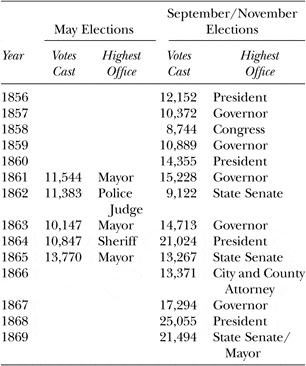
As in New York, voter participation in the springtime city elections in San Francisco was far lower than voter participation in gubernatorial and presidential elections in the fall. Table 3 presents the number of votes cast in city and statewide elections from 1856 to 1869. Throughout that time period, voter turnout in autumn elections depended on which office was at the top of the ticket: presidential elections had the highest turnout, gubernatorial elections saw about 70 to 85 percent of the voters who participated in presidential years, and state legislative and congressional races drew the fewest voters. When city elections were moved to May, however, a much smaller number of voters cast ballots in the city races than in the autumn month elections for governor and president. Compared to gubernatorial elections held only four months later, the May mayoral elections of 1861 and 1863 saw about 4,000 fewer voters, which amounted to turnout decreases of 24 and 31 percent, respectively. The turnout difference was even greater in presidential years, such as in 1864, when 21,024 voters cast ballots in the presidential election but only 13,770 voters participated in the mayoral election six months later.
Votes Cast in San Francisco During On- and Off-Cycle Elections, 1856–1869

Notes: Number of votes cast for 1865 autumn election is an estimate based on the total number of votes cast for all state senate candidates divided by the number of available seats. The highest office in years in which there was no executive race was whichever office was placed at the top of the ticket.
The shift to off-cycle elections also had meaningful consequences for the structure of party competition in the city, not all of which worked to the advantage of the People's Party. From 1856 to 1859, when city elections were held at the same time as state and national elections, party competition at the local level mirrored party competition for state races, except that the Republicans only ran candidates for state offices and the People's Party only for local offices. Starting in 1861, however, party competition in city elections operated more independently of state and national politics. In the first off-cycle city election, the Administration Union Party (the party of Lincoln) cut a deal with the Douglas Democrats and put up a fusion ticket to defeat the People's Party.Footnote 91 These two organizations did not combine their efforts in the fall state election of 1861, which suggests that they most likely would not have combined their municipal tickets if city elections had been held in the fall. The pro-union Democrats and Republicans combined forces again in May 1862, calling themselves the Citizens' Party.Footnote 92 Thus, the People's Party discovered that off-cycle election timing actually made the major national parties more willing to combine their tickets in city elections to defeat the local party.Footnote 93
Even so, for the first few years of off-cycle city elections, the election schedule appeared to deliver a net gain to the People's Party. In the years leading up to the switch, the People's Party's vote share shrank from 61 percent in 1856 to 49 percent in 1859. In 1861, the first year of separate elections, it saw its vote share jump to 55 percent, 58 percent in 1863, and then a full 70 percent in May 1864 when it ran as the “People's Union” party.Footnote 94 Thus, in spite of the national parties' attempts to unseat them in city government, the People's Party won all municipal elections from 1861 to 1865.Footnote 95
The Union Party had a crisis in 1865, however, when the party's convention erupted in violence between the Short Hair and Long Hair factions. At the same time, the Democrats were growing increasingly popular and threatened to erode the Unionists' vote share in the city. The People's Party thus became a prime target of the Union Party, which was eager to secure control of city government so that it could use the San Francisco spoils to bolster support for the party at the state level.Footnote 96 After winning only a few municipal offices in May of 1865, the Union Party used its three-fourths majority in the state legislature to enact a series of laws that changed city and state electoral rules. The most famous of these laws was the Registry Act, which was designed to restrict the franchise of immigrants, who mainly voted for the Democrats.Footnote 97 In addition, because State and National Voters in San Francisco were decidedly in favor of the Union Party in 1865, the Unionists moved city elections to on-cycle, as I show in Table 2.
Unfortunately for the Unionists, they never had the opportunity to reap the benefits of State and National Voter turnout at a time when national tides were in their favor. In 1867, the Democratic Party had a resurgence in California, and the concurrence of city elections with the state election brought to victory the first Democratic mayor since the People's Party came to power in 1856. The Democratic Party thus inherited a municipal election schedule that worked to its advantage, and throughout the 1870s, the party made sure that it continued to do so. The People's Party was no longer viable on its own; its mayoral candidate won a mere 3 percent of the vote in 1867. The state legislature responded to its brief comeback in 1871 (under the name Taxpayers' Party) by amending the act of 1866 so that city elections would never be held on a day without state offices accompanying them on the ballot.Footnote 98
During the 1870s, competition between Republicans and Democrats was intense and relatively balanced. It was also a decade in which many third parties surfaced, occasionally winning sizeable percentages of the city vote.Footnote 99 The major parties rotated in and out of state government and often found that they had common interest in passing legislation that would help to corral the large and unpredictable San Francisco electorate into support of the major national parties. In the late 1870s, for example, when the Workingmen's Party became a powerful force in city and state politics, delegates to the California constitutional convention merged the date of the state election with the day of the national general election in November of even-numbered years. By consequence, as of 1882, San Francisco city elections were concurrent with state and national elections.Footnote 100 As I show in Table 2, the Republican-dominated state legislature of 1880–1882 had an opportunity to move city elections to off-cycle to discourage the turnout of the State and National Voters who favored the Democrats, but at that time, the bigger threat came from third parties like the Workingmen's Party, and besides, the local delegation in the assembly was still strongly Democratic.
The 1880s brought a wave of Democratic machine government to the city under the “Blind Boss” Chris Buckley. Unlike the New York machine, however, whose strength was rooted in its reliable ward and precinct organizations, the San Francisco machine did not have a strong base of organizational support in the city's neighborhoods. Rather, “it was suspended like a marionette from above.”Footnote 101 The Democratic Party was therefore never much stronger than its rivals in terms of its organizational capacity; Republicans and some third parties were also well equipped to turn out supportive voters on election day. The Democrats, however, had the advantage of on-cycle city elections at a time when national and state political tides were in their favor, and thus it was the participation of the State and National Voters in city elections that sustained that decade of the Democratic machine.
6. PHILADELPHIA
Like San Francisco, Philadelphia city elections were originally scheduled to coincide with state elections, which, in Pennsylvania during the Second Party System, took place in October. Unlike both New York and San Francisco, however, the Whigs were the majority party in pre-Civil War Philadelphia.Footnote 102 In the late 1840s, there was a popular push to consolidate all of the townships, districts, and boroughs in the county of Philadelphia with the then-separate municipal government,Footnote 103 but the plan was resisted by both major parties: representatives from the areas of Philadelphia County outside of the city of Philadelphia were all Democrats, whereas the delegation from the city of Philadelphia was fully Whig.Footnote 104 It was the debate over the consolidation plan that eventually led to the city's first election timing change.
When popular support for consolidation surged in the early 1850s, the legislature took up an early version of the bill that made no changes to city election timing. Many speculated that it was the Democratic delegation from Philadelphia County that secretly worked to undermine it.Footnote 105 A document circulated to legislators during the debate illustrates how careful the parties were in considering the effects of consolidation, election timing, and turnout on their fortunes. The document, which was an analysis of Whig and Democratic vote shares in the city and surrounding county areas for the last several elections, showed that consolidation would “extinguish the hopes of Democracy for a long time to come” because the Whig majority in the city was larger than the Democratic majority in the surrounding areas of the county.Footnote 106 It also noted that the decreased Whig majority in 1850 as compared to 1848 was due to a decreased aggregate vote, not to fewer votes for the Whigs, “thus demonstrating . . . that of the many who remained away from the polls in 1850, by far the larger proportion were Whigs and Natives.”Footnote 107
By 1854, public support and pressure for the consolidation proposal was too strong to be ignored. The Democrats, with unified control of both chambers of the state legislature, passed the consolidation measure, but unlike the previous version, the bill that became law fixed the timing of the city's elections to June.Footnote 108 The move was likely intended to help the Democrats, who were sure to be a minority in the new city but whose candidates were favored to a greater extent among lower-turnout electorates.Footnote 109 However, off-cycle elections also facilitated Whig fusion with the nativists, and for two years after the new election schedule was instituted, the Whigs managed to stay in control of city government.Footnote 110
Following the disappearance of the Whig Party, the party organizations of the Democrats and the Republicans were relatively well matched in Philadelphia. The Democrats controlled the city in 1856 and 1857, followed by two years of Republican control in 1858 and 1859. If the Republicans had tried to shift city elections back to on-cycle during this period, they would have run up against either a fully Democratic or a divided state legislature. In the spring elections of 1860, however, the incumbent Republican Party had a close call—it won the city election by only a few hundred votes out of 72,000 cast—and it responded by convincing its co-partisans in the state legislature to fight for yet another change in city election timing. Early in the 1861 session of the state House, Republicans introduced a bill to abolish the spring city election and combine all future city elections with the general state election in October. The debate that ensued in the legislature was intense, with Republicans arguing that their proposed city election schedule would save Philadelphia citizens 20 to 40 thousand dollars in election costs and Democrats calling the proposal a purely partisan maneuver.Footnote 111 Henry Leisenring, a Democrat from the Philadelphia delegation, explained to the other legislators:
Let us be plain on this matter. A worthy friend of mine, on this floor, who is an active Republican member, said to me yesterday, that some of the friends of this bill, from the city, urged him to vote for it, because it was a foregone conclusion that if the election takes place in May, the Democrats, or Locofocos, as he expressed it, will be successful . . . I do not believe the members of this House are prepared for any such action.Footnote 112
When Leisenring pressed one of the bill's advocates, Republican Jacob Ridgeway from Philadelphia, on the question of whether city Republicans wanted to change the city election date to increase their chances of staying in control of city government, Ridgeway simply retorted, “Of course they want the bill passed. They have beaten the Locofocos [Democrats] so often that they want six months respite.”Footnote 113
Unfortunately for the Democrats, as I show in Table 2, the state government was stacked against them. The new election schedule was put into effect that year. Every single Democrat in the House voted in opposition to the bill. Every single vote in favor of the measure was cast by a Republican legislator. The Republican legislature had no trouble getting the bill past the governor, who was also a Republican.
Proponents of the spring city election were outraged. Reporters called the act “a political move,”Footnote 114 “a political dodge,”Footnote 115 and “arbitrary partizan legislation.”Footnote 116 Newly organized reform groups were just as furious as the Democrats.Footnote 117 Based on the events that followed, it seemed that their frustration was warranted: in the first October election in 1861, the Republicans elected a majority to the city council and won most citywide offices. As the Civil War wore on, the on-cycle election schedule continued to come to the aid of the Republican Party in local elections thanks to city voters' increasing allegiance to the Republican national platform.Footnote 118 By the late 1860s, the Republican Party had a firm grip on Philadelphia government and powerful electoral machinery for keeping it in power. Moreover, the legislature was dominated by Republicans for the next fifteen years, so there was little motive at the state level to once again isolate city elections from state and national elections.
As in New York and San Francisco, the nascent Republican machine in Philadelphia provoked a reform movement, and, also similar to the other two cities, the Citizens' Municipal Reform Association and the Reform Club in Philadelphia had serious organizational problems. Most of the reformers called themselves Republicans in state and national political affairs, which made many of them unwilling to desert the Republican Party in municipal races—especially those conducted at the same time as state and national races—for fear that their desertion would assist in the election of Democrats who wanted to lower tariffs. The slates of candidates they fielded in the early 1870s were failures.Footnote 119
When state-level corruption allegations resulted in a state constitutional convention in 1873, reformers seized the opportunity and arrived with a large set of proposals. One of the reformers' proposals that ignited the most debate was their plan to establish a uniform February election date for all Pennsylvania municipalities.Footnote 120 Just as in 1861, the debate on the scheduling of local elections split almost perfectly along party lines within the Philadelphia delegation, with Democratic delegates in favor of creating an off-cycle schedule and Republicans opposing both the requirement for a uniform local election date and the February schedule that had been proposed. One Republican delegate from Philadelphia felt that local governments should be allowed to choose whatever election date was convenient for them. His Republican colleague, also from Philadelphia, tried to insert a provision that would allow cities to change their election dates by a vote of the people at the next general election. John Price Wetherill, a Republican delegate from Philadelphia, tried to pass an amendment that would ensure that the section on election timing would not apply to cities of over 100,000 inhabitants—meaning Philadelphia. Philadelphia Democrats Worrall and Cuyler objected to all of this, arguing that it was the practice of combined elections in Philadelphia that had led to bad government in the city.Footnote 121
After over a week of debate on the issue of local election timing—even before the convention had decided which offices would exist under the new constitution—the election timing proposal finally came to a vote. The uniform February local election date was approved by delegates by a vote of 84 yeas to 24 nays. Among the Philadelphia delegation to the constitutional convention, all but one Democrat voted in favor of the measure, and all but one Republican voted against it.Footnote 122
For a few years after 1874, Republican candidates' vote shares in state races tended to be higher than Republican candidates' vote shares in city races, suggesting that off-cycle elections did undermine Republican electoral efforts in the short run. Moreover, the Republican Party was rife with factionalism during this time.Footnote 123 Reformers had some minor wins in 1876, and in both 1877 and 1881, the Democrats and reformers claimed large city election victories against the Republicans. However, the short wave of anti-Republican victories in the 1870s did not mark the beginning of the end for the Republican machine. The early 1880s actually saw the rise of a new machine run by Matthew Quay and the state Republican Party organization. Therefore, even though the new state constitution mandated off-cycle elections for every city in the state of Pennsylvania, Philadelphia elections continued to be dominated by the Republican machine.
7. THE NATIONAL MUNICIPAL REFORM MOVEMENT
By the time municipal reformers gathered in a national forum in 1894, New York, San Francisco, and Philadelphia already had long histories of election timing manipulation. Changing the dates of city elections was a partisan power play: it changed the number of voters who participated, altered the distribution of voters in support of each party, and caused the parties to shift their competitive strategies. In some cases, the partisan fight over election timing pitted one major national party against the other major national party, as in New York in 1849, Philadelphia in 1854, and Philadelphia in 1861. In other cases, a national party conspired against a local party organization, or vice versa, as in San Francisco in the 1860s. Many cases involved a bit of both, because weaker national parties often coordinated with local parties to defeat the dominant party, and in San Francisco, national parties coordinated to fight the local party. Regardless of the particulars, party leaders clearly recognized the importance of election timing for their electoral fortunes and sought to set the rules in their own favor.
For many cases, the framework developed here yields the same predictions as other existing theories, but it can also account for cases those theories leave unexplained. For example, both Ethington and Negretto argue that the clash over election timing pits major national parties against smaller parties,Footnote 124 and yet here we have seen cases in which one major national party fights with the other over election timing. Others have argued that groups promoted off-cycle elections to disenfranchise immigrants and the lower classes,Footnote 125 which was often true in the nineteenth century, but not always: the Whigs favored on-cycle elections in New York in 1849, the Unionists favored on-cycle elections in San Francisco in 1866, and Republicans favored on-cycle elections in Philadelphia in 1861 and at the Pennsylvania constitutional convention of 1873. On-cycle election timing did not consistently favor one party in particular across the three cities, or even within cities over time. Although we have seen preliminary evidence that the parties that engineered the election timing changes benefited from those changes in the short run, exogenous changes to political conditions often tilted the advantage of the changed election schedule in favor of their rivals in the longer run, as with the Unionists in San Francisco in the late 1860s.
Other American cities also experienced episodes of election timing manipulation. The Minnesota legislature, for example, changed the election timing of St. Paul three times in four years.Footnote 126 In New Jersey, Republicans changed Jersey City and Newark elections to on-cycle to expose them to a wave of pro-Republican national sentiment.Footnote 127 Moreover, machine politics was an issue in the majority of large American cities during the Third Party System.Footnote 128 The St. Louis government was selling franchises and contracts for political gain, the A.A. Ames regime ran Minneapolis, and Cincinnati had Boss George B. Cox.Footnote 129 It is therefore likely that there were other cases of city election timing manipulation.
Still, the conditions of American cities varied greatly, and the delegates to the National Municipal League in the late 1890s disagreed on a number of proposed remedies. They quickly came to consensus on one issue, however: to undermine the urban political machines, they had to separate city elections from state and national elections. Some delegates thought that such a policy would reform the existing party system. Others anticipated that election separation would lead to the creation of a wholly municipal party system. Still others advocated the banishment of political parties from city government altogether.Footnote 130 Regardless of the differences in perceived outcomes, the separation of city from state and national elections became a cornerstone of the national organization of good government groups at a time when such groups were rapidly multiplying in number.Footnote 131
Why did the reformers prioritize off-cycle elections? Their rhetoric on the subject was typical of the broader Progressive message: for years, city government had been run by political parties whose main interests were in state and national policy, even though good city policy had nothing to do with the policies that dominated the parties' state and national platforms. As the New York Times put it, “We cannot have Democratic pavements, Republican water-works, or National Greenback-Labor parks.”Footnote 132 The Progressives thought that city government should be administered like a business, with an emphasis on honesty and efficiency. However, with city elections held on the same day as national elections, voters got caught up in partisan competition and lost sight of the importance of electing “good men” to city office. Off-cycle elections would encourage city voters to consider their vote for city officials independently of their vote for president or governor, resulting in more responsive city government.
For the present purposes, it is irrelevant whether the reformers actually hoped to build a large, better-informed electorate in the cities or whether they simply dressed up their desire to win elections in fancy rhetoric. Regardless, the reformers had to get their candidates elected in order to control city policymaking,Footnote 133 and they were not making headway under the existing system. Because the urban machines were run by local organizations of the national political parties, reformers likely figured that their best chance of minimizing the influence of these rival organizations was by holding city elections on a separate day than national elections. Thus, in their crusade against the political parties, they not only had to build an organizational apparatus that looked and worked like a political party, but they also fought to structure electoral institutions so that they worked in their favor—just like their enemies did.
The theoretical framework suggests that, in some ways, the reformers were correct in their calculations about election timing: because the party of the machine in any given city tended to also be the party favored by State and National Voters, the incorporation of State and National Voters into city elections worked to the machine's advantage. Moreover, on-cycle elections encouraged unity within the machine's party and discouraged fusion among the opposition parties. The reformers needed to coordinate with one of the major parties to have a chance at winning city elections, and their attempt at interparty cooperation would be enhanced by off-cycle election timing. However, the framework also suggests that off-cycle election timing would not necessarily deliver a fatal blow to the party of the machines. The machines in most cities were also dominant in organizational capacity: they were well resourced and well equipped to mobilize a massive army of supportive voters as needed, more so than any other city organization. Therefore, the low baseline turnout of off-cycle elections could actually work in the machine's favor. It is not clear whether the reformers did not consider the relationship between low turnout and party organizational strength, whether they thought they could overcome it in time, or whether they simply thought that the advantages of off-cycle timing outweighed the disadvantages.
In New York City, reformers achieved a permanent transition to off-cycle city elections by amending the state constitution in the mid-1890s. By this time, reform organizations in the city had been promoting the separation of city elections from state and national elections for two decades, but they had met resistance in state government during the 1870s and 1880s. That resistance finally broke down in the mid-1890s because of a few critical events. First, ballot reform in the state had somewhat reduced vote- and spoils-trading between Tammany and Republicans, which lessened Republican incentive to protect on-cycle elections.Footnote 134 Second, a revolt within the Republican Party against the machine tactics of Republican state boss Thomas C. Platt strengthened reform sentiment within the party.Footnote 135 Meanwhile, the depression of 1893 and strong national tides swept Republicans into state government and the New York constitutional convention in 1894. During the convention, reformers lobbied the delegates for the separation of municipal elections from state elections,Footnote 136 and Republicans—eager to weaken the Democratic machine in New York City as well as the Democratic powerhouses in Brooklyn and Buffalo—agreed to go along with reformers' proposals. They included a provision in the state constitution that city elections—not just in New York City, but also in cities like Albany, Rochester, Syracuse, and Buffalo—would be held off-cycle in November of odd-numbered years.Footnote 137 After the first off-cycle city election in which Republicans made the mistake of not fusing a ticket with the reform Citizens' Union Party, Republicans worked hard to bring reformers into the mainstream party.Footnote 138 In the 1901 city election, the Citizens' Union fused with the Republican Party and won control of city government.Footnote 139
However, Tammany did not disappear. It suffered a period of decline during the years of Republican control that followed the national realignment of the 1890s, but the Democratic machine reemerged as an organizational powerhouse in 1917, achieving a degree of control over city elections even greater than that of the late nineteenth century. By that time, of course, city elections had been held off-cycle for twenty years, and voter turnout in city elections was extremely low. In 1925, only 28 percent of New York adults voted in the city election, far shy of the 61 percent who had voted in 1897. The machine, however, could still count on its supporters: city employees knew that their jobs were at stake in each and every election, and the organization knew it could rely on them to vote and to mobilize their friends and relatives. Tammany's vote shares actually improved as overall turnout declined.Footnote 140 Thus, the great irony of the election timing reform promoted by the Citizens' Union in the 1890s is that in the long run, it appeared to work to the machine's advantage.
As in New York, a number of factors chipped away at the Democratic machine's dominance in San Francisco in the early 1890s, including the rise of organized labor, the Reform Ballot Act that mandated the use of the secret ballot in California elections, the indictment of Boss Buckley, the election of a Populist mayor in 1892, and the pro-Republican national tides of the mid-1890s. However, the final election timing change in San Francisco was not imposed at the state level; rather, it came from within the city itself. Specifically, city leaders took advantage of a provision of the California constitution of 1879 that allowed municipalities to draft their own city charters. Thus, unlike the other election timing changes that took place in New York, San Francisco, and Philadelphia during the nineteenth century, all it took to switch San Francisco elections to off-cycle in 1898 was a city leader willing to push through the change.
Because the city initiated the change—not the state legislature or even a new state constitutional convention—the state-level dimension of the theoretical framework is less relevant for the 1898 election timing switch in San Francisco. The traditional wings of both the Republican and Democratic Parties almost certainly favored retention of the longstanding on-cycle election schedule. As I show in Table 2, Republicans had party tides working in their favor, and Democrats likely wanted intraparty factions to stick with the mainstream party candidates. However, the man who initiated the successful San Francisco charter effort, James D. Phelan, was not a traditional Democrat or Republican: he identified with the reform wing of the Democratic Party, and he was also head of an organization of local businessmen that sought to redesign the electoral and administrative structure of the city. When he was elected mayor in 1896, he oversaw the drafting of a new city charter that incorporated many of the provisions that were, by then, being promoted by the national municipal reform movement. One of those provisions was the switch to city elections in November of odd-numbered years.Footnote 141 Thus, when Phelan's charter was approved by San Francisco voters in November 1898,Footnote 142 the city's elections were shifted to off-cycle.
As in New York, San Francisco's switch to off-cycle elections in 1898 was permanent. However, unlike New York, San Francisco never supported a Democratic political machine after the 1890s, in part because its Democratic Party organization lacked the ward and precinct network of the New York City machine.Footnote 143 Therefore, when city elections were moved to off-cycle, the old San Francisco machine was not well equipped to overwhelm the small city electorate by mobilizing supporters.
Importantly, the changes during the 1890s in New York and San Francisco were not isolated events—they were part of a much larger structural reform movement. In the same decade that New York and San Francisco made election timing changes, cities ranging from Baltimore to Indianapolis to Waterbury, Connecticut got new charters that separated city elections from state and national elections.Footnote 144 This was the beginning of what became a full-fledged national reform movement in the early twentieth century. By the early 1900s, reformers had moved on to more sweeping measures, promoting a comprehensive remodeling of American city government, of which off-cycle election timing was an integral part.
Meeting in Providence in 1907, National Municipal League delegates noted their large-scale success in promoting off-cycle city election timing. Still, they lamented the continued presence of the machines in city politics, and some delegates argued that off-cycle election timing had not undermined the machines as anticipated. Others argued that off-cycle scheduling had never been intended as a cure-all—it had merely been a first step of many that they expected to be necessary. It was at this time that the league began to promote the elimination of party labels from ballots in municipal elections. Delegates also recognized the importance of ballot reform and reform of the nomination process should they ever expect success in dislodging the political parties from their positions of power in city government. Thus, reformers set about designing new structures that would further weaken the machines.
8. DISCUSSION
I began this paper with a puzzle: most local governments in the United States today hold off-cycle elections, and off-cycle election timing both lowers voter turnout and alters the composition of the electorate in a way that favors organized interest groups.Footnote 145 Still, in spite of the fact that the timing of elections has the potential to affect election outcomes and policy, local election timing in the United States has changed little since the Progressive Era. How did off-cycle election timing become such a durable feature of the American political landscape—a political institution that few people scrutinize today?
This study reveals that there was a long period in United States history in which the timing of local elections was not durable; rather, it was frequently changed for the purpose of tipping the balance of political party power in elections. Changes in city election schedules were driven by a special alignment of interests, including the potential for party gain at the local level and friendly government at the state level. In New York, San Francisco, and Philadelphia, city election timing was changed at about the frequency one would expect based on the parameters identified in the theoretical framework. Unlike today, election timing was a malleable policy that political parties used to affect how many people voted, which parties fused, which factions ran separate slates of candidates, and what percentage of the vote went to each party competing for city office. By highlighting the regularity with which this occurred, this paper suggests that future scholars would do well to investigate more rigorously the effects of election timing changes on election outcomes, political party fortunes, and public policy in the nineteenth century.
However, after sixty years of frequent changes in city election timing from the rise of the mass political party to the early years of the Progressive Era, local election timing became relatively stable in the twentieth century. Much of the institutionalization of off-cycle local election timing can be explained by the way in which the Progressive reformers enacted their proposals. The election timing changes discussed in this article—with the exceptions of the final switches in each city—were the result of special legislation, meaning legislation that applied to only a single city. Starting in the late 1870s, however, state legislatures were increasingly required to enact general legislation that applied uniformly to all cities within their boundaries.Footnote 146 Thus, the municipal reformers succeeded in convincing state politicians to enact off-cycle election schedules during a period in which it was generally becoming more difficult for state legislators to tamper with the laws of individual cities. Changing city election timing was further inhibited in states where reform parties succeeded in getting off-cycle election timing locked into constitutions, as in Pennsylvania in the 1870s and New York in the 1890s. The push for off-cycle elections also coincided with the home rule movement, and ultimately, many of the largest American cities implemented off-cycle election timing by crafting their own city charters, as in San Francisco. As a consequence of these general trends in the methods used to govern localities, it became more difficult for post-Progressive state legislators to change the election timing rules of individual cities.
More generally, the Progressive movement made sweeping changes to the American political environment, and as a consequence of those changes, the national political parties' interests in controlling city government were dramatically reduced. For one, the early twentieth century marked the end of the spoils system as the regular way of conducting politics in the United States. The implementation and gradual strengthening of civil service laws undercut political parties' ability to use government jobs to win votes and campaign contributions. Once city jobs had to be distributed according to merit rather than party loyalty, the cities were no longer as appealing to national political parties as sources of political power. Changes in ballot practices also affected the operation of politics. As states adopted the Australian ballot, voters were presented with the names of all candidates rather than only the nominees of their preferred party, and the result was a rise in split-ticket voting.Footnote 147 Therefore, even in places where city elections remained on the same day as state and national elections, it became easier for individuals to vote for a municipal candidate of a different party than their preferred party in the state and national races. Other reforms such as the direct primary and nomination by petition, direct democracy, the nonpartisan ballot, and at-large elections weakened the parties' control over elections at all levels of government. By 1917, the American political scene—especially in the cities—looked quite different than it had in the 1880s.
The parties gradually relinquished their interest in local politics in many places and declined to enter the political fray in newer cities, but the space they left did not stay empty for long. An important consequence of the party-weakening reforms of the early twentieth century was the rise of political activity by nonparty groups, such as nonpartisan slating groups and special interest groups.Footnote 148 Chambers of commerce, good government groups, labor organizations, business, and other interests became increasingly influential in political activities that had previously been carried out by the parties, such as financing campaigns, endorsing candidates, nominating candidates, and electioneering.Footnote 149 Therefore, after the Progressive Era, the local groups with the strongest organizational capacity in many cities were not political parties—they were interest groups. Unlike political parties, whose competition in city elections had been zero-sum, it was possible for city government to accommodate the demands of many different interest groups simultaneously, as long as the groups were not working at cross-purposes. Because off-cycle election timing increased the influence of the dominant interest groups in elections, those groups had a stake in protecting it from proposed changes.
Still, many of the large cities where political parties remained active experienced rule by party machines well into the twentieth century. The great irony of the Progressive reformers' push for off-cycle elections was that it probably actually helped the machines in the long run. In cities like New York and Philadelphia, the political machines continued to be the groups with the strongest organizational capacity, and the low turnout that accompanied off-cycle elections enhanced the effectiveness of machine mobilization efforts. As Raymond Wolfinger noted, “These low-salience contests are particularly amenable to the resources typical of machine politics . . . since precinct work is effective in inverse relation to the salience of the election.”Footnote 150 Charles Adrian summed up the effect of off-cycle election timing nicely:
The major danger in a light vote lies in the fact that highly organized groups, whether of the nature of old-fashioned city machines or of special interest groups of any type, will thereby be able to control the government, for the lighter the vote the easier it is for such groups to win. They have a solid nucleus of dependable voters. A small turnout does not result in the same percentage distribution of the vote among the various segments of the population as would be found in a large turnout.Footnote 151
With off-cycle election timing working in favor of the dominant interest groups and the old-fashioned machines, it was unlikely that state legislators and party leaders would find good reason to alter local government election timing. The potential benefits of making such an attempt were few and the costs great. At a minimum, it would involve passing a law for all municipalities in the state. For cities with home rule charters, it was unlikely that they would be able to do so at all. Also, any attempt to tamper with local election timing would surely bring the wrath of the interest groups and local machines.
Thus, to understand why so many local elections in the United States are held off-cycle today, we must pay attention to both the strategic, short-term calculations of reelection-motivated party elites as well as to the specific historical context that shaped those calculations.Footnote 152 Consistent with the classic rational choice accounts of legislative and party policymaking by Mayhew and Downs,Footnote 153 political party elites in the nineteenth century appeared to be, first and foremost, concerned with getting their candidates elected. At many slices of time throughout the nineteenth century, party elites saw windows of opportunity for securing electoral gain by changing the timing of city elections, which was made possible by supportive party elites in state government. Also in tune with the rational choice perspective, the parameters that defined these windows of opportunity were, I argue, generalizable across time and space. All of them shaped decision making in the three cities throughout the nineteenth century, and some of them are even still relevant today.
Still, it was the specific historical context—which was affected by both existing election schedules and factors external to the timing of elections—that determined the conditions that fed into party elites' incentives to change election timing. Moreover, our understanding of the durability of off-cycle local election timing in the twentieth century cannot be divorced from that which transpired in the nineteenth century and, as a result, the Progressive Era. It is a difficult thought experiment indeed to consider what the Progressive movement would have been—and whether the Progressives would have promoted off-cycle elections—had there not been urban machines, the spoils system, and a history of tampering with election timing by party elites. That history, combined with the timing of other reforms that led to new state constitutions, city charters, and general as opposed to special legislation, partly explains the stability of election timing that followed the Progressive movement. The rest is probably best explained by the weakening of political parties and the rise of interest groups that occurred in the early twentieth century, facilitating the institutionalization of off-cycle election timing.
Today, New York, San Francisco, and Philadelphia still hold off-cycle elections. Turnout in the most recent New York mayoral contest—a highly competitive election—was 13 percent of registered voters.Footnote 154 Voter turnout in San Francisco's odd-year elections regularly dips well below citywide turnout in gubernatorial and presidential contests. This pattern is not unique to large cities. Throughout the country, municipal elections that are held at different times than state and national elections see far lower turnout than local elections that are held on-cycle, and a growing body of evidence shows that this has non-neutral implications for public policy. Thus, even if the Progressive reformers did not succeed in ridding the country of the machines, they did leave behind a local election schedule that has largely persisted until today, and one that continues to have an influence on the dynamics of American elections.
SUPPLEMENTARY MATERIAL
Online appendix www.journals.cambridge.org/sap2012001