

So no one
could connect
the price of bread
with the price of boots.
It was not a union (smychka)
but idle phrases
—From “Hard money, hard ground for the union of the peasant and the worker” Vladimir Maiakovskii, 1924In the challenge to capture the immensity of the social disarray left in the wake of World War I, historians have used a wide selection of facts and metaphors, often involving death counts, population movements, infrastructural destruction, economic accounting and examples of massive cultural transformation. Following Vladimir Maiakovskii's celebration of the coming of hard currency to the Soviet Union, this article proposes a less immediate, less palpable consequence, but one that immediately confronted states as they attempted to reorganize new social compositions from what was left of the old: people's responsibilities to one another and the ways in which they become tabulated in debt, in other words, the reconstitution of money. While the ossification of debt leads to stasis and rancor, its recirculation, usually under new arrangements, lends the necessary oxygen for societies to begin a measure of regeneration and productive activity. In the post-World War I landscape of the international economy this dynamic is well established in historical analyses. A net debtor at the beginning of the war, the United States had become Europe's creditor by its end, as well as the world's most dynamic economy. On the other hand, the ledgers among European countries—and within them—were felt with a particularly acrimonious force, congealing into social arrangements impossible to sustain, much less build upon, until the middle of the decade.
These were embodied in debt, as in the German reparations Keynes famously castigated in 1919 in his Economic Consequences of the Peace. The story is well known, not least because Keynes’ prescient analysis provided the general framework within which historians have analyzed the fate of 1920s Europe. Unable to overcome the victors’ vindictive writ, Germany failed to reconstitute a polity willing, or even capable, to repay the debts imposed upon it.Footnote 1 Beyond that breakdown in international politics, imperial carcasses were divvied up into their ethno-national components, resulting in vast movements of people that tore asunder networks of provision and debt at the level of neighborhoods all over the eastern end of the European continent. And everywhere working classes sought to readjust what was owed them, advancing the rise of the welfare state and the power of workers’ unions. Economists have a leveling concept for all these reconfigurations of what people owe one another: inflation.
The triumphal denouement is also well known. In the absence of any institutionalized international governance of debt, and following the disastrous French occupation of the Rhur valley in 1923, American bankers belatedly organized a rescue package for Europe through which they would come to supervise German financial affairs while the victors lowered and restructured the reparation payments. In exchange for this measure of international civility, the US bankers organized bond issues and other loan instruments in Germany and elsewhere that they marketed in the US, flooding European markets with American capital. This renewal of debt circulation allowed central banks all over Europe to replenish hard currency and gold reserves and reattach their currencies to the gold standard throughout the mid-1920s, which was the foundation of the “Golden Twenties.”
This general narrative outline of the 1920s has proved durable. This article seeks to include a curious absence, that of the Soviet Union, and append its historical experience of the Gold Standard to that of the rest of Europe. The pacing of its own reconstitution of society following the civil war clearly advocates for this reconnection. Documents show that the timing of historical occurrences in the 1920s Soviet economic reconstruction familiar to historians was understood within the Bolshevik leadership to be inseparable from events in Europe: the scissors crisis, the culmination of monetary reform, the relative calm of the mid-1920s and the end of the New Economic Policy (NEP).Footnote 2 Documents produced by the Bolshevik leadership also show that in the context of a society in complete disarray, the reactivation and restructuring of the circulation of debt was well understood to be the social technology through which the state would generate its authority within and without the Soviet Union. In view of this narrative task of reconnection, the article will also seek to recast some of the major historiographical debates about the NEP period of Soviet history.
These debates have revolved around Lenin, his rule and its relationship to Stalin's rule.Footnote 3 This is fundamentally a question of how we understand the New Economic Policy that Lenin implemented in 1921. Bolsheviks, and Lenin first of all, conceived it as a transitional stage, but historians are offered no guidance of what this meant. Was NEP meant to develop organically into socialism? Or was it meant as a window of respite and recovery before the “real” Bolshevik project could be resumed? Did Stalin execute Lenin's vision or did he break with it?Footnote 4 But perhaps recovering an older question may be more constructive: Was the Bolshevik project contingent on historical developments outside Bolshevik control?Footnote 5
Lenin's own uncertainty over NEP argues, as this article will, for contingency. The NEP was to be established in the Soviet Union “seriously and for a long time,” a vague formulation that Lenin calculated to be certainly more than a decade, and perhaps as long as a generation.Footnote 6 He was not wrong to be vague. The NEP was ultimately a gamble predicated on the health of the world economy secured through a vital monetary reform that served as the policy's—and the regime's—social foundation. The NEP is rendered unintelligible without an understanding of its most basic component: money. And money itself requires an exposition of its socio-political function. The 1921–24 monetary reform is treated, when at all discussed, as a technical matter devoid of social meaning and, ultimately, historical import. This article aims to clarify the socio-political meaning of money with a view toward laying the groundwork for a reconstruction of NEP and Soviet history. It will do so not by addressing the crisis it caused at the end of NEP, but by focusing on the domestic and international conjuncture that gave rise to money's ephemeral institutionalization in the Bolshevik project.Footnote 7 Money was the underlying medium baring the Bolshevik project open to contingent impulses from the liberal world that first organized and then wrecked the Bolsheviks’ first attempt at building a path to socialism.
After foregrounding the socio-political importance of money, the article will reacquaint readers with the story of the monetary reform, but it will do so in light of its crucial international underpinning. The reform's implementation was not a simple matter of diktat, of technical and administrative proficiency, as the story is usually told. What this article will show is the extent to which its success depended on developments abroad and well beyond Bolshevik control. These caused delays and hand-wringing. It contributed to the scissors’ crisis, a general ideological relocation to more economically liberal positions, and a discursive obsession with the ruble's hard gold content that lasted as long as the regime itself. The article aims to recover the Bolsheviks’ own understanding of the transformation through money they were executing in the social relations of the country and in its international affairs, both intricately woven with what they thought as the definitive battle for socialism.Footnote 8 But first it will pause to elucidate what has been obscure: what is money?
Debt and Taxes: Some Theoretical Observations on Money
Two and a half centuries ago, Adam Smith decisively and enduringly popularized a historical narrative in which people's consuming purpose was to barter things with each other. In Smith's telling, this primitive barter exchange was uneconomical, since two individuals who entered into an exchange would have to possess the exact commodities the other wanted—what economists refer to as the problem of the double coincidence of wants. With time, Smith wrote, people came to the realization that using a medium of exchange—usually commodity-based coin—facilitated barter. And later still, in historical time, credit arrangements expanded exchange in terms of both volume and distance. Money in this version of economic history is a simple byproduct of market exchange, a useful tool laid over the essence of human relations, which was, is and will continue to be barter exchange.
The problem is that this formulation does not comport with the archeological record. The most thorough critique of the unreconstructed conception of the market and of human behavior offered by classical—and neoclassical—economics comes from an examination of the historical record. But even a moment's reflection shows this story to make little sense of actual human behavior. Could there ever have been a community that engaged in such awkward, self-serving barter exchange? If such a community ever existed before the use of money, anthropologists have failed to find one among the countless non-monetized societies they have examined.Footnote 9 More likely, exchange among members of a community meant a perpetual reciprocation of favors and debt relations, rather than an impersonal exchange of things and services.Footnote 10 As far as barter is concerned, the very logic of how such an exchange might work requires a standard of value as a precondition for calculating the value of the things exchanged. Furthermore, the level of specialization in production needed for markets to arise already presupposes a degree of calculation that can only be explained by an already-existing standard of value; it would be a risky enterprise to specialize production if producers could rely only on barter.Footnote 11 This is why anthropologists, and increasingly sociologists as well, think of barter not as a primitive form of exchange, but as a temporary condition prevailing in a society that, for some reason or another, has suddenly become demonetized. As anthropologist David Graeber has noted, the sequence in the historical appearance of these systems of exchange is exactly backward: first came credit, then coin, then barter.Footnote 12
With this historical critique in place, it becomes possible to think of money as something more than a mere stand-in for the underlying commodities being exchanged. Money as a social institution is the arena over which different groups fight for their interests in “the struggle of man against man,” in Max Weber's formulation. The best place in which to discern the social nature of money is at its source. Money is created through debt. Money is a debt relation. In the present there are various mechanisms through which this occurs, some initiated by governments with the assistance of central banks, some initiated directly by banks.Footnote 13 Either way, money is created when a loan is made, either to the government in the form of bonds, or to a bank in the form of a bank deposit. It is on the basis of this loan that new credit can be generated, monetized, and expanded following the money multiplier. Money is transferable debt.Footnote 14 Credibility, trust, social convention, future expectations and other such intersubjectively shared attitudes then account for what economists call money velocity: the speed with which the money is created and circulates. Periods in which people borrow money are thus associated with money creation and inflation, while periods in which people pay back their debts are associated with money destruction and an appreciation in the value of money, that is, deflation.Footnote 15
But what ultimately gives money its value? A conception of money as a social institution eschews the idea that money derives its value from some underlying commodity. It is state purpose that endows money with value, and social relations that drives the direction of that value.Footnote 16 The state achieves this through taxation, an institution that is deeply imbricated with sovereignty. A sovereign state capable of imposing an obligation (debt) on its population necessarily becomes the most important financial operator in that society, according its money form the power to pay off people's obligations to the state. This conception of money has the virtue of maintaining its social nature and obviating the prior existence of markets, which as we have seen is an illogic. Taxation is the fulcrum through which money develops its fiduciary value in society.
Ultimately, however, money is never one essential type of relation.Footnote 17 It is a relation constructed for a specific society and time that may suddenly lurch into social renegotiations often experienced as inflation. While the anthropological and sociological theories of money sketched above generate extraordinary insight into constructions of money internal to a sociopolitical unit, an equally penetrating analysis of money's international and supranational existence is still awaiting its theorist(s). But the chervonets—and the sociopolitical formation it underpinned—was generated precisely in the quantum entanglement of the internal and external economic life of the Soviet Union in a particular postwar moment in the history of capitalism. That the Bolsheviks so meticulously and near unanimously set upon this reproduction of the yellow-brick road renders difficult the dismissal of the NEP as “political trickery”—to echo Lenin's own admonition. It also raises doubts that the rather facile, unexamined notion of “anticapitalism” sometimes used to understand Bolshevik purpose is analytically meaningful. It is simply not enough to gesture to Bolshevik anticapitalist discourse as proof that this was somehow implemented; interconnections with and reproductions of essential capitalist practices and institutions were always at the core of the Bolshevik project and must be incorporated in any explanation of its trajectory—even during its first decade.Footnote 18
The rootedness of money in social conjunctures and political negotiations is particularly easy to see during moments of institutional fluidity, for example in the aftermath of revolutions.Footnote 19 It is during moments of state disintegration and reconfiguration that money loses its patina as a technology of exchange naturally, even spontaneously occurring.Footnote 20 Reinstating money, as with the reconstruction of any institution, requires a new set of compromises and political settlements in what people owe the new state, what the state owes its former creditors (whether internal or external), and ultimately what people of all stations owe to each other: in short, how society is to be reconstituted.Footnote 21
To be sure, the Soviet Union was not born in a financial vacuum. Imperial Russia's State Bank had maintained one of the most stringent pegs to gold of any country in the two decades before World War I, chronically issuing fewer banknotes than its gold reserves could underwrite.Footnote 22 When war came, the tsarist government found it could monetize large quantities of its debt without devastatingly adverse effects to the amount of money its subjects were willing to hold, that is, without causing inflation. The value of money in circulation grew, also increasing the seigniorage revenues the government derived from this process.Footnote 23 The February Revolution of 1917, however, radically changed perceptions over the debts people and classes owed one another.Footnote 24 With the progressive destruction of the social stability upon which the tsarist financial system of debt exchange had been built, the social value of money eroded, a problem the Provisional Government countered and exacerbated by doubling in nine months the amount of money issued by the former tsarist government over the course of three years.Footnote 25 Credit arrangements were the first to disappear; government bonds, which had financed half the government's debt throughout World War I, were replaced by the “kerenki” and other such notes of rapidly depreciating value.Footnote 26 The dislocations, social breakdown, institutional disintegration, and sheer violence of the revolutions and Civil War diminished the value of circulated debt to a fraction of what it had been in 1917.
Different types of money existed through the Civil War. Most valuable among these were tsarist gold rubles, which still flashed and burned like embers in the desolate, deurbanized ruins of markets from a world that had moved on. These gold rubles were largely hoarded by the population until reconstruction began. In contrast, the Soviet token (sovznak), introduced in 1919 by the Bolshevik government, lost value with every emission. Yet its constant depreciation proved a useful if limited taxing device for the Bolsheviks during a time when the Bolsheviks had declared a cruel war of grain requisition against the peasant. A reduced but substantial number of people relied on government wages and business even in the bleakest days of the Civil War, providing the Bolshevik government a captive social group to exploit more peacefully. Lenin would come to value this unsustainable form of seigniorage. But the cities were also hungry, and something had to be done to rebuild the country's productive capacity, if only to fend off mass starvation. It turned out to be too late for that; in 1921 famine gradually settled on Russia like ash heralding a volcanic tragedy. It was clear that all links between town and country had been broken. The first task was to reconstruct the foundational social institution that is money.
Ideologues who argued for the disappearance of money have left a bigger impression on the historiography than is appropriate.Footnote 27 The fact is that no Soviet leader involved in the political economy of the Soviet Union ever countenanced that as a serious policy; the idea in fact became a subject of derision as extreme leftism.Footnote 28 Or as Finance Commissar Grigorii Sokol΄nikov explained at the Politburo in April 1923: “The destruction of the financial mechanism and the financial system of tsarism and the expropriation through the gigantic paper-money issue of the capital previously accumulated by the bourgeoisie and the kulaks were historically necessary and worthwhile. However, this cancellation of state finances and the monetary system of bourgeois-landlord Russia could not mean, contrary to the natural ideological overestimation of this ‘annulment,’ the destruction of the money economy in general, but merely represented its clearing of the ground for the creation of a financial system of the Soviet state and its system of monetary circulation.”Footnote 29 As we will see later on, hard money was not a temporary compromise, but the basis upon which the leadership expected to plan the industrialization of the Soviet Union.
Money has not been much of a problem in NEP historiography, where it is typically noted as replacing Lenin's tax-in-kind measures that launched NEP in 1921. This is because the narrative is written by and large under assumptions of classical economics, that is, from a social theory based on rational instrumentalism that has long argued that barter was rationally replaced by money.Footnote 30 NEP history is an iteration of this entrenched economic assumption.Footnote 31 The outcome has bedeviled Soviet history, and especially the history of its economic life, which is often rendered exotic: the rational, self-interested homo economicus enduring in an alien world of hardship and peculiar absurdity.Footnote 32 More critically, it has made a nonsense of the NEP era.
The NEP appears in textbooks as a temporary retreat (Lenin's word of choice, after all): an escape back to the market in order to rationally reconstruct an economy before the (communist) forces of destruction brought back the civil war ethos to bear on society.Footnote 33 These same texts render the leadership as more or less abdicating from active rule: the rickety raft that is the Soviet state drifts down the river NEP as Bolshevik leaders fight amongst themselves.Footnote 34 The market itself also remains an unexamined miracle formula, able to organically regenerate society because of its affinity with human nature and the ingrained Smithian notion of our inherent propensity to truck and barter.Footnote 35 We witness Bolsheviks first tolerate a more or less natural outcome—markets—before unleashing the radical impulse that the most traditional narratives see inherent in the very project of communism.Footnote 36 Decontextualized from any international milieu, the construction of NEP can be seen as a mere act of Bolshevik (rational) will.
But markets are not simply the natural outcome of human endeavor.Footnote 37 And NEP was no mere temporary retreat. As the first comprehensive project for reaching socialism, the NEP was painstakingly constructed, and its foundation, the institution that created the system and sustained it in the 1920s, was its currency: the chervonets. The chervonets was the institution that imparted social coherence, Bolshevik sovereignty, and economic dynamism to the NEP.Footnote 38 The second the chervonets is introduced, however, we require a history of NEP that cannot be confined to the borders of the Bolsheviks’ new domain. This is because faith in the chervonets, which is to say social faith in the very possibility of economic life after years of war, rested on the credibility of hard money, of international currencies such as dollars, pounds, and francs in the Soviet Union's basket of currencies—supplemented as it was with gold and platinum. This in turn generated an impulse to maintain orthodox currency policies in an international environment in which all of the Soviet Union's most important trading partners were trying to reconstruct the gold standard, that liberal bastion that had underwritten decades of prosperity in the world-before-the-war. A history of the state and society of Soviet NEP should begin with the chervonets.
Devising the Chervonets, 1921–22
Lenin's introduction of the New Economic Policy in March 1921 meant the beginning of a new relationship with the countryside, the smychka. In their dire need to coax and compel peasants to produce food for the state, the Bolsheviks implemented a tax in kind. The pood of grain quickly and predictably became a standard and store of value, and markets rose around these as they had around forms of money of a less reproducible sort that still circulated in the country.Footnote 39 It is after the famous Tenth Party Congress that introduced the NEP that the debate began about how to cement the smychka. Two bourgeois economists were the first on the scene: N. N. Kutler, former finance minister to the Tsar, and the banker V. V. Tarnovskii. Both argued in respective speeches at the Narkomfin (People's Commissariat of Finance) Institute for Economic Research for an orthodox approach to finance that entailed a return to gold—a return, that is, to the Sergei Witte financial system under which they had labored.Footnote 40 Both these economists would come to form part of Grigorii Sokol΄nikov's team at the People's Commissariat of Finance.
There were protestations and a fair amount of confusion over how to institute a more stable form of money than the sovznak had proven to be. Gosplan economist and future NEP garrotter Vladislav Strumilin, to mention the most forceful critic, argued for a “goods ruble” that would draw a stable value by having the government establish firm prices for goods.Footnote 41 This “goods ruble” would derive its value from a strict foundation of commodity exchange—incidentally an idea with an unimpeachable Marxist pedigree.Footnote 42 But the debate was quickly resolved. As early as December 1921 the idea of a gold-backed ruble was unanimously adopted and became, as historian E. H. Carr long ago noted, “an unassailable item of party doctrine.”Footnote 43 Furthermore, Sokol΄nikov went on to quickly concentrate budgetary power under his prerogative, preempting predictable challenges of certain other corners of the state, such as the industrial managers of Vesenkha (Supreme Soviet of the National Economy). As early as February 1922, Sokol΄nikov's deputy could report that “Vesenkha could not receive anything from the bank without us. All issues involving finances go through Kutler, and he is a member of the budgetary commission. All work is concentrated.”Footnote 44
Yet the road to the establishment of a gold-backed ruble would be an uncertain and tortuous one. Tasked with its implementation, Sokol΄nikov's Narkomfin first worked out a blueprint on January 30, 1922.Footnote 45 Narkomfin called for legalizing the ownership of gold and foreign currency in the Soviet Union, for institutionalizing tax payments in money, and for allowing the conversion of foreign currency and gold into Soviet money. From this point forward Sokol΄nikov adopted the disciplining posture toward state budget and balance of payments deficits that would characterize his tenure in the Bolshevik leadership, for example in his February instruction to Kalinin to cut down on government staff and expenses in general.Footnote 46 Only budget surpluses and a general surplus of exports over imports could bring into the country the gold and hard currency the monetary reform required. But for the moment this was to be done in the service of stabilizing the sovznak and widening its circulation within the territory; the idea of establishing a completely new currency had not yet come.
Ideas, however, were not lacking. One expounded by Sokol΄nikov was to create mixed enterprises, owned by both state and private equity. They could then put the kind of people on the board of these enterprises whose name had weight among foreign bankers.Footnote 47 Loans connected to commercial operations carried out by these enterprises could then supplement credit received on the basis of the creation of a gold reserve at the State Bank. Ultimately, Sokol΄nikov preached to his choir, “we need to substantiate the fact that we can return a loan. Without a doubt because our accounting and our business operations are too weak no one will give us credit and provide funds. We have to give guarantees.”Footnote 48
In the liberalizing impulse that characterized the financial reform, a drive also developed to liberalize the monopoly of foreign trade. After all, no financial reform could take place along liberal lines without the development of gold and foreign currency reserves, and by the beginning of 1922, much of the Bolshevik leadership came to the opinion that undoing the government's monopoly over foreign trade transactions would expedite the accumulation of these reserves. Top Bolshevik leaders like Sokol΄nikov, Leonid Krasin, Nikolai Bukharin, Grigorii Piatakov, Grigorii Zinov΄ev, Lev Kamenev and Iosif Stalin spoke in support of allowing greater leeway to industrial concerns around the country to deal directly with foreign trade partners without having to go through the People's Commissariat of Foreign Trade. This was to be one of the last battles Lenin would wage and win against the grain of the majority of the Bolshevik leadership. “Sokol΄nikov's project,” Lenin wrote to Kamenev in March 1922, “shows that our dear, talented and valuable Sokol΄nikov does not understand anything about trade. He will ruin us if we give him way.”Footnote 49 An ailing Lenin had to seek out the help of Lev Trotskii to head off this initiative, a fight that lasted through much of the year.Footnote 50
The liberalization of foreign trade was unlikely to have done much to help the financial situation of the country anyway. The world economy had been in crisis since the start of NEP.Footnote 51 Extreme inflation was the norm among many of the traditional trade partners of Russia in east central Europe. Only England and the United States were successfully stabilizing their economies in the wake of the postwar global recession. Meanwhile, the capital imbalances that had characterized the political economy of World War I were wreaking havoc on the ability of governments, particularly those forged from the defeated empires, to re-institutionalize the stable systems of debt creation and exchange that had prevailed before the war. Only Germany, a fellow international pariah, reached an understanding with the Soviet Union in the Treaty of Rapallo, but economic relations between the two would have to wait for the stabilization of the German currency through American loans starting with the Dawes Plan of 1924.Footnote 52
In the spring, the Soviets began to come to the consensus that they would need a wholly new currency backed by gold, and only on June 20, 1922 was it given a name: the chervonets. This new currency was to have an explicit equivalence with gold, “without any expression in rubles.”Footnote 53 This came on the heels of yet another dispute between Sokol΄nikov and Lenin over whether to create a credit system through which to pay for grain—by crediting peasants in money that was not the sovznak—or to use the sovznak printing press. Lenin was of course for the latter, and Sokol΄nikov recognized that the government could ill afford a sudden stop in the revenues the sovznak provided—in taxes, seigniorage, and constant devaluation, which itself constituted a form of taxation.Footnote 54 But already the devaluation could not make up for the decreasing tax base the sovznak drew from as Soviet citizens refused to hold it; the Bolshevik government could not yet convince its population that it was a responsible steward of social debt exchange, that is to say money. Sokol΄nikov suggested instead the grain loan. This would be denominated in gold. It would be a short-term loan, and “later we will issue longer-term loans, if there will be more trust toward the Bolsheviks.”Footnote 55 This would take some money out of circulation, Sokol΄nikov believed, thus serving both as counterweight to inevitable new emissions of sovznaki and as the first building bloc to reconstructing the trust between and within state and society that years of war, requisitions, and the sovznak itself had eroded. These new banknotes were to be introduced slowly and in very limited quantities. “When we have taken a bite out of the deficit,” he wrote Stalin, “then we can give the State Bank reserves of gold and other valuables and obtain a certain amount of secured notes with a chance that their number will not have to increase (or, in any case, not increase quickly and without limit), and we will finally stop our own treasury emissions.”Footnote 56
This, then, was the goal: the recovery of social trust. Only under this condition could NEP move forward. It was also the introduction of the idea of these grain loans that allowed the intellectual space for the invention of the chervonets and the dual currency system that the Soviets would use to build trust for the new currency. The strategy was, by its very nature, internationalist. As the economist Leonid Iurovskii, who was intimately involved in the reform, later explained:
It was only after the State Bank began to issue its notes and at the same time the volume of trade expanded and a revival ensued in the foreign market, causing the demand and supply of foreign currency to lose the character of occasional occurrences and become connected with actual transactions with foreign countries, that the rate of the stable measure of value, which had taken the place of the “gold ruble,” i.e. the rate of the Tchervonetz, ceased to be a mere derivative of the index numbers of prices. The relation of the Tchervonetz to the pound and dollar began indeed to acquire real significance; and thanks to this relation the bank notes began actually to represent gold, and prices expressed in Tchervontzi, to assume the character of gold prices.Footnote 57
Even the language employed by the Bolsheviks told of the submissiveness to the liberal world order with which they approached the establishment of monetary sovereignty. This could only arise from the “availability of real values” accumulated by the State Bank in the form of gold, precious metals, and hard currency.Footnote 58 The corollary to this is that the international conditions which ruled in 1922, and which did not allow for the broad circulation of debt arrangements internationally, would have to be outlived if the chervonets was to be successfully introduced. The process took years and heavy financial intervention from the United States in Europe, what has come down as the Dawes Plan. It was upon this capitalist peace that the revolution, under firm, Bolshevik hands, had come to depend.
Waiting for the Chervonets, 1922–24
At least by the end of 1922 the task ahead had crystallized. The institutional web connecting international finance, domestic social stability, state legitimacy, taxes, and the construction of markets was well understood by those whose task it was to create it. During the perennial crisis that was 1922 Russia, “not a single economic problem can be solved other than while addressing it as a financial task,” Sokol΄nikov wrote in October.Footnote 59 “The growth of cash receipts from taxes, the growth of cash proceeds from railways and telegraph posts, not only allows the reduction of the relative size of sovznak emissions,” Sokol΄nikov wrote. “The expansion of the money economy that is expanding the scope of the circulation of money provides its own demand and creates an element of stabilization of the paper ruble.”Footnote 60 On this basis, new taxes were being successfully introduced, with the end goal of introducing direct taxation once the new gold ruble was strong (that is, legitimate) enough.
As the economy became ever more monetized, Sokol΄nikov continued to explain, “it will need more money, without which market turnover will not develop.”Footnote 61 The gold value of paper money circulating at the time was estimated to be 160 million rubles, or one fifteenth of the value of circulating money before the revolution. This in turn would give new meaning to the country's gold reserves, which had so far only helped in buying things abroad and could now be put to more meaningful use domestically. After all, Sokol΄nikov argued, the economy could not be constructed from the top, but rather from the bottom, from its base in the peasant economy that served as the market for light industry, which in turn was the market for heavy industry. Both the demand and the taxes upon which a heavy industry was to be built could only come from the peasants, and only a stable currency could set the wheel in motion.Footnote 62 State, authority, society, and economic construction: the gold standard imparted coherence to it all.
Although this article argues that the international economic context determined the monetary reform's failures, and set the pace of its success in 1924 in tandem with European recovery, most analyses tell a story of the institutionalization of the chervonets as the accumulation of a series of decrees, a tale usually told in the monetarist vein of classical economics.Footnote 63 This is certainly part of the story. It began in August 25, 1922, when the gold ruble was fixed to international currencies, and ended with the final abolition of the sovznak by March 31, 1924. Progress was meticulously monitored by Sokol΄nikov and the economists of Narkomfin. In their estimation, income from taxes and profits from state production finally—merely—matched those of monetary emissions in December 1922.Footnote 64 This agreed with Evgenii Preobrazhensky's assessment, who wrote to Kamenev in December 1922 that by 1923 the State Bank could begin to curtail emissions and print just enough money to cover increases in goods circulations. In other words it was now time to find out what revenues money taxes in the countryside could bring, a task Preobrazhensky warned would be fraught with political danger and should be done with care.Footnote 65
This is precisely what Sokol΄nikov set out to do. In January 1923 he requested that he be allowed to begin releasing some foreign currency onto the market. The objective was to have short-term lending to industry done not through new state emissions of paper, but through credit created by banks on the basis of hard currency reserves. Eventually, Sokol΄nikov hoped, this would “allow for the development of lending to industry by issuing banks rather than by the treasury. At the same time, to preserve and strengthen the gold backing of banknotes, a significant deposit of metal should be made to the hard money fund of Gosbank, which is a prerequisite for the success of the plan to issue banknotes.”Footnote 66 Over the next few months, the development “from an in-kind system of national economy (ot natural΄noi sistemy gosudarstvennogo khoziaistva) to a monetary system” was very partial, limited to a number of regions “with developed crafts culture and technical farming” where, from January, a few local party organs were able to levy taxes exclusively in cash.Footnote 67
By May 1923, all the decrees and formal provisions for the success of the reform had been established. The concern was with scale and provincial penetration in order “to revitalize local markets” while making sure that the banking, trade and industrial branches of government continued all their support in the preservation of the currency's stability.Footnote 68 As Gosbank Chairman Aron Sheinman argued to Narkomfin, the reform and the national economy more generally would stagnate unless they managed to introduce the chervonets into the economic life of the peasant.Footnote 69 The only kinds of debt that circulated in the countryside were tax certificates like short-term grain loans.Footnote 70 But they needed to create a system of public credit and to develop tax revenues in order to balance state budgets; to do this they needed the chervonets to circulate in the countryside, which would in turn promote market creation. These uneven economic geographies of chervonets circulation would bedevil the Bolsheviks for the rest of the year.
The endgame of the reform was also clear: the final elimination of the sovznak and its thorough substitution by the chervonets. The conditions for the timing of this coup de grace were three: A small budget deficit, exports at 10 to 15 percent over imports, and a transition whereby 90 percent of agricultural taxes were levied in money through a unified tax.Footnote 71 Yet 1923 proved an inauspicious year for it. In September the Commissariat of Finance informed the Politburo that it would have to postpone the transition to government accounting in chervonets because of a sixty million ruble budget deficit that month that would have to be covered with new emissions. The problem was the scissors crisis, so called because of the divergence between the prices of industrial goods (which went up) and agricultural goods (down) when set down in a graph. The scissors opened to its full extent in October and was reined in through cost cuts, increased taxes, credit suppression and labor intensification measures in industry. Resolving crisis through austerity measures would become a hallmark of the NEP, and its ultimate destruction.
The scissors crisis is generally understood to be a matter of overproduction within a conventional theoretical framework of supply and demand. Agricultural production bounced back very quickly after the 1921 famine, hence the fall in prices, while the reconstruction of Russia's industrial base took longer, the implication being that comparatively slow industrial growth made manufactured goods more expensive. But unlike during the goods famine of 1927 (the other scissors crisis), inventories of manufactured products were growing in the 1923 scissors crisis. The problem was an upswing in production costs, particularly in labor costs, and the monopolistic power to set prices of the recently nationalized enterprises. Among the Bolsheviks, in fact, it was understood that the incompleteness of the monetary reform had much to do with the problem. The lack of monetary penetration in the provinces that Sheinman and Sokol΄nikov were alluding to earlier in the year meant an overvaluation of gold-backed rubles relative to goods, that is, cheaper agricultural goods.Footnote 72 As for the alternative currency, farmers preferred to hold on to their grain rather than to the sovznaki it might purchase. Industry, on the other hand, was ever better supplied by banks and increasingly financed through gold-backed loans; as the Soviet state increased credit availability to state industry, it created inflationary pressure and encouraged managers to increase the price of their production to pay back loans. In short, the Bolsheviks understood that the uneven circulation of gold-backed credit, which was growing quickly in the industrial sector but failing to penetrate the peasant economy, was increasing the price of industrial labor and goods while failing to organize the economic life of the countryside and intensify debt-based turnover there. All this had been abetted by a plan to steadily increase credit emissions of gold currency until October, which in September Sokol΄nikov now wanted to not merely slow down, but reverse.Footnote 73 This was to be achieved by immediately discontinuing any further credit to Soviet trusts and even reneging on promised loans.Footnote 74 Sokol΄nikov knew he was risking a crisis in industry, but his priorities were clear: “The restoration and consolidation of our monetary circulation is for us a factor of paramount international significance, since it is on the basis of a healthier monetary circulation that we can obtain the foreign credit we need.”Footnote 75
But in that internal-external dialectic, foul winds from abroad continued to hinder the reform's progress. The Dawes Plan was a year away, and the stabilization of Germany began only in December of 1923. Markets abroad might have provided the kind of price-lifting demand farmers sought for the grain. But this would not begin to happen until the end of 1923. This was the very moment, November 1923, when the newly established Rentenmark began stabilizing prices in Germany, while at the same moment, the Bolsheviks’ other great trade partner, England, was ending its extreme postwar austerity measures—which brought the value of the pound back to prewar levels—and increasing its imports from Russia. These had been and would be two of Russia's most important markets. When international markets finally began taking significant amounts of Soviet grain, from October to December, the blades of the scissors began to close. The Bolsheviks’ redoubled efforts at austerity can only be understood as they understood it, as an attempt to reduce labor costs, increase exports of grain (to improve domestic grain prices) and thus increase imports of products (to provide more competition to domestic production and reduce prices).Footnote 76 Sokol΄nikov's call to sublimate all purpose to the monetary reform was at the core of Bolshevik governance during the years of the chervonets’ institutionalization. See Figure 1.Footnote 77
Grain exports and the Scissors Crisis.

By the end of the reform, the Bolsheviks had succeeded in building the necessary social trust to reactivate a system of debt exchange that would be the basis for the reconstruction of the economy. This is how the system was sketched in interviews with Soviet bank officials by the American journalist Anna Louise Strong:
There is two hundred thousand dollars now in Germany … to the credit of the Clothing Industry of Russia. It was deposited by the Amalgamated Clothing Workers of America. Now, we do not touch this money in Berlin, but because it is there, we give permission to the Textile Trust, which is also state-owned, to buy half a million dollars’ worth of wool in Australia. At the same time we order the Textile Trust, in return for this loan, to begin at once turning over cloth to the Clothing Trust. Thus we build up a united state-owned industry. We can do this because we are the bank where all these trusts do business.
Suppose the miners in the Donetz Basin want clothing. They cannot pay at once, they must buy on installments. The mines of the Donetz ask us for credit and we give it to them. Not in the form of paper rubles, but in the form of clothing for their miners. We can do this because we have power over the Clothing Trust to send miners overalls to the Donetz and to wait three months for payment. They can afford to do this because we make the Textile Trust give them cloth. The Textile Trust can give them cloth because we allowed them to order raw wool from Australia. And all of this we did on the one deposit of credit in a bank in Berlin.Footnote 78
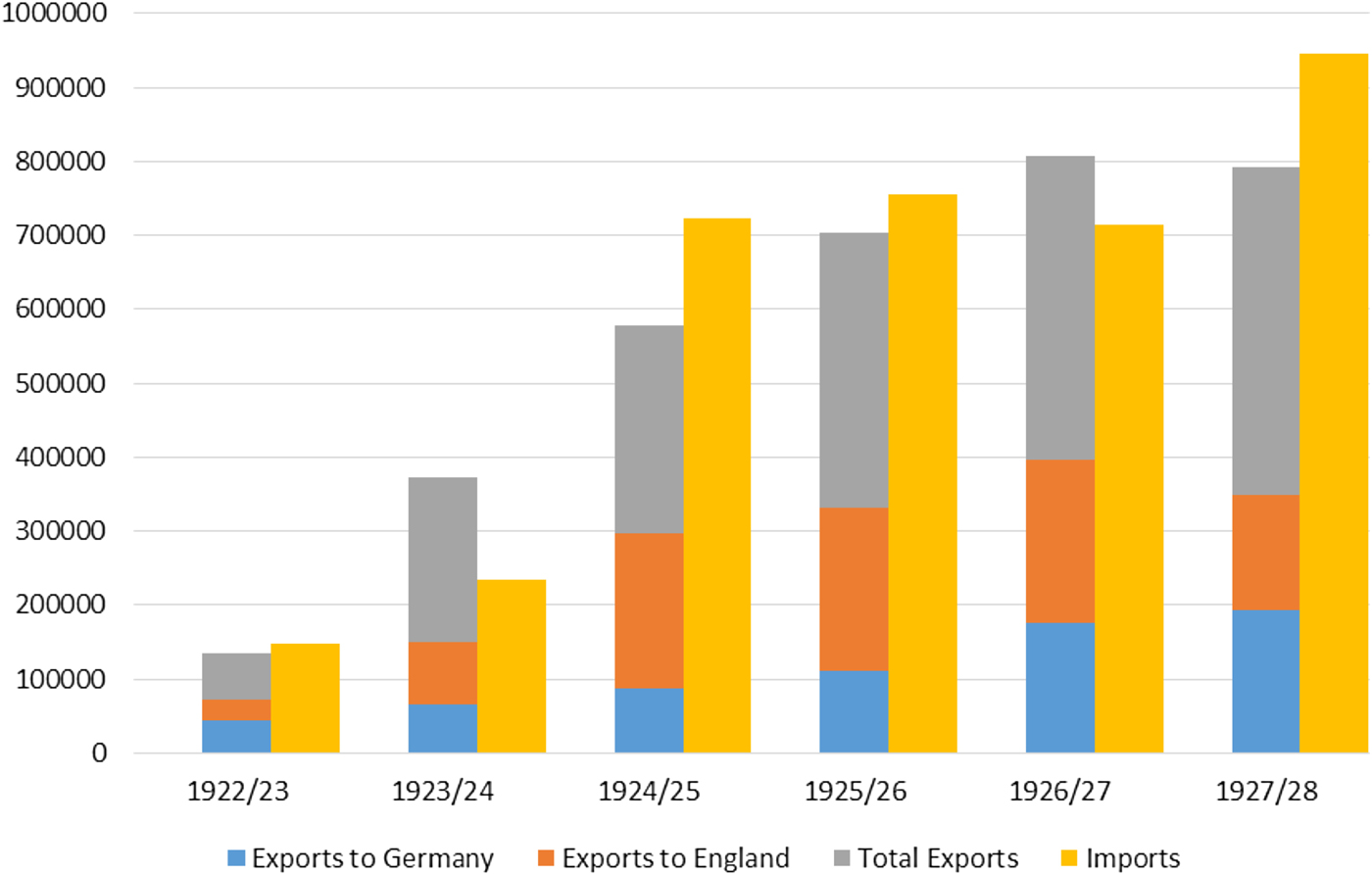
What is being described here is the creation of debt relations (money) among domestic trusts on the basis of the credibility of capitalist banking institutions, and the Soviet state's ability to transact with the world economy on a regular basis. This was possible because foreign financial partners knew exactly the state of Soviet reserves. Soviet balances—which is to say all of their foreign currency and some of their gold—were held in the major foreign banks of Britain, Germany, and the United States, and they were published twice a month for all to see.Footnote 79 See Figure 2.Footnote 80
Soviet Imports and Exports (of which Exports to England and Germany), 1922–28.

Gold Standard Bolshevism, Smychka, NEP
Sokol΄nikov's grand vision for the Soviet experiment did not go unchallenged in the margins, particularly by those who wanted to see industry free from the discipline of the chervonets’ prerogative. He prevailed because his was the Bolshevik state's guiding vision as set down in 1921.Footnote 81 In September 1923, his vision was undiminished: “Another two or three months of a healthy chervonets and many more opportunities for foreign credit will open before us. You cannot imagine the international effect our financial policy is having. It paves the way for the recognition of Soviet Russia and the establishment of real commerce. A financial relationship with Moscow is at least as important as all our diplomatic work. Capitalists regard the chervonets as an indicator of the political and economic situation of the Soviet Union, that's why I think we cannot calmly accept the demand for more emissions of chervontsy. We must hold no matter what.”Footnote 82 Sokol΄nikov had not counted on the scissors crisis, which had to wait until the larger financial resolution in Europe allowed for a steady commercial and financial turnover with the Soviet Union—and a positive balance of payments. Connecting the fate of socialism's economic life to the recovery of the capitalist world was by design; timing the completion of that connection to the spring of 1924 was not.
Importantly, the People's Commissariat of Finance was not simply recreating a liberal world of markets. This was the first attempt at constructing socialism, not a simple provisional compromise with the rationalism of liberal architecture. On the basis of the “real values” of foreign money, the Commissariat of Finance looked forward to transitioning from indicative planning to a hard annual budget that could be expanded and manipulated according to the economic and financial growth of the Soviet Union.Footnote 83 For Sokol΄nikov himself, the end of the reform was the beginning of a new era of socialist construction.Footnote 84 A currency legitimated by international finance was the platform upon which hard budgets and effective planning could be carried out.Footnote 85
By the time Sokol΄nikov was explaining this in a speech in 1926, Stalin had already maneuvered him out of the leadership and Narkomfin. Stalin did so by gesturing to ideological differences, most notably at the fourteenth party congress that took place in December 1925, where Sokol΄nikov became the most frequent target of Stalin's rejoinders.Footnote 86 The semantics of his criticisms, mainly circling around the definition of state capitalism in the Soviet context, reveals in effect a complete agreement with Sokol΄nikov's project.Footnote 87 For Stalin, the chervonets was “the only basis on which it is possible to plan and develop industry” and could not be allowed to be undermined through deficits in the balance of payments that would shrink gold reserves and cause its devaluation.Footnote 88
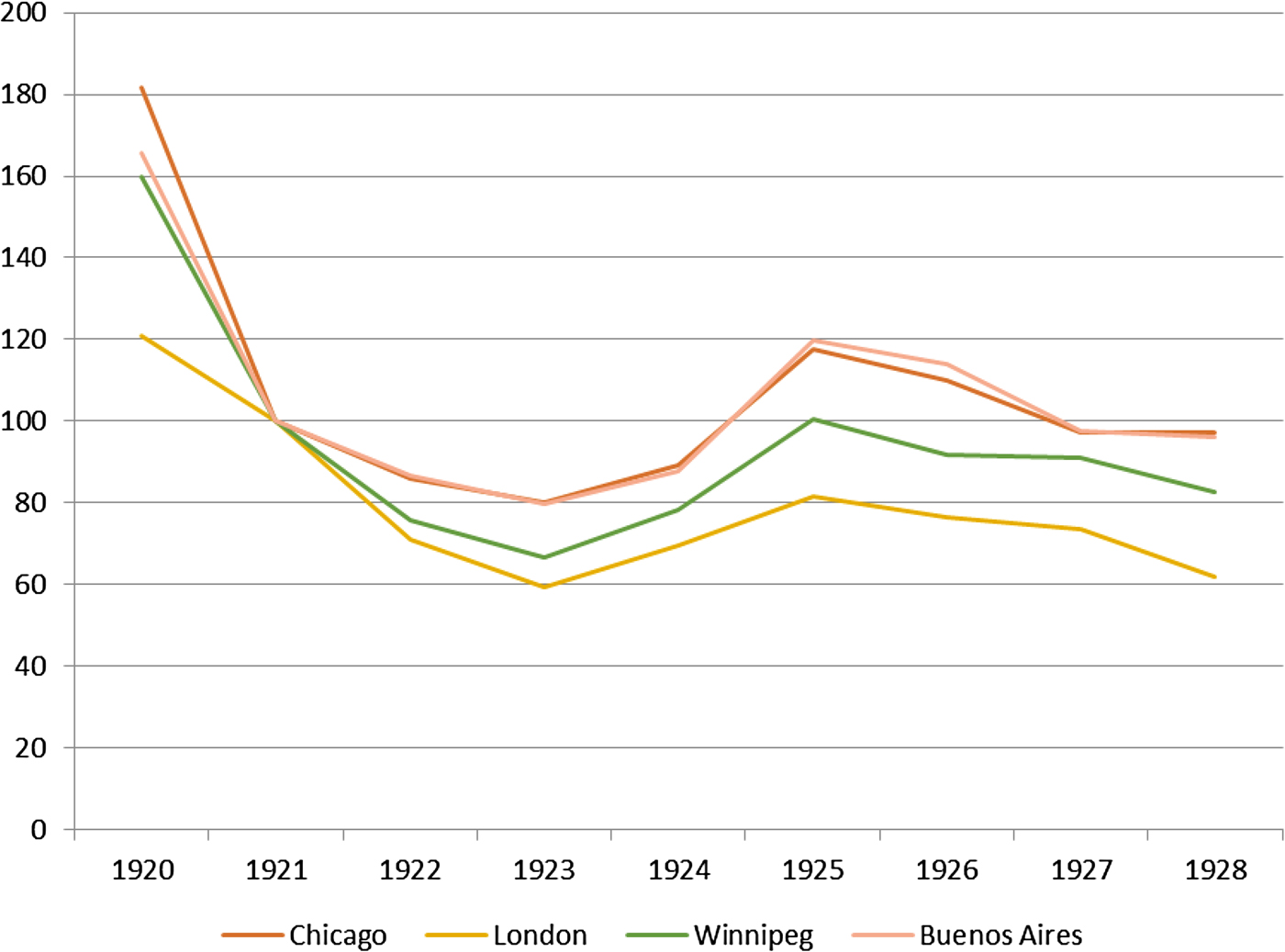
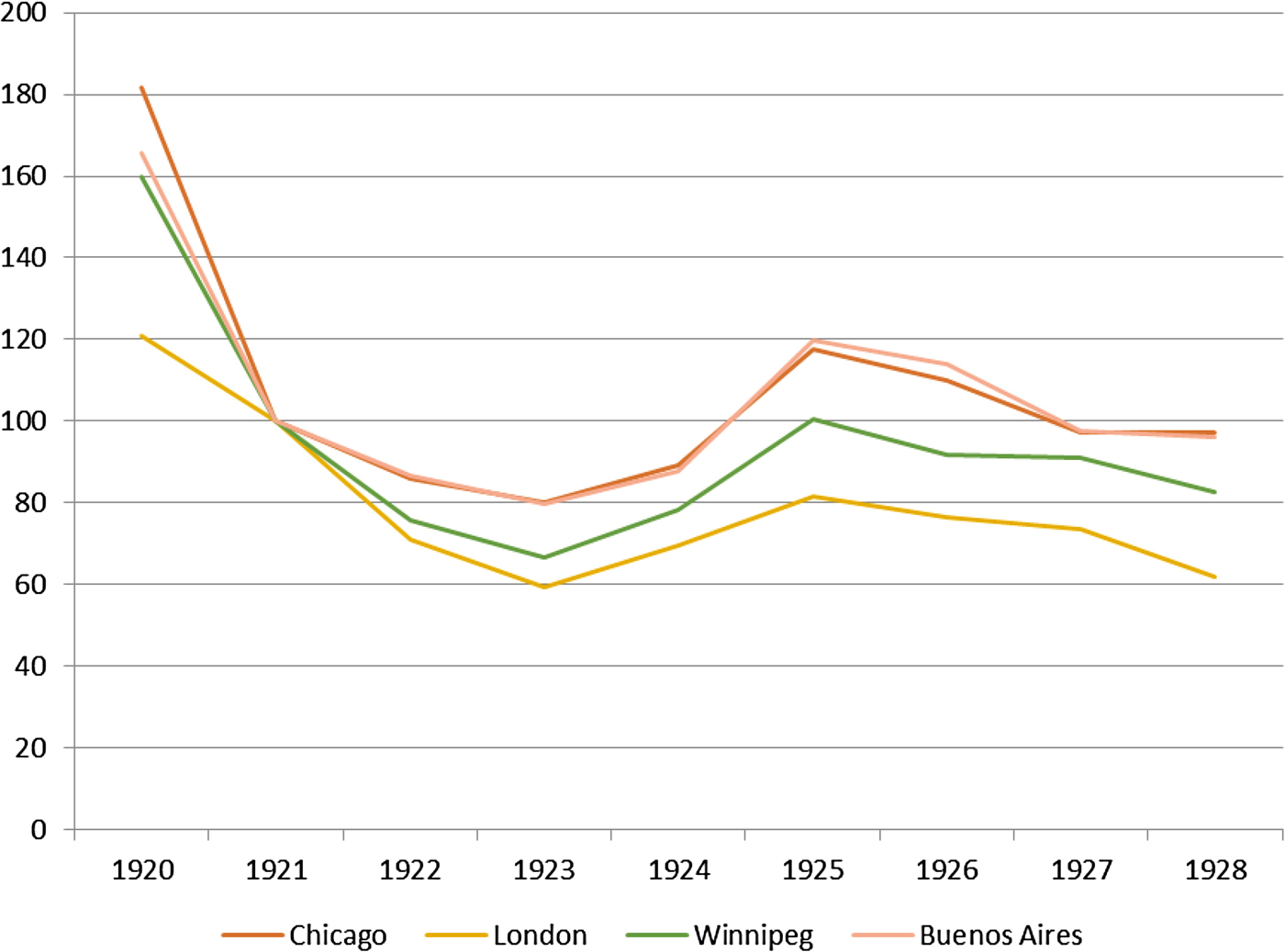
The end of the monetary reform in 1924 was followed a year later by the amalgamation of the Commissariats of Foreign and Domestic Trade into one institution, to be run by one of Stalin's own men, Anastas Mikoian. This was nothing less than the institutional acknowledgement that the domestic legitimacy of the Bolshevik state as a responsible steward of social trust was now dependent on the institution that safeguarded that trust internationally: the gold standard. The political orthodoxies remained, so when the country started experiencing a chronic balance of payments deficit in the second half of 1925—partly a consequence of falling prices in the oversaturated international grain market, which peaked that year—Mikoian, like Krasin and Sokol΄nikov before him, became anxious. The interest rates the Bolsheviks were offered for the loans necessary for the functioning of the country's foreign trade were still much too high, “which discredits us, brands us as bad credit risks and causes us to overpay when purchasing goods abroad.”Footnote 89 Chronic deficits meant that the hard-earned gold and foreign currency reserves that underpinned Bolshevik money had begun a process of slowly accelerating depletion. See Figure 3.Footnote 90
Wheat Market Prices around the World (1921 = 100).
With gold draining from state coffers, the Bolsheviks were forced to cease the defense of the chervonets in 1926, at least domestically, although they were able to maintain some credibility through further efforts at austerity through 1927.Footnote 91 Yet world grain prices failed to recover, and with the smychka slowly fading into oblivion as peasants increasingly refused to deal with the state in a depreciating currency, the Bolsheviks opted for more administrative measures.Footnote 92 This should not be somehow seen in opposition to the market. After all, markets had come to life—can only come to life—under conditions of state administration. Furthermore, the Bolsheviks expected the five-year plan they drew up in 1928 to be fully compatible with the chervonets and the markets built around it.Footnote 93 Indeed, the Bolshevik leadership continued to hope, well into 1928, that they could rebuild their hard currency reserves and get back on track so that the first Five-Year Plan may be built on hard budgets.Footnote 94 Instead, it would be the capitalist world that would follow the Soviet Union in delinking their currencies from the gold standard. Budgets evanesced along with the system of circulating debt arrangements that they had been built upon.
Austerity—though it was not then called that—is a conservative policy in the deepest sense of the word. It is afraid of change. It is about maintaining a system of debt exchange, both internally and externally, that has built a sense of trust over time. Trust is always seen as fragile, rather than robust, and hence only a conservative continuity may nurture it. The world of international financiers is an embodiment of this sensibility. The Soviet Union purchased a degree of trust in this rarefied world after a half-decade of orthodoxy, just in time for that world to vanish from the scene of most of its European strongholds. The Bolsheviks had felt the pressures of the Great Depression before anybody else, and had had to thoroughly overhaul their socio-economic project by 1930.Footnote 95 The chervonets had no place in the new, ad-hoc project Stalin improvised, and it disappeared silently from the scene in the midst of the violence that attended the new socio-political construct.
Joseph Schumpeter observed that “in a people's monetary system is reflected everything that this people wills, does, suffers, is.”Footnote 96 This article has tried to substantiate this claim in tracing the development of the chervonets and the aspirations it embodied. The monetary anarchy of the Civil War era reflected the fundamental breakdown of social relations in the country, of networks of obligations: between debtors and creditors, landowners and peasants, town and country. When the Bolsheviks tried to stabilize the financial sovereignty of the state and reorganize society to advance the state's purposes (and the purposes of the revolution), they appealed to the central legitimizing institution of the liberal world order, the gold standard. Their money of issue would gain strength, credibility and ultimately purchase by linking it to the international liberal order, the very same order that had served tsarist Russia so well. This was a goal of the medium-term, but while they slowly increased the degree to which they could appropriate resources in a destroyed domestic sphere, they would gain legitimacy abroad as well. This, they thought, represented the surest and quickest path to capital, one that could be followed without unleashing another social meltdown. They abdicated, in effect, a sovereign monetary space, expecting to find in the global liberal order a domestic and international legitimacy that eluded them.