When I became king, it occurred to me to change my name … An inspiration from the hidden world brought it into my mind that, inasmuch as the business of kings is the controlling of the world, I should give myself the name of Jahangir [world-seizer] and make my title of honor Nur ud-Din [light of the faith], since my sitting on the throne coincided with the rising and shining on the earth of the great light.Footnote 1
The increasing preoccupation of the scholarly community in recent years with globalization appears to have left its impact on postmodern geographers and historians of cartography as well, several of whom have turned their attention recently to the history and politics of the image that is at the center of this new problematic, namely, the terrestrial globe.Footnote 2 As Denis Cosgrove notes in his provocative analysis of cartographic representations of Earth in the Western imagination, “Whether pictured as a networked sphere of accelerating circulation or as an abused and overexploited body, it is from images of the spherical earth that ideas of globalization draw their expressive and political force” (2001: ix). Its very ubiquity as a symbol of the times in which we live underscores the preoccupation with the image of the globe in the late modern imagination. However, as Jerry Brotton observes, its pervasiveness may also point to an increasing redundancy of its appearance in our times, and the image of the globe has suffered what might be called “a waning of affect” (1999: 73). This argument leads him to a study of the early modern period in Europe when the terrestrial globe first emerged in his assessment as “a socially affective object” (ibid.: 72). In his Trading Territories (1997), Brotton considers how the terrestrial globe came to not just reflect an increasingly “global” world but also to constitute it over the course of the sixteenth century. Its power lay “in the ideological representation of the world it purported to describe. Its lack of cognitive specificity was not its weakness but ultimately its greatest strength, because the very perceptions of distance and space upon which the terrestrial globe rested stressed speculation and conjecture over the extent and possession of distant territories” (1999: 87–88). From the early years of the sixteenth century, even as the Copernican revolution was slowly undoing medieval Christian cosmological conceptions of the universe, terrestrial globes became increasingly crucial to the exercise of state power in Europe, as well as to the surging search for new markets and tradable goods. As importantly, as prestige objects, globes and maps became part of a new gift economy of circulation and exchange, and were sought after like “the spices, pepper, silk and precious metals to which [they] appeared to give directional access” (Brotton Reference Brotton1997: 25; see also Jardine Reference Jardine1996: 295–309, 425–36). In the process, they helped fashion new bourgeois modalities of the self, mostly but not exclusively male. Not surprisingly, as Brotton notes, “It is upon the figure of the globe, as both a visual image and a material object, that many of the social and cultural hopes and anxieties of the period came to be focused” (1997: 21).
Accordingly, revisionist scholars have begun to critically scrutinize the social and symbolic significance of the terraqueous globe. As Brotton points out, historians of science and cartography have hitherto largely tended “to reify world maps and globes as proto-scientific objects divested of any wider social significance, and have limited the ways in which these objects came to be utilized both practically and imaginatively within a range of social situations” (ibid.: 19). These revisionist studies clearly and visibly extend the conceptual field within which we may think the globe, and write about it. And the small but growing scholarship on cartographic traditions and practices of societies and cultures outside Europe, prior to and into the modern centuries, offers tantalizing glimpses of interest in, and even the manufacture of, terrestrial globes, however episodically, in regions far away from its putative homeland in the West, such as the Arab world, India, China, and Japan. They also alert us to the important—but frequently forgotten or erased—roles played by astronomical and geographical knowledges from other parts of the world in the new science of cartography emerging in early modern Europe (Karamustafa Reference Karamustafa, Harley and Woodward1992: 221–22; Needham Reference Needham1971: 586–87; Raj Reference Raj2006; Schwartzberg Reference Schwartzberg, Harley and Woodward1992: 397–99; Unno Reference Unno, Harley and Woodward1994: 390–92, 466–71).
Building on this scholarship, this essay is located in early modern India, when the terrestrial globe became visible for the first time in the Mughal court, especially pictorially.Footnote 3 As Denis Cosgrove writes, “To imagine the earth as a globe is essentially a visual act … . Such a gaze is implicitly imperial, encompassing a geometric surface to be explored and mapped, inscribed with content, knowledge, and authority” (2001: 15–16). To masterfully visualize Earth as an integrated totality, a spherical entity suspended in the cosmos and gridded by a mathematical network of latitudes and longitudes, is also an act that requires an enormous leap of imagination that does not come naturally. It has to be learned and in a disciplined manner; it is “hard-won knowledge, map knowledge” (Wood and Fels Reference Wood and John Fels1992: 5). But once such knowledge seizes the human imagination, the image of Earth as a sphere comes to eventually reign (albeit not without resistance), for it is “a figure of enormous imaginative power” (Cosgrove Reference Cosgrove2001: 3). In Cosgrove's reading, “To achieve the global view is to loose the bonds of the earth, to escape the shackles of time, and to dissolve the contingencies of daily life for a universal moment of reverie and harmony” (ibid.: 5). He also suggests that “desires of ordering and controlling the object of vision” propel the visualization of Earth as globe, and that such desires are “connected as closely to lust for material possession, power and authority as to metaphysical speculation, religious aspiration, or poetic sentiment” (ibid.). While we may never be able to grasp the full extent of the Mughal interest in the terrestrial globe brought into their court by sundry Europeans, we can chart its complex visual trajectories as it came to be deployed by artists in the imperial atelier from the early years of the seventeenth century.
Inspired though by the work of Walter Mignolo (Reference Mignolo1995: 219–23) and Laura Hostetler Reference Hostetler(2001), this essay sets out to not just track the visual uses of the globe in the Mughal court, but to ask more fundamentally what does a postcolonial history of the terraqueous globe achieve? I suggest that such a history compels us to pluralize and complicate the social and political lives of this icon of modern Western cartographic practice outside its putative originary home in the metropole where most scholars have documented it.Footnote 4 As important, however, is that a postcolonial perspective reminds us that the history and politics of the globe (as concept, apparatus, representation, sign, and symbol) as it travels away from its putatively natural habitat is not necessarily a mere rehearsal or repetition of the paths taken in the West. A relocation to regions outside the West facilitates, and a postcolonial perspective encourages us to pursue, the challenge of understanding how the globe—this much-touted symbol of unity and universality—might also reflect and constitute difference.
In considering the different trajectories that this putatively Western invention might take outside Europe, I am not attempting to exoticize alterity for its own sake, thereby reproducing a Manichean and Orientalist dichotomy between “the West” and “the Rest.”Footnote 5 Nor do I wish to minimize the importance of understanding intersecting “connected histories” of early modern cartographic practice and scientific knowledge-production that recent scholarship has underscored (Raj Reference Raj2006). Instead, by demonstrating how the encounter with the globe-form enables at least one part of the non-European world to destabilize a Europe-centered mapping of Earth, as well as pluralize ways of visualizing the terrestrial realm, this essay positions itself within the recent vein of post-colonial scholarship that insists that the study of alterity and difference contributes to the theoretically fertile project of “provincializing Europe” (Chakrabarty Reference Chakrabarty2000). The principal, provisional implication of my reading for a revisionist, post-colonial history of cartography is that the globe itself—a key material sign of a secularizing, globalizing, and imperializing Europe—provides an opportunity for confronting and opposing a singular reading of the global lives and times of this “universal” object and symbol.
An Emperor's Global Dream
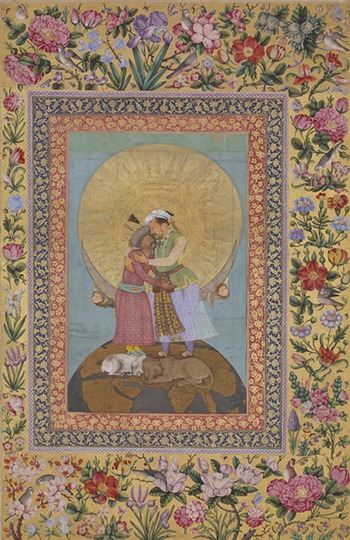
My entry point into this other history—and the anchor image for this essay—is a much-reprinted and much-discussed painting by Abu'l Hasan (a.k.a. Nadir al-Zaman [“The wonder of the epoch”]), arguably the most favored imperial artist in the atelier of the Mughal emperor Jahangir (r. 1605–1627) (Figure 1).Footnote 6 Around 1618, responding to what the painter himself refers to as “a dream” of his imperial patron in which Jahangir's Safavid rival Shah ‘Abbas appeared to the Mughal ruler, Abu'l Hasan painted what has been declared to be “one of the greatest of political pictures from any culture” (Losty Reference Losty and Bombay1991: 81).Footnote 7 In Jahangir's dream, as captured pictorially by Abu'l Hasan, the two rival emperors are shown embracing each other against the background of an immense halo composed of a radiant sun and a beautiful crescent moon supported by two celestial putti. Numerous commentators have noted that not only is Jahangir painted lighter and brighter than his dark-complexioned rival (alerting us to the prevalence of a non-European/pre-colonial racial economy at work), but he is also bigger than the Shah, who appears frail and meek, his arms unable to grasp the majesty of the great man he seeks to embrace. On the other hand, “the attitude of the Mughal emperor is that of a great monarch generously patronizing an inferior rival” (Das Reference Das1978: 217). This impression is further strengthened by the fact that Jahangir is made to stand on a large lion while his Persian rival's feet rest on a smaller lamb.
The St. Petersburg Album: Allegorical Representation of Emperor Jahangir and Shah ‘Abbas of Persia. Painted by Abu'l Hasan, ca. 1618. Opaque watercolor, gold and ink on paper, 23.8 × 15.4 cm. Freer Gallery of Art, Smithsonian Institution, Washington, D.C., purchase F1945.9.

What makes this particular painting foundational for any history of modern cartography in India is that the animals on which the two emperors are standing in turn rest on a partially visible globe on which are clearly delineated and named the territories over which their mastery is imagined to prevail. That in this painting the globe, still an utter rarity in India around 1618, is not centered on Europe begins to undermine the apparent European-ness of this object, opening up possibilities for an oppositional biography to emerge for this Western import.Footnote 8 As telling for this oppositional biography is that this much-touted product—and sign—of the newly-emergent European science (itself under radical reconfiguration at this time) was drawn, on the eve of that continent's imperializing and globalizing mission, into a complex assertion of power in another part of the world, as the Mughal emperor advanced hegemonic claims, albeit unsuccessfully, over his rival Safavid's territory, leaving Europe hugging the margins of the picture (both literally and figuratively). Being Jahangir's dream that is pictorialized here by a painter in his atelier, the Mughal's territorial reach as represented on Abu'l Hasan's globe is much vaster. The lion on which he stands sprawls across a good part of Persia (which is labeled as such under its paw) as well as much of what we recognize as central Asia, a part of the world that had been under the sway of his ancestor Timur. In turn, the Safavid's vast empire is reduced to some paltry territories around the Mediterranean.
In Joseph Schwartzberg's authoritative analysis of South Asian cartography, one of the few that considers the territorial configurations of the globe in this painting, he writes:
There can be no question that the general shapes of the portions of Asia, Africa, and Europe indicated on the globe … derive from European maps … . But within the area of India, the delineation of rivers looks intriguingly distinctive. These appear to be notably more accurately aligned than on roughly contemporaneous European maps—certainly much more so, for example, than the map of the Mughal Empire in the 1625 edition of Purchas His Pilgrimes, which was copied from the 1619 map drawn by William Baffin on the basis of information provided by Roe … (1992: 409).Footnote 9
Schwartzberg therefore concludes that Abu'l Hasan must have had access to all manner of Mughal maps of the empire that appear to have not survived into the present, and that we know virtually nothing about. This much is also clear from Irfan Habib's brief analysis of cartography in Mughal India, where he analyzes a series of thirty-three maps of the “Inhabited Quarter” (the northern half of the Eastern Hemisphere) that were included in an encyclopedic Persian work called the Shahid-i-Sadiq finished in 1647 by one Sadiq Isfahani of Jaunpur. Habib, too, infers that Isfahani's mid-seventeenth-century maps are much more detailed and accurate than either earlier Arabic and Persian representations of Indian territory or contemporary European ones (Habib Reference Habib1979).Footnote 10
While we know little about other Mughal maps such as Isfahani's to which Abu'l Hasan might have had access, we can turn to an important cartographic encounter in the Mughal court to speculate on the conditions under which the emperor's painter might have gained knowledge of contemporary European representations of the known world. I refer to a fortuitous meeting at the temporary Mughal camp in Mandu on 9 September 1617 between Jahangir and Sir Thomas Roe, the English ambassador between late 1615 and early 1619 from the court of James I to Mughal India. Having been informed before he set out on his mission that “the great Mogull” made “more estimation” of world maps than of “all other presents,”Footnote 11 Roe gifted the emperor “a faire book well bounded, filleted and gilt, Mercators [sic] last edition of the maps of the world; which I presented with an excuse that I had nothing worthy, but to a great king I offered the world, in which he had so great and rich a part” (Foster Reference Foster1990: 380, my emphasis).Footnote 12 On being “offered the world” in this cartographic manner, “the King tooke in great courtesie, often laying his hand on his breast, and answering: Everything that came from mee was welcome” (ibid.). However, it is clear that, two weeks later, on 25 September, this particular English gift was not all that welcome. I turn to Roe's Journal, where the entry for this day reads, “The King, hearing that I had been sicke and wished for wine, gave me five bottles, and commanded, when I had ended those, to send for five more, and so as I wanted: and a fat hogge, the fattest I ever saw … . I tooke this as a signe of favour, and I am sure in that court it is a great one. Then he sent for the map-booke, and told me had had shewed it his mulaies, and no man could reade nor understand it; therefore, if I would, I should have it againe. I answered: at his pleasure; and so it was returned” (Ibid.: 392).Footnote 13
Roe himself has nothing more to say on either the presentation of Mercator's Atlas to Jahangir, the emperor's assessment of the gift, or the subsequent return of the “map booke.” But his chaplain Edward Terry writes about it with a sense of displeasure but also barely-hidden satisfaction:
The Mogol feeds and feasts himself with this conceit, that he is Conqueror of the World; and therefore I conceive that he was troubled upon a time, when my Lord Ambassador, having business with him (and upon those terms there is no coming unto that King empty handed, without some present or other) … and having at that time nothing left which he thought fit to give him, presented him with Mercators [sic] great book of Cosmography (which the Ambassador had brought thither for his own use), telling the Mogol that that book described the four parts of the world, and all several countreys in them contained. The Mogol at the first seem'd to be much taken with it, desiring presently to see his own territories, which were immediately shewen unto him; he asked where were those countreys about them; he was told Tartaria and Persia, as the names of the rest which confine with him; and then causing the book to be turn'd all over, and finding no more to fall to his share but what he first saw, and he calling himself the Conqueror of the World and having no greater share in it, seemed to be a little troubled, yet civily told the Ambassadour [sic], that neither himself nor any of his people did understand the language in which that book was written, and because so, he further told him that he would not rob him of such a jewel, and therefore returned it unto him again. And the truth is that the Great Mogol might very well bring his action against Mercator and others who describe the world, but streighten him very much in their maps, not allowing him to be lord and commander of those provinces which properly belong unto him (Foster Reference Foster1990: 382–83n, my emphasis).Footnote 14
Terry's reporting of the seemingly inconsequential encounter between Jahangir and Mercator's Atlas echoes examples from other times and other cultural contexts of the fantasies, hopes, and anxieties unleashed when the Self confronts an image of the world in modern cartographic artifacts.Footnote 15 In its tone, it is also suggestive of something that becomes all too familiar from subsequent centuries in its anticipation of the umbrage that colonials typically display when the native speaks back. Others have noted that Abu'l Hasan's provocative painting radically re-centered on Jahangir's empire with Europe confined to its margins, and produced around the time of this fateful encounter, may be seen as an imperial retort—a painting back—to the famous European cartographer who had dared to confine the great Mughal to only a small section of the world on his maps (Gascoigne Reference Gascoigne1971: 152). Such a reading is strengthened by the fact that this is not the only time that Abu'l Hasan and his colleagues resorted to the globe-form to praise and flatter their imperial master, and to disparage his (potential) rivals, both the more traditional foes like the Safavids and the Ottomans, as well as new arrivals like the Europeans. From around this time and for the next few decades, under the direct patronage of both Jahangir and his successor Shah Jahan (r. 1628–1658), the terrestrial globe comes to be deployed in some of the most innovative paintings of the Mughal atelier. It is used in ways that suggest that it became an intriguing new-fangled ingredient in conventional regimes of praise and adulation in the imperial court, as well as for the fashioning of the royal Self and the visible assertion of imperial authority in seventeenth-century India.
And yet, curiously, while several of these paintings have been skillfully studied at length by historians of Mughal art, the visual appearance of the globe in them has only elicited occasional comments, usually to illustrate the growing European artistic “influence” in the Mughal court.Footnote 16 Frequently, the globe is dismissed as a “European” object. My goal here, by contrast, is to demonstrate how the Mughal artists made it “their own,” rendering it Mughalai.Footnote 17 As for historians, including Irfan Habib Reference Habib(1979) and A. J. Qaisar Reference Qaisar(1982), who have written thoughtfully about Mughal cartography and science, they have largely ignored these striking examples of an early modern attempt from India to appropriate from Europe the representational authority to map the known world on and with cartographic instruments. Even the astute Sanjay Subrahmanyam ignores the gifting and return of Mercator's Atlas in his insightful reflections on how one may interpret such cross-cultural encounters as Roe's with Jahangir (2002). Building on his work, I would like to suggest that Roe and Terry were too hasty in concluding that Jahangir and his court could not read or understand the new cartographic language that Mercator and his colleagues were beginning to fashion in distant Europe. I propose in what follows that not only did the emperor's artists grasp this new language, but that they were sophisticated enough to paint back in response an alternative and more satisfying vision and version, and to skillfully deploy the globe-form in support of agendas that had little to do with Europe. So, although the globe's “universal iconographic legibility” has been noted (Lippincott Reference Lippincott and Dekker1999: 78), I am more interested in ways that these paintings alter its meaning and message beyond what might have been intended by European science, cosmography, or art in their particular deployments of its form in early modern India.
In the rest of the essay, therefore, I discuss the appearance of the terrestrial globe in a range of visual situations in order to elicit its work as a socially and politically affective object in the Mughal court. I consider how the globe's “calculated display” (Brotton Reference Brotton and Cosgrove1999: 82) in the productions of the imperial atelier may mark new ways of marking the singularity of the royal personage and of working out complex local and trans-regional assertions of power and prestige. At the same time, these paintings retort back to Europe's newly-emerging ways of mapping the earth that were beginning to increasingly circulate in the seventeenth-century world. These paintings are also important in that they are arguably the earliest instances in the subcontinent of the deliberate visual association of the terrestrial globe with the human body, and in pictorial presentations of the Self. They can help us to understand what kind of Self the Mughal emperor was seeking to fashion for himself and project for others, specifically through use of the globe-form.Footnote 18 Whether or not these paintings represent “the unrealistic fantasies of a benign demagogue” (Findly Reference Findly1992: 208),Footnote 19 or whether “they give meaning to the [Mughal] dream of universality, order and eternity” (Mukhia Reference Mukhia2004: 86), they certainly offer the most striking examples in India of historically-known individuals visually presenting themselves with modern cartographic artifacts as part of their public identity. In the West from at least the early sixteenth century until relatively recently, paintings, portraits, tapestries, and photographs show monarchs, merchants, travelers, burghers, and educated gentlemen in the company of the terrestrial globe. It is the paradigmatic visual icon of the worldly (male) self until the past century (Lippincott Reference Lippincott and Dekker1999). Tellingly, however, given the regimes of mimicry of the West that come to be institutionalized in colonial India, elite Indians rarely used the globe in their visual self-presentation in portraits or photographs. These Mughal paintings featuring the globe are quite precocious in this regard as well.
To return to one final point regarding Roe's returned gift, Terry reports that the encounter with Mercator's Atlas destroys “the conceit” on which Jahangir “feeds and feasts himself “that he is “Conqueror of the World.” Obviously, I hope to suggest to the contrary in this essay by demonstrating that this confrontation with seemingly novel European ways of representing the terrestrial world enables Jahangir and his artists to (re)present him, as his name suggested, as the world-gripper, the world-seizer, the world-holder, the world-king, and that this world was not necessarily centered on Europe or matters European, as in the various works of art being imported into the court. But in the closed circuits of Mughal artistic culture where few outside the emperor's circle of choice might have had access to these painterly assertions of imperial lordship, we must ask who and where is the audience that will behold him as master of the globe?Footnote 20 Where and who is “the world” that Jahangir, “the world capturer,” or Shah Jahan, “the world ruler,” seeks to address through such deployments of the terrestrial globe? Is Europe even listening to these assertions, or seeing them? More tellingly, given its marginal and shadowy presence in the realpolitik and everyday life of seventeenth-century India, is Europe even the intended audience, or is this another case of the appropriation of a European artifact for specific local and regional agendas? The calculated display of the globe in these paintings might not even care about an assumed subject-audience that has to be readily impressed; that too is part of the conceit of the globe in Mughal visual practice that we must consider.
Mughal Global ConceitsFootnote 21
By the time the terrestrial globe is drawn into the artistic activities of the Mughal court in the early seventeenth century, it had begun to circulate, albeit episodically and ephemerally, in India. Harbans Mukhia has recently drawn our attention to a tantalizing account of John Francis Careri in which the Italian writes that because Aurangzeb (or Alamgir) believed that he was lord of three-quarters of the world, “for this reason, he carry'd as his particular Ensign a Golden-Globe, and had it in his Seal” (2004: 60–61).Footnote 22 While there is scant evidence from the Mughal archive that Aurangzeb's predecessors, too, might have used the globe in this fashion, in a tantalizing painting dated to circa 1639 and attributed to Abid, which shows Shah Jahan seated in the so-called Peacock Throne, a mounted terrestrial globe is prominently displayed in front of and below the throne.Footnote 23 We do learn, however, almost exclusively from European accounts, that maps, globes, and other cartographic artifacts were sought after as prestige objects of prestation from the time the first Jesuit mission in 1580 to Akbar's court presented the emperor with Abraham Ortelius' Theatrum Orbis Terrarum, “The Theatre of the World,” the first atlas to “have made the earth portable, which a great many people assert to be immovable” (Bailey Reference Bailey1999: 116).Footnote 24 Around 1611, Father Jerome Xavier describes some of the decorations that the Jesuits used one year at the Christmas crib in Agra as including, “an ape which squirted water from its eyes and mouth, and above it a bird which sang mysteriously … and a globe of the world supported on the backs of two elephants …” (ibid.: 123). From at least November 1615, letters received by both the English and Dutch trading companies from their servants posted in India record requests for and receipt of globes and maps intended as gifts for the Mughal emperor and his governors and subordinates posted in different parts of the empire (Beach and Koch Reference Beach and Koch1997: 139; Habib Reference Habib1979: 94; Qaisar Reference Qaisar1982: 35–36, 148).Footnote 25
Seventeenth-century European accounts almost always present the sighting by natives of these cartographic objects as giving rise to wonder and surprise, and as we have see from Roe and Terry's writings, to some derision as well. Thus, K. N. Chaudhuri reminds us that Tavernier came across some Brahmans and nobles puzzling over two globes (presented by the Dutch) in Varanasi, and that he was called upon to point out the position of France upon them (1990: 35). But other than such European reportage, there is hardly any information on how the circulation of the terraqueous globe was received in Mughal India. This is yet another reason that the thirty or so paintings of the imperial atelier featuring this cartographic instrument are so important for any history of how the globe comes to be apprehended outside Europe.Footnote 26
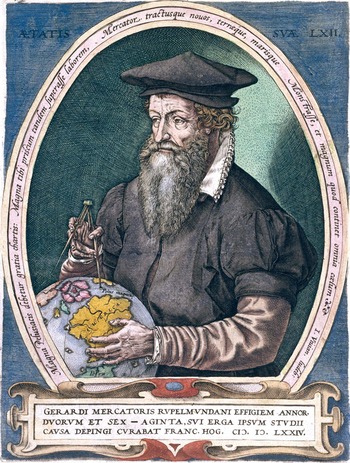
A remarkable late-sixteenth-century painting from the Ottoman court shows several men studying various scientific instruments, including a mounted terrestrial globe on which Africa, Asia, and Europe are clearly delineated (Brotton Reference Brotton1997: pl. 8; Savage-Smith Reference Savage-Smith, Harley and Woodward1992: 27–28). By contrast, in the known productions of the Mughal atelier the globe does not appear to have been visually represented as a scientific object of curiosity. Indeed, in none of the hitherto-documented Mughal paintings featuring it does the globe ever appear in isolation. Instead, it is invariably visually displayed in the company of the Emperor, most often physically connected to his body in some fashion: he is either holding it, standing on it, resting his feet on it, or waiting to receive it from either his predecessors or, interestingly, from Muslim holy men. With a few notable exceptions that I will flag later, the globe visually appears only in imperial contexts where the Emperor invariably occupies center stage. This is in contrast to, for example, contemporary Europe, where all manner of (male) grandees—navigators, explorers, sea captains, astronomers, geographers, philosophers, nobles, and ambassadors—had themselves painted in the globe's company, frequently to the point of asserting a proprietary attitude toward it (e.g., Figure 2; see also Lippincott Reference Lippincott and Dekker1999). In Mughal visual practice on the other hand, the terrestrial globe appears as an imperial prerogative par excellence, and joins the ranks of such exclusive signifiers of imperial sovereignty such as the crown, the plume or turban ornament, the precious gem, the falcon, and the ceremonial robe of honor (Okada Reference Okada and Dusinberre1992: 30–33). Even more so than these other perquisites, however, it seems to have been exclusively identified with the imperial body, for unlike these, the globe is never shown being handed over by the emperor to lesser personages.Footnote 27 It is always painted as an object of imperial possession, never of alienation and separation, as befitted an artifact that might have come in quite handy for shoring up a well-established Mughal conceit of “the Emperor's person as an embodiment of Empire,” and in this case, more than the empire—the world itself (Richards Reference Richards, Alam and Subrahmanyam1998: 128). The imperial artist's monopoly over the globe's representation to the exclusion of others' capacity to mimic or similarly deploy it suggests that the Mughal alone claimed the visual capacity to own the globe-form, and the world that it purported to signify. This is the most striking manifestation of the emperor's conceit with regard to this cartographic apparatus.
Portrait of Mercator holding and measuring a globe. Engraved by Frans Hogenberg in 1574. From Atlas sive cosmographicae meditationes de fabrica mundi et fabricati figure, 1595.S0005093. ©Royal Geographical Society Picture Library, London.

Imperial conceit in relation to the terrestrial globe is also underscored in these portraits by the fact that the emperor's body, in conformity with the logic of hieratic arts, always subordinates the cartographic artifact over which he looms large, reducing it to an entity that is literally at his feet or that he can hold lightly in his hand. How much more effectively and affectively could his artists suggest the power of their imperial patron than by visually suggesting that he may be a man of the world, so to speak, but was also above it? So, in several examples, in a motif that becomes very common, the emperor is painted standing on the globe, his feet resting lightly on land formations (sometimes distinctively delineated, sometimes vague and unspecified) marked on its surface while his body, elaborately bejeweled and sumptuously clothed, soars gloriously into the cosmos. He is frequently shown obviously exercising his lordship over others, as in a portrait by another of the emperor's favorite artists, Bichitr, which has been widely interpreted as Shah Jahan receiving the submission of a Hindu, possibly Rajput prince (Arnold and Wilkinson Reference Arnold and Wilkinson1936: pl. 63).
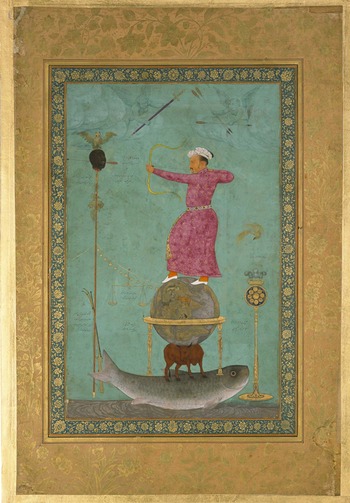
As this portrait suggests, more is going on in these pictures than just the bestowal of a cosmic persona on the emperor, as the globe is drawn into all manner of visual dramas that his artists enacted on his behalf. The most striking examples of these are two paintings attributed to Abu'l Hasan. In one, completed perhaps around 1620, Jahangir is shown standing on the globe shooting at the head of a sworn enemy, the Deccani Abyssinian overlord Malik ‘Anbar (Figure 3).Footnote 28 In the other, generally dated to 1620–1625, he nails down the cringing figure of poverty personified while astride a terrestrial globe (Figure 4).Footnote 29 Both paintings conscript the terrestrial globe into complex political, moral, and personal envisionings of the royal self. In the second painting, a carefully painted inscription over the haloed head of the emperor reads, “Blessed portrait of His Supreme Majesty who dispatches his eager shafts into Poverty and who, through his rectitude and fairness, is laying new foundations for the world.”Footnote 30 In Ellison Findly's reading, Jahangir is set up here as “a divinely legitimate monarch ruling over all the known world, but one who additionally has the moral character to fight poverty with martial-like justice” (1992: 208), while in the 1620 effort by the same artist it is clear that even though he may be a righteous and just sovereign, this did not make Jahangir less of a warrior, as demonstrated by his vanquishing of one of the best-known braves of his time, Malik ‘Anbar. It is telling that the artist thought it significant to enact these complex visual dramas with the aid of the newly introduced terrestrial globe as imperial stage prop, painted with considerable attention to detail. Indeed, it is hard to think of the enactment of these dramas without the globe's presence. Other artists appear to have found it so, for these two paintings were much imitated, occasionally with variations, into the nineteenth century by those working for a new post-Mughal clientele (Das Reference Das1978: 226, n. 35; Desai 1993). In our own times, their theme has been carried forward in “The Greatest,” by the talented diaspora painters Amrit and Rabindra Kaur Singh in England,Footnote 31 and in works by the Pakistani Karkhana collective (Imran Qureishi et al. Reference Imran Qureshi2005: 87–89).Footnote 32
Jahangir Shoots Malik ‘Anbar. Painted by Abu'l Hasan, ca. 1620. Gouache on paper, 25.8 × 16.5 cm. CBL In 07A. 15. ©Trustees of the Chester Beatty Library, Dublin.

Emperor Jahangir Triumphing over Poverty, attributed to Abu'l Hasan, ca. 1620–1625. Opaque watercolor, gold, and ink on page, 23.81 × 15.24 cm. Los Angeles County Museum of Art, Nasli and Alice Heeramaneck Collection, Museum Associates, purchase M.75.4.28.

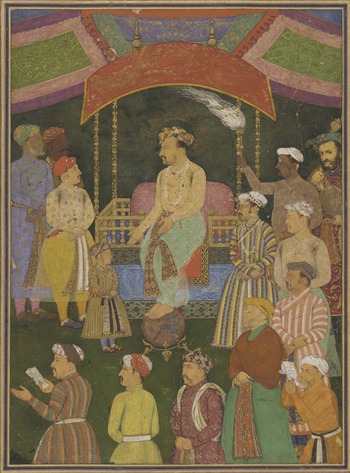
That the known and inhabited world was literally at the emperor's feet is also visually underscored in another much-analyzed painting (ca. 1615) attributed to Abu'l Hasan. In this work, Jahangir is shown seated on a rectangular throne under a red canopy, looming over others assembled in his court and virtually ignoring them as he gazes beyond them to a distant horizon, while his unshod feet rest on a delicately painted globe placed on a golden stand (Figure 5).Footnote 33 Although Abu'l Hasan does not trouble to name the territories marked on the globe, as he does in his later, 1618 venture, he resorts to another interesting device to visualize global mastery. Jahangir is shown carrying a key in his cummerbund, which fits into the keyhole of the globe, placed strategically in what Findly identifies as “north-central India” (1992: 206). “The key of victory over the two worlds is entrusted in his hand,” reads Abu'l Hasan's inscription. That the emperor is shown sitting European style, literally treating the world as his footstool, while figures representing rival emperors (such as the Persian shah and the Turkish sultan) are relegated to the margins of the picture, has been read as “a clear statement of his world dominance” (Beach Reference Beach1981: 203). In Ellison Findly's words, “With the whole world at his feet and the fate of India locked up tightly in his hands, he occupies the central position within his universe” (1992: 206).
Durbar Scene of Jahangir. Painted by Abu'l Hasan, ca. 1615. Opaque water color, gold, and ink on paper, 16.9 × 12.3 cm. Freer Gallery of Art, Smithsonian Institution, Washington, D.C., purchase F1946.28.

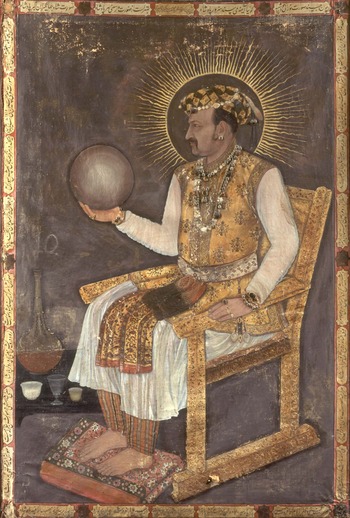
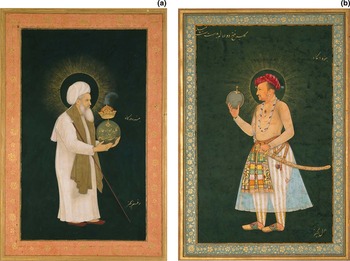
This conceit of having the world at his feet, its key in his belt, and potential rivals distant and foreign arranged around him in a manner that suggests that they are paying court to him, is matched by another in paintings in which the emperor lightly holds the world—frequently reduced to a small orb—in his capable hands.Footnote 34 The most magnificent example of the latter has also been declared to be the largest known Mughal painting, auctioned by Sotheby's in London in October 1995. This was also painted by Abu'l Hasan, this time, in Mandu sometime between March and October 1617, roughly around the same time as Jahangir's fateful encounter with the Mercator atlas. In it the emperor sits in a European-style chair with a magnificent radiating nimbus around his head, elaborately bejeweled, clothed but with unshod feet, holding an unmarked orb in the palm of his left hand (Figure 6). Persian verses bordering the picture declare his “visage as world-illuminating,” and note that “if a hundred kings like Alexander came to the World, they would all prostrate themselves a hundred times at a glimpse of his face,” and that “the kings of Rum [Turkey] and China wait at the gate” (Sotheby's Reference Sotheby's1995: 74–83). It has been suggested that the absence of territorial markers on the globe represents the emperor's triumph over both “the temporal and spiritual worlds” (Sotheby's Reference Sotheby's1995: 79).Footnote 35 In another magnificent portrait produced around 1620 by Bichitr, which similarly shows the emperor holding the globe while standing with his hand resting on the hilt of his sword, an inscription on the upper-left-hand corner of the work declares, “the key to conquest of both worlds is entrusted to your hand,” kalid-i-fath-i dau ‘alam bi-dast ast [musallam] (Leach Reference Leach1995: 388–89) (Figure 7b).
The Mughal Emperor Jahangir with Radiant Gold Halo, Holding a Globe. Painted by Abu'l Hasan, ca. 1617. Gouache with gold on fine cotton, 210.5 × 143 cm. Courtesy Sotheby's Picture Library, London.

(left) Shaykh Mu'in al-Din Chisti Holding a Globe. Figure 7b (right) Jahangir Holding a Globe. Painted by Bichitr, ca. 1620. The Minto Album. Gouache on paper. ©Trustees of the Chester Beatty Library, Dublin. Figure 7a: 21.8 × 13 cm. CBL In 07A.14. Figure 7b: 20.5 × 12.7 cm. CBL In 07A.5.

The conceit that the Mughal emperor was master of both worlds—widely interpreted as “the temporal” or “the visible” (‘alam-i-suri) and “the spiritual” (‘alam-i-ma'navi)—brings us to another productive role in which the globe is cast in several of these paintings, as it comes to participate in the politics of what the art historian Jeremiah Losty refers to as “the dervish-oriented kingship” that was critical to sovereignty and rule from the thirteenth century (1991: 76). As Simon Digby observes, Sufi shaikhs held “the power to bestow kingship upon individuals whom they encountered, or to foresee the attainment of a throne by such men” (1990: 75). In the artistic productions of the Mughal court, the emperor is frequently pictured receiving the blessing and endorsement of all manner of holy men drawn from different faiths, but the globe figures especially in those paintings featuring Khwaja Mu'inuddin Chisti and Khwaja Khizr, who occasionally are pictured offering the world itself to him. So, in 1620, Bichtr painted a bearded man passing the Timurid crown to Jahangir; the crown in turn is placed on a globe on which the land masses are indistinctively marked while pride of place is given to an escutcheon plate surmounted by a key (Figure 7a). Tellingly, the globe is inscribed with the stock phrase: “The key to the conquest of the two worlds [‘alam] is entrusted to your hand” (Leach Reference Leach1995: 398). A companion piece to this painting, also by Bichtr, shows a resplendent standing Jahangir holding a globe, once again with indistinctive territorial delineations. But this time the crown is missing and the key that was perched atop the escutcheon plate is now inserted in the lock (Figure 7b). In Robert Skelton's analysis, “Clearly Jahangir has unlocked the secrets of the visible and invisible worlds, since, as the Regent of God, he shares his Creator's omniscience …” (1988: 183). The bearded shaikh has been widely interpreted as the twelfth-century Khwaja Mu'inuddin Chisti of Ajmer, who Akbar revered and to whose tomb he went on frequent pilgrimages. Although long dead by Jahangir's time, Mu'inuddin is placed within the same temporal space as the emperor, erasing the centuries that separated them.
That it is not Jahangir alone but also Shah Jahan who wished to have his overlordship of the world endorsed by other-worldly men is confirmed by the several paintings in the mid-seventeenth-century Padshahnama, which documents the achievements of Shah Jahan and which has been masterfully discussed by Milo Beach and Ebba Koch (Reference Beach and Koch1997). In a glorious 1656 work attributed to a Kashmiri artist, Shah Jahan is pictured visiting the shrine of Khwaja Mu'in ud-Din Chisti at Ajmer. The shrine is painted in the background while in the foreground, waiting to greet his mounted figure, is a holy man offering a globe clearly marked with various territorial formations (Beach and Koch Reference Beach and Koch1997: pl. 41). The figure has been interpreted as the mythical mystic Khwaja Khizr, an “emblem of fertility … [whose] very appearance would cause nature to become green and lush” (ibid.: 204). Khwaja Khizr appears in other Shah Jahani period paintings as well, playing a similar role. For example, in a image by Abid dated to 1635, Khwaja Khizr holds out an orb to Jahangir holding court in the jharoka (viewing balcony) above him as he waits to greet his son Prince Khurram, who later went on to become his successor Shah Jahan (ibid.: pl. 37). The emperor's dominion—signified here by the globe—seems to be receiving the holy man's endorsement (ibid.: 198–99). Similarly, in a painting recently published from what is referred to as the St. Petersburg Album, Khwaja Khizr offers the elixir of life in a chalice poised atop a globe. Waiting to receive it is a figure who has been identified as Shah Jahan's son, Shah Shuja, recently appointed as governor of Bengal (Akimushkin Reference Akimushkin1996: pl. 199).
I noted earlier that the terrestrial globe in Mughal imperial visual practice is a royal prerogative par excellence, invariably shown in association with the emperor's body or his wielding of authority and power. Rarely, if ever, is anyone other than the emperor himself shown handling the globe or in contact with it. Even when his sons appear in the company of the terraqueous globe, their imperial father invariably accompanies them. The painting in the St. Petersburg Album is exceptional in this regard. The other exception in the known archive of Mughal paintings is when Sufi elders are shown passing on the globe, or, in a clear imitation of European models, celestial angels are envisioned bestowing the globe upon the emperor (Okada Reference Okada and Dusinberre1992: pls. 31 and 246). As we learn from European missionary visitors to the Mughal court, Jahangir was particularly fond of a painting of Christ holding an orb, and accorded it pride of place on the walls of the imperial palace from as early as 1608 (Bailey Reference Bailey1999: 134; see also Verma Reference Verma2005: 131–43). In a 1640 painting in the Padshah Nama by Murar, the jharoka (viewing balcony) in which Jahangir is seated is flanked by European paintings, mounted between the brackets supporting the roof of its gallery. To the right of the imperial group is the image of the Virgin Mary, and on the left that of Christ in his familiar guise as Salvator Mundi. It is almost as if the savior of the world himself is endorsing Jahangir's worldly rule (Beach and Koch Reference Beach and Koch1997: pl. 38; see pl. 39 for a similar appearance in a painting by Payag). In an earlier painting from 1617, which has been called “Jahangir and Prince Khurram feasted by Nur Jahan,” a similar painting hangs strategically above the mis-en-scéne (Stanley Clarke Reference Stanley Clarke1922: pl. 5, no. 7). And in a joint work of Hashim and Abu'l Hasan, dated to circa 1620, a youthful Christ at the cross shares the frame with Jahangir, the palm of whose hand rests on an orb (Gascoigne Reference Gascoigne1971: facing 115). Jahangir's halo is much more distinctive, even as Christ's image is clearly subordinated to that of the Mughal emperor, who is placed above him within the frame of the painting. Of interest here is that, as in similar portraits, “the sacred person is depicted on the same level of reality as the living emperor,” and also that the painting substitutes “the sacred protagonist of a Christian painting for the person of the emperor (Koch Reference Koch2001: 10–11).
In his influential 1961 essay “The Emperor's Choice,” art historian Richard Ettinghausen analyzed several of the so-called allegorical paintings from the late Jahangiri period to conclude that the emperor's closing years were marked by a progressive preoccupation with spiritual and mystical concerns to the point of disdain for the temporal world. I would like to complicate this reading, however, by noting that, paradoxically, these same years of apparent withdrawal from worldly affairs as depicted in the paintings of the Mughal court are also marked by the increasing presence of the terrestrial globe in the artistic productions of that very atelier. Ettinghausen has not particularly emphasized the role played by the globe in the construction of an ideology of Sufi-sanctioned kingship that apparently privileges the spiritual over the temporal, the mystic over the warrior. But it is ironic that the terrestrial globe—the cartographic artifact and visual icon that was being deployed in early modern European art to suggest worldliness, earthliness, and, increasingly, imperial reach—is mobilized in these Mughal artistic productions to represent the constitutive role of the atemporal and the transcendent in the emergence of a new imperial self and new modalities of wielding royal authority. It is also important to recognize that as this newfangled artifact coming in from Europe was incorporated into an older regime of the moral-cum-political relationship between the Sufi and the sultan, it unleashed a different trajectory for the globe in early modern India than the one it inhabited in contemporary Europe.
While shaikhs and putti, even Christ himself, may be shown offering globes to the emperor, sanctioning and endorsing his sovereignty, Jahangir was fully aware of the power of demonstrating the legitimacy of succession in temporal terms as well, especially so given the fraught circumstances in which he had ascended the imperial throne. This awareness is signaled in numerous paintings that show the crown or the turban clasp or a precious jewel being handed over from one sovereign to another, but it is noteworthy that the terrestrial globe is incorporated into these more conventional regimes of transfer of sovereignty (Okada Reference Okada and Dusinberre1992: 30–32). Thus a painting by Abu'l Hasan and Hashim, done possibly around 1615, shows a haloed Jahangir, richly attired in costly clothes and valuable jewels, holding a framed painting of his father. Akbar, looking old and fragile, and dressed in pure white, holds a dark green orb in his hand that he appears to be handing over to Jahangir as the latter gazes upon him (Okada Reference Okada and Dusinberre1992: pl. 27).Footnote 36 Similarly, in a painting produced by an unknown artist around 1645, Akbar is on display along with his son and grandson. While Akbar holds an ornamented jewel and looks at Shah Jahan, who holds out his hands in front of him, Jahangir holds a globe on which is inscribed a cluster of buildings; he is in the act of handing over the globe to his son, in the same way as in the earlier painting by Abu'l Hasan and Hashim his father was depicted offering the world to him.Footnote 37
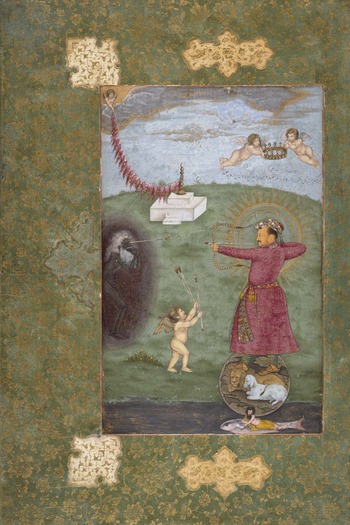
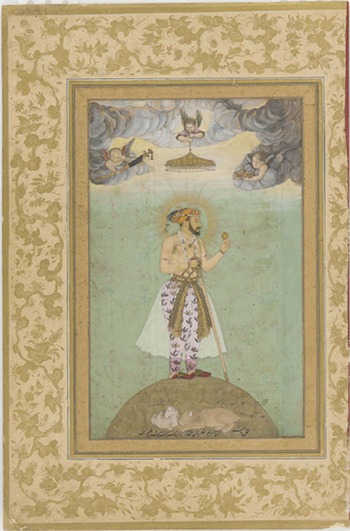
There is a last conceit for which imperial artists resorted to the globe in order to flatter their royal patrons. As I have noted, the globes that figure in these paintings may or may not display identifiable territories.Footnote 38 Every now and then they appear as indistinctive orbs, sometimes with a band running across them, at other times bearing objects such as an escutcheon plate or the Timurid crown, or a cup bearing the elixir of life. Intriguingly, in a 1629 portrait by Hashim of Shah Jahan done soon after he succeeded to the throne, the “ruler of the world” is shown on top of the world, which is in turn represented by a globe adorned with two groups of holy men, each holding scrolls on which are inscribed a prayer: “O God, preserve this king, this friend of mystics, in whose shadow the peaceful existence of men unfolds” (Welch et al. Reference Welch1988: pl. 62) (Figure 8). This substantiates my earlier point about the incorporation of the globe into an older ideology of kingship sanctioned by Sufi mystics, but this portrait also illustrates what might be the most wide-spread motif used by imperial artists to adorn globes: the image of a ferocious beast of prey (dad), usually a lion, lying down peaceably with its potential victim (daam), generally a lamb. Ebba Koch has written eloquently about this imagery of dad-o-daam, and comments, “the power over dad-o-daam demonstrates allegorically the power of the universal ruler who by his regal charisma reverses the laws of nature and brings inimical nature, the oppressor and the oppressed, to a peaceful co-existence” (2001: 116). She traces the impulse of this imagery back to the influence exerted on Mughal artists by the circulation of the title page illustration of the Royal Polyglot Bible. This was printed in Antwerp by Plantin between 1568 and 1572 and was presented to Akbar, along with a host of Christian images, by the first Jesuit mission to his court in 1580. Koch writes, “the Mughals were quick to realize the potential of such images for their own purposes and surrounded themselves with Christian symbols to enhance their aura as semi-divine rulers … . The success of this [motif] in Mughal art was based on the fact that it related generally to the role that animal symbolism played in the Islamic pictorial tradition … . [I]t represented a visual expression of the ancient idea that peace among the animals was brought about a just ruler—above all by the Koranic model of rulership, Solomon—which had been used extensively to eulogize Muslim princes …” (Beach and Koch Reference Beach and Koch1997: 137). The Mughal artistic innovation here, generated certainly with the complicity of their imperial patrons, lies in deploying the terrestrial globe as the ground on which to play out this golden age drama of peace and plenitude among the beasts as a sign of ideal kingship and rule (Koch Reference Koch2001: 1–11, 116–29; Verma Reference Verma2005: 67–71). What Mignolo characterizes as the “geometric rationalization of space” that modern scientific cartography was beginning to inaugurate in the West around the same time is magnificently countermanded by such an enchanted imagery in which a very different kind of dominion is asserted (1995: 222–23). In early modern European art the terrestrial globe is in many cases meticulously painted so as to signify (intended) dominion over specific territories (Lippincott Reference Lippincott and Dekker1999: 76–77, 83; Welu Reference Welu1975: 541–44). By contrast, the Mughal atelier's deployment suggests that a very different, and perhaps even superior kind of empire is enabled by the just and moral ruler of the sovereign, one in which the strong and weak can co-exist, one “where the lion has sipped milk from the teat of the goat” (Koch Reference Koch2001: 19). The dad-o-daam as a visual supplement, added to the terrestrial globe to hide, blur, or even erase the delineated territories on its surface, is perhaps the most powerful reminder we have of an emergent cartography of difference and alterity.
The Emperor Shah Jahan Standing upon a Globe; above, Angels Bearing Insignia of Sovereignty. Painted by Hashim, 1629. Color and gold on paper 25.1 × 15.8 cm. Freer Gallery of Art, Smithsonian Institution, Washington, D.C., purchase F1939.49.

Global Confrontations
The terrestrial globe as an object and as representation was only introduced into India in the later years of the sixteenth century, but it was incorporated within a few decades into the visual productions of the Mughal workshop to generate an aura of grandeur and singularity for the imperial patrons. It remained though an elusive and exclusive prestige object until well into the colonial period, when missionaries and colonial educators attempted to introduce it into the schoolroom. I have demonstrated elsewhere that the native nonetheless continued to put this pride of the new European science to affect-laden and enchanted uses alongside the more profane and secular tasks of pedagogy and assertions of state power for which it was dominantly destined (Ramaswamy Reference Ramaswamy and Ramaswamy2003). For now, however, let me conclude by returning to two of Abu'l Hasan's paintings discussed earlier to point out how, even in the Mughal century, when the terrestrial globe first entered India, it was never simply taken on board or circulated in the manner intended by its original creators. In Abu'l Hasan's painting of circa 1620, where Jahangir is envisioned slaying the Abyssinian Malik ‘Anbar (Figure 3), the globe does not stand as a sovereign sphere unto itself, as European cartography of the day would have it. Instead, following classical Islamic cosmological conceptions (traced by some scholars to Iran and ancient Babylonia, and eventually perhaps back to India), it is made to rest on an ox, which in turn stands on a large fish with scales.Footnote 39 An inscription on the painting reads, almost in defiance of the purposes for which the free-standing sphere was designed from the 1490s by men like Martin Behaim, Gemma Frisius, and Gerard Mercator, “Through the divine felicity of the Divine Shadow's coming, the earth is raised up on the Fish-bull,” “zi yumn-i maqdam-i zill-i illahi zamin gashta samk bar gav-mahi” (Leach Reference Leach1995: 400). As Skelton observes, “The fixing of the earth in place is one of the mysteries of God's creative power,” and he quotes from the twelfth-century Sufi poet Farid al-Din ‘Attar: “At the beginning of the centuries, God used the mountains as nails to fix the earth; and washed Earth's face with the waters of Ocean. Then he placed Earth on the back of a bull, the bull on a fish, and the fish on the air” (1988: 182). Similarly, in the slightly later painting by the same artist (Figure 4), the earthly globe which supports the grand Mughal's body is in turn supported on the back of a fish; the ox has been replaced by a man who it has been speculated is Manu, who was saved from the great flood by Vishnu in his first incarnation as Matsya, the fish. This leads Skelton to suggest, “Under the Just King, then, even Hindu laws are respected” (1988: 185). Instead of accepting, prima facie, that the earth is suspended in the universe free of external supports, these paintings demonstrate that going global in Mughal visual practice did not necessarily mean a capitulation to European worldviews but instead provoked a complex assertion of difference and defiance through the mediation of the imperial atelier.