INTRODUCTION
Phosphorus (P)-deficiency is an important hindrance to cultivation in many tropical soils throughout the world (Simpson et al., Reference Simpson, Oberson, Culvenor, Ryan, Veneklaas, Lambers, Lynch, Ryan, Delhaize, Smith, Smith, Harvey and Richardson2011; Weerarathne et al., Reference Weerarathne, Suriyagoda and Marambe2015), limiting plant growth particularly in economically developing countries where access to P fertilizer is restricted (Lynch, Reference Lynch2007). Although the necessity exists for the application of P fertilizers in quantities five-fold greater than the amount translocated to economically important products (Simpson et al., Reference Simpson, Oberson, Culvenor, Ryan, Veneklaas, Lambers, Lynch, Ryan, Delhaize, Smith, Smith, Harvey and Richardson2011), increasing P-fertilizer application is not regarded as a viable option to improve agricultural production to meet global food demand (Dawson and Hilton, Reference Dawson and Hilton2011; Gilbert, Reference Gilbert2009; Hinsinger et al., Reference Hinsinger, Betencourt, Bernard, Brauman, Plassard, Shen, Tang and Zhang2011; Vance, Reference Vance2001). Therefore, the necessity exists to consider alternative approaches such as more P-efficient genotypes and alternative management practices to exploit soil-P resources better through increasing bioavailability of P in agro-ecosystems (Lambers et al., Reference Lambers, Shane, Cramer, Pearse and Veneklaas2006; Vance, Reference Vance2001). In this context, mixing P-efficient with inefficient species as intercrops or using the residues of P-efficient species for subsequent crops in crop rotation (Simpson et al., Reference Simpson, Oberson, Culvenor, Ryan, Veneklaas, Lambers, Lynch, Ryan, Delhaize, Smith, Smith, Harvey and Richardson2011) are some options available to improve the P-efficiency in cropping systems that operate under P-limited conditions.
Intercropping or mixed cropping is a form of agricultural practice that involves growing multiple crop cultivars or species simultaneously in the same field for a large part of their life cycle (Lithourgidis et al., Reference Lithourgidis, Dordas, Damalas and Vlachostergios2011; Vandermeer, Reference Vandermeer1989). This age-old practice is still applied widely around the world mainly in tropical, small-scale subsistence farming (Lithourgidis et al., Reference Lithourgidis, Dordas, Damalas and Vlachostergios2011). Moreover, legume–cereal intercropping is practiced widely in many countries (Wang et al., Reference Wang, Marschner, Solaiman and Rengel2007), where it has been revealed that certain P-efficient grain legumes can mobilize sparingly available P, thereby enhancing its availability for the P-inefficient cereals (Jemo et al., Reference Jemo, Abaidoo, Nolte, Tchienkoua, Sanginga and Horst2006; Li et al., Reference Li, Sun, Zhang, Li, Yang and Rengel2001; Li et al., Reference Li, Tang, Rengel and Zhang2003; Li et al., Reference Li, Li, Zhang and Tang2004). In this context, crops with the ability to exude P-mobilizing compounds, which are regarded as capable of accessing sparingly available phosphate or mobilizing P from organic sources, have been examined (Simpson et al., Reference Simpson, Oberson, Culvenor, Ryan, Veneklaas, Lambers, Lynch, Ryan, Delhaize, Smith, Smith, Harvey and Richardson2011). Among those species, the ability of white lupin (Lupinus albus) to enhance P availability for neighbouring cereals in P-deficient soils has been investigated in detail (Cu et al., Reference Cu, Hutson and Schuller2005; Dissanayaka et al., Reference Dissanayaka, Maruyama, Masuda and Wasaki2015; Gardner and Boundy, Reference Gardner and Boundy1983; Horst and Waschkies, Reference Horst and Waschkies1987; Kamh et al., Reference Kamh, Horst, Amer, Mostafa and Maier1999; Lelei and Onwonga, Reference Lelei and Onwonga2014; Li et al., Reference Li, Shen, Zhang, Marschner, Cawthray and Rengal2010; Wang et al., Reference Wang, Marschner and Zhang2012). White lupin, with its ability to form cluster roots (an adaptation for nutrient acquisition from nutrient-poor soils) and exude vast amounts of phosphate-mobilizing substances (Lambers et al., Reference Lambers, Clements and Nelson2013), has been identified as an ideal plant species to thrive in soils where higher amounts of P remain in poorly available forms for most plants. White lupin can mobilize sparingly available nutrients for themselves as well as for intercropped or subsequent crops (Lambers et al., Reference Lambers, Clements and Nelson2013).
The phenomenon of enhancing growth and P uptake by cereals when intercropped with P-mobilizing plant species is well established (Simpson et al., Reference Simpson, Oberson, Culvenor, Ryan, Veneklaas, Lambers, Lynch, Ryan, Delhaize, Smith, Smith, Harvey and Richardson2011). However, some reports have described a positive effect of lupin intercropping (Cu et al., Reference Cu, Hutson and Schuller2005; Dissanayaka et al., Reference Dissanayaka, Maruyama, Masuda and Wasaki2015; Gardner and Boundy, Reference Gardner and Boundy1983; Horst and Waschkies, Reference Horst and Waschkies1987; Kamh et al., Reference Kamh, Horst, Amer, Mostafa and Maier1999; Lelei and Onwonga, Reference Lelei and Onwonga2014). Other reports have reported no significant effect (Dissanayaka et al., Reference Dissanayaka, Maruyama, Masuda and Wasaki2015; Li et al., Reference Li, Shen, Zhang, Marschner, Cawthray and Rengal2010; Wang et al., Reference Wang, Marschner and Zhang2012). These contrasting findings are useful to infer the mechanisms involved in interspecific P facilitation in lupin–cereal intercropping. This review elucidates the possible mechanisms underpinning the positive interspecific facilitation through enhanced acquisition of P by P-inefficient plant species in intercrops with P-mobilizing lupins.
DYNAMIC NATURE OF P IN SOIL, PLANT ACQUISITION AND OPPORTUNITY FOR INTEGRATION
Phosphorus occurs primarily as inorganic-P in apatite minerals derived from bedrock. However, the amount of organic-P builds up over time with soil formation and weathering (Richardson et al., Reference Richardson, Peltzer, Allen, McGlone and Parfitt2004). Older soils (at latter stage of soil development) become P-limited, although young soils (in an early stage of soil development) contain sufficient amounts of inorganic-P (Vitousek and Farrington, Reference Vitousek and Farrington1997). In soil, P is partitioned between P in soil solution and sorbed-P (bound-P). The bound-P fraction represents the P, which is bound tightly to minerals or organic compounds. Therefore, most P in this fraction is non-labile. Various chemical and biochemical reactions are necessary to release the sorbed phosphate ions for plant roots to acquire (Hinsinger et al., Reference Hinsinger, Betencourt, Bernard, Brauman, Plassard, Shen, Tang and Zhang2011).
The P fertilizers applied to many soils are incorporated into organic matter. They later accumulate in sparingly available P pools and organic P forms (Simpson et al., Reference Simpson, Oberson, Culvenor, Ryan, Veneklaas, Lambers, Lynch, Ryan, Delhaize, Smith, Smith, Harvey and Richardson2011). Phosphate is initially adsorbed either to surfaces of soil particles or precipitates with Ca or oxides and hydroxides of Al and Fe (McLaughlin et al., Reference McLaughlin, McBeath, Smernik, Stacey, Ajiboye and Guppy2011; Pierzynski et al., Reference Pierzynski, McDowell, Sims, Sims, Sharpley, Pierzynski, Westermann, Cabrera, Powell, Daniel and Withers2005; Sample et al., Reference Sample, Soper, Racz, Khasawneh, Sample and Kamprath1980). Therefore, a part of the applied P is expected to accumulate in soils (Bünemann et al., Reference Bünemann, Heenan, Marschner and McNeill2006; McLaughlin et al., Reference McLaughlin, Baker, James and Rundle1990). Different P fractions in soil can be extracted chemically. The resin P, NaHCO3-extractable inorganic and organic P are regarded as labile soil-P fractions and are the most available for plant acquisition (Bowman and Cole, Reference Bowman and Cole1978; Tiessen and Moir, Reference Tiessen, Moir and Carter1993; Tiessen et al., Reference Tiessen, Salcedo and Sampio1992). The NaOH-extractable inorganic and organic P, acid-extractable (HCl) P and residual-P are the less labile pools (Hedley et al., Reference Hedley, Stewart and Chauhan1982; Tiessen and Moir, Reference Tiessen, Moir and Carter1993). The NaOH-extractable inorganic and organic P represents the P associated with oxides and hydroxides of Al and Fe (Hedley et al., Reference Hedley, Stewart and Chauhan1982) and are regarded as sparingly available P pools.
Under P-limited environments, plants employ three broad strategies to support their growth: (i) ‘root foraging strategies’ – enables the plant to explore large volumes of soil and thereby acquire more P from soil; (ii) ‘P mining strategies’ – increases desorption and mineralization of sparingly available P and organic P in soil by root exudation and (iii) ‘improved internal P-utilization efficiency’ – helps plants to use acquired P efficiently (Richardson et al., Reference Richardson, Lynch, Ryan, Delhaize, Smith, Smith, Harvey, Ryan, Veneklaas, Lambers, Oberson, Culvenor and Simpson2011). Plants that are able to use any of these strategies would use soil-P and fertilizer-P efficiently (Simpson et al., Reference Simpson, Oberson, Culvenor, Ryan, Veneklaas, Lambers, Lynch, Ryan, Delhaize, Smith, Smith, Harvey and Richardson2011). However, such adaptations are missing in many modern crop varieties to thrive in P-deficient soils. Therefore, the possibility exists of integrating P-mining plant species with modern crop varieties in intercropping systems to achieve the necessary growth improvement and yield advantages under P-limited environments (Simpson et al., Reference Simpson, Oberson, Culvenor, Ryan, Veneklaas, Lambers, Lynch, Ryan, Delhaize, Smith, Smith, Harvey and Richardson2011).
WHAT MAKES LUPINS WELL ADAPTED TO GROWTH IN P-LIMITED ENVIRONMENTS?
Some species in the genus Lupinus have evolved a promising strategy to enhance P acquisition in P-limited conditions. White lupin (L. albus), which is a species in the genus Lupinus that has been used for mixed cropping, produces proteoid or cluster roots (Gardner et al., Reference Gardner, Parbery and Barber1981), which are specialized root structures formed in response to soil P-deficiency. These are bottle-brush-like clusters of rootlets of limited growth with an average length of 0.5–1 cm. The rootlets are closely arranged along the lateral roots. They are usually covered with long and dense root hairs (Dinkelaker et al., Reference Dinkelaker, Hengeler and Marschner1995; Purnell, Reference Purnell1960; Watt and Evans, Reference Watt and Evans1999). Cluster root formation is known to be the best strategy to acquire P when it is not readily available in soil (Lambers et al., Reference Lambers, Martinoia and Renton2015). The proteoid roots are able to acidify the rhizosphere soil strongly (Dinkelaker et al., Reference Dinkelaker, Römheld and Marschner1989; Li et al., Reference Li, Shinano and Tadano1997) because of the release of a large amount of organic acids (predominantly as citric and malic acid) and protons into the rhizosphere (Dinkelaker et al., Reference Dinkelaker, Römheld and Marschner1989; Keerthisinghe et al., Reference Keerthisinghe, Hocking, Ryan and Delhaize1998; Li et al., Reference Li, Shinano and Tadano1997; Neumann et al., Reference Neumann, Massonneau, Martinoia and Römheld1999). Citrate can release P from sparingly soluble Fe-phosphate and Al-phosphate (Gerke et al., Reference Gerke, Römer and Junk1994) by mechanisms of ligand exchange or chelation of metal ions (Hinsinger, Reference Hinsinger1998). Carboxylates can also influence P mobilization indirectly by influencing the rhizosphere microorganisms (Lambers et al., Reference Lambers, Clements and Nelson2013) that solubilize inorganic phosphates (Kucey et al., Reference Kucey, Jancen and Leggett1989; Wang et al., Reference Wang, Zhou, Yang, Jin and Liu2005).
Cluster roots can further enhance the P uptake of white lupin through the secretion of extracellular acid phosphatases (Adams and Pate, Reference Adams and Pate1992; Neumann et al., Reference Neumann, Massonneau, Martinoia and Römheld1999; Neumann et al., Reference Neumann, Massonneau, Langlade, Dinkelaker, Hengeler, Römheld and Martinoia2000; Ozawa et al., Reference Ozawa, Osaki, Matsui, Honma and Tadano1995; Wasaki et al., Reference Wasaki, Yamamura, Shinano and Osaki2003), which hydrolyze organic P in soil. Phosphatase secretion is important with carboxylate exudation, where the possibility exists for plants to access greater amounts of P when both phosphatases and carboxylates are present. Acid phosphatases can hydrolyze organic P once mobilized by carboxylates (Braum and Helmke, Reference Braum and Helmke1995; Gerke et al., Reference Gerke, Römer and Junk1994). Consequently, three factors contribute to lupin acquisition of P under P-limited conditions. First, chelation-desorption-displacement of sorbed-P by organic anions (e.g. citrate) releases P from sparingly available P fractions in soil. Second, exudation of phosphatases mobilizes P from organic P forms in soil. Third, rhizosphere acidification caused by proton release increases the solubility of inorganic P in alkaline soils.
Most species of the genus Lupinus do not form specialized root structures of these types (Lambers et al., Reference Lambers, Clements and Nelson2013). Some Lupinus species form true cluster roots, although several others form cluster-like roots. Barbas et al. (Reference Barbas, García and Mañero1999) and Hocking and Jeffery (Reference Hocking and Jeffery2004) demonstrated the cluster-like root formation and carboxylate secretion by L. luteus, whereas Egle et al. (Reference Egle, Römer and Keller2003) and Pearse et al. (Reference Pearse, Veneklaas, Cawthray, Bolland and Lambers2006) reported that Lupinus angustifolius and Lupinus mutabilis release large amounts of carboxylates without producing these specialized root structures. This difference underscores the fact that many lupin species are able to thrive under P-limited environments and that they have the ability to improve soil fertility status (Lambers et al., Reference Lambers, Clements and Nelson2013). Therefore, some species in the genus Lupinus can be regarded as new crop/pasture species for a situation in which the cost of nitrogen fertilizer is increasing and global rock phosphate reserves are decreasing (Cordell et al., Reference Cordell, Ostertag, Rowe, Sweinhart, Vasquez-radonic, Michaud, Colleen Cole and Schulten2009; Vance et al., Reference Vance, Graham, Allan, Pedrosa, Hungria, Yates and Newton2000).
MECHANISMS UNDERLYING INTERSPECIFIC FACILITATION THROUGH ENHANCED P ACQUISITION IN LUPIN–CEREAL INTERCROPPING: SYNTHESIS FROM PREVIOUS STUDIES
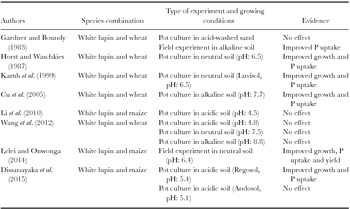
Although many species in the genus Lupinus can mobilize P in soil, only L. albus (white lupin) has been examined in several studies for its potential to improve the growth and P acquisition of P-inefficient plant species when they are as intercrops in soils having low available-P. However, in these studies, attention has been paid only to maize and wheat as companion plants (Table 1). Gardner and Boundy (Reference Gardner and Boundy1983), Horst and Waschkies (Reference Horst and Waschkies1987), Kamh et al. (Reference Kamh, Horst, Amer, Mostafa and Maier1999), Cu et al. (Reference Cu, Hutson and Schuller2005), Lelei and Onwonga (Reference Lelei and Onwonga2014) and Dissanayaka et al. (Reference Dissanayaka, Maruyama, Masuda and Wasaki2015) have reported the occurrence of P facilitation to intercropped maize (Zea mays L.) and wheat (Triticum aestivum L.) by white lupin. Studies conducted by Li et al. (Reference Li, Shen, Zhang, Marschner, Cawthray and Rengal2010), Wang et al. (Reference Wang, Marschner and Zhang2012) and Dissanayaka et al. (Reference Dissanayaka, Maruyama, Masuda and Wasaki2015) have shown that in some soil types, the positive effects of white lupin are negligible, providing no clear advantage to the intercropped plant. Although the ability of white lupin to enhance P availability through its P-mobilization strategy is well established, these findings suggest that the soil type/soil characteristics play a predominant role in determining the P-mobilization status from less labile P pools and its benefits for companion plant species.
Effect of phosphorus (P)-mobilizing white lupin on growth and P acquisition of P-inefficient companion plant species in intercropping cultivation systems.

Kamh et al. (Reference Kamh, Horst, Amer, Mostafa and Maier1999) demonstrated that white lupin can mobilize P not only from acid-soluble P, but also from the residual P pool in soils, leading to wheat crops having higher acquisition of P in the mixed cropping system compared to its monoculture, as a result of P mobilization from less labile P pools. Cu et al. (Reference Cu, Hutson and Schuller2005) demonstrated that white lupin increased P availability to the companion crop wheat from citric acid soluble soil-P pools, which are not normally available to monocropped wheat. In both of these studies, the companion cereal was benefited with no negative effect on white lupin. Lelei and Onwonga (Reference Lelei and Onwonga2014) reported that white lupin enhanced P availability from rock phosphate and thereby increased growth, P uptake, and yield of intercropped maize (Table 1). Although maize became the beneficiary in this cropping combination, growth of white lupin was negatively affected.
Few studies conducted have investigated the changes of different P fractions in the rhizosphere of intercropped species with white lupin. Dissanayaka et al. (Reference Dissanayaka, Maruyama, Masuda and Wasaki2015) attempted to address this limitation where labile, sparingly available and non-labile P pools were studied separately for maize and white lupin both in mixed and monocultures in two soils (Regosol and Andosol) with contrasting P-sorption capacities (Table 1). It is particularly interesting that between the two soil types, positive effects of intercropping were noted only in Regosol. The main contributing factor for enhanced growth and P acquisition was the mobilization of P from sparingly soluble P pools by white lupin, resulting in increased P availability for maize in the mixed culture. The contrasting intercropping effects between two soils were explained using three parameters: (i) difference in P availability between two soils as affected by their P-sorption capacities; (ii) contrasting root growth behaviour of maize and root intermingling of maize with white lupin between two soils and (iii) differential capacity of white lupin to increase P availability for intercropped maize between two soils. White lupin mobilized P from both NaOH-extractable inorganic and organic-P fractions in Regosol. In Andosol, mobilization occurred only from NaOH-extractable organic-P fraction. Poorer root intermingling among intercropped plants in Andosol possibly restricted the sharing of intercropping benefits in terms of P availability and uptake.
Dissanayaka et al. (Reference Dissanayaka, Maruyama, Masuda and Wasaki2015) reported that P-sorption capacity of the soil in which plants are grown is an important parameter that can be used to determine the characteristics of the intercropping relation, i.e. Andosol with 10-times higher P-sorption capacity to that of Regosol, recorded no positive effects on intercrops. Although white lupin mobilized P from NaOH-extractable organic-P fraction in Andosol, part of the released P would have again accumulated in P-sorption compounds. Andosols are rich in allophanes containing active aluminum. They show high retention of P, resulting in low utilization of applied P fertilizer (Lukito et al., Reference Lukito, Kouno and Ando1998). Moreover, P accumulates mainly in non-labile forms (Hirata et al., Reference Hirata, Watanabe, Fukushima, Aoki, Imamura and Takahashi1999). It is also evident that the intercropping relation becomes positive for the companion plant when the latter occupies the maximum soil volume influenced by P-mobilizing white lupin. A plant with higher rooting density would accommodate strong rhizosphere overlapping with P-mobilizing lupin and extract more P. Therefore, consideration of soil parameters that determine root growth other than available P concentration in soil is likely to be fruitful. This fact also showcases the importance of root architecture of the P-inefficient crop plants and crop arrangement in mixed cropping with lupins to maximize the sharing of rhizosphere functions. A plant with more numerous fine roots might gain marked benefits from intercropped lupin because of better rhizosphere overlapping than a plant with fewer large roots when established in closer proximity to lupin.
In contrast to observations of P acquisition of plants in acidic Regosol made by Dissanayaka et al. (Reference Dissanayaka, Maruyama, Masuda and Wasaki2015) and Li et al. (Reference Li, Shen, Zhang, Marschner, Cawthray and Rengal2010) reported no improved growth or P acquisition by maize plant in mixed culture with white lupin when grown in an acidic soil (Table 1). However, results reported by Dissanayaka et al. (Reference Dissanayaka, Maruyama, Masuda and Wasaki2015) for acidic Andosol were comparable with those of Li et al. (Reference Li, Shen, Zhang, Marschner, Cawthray and Rengal2010). Li et al. (Reference Li, Shen, Zhang, Marschner, Cawthray and Rengal2010) have not studied root intermingling or rooting density between two plants in the intercropping system or P-sorption capacity of the soil used, thereby making it difficult to explain the contrasting results reported from the two studies. In addition, Dissanayaka et al. (Reference Dissanayaka, Maruyama, Masuda and Wasaki2015) studied different P rates and forms for a 6-week period, whereas Li et al. (Reference Li, Shen, Zhang, Marschner, Cawthray and Rengal2010) conducted the study only with FePO4-amended soil at a rate of 100 mg kg−1 soil for 4 weeks. Li et al. (Reference Li, Shen, Zhang, Marschner, Cawthray and Rengal2010) did not examine the dynamics of different P fractions in rhizosphere within the cultivation period. Therefore, the extent of contribution of added FePO4 to different P fractions (labile and less labile) in soil remains unknown. If application of FePO4 increased some labile P pools in soils, then intercropping benefits of lupin for companion maize cropping would have been eliminated because of enhanced P availability in soil. Earlier studies have clarified that P facilitation by lupin for neighbouring crops occurs only in low P available soil conditions (Cu et al., Reference Cu, Hutson and Schuller2005; Dissanayaka et al., Reference Dissanayaka, Maruyama, Masuda and Wasaki2015; Kamh et al., Reference Kamh, Horst, Amer, Mostafa and Maier1999).
Wang et al. (Reference Wang, Marschner and Zhang2012) conducted experiments in acidic, neutral and alkaline soil, and reported that no soil gives positive effects of white lupin to wheat (Table 1). In this study, the NaOH-extractable inorganic-P fraction was depleted by white lupin and by wheat in neutral and acidic soils. Therefore, wheat itself could have increased P availability in its rhizosphere without the influence of white lupin. The alkaline soil recorded the highest resin-P content among all three soils (more than double that of neutral and acidic soil). Therefore, they would have affected the P-mobilizing ability of white lupin.
Based on the available literature, characteristics of the intercropping relation between cereal and lupin are explainable by three outcomes. First, positive–neutral relations, where the growth and P acquisition of cereal are enhanced with neither positive nor negative effects on lupin, e.g. maize and wheat increased their growth and P acquisition when grown with white lupin without negatively affecting the growth and P uptake of white lupin (Cu et al., Reference Cu, Hutson and Schuller2005; Dissanayaka et al., Reference Dissanayaka, Maruyama, Masuda and Wasaki2015; Gardner and Boundy, Reference Gardner and Boundy1983; Horst and Waschkies, Reference Horst and Waschkies1987; Kamh et al., Reference Kamh, Horst, Amer, Mostafa and Maier1999). This growth increase occurs when lupin mobilizes P from sparingly available P forms in excess of its own requirements, producing an extra amount that is available for the companion cereal to acquire. Second, positive–negative relations can lead to cereal benefits with a negative effect on the companion lupin, i.e. growth, P uptake and yield of the intercropped maize are enhanced whereas those of lupin are reduced (Lelei and Onwonga, Reference Lelei and Onwonga2014). This might occur when interspecific competition for P by cereal–legume crops becomes stronger. The cereal then acquires a considerable proportion of mobilized P by lupin making it less available for lupins. The two interactions described above occur when two intercropped partners strongly intermingle their root systems in soil with limited P-availability. Third, neutral–neutral relations are those where both partners get neither positive nor negative effects from intercropping, e.g. lupin–maize/wheat intercrops show no marked effects (Dissanayaka et al., Reference Dissanayaka, Maruyama, Masuda and Wasaki2015; Li et al., Reference Li, Shen, Zhang, Marschner, Cawthray and Rengal2010; Wang et al., Reference Wang, Marschner and Zhang2012). This might result when plants are grown either in high P availability or highly P-sorbing soils, and can occur when poor root intermingling between intercropped plants limits the sharing of rhizosphere functions.
DOES THE NON-MYCORRHIZAL P-ACQUISITION STRATEGY OF LUPIN INFLUENCE MYCORRHIZA-DEPENDENT P-ACQUISITION OF ITS NEIGHBOUR?
Arbuscular mycorrhizas (AM) contribute substantially to P acquisition in many crop plants (Hu et al., Reference Hu, Lin, Wang, Cui, Dai, Chu and Zhang2010; Yoneyama et al., Reference Yoneyama, Xie, Kusumoto, Sekimoto, Sugimoto and Takeuchi2007) because of colonization of plant roots by AM fungi with the formation of an extensive network of hyphae, thereby exploiting P in soil (Smith and Read, Reference Smith and Read2008). However, genus Lupinus is generally non-mycorrhizal, although weak mycorrhizal associations have been reported with some species (Oba et al., Reference Oba, Tawaraya and Wagatsuma2001; Trinick, Reference Trinick1977; Vierheilig et al., Reference Vierheilig, Alt, Mohr, Boller and Wiemken1994). Improved growth and/or P acquisition of host plant as influenced by mycorrhizal colonization varies among crop species. It is sensitive to P concentration of plants (Smith and Read, Reference Smith and Read2008; Zhu et al., Reference Zhu, Smith and Smith2003). Wheat and maize, the two crop species that have been examined as P-inefficient plants in mixed cultures with lupin, are mycorrhizal species (Howeler et al., Reference Howeler, Sieverding and Saif1987) that respond to mycorrhizal inoculation at low fertility levels (Gavito and Varela, Reference Gavito and Varela1995; Hetrick et al., Reference Hetrick, Gerschefske and Thompson1987). Wang et al. (Reference Wang, Marschner and Zhang2012) demonstrated that mycorrhizal colonization of wheat did not change markedly when it was grown with white lupin in a mixed culture. Vierheilig et al. (Reference Vierheilig, Lerat and Picho2003) also reported that the root exudates of non-mycorrhizal lupin did not affect the AM colonization of mycorrhizal cucumber plants (Cucumis sativus L.). These results suggest that a non-P-mobilizing plant intercropped with P-mobilizing lupin can achieve the additive P benefits from mycorrhizal-mediated P partitioning from soil and P-mobilized by lupin from sparingly available P pools. However, one might argue that the mycorrhizal infection of neighbouring species could be reduced with an increase in plant-P concentration of neighbouring species through the influence of P-mobilizing lupin. To date, the influence of a non-mycorrhizal P-acquisition strategy of white lupin on P uptake of neighbouring crop plants vis-à-vis a mycorrhizal P-acquisition strategy remains poorly understood because of the few studies which have examined the related phenomena. Therefore, a detailed exploration is necessary to elucidate how P-mobilizing species in the genus Lupinus affect the mycorrhizal symbiosis of mycorrhizal species when they co-exist in P-limited environments.
CONCLUSIONS AND PERSPECTIVES
We have provided an overview of rhizosphere sharing of P-mobilizing white lupin on the P accumulation of P-inefficient species using contrasting findings from studies conducted to date. Evidence from lupin–cereal intercropping systems demonstrates that the P-mobilizing strategy of lupin does not enhance growth and P accumulation of neighbouring cereal crops in all soil conditions. The P availability and P-sorption capacity of soil, root architecture and rooting density of P-inefficient species, and the characteristics of root interactions and intermingling between lupin and companion plant species are determinants of the positive effects or lack of effects of mixed cropping. Whenever positive interactions between two plant species operate in a particular soil, lupins mobilize sparingly available P pools through exudation of P-mobilizing compounds, thereby enhancing available P concentrations in the rhizosphere of the companion plants. Rhizosphere overlapping with lupin has further strengthened P acquisition by cereal crops. Most studies conducted in this regard have been conducted in pot cultures in glass houses. L. albus is the only species that has been examined for intercropping experiments under field conditions. This shortcoming must be resolved using specifically designed field experiments to test whether evidence of glasshouse experiments persists under practical farming conditions where crops are grown to maturity until harvest. Utilization of other species of the genus Lupinus with P-mobilizing ability such as L. luteus, L. angustifolius and L. mutabilis in mixed cropping experiments to check their performance in supporting P acquisition of neighbouring plant species is also recommended. Extending future studies to a wider range of soil types in terms of P availability and P-sorption capacity is expected to be valuable to define the range of a particular soil parameter that influences P mobilization. That information can be invaluable for use in intercropping of P-efficient lupin with P-inefficient plant species.
Acknowledgements
This review was supported by the Ministry of Education, Culture, Sports, Science and Technology (MEXT) and the Ministry of Agriculture, Forestry and Fisheries (MAFF), Japan through a Grant-in-Aid for Young Scientists (23688010) and a research project entitled: ‘Development of technologies for mitigation and adaptation to climate change in Agriculture, Forestry and Fisheries’. Constructive comments from anonymous reviewers are gratefully acknowledged.