Research on the development of antisocial behavior (AB) is important because of its direct cost to society not only in terms of damaged property and disruption of normal patterns of living but also because of the difficulty of treating delinquent youth, and the potential emergence of later adult criminality and other serious disorders such as substance abuse (Dishion, Capaldi, Spracklen, & Li, Reference Dishion, Capaldi, Spracklen and Li1995; Nagin & Tremblay, Reference Nagin and Tremblay2001; Ogders et al., Reference Odgers, Moffitt, Broadbent, Dickson, Hancox and Harrington2008; Tremblay et al., Reference Tremblay, Nagin, Seguin, Zoccolillo, Zelazo and Boivin2004). Studies suggest that most antisocial youth may be classified into one of two groups: those with onset in early childhood (early starters), and those with an onset in adolescence (late starters). In theory, these trajectories arise from different developmental processes (Moffitt, Reference Moffitt1993; Patterson, Reid, & Dishion, Reference Patterson, Reid and Dishion1992). For early-starting AB, comprehensive reviews (Loeber & Dishion, Reference Loeber and Dishion1983; Shaw & Gross, Reference Shaw, Gross and Lieberman2008) suggest that child conduct problems (CPs) and parenting practices are two of the most reliable predictors of later AB from early childhood. For late starters, experiences in adolescence (e.g., deviant peers, low parental monitoring) are thought to potentiate antisocial trajectories (Aguilar, Sroufe, Egeland, & Carlson, Reference Aguilar, Sroufe, Egeland and Carlson2000; Nagin & Tremblay, Reference Nagin and Tremblay2001).
Children with an early pattern of CPs have been found to show high rates of AB in the elementary school years and beyond (e.g., Campbell & Ewing, Reference Campbell and Ewing1990; Egeland, Kalkoske, Gottesman, & Erikson, Reference Egeland, Kalkoske, Gottesman and Erikson1990; Shaw, Gilliom, & Giovanelli, Reference Shaw, Gilliom, Giovannelli and Zeanah2000). This is particularly the case for boys, for whom early patterns of CPs are likely to take on more serious forms of AB during adolescence and adulthood (Brame, Nagin, & Tremblay, Reference Brame, Nagin and Tremblay2001; Moffitt, Caspi, Harrington, & Milne, Reference Moffitt, Caspi, Harrington and Milne2002; Patterson, Forgatch, Yoerger, & Stoolmiller, Reference Patterson, Forgatch, Yoerger and Stoolmiller1998; Stevenson & Goodman, Reference Stevenson and Goodman2001). Oppositional and aggressive behaviors have been shown to have moderate stability over time, approaching that of intelligence (Campbell, Reference Campbell1994; Olweus, Reference Olweus1979; Reef, van Meurs, Verhulst, & van der Ende, Reference Reef, van Meurs, Verhulst and van der Ende2010; Richman, Stevenson, & Graham, Reference Richman, Stevenson and Graham1982).
Parental management strategies and affective ties with children appear to be the other key component for early-starting pathways. Beginning in the second year of life, consistent relations have been documented between early caregiver interactions and CPs after accounting for the contribution of child temperament factors and earlier problem behavior (Campbell, Pierce, Moore, Marakovitz, & Newby, Reference Campbell, Pierce, Moore, Marakovitz and Newby1996; Erickson, Sroufe, & Egeland, Reference Erickson, Sroufe and Egeland1985; Shaw, Gilliom, Ingoldsby, & Nagin, Reference Shaw, Gilliom, Ingoldsby and Nagin2003; Shaw, Keenan, & Vondra, Reference Shaw, Keenan and Vondra1994).
Through the 1980s, the bulk of longitudinal research on AB had been concerned with school-age children, adolescents, and adults (Loeber et al., Reference Loeber, Wung, Keenan, Girouz, Stouthamer-Loeber and Van Kammen1993; Moffitt, Reference Moffitt1993). Few attempts had been made to trace its precursors beginning in infancy (Egeland et al., Reference Egeland, Kalkoske, Gottesman and Erikson1990). Studies have been subsequently initiated in early childhood to establish links to the more extensive database on the correlates of AB during school age and adolescence (Bongers, Koot, van der Ende, & Verhust, Reference Bongers, Koot, ver der Ende and Verhulst2008; Campbell et al., Reference Campbell, Pierce, Moore, Marakovitz and Newby1996; Reef et al., Reference Reef, van Meurs, Verhulst and van der Ende2010; Shaw et al., Reference Shaw, Gilliom, Ingoldsby and Nagin2003). These studies begun during early childhood also have the potential to inform early preventive interventions when patterns of child behavior and family relationships have been shown to be more readily modifiable than at older at ages (Dishion & Patterson, Reference Dishion and Patterson1992). This report uses one of the few data sets that have prospectively followed a cohort of ethnically diverse boys at heightened risk for antisocial outcomes from infancy through adolescence to advance our understanding of risk factors during both early childhood and early adolescence that might be related to early- and late-onset trajectories of AB.
Advances in Modeling Trajectories
In the past quarter century, several methodological advances occurred that allowed researchers to move beyond the use of ad hoc categorization procedures for studying developmental trajectories, including techniques that model behavior trajectories over time such as hierarchical linear modeling (Bryk & Raudenbush, Reference Bryk and Raudenbush1992) and growth curve modeling (McArdle & Epstein, Reference McArdle and Epstein1987), as well as techniques that specify latent groups with different patterns of behavior over time such as mixture modeling (Muthén, Reference Muthén, Marcoulides and Schumacker2001; Nagin, Reference Nagin1999). Nagin (Reference Nagin1999) introduced a type of mixture modeling using a semiparametric, group-based (SPGB) approach for modeling developmental trajectories, which has the advantage of identifying clusters of individuals who share common pathways. As a part of growing number of person-oriented methods, classification of more homogeneous groups occurs based on the pattern of trajectories over time rather than using an a priori criterion. The use of these types of mixture models has become very appealing to researchers desiring to model patterns of AB. Many of these studies focused on AB during middle childhood and/or adolescence (Broidy et al., Reference Broidy, Nagin, Tremblay, Bates, Brame and Dodge2003; Bushway, Thornberry, & Krohn, Reference Bushway, Thornberry and Krohn2003; Chung, Hawkins, Gilchrist, Hill, & Nagin, Reference Chung, Hawkins, Gilchrist, Hill and Nagin2002; Lacourse, Nagin, Tremblay, Vitaro, & Claes, Reference Lacourse, Nagin, Tremblay, Vitaro and Claes2003; Moffitt, Reference Moffitt, Cicchetti and Cohen2006), and other recent studies examined aggressive behavior and more broadly defined CPs beginning in early childhood (NICHD Early Child Care Research Network, 2004; Shaw et al., Reference Shaw, Gilliom, Ingoldsby and Nagin2003; Tremblay et al., Reference Tremblay, Nagin, Seguin, Zoccolillo, Zelazo and Boivin2004).
Overall, the results of these studies typically support early- and late-starting taxonomies of AB (Moffitt, Reference Moffitt1993; Patterson et al., Reference Patterson, Reid and Dishion1992). Moreover, this pattern has consistently emerged for studies conducted around the world; across variations in starting ages (Chung et al., Reference Chung, Hawkins, Gilchrist, Hill and Nagin2002; NICHD Early Child Care Research Network, 2004), follow-up lengths (Moffitt, Reference Moffitt, Cicchetti and Cohen2006), and sample types (e.g., high risk, representative samples, low risk; Broidy et al., Reference Broidy, Nagin, Tremblay, Bates, Brame and Dodge2003); and different informants and methods for measuring AB, including parents, teachers, and youth, as well as official records from police, court, arrests, convictions (Piquero, Reference Piquero and Lieberman2008). The studies initiated during childhood and continuing during adolescence typically have identified three to five groups across more than 30 studies, with the typical pattern including persistent high and persistent low groups; a moderate and typically declining group; and, when trajectories are followed through adolescence, a late-starting high group (Bongers et al., Reference Bongers, Koot, ver der Ende and Verhulst2008; Broidy et al., Reference Broidy, Nagin, Tremblay, Bates, Brame and Dodge2003; Odgers et al., Reference Odgers, Moffitt, Broadbent, Dickson, Hancox and Harrington2008).
Developmental Transitions: Early Childhood and Early Adolescence
The current theoretical perspective emphasizes the unfolding of disruptive behavior during key developmental periods, accounting for the context of critical developmental challenges for children and parents (Shaw & Bell, Reference Shaw and Bell1993; Shaw, Bell, & Gilliom, Reference Shaw, Bell and Gilliom2000). These key developmental transitions are marked by biological transformations in the child's cognitive and physical functioning that have critical implications for the child's socioemotional functioning and present challenges to parents coping with their child's newfound status. The toddler period represents one of these critical developmental transition points, marked by the child's increased physical mobility that unfortunately is not accompanied by comparable increases in cognitive abilities (Shaw & Bell, Reference Shaw and Bell1993). Thus, infants who were previously just learning to stand up and walk can now engage their environment at a more rapid pace without concomitant increases in their ability to inhibit their behavior or understand its consequences for themselves (e.g., crossing a street, putting their fingers in electric outlets) or on others (e.g., being physically aggressive with siblings, adults, pets, objects of value). During early childhood, parents are particularly affected by these challenging transitions based on children's greater physical and psychological dependence on caregivers relative to later developmental periods. Thus, parent's mental health and quality of caregiving represent important influences on children's emerging problem behavior during early childhood.
A comparable set of challenges occurs during the transition to adolescence with emerging adolescents' increasing physical mobility and increasing potential to engage in activities that might have severe adverse consequences on their own well-being and others (e.g., unprotected sex, use of drugs) without sufficiently developed cognitive abilities to inhibit these behaviors or fully understand its long-term implications (Steinberg, Reference Steinberg2007). These challenges in negotiating the social context occur during a period of dramatic physical changes associated with puberty (Dahl, Reference Dahl2001). Whereas assessing risk factors during such developmental transitions might overidentify levels of risk, it might also provide a sampling of how children and parents might respond to similar challenging contexts and events throughout development (Shaw & Gross, Reference Shaw, Gross and Lieberman2008). Thus, in the current study, assessments of risk were focused on two critical transition points, the toddler period (ages 1.5–3 years) and the transition to adolescence (ages 10–12).
Differentiating Early- and Late-Starting Patterns of AB
Despite the relatively high stability of CPs from middle childhood through adolescence, it is clear that as many as half of early-starting 5-year-olds fail to persist in showing high levels of CPs during middle childhood and adolescence (Coie & Dodge, Reference Coie, Dodge, Damon and Eisenberg1998; Loeber et al., Reference Loeber, Wung, Keenan, Girouz, Stouthamer-Loeber and Van Kammen1993). Several factors have been shown to affect the trajectory of early-starting patterns. Whereas during early childhood, the direct effects of family and community risk factors on child CPs appear to be largely mediated by the caregiver's parenting and well-being, beginning at school age multiple sources of influence are present that are not accounted for by earlier caregiving factors. The onset of school age is accompanied by an increase in the amount of time children spend with peers and other adults in the neighborhood and a decrease in time under the supervision of parents. Accordingly, the stability of early-starting patterns of CPs is likely to be influenced by the child's own developing internal attributes and dispositions (Dodge & Somberg, Reference Dodge and Somberg1987; Frick & Morris, Reference Frick and Morris2004) and transactions the child has with parents, siblings, teachers, and peers. These internal attributes and dispositions are likely to crystallize by early adolescence and help to maintain or even increase levels of CPs as they transition into more serious AB.
Whereas the stability of CPs beginning in early childhood is likely influenced by child and ecological characteristics during middle childhood and early adolescence, it is more challenging to understand the genesis of late-starting AB. Change in the child's context appears to be the theme underlying why theorists have posited adolescents would begin showing serious forms of AB after an early and middle childhood pattern relatively free of CPs. For example, findings from the Aguilar et al. (Reference Aguilar, Sroufe, Egeland and Carlson2000) study of low-income families suggest that late starters may be insulated from early-starting pathways by lower levels of family stressors in early childhood. Similarly, Nagin and Tremblay (Reference Nagin and Tremblay2001) found that late onset of aggressive behavior was associated with first-time family break-up and school failure after age 12.
Moffitt (Reference Moffitt1993) has postulated that late-starting AB results when adolescent males, lacking opportunities for demonstrating their social maturity, mimic the AB of early-starting youths to help them close this maturity gap. Although we concur with Moffitt that some late-starting youths may be motivated by wanting to fit into their peer group, we do not expect this process to be random. Instead, it is anticipated that late-starting trajectories would be predicted by a history of marginal adjustment that is moderated by life events, neighborhood risk (discussed below), and exposure to deviant peers. This expectancy is based on the findings from Nagin and Tremblay (Reference Nagin and Tremblay2001), who found late-starting aggressive youth to show significantly higher levels of socioeconomic risk and attention-deficit/hyperactivity disorder (ADHD) symptoms than persistently low aggressive children but better functioning than children in the persistently high aggressive group, a finding replicated by Capaldi and Patterson (Reference Capaldi, Patterson, Fowles, Sutker and Goodman1994) for late-arrest adolescents compared to early-arrest and no-arrest peers. Overall, the evidence suggests that, compared to persistently low AB children, late-starting youth may have suboptimal but not clinically impaired functioning in childhood, leaving them more vulnerable for stressors in adolescence to potentiate late-starting AB.
Early- and Late-Starting Pathways From Early Childhood: Parenting and Family Risk Factors
The aspects of caregiving have been highlighted as central causal factors in the development of early-starting antisocial pathways, as postulated by social learning and attachment theorists (Greenberg & Speltz, Reference Greenberg, Speltz, Belsky and Nezworski1988; Patterson et al., Reference Patterson, Reid and Dishion1992). From a social learning perspective, parenting management practices that model and reinforce disruptive behavior are hypothesized to be associated with increasingly frequent and severe externalizing symptoms that begin during the “terrible twos” and escalate during the preschool and school-age years through a coercive cycle (Patterson, Reference Patterson1982; Shaw & Gross, Reference Shaw, Gross and Lieberman2008). With respect to attachment theory, parenting characterized by insensitivity and low responsiveness has been linked with avoidant and disorganized infant attachments and subsequent externalizing problems (Aguilar et al., Reference Aguilar, Sroufe, Egeland and Carlson2000; Erickson et al., Reference Erickson, Sroufe and Egeland1985; Lyons-Ruth et al., Reference Lyons-Ruth, Alpern and Repacholi1993). In addition, direct measures of maternal unresponsivity and low positivity during infancy and toddlerhood have been linked to emerging CPs (Martin, Reference Martin1981; Shaw et al., Reference Shaw, Keenan and Vondra1994, Reference Shaw, Winslow, Owens, Vondra, Cohn and Bell1998; Wakschlag & Hans, Reference Wakschlag and Hans1999). However, the follow-up for most of these studies typically has been limited to the preschool or early school-age period and there are only a few studies on parenting and antisocial outcomes that have spanned early childhood to adolescence (Aguilar et al., Reference Aguilar, Sroufe, Egeland and Carlson2000; Caspi et al., Reference Caspi, McClay, Moffitt, Mill, Martin and Craig2002; Fergusson & Woodward, Reference Fergusson and Woodward1999; Moffitt & Caspi, Reference Moffitt and Caspi2001). Two studies have shown that aspects of parenting tend to differentiate early-starting children from other groups through adolescence. Moffitt and Caspi (Reference Moffitt and Caspi2001) found a nonsignificant trend for greater deviant mother–child interaction at age 3 for early-starters versus adolescent-limited youth in the Dunedin cohort. Aguilar and colleagues (Reference Aguilar, Sroufe, Egeland and Carlson2000) found that low-income, early-starting youth were more likely to be maltreated between birth and age 2 than nonoffending youth and tended to have parents who were more psychologically unavailable and more hostile at age 3. Thus, there is some evidence that early aspects of parenting may be important across childhood and adolescence in terms of the trajectories of AB, but clearly more research is needed to connect predictors from early childhood to patterns of AB in adolescence.
Several other proximal family risk factors have been implicated in the development of AB, including parenting hassles and social support (Shaw et al., Reference Shaw, Gilliom, Giovannelli and Zeanah2000), parental psychopathology (Zahn-Waxler, Iannotti, Cummings, & Denham, Reference Zahn-Waxler, Iannotti, Cummings and Denham1990), and parental conflict particularly in the form of exposure to interparental aggression (Emery, 1988). For example, using data from the Kauai longitudinal study, Werner and Smith (Reference Werner and Smith1992) found a composite of marital conflict and single-parent status to be the strongest early childhood predictor of adolescent delinquency for boys. Exposure to verbal and physical parental aggression in particular has been consistently related to child AB both concurrently and within short-term longitudinal studies (Cummings, Pelligrini, Notarius, & Cummings, Reference Cummings, Pelligrini, Notarius and Cummings1989), but prospective longitudinal studies spanning from early childhood to adolescence are lacking. Similarly, direct and interactive effects have been found for parental history of psychiatric illness on AB (Cadoret, Yates, Ed, Woodworth, & Stewart, Reference Cadoret, Yates, Ed, Woodworth and Stewart1995; Kandel & Mednick, Reference Kandel and Mednick1991; Shaw et al., Reference Shaw, Gilliom, Giovannelli and Zeanah2000), focusing primarily on parental antisociality and depression. For example, Kandel and Mednick (Reference Kandel and Mednick1991) found that the association between pregnancy complications and adult violent offending was amplified when there was a history of parental psychiatric disorder. Shaw and colleagues (Reference Shaw, Bell and Gilliom2000), using the current sample, found a direct link between maternal depressive symptoms at 1.5 and 2 years and clinically elevated reports of school-based CPs when children were age 8 (d = 0.73). However, few studies have attempted to examine the associations between early maternal depressive symptoms and youth early- and late-starting trajectories of AB during adolescence.
Predictors From Early Adolescence: Youth Attributes, Parenting, Peers, and Neighborhood
Risk factors as moderators in early- and late-starting pathways
Although also shown to be important in relation to preventing CPs in early childhood (Shaw, Dishion, Supplee, Gardner, & Arnds, Reference Shaw, Dishion, Supplee, Gardner and Arnds2006), parental monitoring takes on increasing importance during the transition to adolescence with youths' increasing mobility and access to deviant peers (Dishion, Andrews, & Crosby, Reference Dishion, Andrews and Crosby1995). Monitoring is thought to decrease risk for youth AB by providing feedback to parents about youth behavior and by enhancing the quality of the parent–child relationship (Crouter, Helms Erickson, Updergraff, & McHale, Reference Crouter, Helms Erickson, Updergraff and McHale1999). Monitoring appears to be dependent on the child's willingness to divulge information to parents (Stattin & Kerr, Reference Stattin and Kerr2001). Low levels of monitoring behavior, most likely reflective of distance in the parent–child relationship, may exacerbate risk for early starters and place heretofore marginally adjusted children at risk for late-starting pathways.
Parental monitoring appears to be a key protective factor for both limiting access to a deviant peer group and reducing the influence of the group (Dishion & McMahon, Reference Dishion and McMahon1998; Laird, Pettit, Bates, & Dodge, Reference Laird, Pettit, Bates and Dodge2003). For example, one component of monitoring, parental knowledge of youth activities, has been found to predict increases in both antisocial peer involvement and delinquent behavior in subsequent years (Laird et al., Reference Laird, Pettit, Bates and Dodge2003). Other research has shown that the influence of deviant peers can be attenuated by diligent supervision (Dishion et al., Reference Dishion, Andrews and Crosby1995). In the current study, parental knowledge, an important component of monitoring, was assessed as youths were transitioning to adolescence.
Internal representations of the child: The role of social information processing
Particularly relevant for early starters is the development of social information processing (Dodge & Pettit, Reference Dodge and Pettit2003). Several investigators have documented that children with hostile attributional biases (Dodge & Somberg, Reference Dodge and Somberg1987) are more likely to show early patterns of CPs, particularly aggression. Individual differences in styles of processing appear stable over time, forming a traitlike characteristic. The relation between a hostile attributional bias and CPs has been replicated in over 100 studies from a diverse set of laboratories and investigators, and interventions directed at modifying children's distortions in their social–cognitive appraisals have been linked to longitudinal changes in school-age children's delinquent behavior and CPs at school (Lochman & Wells, Reference Lochman and Wells2003). Thus, it appears that children who develop such response patterns take another step in the pathway toward early-starting CPs.
In addition to youth social information processing, extensive research has supported an association between a wide range of dispositional characteristics and AB, beginning in early childhood with indicators of temperament (Bates, Maslin, & Frankel, Reference Bates, Maslin and Frankel1985; Shaw et al., Reference Shaw, Gilliom, Ingoldsby and Nagin2003) and continuing through adulthood (see Eysenck, Reference Eysenck1996). During childhood and adolescence, several dispositional factors have been implicated in the development of AB, including high levels of impulsivity, sensation seeking, and negative emotionality and low levels of effortful control (Eisenberg, Hofer, & Vaughan, Reference Eisenberg, Hofer, Vaughan and Gross2007). Lahey and Waldman (Reference Lahey, Waldman, Lahey, Moffitt and Caspi2003) proposed a developmental propensity model of AB that attempts to integrate older propensity theories (Farrington, Reference Farrington1995; Hirschi, Reference Hirschi1969) with recent theory and empirical research on temperament, personality, and developmental theories of AB. In addition to sensation seeking and negative emotionality, the developmental propensity model emphasizes prosociality (Lahey et al., Reference Lahey, Applegate, Chronis, Jones, Williams and Loney2008). Low prosociality, which is characterized by low levels of empathy and an absence of guilt in response to misdeeds, has also been linked to callous–unemotional (CU) traits, an important disposition in relation to AB (Lahey & Waldman, Reference Lahey, Waldman, Lahey, Moffitt and Caspi2003). Callous traits in youth with AB have been shown to predict a more severe course of AB that is more stable, chronic, severe, and resistant to intervention (Frick & White, Reference Frick and White2008). In sum, aspects of callousness, low empathy, and low prosociality are likely to lead to more persistent trajectories of AB.
Deviant peer affiliation
As children move into the school-age and adolescent periods, they spend relatively more time interacting with peers at school and in their neighborhood; thus, a developmental model of early- and late-starting patterns of AB needs to account for the influence of peers. Social learning models such as Patterson and colleagues' model (Reference Patterson, Reid and Dishion1992) posit that peers teach and promote the use of aggression and delinquent activities through modeling and negative reinforcement. Beginning as early as kindergarten, researchers have documented the effect of peer influence on CPs, after accounting for the child's previous level of CPs (Snyder et al., Reference Snyder, Schrepferman, Oeser, Patterson, Stoolmiller and Johnson2005; Tremblay, Masse, Vitaro, & Dobkin, Reference Tremblay, Masse, Vitaro and Dobkin1995). In addition, the magnitude of this relation appears to increase as children move into adolescence, even after accounting for the effects of earlier parental disciplining and monitoring practices (Dishion, Patterson, Stoolmiller, & Skinner, Reference Dishion, Patterson, Stoolmiller and Skinner1991; Simons, Whitbeck, Conger, & Conger, Reference Simons, Whitbeck, Conger and Conger1991). Several research teams have now documented that involvement with deviant peers is a factor that maintains early-starting antisocial pathways and serves as a critical initiating factor for late-starting pathways, preceding engagement in more serious forms of AB (Elliott & Menard, Reference Elliott, Menard and Hawkins1996; Fergusson, Horwood, & Horwood, Reference Fergusson, Horwood and Horwood1999).
Neighborhood influences
Neighborhood contextual factors, such as poverty, social disorganization, and violence, have long been studied in relation to AB in children and adolescents (Brooks-Gunn, Duncan, & Aber, Reference Brooks-Gunn, Duncan and Aber1997). Sampson (Reference Sampson1997) and Wilson (Reference Wilson1996) have posited that certain structural and experiential characteristics of neighborhoods facilitate the emergence of criminogenic environments. Residential instability, population heterogeneity and high density, lack of institutional resources, and physical deterioration lead to disorganized, chaotic environments and low social connectedness among community members. Children growing up in these types of disadvantaged environments have been shown to be exposed to greater levels of violence and delinquency (Attar, Guera, & Tolan, Reference Attar, Guerra and Tolan1994) and to antisocial attitudes and norms in the neighborhood (Gorman-Smith, Tolan, Henry, & Florsheim, Reference Gorman-Smith, Tolan, Henry and Florsheim2000). Exposure to violence is directly linked with child AB through the disruption of the development of empathy and desensitization to the effects of AB on others (Garbarino, Kostelny, & Dubrow, Reference Garbarino, Kostelny and Dubrow1991), increased anger and frustration at the lack of control over stressful events (Attar et al., Reference Attar, Guerra and Tolan1994), and modeling of aggressive behaviors as normative problem-solving strategies (Bandura, Reference Bandura1986).
The emergence of direct neighborhood effects would be expected to occur as children move into middle childhood and adolescence, as they experience greater mobility and autonomy from caregivers (Steinberg, Reference Steinberg2007), lower levels of parental supervision (Dishion & McMahon, Reference Dishion and McMahon1998), and increasing involvement with peers and adolescents in the neighborhood (Leventhal & Brooks-Gunn, Reference Leventhal and Brooks-Gunn2000). Similar to associations expected for deviant peer affiliation, it was expected that neighborhood risk would be related to both the maintenance of early-starting pathways and as a predictor of later-starting AB via exposure and modeling of AB by peers and adults in the neighborhood.
The Current Study
In the current study we sought to advance our understanding of early- and late-starting patterns of AB by examining predictors of AB trajectories from early childhood, emerging adolescence, and midadolescence. It was expected that predictors of early-starting AB could be identified during early childhood from proximal indicators of the family environment, including parenting, interparental conflict, and maternal depressive symptoms, as well as reports of early child CPs. In addition, it was expected that youth, parenting, peer, and neighborhood attributes, assessed during the transition to adolescence, would discriminate early-starting boys from those showing lower levels of AB from ages 10 to 17. Although late-starting youth were not expected to be differentiated based on early childhood family predictors, it was hypothesized that group differences would be found in relation to persistently low AB youth based on parenting, neighborhood, and peer factors during the transition to adolescence, as well as the frequency of life events and affiliation with deviant peers during midadolescence when late-starting youth are likely to be beginning their increase in AB. A final goal was to relate trajectory group patterns of AB to other indicators of adolescent adaptation in late adolescence, including official court records of AB and indices of mental health.
Methods
Participants
The participants in this study are part of the Pitt Mother and Child Project, an ongoing longitudinal study of child vulnerability and resiliency in low-income families (Shaw et al., Reference Shaw, Gilliom, Ingoldsby and Nagin2003). In 1991 and 1992, 310 infant boys and their mothers were recruited from Women, Infants, and Children nutrition supplement clinics in Allegheny County, Pennsylvania, when the boys were between 6 and 17 months old. At the time of recruitment, 53% of the target children in the sample were European American, 36% were African American, 5% were biracial, and 6% were of other races (e.g., Hispanic American or Asian American). Two-thirds of mothers in the sample had 12 years of education or less. The mean per capita income was $241 per month ($2,892 per year), and the mean Hollingshead socioeconomic status score was 24.5, indicative of a working class sample. Thus, many boys in this study were considered at elevated risk for antisocial outcomes because of their socioeconomic standing.
Retention rates were generally high at each time point from age 1.5 through adolescence. Ninety percent to 94% of the initial 310 participants completed assessments at ages 5 and 6; some data were available on 89% or 275 participants at ages 10, 11, or 12; and some data were available on 89% or 276 participants at ages 15 (Trentacosta, Hyde, Shaw, & Cheong, Reference Trentacosta, Hyde, Shaw and Cheong2009). The present study included 268 boys who had data on their self-reported delinquency from at least two points for trajectory analyses.
Procedure
Target children and their mothers were seen for 2- to 3-hr visits at ages 1.5, 2, 3.5, 5, 5.5, 6, 8, 10, 11, 12, 15, and 17 years old. Data were collected in the laboratory (ages 1.5, 2, 3.5, 6, and 11) and/or at home (ages 2, 5, 5.5, 8, 10, 12, 15, and 17). A measure of self-reported delinquency was also collected from the boys at age 16 during a brief phone interview. Home and lab assessments included various structured observational tasks that are not the focus of the present report. In addition, parents and, beginning with the assessment at age 8 years, target children completed questionnaires regarding family issues (e.g., parenting, family member's relationship quality, neighborhood conditions) and child behavior. At all points, children were assessed with their primary caregiver, who in most cases were their mothers (at age 15, 90% of visits were with mothers) but could also be another adult who was responsible for the majority of the parenting (4% fathers, 2% stepmothers, and 2% were grandmothers at age 15). Participants were reimbursed for their time at the end of each assessment.
For the present study, the following assessment waves were used: early childhood: data collected at ages 1.5–3.5 to assess early childhood precursors of adolescent delinquent behavior trajectories; early adolescence: data collected from ages 10 to 12 assessed how youth in different trajectory groups differed at the beginning of adolescent behavior trajectories; and late adolescence: data collected at age 15 assessed life events and deviant peer affiliation and how youths in each trajectory group differed at the end of adolescence. Data across adolescence (10, 11, 12, 15, 16, and 17) were used to inform delinquent behavior trajectories.
Measures
AB
Youth-reported AB (ages 10–17)
Youth AB was assessed based on boys' reports at age 10, 11, 12, 15, 16, and 17 using the Self-Report of Delinquency Questionnaire (SRD; Elliot, Huizinga, & Ageton, Reference Elliott, Huizinga and Ageton1985). The SRD contains 62 items that assess the frequency with which an individual has engaged in aggressive and delinquent behavior, alcohol and drug use, and related offenses during the prior year. The SRD is a semistructured interview that assesses the frequency with which an individual has engaged in delinquent behavior, alcohol and drug use, and related offenses (Elliott et al., Reference Elliott, Huizinga and Ageton1985), using a 3-point scale (0 = never, 1 = once/twice, 2 = more often). When the SRD was administered at ages 10, 11, and 12, a version designed for younger youths was used, eliminating more serious forms of drug use and physical assaults (N = 33 items). To compensate for the different number of items used at ages 10–12 versus 15–17, a mean averaged from both versions was used in the analyses; thus, growth across time represents boys endorsing a greater proportion of the total number of items at each age. Internal consistency was high from age 10 to age 17 (α = 0.79–0.93).
Early childhood predictors
Parenting (age 2)
The Home Observation for Measurement of the Environment Inventory, Infant Version (HOME; Caldwell & Bradley, Reference Caldwell and Bradley1984), is a widely used measure of support and stimulation in the child's home environment, which includes both observational and interview components. We chose to use the total HOME score to assess the quality of the overall parenting and child-rearing environment. The HOME contains subscales assessing facets of positive parenting (acceptance, responsivity, and involvement), predictability within the home and family schedule (organization), and opportunity for child learning (learning/play materials, variety). Total HOME scores demonstrated high internal consistency (α = 0.82).
Maternal depressive symptoms (ages 1.5 and 2)
The Beck Depression Inventory, a well-established and widely used measure of depressive states (Beck, Ward, Mendelon, Mock, & Erbaugh, Reference Beck, Ward, Mendelon, Mock and Erbaugh1961), was administered to mothers. The Beck Depression Inventory contains 21 items rated on a 0 to 3 scale. Because scores at the two ages were highly correlated (r = .66, p < .001), a composite was formed based on the scores at ages 1.5 (α = 0.82) and 2 (α = 0.83).
Interparental aggression (age 3.5)
The Conflict Tactics Scales (Form N; Straus, Reference Straus1979) was administered to mothers to assess verbal reasoning, verbal aggression, and violence between adult partners. The Conflict Tactics Scales consists of 26 items that measure the frequency of conflict resolution tactics used by partners over the past year. For purposes of the present study, a mean of the two factors of Verbal Aggression and Physical Aggression was composited (after being standardized), because both were hypothesized to be related to the development of AB trajectories. Internal consistencies were high in the present sample for both factors (α = 0.83 and 0.88 for Verbal Aggression and Physical Aggression, respectively, with a high correlation between the two factors (r = .55, p < .001).
Early childhood externalizing (ages 2 and 3.5)
The Externalizing factor from the Child Behavior Checklist (Achenbach & Rescorla, Reference Achenbach and Rescorla2000) was used to assess early CPs based on maternal report. The Externalizing factor includes items assessing aggression and rule-breaking behavior and showed excellent internal consistency in the present sample (e.g., α = 0.88 at age 2 and 0.89 at age 3.5).
Neighborhood impoverishment (ages 1.5, 2, and 3.5)
Neighborhood impoverishment was ascertained by geocoding addresses using census data. Data were coded at the block group level, the smallest unit for which all census data are available (Vanderbilt-Adriance & Shaw, Reference Vanderbilt-Adriance and Shaw2008). Because data were collected from 1991 to 1995, 1990 census data were used. Based on methods devised by Wikström and Loeber (Reference Wikström and Loeber2000) and adapted by others including Vanderbilt-Adriance and Shaw (Reference Vanderbilt-Adriance and Shaw2008), a factor of neighborhood poverty was generated using the following census block group level variables: (a) median family income, (b) percentage of families below poverty level, (c) percentage on public assistance, (d) percentage unemployed, (e) percentage single-mother households, (f) percentage African American, and (g) percentage with a bachelor's degree or higher. Wikström and Loeber (Reference Wikström and Loeber2000) selected these variables based on previous research investigating neighborhood census structural characteristics associated with AB (see Vanderbilt-Adriance & Shaw, Reference Vanderbilt-Adriance and Shaw2008). Using all census block groups in Allegheny County, Pennsylvania, these variables were standardized, summed, and then averaged across ages (reverse scoring median family income and percentage of bachelor's degree) to create an overall neighborhood impoverishment factor score for each block group. The score for the block group in which the child lived at ages 1.5, 2, and 3.5 was then averaged across all time points to yield a summary of the child's exposure to community risk. Children's scores were stable across time (r = .79–.95).
Transition to adolescence predictors
Callousness (ages 10, 11, and 12)
To assess callousness especially as it related to lack of empathy, two measures were combined to create a factor of callousness. First, five items (e.g., “concerned about the feelings of others,” “feels bad/guilty,” “concerned about feelings of others”) from the youth report version of the Callous–Unemotional Scale of the Antisocial Process Screening Device (Frick, Bodin & Barry, Reference Frick, Bodin and Barry2000, Frick et al., Reference Frick, Cornell, Bodin, Dane, Barry and Loney2003) were collected at age 10 and 11 (α = 0.61 and 0.61). To augment this scale, a measure of child empathy from the Child and Adolescent Dispositions Scale (CADS; Lahey et al., Reference Lahey, Applegate, Chronis, Jones, Williams and Loney2008) was administered to youths at the age 12 assessment. For the CADS Empathy/Prosociality Scale, youths were asked to rate each of 10 items by thinking about how well the item described an emotion or behavior they had and how often it occurred during the last 12 months based on a 4-point Likert scale, ranging from 1 (not at all) to 4 (very much/very often). In a previous study (Lahey et al., Reference Lahey, Applegate, Chronis, Jones, Williams and Loney2008), the Empathy/Prosociality factor was identified among three factors within the CADS measure using both exploratory and confirmatory factor analysis in multiple samples. The Empathy/Prosociality factor contained 9 items that factored together in previous studies of the CADS youth report (Lahey, Rathouz, Applegate, Tackett, & Waldman, Reference Lahey, Rathouz, Applegate, Tackett and Waldman2010) and in our own sample, such as “do you feel bad for other children your age when they get hurt?” This factor was shown to be internally consistent and externally valid in multiple samples and to have high test–retest reliability. Within the present sample the scale had adequate internal consistency (α = 0.82). To combine these measures and create an overall assessment of callousness, mean scores of the three variables (age 10 CU, age 11 CU, and age 12 empathy) were combined with a principle components analysis extraction within SPSS. Factor loadings were high (0.70 –0.76), and an extracted factor score was used for each subject as a total callousness score across ages 10–12.
Social information processing (ages 10 and 11)
When boys were ages 10 and 11, hostile attribution bias and maladaptive response generation were assessed using a vignette procedure developed by Dodge and Somberg (Reference Dodge and Somberg1987). Interviewers orally presented the target child with eight social vignettes and accompanying pictures. In each vignette, the behavior of another boy leads to a negative outcome for the target child (e.g., being bumped), with the intentions of the other boy left ambiguous. Following each vignette, the target child was asked to assess the child's attribution of intent of the “other boy” (“Did the other boy hurt the target child on purpose?”) and asked the child how they would respond in the situation (e.g., tell a teacher). The attributions were coded “hostile” if the target child responded that the “other boy” performed the action on purpose. The responses to the situations were coded as retaliatory and therefore hostile (e.g., acts or threats of physical or verbal aggression), verbally engaging (nonhostile), or ambiguous (e.g., doing nothing, making commands) in their adaptive value. In past research with this sample, interrater agreement was high for both variables in this construct (κ = 0.92 for both). The number of hostile attribution responses at each age was summed and then averaged across the two ages (α = 0.65 and 0.63 at ages 10 and 11, respectively). The same procedure was repeated with the number of hostile responses at both ages (α = 0.70 and 0.65 ages 10 and 11, respectively). These two mean scores (r = .72) were summed to generate a composite of hostile social information processing.
Parental monitoring knowledge (age 11–12)
Using an interview developed at the Oregon Social Learning Center (Dishion et al., Reference Dishion, Patterson, Stoolmiller and Skinner1991), interviewers asked children a series of questions about their parent's knowledge of their whereabouts and discipline practices at age 12. The knowledge factor was based on five items and focused on the degree to which parents were informed of boys' whereabouts, plans, and interests (Moilanen, Shaw, Criss, & Dishion, Reference Moilanen, Shaw, Criss and Dishion2009). Items included “How often does at least one of your parents know where you are after school?” and “How often does at least one of your parents have a pretty good idea about your plans for the coming day?” Boys responded to these items on a 5-point response scale, ranging from 1 (never or almost never) to 5 (always or almost always). Adequate internal consistency was found at ages 11 and 12 for a five-item scale (α = 0.60 and 0.71, respectively); a mean of scores from ages 11 and 12 was used to create a composite (r = .56).
Perceived peer AB (ages 11 and 12)
Fourteen items from the early youth version of the Self-Report of Delinquency Interview (Elliott et al., Reference Elliott, Huizinga and Ageton1985) were administered to target youths regarding the behavior of their best friends. These items were rated on a 3-point Likert scale (1 = never, 2 = once/twice, 3 = more often) and are similar to those used in previous studies (e.g., Dishion et al., Reference Dishion, Patterson, Stoolmiller and Skinner1991; Laird et al., Reference Laird, Pettit, Bates and Dodge2003). Factors at ages 11 (α = 0.87) and 12 (α = 0.83) years were based on the sum of the 14 items, which were highly correlated across age (r = .62, p < .001).
Late adolescent outcomes
Adolescent life events (age 15)
Youth completed an adaptation of the Masten, Neemann, and Andenas (Reference Masten, Neemann and Andenas1994) Life Events Questionnaire at the age 15 home visit. The adaptation by Brady and Matthews (Reference Brady and Matthews2002) includes 9 additional items from a similar scale developed for urban youths by Farrell, Ampy, and Meyer (Reference Farrell, Ampy and Meyer1998) on “perceived injustice” and “peer provocation” (48 items total). Youths rate whether they have experienced each of the items and, if they occurred, their degree of impact (“how much it bothered me”) on a 3-point scale (a little or not at all, some, a lot). For the present study, a composite was generated based on the mean number of events (α = 0.74) and intensity of events (α = 0.78), which were highly related (r = .79).
Adolescent and peer deviant talk (age 15)
Youths and a close friend engaged in four 5-min tasks that included planning an activity together, solving a problem that occurred for the target youths in the past month and involved parents, solving a problem for the friend that occurred in the previous month and involved parents, and planning a party together (Dishion, Eddy, Haas, Li, & Spracklen, Reference Dishion, Eddy, Haas, Li and Spracklen1997). These videotaped interactions were coded using the Topic Code (Poe, Dishion, Griesler, & Andrews, Reference Poe, Dishion, Griesler and Andrews1990), which for the purposes of the present study focused on two codes: normative talk and rule breaking. Rule breaking includes any verbal behavior or gesture that contains a violation of legal or conventional norms of conduct (e.g., “Just tell your mom you're staying at my house and then we'll stay at Antoine's …”). All verbal behaviors not coded as rule breaking were coded as normative talk. Internal consistency ratings conducted on 15% of the tapes was satisfactory (κ = 0.85). In the current study, measures of both youth and peer deviant talk were used based on the average percentage of deviant talk across the four discussion tasks for each adolescent and then a mean of the two scores (peer and target youth) was taken (r = .88).
Adolescent psychiatric diagnoses (age 17)
Primary caregivers and their sons were administered the Schedule for Affective Disorders and Schizophrenia for School Aged Children (K-SADS; Kaufman, Birmaher, Brent, & Rao, Reference Kaufman, Birmaher, Brent and Rao1997) by a trained examiner. The K-SADS is a semistructured interview that assesses DSM-IV child psychiatric symptoms over the last year. The same examiner privately interviewed the primary caregiver and then the adolescent about both internalizing (e.g., depression) and externalizing disorders and made a clinical judgment about the presence or absence of each symptom. To establish reliability, clinical interviewers participated in an intensive training program at Western Psychiatric Institute and Clinics or were trained by doctoral-level clinical psychology students who had attended this training and had extensive experience with the measure. All examiners were observed multiple times by experienced examiners before administering the interview. In addition, every case in which a child approached or met diagnostic criteria was discussed at regularly held interviewing team meetings, which included all other interviewers and the first author, who is a licensed clinical psychologist with 18 years of experience using the K-SADS. For the current study, the following diagnoses were examined in the 241 youth that participated in age 17 diagnostic interviews and had trajectory data: conduct disorder (CD; n = 31), oppositional defiant disorder (ODD; n = 25), ADHD (n = 26), depression (major depressive disorder, n = 16; dysthymia, n = 1; total n = 7), and any anxiety disorder (n = 6; generalized anxiety disorder, n = 4; simple phobia or separation anxiety, n = 0; social phobia, n = 2; obsessive compulsive disorder, n = 1; and panic disorder with or without agoraphobia, n = 1).
Court records (ages 15–18)
To assess each boy's involvement with the legal system, after receiving written permission from primary caregivers, court records were obtained from the primary county where the participants resided (Allegheny, PA) and, when available, other counties where participants lived. The court records were obtained on an annual basis and were most recently collected when all boys were at least 15 years old. Based on the 2-year range of the boys' birthdays, court records were last collected when the boys were between 15.9 and 18.0 years old (M = 16.8 years). The number of petitions (equivalent to the number of charges against the boy in this state) against each boy was summed to create a continuous measure of contact with the legal system. Based on the lag in time between petition date and disposition hearing (similar to a verdict and sentencing), dispositions could not be used because many cases were still being processed. If court records could not be obtained for a boy, these data were considered missing (87% of the boys from the project had data). Of the 268 boys included in these analyses, 241 had court data available, and of these boys 94 (39%) had at least one petition against him.
Data analyses
Group-based trajectory modeling
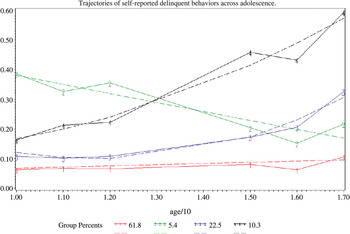
In the first step of analyses, we used a SPGB approach (Nagin, Reference Nagin2005) to model the trajectory of AB among adolescents from ages 10 to 17 (see Figure 1; for more details on this method in a recent study from this sample, see Gross, Shaw, Burwell, & Nagin, Reference Gross, Shaw, Burwell and Nagin2009). The SPGB method is designed to identify clusters of individuals who share common pathways and may be particularly relevant for examining adolescent AB because it addresses such issues as course, timing, and severity of behaviors, which have been helpful in identifying groups more homogenous with respect to developmental course, precursors, and outcomes (e.g., Broidy et al., Reference Broidy, Nagin, Tremblay, Bates, Brame and Dodge2003). In addition, SPGB is designed to efficiently handle data that are missing completely at random; when data are missing, the equations are adapted to accommodate missing observations and the sample size count is adjusted so as not to include missing observations (Nagin, Reference Nagin2005). As a result, SPGB is useful for longitudinal data analysis, allowing the researcher to retain individuals with incomplete assessment histories.
Trajectories of self-reported delinquent behaviors across adolescence. Solid lines are actual values, and dashed lines are predicted values. Group 1 is low stable, Group 2 is high decreasing, Group 3 is late increasing, and Group 4 is high increasing. [A color version of this figure can be viewed online at http://journals.cambridge.org/dpp]

Using finite mixtures of suitably defined probability distributions, the group-based approach for modeling developmental trajectories is intended to provide a flexible and easily applied method for identifying distinctive clusters of individual trajectories within the population and for profiling the characteristics of individuals within these clusters. Thus, whereas the hierarchical and latent growth curves methodology models population variability in growth with multivariate continuous distribution functions, the group-based approach utilizes a multinomial modeling strategy that has the strength of being able to identify trajectories of individuals on selected outcomes over time. Technically, the group-based trajectory model is an example of a finite mixture or latent class model. Its parameters are estimated by maximum likelihood. A polynomial function is used to model the relationship between an attribute (e.g., adolescent delinquent behaviors) and age or time (Nagin, Reference Nagin1999, Reference Nagin2005; Nagin & Tremblay, Reference Nagin and Tremblay1999). The models were estimated with a specialized SAS-based procedure called “Proc Traj,” which is described in Jones, Nagin, and Roeder (Reference Jones, Nagin and Roeder2001). A censored normal model was fit to the data. Censored normal models are used not only in group-based models but also in conventional single group models that use psychometric scale data where a significant number of participants cluster at the scale maximum or minimum. In this analysis, there was a significant number of adolescents who exhibited no or few ABs, resulting in a cluster of data at the scale minimum. By formally accounting for this censoring in the specification of the likelihood function, the censored normal model provides consistent estimates of the parameters of the polynomial relationship that describe the trajectory equations for each group. A more comprehensive discussion of the technical details of this approach can be found elsewhere (Nagin, Reference Nagin2005).
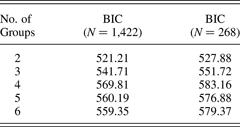
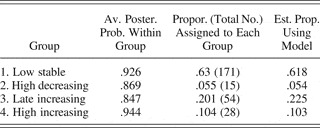
In selecting the optimal trajectory group model, the Bayesian information criteria (BIC) is typically used to identify the best fit in both the number and shape of groups. Following the recommendation of Kass and Rafferty (Reference Kass and Raftery1995), the model selection is guided by the objective of maximizing the BIC score. The model generates posterior probabilities of group membership, which estimates each individual's probability of belonging to each of the trajectory groups. Individuals are assigned to the group with the largest posterior probability estimate. Indicators of good fit to a model include maximized BIC scores, high within group posterior probabilities, and close fit between predicted and actual group proportions (see Table 1 and Table 2).
Model fit indices
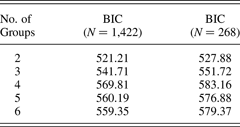
Note: BIC, Bayesian information criterion.
Diagnostic statistics for judging model selection

Risk factor and outcome analysis
Once the trajectories were established, we sought to address three core questions. First, are their unique and independent effects of parenting, maternal depressive symptoms, interparental aggression, neighborhood risk, and child behavior in early childhood on the emergence of adolescent AB trajectories? Second, what child, parenting, and broader community factors in early adolescence distinguish between different developmental patterns of adolescent behavior, and are there factors in midadolescence (i.e., life events, association with deviant peers) that further discriminate early- and late-starting youth? Third, how do youth in each of these trajectories differ on other indices of AB and diagnoses of psychiatric disorders in late adolescence? To examine these questions, we conducted exploratory analyses of variance (ANOVAs) to determine if there were differences in the early developmental histories among youth who had been assigned to different AB trajectories based on their posterior probabilities of group membership. For risk factors from early childhood that were assessed 6.5 to 8.5 years before the initial assessments of AB trajectories, we then used multinomial logistic regression to examine each factor's independent contribution to discriminating trajectory groups. For risk factors measured during early and midadolescence, we used ANOVAs with post hoc Tukey tests (Shaw et al., Reference Shaw, Gilliom, Ingoldsby and Nagin2003) to examine the differences in the characteristics of the youths in each group; but we did not use multivariate analysis because these risk factors were measured concurrently or after assessments of AB trajectories had been initiated.
Finally, as is typical in a longitudinal study of this length, although the missing data for any measure at any age was small (most variables had <10% missing with a range across variables of 2%–34%), listwise deletion would have severely limited the final sample size. Thus, for all 268 boys who had enough data to be included in the trajectory analyses, the data were imputed for all other variables (except categorical variables such as diagnoses and court petitions) using the expectation maximization algorithm in IBM SPSS Statistics (v. 18).
Results
Identification of trajectories
First, trajectories of youth ABs were modeled from ages 10 to 17. Various models were examined with regard to the characteristics and number of trajectory groups (see Table 1). As can be seen in Table 1, a four-group model maximized BIC scores and was selected. In addition, nonsignificant growth terms (e.g., quadratic terms for each group) were removed from the model to maximize the final BIC score (BIC = 575.50, N = 1,422; BIC = 587.18, N = 268) and resulted in a model that contained two groups with linear growth and two groups with quadratic and linear growth. Group 1, which we term “low stable,” consisted of 64% (n = 171) of the sample who endorsed few delinquent behaviors (<8% of total possible score on the SRD at all ages) and showed small linear growth across adolescence. Group 2, which we term “high decreasing,” consisted of 6% of the sample (n = 15) who endorsed a high percentage of AB during early adolescence (39% at age 10) but lower levels in late adolescence (21% at age 17), resulting in negative linear growth. Group 3, which we term “late increasing,” consisted of 20% of the sample (n = 54) who endorsed relatively low levels of AB in early adolescence (11% at age 10) but increases in late adolescence, especially at ages 16 and 17 (34% at age 17), resulting in linear and quadratic growth. Group 4, which we term “high increasing,” consisted of 10% of the sample (n = 28) who endorsed moderate levels of AB at age 10 (16%) but reported rapid increases in AB across adolescence, with very high levels of AB reported by age 17 (59%), resulting in linear and quadratic growth.
The average posterior probability for each group was calculated to confirm the adequacy of the final four-group model. Posterior probabilities measure a specific individual's likelihood of belonging to each of the model's trajectory groups (Nagin, Reference Nagin2005). As shown in Table 2, for all four groups the average posterior probabilities fell well above the lower recommended threshold for assignment of 0.70 (Nagin, Reference Nagin2005). The range in the current sample was 0.85 (late increasing) to 0.94 (high increasing). In addition, we found that the model met three other indicators of model adequacy recommended in Nagin (Reference Nagin2005): a close correspondence between each group's estimated probability and the proportion of individuals actually classified to the group on the basis of the maximum posterior probability assignment rule, reasonably tight confidence intervals on group membership probabilities, and high odds of correct group classification relative to chance.
Early childhood risk factors for AB trajectory group membership
After establishing the trajectories of self-reported AB, we examined early childhood risk factors that were associated with trajectory group membership. A series of ANOVAs was initially computed to examine the associations between trajectory group membership and early childhood risk factors (see Table 3). Each early childhood risk factor was examined, including early parenting, maternal depressive symptoms, interparental aggression, neighborhood impoverishment, and early child externalizing behavior. Parenting, maternal depression, and neighborhood impoverishment all showed significant associations with AB group status in expected directions. Interparental aggression showed a trend toward a significant effect, and early child externalizing was not a significant predictor of AB group status. Post hoc Tukey tests indicated that for parenting, Group 2 (high decreasing) demonstrated the lowest levels of positive parenting behaviors compared to the three other groups. For maternal depression, Group 2 and Group 4 (high increasing) had the highest levels, with Group 4 being statistically higher than Group 3 (late increasing). For interparental aggression, Group 2 had the highest level and differed statistically from Group 1 (low). For neighborhood impoverishment, Group 2 again had the highest levels and differed statistically from Group 1 and Group 3.
Analysis of variance of early childhood risk factors by trajectory group

Note: n = 268 for all analyses.
†p < .10. *p < .05. **p < .01. ***p < .001. All pairwise differences reported if significant at p < .05.
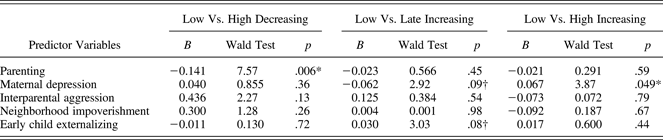
To examine possible unique contributions of each early childhood risk factor to later adolescent AB trajectories, a multivariate multinomial regression was computed in which all groups were compared to Group 1 (low stable; see Table 4). In this multivariate approach, parenting contributed unique variance to the prediction of group status (χ2 = 8.22, df = 3, p < .05), as did maternal depression (χ2 = 9.20, df = 3, p < .05). None of the other risk factors (interparental aggression, neighborhood impoverishment, and early child externalizing) significantly discriminated group status (all χ2 < 4, ns), but the final model with all predictors was significant (χ2 = 34.2, df = 15, p < .01). When examining group specific effects, for parenting, Group 2 (high decreasing) was lower than Group 1, and for maternal depression, Group 4 (high increasing) was greater than Group 1 (see Table 4).
Multivariate logit analysis for predicting trajectory group membership with each group compared to low
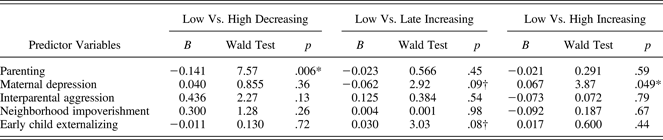
†p < .10. *p < .05.
Transition to adolescence predictors of AB trajectory group membership
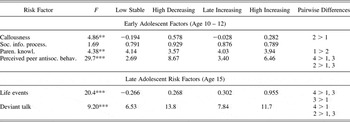
Next, to examine risk factors at the beginning of adolescence that may distinguish adolescent AB trajectories, a series of ANOVAs was computed examining how each group differed in the levels of youth callousness and social information processing, parental monitoring knowledge, and youth perceived peer AB (see Table 5). Callousness, parental knowledge, and perceived peer AB were all significant predictors of group status but social information processing was not. Using post hoc Tukey tests, specific group differences were examined. For callousness, Group 2 (high decreasing) demonstrated the highest level (followed by Group 4, high increasing) and was statistically higher than Group 1 (low). For parental knowledge, Group 2 demonstrated the lowest levels and was statistically lower than Group 1. For perceived peer AB, Group 2 reported the highest levels, followed by Group 4. Group 2 and Group 4 were statistically significantly higher than Group 1 and Group 3 (late increasing).
Analysis of variance and means of early and late adolescent risk factors by trajectory group

Note: n = 268 for all analyses.
**p < .01. ***p < .001. All pairwise differences reported if significant at p < .05.
Mid–late adolescent outcomes
A second series of ANOVAs was computed to examine the risk factors assessed at age 15 that might explain changes in the course of AB, specifically increases among late-starting youths. Both adolescent life events and peer deviant talk were examined and demonstrated significant differences across groups (see Table 5). For life events, Group 4 (high increasing) demonstrated the highest level, with Group 3 (late increasing) showing the next highest level. Group 4 was significantly greater than Group 1 (low) and Group 3, and Group 3 was significantly greater than Group 1. In terms of observed peer deviant talk, Group 2 (high decreasing) demonstrated the highest levels followed by Group 4. Group 2 was significantly higher than Group 1 and Group 3, and Group 4 was significantly higher than Group 1.
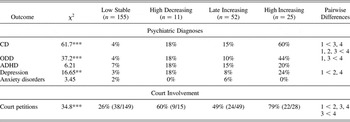
Finally, a series of χ2 tests was computed to examine whether psychiatric diagnoses of externalizing and internalizing disorders assessed at age 17 and juvenile court involvement (ages 15–18) were associated with different AB group trajectories. Youths in different adolescent AB trajectory groups differed significantly in their rate of diagnoses of CD, ODD, and depression but not ADHD or anxiety disorders (see Table 6). When examining group differences using dummy-coded logistic regression predicting diagnosis, Group 4 (high increasing) showed the highest rate of CD diagnosis (60%) and was significantly higher than all other groups (Group 3 [late increasing] was also significantly higher than Group 1 [low]). Similar group differences were seen for ODD in which Group 4 had the highest diagnosis rate (44%), and this rate was significantly higher than that of Group 1 or Group 3. For depression, Group 2 (high decreasing) and Group 4 had significantly higher rates of diagnosis (18% and 24%, respectively) than Group 1. Youths in different AB trajectory groups also differed in their rate of court involvement (i.e., having one or more petition against them). All groups had relatively high rates of involvement (from 26% to 79%) with Group 4 having the highest rate (79%), followed by Group 2 (60%) and Group 3 (49%). Group 2, Group 3, and Group 4 all had significantly higher rates of court involvement than Group 1, and Group 4 was also significantly higher than Group 3.
Chi square, logistic regression group comparisons, and percentage of boys in each group with court involvement and psychiatric diagnoses at age 17 by trajectory group

Note: n = 243 for all analyses involving diagnoses. The n for each group with available court data are indicated in the table. Groups were compared via χ2 test and using a logistic regression with dummy codes to examine pairwise comparisons. CD, conduct disorder; ODD, oppositional defiant disorder; ADHD, attention-deficit/hyperactivity disorder.
**p < .01. ***p < .001.
Discussion
This study sought to examine the trajectories of AB across a 7-year span during adolescence and to examine predictors and outcomes of these trajectories from age 1.5 to age 17. Consistent with prior research on early- and late-starting patterns of AB, four groups were identified (Broidy et al., Reference Broidy, Nagin, Tremblay, Bates, Brame and Dodge2003; Bushway et al., Reference Bushway, Thornberry and Krohn2003; Chung et al., Reference Chung, Hawkins, Gilchrist, Hill and Nagin2002; Lacourse et al., Reference Lacourse, Nagin, Tremblay, Vitaro and Claes2003; Moffitt, Reference Moffitt, Cicchetti and Cohen2006; Nagin & Tremblay, Reference Nagin and Tremblay1999), including stable high (10.4%) and stable low (63%) groups, a late-starting high group (20.1%), and a high decreasing group (5.5%).
One of the study's primary strengths was having data on early child and family risk factors beginning at 18 months of age that could potentially discriminate trajectories of AB during adolescence. In initial univariate analyses, several early childhood risk factors from multiple contextual domains discriminated trajectory group status, including parenting, interparental aggression, neighborhood impoverishment, and maternal depressive symptoms. In most cases, these differences emerged between the high decreasing group and the stable low and late increasing groups, the one notable exception being higher rates of depressive symptoms among mothers of boys in the high increasing group versus the late increasing group. However, in follow-up multivariate analyses, only two early childhood risk factors persisted in discriminating AB group status: (a) HOME parenting scores were lower for boys in the high decreasing group versus the stable low group, and (b) depressive symptoms were higher for mothers of boys in the high increasing versus the stable low group.
For risk factors assessed during early and middle adolescence, youth callousness, parental knowledge, and perceived AB of peers in early adolescence, as well as life events and peer deviant talk were discriminators of trajectory group status, but again not always in expected ways. It is surprising that boys in the high decreasing group showed the highest level of callousness, perceived peer AB, and peer deviant talk, and the lowest level of parental knowledge; whereas, more in line with expectations, boys in the high increasing group reported high rates of peer AB, engaged in high levels of deviant talk, and experienced high rates of life events. As expected, boys in the late increasing group did report high frequencies of life events, but their rates of deviant talk in peer interactions were not high relative to other groups. This result suggests that late-starting youth may have increased risk for initiating their delinquent behavior when life stressors increase during a sensitive period in adolescence. This result also emphasizes that, although high decreasing and high increasing groups were identified by several risk factors in early childhood and early adolescence, relatively little risk defined these later starting youth who still evidenced high rates of court involvement (49%).
When AB trajectory groups were compared on rates of psychiatric diagnoses at age 17, as expected the high increasing group showed the highest frequencies of diagnosis of CD and ODD, as well as depression. Boys in the high decreasing group also had significantly higher rates of depression than the low stable group. Juvenile court involvement was high to relatively high for the entire sample, with the late increasing group (49%), the high decreasing group (60%), and the high increasing group (79%) all showing significantly higher rates of court petitions than the low stable group (26%). Clearly, membership in any of the three groups with elevated AB (early starting, late starting, high decreasing) portends poor outcomes: greater risk for arrest and, for boys in the high increasing group, diagnoses of CD or ODD. Note that because most of the items on the SRD that were used to assess AB from age 10 to 17 included behaviors also assessed in the diagnosis of CD, it is not surprising that 60% of boys in the high increasing group met criteria for CD at age 17, with a diagnosis for CD being informed by both youth and parent report and filtered through clinician interview.
At a broad level, the results corroborate and extend previous research on the emergence of early- and late-starting AB and its developmental precursors. Similar to prior research conducted on emerging adolescents and younger children, groups of persistently high and low AB boys were identified using SPGB modeling (Broidy et al., Reference Broidy, Nagin, Tremblay, Bates, Brame and Dodge2003; Nagin & Tremblay, Reference Nagin and Tremblay2001; NICHD Early Child Care Research Network, 2004; Shaw et al., Reference Shaw, Gilliom, Ingoldsby and Nagin2003), along with a late-starting group typically found in studies of adolescent AB (Chung et al., Reference Chung, Hawkins, Gilchrist, Hill and Nagin2002; Moffitt, Reference Moffitt, Cicchetti and Cohen2006). Perhaps the most surprising group in terms of its course of AB and its ability to be discriminated by both early childhood and adolescent risk factors was the high decreasing group. Whereas we expected this group to have a relatively high number of risk factors during early childhood, it was not anticipated that boys with a descending course of AB would be discriminated from boys in the high increasing group on parental knowledge, peer AB, and callousness during early adolescence. However, a closer inspection of their “high decreasing” pattern and other indicators of their behavior suggest that these boys may have engaged in higher rates of AB during adolescence than suggested by their trajectory pattern plotted in Figure 1. First, because mean scores were used to incorporate the use of the two different versions of the SRD in the modeling of trajectory groups (assessing the percentage of total possible acts endorsed), this procedure hid that the high decreasing group endorsed a comparable number of antisocial items in later adolescence relative to early adolescence (i.e., a sum of 25.74 at age 10 vs. a sum score of 26.04 at age 17). Second, based on data from three assessments (ages 10, 11, and 12), boys in the high decreasing group reported higher rates of callousness and lower rates of empathy and prosociality than other groups, which included items such as “keeping promises” and “not being concerned about right and wrong.” Moreover, when trajectory groups were compared on items from the Antisocial Process Screening Device (Frick et al., Reference Frick, Bodin and Barry2000) and CADS (Lahey et al., Reference Lahey, Applegate, Chronis, Jones, Williams and Loney2008), measures not included on their Empathy/Callousness factors, boys in the high decreasing group rated themselves as highest on “good at telling lies others believe” and “lie easily and skillfully.” In addition, at age 10 mothers reported boys in the high decreasing group to be the highest on the Child Behavior Checklist item “lies or cheats” (all three items differed significantly by group on ANOVAs with pairwise comparisons). Third and finally, the high percentage of court involvement (60%) found for high decreasing youths also suggests that they were likely underreporting their levels of AB on the SRD at ages 15 and 17. Thus, it is possible that the high decreasing group is actually a group characterized by relatively high levels of AB but low levels of self-reporting of these behaviors in late adolescence. This small group of youths may be particularly important to pay attention to as they appear to have a host of risk factor and poor outcomes yet may not reliably report on their antisocial activities. This finding also underlines the importance of having both self-reports and objective reports (offense records, diagnoses with another reporter) when examining youth AB.
If boys in the high decreasing group were underreporting their engagement in AB during late adolescence, it raises the question of how this issue could be better addressed in future studies, particularly using group-based modeling approaches. The foundation of SPGB and other growth modeling approaches rests on having at least three assessments of the variable of interest over time. Being able to compare youth and other informant reports (e.g., use of parent or peer report), reports from other methods (e.g., juvenile court records), or combined reports (aggregating parent and/or peer report with youth report, using endorsement of AB from any one of multiple informants to create a latent factor) of AB might address this issue in future studies; but this approach is not without its challenges. First, because the vast majority of AB is committed covertly during adolescence, parents and individual peers may not be aware of the majority of youth antisocial activities. Second, repeated assessments using the same second or third reporter (e.g., mothers, peers) would be ideal in using a growth modeling approach. Whereas this strategy should be feasible in most cases for parents, based on the delicacy and endurance of peer relationships from early to later adolescence, it would likely necessitate relying on different peers to report on youth AB. However, the use of different informants over time has been done successfully in prior studies using SPGB modeling with teachers (Nagin & Tremblay, Reference Nagin and Tremblay2001). The use of court records to enhance and corroborate youth and other informant reports also remains an option (Caspi et al., Reference Caspi, McClay, Moffitt, Mill, Martin and Craig2002; Trentacosta et al., Reference Trentacosta, Hyde, Shaw and Cheong2009), but it does present a challenge for growth modeling because of the relatively low base rate of court involvement in any one year, particularly prior to age 14 when there is a low rate of antisocial acts discovered by the justice system (Dunford & Elliot, Reference Dunford and Elliott1984; Farrington, Jolliffe, Loeber, & Homish, Reference Farrington, Jolliffe, Loeber and Homish2007). Despite these caveats, researchers are encouraged to corroborate youth reports of AB using other informants during adolescence, especially those who are likely to have greater access to youth covert antisocial activities (i.e., peers vs. parents).
Early childhood risk factors: Parenting and maternal depression
In terms of early childhood factors found to discriminate trajectories of adolescent AB, two stood out: parenting and maternal depression. That parenting practices discriminated the high decreasing group from other groups corroborates previous research that the early caregiving environment plays a critical role in the development and maintenance of CPs in early and middle childhood and more serious AB during adolescence (Aguilar et al., Reference Aguilar, Sroufe, Egeland and Carlson2000; Caspi et al., Reference Caspi, McClay, Moffitt, Mill, Martin and Craig2002; Fergusson & Woodward, Reference Fergusson and Woodward1999; Moffitt & Caspi, Reference Moffitt and Caspi2001). Similar to the Aguilar et al. findings, parenting was assessed based on observational data during very early childhood and was successful in discriminating patterns of AB 8 to 15 years later.
Maternal depression was the only risk factor assessed in early childhood to discriminate the high increasing group from other groups, a group of boys for which approximately four out of five boys would subsequently have juvenile court involvement. Previous research linking maternal depression to AB has been more limited in terms of the length of time between assessments of maternal depression and later AB (Shaw et al., Reference Shaw, Gilliom, Giovannelli and Zeanah2000), the severity of AB present in the sample being assessed, and the use of prospectively collected data (Kandel & Mednick, Reference Kandel and Mednick1991). With these added methodological strengths, the current findings add more evidence to previous research linking early maternal depression to later maladaptive child outcomes (Kandel & Mednick, Reference Kandel and Mednick1991; Shaw et al. Reference Shaw, Gilliom, Giovannelli and Zeanah2000), which has been theorized to be transmitted by compromising caregiving quality, modeling of harsh and aggressive parental behavior, and genetic risk (Goodman et al., Reference Goodman, Rouse, Connell, Broth, Hall and Heyward2011). Emerging findings in the prevention area also suggest the centrality of maternal depression in leading to early-starting pathways of AB. In a recent intervention study by Shaw, Connell, Dishion, Wilson, and Gardner (Reference Shaw, Connell, Dishion, Wilson and Gardner2009) that utilized the Family Check Up, improvements in maternal depressive symptoms (ages 2–3) were found to mediate improvements in child CPs and internalizing symptoms from ages 2 to 4. This intervention finding and the current results suggest that targeting maternal depression may be particularly timely during the terrible twos for preventing early-starting CPs because of the frequency with which children demonstrate oppositional and aggressive behavior at this age (Gross et al., Reference Gross, Shaw, Burwell and Nagin2009).
Although not a focus of the present study, it is worth noting that, using the current data set, reliable linkages were found among early childhood measures of parenting, maternal depression, and other risk factors assessed in the first 3 years and risk factors assessed in early adolescence (Hyde, Shaw, & Moilanen, Reference Hyde, Shaw and Moilanen2010; Sitnick, Shaw, & Hyde, Reference Sitnick, Shaw and Hyde2011; Trentacosta, Hyde, Goodlett, & Shaw, Reference Trentacosta, Hyde, Goodlett and Shaw2011). For example, HOME parenting scores at 24 months were reliably related to youth reports of callousness (r = –.34, p < .001), parental knowledge (r = –.29, p < .001), and perceptions of peer AB (r = –.35, p <. 001). In addition, maternal depressive symptoms assessed at 18 and 24 months were predictive of perceived peer AB (r = .20, p < .01) during early adolescence. Similar associations were also evident for early neighborhood impoverishment and hostile attributional biases (r = .19, p < .01), parental knowledge (r = –.13, p < .05), and perceived peer AB (r = .33, p < .001) during early adolescence, suggesting both continuity within domains (e.g., HOME scores in early childhood to parental knowledge during early adolescence) and predictive validity from early childhood family factors to youth AB and its correlates (e.g., association with deviant peers, callousness).
Adolescent risk factors: Deviant peers and life events
Although the high decreasing group could more easily be discriminated from other trajectory groups based on their presence of risk factors during early childhood and early adolescence, the high increasing group (early starters) demonstrated the highest self- and court-reported levels of AB during adolescence. During early childhood this group was characterized by high levels of maternal depressive symptoms, which might have led them to associate with more deviant peers and experience high levels of life events during adolescence as their levels of AB continued to be maintained and increased. In addition to this finding suggesting that targeting maternal depression in early childhood may prevent early-starting AB (e.g., Shaw et al., Reference Shaw, Connell, Dishion, Wilson and Gardner2009), it also confirms other research regarding the salience of involvement with deviant peers (Dishion et al., Reference Dishion, Eddy, Haas, Li and Spracklen1997) and the occurrence of life events, the latter for both early- and late-starting youth (Aguilar et al., Reference Aguilar, Sroufe, Egeland and Carlson2000; Nagin & Tremblay, Reference Nagin and Tremblay2001).
Limitations and future directions
There are several significant methodological limitations of the study. The participants were limited to low-income European American and African American boys living in an urban setting. Future work with boys and girls from other socioeconomic strata and ethnic backgrounds is recommended to replicate or disconfirm these results (Miller, Malone, & Dodge, Reference Miller, Malone and Dodge2010). Regarding the identification of trajectory groups, it should be emphasized that such groups are probabilistic in nature and that a single trajectory group may include individuals with relatively high and low probability of membership in that group. However, our analysis revealed such probabilities were generally very high, which suggests little classification error.
Perhaps the greatest methodological limitation of the study is the absence of the direct measurement of biological factors that may underlie parent and child behavior, because the influence of biological mechanisms could not be estimated or partitioned from environmental influence. Thus, associations among such risk factors as parenting, maternal depression, youth empathy/callousness, and AB could reflect causal mechanisms or reflect a gene–environment correlation. We are currently collecting both genetic and functional magnetic resonance imaging data on research participants in this sample that will allow us to investigate Gene × Environment correlations and interactions on trajectories of AB (Caspi et al., Reference Caspi, McClay, Moffitt, Mill, Martin and Craig2002) and apply an imaging genetics approach to the data set (Hariri, Reference Hariri2009). Imaging genetic studies, when combined with rich measures of the environment, have the potential to inform our understanding of how genes affect brain functioning and subsequent behavior differentially across different environmental contexts (Caspi & Moffitt, Reference Caspi and Moffitt2006; Hyde, Borgan, & Hariri, Reference Hyde, Bogdan and Hariri2011). Applying an imaging genetics approach to the current data set may further enhance our understanding of how genetics influences neural reactivity and, more specifically, how genes in combination with environmental risk (e.g., parenting, maternal depression) affect risk of early- and late-starting trajectories of AB through neural differences in sensitivity to reward and threat (Hyde et al., Reference Hyde, Bogdan and Hariri2011).
Implications for early intervention
The present study extends previous research by documenting how risk factors across multiple domains and two periods of developmental transition are associated with persistence versus desistance in youth AB across adolescence, for which few other longitudinal data including early childhood predictors are available (Aguilar et al., Reference Aguilar, Sroufe, Egeland and Carlson2000). Following up a previous paper using the same sample examining toddler-age predictors of overt AB from ages 2 to 8 (Shaw et al., Reference Shaw, Gilliom, Ingoldsby and Nagin2003), the findings continue to suggest the salience of early parenting and other family factors that might directly and indirectly compromise caregiving quality, most notably maternal depression. Although parent training may be helpful in improving more proactive and positive versus harsh and controlling caregiving practices, the current results suggest that such interventions will need to be tailored to account for other contextual aspects of the child's ecology (e.g., maternal depression) and that emerging factors in early adolescence (e.g., callousness, life events, deviant peers) may potentiate trajectories if they are not addressed earlier in life.