Introduction: agency, brokerage and entrepreneurs
A key interest in policy analysis is to explain the process through which certain policy outcomes are reached (Howlett, Reference Howlett2002; Knill et al., Reference Knill, Schulze and Tosun2012; Fischer, Reference Fischer2013). To achieve this, policy analysts attempt to account for all different pathways that influence policy outcomes (Dür, Reference Dür2008; Fischer and Sciarini, Reference Fischer and Sciarini2013). One such pathway concerns the identification of key agents, termed policy entrepreneurs and brokers, who are said to have a significant impact on decision making and thus able to shape outputs and outcomes decisively at critical policy junctures (Stokman and Zeggelink, Reference Stokman and Zeggelink1996; Mintrom and Norman, Reference Mintrom and Vergari2009). But how can such exceptional agents be identified within the policy process? The aim of this paper is to answer this question and to also investigate whether their network position offers a specific policy advantage or reflects such an advantage. We employ formal social network analysis (SNA) and conduct case study analysis on two sets of empirical data to answer these questions. In our analysis, we do not directly address the interdependence inherent in a network of relations as both a cause and a reflection of power inequalities between actors. We, instead, focus our analytic effort on differentiating between two types of political action that political science hypothesizes are distinct in their impact on political outcomes. This constitutes an important theoretical contribution because it allows us to problematize how network relations affect the power of political agents.
The starting point, for both case studies employed, is an extraordinary policy outcome and a closer inspection of the actions and relations of agents associated with the relevant event. The network relations of policy actors are important, as an actor’s relational environment can provide information about constraints and opportunities available to them. More concretely, we adopt an actor-centered approach and wish to identify exceptional agents via their relational profile in a policy network. Mainly, two distinct types of exceptional agents have been identified in both, the policy and the network literature: entrepreneurs and brokers. Assumptions for the roles of these actors in the two literatures differ. In the most influential work on network brokerage (Burt, Reference Burt2005) brokers are often synonymous to entrepreneurs,Footnote 1 and although this assumption is not equivalent to stating that all entrepreneurs are brokers, the two are often conflated. In policy process theories, on the other hand, entrepreneurs and brokers are said to play distinct roles that can have considerable impact on policy outputs (Peters, Reference Peters1997; Svensson and Öberg, Reference Svensson and Öberg2006; Mintrom and Norman, Reference Mintrom and Vergari2009). Policy entrepreneurs are said to act in a rather self-interested and strategic way, while policy brokers to seek stability and feasible policy outputs (Christopoulos and Ingold, Reference Christopoulos and Ingold2011). This then also creates different expectations on how policy solutions are shaped: while policy brokers try to mediate among conflicting coalitions and engineer a compromise solution (Sabatier and Jenkins-Smith, Reference Sabatier and Jenkins-Smith1993); policy entrepreneurs, on the other hand, are trying to promote their interests so that the final outcome reflects their policy preferences (Kingdon, Reference Kingdon2003). Disentangling the two can enhance our understanding of how such behavioral archetypes impact policy outcomes. We thus assume that although not all actors will gain advantage from their structural positions, some will occupy structural positions of privilege. Defined by different centrality algorithms, they can be associated with different types of network centrality and network brokerage. We employ the heuristic term ‘exceptional’ to, therefore, exemplify the case where different types of network structure privilege can be associated with policy entrepreneurship or policy brokerage.
We wish to demonstrate, in this article, that these archetypes of exceptional agency are reflected in a distinct profile. We borrow insights from former case studies (see Christopoulos and Quaglia Reference Christopoulos and Quaglia2009; Ingold and Varone, Reference Ingold and Varone2011) and validate them through graph theoretical network models. In line with Beyers et al. (Reference Beyers, Raine and Maloney2008), we thus combine qualitative (case study analysis) and quantitative (social network models) approaches in a mixed methods design to gain in depth understanding on how network positions affect policy outcomes. We have also developed conceptual and methodological guidelines to suggest a model for formal network analysis of policy networks as well as highlight key elements of the distinctiveness of exceptional policy actors.
The article is structured as follows: we first offer a critical review of the literature on political entrepreneurship and brokerage that places the role of exceptional agency within political action. This leads us to a review of the constraints and opportunities of political agency through a network lens. More concretely, we propose the use of a range of different network measures with complementary underlying assumptions on the effect of relations on political contest. We explore whether these network metrics can capture the difference between policy entrepreneurs and brokers in policy networks. Two case studies [Swiss Climate policy (SCP) and EU Competition (EUC) policy] allow us to decouple brokerage and to highlight the advantages and shortcomings of centrality measures for distinguishing between policy brokers and entrepreneurs. We conclude with a call for widening existing theoretical frameworks to incorporate actor relations and for sharpening the methodological tools of policy analysis with the use of method and data triangulation.
Defining brokers and entrepreneurs
Let us first examine prominent claims in the literature. Agents in positions of structural privilege can induce creativity to the policy process and take an important role when it comes to policy change by modifying the status quo (Kingdon, Reference Kingdon1995: 2005). This is why policy process theories assign such agents a particular role in shaping policy, with recent interest on policy entrepreneurship strongly associating these actors with the timing of policy windows (Copeland and James, Reference Copeland and James2014).
Policy entrepreneurs have been broadly defined as agents that are innovative and who display a good knowledge of the policy process (ibid.) or a long network horizon (Christopoulos and Ingold, Reference Christopoulos and Ingold2011). Schneider et al. (Reference Schneider, Teske and Mintrom1995) expound on the concept of the political entrepreneur as the idea ‘pusher’, indeed the creator of ideas, noting the importance of discovering and framing opportunities in such a fashion that create demand for the proposed solution. In that regard, entrepreneurs are said to be strategic and opportunistic actors (Holcombe, Reference Holcombe2002: 143), that are self-interested and have strong leadership qualities (Arce, Reference Arce2001: 124). Mintrom and Vergari (Reference Mintrom and Vergari1996) find that policy entrepreneur engagement with a policy network determines their success, while Mintrom and Norman (Reference Mintrom and Vergari2009) consider the integration of multiple theoretical streams as paramount for an understanding of the complexity of policy change. The Multiple Streams Framework claims that policy entrepreneurs succeed in capturing the decision maker’s attention (Zachariadis, Reference Zachariadis2007: 69); while access to decision makers is the crucial condition for a policy network to channel policy outputs (Stokman and Zeggelink, Reference Stokman and Zeggelink1996). Entrepreneurial political action is also associated with institutional change (Sheingate, Reference Sheingate2003) and influential in studies of collective action problems (Schneider and Teske, Reference Schneider and Teske1992). In the present study, we focus on regulatory change that can presumably be affected by the presence of such agents.
Another category of exceptional agents found in the literature are policy brokers. But a broker is framed differently than an entrepreneur. Brokers have a prominent place within an Advocacy Coalition Framework (ACF), where they are seen as actors seeking stability within specific policy subsystems (Sabatier and Jenkins-Smith, Reference Sabatier and Jenkins-Smith1993). They appear to connect subsystems where advocacy coalition groups differ in their beliefs, and where there is conflict about policy preferences. In such situations, policy brokers can intervene by promoting conciliatory policy solutions and by mediating trust (Svensson and Öberg, Reference Svensson and Öberg2006). For instance, they can incentivize coalition members to not activate institutionalized veto points (Ingold and Varone, Reference Ingold and Varone2011). Furthermore, it has been empirically demonstrated by Ingold and Varone (Reference Ingold and Varone2011), that brokers need strategies and some sort of (self-) interest to invest resources and act as mediators within a given policy process.
The major distinction between entrepreneurs and brokers in the policy literature, is that entrepreneurs are presumed strongly strategic and self-interested, while brokers are presumed to seek stability, acting to find feasible policy compromises. This distinction is not trivial, as both actor types shape policy outcomes differently and the presence of the one, the other, or both together, would potentially induce different policy outcomes.
Brokers and entrepreneurs are not defined as personalities, but rather as roles actors play within a given policy process, at a given time (Mintrom, Reference Mintrom2000; McCaffrey and Salerno, Reference McCaffrey and Salerno2011). Exceptional agents can thus be identified through their action and activities in a policy process; and a network perspective identifies them through their relations and positions in networks of influence. Their structural position should thus also be reflected in the type of relationships they cultivate during the policy process: while brokers seek stability and compromise they need to be transparent and recognized; on the other hand, entrepreneurs may engage in opportunistic action and strategic relationships that are most effective if partially concealed from other actors in the network. However, within the scope of the present study, we can assume a motivational distinction since, in their idealized form, policy entrepreneurs promote their own interests and values while policy brokers seek systemic balance. Seeking balance does not necessarily make policy brokers altruistic but might imply a different modus operandi.
A network approach in decoupling brokerage
Whether political agents act as brokers or entrepreneurs depends on their political acumen as well as on the structure of relations in the policy community within which they are embedded. Agents that we would expect to singularly affect policy outcomes (those we identified earlier as exceptional) should hold a privileged structural position in terms of their ability to influence others. Such positions hold informational advantage and can amplify their potential to influence others. As stated by Wasserman and Faust (Reference Wasserman and Faust1994: 171), ‘One of the primary uses of graph theory in SNA is the identification of the most important actors in a social network’. SNA offers a toolbox of graph theoretical algorithms that dissect the relational profile of actors. Advances of SNA in explaining agency has been evident in research on social movements (Diani and Della Porta, Reference Diani and Della Porta2005); policy networks (Knoke, Reference Knoke1990); economic action (Jackson, Reference Jackson2010); and economic geography (Barthelt and Gluckler, Reference Barthelt and Gluckler2011). Several scholars have used a network approach to reconstruct decision-making processes and stakeholder intervention in policy domains (Knoke et al., Reference Knoke, Pappi, Broadbent and Tsujinaka1996; Svensson and Öberg, Reference Svensson and Öberg2006; Fischer and Sciarini, Reference Fischer and Sciarini2013). Researching a policy network, via SNA, implies analyzing a policy process via a mathematical abstraction, where relations can be contingently examined with the actors that are involved (Henning, Reference Henning2009; Ginty, Reference Ginty2010). In that respect the method is conducive to the integration of structure and agency (Christopoulos, Reference Christopoulos2008), although the theoretical implications of this integration have not been exhaustively explored (Emirbayer, Reference Emirbayer1997). The major theoretical departure of a science of networks is to model human agency as interdependent. This permits us to account for instrumental constraints and opportunities to their agency, as well as improve the content validity of such models.
More concretely, one way of conceptualizing the difference between policy entrepreneurs and brokers is to identify their relational profile and infer the underlying behavior that has led to this position in social structure. Put differently, to distinguish brokers from entrepreneurs in a policy network, we can investigate the differences in their relational profile considering that policy brokers have different goals, which reflect in their actions and presumably their position in relational space. Following their characteristics as outlined above, policy brokers choose between bridging and bonding roles as their aim is to improve the stability of the policy environment in the evolving network; while policy entrepreneurs are defined as more opportunistic actors interested more in policy decisions and outputs (see Christopoulos and Ingold, Reference Christopoulos and Ingold2011).
We now develop this model further acknowledging that although these appear as distinct ‘ideal-types’, in reality actors cannot be unequivocally boxed in such idealized frames, nor indeed that these can be seen to occupy opposite ends of a behavioral continuum. As argued above, policy brokers can be serving a strategic interest by investing resources in a mitigating role; or policy entrepreneurs may, for strategic reasons, assume overt brokerage roles.
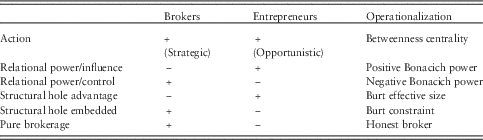
Based on former work, we propose a series of operationalization strategies that should capture these idealized roles as reflected in these actors’ relational profiles. In Table 1, we list a series of actor attributes derived from the policy analysis literature that can be captured through network analysis. However, it should be reiterated that in an ideal operationalization environment, SNA would be one of multiple methodological tools utilized to capture agent preferences, actions, constraints, and opportunities.
Conceptual archetypes: distinguishing policy brokers from policy entrepreneurs

The algorithms that we use have their roots in graph theory and the aim here is to empirically test if they are useful in distinguishing between different types of agency.
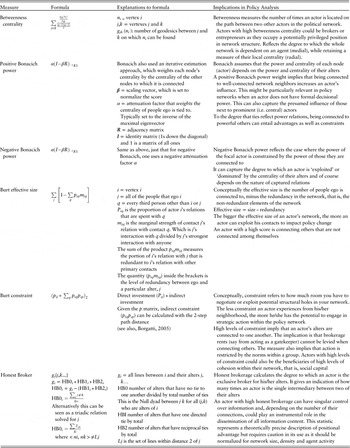
In Appendix I, we outline the algorithms and implications for policy analysis of the statistics selected. Centrality measures, in general, and betweenness centrality in particular (see Freeman, Reference Freeman1979) have been successfully employed in identifying those playing a key role in a policy process (Knoke et al., Reference Knoke, Pappi, Broadbent and Tsujinaka1996). Betweenness centrality identifies actors who are on the shortest path between other actors, those that potentially control information flows. Both, brokers and entrepreneurs can display high betweenness centrality: the former linking actors defending different policy preferences in order to seek stability in the network; the latter in a more opportunistic manner to influence decision making and outputs. Betweenness centrality is thus used here as a ‘filter’ metric since it combines one-sided dependence with node importance (see Appendix 1 for algorithmic expressions). More concretely, betweenness combines a reflection of the degree to which the whole network is dependent on a specific agent for its cohesion as well as by summing values of all relevant geodesics and thus remaining a core centrality metric (Brandes et al., Reference Brandes, Kosub and Nick2012). Betweenness, therefore, is employed here to identify all actors that potentially play an exceptional role in relational space. At a practical level, since most political networks exhibit a strong core-periphery structure, rankings for most centrality statistics converge; we have combined both medial and radial centrality statistics (Borgatti, Reference Borgatti2005; Borgatti and Everett, Reference Borgatti and Everett2006) casting a wide net to capture behaviors that entail seeking political balance (medial) or political support (radial). Whether distant ties (an actor gains through brokerage) or strong ties (gained through belonging to a cohesive group) are more effective in conveying influence would be determined by tie resonance, which lies beyond the scope of the present analysis.Footnote 2
As stated already, the policy literature assumes that policy entrepreneurs seek the aggrandizement of their political resources, while policy brokers are assumed to take a more strategic perspective. In assessing their pursuit of power and aggrandizement of political capital we have first considered the Bonacich measure. Bonacich (Reference Bonacich1987) conditions the number of ties an actor has with the relational power of his/her alters (for an application, see Ingold, Reference Ingold2009). Two configurations are modeled depending on whether the presence of a tie implies that an agent’s influence is affected by connecting to well or weakly connected others. A positive effect can be associated with leveraging power by being connected to powerful others, where the centrality of these alters augments the power of the focal actor. A negative effect can be associated to the potential of central actors to dominate relationally weak alters. Consistent with the policy literature, policy entrepreneurs are seen as opportunistic, while policy brokers as strategic, the former by having influential ties to central others (positive Bonacich power) that help them access decision making and shape policy output more easily; the latter by cultivating relations toward structurally weak alters (negative Bonacich power). Policy brokers link structurally weak actors and enhance information flow and stability in the policy network.
Ron Burt (Reference Burt1992, Reference Burt2002, Reference Burt2005) formalized the essential aspects of positional advantage and disadvantage of individuals that result from how they are embedded in their relational neighborhood. In exploiting so called structural holes, the effective size of actor A’s network consists of all actors A is tied to and the relations between them (Burt, Reference Burt1992). The bigger the effective size of an actor’s structural hole (i.e. absence of ties between alters), the more an actor can exploit his contacts to impact policy change. We expect policy brokers (unlike network brokers) to have low rank on effective size as they engage in trust building among network actors to make political compromise feasible. We anticipate policy entrepreneurs to rank high on effective size as they attempt to exploit structural advantage by exploiting the lack of ties between their alters. A related measure is that of structural constraint (ibid.). The algorithm evaluates the degree to which relations between alters constrain ego. This is often associated to high levels of cohesion among ego’s alters that limits A’s opportunity for playing one against another. Burt’s constraint can be relevant to identifying policy entrepreneurs, who we would expect not to be constrained by the relations among their alters.
Finally, honest brokerage calculates the degree to which brokers exclusively connect their alters, that is, whether they are the only direct intermediary between others (Ahuja, Reference Ahuja2000; Borgatti, Everett and Freeman, Reference Borgatti, Everett and Freeman2002). It is thus an apt statistic to evaluate policy brokers, conceived as singular trusted partners, in a highly contested political setting.
The previous section gave an overview of conceptual insights from former work. We proceed to validate our conceptual assumptions empirically. More concretely, we wish to highlight whether different network measures are capable of reflecting presumed differences between entrepreneurs and brokers in policy networks. We validate this by testing our assumptions on cases where we have observed unanticipated policy outcomes. We have identified brokers and entrepreneurs in a case of SCP and EUC and Transport policy.
Cases, data, and methods
We chose these specific cases of EUC policy and SCP for several reasons: first, and as stated earlier, identifying unanticipated exceptional policy outcomes serves as a starting point in locating the agents that are presumably responsible. From previous studies (Christopoulos, Reference Christopoulos2006; Ingold, Reference Ingold2011), we know that in both cases, policy outputs were different than anticipated and can be therefore considered extraordinary. Second, we chose those two cases for our analysis as we could, in preliminary studies, classify them as ‘good examples’ of processes with a certain degree of conflict where the action of entrepreneurs and brokers became crucial to the policy outcomes. And finally, it seems appropriate to investigate agency captured both in the actions of individual agents (i.e. EUC) and organizations (i.e. SCP). We recognize that both systems have very different institutional settings and policymaking specificities. Even though we are not conducting a comparative analysis, we wish to feature some specific network measures that highlight the difference between brokers and entrepreneurs, abstracting them from their respective institutional and case-specific contexts. We even go one step further: as outlined hereafter, the cases and data are inherently different. The Swiss case considers organizations within a decade long policy process, while the EU case looks at individuals during a 6-month phase of the policy cycle. By employing two dissimilar cases, in a most different-systems-design, we aim to demonstrate the reliability of this method in disentangling two different types of agency, policy brokerage, and policy entrepreneurship.
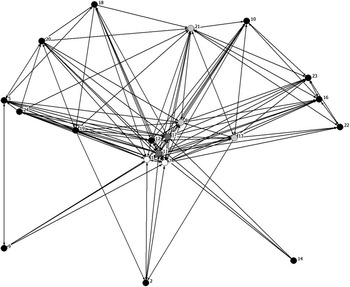
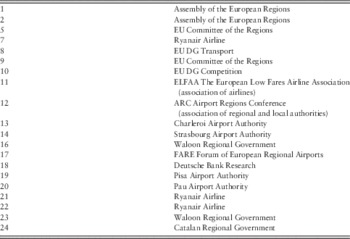
Remarkable agency has been evident in EUC, a case of lobbying the EU to attain a regulatory derogation to competition policy rules (Christopoulos, Reference Christopoulos2006). Two political entrepreneurs were successful in forcing the EU Commission to backtrack on an earlier decision to impose fines on one of them (actor 7). This retreat subsequently turned into a proper rout with the introduction of a derogation on a fundamental EU law prohibiting state subsidies to private enterprise.Footnote 3 This substantial change cannot be understood just by taking account of the political power of the actors benefiting from this lobbying effort or from contrasting their economic significance. Indeed, actors negatively affected, had higher economic and political relevance. The latter included most major EU airlines and airports. Actors opposed on principle to the changes had higher political capital (i.e. Directorate General for Competition of the EU Commission) from those in favor of change. The success of the political entrepreneurs directly reflected their structural position in the influence network and their effectiveness at manipulating three important and interconnected elements of interest intermediation. They managed to introduce a new dimension to the policy agenda, elevate this dimension to prominence, and engineer a coalition of interests that legitimized their interjection. They also managed, at a critical juncture of agenda setting, to keep those with contesting interests peripheral to the policy debate, and therefore reset the policy agenda. Brokers, just as Burt (Reference Burt2005) contends, benefit both by bridging networks as well as sustaining structural holes. None of the major airlines or other economic interests opposed to the changes were active in the network depicted in Figure 1 which, in that respect, represents a cluster of 20 actors from a much wider policy community, albeit a cluster that was instrumental in bringing about policy change. The policy space was defined by a series of key events organized around a lobbying effort as perceived by a number of informants between January and June 2004.Footnote 4
Ryanair-Charleroi policy network at the agenda setting stages of the policy cycle (June 2004). Ties represent reported influence between actors, multidimensional scaling graph. White nodes are broker–entrepreneurs, dark gray are entrepreneurs, and light gray brokers.

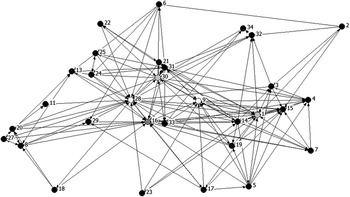
In the case of SCP, the ACF developed by Sabatier and Jenkins-Smith (Reference Sabatier and Jenkins-Smith1993) was applied and two opposing coalitions identified. The aim was to investigate a policy change on the level of newly introduced instruments to mitigate climate change (see Ingold, Reference Ingold2008, Reference Ingold2011). Therefore, the political elite, consisting of 34 actors representing political parties, interest groups, trade unions, federal agencies, and scientific institutes were identified and interviewed. Coalitions were identified based on structural equivalence measures in the ally/enemy network and through an in-depth belief investigation. Between 2002 and 2005, the Swiss climate mitigation policy was characterized through a pro-economy and a pro-ecology coalition: the first preferring voluntary measures, the second a CO2 tax to mitigate climate change. But no compromise could be found between the coalitions, and the Swiss government debated between creating winners and losers on the one side or the other. We considered this particular situation as ideal for studying the presence of entrepreneurs and brokers. First, the voluntary measures being put on the political agenda were very new and innovative solutions to reduce CO2 emissions in the studied case. They were invented and then promoted by representatives from the private sector. The presence of entrepreneurs could be one explanation for target and interest groups framing policy intensively and so successfully. Second, we know that the final output represents a compromise solution integrating, the preferred instruments from both coalitions. This is an ideal setting for broker intervention to seek stability in the subsystem and thus promote policy compromise. This particular circumstance in the SCP case let us investigate entrepreneurship and brokerage over one decade, investigating a period before, and one after, this important policy change. Our analysis indicates that actors 16 and 31 (a political party and a Federal Agency) decisively impacted the policy output, while some other actors (9, 28, 1, and 30) were central in the network and managed to control information flow and access to decision making (Figure 2; see also Appendix II for a list of actors).
Swiss climate policy network in 2002–2005. Ties represent reported collaboration between actors (directed graphs), multidimensional scaling graph. White nodes are broker–entrepreneurs, dark gray are entrepreneurs, and light gray brokers.

SNA
We use the rank order in betweenness centrality scores as a ‘filter metric’ because it helps us to identify the actors with structural advantages within the network from all other actors. Above average actors identified in the EUC case are: 7, 1, 17, 11, 21, 13, 8, 12, 5, 19. In SCP, the top quartile of rank ordered actors are: 28, 30, 31, 1, 16, 9, 14, 12, 32. From this point onwards, we concentrate our analysis on these actors – corresponding to 1/2 of actors in the EUC policy, and 1/4 of actors in the SCP case – as those most likely to be policy entrepreneurs and/or brokers.Footnote 5
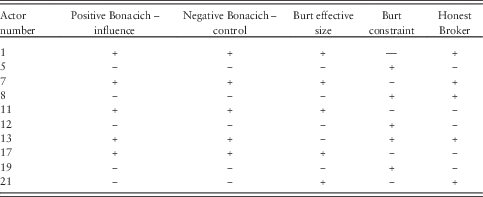
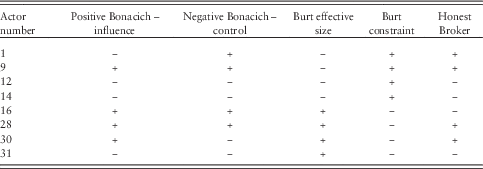
The brokerage profile of actors in these datasets (Tables 2 and 3) reveal a nuanced picture of the roles and behaviour of the actors in these policy spaces. We group them into four categories:
-
(1) Non-Exceptional (black): a group of actors (5, 12, 19 in the EUC case and 12, 14, 31 in SCP) are neither significant brokers nor important policy entrepreneurs. They are active at this point of the policy cycle but show little evidence of exceptionality. They lack substantial brokerage or relational advantage and are mostly constrained by the relations of others.
-
(2) Policy Entrepreneurs (dark-gray): actors 11 and 17 in the EUC case, and actor 16 in the SCP case, respectively, have low ‘honest brokerage’ impact but have high potential to exploit structural holes as evident from their scores on Burt’s effective size measure. At the same time, they are central actors with above average indicators of influence and control over others (Bonacich). So, this group of actors are structurally well embedded (high centrality), which affords them potential network brokerage benefits (high Burt’s effective size), on which, however, they cannot capitalize as their network lacks ‘true’ structural holes (low honest brokerage). This contradictory stress indicates embedded mobilized agents. In that respect, the political entrepreneurship of such agents mainly reflects their attempt to mobilize others. This implies that in cases where we observe unanticipated policy outcomes, we can also anticipate policy entrepreneurs attempting to mobilize relational resources.
-
(3) Policy Brokers (light-gray): a group of actors (8, 13, 21 in the EUC case and 1, 30 in SCP) demonstrate high honest brokerage but variation in other measures of relational centrality. Actors 8 and 13 (Table 2) and actor 1 (Table 3) have high measures of constraint, implying they are embedded in their relations with other actors, while at the same time they have high brokerage scores. They fit our theoretical assumption of actors with a stabilizing influence on the network, as conduits of information and influence. Actor 13 (Table 2) and again actor 1 (Table 3) are more central but lack effective brokerage to be considered entrepreneurs. Actors 21 (Table 2) and 30 (Table 3) play a unique brokerage role as evident from their honest brokerage ranks, but also have large structural holes in their network, which limits the impact of their effectiveness as policy brokers.
-
(4) Oscillating Broker–Entrepreneurs (white): actors 1 and 7 in the EUC case and actors 9 and 28 in the SCP case dominated the brokerage statistics confirming insights from the case study analysis. They can be perceived as both stabilizing brokers and opportunistic entrepreneurs. In both cases, these actors have altered the agenda to benefit their own preferences and facilitated the establishment of a new balance of power that maintained momentum for changes in the policy space. They are ‘honest’ brokers, invariably effective in their use of structural holes and at the same time exhibit high levels of centrality.Footnote 6 Their structural position reflects their power in this policy space. Indeed, we hypothesize that the most exceptional of policy actors are likely to be sensitive to the challenges of the relational environment and oscillate between roles. Therefore, those that unambiguously fit into one relational archetype can be considered predictable, while our ‘oscillating’ broker–entrepreneurs patently are not.
Broker relational profile, ‘Ryanair-Charleroi’

Positive signs indicate actors who rank in the top five with the next five marked negative. This typically corresponds to the first and second quartile for this data set. Brokerage scores reported correspond to the second time point in this data set.
Broker relational profile, ‘Swiss Climate Policy’

Positive signs indicate actors who rank in the top four among focal actors with the next four marked negative. This typically corresponds to the first and second octile for this data set. Brokerage scores correspond to the second time point in this data set.
Of the brokerage statistics we employ, Bonacich power has a strong theoretical justification for inclusion but generally did not provide differentiation of agent roles. This could be a result of the loss of data in the binarization of actor ranks, but also reflects the radial nature of the algorithm. We record weighted centrality, on which actors in our data sets tend to be ranked high or low, on both measures. Burt’s effective size and constraint clearly distinguish between actors in both data sets, while honest brokerage, as our core medial centrality measure, offered an unambiguous measure of impact that permitted a comparison with Burt’s measures for a better understanding of the role of these actors. Using these measures concurrently has allowed us to classify actors into theoretically meaningful categories by exploring similarities between their brokerage and centrality scores.
Triangulating sociometrics with case study analysis
The detailed knowledge in the case studies and the role particular actors have played in the respective policy process, can be triangulated and the results from the network analysis validated with insights from a former qualitative analysis of the EUC and the SCP cases.
In the EUC case, the central role within the influence network of actors 1 and 7 (oscillating broker–entrepreneurs) is evident from their position in this policy space. These two actors resisted an EU Commission decision by instigating a policy change and are identified as the policy entrepreneurs by all other agents within this policy community. As the policy proceeded from a challenge of the old agenda to a consultation on a new agenda, the centrality and brokerage of these two actors gains in prominence. They became more central than could be anticipated from their status and political capital alone, and embedded themselves to the center of the policy space, as this crystallized into an effective challenge to the status quo. As an aside, a number of classic lobbying strategies used before by all actors concerned, by means of deploying prominent political agents to intermediate, had failed to sway the EU Commission. Lobbying became effective when the political entrepreneurs managed to successfully present themselves as the voice of wider industry interests and the conduits of legitimate political concerns from European peripheral regions. This they were able to do by successfully orchestrating the actions of other actors, which allowed them to effectively leverage their political capital and punch above their weight. They brokered an idea that originated with an actor from the epistemic community (actor 18, Deutsche Bank) who provided scientific credibility to their claim of a positive regional growth impact from economic state subsidies to private corporations. At the same time, they coordinated influence toward actors 8 and 10 (EU Commission) from a number of disparate interests, such as regional governments, regional airports, low cost airlines, and professional associations representing them. The success of actors 1 and 7 reflects their good understanding of the relations between other actors, the advantage of brokering the opinions of others and their effectiveness at blocking other actors from the policy debate. They were exceptional by managing a concerted lobbying campaign, premised on cultivating the relations of those sympathetic to their claims, and by making their adversaries appear isolated and parochial from the perspective of the key political agent with decisional power in this policy space, the EU Commission. Their role is exceptional and we recognize here that actors 1 and 7 are both brokers and political entrepreneurs during this time frame. Indeed, we hypothesize, they were likely to oscillate between those roles and therefore potentially exhibit exceptional behavior.
In SCP, the exceptional roles (oscillating brokers–entrepreneurs) of actors 9 (transport representative) and 28 (green NGO) confirm former results of SNA in this case. Those actors were very active in the network, displaying a high number of ties that may also explain their high centrality, influence, and control over others. The added value of the analysis presented here is, that those two actors seem to oscillate between both roles, of broker and entrepreneur. At the same time, we observe a rather peripheral role of actors 12 and 14 (no brokerage): even though those actors were important initiators of a new policy option, the voluntary measures to mitigate climate change, they did not have direct access to decision making and were perceived as ‘traditional’ private sector lobbyists.Footnote 7
The strategic role (indicated through high Bonacich power measures and Burt effective size – thus categorized as entrepreneur) of actor 16 again confirms former results: it is a center-right political party influential within Parliament and Government. It was the actor bringing forward a feasible policy solution in this arena and can, thus, be perceived as one decisive actor in the network that has acted strategically (Ingold and Varone, Reference Ingold and Varone2011). Finally, the broker role of actors 1 and 30 was confirmed mainly through their high honest brokerage activity. They are the most central actors in the network: the first is the most important representative of the private sector, the second the Federal Agency for the Environment, guiding this whole policy process. They are thus related to all actors in the network, which impacts positively on their general brokerage role.
SNA has offered an insight on actors that are not as prominent as the ‘usual suspects’ of policy analysis, those agents with high levels of legitimacy and power. It allowed us, therefore, to consider the impact of all actors on the policy process. Comparing a range of different descriptive statistics, couched within the theoretical assumptions of each one, has improved our understanding of the role and impact of these actors on policy. We steered clear of the more advanced techniques for predictive analysis with social network data, such as, MRQAPs, ERGM, and Stochastic MCMC models as they are less appropriate for dealing with an initial treatment of a theory building project (see Robins, Lewis and Wang, Reference Robins, Lewis and Wang2012).
Discussion: on exceptionality, centrality, and brokerage elasticity
The starting point for this research was that SNA offers several measures that may depict the conceptual difference that brokers and entrepreneurs have in policymaking processes. Borrowed from policy process theories, the basic assumption was that brokers and entrepreneurs search for different pathways to influence policymaking (see also Dür, Reference Dür2008), and are, thus, differently embedded in a policy network as they display distinct relational profiles. Table 1 summarized the network concepts and measures we used to highlight the difference among those two types of agents. This has allowed us to go beyond an analysis of political agency as merely the sum of actions of political agents.
As hypothesized, elementary centrality measures in general, and betweenness centrality in particular, can differentiate those that are most engaged and likely to be influential in a policy process. But there are several actors in a network displaying high centrality without having a remarkable impact on the policy process. We predicted that positive Bonacich power would fit the profile of policy entrepreneurs; negative would fit the profile of policy brokers. We found, instead, that policy entrepreneurs are actors who activate ties to both, well and poorly connected others, in order to influence and/or control them. Concerning Burt’s positional advantage and disadvantage measures, we got mixed results in both case studies. We conclude that effective size and constraint help identify those exploiting structural holes, but do not sufficiently disentangle policy brokerage from policy entrepreneurship. Finally, the honest brokerage measure appears consistent for identifying compromise seeking policy brokers: in contrast to entrepreneurs, brokers in both case studies had high honest brokerage scores.
Congruent to our findings here, we would suggest that policy entrepreneurs are central in both Bonacich power measures and have a structural hole advantage through Burt’s effective size measure. Policy entrepreneurs therefore, have, at the same time, high levels of centrality and high levels of network brokerage. Such a relational profile implies informational advantage and high levels of influence. Policy brokers rank high on honest brokerage, which implies that they are unique interlocutors between different segments of a network. Making this distinction allow us to disambiguate the agency of political brokers and entrepreneurs but also to classify a new class of agency, which we term here as ‘exceptional’, to portray the relational profile of those agents that oscillate between roles. The agents we have here identified as exceptional, rank high on almost all the measures of centrality and brokerage that we employ. Such agents appear to be central, connect different clusters, and have a high proportion of their brokerage as ‘honest’. Exceptional political agents score high on both network brokerage and network centrality, which implies a structural position with potential contradictions. The case study analysis has allowed us to confirm an intuition that these are actors that have oscillated between roles. Exceptional agents not only have a structural advantage but shift roles to suit the circumstance. This could make them difficult to predict for their opponents while remaining a reliable source of information or influence for their supporters. This reflects, to some degree, what Paddgett and Ansell (Reference Padgett and Ansell1993) have termed ‘robust action’ to describe the type of control Cosimo de Medici exercised on medieval Florentine politics. His role ambiguity translated into an advantage in the same way that, in our cases studies, the exceptional agents appear to be brokers for some of their alters and entrepreneurs to others.
There are a number of network contingent concepts that we consider relevant, but for which we lack data to test our assumptions, such as network cognition and network horizons. These could indicate directions for future work in the field. In terms of network cognition, our assumption is that an accurate mental map of their relational environment could provide a major advantage to political actors, being related to insights from the theory of cognitive social structure (Krackhardt, Reference Krackhardt1999). This could also enable a clearer differentiation between policy brokers and policy entrepreneurs since the latter would need more accurate cognition of network brokerage opportunities than the former.
We further assume that an agents’ network horizon could provide an advantage (Friedkin, Reference Friedkin1983). The theory here assumes that success depends on cognition of who their associates are connected to, those that see further into their relational horizon (Friedkin, Reference Friedkin1998). Our assumption here is that policy brokers would need an accurate view of the relations between alters of their own alters. So, in terms of cognition of network topology, policy entrepreneurs would have a better comprehension of the ‘global’ network while policy brokers would be able to see the benefits they can draw from their local networks (relations of their alters). The former would value opportunities of information flow across different clusters in the relational topography, while the latter, resource flows that can be reaped through strong ties.
We conclude that comparing network statistics provided a unique insight into actors’ relational constraints and opportunities (Tables 2 and 3), which would not have been possible from a cross-sectional design employing conventional policy analysis. And we have also provided a theoretical justification to the old adage that context matters. In policy environments with low levels of contestation, central actors are powerful. Centrality does not directly translate into power in a fragmented and clustered policy space. Unanticipated policy outcomes result because influence is harder for political actors to assess and power could lie with those that broker influence between opposing clusters, or those that seek balance and compromise through group cohesion. In that respect, network analysis allows us to directly reflect and theorize on issues of power and its dissemination in political systems.
And a word of caution. The effects of agency on social structure, whether the latter is conceived as an institution or a network of relations, are difficult to capture on a cross-sectional design. A longitudinal analysis would be much preferable. Furthermore, the descriptive analysis employed here adequately explores how social structure impacts political agency, but for a further caveat. The relational behaviour of political agents is rarely unidimensional. Indeed, the recognition that actors interact in multiple, co-evolving, and parallel social worlds is neither novel nor revolutionary. The analysis of such data is still at an early stage however. An interest in complexity (Uhl-Bien et al., Reference Uhl-Bien, Marion and Meindl2008) and attention in the analysis of agency in tandem with structure, objects, values, beliefs, and events (Carley, Reference Carley2009) indicates the future for explanatory and predictive social science.
As far as descriptive SNA is concerned, future research should explore further the elasticity of brokerage based on our claim that exceptional actors oscillate between roles. This we assume allows them to suit specific relational situations and task demands. Network analysis is conducive to capturing power relations as it can be employed to contingently consider information, reputation, support, and conflict information as reflected in the relations of policy makers. As demonstrated here, it is also consistent with method and data triangulation.
Acknowledgments
The authors would like to thank three anonymous reviewers and the editors for very helpful comments to an earlier draft. Also, they would like to thank Ron Burt, Ulrich Brandes, Martin Everett, Manuel Fischer and Frans Stokman for suggestions during conference presentations of this work. Errors remain their own.
Graph Theory Algorithms and their theoretical implications in Policy Analysis

Actors’ list of ‘Ryanair-Charleroiʼ

Actors’ list of Swiss Climate Policy