Introduction
One of the challenges facing livestock production worldwide is animal manure management. Improper management and utilisation of manure can contribute to environmental degradation, and ultimately be detrimental for human and animal health. During the past decade, U.S. livestock industries have become increasingly aware of environmental issues associated with the production, storage, treatment, and utilisation of animal wastes. Particularly in regions where animals are concentrated, excessive manure loading rates pose problems such as the accumulation of nitrates in ground water and phosphorus and nitrates in surface water. In addition, high fly propagation and off site migration, as well as particulate and gaseous emissions from livestock facilities, have become significant nuisance and environmental issues. These issues are major constraints to the profitability and growth of livestock industries and require new approaches to manure management.
Broiler litter is a combination of bedding and manure droppings from poultry broilers. In the U.S., bedding is generally wood shavings or peanut hulls. The broiler grow-out period varies from 40 to over 60 days, and removal frequency of litter generated is variable and depends somewhat on availability of bedding. Farms may remove all litter after each flock or remove only the cake for marketing, using windrows to partially compost the remaining litter in-house, which is then spread back out in the building. The farm operator may apply a limited amount of fresh bedding before the next flock. For large operations, a common practice is to raise 4-6 flocks before complete cleanout. In Ohio, complete clean out after each flock may be used to reduce ventilation requirements for ammonia (NH3) control. Although composting litter remaining from previous batches generates heat during winter, the resultant increase in NH3 levels requires additional ventilation which removes heat as indicated by Wicks (Reference WICKS2011). Poultry litter may be directly applied to land, temporarily stored under roofed structures or well secured impermeable tarpaulins before land application, or processed and marketed.
Numerous studies have evaluated the effectiveness of different technologies for treating or processing poultry litter that have the potential to minimise environmental impacts and/or create value-added products. These technologies include burning for electrical generation; anaerobic digestion for methane production; pelletising for improved transportability and application; and composting to reduce odours, pathogens, and moisture. Ritter and Stehr (Reference RITTER and STEHR2007) evaluated the economic viability of several technologies. Even assuming no transportation costs due to state subsidies being paid in the study area, they found that, with the exception of pelletising and composting, costs exceeded the income generated. Their evaluation of the AgriRecycle Plant in Seaford, DE, USA indicated that pelletising could generate income depending on the cost of the litter and the volume processed. This analysis focused on a centralised facility and did not account for transportation costs. They found that the economic feasibility of a windrow composting system depended on the cost of the litter and amendments, operating costs, and the retail price of the finished compost. For example, for retail compost price of $7.55 m-3, their study suggested returns of $781,000 to $1,376,000 annual profit for a plant with an annual capacity of 59,000 t. No information was reported on assumptions for volume reduction of materials and loss of N during the composting process.
Raviv (Reference RAVIV2005) stated that the N content of compost should be higher than 1.8%. Methods must be employed, however, that reduce their loss during composting. Composting methods and operating parameters can be varied to obtain required results. The final compost should be stable and non-phytotoxic.
This paper outlines opportunities in composting broiler litter from broiler facilities to create a product sought after by commercial nursery and vegetable growers, as well as home owners. It focuses on composting principles and systems that can lead to minimal environmental impacts and N losses during the composting process and produces a low moisture product to reduce transportation costs.
Properties of broiler litter
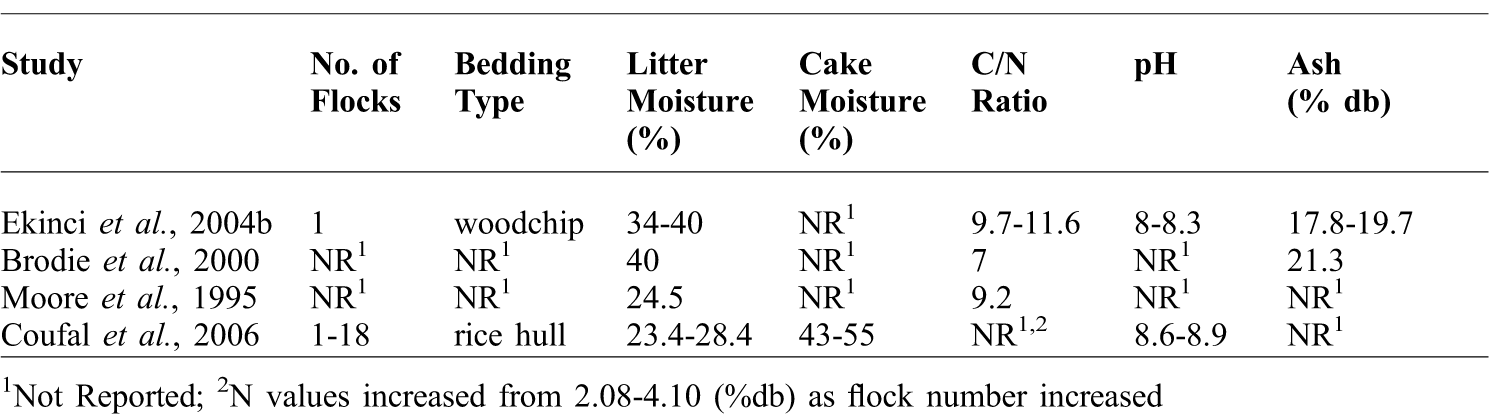
Properties of broiler litter (BL) are variable as shown in Table 1. Based on knowledge of composting, different management approaches will be required depending on moisture content (e.g. 24.5% versus 40%).
Summary of broiler properties from published studies.

1Not Reported; 2N values increased from 2.08-4.10 (%db) as flock number increased
Composting process
Composting is the decomposition of organic matter under controlled conditions that yield temperatures conducive to thermophilic microorganisms, resulting in a humus like organic material. Generally it occurs in a predominantly aerobic environment. The process consumes oxygen and releases heat, water, and CO2. Under controlled conditions, the composting process is described in terms of primary (high rate composting), secondary (compost stabilisation), and curing phases. The primary phase is where most of the organic breakdown occurs and high temperatures are achieved. The secondary phase has lower biological activity resulting in slower composting and lower pile temperatures. During the curing stage, the decomposition rate slows and the compost stabilizes. The length of time for any one phase of composting will be affected by the input and process parameters (e.g., temperature, moisture, oxygen level, C/N ratio, particle size) and management practices (e.g., turning frequency, pile size).
For maximum composting rates, primary ingredients, amendments, and recycled compost are mixed to achieve optimal ranges for initial carbon/nitrogen ratio (C/N) (20-40), moisture (45-65%), porosity (30-50%), and other factors as shown in Rynk (Reference RYNK1992), Haug, (Reference HAUG1993), and Epstein (Reference EPSTEIN1997). Then the mix is put into a pile or windrow where the composting process occurs. Depending on the system and phase, the mix is turned daily, every 3-4 days, or sometimes only weekly or monthly. In some systems, air is forced through the compost to control temperature and keep the pile supplied with oxygen. When little or no heat output is observed, the material is removed, remixed, and put into a curing pile. Length of curing depends on the compost maturity and stability required for a given market. Haug (Reference HAUG1993); Hoitink and Keener (Reference HOITINK and KEENER1993); and Keener et al. (Reference KEENER, DICK and HOITINK2000a) discussed the relationship between the composting process and compost maturity and stability.
Composting as applied to broiler litter
Keener et al. (Reference KEENER, MARUGG, HANSEN and HOITINK1993; Reference KEENER, EKINCI and MICHEL2005) noted that optimisation of a design, whether based on cost of construction and operation, energy use (conservation of resources), or pollution levels (odours, dust, etc.), can be accomplished through field experimentation and mathematical modelling of the composting process. The following sections present results of both field experimentation and modelling for optimising composting of broiler litter.
mixing ratios
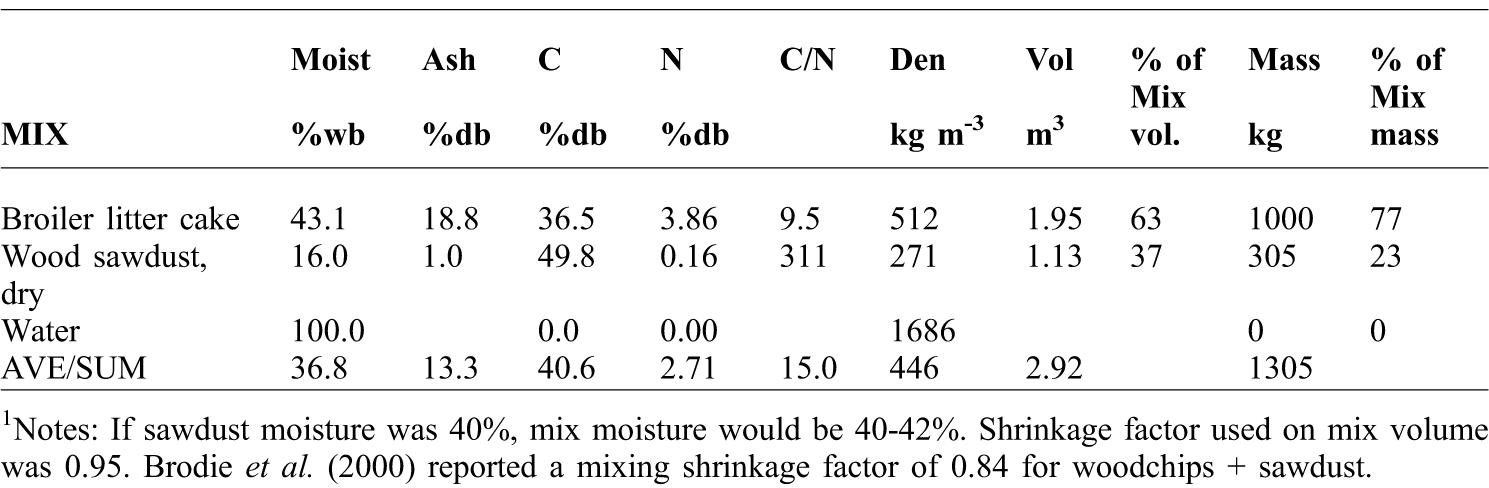
Feedstock mixes are usually developed on a volume basis to make it easier for the facility operator to manage the process. The OCAMM (2014) website presents a computer spreadsheet developed by Keener et al. (Reference KEENER, EKINCI, ELWELL and MICHEL2000b) to calculate a mixture's carbon levels, nitrogen, C/N ratio, moisture, and density based on the volume or mass of materials being mixed and their individual properties. Using this spreadsheet, mixing ratios were formulated for a typical broiler litter cake and sawdust (Table 2) for a target C/N of 15 and moisture of 35%. Brake (Reference BRAKE1992) indicated that composting of broiler litter in the bird house requires a minimum C/N ratio of 15 and a moisture level of 45%. Bucklin et al. (Reference BUCKLIN, JACOB, NORDSTEDT, SLOAN, TERVOLA and MATHER2004) observed that self- heating occurred at 20-25% moisture in deep stacked piles of broiler litter.
Mixing ratios for poultry litter cake and sawdust to achieve a compost mix with a C/N of 15 and moisture of 35%1.
1Notes: If sawdust moisture was 40%, mix moisture would be 40-42%. Shrinkage factor used on mix volume was 0.95. Brodie et al. (Reference BRODIE, CARR and CONDON2000) reported a mixing shrinkage factor of 0.84 for woodchips + sawdust.
The C/N value of 15 was chosen to minimise amendment use, a requirement to keep operating costs low, and still achieve high temperatures that Bucklin et al. (Reference BUCKLIN, JACOB, NORDSTEDT, SLOAN, TERVOLA and MATHER2004) showed were needed for pathogen reduction. Table 2 gives an approximate mixing ratio of 1.7:1 v/v for broiler litter cake to sawdust. Brodie et al. (Reference BRODIE, CARR and CONDON2000) used broiler litter:wood chips:sawdust ratios of 3:5:5 v/v for static piles and 2:3:3 v/v for turned windrows to give C/N ratios of 15 and 14, respectively. The low amendment levels proposed in this paper are based on research on composting un-amended caged layer manure by Elwell et al. (Reference ELWELL, KEENER, CAREY and SCHLAK1998) and Keener et al. (Reference KEENER, ELWELL and GRANDE2002) and will be discussed later.
The proposed compost mix, with a C/N of 15, will usually result in a high NH3-N loss, unless the composting system and its operational practices are managed to reduce NH3-N loss as shown in Kirchmann and Witter (Reference KIRCHMANN and WITTER1989); Elwell et al. (Reference ELWELL, KEENER, CAREY and SCHLAK1998); and Ekinci et al. (Reference EKINCI, KEENER and ELWELL2000). Hansen et al. (Reference HANSEN, KEENER, MARUGG, DICK and HOITINK1993) showed that NH3-N losses for a C/N ratio of 15 were three times greater than for a C/N ratio of 20, when composting caged layer manure amended with ground corncobs.
C/N and moisture content
According to Rynk (Reference RYNK1992) composting with C/N ratios between 25:1 and 40:1 favours higher growth rates of microorganisms and efficient processing of degradable organics with limited odour generation. Ekinci et al. (Reference EKINCI, KEENER and ELWELL2002) used broiler litter and paper mill sludge to evaluate the effects of C/N on the decomposition rate (k). Their results showed maximum decomposition occurred at a C/N of around 35. Using these results, for a C/N of 15 for composting broiler litter/cake, k would be one third of the maximum rate.
During normal composting, moisture level decreases unless water is added. Ekinci et al. (Reference EKINCI, KEENER, MICHEL and ELWELL2004a) found the optimum moisture was 44.5%, for materials with ash of 52%. On an ash free basis, moisture was 62.6%, which falls within the 50-65% optimum moisture range cited by Rynk (Reference RYNK1992). Studies of Elwell et al. (1998, showed that un-amended poultry manure at 42.6% moisture (ash 18-25%) would have little biological activity.
temperature, decomposition rate and airflow
The decomposition rate is a function of temperature. Most researchers agree that 55-65°C will lead to maximum decomposition rates. Ekinci et al. (Reference EKINCI, KEENER, MICHEL and ELWELL2004a) showed that for broiler litter and paper mill sludge the maximum decomposition rate occurred at a composting temperature of 58°C. Optimum composting temperatures were achieved by controlling pile size and/or regulating airflow as shown by Haug (Reference HAUG1993) and Keener et al. (Reference KEENER, HANSEN and ELWELL1997) and allowing heat generated through microbial activity to leave the pile. Organic material stored in piles a few meters high by several meters across usually reaches 60°C in less than two days with minimal aeration. Maximum practical depth ranges from 1.5 to 3.5 m, depending upon the material to be composted and turning equipment design. Bucklin et al. (Reference BUCKLIN, JACOB, NORDSTEDT, SLOAN, TERVOLA and MATHER2004) noted that for deep stacked piles of broiler litter, self heating occurs if the pile is 2-3 m deep and moisture is a minimum of 20-25%. It should be noted that deep piles with depths >4 m sometimes lead to spontaneous combustion.
Keener et al. (Reference KEENER, MARUGG, HANSEN and HOITINK1993; Reference KEENER, DICK and HOITINK2000a; Reference KEENER, EKINCI, ELWELL and MICHEL2000b; Reference KEENER, EKINCI and MICHEL2005) developed fundamental equations for design of aeration systems for composting for continuous and intermittent aeration. For broiler litter/cake composting, airflow requirements would initially be 3.48 m3per day for each kg of dry compost. Compost studies suggest airflow requirements can decrease as much as 40-fold from day 0 to day 21. To minimise capital and operating costs, and achieve high decomposition rates, fan design, according to Keener et al. (Reference KEENER, EKINCI and MICHEL2005), should be based on maintaining the pile at 57-65°C .
particle size
Particle size and distribution are critical for balancing surface area for growth of microorganisms and maintenance of adequate porosity for aeration. Studies on particle size suggest acceptable values to be 0.8-1.2 cm nominal diameter as shown in Rynk (Reference RYNK1992). For poultry litter, particle size is not an issue if moisture is <45% at the start of the process and mechanical mixing is used during or at the end of the process to eliminate clumping of materials and produce a granular product.
pH
A pH of between 6.7 and 9.0 supports good microbial activity during composting. Carey (Reference CAREY1997) showed that large quantities of ammonia (NH3), however, can be lost if the pH is not maintained below 7.5. Broiler litter/cake has a high pH of 7.5–8.9 as cited in Ekinci et al. (Reference EKINCI, KEENER, ELWELL and MICHEL2004b) and Coufal et al. (Reference COUFAL, CHAVEZ, NIEMEYER and CAREY2006), so would be expected to lose a high percentage of its N as NH3-N.
ammonia, odour control and volume reduction
N is lost from the composting system via numerous pathways, with NH3 being the most common. As the N content of finished compost impacts its market value, three concepts should be observed to minimise NH3 loss for low C/N mixes and reduce odours:
1. Airflow control is critical. Experimental studies of Elwell et al. (Reference ELWELL, KEENER, WILES, BORGER and WILLETT2001) explored the effect of continuous and intermittent aeration on NH3 emissions and odour generation during composting of hog manure. Results showed NH3 emission was highly correlated with total airflow, regardless of fan operating mode, and suggested odour emissions would be reduced if the airflow was reduced while maintaining aerobic conditions. Kirchmann and Witter (Reference KIRCHMANN and WITTER1989) showed that if acidic conditions occur in poultry manure composting due to extremely low air exchange, less than 1% of the N originally present would be evolved. However, it should be noted that for the composting material to dry and stabilise, air exchange must occur.
2. Pile enclosure is desirable. Keener et al. (Reference KEENER, ELWELL and GRANDE2002) showed that by enclosing the pile, in a building or with semi-permeable covers, airflow is better controlled and higher levels of NH3 can be maintained at the surface of the pile. This can reduce NH3 diffusion away from the surface of the pile, and N loss from the compost.
3. Dry compost is desirable. As the compost moisture level drops, Carey (Reference CAREY1997) showed that biological and chemical activity is inhibited, lowering the rate of transforming uric acid → urea → NH3 + CO2. To maximise drying rates while minimising total air flow, fans operated for compost should be maintained at 65-70°C to take advantage of air's higher water holding capacity at higher temperatures. Also, surface drying of the compost is enhanced whenever the pile is turned.
Other alternative methods have been proposed to capture or reduce N losses. Carey (Reference CAREY1997) proposed acid scrubbing of NH3 emissions from the composting process and returning the NH3 salt back to the finished compost. This has merit, but remains to be proven cost effective. Still other approaches by Ekinci et al. (Reference EKINCI, KEENER and ELWELL2000) used alum, while those by Tubail et al. (Reference TUBAIL, CHEN, MICHEL, KEENER, RIGOT, KLINGMAN, KOST and DICK2008) used gypsum. Koenig et al. (Reference KOENIG, PALMER, MINER, MILLER and HARRISON2005) evaluated ten amendments used to reduce NH3 volatilisation during in-house composting of caged layer manure. Aluminium sulphate was found to be effective, but it could not be verified that NH3 levels could be reduced below the 25 ppm needed to meet human health standards. Of these approaches, gypsum may be viable for some operations, but requires further studies on efficacy with broiler litter.
During composting, Michel et al. (Reference MICHEL, PECCHIA, RIGOT and KEENER2004) showed volume and mass reductions of parent materials as high as 75-80% for composting dairy manure and amendments. A study by Elwell et al. (Reference ELWELL, KEENER, CAREY and SCHLAK1998) on un-amended poultry manure indicated that dry matter losses would be <30% if, during the process, the moisture dropped rapidly to under 20%. Brodie et al. (Reference BRODIE, CARR and CONDON2000) reported 33% and 41% volume reduction during static pile and windrow composting of broiler litter amended with woodchips and sawdust (3:5:5), respectively.
Compost systems
Composting systems can be classified as static piles, aerated static piles, turned windrows, and aerated turned windrows. The terms ‘windrow’ and ‘pile’ can be used interchangeably. The terms in-vessel and tunnel indicate that the pile or windrow is contained within a structure. The best system depends on the material(s) to be composted and takes into account health, safety, public nuisance, and economics. Descriptions of these systems along with applications for processing broiler litter for value-added marketing follows.
static pile
Composting material is placed in a pile (or windrow) and left to compost with minimal turning and without forced ventilation. This approach is generally used with materials unlikely to generate offensive odours under anaerobic conditions, such as leaves and yard wastes, which have high C/N ratios (>50). Where escaping odours may be a problem, the pile is capped with a biofilter material to trap and destroy the odours. Keener et al. (Reference KEENER, ELWELL and MONNIN2000c) have successfully used the latter approach for dead animal composting, in which the pile is capped with 25-50 cm of biofilter material. These systems are usually turned using a front-end loader, once at the end of the high-rate phase of composting and once between the stabilising and curing phases. If woodchips are used in the mix, screening often precedes the marketing of material to provide a uniform product less than 1 cm in size. The over-sized material left from screening is often mixed with the incoming material for further composting.
Brodie et al. (Reference BRODIE, CARR and CONDON2000) investigated static pile composting for broiler litter. They amended broiler litter with sawdust and woodchips (3:5:5 v/v), respectively. Initial moisture content was 42% and C/N was 15. Pile shape was triangular with a base width of 4.6 m and height of 2.4 m. Two static piles, one of which was covered with a 15-cm layer of previously made compost and the other was uncovered throughout the study, were constructed on a 0.41 m deep layer of woodchips. Piles reached sustained high temperatures (>53°C) sufficient to meet criteria for pathogen reduction as shown by Epstein (Reference EPSTEIN1997), but continued to self heat after 200+ days when turned. Also, the moisture content remained high in the product and at 350 days was >40% due to rainfall. Final N in the compost was 1.3%. These results suggest that outside static pile composting of broiler litter would not lead to a dry, stable product required for high value markets.
Keener and Elwell (Reference KEENER and ELWELL2003) studied static pile composting of caged layer manure at Cort Farms, Seymour, IN, USA. Manure was removed yearly from the high rise houses and placed in a 30 x 91 m Quonset building. About 725 tons yr-1 of manure from 2.5 million birds went into the building at less than 25% moisture. Operational procedures were to pile manure in layers on one side (1/2) of the building and increase pile height to within 3 m of the roof of the structure. Material was then composted 6-12 months before being removed and sold. Temperatures of the material reached 50-53°C at surface depths >30cm. For manure going into storage, the moisture was 10-20% and ash content was 47-55%, suggesting manure was well decomposed when removed from the bird houses. The ash and moisture content of material did not significantly change during storage, suggesting biological decomposition was very low. The N of the product ranged from 4.4 - 5.1% (dry basis). It was concluded that deep pile storage of dry poultry manure under roof can effectively protect nutrients and control fly and beetle population. However, deep pile storage (>5 m) for manure >25% moisture would likely self heat to very high temperatures, increasing the probability of fire, and would become wetter and more odorous without some turning or aeration.
New Day farms in Raymond, OH, USA, stored caged layer manure under roof in large static piles ~5 m maximum depth. The manure was dried to <40% moisture on belts below the caged layers, removed weekly, and transported to the storage/composting building, piled on the floor, and allowed to self heat. After 3-4 days, the manure was spread in a thin layer onto a large composting pile using a front end loader. Egg shells from New Day's egg breaking facility were centrifuged to remove remaining liquids then mixed into the active compost. Storage time depended on demand for the product, but was able to be kept for up to six months. Composted dead birds, also produced at the site, were blended into the finished compost. Management of odours and flies has posed no major issues. Typical analysis of the finished product was 34% moisture, 4.8% N (0.6% NH3-N), 5.7% P2O5, and 2.2% K2O. Analysis of the composted product has shown it to be below limits as set by the Ohio EPA for Salmonella spp. (<3 MPN/4 g TS) and faecal coliform (<1000 MPN/g TS).
aerated static pile
Composting material is placed in piles with ventilation ducting underneath the piles. Studies on aerated static pile systems showed that they work best using forced ventilation, in which the air is pushed up through the pile, as opposed to negative pressure, in which the air is drawn down through the pile, because of higher pressure drops and accumulation of water in the piping under suction. Even so, many aerated static pile systems aerate using negative-pressure and exhaust the resulting gases through a biofilter. According to Keener et al. (Reference KEENER, HANSEN and ELWELL1997; Reference KEENER, EKINCI, ELWELL and MICHEL2000b; Reference KEENER, EKINCI and MICHEL2005), the rate of aeration required to prevent anaerobic metabolism within the compost varies with the material being composted.
Windrow dimensions are generally limited to 2.5 m in height and less than 30 m in length to balance airflow along the pile, static pressure drops, and fan power requirements. Spacing of ducts is usually controlled by pile height since duct spacing is approximately equal to the height of the pile. A block approach is often used to maximise use of space. Pipe sizing, both header and aeration duct, and hole placement in the aeration duct can be critical for successful operation of this system. Improper design leads to over ventilation of the pile in one location and under ventilation (with accompanying odours and low decomposition rate) in other places. Das and Keener (Reference DAS and KEENER1997) showed that matching pile depth to material type and moisture is critical for the success of this system.
Recent aerated static pile technologies have used a porous, geotextile cover which sheds rainfall and reduces odour generation as gases leaving the pile encounter a biofilm on the cover. For example, in the GORE system, pre-mixed material is put over an aeration duct, covered, and then aerated intermittently for 2-4 weeks. The material is then put into a curing pile. Although no published studies on the use of geotextile covers for composting poultry manure have been found, according to Paré et al. (Reference PARÉ, PAULITZ and STEWART2001) and Sommer (Reference SOMMER2001) there is some evidence that these covers may be effective in retaining N in the compost.
turned windrow
Composting material is placed in a windrow (pile) and is turned at regular intervals. Pile heights are generally limited to 1.5-2.5 m because of the ability of equipment to handle material and porosity considerations. Turning equipment includes tractors with buckets, payloaders, and turners that discharge from the side or straddle the windrow. Windrow length depends on site location. Turned windrow systems are used for many types of materials such as yard trimmings and cattle manure.
Compost porosity >30% is important to minimise anaerobic conditions since windrows, as with static piles, depend on natural convection (chimney effects) to ventilate the pile. However, Michel et al. (Reference MICHEL, PECCHIA, RIGOT and KEENER2004) showed that excessive porosity (>70%), can prevent the windrow from self-heating. Keener et al. (Reference KEENER, EKINCI and MICHEL2005) showed that turning the pile can incorporate oxygen, but if the pile lacks porosity, the centre of the windrow becomes anaerobic in minutes. Many turners add water into the windrow if needed.
Windrow systems using highly putrescible materials often generate some odours early in the process. Miller (Reference MILLER1993) showed that keeping the pile temperature below 58°C can minimise odours and can be accomplished by regulating pile size, moisture content, and porosity. Another method is to cap the piles with a biofilter material to degrade escaping odours and to delay turning the windrows until the temperature of the high rate phase of composting has declined to <58°C.
Brodie et al. (Reference BRODIE, CARR and CONDON2000) investigated turned windrow composting for broiler litter. They amended broiler litter with sawdust and woodchips (2:3:3 v/v), respectively. Initial moisture content was 42% and C/N was 14. Pile shape was semi-circular with a base width of 3 m and height of 1.5 m. The pile was uncovered throughout the study and was turned every 10 days. The turned windrows reached high temperatures (>53°C) which dropped after each turn for short periods of time, possibly due to small pile height. The pile cooled to ambient temperatures after 100 days. Volume dropped to 59% after nine months of composting. Final moisture content was 22% and N was 1.01%. It is estimated, that 76% of initial N was lost. Results of this study suggest outside turned windrow composting of broiler litter does not lead to a product with a high N level. Thus, marketing opportunities based on nutrient content may be limited; however, it can have value as a soil improver.
in-vessel
In-vessel systems are often designed to both aerate and mechanically turn the compost. Historically, it has included upright silos, flat rectangular structures with bays, and structures with walking floors. Operating principles of in-vessel composting systems have been well defined by Haug (Reference HAUG1993) and Keener et al. (Reference KEENER, MARUGG, HANSEN and HOITINK1993; Reference KEENER, EKINCI and MICHEL2005). In-vessel systems can be used for all types of prepared materials and have the capability of controlling emissions. An approach used to reduce costs with such technology is to use two composting systems: 1) an in-vessel system for 7-21 days (phase 1), then 2) an aerated pile until material is through the secondary phase of composting. In-vessel systems have high fixed and operating costs and are selected based on materials to be composted, site requirements, and processing cost per unit of product.
Keener et al. (Reference KEENER, ELWELL and GRANDE2002) studied the aerated turned windrow system located at the Daylay (New Day) Egg Farm, West Mansfield, OH, USA. In 2002 the farm operated a 1.6 million bird caged layer facility. The birds were housed in eight buildings, four of which were of the deep pit design with 150,000 birds each. The other four, with 250,000 birds each, incorporated a belt conveyor system for removing manure every three days. Manure on the belt was delivered to two separate buildings, where it was composted using Salmet composters (Dietzenbach, Germany) into a dry product suitable for high-value markets. The composting complex consisted of: (1) a 62 m x 141 m building with 12 lanes, storage, and eight exhaust fans; and (2) a 31 m x 141 m building with six lanes, storage, and four exhaust fans. Operationally, un-amended poultry manure (<55% moisture) was piled at the input end of one lane, which was an aerated in-vessel composting bay with a turner. Material in a lane was turned every three days over a 56-day period and moved six meters toward the output end of the composting bay during each turn. After 18 turns the material was removed from the bay and stored until marketed. The first one third of the bay was aerated during the first 18 days, using an on-off fan control. NH3 levels in the compost building measured 90-160 ppm, depending on exhaust fan operation. Properties of layer manure entering the system were 49-53% moisture, 30.3-30.7% ash, 5.7-5.9% N, and 5.0-6.03 C/N. Properties of compost leaving the system were 10-18% moisture, 34.1-37.2% ash, 5.6-6.2% N, and 5.0-5.8 C/N. Dry matter loss of the poultry manure was 10.0-18.6% and N loss was 12.2-15.0%. Based on the properties of the poultry manure being composted, this system should compost and dry broiler litter in a similar fashion, giving a product with 80-90% of the original dry matter, moisture content of 10-18%, and a N level >3.6% (assumes N of 4.3% in litter/cake entering system).
Conclusions
Of the systems reviewed for composting broiler litter, two methods appear to meet the objectives of producing a high N, high value product. In the first, the material is placed in a small static pile at <40% moisture until self-heating subsides (one to two weeks), and then layered on a larger pile. The second method, an in-vessel system, uses turned windrows in an enclosed building with forced aeration for the first 18 days. After a total of 56 days, the compost is moved to a non-aerated curing pile until stabilised. Both methods can produce compost with higher N levels and pathogen levels below safe limits.
Acknowledgements
Financial support was provided by U.S. Grains Council, 1400 K Street, NW, Suite 1200, Washington, DC 20005 and State and Federal funds appropriated to the Ohio Agricultural Research and Development Center, The Ohio State University, Wooster, OH 44691. Any reference to a specific company or product is for informational purposes only and is not an endorsement.