Introduction
The first episode of psychosis (FEP) is typically preceded by a period of variable but identifiable, emerging symptoms (Cupo et al., Reference Cupo, McIlwaine, Daneault, Malla, Iyer, Joober and Shah2021; Yung & McGorry, Reference Yung and McGorry1996). These early symptoms can include non-psychotic and subthreshold or attenuated psychotic symptoms. Early interventions aimed at preventing, delaying, or mitigating the transition to psychosis generally target the interval between the first identifiable symptom and FEP onset (Fusar-Poli et al., Reference Fusar-Poli, Salazar de Pablo, Correll, Meyer-Lindenberg, Millan, Borgwardt and Arango2020). This period of early symptoms can unfold slowly over several years, or abruptly over weeks or months. More insidious progression to FEP has been associated with poorer outcomes after psychosis onset (Clarke et al., Reference Clarke, Whitty, Browne, McTigue, Kamali, Gervin and O'Callaghan2006; Harris et al., Reference Harris, Henry, Harrigan, Purcell, Schwartz, Farrelly and McGorry2005), but more rapid progression leaves less time for preventing FEP. Hence, better understanding the speed of illness progression prior to FEP onset could inform and guide actionable early intervention strategies.
Features of the first identifiable symptom, including its content and age at onset, may also assist in predicting the subsequent speed of illness progression for two reasons. First, the presence of subthreshold psychotic symptoms is associated with higher risk of later psychosis in the general population (Guloksuz et al., Reference Guloksuz, Pries, ten Have, de Graaf, van Dorsselaer, Klingenberg and van Os2020). In studies conducted in populations experiencing homelessness and with schizophrenia respectively, suspiciousness tended to precede the emergence of other subthreshold psychotic and non-psychotic symptoms (Jones et al., Reference Jones, Gicas, Mostafavi, Woodward, Leonova, Vila-Rodriguez and Honer2021a; Messias, Kirkpatrick, Ram, & Tien, Reference Messias, Kirkpatrick, Ram and Tien2001). Together, this suggests that the emergence of subthreshold psychotic symptoms in general and suspiciousness in particular may be associated with more rapid illness progression. Second, since the incidence of anxiety, mood, and psychotic disorders peaks at different ages (Jones et al., Reference Solmi, Radua, Olivola, Croce, Soardo, Salazar de Pablo and Fusar-Poli2021b), and given hierarchical models of illness development leading to psychosis (de Jong, Giel, Lindeboom, Slooff, & Wiersma, Reference de Jong, Giel, Lindeboom, Slooff and Wiersma1984; Docherty, Van Kammen, Siris, & Marder, Reference Docherty, Van Kammen, Siris and Marder1978), the various types of symptoms preceding FEP are likely to have different ages at onset. Earlier or later age at onset of a given symptom may in turn influence its prognostic implications; for example, younger age at first presentation for self-harm has been associated with higher risk of psychosis (Bolhuis et al., Reference Bolhuis, Lång, Gyllenberg, Kääriälä, Veijola, Gissler and Kelleher2021), and earlier onset of psychotic symptoms has been associated with poorer clinical outcomes after FEP (Clarke et al., Reference Clarke, Whitty, Browne, McTigue, Kamali, Gervin and O'Callaghan2006).
In the current study, we aimed to examine the association between the content of the first identifiable symptom (grouped as subthreshold psychotic v. non-psychotic in aggregate, and individual symptoms within these categories) and the rapidity of progression en route to an FEP. Beginning with the first symptom experienced prior to psychosis, we indexed illness progression in two ways: time to onset of FEP and symptom incidence rate prior to FEP. We also aimed to explore how the associations between the first identifiable symptom and illness progression would change according to the symptom's age at onset.
Methods
Setting
This study was conducted at the Prevention and Early Intervention Program for Psychosis (PEPP-Montreal) within the Douglas Mental Health University Institute. PEPP-Montreal is publicly funded and is the only early intervention service in a catchment area of over 300 000 individuals in the southwest of Montreal, Canada. The current study was part of a broader investigation of early intervention in FEP approved by the Douglas Research Centre's research ethics board.
Participants
The patient sample for this study was derived from FEP patients admitted to the program between 2003 and 2017. Inclusion criteria for both the service and the study were: (1) meeting diagnostic criteria for a nonaffective or affective psychotic disorder based on the SCID-IV (First, Spitzer, Gibbon, & Williams, Reference First, Spitzer, Gibbon and Williams2002), confirmed by a senior psychiatrist (RJ, AKM, or JLS), and not attributable to substance use alone; (2) having received <30 days of antipsychotic medication; (3) IQ ⩾70; (4) no organic mental disorder, such as epilepsy; and (5) age between 14 and 35 years. Research participants provided written informed consent/assent. Data were available for 626 individuals who consented to participate in the research program.
Measures
The Circumstances of Onset and Relapse Schedule and Topography of Psychotic Episode were applied systematically to retrospectively evaluate the occurrence and timing of 27 signs or symptoms preceding FEP onset, as well as the date of onset of FEP (Norman & Malla, Reference Norman and Malla2002). Onset of FEP was defined as the date when psychotic symptoms reached threshold-level severity. Data were collected through semi-structured interviews with patients and family members within 3 months of intake in the clinic. Interviews were complemented by a detailed review of all available health and social records.
To conduct the interviews, research assistants were trained by rating videotapes, role-playing, and interviewing under direct supervision of a senior psychiatrist and an experienced research coordinator. Anchor points were used to elicit the timing of symptoms (e.g. ‘your 16th birthday’ or ‘during 8th grade’) and to ensure consistent assignment of age in these scenarios. Twelve randomly selected cases were independently evaluated by 3–8 raters for variables including the length of treatment delays and the number of help-seeking contacts; interrater reliability was good to excellent (intraclass correlation coefficients: 0.81–0.98). Data were recorded after a consensus meeting chaired by a senior psychiatrist (RJ, AKM, or JLS).
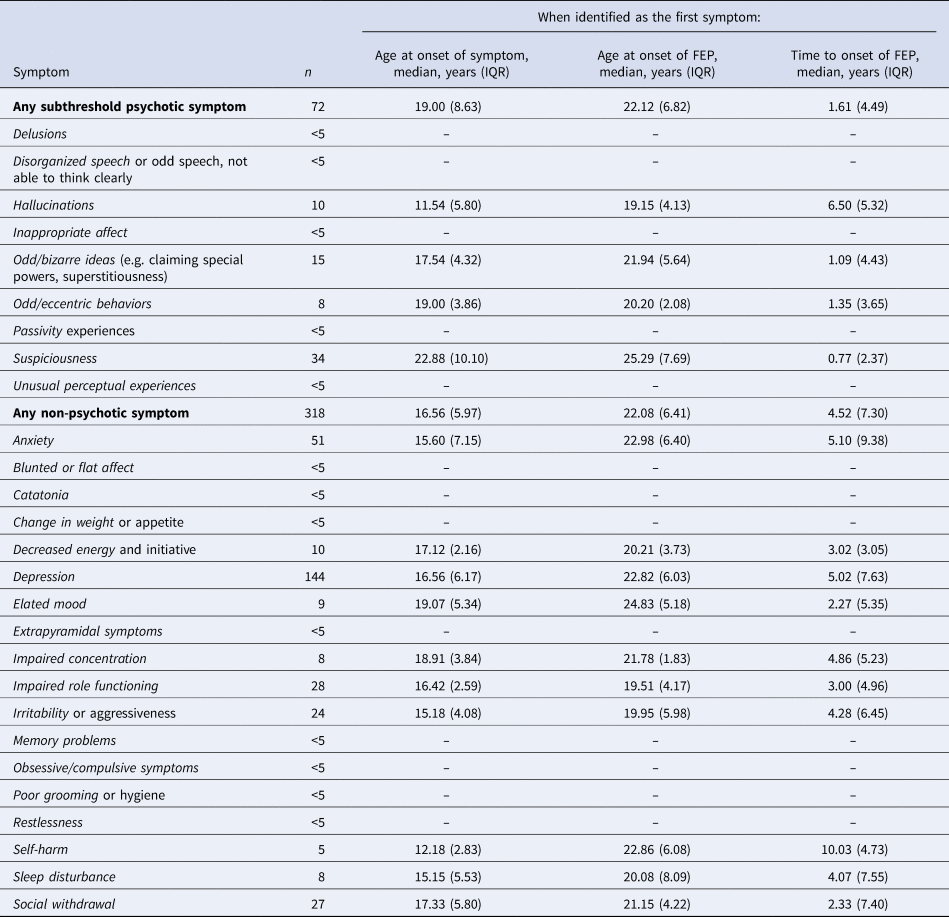
Of 27 signs/symptoms measured with the Topography of Psychotic Episode, nine were previously classified as ‘attenuated positive symptoms or subthreshold psychotic symptoms’ (subthreshold psychotic symptoms) by an international panel of experts (Table 1) (Shah et al., Reference Shah, Crawford, Mustafa, Iyer, Joober and Malla2017). The remaining 18 signs/symptoms were classified as non-psychotic ones. Below we refer to signs/symptoms as ‘symptoms’ for simplicity.
Description of the 27 early symptoms and their timing relative to first-episode psychosis when identified as first symptoms

FEP, first-episode psychosis; IQR, interquartile range.
Signs/symptoms are referred to as ‘symptoms’ for concision. Ages at and time to onset are only reported if n ⩾ 5 cases. In italics: abbreviated symptom designation used in the text and figures.
The exposure variable was the content of the first identifiable symptom: either subthreshold psychotic or non-psychotic, and specific symptoms within these categories (Table 1). To limit identifiability of individual participants, symptoms were examined separately only if reported as firsts by ⩾5 participants. However, symptoms with <5 cases were still included in the overall subthreshold psychotic/non-psychotic categories.
Outcomes were (1) time to onset of FEP, calculated as the interval in years between onset of the first identifiable symptom and onset of FEP, and (2) symptom incidence rate. Symptom incidence rate was defined as the count of new symptoms per person-year between onset of the first identifiable symptom and onset of FEP. This particular choice of outcome is consistent with the notion that the count of symptoms, in the pre-onset phase of FEP, can serve as a transdiagnostic index of syndrome complexity (van Os, Schaub, & Carpenter, Reference van Os, Schaub and Carpenter2021). In a population-based cohort study, it was recently shown that the total burden of undifferentiated symptoms in young adults is associated with functional impairment in a stepwise fashion (Crouse et al., Reference Crouse, Ho, Scott, Martin, Couvy-Duchesne, Hermens and Hickie2021). Here, we extend this line of research by looking at the speed at which the total symptom count grows as a marker of illness progression.
Statistical analysis
Analyses were conducted in R, version 3.6.2, between January and August 2021. Participants were excluded from analyses if they had not completed the Circumstances of Onset and Relapse Schedule and Topography of Psychotic Episode. Characteristics of participants included v. excluded from the analytic sample were compared, but in accordance with the STROBE statement (Vandenbroucke et al., Reference Vandenbroucke, von Elm, Altman, Gøtzsche, Mulrow, Pocock and Egger2007), inferential statistics (i.e. p values) were not computed for descriptive analyses.
Given the focus of this study, each analytical model was conducted in three stages to account for age effects in the associations between first identifiable symptom and the rapidity of progression to FEP: (1) unadjusted models, which indicate what information each first symptom, on its own, provides about the rapidity of illness progression; (2) models adjusted for age at onset of the first symptom, which clarify whether that symptom is associated with progression only because it typically manifests at ages earlier or later than the mean age of FEP onset; and (3) interaction between the first symptom and its age at onset, to identify whether the association of each specific symptom with illness progression varies according to age at symptom onset. Age was treated as a continuous variable throughout the analyses.
Using Cox proportional hazards models, we examined the association between each specific type of first identifiable symptom and time to onset of FEP. This included having had any subthreshold psychotic symptom as the first identifiable symptom (dichotomous variable; Yes/No) as a predictor of time to onset of FEP, followed by considering each symptom (e.g. Depression as first symptom: Yes/No; Suspiciousness as first symptom: Yes/No, etc.) separately as a predictor of time to onset of FEP. From these models, we estimated the hazard ratios (HR) for onset of FEP associated with having each first symptom compared to having any other first symptom. Assumptions of proportional hazards were confirmed by visual inspection of Schoenfeld residuals and log[−log(Survival)] plots (Kassambara, Kosinski, Biecek, & Fabian, Reference Kassambara, Kosinski, Biecek and Fabian2021). Ties were handled using Efron's method (Efron, Reference Efron1977).
To examine the association between the first identifiable symptom and symptom incidence rate, we used negative binomial regressions. Symptom count was regressed on having had any subthreshold psychotic symptom as the first identifiable symptom, with time to onset of FEP as the time scale. Next, each first symptom was examined separately using the same method. Regression coefficients were exponentiated to obtain incidence rate ratios (IRRs), corresponding to the ratios of symptom incidence rates in participants who experienced a given symptom as the first symptom compared to those who did not.
We compared findings before and after Bonferroni corrections for multiple testing, applied to 95% confidence levels across first identifiable symptoms. Estimates were considered statistically significant if their confidence intervals did not overlap with the null value. As a sensitivity analysis, we tested models adjusted for gender, visible minority status and socio-economic status (Hollingshead Index; Hollingshead, Reference Hollingshead1975). For exploratory purposes, interaction terms were considered statistically significant if p < 0.05 (two-sided) uncorrected for multiple testing. We used the emmeans package (Lenth, Reference Lenth2020) to estimate effect sizes from significant interactions across different values of age of symptom onset. To allow a dynamic visualization of interaction effects (or absence thereof), interactions were probed by estimating slopes for first symptom according to different values of age at onset of first symptom [range: mean age at onset in years ± 2 standard deviations (s.d.)]; an online, interactive data visualization is provided for these results (https://vincepaquin.shinyapps.io/Symptom_to_FEP/).
Results
Sample characteristics
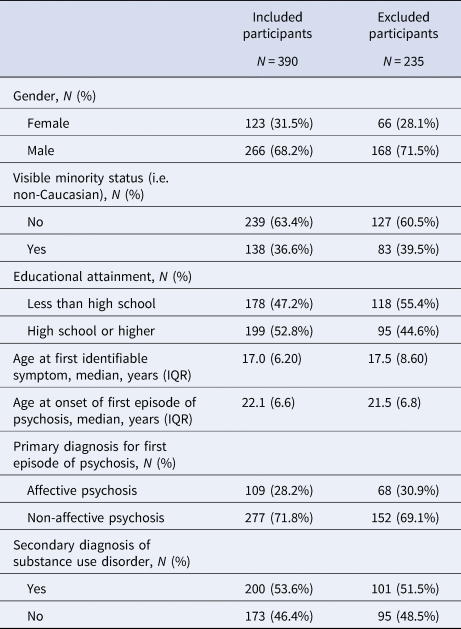
Among 626 participants who consented to participate in research, 390 (62%) completed required assessments regarding signs/symptoms experienced prior to FEP, and this group constitutes the analytic sample of the current study. Between participants included v. excluded from the current study, gender, visible minority status, age at onset of first identifiable symptom, age at FEP onset, and diagnoses at intake were similar (Table 2). There was a slightly higher proportion of high school completers in those for whom complete data were available (52.8% v. 44.6%). In the included (analytic) sample, the median time to onset of FEP after onset of the first identifiable symptom was 3.83 years [interquartile range (IQR) = 7.34 years] and the symptom incidence rate following the first symptom was 1.46 (95% CI 1.41–1.51) symptoms per person-year until FEP onset.
Sociodemographic and baseline clinical characteristics of participants included v. excluded from the analytic sample

IQR, interquartile range.
Time to onset of first-episode psychosis
Table 1 presents median time to onset of FEP for each of the possible first identifiable symptoms. Below, we report hazard ratios for onset of FEP associated with each first symptom compared to having any other first symptom.
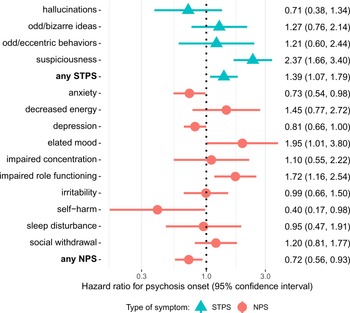
Figure 1 presents hazard ratios before Bonferroni corrections. In participants who experienced any subthreshold psychotic symptom as the first symptom (compared to those who did not), time to onset of FEP was shorter after the onset of the first symptom. Within the subthreshold psychotic and non-psychotic categories, specific symptoms displayed distinct associations with time to onset of FEP. Of subthreshold psychotic symptoms, suspiciousness was associated with shorter time to onset of FEP compared to other subthreshold psychotic and non-psychotic symptoms. Of non-psychotic symptoms, anxiety and self-harm were associated with longer time to onset compared to other symptoms, while elated mood and impaired role functioning were associated with shorter time to onset.
Association of the first identifiable symptom with time to onset of first-episode psychosis. Hazard ratio for psychosis onset associated with one first symptom compared to other first symptoms. Only symptoms with ⩾5 cases were examined separately. Bonferroni-corrected confidence intervals are presented in online Supplementary Material. STPS, subthreshold psychotic symptoms; NPS, non-psychotic symptoms.

Online Supplementary Fig. S1 presents hazard ratios after Bonferroni corrections (k = 16). Suspiciousness remained associated with time to onset of FEP [HR = 2.37 (95% CI 1.38–4.08)], while other associations were no longer significant.
These findings were stable after adjusting for gender, visible minority status and socioeconomic status (online Supplementary Fig. S2). After adjusting for age at symptom onset (online Supplementary Fig. S3), none of the Bonferroni-corrected associations were significant.
Symptom-by-age interaction coefficients are presented in online Supplementary Table S1. Age at symptom onset interacted with odd/eccentric behaviors [coefficient = 0.22 (95% CI 0.02–0.43); p = 0.033], impaired role functioning [coefficient = −0.09 (95% CI −0.18 to −0.01); p = 0.026], and social withdrawal [coefficient = 0.11 (95% CI 0.00–0.22); p = 0.046]. Other interactions were not significant.
Symptom-by-age interactions of significant models are summarized in online Supplementary Fig. S4, and an interactive visualization of hazard ratios in the function of symptom-by-age combinations is available at https://vincepaquin.shinyapps.io/Symptom_to_FEP/. Compared to other symptoms, odd/eccentric behaviors and social withdrawal were associated with shorter time to onset of FEP when emerging at older ages (⩾17 and ⩾18 years, respectively); conversely, at <17 and <18 years, their associations with time to onset were not significant. Impaired role functioning was associated with shorter time to onset of FEP when emerging at ⩽19 years, while at >19 years, the association was not significant. For anxiety, there was no threshold of significance between ages 7 and 27 years; the association with time to onset was not significant throughout.
Symptom incidence rate
Symptom incidence rates according to the first identifiable symptom are presented in online Supplementary Table S2. Below, we report IRRs following each type of first identifiable symptom compared to other first symptoms.
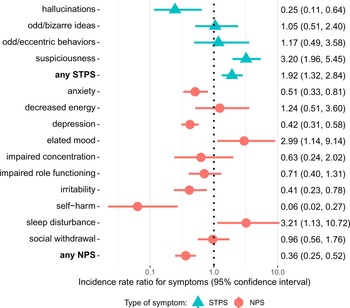
Figure 2 presents IRRs before Bonferroni corrections. Compared to non-psychotic symptoms, having had a subthreshold psychotic symptom as the first identifiable symptom was associated with a higher rate of new symptoms developed per person-year between first symptom and FEP onset. However, these associations were again heterogeneous within the subthreshold psychotic and non-psychotic symptom categories. Of subthreshold psychotic symptoms, and compared to other subthreshold psychotic/non-psychotic symptoms, suspiciousness was associated with a higher symptom incidence rate, while hallucinations were associated with a lower symptom incidence rate. Of non-psychotic symptoms, and compared to any other subthreshold psychotic/non-psychotic symptom, elevated mood and sleep disturbance were associated with higher symptom incidence rates, while anxiety, depression, irritability, and self-harm were associated with lower symptom incidence rates.
Association of the first identifiable symptom with symptom incidence rate. Incidence rate ratio following one first symptom compared to other first symptoms. For example, participants with suspiciousness as the first symptom developed 3.20 times more symptoms/year after onset of suspiciousness and until onset of first-episode psychosis, compared to participants with other first symptoms. Only symptoms with ⩾5 cases were examined separately. Bonferroni-corrected confidence intervals are presented in online Supplementary Material. STPS: subthreshold psychotic symptoms. NPS: non-psychotic symptoms.

Online Supplementary Fig. S5 presents IRRs after Bonferroni corrections (k = 16). Subthreshold psychotic symptoms were associated with a higher symptom incidence rate compared to non-psychotic symptoms: IRR = 1.92 (95% CI 1.10–3.48). Suspiciousness was associated with a higher symptom incidence rate compared to other subthreshold psychotic and non-psychotic symptoms: IRR = 3.20 (95% CI 1.55–7.28). Depression and self-harm were associated with lower symptom incidence rates: IRR = 0.24 (95% CI 0.27–0.68) and IRR = 0.06 (95% CI 0.01–0.73), respectively. Other associations were no longer significant.
Results were similar after adjusting for gender, visible minority status and socioeconomic status (online Supplementary Fig. S6). When adjusting for age at onset of the first identifiable symptom (online Supplementary Fig. S7), associations of subthreshold psychotic symptoms [IRR = 1.27 (95% CI 0.79–2.11)], suspiciousness [IRR = 1.21 (95% CI 0.60–2.62)], and self-harm [IRR = 0.43 (95% CI 0.11–3.16)] were no longer significant. Depression remained a significant predictor: IRR = 0.57 (95% CI 0.39–0.85). Anxiety was associated with lower symptom incidence rate [IRR = 0.55 (95% CI 0.32–0.98)], and sleep disturbance was associated with higher symptom incidence rate [IRR = 4.26 (95% CI 1.19–20.11)].
Symptom-by-age interaction coefficients are presented in online Supplementary Table S3. Age at symptom onset interacted with subthreshold psychotic symptoms [coefficient = −0.07 (95% CI −0.13 to −0.01); p = 0.003; reference: non-psychotic symptoms]. Age at onset also interacted with odd/bizarre ideas [coefficient = −0.12 (95% CI −0.31 to 0.03); p = 0.042], suspiciousness [coefficient = −0.11 (95% CI −0.20 to −0.03); p = 0.001], impaired role functioning [coefficient = −0.25 (95% CI −0.41 to −0.06); p < 0.001], and social withdrawal [coefficient = 0.14 (95% CI 0.00–0.27); p = 0.03]. Other interactions were not significant.
Symptom-by-age interactions in significant models are summarized in online Supplementary Fig. S4, and an interactive visualization of symptom IRRs according to any symptom-by-age combination is available at https://vincepaquin.shinyapps.io/Symptom_to_FEP/. Compared to other symptoms emerging at the same age, subthreshold psychotic symptoms, odd/bizarre ideas, suspiciousness, and impaired role functioning were associated with faster symptom incidence after emerging at younger ages (⩽17, ⩽10, ⩽19, and ⩽14 years, respectively). They were not associated with symptom incidence after emerging at older ages, except impaired role functioning which was associated with slower symptom incidence compared to any other symptom when emerging at ⩾19 years. Compared to other symptoms, social withdrawal was associated with slower symptom incidence when emerging at ⩽15 years; it was not associated with symptom incidence when emerging at >15 years.
Discussion
In a catchment-based sample of individuals with FEP, we found that the nature and timing of the first identifiable symptom, years before the onset of psychosis, was variably associated with two measures of illness progression speed: time to onset of psychosis and the rate at which symptoms emerge prior to FEP.
Clinical tools for estimating psychosis risk have generally aggregated subthreshold psychotic symptoms into a homogenous risk factor for FEP (Shah et al., Reference Shah, Crawford, Mustafa, Iyer, Joober and Malla2017; Yung et al., Reference Yung, Yung, Pan Yuen, Mcgorry, Phillips, Kelly and Buckby2005). Consistent with this, our group previously demonstrated that experiencing subthreshold psychotic symptoms prior to FEP predicted poorer longitudinal outcomes (Rosengard et al., Reference Rosengard, Malla, Mustafa, Iyer, Joober, Bodnar and Shah2019) and altered cortical organization (Rosengard et al., Reference Rosengard, Makowski, Chakravarty, Malla, Joober, Shah and Lepage2020) after psychosis onset. However, in the present study, having any subthreshold psychotic v. non-psychotic symptom as the first symptom was not associated with significant differences in time to onset of FEP, suggesting that a more granular approach examining specific symptom types may be a more informative strategy to understanding trajectories. As such, suspiciousness (one of the most common subthreshold psychotic symptoms to precede psychosis onset: Shah et al., Reference Shah, Crawford, Mustafa, Iyer, Joober and Malla2017; Yung & McGorry, Reference Yung and McGorry1996) was a significant precursor of shorter time to onset of FEP and higher symptom incidence rate when emerging as the first symptom prior to FEP, whereas other subthreshold psychotic symptoms such as hallucinations did not display similar associations. This may reflect the fact that low-intensity or intermittent perceptual disturbances are relatively frequent in the general population, and often benign in the absence of other psychotic symptoms (De Loore et al., Reference De Loore, Gunther, Drukker, Feron, Sabbe, Deboutte and Myin-Germeys2011; Ohayon, Reference Ohayon2000). In contrast, suspiciousness implies a cognitive interpretation of the environment as hostile, which may make a stronger building block for illness progression, potentially through the emergence of anxiety, delusions, and greater fear from hallucinations (De Loore et al., Reference De Loore, Gunther, Drukker, Feron, Sabbe, Deboutte and Myin-Germeys2011; Jones et al., Reference Jones, Gicas, Mostafavi, Woodward, Leonova, Vila-Rodriguez and Honer2021a; Winton-Brown & Kapur, Reference Winton-Brown, Kapur, Tamminga, van Os, Reininghaus and Ivleva2020). Thus, one interpretation of our findings is that the attributional bias underlying suspiciousness is responsible for faster illness progression compared to other early symptoms.
Early non-psychotic symptoms also have prognostic implications based on our findings. In the age-unadjusted model, self-harm was associated with a subsequent lower symptom incidence rate, while in age-adjusted models, such associations were found after first symptoms of depression and anxiety. This should not be taken to imply that these non-psychotic symptoms are less important than other symptoms en route to an FEP. Since slower illness progression is a potential risk factor for poorer outcomes after FEP onset (Clarke et al., Reference Clarke, Whitty, Browne, McTigue, Kamali, Gervin and O'Callaghan2006; Harris et al., Reference Harris, Henry, Harrigan, Purcell, Schwartz, Farrelly and McGorry2005), future work could examine whether non-psychotic symptoms such as self-harm or affective dysregulation are associated with unfavorable prognosis, conditional on or independently of the age at first symptom manifestation (Bolhuis et al., Reference Bolhuis, Lång, Gyllenberg, Kääriälä, Veijola, Gissler and Kelleher2021). We also found that sleep disturbance was associated with a higher symptom incidence rate after controlling for age. Sleep disturbance has been shown to be a general risk factor for psychopathology (Barton, Kyle, Varese, Jones, & Haddock, Reference Barton, Kyle, Varese, Jones and Haddock2018; Carpenter et al., Reference Carpenter, Crouse, Scott, Naismith, Wilson, Scott and Hickie2021; Freeman et al., Reference Freeman, Sheaves, Goodwin, Yu, Nickless, Harrison and Espie2017), including for FEP in at-risk individuals (Lindgren, Kuvaja, Jokela, & Therman, Reference Lindgren, Kuvaja, Jokela and Therman2021; Ruhrmann et al., Reference Ruhrmann, Schultze-Lutter, Salokangas, Heinimaa, Linszen, Dingemans and Klosterkötter2010). With a sizeable minority of individuals never experiencing identifiable subthreshold psychotic symptoms prior to psychosis onset (Cupo et al., Reference Cupo, McIlwaine, Daneault, Malla, Iyer, Joober and Shah2021; Schultze-Lutter et al., Reference Schultze-Lutter, Rahman, Ruhrmann, Michel, Schimmelmann, Maier and Klosterkötter2015), our results support the importance of capturing multiple symptom domains, such as sleep disturbance and self-harm alongside subthreshold psychotic symptoms, to improve risk assessments (McGorry, Hartmann, Spooner, & Nelson, Reference McGorry, Hartmann, Spooner and Nelson2018; Shah et al., Reference Shah, Scott, McGorry, Cross, Keshavan and Nelson2020).
It is noteworthy that the first identifiable symptom had variable prognostic implications based on its age at onset. When added as a covariate, age at onset appeared to largely explain the associations between first symptoms and subsequent illness progression. But the relationship between symptom content, age at symptom onset, and subsequent illness trajectories may be more complex, given the interactions observed between specific symptoms and their age at onset. To our knowledge, this symptom-by-age interplay has never been examined relative to the rapidity of illness progression, but is consistent with developmental factors shaping the expression of psychosis (Keshavan, Giedd, Lau, Lewis, & Paus, Reference Keshavan, Giedd, Lau, Lewis and Paus2014; Paquin, Lapierre, Veru, & King, Reference Paquin, Lapierre, Veru and King2021). Between childhood and adulthood, extensive changes in brain functioning and morphology take place (Nadig et al., Reference Nadig, Seidlitz, McDermott, Liu, Bethlehem, Moore and Raznahan2021; Petanjek et al., Reference Petanjek, Judaš, Šimić, Rašin, Uylings, Rakic and Kostović2011), paralleled by shifting demands in social, academic, and familial environments. Age at onset of a given symptom may reveal, or contribute to, a mismatch between the individual's functioning and age-related external demands. For example, we found that younger age at onset of suspiciousness was associated with a higher symptom incidence rate: suspiciousness emerging before adolescence could be a stronger risk factor for poorer social adjustment (e.g. bullying, aggression) (Shakoor et al., Reference Shakoor, McGuire, Cardno, Freeman, Plomin and Ronald2015; Wong, Freeman, & Hughes, Reference Wong, Freeman and Hughes2014), contributing to feedback loops where attributional bias, maladaptive behaviors, and environmental stress reinforce each other until they crystallize into later-life psychopathology (Healy, Coughlan, Clarke, Kelleher, & Cannon, Reference Healy, Coughlan, Clarke, Kelleher and Cannon2020). However, this and the other interactions identified here were exploratory and should be interpreted as proofs-of-concept: interaction models, contrary to the other analyses, were not corrected for multiple comparisons and require replication.
Strengths and limitations
Our study was conducted in a large catchment-based sample for which trajectories were consistently and systematically assessed. These retrospective measures permit the capture of all trajectories leading to psychosis, including individuals without subthreshold psychotic symptoms who would have presumably been missed in prospective cohorts focusing solely on clinical high-risk youth (van Os et al., Reference van Os, Schaub and Carpenter2021). It is also noteworthy that sociodemographic and baseline clinical characteristics of participants who were excluded due to insufficient data were similar to those of our analytic sample – suggesting that those included were representative of the total consenting population.
It should be emphasized that the potential for recall bias is an important limitation of our study. Previous attempts at evaluating recall bias in small samples in the context of intense illness experience or cognitive impairments have found reasonable levels of convergent validity and agreement between different sources of information (Fisher et al., Reference Fisher, Craig, Fearon, Morgan, Dazzan, Lappin and Morgan2011; Gayer-Anderson et al., Reference Gayer-Anderson, Reininghaus, Paetzold, Hubbard, Beards, Mondelli and Morgan2020; Hambrecht, Häfner, & Löffler, Reference Hambrecht, Häfner and Löffler1994). Nonetheless, symptoms and their timing of onset could have been misreported, including as a function of insight (e.g. recognizing delusional ideas as such). Isolating a single first symptom can also be prone to error since in practice, symptoms often present together. Further, our use of semi-structured interviews may have introduced a social desirability bias. Notwithstanding this, we minimized distortions arising from recall and social desirability as much as possible by complementing interviews of participants with collateral information from family members, a detailed review of all available health and social records that were accessible, and the standardized use of probes and anchor-points (e.g. birthdays and major life events) to timestamp symptoms in a consistent manner.
Another limitation is that transition to FEP and symptom incidence do not capture all aspects of illness progression. Future studies could take into account additional indices, such as severity, intensity, or level of distress associated with each symptom. Also, many first symptoms were reported by few participants, limiting our power to detect associations, and sometimes leading to wide confidence intervals (e.g. for self-harm, sleep disturbance) or exclusion from analyses for anonymity purposes. Finally, the hazard ratios for the onset of FEP should not be understood as measures of relative risk of converting to psychosis. All participants had FEP (this was a condition of inclusion in the study), and thus, direct comparisons with hazard ratios from prospective cohorts of individuals at risk for psychosis are not possible.
Future directions
To examine the predictive accuracy of early symptoms as signposts for speed of illness progression, larger cohorts are needed. Multimodal approaches to risk prediction, exemplified by recent applications of machine learning (Koutsouleris et al., Reference Koutsouleris, Dwyer, Degenhardt, Maj, Urquijo-Castro and Sanfelici2021; Rosen et al., Reference Rosen, Betz, Schultze-Lutter, Chisholm, Haidl, Kambeitz-Ilankovic and Kambeitz2021), can increase prognostic capacity by integrating clinical, environmental, and biological markers of risk. Ultimately, prognoses for the rapidity of illness progression could be further refined by integrating characteristics of the first identifiable symptom with other risk factors such as familial history and polygenic scores (Pedersen et al., Reference Pedersen, Agerbo, Plana-Ripoll, Grove, Dreier, Musliner and Vilhjálmsson2021). Until these approaches are implemented and accessible to all, simple associations between early symptoms and the rapidity of illness progression can help tailor the intensity and timing of early interventions in at-risk individuals.
Supplementary material
The supplementary material for this article can be found at https://doi.org/10.1017/S0033291721003755
Data
Data were requested from the curated database at the Prevention and Early Intervention Program for Psychosis (PEPP-Montreal) at the Douglas Mental Health University Institute. Once access was granted to relevant data, they were and continue to be accessible to all authors in a shared and password-protected drive. This drive is only accessible through servers at the Douglas Mental Health University Institute.
Author contribution
V.P. and J.L.S. designed the manuscript. A.M., S.N.I., R.J., and J.L.S. were involved with the curation of the PEPP-Montreal database (data acquisition). V.P. conducted the analyses and wrote the initial draft under the supervision of J.L.S. All authors contributed to data interpretation and revised the work for important intellectual content; furthermore, all authors take full accountably for all aspects of the manuscript, and have approved the submitted version for publication.
Financial support
This work was supported by grants 68961 and MCT-94189 from the Canadian Institutes of Health Research (S.N.I.), salary awards from the Fonds de Recherche du Quebec-Sante (R.L., J.L.S.) and the Canada Research Chairs Program (A.M.), the Sackler Foundation, and the Lobeer Foundation.
Conflict of interest
None.