Introduction
The American cranberry (Vaccinium macrocarpon Ait.) is indigenous to North America and is closely related to the small cranberry (Vaccinium oxycoccus L.) and the lingonberry (Vaccinium vitis-idaea L.), which are found throughout Europe, Asia and parts of North AmericaReference Eck1. It is a low-growing, slender, vine-like woody perennial that can remain commercially productive for decades. It produces short vertical branches (uprights) 5–20 cm in height and long prostrate branches (runners) from 1 to 2 m in lengthReference Eck1. Runners colonize the open soil, while the uprights produce reproductive and vegetative buds.
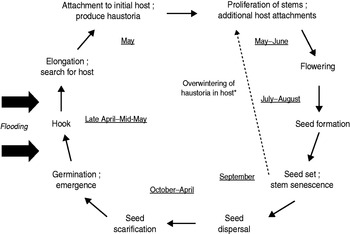
Dodder (Cuscuta gronovii Willd.), an obligate parasite characterized by slender, thread-like yellow–orange twining stems, is a serious pest in cranberry. A recent survey indicated that 45% of cranberry growers reported that 5–25% of their farms are typically infested with dodder; one-third reported that more than 50% of their farms can be infested in any given year. Dodder was ranked as either first or second as a problematic weed by 25% or 20% of growers surveyed, respectivelyReference Sandler2. Its vigorous growth habit, combined with a prodigiousReference Stevens3 and long-lived seed bank, makes management difficult. Although Cuscuta spp. may overwinter as haustoria in host stemsReference Meulebrouck, Ameloot, Brys, Tanghe, Verheyen and Hermy4, Reference Dean5, the seed bank is likely the main contributor leading to new infestations in any given year. Thus, limiting seed production is seen as the critical link in the life cycle (Fig. 1) that must be broken to make any significant gains in management of this pest. When parasitism is successful, dodder can have multiple attachments that create a dense mat reducing the amount of light penetrating into the plant canopy. Light reduction, combined with the removal of water and nutrients from the cranberry vine by the haustoria, can cause cranberry yield losses as high as 80–100%Reference Devlin and Deubert6.
Model of the life cycle of dodder. Calendar dates are related to typical conditions for Massachusetts. *May occur in some dodder species.

Chemical herbicides are the primary tools available to cranberry growers for dodder managementReference Sandler7. Growers routinely scout for early emerging seedlings to time pre-emergence herbicide applications. Even when these applications are timed properly, extended periods of dodder seedling emergenceReference Sandler and Ghantous8 can result in escapes that require additional management. Post-emergence control options include rakingReference Hunsberger, Autio, DeMoranville and Sandler9, hand-pulling and the application of household cleaning productsReference Morrison, Sandler and Romaneo10. Glyphosate applications, though effective in alfalfaReference Dawson11, are not a viable option because the herbicide will injure cranberryReference Shawa12, Reference Ghantous, Sandler, Jeranyama and Autio13.
Flooding is an important management tool used by cranberry growers to protect plants from winter injuryReference Bergman14 and to manage insect pestsReference Averill, Sylvia, Kusek and DeMoranville15. Growers may use multi-week spring or fall floods to manage cranberry fruitworm (Acrobasis vaccinii Riley), fruit rot and dewberries (Rubus spp.)Reference Averill, Averill and DeMoranville16, Reference DeMoranville, Sandler, Shumaker, Averill, Caruso, Sylvia and Pober17. They may also use short-term (48-h) floods in mid-May as a management option for black-headed fireworm (Rhopobota naevana Hubner)Reference Cockfield and Mahr18. Temperature is an important criterion as water that is too warm can negatively impact stored carbohydrates in cranberry and reduce yieldsReference Botelho and Vanden Heuvel19. Whether used deliberately or accidentally, flooding is known to impact weed species. In rice (Oryza sativa L.) cultivation, flooding for several weeks reduced plant height and inhibited seedling emergence for two species of morning glory (Ipomoea wrightii Gray and Ipomoea lacunose L.)Reference Gealy20, a close relative of dodder. Germination of texasweed (Capernoia palustris (L.) St.-Hil.) was inhibited, while the soil was constantly saturated or flooded 10 cm above the soil surface, but floods had no effect on the survival of texasweed at any emergent growth stage when compared with the untreated controlReference Koger, Reddy and Poston21. Demonstration-style studies that evaluated flooding as a management tool for dodder in cranberry produced varied resultsReference Sandler and Mason22. Controlled studies have not been conducted to determine the best methodology for the use of flooding for dodder management in cranberry.
The focus of this research was to build on observations from previous demonstration studies to further develop practical recommendations for the use of short-term floods (24–48 h) as a management tool for dodder in cranberry. When should the flood be applied and for how long? Is water temperature important? Utilizing a routine scouting technique as a trigger for treatment, our objective was to determine the effect of water temperature, flood duration and timing of flood initiation on dodder seed germination, the degree of attachment of the parasite to the host and the fecundity of the parasite.
Materials and Methods
Dodder seed collection and preparation
Dodder seed was collected from a commercial Massachusetts cranberry farm (41°47′N, 70°40′W) in 2005. Plants showing evidence of copious dodder seed production were identified, pulled out of the ground and placed into large paper bags. Once at the lab, all biomass was stored at 21°C and allowed to air-dry. Within 3 weeks, dodder seed capsules were separated from the host, placed onto a fine mesh sieve (US Standard Sieve, Sieve No. 100, 150 μm) and crushed repeatedly by hand to separate the seed from the capsules. Gentle shaking of the sieve separated the seeds from any remaining chaff. Using a dissecting microscope, healthy seeds (i.e., yellow in color, fully spherical in shape) were visually sorted from damaged seeds (i.e., off-color and misshapen); the former were placed in glass scintillation vials and stored at 21°C until needed.
Dodder seed was scarified in concentrated sulfuric acid (36.8 N, Fisher Scientific, Pittsburgh, PA) to break dormancyReference Gaertner23 with a soak time of 15 min. The seeds were then rinsed for 1 min in sodium hydroxide (2.5 N, Fisher Scientific, Pittsburgh, PA) and then rinsed for 1 min in deionized water. Once dried, seeds were counted and weighed. The average seed weight was determined from weighing four separate batches of 100 seeds. Once weighed, the allotment of seeds was placed into cloth pouches (as described below). One hundred seeds (as determined by weight) per pouch were used in water temperature studies, and 200 and 100 seeds for the 2006 and 2007 flood initiation studies, respectively. The decision to use fewer seeds in the 2007 studies was due to logistics.
Water temperature and flood duration studies
Incubator studies were designed to evaluate the effect of water temperature on dodder seed germination. To simulate spring conditions in Massachusetts, three water temperatures (10, 15 and 20°C) were evaluated. To evaluate the use of short summer floods for post-emergence dodder control, slightly higher temperature levels (15, 20 and 25°C) were used. These temperatures represent a reasonable range of temperatures for flood waters on cranberry farms in spring and summer conditions in MassachusettsReference Botelho and Vanden Heuvel24. For both experiments, seeds were placed into 10×10 cm cotton pouches that were stitched on three sides. The top was folded over twice and stapled shut to prevent seed loss. Pouches subjected to spring and summer water temperatures were submerged for 0, 24 or 48 h and 0, 12, 24, 36 and 48 h, respectively. Shorter retrieval intervals were used in the latter case since the risk of injury for flooded vines is higher under summer conditionsReference Botelho and Vanden Heuvel19, Reference Vanden Heuvel and Goffinet25. Both experiments were repeated twice.
Four incubators (Fisherbrand, Model 146E, Pittsburgh, PA) served as replication units for both experiments, each of which was conducted over a 3-week period. Each week, all four incubators were set to the same temperature and monitored with a standard thermometer. The effect of week on the results cannot be entirely disregarded since one temperature treatment was tested each week (i.e., 10°C in week 1, 15°C in week 2, etc.). A single water-filled 19-liter plastic container was placed inside each incubator and allowed to thermoequilibrate at each temperature level for at least 24 h before submerging seeds. Thermometers were placed in the interior of the incubator and in the water-filled containers to verify that the desired temperatures were reached. Seeds in pouches representing the 0 h treatment were transferred directly to Petri dishes that contained a 50:50 sand:peat mix. The remaining pouches were submerged and removed after 12, 24, 36, or 48 h as appropriate. Seeds from each pouch were planted as a group, with the contents of one pouch placed in a Petri dish. Seeds were incubated at 22°C in the dark for at least 3 weeksReference Gaertner23. Dishes were checked at least weekly; germinated seeds were counted, removed and percent germination was determined.
Flood duration and timing studies
Vine propagation
Cranberry plants (cv. Stevens) were propagated from cuttings taken from State Bog at the University of Massachusetts Cranberry Station farm, East Wareham, MA. A method (T. Roper, personal communication) commonly used by cranberry researchers was employed for upright propagation. Sand was collected from the University of Massachusetts Cranberry Station farm in East Wareham, MA and sieved to obtain particle sizes used in cranberry productionReference DeMoranville, Sandler, Sandler and DeMoranville26. The sand was combined with sphagnum peat moss in a 3:1 (v/v) mix in an electric cement mixer to blend thoroughly; water was added to evenly moisten the mixture. Uprights at least 7 cm in length were cut with hand pruners from the research farm. Once cut, the uprights were kept damp at 5°C until planted. Under these conditions, the cuttings will stay viable for 1–2 weeks. Before planting, Weedblock® landscape cloth (Easy Gardener, Waco, TX) was placed in the bottom of each pot to contain the sand:peat mix. Vines were then cut to 7.6 cm lengths and leaves were removed from the bottom 5 cm. Each upright was placed into pre-made holes and filled with the sand:peat mix; no rooting hormone was used. Pots were watered as needed to encourage rooting, establishment and growth.
Incubator conditions
To simulate springtime environmental conditions in Massachusetts, seeds were submerged in water-filled plastic containers under controlled conditions inside a growth chamber (Percival Scientific, Perry, IA, Model No. PGC-10). Lights were turned on and off gradually, starting at 6.00 h and ending at 21.00 h for a 15-h day. Light levels ranged from 500 to 1000 μmol depending on distance from the lights. Night temperature was 15°C, and was gradually raised until the temperature reached 19°C at 14.00 h. The temperature was then gradually reduced from 16.00 h to 23.00 h. The growth chamber was started at least 24 h prior to treatment application to allow the water to thermoequilibrate with the surrounding environment.
Determination of biological marker
Since research indicated that peak dodder seedling emergence on cranberry bogs occurred 2–3 weeks after early seedling emergence (AEE)Reference Sandler and Ghantous8, early seedling emergence was selected as the biological marker for flood initiation (Fig. 1). Growers currently scout for early emerging seedlings to time herbicide applicationsReference Sandler, Sylvia and Guerin27, and so using this biological marker would be easy to incorporate into a practical plan for timing a flooding event. Containers, representing a simple system of simulated bogs, have been used to monitor the germination pattern of Massachusetts dodder seed for more than 11 yearsReference Sandler and Ghantous8. The start of the experiment was determined by checking for early seedling emergence in these containers. The studies were initiated on May 7, 2006 and May 15, 2007, 1 week AEE, by placing seed pouches into each bucket.
Study setup
In both years, the experiment had three flood durations (0, 24 and 48 h) and four times of flood initiation (1, 2, 3 and 4 weeks AEE). All treatment combinations were replicated five times. Prior to submersion, a portion of the seeds were planted directly (representing the 0-h flooding treatment) to pots containing rooted cranberry vines and to Petri dishes filled with the sand:peat mix. Incubation in Petri dishes was included to assess seed germination in the absence of a host. Seeds placed in pouches (as described above) were submerged in five 11-litre plastic buckets inside the growth chamber. Each bucket was filled to a depth of 27 cm and pouches were held to the bottom with a weight. As each flooding time period elapsed, pouches were removed from each bucket and the seeds were removed as a group from each pouch and planted to a pot containing cranberry or to a Petri dish. Seed germination and attachment were monitored as described below.
In 2006, after being inoculated with dodder seed, all pots were planted directly into an area of the research farm to expose treated seeds to realistic environmental field and weather conditions. The site was prepared by hand-pruning runners in the plot area, and then cultivating with a front tine, forward rotating, 23-cm width rototiller (Echo Inc., Lake Zurich, IL). Arranged in a randomized complete block design, pots were planted with the rims above the soil line (approximately 7 cm deep in the soil). The study had 5 rows of 12 pots (each row represented a block) spaced 0.5 m apart; pots were spaced 0.25 m apart. The 2007 experiment was conducted in the greenhouse. Pots were arranged in a randomized complete block design with five replicates. All plants received 1 g of Osmocote® 14-14-14 slow-release fertilizer in early May. All plants were watered as needed.
Collection of germination, attachment and biomass data
Petri dishes containing dodder seeds were placed in an incubator at 22°C and checked weekly for seedling emergence. Germinated seedlings were counted and removed for at least 3 weeks, and germination percentage was determined.
Following inoculation with dodder seed, all pots were visually rated weekly for dodder infestation. A qualitative rating scale of 0–4 was used to assess the degree of dodder attachment to its host. A rating of 0 indicated zero attachments, a rating of 1 indicated less than 3 attached stems (scarce), a rating of 2 indicated 4–6 attached stems (few), a rating of 3 indicated 6–10 attached stems (moderate) and a rating of 4 indicated more than 10 attached stems (heavy). The experiments were maintained for 6 months (May–October) in each year.
Cranberry and dodder biomass and dodder seed were collected, October 27–30, 2006 and October 24, 2007. The vines were cut at soil level using hand pruners, one replicate at a time. Cranberry biomass, dodder biomass and dodder seed were separated and placed into individual paper bags. Cranberry biomass was dried at 60°C for at least 2 days, and the dry weights recorded. Dodder biomass and seeds were allowed to air-dry prior to recording their weights. All seeds collected were tested for germination as described above.
Statistics
All data were analyzed in SAS version 9.1 (SAS Institute Inc., Cary, NC). Germination data were checked for normality and no transformations were needed. All germination data were analyzed in Proc Mixed with blocks (replicates) nested within repetition. Data for dodder biomass (dodder stem and seed) and total number of dodder seeds produced were analyzed using Proc GLM. Attachment ratings were categorized as ordinal response variables, which violate the assumptions of a standard analysis of varianceReference Schabenberger and Pierce28; these data were analyzed in Proc Logistic. Orthogonal polynomial contrasts were used to determine linear and quadratic relationships for significant continuous variables, and regression lines were calculated as appropriate. Mean separation for significant treatment levels was performed using Tukey's Honestly Significant Difference test at P=0.05.
Results and Discussion
Water temperature and flood duration
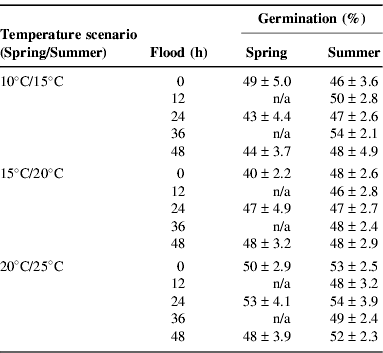
Neither water temperature nor flood duration affected seed germination for the spring or summer scenarios (Table 1). Germination values ranged from 40 to 53% and from 45 to 53% for the spring and summer scenarios, respectively. The mean germination values fell within normal dodder germination ranges noted in previous laboratory studies (H.A. Sandler, unpublished results). When evaluated under the stated controlled conditions, flood duration and water temperature had no practical impact on seed germination. This conclusion supports previous work that found flooding reduced dodder stem weights, but did not impact seed germinationReference Sandler and Mason22. The results from the incubator experiment further suggest that differences observed in the field may be attributable to impacts on emerged seedlings. This theory is supported by a study conducted on hairy beggarticks (Bidens pilosa L.) seedlings that showed a decrease in emergent seedlings with increased duration of floodingReference Reddy and Singh29.
Percent germination of dodder seed plated to Petri dishes after being subjected to various flooding durations at various temperatures under controlled conditions in an incubator. Values are mean (n=8)±standard error.
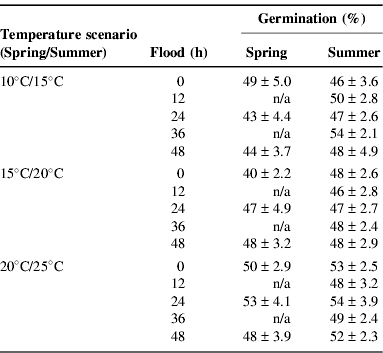
n/a=not applicable.
Flood duration and timing
Seed germination in Petri dishes
Flood duration and week of initiation affected seed germination. Weeks 1 and 4 had lower germination compared to Weeks 2 and 3 (38% versus 45%, respectively). Seeds submerged for 24 or 48 h had a slightly higher percent of germination (43%) than seeds submerged for 0 h (38%). Again, the germination rates fell within previously observed germination ranges for dodder seed. These data correspond to the trends noted in the water temperature/flood duration incubator study and support the contention that floods do not impact seed germination.
Attachment rating
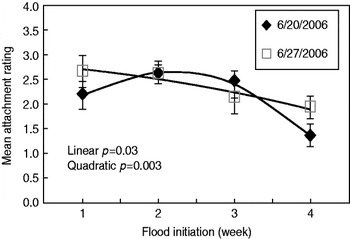
Mean attachment ratings in 2006 were affected by flood initiation. Mean attachment ratings for cranberry vines (Fig. 2) were lowest at 4 weeks AEE for observations recorded on June 20 (X 2=14.25; P=0.003) and June 27, 2006 (X 2=9.29; P=0.03). There was no treatment effect seen for July 14, 2006 or later (data not shown)Reference O'Connell30. The authors observed dodder senescence at this point in time.
2006 mean attachment rating of dodder on cranberry vines following submersion in water for a certain number of weeks AEE for June 20 and June 27, 2006. A rating of 0, 1, 2, 3 and 4 indicated 0, 1–3, 4–6, 6–10 and >10 attached stems, respectively. Bars are standard error of the mean.

In 2007 (Fig. 3), mean attachment rating was also lowest at 4 weeks AEE. The effect of flood initiation at 4 weeks AEE was observed for dates of July 13, 2007 (X 2=13.49; P=0.004) and August 6, 2007 (X 2=14.95; P=0.002). Attachment ratings were lowest at 4 weeks AEE, indicating that a later flood initiation may provide better control of dodder than an earlier flood initiation (relative to early seedling emergence). These results are supported by previous field researchReference Sandler and Mason22, which found that short-term floods initiated 1 week AEE had no effect on seed germination in one year (seeds placed in pouches and secured to the bog floor), while in another year, floods initiated 3 weeks AEE reduced dodder stem weights (i.e., indirect evidence that flooding later suppressed dodder infestation). Results support the premise that short-term floods affect dodder growth (i.e., biomass) and not seed germination.
2007 mean attachment rating of dodder on cranberry vines following submersion in water for 1–4 weeks AEE for several dates in July and August 2007. A rating of 0, 1, 2, 3 and 4 indicated 0, 1–3, 4–6, 6–10 and >10 attached stems, respectively. Dates of July 19, 2007, August 1, 2007 and August 28, 2007 were also significant, but are not included since dates in the figure are representative. Bars represent standard error of the mean.

Dodder stem biomass and seed number
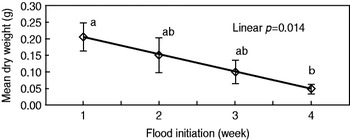
In 2006, mean total seed number at the 48-h flood duration was similar to 0-h duration (2.2 versus 0.9 seed per pot) and both were lower than the 24-h flood duration (5.6 seeds per pot) (F 2,44; P=0.011); no other effects were noted. This result is contrary to expectations since it was thought that flooding would reduce seed production (fecundity). The effects seen in the present study may not be a true description of the effect of flood duration on dodder seed numbers since so few seeds per pot (1–6) were produced, and the standard errors (0.4–1.3) were so largeReference O'Connell30. Future research might focus on validating the effect of flood duration on seed number by ensuring good pollination and seed production of the parasite under controlled conditions. In 2007, dodder biomass decreased linearly (Fig. 4) and was lowest with a flood initiation at week 4 (F 3,44; P=0.04); no other effects were noted. This finding was consistent with the attachment rating data, which had lower values when flooding was initiated 4 weeks AEE. These results differ from those found in a texasweed study where flooding at an earlier growth stage (2.5 cm tall plants) reduced plant biomass, but flooding at a later growth stage (7.5 and 15 cm-tall plants) did not affect texasweed biomassReference Koger, Reddy and Poston21.
In 2007, mean dry weight of dodder on cranberry subjected to floods initiated 1–4 weeks AEE. Mean separation with Tukey's HSD; means with the same letter are not significantly different. Bars represent standard error of the mean.

Although used to manage other serious cranberry pests, such as Sparganothis sulfureana (Clemens)Reference Teixeira and Averill31 and black-headed firewormReference Cockfield and Mahr18, flooding can reduce the carbohydrate reserves in cranberryReference Botelho and Vanden Heuvel24 and this physiological impact must be considered when implementing a pest management strategy. The reduction in total non-structural carbohydrates (TNSC) is affected by both water temperature and duration of flood, with long (>3 days) warm floods causing the greatest depletionReference Botelho and Vanden Heuvel19. Although typical conditions in spring (i.e., when a flood for dodder management would be initiated) minimally reduce TNSC, stressed or weakened vines may incur more injury and subsequent yield loss than the weed management strategy prevents.
Cranberry growers currently scout for early emerging seedlings to time herbicide applicationsReference Sandler, Sylvia and Guerin27, and so using early seedling emergence as a biological marker for a flooding event (Fig. 1) would be easy to incorporate into typical scouting activities and an integrated weed management plan. Portions of the farm, such as areas where the fruit are removed during harvest, are likely to have received deposits of dodder seed in the fall and serve as reasonable places to search for seedlings in the spring. Open or thinly vined areas warm quickly in the spring and would be good places to scout for early emerging seedlings. The use of a short-term spring flood is used for other pests and fits well into the typical scope of activities familiar to most growers and would be inexpensive to include in a dodder management program.
Conclusions and Future Research
Results from the initiation/duration experiments showed that short-term floods reduced attachment ratings and dodder stem biomass, with the lowest values obtained with floods initiated at 4 weeks AEE. These results indicate that one must allow time for dodder seed to germinate before applying a short-term flood, suggesting that the short-term floods may impact on emergent dodder seedlings. Delaying the onset of the flooding event until a substantial proportion of the population emerges may offer better management results. Based on that premise, additional areas of research to consider are flooding at various stages of dodder growth (e.g., early germinated seedlings and post-attachment growth stages) that may be more susceptible to flooding (Fig. 1). It may also be useful to explore floods initiated later than 4 weeks AEE to see if a flood initiated later will impact a greater proportion of susceptible growth stages. The impact of dissolved oxygen on dodder germination or growth was not investigated in the present study but should be considered in future research projects. The presence of an additional (herbaceous) host at the time of seed germination as a precursor to successful attachment and its influence on management efforts also warrants further investigation.
Acknowledgements
This work was supported in part by funding from the U.S. Environmental Protection Agency Region 1 Strategic Agricultural Initiative program, Grant X8-97120901. We are also grateful for the additional financial support of this project by the Cape Cod Cranberry Growers’ Association. The authors thank K. DeMoranville, N. DeMoranville, J. Moores, T. Revell and D. Shumaker for technical support. Thanks to P. Jeranyama for statistical advice.