





Introduction
Three decades after the collapse of state socialism, scholarly understandings of civil societies in postsocialist Central and Eastern Europe (CEE) continue to evolve. Early accounts portrayed the region as characterized by a “weak civil society”—marked by low levels of civic engagement, underdeveloped associational life, and limited protest activity—but as scholarly attention shifted toward the proliferation of externally supported non-governmental organizations (NGOs), researchers increasingly emphasized a “strong civic sector” characterized by professional(ized) activism oriented toward cooperation rather than contention with public authorities (Baća, Reference Baća2022; Jacobsson & Saxonberg, Reference Jacobsson and Saxonberg2013). Consequently, the notion of low participatory yet high transactional activism came to dominate much of the literature on postsocialist civil society, while empirical challenges to this view emerged predominantly from social movement studies (Císař, Reference Císař, Fagan and Kopecký2017; Fagan & Sircar, Reference Fagan and Sircar2018; Jacobsson & Korolczuk, Reference Jacobsson and Korolczuk2017). Over the past decade, this body of work has critically reassessed theoretical frameworks derived from the experiences of affluent Western democracies, demonstrating how such approaches often obscure actually existing civil societies in CEE, particularly with regard to their supposedly weakest component: contention enacted through non-institutional forms of participation (Baća, Reference Baća2023; Gagyi, Reference Gagyi2021; Jacobsson & Korolczuk, Reference Jacobsson and Korolczuk2020). While this research agenda has introduced substantial conceptual innovation grounded in the postsocialist experience—capturing how civil societies in the region are enacted, reproduced, and transformed through a wide array of practices—it has yet to sufficiently explain the conditions under which such practices become contentious.
Building on this insight, this article advances the premise that civil society studies must be cross-fertilized with social movement theory in order to adequately capture empirical realities in CEE, particularly in light of the expansion of contentious politics in the post-2008 period (Beissinger & Sasse, Reference Beissinger, Sasse, Bartels and Bermeo2014; della Porta, Reference della Porta2020; Rone & Dinev, Reference Rone, Dinev and Mattoni2025), which is often understood as marking the onset of a third, more socially embedded stage of civil society development in the region (Baća, Reference Baća2024; Stubbs, Reference Stubbs2012). Drawing on theoretical work generated not only about but also from CEE, the article develops propositions on how processes, structures, and relations (PSR) condition the dynamics of practices (P) through which civil societies in the region are enacted, reproduced, and transformed over time. On this basis, the article proposes a formal analytical model—referred to here as PSR-P—that articulates a structured set of relationships among concepts by delimiting these three macro-level factors and specifying how they shape the conditions under which individual-level practices are enacted. The empirical analysis compares two points in time—the eve of the global financial crisis in 2008, widely understood as a watershed moment in the global reconfiguration of contentious politics and particularly salient in CEE (Gagyi, Reference Gagyi2021), and a decade later, immediately preceding the socioeconomic and sociopolitical shocks produced by the COVID-19 pandemic (Crăciun & Rammelt, Reference Crăciun and Rammelt2025)—examining the extent to which these transformations contributed to the emergence of contentious practices across the region (Baća, Reference Baća2022). It draws on publicly available data from leading cross-national indexes, including the Bertelsmann Transformation Index (Bertelsmann Stiftung), the Civil Society Organization Sustainability Index (USAID), and Freedom in the World (Freedom House), to operationalize the processual, structural, and relational dimensions of postsocialist transformation, and on the European Values Study (EVS Foundation) to operationalize practices. The article begins with a critical review of the literature on civil society and social movements in CEE, from which it develops the PSR-P framework and derives three hypotheses concerning how these country-level conditions shape contentious practices. It then presents the theory-driven measurement design and operationalization of the framework, followed by the multilevel analysis and empirical results. The discussion interprets these findings in relation to key debates in the study of postsocialist societies, while the conclusion summarizes the article’s broader theoretical contributions, limitations, and implications for civil society research and adjacent fields.
Theoretical framework: Conceptualizing processes, structures, relations, and practices
Despite being a central theme in scholarship on CEE, “civil society” has remained one of the least understood components of postsocialist transformation (Ekiert & Kubik, Reference Ekiert and Kubik2014; Hann & Dunn, Reference Hann and Dunn1996). Communist dissidents envisioned it as an autonomous sphere capable of shielding individuals from the state. Their moralized and anti-political conceptualization—which privileged autonomy from institutional politics over collective political action—provided fertile ground for the development of a liberal, yet similarly depoliticized, understanding after 1989 (Gagyi & Ivancheva, Reference Gagyi, Ivancheva, Moskalewicz and Przybylski2017; Piotrowski, Reference Piotrowski2009). Within this ideological framework, civil society became synonymous with the promotion of Western democratic values through non-contentious participation, while actors, actions, and claims that failed to conform to liberal norms of civicness and civility were routinely excluded from the conceptual-cum-political boundaries of civil society, both on the ground and in official reports (Baća, Reference Baća2022; Jacobsson & Saxonberg, Reference Jacobsson and Saxonberg2013; Kopecký & Mudde, Reference Kopecký and Mudde2003; Stoyanova, Reference Stoyanova2018). An important exception emerged when such mobilizations targeted authoritarian governments—as in the case of Western-supported “color revolutions”—in which case they were celebrated as exemplars of civil society’s strength (Bunce & Wolchik, Reference Bunce and Wolchik2012). Conversely, protests driven by socioeconomic discontent—particularly those involving impoverished and marginalized groups mobilizing against postsocialist establishments or confronting inequalities produced by post-1989 reforms, low-capacity institutions, and unresponsive governments—were rarely examined within the framework of civil society studies (Císař, Reference Císař, Fagan and Kopecký2017; Ekiert & Kubik, Reference Ekiert and Kubik1998; Gagyi, Reference Gagyi2021; Greskovits, Reference Greskovits1998; Vanhuysse, Reference Vanhuysse2006). As a result, subsequent research focused primarily on NGOs, and only in the past decade has civic engagement been systematically examined through the lens of social movements and protest politics, showing that contention has become increasingly legitimized as a mode through which civil societies are enacted, reproduced, and transformed across CEE (Crăciun & Rammelt, Reference Crăciun and Rammelt2025; Fagan & Sircar, Reference Fagan and Sircar2018; Jacobsson & Korolczuk, Reference Jacobsson and Korolczuk2017). When these bodies of work are brought into dialogue, three country-level factors emerge as pivotal in shaping the development of civil societies in CEE: (1) political and economic processes characteristic of postsocialist transformation that shaped trajectories of political participation; (2) socialist legacies that, under these processes, conditioned the (infra)structural configurations through which the civic sector emerged as a proxy for civil society as a whole; and (3) relational arrangements (re)articulated during the transition—particularly those pertaining to political and civic life—that have decisively influenced patterns of civic engagement and social movement activity.
It is widely recognized that the so-called postsocialist transition constituted a geopolitical experiment in institutional engineering—one that, at least in theory, was expected to produce a strong civil society (Horvat & Štiks, Reference Horvat and Štiks2015; Meyer et al., Reference Meyer, Moder, Neumayr and Vandor2020). Nevertheless, survey-based research consistently showed declining levels of citizen involvement in public life throughout the first two decades after 1989 (Petrova, Reference Petrova2007; Pietrzyk-Reeves, Reference Pietrzyk-Reeves2008). Compared to Western European averages, CEE exhibited significantly lower levels of key characteristics typically associated with a vibrant civil society, including social capital (Lane, Reference Lane2010), civic engagement (Howard, Reference Howard2003), membership in voluntary associations (Bernhard & Karakoç, Reference Bernhard and Karakoç2007), and participation in protest activities (Bernhagen & Marsh, Reference Bernhagen and Marsh2007). As a result, the region ranked among the least organizationally dense civil societies in the world (Greskovits, Reference Greskovits1998; Wallace et al., Reference Wallace, Pichler and Haerpfer2012). Although the global financial crisis of 2008 was followed by a notable rise in protest across the region (Crăciun & Rammelt, Reference Crăciun and Rammelt2025), subsequent scholarship largely analyzed these dynamics through the lens of democratization theory, emphasizing the effects of economic shocks (Beissinger & Sasse, Reference Beissinger, Sasse, Bartels and Bermeo2014), political reforms (Vráblíková, Reference Vráblíková2014), and historical legacies (Borbáth & Gessler, Reference Borbáth and Gessler2020) on patterns of citizen involvement. By treating contention as a residual form of political participation, activated primarily when institutional channels fail, this body of work has provided little insight into how civil society is (re)constituted through contention itself. While it concluded that the interaction between the legacies of state socialism and processual trajectories characteristic of postsocialist transformation constrained civil society development in the region until 2008—after which this dynamic partially shifted—it neglected the structural configurations that emerged from this interaction, which channeled civic engagement into compliant practices through which the civic sector became institutionalized and stabilized as civil society itself.
Indeed, against the backdrop of a grim diagnosis of postsocialist civil society as depleted of the elements deemed necessary for its strengthening—most notably mass participation—its development was consequently fostered through foreign assistance, resulting in the construction of a distinct (infra)structural configuration conducive to specific organizational forms, such as NGOs, and particular modes of civic engagement, such as transactional activism (Petrova & Tarrow, Reference Petrova and Tarrow2007). Intended to compensate not only for “weak civil society” but also for the low-capacity states that emerged during the transition—dynamics that reinforced one another in a self-perpetuating feedback loop (Sissenich, Reference Sissenich2010)—donor-supported “civil society building” through NGO-ization privileged the non-contentious cooperation of civil society organizations with state institutions through education, lobbying, advocacy, service provision, expertise sharing, and other compliant practices (Baća, Reference Baća2022, Reference Baća2024; Gagyi, Reference Gagyi2021; Jacobsson & Saxonberg, Reference Jacobsson and Saxonberg2013; Stubbs, Reference Stubbs2012). As a result, civil society became effectively narrowed to the civic sector, composed primarily of professional(ized) NGOs. With foreign donors defining thematic priorities, these actors were constrained both in what they could legitimately engage with and in how they could do so, while contentious practices that did not conform to liberal understandings of democracy and activism were largely relegated to civil society’s conceptual counterpart—uncivil society—and thereby excluded from the symbolic-cum-political boundaries of civil society (Fagan & Sircar, Reference Fagan and Sircar2018; Kopecký & Mudde, Reference Kopecký and Mudde2003; Piotrowski, Reference Piotrowski2009; Stoyanova, Reference Stoyanova2018). Nevertheless, while the process of postsocialist transformation rendered civil society ideologically sanitized, it simultaneously generated structural configurations that organized state–society relations around transactional activism, to the extent that the region no longer lagged behind its Western counterparts in terms of institutional cooperation between NGOs and public authorities (Císař, Reference Císař, Fagan and Kopecký2017; Ekiert & Kubik, Reference Ekiert and Kubik2014; Foa & Ekiert, Reference Foa and Ekiert2017). Accordingly, this body of work demonstrated how donor-supported institutional engineering in contexts of low-capacity governments reorganized, stabilized, and reproduced civic life through compliant practices, while also circumscribing the empirical focus of civil society scholarship in CEE and leaving forms of civic engagement beyond the civic sector largely uncharted.
Finally, a distinct strand of scholarship has emphasized how (pre)socialist legacies, (post)transitional realities, and (sub)cultural specificities interacted not simply to weaken civil societies in the region, but also to (re)produce modes of civic engagement and forms of associational life that did not align with dominant theoretical frameworks (Gagyi & Ivancheva, Reference Gagyi, Ivancheva, Moskalewicz and Przybylski2017; Hann & Dunn, Reference Hann and Dunn1996). Only in the past decade has this perspective become more prominent, as a growing body of work—drawing on civil society research, social movement theory, and resistance studies—has highlighted how postsocialist civil societies occupy liminal, hybrid, and ambivalent spaces within the polity–economy–society nexus and thus remain insufficiently captured by the conceptual frameworks that have long underpinned analyses of CEE (Baća, Reference Baća2022; Fagan & Sircar, Reference Fagan and Sircar2018; Jacobsson & Korolczuk, Reference Jacobsson and Korolczuk2020; Pietrzyk-Reeves, Reference Pietrzyk-Reeves2022). While this research agenda acknowledges that the relational arrangements generated during postsocialist transformations impeded the organizational and mobilizational capacities of social actors, thereby constraining the emergence of sustained forms of contention organized as social movements, it also shows that protest activities were not absent but rather characterized by “many events, no organizations, and few participants” (Císař, Reference Císař, Jacobsson and Saxonberg2013: 143; see also Baća & Vasiljević, Reference Baća, Vasiljević, Kolleck and Karolewski2025). Such contention was often expressed through innovative experiments with participatory democracy, infrapolitical resistance, and other forms of direct action (Fagan & Sircar, Reference Fagan and Sircar2018; Fiket et al., Reference Fiket, Markov, Ilić and Pudar Draško2024), many of which remained analytically elusive due to their short-term, small-scale, and low-profile character (Císař, Reference Císař, Jacobsson and Saxonberg2013; Jacobsson & Saxonberg, Reference Jacobsson and Saxonberg2013). Following the shift in protest patterns after 2008, contentious practices became more pronounced as a mode through which civil societies were reconfigured (Baća, Reference Baća2024; Beissinger & Sasse, Reference Beissinger, Sasse, Bartels and Bermeo2014; Crăciun & Rammelt, Reference Crăciun and Rammelt2025; Jacobsson & Korolczuk, Reference Jacobsson and Korolczuk2020), often resulting in more visible forms of civic activism and social movements that (re)politicized public life across CEE (Baća, Reference Baća2023; Horvat & Štiks, Reference Horvat and Štiks2015; Rone & Dinev, Reference Rone, Dinev and Mattoni2025; Stoyanova, Reference Stoyanova2018). Nevertheless, this shift has come at the expense of a systematic examination of how postsocialist transformation has reshaped the broader context in which contention emerges and evolves over time. In other words, while this literature has tended to foreground mobilization itself, it has paid comparatively less attention to how relational configurations within the polity–economy–society nexus have reworked the conditions under which contentious practices become possible, legitimate, and consequential.
Drawing on state-of-the-art theoretical approaches that foreground processes, structures, and relations as interrelated dimensions of postsocialist transformation shaping civil society (Baća, Reference Baća2024; Florea et al., Reference Florea, Gagyi and Jacobsson2022; Pietrzyk-Reeves, Reference Pietrzyk-Reeves2022), this article proposes a formal analytical framework that integrates all three dimensions to examine their role in the enactment, reproduction, and transformation of civil society through contentious practices in CEE. It covers the period from just before the 2008 global financial crisis to a decade later, immediately preceding another major global socioeconomic shock brought about by the COVID-19 pandemic. This periodization is also determined by the approximately decennial cycle of the European Values Study, with the concluding period corresponding to the last wave fielded before the COVID-19 pandemic. Departing from approaches that understand non-conventional participation primarily as a residual political response activated when institutional channels fail, or as an additional pressure mechanism vis-à-vis routine politics, the article instead treats contention as a constellation of practices in and through which citizens “abandon the official ways of not only conducting but also initiating and settling disputes” by deciding “to ‘do something’ without falling into a routinized way of doing it”, thereby reconfiguring civil society alongside the compliant practices that have long dominated scholarly accounts of the region (Baća, Reference Baća2022: 14). These contentious practices encompass activities situated outside both routinized forms of everyday action and institutional politics—from signing mundane petitions to participating in large-scale demonstrations—through which individuals, alone or collectively, articulate grievances, negotiate disputes, and address public concerns by political and/or non-political means (Baća, Reference Baća2022, Reference Baća2024; Jacobsson & Korolczuk, Reference Jacobsson and Korolczuk2017, Reference Jacobsson and Korolczuk2020). Accordingly, in examining the conditions under which civil societies in CEE become contentious, the article approaches contentious practices as a unified analytical category—rather than disaggregating their specific forms, contents, or outcomes—through which civil societies are enacted, reproduced, and transformed within the third stage of their development in the region.
To address this gap in the literature, the article develops a formal macro–micro analytical framework specifying how processes, structures, and relations collectively condition the likelihood of contentious practices across CEE. The three hypotheses guiding the analysis are explicitly anchored in the post-2008 transformation of civil societies in the region:
H1 (processes): After 2008, processual trajectories are expected to be positively associated with contentious practices, as long-term advances in postsocialist political and economic transformation increasingly produce conditions conducive to contention.
H2 (structures): After 2008, structural configurations are expected to be negatively associated with contentious practices, as greater governance capacity and stronger civic sectors increasingly channel civic engagement toward compliant forms of interaction with public authorities.
H3 (relations): After 2008, relational arrangements are expected to be positively associated with contentious practices, as more expansive political rights and civil liberties increasingly legitimize contention as a mode of civic engagement and political participation.
Taken together, these hypotheses specify how the interplay of these three country-level factors reconfigures the conditions under which contentious practices emerge at the individual level, thereby advancing a theoretically integrated and empirically testable account of how civil societies in CEE are reconfigured through contention over time.
Methodological design: Operationalizing processes, structures, relations, and practices
The methodological design of the article is grounded in a theory-driven approach to concept operationalization, in which indicators derive their analytical relevance from careful alignment with specified theoretical dimensions rather than being treated as self-evident measures (Goertz, Reference Goertz2006). Consistent with established standards for multidimensional concepts and composite indicators, this strategy enables the theoretically grounded aggregation of distinct yet interrelated dimensions of long-term societal transformation at the macro level, while preserving conceptual coherence in the operationalization of individual-level practices (Greco et al., Reference Greco, Ishizaka, Tasiou and Torrisi2019). Accordingly, cross-national indexes are employed as theory-aligned indicators of macro-contextual conditions, as validity is understood to arise from the correspondence between theoretical constructs and their operational variables, rather than from the pursuit of “perfect” statistical measures (Adcock & Collier, Reference Adcock and Collier2001). The analysis encompasses 20 countries in CEE: Albania, Armenia, Belarus, Bosnia and Herzegovina, Bulgaria, Croatia, Czechia, Estonia, Georgia, Hungary, Lithuania, Montenegro, North Macedonia, Poland, Romania, Russia, Serbia, Slovakia, Slovenia, and Ukraine. Data for Azerbaijan, Kosovo, Latvia, and Moldova were unavailable for one of the research waves in the composite dataset, which prevented the measurement of a 10-year trajectory and resulted in their exclusion from the analysis. Accordingly, processes, structures, and relations are operationalized using selected dimensions of the Bertelsmann Transformation Index (BTI), the Civil Society Organization Sustainability Index (CSOSI), and Freedom in the World (FIW), respectively. This operationalization reflects a broad theoretical consensus that variation in postsocialist civil societies arises from the combined effects of processual, structural, and relational factors (Baća, Reference Baća2024; Florea et al., Reference Florea, Gagyi and Jacobsson2022; Pietrzyk-Reeves, Reference Pietrzyk-Reeves2022). The selected instruments most consistently capture, at the country level, the long-term trajectories of postsocialist transformation, the institutional arrangements through which civil societies are structured, and the relational conditions shaping political and civic life, as emphasized in the literature (Baća, Reference Baća and Eșanu2025). Accordingly, a six-dimensional matrix is constructed by assigning two dimensions to each of the three country-level factors, comparing the period immediately preceding the 2008 global financial crisis with the period a decade later, prior to the global pandemic. The independent variables (IVs) are derived from key dimensions of three global indices: five specific dimensions drawn from the BTI and FIW, and an overall score from the CSOSI, as summarized in Table 1.
Operationalization of country-level indicators within the PSR-P framework

Table 1. Long description
The table is organized into three main sections based on indices.
1. B T I (Bertelsmann Transformation Index) covers three columns:
* Political transformation: Stateness, Political participation, Rule of law, Stability of democratic institutions, and Political and social integration.
* Economic transformation: Level of socio-economic development, Organization of the market and competition, Monetary and fiscal stability, Private property, Welfare regime, Economic performance, and Sustainability.
* Governance capacity: Level of difficulty, Steering capability, Resource efficiency, Consensus-building, and International cooperation.
2. C S O S I (Civil Society Organization Sustainability Index) covers one column:
* Civic sector sustainability: Legal environment, Organizational capacity, Financial viability, Advocacy, Service provision, Sectoral infrastructure, and Public image.
3. F I W (Freedom in the World) covers two columns:
* Political rights: Electoral process, Political pluralism and participation, and Functioning of government.
* Civil liberties: Freedom of expression and belief, Associational and organizational rights, Rule of law, and Personal autonomy and individual rights.
The bottom row categorizes these indicators into three overarching factors:
* Processual factors: encompassing Political and Economic transformation.
* Structural factors: encompassing Governance capacity and Civic sector sustainability.
* Relational factors: encompassing Political rights and Civil liberties.
To assess the influence of these factors on contentious practices in civil societies across CEE, this study employs multilevel binomial logistic regression analysis. This approach allows for the incorporation of country-level predictors derived from global indexes while controlling for individual-level characteristics and accounting for the nested structure of the data. First, three dimensions from the BTI are employed as IVs, as this biannual index assesses political and economic transformation toward liberal democracy and market economy. Processes are operationalized through political and economic transformation, as these dimensions capture the long-term, path-dependent trajectories through which postsocialist societies have been reconfigured, including changes in regime configurations, market arrangements, and modes of state intervention that condition the evolving opportunities and constraints for contentious practices over time (Florea et al., Reference Florea, Gagyi and Jacobsson2022). The 2008 and 2018 BTI reports capture developments during the assessment periods 2005–2007 and 2015–2017, respectively, using a 10-point scale ranging from 1 (lowest) to 10 (highest). The index comprises 17 criteria and 49 indicators aggregated into three analytical dimensions: political transformation, economic transformation, and governance capacity. Of these categories, political and economic transformation are used to operationalize processes, while governance capacity captures the structural dimension of the model, as it denotes institutionalized capabilities that shape opportunities for participation rather than merely reflecting ongoing state performance. Given the high intercorrelations among the three analytical dimensions of the BTI, they are estimated in separate regression models to avoid multicollinearity, with each model capturing the association between a single dimension and the probability of individual engagement in contentious practices. Second, alongside governance capacity from the BTI, structures are operationalized through civic sector sustainability from the CSOSI, as both dimensions capture the institutional and organizational (infra)structures that pattern participation, mediate state–society relations, shape access to resources, and condition the extent to which citizens engage directly in collective action or through professional(ized) intermediaries (Skocpol, Reference Skocpol2003). Accordingly, the CSOSI is included as an additional IV, as this annual index measures the overall strength and viability of the civic sector. The 2007 and 2017 CSOSI reports assess the sustainability of the civic sector in CEE countries during their respective years using a seven-point scale ranging from 1 (highest) to 7 (lowest), with scores reverse-coded in the analysis to ensure interpretive consistency with the other country-level indicators, such that higher values indicate greater civic sector sustainability. The index employs seven criteria to assess this dimension, which is operationalized here as a single IV.
Third, two dimensions from the FIW are employed as IVs, since this annual report assesses political rights and civil liberties across countries. Relations are thus operationalized through these two components, which capture constellations of interaction among citizens, organizations, and authorities, including the extent to which participation, association, and expression are recognized, protected, and effectively enacted within the polity–economy–society nexus (McAdam et al., Reference McAdam, Tarrow and Tilly2001). The 2008 and 2018 editions of the FIW assess political rights and civil liberties in CEE countries during 2007 and 2017, respectively, using a seven-point freedom scale ranging from 1 (highest) to 7 (lowest), with scores likewise reverse-coded in the analysis so that higher values indicate greater political rights and civil liberties. The index comprises 25 indicators organized into seven criteria and grouped into two analytical dimensions—political rights and civil liberties—which are treated as separate IVs to operationalize relations in the model. Finally, the analysis includes individual- and country-level control variables. Individual-level controls are derived from the European Values Study (EVS) and include age, sex, education, and income. Country-level controls include standardized GDP, a time indicator corresponding to the two observation points of 2008 and 2018, and two context-specific variables identified in the literature as critical to “civil society building” in postsocialist CEE: socialist legacy (Yugoslav-type vs. Soviet-type state socialism) and EU integration status (EU member state vs. non-EU member state). Incorporating these variables makes it possible to account for pre-1989 legacy factors, such as enduring political cultures of state socialism—most notably Yugoslav self-management socialism, which was more liberal and horizontally organized than its Soviet counterpart and positioned outside the Eastern Bloc within the Non-Aligned Movement, thereby fostering a distinct form of socialist civil society (Baća, Reference Baća2024)—as well as post-1989 European integration, commonly interpreted as an indicator of successful postsocialist transition (Matlak et al., Reference Matlak, Schimmelfennig and Woźniakowski2018). Together, these controls capture important sources of variation within CEE.
The dependent variable (DV) is derived from the 2008 and 2017 waves of the EVS. For the 2008 wave, fieldwork was conducted in 2008 in all analyzed countries, whereas for the 2017 wave, data collection in most countries took place between late 2017 and 2018, with four cases extending beyond 2018. Accordingly, the IVs are measured prior to the DV survey waves, capturing country-level conditions before data collection, since respondents report engagement in contentious practices that developed within these preceding contexts. Specifically, the DV is constructed from the “taking political action” items, which encompass four types of contentious practices: signing petitions, participating in boycotts, taking part in lawful demonstrations, and joining unofficial strikes. These measures are based on survey questions asking respondents whether they have engaged in, might engage in, or would never engage in each activity. Although limited in conceptual range, they capture a spectrum of contention central to the theoretical argument, spanning low-threshold activities bordering on everyday life (such as signing petitions), forms of withdrawal from routinized participation (such as boycotts), and both legal and illegal protest activities that entail departure from conventional channels. Moreover, insofar as practices are constituted not only through enacted performances but also through actors’ sense of what is conceivable and doable in given situations (Baća, Reference Baća2022), these measures capture both reported participation and actors’ practical orientations toward contentious practices, including dispositions to engage in them and perceptions of their availability as possible courses of action.
The four types of contentious practices are operationalized as a single analytical category—that is, a contentious dimension of civil society—and measured using a composite variable, as the primary interest lies in estimating the conditions under which civil society becomes contentious across the two observation points rather than in differentiating among specific forms. Accordingly, a synthetic index of individual engagement in contentious practices is constructed by summing responses across the four items, yielding a scale ranging from 0 to 8. Because the distribution of this score is highly right-skewed—reflecting generally low levels of participation—it is recoded into three ordered categories: no engagement (0), medium engagement (1–3), and high engagement (4–8). Using quantile-based binarization, this measure is further transformed into a binary DV by assigning a value of 1 to individuals in the highest tercile (scores of 4 or higher), indicating engagement in contentious practices, and 0 to those in the lower two terciles (scores below 4), indicating non-engagement. This operationalization follows a threshold-based approach that prioritizes category membership over variation in intensity, consistent with theory-driven measurement strategies (Goertz, Reference Goertz2006), and thus reflects the guiding research question of what makes civil societies contentious. The resulting data-reduction strategy enables the estimation of the probability of individual engagement in contentious practices using multilevel binomial logistic regression analysis. Given the hierarchical structure of the data, with individuals nested within countries, two-level models are estimated in which the first level includes individual-level demographic covariates associated with contentious practices, while the second level incorporates processual, structural, relational, and other country-level control predictors. This specification allows for the estimation of both fixed effects (the average influence of predictors derived from cross-national indexes on contentious practices) and random effects (country-specific deviations from these average relationships). By explicitly modeling this hierarchical structure, the approach yields more accurate estimates by accounting for the fact that individual engagement in contentious practices in CEE is jointly shaped by personal characteristics and (supra)national conditions. Taken together, the PSR-P model makes it possible to estimate how processual, structural, and relational factors shape contentious practices through which civil society is enacted, reproduced, and transformed across the region.
Empirical analysis: Explaining variation in contentious practices
The PSR-P model introduced here accounts for influences operating at both the country and individual levels, incorporating country-level predictors derived from the BTI, CSOSI, and FIW—whose original average scores for each country are reported in Table 2, although CSOSI and FIW values were reverse-coded in the analysis to ensure interpretive consistency with the BTI, such that higher values indicate higher levels of advancement—alongside individual-level demographic controls (sex, education, income, and age) drawn from the EVS, as well as additional country-level controls capturing national and regional variation in standardized GDP, EU membership, and socialist legacy. This specification reduces bias in parameter estimates by accounting for unobserved heterogeneity across levels. To further address cross-national heterogeneity and avoid downwardly biased standard errors resulting from country-level clustering, the models are estimated with random effects. This approach captures country-specific deviations from the overall pattern and enables an assessment of how national contexts condition individual engagement in contentious practices.
Country-level scores for processual, structural, and relational factors (2008 and 2018)

Table 2. Long description
The table compares scores for 20 countries across two time periods: 2008 and 2018. The metrics are grouped under three main indices: B T I (with sub-metrics P T, E T, and G C), C S O S I (metric C S S), and F I W (metrics P R and C L).
Key data points include:
* Albania: B T I P T dropped from 7.50 in 2008 to 7.05 in 2018.
* Armenia: B T I P T dropped from 6.00 to 5.12; G C dropped from 5.17 to 4.25.
* Belarus: B T I P T rose from 3.93 to 4.33; C S O S I C S S improved from 6.0 to 5.5.
* Bulgaria: B T I P T dropped from 8.70 to 8.10.
* Croatia: B T I P T dropped from 8.85 to 8.35; F I W P R improved from 2 to 1.
* Czechia: Maintained high scores, with B T I P T at 9.55 in 2008 and 9.40 in 2018.
* Estonia: B T I P T rose from 9.55 to 9.75.
* Hungary: Significant declines across all metrics; B T I P T fell from 9.35 to 7.15, E T from 9.00 to 7.71, and G C from 6.70 to 4.44.
* Lithuania: B T I P T rose from 9.35 to 9.45.
* Poland: B T I P T dropped from 8.80 to 8.55; F I W C L score moved from 1 to 2.
* Russia: B T I P T dropped from 5.35 to 4.55; F I W P R score moved from 6 to 7.
* Slovakia: B T I P T dropped from 9.20 to 8.60.
* Slovenia: B T I P T dropped from 9.70 to 9.25.
* Ukraine: B T I P T dropped from 7.35 to 6.90; C S O S I C S S improved from 3.6 to 3.2.
When comparing CEE to its Western European neighbors, the average protest participation score for postsocialist countries is 1.974 (t(30) = 6.048) in 2008 and 2.064 (t(30) = 6.892) in 2018, while the corresponding averages for Western Europe are 3.428 and 3.564, respectively. Table 3 presents cross-national variation in individual engagement in contentious practices across CEE countries at both time points, as well as the persistent gap relative to Western Europe.
Individual engagement in contentious practices across CEE countries (2008 and 2018)

Table 3. Long description
The table lists 20 countries and two regional averages (C E E and Western Europe). For each entry, percentages are provided for No engagement, Medium engagement, and High engagement in both 2008 and 2018.
* Albania: 2008 (42.1% No, 38.5% Medium, 19.4% High); 2018 (34.3% No, 53.8% Medium, 11.9% High).
* Armenia: 2008 (54.2% No, 29.2% Medium, 16.6% High); 2018 (29.3% No, 47.5% Medium, 23.3% High).
* Belarus: 2008 (58.8% No, 32.5% Medium, 8.7% High); 2018 (59.7% No, 27.9% Medium, 12.4% High).
* Bosnia-Herzegovina: 2008 (19.8% No, 36.7% Medium, 43.5% High); 2018 (20.1% No, 37.5% Medium, 42.4% High).
* Bulgaria: 2008 (48.4% No, 36.0% Medium, 15.6% High); 2018 (47.9% No, 35.7% Medium, 16.3% High).
* Croatia: 2008 (8.1% No, 44.5% Medium, 47.4% High); 2018 (12.5% No, 35.9% Medium, 51.6% High).
* Czechia: 2008 (29.4% No, 40.2% Medium, 30.4% High); 2018 (25.5% No, 42.5% Medium, 32.0% High).
* Estonia: 2008 (38.9% No, 39.9% Medium, 21.2% High); 2018 (35.7% No, 40.1% Medium, 24.2% High).
* Georgia: 2008 (38.6% No, 32.3% Medium, 29.1% High); 2018 (42.0% No, 37.0% Medium, 21.0% High).
* Hungary: 2008 (51.5% No, 38.1% Medium, 10.4% High); 2018 (57.1% No, 27.1% Medium, 15.8% High).
* Lithuania: 2008 (33.7% No, 49.0% Medium, 17.3% High); 2018 (32.1% No, 35.0% Medium, 32.9% High).
* Montenegro: 2008 (30.9% No, 41.2% Medium, 27.9% High); 2018 (14.6% No, 39.7% Medium, 45.7% High).
* North Macedonia: 2008 (12.3% No, 32.2% Medium, 55.5% High); 2018 (36.3% No, 32.5% Medium, 31.2% High).
* Poland: 2008 (26.2% No, 46.7% Medium, 27.1% High); 2018 (26.6% No, 46.7% Medium, 26.6% High).
* Romania: 2008 (57.1% No, 32.0% Medium, 10.9% High); 2018 (48.3% No, 36.5% Medium, 15.2% High).
* Russia: 2008 (54.2% No, 32.9% Medium, 13.0% High); 2018 (54.0% No, 31.5% Medium, 14.5% High).
* Serbia: 2008 (21.9% No, 44.7% Medium, 33.4% High); 2018 (21.8% No, 38.3% Medium, 39.9% High).
* Slovakia: 2008 (31.3% No, 49.4% Medium, 19.2% High); 2018 (27.4% No, 45.8% Medium, 26.8% High).
* Slovenia: 2008 (19.1% No, 42.0% Medium, 38.9% High); 2018 (21.7% No, 37.3% Medium, 41.0% High).
* Ukraine: 2008 (50.3% No, 31.8% Medium, 18.0% High); 2018 (42.1% No, 43.2% Medium, 14.7% High).
* C E E Average: 2008 (36.5% No, 38.4% Medium, 25.1% High); 2018 (35.3% No, 38.5% Medium, 26.2% High).
* Western Europe Average: 2008 (12.5% No, 39.8% Medium, 47.7% High); 2018 (10.6% No, 37.2% Medium, 52.1% High).
Two descriptive patterns are evident here, suggesting that the post-2008 period did not uniformly intensify contentious practices across CEE. First, the aggregate increase in these practices across the region is modest and does not indicate convergence with Western Europe, where high engagement remains substantially more widespread. Second, the regional average conceals significant intraregional divergence, as some countries exhibit notable increases in contentious engagement while others register declines. This variation reinforces the need for a model capable of accounting for the distinct contributions of processual, structural, and relational country-level factors, while controlling for individual characteristics and other theoretically relevant national-level conditions.
Findings
Table 4 reports the results from four multilevel binomial logistic regression model specifications estimating the probability of individual engagement in contentious practices. Across all models, the intercepts are negative and statistically significant, indicating low baseline probabilities of participation. AIC and BIC values are reported for model comparison, while the interpretation focuses primarily on the direction, magnitude, and statistical significance of theoretically specified predictors. In addition, statistically significant random effects indicate meaningful cross-national variation in contention beyond individual-level characteristics. Model 1 presents a baseline specification that includes individual-level characteristics (sex, age, education, and income) and a country-level economic indicator (standardized GDP, or ZGDP), with the temporal indicator (2018 vs. 2008) introduced in subsequent models. Coefficients are reported as log-odds, with substantive interpretations translated into odds ratios in the text, which capture multiplicative changes in the odds of engagement rather than absolute changes in the probability of engaging in contentious practices. At the individual level, male respondents have nearly 70% higher odds of engaging in contentious practices compared to female respondents, while younger individuals are more likely to engage, with each additional year of age associated with an approximately 0.9% decrease in the odds. Education and income are also positively associated with engagement: individuals with higher education more than double their odds relative to the lowest education group, while medium income increases the odds by about 12% and high income by nearly 40% compared to low income. At the country level, a one-standard-deviation increase in ZGDP is associated with an approximately 50% increase in the odds of engaging in contentious practices.
Baseline multilevel logistic regression models of individual engagement in contentious practices

Table 4. Long description
A table with five columns. The first column lists variables, and the subsequent four columns represent Model 1, Model 2, Model 3, and Model 4. Each cell contains a coefficient with significance stars and a standard error in parentheses.
* Intercept: Values range from minus 1.538 in Model 1 to minus 2.021 in Model 4, all significant at p < .01.
* Male: Constant at 0.527 or 0.523 across all models, significant at p < .01.
* Age: Constant at minus 0.009 across all models, significant at p < .01.
* Education (medium): Values range from 0.439 to 0.458, significant at p < .01.
* Education (high): Values range from 0.760 to 0.782, significant at p < .01.
* Income (medium): Values range from 0.113 to 0.115, significant at p < .01.
* Income (high): Values range from 0.325 to 0.331, significant at p < .01.
* Z G D P: Decreases from 0.402 in Model 1 to 0.216 in Model 4, significant at p < .01.
* 2018 vs. 2008: Introduced in Model 2 (0.178), remaining stable through Model 4 (0.172), significant at p < .01.
* E U member-state: Introduced in Model 3 (0.137, p < .1) and Model 4 (0.118, not significant).
* Yugoslav-type socialist legacy: Only in Model 4 (1.214, p < .01).
* Soviet-type socialist legacy: Only in Model 4 (minus 0.053, not significant).
* A I C: Values range from 238,099.257 to 238,292.697.
* B I C: Values range from 238,108.093 to 238,301.532.
* Z random effect: Values range from 2.587 to 3.020, significant at p < .05 or p < .01.
Note: Two-tailed tests: *** p < .01, ** p < .05, * p < .1.
CSOSI and FIW variables were reverse-coded in the regression analysis so that higher values indicate stronger civic sector sustainability, political rights, and civil liberties. Table 2 reports original index scores.
The consistency of results across Models 2–4 underscores the robustness of the finding that individual-level characteristics are strong predictors of engagement in contentious practices, while economic conditions, as measured by ZGDP, remain meaningfully—though somewhat variably—associated with this outcome. The positive coefficient of approximately 0.17 for the temporal indicator suggests that, holding all other factors constant, the odds of engaging in contentious practices were about 20% higher in 2018 than in 2008. Model 4 introduces country- and regional-level variation within CEE. While EU membership exhibits a modest positive association with contentious engagement, the coefficient for the former Yugoslav republics is particularly pronounced, indicating that individuals in these countries have more than three times the odds of engaging in contentious practices compared to those in countries with a Soviet-type socialist legacy. Moreover, the effect of EU membership loses statistical significance once socialist legacy is taken into account, suggesting no substantial difference in contentious engagement between individuals in EU and non-EU countries. Taken together, these findings highlight the interplay between individual- and country-level factors in shaping contentious practices in CEE civil societies. At the same time, the persistence of significant country-level variance points to the continued relevance of context-specific dynamics not fully captured by the variables included in these model specifications.
Table 5 presents an empirical test of the PSR-P model through a series of six multilevel binomial logistic regression models testing three hypotheses concerning the effects of country-level processual (H1), structural (H2), and relational (H3) factors on the likelihood of individual engagement in contentious practices across CEE. The statistical significance of several fixed effects highlights the relevance of country-level contextual factors, thereby underscoring the value of a multilevel modeling approach. All models control for the previously established set of individual- and country-level predictors, which exhibit consistent effects across specifications, reaffirming their role as robust correlates of contentious practices in CEE. Among the control variables, ZGDP shows some variation but remains positive in every specification. The Yugoslav-type socialist legacy is statistically significant across all models, whereas EU membership is unstable, reaching statistical significance only in selected models and changing direction in the civil liberties specification. This pattern suggests that EU membership should not be interpreted as a consistent predictor of contentious practices once country-level PSR dimensions and socialist legacy are taken into account. Finally, the temporal indicator comparing 2018 to 2008 remains consistently positive and statistically significant across the six PSR models, indicating that, depending on the specific processual, structural, or relational factor included, the odds of engaging in contentious practices were approximately 19% to 27% higher in 2018.
Multilevel logistic regression models estimating the effects of processual, structural, and relational factors on individual engagement in contentious practices

Table 5. Long description
The table presents coefficients and standard errors in parentheses for six models.
Common variables across all models include:
- Intercept: Ranges from -2.906 to -1.522, all significant at p < .01.
- Male: Consistently positive (0.518 to 0.523), significant at p < .01.
- Age: Consistently negative (-0.009), significant at p < .01.
- Education (medium and high): Positive coefficients, significant at p < .01.
- Income (medium and high): Positive coefficients, significant at p < .01.
- Z G D P: Positive coefficients, significant in Models 6 through 10.
- 2018 vs. 2008: Positive coefficients (0.175 to 0.237), significant at p < .01.
- E U member-state: Mixed results; significant and negative only in Model 10 (-0.150).
- Yugoslav-type socialist legacy: Strongly positive (1.136 to 1.273), significant at p < .01.
Model-specific variables:
- Model 5: Political transformation (0.113, p < .01).
- Model 6: Economic transformation (0.097, p < .05).
- Model 7: Governance capacity (0.126, p < .01).
- Model 8: Civic sector sustainability (0.119, p < .05).
- Model 9: Political rights (0.021, not significant).
- Model 10: Civil liberties (0.148, p < .01).
Model Fit Statistics:
- A I C: Values range from 238,262.249 (Model 9) to 238,374.449 (Model 7).
- B I C: Values range from 238,271.085 (Model 9) to 238,383.285 (Model 7).
- Z random effect: Significant across all models (2.357 to 2.599).
Note: Two-tailed tests: *** p < .01, ** p < .05, * p < .1.
CSOSI and FIW variables were reverse-coded in the regression analysis so that higher values indicate stronger civic sector sustainability, political rights, and civil liberties. Table 2 reports original index scores.
To test the hypotheses derived from the PSR-P model, Table 5 reports six multilevel binomial logistic regression models incorporating processual, structural, and relational country-level variables while controlling for the established set of individual- and country-level predictors. Regarding H1, Models 5 and 6 show that higher levels of political and economic transformation are positively associated with individual engagement in contentious practices. Specifically, a one-unit increase in political transformation is associated with an approximately 12% increase in the odds of engagement, while a comparable increase in economic transformation corresponds to an approximately 10% increase. These findings are consistent with H1, which posits that further advanced processual trajectories are associated with higher levels of contention in the post-2008 period. In contrast to H2, Models 7 and 8 indicate that both governance capacity and civic sector sustainability are positively associated with engagement in contentious practices, each corresponding to an approximately 13% increase in the odds. This pattern runs counter to the expectation that more developed structural configurations would be negatively associated with contention by channeling engagement toward compliant forms of civic action; accordingly, no support is found for this hypothesis. Turning to H3, the results reveal a differentiated pattern. Political rights exhibit a substantively negligible and statistically non-significant association with contentious practices, suggesting that such formal guarantees alone do not meaningfully shape the contentious dimension of civil society. In contrast, higher levels of civil liberties are associated with an approximately 16% increase in the odds of individual engagement in contentious practices. These findings provide partial support for H3, indicating that only specific relational arrangements—those reflected in civil liberties rather than political rights—contribute to making civil society contentious in CEE.
Given that the previous models indicate a significant temporal effect on contentious practices, Table 6 reports six additional models incorporating interactions between PSR factors and time. While the effects of individual- and country-level control variables remain largely stable, the interaction models show that several PSR associations strengthen in 2018 relative to 2008, although not uniformly across all country-level factors. For processual factors, the positive associations between political and economic transformation and individual engagement in contentious practices become stronger over time. For structural factors, governance capacity does not show a statistically significant temporal shift in its association with contention; by contrast, civic sector sustainability points to a positive, but weaker and less robust, time-contingent association, suggesting that its relationship with contentious practices may have strengthened modestly in 2018 relative to 2008. For relational factors, political rights do not emerge as a salient factor in the main-effects specification, but their association with contentious practices strengthens significantly by 2018. Civil liberties, however, display one of the strongest time-contingent effects among all dimensions, broadly comparable to economic transformation, indicating that their association with individual engagement in contentious practices became especially pronounced over time.
Multilevel logistic regression models with time interactions (PSR factors × 2018 wave)

Table 6. Long description
The table presents coefficients and standard errors in parentheses for six models (Model 5.1 to Model 10.1).
Common predictors across all models include:
* Male: positive and significant (approximately 0.52).
* Age: negative and significant (-0.009).
* Education (medium and high): positive and significant (ranging from 0.45 to 0.79).
* Income (medium and high): positive and significant (ranging from 0.10 to 0.33).
* Z G D P: positive, varying significance across models.
* 2018 vs. 2008 wave: positive and significant in Models 8.1, 9.1, and 10.1.
* Yugoslav-type socialist legacy: strongly positive and significant (ranging from 1.13 to 1.28).
Specific interaction terms for each model:
* Model 5.1: Political transformation (0.087) and its interaction with wave (0.045).
* Model 6.1: Economic transformation (0.099) and its interaction with wave (0.062).
* Model 7.1: Governance capacity (0.117) and its interaction with wave (0.016).
* Model 8.1: Civic sector sustainability (0.129) and its interaction with wave (0.056).
* Model 9.1: Political rights (0.017) and its interaction with wave (0.036).
* Model 10.1: Civil liberties (0.114) and its interaction with wave (0.063).
Model fit statistics at the bottom show A I C values around 238,225 to 238,361 and B I C values around 238,234 to 238,369. The Z random effect is significant across all models (approximately 2.6 to 2.8). Significance levels are indicated by asterisks: three for p < .01, two for p < .05, and one for p < .1.
Note: Two-tailed tests: *** p < .01, ** p < .05, * p < .1.
CSOSI and FIW variables were reverse-coded in the regression analysis so that higher values indicate stronger civic sector sustainability, political rights, and civil liberties. Table 2 reports original index scores.
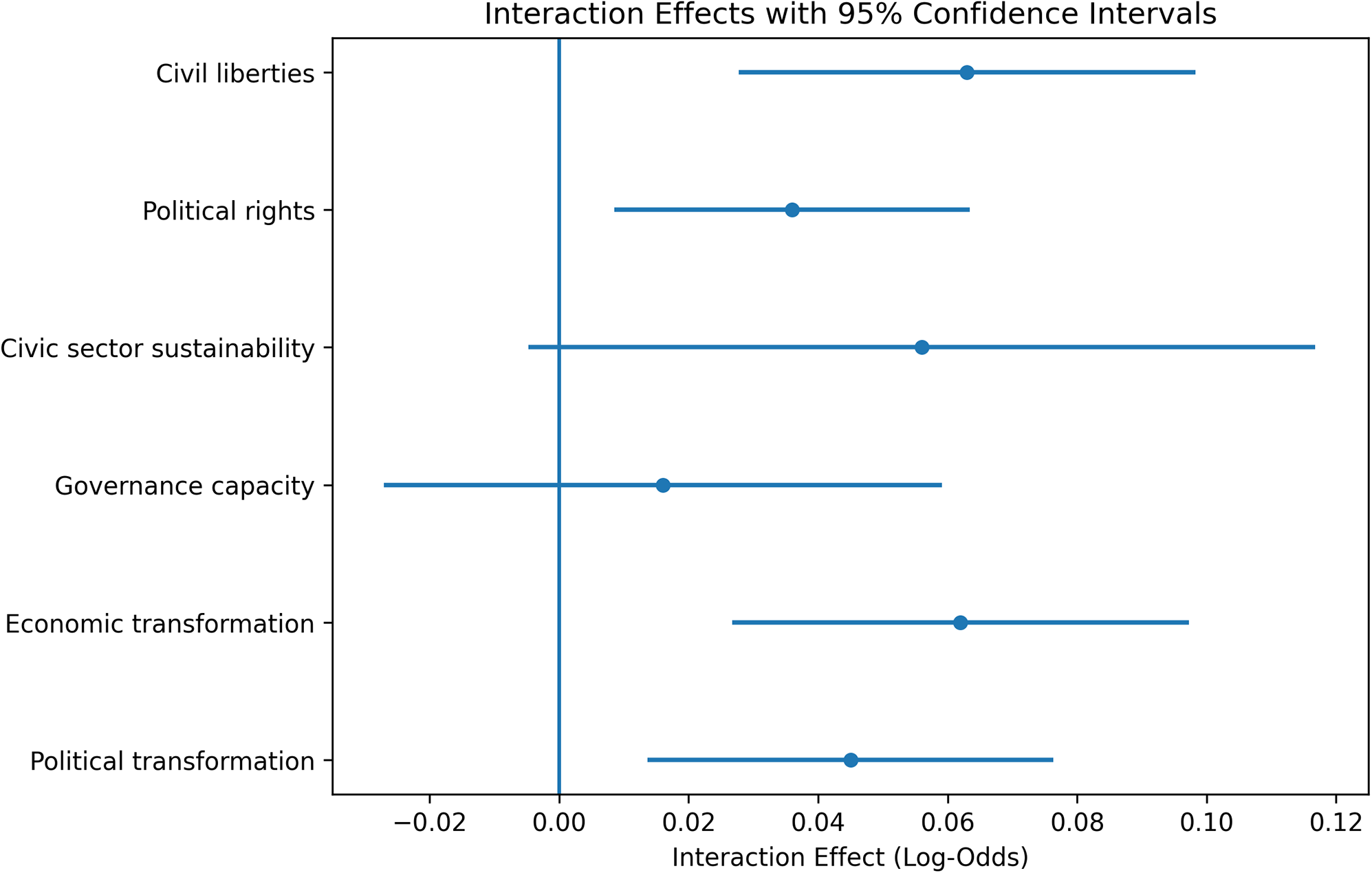
Finally, Figure 1 presents the interaction effects between time (2018 vs. 2008) and the six country-level PSR variables, expressed as log-odds coefficients with 95% confidence intervals. This presentation facilitates the assessment of the direction, magnitude, and statistical uncertainty of temporal changes in the associations between country-level conditions and contentious practices. For processual factors, political transformation displays a positive and statistically significant interaction effect, indicating that its association with individual engagement in contentious practices strengthened in 2018 relative to 2008. Economic transformation shows a similar pattern, with a positive and statistically significant temporal interaction, suggesting that its association with contentious practices became more pronounced in the later period. For structural factors, the interaction between governance capacity and time is not statistically significant, as the confidence interval spans both negative and positive values, indicating no systematic temporal shift in its association with contention. Civic sector sustainability points in a positive direction, but its confidence interval falls very close to zero and slightly crosses it, indicating a weaker and less robust temporal strengthening than the other clearly positive interaction effects. Turning to relational factors, political rights display a modest but statistically significant positive interaction with time, indicating that institutionalized political rights became somewhat more relevant for contentious engagement by 2018. Civil liberties, however, exhibit one of the strongest and most robust interaction effects, broadly comparable in magnitude to economic transformation, indicating that their association with the contentious dimension of civil society became more pronounced over time.
Time-contingent effects of processual, structural, and relational factors on individual engagement in contentious practices.

Fig. 1. Long description
The x-axis is labeled Interaction Effect Log-Odds and ranges from minus 0.02 to 0.12. A vertical reference line is positioned at 0.00. Six variables are listed on the y-axis from top to bottom.
* Civil liberties: Point estimate at approximately 0.063 with a confidence interval from 0.028 to 0.098.
* Political rights: Point estimate at approximately 0.036 with a confidence interval from 0.008 to 0.064.
* Civic sector sustainability: Point estimate at approximately 0.056 with a wide confidence interval from minus 0.005 to 0.117, crossing the zero line.
* Governance capacity: Point estimate at approximately 0.016 with a confidence interval from minus 0.027 to 0.059, crossing the zero line.
* Economic transformation: Point estimate at approximately 0.062 with a confidence interval from 0.027 to 0.097.
* Political transformation: Point estimate at approximately 0.045 with a confidence interval from 0.014 to 0.076.
All factors except Civic sector sustainability and Governance capacity show statistically significant positive interaction effects as their intervals do not cross the zero line.
Discussion
By foregrounding contention as a practice through which civil society is enacted, reproduced, and transformed—rather than as a residual category of non-conventional political participation—this article treats it as normatively and analytically on par with compliant practices (Baća, Reference Baća2022). In doing so, it provides empirical support for the claim that postsocialist civil society is “neither fixed nor static”, but rather “a historically and geographically contingent arrangement of practices, relations, and processes that remain in perpetual flux yet embedded in local and regional contexts” (Baća, Reference Baća2024: 9; see also Florea et al., Reference Florea, Gagyi and Jacobsson2022). Moreover, the finding that, holding all else constant, the odds of contention increased by approximately 20% between the period preceding the 2008 global financial crisis and the decade that followed—albeit with differentiated regional patterns—supports arguments that postsocialist CEE is not moving along a common trajectory but instead constitutes a constellation of civil societies whose contentious dimensions are shaped by distinct configurations of processual, structural, and relational factors (Baća, Reference Baća and Eșanu2025; Pietrzyk-Reeves, Reference Pietrzyk-Reeves2022; Rone & Dinev, Reference Rone, Dinev and Mattoni2025). The analysis yields five principal insights with broader implications for civil society research, pointing to the dynamic interplay of factors shaping the contentious dimension of civil society across CEE.
First, the findings underscore the importance of processual trajectories. As H1 anticipated, both political and economic transformation are positively associated with individual engagement in contentious practices in the post-2008 period, and these associations strengthen over time, most notably in the case of economic transformation, which displays one of the strongest time-contingent effects. Rather than producing a straightforward demobilization of civil society, these processes appear to generate delayed and cumulative effects: political transformation expands the conditions under which contention becomes institutionally and practically available as a legitimate form of civic engagement, while economic transformation intensifies the social consequences of marketization, inequality, and insecurity that render contention meaningful (Beissinger & Sasse, Reference Beissinger, Sasse, Bartels and Bermeo2014; Crăciun & Rammelt, Reference Crăciun and Rammelt2025; Gagyi, Reference Gagyi2021; Stoyanova, Reference Stoyanova2018). Accordingly, the post-2008 period should not be understood simply as a discontinuity with the earlier period, but rather as a phase in which the accumulated contradictions of the postsocialist condition became publicly contestable through civil society. This interpretation also echoes social movement research showing that many protests in CEE emerged in response to challenges produced or intensified by neoliberal reforms, austerity measures, harsh privatization, labor-market precaritization, and the erosion of social protections (Gagyi, Reference Gagyi2021; Jacobsson & Saxonberg, Reference Jacobsson and Saxonberg2013; Jacobsson & Korolczuk, Reference Jacobsson and Korolczuk2017; Vanhuysse, Reference Vanhuysse2006). Contention thus appears not as an anomaly, failure, or breakdown of postsocialist transformation, but as one of the ways in which its longer-term consequences are negotiated, politicized, and contested through civil society.
Second, the findings related to structural configurations challenge several dominant assumptions in the literature on “civil society building” in CEE. Contrary to the expectation formulated in H2, both governance capacity and civic sector sustainability display positive associations with contentious practices. The interaction models, however, qualify this pattern: governance capacity remains positively associated with contention but does not show a statistically significant temporal shift, whereas civic sector sustainability points to a positive, but weaker and less robust, time-contingent association, suggesting that the relationship between civic sector sustainability and contentious engagement may have strengthened modestly after 2008. The rejection of H2 thus provides a key bridge between civil society research and social movement theory, suggesting that the NGO-ization of civil society in CEE had ambivalent long-term consequences, as the civic sector came to function not only as a site of transactional activism, but also as an institutional foundation for later contention. Rather than simply displacing grassroots activism, it may have helped generate latent capacities through which contention could subsequently emerge—including organizational infrastructures, activist skills, advocacy repertoires, horizontal networks, and public legitimacy that could be reactivated for contentious purposes once broader processual and relational conditions shifted (Císař, Reference Císař, Fagan and Kopecký2017; Foa & Ekiert, Reference Foa and Ekiert2017; Jacobsson & Saxonberg, Reference Jacobsson and Saxonberg2013; Petrova & Tarrow, Reference Petrova and Tarrow2007)—a dynamic that became particularly visible after 2008, when social movements mobilized across sectors around issues widely understood as by-products of postsocialist transformation, including systemic corruption, crony privatization, environmental degradation, appropriation of the commons, unequal access to resources, and façade democracy (Baća, Reference Baća2024; Florea et al., Reference Florea, Gagyi and Jacobsson2022; Stubbs, Reference Stubbs2012; Vráblíková, Reference Vráblíková2014). In other words, the evidence suggests that the tension between transactional and participatory activism—which dominated much of the research on civil societies in CEE—may reflect a phase distinction rather than a structural divide: institutional (infra)structures that favor transactional activism are not a ceiling on contention, but a floor upon which it can later build depending on shifting relational and processual conditions.
Third, regarding relational factors, the analysis highlights the importance of civil liberties in accounting for variation in contention across CEE. While not fully supporting H3, the distinction between political rights, which exhibit no statistically meaningful association, and civil liberties, which are positively and significantly associated with contentious practices, indicates that contention depends less on formal political access than on the practical freedoms that enable citizens to associate, speak, assemble, criticize, and recognize one another as legitimate political actors. These results refine political opportunity approaches by showing that, for civil society, a key relational condition is not simply access to the polity, but the everyday interactions and autonomous spaces in which grievances can be articulated and transformed into collective practices that render contention a viable mode of civic engagement (Crăciun & Rammelt, Reference Crăciun and Rammelt2025; Horvat & Štiks, Reference Horvat and Štiks2015; Jacobsson & Korolczuk, Reference Jacobsson and Korolczuk2020; Vráblíková, Reference Vráblíková2014). Civil liberties not only exhibit a robust and statistically significant positive association with contentious practices but also display one of the strongest time-contingent effects among all predictors, broadly comparable in magnitude to economic transformation, while political rights become only modestly more relevant in the later period. This pattern also resonates with approaches that foreground daily interactions and situated enactments over formal institutional design, particularly in light of the expanding role of digital spaces as arenas through which civic practices are organized, expressed, and sustained (Baća, Reference Baća2023; Baća & Vasiljević, Reference Baća, Vasiljević, Kolleck and Karolewski2025; Fagan & Sircar, Reference Fagan and Sircar2018; Fiket et al., Reference Fiket, Markov, Ilić and Pudar Draško2024). In other words, civil liberties make contention practically available, not merely legally possible: what matters most for the contentious (re)constitution of civil society is not formal political openness, but the relational conditions through which civic agency is strengthened, articulated, and expressed.
Fourth, across all models, individual-level characteristics exhibit stable and robust associations with contentious practices, underscoring the importance of social stratification in rendering such practices viable options for engagement. Rather than serving merely as control variables, these factors reveal a broader pattern: the post-2008 expansion of contentious practices in CEE was neither socially uniform nor equally accessible. The consistent effects of gender, age, education, and income caution against treating civil society as an evenly accessible democratic arena, as contentious engagement disproportionately involved resource-endowed individuals, with participation concentrated among men, the highly educated, and higher-income groups. This finding supports previous research showing that even when contention becomes more legitimate at the macro level, the capacity to engage in it remains socially stratified, reflecting broader patterns of civic inequality and indicating who is able to participate in the contentious dimension of civil society (Bernhagen & Marsh, Reference Bernhagen and Marsh2007; Bernhard & Karakoç, Reference Bernhard and Karakoç2007; Howard, Reference Howard2003; Petrova, Reference Petrova2007). Such a pattern is also consistent with the composition of some of the most visible social movements in CEE after 2008, which were predominantly middle-class, urban, and educated (Fagan & Sircar, Reference Fagan and Sircar2018; Gagyi, Reference Gagyi2021; Rone & Dinev, Reference Rone, Dinev and Mattoni2025; Stoyanova, Reference Stoyanova2018), suggesting that an aggregate expansion of contention may coexist with persistent inequalities in the capacity to engage in contentious practices.
Fifth, while economic development, expressed through standardized GDP, is positively associated with contention—suggesting that material resources condition the capacity for engagement even in non-institutional forms—formal EU membership exhibits only weak and inconsistent associations once socialist legacies are taken into account. This finding calls into question interpretations that treat Europeanization as a linear process bringing civil societies in CEE closer to their Western counterparts (Lane, Reference Lane2010; Matlak et al., Reference Matlak, Schimmelfennig and Woźniakowski2018; Meyer et al., Reference Meyer, Moder, Neumayr and Vandor2020; Petrova & Tarrow, Reference Petrova and Tarrow2007). Most importantly, the higher likelihood of engagement in contentious practices across former Yugoslav countries indicates that historically sedimented experiences of self-management socialism continue to shape whether contention is perceived as an available and legitimate civic practice, while also reflecting distinct trajectories shaped by the Yugoslav wars, state-building processes, and transnational diffusion across the region (Baća, Reference Baća2024; Hann & Dunn, Reference Hann and Dunn1996; Rone & Dinev, Reference Rone, Dinev and Mattoni2025; Stubbs, Reference Stubbs2012). This legacy effect, which remains one of the most stable and substantively pronounced country-level predictors across all models, should not be understood merely as a residual institutional variable, but as a historically embedded feature of political culture that is reproduced through practices and relations that sustain capacities for contention over time.
Finally, while the PSR-P framework offers a transferable formal analytical model for examining civil societies beyond CEE, several limitations point to avenues for future research and further refinement of the framework. First, by treating contentious practices across CEE as a unified analytical category and the region itself as a coherent analytical space, the study does not differentiate among specific forms of contention in order to examine variations in forms, contents, and outcomes across countries and subregions. Future research should therefore account more systematically for the significant country-specific variation that remains unexplained in the present cross-national model, as indicated by persistent random effects and variance components, in order to probe more closely the subregional and national differences within the postsocialist region. Second, the approach is necessarily shaped by theoretical, methodological, and political biases, as it draws primarily on global indexes relying on expert assessments embedded in liberal-normative understandings of democratic transition, while the EVS captures only a limited range of contentious practices—a combination that obscures informal and context-dependent forms of contention and, more importantly, the ways in which contentious and compliant practices jointly shape the broader ecology of civil society in postsocialist contexts. Future research should therefore seek to better capture contextual and situational specificities and unpack the mechanisms through which processual, structural, and relational factors shape a wider range of practices—not only contentious ones—through which civil societies are enacted, reproduced, and transformed. Finally, while the study captures temporal change through repeated cross-sections and interaction effects, longer time horizons and additional data waves would enable a more fine-grained analysis of non-linear dynamics and critical junctures, which would be particularly valuable for assessing subsequent developments with major implications for civil society, such as democratic backsliding and geopolitical realignments. Taken together, these directions would contribute to a more context-sensitive and temporally robust operationalization of the PSR-P framework.
Conclusion
This article integrates insights from scholarship on civil society and social movements in CEE regarding the processes, structures, and relations shaping the development of postsocialist civil societies, particularly their contentious dimension, into a unified analytical framework. By focusing on contention as a practice through which civil society is enacted, reproduced, and transformed, the analysis shows that contentious engagement increased significantly between 2008 and 2018, although unevenly across the region. Yet, this expansion of contention is not structurally predetermined, but becomes more likely where long-term transformation processes, structural configurations, relational freedoms, and political cultures shaped by historically sedimented repertoires of state–society relations jointly create the conditions under which contentious practices become available, meaningful, and legitimate. Contention should therefore not be treated as a residual form of political participation activated only when institutional channels fail, but as a constitutive dimension of civil society alongside its more prevalent compliant practices. At the same time, postsocialist civil society should not be understood as a singular regional formation, but as a plurality of civil societies differentiated across national and subregional contexts in CEE. Nor is civil society an evenly accessible democratic arena; rather, it is a stratified field in which engagement remains shaped by unequal access to social, cultural, and economic resources.
In this sense, the article contributes to the new wave of scholarship on postsocialist civil societies by showing that they should not be understood through the binary of weak participatory activism versus strong transactional activism, but as historically changing configurations of civic practices in which compliant and contentious forms of engagement coexist, overlap, and may be reconfigured into one another under shifting processual, structural, and relational conditions. While Yugoslav-type socialist legacy is the most robust contextual predictor and EU membership remains unstable across model specifications, the interaction models demonstrate that economic transformation and civil liberties display the strongest time-contingent associations with contentious practices. This suggests that the post-2008 reconfiguration of civil society in CEE was shaped less by formal geopolitical positioning than by the convergence of historically sedimented repertoires of civic engagement, accumulated socioeconomic contradictions arising from the postsocialist transition, and the practical freedoms that enabled emerging grievances to be publicly articulated and enacted through contentious practices. Overall, the PSR-P model reaffirms the value of integrating civil society research with social movement studies by offering a formal analytical framework for examining not only the strength and institutional development of civil society but also the conditions under which it becomes contentious over the course of long-term societal transformation.
Acknowledgments
AI-assisted tools were used exclusively for language editing and stylistic refinement to improve clarity and grammatical accuracy in English, comparable to the support the authors would otherwise seek from a professional language editor, as English is not their first language. The authors retained full responsibility for the study’s intellectual content, theoretical framework, research design, data analysis, interpretation of findings, and final text, in accordance with the AI policies of Voluntas.
Funding statement
This project is supported by the National Scholarship Programme of the Slovak Republic for the mobility of international researchers (ID: 51569).
Competing interests
The authors declare no conflicts of interest with respect to the research, authorship, and/or publication of this article.
Ethical standards
Ethics approval was not required for this study, as it relies exclusively on pre-existing secondary data from publicly accessible datasets and indices: the Bertelsmann Transformation Index (BTI), Civil Society Organization Sustainability Index (CSOSI), Freedom in the World (FIW), and the European Values Study (EVS).



 Open access

