Projections of population demographics and limited public health budgets have spawned the new research field of health economics. However, despite considerable technological innovations in laboratory diagnostics and a correspondingly growing potential for cost containment, so far mainly therapeutics have been addressed in pharmacoeconomic studies. Existing economic studies on diagnostics have mostly been cost-effectiveness analyses of individual test procedures (Reference Berg and Lindgren3;Reference Bogavac-Stanojevic, Ivanova Petrova, Jelic-Ivanovic, Memon and Spasic5;Reference Chuck, Ohinmaa, Tilley, Singh and Jacobs7;Reference Dowdy, O'Brien and Bishai9;Reference Muller, Stratmann-Schone, Klose and Leidl15). Outcomes research on the decision making for the use of different diagnostic procedures and usage patterns on a broader scale is rather scarce (Reference Barreto, Takei and E C2;Reference Wachtel and O'Sullivan24).
However, excessive use of laboratory diagnostics has been common for decades (Reference Martin14;Reference Rafeh and el-Tobgi20;Reference Sood, Sood and Ghosh21). Interventions to improve test-ordering behavior of clinicians have proven mostly unsuccessful (Reference Axt-Adam, Van Der Wouden and Van Der Does1;Reference Dowling, Alfonsi, Brown and Culpepper10;Reference O'Brien, Oxman and Davis16;Reference Sood, Sood and Ghosh21). Therefore, an independent rules-based approach for laboratory testing may be most promising to achieve a practice improvement.
Based on a case study, the current cost-minimization analysis aimed to evaluate the impact of implementing clinical decision rules for the use of liquor diagnostics on direct costs and clinical outcomes. It tested the hypothesis that direct laboratory costs were reduced without affecting diagnostic or clinical outcomes.
MATERIALS AND METHODS
Study Setting and Design
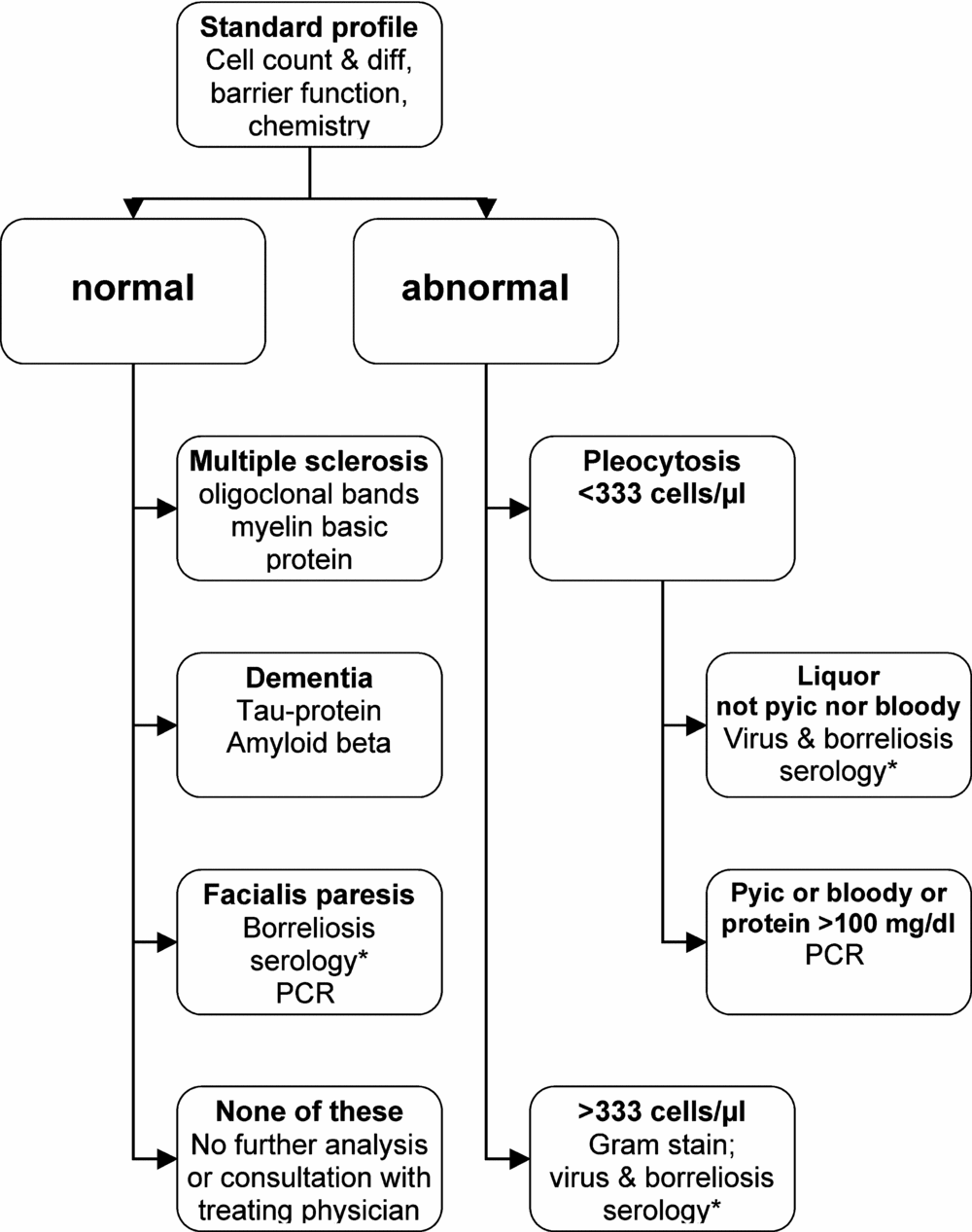
The study was performed at the Clinic of Neurology of the Paracelsus Medical University in Salzburg (Austria), which is a leading center of excellence in neurology. Based on statistics of the clinic in 2004, excessive use of laboratory testing was most prominent for liquor diagnostics, which had usually been ordered in an uncontrolled way by the treating clinicians. Consequently, the heads of the central laboratory and all clinical departments jointly developed a tree of decision rules for the use of liquor diagnostics, in line with the current practice guidelines of the German Society of Liquor Diagnostics and Neurochemistry (www.dgln.de). Accordingly, a standard liquor testing profile became mandatory, and further sophisticated testing conditional upon its outcome and putative diagnoses (Figure 1). This diagnostic algorithm was implemented in the clinic's laboratory information management system (Orbis Information Systems Ltd., Dublin, Ireland) in July 2005.
Decision rules for the use of liquor diagnostics. Asterisks indicate in cerebrospinal fluid and serum; Chemistry: total protein, lactate, glucose. PCR° indicate polymerase chain reaction for herpes simplex virus and enterovirus.

To evaluate the economic and clinical impact of this change, data from all patients hospitalized and discharged between 1 January 2004 and 31 December 2006 were analyzed. Study end points were the costs for liquor diagnostics (overall, per diagnosis-related group, and per patient); the frequency of discharge diagnoses; the duration of hospital stay (per patient and per diagnosis-related group); and the cases of death while in hospital (overall and per diagnosis-related group). Costs of liquor diagnostics were calculated as costs of reagents based on the tariffs of 2006. This was a retrospective analysis of patient records from 3 consecutive years: the one before the change, the year of change, and the year after.
Statistics
Depending on the type and distribution of data, statistical analyses were conducted either with an analysis of variance, with Kruskal-Wallis or Median tests, or in case of categorical variables with Chi-squared or Fisher's exact tests. Due to the exploratory character of analyses per diagnosis-related group, no correction for multiplicity was applied.
RESULTS
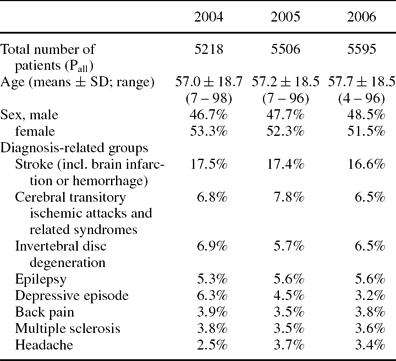
Over the 3 years, patient demographics and disease characteristics hardly changed, neither overall (Table 1) nor in the subset of patients who underwent liquor diagnostics. Liquor diagnostics were most often used in patients with headache (total: 9.5 percent; 2004: 6.4 percent; 2005: 10.0 percent; 2006: 11.9 percent), invertebral disc degeneration (total: 8.6 percent; 2004: 9.3 percent; 2005: 8.3 percent; 2006: 8.2 percent), stroke (incl. brain infarction or hemorrhage, total: 6.5 percent; 2004: 6.4 percent; 2005: 8.1 percent; 2006: 4.7 percent), back pain (total: 5.5 percent; 2004: 5.5 percent; 2005: 5.0 percent; 2006: 6.1 percent), and fascialis nerve impairment (total: 5.5 percent; 2004: 4.9 percent; 2005: 5.7 percent; 2006: 5.7 percent).
Patient Demographics and the Most Frequent (>2% of cases) Diagnoses at Discharge

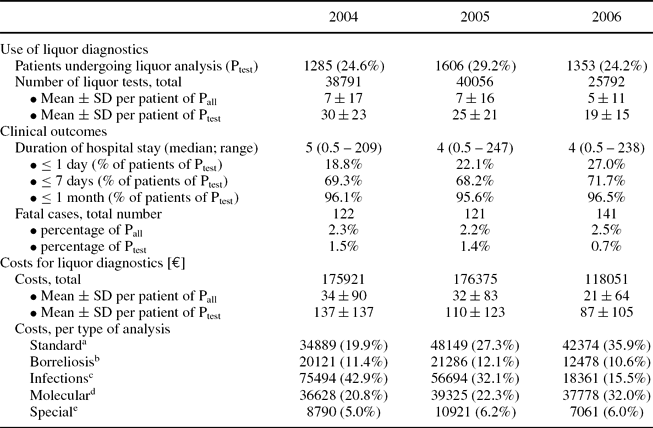
On average, in one of four hospitalized neurology patients, liquor diagnostics were used. The percentage slightly increased in 2005, but returned to this level in 2006 (Table 2). The percentage of patients undergoing liquor diagnostics was considerably higher for certain diagnosis-related groups, for example, for headache (total: 76.5 percent; 2004: 62.6 percent; 2005: 78.0 percent; 2006: 84.3 percent) and fascialis nerve impairment (total: 70.9; 2004: 60.9 percent; 2005: 82.1 percent; 2006: 69.4 percent).
Use and Costs of Liquor Diagnostics

aCell count/diff., barrier function, chemistry (total protein, lactate, glucose).
bBorreliosis serology.
cVirus serology.
dPolymerase chain reaction for herpes simplex virus and enteroviruses.
eTau-protein, amyloid beta, oligoclonal bands, myelin basic protein, neurospecific enolase; special stains.
Pall, total patient population; Ptest, subset of patients undergoing liquor analysis.
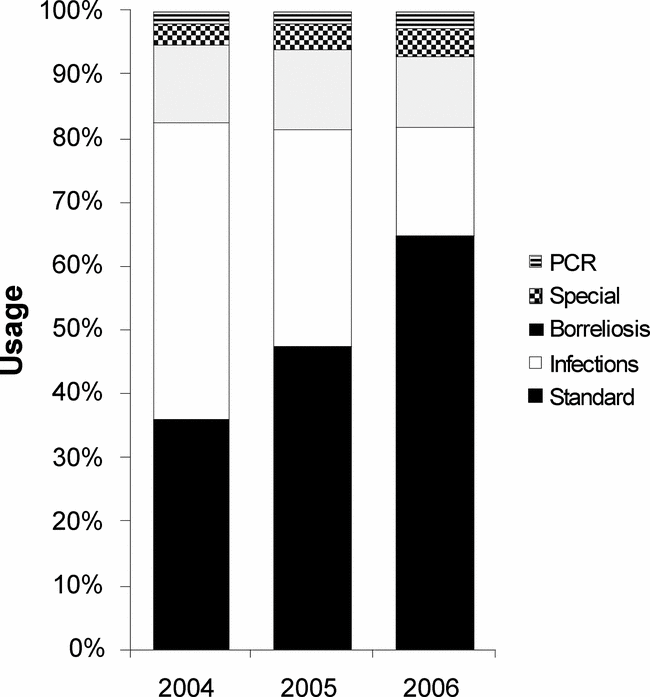
The average number of different liquor tests performed per individual patient significantly decreased over the 3 years (p < .0005; Table 2). Use of the standard tests highly increased, whereas serological tests for infections highly decreased, regardless of the discharge diagnosis. The percentage of borreliosis tests remained fairly constant (Figure 2). The percentage of patients with polymerase chain reaction (PCR) and special analyses increased but remained low.
Use of different types of liquor diagnostics. PCR, herpes simplex virus and enteroviruses; Special, tau-protein, amyloid beta, oligoclonal bands, myelin basic protein, neurospecific enolase; special stains; Borreliosis: borreliosis serology; Infections: virus serology; Standard: cell count/diff., barrier function, chemistry (total protein, lactate, glucose).

Annual overall costs for liquor diagnostics in 2006 were reduced by 32.9 percent in comparison to 2004 (Table 2), mainly due to the decreased use of serological tests for infections (Figure 2). Percentage of costs for the standard test profile and PCRs increased, however, for PCRs and special tests absolute costs remained fairly constant. Medication costs per patient (data not shown) as well as the average duration of hospital stay slightly decreased (p < .001; Table 2). Mortality during hospitalization showed a similar, but not significant trend in patients undergoing liquor diagnostics (p < .1; Table 2). None of these trends in clinical outcomes reached significance for any single diagnosis-related group.
DISCUSSION
This is one of the rare studies on the economic impact of changing ordering practices in laboratory diagnostics. It confirmed an excessive use of liquor diagnostics, particularly of serological tests for infections, until clinical decision rules (Figure 1) were implemented. These rules to a large extent shifted the use of liquor diagnostics from rather specific to less-expensive standard tests as a first line diagnostic measure (Figure 2), resulting in a substantial cost-saving.
Because frequencies of discharge diagnoses hardly changed and mortality and duration of the hospital stay, particularly in the subset of patients undergoing liquor diagnostics, even decreased over the 3 years (Table 2), the clinical decision rules apparently had no adverse impact on clinical outcomes. Because mortality was investigated only while patients were in the hospital, its slight decrease may directly be associated with the decreased duration of hospital stay. The latter is probably due to other reasons, because cost pressure has generally shifted paradigms that encourage earlier discharge. However, there might be some diagnosis-related groups for which a more considered use of diagnostics in fact plays a role.
So has a clinical benefit of decision rules for the use of diagnostics been reported in children with meningeal signs (Reference Oostenbrink, Oostenbrink and Moons17;Reference Oostenbrink, Oostenbrink and Moons18). In our study, the above trends for a decrease in duration of hospital stay and mortality also appeared most consistent for the diagnosis-related group of central nervous system infections, but failed to reach significance (p > .1). Sample size was smaller and the patient population less homogenous than in the mentioned previous studies. Anyway, common ordering behavior appears not to be in line with current practice guidelines for neurological infections (8), which clearly discourage the routine use of serological test for bacterial antigens and viral RNA or antibodies. Viral cultures were also reported to be often ordered by clinicians, although of no benefit on top of PCR screening for the detection of enteroviruses and herpesviridae in cerebrospinal fluid (Reference Polage and Petti19).
The inappropriate ordering of laboratory diagnostics by physicians is a persisting problem across specializations (Reference Axt-Adam, Van Der Wouden and Van Der Does1;Reference Gortmaker, Bickford, Mathewson, Dumbaugh and Tirrell11). It is due to the ever-advancing knowledge in medical science and the resulting plethora of publications and guidelines with which it becomes almost impossible for clinicians to keep up in their demanding day-to-day practice (Reference Jackson12;Reference Lewandrowski13). In addition, diagnostics often play just a subordinate role. Several approaches to improve ordering practice have proven relatively inefficient, although personal interactions with the laboratory less so than practice guidelines, presentations, or written information (Reference Bloom4;Reference Bunting and Van Walraven6;Reference Verstappen, Van Der Weijden and Dubois22;Reference Verstappen, Van Der Weijden and Sijbrandij23).
As suggested by this study, a considerable cost containment and practice improvement may result from sharing the responsibility for an appropriate test selection with the specialists. This becomes feasible with the presented decision rules that cover the majority of cases by standard procedures. However, if standard test results are normal, the lack of a putative diagnosis will lead to consultations with the ordering clinician. Thus, the implemented procedure may also foster the interaction between the laboratory and clinicians and possibly an improvement of their ordering behavior in the long run.
CONCLUSION
By implementing clinical decision rules for the usage of liquor diagnostics, costs can be substantially reduced while simultaneously maintaining the same medical care in hospitalized neurology patients.
CONTACT INFORMATION
Elisabeth Haschke-Becher, MD (e.haschke-becher@salk.at), Assistant Chief of Central Laboratory, University Clinic of Neurology and Institute of Public Health, Paracelsus Medical University of Salzburg, Christian-Doppler Clinic Salzburg, 79 Ignaz Harrerstrasse, Salzburg, 5020, Austria
Uwe Totzke, PhD (info@totzke-scientific.com), TOTZKE SCIENTIFIC Writing, Medical Affairs & Communication, Route de Bellegarde 36, CH-1284 Chancy, Switzerland
Shahrzad Afazel, PhD (s.afazel@salk.at), Head of Technicians, Central Laboratory, University Clinic of Neurology, Tim Johansson, PhD (t.johansson@salk.at), Institute of Public Health, Markus Schwarz, PhD (m.schwarz@salk.at), Head of Institute of Public Health, Gunther Ladurner, MD (g.ladurner@salk.at), Professor, Head of University Clinic of Neurology and Institute of Public Health, Central Laboratory, Paracelsus Medical University of Salzburg, Christian-Doppler Clinic Salzburg, 71 Ignaz Harrerstrasse, Salzburg, 5020, Austria
Claudia Wild, PhD (claudia.wild@hta.lbg.ac.at), Director, Ludwig Boltzmann Institut of Health Technology Assessment, Ludwig Boltzmann Society, Garnisongasse 7/20, Vienna, 1090, Austria