I. INTRODUCTION
In the metaphysical sense of “fundamental,” law is clearly not a fundamental feature of reality. If, say, it is the law in the United States that one ought to drive on the right-hand side of the road, or that one may freely walk on hills at night, this must be so in virtue of other, more fundamental things. Law being derivative, it owes its existence to more basic entities; it depends on them. Correlatively, when someone wants to find out what the law is, an adequate way of doing so would involve precisely appealing to those things that the law is determined by. For we do not have direct epistemic access to the law, and when we treat something as a reason for regarding a hypothesis on the existing law as correct, we do so because we think that it is partly responsible for making the law as it in fact is.
Although this much is fairly uncontroversial, two interesting questions naturally arise if law is derivative in this way. What are the kinds of things that are responsible for determining it? And what is the nature of the dependence relation that ties it to its determinants?
The first question is familiar from the long-standing debate between positivist and anti-positivist theories about the nature of law, as the key dividing line between them is indeed whether the legal determinants are wholly social, or partly moral, in kind.
The second question, by contrast, has received considerably less attention in the literature. Though a number of philosophers have recently embraced the view that the relation of law-determination is metaphysical grounding,Footnote 2 this choice has seldom been backed by any explicit argument in its favor.Footnote 3 Furthermore, the author who has most closely focused on the nature of law-determination—Mark Greenberg, in his “How Facts Make Law”Footnote 4—has forcefully defended a view that is not clearly compatible with the idea that law-determination really is what metaphysicians now call “grounding.” The view in question, of course, is that law-determination is what he called “rational determination.”
Perhaps even more interestingly, Greenberg also argued that because the nature of law-determination is a certain way, legal positivism is open to objections from which its anti-positivist rivals are immune.Footnote 5 Greenberg's claims are both interesting on their own and possibly interwoven. They deserve serious consideration, and in this paper we will take them up in turn.
In Section II, we argue that grounding is the relation of noncausal dependence that holds between law and its determinants—whatever these turn out to be. Section III defends this claim from the potentially rival view that law-determination is rational determination instead. The way we defend this claim is by arguing that, on its best understanding, rational determination turns out to actually be grounding. Interestingly, as we shall see, reaching this conclusion requires taking rational determination to have a wider application than Greenberg took it to have. We then conclude this section by defending our stance against the rival conception of rational determination offered by Plunkett.Footnote 6 Finally, in Section IV we elucidate the grounding framework for theories about the nature of law previously developed, by providing a ground-theoretic interpretation of Hartian positivism. While doing so, we pursue a twofold aim: to better explicate our framework by looking at one specific application, and to use it for evaluating Greenberg'sFootnote 7 contention that law being rationally determined poses a special problem for legal positivism. In this respect, we will see how certain ground-theoretic notions bear on the way Hartian positivists might be able to answer Greenberg's powerful and influential challenge.
II. LAW-DETERMINATION AND GROUNDING
In the opening pages of Law's Empire, Ronald Dworkin made the following claim:
Everyone thinks that propositions of law are true or false (or neither) in virtue of other, more familiar kinds of propositions on which these propositions of law are (as we might put it) parasitic. These more familiar propositions furnish what I shall call the “grounds” of law.Footnote 8
As controversial as this passage may be in certain (plausibly unnoticed and unwanted) respects,Footnote 9 there is little doubt that Dworkin is here drawing our attention to a central and hardly deniable fact about law. Law is not a fundamental feature of reality, and so it can only be what it is in virtue of other, more basic things.Footnote 10 Though Dworkin was writing before contemporary work on grounding emerged, the idea that grounding might be the dependence relation holding between law and its determinants is of interest on its own.Footnote 11 The main goal of this paper is to explore and defend this view.
Let us first introduce some key notions. Start with a collection of legal facts, that is, facts about the content of the law in a given legal system at a given time. As many legal facts obtain in the actual world, and given that they are not fundamental, one may ask what it is in virtue of which they obtain. Although answers to this question can take a variety of different forms, a traditional and philosophically interesting dividing line has us concerned with the question whether the determinants of the legal facts are wholly social, or rather partly moral, in kind.
Exclusive positivists characteristically claim that social facts are always among the legal determinants, whereas moral facts never are. By contrast, inclusive positivists maintain that moral facts may or may not play a role in determining the law, and anti-positivists contend that they necessarily play such a role. Though all agree that social, descriptive facts are among the things in virtue of which the legal facts are as they are, there remains a disagreement as to whether moral facts also qualify as determinants—and if they do, to what extent.
For present purposes, the important point is that all the parties to the dispute are making claims about the determination base for law. Thus, if we are to fully grasp what these views are about, we need to know what the dependence relation that they invoke, and that seems so central to their enterprise, is.
A. Law-Determination as Grounding
Let us neutrally call “law-determination” the relation—whichever it is—that holds between law and the more basic things that metaphysically determine it. Given this terminological stipulation, our question can then be raised by asking what sort of relation law-determination is.
A preliminary point is that it is important not to confuse it with causation. Uncontroversially, ordinary empirical facts about the behavior, mental states, and attitudes of the lawmakers are among the metaphysical determinants of the law. For instance, part of what makes it the case that according to U.S. law smoking in public buildings is forbidden is that the U.S. lawmakers performed certain actions and expressed certain attitudes in certain institutional contexts. These actions, in turn, stand in certain causal relations with past and future events, so that one may also look for the casual story that led to their actual occurrence and investigate their effects. But however interesting these causal links may be, they are not the ones that interest us when we ask about the relation between the legal facts, on the one hand, and facts about officials’ actions, utterances, and mental states, on the other.
One reason for this is that what we are after is not the diachronic link between law-making actions and their causal effects, but rather the synchronic link between facts about law-making actions (and the like) and legal facts. Moreover, unlike causation the target notion of determination is of a constitutive kind, and ought to ensure that the determinants are more basic, in a metaphysical sense, than what they determine. Relatedly, notice that when lawmakers write down legal texts or raise their hands in parliamentary rooms, it is not as if the raisings of their hands or their writing texts could cause legal facts to obtain in the way that raising one's hands causes the surrounding air to move. To regard causation as the connecting link between (things of the sort of) legal facts and the underlying social practices seems to involve a category mistake of sorts.
If law-determination is not causation, then what is it? Starting with the work of Fine,Footnote 12 Rosen,Footnote 13 Schaffer,Footnote 14 and others, in recent years there has been a surge of interest in a constitutive or metaphysical type of determination called “grounding.” Theories in various areas of philosophy put forward determination claims, whereby certain entities are said to be dependent on, or determined by, some others. For instance, physicalists in the philosophy of mind hold that mental properties and facts are determined by, and are nothing over and above, physical ones; likewise, naturalists in metaethics typically maintain that moral properties depend upon natural ones.
While for some time attempts were made to define the relevant notion of dependence in terms of well-understood modal notions such as supervenience and necessitation, these attempts ultimately met with unavoidable difficulties. In particular, Fine convincingly argued that neither supervenience nor necessitation is in general sufficient for dependence.Footnote 15 To use one of his examples, although the fact that Socrates exists supervenes on, and is necessitated by, the fact that singleton Socrates exists, the latter fails to determine the former in any intuitive sense.
Taking the failure of modal definitions of dependence at face value, several metaphysicians introduced a primitive notion of grounding with a view to formally modeling and better capturing metaphysical dependence. This, in turn, led various authors to formulate ground-theoretic versions of dependence views in various areas of philosophy (e.g., physicalism and naturalism), viewing them as both more adequate and potentially illuminating.Footnote 16
The assumptions about grounding that we make here are quite standard, and some of them are made for the sake of definiteness, since they will not play an essential role in the present dialectic.Footnote 17 Specifically, we take grounding to be a many-one relation that is synchronic, transitive, asymmetric (hence irreflexive), nonmonotonic, and that holds (at least) between facts.Footnote 18, Footnote 19 Most importantly for our purposes, grounding is commonly thought to bear an intimate relation to explanation, where some articulate this thought through the idea that grounding is metaphysical explanation, and others vindicate it by holding that grounding, though not being (identical to) a type of explanation, backs or underwrites explanatory “because”-claims.Footnote 20
Finally, we will rely on the usual distinction between full and partial ground, as well as on a distinction that is sometimes drawn between different kinds of partial grounds, namely structuring and triggering grounds.Footnote 21 A set of facts Γ fully grounds a fact A if nothing needs to be added to Γ in order to have a complete account of the obtaining of A, whereas A is partially grounded in Γ if for some ∆ such that Γ ⊆ ∆, A is fully grounded in ∆.Footnote 22
Within a full grounding base (a set of full grounds), partial grounds sometimes play different roles, thereby inducing a division of labor between them. In particular, some facts—the triggering grounds—are such that they play a grounding role only if certain other facts—the structuring grounds—enable them to play this role. In this way, the structuring grounds not only function as partial grounds, but also enable or allow other facts to be further grounds, so that the relevance and status of triggering facts qua grounds crucially depends on the presence of these structuring facts. In due course (Section IV), we'll elaborate on these notions, and will explain how they may be exploited by Hartian positivists to address a challenge that GreenbergFootnote 23 raises against simple positivist accounts of law.
The aim of the preceding remarks was to introduce the notion of grounding appealed to in contemporary metaphysics, and to outline some of its features that will play a significant role in the paper's arguments. Having done so, we are now in a position to state the main claim that we will defend:
Law-determination as grounding (LDG): metaphysical grounding is the relation of noncausal dependence that holds between legal facts and their determinants.
Although LDG has been endorsed by various philosophers in various ways,Footnote 24 a sustained defense of it has yet to be provided.Footnote 25 In the next two sections we aim to do just that, while also defending LDG from worries that may arise from Greenberg'sFootnote 26 influential argument that law-determination is rational determination.
B. Why Believe LDG
An important consideration in favor of LDG is that grounding has essentially the features that a relation of law-determination should have.Footnote 27 As was noticed, law-determination is not a causal relation, but rather a synchronic, constitutive type of determination. Further, unlike modal notions such as necessitation and supervenience, law-determination should be an explanatory relation, and allow us to keep track of the generative transitions that give rise to the legal facts on the basis of their more fundamental determinants. Crucially, grounding is the generative, synchronic relation designed to capture a constitutive type of determination, and has the appropriate formal properties to play this role (see Section II.A).
Relatedly, LDG has the benefit of allowing us to integrate constitutive accounts of law within general accounts of reality as a whole. As noted above (Section II.A), grounding is an independently motivated notion that is receiving increasingly widespread applications throughout philosophy. This is because every derivative entity depends on more fundamental entitiles, and because of grounding's aptness in capturing metaphysical dependence. So if grounding is the overarching relation that “holds together” the whole of reality, and if legal facts are parts of it, LDG would enable accounts of legal reality to explain how law fits into reality overall.
Another consideration that supports LDG is that the hypothesis is useful. Grounding is an increasingly well-understood relation, whose properties and relations to other notions like supervenience, necessitation, and explanation are becoming growingly clear. We already mentioned grounding's connection to explanation. Moving to its relation to modality, it is widely accepted that either grounding entails necessitation, or it at least obeys a weaker principle to the effect that every grounding claim entails a corresponding global supervenience claim.Footnote 28 Because of its connection to these relations, grounding can be used to draw the modal consequences of metaphysical views, and in this way it can help us to evaluate their strengths and weaknesses.
Lastly, hyperintensionality. It has been noticed by Greenberg that, under the assumption that the basic moral facts are necessary, framing the dispute between positivism and anti-positivism in terms of supervenience meets with very serious difficulties.Footnote 29 The problem is that if positivism is understood as the view that legal facts supervene on social facts alone, and anti-positivism as claiming that they supervene on social and moral facts taken together, their claims will be true under exactly the same conditions. For if the moral facts are necessary (hence invariant across worlds), anti-positivism will be true just in case any variation in legal facts requires a variation in social facts, just as positivism is. The underlying issue here is that, since supervenience is an intensional notion, it cannot discriminate between claims that feature intensionally equivalent supervenience bases (and the same supervenient entities).Footnote 30
Grounding, by contrast, is widely regarded as hyperintensional, which means at least the following two things: first, that it can fail to hold between co-intensional entities (e.g., necessarily co-obtaining facts); second, that it is possible for a fact B to be fully grounded in a fact A, even though it fails to be grounded in a fact that necessarily co-obtains with A, and it is possible that A grounds B, even though it fails to ground a fact that necessarily co-obtains with B. Thanks to this, grounding is capable of marking distinctions in terms of which entities are related by it and which are not, even when these are co-intensional. And because of this, unlike supervenience it is capable of distinguishing the views that concern us here.
III. RATIONAL DETERMINATION
While up to this point we have focused on building a positive case in favor of LDG, we now turn to defending it from a potential objection. In his seminal paper “How Facts Make Law,”Footnote 31 Mark Greenberg argued that the relation of law-determination is what he called “rational determination.” Partly because he was writing before the contemporary literature on grounding had developed, it is unclear what the relationship is between rational determination and grounding, and so it is an open question whether the claim that law-determination is rational determination is a rival of LDG.
In the opening remarks of his discussion, Greenberg makes clear that rational determination is not a purely modal notion. Since part of its job is to help us elucidate the distinction between positivism and anti-positivism, the problems that supervenience and necessitation have in this respect (see Section II.B) force the conclusion that it cannot be either of them.
After making this point, Greenberg goes on to introduce a distinction between two distinct kinds of constitutive relations. For him, constitutive determination can be either rational or a-rational. In his words, if the relation between some A facts and the B facts they determine is a-rational, “there need be no explanation of why the obtaining of particular A facts has the consequence that it does for the B facts”;Footnote 32 that is, the A facts need not provide reasons why the B facts they determine (rather than other facts) obtain. By contrast, the A facts rationally determine the B facts just in case the A facts constitutively determine the B facts and the A facts provide reasons why the B facts they determine obtain.Footnote 33 The condition that if some A facts rationally determine a B fact then the A facts must provide reasons why the B fact obtains (the second conjunct of the definition) is what he calls the “rational-determination requirement.”
As the key notion of a reason why provides the distinctive feature of rational determination, it is crucial to be clear on what kind of reasons we are dealing with. Greenberg is in fact quite clear on this. Since his aim is ultimately to use the rational determination requirement to argue against legal positivism, he is at pains to highlight that the notion of reason relied upon is not of a moral or evaluative kind, for otherwise he would be begging the question against the positivist. The relevant notion of reason is rather epistemic or explanatory: reasons are considerations that make the explanandum intelligible.Footnote 34
Although we shall follow Greenberg in understanding the view that law is rationally determined as involving the claim that the legal determinants must provide explanatory reasons for the obtaining of legal facts, it might be useful to clarify how rational determination relates to, and differs from, two other notions that have been discussed in the literature.Footnote 35
One distinction to be drawn is with the notion of a determination relation being transparent, in a specific sense of transparency that has been salient in discussions of physicalism.Footnote 36 In this context, the connection between some metaphysical determinants and what they determine is said to be transparent when the former logically or a priori entail the latter.Footnote 37 That is, in such cases it is not logically possible or a priori open that the determining entities obtain without the determined entity also obtaining. As Greenberg makes clear,Footnote 38 however, rational determination is a broader and weaker notion than transparency so conceived. For while a priori and logical entailment both suffice for rational determination, rational determination can hold without either of them being present.Footnote 39 So although rational determination bears an intimate connection to transparency, the two are also relevantly different.
Secondly, it is important not to conflate the notion of reason involved in rational determination with that of reasonableness. Ram Neta, for instance, construes rational determination in such a way that “to say that one thing, A, ‘rationally determines’ another thing, B, is to say that A makes it the case that B, and makes it the case in a way that makes it at least somewhat reasonable for it to be the case that B.”Footnote 40 In similar vein, Barbara Baum Levenbook interprets rational determination as requiring that “[t]he content of law must be reasonable or sensible in relation to its base.”Footnote 41
However, Greenberg has made clear that these renderings of rational determination misrepresent the core of the notion.Footnote 42 For one thing, as he points out, rational intelligibility—the notion in terms of which rational determination is spelled out—is a relation between determinant and determined facts, and not a monadic property of the latter. For another, there simply is no requirement that the rationally determined facts should be reasonable or rational.Footnote 43 The rationally determined facts must rather be made intelligible by their determinants, and this is a matter of providing an adequate kind of explanation, not of producing a reasonable outcome.
Let us return to our main business. Given the distinction he draws between rational and a-rational determination, Greenberg is led to regard rational determination as a special or unusual relation, in the sense that it is distinct from “mere” constitutive determination, and in the sense that it holds between law and its determinants but not among many other things that stand in a metaphysical dependence relation. As he puts it, “rational determination is an interesting and unusual metaphysical relation because it involves the notion of a reason, which may well be best understood as an epistemic notion. If so, we have an epistemic notion playing a role in a metaphysical relation.”Footnote 44
Now, it is clear that if grounding is the overarching, general relation it is meant to be, whereas rational determination is a special relation, holding between law and its determinants but not between many other things that stand in a metaphysical dependence relation, then rational determination and grounding cannot be the same. So it is crucial that we examine whether rational determination really is special or unusual in this way.
A. The Argument from Epistemic Asymmetry
One argument used by Greenberg to support the view that legal facts are rationally determined while other facts are not proceeds by inferring a conclusion about the nature of the relation at work in certain dependence claims from premises concerning the way we know about the facts that are so determined (according to such claims).
His reasoning may be reconstructed as follows. Let B be a derivative fact; if one knows that B obtains, there are at least three ways in which they could know this: (i) directly (e.g., perceptually or by introspection), without having to know the determinants of B. Plausibly, this might be what happens with respect to some mental facts, such as when one knows that she is conscious, and with respect to facts that one knows through perception, like the fact that there are clouds in the sky.Footnote 45
Second, (ii) one could know B through the A facts that determine it, via a nonrational, perhaps hardwired capacity to derive B from them. Greenberg illustrates this type of case with the example of aesthetic facts, such as when one knows that a painting has certain aesthetic properties by means of knowing the arrangement of shapes and colors on the canvas, or when one knows that a joke is funny by knowing “what was said and done.”Footnote 46
Third, (iii) one may come to know B through the A facts that determine it, through a rational activity by which they are cited as reasons why B obtains. Importantly, for Greenberg this is what happens when B is a legal fact.
We think that Greenberg is drawing an important and genuine distinction here. Cases (i)–(iii) reveal that there is an epistemic contrast between (i) and (ii) on one hand, and (iii) on the other, as only in cases (i) and (ii) can the derivative fact be known without invoking its determinants qua reasons.Footnote 47 Crucially, however, Greenberg infers from this that there is also a metaphysical contrast between the two types of cases. For he takes it that in (i) and (ii), as opposed to (iii), the relation between the A facts and B is a-rational (i.e., the determinants need not provide reasons why the derivative fact obtains), and he regards this conclusion as supported by the epistemic disparity in question.
Our reply is the following. Although there is an epistemic contrast in the ways we come to know facts in these different domains, no conclusion follows from this regarding the nature of the dependence relation involved. For from the fact that one need not appeal to the determinants of a given fact qua reasons in order to know that the determined fact obtains, it clearly does not follow that they do not provide such reasons. A fact may provide a reason even when we are utterly unaware that it does.
Now, one could reply that the epistemic considerations were intended to lend abductive support to the metaphysical conclusion. But even so, it is far from clear that positing distinct metaphysical relations provides the best explanation of the epistemic disparity in question. For it could just be a fact about us that we know certain things in certain ways and other things in other ways. The way we know things—by perception, introspection, reason, etc.—is one question, and one whose connection with the metaphysical issue of how the things we know are related to their grounds is all but straightforward. At the very least, then, our argument in favor of LDG (see Section II) and the common unitary assumption that there is but one relation of metaphysical dependence suggest that the burden of proof here lies with those willing to show that things are otherwise.Footnote 48
B. The Argument from Intuitive Difference
Greenberg's second argument moves from the thought that there is an intuitive difference between (domains such as) law, where the relation of dependence appears to be necessarily reason-based, and other domains (for instance aesthetics) where this doesn't seem to be the case.
He describes the intuitive grip behind this thought as follows: “Descriptive facts metaphysically determine aesthetic facts. A painting is elegant in virtue of facts about the distribution of color over the surface (and the like). But arguably there need not be reasons that explain why the relevant descriptive facts make the painting elegant.”Footnote 49 And in a follow-up paper, he puts it thus: “a small difference in the arrangement of paint might make a clumsy scene elegant, without providing a reason for the difference. In contrast, it cannot be a brute fact that, say, a particular change in the wording of [a] statute would have a particular impact on the legal facts.”Footnote 50
At this point, someone who wanted to deny that there is a difference between law and other domains in terms of whether the determinants provide reasons could choose one of two options: claiming either that also the determinants of (say) aesthetic facts provide reasons for them, or that law is not “reason-based” either. We shall pursue the former strategy.
Let us start by flagging two assumptions that both Greenberg and we share. First, the relation between law and its determinants is reason-based; that is, for any legal fact, the facts that determine it provide epistemic, explanatory reasons why it obtains. Second, when derivative facts in other domains (such as aesthetics) obtain, there have to be more basic facts in virtue of which they obtain: all inter-level connections require the presence of some constitutive relation backing those connections. To follow Greenberg's example for illustrative purposes, when a painting is elegant, it is so in virtue of facts about the distribution of shapes and colors on the canvas. Then the question is, do these facts provide reasons why the painting is elegant?
We agree that the cases of law and aesthetics are intuitively different in some respect. For a start, the determination claims in the two cases clearly feature distinct grounds—social (and maybe moral) facts in one case, facts about shapes and colors in the other.
Less obviously, also the truth of these claims is to be explained differently. If one takes the grounding fact that certain social facts ground a legal fact and asks what grounds this fact, the answer will differ from the one they would get in the corresponding aesthetic case. Indeed, the main views on the general question of what grounds facts about grounding all yield this result.Footnote 51 This would already suffice to vindicate a substantial (as well as intuitive) difference between the two cases. What, then, are our reasons for thinking that the (relevant) differences stop here?
A key part of our response is rooted in the general connection between grounding and explanation. As was briefly mentioned in Section II, a central feature of grounding is that either it should itself be viewed as an explanatory relation, or else it should be able to back explanations whereby the grounds function as reasons why the facts that they ground obtain.Footnote 52 Indeed, it is this property of grounding that underwrites some of the core principles that are often thought to govern it. For instance, irreflexivity and asymmetry derive their appeal from the fact that nothing explains itself, and from a general ban on circular explanations.
Moreover, an informal requirement of relevance—to the effect that if a fact A is a ground for B, then A must be relevant for explaining B—also seems to characterize the grounding relation.Footnote 53 Indeed, this requirement provides a significant motivation for taking grounding to be a nonmonotonic relation—that is, for thinking that it is not the case that for any Γ and ∆ such that Γ ⊆ ∆, if Γ grounds B then ∆ grounds B. Additions to a grounding base do not always yield another grounding base, and this is because each ground must be relevant in accounting for the grounded fact.Footnote 54 This suggests that there is an intimate relation between the notion of ground and that of a reason why: if something is a ground for something else then it should be apt for figuring within an explanation of the grounded fact, and should be so apt in virtue of providing a reason why the grounded fact obtains.
Now, as per our first shared assumption, the legal determinants provide reasons for the obtaining of legal facts. Further, as per our second assumption, when a painting is elegant it is so in virtue of facts about its shapes and colors (and the like). The relation between the painting's elegance and its colors and shapes is clearly not a causal one. It is not merely modal either, since by themselves modal relations do not carry the import that the determined entity holds in virtue of its determinants. It is rather a grounding relation, as is supported by general considerations for regarding constitutive determination as adequately captured by the notion of grounding. But then, given the connection between grounding and explanation, it follows that the shape and color facts do provide reasons why the painting is elegant.
Indeed, it is worth noting that there is nothing counterintuitive about this. If the grounding story about the painting is correct and one were asked why a particular painting was elegant (in the metaphysical, not causal sense of “why”), an entirely appropriate answer would consist in saying that it is so because of its shapes and colors (and the like).
At this point, one may object that although both cases involve reasons of some kind, they involve reasons of two quite different kinds. That is, assuming that aesthetic facts are grounded while legal facts are rationally determined, it could be objected that the reasons involved in grounding and rational determination are different.
It is, however, far from clear that this is so. First, just as we saw that the notion of reason in play within rational determination is distinct from that of reasonableness, the notion of reason involved in grounding relations is equally distinct. Second, the same is true of transparency. As Schaffer persuasively argues,Footnote 55 the relation between grounds and grounded need not be transparent, for in many cases it is both logically possible and a priori open that the grounds obtain without the grounded fact also obtaining. So grounding and rational determination are alike in this respect as well.
Indeed, that there is such a similarity is no coincidence, given that both grounding and rational determination involve an epistemic, explanatory notion of reason. It thus seems that if one wished to draw a distinction between them, one would need to draw a distinction among different kinds of epistemic, explanatory reasons, and it is unclear just what the relevant difference might be.Footnote 56
To conclude, if the preceding discussion is on the right track, there doesn't seem to be much reason to think that a-rational determination is anywhere instantiated. Although our discussion focused on the case of aesthetic properties, the considerations that led us to conclude that the determinants of aesthetic facts too provide reasons for their obtaining were entirely general, and not tied to the aesthetic character of the example.
At the same time, we noticed that rational determination appears to have essentially the same features of grounding. Both are relations of constitutive dependence whereby the determinant facts give reasons why the facts they determine obtain. Hence, it appears that the best that can be said in favor of rational determination is that all constitutive determination is rational, and that rational determination is grounding.Footnote 57
C. Plunkett's Alternative Interpretation
David Plunkett puts forward a different and less conservative interpretation of rational determination than the one we have offered.Footnote 58 According to him, rational determination is a species of grounding definable from it via genus and differentia, wherein certain epistemic facts literally play a constitutive role. In particular, for him, when some facts rationally determine another fact it is not merely that the former give reasons why the latter holds; rather, facts about intelligibility (by human-like creatures) are themselves among the grounds of that fact:
[On] the way I am reading it, what differentiates rational grounding from arational grounding is simply what sorts of facts are among the A facts: namely, in cases of rational-grounding, particular sorts of facts about what certain creatures under certain conditions are able to find intelligible are among the A facts. More specifically, in cases of rational grounding, among the A facts is the fact that certain specified creatures under certain specified conditions are able to find intelligible the obtaining of the B facts, given the other A facts. In contrast, such facts are not in the grounds of the B facts in cases of arational grounding.Footnote 59
To pin down his position, let us offer the following definition as representative of his view:
Plunkett's rational determination: A1, A2, … rationally determine B =df A1, A2, … ground B and one fact among the A facts is the fact that creatures like us are able to find intelligible how the other A facts ground B.
We think that this conception of rational determination is problematic, in that it renders the claim that law is rationally determined unsupported by the considerations that make it interesting and plausible.
While the driving thought behind rational determination was that metaphysical determinants should provide reasons why the determined fact obtains, Plunkett's characterization goes beyond this, by making the stronger claim that facts about intelligibility are themselves metaphysical grounds. The main problem is that in doing so, the claim that law is rationally determined is no longer supported by the compelling evidence that Greenberg cites in its favor.
When Greenberg claims that the requirement should be uncontroversial in the legal domain, and that in fact it is implicitly assumed by most contemporary legal theorists, he mainly appeals to a piece of what might be called “interpretive phenomenology.” The idea is that our experience as legal interpreters—as anyone who is trying to figure out what the legal facts are (or, which is the same, what the law says)—exhibits two characteristic features. First, we see that (setting testimony aside) legal facts are only knowable on the basis of their determinants.Footnote 60 It is not as if we could see what the law is directly; rather, we have to work it out from its sources.
Second, whenever we (as interpreters) regard a fact as relevant for determining the law, that fact is treated by us as a reason in support of our claim that the law is as we say it is.
In this respect, our conception of rational determination is not only supported by the interpretive phenomenology of legal practice, but does also a good job at explaining it: the reason that legal determinants are treated as reasons why the law is a certain way is precisely that in general these determinants do provide such reasons. By contrast, these data are clearly silent on whether any fact about intelligibility plays any grounding role. Thus, absent independent reasons to think that law is rationally determined in Plunkett's sense, the inflation of the grounding base it entails seems to be gratuitous at best.
IV. HARTIAN EXPLANATIONS
The last section concluded our defense of LDG. In this section, we move on to examine an influential challenge raised by GreenbergFootnote 61 against simple positivist accounts of law, based on the idea that law being rationally determined poses a special problem for positivism.
In doing so, we provide an application of LDG by offering a grounding-based interpretation of Hartian positivism and show how certain ground-theoretic resources can be relevant to addressing the challenge. However, apart from examining how Hartian positivism fares vis-à-vis Greenberg's criticism, it is not our goal here to conclusively defend this view. Though we shall remain noncommittal regarding its ultimate prospects and merits, it matters to see how the ground-theoretic framework, and in particular the distinction between triggering and structuring grounds, bears on addressing one of the strongest arguments leveled against positivism to date.
A. Greenberg's Indeterminacy Objection to Simple Positivist Accounts
Many philosophers agree that some social facts at least partly determine legal content. The relevant social facts include ordinary empirical facts about the sayings, doings, and mental states of members of constitutional assemblies, legislatures, courts, administrative agencies, and the like. Let us follow GreenbergFootnote 62 and call these social facts “law practices.” It is also a point—convincingly made by GreenbergFootnote 63—that law practices on their own are not sufficient for determining any determinate set of legal contents.
Essentially, the problem is that there are many possible mappings from complete sets of law practices to sets of legal facts, and the law practices cannot determine which mapping is correct.Footnote 64
In fact, there are two aspects to this problem; the law practices fail to settle that they are relevant for determining the law (as opposed to being completely irrelevant), as well as how they are relevant (i.e., the way in which they contribute to determining it). Something other than the law practices must determine which facts are relevant in fixing legal content—that, for instance, enactment facts form part of the law practices—as well as how they are relevant—whether, for instance, they contribute semantic or rather pragmatic content to the content of the law. Therefore, given that determinate legal facts do obtain in our systems, and given that no determinate legal facts can be generated by the law practices on their own, law practices cannot fully determine the legal facts. The serious question then is not whether law practices can constitute a full grounding base on their own, but rather what must be added for there to be one.
Let us briefly pause to notice something that the problem just outlined is not. At some points, Greenberg seems to suggest that the problem resides in a failure on the part of the law practices to meet the rational determination requirement. He writes: “saying that there have to be reasons for the contribution of law practices to the legal facts is just an intuitive way of summarizing why law practices by themselves do not provide reasons for legal facts,” where a failure to provide reasons for legal facts constitutes a violation of the rational determination requirement.Footnote 65 But given that the requirement is the condition that any fact that rationally determines something must be relevant for explaining it, it should be clear that law practices do meet the requirement. For law practices uncontroversially are (some of the) facts that determine the law, and so they ought to provide reasons for the obtaining of legal facts. The problem, rather, is that law practices are unable to determine their own relevance to fix legal content, and to determine how they themselves contribute to fixing it.
B. Meeting the Challenge in a Hartian Spirit
Let us turn to Hartian positivism, as embedded within a grounding framework. Hart's model of the making of legal facts involves two types of metaphysical determinants. Along with the social facts that fall under the label of law practices, there are also the specific types of social rules that he called “rules of recognition.”
A rule of recognition is something that specifies what it takes for propositions to be law or, in other words, something that sets conditions propositions must satisfy in order to be legally valid. The toy example given by Hart was that of a rule stating that what the Queen in Parliament enacts is law. Since their role is to specify conditions of legal validity, and since validity is a relation between propositions and systems, rules of recognition must also be relativized to particular legal systems.
In general, then, given a particular system s 1, the rule of recognition of s 1 will have the form “(∀p) (Lps 1 ↔ Fp)”—for all propositions p, p is law in s 1 iff p is F.Footnote 66 Of course, in many cases the property F will encode a long and logically complex condition, which need not be readily available to competent users of the term “law.” (For the sake of concreteness, it could be a property like being the semantic content of a sentence contained in a text approved by most members of the parliament—or something along those lines.) Hart also thought that rules of recognition depend for their existence on certain attitudes held by the officials of the legal system, attitudes that he called collective acceptances.
On a ground-theoretic interpretation, rules of recognition play a double role. First, since they are among the things in virtue of which the legal facts are as they are, they count as partial grounds of law. Secondly, by specifying conditions that propositions must meet in order to be law, they enable certain facts to be further grounds, and determine the way in which these facts contribute to legal content. This happens thanks to the fact that the property F that forms part of the content of the rules “encodes” a specification of the features that must be true of a proposition if it is to bear the validity relation to the legal system. Then, exemplifications of these features will count as further grounds of law—i.e., will count as law practices. This is how, by discharging their second function, rules of recognition establish which facts belong to the law practices and how such practices have an impact on the existing law.
The distinction between the roles played by rules of recognition and law practices in a Hartian metaphysical account mirrors the distinction between the roles of “structuring” and “triggering” causes within causal accounts.Footnote 67 In the context of causation, Dretske draws the contrast between these two roles by considering (among others) the scenario of a dog who salivates upon hearing a bell ringing due to being classically conditioned.Footnote 68 The conditioning creates a state in her brain that causes her to salivate when the bell rings, while itself also being a cause of the salivation. In so doing, it creates a “structure” that allows a certain causal role to be played by the bell's ringing, which in turn “triggers” the salivation process.
As Schaffer persuasively argues,Footnote 69 this kind of explanatory structure can be fruitfully extended to the case of metaphysical determination. In particular, he designs a framework based on precisely the same distinction while working with a case in social ontology concerning the grounds of money.
At the less fundamental level, the explananda are facts about particular pieces of paper being money. Then, the toy model involves two grounds for these types of facts: a rule stating that (say) all and only things printed by the Bureau of Printing and Engraving are money, together with the fact that a particular piece of paper was printed by the Bureau. Here, the rule plays the role of structuring ground, by allowing the fact that the piece of paper was printed to have the bearing it does on the fact that the piece of paper is money. And because of this, the fact about the piece of paper being printed is able to ground—via triggering—the fact that it is money.Footnote 70
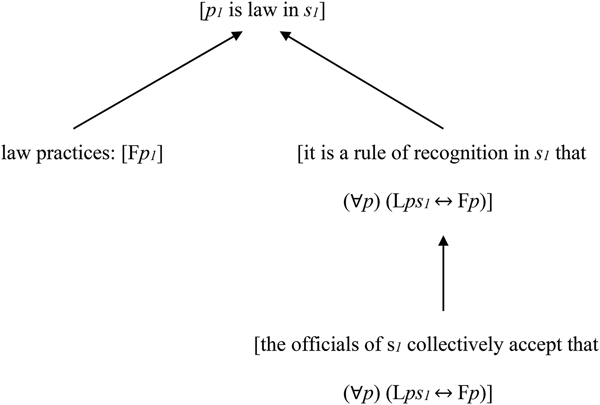
To conclude, let us illustrate how the Hartian account can reproduce the same explanatory structure. Consider a toy system s 1, and assume that we are looking for an explanation of why proposition p 1 is law in s 1—equivalently, of why it is a fact that p 1 is legally valid in s 1. In s 1, the law practices are constituted only by three facts: the fact that Rex enacted text t, that the semantic content of t (at its context of use) is the proposition that p 1, and that Rex is the authority of s 1. Further, suppose that the officials of s 1 collectively accept the rule that for all propositions p, p is law in s 1 iff p is the semantic content of a text enacted by the authority of s 1, and call this rule “R.”
A Hartian should then say that this fact about the collective acceptance of R by the officials of s 1 grounds the fact that R is the rule of recognition of s 1. Then, on the Hartian account the law practices of s 1, together with the fact that R is the rule of recognition of s 1, collectively ground the fact that p 1 is law in s 1. The law practices function as grounds that trigger the higher-level legal fact into existence, while the fact that R is the rule of s 1 creates a background state connecting them with the law of s 1. Crucially, the fact about R plays two roles at once: it grounds the legal fact, but it also explains why and how the triggering facts too count as grounds (see Figure 1).
Hartian Grounding ExplanationsFootnote 71

Altogether, this appears to provide a simple and elegant response to our initial challenge, a response that is also integrated within a general and independently motivated explanatory scheme, which already found application in the neighbor field of social ontology.
V. CONCLUDING REMARKS
Some entities are metaphysically derivative; they depend on more fundamental things. Since law is one such thing, we need an account of how it is related to its more basic determinants. And although some philosophers have claimed metaphysical grounding to be this relation, our main aim here was to give an argument for this claim.
After that, we clarified the link between grounding and another prominent candidate for the task, rational determination. Although we ended up agreeing with Greenberg that law-determination may well be rational determination, we also argued that rational determination has a much wider application than Greenberg took it to have. Insofar as law-determination is rational determination, this is because the latter is (identical to) grounding, which is why Greenberg's contention does not represent a threat to our main claim.
Finally, we applied the resulting framework for theories of law-determination and sketched a ground-theoretic interpretation of Hartian positivism. In so doing we pursued the two related goals of clarifying the framework itself and of assessing how the Hartian proposal might answer a challenge raised by GreenbergFootnote 72 against simple positivist accounts of law. Drawing on parallel explanatory models in social ontology, we saw that the structure of the Hartian ground-theoretic account determines a certain division of labor among partial grounds, which—perhaps surprisingly—provides to the account the resources to deal with the objection, opening the door to an unexpected way out for it.