

A key component of social and emotional learning (SEL) programs is the facilitation of relationship skills, and a major focus of this study was to examine the reflections of teachers who had implemented the SEL program in the classrooms and to analyse whether or not the teachers indicated changes in the quality of student-student and student-teacher relationships. Interaction and cooperation with other children and adults is a primary goal thoughout the child's educational experience from the early primary grades up through high school graduation. Many children who are entering school have not yet developed the necessary skills to interact cooperatively with others, nor have they developed sufficient ability to control their behaviour, organise their actions, and regulate their emotions (Gilliam & Shahar, Reference Gilliam and Shahar2006; Raver & Knitzer, Reference Raver and Knitzer2002; Rimm-Kaufman, Pianta, & Cox, Reference Rimm-Kaufman, Pianta and Cox2000), but SEL programs can provide the opportunity to learn and develop various social and emotional competencies.
At the basis of social and emotional competencies, in addition to relationship skills, are skills such as emotion recognition, the understanding of emotions, and the adaptive regulation of emotions within various situations. These skills are interrelated in that development of successful relationships is facilitated by adequate emotion regulation, as well as impulse control and stress management. As the child matures throughout the school years, in order to maintain positive and fulfilling interpersonal relationships, the ability to experience and adequately express empathy and tolerance increases in importance. For relationship enhancement, the child gains advantage by learning how to communicate intentions in a clear and constructive manner, demonstrate active listening, and seek and offer help when necessary (Merrell & Guelder, Reference Merrell and Guelder2010; Collaborative for Academic, Social, and Emotional Learning [CASEL], 2012).
Students who are able to adaptively and appropriately regulate their emotions and maintain friendly relationships with others have been shown to evidence higher academic motivation, to have greater ability to make use of their own resources within the educational process (Elias et al., Reference Elias, Zins, Weissberg, Frey, Greenberg, Haynes and Shiver1997; Merrell & Guelder, Reference Merrell and Guelder2010), and to experience greater academic success (Weaver & Wilding, Reference Weaver and Wilding2013; Zins, Weissberg, Wang, & Walberg, Reference Zins, Weissberg, Wang and Walberg2004). Social and emotion competencies are important in the school environment because they facilitate a more positive school climate (Berndt & Keefe, Reference Berndt and Keefe1995; Ladd, Birch, & Buhs, Reference Ladd, Birch and Buhs1999), a generally more positive attitude in regard to school (Raver, Garner, & Smith-Donald, Reference Raver, Garner, Smith-Donald, Pianta, Snow and Cox2007), and a feeling of belongingness to the school (Durlak, Weissberg, Dymnicki, Taylor, & Schellinger, Reference Durlak, Weissberg, Dymnicki, Taylor and Schellinger2011). Later in life, children with more developed social and emotional competencies also experience benefits in various domains of life (Zins et al., Reference Zins, Weissberg, Wang and Walberg2004), including better physical and mental health, and more advanced levels of moral reasoning (Durlak et al., Reference Durlak, Weissberg, Dymnicki, Taylor and Schellinger2011).
During the past several decades it has become generally recognised that these intrapersonal and interpersonal skills can be learned and developed within school-based SEL programs (CASEL, 2012). Following the rapid development of SEL programs in many countries across the globe, there is now a growing recognition of the necessity to study the effectiveness and sustainability of the various SEL programs (Durlak et al., Reference Durlak, Weissberg, Dymnicki, Taylor and Schellinger2011; Elias et al., Reference Elias, Leverett, Duffell, Humphrey, Stepney, Ferrito, Durlak, Cormitovich, Weissberg and Gullota2015). Recent research has shown that these programs are effective both when implemented on a universal level, focusing upon all of the students within the school environment (Sklad, Diekstra, De Ritter, & Ben, Reference Sklad, Diekstra, Ritter, Ben and Gravestein2012), as well as focusing upon specific students with specific behavioural and emotional difficulties (Merrel & Guelder, Reference Merrell and Guelder2010). Research on program effectiveness has also indicated that it is important to examine the implementation of a SEL program within the broader ecology of the school environmental system (Kress & Elias, Reference Kress, Elias, Sigel and Renninger2006). Within the dynamic ecosystem, the SEL program brings changes to the school environment, and these changes in turn engender the necessity of alterations in the SEL program in order to facilitate its sustainability (Elias, Reference Elias2010). Yet, as a result of the modifications, which are necessary for adaptation to the specific school context, it is important not to lose sight of the basic core principles of SEL programs (Elias et al., Reference Elias, Leverett, Duffell, Humphrey, Stepney, Ferrito, Durlak, Cormitovich, Weissberg and Gullota2015).
The sustainability of a program is most often influenced by various internal and external aspects, including teacher continuity (Elias, Reference Elias2010), support from the school administration (Merrel & Guelder, Reference Merrell and Guelder2010), availability of support from SEL program experts, and positive feedback from colleagues, parents, students, and the media (CASEL, 2012; Elias, Reference Elias2010). Additional factors facilitating implementation and maintenance of a SEL program include the attitudes of the teachers regarding the necessity of the SEL program, the confidence of the teacher in his or her ability to implement the program, and an understanding of the SEL principles.
Research on aspects facilitating SEL program implementation and maintenance has also pointed to the teacher's own social and emotional competence (Gunter, Caldarella, Korth, & Young, Reference Gunter, Caldarella, Korth and Young2012; Jennings & Greenberg, Reference Jennings and Greenberg2009). For more successful implementation of the SEL program, the teacher should be able to demonstrate examples of positive social and emotional behaviour, good interpersonal relationship skills, and successful emotion regulation (Merrel & Guelder, Reference Merrell and Guelder2010; Reyes, Brackett, Rivers, Elbertson, & Salovey, Reference Reyes, Brackett, Rivers, Elbertson and Salovey2012). Teachers with well-developed social and emotional competencies are able to more readily develop positive relationships with students and to ensure a more conducive classroom climate.
Positive teacher-student relationships allow the student to experience the teacher as a ‘secure base’, to experience feelings of greater self-worth, and to engage in more adaptive emotion regulation and conflict resolution (Denham & Weissberg, Reference Denham, Weissberg, Chesebrough, King, Gullotta and Bloom2004). Students experiencing positive teacher-student relationships also indicate greater motivation to work in cooperation with one's classmates (CASEL, 2012). A recent meta-analysis of 99 studies reported that closer student-teacher relationships were associated with higher levels of student engagement and achievement at all grade levels, from preschool through the 12th grade (Roorda, Koomen, Spilt, & Oort, Reference Roorda, Koomen, Spilt and Oort2011). In addition, positive student-teacher relationships may contribute to teachers’ levels of motivation and self-efficacy (Spilt, Koomen, & Thijs, Reference Spilt, Koomen and Thijs2011).
The teacher's ability to reflect upon his or her social, emotional, and pedagogical competence is an important aspect that can facilitate SEL program implementation and sustainability (Odabasi Cimer, & Palic, Reference Odabasi Cimer and Palic2012). Teachers who have greater personal competence in social and emotional skills generally have greater self-awareness and ability to understand the bidirectional effects of how a student's emotional reactions affect the teacher, and how the teacher's emotional reactions affect the student (Richardson & Shupe, Reference Richardson and Shupe2003).
The Latvia SEL Program and the Current Study
The first (and to date, only) SEL program in Latvia was developed during the period from 2011–2012 and initially implemented in 39 Latvian public schools during the 2012–2013 and 2013–2014 school years. An additional two schools were included in the project 2 years later. The Latvia SEL program has served to fill a very important need regarding schoolchildren's social and emotional development, especially in light of the fact that these competencies had been vastly neglected during the Soviet period. Even during the early years of renewed Latvian independence in the 1990s, there was a dearth of focus on children's social and emotional skills. Subsequently, the Latvian SEL program (Martinsone, Reference Martinsone2016; Martinsone & Niedre, Reference Martinsone and Niedre2013) was initiated and developed with the financial support of a European Social Fund project aimed at reducing students’ social exclusion and school drop-out rate. The program was then implemented simultaneously at all grade levels within each participating school, together with the implementation of a behaviour-improvement program, ‘Support for Positive Behaviour’.
The Latvia SEL program has been developed as an original program designed to address the specific needs of students and teachers within the sociocultural context of Latvia; nevertheless, it was based upon the principles and theoretical insights from previously existing SEL programs in other countries. The Latvia SEL program is a universal school-wide program for Grades 1 through 12, consisting of eight SEL lessons during each school year. Students are learning skills of emotional self-regulation, positive social interaction, problem resolution, and goal-setting strategies. For each session, a detailed lesson plan has been developed that includes the following structure: setting meaningful lesson objectives, student engagement, learning of major concepts, and reflection at the end of each lesson. A description of the SEL program's theoretical framework, structured lesson plans, glossary of primary concepts, and a CD with supplementary teaching materials (including video clips, work sheets, PowerPoint presentations, illustrations, texts for reading and discussion) is included with the teacher's handbook.
From the 1st through 10th grade, the SEL lessons are conducted within the classroom by the homeroom teacher. The 11th- and 12th-grade students are able to engage in outside-of-classroom prosocial activity projects, within which they apply the basic SEL principles learned in previous grades (or during previous SEL lessons, as in the case when the student was already in 11th or 12th grade upon SEL program initiation at their school). Examples of prosocial activities have included 12th-grade students teaching first-graders about traffic safely rules, or organising a concert at a social services centre. These prosocial activities are based upon organisational efforts to include all class members, the design and realisation of the planned project, reflection about the experience, and broader dissemination of information about the project.
At the end of the first year of implementation of the Latvia SEL program, the 630 teachers who had been conducting the SEL lessons were asked to reflect (in written form) upon their own strengths and weaknesses in regard to the implementation process. The results of this initial qualitative assessment of the teachers’ perceptions of their own engagement (Martinsone & Damberga, Reference Martinsone and Damberga2016) showed that the majority of the teachers had difficulty in reflecting upon their own strengths and weaknesses, but rather focused their responses upon the students’ achievements and/or their own professional competencies, or upon an evaluation of the program itself. Less than a quarter of the teachers wrote about changes in student interpersonal relationships. Only 15% of the teachers mentioned anything about their own socioemotional competencies or their own attitudes and values as contributing factors in regard to successful program implementation. It became apparent that the teachers had a tendency to attribute successful program implementation to external factors rather than their own personal investment.
The focus group discussion format was chosen for the current study in order to allow for a greater probing of the teachers’ views, and for the possibility of refocusing the teachers’ reflections upon their perceptions of their own investment in the process, as necessary. The focus group interview questions were developed in order to facilitate teachers’ reflections on issues linked to program effectiveness and sustainability (e.g., CASEL, 2012; Elias, Reference Elias2010; Jones & Bouffard, Reference Jones and Bouffard2012). The questions were designed to elicit teachers’ opinions on the program benefits or consequences for both students and themselves, and upon their perceptions of the meaning of their own participation within the process.
The following general research questions were posed:
-
1. What did the teachers consider as the main benefits from the Latvia SEL program for the students and for themselves?
-
2. Which of the teachers’ own social and emotional competencies did they consider as important for SEL program maintenance?
Method
Participants
Participating in this focus group study were 58 SEL program teachers from seven schools in which there has been continuous implementation of the Latvia SEL program, from various regions of Latvia. The age range of the participating teachers was from 30 to 63 years (M = 46.43, SD = 8.51), with years of teaching experience ranging from 3 to 42 years (M = 22.83, SD = 9.40). Their experience in implementation of the SEL program ranged from 2 to 4.5 years (M = 4.33, SD = .46). In general, the gender distribution of teachers in Latvia is markedly disproportional, and from the 630 teachers initially participating in the Latvia SEL program, 97% were women. Within this focus group study, all 58 teachers were women. Participating in the focus groups were teachers from two schools in the capital city Riga and five schools from other regions of Latvia.
Procedure: Focus Group Organisation and Process
A general invitation to participate in the focus groups was sent out to teachers who had been engaged in active implementation of the Latvia SEL program, and in response, 58 teachers agreed to participate. In each focus group, there were either eight or nine teachers, and in each focus group there were teachers representing both primary and secondary grade levels. The length of each focus group discussion ranged from 45 to 80 minutes. To the extent that almost all of the teachers participating in the groups had been implementing the SEL program since the initial implementation in 2012–2013, the groups were relatively homogeneous, thereby facilitating group dynamics (Krueger & Casey, Reference Krueger and Casey2015). Due to financial constraints there was only one discussion moderator for each group. Two of the focus groups were moderated by the first author, three by the second author, and two from the more distant Latvia regions were moderated by the local SEL supervisors, who had received additional training in moderating focus groups.
The specific questions developed for the focus group discussions and analysed for purposes of this article (several other questions regarding aspects of sustainability were also addressed and discussed within the focus groups, but those aspects are not being analysed in this article) were as follows:
-
1. In your opinion, which skills have the students developed as a result of the SEL program?
-
2. What changes in your own teaching approach have you observed after the implementation of the SEL program?
-
3. Which social and emotional competencies of the teacher are crucial for successful maintenance of the SEL program?
The focus group leader ensured that each of the questions was addressed and answered, if necessary with additional questions for probing or clarification. Toward the end of the discussion the moderator provided a summary of the participants’ responses and asked for any additional reflections, additions, or affirmations of the discussion content. The moderator simultaneously made observational notes and detailed notes of the discussants’ statements, analogous to a direct transcription. Three of the focus group discussions were tape-recorded with the participants’ consent. After each discussion session, the moderator prepared a detailed interview transcript (from the taped material or from the detailed notes made during the discussion).
Thematic Analysis of Focus Group Discussions
The focus group discussion content was analysed according to principles of thematic analysis (Joffe & Yardley, Reference Joffe, Yardley, Marks and Yardley2004), with the aim of identifying the subthemes and higher order themes expressed in response to each of the focus group discussion questions. There was no preconceived framework as to what might be the content of the teachers’ responses, and the subthemes and themes were identified inductively. Initially, each of the two authors of this study independently read and reviewed each focus group transcript several times. They identified individual units of meaning, including separate words, phrases or sentences that expressed a unified thought. As a second step, the subtheme was extracted from each unit of meaning, and units of meaning with similar subthemes were grouped together. Finally, similar subthemes were grouped together as higher order themes. After the independent identification of themes and subthemes by each author, discrepancies were discussed, and in case of disagreement the discussion continued until consensus agreement was reached.
Results
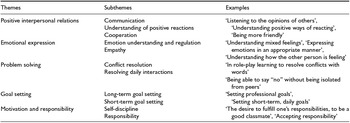
The major themes that emerged from analysis of the initial focus group question regarding which socioemotional skills had been developed as a result of the SEL program included the themes of positive interpersonal relations and emotional expression. Other themes included increased ability in problem solving, goal setting, motivation, and acceptance of responsibility (see Table 1).
Themes, Subthemes and Illustrative Examples of Opinions Expressed in Response to the First Discussion Question: In Your Opinion, Which Skills Have the Students Developed as a Result of the SEL Program?

In regard to the students’ positive changes in interpersonal relationships, teachers mentioned more adaptive communication, interpersonal understanding, and mutual cooperation. One teacher offered the following conclusion regarding her observations of relationship benefits from the SEL program:
In observing my students I can assuredly say that the friendships in the class have become more lasting, the students have learned to develop positive, stable and trustworthy relationships. The students are better able to understand each other, to listen, to depend upon one another. They have learned skills of cooperation, how to resolve differing opinions. Students less often make rash judgments, but first try to speak with one another, to understand differing opinions and perspectives on the situation.
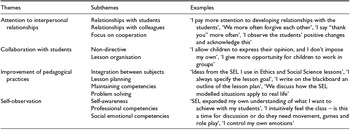
With the second focus group question, the emphasis was placed upon the teacher as a crucial component of the maintenance of the SEL program — ‘What changes in your own teaching approach have you observed after the implementation of the SEL program?’ One of the major themes (see Table 2) that emerged was that the teachers were paying more attention to their relationships with students and colleagues. They also mentioned that their means of communication with students had changed — their communication had became less directive and more facilitating of the students’ active participation. The teachers also stated that their pedagogical practices had changed and that they purposefully expand and carry forward the principles of SEL outside of the classroom, integrating these principles with lessons in other subject areas, and making connections with problem solving in daily situations. They mentioned that their ability to self-reflect had developed. They commented on their increased ability to understand their role within specific situations and to adapt their approach in regard to the specifics of the class composition and classroom climate. The teachers also remarked that they are better able to control their own emotions.
Themes, Subthemes and Illustrative Examples of Opinions Expressed in Response to the Second Discussion Question: What Changes in Your Own Teaching Approach Have You Observed After the Implementation of the SEL Program?

Within one of the focus groups with teachers from a large public school in the capital city, some of the participants responded with partially negative responses, indicating that SEL is one of many projects in which the school had participated, and therefore that their pedagogical practices had not changed.
On the other hand, the teachers from another large capital city school commented that specifics of the SEL program content were closely aligned with examples and metaphors that they themselves had previously used to help their students understand socioemotional principles. The teachers recognised that some of these were examples that they had provided for the SEL program authors during the pilot phase of the Latvia SEL program development. For these teachers, this created an appreciation of the fact that their ideas had been heard and incorporated, and this enhanced their motivation and desire to use and maintain the SEL program in their school.
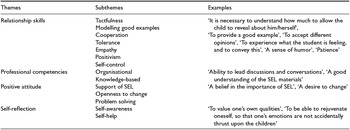
The themes that emerged in response to the third focus group question ‘Which social and emotional competencies of the teacher are crucial for successful maintenance of the SEL program?’ included relationship skills, professional competencies, positive attitude, and self-reflection (see Table 3). The teachers were united in their opinion that their own interpersonal skills related to their ability to cooperate and to demonstrate good relationship models for their students and their own tolerance and empathy were very important aspects of SEL program success. The teachers indicated an awareness of the significance of positive changes in their own socioemotional skills for the development of social and emotional competencies in their students. It seems very meaningful that some of the teachers spoke about the importance of the teacher's attitude toward the SEL program and the teacher's ability to self-reflect. They expressed the opinion that it is important for teachers to be open to change and self-development, and that it is necessary to express one's positive attitude about the program not only in words, but also in deeds.
Themes, Subthemes and Illustrative Examples of Opinions Expressed in Response to the Third Discussion Question: Which Social and Emotional Competences of the Teacher are Crucial for Successful Maintenance of the SEL Program?

The teachers’ insights in regard to the issue of social and emotional awareness are illustrated by the following acknowledgment:
This year I had one experience when I lost control of myself and I raised my voice too high. And then the next day I understood that this was not good, and I publicly apologised to the class. The class responded — ‘Yes, teacher, we understand, it's fine’ — and some days later the parents came up to me and said that their children valued very highly the ability of a teacher to ask for forgiveness.
This illustration points to the issue of how the teachers involved in the implementation of the Latvia SEL program have themselves gained benefit in regard to their own socioemotional competencies, and how they have also increased their ability to acknowledge and speak about situations that have been socially and emotionally difficult, but which have subsequently been resolved.
Discussion
The answers that teachers provided to the three focus group interview questions were thematically analysed in order to ascertain the opinions of the teachers regarding various aspects associated with Latvia SEL program's effectiveness and sustainability, and benefits that students and teachers have gained from the program, including positive changes in the teachers’ own social and emotional competence.
In providing their views on the benefits of the SEL program for students, the teachers emphasised the improvement in interpersonal relationships, but also mentioned other social and emotional competencies that had been included as thematic blocks within the Latvia SEL program — positive communication, emotion regulation, goal setting and problem solving, as well as character building and increases in academic motivation. These results also align with other similar SEL conceptual models that include character development as an aspect of socioemotional competence (Elias, Reference Elias2009) and the five competence model, which includes self-awareness, self-management, social awareness, relationship skills, and responsible decision making (Zins, Weissberg, Wang, & Walberg, Reference Zins, Weissberg, Wang and Walberg2004; www.CASEL.org).
The teachers commented that among the benefits of the SEL program is that it is sequentially organised, systematic, and coordinated from one grade level to the next, continually adding upon the development of each of the four SEL competence areas. The active learning approach helps the students to more readily gain new skills and to develop their personality. The results from this study also align with the conclusions from Durlak et al. (Reference Durlak, Weissberg, Dymnicki, Taylor and Schellinger2011), indicating that SEL program effectiveness components can be characterised by the acronym SAFE (sequenced, active, focused, explicit).
It is known from experience in other countries that the integration of the SEL program in the school system may create systemic resistance because it entails changes in the daily routines and rituals, a necessity to alter accustomed activities, and this may prove to be a challenge, especially in situations of a tight daily schedules (Elias, Reference Elias2010; Elias et al., Reference Elias, Leverett, Duffell, Humphrey, Stepney, Ferrito, Durlak, Cormitovich, Weissberg and Gullota2015). The school administration's initiative in creating a positive school climate, and the modelling of social and emotional competencies, as well as the development of clear norms and values for the school, has shown to be a positive promoting factor in previous studies. Administrative support of the SEL activities at the broader school level helps students to develop positive interpersonal relationships and to feel a greater sense of belonging to the school (Durlak et al., Reference Durlak, Weissberg, Dymnicki, Taylor and Schellinger2011; Mart, Weissberg, & Kendziora, Reference Mart, Weissberg, Kendziora, Durlak, Domitrovich, Weissberg and Gullotta2015). SEL program maintenance is also facilitated by parallel programs that support positive behaviour (Merrell & Guelder, Reference Merrell and Guelder2010), and during the focus group discussions of this study, the teachers also commented upon the positive effects of the positive behaviour program that had been simultaneously implemented in the school.
In general, in responding to questions about the benefits of the Latvia SEL program, one of the most prominent themes mentioned by the teachers was in regard to interpersonal relationships. The teachers pointed out that the content of the SEL program has specifically facilitated both student-student and teacher-student relationships. As a result of their participation and implementation of the SEL program, the teachers have begun to pay more greater attention to the quality of their interpersonal relationships with students, and also with their colleagues. These positive changes in teacher-student relationships most likely will be of future benefit to both students and the teachers themselves, as noted by previous researchers. These positive relationships foster the students’ academic and personal growth, both as a result of their exposure to models of positive relationships and by the teacher's greater ability to engage the students in activities that serve to enhance their development and achievement (Birch & Ladd, Reference Birch and Ladd1997; Murray & Greenberg, Reference Murray and Greenberg2000; Pianta, Hamre, & Stuhlman, Reference Pianta, Hamre, Stuhlman, Reynolds and Miller2003; Williford & Wolcott, Reference Williford, Wolcott, Durlak, Domitrovich, Weissberg and Gullotta2015). The increase in positive teacher-student relationships will also most likely have future benefits for the teachers themselves, as previous researchers have shown these relationships contribute to the teachers’ level of motivation and self-efficacy (Spilt et al., Reference Spilt, Koomen and Thijs2011). The teachers also mentioned that in their pedagogical practice they are now devoting greater attention to fostering positive attitudes towards learning in general, cooperation among classmates, and conflict resolution approaches that are based on understanding of SEL principles.
In regard to their own social and emotional competencies, the teachers spoke about the benefits of being aware of one's own thoughts, emotions and behaviour, and of acknowledging the extent to which teachers and students have bidirectional influence upon each other. Self-reflection is part of a broader metacognitive process that includes not only the ability to be aware of oneself, but also the ability to see others as distinct individuals with their own thoughts, emotions, and needs (Benbassat & Priel, Reference Benbassat and Priel2015). This competence allows teachers to react in a more controlled manner and to observe and gain greater in-depth understanding of their own experience. For example, in one of the focus groups, a teacher expressed her view that teachers must observe mental hygiene so that they do not accidentally project their own emotions onto the students. Other authors have also commented on the importance of the teacher's own social and emotional competence as a facilitating factor in the implementation of SEL programs (Elbertson, Brackett, & Weissberg, Reference Elbertson, Brackett, Weissberg, Hargreaves, Lieberman, Fullan and Hopkins2010). At the same time it must be noted that in response to the interviewer's question about the teacher's own socioemotional competence, some of the focus group participants spoke instead about their professional skills, such as the importance of knowing how to lead a discussion, maintaining discipline during the role-play exercises, and being able to flexibly adapt the SEL themes. This tendency to pay attention to professional skills instead of personal socioemotional skills was also noted in a previous study (Martinsone & Damberga, Reference Martinsone and Damberga2016).
Positive interpersonal relationships was a prominent theme that the teachers acknowledged in regard to aspects that are necessary for successful SEL implementation and maintenance. The teachers also commented on the necessity to develop positive relationships with the school administration and other school personnel. Previous research has also shown that for the maintenance of the SEL program, it is useful to have a multilayered support system whereby other school professionals can work with individuals or small groups to strengthen the social and emotional competencies that have been addressed during the SEL lessons, especially in situations of developing behavioural problems (Mart et al., Reference Mart, Weissberg, Kendziora, Durlak, Domitrovich, Weissberg and Gullotta2015). Another important theme put forward by the teachers was concerning the necessity for a positive attitude in order to have successful SEL program implementation. Also, previous researchers have shown that if the teacher is doubtful about the necessity of SEL, or doubtful of his or her ability to implement the program, then this may serious impede the implementation of the SEL program, and can foster discontent among the teachers (Collie, Shapka, Perry, & Martin, Reference Collie, Shapka, Perry and Martin2015; Kress & Elias, Reference Kress, Elias, Sigel and Renninger2006).
Teachers’ perceptions differed as to how they evaluated their own investment in facilitating the SEL process, with some teachers expounding a great deal of initiative — for example, in proposing to invite parents to some of the SEL lessons. Such a practice of fostering positive relationships with parents could be very useful for disseminating within society at large the importance of SEL and for expanding the school administration's and community's interest in supporting the program. By facilitating a broader understanding of the SEL principles, there is greater opportunity for these principles to become embedded in the community (Catalano, Berglund, Ryan, Lonczak, & Hawkins, Reference Catalano, Berglund, Ryan, Lonczak and Hawkins2004; Elias et al., Reference Elias, Leverett, Duffell, Humphrey, Stepney, Ferrito, Durlak, Cormitovich, Weissberg and Gullota2015).
Limitations
One of the limitations of this study was that the first author of this focus group research was also the first author of the Latvia SEL program who organised the implementation of the program almost five years ago. Therefore, in leading some of the focus groups and in analysing the discussion transcripts, it was necessary to be very aware of possible confounding aspects and the necessity to present oneself in the most neutral possible manner, and to also be aware of possible tendencies of researcher's bias. Second, due to financial constraints, each focus group was led by only one moderator who was also then responsible for observations and note taking. This also precluded the possibility for two moderators to compare and align notes at the end of each discussion.
Nevertheless, the discussion transcript analysis allowed comparison of themes expressed by the various focus groups, and it was found that there was great theme congruence among the various groups, including the two groups led by the regional supervisors. Also, due to financial constraints, it was not possible to achieve total school randomisation for participation in the focus groups, and therefore one cannot conclude that the results of this study represent all the schools that have implemented the Latvia SEL program.
Conclusions
In summary, one of the major themes presented by the teachers was the theme of relationships as a benefit from the SEL program, as well as a prerequisite for successful maintenance and sustainability of the program. The theme of relationships was prominent both in regard to student-student relationships, teacher-student relationships, teacher-administration relationship, and more general positive relationships with society at large. Second, the teachers pointed to several qualitative changes that they noticed in their own pedagogical practice that they attributed to the implementation of the SEL program in their school. Third, the teachers acknowledged that for quality implementation of the SEL program, the social and emotional competencies of the teacher are important as well. The teachers pointed to the significance of tact, tolerance, self-control, emotional sensitivity, and the ability to demonstrate positive behavioural models for the students. The teachers mentioned the benefits of a positive and engaging attitude toward the SEL material and the benefits of their ability to self-reflect, allowing for an awareness of oneself as a part of the dynamically changing school environment, and allowing for greater self-understanding.
Acknowledgments
The Latvia SEL program was developed as a part of the European Social Fund Project ‘Development and Implementation of Support Programs for Establishing a Support System for Young People at Risk of Exclusion’, and it was one of several subprograms aimed at reducing pupils’ social exclusion and school drop-out rates.
Conflict of Interest
None.