INTRODUCTION
An Integrated Farming System (IFS) can ensure the highest standard of food production with the minimum environmental impact with even highly vulnerable climatic conditions with the available resources accessible to farmer. IFS has revolutionised conventional farming of livestock, aquaculture, horticulture, agro-industry and allied activities in some countries, including India. Humans developed agricultural systems that combined crop production with animal husbandry 8 to 10 millennia ago (Allen et al., Reference Allen, Baker, Segarra and Brown2007; Halstead, Reference Halstead1996; Russelle et al., Reference Russelle, Entz and Franzluebbers2007; Smith, Reference Smith1995). Research on integrated crop and livestock systems has found to be highly productive and environmentally sustainable (Allen et al., Reference Allen, Brown, Kellison, Segarra, Wheeler, Dotray, Conkwright, Green and Acosta-Martinez2005, Reference Allen, Baker, Segarra and Brown2007; Russelle et al., Reference Russelle, Entz and Franzluebbers2007). This productivity often reflects the improved soil structure and fertility, weed suppression and disruption of pest cycles created by diverse crop sequences and the livestock presence (Entz et al., Reference Entz, Baron, Carr, Meyer, Smith and McCaughey2002; Humphreys, Reference Humphreys1994; Mckenzie et al., Reference McKenzie, Hampton, White, Harrington, White and Hodgon1999; Tracy and Zhang, Reference Tracy and Zhang2008; Tracy and Davis, Reference Tracy and Davis2009). IFS not only provides the means of production, such as fuel, fertiliser/manure and feed, but also a healthy environment for ecological balance (Gill et al., Reference Gill, Singh and Gangwar2010).
Many attempts have been made to integrate the desirable features of farming system research into mainstream agricultural research so that the technologies developed are relevant, client-oriented and location-specific. IFS is a reliable way of obtaining high productivity with substantial nutrient economy in combination with maximum compatibility and replenishment of organic matter by way of effective recycling of organic residues/wastes etc. obtained through the integration of various land-based enterprises (Solaniappan et al., Reference Solaniappan, Subramanian and Sankar2007). With some 80% operational farm holdings in India being less than one hectare, and with emphasis given to cereal production, there is a high risk of crop losses due to flood or drought. Historical records indicate that extreme excess or deficit occurs in one or other part of the region every year. Climate model simulations (Hennessey et al., Reference Hennessey, Gregory and Mitchell1997) and empirical evidence confirms that warmer climates because of increased water vapour lead to more intense precipitation events and therefore increase the risk of floods (Intergovernmental Panel on Climate Change (IPCC), Reference Solomon2007), and similarly, larger breaks within the monsoon season may cause severe drought conditions across the region. The recent extreme rainfall deficit that occurred over Bihar during June and July of 2009 incurred a loss of USD 40 million to the state exchequer (Khan et al., Reference Khan, Singh, Singh, Upadhyaya, Srivastava, Dey, Kumar and Subash2009). Thus, small and marginal farmers can take a suitable crop along horticulture, animals, fisheries and other components that would minimise risks and provide additional income and employment from the same piece of land. Integrating different components with the crop will increase profitability through recycling of waste from one component into another. This investigation evaluating different farming system models was undertaken to identify suitable enterprise combinations and assess returns and employment opportunities.
MATERIALS AND METHODS
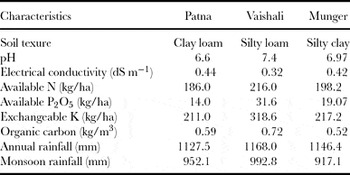
Field studies on the integration of different components with crop in IFS mode and recycling of resources within the system were carried out at three locations, viz. Patna (25°37′ N, 85°12′ E), Vaishali (25°51′ N, 85°21′ E) and Munger (25°6′ N, 86°16′ E) districts, from 2007–2008 to 2009–2010 (three years) involving crops, poultry, cattle, goat, mushroom farming, fish and ducks in different combinations. The initial soil physical and chemical characteristics of these sites are given in Table 1.
Initial soil physical and chemical characteristics and rainfall of study sites.

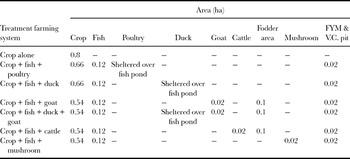
Seven farming system treatments were evaluated with each been allocated an area of 0.8 ha (2 acre). These systems were (i) crop alone, (ii) crop + fish + poultry, (iii) crop + fish + duck, (iv) crop + fish + goat, (v) crop + fish + duck + goat, (vi) crop + fish + cattle and (vii) crop + fish + mushroom. In 2-acre farm, an area of 0.1 ha was assigned for growing fodder crops to feed cattle (3 cows + 3 calves) and goat (20 female goat + 1 buck), 0.02 ha allocated for goat shed, 0.02 ha for cattle shed, 0.02 ha for mushroom shed, 0.02 ha for farm yard manure (FYM) and vermi-pits and remaining 0.12 ha was allotted to 2 fish ponds. The cropping area of each system varies depending upon the area occupied by different components/enterprises of that farming system (Table 2). In another 0.8 ha, conventional cropping system as practiced by farmers was taken up for comparison. In conventional cropping systems, (i) rice (Oryza sativa L.)–wheat (T. aestivum) and (ii) rice (Oryza sativa L.)–maize (Zea mays L.), each in 0.4 ha as practiced by farmers were followed, while under IFS, (i) rice (Oryza sativa L.)–wheat (T. aestivum)–moong (Vigna radiata) and (ii) rice (Oryza sativa L.)–maize (Zea mays L.)–moong (Vigna radiata) were taken as crop. In ‘crop alone’ treatment, two cropping systems, viz. rice–wheat–moong and rice–maize–moong, were grown with recommended dose of fertiliser, i.e. 120:60:40 kg NPK/ha each for rice, wheat and maize and 20:60 kg NP/ha for moong crop (as inorganic form). The yield of rice–wheat–moong and rice–maize–moong obtained from different organic and inorganic amendments as discussed below and averaged in each three locations were taken as yield of ‘crop alone’ treatment as well as crop component under different farming systems. To sustain the productivity of soil, inorganic fertilisers combined with organic wastes obtained from various components of IFS-recycled pond silt, poultry manure, duck manure, goat manure and cow dung as FYM, composted residues (cereal residues) and vermicompost, each the rate of 10 t/ha, were applied to the crops grown under different IFS modules. The FYM, vermicompost, poultry manure, duck manure, goat manure as well as poultry and ducks’ recycled silt, were used once in a year for raising crops. The rest of the nutrients were applied in the form of inorganic fertilisers to each crop as per recommendation. Water was applied as per requirement of different enterprises. All crops were irrigated on the basis of optimum irrigation water/cumulative pan evaporation (IW/CPE) ratio and 5 cm water was applied for each irrigation. Summer maize (Zea mays L.)–napier grass (Pennisetum purpureum Schum.)–berseem (Trifolium alexandrinum) fodder system was followed in 0.1 ha of land.
Allocation of area under different components of farming systems.

FYM – farmyard manure, V.C. pit – Vermi Compost Pit.
One hundred chickens and 35 ducks sheltered over two fish ponds and a cattle unit located in a cattle shed were linked to supplement the feed requirements of poly-cultured 300 fingerlings reared in each pond to assess the feasibility of rearing fish by using different manure as feed. Vermi-pits and FYM-pits were also linked with cattle and crops.
Under the goat component, 20 female goats and one buck (Black Bengal) were reared for meat with goat manure used for crops. In one year, 60 buck kids were reared and sold at USD 2.18/kg live weight (kids were sold at the age of 9–10 months). Under the poultry component, 100 broiler chicks/batch (total six batches/year) were maintained. Each batch was maintained for 40 days and broilers attained an average weight of 1.5 kg during the period, which were sold at USD 1.53/kg live weight. In all 25% of poultry droppings/litters were used in the pond as fish feed and 75% were used as manure for crops.
Under the fish component, mixed fish farming was practised. Fresh water fish, rohu (Labeo rohita) as a column feeder (30%), catla (Catla catla) and silver carp (Hypophthalmicthys molitrix) as surface feeders (30%) and mrigal (Cirrhinus mrigala) and common carp (Cyprinus carpio var. communis) as bottom feeders (40%) were raised in both the ponds. At the end of the first year, the adult fishes were harvested thrice at 20-day intervals. Water in the ponds was drained and dried with settled silt (5 tonne) being removed and applied as organic fertiliser to the first crop in the sequence. In the duck enterprise (Khaki Campbell), 30 females and five male ducks were integrated into the pond. Duck droppings were fed to the fish with no extra feed being provided. Number of eggs laid/annum were recorded.
The year-round mushroom production was also included in the system in an area of 0.02 ha by using a small hut made with available local material. From March to September, Paddy straw mushroom (Volvariella spp.) and milky mushroom (Calocybe indica) and from October to February, Oyster mushroom (Pleurotus spp.) were raised by making bamboo racks in the shed. 75–80 % humidity was maintained in the hut during the crop season by sprinkling water over the walls of the hut and the bags. Effective agronomic management was provided to all crops, and healthy and hygienic conditions were maintained for animals and birds as recommended. Concentrate feed for the animals and poultry were purchased from the market and expenditure on these items was included in the cost of production.
To compare the productivity of different systems, the yield of each enterprise/component was converted into RGEY. The prices used for converting the yield into RGEY and for computing the economics were the prevailing market price of different commodities, viz. rice grain at USD 0.26/kg, wheat at USD 0.24/kg, moong at USD 0.65/kg, poultry at USD 1.31/kg, duck egg at USD 0.065/egg (or say USD 0.78/kg), goat meat at USD 3.27/kg, fish at USD 1.53/kg and milk at USD 0.44/L. Observations were made on productivity in terms of rice–grain equivalent, economics and employment for different farming systems, as well as conventional cropping system.
The capital costs of establishing different IFS models vary with the enterprises involved in each system. The costs incurred for each are as follows: construction of pond of 0.06 ha area at USD 762.5 per pond (USD 1525 for two ponds); construction of FYM/vermi-pits (six pits) at USD 327; construction of thatched cattle shed at USD 436; thatched goat shed at USD 436; thatched poultry shed (100 birds capacity) at USD 327; thatched duck shed (35 ducks capacity) at USD 327; thatched mushroom shed (100 bags capacity) at USD 436; price of cow at USD 327/cow (USD 980 for three cows); price of goat at USD 11/goat (USD 231 for 21 goats); price of duck at USD 1.6/duck (USD 57.2 for 35 ducks), whereas in case of poultry, cost of one-day-old chick was taken under recurring cost. Two situations have been considered for calculating the net returns from the models: (i) A farmer developing an IFS model with his own capital, and (ii) a farmer borrowing 50% of the capital cost at 6% per annum. In addition, USD 217.9 was provided as subsidy under the Farming System Development Programme by the State Government of Bihar (Kumar et al., Reference Kumar, Shivani, Singh and Bhatt2011). It should be noted that credit facilities are available with different organisations, including. NABARD, banks, rural banks and cooperative banks. The total production cost was calculated by summing the recurring cost of different components, land revenue, depreciation value, interest on working capital at 4% and interest on fixed capital at 3% per annum. Depreciation (D) per year was calculated using the Straight Line method (D = (asset value – junk value)/life of asset) assuming that the system has a life of at least 10 years. The life of a duck was assumed as three years and life of other livestock and components was assumed as 10 years. In case the farmer opts for a loan, he has to repay the financial agency monthly or annually for a maximum period of five years. The repayment will reduce his income for five years. Therefore, the value has been distributed over the system's life and an annual repayment calculated.
The IFS models were evaluated using a sustainability index described by Vittal et al. (Reference Vittal, Sankar, Singh and Sharma2002). The sustainability index for any IFS model can be computed as follows: SI = NR – SD/MNR, where, NR stands for net returns obtained under any model, SD stands for standard deviation of the net returns of all models and MNR stands for maximum net returns attained under any model. A suitable and viable IFS model could be identified for their existence based on net return, sustainability index, employment generation and improvement in soil fertility attained over a period of time.
RESULTS
System Productivity
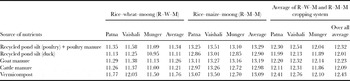
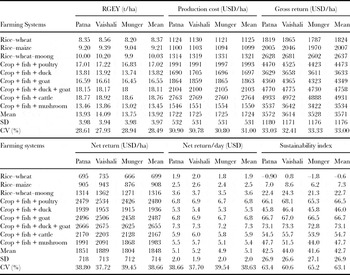
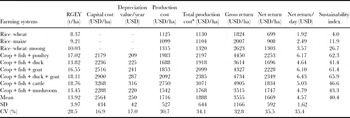
Integrated Farming System provides an opportunity to increase yield and productivity per unit area by virtue of intensification of crops and associated enterprises. The productivity of different components (viz. crop/fish/duck/poultry/goat/cattle) was calculated as RGEY for making comparisons. Among different cropping sequences under IFS compared, rice–maize–moong recorded higher average mean yields of 13.29, 12.90, 13.19, 12.98 and 13.09 t/ha when applied with recycled fish pond silt + poultry manure, duck manure, goat manure, cattle manure and vermicompost, respectively, than rice–wheat–moong cropping sequence (Table 3). However, rice–maize–moong registered higher average productivity of 13.29 t/ha with recycled pond silt + poultry manure (50 + 50%). Total 35.2 tonne of grass–legume mixture (maize–napier–burseem) was also obtained from 0.1 ha, and was utilised as feed for animals. The highest yield from different cropping sequences was obtained with vermicompost (12.43 t/ha) and was followed by poultry recycled droppings with pond silt (12.32 t/ha). The average yield of rice–wheat–moong and rice–maize–moong was also higher than the yield of conventional cropping system (rice–wheat and Rice–maize). In traditional/conventional cropping systems, rice–wheat and rice–maize recorded an RGEY of 8.37 t/ha and 9.21 t/ha, respectively (Table 4).
Productivity (RGEY) in t/ha of different cropping sequences under IFS, mean yield of three years (2007–2010) affected due to different manures/by-products.

In addition to this, 35.2, 36.5 and 33.1 tonne of grass–legume mixture was obtained from 0.1 ha area at Patna, Vaishali and Munger, respectively, which was used as feed for cattle and goats.
RGEY: rice grain equivalent yield.
Productivity (RGEY) t/ha and economics of different farming systems at three places (mean value of three years, 2007–2010).

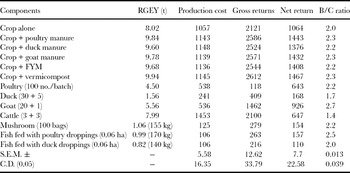
Crop + fish + cattle integration recorded the maximum RGEY at all the sites with an average of 18.76 t/ha, but in terms of economics, crop + fish + duck + goat supersedes (USD 2655/yr) (Table 5). Treatments applied with enriched pond silts having higher nutrients and integration of high-value components, such as fish/poultry/duck/goat/cattle, might have contributed to better crop productivity. Similar results of high productivity were also reported by Jayanthi et al. (Reference Jayanthi, Balusamy, Chinnusamy and Mythili2003) by integrating crop + fish + goat in lowland farming in Tamilnadu, and Korikanthimath and Manjunath (Reference Korikanthimath and Manjunath2010) in Goa. The results of these combinations for three years over the study sites revealed that integration of crop + fish + duck + goat resulted higher average sustainability index (73.1%). Cropping alone (rice–wheat–moong) has resulted in lower sustainability index value of 22.7% only. While considering the individual animal component, average productivity of 5.56 t/ha was obtained with 20 + 1 goat unit (Table 6). The goat unit also produced 2.3 t of goat manure, which was used as manure within the system. While assessing the feasibility of rearing fish by using poultry and duck droppings as feed, the fishes fed with poultry droppings resulted in higher average fish yield of 170 kg/0.06 ha over duck-fed droppings (140 kg/0.06 ha) during the experimental period. A higher level of fish productivity through the recycling of poultry manure was reported by Singh et al. (Reference Singh, Singh, Singh and Singh2004) because of better plankton development as well as direct feed to fishes.
Average productivity (RGEY) t/ha and economics of different farming systems at three places (mean value of three years, 2007–2010) (after considering the capital cost and depreciation value/year).

* Total production cost includes depreciation value, land revenue and interest on working and fixed capitals.
Average productivity (t) and economics (USD) of individual components under developed integrated farming systems (2 acre), mean yield of three places during three years (2007–2010).

Note. Figures in parenthesis denote actual yield; RGEY: rice grain equivalent yield.
Economic analysis of the system
The economic analysis of the system (Table 6) revealed that the integration of crop with other enterprises not only increased the RGEY but also provided more income than crop cultivation alone. Here we have included the capital cost and its depreciation value per year for different enterprises. The annual repayment of loan ranges from USD 256 for crop + fish + poultry system to USD 386 for crop + fish + cattle system. Crop integrated with fish, duck and goat was found highly profitable with the highest net return (USD 2349/yr) and the system also recorded higher per day net return (USD 6.43/day). The crop + fish + poultry system was evaluated as the next best system followed by the crop + fish + goat system in terms of net return and net return/day. The net return as well as net return/day was more in all the systems compared with systems using a mid-term agriculture loan, where it was assumed that 50% of the capital cost was taken as loan (mid-term agriculture loan), in which a farmer has to repay over five years. Thus, the integration of crop with suitable enterprises and recycling of wastes increased profitability and employment opportunity in any of the systems by adding an optimum amount of organic wastes into the system.
Nutrient recycling
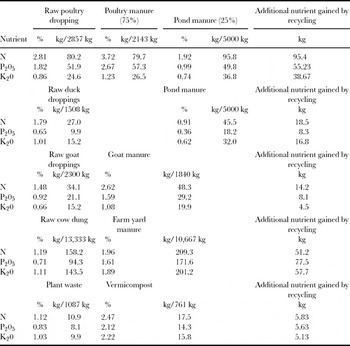
Samples of raw animal and bird manures, recycled products like FYM, goat manure, vermicompost and silted silt in the ponds were collected and analysed for their nitrogen, phosphorus and potassium (NPK) contents. The average quantity of nutrients received through poultry, duck, goat, cattle as droppings and plant wastes in the form of vermicompost for the study sites are given in Table 7. Residue recycling revealed that integration of crop with fish and poultry resulted in higher fish productivity over duck dropping-fed fish, which resulted in a higher net return of USD 157/yr from 0.06 ha of the pond. Poultry unit had produced 2857 kg of raw droppings and out of total raw droppings produced, 25% was fed to fishes and from the rest 75% poultry manure was prepared and applied to the crops, whereas in case of duck unit, 1508 kg raw dropping was produced per year and total droppings were allowed to feed fish. Poultry and duck unit had generated an average of 80.2, 51.9, 24.6 kg and 27.0, 9.9, 15.2 kg of N, P2O5 and K2O per year, respectively. Recycling of droppings through fish ponds enhanced the nutrient content by two to three folds (95.8, 49.8, 36.8 kg and 45.5, 18.2, 32.0 kg) of N, P2O5 and K2O for 25% of poultry and whole duck droppings, respectively. Apart from this, poultry unit had also provided 79.7, 57.3 and 26.5 kg of N, P2O5 and K2O in the form of poultry manure. From raw goat droppings (2300 kg), goat manure was prepared, through which 14.2:8.1:4.5 kg additional NPK was gained. In the case of FYM and vermicompost also the additional nutrients were gained through recycling. Applications of these nutrients as organic sources not only increased the yield but also reduced the application of inorganic fertiliser and thereby increased net return. Manure prepared through recycling of poultry droppings, duck droppings, pond silt, FYM, goat manure and vermicompost (crop residues + mushroom wastes) within the farm acted as an efficient and valuable input for crop production. Acharya and Mondal (Reference Acharya and Mondal2010) also reported similar benefits due to recycling of different animals’ droppings and plant wastes in their findings. If we analyse all animal and plant wastes, then it can be interpreted that cattle recycled droppings had generated the highest P2O5 and K2O, while poultry had generated the highest N into the system. The additional nutrients gained by recycling of waste/by-products over raw wastes were also confirmed by Rangasamy and Jayanthi (Reference Rangasamy and Jayanthi1994) and Baishya et al. (Reference Baishya, Pathak, Bhowmick, Kalita, Mazumder, Chutia, Dutta, Singh, Gangwar and Sharma2005) in lowland situation.
Average nutrient recycling within integrated farming systems over Patna, Vaishali and Munger (mean value of three years, 2007–2010).

Labour requirement
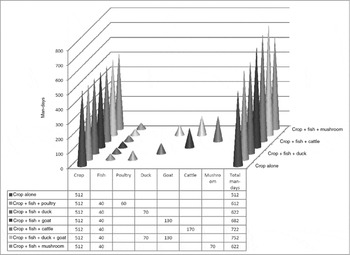
Total employment generated through different farming systems vary due to different labour requirements of different enterprises (Figure 1). The labour requirement increased by 100, 110, 110, 170, 210 and 240 man-days in crop + fish + poultry, crop + fish + mushroom, crop + fish + duck, crop + fish + goat, crop + fish + cattle and crop + fish + duck + goat, respectively. Thus, the crop + fish + duck + goat combination required maximum number of man-days/labour, i.e.752 man-days. This was followed by labour requirement in crop + fish + cattle farming system (722 man-days). However, crops grown in conventional system required least man-days (416 man-days), whereas crops grown in farming system required 96 more man-days (512 man-days) because of the inclusion of one more crop in the sequence.
Individual component and total system man-days requirement per year.

DISCUSSION
When considering the individual animal component, a higher average net return of USD 926/yr was obtained with 20 + 1 goat unit. The highest average net return of USD 2655/yr was obtained from a 1.0-ha area with an average annual expenditure of USD 2103/yr by integrating the crop + fish + duck + goat combination into the system, followed by the crop + fish + goat (USD 2487/yr) and crop + fish + poultry (USD 2480/yr) combinations. The sustainability index was also highest in the crop + fish + duck + goat combination (73.1%) followed by the crop + fish + goat (66.7%) and crop + fish + poultry (66.5%) combination. Poultry (broilers) rearing is only economical when proper care has been taken, otherwise it is a risky enterprise due to frequent occurrence of pests and breakouts of severe diseases leading to 50–100% mortality in the flocks, which would result in a high degree of economic loss. Therefore, proper hygienic conditions should be maintained and the birds should be properly vaccinated (Solaniappan et al., Reference Solaniappan, Subramanian and Sankar2007). A higher benefit/cost (B/C) ratio was obtained in crops with the application of different droppings/recycled manures in combination with inorganic fertilisers compared with crops raised alone on chemical fertilisers as in case where only crops were taken. The crop + fish + cattle model produced a higher RGEY (18.76 t/ha) than all other models. However, when the economic aspects of different models are considered, the crop + fish + cattle model ranked fourth in respect of net returns and the sustainability index because the average incurred expenditures were higher for cattle rearing (USD 1447/yr) with a total average system expenditure of USD 2764/yr. The higher expenditure for cattle rearing was due to the purchase of concentrated feeding mixtures from the market.
Further, if concentrates were prepared at the farmer's level by producing materials from the system, expenditure could be minimised by 50% and the crop + fish + cattle system could be made more profitable. The crop + fish + duck + goat model emerged as the highest profitable enterprise for irrigated lowlands with an average net return of USD 7.3/day during the period of experimentation. This was due to the fact that the system as a whole provided an opportunity to make use of by-product or waste materials of one component as input for another. Hence, there is a possibility of reduction in the cost of production of different enterprises and finally the production cost of the system.
Because of the integration of different components in one system, an increase in employment generation on yearly basis over the study sites was represented. The average employment generation increased to 752 man-days/ha/yr by integrating crop + fish + duck + goat over all other farming systems and was followed by crop + fish + cattle (722 man-days/ha/yr). An extra average employment of 96 man-days per year was generated from crop components due to the inclusion of one more crop (moong) into the system over the traditional cropping system (rice–wheat). Keeping in view the other enterprises like fish, duck and goat, an additional employment of 40, 70 and 130 man-days were generated respectively. The combining of crops with other enterprises would increase the labour requirement and thus provide scope to employ more family labours round the year without giving much relaxation during lean season as in traditional agriculture. A similar increase in employment was also confirmed by Ravisankar et al. (Reference Ravisankar, Pramanik, Rai, Nawaz, Biswas and Bibi2007) and Singh et al. (Reference Singh, Singh, Phogat, Sharma, Singh and Singh1999) with the integration of crop + horticulture + goat + poultry into the system.
CONCLUSIONS
It is clear that small and marginal farmers cannot thrive if they are not practicing cultivation within IFS. This not only ensures economic returns but also provides increased employment. The crop + fish + duck + goat combination resulted in the best integration and provided maximum return and employment, followed by the crop + fish + goat combination. To sustain food security at household or farm level, IFS will conserve the resource base through efficient recycling of residues within the system. The dissemination of such integrated farming system models will help in promoting sustainability in agriculture and its allied sectors.
Acknowledgements
The authors would like to thank Indian Council of Agricultural Research for providing financial support to conduct this experiment. The authors also thank the anonymous reviewer and the editor for their critical comments for improving the quality of the manuscript.