The hands of patients in healthcare facilities are often contaminated with healthcare-associated pathogens.Reference Istenes, Bingham, Hazelett, Fleming and Kirk 1 – Reference Cao, Min, Lansing, Foxman and Mody 3 Patient hand hygiene could potentially be beneficial as a means to reduce the risk of these organisms contaminating devices and wounds or being ingested with subsequent colonization. Patient hand hygiene could also reduce the risk for transmission due to contact with the environment, healthcare personnel, or other patients. Based on these potential benefits, there is increasing interest in patient hand hygiene as an infection control measure.Reference Istenes, Bingham, Hazelett, Fleming and Kirk 1 – Reference Ardizzone, Smolowitz, Kline, Thom and Larson 6 However, limited data are available on the frequency of contamination of patients’ hands during hospitalization, and it has not been demonstrated that patient hand-hygiene interventions reduce such contamination. Therefore, we conducted a randomized trial to test the hypothesis that a patient hand-hygiene intervention would reduce new acquisition of hand contamination in hospitalized patients with negative hand cultures on admission.
METHODS
The Cleveland Veterans’ Affairs Medical Center is a 210-bed acute-care facility. At the time of the study, all hospitalized patients received alcohol-based hand sanitizer supplied with other toiletry items, but no education on patient hand hygiene. Supplemental Table 1 provides detailed information on the study facility.
The Cleveland Veterans’ Affairs Medical Center’s institutional review board approved the study protocol. From October through March 2014, we conducted a non-blinded parallel randomized trial of a patient hand-hygiene intervention versus standard care for a convenience sample of patients newly admitted to 4 medical-surgical wards with anticipated lengths of stay of at least 2 days. Supplemental Table 2 provides details on study procedures. Patients were excluded if they had dementia, difficulty performing hand hygiene, or methicillin-resistant Staphylococcus aureus (MRSA) colonization or Clostridium difficile infection. Verbal consent was obtained. Patients were randomized based on a coin toss. For patients in the intervention group, education was based on a “Four Moments for Patient Hand Hygiene” model.Reference Sunkesula, Knighton, Zabarsky, Kundrapu, Higgins and Donskey 7 In addition to a “Four Moments for Patient Hand Hygiene” poster (Supplemental Figure 1), intervention patients received illustrations of the effectiveness of alcohol-based hand sanitizer (Supplemental Figure 2).Reference Donskey and Eckstein 8 A bottle of alcohol-based hand sanitizer was placed at the bedside, and intermittent soap-and-water hand washing was encouraged. Patients received re-education during daily follow-up visits. During each visit, research personnel directly facilitated the use of alcohol-based hand sanitizer after the collection of hand cultures. Patients randomized to the control group had their hands cultured, but they did not receive education or hand sanitizer.
Premoistened BD BBL CultureSwabs (Becton Dickinson, Cockeysville, MD) were used to culture patients’ hands upon admission and on hospital days 2, 4, and 5 to detect important healthcare-associated pathogens that are susceptible to alcohol-based hand sanitizer: MRSA, vancomycin-resistant Enterococci (VRE), and fluoroquinolone-resistant gram-negative bacilli. The entire surface area of both hands was sampled. To test whether hand hygiene might impact environmental contamination, 5-cm×10-cm areas of the bed rail and bedside table and the entire surface area of the call button were sampled using swabs at the same time points. The swabs were cultured for MRSA and VRE as previously described.Reference Nerandzic, Thota and Sankar 9 For fluoroquinolone-resistant gram-negative bacilli, the swabs were plated on MacConkey agar (Becton Dickinson, Cockeysville, MD) containing 10 µg/mL ciprofloxacin. The microbiologist processing the cultures was blinded to the study group.
Information on medical conditions, medications, devices, mobility, and long-term care facility residence was obtained through chart review; 3 months after discharge, medical records were reviewed to assess for new colonization or infection with the pathogens. The primary outcome we investigated was new acquisition of hand contamination with pathogens. Based on preliminary data showing that ~35% of patients acquired hand contamination, a power calculation indicated that 45 patients per group would provide 80% power to detect a reduction from 35% to 10% acquisition of hand contamination. Bivariate analyses were conducted to compare characteristics of groups. Fisher’s exact test was used for categorical data and the Student paired t test was used for normally distributed data. Data were analyzed using SPSS statistical software version 10.0 (SPSS, Chicago, IL).
RESULTS
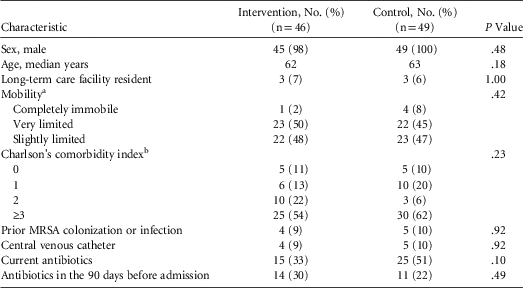
Supplemental Figure 3 provides a flow diagram for study enrollment. Of 115 patients assessed for eligibility, 95 (83%) were eligible and agreed to participate. Of these 95 participants, 49 were randomized to the control group and 46 were randomized to the intervention group; 2 participants in each group were excluded because they had positive hand cultures for MRSA on admission. There were no significant differences in the baseline characteristics of the patients in the 2 groups (Table 1).
Comparison of Baseline Characteristics of Patients in the Intervention and Control Groups

NOTE. Data are No. (%) of patients, unless otherwise indicated. MRSA, methicillin-resistant Staphylococcus aureus.
a Mobility score is a subcategory of the Braden score for prediction of pressure ulcer risk: 1=completely immobile, 2=very limited, 3=slightly limited, 4=no limitation.
b Charlson’s comorbidity index is a method of categorizing comorbidities of patients based on the International Classification of Diseases (ICD) diagnosis codes gathered from administrative data.
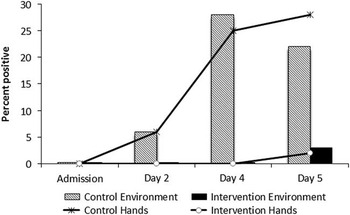
Figure 1 shows the percentage of positive hand and environmental cultures at each time point for control and intervention patients with negative hand cultures on admission. There were no protocol deviations, but the number of patients in each group decreased over time due to hospital discharges; cultures were collected through day 5 for 36 of 47 control patients (77%) and 35 of 44 intervention patients (80%; P=.80). Overall, pathogens were recovered on 1 or more days from the hands of 16 of 47 control patients (34%) versus 1 of 44 intervention patients (2%; odds ratio, 22, 95% confidence interval, 3–947; P=.001). The most common pathogen recovered from hands was MRSA (1 from intervention group and 14 from the control group). Fluoroquinolone-resistant gram-negative bacilli were recovered from hands of 2 control patients but no intervention patients. No VREs were recovered.
Percentage of positive hand and environmental cultures for the control group versus the intervention group. Patients with positive hand cultures on admission were excluded. The control group received standard care; the intervention group received education on hand hygiene. The number of patients in each group decreased over time due to hospital discharges. For the control group, N=47 on admission and day 2, N=40 on day 4, and N=36 on day 5. For the intervention group, N=44 on admission and day 2, N=37 on day 4, and N=35 on day 5. The organisms cultured included methicillin-resistant Staphylococcus aureus (MRSA), vancomycin-resistant enterococci (VRE), and fluoroquinolone-resistant gram-negative bacilli.

For MRSA, environmental contamination closely paralleled hand contamination (Figure 1). Of 14 control patients with MRSA acquired on hands, 13 (93%) had positive environmental cultures. One control patient had negative hand contamination but MRSA was detected in the environment. MRSA was also detected in the environment of the single intervention patient with MRSA hand contamination. In contrast, the cultures were negative for the environments of the 2 patients with fluoroquinolone-resistant gram-negative bacilli on hands.
No patients in either group acquired colonization or infection with the studied pathogens during admission. However, a single control patient with MRSA hand and environmental contamination was found to have MRSA nasal colonization when readmitted 1 month after the study.
DISCUSSION
For hospitalized patients with negative hand cultures on admission, we demonstrated that recovery of healthcare-associated pathogens from hands was significantly reduced in those receiving a patient hand-hygiene intervention versus those receiving standard care. These findings demonstrate that hospitalized patients frequently acquire hand contamination with healthcare-associated pathogens. Furthermore, these results suggest that patient hand hygiene could reduce the risk for acquisition of pathogens.
One surprising finding was that patient hand hygiene was associated with a reduction in contamination of environmental surfaces. This observation suggests that the frequent contamination of these sites among the control patients was derived from contaminated hands and not vice versa. Although surprising, the suggestion that patient hand hygiene might reduce environmental contamination is consistent with previous evidence that chlorhexidine bathing may reduce environmental contamination.Reference Vernon, Hayden, Trick, Hayes, Blom and Weinstein 10 Further studies are needed to determine the source of patient hand contamination.
Our study has some limitations. The study was conducted in a single institution with a small number of participants and was not blinded. We did not perform molecular typing to confirm that environmental and hand isolates were the same strains. Daily cleaning was not monitored, and the low frequency of environmental contamination in the intervention arm might have been due to better cleaning of those rooms. Finally, we did not weigh the hand-sanitizer bottles to assess usage.
In summary, a patient hand-hygiene intervention resulted in reduced contamination of hands of hospitalized patients with healthcare-associated pathogens. Future studies are planned to determine whether such interventions can reduce colonization and infection with healthcare-associated pathogens.
ACKNOWLEDGMENTS
Financial support: This study was supported by the Department of Veterans’ Affairs and by a grant from GOJO to C.J.D. GOJO did not have any role in design of the study, analysis of the data, or writing or editing of the manuscript.
Potential conflicts of interest: C.J.D. has received research grants from STERIS, Pfizer, 3M, Clorox, and GOJO, and he serves on a scientific advisory board for 3M. All other authors report no conflicts of interest relevant to this article.
SUPPLEMENTARY MATERIAL
To view supplementary material for this article, please visit https:/doi.org/10.1017/ice.2016.323