Scholars commonly assume that corruption affects elections in two ways: either by reducing turnoutFootnote 1 or by increasing retrospective voting against the incumbent.Footnote 2 This article extends this body of research and argues that the effects of corruption on elections exceed political scientists’ usual expectations. Specifically, corruption negatively affects the magnitude of ideological voting.
Building on previous studies of political corruption and theories of ideological voting, I argue that prevalent corruption negatively affects the two conditions of ideological voting: (1) voters are able to identify parties’ unique positions and (2) voters believe that parties represent them in the legislative process. When corruption is high, people feel alienated from politics and from the policy-making process.Footnote 3 Parties focus more on clientelistic promises or allegations of corruption and less on ideological programmes. As a consequence, voters have difficulties identifying parties’ positions and do not trust that parties will implement their policy proposals. Hence, they vote less ideologically. In a similar manner, electoral behaviour researchers show that contextual factors that make ideological considerations accessible and the left–right scale clearer (for example, polarization and the number of parties) increase the magnitude of ideological voting.Footnote 4 Also, factors such as political efficacy and majoritarian systems, which are associated with a high chance that parties will implement their ideological programmes, correlate strongly with the magnitude of ideological voting.Footnote 5
In testing the above propositions, I encounter two methodological challenges: (1) selection into voting of those who turn out to vote when corruption is high and (2) a possible spurious relationship between corruption and ideological voting. People may choose to abstain when they cannot identify parties’ ideological positions or when they do not believe that parties will implement their ideological programmes. These conditions lead to selection bias when I estimate the effect of corruption on the restricted sample of voters. In addition, socio-economic and political factors, such as democratic experience, age of party system, the number of parties or electoral system, correlate with both ideological voting and corruption. Hence, the relationship between corruption and ideological voting could be spurious. I address these empirical issues by using Heckman selection models of turnout and vote choice, and by controlling for the effects of other macro confounders of ideological voting in various model specifications at the end of the empirical analysis.
I test my claims on ninety-seven elections in thirty-six countries by using data from all Comparative Study of Electoral Systems (CSES) modules between 1996 and 2015. The analysis is developed in three steps. First, I test whether corruption affects ideological voting by examining cross-electoral variation in the weight that voters assign to their proximity to parties’ ideological positions in their voting decisions as a function of corruption. Secondly, I test the effect of corruption on perceptual accuracy and political efficacy and then estimate whether these two factors mediate the effect of corruption on ideological voting. Thirdly, I estimate Heckman selection models and conduct other robustness tests of the effect of corruption on ideological voting.
The results show that corruption has a strong negative effect on ideological voting: in high-corruption countries (for example, Albania in 2005), the magnitude of ideological voting is, on average, one standard deviation smaller than in low-corruption countries (for example, Finland in 2011). In other words, voters are 65 per cent more likely to vote based on ideological considerations if they live in low-corruption countries compared to high-corruption countries. Empirical tests also show that corruption strongly affects perceptual accuracy and political efficacy, which in turn affect the magnitude of ideological voting.
This study offers new insights into the negative effects of corruption. By reducing the role of ideological considerations in elections, corruption undermines democratic programmatic party–voter linkages and the role of elections in policy agenda setting. Without clear indications of voters’ policy preferences, parties can focus on non-policy activities, including corruption, which further weakens citizens’ feelings of political efficacy and reduces their ability to identify parties’ ideological positions. These implications are discussed at length in the last section of the article. The next section presents a short overview of the literature on the effects of corruption in elections. I then extend this research to ideological voting and develop my theoretical arguments. The following section introduces the data and variables, followed by a detailed presentation of the models and results.
CORRUPTION AND ELECTORAL BEHAVIOUR
More than a century ago, BrooksFootnote 6 said, ‘[I]in the whole vocabulary of politics it would be difficult to point out any single term that is more frequently employed than the word corruption’. After all this time, corruption is still strongly associated with politics, and people refer to it when they talk about misconduct in the public sphere. Seen as the misuse of public power to serve private interests,Footnote 7 political corruption implies that politicians favour certain individuals (their clientelistic networks) and their preferences in the policy-making process at the expense of the rest of the population.
These traits of corruption have been found to poison public sentiment toward democracy,Footnote 8 and to increase mistrust and feelings of alienation.Footnote 9 Citizens of countries with high levels of corruption report lower levels of trust in civil servantsFootnote 10 and low political efficacy.Footnote 11 They are also less confident in the government’s ability to consider their concernsFootnote 12 and feel excluded from the policy-making process.Footnote 13
These effects of corruption have been associated with low electoral turnout. People participate less in elections when corruption is high because they believe their vote cannot make a difference.Footnote 14 When they vote, they are expected to ‘throw the rascals out’, but this does not always happen.Footnote 15 The extent to which corruption affects retrospective voting depends on partisanship,Footnote 16 the salience of corruptionFootnote 17 and the type of corruption.Footnote 18
Electoral behaviour researchers have nevertheless omitted the effects of corruption on other voting strategies, such as ideological voting. One possible explanation is that if corruption increases retrospective voting, the magnitude of other voting strategies declines. This view is based on the assumption that voters first decide whether to engage in a punish–reward strategy and then decide whether to factor their ideological proximity to parties into their voting decision. Without clear empirical evidence of a chronological sequence of voting decision making, it is hard to establish whether ideological voting is conditional on retrospective voting. In this article, I develop a theoretical argument based on the assumption that corruption has an impact on ideological voting that is independent of whether people punish (or reward) the incumbent for corruption. At the end of the article, I discuss whether this new understanding of corruption’s impact on electoral behaviour complements or challenges the old retrospective corruption voting model. I argue that corruption erodes the importance of ideological voting because it reduces an individual’s ability to identify parties’ positions and dampens the belief that parties can implement their proposed electoral programmes.
IDEOLOGICAL VOTING AND CORRUPTION
The ideological model of voting predicts that the expected utility of voting for a party increases with its proximity to the voter’s ideological or policy position.Footnote 19 That means that voters are most likely to vote for the party closest to them on the ideological scale.Footnote 20 The extent to which voters engage in ideological voting, however, depends on two conditions: (1) they can accurately identify the parties’ positions and (2) they believe in parties’ abilities to implement their electoral programmes.
The first condition of ideological voting is based on the assumption that voters choose among parties ordered on a common political space. In other words, parties need to present clear policy platforms, and voters should be able to place these platforms on an ideological scale. If they do not know or are uncertain about parties’ positions, they cannot vote ideologically because they do not know which party is closer and cannot take the risk that the party they vote for is further from their preferred position.Footnote 21 The high cognitive costs of ideological voting makes this more likely among voters who are educatedFootnote 22 and have a high level of political knowledge,Footnote 23 political interestFootnote 24 or political sophistication.Footnote 25
As a result, ideological voting varies with the complexity of electoral and party systems, which foster or dampen voters’ ability to place parties on a common ideological scale. For example, polarization, that is, the degree of ideological differentiation between parties, increases the salience of ideological considerations and makes ideological concepts more accessible.Footnote 26 Voters can thus compare their ideological positions to those of the parties. Similarly, situations in which there are few competitive parties, ideologically distinct choices and unidimensional competition increase the magnitude of ideological voting.Footnote 27
A second condition of ideological voting, although less discussed in the literature, is voters’ confidence that the party closest to their ideological position will be successful in implementing the advocated electoral programme. Either because of prospects for a coalition government or confidence in political parties, voters are more likely to vote ideologically when they are certain that parties can implement their electoral programmes. For example, in majoritarian systems, ideological voting is more likely, as voters can be more confident that if in power, the chosen party will compromise less because the likelihood of a coalition is lower than in proportional systems.Footnote 28 In the same way, individuals who find politics meaningful are more likely to vote ideologically than those who think the political process is distant and non-responsive.Footnote 29 Moreover, programmatic linkages require ex ante credibility: ‘voters must believe that parties will both remain committed to stated policy platforms if elected and have the capacity to implement these platforms once in office’.Footnote 30
Briefly, the magnitude of ideological voting depends on (1) voters’ potential to accurately identify the true positions of parties/candidates in relation to their own ideological positionsFootnote 31 and (2) voters’ beliefs about the parties’ prospects of implementing their ideological programmes.Footnote 32 Political corruption affects each of these conditions. First, when corruption is high, the electoral discourse is more focused on clientelistic benefits or corruption blaming than on policies and electoral programmes. In addition, the new anti-system parties have not had time to develop clear and consistent programmatic messages. Corruption also increases electoral volatility,Footnote 33 which makes it harder for both voters and parties to predict future policies with certainty. Individuals may also question the validity of policy programmes and politicians’ true intentions in light of corruption, lies and empty promises. Thus when corruption is high, voters’ potential to identify parties’ true ideological positions, as well as their likelihood of voting ideologically, is lower than when it is low.
Secondly, even if voters could identify parties’ positions in a context with high corruption, they would have less confidence in the representation functions of political parties, politicians and the electoral system. As already discussed, people do not feel included in the policy-making process when corruption is high; they distrust political parties and have less political efficacy. Hence, their reliance on a party’s chances of implementing its advertised policies is lower; thus, their likelihood of voting ideologically is lower than in a corruption-free context. Although I expect the strongest results in countries where corruption is systemic, corruption scandals in countries such as the United States and the United Kingdom have been found to affect not only politicians’ evaluations but also attitudes toward political institutions.Footnote 34 Taken together, these claims generate three testable hypotheses:
Hypothesis 1: Citizens are less likely to vote ideologically in high-corruption
countries than in low-corruption countries.
because
Hypothesis 2 (Perceptual accuracy hypothesis): Citizens are less likely to accurately
identify parties’ ideological positions in high-corruption countries than
in low-corruption countries.
And
Hypothesis 3 (Political efficacy hypothesis): Citizens are less likely to believe that
parties will implement their ideological programmes in high-corruption
countries than in low-corruption countries.
Disentangling the Effects of Corruption on Ideological Voting, Turnout and Retrospective Voting
One of the challenges of empirically testing the above relationships is disentangling the effect of corruption on ideological voting from its effects on turnout. The feelings of distrust, alienation and low efficacy associated with corruption can affect both individuals’ willingness to participate in elections and the weight of ideological considerations in voting. When corruption erodes turnout by increasing feelings of misrepresentation and alienation,Footnote 35 the voter sample is biased toward those who feel efficacious or think that corruption is low, which might lead to biased estimates of the effect of corruption on ideological voting. Without aiming to identify a chronological order of turnout and vote choice (that is, individuals first decide whether to vote and then determine who to vote for), I measure the effect of corruption on ideological voting after estimating its effect on turnout using Heckman selection models.
A second challenge is that a small magnitude of ideological voting could result from a high magnitude of retrospective corruption voting. People could be voting less on ideological or policy principles because their vote choice is driven by retrospective considerations – that is, punishing or rewarding the incumbent for his or her performance on corruption. Whether prospective and retrospective voting are complementary or exclusive strategies is still debated, as is whether there is a chronological order to voters’ decisions; that is, they vote retrospectively because they could not find a viable party close to their ideological position or do not vote for the closest party because they want to punish/reward the incumbent. Without aiming to establish a causal order between ideological and retrospective models of voting, I assume that the effect of corruption on the two conditions of ideological voting is less dependent on voters’ retrospective voting. Retrospective voting, however, remains a plausible alternative explanation, and future research could test, possibly in an experimental set-up, whether voters base their decisions first on retrospective evaluations and then on ideological positions, or vice versa.
A third challenge is ensuring that the relationship between corruption and ideological voting is not spurious, caused by other factors that influence both corruption and ideological voting. Scholars of party–voter linkages have found strong associations between both programmatic and clientelistic linkages and democratic experience, age of the party system and level of economic development.Footnote 36 Young democracies are characterized by high levels of corruption, underdeveloped party systems and electoral volatility.Footnote 37 Parties cannot offer coherent, credible policies when their ideological position is not fully established, and voters cannot identify parties’ true positions. In addition, uncertainty about election outcomes and governing coalitions leads voters in new democracies to vote for extreme parties rather than for the party closest to their ideological position.Footnote 38 Similarly, low economic development increases voters’ uncertainty and responsiveness to clientelistic political offers,Footnote 39 and reduces the resources people can devote to cognitively intense voting decisions.Footnote 40
Political corruption scholars have identified several other political variables associated with corruption that also affect ideological voting. Proportional representation (PR) systems are associated with higher levels of rent-seeking corruption,Footnote 41 but this depends on the the type of PR system (open or closed list) and on the district magnitude.Footnote 42 In addition, centralized rather than federal states and presidential rather than parliamentary systems foster lower corruption.Footnote 43 Likewise, high clarity of responsibility (measured by incumbents’ majority status in the legislative branch) reduces corruptionFootnote 44 and could reduce ideological voting. In order to distinguish the effects of corruption from the effects of other institutions and political variables, I control for these in estimating the weight that people attach to ideological considerations when voting.
DATA AND VARIABLES
To test my hypotheses, I use the electoral studies of democratic parliamentary elections collected by the CSES between 1996 and 2015.Footnote 45 The CSES has collected cross-national, post-election studies since 1996 from more than forty countries. I pool its four modulesFootnote 46 and, after excluding elections due to lack of data on corruption or other macro indicators, end up with a sample of ninety-seven elections in thirty-six countries.Footnote 47 Of the elections in the sample, 34 per cent are in non-European countries, 49 per cent in Western European countries and 17 per cent in Eastern European countries. In the second part of the analysis, the sample is restricted to eighty-eight countries because several individual-level indicators (for example, income) were not available for nine countries. In total, 66,987 individuals answered all survey items of interest in those eighty-eight countries.
Ideological Voting and Ideological Proximity
To measure the magnitude of ideological voting, I estimate vote choice models using ideological proximity to political parties as one of the main predictors. The coefficient of the ideological proximity indicates the extent to which individuals with an ideological position closer to a party are likely to vote for that party.
Ideological proximity is measured using a linear loss function:
 $$I_{{ijk}} \,{\equals}\,{\minus}\left| {{\rm RIP}_{{ik}} {\minus}{\rm PIP}_{{jk}} } \right|\,$$
It is thus calculated as the reverse absolute difference between the self-reported left–right position RIPik of respondent i from country k and the ideological position PIPjk of party j in country k on the same scale.Footnote 48 A party’s ideological position is calculated as the average party position reported by respondents with high political sophistication (those who correctly answer at least two of the three political knowledge questions in Module 1–3 and at least three of the four questions in Module 4).Footnote 49 In countries where political knowledge items are missing, party position is calculated as the average placement by all respondents. Measured on a 0–10 ideological scale, high values of ideological proximity indicate closer proximity to the party.
Vote Choice
The dependent variable in the vote choice models is the self-reported vote in the current election. The CSES recodes both party-list and district votes according to the electoral system used in the year of the study.Footnote 50 In mixed electoral systems, I use the self-reported party-list vote for all respondents who reported a party-list vote and the district vote for the others. Vote choice is limited to a maximum of six parties for which I can measure respondents’ proximity to parties because respondents were asked to indicate the ideological position of up to six main parties in a country in descending order based on seat share. In countries where ideological position is reported for more than three parties, I exclude the party with the lowest vote share in the CSES database. For these parties, there is a significantly high proportion of missing values for party position items and a substantially low number of respondents who indicate voting for that party, which impedes the convergence of the conditional logit models, in some cases, and thus reduces the number of elections included in the analysis. The results are consistent with those from the models estimated with all existing parties.
Corruption
Corruption is measured at the macro level using the indicator of control of corruption from the International Country Risk Guide (ICRG).Footnote 51 The ICRG indicator is based on the evaluations of the Political Risk Group editors using pre-set questions about the political risk in each country associated with different corruption features (that is, excessive patronage, nepotism, job reservations, favour-for-favours, secret party funding, and suspiciously close ties between politics and business).Footnote 52 These are calculated using identical rules for all countries, which makes a cross-national comparison possible. The political risks associated with corruption are calculated monthly, and for the analysis I use the average monthly estimates from the election year. The monthly estimates are bound between 1 and 6, but this censored nature has been found to dampen the effect of corruption on election results, thus providing a more conservative test.Footnote 53 The initial values of the annual average have been recoded on a 0–1 scale, with high values indicating high levels of corruption.
At the individual level, the CSES provides a survey item measuring individual perceptions of corruption in its second module. Models with perceived corruption instead of the macro indicator of corruption are presented in Appendix Tables 8–12 for comparison and cross-validation. Those models should be considered in light of the endogeneity between perceived corruption and the vote decision, perceptual accuracy and political efficacy.Footnote 54
Perceptual Accuracy
The first condition of ideological voting affected by corruption is voters’ potential to position parties on the ideological scale. This depends on two factors: (1) voters’ cognitive ability to identify a party position and (2) their (un)certainty regarding their perception. A voter might be able to indicate a party position with 30 per cent, 50 per cent or even 90 per cent certainty. The level of certainty then influences whether they vote ideologically. The CSES asked respondents to place parties on an ideological left–right (or alternative policy) scale. They do not ask respondents how certain they are of their answers. I thus construct the mediator based only on respondents’ placement of party positions. Nevertheless, those who are uncertain incorrectly report party positions.Footnote 55 Thus the accuracy of individuals’ perceptions reflects both how likely they are to identify the party positions and how certain they are about their answer. Thus I use perceptual accuracy as a proxy for individuals’ potential to identify party positions. Comparing voters’ assessments of party positions with the positions given by the CSES country experts on the same scale, I estimate how likely respondents are to identify the parties’ true positions. I calculate perceptual accuracy as the reversed mean of the absolute differences between the respondents’ perceptions and the CSES experts’ opinions of parties’ ideological positions:
 $${\rm Perceptual}\,\,{\rm accuracy}_{{ik}} \,{\equals}\,{\minus}{{\mathop{\sum}\nolimits_{j{\equals}1}^J {\left( {\left| {PIP_{{ijk}} {\minus}EPIP_{jk} } \right|} \right)} } \over J}$$
where j is the party whose position is identified by respondent i in country k (PIP) or by the CSES experts (EPIP), and J is the number of parties each respondent placed on the ideological scale. The variable was initially between 0 and 9 but recoded onto a 0–1 scale, with high values indicating high perceptual accuracy. I use expert perceptions instead of the average placement of the most knowledgeable respondents because the latter could be more biased than experts in high-corruption countries. The measures calculated based on expert opinions and those of the most knowledgeable voters are nevertheless highly correlated (r=0.82), and the correlation with corruption at the macro level is strong in both cases at above 0.5.
Political Efficacy
The second condition of ideological voting that is affected by corruption is voters’ beliefs about parties’ prospects of implementing their ideological programmes. This is a function of political confidence and political efficacy. The CSES does not include survey items on political confidence, but it measures political efficacy. Voters are asked whether they think it makes a difference who is in power.Footnote 56 The variable is measured on a 1–5 scale, which I recode onto a quasi-continuous 0–1 scale for ease of comparison with perceptual accuracy. The models estimated using the initial 5-point scale with ordered logit models lead to similar results as those using the quasi-continuous measure.
Individual and Country-level Controls
I control for a range of standard individual-level characteristics typically used in vote choice models: partisanship, age, gender, urban and rural residency, education, incomeFootnote 57 and market position – for example, employed, unemployed, retired or not in the labor force. At the country level, I include an indicator of economic growth to control for retrospective voting in the presence of no individual-level evaluations of the economy in all CSES modules.Footnote 58 In addition, I control for macro confounders that could affect both corruption and ideological voting: the level of economic development, democratic experience (in years),Footnote 59 and different political and electoral institutions:Footnote 60 party age, PR and plurality electoral systems, effective number of parties,Footnote 61 district magnitude, federalism, presidentialism and majority status of the incumbent in parliament. As the sample includes a heterogenous group of countries, I include a categorical variable for whether the countries are Eastern or Western European or non-European. The economic data are taken from the World Bank; the democratic experience data, from Polity IV;Footnote 62 the effective number of parties, from Gallagher;Footnote 63 data for all other political variables are taken from the Database of Political Institutions.Footnote 64
MODELS AND RESULTS
The analysis is divided into three parts. First, I test the main hypothesis (Hypothesis 1) – that corruption affects ideological voting – by examining cross-electoral variation in ideological magnitude as a function of corruption and other possible confounders. Secondly, I test the underlying mechanisms between corruption and ideological voting by assessing the effect of corruption on perceptual accuracy (Hypothesis 2) and political efficacy (Hypothesis 3) and then estimating simultaneous (recursive) models to determine whether these two are indeed the pathway linking corruption and ideological voting. Thirdly, I estimate a hierarchical Heckman selection model to test for selection bias, considering that corruption affects not only ideological voting but also turnout. Additional model specifications test the robustness of the effect of corruption on ideological voting when controlling for different macro confounders.
Two-Stage Hierarchical Model of Ideological Voting and Corruption
In the first part of the analysis, I examine the link between corruption and ideological voting (Hypothesis 1). To do so, I apply a two-step multilevel approachFootnote 65 because vote choice is country specific with different parties in each election. That means that it has as many categories as parties in the country and cannot be used as a dependent variable in a one-step model. To measure ideological voting for all parties in a country in an election, I thus estimate conditional logit models of vote choice separately for each election in the data. From each model of the ninety-seven elections, I then extract the coefficient of ideological proximity and its standard error. I regress the coefficients against corruption and the macro confounders. Because the dependent variable in the second stage is an estimate, I apply Lewis and Linzer’sFootnote 66 feasible generalized least squares approach to estimated dependent variable (EDV) models, which offers consistent standard error estimates in spite of the variation in the sampling variance of the observations on the dependent variable.
First-stage models are separate conditional logit models in each election for each individual i and party j:
 $$\eta _{{ij}} \,{\equals}\,V_{{ij}} \,{\equals}\,\alpha _{j} {\plus}\beta I_{{ij}} {\plus}\gamma _{i}^{\prime} X_{{ij}} $$
where η ij is the utility of voter i of voting for party j, V ij is a dichotomous variable taking a value of 1 if respondent i voted for party j and 0 otherwise, α j denotes the party-specific intercepts, β is the unique coefficient of ideological proximity I ij, which is a party-specific variable, and γ i is the vector of coefficients for each individual characteristic X ij of respondent i: gender, age, education, income, market position and urban residency (in countries where it was included in the questionnaire). Models are initially estimated with ideological proximity as the only party-specific predictor. In a second model, I include a variable accounting for whether voter i is a partisan of party j as a robustness check. Partisanship is excluded initially because of ‘uncertainty about the validity of the concept outside the American context’,Footnote 67 and the endogeneity of partisanship and vote choice, especially in new Eastern European democracies.
After estimating conditional logit models for all elections, I extract the election-specific coefficients of ideological proximity, the βs. These are positive (except for the election in South Korea in 2006, for which the coefficient is negative but statistically insignificant), with a mean of 0.55 and a standard deviation of 0.19. High values indicate that as voters are closer to a party, they are more likely to vote for that party. This is highly correlated with corruption (r=0.33). In a second step, I estimate an EDV model of β in country k as a function of corruption C k and other macro variables M k (economic development and growth, democratic experience, effective number of parties, party age, PR and plurality electoral systems, district magnitude, incumbents’ majority, presidentialism, federalism, and Western, Eastern or non-European countries). Based on Hypothesis 1, I expect a negative coefficient of corruption ς:
 $$\beta _{k} \,{\equals}\,\alpha {\plus}\zeta C_{k} {\plus}\theta 'M_{k} $$
Table 1 presents the estimated coefficient of corruption from Equation 2. The dependent variable for Model 1 is the coefficients of ideological proximity from the models of vote choice without controlling for partisanship. Model 2 includes the coefficients from the models including partisanship. Model 3 is similar to Model 1 but excludes three outliers (Mexico (2006), which has a negative coefficient; the United States (2008) and Spain (2004), which both have a positive coefficient of ideological proximity that is significantly higher than those of the rest of the sample).
Second-stage Estimates of Ideological Proximity on Vote Choice

Note: standard errors in parentheses. Full models included in Appendix Table 3.
*p<0.05, **p<0.01, ***p<0.001
In all three models, the coefficient for corruption is statistically significant and negative. The eroding effect of corruption is 0.22. In high-corruption countries (for example, Albania in 2005), the magnitude of ideological voting is, on average, one standard deviation smaller than in low-corruption countries (for example, Denmark 1998 or Finland in 2011).
Corruption Effect through Perceptual Accuracy of Parties’ Positions or Political Efficacy
As predicted, corruption has a strong, statistically significant, negative effect on ideological voting. I now examine the mechanisms underlying this relationship through the perceptual accuracy of parties’ positions (Hypothesis 2) or feelings of political efficacy (Hypothesis 3). To do so, I test whether those who live in high-corruption countries are less likely to correctly report party positions and to feel politically efficacious compared to those in low-corruption countries. A significant effect of corruption in these two models, however, does not indicate that these are the mechanisms through which corruption erodes ideological voting. A clear empirical answer of the mediating effect is provided by jointly estimating the effect of corruption on ideological voting and on the perceptual accuracy of party positions or on feelings of political efficacy. Thus, I first empirically examine Hypotheses 2 and 3 and then test the mediation mechanisms.
I start by examining the effect of corruption on perceptual accuracy and political efficacy in two separate models:
 $$A_{{ik}} \,{\equals}\,\alpha _{{1b}} {\plus}\omega _{1} C_{{ik}} {\plus}\omega _{2} Z_{{ik}} {\plus}{\varepsilon}_{{1ik}} $$
 $$E_{{ik}} \,{\equals}\,\alpha _{{1b}} {\plus}\omega _{3} C_{{ik}} {\plus}\omega _{4} Z_{{ik}} {\plus}{\varepsilon}_{{3ik}} $$
Both perceptual accuracy A ik and political efficacy E ik are estimated as functions of corruption C ik and a vector of confounders Z ik. This vector includes all socio-economic characteristics included as control variables in the vote choice models X ik, except partisanship. Instead, the vector includes a measure of the strength of partisanship. The expectations are that partisans with strong attachments are more likely than non-partisans to feel politically efficacious and to place parties accurately. The vector of confounders Zik also includes all the macro variables from the second-step vote choice model: the level of economic development, democratic experience, party age, PR and plurality electoral systems, effective number of parties, district magnitude, federal state, majority status of the incumbent, dominance, and Eastern, Western or non-European countries.
Hypotheses 2 and 3 predict that both coefficients of corruption ω 1 and ω 3 are negative and statistically significant. Indeed, the empirical results support both hypotheses.Footnote 68 This means that perceptual accuracy and political efficacy are potential paths from corruption to ideological voting. Further tests are needed to empirically support the mediation mechanisms.
One option for testing the mediation mechanisms is to use the first-stage estimates of ideological voting in the previous subsection with country levels of perceptual accuracy and political efficacy as mediators in a mediation analysis. However, the analysis would suffer from the ecological fallacy, and it would be difficult to conclude that those who are less able to identify party positions or who feel that election results do not matter are voting less ideologically in countries with high levels of corruption. A second option is to include the macro corruption variable and the mediators in conditional logit with the pooled sample. To my knowledge, this is not possible. I pursue a third option: I simplify the vote choice models to allow a one-step multilevel model of the vote decision with a cross-level interaction between ideological proximity and corruption that can be estimated jointly in a simultaneous equation model framework, with the above models of perceptual accuracy and political efficacy.
To simplify the vote choice models, I look at the vote for the incumbent instead of the overall vote choice. A vote for the incumbent is measured as a dichotomous variable coded 1 if people voted for the party of the prime minister in parliamentary and semi-parliamentary systems, or of the president in presidential systems.Footnote 69 The assumption of this new model is that if people factor ideology less into their vote decision when choosing among all parties, as the previous results indicate, they also weight ideology less when deciding whether to vote for the incumbent. The disadvantage of the simplified model is that it does not allow me to estimate the conditional effect of voters’ proximity to other political parties. The advantages are that I can estimate the individual probabilities of voting for the incumbent across different levels of ideological proximity and corruption, as well as test for retrospective corruption voting.
To measure whether ideology matters less for the vote decision when corruption is high, I estimate models of the incumbent vote that include an interaction term (C k*I ik) between corruption C k and ideological proximity to the incumbent I ik. The new model includes a vector of individual-level control variables X ik for each voter i in country k,Footnote 70 as well as a vector of macro-level control variables W k, as in the EDV models:
 $$V_{{ik}}^{{\asterisk}} \,{\equals}\,\alpha _{1} {\plus}\beta _{1} I_{{ik}} {\plus}\beta _{2} C_{k} {\plus}\beta _{3} C_{k} {\asterisk}I_{{ik}} {\plus}\gamma _{1}^{'} X_{{ik}} {\plus}\gamma _{2}^{'} W_{k} {\plus}{\varepsilon}_{{ik}} $$
This is a probit regression of the (latent) vote for the incumbent (V ik). The magnitude of the ideological vote is measured by β 1; the impact of corruption on it by β 3. If the assumption that voters vote less ideologically in countries with high corruption when they vote for the incumbent is true, then β 3 is expected to be negative and statistically significant. Although this would not be different from the results in the previous subsection, comparing the magnitude of β 3 with the effect of corruption after accounting for the effects of perceptual accuracy and political efficacy on ideological voting tests the hypothesized underlying mechanisms.
To estimate the effect of corruption while accounting for the effects of perceptual accuracy and political efficacy on ideological voting, I separately include the two mediators, perceptual accuracy A ik or political efficacy E ik, and their interactions with ideological proximity in a model of the vote for the incumbent:
 $$V_{{ik}}^{{\asterisk}} \,{\equals}\,\alpha _{{1a}} {\plus}\beta _{{1a}} I_{{ik}} {\plus}\beta _{{2a}} C_{k} {\plus}\beta _{{3a}} C_{k} {\asterisk}I_{{ik}} {\plus}\gamma _{{1a}}^{'} X_{{ik}} {\plus}\gamma _{{2a}}^{'} W_{k} {\plus}\lambda _{{1a}} A_{{ik}} {\plus}\lambda _{{2a}} A_{{ik}} {\asterisk}I_{{ik}} {\plus}{\varepsilon}_{{2ik}} $$
 $$V_{{ik}}^{{\asterisk}} \,{\equals}\,\alpha _{{1c}} {\plus}\beta _{{1c}} I_{{ik}} {\plus}\beta _{{2c}} C_{k} {\plus}\beta _{{3c}} C_{k} {\asterisk}I_{{ik}} {\plus}\gamma _{{1c}}^{'} X_{{ik}} {\plus}\gamma _{{2c}}^{'} W_{k} {\plus}\lambda _{{1c}} E_{{ik}} {\plus}\lambda _{{2c}} E_{{ik}} {\asterisk}I_{{ik}} {\plus}{\varepsilon}_{{4ik}} $$
The new models (Equations 6 and 7) are jointly estimated with the models of perceptual accuracy (Equation 3) or political efficacy (Equation 4).Footnote 71 If perceptual accuracy and/or political efficacy are in the pathway linking corruption and ideological voting, the expectations are that the coefficients of their interactions with ideological proximity are positive and statistically significant λ 2a and λ 2c, and the coefficients of the interaction of corruption with ideological proximity in Equations 6 and 7, β 3a and β 3c, are smaller than β 3 in Equation 5. In other words, if corruption has an effect on ideological voting that is (partially) mediated by perceptual accuracy and/or political efficacy, the effect of corruption after accounting for the impact of these mediators is significantly reduced.
This is a simultaneous probit model set-up with the errors from the vote decision and each of the perceptual accuracy and political efficacy models correlated. I use an exclusion restriction in the vote decision equation to achieve identification by including the strength of partisanship only in the models of perceptual accuracy and political efficacy. The strength of partisanship has an expected impact on perceptual accuracy and political efficacy but not on vote choice, as there are no theoretical reasons to expect strong partisans to be more likely than non-partisans to vote for the incumbent, unless these are only the incumbent’s partisans. I estimate the models using conditional mixed-process models and maximum likelihood.Footnote 72 Given the hierarchical structure of the data, that is, individuals within elections within countries, I calculate standard errors using nonparametric bootstrapping, resampling elections and countries.Footnote 73
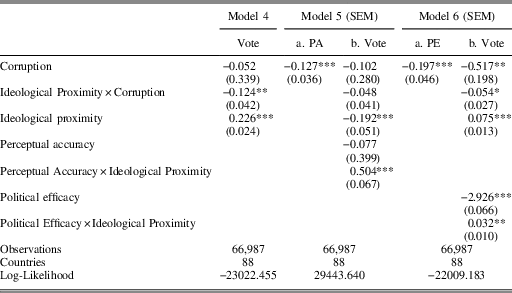
The parameter estimates of interest from Equations 3–7 are presented in Table 2. First, we see that corruption has a strong negative, statistically significant effect on both perceptual accuracy and political efficacy, as predicted by both Hypotheses 2 and 3 (Models 5a and 6a in Table 2). The effect of corruption is higher than a one-standard-deviation change in perceptual accuracy and a two-standard-deviation change in political efficacy. In other words, people in countries with high levels of corruption are substantially more likely to misplace party positions and to feel alienated than people in countries with low levels of corruption.
Probit Models of Vote for the Incumbent and Simultaneous Models of Vote, Perceptual Accuracy (PA) and Political Efficacy (PE)

Note: country-election bootstrapped standard errors in parentheses. Full models included in Appendix Table 5.
*p<0.05, **p<0.01, ***p<0.001
Secondly, perceptual accuracy and political efficacy have the expected positive effect on ideological voting (the coefficients of the interaction terms between ideological proximity and both perceptual accuracy and political efficacy are positive and statistically significant in Models 5b and 6b). Voters weight proximity to the incumbent’s ideological position more when they are able to identify party positions correctly and when they feel that election results matter. In other words, ideological voting is conditional on both perceptual accuracy and political efficacy.
Thirdly, corruption has a negative, statistically significant effect on ideological voting in Model 4, but the effect is reduced substantially after including the mediators, perceptual accuracy and political efficacy, in Models 5b and 6b. In models including political efficacy, the interaction term between ideological proximity and corruption is still statistically significant, whereas in the model including perceptual accuracy, it becomes statistically insignificant. The fact that the conditional effect of corruption on ideological voting is greatly limited offers support for the hypothesized mechanisms through perceptual accuracy and political efficacy but does not negate the existence of other mechanisms through which corruption affects voters’ likelihood of voting ideologically, for example, retrospective corruption voting.
A more intuitive understanding of the conditional effect on ideological proximity of corruption, perceptual accuracy and political efficacy is given by calculating the marginal effect of ideological proximity in Models 4, 5b and 6b (Table 3). Based on the estimates from Model 4, I calculate the marginal effects of ideological proximity in countries with high and low corruption, irrespective of the respondent’s level of perceptual accuracy or political efficacy. The average marginal effects are estimated as the average of marginal effects for each respondent using the observed values of all explanatory variables, except those in the interaction. The observed-value approach is preferred to the average-case approach, in which all explanatory variables are set to their sample mean, because it offers a better prediction for the population under observation and does not refer to a typical, average case that might not even exist in the population.Footnote 74 Based on the results in Models 5b and 6b, the marginal effect of ideological proximity is calculated for high or low corruption and either high or low perceptual accuracy or high or low political efficacy because ideological proximity is interacting with both corruption and the mediators.
Average Marginal Effects of Ideological Proximity Conditional on the Level of Corruption, Perceptual Accuracy and Political Efficacy and their 95 Per Cent Confidence Intervals

Note: the 10th and 90th percentiles are used for low and high levels of corruption, perceptual accuracy and political efficacy. Average marginal effects and predicted probabilities are calculated based on the observed-value approach of Hanmer and Kalkan Reference Hanmer and Kalkan2013, which is based on 1,000 simulations using the results in Model 4 (a), 5b (b) and 6b (c) in Table 2.
Overall, the results in Table 3 indicate that ideological proximity to the incumbent matters less for voters in countries with high corruption than for those in countries with low corruption, with significant differences across people with different levels of perceptual accuracy or political efficacy. Looking at the average marginal effects in the first row in Table 3, models without the mediators included, there is, on average, a change in predicted probabilities of 2.8 percentage points for a one-unit change in ideological proximity (on the 0–10 scale) in countries with low corruption and 1.7 percentage points in countries with high corruption. In other words, the weight of ideological considerations in the probability of voting for the incumbent is 65 per cent higher in low-corruption countries than in high-corruption countries.Footnote 75
There are also substantive differences in the marginal effects of ideological voting at different levels of perceptual accuracy and political efficacy. In high-corruption countries, a one-unit increase in ideological proximity increases the probability of voting for the incumbent by almost 4 percentage points when voters have a high level of understanding of parties’ positions and by half of that effect, 1.8 percentage points, when they mischaracterize parties on the ideological scale. In low-corruption contexts, the changes in probabilities are 4.4 percentage points for high perceptual accuracy and 2.4 percentage points for low perceptual accuracy. Likewise, in countries with high levels of corruption, the change in the predicted probability of voting for the incumbent for those moving one ideological step closer is 1.2 percentage points when they strongly believe that election results make a difference and 1.0 percentage points when their belief is low; in countries with low corruption, the change is substantially higher at 2.3 percentage points and 1.5 per cent, respectively.
Table 3 indicates that when perceptual accuracy and political efficacy come into play, the differences in the marginal effect of ideological proximity in countries with low and high levels of corruption are significantly smaller than in the initial model of vote choice without the mediators. The magnitude of ideological voting is still higher in countries with high corruption than in those with low corruption, but the prediction power of corruption is reduced when ideological voting is conditional on perceptual accuracy or political efficacy. These results support the theoretical expectations that the effect of corruption on the magnitude of ideological voting partially occurs through perceptual accuracy or political efficacy.
As mentioned in the theoretical section, one other mechanism through which corruption reduces ideological voting is retrospective corruption voting. However, the effect of corruption on the vote for the incumbent in Model 4 in Table 2 is not statistically different from 0, irrespective of the level of ideological proximity.Footnote 76 This finding means that incumbents are not punished more or less in countries with high corruption than in countries with low corruption. The results are in line with Burlacu’sFootnote 77 findings that incumbents are punished or rewarded for changes in corruption rather than the absolute level.
Before moving on to the robustness tests of the results from the last two subsections, I briefly present the estimates of the control variables with statistically significant coefficients in the estimated models. In second-stage estimates of ideological proximity on vote choice, economic development and district magnitude have positive and statistically significant effects. In other words, ideological voting is more frequent in developed countries and in those with high district magnitudes. Ideological voting is less present in countries outside Europe (the coefficient is negative and statistically significant). These effects are not found in the one-step models of vote choice. The interaction between ideological proximity and macro institutions is statistically significant only for the effective number of parties. The coefficient of the interaction term is positive, meaning that people are more likely to vote based on ideological principles when a significantly high number of parties participates in elections.
Regarding the effect on perceptual accuracy, the macro control variables with statistically significant coefficients are the number of parties, presidentialism and a non-European context. The results show that voters’ ability to place parties on the ideological scale is higher in presidential regimes and lower in non-European countries and when there are several parties. Regarding political efficacy, the effective number of parties, a non-European context and presidentialism have the same negative effect on voters’ efficacy. The district magnitude and an Eastern European context have positive effects: people are more likely to say that who is in power matters if they live in Eastern European countries than in Western European countries or when the district magnitude is high.
Robustness Tests
This section describes the results of robustness checks. I firstly use a Heckman selection modelFootnote 78 and jointly estimate the impact of corruption on turnout and the vote for the incumbent. The modelling strategy and the full estimated models are presented in detail in the Appendix (pages 11–15). The results indicate that there is selection bias in models of voting for the incumbent (the correlation between the error terms from the turnout and vote for the incumbent models is positive and statistically significant). The coefficient of the interaction term between corruption and ideological proximity is slightly reduced in magnitude, but is still statistically significant and negative, meaning that corruption has a strong eroding effect on ideological voting even after accounting for its effect on turnout. I thus conclude that although there is selection bias in voting for the incumbent, this does not constitute a threat, at least for the main focus of the article.
I also estimate a number of alternative model specifications for both the second-stage estimates of ideological proximity on vote choice and the one-step hierarchical model of voting for the incumbent. For the former, I first estimate a simple baseline model of corruption and then additional models with different groups of predictors: (1) economic development and democracy for programmatic-linkage theories; (2) electoral and party-specific variables; (3) government structure variables; and (4) models excluding Eastern European countries from the sample (Appendix Table 4). For the latter, in addition to ideological proximity’s interaction with corruption, I include its interaction with programmatic-linkage predictors (economic development, democratic experience and party age), as well as electoral and party variables (effective number of parties, district magnitude and electoral systems). I also reduce the number of macro indicators to those from programmatic-linkage theories and run the models without the Eastern European countries. Furthermore, I run the model of voting for the incumbent with country and year fixed effects (Appendix Table 6). The results show that the effect of corruption on ideological voting is robust to all these alternatives.
DISCUSSION AND CONCLUSIONS
This article explores the effect of corruption on ideological voting. Building on theories of political corruption and electoral behaviour, I argue that the negative consequences of corruption do not end with people abstaining or not punishing the incumbent. Corruption also erodes ideological voting, and ignoring these effects would underestimate the harmful impact of corruption on politics. When ideology is not a relevant factor in elections, manifestos and policy reforms lose significance in the political spectrum. Elections lose their role as means of transmitting policy preferences, and representatives do not feel compelled to follow an ideological programme because voters have not chosen them based on their policy proposals. These features weaken voters’ connections to parties and to accountability mechanisms, and thus create a perfect environment in which corrupt politicians can pursue their interests rather than party manifestos.
In testing the conditional effect of corruption on ideological voting, I propose and empirically show that the mechanisms underlying this relationship are perceptual accuracy of party positions and political efficacy. Although the results of the simultaneous equations models should be understood only as correlations among corruption, perceptual accuracy, political efficacy and ideological voting, they indicate strong links among corruption, political perceptions and political behaviour that have been previously ignored by political scientists. Students of corruption have found that corruption affects citizens’ understanding of the political system, but they have only tested how this affects their likelihood to vote. Scholars of ideological voting have identified several factors that affect voters’ potential to place parties on the ideological scale and their confidence in parties’ ability to implement their manifestos, but they have ignored the role of corruption. Therefore, the results of this study contribute to both bodies of literature and highlight the link between them. Future studies could explore other possible mechanisms between corruption and voting models, such as political confidence, which have not been discussed in this article because of data availability constraints.
Treated as mediation mechanisms, the effects of corruption on perceptual accuracy and political efficacy also have important theoretical implications in and of themselves, especially for research on the quality of democratic governance: by fighting corruption, policy makers can change voters’ understanding of parties and of their ideological positions, and consolidate peoples’ reliance on politicians’ role as representatives as well as on their positions as principles in the dynamic process of representation.Footnote 79
The results from the Heckman selection models are also significant. I find that vote choice models suffer from selection bias, but the change in the coefficients of interest is small. These results indicate that although people are more likely to abstain when corruption is high, this still plays a role in voting decisions. Electoral behaviour scholars analyze the predictors of vote choice without considering that those predictors could influence the composition of the sample and thus bias the results. In this article, the bias is considerable but does not invalidate the theoretical expectations. Future research should explore the chronological order of turnout and voting strategies. Do people abstain because they cannot identify a party to vote for, or does the decision to vote ideologically follow the decision to show up to vote?
Regarding the novel finding that corruption erodes ideological voting, I want to re-emphasize its relevance for research on programmatic party–voter linkages. For voters, corruption reduces the incentives to look for the party closest to their ideological position; thus, they vote for the lesser of two evils, either punishing or rewarding the incumbent, without taking into account future ideological positions. For parties, corruption reduces the ability to plan ahead if policies do not drive voters. This means that programmatic linkages are eroded from both the voter and party sides, independently of other socio-economic or political factors.
Before concluding, it is important to discuss again the relationship between ideological voting and retrospective corruption voting in countries with high levels of corruption. In this study, I assume that corruption can reduce ideological voting independently of retrospective voting. The two underlying mechanisms linking corruption and ideological voting are thus based on the assumption that ideological voting is not necessarily the opposite of retrospective voting. In reality, voters can employ different voting decision mechanisms when corruption is high. First, based on the theoretical expectations of this study, voters cannot identify political parties, so they base their vote choice on other strategies, for example, punishing the incumbent for high corruption or rewarding the incumbent for pork barrel politics. Secondly, voters punish the incumbent for high corruption and thus do not vote ideologically for the incumbent, but they could still apply an ideological voting strategy when voting for an opposition party. Based on the results from the two-stage estimates models, this is unlikely because voting for all parties, and not just the incumbent, is reduced in countries with high corruption. Thirdly, voters reward the incumbent for pork irrespective of whether they are ideologically close, and thus they do not apply the ideological voting strategy for the incumbent or for other parties. Based on the insignificant effect of corruption on voting for the incumbent found in the second part of the analysis, ideological voting is replaced by reward or punishment voting strategies.
Finally, the results of this study test cross-national correlations rather than temporal causation between ideological voting and corruption. Thus, one possible conclusion is that when corruption increases, people start voting less on ideological principles, or that less ideological voting leads to more corruption over time. In other words, voters who base their vote decisions less on ideological programmes could open the door to corruption for certain politicians, which in turn increases corruption and further reduces the likelihood of voting ideologically for other voters. By the same token, voters who vote ideologically when corruption is high could send a message to parties to focus on policies, which in time could reduce corruption and increase the appeal of ideological voting for other voters.
The silver lining of this study is that, contrary to previous perceptions that ordinary citizens are ignorant and do not respond to politics adequately, I find that voters adapt their behaviour to corruption. When faced with high levels of uncertainty regarding party positions and the performance of corrupt representatives in implementing electoral promises, people pay less attention to ideological positions and electoral promises when voting. In countries with low corruption, voters have greater confidence in both party positions and their ability to implement electoral programmes, and they thus choose the party closest to them on the ideological scale more frequently.