Introduction
Controlled hypotensive anaesthesia is commonly used to achieve a bloodless operative field for tympanoplasty or endoscopic sinus surgery.Reference Degoute, Ray, Manchon, Dubreuil and Banssillon1, Reference Eberhart, Folz, Wulf and Geldner2 Many different agents have been used: magnesium sulphate;Reference Elsharnouby and Elsharnouby3 vasodilators such as sodium nitroprusside,Reference Degoute, Ray, Manchon, Dubreuil and Banssillon1 nicardipineReference Degoute, Dubreuil, Ray, Guitton, Manchon and Banssillon4 and nitroglycerine;Reference Degoute, Dubreuil, Ray, Guitton, Manchon and Banssillon4 β-adrenergic antagonists such as esmolol;Reference Degoute, Ray, Manchon, Dubreuil and Banssillon1 the α- and β-adrenergic antagonist labetolol;Reference Saarnivaara, Klemola and Lindgren5 and high doses of potent inhaled anaesthetics such as isoflurane.Reference Pavlin, Colley, Weymuller, Van Norman, Gunn and Koerschgen6 Some disadvantages have been reported for these techniques, including: long post-anaesthetic recovery time (for isoflurane); resistance to vasodilators, tachyphylaxis and cyanide toxicity (for nitroprusside); and the possibility of myocardial depression (for esmolol or magnesium sulphate). The combination of remifentanil and volatile agents has been demonstrated as having a role in optimising the operative field for tympanoplasty.Reference Dal, Celiker, Ozer, Başgül, Salman and Aypar7 However, the combination of volatile agents with remifentanil has not been demonstrated as having a role in tympanoplasty or endoscopic sinus surgery in the same study.
In adults, a combination of propofol and remifentanil (an ultra short-acting, μ-agonist, opioid receptor) has been demonstrated to effectively induce controlled hypotension and to achieve a bloodless operative field, without the need for additional potent hypotensive agents and with no reported adverse effects.Reference Degoute, Ray, Manchon, Dubreuil and Banssillon1
The present randomised, double-blinded clinical study was designed to compare the effect of remifentanil combined with desflurane or isoflurane on the quality of the operative field and surgical conditions, blood loss, and recovery time, during tympanoplasty and endoscopic sinus surgery.
Material and methods
The study protocol was approved by our human ethics committee, and a written statement of informed consent was obtained from each subject.
Sixty-four patients of American Society of Anesthesiology physical status I and II, aged 16–60 years, who were scheduled for elective tympanoplasty or endoscopic sinus surgery, were enrolled in this randomised, double-blind, clinical study. Patients were excluded from the trial if they had significant dysrhythmia, uncontrolled hypertension, uncontrolled diseases of the central nervous system, hypersensitivity to opioids, anaemia (haemoglobin < 10 g/dl) or pre-existing coagulation defects, or if they were taking anticoagulatory medication. We included patients undergoing endoscopic sinus surgery for nasal polyposis with pansinusitis.
All patients were admitted the day before surgery and fasted for at least eight hours before surgery. All patients received intramuscular midazolam 0.07 mg/kg for sedation 30 minutes before surgery. The patients were randomly divided into two groups: the desflurane group (n = 32) and the isoflurane group (n = 32).
On arrival in the operating room, two cannulae were inserted at different sites on the same arm, one for remifentanil infusion and the other for administration of fluid and other drugs. Before induction of anaesthesia, baseline measurements were obtained: heart rate (HR), non-invasive mean arterial blood pressure, and oxygen saturation (using equipment purchased from Criticare System, Waukesha, Wisconsin, USA). A crystalloid solution (5 ml/kg) was administered at the start of the induction period and 100 per cent oxygen was administered by mask for the first three minutes. Anaesthesia was induced with remifentanil 1 µg/kg (at 60 seconds) and propofol 2 mg/kg, and endotracheal intubation was facilitated with rocuronium 0.6 mg/kg by intravenous injection. In both groups, remifentanil infusion at 0.5 µg/kg/min was initiated after tracheal intubation. Patients were mechanically ventilated, which was adjusted to provide an end-tidal CO2 concentration of 30–35 mmHg and an oxygen saturation of >95 per cent with 50 per cent air in oxygen. General anaesthesia was maintained with an inhaled anaesthetic, either desflurane (4–6 per cent) or isoflurane (1–1.5 per cent), according to the patient's assigned group.
Patients in both groups received a continuous remifentanil infusion of 0.2–0.5 µg/kg/min until a mean arterial pressure of 65–75 mmHg was achieved.
The remifentanil infusion rate was then titrated to maintain the patient's blood pressure (BP) within these limits. In both groups, signs of inadequate anaesthesia (such as arterial pressure increases beyond the targeted BP, or somatic responses such as movement, tearing or sweating) were treated by increasing the remifentanil infusion rate. The remifentanil infusion rate was then decreased when the target BP was achieved.
Heart rate and mean arterial pressure were recorded before induction of anaesthesia (i.e. baseline), after induction of anaesthesia, during the hypotensive period (at 15, 30, 45, 60, 75, 90, 105, 120, 135, 150 and 165 minutes after the beginning of surgery) and at the end of the surgery. Blood loss was measured by collecting blood with a pump graded with 25 ml increments.
At the end of surgery, the extent to which a bloodless operative field had been achieved was rated by the same attending surgeon (who was blinded to the anaesthetic combination used) on a 100 mm visual analogue scale (VAS) (where zero = best possible operating conditions and dry surgical field, and 100 = worst possible conditions).
In order to make this assessment comparable to other ratings, a six-point scale, described previously by other authors,Reference Fromme, MacKenzie, Gould, Lund and Offord8 was also used, as follows. Zero denoted no bleeding, i.e. a virtually bloodless field. One denoted bleeding so mild that it did not affect surgery. Two denoted moderate bleeding which constituted a surgical nuisance but did not interfere with accurate dissection. Three denoted moderate bleeding which moderately compromised surgical dissection. Four denoted heavy but controllable bleeding which significantly interfered with surgical dissection. Five denoted massive, uncontrollable bleeding. On this six-point scale, optimal surgical conditions were defined as values of two or less, i.e. no interference to surgical dissection.
No local vasoconstrictor was used for bleeding control during surgery.
Five minutes before the anticipated end of surgery, desflurane or isoflurane was stopped. The remifentanil infusion was stopped after skin closure. At the end of surgery, any residual neuromuscular blockade was antagonised with neostigmine and atropine. We recorded the time to extubation and to the patient gaining an Aldrete score of nine or more. After total recovery from anaesthesia (i.e. an Aldrete score of nine or more), the patient was transferred to the recovery room.
We recorded such side effects as intra-operative hypotension (<65 mmHg), bradycardia (<50 beats/min), and post-operative nausea, vomiting, retching, shivering and muscle rigidity. Requirements for an additional hypotensive agent (i.e. esmolol) were recorded. Remifentanil requirements were also recorded.
Assessment of the surgical site, using the 100 mm VAS, was prospectively defined as the main end-point of the study. A prospective power analysis revealed that the inclusion of 32 patients per group would offer a chance power of 80 per cent to detect a clinically relevant difference of 20 mm (on a 100 mm VAS) between the two groups, with an α error of 0.05, assuming a standard deviation (SD) of 28.
Sixty-four patients were recruited and randomly allocated to one of the two groups. Randomisation was achieved by using sequentially numbered, opaque, sealed envelopes containing computer-generated random allocations in a ratio of 1:1, in balanced blocks of eight.
Data were presented as mean ± SD, median (min-max), or percentage, as appropriate. Statistical analyses were performed using Statistica 7.0. software (Statsoft, Tulsa, Arizona, USA). The following variables were compared using the t-test: the duration of hypotension, anaesthesia and surgery; blood loss; time to extubation and to an Aldrete score of nine or more; and weight-adjusted remifentanil infusion dose. The VAS and six-point scale results were compared using the Mann–Whitney U test. The chi-square test was used to compare the study groups as regards: type of surgery; use of additional hypotensive agent; hypotension; and bradycardia. Fisher's exact test was used to compare post-operative nausea, vomiting, retching and shivering within the two study groups. Repeated measures analysis of variance (ANOVA) was used to compare the mean arterial pressure and HR for the two study groups. All post hoc comparisons were performed with Tukey tests. A p value of <0.05 was considered significant.
Results
During the study period, 64 consecutive patients were identified as suitable for inclusion. Of these 64 patients, one in the isoflurane group had to be excluded from data analysis because of protocol violations.
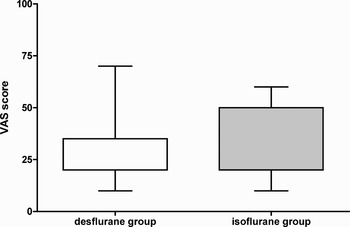
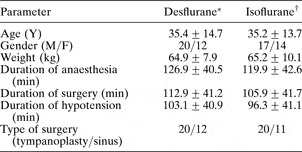
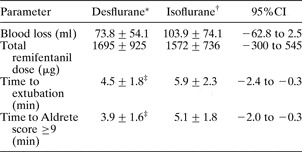
Table I presents subjects' ages, gender, weight, type of surgery, and durations of anaesthesia, surgery and hypotension. The study groups were similar with respect to type of surgery and duration of anaesthesia, surgery and hypotension (p > 0.05). There were no significant differences in the extent of operative bleeding, as assessed by VAS (Figure 1) and six-point scale, comparing the desflurane and isoflurane groups (2(1–6) and 2(1–5), respectively) (p > 0.05). The total remifentanil dose administered and the total blood loss were similar in both groups (p > 0.05) (Table II). The time to extubation and to an Aldrete score of nine or more was significantly less in the desflurane group compared with the isoflurane group (p < 0.05) (Table II).
100-mm visual analogue scale rating of the extent of achievement of a bloodless operative field, for the desflurane and isoflurane groups. Whiskers indicate minimum and maximum values, box shows interquartile ranges (25–75%), and the line indicates median values.

Patient Characteristics for Desflurane and Isoflurane Study Groups

Data are expressed as mean ± standard deviation. *n = 32; †n = 31. Y = years; M = male; F = female; min = minutes
Blood Loss, Remifentanil Dose and Recovery Characteristics for Desflurane and Isoflurane Study Groups

Data are expressed as mean ± standard deviation. *n = 32; †n = 31. ‡p < 0.05 vs isoflurane group. CI = confidence intervals; min = minutes
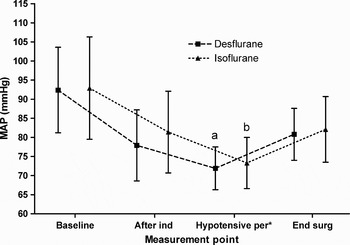
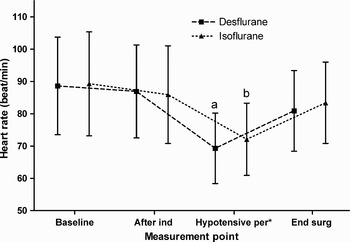
After assessing the effect of drugs and measurement times on mean arterial pressure and HR, using repeated measure ANOVA, a significant difference was observed regarding measurement times. Overall, there were no significant differences in the mean arterial pressure and HR values between the desflurane and isoflurane groups (p > 0.05). The mean arterial pressure and HR values during the hypotensive period were significantly lower than those at baseline, after induction and at the end of surgery, in both the desflurane and isoflurane groups (p < 0.05) (Figures 2 and 3). These results showed that the goals for mean arterial pressure and HR levels had been achieved.
Mean arterial pressure (MAP) values for the desflurane and isoflurane study groups. Data are shown as mean ± standard deviation (indicated by whiskers). ap < 0.05 vs baseline, after induction and end of surgery, in the desflurane group. bp < 0.05 vs baseline, after induction and end of surgery, in the isoflurane group. *Mean MAP measurement during hypotensive period. Ind = induction; per = period; end surg = end of surgery

Heart rate (HR) values for the desflurane and isoflurane study groups. Data are shown as mean ± standard deviation (indicated by whiskers). ap < 0.05 vs baseline, after induction and end of surgery, in the desflurane group. bp < 0.05 vs baseline, after induction and end of surgery, in the isoflurane group. *Mean HR measurement during hypotensive period. Ind = induction; per = period; end surg = end of surgery

The desflurane and isoflurane groups were comparable in their ratios of hypotension (6.3 vs 9.7 per cent, respectively) and bradycardia (6.3 vs 3.3 per cent, respectively). There were no differences between the desflurane and isoflurane groups regarding incidences of post-operative nausea (12.5 vs 9.7 per cent, respectively), vomiting (6.3 vs 6.5 per cent, respectively), retching (3.1 vs 0 per cent, respectively) and shivering (6.3 vs 3.2 per cent, respectively) (p > 0.05). There was no post-operative muscle rigidity and no requirement for additional hypotensive agents.
Discussion
The results of the present study confirm the fact that desflurane and isoflurane have similar effects when used in combination with remifentanil hydrochloride, regarding surgical bleeding. Both agents demonstrated similar haemodynamic effects during tympanoplasty and endoscopic sinus surgery. Remifentanil was effective in maintaining a mean arterial pressure of 65–75 mmHg and creating good surgical conditions. Time to extubation and to recovery was faster with desflurane than with isoflurane (both used together with remifentanil). Post-operative side effects were slight and did not significantly differ between the two groups.
It has become recognised that haemostasis for middle-ear and endoscopic sinus surgery presents special problems for the anaesthetist, since even minimal bleeding impairs the surgeon's vision and lengthens the operation time.Reference Degoute, Ray, Manchon, Dubreuil and Banssillon1, Reference Dal, Celiker, Ozer, Başgül, Salman and Aypar7, Reference Sivaci, Yilmaz, Balci, Erincler and Unlu9, Reference Cincikas and Ivaskevicius10 Controlled hypotension is a technique used during different types of surgery to diminish blood loss through diminishing blood pressure.Reference Degoute, Dubreuil, Ray, Guitton, Manchon and Banssillon4 Many techniques have been devised for this purpose, but none seems ideal and each has its disadvantages. These comprise reflex tachycardia, rebound hypertension, tachyphylaxis and cyanide intoxication during administration of sodium nitroprusside, and the possibility of myocardial depression due to esmolol administration. High doses of inhalation anaesthetics are likely to prolong recovery from anaesthesia and can delay the patient's discharge from hospital.
We aimed for a mean arterial pressure of 65–75 mmHg, representing moderate controlled hypotension.Reference Jacobi, Bohm, Rickauer, Jacobi and Hemmerling11 Controlled hypotension is associated with a certain incidence of morbidity and mortality. Mortality due to controlled hypotension and consequent ischaemic organ failure is 0.02–0.06 per cent;Reference Leigh12 therefore, we avoided profound controlled hypotension (i.e. a mean arterial pressure of 50 mmHg). In addition, intra-operative blood pressure and bleeding within the surgical field are not necessarily correlated. There is good evidence that decreasing the mean arterial pressure below 70 mmHg can even increase intra-operative bleeding, due to local vasodilatation.Reference Lim, Kim, Bahk, Ham and Do13, Reference Boezaart, Van der Merwe and Coetzee14
Isoflurane is the volatile anaesthetic most frequently used to achieve controlled hypotension.Reference Pavlin, Colley, Weymuller, Van Norman, Gunn and Koerschgen6, Reference Dal, Celiker, Ozer, Başgül, Salman and Aypar7, Reference Lessard, Trepanier, Baribault, Brochu, Brousseau and Cote15 Isoflurane has a longer recovery time than sevoflurane and desflurane, but its vasodilator effect is stronger.
Bertrand et al. Reference Bertrand, Boivin, Manel and Laxenaire16 have demonstrated that isoflurane reduces bleeding during microsurgery of the middle ear, compared with halothane. Preckel et al. Reference Preckel, Ferber-Viart, Leftheriotis, Dubreuil, Duclaux and Saumet17 have suggested that isoflurane has a greater propensity to alter cochlear autoregulation, when compared with propofol.
Beaussier et al. Reference Beaussier, Paugam, Deriaz, Mestari, Chandon and Sautet18 found that desflurane, used in combination with fentanyl, maintains better haemodynamic stability during moderate hypotensive anaesthesia, compared with isoflurane. The study was performed in patients undergoing spinal surgery, during which the target systolic BP was 80–100 mmHg. In that study, blood loss and surgical conditions (rated using bleeding scores) were similar for isoflurane and desflurane.
Dal et al. Reference Dal, Celiker, Ozer, Başgül, Salman and Aypar7 investigated the effects of desflurane, isoflurane and sevoflurane, when combined with remifentanil to induce controlled hypotension (mean arterial pressure 60–70 mmHg), on surgical conditions, operative field and haemodynamic effects, during tympanoplasty. They showed that all three agents, combined with remifentanil, induced adequate hypotension and provided similar operating conditions and haemodynamic effects, and that any of them could be safely (and equally) used in anaesthesia for tympanoplasty.
In our study, we did not identify any statistical differences in blood loss and operative conditions, comparing desflurane and isoflurane; this is in accordance with the findings of Beaussier et al. and Dal et al.
In the present study, the inhaled anaesthetic concentrations and the remifentanil infusion rates used were adequate to maintain controlled hypotension effectively and safely. In our clinical practice, we routinely use remifentanil to induce moderate hypotension during tympanoplasty or endoscopic sinus surgery, in order to benefit both from its analgesic effect (in the nitrous oxide free anaesthesia technique) and from the resultant middle-ear blood flow decrease, as reported by Degoute et al. Reference Degoute, Ray, Manchon, Dubreuil and Banssillon1 One advantage of remifentanil in this indication could be its short duration of action.
Desflurane has been used for ENT surgery, in combination with remifentanil, due to its beneficial effects on recovery.Reference Loop and Priebe19 Although Dal et al. Reference Dal, Celiker, Ozer, Başgül, Salman and Aypar7 reported that recovery characteristics for isoflurane, desflurane and sevoflurane were similar, we found that the recovery characteristics of desflurane were better than those of isoflurane. However, we did not collect data on the total amount of study drugs administered during the study period. When taking into consideration the two drugs' MAC (Minimum alveolar concentration) values, desflurane is four times more expensive than isoflurane in our country.
• Controlled hypotensive anaesthesia is commonly used to achieve a bloodless operative field for tympanoplasty or endoscopic sinus surgery
• This study compared the effect of remifentanil combined with desflurane or isoflurane on the quality of the operative field and surgical conditions, blood loss, and recovery, during tympanoplasty or endoscopic sinus surgery
• Desflurane and isoflurane both provided good surgical conditions, in terms of quality of operative field and convenience of hypotension induction, for tympanoplasty and endoscopic sinus surgery
• The recovery characteristics of desflurane were better than those of isoflurane
Conclusion
Desflurane and isoflurane, combined with remifentanil, provided good surgical conditions for tympanoplasty and endoscopic sinus surgery, in terms of quality of operative field and controlled hypotension. There was no need for any additional hypotensive agent, when either drug was used. However, the recovery characteristics of desflurane were better than those of isoflurane; therefore, desflurane may be a good alternative to isoflurane.