This article contributes to two aspects of the literature on inequalities in science. The first focuses on academic work in political science; the second concerns the debates on gender and race asymmetries that intensified with the spread of COVID-19. We concentrated our analysis on a crucial fator in creating enduring hierarchies between social groups: the division of labor. How have political scientists recently organized their daily routine? How much time have they dedicated to work and to everyday life tasks? We sought to answer these questions using data from two surveys conducted in the Brazilian academic community during different periods of the pandemic.
The study of political science as an academic field is relatively consolidated in several countries. Existing research provides ample evidence that gender and race inequalities are a global problem in the discipline. The lack of female representation in leadership roles is evident in academic settings across various regions, including North America (American Political Science Association 2004); South America (Carpiuc Reference Carpiuc2016; Fernández Reference Fernández2006); Europe (Abels and Woods Reference Abels and Woods2015; Bates, Jenkins, and Pflaeger Reference Bates, Jenkins and Pflaeger2012; Kantola Reference Kantola2008, Reference Kantola2015); and Asia and Oceania (Abu-Laban, Sawer, and St-Laurent Reference Abu-Laban, Sawer and St-Laurent2018; Curtin Reference Curtin2013).Footnote 1 There are numerous types of gender asymmetries, such as in the metrics of career progressions (Akhtar et al. Reference Akhtar, Fawcett, Legrand, Marsh and Taylor2005; American Political Science Association 2004); authorship of articles (Campos and Candido Reference Campos and Candido2022; Teele and Thelen Reference Teele and Thelen2017; Williams et al. Reference Williams, Bates, Jenkins, Luke and Rogers2015) and books (Samuels and Teele Reference Samuels and Teele2021); citations received (Dion, Sumner, and Mitchell Reference Dion, Sumner and Mitchell2018); distribution of thematic areas (Candido, Campos, and Feres Júnior Reference Candido, Campos and Júnior2021; Key and Sumner Reference Key and Sumner2019); and evaluation of professors (Chávez and Mitchell Reference Chávez and Kristina2020). Racial diversity indicators are less frequent but tend to demonstrate that disparities between white and Black scholars are even more extreme (Ards and Woodard Reference Ards and Woodard1992; Candido, Feres Júnior, and Campos Reference Candido, Júnior and Campos2019).
The COVID-19 pandemic has renewed the efforts to analyze disparities in science in general, with the division of labor and usage of time as central issues. COVID-19 containment measures, which prompted a shift to remote work and teaching, were soon shown to be linked with negative outcomes for gender equality. Research at the beginning of the pandemic found that female academics were shouldering a greater workload for domestic and care tasks than male academics. There also was a decrease in scientific productivity, especially among women who had children and Black women (Staniscuaski et al. Reference Staniscuaski2021). Other studies revealed an increase in the gender asymmetry of article and paper submissions in various disciplines, including types of authorship in political science (Campos and Candido Reference Campos and Candido2022; Cui, Ding, and Zhu Reference Cui, Ding and Zhu2020; Dolan and Lawless Reference Dolan and Lawless2020; Squazzoni et al. Reference Squazzoni, Bravo, Grimaldo, García-Costa, Farjam and Mehmani2021).
Other research investigated political scientists’ specific perceptions during the initial period of the pandemic. Breuning et al. (Reference Breuning, Fattore, Ramos and Scalera2021) and Shalaby, Allam, and Buttorff (Reference Shalaby, Allam and Buttorff2021) consulted academics from several geographic origins that were mostly linked to US institutions. Their studies highlighted the challenges that all academics face when caring for young children. However, excerpts from testimonies emphasized that the more significant difficulties were encountered by women. The 2022 global context is quite distinct. The development of vaccines and the consequent decrease in the disease’s lethality made it possible for in-person work to resume in many parts of the world. We are living in a new time of coexistence with the virus and contending with new challenges.
Our research probes the hypothesis that the pandemic exacerbated inequalities among political scientists, significantly increasing the burden of housework and care on women. Like Breuning et al. (Reference Breuning, Fattore, Ramos and Scalera2021) and Shalaby, Allam, and Buttorff (Reference Shalaby, Allam and Buttorff2021), we conducted surveys with political scientists. Furthermore, like Shalaby, Allam, and Buttorff (Reference Shalaby, Allam and Buttorff2021), we examined time-usage data. In contrast to both of those research teams, however, we focused on a population residing primarily in a country of the Global South: Brazil. We treated race as one of the main variables in our analysis, together with gender. Another distinctive feature of our study is that we addressed how perceptions about the virus have changed in two different periods: first, at the beginning of the crisis and, later, almost two years after the World Health Organization declared COVID-19 a pandemic (Candido et al. Reference Candido, Catelano, Chaguri, Marques, de Oliveira and Biroli2023).
Our research probes the hypothesis that the pandemic exacerbated inequalities among political scientists, significantly increasing the burden of housework and care on women.
The Brazilian case is relevant for several reasons. First, the country has one of the most developed academic communities of political scientists in Latin America, and it is the subject of a series of comparative studies (Bulcourf, Márquez, and Cardozo Reference Bulcourf, Márquez and Cardozo2015). As early as the mid-twentieth century, international organizations such as the United Nations Educational, Scientific, and Cultural Organization (UNESCO) were already mapping the field’s development in Brazil (Menezes Reference Menezes1950). Several local political scientists are well-ranked in the discipline’s global-impact indices.Footnote 2 Moreover, Brazil was the pandemic’s epicenter for many months. This difficult situation occurred amid a denialist government, with then-President Jair Bolsonaro cutting funding for universities and research while mitigating the negative consequences of the virus for the population. Therefore, Brazilian political scientists experienced not only the adversities that arose from the public health crisis but also direct political threats to working conditions and the exercise of the profession.
The next section describes our research methodology and scope. We then present our results and emphasize the urgency of addressing the intersection between racial and gender inequalities in political science. As several Black feminist authors have argued, examining gender issues without considering the role of race can produce a distorted picture of reality (Cho, Crenshaw, and McCall Reference Cho, Crenshaw and McCall2013; Collins Reference Collins2000, Reference Collins2008; Collins and Bilge Reference Collins and Bilge2020; Crenshaw Reference Crenshaw1989; Davis Reference Davis1981; Gonzalez Reference Gonzalez, António and da Silva1983). The case of Brazil provides evidence to support this position.
METHODOLOGY AND SCOPE
This article discusses data from two surveys conducted in Brazil by professional associations from different social science fields. The first (Marques et al. Reference Marques, Candido, de Oliveira and Biroli2022) was conducted between June 10 and July 15, 2020, and led by the Brazilian Political Science Association. The second survey (Catelano et al. Reference Catelano, Candido, Chaguri, Amaral, Inácio, Castro, Marques, de Oliveira and Biroli2022) circulated between March 2 and 28, 2022, and was driven by the National Association of Graduate Studies and Research in Social Sciences. For both surveys, the academic community was their target audience, and they had the support of anthropology, international relations, and sociology associations for their dissemination.Footnote 3
This article discusses data from two surveys conducted in Brazil by professional associations from different social science fields.
Our study focused on the perceptions of political scientists regarding the division of labor and the usage of time during the COVID-19 pandemic. The two surveys had a relatively similar number of political science respondents (i.e, 274 and 278). Regarding gender balance, there were more women among the participants of the 2020 survey (i.e., 54% versus 46%); conversely, there were more men in the 2022 survey (i.e., 53% versus 47%). The predominance of white people was repeated with 72% and 73%, respectively, versus 28% and 27% of nonwhite people. This sample represents approximately 6% of the Brazilian political science community, if we include graduate student researchers in 2019 according to our classification of the information provided by the Higher Education Improvement Coordination Agency.
Historically, Brazilian political science has developed from graduate studies programs. Although political science undergraduate courses have been offered recently, it is in the master’s and doctoral programs that the tradition of the field was established and consolidated. Moreover, this is the space in which the majority of research is produced, which allowed us to better analyze the effects of the pandemic on the daily life of the discipline in Brazil.
Two other aspects of the data are significant to our research. First, for the “gender” variable, we used the dichotomy “female” and “male” as a synonym for “women” and “men” because only a few respondents did not define themselves in binary terms. Furthermore, we believe that the specificities of gender identity can be understood through qualitative research and case studies better than through surveys. Second, concerning race, we separated the two groups, “white” and “nonwhite,” with the latter term being the total number of self-declared preto (Black), pardo (Brown), amarelo (“Yellow,” applied to East Asian Brazilians), and indígena (Indigenous) people. These categories are based on the classifications historically used in Brazilian censuses and by the long tradition of race and racism studies in the country (Muniz Reference Muniz2012). In our data, “nonwhite” individuals were predominantly “Brown” or “Black.”Footnote 4
THE DIVISION OF TIME AMONG POLITICAL SCIENTISTS
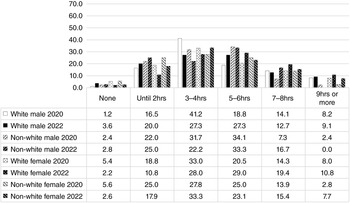
Our study measured how political scientists organized their usage of time after the onset of the COVID-19 pandemic. We divided labor into the following activities: academic work, administrative work, care work, and domestic work.Footnote 5 Figure 1 indicates political scientists’ perception of daily hours spent on academic work in the two periods observed. The results show a striking difference: in 2020, a greater proportion of women reported not devoting time to academic work compared to men. In 2022, the picture was reversed: more men than women stated that they were not dedicating time to this activity. White respondents declared spending the most time on academic work in both periods. White men and white women stand out as the only group who dedicated more than 9 hours per day to their scholarly pursuits; nonwhite men dedicated the least number of hours. The proportion of nonwhite people spending 9 hours or more on academic work decreased between 2020 and 2022, whereas it increased for all other groups. Most significantly, the percentage of nonwhite women spending more than 9 hours on academic work increased from 2.7% to 7.7%.
Perceptions of Daily Hours Devoted to Academic Work (%) (2020 and 2022 )
Source: Authors’ elaboration based on Marques et al. (Reference Marques, Candido, de Oliveira and Biroli2022) and Catelano et al. (Reference Catelano, Candido, Chaguri, Amaral, Inácio, Castro, Marques, de Oliveira and Biroli2022).

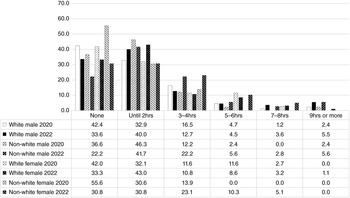
Our findings on the amount of time spent on administrative work by Brazilian political scientists contrast with those indicated by Shalaby, Allam, and Buttorff (Reference Shalaby, Allam and Buttorff2021). Whereas the survey responses in their research demonstrated that these tasks were more burdensome to women, our data signaled the opposite result. In both 2020 and 2022 (figure 2), most researchers declared spending between 0 to 2 hours on administrative tasks every day. Higher proportions of men—both white and nonwhite—reported spending 9 hours or more on administrative tasks compared to women.
Perceptions of Daily Hours Devoted to Administrative Work (%) (2020 and 2022)
Source: Authors’ elaboration based on Marques et al. (Reference Marques, Candido, de Oliveira and Biroli2022) and Catelano et al. (Reference Catelano, Candido, Chaguri, Amaral, Inácio, Castro, Marques, de Oliveira and Biroli2022).

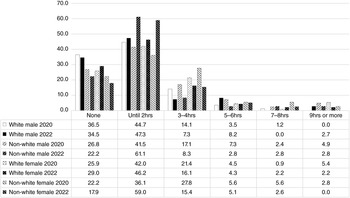
The onset of the COVID-19 pandemic caused abrupt changes in care work. Parents had to adapt to remote teaching following the closing of schools, and stay-at-home mandates made it difficult for elderly and disabled individuals to access the care they needed. Figure 3 indicates the perceived time devoted to care work during the two observed periods. At the beginning of the pandemic, white men were predominantly those who devoted the least amount of time to care, followed by white women and nonwhite men. In both periods, nonwhite women least frequently stated that they did not devote any time to care work.
Perceptions of Daily Hours Devoted to Care Work (%) (2020 and 2022)
Source: Authors’ elaboration based on Marques et al. (Reference Marques, Candido, de Oliveira and Biroli2022) and Catelano et al. (Reference Catelano, Candido, Chaguri, Amaral, Inácio, Castro, Marques, de Oliveira and Biroli2022).

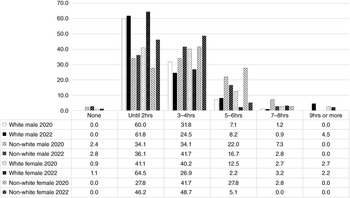
The domestic work variable illustrates race and class inequalities in Brazil. If white men at the beginning of the pandemic were evidently those who devoted the least amount of time to household tasks (following pre-pandemic data), white women almost equaled them during the course of the pandemic—figure 4 shows that they are almost overlapping. The data demonstrate that the number of hours devoted by white women to care work decreased substantially. This likely indicates the effect of the suspension and then the return of paid domestic workers to their routine. However, the variation also points to the fact that in the absence of paid domestic work, white and nonwhite women—rather than men—were primarily responsible for household tasks.
Perceptions of Daily Hours Devoted to Domestic Work (%) (2020 and 2022)
Source: Authors’ elaboration based on Marques et al. (Reference Marques, Candido, de Oliveira and Biroli2022) and Catelano et al. (Reference Catelano, Candido, Chaguri, Amaral, Inácio, Castro, Marques, de Oliveira and Biroli2022).

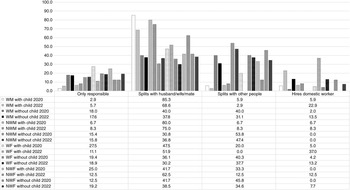
Figure 5 illustrates the perception of academics about the division of domestic-care work. These data helps understand the transformation in time usage among women and white respondents during the pandemic. The figure highlights the increase in respondents who hired domestic workers in 2022. This increase is particularly significant among white men and women with or without children and, to a lesser extent, among nonwhite women. White women decreased the amount of domestic work they shared with their partner between 2020 and 2022, whereas for nonwhite women it increased during the same period. Outsourcing care is still frequent in Brazil and is marked by intense race and class inequalities. Nonwhite women constitute the main group who earn a living through domestic care; they also suffer from the worst socioeconomic indicators in the country (Leão et al. Reference Leão, Candido, Campos and Júnior2017). This reality apparently is reflected in political scientists’ relationship to care work. After the end of social distancing, race inequalities gained more relevance than gender inequalities in the perception of time usage among political scientists. Further research on the gendered division of labor is needed to better understand these dynamics.
Perceptions of the Division of Domestic Care Work (%) (2020 and 2022)
Source: Authors’ elaboration based on Marques et al. (Reference Marques, Candido, de Oliveira and Biroli2022) and Catelano et al. (Reference Catelano, Candido, Chaguri, Amaral, Inácio, Castro, Marques, de Oliveira and Biroli2022).

CONCLUSION
This article aimed to discuss the inequalities among political scientists using the parameters of the division of labor and usage of time by Brazilian academics after the onset of the COVID-19 pandemic. We investigated two periods: (1) June 2020, which corresponded to the imposition of social-distancing measures at the beginning of the pandemic; and (2) March 2022, which was marked by the return to in person-work. Using data from surveys conducted during both periods, we sought to understand how these radical changes impacted political scientists.
At the beginning of the pandemic, more significant impacts on women’s lives were observed; they were overwhelmed by domestic and care work and had less time to devote to their academic careers. This trend was verified in our study and a series of other research not limited to political science. Women are already affected by the “leaky pipeline” phenomenon, as evidenced by their decreasing representation in the field as they progress in their careers. Without policies being promoted to mitigate the negative consequences of the first period of the COVID-19 pandemic, there likely will be a greater decrease in gender diversity.
However, the analyses that problematize the unfolding of the COVID-19 pandemic in political science have focused little attention on racial inequalities. In many countries worldwide, including Brazil and the United States, male domination in the discipline accompanies the predominance of white people in positions of power. Our data showed that the work routine of women was more affected at the beginning of the pandemic, but the intersection with race demonstrated that this was worse for Black women. More recently, white women with children tended to converge with white men in terms of the frequency of outsourcing care work. This represents long-standing class and race disparities in the Brazilian context, wherein white people tend to occupy more-valued jobs and earn higher wages than members of other groups.
Our data showed that the work routine of women was more affected at the beginning of the pandemic, but the intersection with race demonstrated that this was worse for Black women.
The possibility of having more time to develop an academic career is a differential that favors white people, mainly white men. Care work and domestic responsibilities are part of everyday life and should not be considered less-valuable work. The problem lies in our failure to accommodate paid and unpaid labor so that it does not disadvantage those in charge of domestic and care work. Nevertheless, we face a major challenge in the diversification of the academic community: that is, a lack of willingness to address the imbalance in race and gender representation in evaluating access and retention within the academic workspace.
ACKNOWLEDGMENTS
The Ford Foundation partially supported this research. We thank the two anonymous reviewers whose valuable comments and suggestions improved the article’s quality. We also thank the PS editorial team, Géssica Freitas for supporting the visual data edition, and Thomás Abers Lourenço for revising the manuscript.
DATA AVAILABILITY STATEMENT
Research documentation and data that support the findings of this study are openly available at the PS: Political Science & Politics Harvard Dataverse at https://doi.org/10.7910/DVN/Y6TSIK.
Supplementary Materials
To view supplementary material for this article, please visit http://doi.org/10.1017/S1049096523000197.
CONFLICTS OF INTEREST
The authors declare that there are no ethical issues or conflicts of interest in this research.