Introduction
Influenza has been recorded in humans and horses for centuries, and in pigs from the early years of the 20th century. The first recognition that influenza was caused by a virus occurred in the late 1920s when Richard Shope, working in the USA, demonstrated that swine influenza could be transmitted with filtered mucus; shortly after, Sir Christopher Andrewes and colleagues were able to isolate the virus from infected humans in the UK (Wright et al., Reference Wright, Neumann, Kawaoka, Knipe, Howley, Griffin, Lamb and Martin2006). The first isolation of an equine influenza virus was not until 1956 when the virus was detected in horses in the Czech Republic (Sovinova et al., Reference Sovinova, Tumova, Pouska and Nemec1958). For many years, pigs were considered the most important reservoirs of zoonotic influenza viruses; however, work in the 1970s and 1980s firmly established that aquatic birds are the reservoir of the full spectrum of influenza A virus genes and that outbreaks of fowl plague [highly pathogenic avian influenza (HPAI)] in domestic poultry originated from this source (Webster et al., Reference Webster, Bean, Gorman, Chambers and Kawaoka1992; Wright et al., Reference Wright, Neumann, Kawaoka, Knipe, Howley, Griffin, Lamb and Martin2006).
We now recognize that influenza A viruses transmit relatively frequently from the avian reservoir to other birds and mammals, yet they do not typically establish permanent lineages in these new hosts (Webster, Reference Webster2002). Nevertheless, such interspecies transmissions have resulted in the establishment of endemic influenza virus lineages in domestic poultry, pigs, horses and humans. These species may in turn serve as a source of novel virus subtypes for other birds or mammals through additional intra- and inter-species virus transmissions. Introduction of novel genes, from either the aquatic bird reservoir or domestic species, may generate new epidemic or pandemic viruses (Wright et al., Reference Wright, Neumann, Kawaoka, Knipe, Howley, Griffin, Lamb and Martin2006). In this sense, influenza A viruses may be described as ‘promiscuous’ and ‘plastic’; promiscuous because influenza viruses have a history of being able to infect species other than their major host and plastic because point mutations and re-assortment of the segmented genome facilitate immunological evasion and interspecies transmission. The recent pandemics of HPAI H5N1 in poultry and novel H1N1 influenza in humans are excellent examples of these traits, with the two viruses being of wild bird and swine origin, respectively.
Events of the 21st century indicate that the extent of interspecies transmission of influenza viruses is greater than previously appreciated. The HPAI H5N1 and novel H1N1 pandemics have both caused sporadic disease in a wider spectrum of mammalian species, such as tigers, domestic cats, stone martens and domestic dogs, than hitherto identified. These occasional infections, however, have not resulted in sufficient viral adaptation to allow sustained viral transmission within these species. In contrast, two influenza virus subtypes have emerged in dogs since 2004; an H3N8 equine origin virus in the USA and an H3N2 avian origin virus in South Korea. There is convincing evidence that the H3N8 virus has become endemic in the canine population of the USA, but further evidence is required before the H3N2 virus can be considered to be endemic in dogs in South Korea. In total, these events highlight the multiple potential reservoirs for influenza A virus transmission and their significance for both animal and public health.
The respective histories of avian and swine influenza viruses are discussed elsewhere in this symposium. This review will focus on the history and current epidemiological situation with equine and canine influenza viruses. The following nomenclature is used in this review. The term ‘canine influenza’ denotes infection of a canine (currently applies only to domestic dogs) with an influenza virus. The infection is commonly associated with outbreaks of respiratory disease and the virus is easily transmitted between dogs. The term ‘equine influenza’ denotes infection of an equine (horse, donkey, zebra and hybrids) with an influenza virus. The infection is commonly associated with outbreaks of respiratory disease and the virus is easily transmitted between equines of the same and related species. The phrase ‘infection of dogs with influenza virus XX’ – and grammatical variants thereof – is used when describing infections of dogs with influenza viruses that have not lead to sustained transmission. A similar phrase is used for the parallel situation in other species. For more detailed descriptions of the clinical presentation, diagnosis and control of equine and canine influenza the reader is referred to reviews by Newton and Mumford (Reference Newton, Mumford, Coetzer and Tustin2005), Landolt et al. (Reference Landolt, Townsend, Lunn, Sellon and Long2006), Dubovi and Njaa (Reference Dubovi and Njaa2008) and Beeler (Reference Beeler2009).
History and epidemiology of equine influenza
Influenza is the most economically important and most frequently diagnosed respiratory disease affecting the horse (Landolt et al., Reference Landolt, Townsend, Lunn, Sellon and Long2006). Outbreaks of disease, considered to be influenza, have been recorded affecting horses since the 17th century. In 1872, a major epidemic of equine influenza occurred in North America. The Great Epizootic, as it was called, was first noticed near Toronto, Canada, and in 90 days had spread across the continent. It spread down the Atlantic seaboard to Havana, Cuba, whereas another branch raced west to the Pacific. The overall mortality rate in horses was probably between 1 and 2%, although in some areas up to 10% of horses were said to have died from the disease. At that time, horses were vital to the economy of North America and the outbreak forced men to pull wagons by hand, while trains and ships full of cargo sat unloaded, tram cars stood idle and deliveries of basic community essentials were no longer being made. On 24 October 1872, the New York Times observed that ‘there is hardly a public stable in New York, which is not affected, while the majority of the valuable horses owned by individuals are for the time being useless to their owners’ (Law, Reference Law1874) (Wikipedia, http://en.wikipedia.org/wiki/Equine_influenza, accessed 30 January 2010).
While few countries are dependent on the horse for transportation today, the horse is part of the social fabric of most, if not all, nations. Horses travel internationally for competition, exhibition and breeding and while such travel is ostensibly regulated by health examinations and quarantines, these are often insufficient to prevent influenza from being introduced to the resident horses. Accordingly, new variants often spread quickly to other continents, most commonly with the movement of racehorses. Despite widespread use of vaccines, most countries consider equine influenza to be endemic in its equine population although the horse populations of New Zealand and Iceland have never been affected by influenza.
As mentioned previously, the first isolation of an equine influenza virus did not occur until 1956, when a subtype H7N7 virus was isolated from the affected horses in the Czech Republic (A/Equine/1/Prague/56) (Sovinova et al., Reference Sovinova, Tumova, Pouska and Nemec1958). The H7N7 virus was subsequently identified as the cause of outbreaks of influenza in horses in many parts of the world. A second subtype of virus, A/Equine/2/Miami/63 (H3N8) was isolated in 1963 from horses that had traveled from South America to Florida (Waddell et al., Reference Waddell, Teigland and Sigel1963). For several years, both viruses caused equine influenza outbreaks worldwide: however, H7N7 virus has not been identified as a cause of clinical disease since the end of the 1970s. While there were some serological data in the 1990s indicating that it was still circulating in horses in Central Asia and Eastern Europe, this virus is now considered to have gone extinct in the natural environment.
While the H7N7 virus may have died out, horse populations throughout most of the world are still affected by variants of the H3N8 equine influenza virus first isolated in 1963. This virus has evolved considerably since its first isolation and at one point two distinct lineages, American and European, existed (Daly et al., Reference Daly, Lai, Binns, Chambers, Barrandeguy and Mumford1996). The American lineage has since split into South American, Kentucky and Florida lineages with the Florida lineage becoming the dominant global lineage in recent years (Lai et al., Reference Lai, Chambers, Holland, Morley, Haines, Townsend and Barrandeguy2001). To further complicate matters, the Florida and Kentucky sublineages are reportedly evolving in parallel in the United States, such that these viruses alternately circulate in the equine population (Lai et al., Reference Lai, Rogers, Glaser, Tudor and Chambers2004). In 2002, a strain of H3N8 virus within the Florida lineage emerged in North America and quickly spread to other countries. Existing vaccines were found to be less effective against this variant (Toulemonde et al., Reference Toulemonde, Daly, Sindle, Guigal, Audonnet and Minke2005). In 2007, this virus spread widely in Asia and was ultimately introduced into Australia later that year by infected horses from Japan through ineffective quarantine of imported horses (Jacob, Reference Jacob2008). It created a virgin soil epidemic during which approximately 76,000 horses were affected on more than 10,500 properties in New South Wales and Queensland. The epidemic, which it is estimated cost in the region of $400 million, was controlled within four months through rigorous enforcement of movement restrictions and deployment of vaccine. Australia officially regained disease-free status a year after the last clinical case.
In 1989, an outbreak of equine influenza occurred in China from which an H3N8 influenza virus was isolated, A/Equine/Jilin/1/89 (H3N8) (Webster et al., Reference Webster, Bean, Gorman, Chambers and Kawaoka1992). The outbreak occurred in a horse population that had probably not been previously exposed to influenza, and reportedly caused extensive mortality (~20%). This H3N8 virus, however, was different from the conventional equine H3N8 viruses. Sequence comparisons indicated that six of the eight viral gene segments were closely related to avian influenza viruses (Webster et al., Reference Webster, Bean, Gorman, Chambers and Kawaoka1992; Liu et al., Reference Liu, Ji, Chen, Tai, Jiang, Hou, Li and Huang2009). Fortunately, the H3N8 Jilin virus did not appear to spread beyond China and seems to have gone extinct. It was noted at the time that the appearance of this new equine virus in China emphasized the potential for avian influenza viruses to successfully infect mammalian hosts, and that this example of species jumping should serve as a warning for the appearance of new pandemic influenza viruses in humans (Guo et al., Reference Guo, Wang, Kawaoka, Gorman, Ito, Saito and Webster1992). This prescient warning was several years before the first case of H5N1 avian influenza in humans in 1997 (Subbarao et al., Reference Subbarao, Klimov, Katz, Regnery, Lim, Hall, Perdue, Swayne, Bender, Huang, Hemphill, Rowe, Shaw, Xu, Fukuda and Cox1998).
While there are historical references to equine influenza affecting both dogs and people (Law, Reference Law1874), these reports were before the viral etiology of influenza was known. Until recently, there had been no documented equine influenza virus transmissions to other species, and it was suggested that the horse was an ‘isolated or dead-end reservoir’ for influenza A viruses (Webster et al., Reference Webster, Bean, Gorman, Chambers and Kawaoka1992). Experimental infections of human volunteers with H3N8 equine influenza, however, demonstrated that humans are susceptible to infection (Kasel et al., Reference Kasel, Alford, Knight, Waddell and Sigel1965; Kasel and Couch, Reference Kasel and Couch1969). Since 2004, infections with equine H3N8 influenza viruses have been reported in both dogs and pigs. Canine interspecies transmissions will be discussed in the subsequent section. Regarding H3N8 equine influenza infections in pigs, two strains of H3N8 equine influenza virus were isolated from pigs exhibiting respiratory disease during a 2004–2006 swine influenza surveillance program in central China (Tu et al., Reference Tu, Zhou, Jiang, Li, Zhang, Guo, Zou, Chen and Jin2009). Sequence results indicated the viruses were most closely related to European equine H3N8 influenza viruses from the early 1990s, and were distinct from the recently emerged canine influenza virus (Fig. 1).
Phylogenetic tree of the nucleotide sequences of the HA genes (127–1125) of the two H3N8 isolates from pigs and HA genes of equine, canine, swine, human and avian H3 influenza viruses (Tu et al., Reference Tu, Zhou, Jiang, Li, Zhang, Guo, Zou, Chen and Jin2009).

History and epidemiology of canine influenza
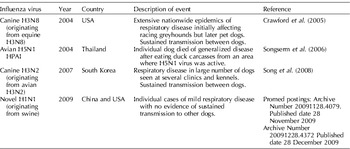
Prior to 2004, dogs were not considered a reservoir species for influenza A viruses because (a) they did not appear to maintain their own influenza virus subtype and (b) no sustained transmission of any influenza virus between dogs had ever been recorded. Table 1 summarizes how the situation has changed since 2004.
The spectrum of influenza viruses that have been confirmed to infect dogs since 2004

H3N8 influenza viruses in dogs
Canine influenza in the USA caused by H3N8 influenza virus
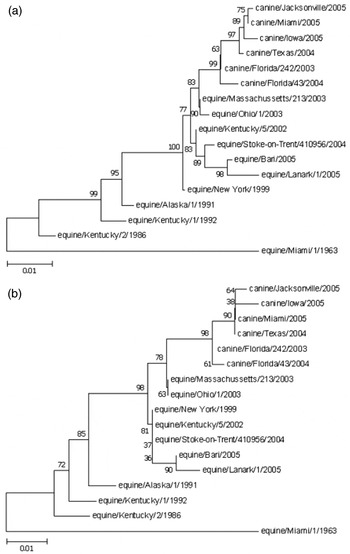
H3N8 canine influenza virus was first isolated in January 2004 from racing greyhounds affected with respiratory disease in Florida (Crawford et al., Reference Crawford, Dubovi, Castleman, Stephenson, Gibbs, Chen, Smith, Hill, Ferro, Pompey, Bright, Medina, Johnson, Olsen, Cox, Klimov, Katz and Donis2005). Thousands of greyhound dogs, at tracks in nine states, were subsequently affected during multiple respiratory disease outbreaks from 2004 to 2006. Canine influenza virus was isolated for the first time from non-greyhound dogs in Florida in August 2004 (Crawford et al., Reference Crawford, Dubovi, Castleman, Stephenson, Gibbs, Chen, Smith, Hill, Ferro, Pompey, Bright, Medina, Johnson, Olsen, Cox, Klimov, Katz and Donis2005). The virus has since been recognized in a majority of states in the contiguous USA, affecting both racing greyhounds and pet dogs. Canine influenza is considered endemic in the canine population of the USA and epidemiologically independent of equine influenza. At this time, there is no evidence of H3N8 canine influenza virus transmission to any other species, including humans. Molecular analyses of the influenza isolates obtained from dogs in the USA indicated the interspecies transmission of an entire H3N8 equine influenza virus to the dog (Crawford et al., Reference Crawford, Dubovi, Castleman, Stephenson, Gibbs, Chen, Smith, Hill, Ferro, Pompey, Bright, Medina, Johnson, Olsen, Cox, Klimov, Katz and Donis2005) and the epidemiology indicated sustained horizontal transmission within the canine population. Although all eight genes of the canine influenza virus isolates share ≥96% sequence homology with 2002 and 2003 equine influenza isolates of the Florida sublineage, H3N8 canine influenza viruses have formed a distinct monophyletic group, which is diverging from its equine ancestors (Fig. 2) (Payungporn et al., Reference Payungporn, Crawford, Kouo, Chen, Pompey, Castleman, Dubovi, Katz and Donis2008). This justifies the use of the term canine influenza virus to describe these isolates.
Phylogenetic relationships among the hemagglutinin 3 (H3) genes. (a) Nucleotide tree of the canine influenza virus H3 genes with contemporary and older equine H3 genes. (b) Amino acid tree of the canine influenza virus H3 protein with contemporary and older equine H3 proteins. Bootstrap analysis values >80% are shown. Scale bar indicates nucleotide or amino acid substitutions per site (Payungporn et al., Reference Payungporn, Crawford, Kouo, Chen, Pompey, Castleman, Dubovi, Katz and Donis2008).

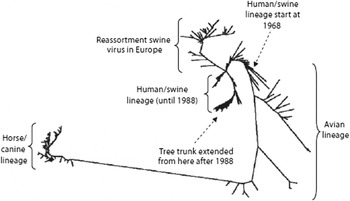
Analyses of the H3 genes of multiple isolates from several species indicate that the horse/canine and human/swine lineages arose independently from the avian lineage, and are not connected to each other. The evolutionary distance between the horse/canine and avian lineages is much larger than that between the human/swine and avian lineages. Since the horse/canine lineage arose independently from avian strains, horse/canine H3 strains seem to have no relationship to the evolution of human H3 strains (Fig. 3) (Zhang et al., Reference Zhang, Jiang and Chen2007).
Unrooted phylogenetic tree structure of horse/canine strains, avian strains and early human/swine strains before 1988. Both the horse/canine and human/swine lineages arose independently from the avian lineage, and are not connected to each other. The distance between the horse/canine and avian lineages was much larger than that between the human/swine and avian lineages. Since the horse/canine lineage arose independently from avian strains, horse/canine H3 strains seem to have no relationship with the evolution of human H3 strains. The substitution rate in the horse/canine lineage was 2.1×10⁻³ substitutions/nucleotide per year (2.1 substitutions/year) (Zhang et al., Reference Zhang, Jiang and Chen2007).

Serological surveys for H3N8 canine influenza virus have been conducted in Canada, New Zealand and Italy. In Ontario, a survey of 225 dogs found one greyhound that was serologically positive to H3 antigen. Since this dog was originally from Florida, the authors concluded that canine influenza was either not present or was currently rare in the province despite its close proximity to affected states in the USA (Kruth et al., Reference Kruth, Carman and Weese2008). No seropositive dogs were identified out of 251 dogs tested in New Zealand (Knesl et al., Reference Knesl, Allan and Shields2009) or 637 cats and dogs tested in Italy (Piccirillo et al., Reference Piccirillo, Pasotto, Moreno, Martin and Cordioli2009).
Infection of dogs with H3N8 equine influenza virus in other parts of the world
Since the discovery of canine influenza in the USA, sporadic interspecies transmissions of H3N8 influenza viruses from horses to dogs have been reported in other countries. In the UK, a retrospective study revealed that an H3N8 equine influenza virus caused a respiratory outbreak among English foxhounds in 2002 (Daly et al., Reference Daly, Blunden, MaCrae, Miller, Bowman, Kolodziejek, Nowotny and Smith2008). This was confirmed through serology, immunohistochemistry, and RT–PCR using archived clinical materials. Serological evidence of a second H3N8 equine influenza virus transmission event to dogs, in the spring of 2003, has also been reported in the UK (Newton et al., Reference Newton, Cooke, Elton, Bryant, Rash, Bowman, Blunden, Miller, Hammond, Camm and Day2007). During the 2007 epidemic of H3N8 equine influenza in Australia, several dogs in contact with infected horses developed influenza-like illness. Multiple cases were confirmed serologically, and limited RT–PCR sequencing indicated that several genes were identical to the circulating equine virus. Influenza virus could not be isolated from the affected dogs and there was no epidemiological evidence to suggest that the virus had acquired the ability to be transmitted from dog to dog (Kirkland et al., Reference Kirkland, Finlaison, Crispe and Hurt2010). There is currently no evidence that any influenza viruses are endemic in the canine populations of either the UK or Australia. Only in the USA has canine influenza, caused by H3N8 virus, become endemic.
It is not known when, where, or how H3N8 equine influenza virus was first transmitted to dogs in the USA. Close contact transmission from infected horses, or ingestion of infected horse tissues, are proposed hypotheses (Crawford et al., Reference Crawford, Dubovi, Castleman, Stephenson, Gibbs, Chen, Smith, Hill, Ferro, Pompey, Bright, Medina, Johnson, Olsen, Cox, Klimov, Katz and Donis2005). These transmission routes were also proposed for the isolated equine influenza outbreaks among dogs in the UK (Daly et al., Reference Daly, Blunden, MaCrae, Miller, Bowman, Kolodziejek, Nowotny and Smith2008). Natural infection of dogs during the recent outbreak of H3N8 equine influenza in Australia (Kirkland et al., Reference Kirkland, Finlaison, Crispe and Hurt2010) and an experimental study in Japan (Yamanaka et al., Reference Yamanaka, Nemoto, Tsujimura, Kondo and Matsumura2009) have demonstrated the feasibility of close-contact transmission of equine influenza virus to the dog.
H3N2 influenza viruses in dogs
In South Korea, transmission of an H3N2 avian influenza virus to dogs was reported in 2007. Subsequent experimental and natural dog-to-dog transmissions of H3N2 influenza virus have been reported, and serological evidence of the infection has been detected in farmed and pet dogs in South Korea (Song et al., Reference Song, Kang, Lee, Jung, Ha, Kang, Park, Park and Oh2008, Reference Song, Lee, Kang, Jung, Oh, Kim, Park and Oh2009; Lee et al., Reference Lee, Song, Kang, Kang, Yoo, Jung, Na, Lee, Park and Oh2009). The H3N2 virus was isolated during outbreaks of severe respiratory disease in dogs at multiple facilities, and was reportedly traced to a dog purchased from a live animal market. It was hypothesized that the virus transmission occurred through feeding dogs infected poultry products or by aerosol transmission. Sequencing results indicated that the viral genes were ≥95.5% homologous to Asian H3N2 avian influenza viruses. With virological and serological evidence of sustained dog-to-dog transmission, the H3N2 subtype represents a second influenza A virus considered an emerging respiratory pathogen in dogs. There have been no reports of human infections with H3N2 canine influenza virus.
Infections of dogs with other influenza viruses
Since 2006, sporadic interspecies transmissions of HPAI H5N1 to dogs have also occurred. In Thailand, a fatal case of HPAI H5N1 was reported in a dog that ingested infected duck carcasses (Songserm et al., Reference Songserm, Amonsin, Jam-On, Sae-Heng, Pariyothorn, Payungporn, Theamboonlers, ChutinimitkuL, Thanawongnuwech and Poovorawan2006). Serological testing indicated that 160, out of the 629 Thai dogs tested, had antibodies to H5N1; however, sustained dog-to-dog transmission has thus far not been reported in the country (Butler, Reference Butler2006). Experimental infections of dogs with HPAI H5N1 have shown that dogs are susceptible to H5N1 infection and subclinically shed virus (Maas et al., Reference Maas, Tacken, Ruuls, Koch, Van rooij and Stockhofe-Zurwieden2007, Giese et al., Reference Giese, Harder, Teifke, Klopfleisch, Breithaupt, Mettenleiter and Vahlenkamp2008). It was noted that dogs may play a role in H5N1 virus adaptation to mammals and contribute to spread to other species.
The potential involvement of dogs in the epidemiology of human influenza has been the topic of several studies over many years. Studies have demonstrated that the dog is susceptible to infection with human influenza viruses both naturally and experimentally, and have reported serological evidence of transient natural infection of dogs. Experimental studies by Todd and Cohen (Reference Todd and Cohen1968) showed that dogs are susceptible to human influenza virus infection; however, there was reportedly no virus transmission to contact dogs. Experimental studies by Nikitin et al. (Reference Nikitin, Cohen, Todd and Lief1972) confirmed that dogs are susceptible to subclinical infection with human strains of influenza virus. During epidemics of influenza in humans, Chang et al. (Reference Chang, New, Taylor and Chiang1976) isolated H3N2 influenza virus from throat swabs taken from three dogs. Through serological surveys Kilbourne and Kehoe (Reference Kilbourne and Kehoe1975), Houser and Heuschele (Reference Houser and Heuschele1980), Manuguerra and Hannoun (Reference Manuguerra and Hannoun1992) demonstrated that dogs may seroconvert without apparently exhibiting clinical signs of influenza virus infection. There was no evidence of sustained influenza virus transmission between dogs in any of these studies. During the pandemic of novel H1N1 influenza virus, there have been confirmed reports of dogs being clinically infected with the virus following close contact with infected humans in both China and the USA (Promed postings, see Table 1; USDA website, http://www.usda.gov/wps/portal/?navid=USDA_H1N1, accessed 30 January 2010). There are no reports of dogs transmitting the H1N1 virus to other dogs or humans.
Discussion
The companionship provided by the domestic dog and horse is highly valued, especially in western society. It is estimated that there are over 50 million dogs and 9 million horses in the USA alone. Dogs and horses live closely with us, travel with us, and dogs often share our beds at night. The emergence of more virulent strains of equine influenza virus and the recognition that canine influenza can be caused by two distinct influenza viruses is clearly a concern for equine and canine health worldwide. There is additional concern that dogs and horses may provide a new source of novel influenza A virus transmission to humans. Recent reports that novel H1N1 virus infections have been recognized in pet dogs in China and the USA (Promed postings, see Table 1) raise further speculation that the dog could act as a ‘mixing’ vessel (akin to the pig) and be a source of novel influenza viruses for humans. There have been no reports of H1N1 influenza virus infecting horses, but horses could conceivably present a similar risk. The relevance of these observations in relation to receptor specificity in horses, dogs and humans is discussed in this symposium by Yassine and colleagues.
Harder and Vahlenkamp (Reference Harder and Vahlenkamp2010) have pointed out that viruses of the H3 subtype have proven to be highly adaptable and are able to recruit avian, mammalian as well as human hosts. While the canine H3N8 and H3N2 viruses are genetically and antigenically different from strains currently circulating in humans, potential transmission of these or similar viruses to the human population from infected pet dogs cannot be excluded. A careful and intensified monitoring of canine and equine populations for influenza virus infections is advisable, especially during outbreaks in other species; however, organizing such surveillance is more of a challenge than might be expected. Dogs in industrialized countries are mostly healthy, but suffer from a range of respiratory diseases that make it more difficult to recognize influenza. In contrast with food animals and horses, where public safety and international travel, respectively, have driven surveillance, there has been little inducement to develop surveillance of dogs for infectious diseases.
The spate of emerging zoonotic diseases in the 21st century, as exemplified by influenza A infections, has led to the One World, One Health philosophy. In adopting One World, One Health as the platform for surveillance, organizations, such as the United States Department of Agriculture, are now recognizing that surveillance should also include companion animals. This is a welcome development; however, surveillance is ultimately only a tool for targeting prevention and control strategies.
Vaccination is recognized as one of the most important methods for the prevention and control of influenza A virus infection in all species (Bridges et al., Reference Bridges, Katz, Levandowski, Cox, Plotkin, Orenstein and Offit2008). Vaccination of animal populations is also important for controlling potential novel influenza A virus transmission from animal reservoirs to humans. That said, influenza vaccines are not the most effective vaccines on the market, and in equine practice annual and even biannual vaccination with inactivated vaccines is commonly practiced. Even where horses are routinely vaccinated for H7N7 and H3N8 influenza subtypes, the complex evolution of H3N8 virus has resulted in equine influenza outbreaks worldwide due to vaccine failure (Newton et al., Reference Newton, Daly, Spencer and Mumford2006; Martella et al., Reference Martella, Elia, Decaro, Di Trani, Lorusso, Campolo, Desario, Parisi, Cavaliere and Buonavoglia2007; Yamanaka et al., Reference Yamanaka, Niwa, Tsujimura, Kondo and Matsumura2008). In 2009, an inactivated vaccine for the protection of dogs against H3N8 canine influenza virus was given a conditional license in the USA (USDA-APHIS, http://www.aphis.usda.gov/newsroom/content/2009/06/caninevacc.shtml, accessed 30 January 2010). Canarypox – and equine herpes virus – vectored canine influenza virus vaccines have also been described in the literature (Karaca et al., Reference Karaca, Dubovi, Siger, Robles, Audonnet, Jiansheng, Nordgren and Minke2007; Rosas et al., Reference Rosas, Van De Walle, Metzger, Hoelzer, Dubovi, Kim, Parrish and Osterrieder2008), but have not yet received USDA approval. Although significant antigenic drift has not yet been observed with canine influenza virus (Payungporn et al., Reference Payungporn, Crawford, Kouo, Chen, Pompey, Castleman, Dubovi, Katz and Donis2008), this warrants further monitoring to ensure vaccine efficacy.
In 1992, the National Institutes of Medicine published a report on Emerging Infections (Lederberg et al., Reference Lederberg, Shope and Oaks1992). The report concluded that ‘pathogenic microbes can be resilient, dangerous foes. Although it is not possible to predict their individual emergence in time and place, we can be confident that new microbial diseases will emerge’. The novel influenza viruses of the first decade of the new millennium have demonstrated the truth of that prediction.