Experience of time influences our behavior greatly. Different concepts have emerged in psychology and social sciences to capture its manifestations at a personality and individual differences level, as for example, temporal construal, future anxiety, time perception, temporal orientation and time perspective. Time perspective refers to the processes implied in dealing with temporally relevant information and the views of the own psychological future and past (Lasane & O´Donnell, Reference Lasane, O´Donnell, Strathman and Joireman2005). In the context of the future time perspective, the consideration of future consequences is one of the constructs that showed more predictive power on behavior. This paper will explore the validity of the Portuguese version of Consideration of Future Consequences Scale (CFC-S), one of the most used instruments to measure the consideration of future consequences. We selected the CFC Scale for several reasons: (a) it has very good psychometric properties; (b) it has been extensively used for 20 years and related to relevant constructs in the English speaking-countries and (c) because there is limited research on cross-cultural validity of the instrument and the underlying factor structure.
The Consideration of Future Consequences Scale
The capacity to foresee the personal future and mentally time travel is a shared and probably unique human feature. It was suggested that it is a great adaptive advantage for our species (Suddendorf & Corballis, Reference Suddendorf and Corballis2007). But this capacity also posits an internal conflict between immediate versus distant outcomes and rewards of our behavior. For example, some people sacrifice an immediate pleasure or benefit for a distant, subjectively better outcome (e.g.: not eating dessert now to be slimmer in the summer). To address scientifically how people differently respond to these dilemmas, the concept of consideration of future consequences was proposed. The construct of individual differences in the consideration of future consequences was defined as “the extent to which people consider the potential distant outcomes of their current behaviors and the extent to which they are influenced by these potential outcomes” (Strathman, Gleicher, Boninger, & Edwards, Reference Strathman, Gleicher, Boninger and Edwards1994, p. 743). It was shown that the CFC-S is a reliable, stable, and valid construct, related to many other psychological and social phenomena. The psychometric properties of the complete (12-item) scale were very good, with internal reliabilities typically ranging from .80 to .86, and test-retest correlations of .76 (two weeks) and .72 (five weeks). In the original article, Strathman et al. (Reference Strathman, Gleicher, Boninger and Edwards1994) reported exploratory and confirmatory factor analyses supporting the idea of a single underlying factor. However, more recent research suggests that the scale is comprised of two factors (Joireman, Balliet, Sprott, Spangenberg, & Schultz, Reference Joireman, Balliet, Sprott, Spangenberg and Schultz2008; Joireman, Shaffer, Balliet, & Strathman, Reference Joireman, Shaffer, Balliet and Strathman2012; Khachatryan, Joireman, & Casavant, Reference Khachatryan, Joireman and Casavant2013; Petroccelli, Reference Petrocelli2003). For instance, Joireman et al. (Reference Joireman, Balliet, Sprott, Spangenberg and Schultz2008) explored the validity of a two-factor solution consisting of CFC-Future and a CFC-Immediate subscales. They also reported that the two sub-factors differentially predict the trait self-control, ego depletion and temporal discounting, with the CFC-I scale being the best and unique predictor.
Concerning the predictive validity of the English version of the CFC, Joireman, Strathman, and Balliet (Reference Joireman, Daniels, George-Falvy and Kamdar2006) have reported the role of the CFC across four domains: (a) Health Behavior, Risk-Taking, and Academic Achievement; (b) Aggression (c) Pro-social Organizational Behavior and (d) Pro-environmental Attitudes and Behavior. Firstly, it was demonstrated that individuals who scored high on the CFC scale reported greater general concern with health, exercising more frequently and reduced use of drugs (Ouellette, Hessling, Gibbons, Reis-Bergan, & Gerrard, Reference Ouellette, Hessling, Gibbons, Reis-Bergan and Gerrard2005). Also, high CFC´s are less likely to engage in risky sexual practices and more likely to get an HIV test (Dorr, Krueckeberg, Strathman, & Wood, Reference Dorr, Krueckeberg, Strathman and Wood1999). Secondly, it was consistently shown that CFC relates to aggression (Joireman, Anderson, & Strathman, Reference Joireman, Anderson and Strathman2003). The consideration of future consequences mediates the relationship between impulsivity and aggression, given that impulsive people have less consideration for the consequences of their actions. Thirdly, research has shown that CFC is related to willingness to engage in prosocial organizational behavior (Joireman, Daniels, George-Falvy, & Kamdar, Reference Joireman, Daniels, George-Falvy and Kamdar2006; Joireman, Kamdar, Daniels, & Duell, Reference Joireman, Daniels, George-Falvy and Kamdar2006). Lastly, individuals high in CFC are usually more concerned with environmental conditions and the use of natural resources: they have better attitudes toward recycling (Lindsay & Strathman, Reference Lindsay and Strathman1997), tend to defend and be concern about the environment (Joireman, Lasane, Bennett, Richards, & Solaimani, Reference Joireman, Lasane, Bennett, Richards and Solaimani2001), and have stronger preferences for public transportation and for structural solutions for transportations dilemmas (Joireman, Reference Joireman, Strathman and Joireman2005; Joireman, van Lange, & van Vugt, Reference Joireman, van Lange and van Vugt2004). Concerning the convergent validity, results show that the CFC has moderate statistically significant negative correlations with the present sub-scales and positive correlations with the Future sub-scale from the Zimbardo Time Perspective Inventory (ZTPI), a widely used instrument to measure time perspective (Boyd & Zimbardo, Reference Boyd, Zimbardo, Strathman and Joireman2005).
Also, a developmental trajectory of the CFC could be found. Studies with adolescents and adults show that CFC relates to psychosocial maturity (composed by three factors: responsibility, perspective and temperance) and antisocial decision-making. Both were affected by age, suggesting that younger people have more difficulties to anticipate or foresee the future implications of theirs present behaviors: adolescents exhibit lower CFC results and lower levels of psychosocial maturity and, inversely, more antisocial decision-making (Cauffman & Steinberg, Reference Cauffman and Steinberg2000). According to this study, adolescents are less psychosocially mature than adults in ways that affect their decision-making while facing antisocial situations, specifically: they score lower on measures of self-reliance and other aspects of personal responsibility, have more difficulty seeing things in long term perspective, are less likely to look at things from the perspective of others, and have more difficulty restraining their aggressive impulses. Other studies relating impulsivity, future time perspective and risk behavior have shown that adolescents often underestimate their chances for negatives outcomes, thus making risk behaviors – such as drug use – more likely (Quadrel, Fischoff, & Davis, Reference Quadrel, Fischoff and Davis1993; Robbins & Brian, Reference Robbins and Brian2004). In particular, adolescents with higher levels of impulsivity and with a negative future orientation show higher levels of risky behavior (Robbins & Brian, Reference Robbins and Brian2004).
Finally, we wanted to establish the relationship between CFC and two important dimensions of subjective temporality: temporal extension, which refers to the perceived distance by an individual between the present time and an event in the past or in the future (Lennings & Burns, Reference Lennings and Burns1998) and time perspective, which is a cognitive-motivational construct (Nuttin & Lens, Reference Nuttin and Lens1985) which allow individuals to organize personal and social experiences in a coherent and meaningful system of temporal frames related with the past, present and future (Zimbardo & Boyd, Reference Zimbardo and Boyd1999). It is believed that a longer temporal extension can be important in the pursuit and achievement of long term objectives (de Volder & Lens, Reference De Volder and Lens1982) and since its one of the dimensions of subjective time (Nuttin & Lens, Reference Nuttin and Lens1985; Vásquez Echeverría, Reference Vásquez Echeverría2011) this construct should be related to the consideration of future consequences but has not been empirically explored yet. So far, Time Perspective has been related only with the overall CFC score. Using CFC dimensions separately could help determine precisely how they relate with TP dimensions; considering the association of Future (ZTPI) with the past dimensions (negative with Past Negative and positive with Past Positive) we believe that CFC-F would present the same pattern of relations with the past temporal frame of TP, both future dimensions are related with planning and foreseeing hypothetical scenarios.
All in all, each individual differs in the level of consideration of future consequences either immediate or distant. This is related to important individual, group and social outcomes, making the CFC Scale a useful instrument to address temporal dilemmas and for applied fields.
The present study aimed to examine the factor structure, psychometric properties and validity of the Consideration of Future Consequences Scale in a Portuguese Sample. First, cross-cultural stability of the factor structure was analyzed. Following the findings of Joireman et al. (Reference Joireman, Balliet, Sprott, Spangenberg and Schultz2008), a two factor structure was expected (i.e. CFC-I and CFC-F), fitting statically better than the one factor solution. Second, convergent validity was assessed by investigating the pattern of relationships between the CFC and other variables. Based on research results with English speaking populations we hypothesize that: (a) Age will be positively related with scores in CFC-F. For that reason, we expect adolescent samples show lower CFC-F scores; (b) Immediate CFC subscale will be positively correlated with: Past Negative ZTPI, Present Fatalist ZTPI, Present Hedonist ZTPI, and negatively with Past Positive ZTPI and Future ZTPI and self-esteem; (c) Future CFC subscale will be positively correlated with: Future ZTPI, Past Positive ZTPI, and negatively with Present Hedonist ZTPI, Present Fatalist ZTPI and Sensation Seeking AISS and; (d) The temporal extension will be positively correlated with Future CFC and negatively with Immediate CFC; (e) Samples of offenders will score higher in Immediate CFC subscale and lower in Future CFC subscale compared with other samples; (f) University students will score higher in Future CFC subscale and lower in Immediate CFC subscale compared with the other samples.
Method
Participants
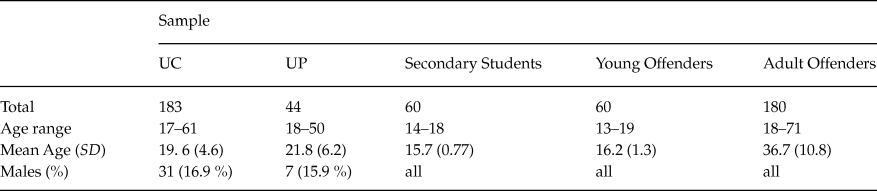
A questionnaire-based study was conducted with 5 samples, totaling 527 (M = 24.8, SD = 11.3) participants. The first sample was composed of undergraduate students from University of Coimbra, Portugal. The second sample was composed of undergraduate students from University of Porto, Portugal. The third sample was formed by secondary students from Mealhada and Anadia cities, Portugal. The fourth sample was composed of young offenders recruited from rehabilitation centers of the Portuguese Ministry of Justice in Lisbon and Coimbra. Lastly, the fifth sample was composed of adult offenders with addictive behaviors (in probation and in prison) and without addictive behaviors (in prison), all under the care of the criminal justice system and recruited from probation and prison services of the Portuguese Ministry of Justice in Anadia and Coimbra. In Table 1, we present a summary of the samples characteristics.
Sample Characterization

Note: UC = University of Coimbra undergraduates. UP = University of Porto undergraduates.
Instruments
Consideration of future consequences scale (CFC Scale)
A Portuguese version of the CFC Scale was used in this study. This scale is composed by 12 items that measure how people weigh distant and immediate outcomes of their behavior. Respondents use a 5-point Likert scale to answer (1 = not characteristic at all; 5 = very characteristic). Some item examples are “I only act to satisfy immediate concerns, figuring the future will take care of itself” and “When I make a decision, I think about how it might affect me in the future”.
Adapting the Portuguese version of the CFC Scale
For the process of translation and adaptation of the CFC Scale to the Portuguese language and culture, the recommendations of van Widenfelt, Treffers, de Beurs, Siebelink and Koudijs (Reference van Widenfelt, Treffers, de Beurs, Siebelink and Koudijs2005) for the translation and adaptation of psychological assessment instruments were taken into account. Some of these suggestions include contacting the original author, creating a translation team and pilot testing the items. Regarding the translation, the principle of translation and back-translation was followed (Hambleton & Patsula, Reference Hambleton and Patsula1999). The translation of the items of the CFC-S was performed by one of the authors and a bilingual psychologist (Portuguese and English). Firstly, this translation was submitted for analysis by an expert in Portuguese to determine the adequacy of the translation to the Portuguese language and culture. Secondly, the translation was discussed between all authors to determine the representativeness of the psychological construct in this version of the scale. Subsequently, in order to assess the correspondence between the Portuguese version and the original version of the scale, a College English teacher was asked to make the scale’s retroversion. The Portuguese CFC-S version is shown in Appendix A.
Socio-demographic questionnaire
Created by the authors to collect general information about socio-demographic data of the participants, such as gender, age, marital status and number of children.
Zimbardo Time Perspective Inventory – ZTPI (Zimbardo & Boyd, Reference Zimbardo and Boyd1999)
The Portuguese version of the ZTPI was used, it consists of 56 items measured on a 5-point Likert scale (1 = very untrue; 5 = very true), and yields five factors each representing a distinct temporal dimension. Ortuño and Gamboa (Reference Ortuño and Gamboa2009), who adapted and validated the ZTPI in a Portuguese sample, replicated the original five factor structure and obtained the following results: (1) Past Positive, related with pleasant and warm attitudes towards the past (explained variance = 6.02%, α = .68, 9 items) and formed by items such as: “Familiar childhood sights, sound smells often brings back a flood of wonderful memories”; (2) Past Negative, that represents an aversive and distressful attitude towards the past (variance explained = 7.85%, α = .80, 10 items) composed of items like “Painful past experiences keep being replayed in my mind”; (3) Present Hedonist, that represents a tendency to seek immediate pleasure, trough exciting and risky experiences (explained variance = 8.37%, α = .79; 15 items) an example of items included in this dimension is “I try to live my life as fully as possible, one day at a time”; (4) Present Fatalist, that shows a total defeat attitude towards life (explained variance = 6.42%, α = .66, 9 items) it is formed by items like “Fate determines much in my life”; and (5) Future, that indicates a strong tendency to create and prosecute long term objectives (variance explained = 6.57%, α = .74, 13 items) it is composed of items like “I believe that a person’s day should be planned ahead each morning”; these 5 temporal dimensions explain 35.25% of the total variance.
Time Perspective Scales – TPS (or Inventário de Perspectiva Temporal – IPT in Portuguese, Janeiro, Reference Janeiro2012)
This scale is formed by 32 items (Likert of 7 points; 1 = It does not describe me at all; 7 = Describes me totally), grouped in four temporal dimensions: (1) Past Orientation; (2) Present Orientation; (3) Future Orientation; and (4) Negative Future. In this study only four items related with the negative future dimension were used (According to Janeiro, Reference Janeiro2012; variance explained = 8%, α = .70, 4 items), this sub-scale is related with an unpredictable and threatening vision of the events yet to come and is formed by items like ‘‘I go into the future by chance not by option”.
Temporal Extension Inventory – TEI (Ortuño, Paixão, & Janeiro, Reference Ortuño, Paixão and Janeiro2011)
This scale is composed of 14 items (Guttman scale) with seven response options each (2 months, 6 months, 1 year, 3 years, 5 years, 10 years and 20 years). All items are formed by statements related with three main contexts of the individual´s existence (life in general, work or relational), located either in the psychological past or future. According to Ortuño et al. (Reference Ortuño, Paixão and Janeiro2011) the items are grouped into two subscales with six items each and the following psychometrics: (1) Future Temporal Extension (variance explained = 26.63%, α = .64), associated with how far ahead an individual usually thinks about his future; (2) Past Temporal Extension (variance explained = 17.84%, α = .85), related with the extent in which an individual thinks about his past; according to the authors this factor structure explains 44.47% of the total variance. Composed by items as “Regarding my profession, I know where I want to be in the next” and “I usually think about issues or events from the last”. The TEI also contains two control items. Items were created without any emotional value, in order to reduce any bias created by a possible positive or negative event in the person´s life.
Arnett Inventory of Sensation Seeking (Arnett, Reference Arnett1994)
The Portuguese version of the AISS is composed of 20 items (4-points Likert Scale, 1 = describes me very well; 4 = does not describe me at all), divided into two dimensions: Novelty and Intensity (Ortuño, Paixão, & Janeiro, Reference Ortuño, Paixão and Janeiro2014 ). The first dimension refers to the need for new sensations while the last one refers to the individual’s need to experience intense sensations and experiences, these two dimensions are composed by items such as: “When taking a trip, I think it is best to make as few plans as possible and just take it as it comes” and “When I listen to music, I like it to be loud”. Arnett (Reference Arnett1994) found an internal consistency of .70 for the total scale, .64 for the Intensity subscale and .50 for the Novelty.
Rosenberg Self-Esteem Inventory – RSES (Santos & Maia, Reference Santos and Maia2003):
The Portuguese version of the RSES is composed by 10 items (4-points Likert Scale, 1 = I strongly agree; 4 = I strongly disagree) related with personal positive and negative attitudes towards the individual itself. Five RSES items represent a positive orientation and five a negative orientation. According to Santos and Maia (Reference Santos and Maia2003), it presents a good internal consistency (.86) and a clear one-dimensional factor structure. The RSES is formed by items such as “On the whole, I am satisfied with myself”.
Procedure
The questionnaires were completed in a classroom setting by the sample of undergraduate students. As for the other samples, the subjects responded individually in an interview context. Participation was voluntary, anonymous and respondents were informed about the objectives of the study at the beginning of data collection. Testing sessions took around 60 minutes. Undergraduate participants completed the following instruments: Socio-demographic questionnaire, CFC Scale, ZTPI, IPT, AISS, RSES and the TEI. The remaining samples answered the following instruments: Socio demographic questionnaire, CFC and the ZTPI.
Data Analysis
Multiple imputations using the EM algorithm were used to replace isolated missing values in the data set. Outliers were computed by the means of the standardized values. All Z-values in both scales superior to ±3 were considered an outlier and eliminated of the dataset. Subsequently, statistical assumptions were analyzed and confirmed. Finally, psychometric properties of the scale were explored. We performed a confirmatory factor analysis for exploring the adequacy of the two factor solution. Later we explored internal consistency measures and lastly, the relationship of CFC sub-scales with other study variables. University samples presented no significant differences on either CFC-I or on CFC-F, so data was collapsed for further analyses. All the data analyses were performed in the statistical software IBM SPSS Statistics Version 20 and IBM SPSS AMOS Version 20.
Results
Three sets of analyses were performed to reach this study’s objectives. First, a Confirmatory Factor Analysis was performed in order to assess the factor structure of the CFC-S. Second, intercorrelations, internal consistency, and homogeneity were assessed to check the reliability of the CFC-S. And third, correlations were performed to assess the relationships between the CFC-S and other variables.
Confirmatory Factor Analysis
There is some evidence that the CFC construct can be divided in two sub components, the CFC-Immediate and the CFC-Future sub-scales. One study report the confirmatory factor analysis of the original English version of 12 items (Joireman et al., Reference Joireman, Balliet, Sprott, Spangenberg and Schultz2008), and two with the 14 items scale (Joireman et al., Reference Joireman, Shaffer, Balliet and Strathman2012, Khachatryan et al., Reference Khachatryan, Joireman and Casavant2013), suggesting the existence of a two-factor solution. Two alternative models were evaluated for. Model 1 tested a one-dimensional model, where all 12 items were specified to load on a single factor. In Model 2, a two-factor solution was tested, where the CFC-I and CFC-F items were specified to load on the correspondent factor of the English version.
Fit Indices for CFC-S Confirmatory Models

Note: The item 5 was removed in the models with 11 items.
*p ≤ .05; **p ≤ .01.
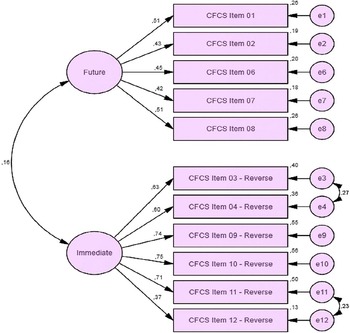
In both cases, item 5 presented low, non-significant loadings (loading for 1 factor solution = .05; loading for the two-factor solution = .06), and it was eliminated of further analyses because it reduces the adequacy of the model and reduces the internal consistency of the CFC-I subscale. Table 4 presents the fit statistics for the competing models. Model 1 has poor fitness indexes that are substantially improved in the two-factor model, reaching good fitness indexes. Figure 1 shows the standardized loading of this later solution.
Standardized loadings for a two factor confirmatory factor analysis of the CFC Scale. All loadings significant at p ≤ .05.

Internal consistency and Intercorrelations of the CFC-S
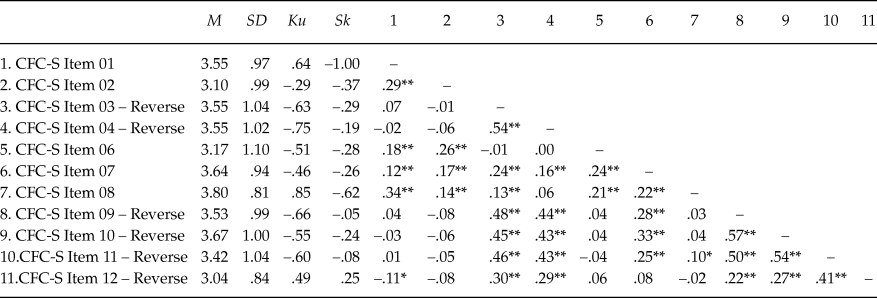
The sample means, standard deviation, intercorrelations between the CFC-S items, and their reliabilities (both internal consistency and homogeneity) are reported in Tables 2 and 3. The association between CFC-I and CFC-F goes in the direction of the previously reported findings, showing a low negative correlation.
Cronbach’s Alpha for the different samples and sub-scales

Note: UC = University of Coimbra undergraduates. UP = University of Porto undergraduates.
The Cronbach’s alpha coefficient CFC-F scales were below the optimal level (Briggs & Cheek, Reference Briggs and Cheek1986). However, Cronbach’s alpha coefficients approaching the level of .60 have also been argued as acceptable for research purposes (Clark & Watson, Reference Clark and Watson1995), moreover, given the fact that in most sub-samples the Cronbach’s alpha was good. The inter-item correlations were .22 for the CFC-F and .42 for the CFC-I, which are acceptable values (Briggs & Cheek, Reference Briggs and Cheek1986; Clark & Watson, Reference Clark and Watson1995), specially for a broad construct such as CFC-F or CFC-I. In conclusion and following these guidelines, we can consider that the CFC-I has very good and the CFC-F has acceptable reliabilities.
Means, Standard Deviations, Normality Tests and Correlations of CFC-S Items

Note: N = 527; *p ≤ .05; **p ≤ .01.
Relations of the CFC-S with other variables
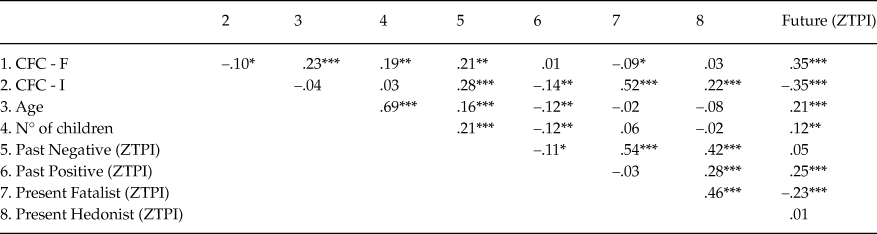
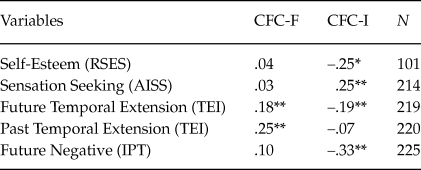
Table 5 shows the correlation of the CFC-S sub-scales with age, number of children and ZTPI sub-scales. As predicted, CFC correlates with age, number of children and with most ZTPI sub-scales. Specifically, CFC-I correlated positively with present fatalistic, present hedonistic and past negative and negatively with Future and past positive ZTPI scales. CFC-F only correlated positively with past positive and Future ZTPI scales. Gender also showed an effect but only in the CFC-I subscale, with M (fem) = 2,18 (.67), M (males) = 2,74 (.66); t = 9,3 (525); p < .001. In Table 6 the relationship of the CFC subscales with other variables is displayed. CFC-I correlates negatively with self-esteem, future negative and future temporal experience, while positively with sensation seeking. The CFC-F correlates positively with future temporal extension and past temporal extension.
Correlations between CFC-S sub-scales, age, number of children and ZTPI sub-scale

Note: *p ≤ .05; **p ≤ .01; ***p < .001.
Correlations of the CFC-Subscales with other variables

Note: *p < .05; **p < .01.
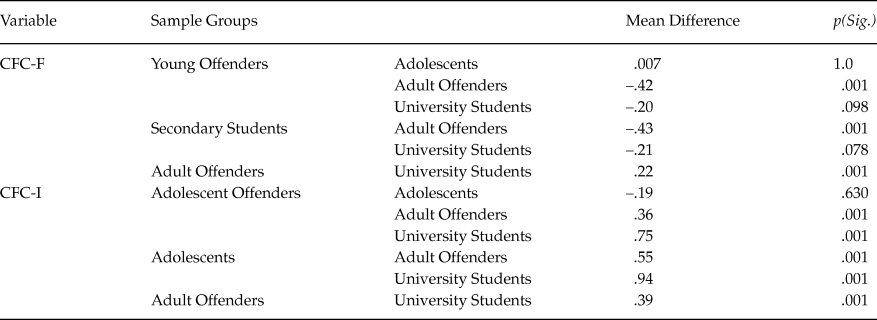
We further analyzed with an ANOVA the predictive power of the scale for distinguishing different sub-samples. We found a main effect of sub-sample on both CFC-I and CFC-F. For CFC-I values were: with F(3, 523) = 48,3 , p < .001; and for the CFC-F, F(3, 523) = 13,8, p < .001. The means and standard deviations for each sub-sample are presented in Table 7. Post-hoc comparisons using the Bonferroni analyses (p < .05) showed that university students are significantly less prone to consider the immediate consequences of behavior than any other group. Also significantly, groups of adolescents (either on probation or not) were the less concerned about the future consequences of their actions and also more concerned about immediate results of their actions. Additionally, participants in prison were the more concerned of the future consequences of their actions, while university students showed intermediate scores on the CFC-F.
Descriptive statistics and ANOVA for sub-samples

Note: Standard Deviation in parentheses.
Differences in CFC-F and CFC-I between sample groups (ANOVA post-hoc: Bonferroni)

Discussion
The objective of this article was to validate the CFC Scale in a Portuguese sample and, by doing so, test the intercultural validity and the two factor structure of the CFC construct proposed by Joireman et al. (Reference Joireman, Balliet, Sprott, Spangenberg and Schultz2008).
As it was hypothesized, the two factor solution presented better fit indexes than the one factor model, further supporting the Immediate and Future sub-scale distinction proposed by Joireman et al. (Reference Joireman, Balliet, Sprott, Spangenberg and Schultz2008); as so this model (two factor with eleven items) is considered as the more parsimonious, as well as the more stable in the studied population (Marôco, Reference Marôco2010) due the showed values in the Akaike’s Information Criterion – AIC and Modified Expected Cross-Validation Index – MECVI. However, we should state the psychometric limitations of the CFC-S Portuguese version. First of all, item 5 was problematic with a small factor loading for the CFC-I subscale and reducing the alphas values significantly, so we suggest its elimination in the Portuguese version. If needed, mean values could be used for inter-cultural or comparison studies with other versions. Preliminary analysis of the Spanish CFC validation also shows the same tendency for item 5 (Vásquez Echeverría, Martín, Ortuño, Esteves, & Joireman, Reference Vásquez Echeverría, Martin, Ortuño, Esteves and Joireman2014). Spanish and Portuguese are highly related languages and we take this in account because the term “convenience” when translated and the consequent meaning of the item 5 is vague and generic, referring in general to the participant’s search for well-being. In this context, almost all subjects respond with high values representing: “characteristic” or “very characteristic”. Concerning the two factor model, it should be noted that the CFC-F sub-scale presents barely acceptable psychometric properties, especially in comparison with the CFC-I subscale that has good psychometric properties. This resembles the data provided by Joireman et al. (Reference Joireman, Balliet, Sprott, Spangenberg and Schultz2008) where the CFC-F scale has below – or barely – optimal statistics. One interpretation of these results could be that our behavior is more regulated by the concern with the immediate consequences of an action than with those of the distant future because the latter is more imagined and fantasized and doesn’t necessarily influences every person current actions (Oettingen & Thorpe, Reference Oettingen, Thorpe, Sanna and Chang2006). A second interpretation is that the 5-item CFC-F sub-scale do not catch adequately all the variation present in the construct. In fact, the new 14 item CFC scale (with 7 items in the CFC-F sub-scale) shows good reliabilities (Joireman et al., Reference Joireman, Shaffer, Balliet and Strathman2012, Khachatryan et al., Reference Khachatryan, Joireman and Casavant2013). Lastly, we should note that Cronbach alpha for the adult offenders sub-sample is particularly low in CFC-F (α = .34), suggesting that the reflections about the future in this group could be structured differently than younger offenders and non-offenders (e.g. pessimistic, with less focus on consequences of behavior of life after prison, but great focus on consequences of behavior for reduction of years of conviction), and that should be measured differently in this sub-sample.
Notwithstanding these limitations, the CFC subscales showed good reliability and the relationship with other variables was very good. The CFC-I showed more significant correlations showing better predictive properties and psychometric steadiness. Participants more concerned with the immediate consequences of behavior showed more sensation seeking tendencies, lower self-esteem, less future negative scores and less future temporal extension. They are also more present-hedonistic, less future oriented, with a negative vision of the past (past negative). This pattern of correlations with the CFC-I scores suggest that a higher concern for immediate outcomes of our behavior is related to reduced well-being. In this line, this pattern resembles a previous study of Joireman et al. (Reference Joireman, Balliet, Sprott, Spangenberg and Schultz2008) that demonstrated that individuals with higher concern for immediate consequences showed a greater impact of ego-depletion on the temporal discounting function and with studies that relate higher CFC scores with more impulsive behavior (Joireman, Strathman et al., Reference Joireman, Daniels, George-Falvy and Kamdar2006). The correlation here found between self-esteem and CFC-I, also supports the idea that higher scores in CFC-I is associated with negative outcomes and judgments of personal own worthiness. Negative affect can conduce to an increased desire for immediate rewards over larger but delayed outcomes (Joireman, Strathman et al., Reference Joireman, Daniels, George-Falvy and Kamdar2006).
It was also found that self-esteem is related to negative dimensions of time perspective, i.e.: past-negative, present-hedonistic and future negative (Ortuño, Paixão, & Janeiro, Reference Ortuño, Paixão and Janeiro2013; Ortuño & Vasquez, Reference Ortuño, Paixão and Janeiro2013). This suggests that high scores in the CFC-I subscale can be consider as a measure of negative affect towards subjective temporality.
On the other side, participants more concerned with the distant outcomes of behavior are older, have (more) children, are more future-oriented and show a longer temporal extension both to the past and future. In general, the pattern of relationships between the CFC Scale and ZTPI sub-scales resemble those reported by Zimbardo and Boyd (Reference Zimbardo and Boyd1999), despite we should note that study employed the CFC total score, and do not offer scores by CFC sub-scales.
Group analysis showed that university students have less concern for the immediate outcomes of behavior. This effect should be considered cautiously because the university sample is composed mainly by females, so this could make the relationship spurious. In line with literature, adolescents were the most concerned about the immediate outcomes of behavior and the less concerned about the future consequences. Planning for the future and identity formation are developmental tasks of adolescence. One of the challenges adolescents face is learning how to evaluate the likely consequences, positive and negative, of new and potentially risky behaviors and relatedly, how to control impulses (Luyckx, Lens, Smits, & Goossens, Reference Luyckx, Lens, Smits and Goossens2008; Smith & Anderson, Reference Smith, Anderson, Monti, Colby and O'Leary2001). Given our results, this developmental task seems not to be accomplished until age of 18, when in European culture persons should face important life decisions and assume many legal responsibilities.
Some hypothesized relationships were not supported by the data. For example, adolescent offenders did not differ either in CFC-I or CFC-F with adolescents without in conflict with the law. This could be reflecting that despite the temporal orientation (i.e.: more concern for immediate consequences of behavior in both adolescents groups over adult groups), the early initiation on illegal behaviors relies on other factors, such as socio-economic status, peer relationships, etc. In the same vein, university students did not consider more the future consequences of behavior than adult offenders. On the contrary, adult offender present higher scores on the CFC-F subscale than university students. This unexpected effect, could be due to the effect of years of imprisonment and sentence, which makes adult offenders more pending of changing their life situation and thus, more concerned about the consequences of their behavior in the distant future.
In conclusion, our findings support the validity of the CFC, with two sub-scales in a Portuguese sample. The overall findings are also in line with previous studies in English speaking countries, suggesting a similar pattern of correlations, internal consistency and factor structure. All in all, this further confirms that the consideration of the future consequences is a construct with cross-cultural validity, and that the most used measure, the CFC Scale, could be fruitfully used for research purposes in the Portuguese language. Furthermore, our results may have important theoretical and practical implications. Firstly, they suggest that the human concern about the future outcomes of behavior it is not an unitary construct. Secondly, relating to possible practical applications, our results show that CFC-I scores could have implications for well-being, as it relates to important variables related to it such as sensation seeking and self-esteem. In this line, future studies should explore the mediation-moderator effects of the CFC-I scores on well-being or psychological distress constructs. For example, the CFC-I could be mediating the relationship between emotion regulation and well-being. Two other issues emerged from this study that we consider important avenues for future research. One refers to clarify the role of CFC-I on adult delinquency. Our results suggest that offenders have more concern for immediate consequences of behavior than university students, but we cannot establish a comparison to general population. Second, we consider important to analyze the developmental changes of the CFC during developmental transitions. For instance, to explore the intra-individual change from adolescence to early adulthood in CFC or changes in CFC-F after having offspring, that could explain the correlations we found independently of age.
Appendix A Items of the Portuguese version of the CFC-S
1. Eu antecipo como as situações podem ser no futuro e tento influenciar o curso das mesmas através do meu comportamento quotidiano.
2. Eu envolvo-me frequentemente em determinados comportamentos cujos resultados só são visíveis muito tempo mais tarde.
3. Eu apenas ajo para satisfazer as preocupações imediatas, pensando que o futuro se encarregará de si próprio.
4. O meu comportamento é apenas influenciado pelos resultados imediatos (ou seja, uma questão de dias ou semanas) das minhas acções.
5. Aquilo que é vantajoso para mim é um factor importante nas decisões que tomo e nas acções que realizo.
6. Eu estou disposto/a a sacrificar a minha felicidade e o meu bem-estar imediatos de modo a alcançar resultados futuros.
7. Eu penso que é importante tomar precauções contra resultados negativos mesmo que estes só venham a ocorrer muitos anos mais tarde.
8. Eu penso que é mais importante desenvolver comportamentos com consequências úteis no futuro do que comportamentos com consequências imediatas menos importantes.
9. Eu geralmente ignoro os avisos acerca de possíveis problemas futuros porque penso que estes se resolverão antes de se tornarem muito preocupantes.
10. Eu penso que fazer sacrifícios agora é geralmente desnecessário, uma vez que os resultados futuros podem ser adiados.
11. Eu apenas ajo para satisfazer as preocupações mais imediatas porque penso que conseguirei resolver os problemas futuros quando estes surgirem.
12. Uma vez que o meu trabalho quotidiano tem resultados específicos, torna-se mais importante para mim do que comportamentos tendo em vista resultados distantes.