

1. Introduction
Since the 1970s, there has been a steady rise in sociolinguistic interest in Arabic. Sociolinguistic research has been conducted in many of the major urban centers where Arabic is spoken, including Amman (Al-Wer Reference Al-Wer, Miller, Al-Wer, Caubet and Watson2007b), Manama (Holes Reference Holes1987), Damascus (Ismail Reference Ismail2008), Beirut (Germanos Reference Germanos2011), Cairo (Haeri Reference Haeri1997), and Casablanca (Hachimi Reference Hachimi, Miller, Al-Wer, Caubet and Watson2007). More recently, scholars have turned their attention to more rural or isolated varieties of the language, or varieties which lack sufficient documentation and description (e.g., Alessa Reference Alessa2008, Al-Qahtani Reference Al-Qahtani2015, Al-Wer and Al-Qahtani Reference Al-Wer, Al-Qahtani, Davis and Soltan2016).
This shift towards examining language change in Arabic-speaking communities where research has not previously been conducted is welcome, given that the bulk of sociolinguistic interest has been on English-speaking communities (Stanford Reference Stanford2016). This more recent focus on understudied varieties of Arabic also raises an important question: what is the role of sociolinguists in these situations, with respect to more general concerns regarding language documentation and description?Footnote 1
Taking my own site of research, Gaza City, as a point of investigation, I examine the available knowledge on Gaza's sociolinguistic landscape while providing additional qualitative information based on recent fieldwork with speakers of Gaza City Arabic (GCA),Footnote 2 the variety spoken by the indigenous, non-refugee residents of the city. By revisiting my own corpus, which has until now been viewed solely through a variationist lens, I point Arabic sociolinguistics towards a discussion that focuses on how language description or documentation can be integrated into sociolinguistic research, and what this integration provides from both a research- and a community-based perspective. Situating a qualitative discussion within the broader sociolinguistic landscape of Gaza, this study presents these two facets of work on GCA as going hand in hand towards understanding the dialect and the precarious position of the community itself in one of the world's longest running conflicts, the Israel-Palestine conflict.
I begin by examining the growth of Arabic sociolinguistics within the broader sociolinguistic enterprise. Following this look at the evolution of the field, I move on to viewing Arabic varieties through the lens of language endangerment. Considering language endangerment within the context of Arabic represents an important but often unarticulated facet of descriptive work on Arabic varieties. I then contextualize these broader discussions within my own body of research on Gaza City, providing a qualitative account of a number of features of the city's dialect. In doing so, I highlight potential paths forward for Arabic sociolinguistics that may bring it closer to research conducted in the language documentation and description paradigms.
2. Arabic dialectology and the birth of Arabic sociolinguistics
Although Arabic dialectology has a time-depth almost equal to that of its English counterpart (Bergsträßer Reference Bergsträßer1915), Arabic sociolinguistics has largely emerged out of the early sociolinguistic tradition, which treats variation as inherent to the linguistic system, and seeks to understand how the social life of a community influences the directionality and extent of language variation and change (Labov Reference Labov1963). Despite its emergence from an already established intellectual tradition, Arabic sociolinguistics still relies heavily on the work of dialectologists. However, reliance on the dialectological tradition often manifests in the utilization of texts and descriptions collected many decades earlier. This is especially true in cases where sociolinguists are researching under-documented Arabic varieties (such as GCA). Arabic sociolinguists are thus often forced to rely on sources that are sometimes out of date, or simply unavailable. Taking GCA as an example, the most reliable source on the dialect (Bergsträßer Reference Bergsträßer1915) was published over a century ago, before the massive refugee influxes into Gaza that have taken place since 1948, drastically changing the city's demographic makeup.
In researching understudied Arabic varieties, we can ask how sociolinguistic interest can enrich and foster further descriptive and documentary work. Similarly, we can ask what sociolinguists gain from incorporating descriptive and documentary methods into our research, and how we can integrate the goals of these two approaches in a way that is beneficial for both the researcher and the community. Focusing on bringing these different strands of research together will allow sociolinguists to make use of often large bodies of data, moving their analyses beyond accounts that focus on small collections of variables.
Following a discussion of language endangerment as it relates to Arabic, the remainder of this article investigates GCA, from the early dialect atlas published in 1915 to a qualitative discussion based on the sociolinguistic work that I conducted almost a century later, in 2013. What follows highlights the information available to us from the scattered sources on GCA and how a descriptive focus based on later sociolinguistic research provides a new understanding of a handful of features of the dialect.
3. Is Arabic endangered?
Arabic is spoken by roughly three hundred million people around the world. Typologically, scholars of Arabic delineate the distribution of Arabic dialects along Western (maghrebi) and Eastern (mashreqi) lines, with the dividing isogloss between the two varieties running roughly along the Nile Delta of Egypt. The distinction between these two Arabic varieties typically focuses on the morphology of the first person imperfective singular and plural verb forms. In areas west of the isogloss, both the singular and plural in the first person are formed with a word-initial n-, while the plural form also takes a word-final -u (e.g., [niktib] ‘I write’, [niktibu] ‘We write’). Contrasting with Western dialects, in Eastern varieties the first person singular lacks word-initial n-, while the plural further lacks word-final -u (Versteegh Reference Versteegh1997, Al-Wer and de Jong Reference Al-Wer, de Jong, Boberg, Nerbonne and Dominic Wattin press).
From this broad Western–Eastern categorization, the spectrum of dialect groupings can be further narrowed, with Arabists often ascribing nation-state-based labels to different dialect groupings (e.g., Palestinian, Lebanese, Moroccan). These labels imply a certain degree of linguistic homogeneity based on present-day political borders which is ultimately misleading, with immense diversity existing within the political boundaries of a given state. Cadora (Reference Cadora1992) highlights the diversity within Arabic dialects through a taxonomy classifying spoken varieties on urban vs. rural, and Bedouin vs. sedentary lines. As with nation-state-based labels, this taxonomy provides general groupings of linguistic features but does not suggest strict linguistic homogeneity within any given group.
Viewing the language as a whole, Arabic is far from endangered. However, mass migration, political conflict, and long-term demographic changes throughout the Arabic-speaking world have created a situation in which numerous varieties of Arabic are endangered, with a number becoming as mutually unintelligible as some Germanic languages. Of the endangered Arabic varieties, two of the most well-known are the Qashqadarya and Bukhara varieties spoken in Uzbekistan (Chikovani Reference Chikovani2002, Reference Chikovani2009). Although both varieties exist within the Uzbek state, they are mutually unintelligible both in relation to each other – as a result of contact with genetically unrelated languages (Uzbek and Tajik) – and in relation to more “mainstream” Arabic varieties spoken elsewhere, particularly in urban centers such as Cairo (Woidich Reference Woidich and Versteegh2007), Beirut (Naïm Reference Naïm and Versteegh2007), or Amman (Al-Wer Reference Al-Wer and Versteegh2007a). Two additional endangered varieties of Arabic, both of which lack thorough documentation, can be identified in Iran (Seeger Reference Seeger, Kuty, Seeger and Talay2013) and Afghanistan (Ingham Reference Ingham, Ferrando and Sandoval2003).
Even within communities where substantial research has been carried out, it is still possible to identify cases of Arabic varieties that have been lost. Blanc's (Reference Blanc1964) description of Muslim, Christian, and Jewish varieties of Bahgdadi Arabic provided one of the most well-known accounts of language variation stratified along religious lines. However, Abu Haidar's (Reference Abu Haidar1991) later work suggests that the Christian variety of Baghdadi Arabic is likely to be receding, while the Jewish variety has likely been lost.
Even for varieties that may not be considered endangered by most established metrics, there is an impetus among researchers to document or describe the particulars of these varieties. Given the sheer number of spoken Arabic varieties, along with the uniquely turbulent sociopolitical environment in the Arabic-speaking world, many Arabic varieties remain undocumented. Filling these gaps in the linguistic record represents an important area of research, and one that the political situation makes increasingly challenging. One case that perhaps best exemplifies these challenges is the status of certain varieties of Syrian Arabic, which may now be in danger as a result of the precarious socio-political context of the Syrian Civil War that has affected the Syrian community since 2011. Cases such as Syria or Gaza City, which I elaborate on below, are of particular concern for scholars committed to documenting and describing Arabic varieties, or attempting to assist community members in documenting language and associated knowledge in one of the world's most socio-politically fraught regions.
4. Gaza City Arabic: from scattered texts to sociolinguistic interviews
The earliest description of GCA dates from the work of German dialectologist Gotthelf Bergsträßer (Reference Bergsträßer1915). Bergsträßer's account of Gaza City was part of a dialect atlas of Arabic varieties in the Levant, with Gaza City representing one part of a much larger project. Aside from this early work, scattered texts collected by Barnea (Reference Barnea1973) and Salonen (Reference Salonen1979, Reference Salonen1980) represent the only other accounts of this variety.
The representativeness of Salonen's data has been called into question by de Jong (Reference De Jong2000), given that the bulk of Salonen's speakers were from villages between Gaza City in the north of the Gaza Strip and Khan Younis in the south. Although the distance between these villages and Gaza City is only 20 kilometers, significant variation exists between varieties of Arabic spoken in urban centres and rural villages (Cadora Reference Cadora1992). Salonen's speakers were also interviewed in the diaspora, so the potential for contact with other varieties of Arabic remains unknown. As a result, Bergsträßer's description of only a handful of features of GCA is the most reliable account of the dialect available, even though it was collected over a century ago, prior to the massive demographic changes that have taken place in Gaza following the influx of Palestinian refugees into the territory since 1948.
When looking at the features of GCA discussed by Bergsträßer, one of the most profound shifts that we can identify relates to the realization of the voiceless uvular stop, /q/. Across spoken Arabic varieties the phoneme is commonly realized as [q, k, ʔ, ɡ], but beyond this regional variation, research has shown that variation in /q/ can also be marked along macrosociological lines. Previous research has provided cases where variation in the realization of this phoneme has been stratified along age, gender, or religious lines (e.g., Holes Reference Holes1987; Al-Wer Reference Al-Wer, Miller, Al-Wer, Caubet and Watson2007b; Hachimi Reference Hachimi, Miller, Al-Wer, Caubet and Watson2007, Reference Hachimi2012).
Bergsträßer's early account describes a glottal [ʔ] realization of /q/ being predominant in Gaza City (Reference Bergsträßer1915: map 4). This glottal realization is also attested as a common feature of urban Palestinian varieties of Arabic more generally (Rosenhouse Reference Rosenhouse and Versteegh2007, Shahin Reference Shahin and Versteegh2007). What makes Bergsträßer's account important is his statement that the glottal realization is typical of Gaza's Christian residents, noting that in the areas surrounding Gaza City and among non-Christians the voiced velar [ɡ] realization of /q/ was primary. For Gazan Christians to favour the glottal realization of /q/ is not all that surprising, given that Christian Palestinian Arabic has been described as being more “urban” (Rosenhouse Reference Rosenhouse and Versteegh2007) and the glottal realization is the common urban reflex of this phoneme across Palestinian Arabic (Shahin Reference Shahin and Versteegh2007). What makes Bergsträßer's early attestation of [ʔ] as a feature of Christian speech important is that in GCA today the realization of /q/ has shifted to the voiced velar [ɡ] (Cotter Reference Cotter, Haddad and Potsdam2016c). De Jong (Reference De Jong2000) has argued that this shift from [ʔ] to [ɡ] has likely come as a result of contact between speakers of Bedouin varieties of Arabic and speakers of urban varieties. The primary outcome of this contact is that the dialect has largely shifted to [ɡ], with both Muslims and Christians now favoring the voiced velar realization.
Despite the frequency of the [ɡ] realization of /q/, within the corpus of data collected from 22 indigenous Gazans in 2013, /q/ is variably realized between [ɡ] and [ʔ] along gender lines (Cotter Reference Cotter, Haddad and Potsdam2016c). In this respect, male speakers primarily realize /q/ as a voiced velar [ɡ], while female speakers show higher rates of [ʔ] (Table 1).
Cross-tabulation of the realization of (q) in the speech of 22 indigenous Gazans along gender lines

Gender also contributes to variation of /q/ in the speech of Palestinian refugees originally from the city of Jaffa who have been in Gaza City since 1948. In this community, female speakers show a near-categorical tendency to realize /q/ as [ʔ], while male speakers overwhelmingly realize it as [ɡ] (Cotter Reference Cotter, Haddad and Potsdam2016c: 241), based on a sample of 575 tokens from 22 speakers. This stratification among refugee speakers and the retention of [ʔ] among female refugees has been argued to stem from the high social salience of variation in this phoneme (Cotter and Horesh Reference Cotter and Horesh2015). The retention of [ʔ] among female refugees has been argued to have links to the indexical field (Eckert Reference Eckert2008) of the glottal variant, indexing identity claims that locate speakers as members of the Jaffa community (Cotter and Horesh Reference Cotter and Horesh2015: 478).
The creation of Israel in 1948 brought about the displacement of hundreds of thousands of Palestinians, many of whom ended up in the Gaza Strip. Of this refugee community, which is today over 80% of the population of Gaza, many members are of dialect backgrounds from the Naqab desert and village communities whose dialects feature a voiced velar realization for /q/ (Henkin Reference Henkin2010, Shawarbah Reference Shawarbah2012). Add to this that Bergsträßer's account attests neighboring dialects realizing /q/ as [ɡ] and the situation becomes less surprising. What is clear, however, is that despite the frequency of the voiced velar realization in the speech of indigenous Gaza City speakers, it is still variable, a potential change in progress, with the glottal variant becoming more common over each generation in the age-stratified data from female speakers (Cotter Reference Cotter, Haddad and Potsdam2016c).
Another focus of sociolinguistic interest in GCA has been the Arabic feminine gender marker (Cotter and Horesh Reference Cotter and Horesh2015, Cotter Reference Cotter2016a), a word-final vocalic morpheme realized in Standard Arabic as [a].Footnote 3 Bergsträßer's account does not mention this morpheme directly, but describes GCA as lacking much of the vowel raising common in Levantine varieties of Arabic (Reference Bergsträßer1915: maps 6 and 8). In earlier research (Cotter and Horesh Reference Cotter and Horesh2015) which examined this morpheme in the speech of both indigenous Gazans and Jaffa refugees living in Gaza City, the feminine marker was not considered to be a sociolinguistic variable in GCA, as no variation was detectable based on the auditory coding methods used in the previous study. In contrast, across generations, Palestinian refugees living in Gaza City showed clear lowering and backing of the raised [e] realization of the vowel common in their traditional dialects to the point where young speakers were realizing the vowel as [a].
More recent research (Cotter Reference Cotter2016a) has re-examined the feminine marker in the speech of indigenous Gazans, showing, through acoustic analyses of 525 tokens produced by 15 speakers, with approximately five representing each of three generations, that a change is taking place in GCA. Although in the speech of elderly speakers of GCA the vowel does not appear as high as the [e] common in most urban Palestinian dialects, it nonetheless shows clear lowering and backing over each generation; the same pattern that was evidenced in the data from Jaffa refugees in Gaza City in Cotter and Horesh (Reference Cotter and Horesh2015). The result is that in the speech of the youngest generation in both communities, the realization of this vowel is much closer to [a]. Cotter (Reference Cotter2016a) attributes this shift to the effects of dialect contact in Gaza, given that many of the refugee communities in Gaza City are of dialect backgrounds that do not raise the feminine marker.
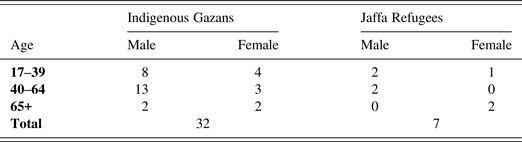
Moving beyond the features of GCA that have been analyzed through a sociolinguistic framework, in the remainder of this section I re-examine a number of Bergsträßer's observations, providing a qualitative account of these features based on data from the corpus of indigenous Gazans who were interviewed in 2013 (Table 2). This corpus consists of 39 sociolinguistic interviews, ranging from 20 minutes to two and a half hours in length, conducted with Palestinians in Gaza City. Of these 39 interviews, 32 were conducted with indigenous residents whose families trace their history back to Gaza City for multiple generations. The remaining seven speakers are Palestinian refugees originally from the city of Jaffa, whose families fled Jaffa in 1948 and came to Gaza. The speech of this refugee community is not examined in the discussion below, but has been discussed elsewhere (Cotter and Horesh Reference Cotter and Horesh2015). The interviews were conducted by the author, with the help of three local community members as research assistants.
Demographic makeup of the corpus of data collected from Gaza City in 2013

Cotter (Reference Cotter2016b) investigated the status of the Arabic interdental fricatives /θ, ð, ðʕ/ in Gaza City. The available descriptive accounts of GCA paint an unclear picture of these phonemes, with Bergsträßer (Reference Bergsträßer1915: map 1) describing them as stops [t, d, dʕ]. The stop realizations of the interdentals are a common feature of urban Levantine varieties of Arabic, and within Palestinian Arabic the replacement of the interdentals with stops has been described in cities like Jerusalem (Rosenhouse Reference Rosenhouse and Versteegh2007) and Jaffa (Horesh Reference Horesh and Mifsud2000). However, the transcripts of Salonen's (Reference Salonen1979, Reference Salonen1980) texts from Gaza City showed a limited degree of variation between the interdentals and their stop counterparts. Salonen's small sample size and the reality that the speakers were not actually from Gaza City (de Jong Reference De Jong2000) makes it difficult to draw conclusions regarding the stability of this variation.
Within the corpus of data collected from Gaza City in 2013, the interdentals /θ, ð, ðʕ/ are categorically realized as their stop counterparts [t, d, dʕ] (Cotter Reference Cotter2016b: 160). Examples that highlight the stop realizations of these phonemes can be seen in cases such as /iθneːn/ ~ [itneːn] ‘two’, /ma-naxuð-iʃ/ ~ [m-naxud-iʃ] ‘we don't take’, and /naðʕall/ ~ [ndʕall] ‘we stayed’ (Cotter Reference Cotter2016b: 156, 158, 159). The only exceptions to the stop realizations come in the form of lexical items from formal registers or Standard Arabic that show incomplete nativization into the dialect. In these cases, the interdentals may be retained or realized as [s, z, zʕ] respectively. This suggests that GCA is still in line with Bergsträßer's account in realizing the interdentals categorically as their stop counterparts [t, d, dʕ], despite decades of migration and dialect contact. However, the variability in Salonen's (Reference Salonen1979, Reference Salonen1980) texts, and attestations by his speakers that they were from village areas outside of Gaza City suggests that there may have been, and could still be, other Arabic varieties in Gaza that retain the interdentals.
A further point of descriptive interest, the realization of /d͡ʒ/ in Gaza City, was reported by Bergsträßer (Reference Bergsträßer1915: map 2) to be realized as [ʒ], a common reflex in urban Palestinian dialects. However, de Jong's (Reference De Jong2000) reanalysis of Salonen's texts noted that based on those materials /d͡ʒ/ was realized as [d͡ʒ] which is common in Bedouin dialects in the area surrounding Gaza City. Based on the data collected in 2013, [d͡ʒ] as a realization of /d͡ʒ/ is predominant in the speech of indigenous Gaza City residents, surfacing in examples such as /d͡ʒamal-ak/ ~ [d͡ʒamal-ak] ‘your (m.) camel’ and /natfarrad͡ʒ/ ~ [natfarrad͡ʒ] ‘we watch’, contrasting with Bergsträßer's early account.
Bergsträßer (Reference Bergsträßer1915: map 11) also describes the diphthong /ai/ as being partially preserved in the Bedouin dialect areas surrounding Gaza City; however in Gaza City today, both /ai/ and /aw/ have been fully monophthongized to [e:] and [o:]. Examples of this process can be seen in cases such as /bait/ ~ [be:t] ‘house’ and /fawq/ ~ [fo:ɡ] ‘up’. In this case Salonen's texts also suggest the monophthonization of /ai/ and /aw/ (de Jong Reference De Jong2000: 537, Salonen Reference Salonen1979: 40).
GCA also takes part in a process common in Levantine varieties of Arabic whereby short vowels are elided in open unstressed syllables (de Jong Reference De Jong2000: 542–543). Examples of this process from the interviews conducted in 2013 can be seen in cases like /sila:ħ/ ~ [sla:ħ] ‘weapons’, /kabi:r/ ~ [kbi:r] ‘big (m)’, and /zira:ʕa/ ~ [zra:ʕa] ‘farming’. Across the data collected in Gaza City, the dialect elides these short vowels in open unstressed syllables in a fashion similar to neighbouring dialects (Blanc Reference Blanc1970, Rosenhouse Reference Rosenhouse and Versteegh2007). Although this type of elision is common in Palestinian Arabic, it has never been documented in GCA outside of de Jong's (Reference De Jong2000) attestations based on Salonen's texts, and represents one of a number of descriptive areas for which we simply did not have sufficient data in the past.
With respect to the first person plural pronoun (Standard Arabic /naħnu/), Bergsträßer (Reference Bergsträßer1915: map 14) notes Gaza City's reflex as [əħna], while Salonen's texts provide alternates in the form of [nəħna] and [aħna] (de Jong Reference De Jong2000: 548). Within the 2013 corpus the [əħna] form is predominant. Additionally, based on the data in the corpus the interrogative ‘what?’ is realized in GCA interchangeably as [e:ʃ] and [ʃu:], in line with what Bergsträßer reported for the dialect in 1915 (map 16).
The irregular verbs /akal/ ‘he ate’ and /axað/ ‘he took’ are reported by Bergsträßer to be realized with a long [a:], as in [ja:kul] ‘he eats’. Salonen's texts paint a similar picture (Reference Salonen1980: 9–11). The 2013 data suggests that this is still the norm in GCA, with attested cases in [na:kul] ‘we eat’ and [b-ja:klu] ‘they eat’.Footnote 4 Additionally, the data collected in 2013 yielded no occurrences of the alternate long [o:] form (e.g., [bo:kul] ‘he eats’). However, in the final portion of the interviews, which focused on language, speakers suggested that in other areas of the Gaza Strip these irregular verbs are realized with [o:]. That being said, the only attested occurrences in the data are of the [a:] form.
GCA also does not appear to take part in the ‘gahawa syndrome’ (de Jong Reference De Jong and Versteegh2011), a process of resyllabification via the insertion of an epenthetic [a] vowel following back spirants, when these are preceded by [a]. The canonical example, /qahwa/ [gahwa] > [gahawa] ‘coffee’, shows how this process manifests. Bergsträßer's (Reference Bergsträßer1915) dialect atlas makes no mention of the process, but based on Salonen's (Reference Salonen1979, Reference Salonen1980) texts de Jong (Reference De Jong2000) notes that the process appears to be inactive in Gaza City. However, he does note some candidates for the process appearing in Salonen's texts such as [ʃahar] ‘month’ and [baħar] ‘sea’ (de Jong Reference De Jong2000: 540). My fieldwork supports de Jong's hypothesis that the process is not active in the dialect of the city. The canonical form, [gahwa], was realized invariably without the epenthetic vowel. One of the cases noted by de Jong, /baħr/ ‘sea’, underwent epenthesis in at least one instance, realized as [baħar]. However, across the corpus this is not regular and it is typologically unlikely that Gaza City has this process.
With respect to forms of negation in GCA, Bergsträßer (Reference Bergsträßer1915: map 21) reports the bipartite compound [ma-…-ʃ] form being active in Gaza City. This bipartite negation is a common feature of urban Palestinian varieties of Arabic (Lucas Reference Lucas2010). However, de Jong (Reference De Jong2000) reports based on Salonen's texts that GCA favours the pre-verbal negative ma:-, for example, [ma ruħt] ‘I didn't go’, but also notes a number of instances of the bipartite form in Salonen's texts. De Jong (Reference De Jong2000) also reports some instances of pre-verbal ma- in the bipartite form eliding, leaving only the post-verbal negative -ʃ, for example, [ruħtiʃ] ‘I didn't go’.
In the 2013 corpus, all three forms of negation appear; but qualitatively, de Jong's point that the pre-verbal ma:- is more common appears to be supported by the data. That being said, there is still evidence of the bipartite form in cases like [m-naxud-iʃ] ‘we don't take’. While Bergsträßer's attestation of the bipartite form is supported, today the situation appears much more complex, potentially as a result of the large-scale dialect contact taking place in Gaza post-1948. Regardless of the source, the situation for this and other features in Gaza City, particularly the two cases of lexical variation discussed below, is one where numerous parallel forms exist side by side.
The first case of lexical variation from the corpus is /halqe:t/ ‘now’. Given the prominent variation across Palestinian dialects in the realization of the voiceless uvular stop as [ɡ] or [ʔ], this lexical item is often realized as [halɡe:t] or [halʔe:t]. Additional variants of /halqe:t/ can surface as [hallaʔ], [hal-waɡit], and [halħi:n]. The third of these variants is typically described as Bedouin in origin. The realization of /halqe:t/ attested in 1915 was [halʔe:t] (Bergsträßer Reference Bergsträßer1915: map 27). Today, however, GCA appears to run the gamut of variation for this lexical item. With the exception of [halħi:n], the remaining variants were all attested in various forms throughout the 2013 data. However, [halɡe:t] was the overwhelmingly common variant, which is in line with Bergsträßer's initial report, despite the shift in /q/ in GCA from [ʔ] to [ɡ].
Variation in the adverb /ha:na/ ‘here’ is common in GCA as well. Bergsträßer (Reference Bergsträßer1915: map 25) describes /ha:na/ being realized by Bedouin speakers surrounding Gaza City as [ho:na], with the final [a] optionally elided. In neighbouring urban areas [ha:na] was common. In reanalyzing Salonen's (Reference Salonen1979, Reference Salonen1980) texts, de Jong (Reference De Jong2000: 550) notes considerable variation in the realization of /ha:na/ with no linguistic factors constraining the use of a given form. Based on the interview data from 2013, /ha:na/ in GCA surfaces as both [ha:na] and the form that elides the final vowel, [ha:n]. In addition, the lexeme can also be realized as [ho:n]. This suggests a situation similar to what Bergsträßer described in his earlier account.
As I noted above, given the turbulent history of Gaza since 1948 there have been immense waves of refugee migration into the Gaza Strip. This has created a linguistic situation that has largely remained a mystery, despite the territory itself being a major player in international politics. The linguistic features discussed in this section, both those cases where sociolinguistic variation has been documented and more recent qualitative observations, highlight potential outcomes of the type of dialect contact endemic to this particular sociopolitical context, and provide rich ground for future analysis. As our focus within Arabic sociolinguistics shifts towards engaging with the goals of description and documentation, we are better positioned to situate variation within its broader linguistic and social context. To do so will not only strengthen our treatments of language in the Arabic speaking world, but will also allow us to better address the concerns and goals of the communities in which we work. Addressing these concerns is an area that I return to below.
5. Sociolinguistic complexity in Gaza City
Beyond the descriptive aspects of the dialect provided above, there are also a number of more macro-linguistic points about the Gaza Strip that become apparent when one looks at the data. The first of these, alluded to in Section 4, is that Bedouin tribes still live in the southern areas of the Gaza Strip, particularly surrounding the southern city of Rafah, close to the present-day border with Egypt. Historically, it was clear that Bedouin tribes had migrated into Gaza and the Sinai Peninsula (Stewart Reference Stewart1991); however, given the demographic shifts that have taken place in Gaza their current status was uncertain. Based on narratives from members of the Gaza City community, the recent fieldwork suggests that at least one group, the Tarabīn, a major tribe of the Sinai and Naqab desert, still lives in Gaza today. One question that remains is to what extent their varieties of Arabic are still spoken.
Another point worth further discussion is the status of Gaza's Christian community. As noted above, a dwindling indigenous Christian community remains in the Gaza Strip. Today this community is concentrated almost entirely in Gaza City and is situated largely around the (Orthodox) Church of Saint Porphyrius, along with local Baptist and Catholic churches. Members of the community placed its current size at roughly 1,200–1,300 members, and noted that many Christians left during periods when entering and leaving Gaza was easier. Despite its small size, this Christian community has existed in Gaza City for roughly 1,600 years, with the original construction of the Church of Saint Porphyrius dating to the fifth century. However, the potential for linguistic variation stratified along religious lines, which has been documented elsewhere in the Arabic-speaking world (e.g., Al-Wer et al. Reference Al-Wer, Horesh, Herin and Fanis2015, Blanc Reference Blanc1964), remains to be investigated in Gaza City.
Beyond the dwindling Christian population, a minority Dom community also calls Gaza home. The Dom are an Indo-Aryan community, speakers of Domari, an endangered Indo-Aryan language related to but distinct from Romani. Matras (Reference Matras2012) provided a thorough grammatical description of the Jerusalem variety of Domari, while Herin (Reference Herin2012, Reference Herin2014) has provided an additional account of the Domari varieties spoken in Aleppo and Saraqib (Syria), and in Beirut (Lebanon).
No linguistic information is available on the status of Domari in Gaza, with some of the few recent reports on this community coming by way of discussions about enduring forms of discrimination against the Dom in the Gaza Strip.Footnote 5 Although Domari is outside the scope of this analysis, scholars must first have a thorough understanding of GCA, which represents the primary contact language, if they wish to describe and document an endangered language like Domari and understand the ways in which it may have changed as a result of contact. The case of Gaza's Dom population, as well as the other cultural points mentioned above, are examples of how sociolinguistics intersects with language description and documentation, and with broader cultural concern in Gaza and the Arabic-speaking world more generally.
6. Discussion
When conducting sociolinguistic research, we have the tools and the time to amass sizeable bodies of data from the communities in which we work. What we still lack within Arabic sociolinguistics is a better framework for conducting research in these under-documented Arabic-speaking communities. I offer suggestions in the hope of moving Arabic sociolinguistics towards an integration of two important and intimately connected areas of the linguistic enterprise.
One practical way we can integrate sociolinguistic research and lines of inquiry from language description or documentation is to build aspects of both methodologies into the fieldwork enterprise from the outset. In addition to a methodological focus on sociolinguistic interview techniques, we can include documentary and descriptive methods that allow us to capture both kinds of knowledge. Elicitation paradigms and methods for developing consonantal inventories and alternations can be built into our fieldwork. Even when we are working on nearly undescribed varieties, the wealth of information on related Arabic varieties provides us with a starting point. If this foundational task of utilizing descriptive and documentary techniques in the study of under-documented varieties of Arabic remains absent from the work of Arabic sociolinguists, at the expense of more holistic descriptions of the varieties we study, we risk losing forever the opportunity to document many of these varieties.
One promising example of the integration of different methodologies are doctoral dissertations (e.g., Al-Qahtani Reference Al-Qahtani2015) that have incorporated dialectal descriptions as component parts of their larger sociolinguistic analyses. These descriptions draw on sociolinguistic data to construct grammatical sketches of the dialects in question. This is particularly important in cases like that described by Al-Qahtani, who investigates an isolated dialect in Saudi Arabia that had been previously undocumented.
Another avenue for integration is cross-disciplinary engagement. This would allow sociolinguists to refine our methodologies to better speak to the specific linguistic, social, cultural, and political contexts of the communities in which we work. These collaborative relationships can result in new insights from the available data. Recent work (Al-Wer and Herin Reference Al-Wer and Herin2011, Al-Wer et al. Reference Al-Wer, Horesh, Herin and Fanis2015) that bridges the gaps between description, documentation, and sociolinguistics represents a promising start, but further work that strengthens these relationships will not only be beneficial for the scholars involved, but will also produce work that is more holistic in its treatment of linguistic as well as social issues.
In addition to documenting the particulars of a given dialect, Arabic sociolinguists are also in a unique position to document culturally significant verbal art forms. It is widely known that folk tales, proverbs, and oral poetry have represented an important component of the sociocultural fabric of the Arabic-speaking community (Caton Reference Caton1991, Holes and Abu Athera Reference Holes and Abu Athera2009). Unfortunately, the sociopolitical ruptures that have taken place in the region mean not only that speakers are forced to uproot their lives, but that forms of verbal art are in danger of slipping from community memory, giving way to the more practical concerns of day-to-day life.
During recent fieldwork that I conducted with Palestinian refugees in northern Jordan, elderly community members reported that what was historically a strong community emphasis on oral poetic production has faded after more than five decades of displacement. Speakers attested that the younger community members are no longer actively producing these verbal art forms. With each passing generation, access to this knowledge fades until it eventually disappears, the result of a long process described to me by members of the community whereby “the poets have died.” Sociolinguistic research conducted in the Arabic-speaking world stands to contribute to the documentation of these forms of verbal art, with collaborations like that of Holes and Abu Athera (Reference Holes and Abu Athera2009) becoming increasingly important.
Beyond collecting and analyzing speech data or oral art forms from these communities, a methodology that is more attuned to issues related to description, documentation, and community wellbeing also lends itself to thought about the products that we as researchers can provide that will give something back to the communities we work in. Doing so moves us away from the research-centric nature of most fieldwork encounters. At present, this kind of community focus appears to be lacking in much of the research on Arabic; shifting in that direction will not only enrich the quality of our research, but strengthen and improve our relationships with communities themselves.
Within research on Palestinian Arabic, one potential community-centric focus would be to collect oral history narratives from community members on the seminal events of Palestinian history, akin to work conducted in English sociolinguistics (Wolfram and Schilling-Estes Reference Wolfram and Schilling-Estes1997). The forced expulsions that coincided with the creation of the state of Israel are now foundational events in Palestinian collective memory (Sa'di and Abu-Lughod Reference Sa'di and Abu-Lughod2007) and the generation that experienced these events is rapidly being lost. Researchers working within these communities can aid the community in documenting their lived history while providing members of the community with a record of their experiences. This approach allows us to leave the field having given something back to the community in the form of documentation of the lived experiences of these events, while also opening up the possibility for linguists to store backups of these digital collections off-site in more secure locations.Footnote 6
Another component in strengthening the relationship between researchers and the community is developing positive working relationships with community members themselves (Meyerhoff and Stanford Reference Meyerhoff, Stanford, Smackman and Heinrich2015). Our research can benefit from collaborating with and training community members to play an active role in developing a research focus that serves both intellectual and community interests (Rice Reference Rice2006, Czaykowska-Higgins Reference Czaykowska-Higgins2009, Crippen and Robinson Reference Crippen and Robinson2013). This form of collaboration not only results in the collection of the speech data that fuels our sociolinguistic work, but also brings members of the community into the research process and gives them agency in documenting their language and heritage.
Even after the end of formal colonial rule in the Middle East, the West has exerted and continues to exert influence across the region. One result of this legacy of outside influence is that individuals in the region have been denied agency in defining the course of their own community's history. Collaboration between researchers and community members provides a space for community voices to enter into broader narratives about the region, and through thoughtful dissemination of the research (Hill Reference Hill2002: 130), can play an important role in reshaping the way communities are viewed.
Sociolinguistics has, to some extent, grappled with the issue of how engaged and active researchers can or should be in the communities in which they work, especially in research focusing on education and policy (e.g., Labov Reference Labov2010, Charity-Hudley and Mallinson Reference Charity-Hudley and Mallinson2013). Similarly, linguists engaged in language documentation and revitalization are perhaps more active than other areas of the field in their advocacy for both the linguistic and human rights concerns of communities (Rice Reference Rice2006, Bowern and Warner Reference Bowern and Warner2015). Sociolinguists of Arabic, whose work regularly interfaces with the broader geopolitics that affect the Arabic-speaking world, can ask what or how much we should be doing in terms of outreach within or on behalf of the communities that we work in.
It goes without saying that community-led efforts should never be overshadowed by initiatives and attempts by outside researchers. At the same time, the decision to do more than collect and analyze data brings with it additional concerns related to how our privilege and position as (often) outside researchers affects the community. If we choose to move beyond our research interests and engage more directly with those broader areas of community concern, we must be prepared to take a back seat to community members. At the same time, we should remain aware of the privileges that we carry with us to the field, as well as the ways in which our approach to knowledge production is rooted in a largely Western intellectual framework (Hill Reference Hill2002).
One potential path forward would be to align ourselves more closely with forms of activism and social justice (Stoecker Reference Stoecker1999). Within related disciplines, most prominently anthropology, activism has grown substantially and represents an important component of the larger anthropological enterprise for at least some areas within the discipline. Our status as generally privileged foreign researchers has the potential to carry some weight within our home communities and we can attempt to bring the stories, experiences, and voices of the communities we work in to a much wider audience.
Regardless of the extent to which we are willing to engage with forms of activism through our work, we must ask: what are our responsibilities to the communities and individuals with whom we work, and how are community members represented as part of our research (Cameron et al. Reference Cameron, Frazer, Harvey, Rampton and Richardson1992, Rice Reference Rice2006)? In a climate of harsh public opinion about the Middle East on an international level, we do well to think critically about how the communities that we work in are represented in the knowledge that we produce.
Rice (Reference Rice2006: 137) has highlighted the multi-layered matrix of responsibilities that researchers must attend to in their work. Returning something to the community, whether linguistic or otherwise, forms an important part of this process (Rice Reference Rice2006: 139, Wolfram Reference Wolfram1993). One important path forward within Arabic sociolinguistics will be to work more closely with communities and attempt whenever possible to solicit feedback from community members on the products of our research. Doing so will allow us as researchers to better navigate issues of representation while further bringing community members into the process of knowledge production.
7. Conclusion
Arabic sociolinguistics has expanded a great deal since it began roughly four decades ago. However, as the other contributions to this issue show, sociolinguistics generally stands at the crossroads of multiple disciplines and foci. Meyerhoff and Stanford (Reference Meyerhoff, Stanford, Smackman and Heinrich2015) have recently reminded us that our intellectual community, committed to understanding the intersections of language and society, has changed and continues to change alongside the communities in which we work. Nowhere is this more true than in the communities where Arabic is spoken; communities that live and change with some of the world's most socially and politically potent forces.
In presenting a number of descriptive features of Gaza City Arabic a century after their initial documentation, I have endeavoured to show that Arabic sociolinguistics has the potential to bridge important gaps between our field and related areas of research. doing this, we move towards a more holistic understanding of the linguistic situation in under-documented Arabic-speaking communities. This new-found understanding, one that reaches across disciplinary boundaries, points us towards what could perhaps be the more pressing area of focus: how the lives, experiences, and of course language of these communities are affected by the influences of regional geopolitics and rapid global and urbanization that define the face of the Arabic-speaking world.