INTRODUCTION
Hull fouling has been recognized as one of the primary transport mechanisms responsible for the dispersal of marine organisms around the world and continues to be a significant vector for the introduction of alien species in modern times (Carlton & Hodder, Reference Carlton and Hodder1995; Gollasch, Reference Gollasch2002; Floerl & Inglis, Reference Floerl and Inglis2003). Many different taxa have spread as part of the fouling community attached to vessel hulls and subsequently appeared on floating pontoons (Fofonoff et al., Reference Fofonoff, Ruiz, Steves, Carlton, Ruiz and Carlton2003; Arenas et al., Reference Arenas, Bishop, Carlton, Dyrynda, Farnham, Gonzalez, Jacobs, Lambert, Lambert, Nielsen, Pederson, Porter, Ward and Wood2006). Even mobile species such as decapods (Gollasch, Reference Gollasch1999), amphipods (Carlton, Reference Carlton, Sandlund, Schei and Viken1999) and platyhelminths such as Cryptostylochus hullensis Faubel & Gollasch, Reference Faubel and Gollasch1996, a flatworm described for the first time from a ship's hull (Faubel & Gollasch, Reference Faubel and Gollasch1996), can be transferred in this way.
Caprellids, like other amphipods, have been found in ships' ballast water, sea-chests and also associated with sessile organisms (i.e. algae, hydrozoans, bryozoans and sponges) attached to ships' hulls (Coutts et al., Reference Coutts, Moore and Hewitt2003; Minchin & Holmes, Reference Minchin and Holmes2006; Cook et al., Reference Cook, Jahnke, Kerckhof, Minchin, Faasse, Boos and Ashton2007). Their semi-sessile nature along with their morphology, which enables them to cling to a variety of substrates, favour their transfer by ships and account for their success in a wide geographical range (Thiel et al., Reference Thiel, Guerra-García, Lancellotti and Vásquez2003; Ashton et al., Reference Ashton, Willis, Cook and Burrows2007; Cook et al., Reference Cook, Jahnke, Kerckhof, Minchin, Faasse, Boos and Ashton2007).
Caprella scaura Templeton, Reference Templeton1836 is known from the western Indian Ocean, and was first described in Mauritius (Templeton, Reference Templeton1836). In the Mediterranean Sea, it was first recorded in the Lagoon of Venice (Italy) in 1994 (Sconfietti & Danesi, Reference Sconfietti and Danesi1996). Since then, it has rapidly spread throughout the Mediterranean and was reported in 2004 from marinas along the northern Adriatic coast of Italy (Sconfietti et al., Reference Sconfietti, Mangili, Savini and Occhipinti-Ambrogi2005; Savini et al., Reference Savini, Marchini, Forni and Castellazzi2006a) and from Leghorn Harbour (Italy) (Galil et al., Reference Galil, Occhipinti-Ambrogi, Gollasch, Abdulla and Linden2008). In addition, Krapp et al. (Reference Krapp, Lang, Libertini and Melzer2006) reported the species in the Amvrakikos Gulf in Greece and in the Strait of Messina on the basis of preserved material collected between 2002 and 2004. Caprella scaura was also recorded in 2005 in Roses Bay in Girona, Spain (Martínez & Adarraga, Reference Martínez and Adarraga2008) and in 2009 along the southern coast of Tunisia (Ben Soussi et al., Reference Ben Soussi, Kahri, Ben Salem and Zaouali2010). Since 2009, it has been present with a stable population in the Mar Piccolo of Taranto (Italy) (Prato et al., in press). The species has recently expanded its range eastwards into Turkish waters (Bakir & Katagan, Reference Bakir and Katagan2011) and westwards reaching the Strait of Gibraltar in 2009 and the island of Tenerife in 2010 (Guerra-García et al., Reference Guerra-García, Ros, Dugo-Cota, Burgos, Flores-León, Baeza-Rojano, Cabezas and Núñez2011). Furthermore, C. scaura has proved to be an aggressive caprellid, able to reach high densities (i.e. 12.925 ind.m−2) (Martínez & Adarraga, Reference Martínez and Adarraga2008), to outcompete native congeners, and to extend its geographical distribution (Guerra-García et al., Reference Guerra-García, Ros, Dugo-Cota, Burgos, Flores-León, Baeza-Rojano, Cabezas and Núñez2011).
The recent discovery of C. scaura in two marinas in Lanzarote is the first record from this island, demonstrating a further spread within the Canary Islands, after the first finding in Tenerife (Guerra-García et al., Reference Guerra-García, Ros, Dugo-Cota, Burgos, Flores-León, Baeza-Rojano, Cabezas and Núñez2011). Its arrival in Lanzarote is discussed taking into account the likely diffusion modes within the Canary Archipelago.
MATERIALS AND METHODS
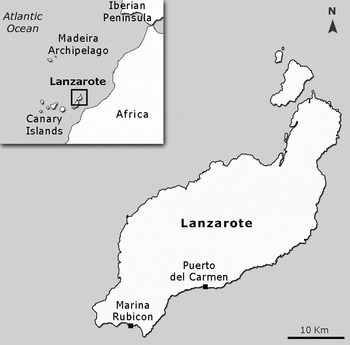
In March 2012 a preliminary investigation was carried out at two marinas on the island of Lanzarote (Figure 1) with the aim of assessing the presence of the bryozoan Zoobotryon verticillatum (Delle Chiaje, 1828). Lanzarote is the easternmost of the seven islands of the Canary Archipelago in the Atlantic Ocean (Figure 1). Two marinas were examined: Puerto del Carmen (28°55′16″N 13°40′27″W) hosting 146 berths and Marina Rubicon (28°51′25″N 13°48′54″W), 500 berths (Figure 1). They are located on the eastern and more sheltered side of the island and mainly frequented by small leisure and fishing crafts. Both marinas are semi-enclosed sheltered sites with varying levels of exposure. A qualitative survey of Z. verticillatum was carried out by hand collections from both craft hulls and floating pontoons. This was part of a study on Z. verticillatum at some Canary Islands marinas showing that the bryozoan densities ranged from 0.07 colonies m−1 at Marina Rubicon to 2.04 colonies m−1 in Puerto del Carmen and colonies branched from less than 1 m to more than 2 m in length in very sheltered areas (Minchin, Reference Minchin2012). During sorting of the retrieved Zoobotryon colonies, a few specimens of Caprella scaura sourced from both marinas and tenaciously attached to the branches of the bryozoan were removed and examined in vivo. The specimens were then pooled to a single vial and preserved in ethanol to enable species level classification. Identification was based on the morphological description provided by Krapp et al. (Reference Krapp, Lang, Libertini and Melzer2006) and Martínez & Adarraga (Reference Martínez and Adarraga2008). Body length measurements were taken using the software Image Pro Plus 4.1 for image analysis.
Location of Lanzarote Island, the easternmost island of the Canary Islands, eastern Atlantic Ocean. Black squares indicate the position of the two investigated marinas, Puerto del Carmen and Marina Rubicon.

RESULTS
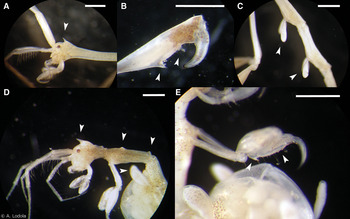
Eighteen Caprella scaura, 9 females and 9 males, were retained after being removed from colonies of Zoobotryon verticillatum. They were present in low numbers on this bryozoan within both marinas. Individuals had the morphological features of C. scaura as reported by Krapp et al. (Reference Krapp, Lang, Libertini and Melzer2006) and Martínez & Adarraga (Reference Martínez and Adarraga2008). The most distinctive characteristic is the occipital spine (Figure 2A) distinguishing C. scaura from all other known species of Caprella within European waters. In males (Figure 2A, B, C) the propodus of gnathopod 2 is elongated and each palm bears two strong teeth (Figure 2B). Females (Figure 2D, E) show variously developed knobs on some pereonites (Figure 2D), the propodus of gnathopod 2 is not elongated (Figure 2E) and palms each have a proximal spine and two distal teeth (Figure 2E). The gills are elliptical in both males and females but they are less elongated and shorter in females (Figure 2D) than in males (Figure 2C). Average length (± standard deviation) of the specimens from Lanzarote was 11.6 ± 2.8 mm for males and 7.4 ± 1.1 mm for females. Males ranged from 7.1 to 16.1 mm and females from 4.9 to 8.7 mm in length. Caprella scaura females were in reproductive condition and brood release was observed when specimens were placed in a glass container before their preservation.
Stereomicroscope photographs of Caprella scaura from Lanzarote Island: (A), (B) and (C) male and (D) and (E) female. Arrows indicate diagnostic features. Scale bar = 1 mm.

DISCUSSION
Although Caprella scaura specimens were recovered in small numbers within both marinas from pontoons and boat hulls, and were of a relatively small size, they may have been more common than was noted. Most of the females (8 out of 9) were in reproductive condition, confirming that the species is acclimatized, reproducing and thus, most probably, established. Although only Zoobotryon verticillatum was examined for attached biota, C. scaura may have been present on other sessile species, since this species would seem not to be associated with a specific habitat (Guerra-García, Reference Guerra-García2003). In the eastern Atlantic Ocean, apart from on Z. verticillatum, C. scaura has been found elsewhere as was noted in Chipiona Harbour, Spain (Guerra-García et al., Reference Guerra-García, Ros, Dugo-Cota, Burgos, Flores-León, Baeza-Rojano, Cabezas and Núñez2011). The small number of C. scaura individuals found in Lanzarote is much lower than that reported from the fish cages off Tenerife, where thousands of specimens were recorded (Guerra-García et al., Reference Guerra-García, Ros, Dugo-Cota, Burgos, Flores-León, Baeza-Rojano, Cabezas and Núñez2011). A further alien caprellid Caprella mutica Schurin, 1935 is also known to occur in high abundance on fish cages in northern Europe (Tierney et al., Reference Tierney, Kane, Naughton, Kennedy, O'Donohue, Copley and Jackson2004; Ashton et al., Reference Ashton, Boos, Shucksmith and Cook2006; Cook et al., Reference Cook, Jahnke, Kerckhof, Minchin, Faasse, Boos and Ashton2007; A. Jelmert, personal communication) as well as being associated with floating pontoons (Buschbaum & Gutow, Reference Buschbaum and Gutow2005).
The C. scaura female specimens from Lanzarote had a body length similar to that of specimens found in Tenerife whereas males were larger in the March samples from Lanzarote when compared to those collected during June from Tenerife (Guerra-García et al., Reference Guerra-García, Ros, Dugo-Cota, Burgos, Flores-León, Baeza-Rojano, Cabezas and Núñez2011). Males attain larger sizes in winter (Foster et al., Reference Foster, Heard and Knott2004; Guerra-García et al., Reference Guerra-García, Ros, Dugo-Cota, Burgos, Flores-León, Baeza-Rojano, Cabezas and Núñez2011) and this could explain the differences in size found.
A possible vector associated with the first record of C. scaura in the Lagoon of Venice in 1994 (Sconfietti & Danesi, Reference Sconfietti and Danesi1996) could have been within the hull fouling community of ships originating from the Indian Ocean, most likely through the Suez Canal, as was the case of other less conspicuous species, for instance the pycnogonid Ammothea hilgendorfi (Böhm, 1879) and the gammarid Elasmopus pectenicrus (Bate, 1862) (Occhipinti-Ambrogi, Reference Occhipinti-Ambrogi2000). Thereafter, the species may have been secondarily dispersed again by ships, including ballast water, but fish cage movements may also be involved (Krapp et al., Reference Krapp, Lang, Libertini and Melzer2006). Martínez & Adarraga (Reference Martínez and Adarraga2008) suggested its spread within Mediterranean waters was also due to the continuous circulation of yachts. The finding of C. scaura in marinas along the northern Adriatic coasts strongly suggests recreational boating as the main vector for its spread from its first known occurrence in the Lagoon of Venice (Sconfietti et al., Reference Sconfietti, Mangili, Savini and Occhipinti-Ambrogi2005; Savini et al., Reference Savini, Marchini, Forni and Castellazzi2006a). Indeed, harbour environments are commonly associated with biological invasions (Floerl & Inglis, Reference Floerl and Inglis2003; Cohen et al., Reference Cohen, Harris, Bingham, Carlton, Chapman, Lambert, Lambert, Ljubenov, Murray, Rao, Reardon and Schwindt2005; Arenas et al., Reference Arenas, Bishop, Carlton, Dyrynda, Farnham, Gonzalez, Jacobs, Lambert, Lambert, Nielsen, Pederson, Porter, Ward and Wood2006) and pleasure boating has been recognized as playing an important role in secondary diffusion of alien species (Floerl & Inglis, Reference Floerl and Inglis2005; Minchin et al., Reference Minchin, Floerl, Savini, Occhipinti-Ambrogi, Davenport and Davenport2006; Savini et al., Reference Savini, Marchini, Forni and Castellazzi2006a, Reference Savini, Occhipinti-Ambrogi, Minchin and Floerlb). Furthermore, vessels have been considered responsible for the introduction of C. scaura along the eastern Atlantic coast given that the Strait of Gibraltar is a region with much shipping and leisure craft traffic (Guerra-García et al., Reference Guerra-García, Ros, Dugo-Cota, Burgos, Flores-León, Baeza-Rojano, Cabezas and Núñez2011). We consider the most likely vector for the appearance of C. scaura in Lanzarote to be hull fouling. Indeed, slow-moving fouled vessels may reduce the risk of individuals becoming detached. The ability to spread is almost certainly due to their tenacious habit of adhering to other organisms by means of their slender and pointed dactyls (Schultz & Alexander, Reference Schultz and Alexander2001). Thus, it is likely that C. scaura was directly introduced to the two investigated marinas from nearby already-colonized areas in Tenerife by means of secondary local dispersion or from elsewhere. A further possible explanation for the arrival of C. scaura in the Canary Islands cannot be excluded, i.e. the transfer in floating Sargassum C. Agardh, 1820 from the Caribbean and the Gulf of Mexico, where the species is already present (LeCroy et al., Reference LeCroy, Gasca, Winfield, Ortiz, Escobar-Briones, Felder and Camp2009). The same mode of dispersal has been suggested for the presence in Tenerife of the tanaidacean Zeuxo exsargasso Sieg, 1980 (Bamber & Costa, Reference Bamber and Costa2009), which is now widespread throughout the Canary Islands, including Puerto del Carmen in Lanzarote (Bamber, Reference Bamber2012). The distribution of many caprellids might be facilitated by their ability to be associated with the fouling communities on floating objects that have a high potential for far-range dispersal involving both local and regional scales (Thiel et al., Reference Thiel, Guerra-García, Lancellotti and Vásquez2003). The related Caprella andreae Mayer, 1890 was recorded attached to the fibrous husk of an intact coconut, Cocos nucifera L., found on an Irish shore (Minchin & Holmes, Reference Minchin and Holmes1993). McCain (Reference McCain1968) recovered this same species among incrustations on the backs of some turtles and highlighted its habit of attaching itself to floating materials (i.e. driftwood, buoys and plants). As a result C. andreae has become widely distributed including the Mediterranean Sea (McCain, Reference McCain1968), off the eastern coast of the United States (Caine, Reference Caine1986), in the North Sea (Holmes et al., Reference Holmes, Costello, Connor, Howson and Picton1997), Pacific Ocean (Takeuchi & Sawamoto, Reference Takeuchi and Sawamoto1998) and along the eastern Atlantic coast (Lopes et al., Reference Lopes, Marques and Bellan-Santini1993). Similarly, C. mutica has been observed attached to drifting seaweed off the coast of northern Japan (Sano et al., Reference Sano, Omori and Taniguchi2003) and in a harbour in Ireland (Minchin & Holmes, Reference Minchin and Holmes2006). The capability of tenaciously clasping to a wide range of fouling species, including those on the hulls of pleasure crafts, ensures wide dispersal (Cook et al., Reference Cook, Jahnke, Kerckhof, Minchin, Faasse, Boos and Ashton2007) of those species which lack a pelagic phase (Aoki, Reference Aoki1999). Moreover, specimens of C. mutica detached from drifting algae or displaced by wave action have been demonstrated to have the ability to disperse locally (<5 km) by free-swimming (Ashton, Reference Ashton2006). Thus, C. scaura might display the same distributional abilities and be expected to appear in other marinas within Macaronesia either by rafting or on boat hulls. Yachts, leaving the Mediterranean Sea often visit other Macaronesian islands when undertaking Atlantic journeys (Cornell, Reference Cornell2002). Large numbers of yachts pass by the Canary Islands en route to the western Atlantic. The occurrence of C. scaura in both the western (Martínez & Adarraga, Reference Martínez and Adarraga2008) and eastern Mediterranean basins (Bakir & Katagan, Reference Bakir and Katagan2011) and recently in the eastern Atlantic Ocean (Guerra-García et al., Reference Guerra-García, Ros, Dugo-Cota, Burgos, Flores-León, Baeza-Rojano, Cabezas and Núñez2011; present study) suggests that further diffusion may occur by such means.