INTRODUCTION
Acquiring systematic patterns alongside numerous exceptions poses one of the biggest challenges to a language-learning child. Causative structures provide one example of this challenge. Most languages have at least one way of expressing causativity – an action involving an agentive causer who changes the state or the position of a patient causee. Languages can use at least one of four possible structures: lexical, morphological, periphrastic, and light verb constructions (LVCs) (Hopper & Thompson, Reference Hopper and Thompson1980; Comrie, 1985; Talmy, Reference Talmy1988; Song, 1996; Van Hout, Reference Van Hout1996; Shibatani & Pardeshi, Reference Shibatani, Pardeshi and Shibatani2002). Causatives alternate with non-causative counterparts that express the same action without an overt causer (e.g. the lamp broke vs. the boy broke the lamp). However, not all constructions alternate (e.g. the rabbit disappeared vs. *the magician disappeared the rabbit). Idiosyncratic restrictions and alternating structures must be learned on a case-by-case basis. Studying the development of the causative in child language can help understand how children acquire language-specific constructions, which could in turn shed light on broader mechanisms at play in language acquisition, such as whether children mostly use innate syntactic knowledge or statistical frequency in acquisition.
Previous studies of causative acquisition have taken three general approaches to address these questions. First, diary-based studies, which make up the bulk of research on causatives in child language, focus on error production and what they reveal about underlying structures (e.g. Bowerman & Croft, Reference Bowerman, Croft, Bowerman and Brown2008). Second, corpus studies also look at errors, but focus on how these elucidate developmental stages of causative acquisition (e.g. Berman, Reference Berman1982; Allen, Reference Allen1998; Courtney, Reference Courtney2002). Finally, experimental methods have been used to better understand what syntactic or semantic cues children pay attention to when parsing and producing causatives (e.g. Dittmar, Abbot-Smith, Lieven & Tomasello, Reference Dittmar, Abbot-Smith, Lieven and Tomasello2008). However, these studies have focused on a narrow range of languages. For most languages, only corpus data is available, which is particularly helpful for distinguishing stages in development.
In the current study, we investigate the acquisition of causatives in Persian. Persian is particularly interesting because of its unique verbal structure: a limited number of around 200 lexical verbs, alongside a rich set of productive LVCs (these consist of a non-verbal constituent combined with one of a dozen light verbs). Persian provides four different constructions to express the causative: LVCs, lexical, morphological, and periphrastic constructions. LVCs in particular give rise to productive usage and unique overgeneralization patterns. Their use is not only constrained by argument structure, but also by the restrictions on the construction of the multiword collocation itself. Persian data allows us to explore a system with four possibilities for the causative, as compared to two or three possibilities available in other languages studied. We particularly emphasize patterns in acquisition of the LVC, which has not been looked at in previous studies. In this first study on the acquisition of the causative in Persian, we examine stages of development in spontaneous speech corpora of four monolingual Persian-speaking children (and their caregivers), aged 1;11 to 6;7.
Acquisition of the causative
A child must learn the causative semantics as well as the syntactic constraints of the causative construction. Most studies focus on whether children use innate rules (e.g. Pinker, Reference Pinker1984; Valian, Reference Valian1986) or usage-based statistical generalizations to home in on causative semantics, especially with no direct negative input from parents (e.g. Tomasello, Reference Tomasello1992). Previous studies have taken three different approaches to address this question.
In experimental approaches, studies have situated the causative construction as a prototypical transitive construction. This allows for critical sentences to be manipulated for case marking and argument structure to better understand at what point children attain abstract representations of argument structure constructions. While these studies have not solely focused on the causative, they contribute to our understanding of the most important cues for children's perception of causative semantics. Naigles, Fowler, and Helm (Reference Naigles, Fowler and Helm1992) found that English-speaking children go from relying primarily on syntactic frames (ages 2–4) to relying primarily on verbal semantics (age 5+) when interpreting the meaning of verbs in cases where the cues conflict. Kannada-speaking children (Lidz, Gleitman & Gleitman, Reference Lidz, Gleitman and Gleitman2003) adhere more to the number of nouns in a sentence than to morphological cues to interpret causative meaning. Studies on languages with rich morphological marking have also shown that, despite the importance of morphological cues for determining verb meaning, argument structure takes precedence, suggesting the existence of a universal ‘bootstrapping’ mechanism of meaning from syntactic form (e.g. Turkish: Göksun, Küntay, & Naigles, Reference Göksun, Küntay and Naigles2008; Ural, Yüret, Ketrez, Kocbas & Küntay, Reference Ural, Yüret, Ketrez, Kocbas and Küntay2009; Japanese: Imai, Haryu, Okada, Kajikawa & Saalbach, Reference Imai, Haryu, Okada, Kajikawa and Saalbach2007). Children seem to begin at age two with prototypical instances of constructions, with redundant grammatical markings playing a large role, and only later develop the ability to weigh individual cues appropriately (Dittmar et al., Reference Dittmar, Abbot-Smith, Lieven and Tomasello2008). In an elicitation task, Brooks and Tomasello (Reference Brooks and Tomasello1999) prompted children from three age groups to produce a novel verb in a causative frame. Only the older group (4;6 and older) were sensitive to semantically idiosyncratic rules, suggesting that rules are not innate but emerged later in development. The experimental evidence thus far suggests that children begin early with weak abstract representations, but also are very sensitive to frequency and lexical learning.
For languages where only diary and corpus data are available, studies have approached the same theoretical question by looking more specifically at causatives and overgeneralization errors produced by children. Overgeneralization errors occur when the child overextends a pattern found with one group of verbs to other individual verbs that happen not to allow the given pattern. Proponents of the innatist approach propose that the causative construction is inborn with a predefined structure (Pinker, Reference Pinker1989). Errors then simply reflect mistakes in the understanding of underlying verb structures. In contrast, usage-based approaches claim that children first learn causative verbs as individual items, and exploit abstract structures in later development (Bowerman & Croft, Reference Bowerman, Croft, Bowerman and Brown2008). Under this view, sensitivity to statistical regularity underlies the constraints on the causative alternation (Brooks & Tomasello, Reference Brooks and Tomasello1999; Bowerman & Croft, Reference Bowerman, Croft, Bowerman and Brown2008).
Diary and corpus studies have contributed many examples of errors produced by children, as well as general patterns of causative use, mostly focusing on language-particular structures (Hebrew: Berman, Reference Berman1982; English: Bowerman, Reference Bowerman1974; Lord, Reference Lord1979; Bowerman & Croft, Reference Bowerman, Croft, Bowerman and Brown2008; Pinker, Reference Pinker1989; Japanese: Morikawa, Reference Morikawa1990; K'iche: Pye, Reference Pye and Levy1994). Bowerman (Reference Bowerman1974) finds that English-speaking children begin producing lexical causatives before periphrastic ones. She argues that children begin with ‘unanalyzed’ forms and later create novel verbs based on established patterns. For some time in this trajectory, the child makes overgeneralization errors (e.g. he disappeared the rabbit). Bowerman suggests that when children finally understand the meaning of their first lexical verbs, they overgeneralize the causative construction to all verbs before later mastering the appropriate language-specific subclasses. Exceptions become entrenched (i.e. the establishment of a conventional form) and preempt mistakes (i.e. prevent overgeneralization of a broad rule). In a recent cross-linguistic study of causatives in Hebrew and Estonian, Argus, Uziel-Karl, and Laalo (Reference Argus, Uziel-Karl and Laalo2011) also find that children between 2;0 and 2;6 do not choose the most transparent causative constructions (i.e. periphrastic causatives). Rather, they tend to use language-specific preferences (i.e. lexical causatives, causative morphemes), reflecting patterns in child-directed speech.
However, errors occur rarely in child language corpora. Maratsos (Reference Maratsos, Aaronson and Reiber1979) calculated that to find 100 errors, Bowerman (Reference Bowerman1974) must have listened to about 750,000 utterances. This staggering number of utterances is rarely available in typical child language corpora.
Another approach that involves corpora centers on defining developmental stages. Berman (Reference Berman1982) proposes a general model of language development using stages. She applies this model to the development of transitivity in Hebrew, with a focus on the causative alternation (Berman, Reference Berman and Levy1994). This model includes three phases (Pregrammatical, Grammatical, and Conventionalized), which can be divided further into five stages (Rote Knowledge, Early Alternations, Interim Schemata, Rule Knowledge, and Mature Usage). These stages correspond to: (i) learning unanalyzed forms; (ii) using a familiar set of lexical items in a limited number of alternations; (iii) acquiring a semi-productive set of grammatical rules; (iv) adhering strictly to acquired rules (often resulting in overgeneralizations); and (v) achieving adult-like grammar.
This model provides a framework within which to explore the quantitative and qualitative aspects of mastering a variety of constructions. For the causative, a child first learns individual verbs (e.g. Jane broke the vase), followed by a period of overgeneralization where semantically related words appear in known structures by induction (e.g. Jane disappeared the rabbit). In the fourth stage, high-frequency verbs are then entrenched and preempt erroneous alternatives. And finally, the child attains adult-like language.
While originally based on Hebrew data, this model has subsequently been used to describe the development of the causatives in two other longitudinal corpus studies (Inuktitut: Allen, Reference Allen1998; and Quechua: Courtney, Reference Courtney2002). The three corpus studies ultimately support a theory of verb-by-verb learning as opposed to using predefined categories or structures.
Allen (Reference Allen1998) examines the utterances of eight Inuktitut-speaking children between ages 1;0 and 3;6. Inuktitut verbs are divided into two classes: those that express causativity only through morphological markers, and those that occur either as lexical verbs or with a morphological marker. Allen finds three stages in the data: in the first stage, children produce only lexical causatives with a limited number of verbs; in the second stage, children use lexical causatives more productively and start using the morphological causative superfluously; and in the third stage, children use the causative alternation with both lexical causative verbs and morphological markers with minimal error.
Courtney (Reference Courtney2002) describes five developmental stages in Quechua-speaking children aged 2;4 to 3;5. As in Inuktitut, Quechua only allows lexical and morphological causatives. Courtney analyses mistakes (e.g. anomalous uses of the causative marker), productivity (e.g. extending the use of the marker to a number of new verb roots), and proper case marking for morphological and lexical causatives (e.g. of the causee). She finds that, in a first stage, children omit the causative marker and often omit case markings of the arguments. In the second stage, a few instances of the causative morpheme occur, but as unanalyzed amalgams. In the third stage, children use the causative more productively, though case marking is still often missing. In the fourth stage, they produce causatives reliably, and restrict errors to a small number of constructions. In the fifth stage, the children attain adult-like mastery.
In the current study, we take the spontaneous speech approach to looking at longitudinal data from Persian child language. The Persian-speaking child must master four different causative constructions and learn which constructions are used with which verbs. The languages in which causative acquisition has been studied so far only offer two or three causative structures, so Persian-speaking children arguably face a more difficult learning task, and thus allow us deeper insight into how children deal with learning systematic patterns alongside each of their exceptions. Further, the LVC causative is the most productive of the four causative options in Persian. Because of its complex structure, and the intricate mix of patterns and exceptions with respect to the causative, it offers a greater opportunity than other causative constructions to find specific error patterns and alternations as evidence for underlying learning strategies. In addition to focusing on errors and alternations, we will examine stages of development of the causative in Persian, based on both frequency data and overgeneralization errors. The stages found in this study will lay the groundwork for further understanding of causatives in Persian.
The Persian causative construction
Modern Persian is an Indo-European language spoken in Iran and parts of Afghanistan, Tajikistan, and Bahrain. Word order is relatively free, with a default SOV order. The verbal system has a limited number of just over 200 lexical verbs, which are being progressively replaced by semantically equivalent LVCs (Folli, Harley & Karimi, Reference Folli, Harley and Karimi2004). LVCs express the majority of verbal notions through the combination of one of a dozen light verbs (e.g. zædæn ‘hit’, amædæn ‘come’, gereftæn ‘get’, kærdæn ‘do’) with a non-verbal preverbal element (PV). The LVs serve as a basis for hundreds of different verbal notions typically expressed by lexical verbs in other languages, such as English. When a loan word enters Persian, it is incorporated into an LVC as a PV and assigned an LV (e.g. esemes zædæn ‘to send an SMS’ (lit. ‘SMS hit’), or kabl keshidæn ‘install cables’ (lit. ‘cable pull’)).
Persian uses four different constructions to express causativity. As in English, certain Persian lexical verbs can express both causative and non-causative meanings (e.g. English broke: The vase broke vs. Jane broke the vase). In (1a), the Persian verb rixtæn ‘to spill’ can be used both as a causative and a non-causative, as can the verb pashidæn ‘to spray’ in (1b). The non-causative usually occurs in the third person singular, and the causative takes a volitional subject.
(l) NON-CAUSATIVE CAUSATIVE
a. ab rixt. ab ra rixt-æm.
water spill&pst&3sg water acc spill&pst-1sg
‘Water spilled.’ ‘I poured the water.’
b. roqæn pashid ru lebas-et roqæn ra pashid-æm ru lebas-et.
oil spray&pst&3sg on clothes-poss.2sgoil acc spray&pst-1sg
on clothes-poss.2sg
‘The oil sprayed onto your clothes.’ ‘I sprayed the oil onto your clothes.’
Different lexical items can also be used to form lexical causatives and their and non-causative alternants (i.e. English: kill–die, give–receive). In (2), the Persian mordæn ‘to die’ alternates with the lexical causative koshtæn ‘to kill.’
(2) NON-CAUSATIVE CAUSATIVE
Ali mord. Sohrab Ali ra kosht.
Ali die&pst&3sg Sohrab Ali acc kill&pst&3sg
‘Ali died. ’‘Sohrab killed Ali.’
In their study on Persian causative constructions, Golfam and Dehghan (Reference Golfam and Dehghan2012) label the causatives in (1) as ‘non-equitive simple lexical causatives’ (same) and those in (2) as ‘equitive simple lexical causatives’ (different). In examples in (1) and (2), the argument structure changes the meaning of the verb: the causative has two arguments, while the non-causative has a single argument. Similarly to English, the lexical causative in Persian must be learned on a case-by-case basis.
The ‘morphological causative’ occurs when a causative morpheme appears in a verb. Although this structure does not exist in English, it is very common in many other languages. In Turkish, for example, adding the suffix -dir turns a non-causative verb into a causative (Comrie, Reference Comrie and Shopen1985).
Persian has a morphological causative morpheme -an-, added directly to the verb root before tense and number inflection (Lotfi, Reference Lotfi2008, p. 3), as in example (3). These forms are fossilized in Modern Persian, though they reflect a previously productive process.
(3) NON-CAUSATIVE CAUSATIVE
bæche-ha tærs-id-ænd. bæche-ha ra tærs-an-d-i.
child-pl scare-pst-3pl child-pl acc scare-cau-pst-2sg
‘The children got scared.’ ‘You scared the children.’
Many lexical verbs end with the typical verbal ending -id-, and cannot accept the causative morpheme (e.g. xæridæn ‘to buy’, busidæn ‘to kiss’, dozdidæn ‘to steal’, jængidæn ‘to fight’), or they are already causative (e.g. tærashidæn ‘to sharpen’, kubidæn ‘to slam’). Adult speakers might use this systematic pattern to create pragmatically marked, satirical constructions using this morpheme (see Lotfi, Reference Lotfi2008), but this has only been reported so far in a particular register of adult speech.
The ‘periphrastic causative’ results from embedding a non-causative within a causative clause. For example, in the English sentence Jane made John eat his peas, the non-causative clause John eats his peas occurs inside the causative clause headed by Jane made. The Persian periphrastic causative is constructed in an identical manner, as in (4). As in English, it expresses a nuanced meaning of indirect causation.
(4) CAUSATIVE
Ali baes ∫od ke Amir dærs-esh ra næ-xan-æd.
Ali reason become&pst&3sg that Amir study-poss.3sg
‘Ali made Amir not study.’
While productive, this structure rarely occurs in our data from children and their caregivers. The meaning conveyed by the construction is more complicated than the equivalent English periphrastic. Namely, in (4), the clause Ali baes shod expresses a meaning like ‘Ali was the reason why …’. The outside, causative clause can also express temporally distant causation (Jackendoff, Reference Jackendoff1990). The fine-grained semantic differences of different constructions are beyond the scope of this paper (for a discussion, see Song, Reference Song1996).
Finally, LVCs represent the most common and productive causative construction in Persian. Similar to a handful of South-Asian languages, Persian has highly productive LVCs (Mohannan, Reference Mohanan, Alsina, Bresnan and Sells1996; Butt & Geuder, Reference Butt, Geuder, Eckardt, von Heusinger and Schwarze2001). Folli et al. (Reference Folli, Harley and Karimi2004) argue that the LV determines the causativity of the verbal predicate. The LVC pairs in (5a) and (5b) show that changing one LV for another can result in a change of causativity.
(5) NON-CAUSATIVE CAUSATIVE
a. qælt xordæn qælt zædæn
‘to roll’ (lit. ‘somersault eat’) ‘to roll (volitional)’ (lit. ‘somersault hit’)
b. kæj shodæn kæj kærdæn
‘to bend’ (lit. ‘bent become’) ‘to bend something’ (lit. ‘bent do’)
In the examples in (5), replacing xordæn ‘to eat’ with zædæn ‘to hit’ in (5a), or shodæn ‘to become’ with kærdæn ‘to do’ in (5b), turns a non-causative LVC into a causative. However, switching from an LV like kærdæn ‘to do’ to the LV shodæn ‘to become’ does not guarantee a change in causativity. Alternations between LVs are only semi-productive, in that only subsets of LVs alternate freely. These subsets are based on semantic similarity (see Family, Reference Family2006), and the child must learn the constraints on these systematic patterns on a case-by-case basis.
Certain LVs frequently occur as causatives (e.g. the verbs kærdæn ‘to do’, dadæn ‘to give’, ændaxtæn ‘to throw’), but these can also occur in non-causative LVCs. For example, the frequently causative LVs skærdæn ‘to do’ (6a) and dadæn ‘to give’ in (6b) also occur in non-causative LVCs, as in (6c) and (6d). The causative valency of the LV often also depends on the PV.
(6) NON-CAUSATIVE CAUSATIVE
a. tæb kærdæn c. ab kærdæn
‘to come down with a fever’ (lit. ‘fever do’) ‘to melt’ (lit. water do)
b. gush dadæn d. qærar dadæn
‘to listen’ (lit. ‘ear give’) ‘to place’ (lit. ‘place give’)
LVs in Persian often express more than just causativity. Kærdæn ‘to do’ can form inherently unergative verbs, as in (6a) (Megerdoomian, Reference Megerdoomian2002; Folli et al., Reference Folli, Harley and Karimi2004). These LVCs are already intransitive and cannot partake in the transitivity alternations with shodæn ‘to become’.
Some LVCs do not have causative alternants, and Persian speakers must use the periphrastic causative described above in (5). Determining the causativity of an LVC depends partly on whether it alternates with a non-causative LVC, and partly on its argument structure.
Persian-speaking children must learn to use the correct causative using four possible constructions. While the use of lexical, morphological, and periphrastic causatives has been studied in several languages (e.g. Hebrew, English, Inuktitut), the Persian verbal system revolves around a productive class of LVCs alongside a closed class of lexical verbs.
Goals of this study
In Persian, children have four constructions to master instead of the two or three presented in other languages studied thus far. Further, the productive multiword structure of the LVCs offers many more opportunities for overgeneralization errors than in previous studies. These two factors specific to the structure of Persian pose a particular challenge to children learning the causative, and allow us more insight into the learning process than found in previous studies on other languages.
In this study, we use a corpus of spontaneous speech from Persian-speaking monolingual children, aged 1;11 to 6;7 to explore how they and their caregivers use these constructions. We focus particularly on the use of LVCs and lexical causatives.
In order to quantify the stages children go through, we use an analysis method introduced by Gries and Stoll (Reference Gries and Stoll2009). This novel method uses variability clustering to empirically calculate stages on a purely statistical basis, and provides an alternative to temporally unstable measures, such as mean length of utterance (MLU) (Brown, Reference Brown1973).
We complement the results from the quantitative analysis with error analysis and alternation patterns, which provide qualitative information on language-specific challenges. The Persian LVC causative is particularly prone to overgeneralizations: children must learn which LV to use to express the causative, and this involves learning the semantic restrictions on possible LV and PV combinations.
We fit our findings within Berman's stage model of language acquisition. The aim is not to validate or test the model, but to compare our findings to previous findings on corpora, which have also used the model to trace stages in development in different languages.
METHODS
Data
We examine three longitudinal corpora of monolingual Persian children. The participants were three girls (Lilia, Rosha, and Minu) and one boy (Radin). All have normal language development and no history of language delay according to parental report. Over the recording period, the children's ages range from 1;11 to 6;7. Minu and Rosha do not have any siblings, and Lilia is Radin's younger sister (they were recorded as part of a single dataset). The parents and children were all born and raised in Tehran, the capital of Iran with over fourteen million inhabitants. All interaction was recorded in an indoor home setting, allowing for a minimal and stable number of interlocutors who mostly addressed the children. All families are from the middle to upper socioeconomic class, and the mothers spend much of the day at home with the children. In all three families, the father works all day on weekdays, while the mother takes care of the children. All parents hold university degrees, and none are divorced or separated.
The mothers of each child audiotaped the children at home during playtime, mealtime, and other daily and routine activities. A typical day for the two girls Lilia and Rosha (1;11 and 2;8 at the beginning of data collection, respectively) includes playtime, TV-watching, and eating in a home setting with their caregivers. The older children, Minu (4;1) and Radin (5;7), attend school on weekdays and spend the rest of the day doing activities at home. The child-directed speech (CDS) comes solely from adults, as no children other than the target children were present during the recordings (in the Lilia corpus, the speech of respective siblings was not included in CDS analyses).
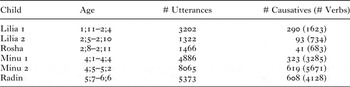
Table 1 provides the age range, range of mean length of utterance in words (MLUw), number of utterances, and number of hours of recording. The Lilia and Minu corpora are taken from the CHILDES database (MacWhinney, Reference MacWhinney2000; Family, Reference Family2009). Data for Radin (Lilia's older brother) are taken from the Lilia corpus. The Rosha corpus was recorded and transcribed during the same year by the same researcher. Lilia, Radin, and Minu were recorded approximately one hour every two weeks for one year, and Rosha for about an hour each month for three months. Rosha's corpus provides relatively less data, but her age overlaps with Lilia for most of the recording period, allowing for comparisons.
Summary of the child language data used in this study

The first author, a native speaker of Persian, transcribed and glossed all utterances in the recording following the CHAT format of CHILDES (MacWhinney, Reference MacWhinney2000). Utterances were coded for parts of speech and for inflectional and derivational morphology. We invite the reader to consult ‘Appendix 2’ for the raw numbers extracted from the corpora: utterances, verbs, causatives, types of causatives at each age of recording, and cumulative types (counting each new verb used in the causative, cumulatively over subsequent recordings). Direct repetitions and nursery rhymes were excluded from later analysis, as were utterances that included unintelligible material (all of these accounted for less than 1% of the data).
These longitudinal corpora, the only publically available annotated data for Persian child language, deliver only a small sample relative to the developmental scale of this study. The missing period between ages three and four represents an especially important period for rule learning and generalization of schemas (Tomasello, Reference Tomasello2000). To trace the emergence of different causative constructions more precisely, one would require a dense and continuous dataset alongside detailed experimental data. For example, the variability seen in the data might be due to the small sampling density (Tomasello and Stahl, Reference Tomasello and Stahl2004). However, the current data suffice to address preliminary and fundamental questions related to causativity in Persian child language. First, we can approximate the age when children begin to master the different types of causative constructions, and also compare child data to child-directed speech. Second, the data also reveal errors children make in using the causative, as well as alternations particular to the Persian verbal system.
Coding
Both child speech and child-directed speech were coded for the four types of causative constructions found in Persian: lexical, morphological, periphrastic, and LVC. The child-directed speech encompasses all speech by adults, both directed to the children and overheard by the children. For reliability, a second native Persian speaker coded 460 utterances from the different corpora. Disagreements were resolved through discussion.
We exclude the fairly frequent copula clitic (accounting for up to 23% of total verbal forms). This clitic form of the verb budæn ‘to be’ occurs mostly in the third person singular and attaches as a suffix -e to adjectives (e.g. qæshæng-e (lit. ‘nice-be.prs.3sg’) ‘he/she/it is nice’). It has only a predicative role without rich semantics, and is considered different from lexical verbs or LVs.
Determining exactly what constitutes a causative in Persian can be problematic, especially for lexical and LVC structures. The working definition of causativity used in this study is: causing a change of state or a change of location. All causative verbs are telic and they include change of state verbs, transfer verbs (change of possession), and verbs of caused motion.
As Persian allows for arguments to be omitted, contextual cues (e.g. prior discourse, verb agreement, volition of subject) were also used to determine causativity in ambiguous argument structures. The examples discussed below all occur in the current dataset.
Coding lexical causatives. Lexical causatives that were homophonous with their non-causative counterparts (e.g. rixtæn ‘spill–pour’, shekæstæn ‘break–break’, pashidæn ‘spray–spray’, poxtæn ‘cook–cook’) were determined after argument structure analysis. Non-causatives usually take a subject argument that undergoes the change of state or location, while the causative takes two arguments (i.e. causer as subject and causee as object). The verb rixtæn ‘to spill/pour’ in (7) can express both causative and non-causative actions.
(7) NON-CAUSATIVE LEXICAL (Lilia, 2;10)
mother: bæd ke mi-zar-i ru sofre bæd mi-riz-e.
then that prog-put&prs-2sg on table then prog-spill&prs-3sg
‘Then when you put it on the table, then it will spill.’
lilia: næ ne-mi-riz-e.
no neg-prog-spill&prs-3sg
‘No, it will not spill.’
CAUSATIVE LEXICAL (Lilia 2;5)
lilia: be-riz-æm?
sbjv-pour&prs-1sg
‘Should I pour (it)?’
Other lexical causatives express causativity unambiguously. The following verbs were coded as causative: tærashidæn ‘to scrape’, aværdæn ‘to bring’, bordæn ‘to take’, foruxtæn ‘to sell’, dadæn ‘to give’, ferestadæn ‘to send’, saxtæn ‘to build’, bæstæn ‘to close’, kændæn ‘to rip off’, boridæn ‘to cut’.
Zædæn ‘to hit’, ændaxtæn ‘to throw’, keshidæn ‘to pull’, and kubidæn ‘to slam’ express causativity only when they occur with a locative. In these cases, they express a change of position of the object, as in (8). In other cases, they were coded as non-causative.
(8) CAUSATIVE LEXICAL zædæn‘to hit’ (Minu 5;2)
minu: mi-zæn-æm tu dærbaz-æt.
prog-hit&prs-1sg in goal-2sg
‘I'll hit it into your goal.’
Gozashtæn ‘to put’ was also coded as causative when the final destination of the object was explicit in the sentence or prior discourse. This condition was flexible in recordings where the children worked on puzzles, when the location argument was often dropped because of shared visual cues, retrievable in context. For a list of non-causative verbs occurring in the corpora, see ‘Appendix 3’.
Coding morphological and periphrastic causatives. Periphrastic causatives were easily identifiable due to their special syntax. Similarly, morphological causatives were mostly identifiable due to the morpheme. However, the verb chelandæn ‘to squeeze (as in a hug)’ does not express a change of state, nor does it have a non-causative counterpart. Similarly, xarandæn ‘to itch/make itch’ may be causative only when it means ‘to make itch’ (e.g. as in ‘this sweater makes my skin itch’) and alternates with the non-causative verb xaridæn ‘to itch’. However, it can also have the non-causative meaning ‘to scratch’. These forms were checked on a case-by-case basis.
Coding light verb construction causatives. Causativity for the LVs required finer-tuned judgments. Several of the twelve LVs occurred in both causative and non-causative constructions. LVs that were non-causative across the board were: amædæn ‘to come’, ræftæn ‘to go’, oftadæn ‘to fall’, xordæn ‘to eat’, shodæn ‘to become’, and bordæn ‘to take’ (except for one instance of the causative pish bordæn (lit. ‘ahead take’) ‘to advance, make progress’). Certain verbs (e.g. bordæn) may be causative when used as lexical verbs, but non-causative when used as LVs.
Keshidæn ‘to pull’ and gereftæn ‘to get’ are only causative in relatively rare uses (e.g. luleh keshidæn ‘install pipes’ (lit. ‘pipe pull’), æz bærq keshidæn ‘unplug’ (lit. ‘from electricity pull;), hal gereftæn ‘upset’ (lit. ‘health get’), naxon gereftæn ‘trim nails’ (lit. ‘nail get’), ab gereftæn ‘rinse, pour water on’ (lit. ‘water get’)).
Zædæn ‘to hit’ is not causative unless it has a non-causative counterpart with LV xordæn ‘to eat’, and only occurs once in the data, as presented in (9).
(9) CAUSATIVE LV zædæn ‘to hit’ (Rosha, 2;8)
rosha: bæd pula ro gere zæd-æm.
then money-placc knot hit&pst-1sg
‘Then I tied the money together.’
Aværdæn ‘to bring’ is causative in most cases, except for when it refers to ‘luck’ or ‘rolling dice’ (e.g. bæd aværdæn ‘have bad luck’ (lit. ‘bad bring’), pænj aværdæn ‘roll a five’ (lit. ‘five bring’)), ‘imitate’, as in æda dær aværdæn (lit. ‘mannerism out bring’), ‘obtain’, as in be dæst aværdæn (lit. ‘to hand bring’), or ‘vomit’, as in bala aværdæn (lit. ‘up bring’).
Kærdæn ‘to do/make’ and dadæn ‘to give’ occurred in causative constructions most frequently (approximately 40% of LVCs expressed with each verb, in child and CDS). See ‘Appendix 4’ for a complete list of PVs from the corpus that occur in causative constructions with kærdæn ‘to do/make’ and dadæn ‘to give’.
Coding alternations. Alternations specific to Persian occur when changing one LV for another results in a change in causativity. The occurrence of an alternating pair within a three-utterance sequence was considered as evidence that the child understands the meaning differences associated with this change. We extracted all instances of alternating pairs that met the following four conditions:
1. they occurred within a three-utterance sequence so as to guarantee the likelihood that the second LVC was produced based on the first, to express a change in causativity;
2. the LVCs occurred with the same PV, which provides a structurally transparent encoding (the LV) of the semantic change involved in the alternation;
3. the pair expressed a difference in causativity.
Coding errors. Errors in the causative constructions, discussed further below, were extracted from the total list of errors produced. These included overgeneralization errors, and the substitution of a causative structure for a non-causative, or vice versa.
Quantitative analysis
We first analyzed the proportion of causatives used relative to all verbs per recording. We compared this to caregiver speech and used Pearson's product moment to find correlations.
Second, we applied Gries and Stoll's (Reference Gries and Stoll2009) clustering methods to each child's corpus, with the goal of finding beginning and ending times of empirically grounded developmental stages. This method determines possible stages in longitudinal datasets from the bottom up, and has been presented as one solution to the problem of data scarcity in longitudinal data and the arbitrariness of stage boundaries (Gries and Stoll, Reference Gries and Stoll2009, p. 225). An iterative algorithm computes the distance between recordings in a dataset in a temporally bound fashion, categorizing based on the data and predefined criteria.
We used four predetermined variables: the relative frequency of lexical causatives, the relative frequency of morphological causatives, the relative frequency of LVC causatives, and cumulative types of causatives (details provided in ‘Appendix 2’). The cumulative types of causatives records the number of new lexical items used within a particular construction. This reflects the child's ability to flexibly use a variety of items within that construction, and also indicates how freely she uses the construction productively. We counted the occurrence of each new lexical item used as a causative, and added one count for each new occurrence (for LVCs, we counted novel PVs used with the same LV).
The criteria are listed in a matrix form, with the recording number as the first column and each criteria as a separate column thereafter. The results are presented in the form of a dendrogram, a tree-like diagram that depicts relationships in data. Outliers (datapoints that do not coincide with developmental tendencies) can be detected as branches that do not merge with the rest of the data groupings.
After determining empirically grounded stages, we calculated the relative frequency of each causative construction relative to all causatives. We compared the frequency of types of causatives in child and CDS by doing a chi-square test on the proportions of different constructions, per stage.
Qualitative analysis
First, we identified alternating pairs of utterances with causative and non-causative LVs under the assumption that these alternations are strong indicators of productivity (Allen & Crago, Reference Allen and Crago1996, p. 141). Productivity manifests itself when a child can use patterns or constructions in various contexts. This shows that they have understood the meaning of the construction despite variable lexical items. We focus on LVC causatives, the most productive of the four possible constructions.
We also examined overgeneralization errors, as reflections of underlying rules the child has acquired. We extracted self-corrections, as they provide evidence for productivity (Allen & Crago, Reference Allen and Crago1996, p. 141). When a child becomes aware of error and corrects herself in a following utterance, it shows that the child has not merely memorized it as a chunk, but is rather constructing and monitoring correct use. Innovative forms (Allen & Crago, Reference Allen and Crago1996, pp. 139, 142) also represent evidence for productivity. In these cases, the child invents a new verb based on an incomplete structural template on the fly, reflecting her productive capacity.
QUANTITATIVE RESULTS
Frequency
In this section, we present the relative frequency of the causatives relative to all verbs in child speech and CDS. We also apply an empirically grounded algorithm to the corpora, based on parameters related to the causative construction. We then calculate the relative frequency of the four different types of causative constructions.
The frequency of the causative construction relative to other verbs does not change significantly over time and varies widely across recordings (details provided in ‘Appendix 2’). Persian children never use more than 20% causatives, and opt for fewer structurally transparent causatives (i.e. morphological and periphrastic), relying mostly on lexical and LVC causatives. This finding resembles the results of a study on Estonian and Hebrew of four children between 1;6 and 3;0 (Argus et al., Reference Argus, Uziel-Karl and Laalo2011), where the frequency of the causative construction relative to other verbs fluctuates and never exceeds 15%.
Two possible explanations could account for this variability. First, the general frequency of causatives could depend on discourse context. In some recordings, a child or caregiver might be expressing actions that are not causative by nature (e.g. activities like swimming, or descriptions of a painting), while in another recording they may talk about activities that are more likely to be causative (e.g. a sports game, what the child did at the playground). Second, there may be a correlation between the relative frequency of causatives in child-directed speech (CDS) and child speech. To investigate this second possibility, and after excluding recordings where the child or the caregiver produced less than ten utterances, a Pearson's product moment was computed to assess the relationship between the occurrence of causatives in CDS and child speech. Lilia's and Rosha's use of the causative did not significantly correlate with their respective CDS, while the older children's did: Minu (r = ·497, n = 30, p < ·005), Radin (r = ·514, n = 16, p < ·05). This could indicate more flexibility in the older children's language that allows them to tune in more closely to the language of the caregiver. This also suggests that the older children have ease in production that allows them to mirror the caregiver speech more accurately.
Clustering
In order to look at the finer patterns in the data, we used an approach to determining stages introduced by Gries and Stoll (Reference Gries and Stoll2009), discussed above. The matrix for each corpus included the recording number (reflecting the age of the child) as the first column, the proportion of lexical, morphological, and LV causatives in the next columns (we excluded periphrastic causatives as they rarely occur in the corpus), and cumulative causative types in the last column. We included this last variable because it reflects productivity, as the child learns to use a more diverse palate of verbs (or PVs in the case of LVCs) to express the causative. The algorithm, which uses variability-based neighborhood clustering, was run as an R script (R Core Team, 2013) on the resulting matrix.
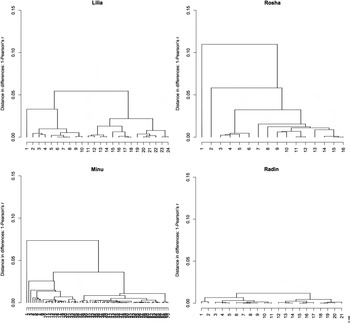
Figure 1 depicts the dendrogram representation of the results for all recordings from each child. These dendrograms first allow us to discard outlier data, which merge with the other datapoints late in the tree structure (furthest up on the y-axis). For example, in Rosha's data, the first and second datapoints can be considered as outliers since they do not group with the others. Also, in Minu's data, the first datapoint does not merge with the rest of the data.
Dendrograms depicting the results of the clustering algorithm on the corpora of the four children (Lilia, Rosha, Minu, Radin). The ages are plotted on the x-axis, and the y-axis corresponds to the sums of quotients (the distance between two datapoints).

These diagrams also allow us to determine the number of groups in the data. Approximate cut-off points emerge in the tree diagram as groups of datapoints that branch off the same branch. Knowing the age span of each child, the dendrograms show the time (x-axis) where one cluster begins or ends. For Lilia (1;11 to 2;10), the algorithm maps out two clusters: the first one spanning recordings 1–10 (corresponding to ages 1;11–2;4) and the second spanning 11–24 (ages 2;5–2;10).
Rosha's data, on the other hand, only spans across ages 2;8–2;11. While the algorithm shows a possible division in her data after datapoint 6, we choose not to divide her data since it only spans across three months, and it is unlikely that the child goes through any noticeable developmental stages in this limited time.
Minu's corpus spans 4;1–5;2. It is likely that she passes through at least two stages in development. Upon discarding the first datapoint as an outlier, the algorithm reveals two clusters: the first spanning recordings 2–26 (ages 4;1–4;4) and the second recordings 27–72 (ages 4;5–5;2).
Finally, Radin's data, spanning ages 5;7–6;6, shows only a low-level grouping: the small distances between the two groups means that the differences between the data are not large. His age range does not coincide with any stages that have been reported in previous literature. As we will see in our qualitative analysis, his language is almost adult-like.
The stages found in the data are summarized in Table 2. The remaining comparisons and discussions on the data will be based on these stages.
Summary of developmental groups as revealed by variability-based clustering methods for all children

Type of causatives
Persian-speaking children use four different constructions to express the causative: the morphological and periphrastic causatives do not occur frequently in any of the children's speech, while lexical and LVCs occur quite frequently. The stages determined by the empirically based clustering algorithm above were based on the relative frequency of the different types of causatives, and also on cumulative types.
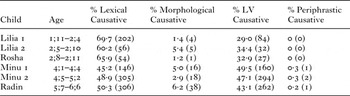
We will use the stages found in the previous subsection (summarized in Table 2) to look at different causative types. The different types of causatives used by the children in different stages are summarized in Table 3.
The percentage of different types of causatives uttered in the different stages for each child with the number of tokens in parentheses

The children rarely use morphological causatives, and the periphrastic causative occurs only in older children's speech. Lexical causatives and LVC causatives represent the bulk of the causative constructions uttered by all the children. The data show that the two younger children, Lilia and Rosha, use a higher proportion of lexical causatives relative to LVC causatives, while Minu and Radin use an almost even split between the two constructions. Radin's data also show an increase in the use of morphological causatives. Since he is the oldest child, this could be due to a larger vocabulary.
We compared the different types of causative constructions used in different stages using chi-square. We only considered LVC and lexical causatives, because the periphrastic and morphological causatives were too scarce. We found that the proportion of different causative types did not differ between Lilia's two stages or between either of Lilia's stages and Rosha's data. We also found that Minu's two stages did not differ from Radin's data. However, there was a significant difference between Rosha and Minu's data (X2(1) = 7·117, p < ·05), suggesting that the Persian-speaking child changes from using a higher number of lexical causatives to using nearly an equal number of lexical and LVC causatives some time between ages 2;11 and 4;1.
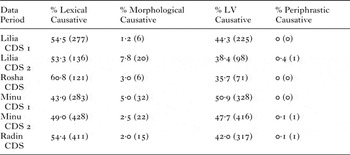
The relative frequency of causative types used in CDS is reported in Table 3 for each child's stage. As in child speech, the morphological causative occurs rarely and the periphrastic almost never. The remaining causative constructions are distributed between lexical causatives and LVC causatives.
The percentage of different types of causatives uttered by the caregiver over each corpus period for each child with the number of tokens in parentheses

We performed a chi-square test comparing proportions of lexical and LVC causatives in each CDS and child speech pair. Only Lilia's first stage and associated CDS significantly differ (X2(1) = 5·054, p < ·05). This indicates that Lilia constructs a higher number of lexical causatives than her caregivers in her first stage. Lilia might not have a sufficient vocabulary with which to accurately parallel her caregiver's speech in terms of using the LVC causative to describe causative events.
QUALITATIVE RESULTS
In previous studies, stages of development have often been distinguished using qualitative data. Alternating causative constructions and errors provide finer-grained and complementary insight into the development of the construction in Persian.
Causative alternations
Causative constructions alternate with non-causative counterparts. Persian frequently employs LVCs, and expresses causatives through alternating LVs. In LVCs, replacing only the LV while retaining the PV can change the causative semantics of the same event. We extracted sequences of utterances that contained alternations, either within or across speakers. These alternations had to occur within three utterances of each other. We kept this utterance frame reasonably small to ensure that two alternating constructions were related in discourse. These patterns reflect a child's ability to manipulate the causativity of an LVC by substituting one LV for another.
Twenty such alternations occur in the corpora, with twelve in Minu's corpus, three in Lilia's corpus, and five in Radin's corpus (the lack of alternations in Rosha's corpus could be due to the small size of the dataset). Most involve kærdæn ‘to do’ and shodæn ‘to become’, the two most common and least semantically rich LVs. Other alternations, using LVs dadæn ‘to give’ and gereftæn ‘to get’, and zædæn ‘to hit’ and xordæn ‘to eat’, occur only in Minu's and Radin's speech.
In (10), Lilia (1;11) and her mother look for a toy, and once Lilia finds it, she exclaims that the toy is found using the non-causative form peyda shod ‘found became’. Her mother repeats her utterance, and Lilia replies with the causative form peyda kærdæm ‘I found (it)’, insisting that she caused the toy to be found. The object is dropped in her causative sentence, as Persian allows argument omission if the argument is accessible in discourse. The correct person and number inflections on the verb indicate further that she knows that using alternating LVs results in different semantics.
(10) lilia: peyda shod! (Lilia, 1;11)
found become&pst&3sg
‘(It)'s been found.’
mother: peyda shod.
found become&pst&3sg
‘(It)'s been found.’
lilia: mæn peyda kærd-æm.
I found do&pst-1sg
‘I found (it).’
Lilia (2;4) uses the PV pare ‘ripped’ with the same alternating LVs. She addresses her mother, reporting that her brother has ripped a cloth in (11). She correctly omits the agent argument in the second utterance, the non-causative version of the first utterance.
(11) lilia: mami in o pare kærd. (Lilia, 2;4)
mommy this acc ripped do&pst&3sg
‘Mommy, (he) ripped this.’
lilia: in pare shod.
this ripped become&pst&3sg
‘This ripped.’
In (12), Minu (4;10) alternates between a causative and non-causative LVC within the same utterance. Here, she uses the alternating LVs zædæn ‘to hit'and xordæn ‘to eat’ with the same PV gul ‘trick’ to express the causative and non-causative, respectively.
(12) minu:
bebin, majæra injuri-e ke ævæl injuri (Minu, 4;10)
look story this-way-be&prs&3sg that first this-way
bud ke Prænsjan ne-mi-dunest
be&pst&3sg that Prince-John neg-prog-know&pst&3sg
ke mæn mi-xa-m gul-esh be-zæn-æm væli
that I prog-want&prs-1sg trick-3sg sbjv-hit&pst-1sg but
hala ke in gul o xord momkene
now that this trick acc ate&pst&3sg maybe
‘Look, the story is this that Prince John didn't know that
I want to trick him but now that he was tricked, maybe …’
Minu does not finish her sentence, but she overtly uses the appropriate argument structure for each LVC. Namely, the causative LV zædæn ‘to hit’ takes a subject and object while the non-causative xordæn ‘to eat’ takes only a subject.
This type of alternation can also occur across speakers, as in (13). Lilia (2;8) and her brother try to open a package of candy. Her brother asks their mother if she can open the bag for Lilia, using the verb kærdæn ‘to do’ in the LVC baz kærdæn ‘to open’ (lit. ‘open do’). Lilia then asks if her bag has been opened and she uses non-causative shodæn ‘to become’ in baz shodæn ‘to open’ (lit. ‘open become’). Lilia correctly uses the intransitive argument structure with the non-causative LVC she utters.
(13) radin: mami in o bær-e Lilia baz mi-kon-i? (Lilia, 2;8)
mommy this acc for-ez Lilia open prog-do&prs-2sg
‘Mommy, will you open this for Lilia?’
lilia: baz shod?
open become&pst&3sg
‘Did it open? (= Has it been opened?)’
Similarly, in (14), Radin at 6;4 responds to his mother who is telling him and Lilia that they seem to have learned how to do a puzzle. She uses the non-causative yad gereftæn ‘to learn’ (lit. ‘memory get’), and Radin responds with the causative yad dadæn ‘to teach’ (lit. ‘memory give’).
(14) mother: yad gereftin a. (Radin, 6;4)
memory get&pst-2pl rel
‘You seem to have learned (well).’
mother: kælæk-a.
rascal-pl
‘You rascals.’
radin: shoma behemun yad dadi.
you to-1pl memory gave&pst-2sg
‘You taught us!’
While only twenty alternations occur in our spontaneous speech data, the presence of alternations suggests knowledge of the semantic change triggered by the alternating LV. Persian expresses causativity transparently through alternating LVs, and the emergence of these alternations reflects knowledge of the underlying patterns. Interestingly, the alternations occurring in Lilia's speech only involve the generic kærdæn ‘to do’/shodæn ‘to become’ LV alternation, while the older children (i.e. Radin, Minu) exhibit alternations with LVs such as zædæn ‘to hit’ and xordæn ‘to eat’, as in (12), and dadæn ‘to give’ and gereftæn ‘to obtain’, as in (14) above. Lilia and Rosha have perhaps not acquired the semi-productive rules underlying alternations between other LVs. The generic LVs kærdæn ‘to do’ and shodæn are relatively high-frequency LVs, which leads to an earlier mastery of their structure and semantics. However, the lack of alternations is not due to the lack of knowledge of the LVs, because the children use all LVs in other contexts.
Alternations provide one of the strongest pieces of evidence for productivity in spontaneous speech data. However, spontaneous speech is sporadic and we cannot conclude that a child has full competence of the causative LVC structure from the available evidence. We can conclude that Lilia (at 1;11) has acquired an item-based alternation that involves two LVs: kærdæn ‘to do’ and shodæn ‘to become’. Her use of this alternation demonstrates that she understands the meaning change occurring between two alternating LVs. This pair represents two of twelve LVs, which represents a significant portion of the LVC system. This reflects an incremental acquisition of the LVC causative in Persian. The semi-productive system of LVCs in Persian provides us with easily accessible data on alternations (as they occur between pairs of explicit LVs), but full knowledge of resulting meaning differences in alternations cannot be proven absolutely without intensive experimental evidence.
Overgeneralization errors
Despite the rarity of overgeneralization errors in the corpora, they nevertheless reveal components of a child's structural knowledge. Errors related to the causative occur nineteen times in the data: two for Lilia, fourteen for Minu, and three for Radin.
Three types of errors emerge in the corpora. In the first type, the child creates a novel causative LVC by using a causative LV with a PV. In these cases, the PV can occur with a non-causative LV to express a non-causative event. The child then uses the causative LV that normally alternates with the non-causative to create a new causative LVC. In the second type, the child uses the common causative LV kærdæn ‘to do’, either extending the use of kærdæn ‘to do’ to a normally non-causative LVC or using it with a derivation of the lexical causative in order to emphasize the causative nature of the action. In the third type, the child uses a non-causative lexical verb with a causative meaning. Explanations and examples for each error type are given in the following sections.
Creating novel LVCs. Bowerman (Reference Bowerman1974) reports uses of non-causative verbs as causatives, mostly for lexical verbs, from her diary study of English. The errors produced in Persian are of a different nature: namely, the child erroneously uses a causative LV in a construction that exists with the non-causative alternant. The child attempts to render a non-causative LVC into a causative by replacing an LV, and not by using the original as a causative.
For example, in (15), Lilia (2;2) argues with her brother about who won more frequently in a game. She uses the LV kærdæn ‘to do’ to express the notion ‘becoming a winner’. The target construction is non-causative, occurring with the same PV and the LV shodæn ‘to become’. Here, she uses kærdæn ‘to do’, seemingly intending the meaning: ‘I'll make myself the winner.’ Perhaps she focuses on her active role in making herself a winner. Even though her brother utters the correct form of the LVC, she repeats the erroneous form she used in her first utterance.
(15) lilia: pæs bishtær mæn bærænde *mi-kon-æm. (Lilia, 2;2)
then more I winner prog-do&prs-1sg
Target LVC: bærænde shod-æm (winner become&pst-1sg) ‘I won.’
Target meaning: ‘I'll be the winner more often.’
radin: mæn bærænde shod-æm.
I winner become&pst-1sg
‘I won.’
lilia: mæn ælan bærænde *mi-kon-æm.
I now winner prog-do&prs-1sg
Target LVC: bærænde mi-sh-æm (winner
prog-become&prs-1sg) ‘I will win.’
Target meaning: ‘I'm going to win now.’
In (16), Minu (age 4;3) asks her father to remember something as he finishes telling a story. Minu replaces the LV amædæn ‘to come’ in the LVC yad amædæn ‘to remember, to come to mind’ (lit. ‘memory come’) with the causative alternant aværdæn ‘to bring’. Minu insists that her father recall something immediately and perhaps to willfully bring the memory forth. She uses the causative LV alternant to express causing to remember.
(16) minu: em em, yad-et *bi-ar dige! (Minu, 4;3)
um um, memory-2sg imp-bring&2sg already
Target LVC: yad-et bi-ad (memory-2sg
imp-come&prs&3sg) ‘remember’
Target meaning: ‘Um, remember it already!’
Amædæn ‘to come’ and aværdæn ‘to bring’ can combine with the same PV to express non-causative and causative events, respectively. However, the causative aværdæn ‘to bring’ cannot combine with the PV yad ‘memory’ here. While yad aværdæn (lit. ‘memory bring’) does not exist in Persian, the compound be yad aværdæn ‘to remember’ (lit. ‘to memory bring’), with the preposition be ‘to’, does exist in more formal registers.
In example (17), Minu is playing with some figures on the table, and she wants to say that one of the players pulls his finger away (i.e. escapes) from the stick, as she slides her own finger away from the stick on the table. Instead of using the verb færar dadæn ‘to make escape’ (lit. ‘escape give’), Minu creates a new LVC dær bordæn (lit. ‘out take’) to express a causative with the intended meaning of ‘escaping’. She bases this LVC on dær ræftæn ‘to escape’ (lit. ‘out go’). Ræftæn ‘to go’ and bordæn ‘to take’ can alternate in some cases with the same PV to express non-causative and causative versions of the same action.
(17) minu: bæd ængosht-esh o æz dæst-e chub (Minu, 4;10)
*dær mi-bær-e
then finger-poss&3sg acc from hand-ez stick out
prog-take-prs&3sg
Target meaning: ‘Then, he made his finger escape the stick.’
Target LVC: færar mi-de (escape prog-give&prs&3sg)
‘he leads to escape’
Overgeneralizing LVCs to lexical causatives. A second type of error found in the Persian child data occurs when a child uses the frequently causative LV kærdæn ‘to do’ superfluously. In the following examples, Minu uses it in contexts where she wants to stress the causative aspect of a verbal notion. Kærdæn ‘to do’ is used with a participial form of a verb that could otherwise be used as a lexical verb to express the intended meaning.
In (18), Minu is playing with some paper and stickers and asks her aunt if she can tear off a sticker by using the participial form of the verb kændæn ‘to tear’ combined with the LV kærdæn ‘to do’. In this example, while kænde kærdæn (lit. ‘tear do’) could hypothetically exist in Persian to mean ‘to tear’, the form is preempted by the verb kændæn ‘to tear’. The child realizes this and employs the appropriate verb in the final utterance of the sequence.
(18) minu: *kænd-æsh kon-æm? (Minu, 4;4)
tear&prs-3sg do&prs-1sg
Target LVC: be-kæn-æm-esh (sbjv-tear&prs-1sg-3sg)
‘should I tear it’
‘Should I tear it?’
aunt: *kænd-æsh bo-kon.
tear&prs-3sg imp-do&prs&2sg
Target LVC: be-kæn-esh (imp-tear&prs&2sg-3sg) ‘tear it’
‘Tear it.’
minu: be-kæn-æm-esh.
sbjv-tear&prs-1sg-3sg
‘I'll tear it.’
Her aunt responds by using the same erroneous form, repeating Minu's creation without correcting her. It is well established that children recover from erroneous productions without correction or negative responses from their caregivers (e.g. Brown & Hanlon, Reference Brown, Hanlon and Hayes1970). Minu quickly indicates that she realizes her mistake when she responds by using the correct form of the causative kændæn ‘to tear’ in the subsequent utterance. Her self-correction reflects preemption, a mechanism that normally allows a child to develop her use of constructions appropriately by preventing overgeneralization (though she catches herself too late in this case). According to criteria presented in Allen and Crago (Reference Allen and Crago1996), this type of self-correction represents evidence that the child has productive knowledge of the structure being used.
In (19), Minu is playing with two live chicks that her parents have bought her. She makes up a story about having a ‘chick-store’. As in the above example, she uses the participial form of a lexical causative verb (here, bæstæn ‘to close’) as a PV, combined with kærdæn ‘to do’.
(19) minu: væqti unjujeforushi ro bæste kærd-im (Minu, 5;2)
when that chickstore acc closed make&prs-1pl
Target form: bæst-im (close&pst-1pl) ‘we close’
‘When we close the chickstore …’
Minu again uses kærdæn ‘to do’ productively to create a causative LVC where a simple lexical causative form already exists. As in the examples of causative LVs used in non-alternating LVCs, the child uses a productive process for creating new causatives. It is safe to assume that the inappropriate LVC she uses above disappears from her grammar as it is later preempted.
Using a non-causative as a causative. In (20), Radin uses a non-causative verb pæridæn ‘to jump’ as a causative, instead of the correct morphological alternant pærandæn ‘to make jump’. Radin uses a non-causative to express a causative and fails to use the appropriate causative morpheme needed in this case.
(20) radin:mi-xa-m in o *be-pær-æm-esh. (Radin, 6;1)
prog-want-prs&1sg this acc sbjv-jump-prs&1sg-3sg
Target verb: be-pær-an-æm-esh (sbjv-jump&prs-cau-1sg-3sg) ‘to make jump’
Target meaning: ‘I want to make this jump.’
Unlike the LVC errors presented above, this example is similar to those found in Bowerman (Reference Bowerman1974) and Bowerman and Croft (Reference Bowerman, Croft, Bowerman and Brown2008). The child uses a non-causative in a transitive construction to express a causative meaning (e.g. ‘don't giggle me’). This is the only error of this type found in our dataset.
In sum, the qualitative alternation and overgeneralization errors that Persian provides stem mostly from LVC production. In fact, no causativity errors were found for any of the other three causative constructions, except for the last example from Radin, where the error seems to be from a lack of vocabulary and not an overgeneralization per se. Errors in LVCs involve either creating a new LVC by using the wrong LV with a PV or by using a participial form of a lexical item with the frequently causative kærdæn ‘to do/make’. Maratsos (Reference Maratsos, Aaronson and Reiber1979) approximated that Bowerman's (Reference Bowerman1974) must have had to listen to 750,000 utterances to extract 100 errors. In our combined corpora, we have approximately 51,000 utterances and 20 causativity errors, mostly involving LVCs. Persian child language provides us with almost three times as many as Maratsos' approximation would predict for the current corpora. The structure of the LVC in particular has thus allowed us to examine the structure of the causative construction in a more expanded way than in other languages. In the next section, we will describe how these patterns fit with developmental stages.
GENERAL DISCUSSION
General patterns
Persian-speaking children use four different structures to express the causative: lexical verbs, the causative morpheme, LVCs, and periphrastic constructions. Similar to the Estonian and Hebrew data from Argus et al. (Reference Argus, Uziel-Karl and Laalo2011), the general frequency of the causative relative to other verbs was quite variable between recordings, and never exceeded 20%. A Pearson product moment correlation revealed that the relative frequency of causative constructions uttered by the children and the caregiver correlated only for the two older children. This could indicate higher sensitivity to contextual cues and the ability to reflect adult speech more accurately for appropriate situations that necessitate a causative structure.
We also found that both adults and children use lexical and language-specific LVC causatives far more often than morphological and periphrastic causatives. The periphrastic causative occurs a mere two times in all the data, once in Minu's speech and once in Radin's. We can conclude that more sophisticated syntactic knowledge might be necessary to produce it. Its structure in Persian could be the reason why it occurs less frequently in Persian child speech than in English or in Inuktitut. In Persian, this construction can be translated as ‘I was the reason why …’ or ‘I did something such that …’, which are both more complicated, both syntactically and semantically, than the two-word construction I made… in English.
As with English-speaking children (Bowerman, Reference Bowerman1982), the Persian-speaking children progressively use more morphosyntactically transparent causatives as they grow older (i.e. periphrastics in English, LVCs in Persian). This may parallel a general increased ability to parse multiword constructions that make up the core of the Persian verbal system, instead of treating them like unanalyzed chunks.
STAGES
We applied the algorithm from Gries and Stoll (Reference Gries and Stoll2009) to determine the cut-off points for empirically based stages. We used the relative frequency of the four different causative constructions and cumulative types as criteria. This latter criterion quantifies how freely a child uses a particular construction with different lexical items. When a causative argument structure or LVC frame (which includes a causative LV and selectional restrictions on the PV) occur with different lexical items, this indicates that the child does not only use memorized chunks, but can productively use the constructions. This novel analysis method calculates the distance between sequential datapoints (i.e. recordings), resulting in a dendrogram based on variability clustering. These tree-like structures allow us to visualize possible clusters of sequential recordings based on their quantitative similarity. This frees us from arbitrary divisions in corpora, based on an intuitive assessment of often fluctuating criteria (e.g. MLU). However, given the possible clusters found with this new method, we must examine their plausibility relative to true developmental change relative to the child's age range. For example, Lilia's data were split into two stages: the earlier stages spanning from 1;11 to 2;4 and the second from 2;4 to 2;11. Rosha's data were not split, despite the two clusters in the dendrogram, because her data span only three months and the recordings in her dataset are shorter than Lilia's, which makes it difficult to pinpoint fine development in her speech. Minu's data had two stages from 4;1 to 4;4 and from 4;5 to 5;2. And, finally, the dendrogram for the oldest child, Radin (5;7 to 6;6), only has low-level grouping (i.e. the short distance on the y-axis reveals that the differences between recordings are not large). His age does not coincide with previously reported stages; and based also on qualitative analyses that followed, we considered his data to be from a single stage in development.
Looking at only quantitative data (i.e. the relative frequency of each construction), we found a significant difference between the two older children and the two younger children. Namely, the younger children used more lexical verbs and the older children used more LVCs. We turned to qualitative data to substantiate the groups found through variability clustering.
The patterns that we observed in the Persian data fit several of Berman's (1986) stages. None of the children are in the Rote Knowledge stage: Lilia is already 1;11 at the beginning of the recordings, and she masters inflectional morphology and produces full sentences. During the first stage (1;11 to 2;4), Lilia seems to be in an Early Alternations stage. She uses causative alternations with the most frequent LVs, namely kærdæn ‘to do/make’ and ∫odæn ‘to become’. Already at age 1;11, Lilia displays understanding of the difference in causativity resulting from the alternation, repeated here in (21). While she does not use a different argument structure, she uses the first person singular for the causative LVC, and the third person for the non-causative utterance.
(21) lilia: peyda shod! (Lilia, 1;11)
found become&pst&3sg
‘(It)'s been found.’
mother: peyda shod.
found become&pst&3sg
‘(It)'s been found.’
lilia: mæn peyda kærd-æm.
I found do&pst-1sg
‘I found (it).’
Lilia also produces overgeneralization errors with LVCs, using the verb kærdæn ‘to do/make’ from an early age. This may indicate early productivity of at least a limited number of items in the LVC system, as these types of errors reveal that she attempts to apply a rule that is only partially specified in her grammar. In other words, she has not learned the semantically defined exceptions to causative formations with LVCs. She only makes errors using a single frequent LV (i.e. kærdæn ‘to do/make’).
It is also interesting to note that while the relative frequency of the LVC and lexical causatives used by the children correlates with respective CDS for each stage, this was not the case in Lilia's first stage. This could reveal that she does not have a large enough lexicon to use the same constructions, or she has not learned the systematic patterns related to the more morphosyntactically complicated causative (i.e. LVC). Her first stage also has a numerically larger, but not statistically significant, number of lexical causatives (69·7%) compared to the next stage (60·2%). She thus seems to rely more on memorized lexical units (i.e. lexical causatives) before expanding to the productive options available in Persian.
The next stage found in Lilia's data (2;4 to 2;11) coincides with Rosha's data (2;8 to 2;11), both in terms of their age and the relative frequency of different types of causative constructions. They are in the Interim Schemata stage, where they have acquired a semi-productive set of rules and can use a larger number of lexical items within established constructions. While we have evidence of Rosha overgeneralizing the LV kærdæn ‘to do/make’ as Lilia does (see example (21) above), Rosha's limited data does not provide us with other qualitative data like alternations, due perhaps to the small number of available utterances.
Unfortunately, we do not have data from ages 2;11 (Rosha and Lilia's last recordings) to 4;1 (Minu's first recording), due to the limited resources available for Persian child language. We assume that the Persian-speaking child goes through a transition in the missing period of data. Quantitatively, Minu and Radin use significantly more LVCs than the younger children, splitting their produced constructions almost evenly between lexical and LVC causatives.
Only Minu and Radin display knowledge of alternations with LVs other than kærdæn ‘to do’ and shodæn ‘to become’. Expressing the same event as causative and non-causative in a sequence of up to three utterances, Minu (in her first of two stages) uses the alternating zædæn ‘to hit’ and xordæn ‘to eat’ LVs, and Radin displays knowledge of the dadæn ‘to give’ and gereftæn ‘to receive’ LV alternation. Being able to alternate between larger repertoires of LVs indicates a more proficient and productive understanding of the LVC structure.
Minu is in the Rule Knowledge stage in at least her first stage (4;1 to 4;4) and arguably in her second stage as well (4;5 to 5;2). She makes LV substitution errors, alongside correct alternations with various LV pairs in both stages. The second stage in her data could be a result of more flexible use of the causative construction with a variety of lexical items. Our quantitative and qualitative measures might not be sensitive enough to capture this transition. However, since cumulative types were taken into account in the quantitative analysis, her bigger vocabulary could underlie a more productive use of the construction.
Radin (5;7 to 6;6) does not make errors in LVC production. He has achieved a Mature Usage stage, at least with LVCs. Allen (Reference Allen1998) found that different constructions go through stages at different ages: for example, the morphological causative is mastered later than the lexical causative in Inuktitut. The early appearance of alternating LVs in Persian shows that the children can use both a causative and non-causative LV with the same PV to express the differing semantics of an event. On the other hand, due to the relatively rare occurrences of the morphological causative and its frozen nature, we cannot differentiate it from the lexical causative, which also needs to be learned on a case-by-case basis. In fact, the children never overgeneralize the causative morpheme. This suggests that the children never mistake this form as part of a systematic pattern, but learn each instance as a new lexical causative.
In Persian, causativity errors where a child extends the use of a non-causative as a causative occur only once. Radin fails to use the morphological causative in a causative utterance, using the non-causative lexical verb instead. This could indicate that Radin does not have a large enough lexicon that includes the causative version of that verb. This makes him overgeneralize the non-causative lexical verb to a causative context, in a similar manner to homophonous lexical verbs that occur as both causatives and non-causatives. Bowerman and Croft (Reference Bowerman, Croft, Bowerman and Brown2008) found that errors of causativity proliferated in the children's speech from ages three through five, and then gradually decreased until age twelve. While Lilia produces some errors, the numbers peak in Minu's corpus and nearly diminish in Radin's corpus. Minu's age spans a similar range as the corpus used in Bowerman and Croft. However, it is important to note that the types of errors studied in Bowerman and Croft are mostly non-causative verbs used as a causative in English. In Persian, overgeneralization errors are mostly from the use of a wrong LV in an attempt to create a causative LVC.
The stages that emerge from the neighborhood-clustering algorithm are based on both relative frequencies of causative types and the cumulative causative types parameter. The increase in different lexical items used in any causative construction suggests that the child has a richer vocabulary and perhaps a mastery of alternations that does not emerge explicitly in our limited data. The importance of flexibility in using a construction, as reflected in the cumulative types parameter, provides important grounds for future research. We expect that the difference between Minu's first and second stage would be revealed with more fine-tuned examination of the grammatical milestones that coincide with an increase of cumulative types. While we do not have qualitative data that justifies the division between Minu's two stages from the cluster analysis, this analysis has been crucial in dividing Lilia's data. Importantly, using an empirically grounded method to find cut-off points in sequential recordings afforded us a more objective manner of comparing grammatical structures within and across children, as well as with CDS. This method holds a great deal of promise for future studies of stages in child language.
CONCLUSION
The four different causative constructions in Persian occur with different frequencies. This poses a challenge for the Persian-speaking child, as she must learn how to use constructions that lend themselves to systematic patterns, alongside unproductive constructions that must be learned on a case-by-case basis. LVC formation lies at the core of the Persian verbal system and provides a partially lexically filled template for building verbal notions. Changing an LV while maintaining the same PV can change the causativity of a construction. The transparent structure of LVCs, which comprise a non-verbal PV and one of a limited number of twelve LVs, allows us to see the structure of the causative in a more expanded fashion than in other languages.
We find that the LVC and lexical causatives occur most often in both child and caregiver speech, while the morphological and periphrastic causatives are rarely used by either group. Children exploit two of these four available options in Persian, and our data shows that younger children rely mostly on lexical causatives. Children seem to prefer using the simple option (i.e. lexical causative) at the beginning, and slowly build templates for the more complex, but productive, multiword option (i.e. LVC).
Our quantitative data were based on types of causatives and the cumulative type parameter, which reflects the variety of lexical items used in established constructions. The clusters found using Gries and Stoll's (Reference Gries and Stoll2009) were further justified by an analysis of errors and alternating constructions. Using Berman's (Reference Berman1982) stages, we found that the youngest child, Lilia is at the Early Alternations stage. She produces alternations of kærdæn ‘to do/make’ and shodæn ‘to become’, which implies that she has a first template for LVC causative alternations for this pair of LVs. In Lilia's second stage, which also coincides with Rosha's corpus, represents the Interim Schemata stage. The children have attained more flexibility in using the constructions and mirroring their caregiver's speech relative to the type of constructions. Minu is in the Rule Knowledge stage, as can be observed through LV replacement errors and more varied LV alternations. Radin represents the Mature Usage stage, as he no longer makes errors using LVCs.
Our study shows that Berman's stages apply to the available Persian data. The structure of the Persian LVC system provides a relatively transparent way of looking at how children gradually learn systematic patterns alongside frozen items that must be learned individually. Only LVCs undergo alternations in child speech, and only LVCs are used erroneously. This study highlights the importance of this language-specific construction for the study of causativity development in Persian. Further investigation of when and how children use this construction should include elicitation experiments, where children are forced to build causative LVC alternants, triggering both errors and alternations.
While the mechanisms seem to be universal, language-specific patterns, such as the LVCs in Persian, determine the types of morphosyntactic patterns a child must master.
The lack of longitudinal data for Persian puts a limitation on our findings, as the development reported is tracked across different children. Individual variability could underlie some of our results, because two children cannot necessarily be compared to each other. Allen (Reference Allen1998) showed that the development of the causative in Inuktitut did not depend on age, as children went through stages at different ages. However, the patterns revealed in our study match the stages found previously in other languages and highlight the trajectory of language-specific structures in Persian.
Allen (Reference Allen1998), like Berman (Reference Berman and Levin1986), provides evidence for verb-by-verb learning where children learn isolated instances at first and extract schemas as they get older. The errors and alternations reveal that children learn isolated verbs first and gradually learn how they alternate, and eventually use this knowledge productively. These patterns support a usage-based theory of language acquisition, where children learn constructions on a verb-by-verb basis until they are able to extract generalizations and use them productively. In Persian, children also seem to begin with single chunks (e.g. lexical causatives) and then go from having weak templates for a part of the systematic LVC structure to mastering the fine semantic constraints that make up the patterns alongside the exceptions.
APPENDIX 1
List of abbreviations used
All abbreviations, except for the following, follow the Leipzig Glossing Rules (Lehmann, Reference Lehmann1982; Croft, Reference Croft2003):
EZ – ‘ezafe’ marker (marks possession or adj/noun relations)
LV – light verb
LVC – light verb construction
PV – preverb
APPENDIX 2
Summary of raw data
Lilia:

Rosha:

Minu:

Radin:

APPENDIX 3
List of non-causative verbs
Here, we list the non-causative verbs found across all corpora (causative verbs are listed in the ‘Coding’ section under ‘Methods’).
non-causative light verbs (those with an asterisk also occur as causatives): amædæn ‘to come‘, *aværdæn ‘to bring’, *bordæn ‘to take’, *dadæn ‘to give’, dashtæn ‘to have’, *gereftæn ‘to get’, gozashtæn ‘to put’, gozærundæn ‘to pass’, gozæshtæn ‘to leave behind’, *gærdandæn ‘to move (something)’, gæshtæn ‘to search’, istadæn ‘to stand’, *keshidæn ‘to pull’, *kærdæn ‘to do’.
non-causative simple verbs (those with an asterisk also occur as causatives): *ændaxtæn ‘to throw’, ærzidæn ‘to value’, amædæn ‘to come’, *aværdæn ‘to bring’, bæxshidæn ‘to forgive’, baridæn ‘to sprinkle/pour (as in rain or snow)’, baxtæn ‘to lose’, bayestæn ‘to have to’, *bordæn ‘to take’, *boridæn ‘to cut’, budæn ‘to be’, chærxidæn ‘to turn’, chæspidæn ‘to stick’, chekidæn ‘to drip’, cheshidæn ‘to taste’, danestæn ‘to know’, dashtæn ‘to have’, didæn ‘to see’, doidæn ‘to run’, dozdidæn ‘to steal,’, duxtæn ‘to sew’, fæhmidæn ‘to understand’, færmaidæn ‘to go ahead’, gæshtæn ‘to search’, *gereftæn ‘to get’, goftæn ‘to say’, gozærandæn ‘to pass’, gozæshtæn ‘to leave behind’, *gozashtæn ‘to put’, jængidæn ‘to battle’, joidæn ‘to chew’, *kærdæn ‘to do’, kashtæn ‘to plant’, *keshidæn ‘to pull’, lærzidæn ‘to tremble’, malidæn ‘to rub’, mandæn ‘to stay’, mordæn ‘to die’, neshæstæn ‘to sit’, neveshtæn ‘to write’, oftadæn ‘to fall’, pæridæn ‘to jump’, porsidæn ‘to ask’, *poxtæn ‘to cook’, pushidæn ‘to wear’, ræftæn ‘to go’, ræqsidæn ‘to dance’, residæn ‘to arrive’, *rixtæn ‘to pour’, *saxtæn ‘to build or match’, sepordæn ‘to bestow’, shekæstæn ‘to break’, shemordæn ‘to count’, shenaxtæn ‘to recognize’, shenidæn ‘to hear’, shodæn ‘to become’, suxtæn ‘to burn’, tæpidæn ‘to beat’, tærsidæn ‘to fear’, tævanestæn ‘to be able’, xabidæn ‘to sleep’, xændidæn ‘to laugh’, xæridæn ‘to buy’, xandæn ‘to read’, xastæn ‘to want’, xordæn ‘to eat’, *zædæn ‘to hit’.
APPENDIX 4
List of causative LVCs with kærdæn ‘to do/make’ and dadæn ‘to give’
Since the light verbs kærdæn ‘to do/make’ and dadæn ‘to give’ occur in both causative and non-causative LVCs, we list the PVs with which these LVs occur in the corpus to produce causative constructions.
kærdæn:ab kærdæn ‘melt’ (lit. ‘water do’), abi kærdæn ‘color blue’ (lit. ‘blue make’), æsæbani kærdæn ‘anger’ (lit. ‘angry make’), ævæz kærdæn ‘change’ (lit. ‘change do’), amade kærdæn ‘prepare’ (lit. ‘prepared make’), ardi kærdæn ‘put flour on’ (lit. ‘floury make’), avizun kærdæn ‘hang’ (lit. ‘hang do’), aziyæt kærdæn ‘bother’ (lit. ‘bothering do’), bad kærdæn ‘fill with air’ (lit. ‘wind do’), bædbæxt kærdæn ‘make miserable’ (lit. ‘unlucky make’), bæraq kærdæn ‘make shiny’ (lit. ‘shiny make’), bala kærdæn ‘pull up (i.e., sleeve)’ (lit. ‘up do’), bamæze kærdæn ‘make cute’ (lit. ‘cute make’), baz kærdæn ‘open’ (lit. ‘open make’), bidar kærdæn ‘waken’ (lit. ‘awake make’), birun kærdæn ‘kick out’ (lit. ‘out do’), bolænd kærdæn ‘lift’ (lit. ‘tall do’), bozorg kærdæn ‘make big’ (lit. ‘big make’), chæspkari kærdæn ‘make gluey’ (lit. ‘gluey make’), dærbodaqun kærdæn ‘mangle, beat up’ (lit. ‘mangled make’), dæst kærdæn ‘insert hand’ (lit. ‘hand do’), daq kærdæn ‘heat’ (lit. ‘hot do’), daqun kærdæn ‘destroy’ (lit. ‘destroyed do’), divane kærdæn ‘drive crazy’ (lit. ‘crazy make’), dorost kærdæn ‘fix’ (lit. ‘fixed/right do’), entexab kærdæn ‘choose’ (lit. ‘choice make’), estefade kærdæn ‘use’ (lit. ‘use do’), estop kærdæn ‘stop’ (lit. ‘stop do’), ezafe kærdæn ‘add’ (lit. ‘addition do’), fæks kærdæn ‘fax’ (lit. ‘fax do’), foru kærdæn ‘insert’ (lit. ‘in do’), gærm kærdæn ‘warm’ (lit. ‘warm do’), geli kærdæn ‘make muddy’ (lit. ‘muddy make’), gelimali kærdæn ‘smear mud on’ (lit. ‘muddy/dirty do’), hæva kærdæn ‘raise’ (lit. ‘sky/air do’), hazer kærdæn ‘prepare’ (lit. ‘ready make’), jadu kærdæn ‘cast spell’ (lit. ‘spell do’), jæm kærdæn ‘clean’ (lit. ‘arranged do’), jæm o jur kærdæn ‘clean up’ (lit. ‘arranged and matched do’), jezqale kærdæn ‘burn’ (lit. ‘burnt do’), joda kærdæn ‘separate’ (lit. ‘separated do’), joft kærdæn ‘pair up’ (lit. ‘pair do’), kæchæl kærdæn ‘render bald (e.g. by shaving)’ (lit. ‘bald make’), kæj kærdæn ‘bend’ (lit. ‘bent make’), kæm kærdæn ‘decrease’ (lit. ‘less make’), kæsif kærdæn ‘dirty’ (lit. ‘dirty make’), kuchik kærdæn ‘reduce in size’ (lit. ‘small make’), kuta o bolænd kærdæn ‘make big and small’ (lit. ‘short and long make’), lule kærdæn ‘roll up’ (lit. ‘roll make’), mæhdud kærdæn ‘limit’ (lit. ‘limited make’), mæjbur kærdæn ‘force’ (lit. ‘forced make’), maoshairi kærdæn ‘spill non-alcoholic beer on’ (lit. ‘non-alcoholic-beery make’), masti kærdæn ‘spill yogurt on’ (lit. ‘yogurty make’), mohafezæt kærdæn ‘protect’ (lit. ‘protection do’), monfajer kærdæn ‘explode’ (lit. ‘explosion do’), montæqel kærdæn ‘transfer’ (lit. ‘transfer do’), moqævi kærdæn ‘strengthen’ (lit. ‘strong do’), morætæb kærdæn ‘tidy’ (lit. ‘tidy make’), moshæxæs kærdæn ‘make apparent’ (lit. ‘apparent make’), narahæt kærdæn ‘sadden’ (lit. ‘sad make’), nesv kærdæn ‘cut in half’ (lit. ‘half make’), pæhn kærdæn ‘spread’ (lit. ‘spread make’), pærpær kærdæn ‘shred’ (lit. ‘shredded make’), pært kærdæn ‘throw’ (lit. ‘throw do’), pærtab kærdæn ‘throw’ (lit. ‘throw do’), pæshimun kærdæn ‘make regret’ (lit. ‘regret make’), pæxsh kærdæn ‘spread’ (lit. ‘spread do’), pak kærdæn ‘clean’ (lit. ‘clean make’), panseman kærdæn ‘put bandage on’ (lit. ‘bandage do’), pare kærdæn ‘rip’ (lit. ‘ripped do’), peida kærdæn ‘find’ (lit. ‘found do’), piade kærdæn ‘let/drop off’ (lit. ‘pedestrian make’), pich kærdæn ‘twist’ (lit. ‘twist do’), pichide kærdæn ‘make complicated’ (lit. ‘twisted make’), por kærdæn ‘fill’ (lit. ‘full do’), qaem kærdæn ‘hide’ (lit. ‘hidden make’), qafelgir kærdæn ‘surprise’ (lit. ‘surprised do’), qati kærdæn ‘mix up’ (lit. ‘mix do’), qati pati kærdæn ‘mix’ (lit. ‘mix mix do’), ræd kærdæn ‘skip/pass’ (lit. ‘passed do’), ræha kærdæn ‘free’ (lit. ‘free make’), rænde kærdæn ‘grate’ (lit. ‘grated do’), ræng kærdæn ‘color’ (lit. ‘color do’), rængamizi kærdæn ‘color’ (lit. ‘coloring do’), rængovaræng kærdæn ‘color in many colors’ (lit. ‘colorful make’), rixt o pash kærdæn ‘make a mess’ (lit. ‘spill and spray do’), riz kærdæn ‘make small’ (lit. ‘fine make’), roshæn kærdæn ‘turn on’ (lit. ‘illuminate do’), saf kærdæn ‘make flat’ (lit. ‘flat make’), sefid kærdæn ‘whiten’ (lit. ‘white make’), seft kærdæn ‘harden’ (lit. ‘hard make’), serch kærdæn ‘search’ (lit. ‘search do’), sharj kærdæn ‘charge’ (lit. ‘charge do’), shol kærdæn ‘loosen’ (lit. ‘loose make’), shoru kærdæn ‘begin’ (lit. ‘beginning do’), shut kærdæn ‘shoot’ (lit. ‘shoot do’), siah kærdæn ‘blacken’ (lit. ‘black make’), sir kærdæn ‘make full (e.g., satiated)’ (lit. ‘satiated make’), sorx kærdæn ‘fry’ (lit. ‘fried do’), suræti kærdæn ‘make pink’ (lit. ‘pink make’), surax kærdæn ‘make a hole’ (lit. ‘hole make’), ta kærdæn ‘fold’ (lit. ‘fold do’), tæbdil kærdæn ‘exchange’ (lit. ‘exchange do’), tækmil kærdæn ‘complete’ (lit. ‘complete do’), tæmam kærdæn ‘finish’ (lit. ‘finish do’), tæmir kærdæn ‘repair’ (lit. ‘repaired make’), tæmiz kærdæn ‘clean’ (lit. ‘clean make’), tæn kærdæn ‘put on’ (lit. ‘body do’), tænzim kærdæn ‘tune’ (lit. ‘tuned do’), taromal kærdæn ‘beat up’ (lit. ‘beaten do’), tike tike kærdæn ‘make into pieces’ (lit. ‘piece piece do’), tiz kærdæn ‘sharpen’ (lit. ‘sharp do’), tond kærdæn ‘speed up’ (lit. ‘fast do’), va kærdæn ‘open’ (lit. ‘open do’), væsl kærdæn ‘fasten’ (lit. ‘fastened do’), vared kærdæn ‘enter’ (lit. ‘entered do’), vel kærdæn ‘let go’ (lit. ‘loose make’), xab kærdæn ‘put to sleep’ (lit. ‘sleep do’), xæfe kærdæn ‘strangle’ (lit. ‘strangled do’), xælas kærdæn ‘alleviate’ (lit. ‘rid do’), xæm kærdæn ‘bend’ (lit. ‘bent do’), xændun kærdæn ‘make happy’ (lit. ‘smiling make’), xærab kærdæn ‘ruin’ (lit. ‘ruined do’), xærabkari kærdæn ‘mess up’ (lit. ‘mess-up do’), xæste kærdæn ‘tire’ (lit. ‘tired make’), xali kærdæn ‘empty’ (lit. ‘empty do’), xamush kærdæn ‘turn off’ (lit. ‘off make’), xis kærdæn ‘wet’ (lit. ‘wet make’), xoshk kærdæn ‘dry’ (lit. ‘dry make’), xurd kærdæn ‘crush’ (lit. ‘crushed do’), yævash kærdæn ‘slow down’ (lit. ‘slow do’), zæbt kærdæn ‘record’ (lit. ‘record do’), zendani kærdæn ‘imprison’ (lit. ‘prisoner do’), ziad kærdæn ‘increase’ (lit. ‘plentiful make’), ziba kærdæn ‘beautify’ (lit. ‘beautiful do’).
dadæn:adres dadæn ‘give an address’ (lit. ‘address give’), ænjam dadæn ‘accomplish’ (lit. ‘accomplishment give’), aramesh dadæn ‘calm’ (lit. ‘calmness give’), azar dadæn ‘annoy’ (lit. ‘annoyance give’), bazi dadæn ‘let (someone) play’ (lit. ‘game give’), dæstmozd dadæn ‘tip’ (lit. ‘tip give’), eidi dadæn ‘offer a present (for the New Year)’ (lit. ‘New-Year-gift give’), esemes dadæn ‘send an SMS’ (lit. ‘SMS give’), etela dadæn ‘inform’ (lit. ‘information give’), færar dadæn ‘make escape’ (lit. ‘escape give‘), hærekæt dadæn ‘move’ (lit. ‘movement give’), hal dadæn ‘give joy to’ (lit. ‘health give’), hedie dadæn ‘offer a present’ (lit. ‘present give’), hol dadæn ‘push’ (lit. ‘push give’), hoquq dadæn ‘pay salary’ (lit. ‘salary give’), ja dadæn ‘make room for’ (lit. ‘place give’), jayeze dadæn ‘give a prize’ (lit. ‘prize give’), kar dadæn ‘employ’ (lit. ‘work give’), masaj dadæn ‘massage’ (lit. ‘massage give’), nejat dadæn ‘save’ (lit. ‘save give’), neshun dadæn ‘show’ (lit. ‘indication give’), pæs dadæn ‘return’ (lit. ‘back give’), qærar dadæn ‘place’ (lit. ‘place give’), qærz dadæn ‘lend’ (lit. ‘loan give’), qel dadæn ‘roll’ (lit. ‘roll give’), qelqelæk dadæn ‘tickle’ (lit. ‘tickle give’), rah dadæn ‘give way’ (lit. ‘path give’), seda dadæn ‘make a sound’ (lit. ‘sound give’), shekæst dadæn ‘defeat’ (lit. ‘defeat give’), sor dadæn ‘slide’ (lit. ‘slide give’), tab dadæn ‘swing’ (lit. ‘swing give’), tækan dadæn ‘move’ (lit. ‘movement give’), tæqir dadæn ‘change’ (lit. ‘change give’), tæxfif dadæn ‘give a discount’ (lit. ‘discount give’), xæbær dadæn ‘inform’ (lit. ‘news give’), xærash dadæn ‘scratch’ (lit. ‘scratch give’), yad dadæn ‘teach’ (lit. ‘memory give’), zæman dadæn ‘give time’ (lit. ‘time give’).