Depressive symptoms in childhood and adolescence are serious concerns, and involve 15–25% of the population. Due to early onset, persistence, vulnerability to depression in adult life and links with anxiety, eating disorders, addiction and psychosocial problems (Fergusson & Woodward, Reference Fergusson and Woodward2002) research efforts have focused on the characteristics of early interventions, predictors, and preventive factors (Abela & Hankin, Reference Abela and Hankin2008).
Knowledge of what can favour depressive symptoms could be of help in devising effective preventive strategies and interventions before the onset of depression. Previous studies have stressed the importance of examining social factors, such as peer relationships, family conflicts, development of proper communication skills, negotiation strategies and assertiveness (e.g., McGinn, Cukor, & Sanderson, Reference McGinn, Cukor and Sanderson2005; Wade & Kendler, Reference Wade and Kendler2000). In addition, the importance of some cognitive factors has been stressed as a source of dysfunctional behaviour and thoughts which characterize depressive attitudes. Among these, cognitive distortions, and maladaptive explanatory styles are considered as important aspects of cognitive vulnerability. An entity theory which leads individuals to think that their abilities are rather stable and will probably never change often characterizes those showing depressive symptoms and makes them experience shame, devaluation of personal abilities, poor use of cognitive capacities, and low persistence, with negative consequences for academic achievement (Pepi, Faria, & Alesi, Reference Pepi, Faria and Alesi2006).
Depressive symptoms cause loss of interest, energy and concentration, and favour rumination, a sense of guilt and worthlessness (Kovacs & Goldston, Reference Kovacs and Goldston1991) which may relate with academic achievement, measured by marks, namely Grade Point Average (GPA). In turn, poor achievement causes dissatisfaction, negative emotions, and negative feedback from teachers and parents, which then worsen depressive symptoms. This could results in a vicious circle, in which depressive symptoms and poor achievement affect each other, leading to greater duration and perhaps severity of symptoms. However, it has been shown (e.g., Maughan, Rowe, Loeber, & Stouthamer-Loeber, Reference Maughan, Rowe, Loeber and Stouthamer-Loeber2003), that achievement and learning problems occur before the emergence of depressive symptoms, while the reverse path is not supported, and that an intervention aimed at favouring achievement (Kellam, Rebok, Mayer, Ialongo, & Kalodner, Reference Kellam, Rebok, Mayer, Ialongo and Kalodner1994) causes reduced depressive symptoms, suggesting that the main direction is from achievement to depressive symptoms and not the opposite.
Previous studies have shown that self-reported depressive symptoms are related to academic achievement measured by marks (Fröjd et al., Reference Fröjd, Nissinen, Pelkonen, Marttunen, Koivisto and Kaltiala-Heino2008; Riglin, Frederickson, Shelton, & Rice, Reference Riglin, Frederickson, Shelton and Rice2013; Rothon et al., Reference Rothon, Head, Clark, Klineberg, Cattell and Stansfeld2009), directly or through the mediation of entity theory (Da Fonseca et al., Reference Da Fonseca, Cury, Santos, Payen, Bounoua, Brisswalter and Deruelle2009), maladaptive explanatory styles (Fosterling & Binser, Reference Fosterling and Binser2002) and low perceived academic competence (Herman, Lambert, Reinke, & Ialongo, Reference Herman, Lambert, Reinke and Ialongo2008; Quiroga, Janosz, Bisset, & Morin, Reference Quiroga, Janosz, Bisset and Morin2013; Schwartz, Hopmeyer Gorman, Duong, & Nakamoto, Reference Schwartz, Hopmeyer Gorman, Duong and Nakamoto2008;).
All these motivational aspects relate with perceived control, defined as the belief to exert control over learning or other domains, such as social and behavioural, here not considered, given that the focus is on academic achievement, and thus the academic domain. In particular, an entity theory leads to think not to be able to improve, thus reducing perceived control. A maladaptive explanatory style characterised by attributing failures to stable and uncontrollable causes reduces the perceived control over future similar situations, low perceived academic competence leads to think not to be able to succeed, namely to reduced perceived control. The importance of perceived control is stressed by the fact that it favours achievement and helps in affording difficulties arising in grasping the school subjects, understanding difficult concepts, recalling material, accomplishing new tasks, or coping with distractions (Skinner, Zimmer-Gembeck, Connell, Eccles, & Wellborn, Reference Skinner, Zimmer-Gembeck, Connell, Eccles and Wellborn1998).
Two models outline the importance of reduced perceived control in the onset of depressive symptoms. The first is the competence model of depression (Cole, Jacquez, & Maschman, Reference Cole, Jacquez and Maschman2001), which postulates that depressive symptoms develop as a consequence of perceived low competence in central areas of life, so that failures are recognized as a confirmation of the belief causing a vicious circle with perceived low competence, expected failures (depressive attitude), failures attributed to low competence affecting each other, and leading to reduced perceived control. The second is the diathesis-stress model of depression (Hankin et al., Reference Hankin, Oppenheimer, Jenness, Barrocas, Shapero and Goldband2009), following which negative cognitions such as attribution to stable, global, and internal factors (of the kind: I’m not good at) interact with failures creating a vulnerability factor which favour the onset and the maintenance of depressive symptoms. The main prediction of this model is that depressive symptoms are more likely to emerge when people experience difficulties or setbacks and have a set of dysfunctional beliefs – all characterized by reduced perceived control - on the basis of which they interpret the situation in a depressive way.
Following the competence model, a greater ability to cope with difficulties (i.e. higher perceived control in face of poor achievement) could reduce the depressive symptoms. This way, failures may be not seen as signs of incompetence. Consequently internal control could increase. In line with the diathesis-stress model of depression, experiencing problems in studying and believing to be unable to afford them, cause stress that can exacerbate or favour the depressive symptoms favouring avoidance, learned helplessness, and dysfunctional beliefs. Increasing the belief to be able to face the situation, namely perceived control, should reduce the depressive symptoms onset.
Given that previous studies found that low perceived control plays a critical role in the emergence of depressive symptoms (Weisz, Southman-Gerow, & McCarty, Reference Weisz, Southman-Gerow and McCarty2001), and that increased perceived control reduces this risk, the present study wished to consider the role played by a further factor than could favour perceived control and achievement: self-regulated learning strategies use. Self-regulated learning strategies can be defined as every procedure and study strategy which favour active and student-centred learning and which “occurs largely from the influence of students' self-generated thoughts, feelings, and behaviours, which are oriented toward the attainment of goals” (Zimmerman & Schunk, Reference Zimmerman and Schunk2011). Examples of these strategies are planning and reviewing the plan, making personal elaborations, self-questioning, producing personal schemas, being able to self-assess own preparation. These strategies are characterised by perceived control over the various phases of learning: being able to start, to continue, to cope with distraction, and to know when the contents are well known and can be retrieved during essays.
Notwithstanding the importance of self-regulated learning strategies use in favouring achievement, its role has never been examined in the relation between Grade Point Average (GPA) and depressive symptoms. To the best of our knowledge, until now, only two research studies (Masi et al., Reference Masi, Sbrana, Poli, Tomaiuolo, Favilla and Marcheschi2000; Moè, Cornoldi, De Beni, & Veronese, Reference Moè, Cornoldi, De Beni, Veronese, Scruggs and Mastropieri2004) have found some relations between self-regulated learning strategies use and depressive symptoms. Unfortunately, both failed to consider an objective measure of academic achievement, such as GPA.
Linked with the self-regulated learning strategies use is effort attribution. Recognizing that effort more than innate abilities or luck is the main factor explaining success or failure implies perceived control over the learning process and the outcomes. The same could be said for mastery goals which are linked with effort attribution and in a reverse relation with an entity theory, which, in a previous study (Da Fonseca et al., Reference Da Fonseca, Cury, Santos, Payen, Bounoua, Brisswalter and Deruelle2009), has been found to relate with depressive symptoms and achievement. Finally, perceived academic competence has been included given that it is linked with being able to study (namely using self-regulated learning strategies) and that previous studies (e.g., Herman et al., Reference Herman, Lambert, Reinke and Ialongo2008; Quiroga et al., Reference Quiroga, Janosz, Bisset and Morin2013; Schwartz et al., Reference Schwartz, Hopmeyer Gorman, Duong and Nakamoto2008) have outlined its role in mediating the relation between GPA and depressive symptoms.
Given the importance of perceived control, considering its multidimensional nature (strategic and motivational), and providing that self-regulated learning strategies use has never been considered in previous studies aimed to assess which factors could mediate the relation between GPA and Depressive symptoms, this study aimed: (1) to confirm the negative relation between academic achievement measured trough GPA and self-reported occurrence of depressive symptoms in adolescence; and (2) to test the mediating role of three facets of Perceived Control (PC): self-regulated learning strategies use (control of the strategic aspects), effort attribution (control of the link action and outcomes), and perceived competence (control of intrinsic motivation). The hypothesis is that PC reduces depressive symptoms onset in face of low achievement, a prediction in line with both the competence and the diathesis-stress models of depression.
Method
Participants
Participants were two hundred and eighteen students (114 girls, 104 boys) of medium to high socio-economic status, attending two public schools, located in the suburbs of a large metropolitan area in the Northern Italy. They were at sixth (n = 32, 16 girls, 16 boys), seventh (n = 53, 34 girls, 19 boys), eighth (n = 49, 30 girls, 19 boys), ninth (n = 42, 17 girls, 25 boys), and tenth grade (n = 42, 17 girls, 25 boys). Their ages ranged from 11 to 16, with a mean of 13.52 years, SD = 1.47. Sixth to eighth grades correspond to middle school, while 9th and 10th to high school.
Measures
Academic achievement
The Grade Point Average (GPA) was considered as an objective measure of overall achievement, in order to avoid mistaken or incomplete recollection of marks by students. Marks in the main school subjects (first language, second language, mathematics, science, and history) were collected from a review of school records at mid-term, and a mean score was then calculated (M = 7.49, SD = 1.14). In Italy marks are on a 10-point scale, where 10 is excellent, and 6 is the 'enough' point. Half points are also used, such as 6.5, 5.5, and so on. Marks below 6 are 'not enough', but usually teachers do not assign marks lower than 4. The range for this sample is 5–10.
Perceived control
It was measured through three variables: Self-Regulated Learning Strategies use, Perceived Competence, and Effort Attribution.
Self-Regulated Learning Strategies use and Perceived Competence were assessed through two sub-tests of the battery AMOS (De Beni, Moè, & Cornoldi, Reference De Beni, Moè and Cornoldi2003) validated with Italian samples to measure strategic and motivational aspects of learning. The first sub-test was a 23-item scale, assessing self-regulated learning strategies use (example items “At the beginning of a study session, I list the things I have to do”, and “When I study, I try to use my own words to summarise the text”, anchoring points 1-never and 5-always). The second was a 5-item scale about perceived competence (example items “Ability to study”, “Being able to study successfully”, anchoring points 1-not much and 5-optimum). Two mean scores were obtained by summing the ratings given by participants and dividing by 23, and by 5, respectively. Cronbach’s alpha in this study were 0.83, and 0.72, respectively for self-regulated learning strategies use and perceived competence, close to those obtained in the validation (0.76 and 0.72).
Effort Attribution was measured with the Attributional Style Questionnaire (ASQ: De Beni & Moè, Reference De Beni and Moè1995) an Italian validated and largely used instrument to assess attributions, which presents 24 scenarios, 12 of success and 12 of failure (example item “You are asked to solve a math problem on the blackboard, but you fail. Why?”). Participants had to choose two causal explanations out of five, regarding effort ('I do not place effort'), ability ('I am not able'), luck ('I am unlucky'), help ('They do not help me'), or task characteristics ('It is difficult'), by placing a '1' near the cause they consider the most important and a '2' near the second for importance. For scoring, the choices 'effort' or 'lack of effort' were considered: 2 points were assigned if chosen as first attribution, 1 if chosen as second and then summed. For instance, if a participant had chosen 11 times effort as the main attribution, and 8 times as the second one, his/her score will be 30 (11*2+8*1). Cronbach’s alpha in this study was 0.66, very close to that obtained in the validation (0.67).
Depressive symptoms
The occurrence of depressive symptoms was measured by the Italian version of the Children's Depression Inventory (Camuffo, De Giorgis, & Mayer, Reference Camuffo, De Giorgis and Mayer1985) of Kovacs (Reference Kovacs1985). It presents 27 items describing symptoms such as being sad, having difficulties in making decisions, or suicidal ideation. For each, participants are asked to choose one of three levels of severity. For instance, for item 1: 0 = 'Sometimes I'm sad’, 1 = 'I'm sad most of the times', 2 = 'I'm always sad'. The total score was calculated by summing the 27 ratings (M = 10.22, SD = 6.32). The higher the score, the more serious the depressive symptoms. Cronbach’s alpha in this study was 0.88, close to that obtained in the validation (0.86).
Procedure
Parental permission was obtained by means of signed informed consent forms, and verbal assent was required from participants. All of them agreed to participate. It was explained to them that they would be asked to give answers to some questions, but that they would be free to withdraw from participation at any point if they did not wish to continue. No participants did so. They were also informed that participation was confidential.
Then the marks obtained at mid-term were collected and mean values calculated by averaging the marks in the main subjects (first and second language and mathematics). A month after the end of the mid-term, the questionnaires were administered (in the order in which they are described in the previous section) in a quiet classroom during the school day, in several group sessions containing 17–23 participants each. Age and gender were ascertained by asking participants to report them on the first page of the booklet in which the questionnaires were presented.
At the end of questionnaire compilation, they were thanked and the aims of the research were briefly explained. Free time was allowed. Participants took 40–45 minutes to complete the questionnaires. Those who completed them first remained quietly in the classroom waiting for the others to finish.
Data Analysis
To test hypothesis 1 about the relation between academic achievement and depressive symptoms, Pearson correlations were run among all the variables considered, after having ascertained the occurrence of no grade level difference, with SPSS 20 statistical package. Hypothesis 2 about the mediation of Perceived Control was tested through Path Model with LISREL 8 statistical package.
Results
Preliminary analyses
The scores obtained in the 5 variables considered in the 5 grades were compared in order to ascertain for grade level differences. Setting the p level at .01, it emerged that older students (9th and 10th grade) have lower GPA (M = 6.89, SD = 0.71), than younger (M = 7.86, SD = 1.21), a difference due to the change from middle (6th to 8th grade) to high school. Given that no other difference was observed the following analyses were run considering the whole sample.
Relations among variables
GPA correlated negatively with depressive symptoms (r = –0.28, p < .001), a result in line with those found in the literature (Hishinuma, Chang, McArdle, & Hamagami, Reference Hishinuma, Chang, McArdle and Hamagami2012: –0.16 < r < –0.36). Self-regulated learning strategies use, perceived competence and effort attribution correlated with each other and correlated negatively with depressive symptoms and positively with academic achievement. The same set of relations was found partialling out either grade level or gender. See Table 1 for correlation indexes and descriptive statistics.
Descriptive statistics and correlations among study variables

Notes: n = 218, all p < .01
Model estimation
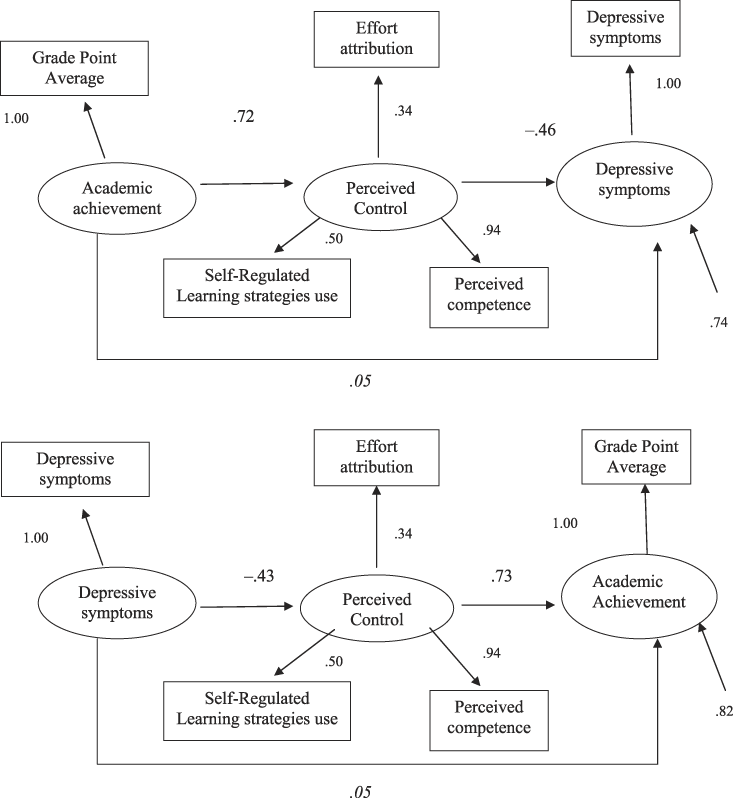
The first step was to assess the direct relation between GPA and Depressive symptoms. A regression analysis showed that it was significant (β = –0.29, t = 4.40, p < .001, R2 = .08). The second step was to test the mediation of Perceived Control in this relation between Academic Achievement and Depressive symptoms. Three latent variables were considered: Academic achievement, Perceived Control, and Depressive symptoms. Academic Achievement was measured through Grade Point average, Perceived control had three observed variables (self-regulated learning strategies use, effort attribution, perceived competence), Depressive symptoms was measured with the homonymous observed variable.
Of the various fit indices, chi-square test of significance, Root Mean Square Error of Approximation (RMSEA) as a descriptive measure of the overall model fit, Goodness-of-Fit Index (GFI), Adjusted-Goodness-of-Fit Index (AGFI), Normed Fit Index (NFI), Comparative Fit Index (CFI), and Standardized Root Mean Square Residual (SRMR) for descriptive measures of model parsimony were all employed. The values obtained were χ2 (4) = 9.030 (p >.05: the model overlap that hypothesized), RMSEA = .076, 90% CI 0–.143, GFI = .984, AGFI = .939, NFI = .969, CFI = .982, SRMR = .039. For the χ2-to-df ratio, values of less than 3 are considered adequate. For RMSEA, a value of .06 or less reflects a good fit, and .09 or less an acceptable fit. For the other indexes, values of .90 or greater are considered acceptable, and .95 or higher indicate a good fit with the data. The overall fit was acceptable. The direct effect was not statistically significant when Perceived Control was considered, while the indirect effect was significant: β = –0.31 (z = –4.97), see Figure 1 for the standardized solution.
Perceived control mediates the relationship between academic achievement and depressive symptoms
Note: Figures are standardized values. All the relationships are significant at p< .05, except the direct one, that from academic achievement to depressive symptoms or vice versa χ2 (4) = 9.030 and 9.098 (respectively the first and the second model, both p > .05: the models overlap those hypothesized), Root Mean Square Error of Approximation = .076, 90% Confidence Intervals 0–.143, Goodness-of-Fit Index = .984, Adjusted-Goodness-of-Fit Index = .939, Normed Fit Index = .969, Comparative Fit Index = .982, Standardized Root Mean Square Residual = .039.

Given the cross-sectional design used here, causal inferences among variables must be treated with caution. In particular, the relation between Depressive symptoms and Academic achievement could be bi-directional. Whereas most studies but not all (e.g. recently Hishinuma et al., Reference Hishinuma, Chang, McArdle and Hamagami2012) have shown that the direction is from Academic achievement to Depressive symptoms, a second model was tested, considering the opposite relation, that is from Depressive symptoms to Academic Achievement, and Perceived Control as the mediator. It showed that Depressive symptoms relates with Perceived Control (β = –0.43, p < .05), and Perceived Control relates with Academic achievement (β = 0.73, p < .05). The direct effect of Depressive symptoms on Academic achievement was not significant, while the mediate effect was. The fit indexes were χ2 (4) = 9.098 (p > .05: the model overlap that hypothesized), RMSEA = .076, 90% CI 0–.143, GFI = .984, AGFI = .939, NFI = .969, CFI = .982, SRMR = .039.
Adding gender and grade level as covariates in both models did not change the set of relations, thus showing that whatever the gender or grade level, the relation between Academic achievement and Depressive symptoms become not significant when Perceived Control considered.
Discussion
The results confirmed that GPA relates negatively with self-reported depressive symptoms, and suggested that Perceived Control, considered as a set of abilities of reflecting, organizing and controlling the learning process through the use of self-regulation learning strategies, adaptive motivations and self-perceptions, mediates this relation. Even more interestingly, the relation between academic achievement and depressive symptoms became non-significant when Perceived Control was controlled for.
Whatever its origin, low achievement is one risk factor for the onset and the maintenance of depressive symptoms, probably mainly in students at risk due to social, biological or cognitive vulnerability and, as suggested by the study results, in those with poor strategies and motivations, i.e., low in perceived control. Along the years the relation between academic achievement and depressive symptoms could become reciprocal with bad marks exacerbating the occurrence of depressive symptoms and depressive symptoms leading to the unwillingness to place effort, and to apply, thus influencing the performance. Here the direction GPA versus depressive symptoms has been tested in line with the results of previous research (e.g., Herman et al., Reference Herman, Lambert, Reinke and Ialongo2008) which led to assess GPA before all the other variables and thus to place it as first in testing the model. Perceived Control was then considered as the mediating variable and thus placed in the middle.
It emerged that Perceived Control is important in that it can prevent low achievers from developing depressive symptoms, in line with both the competence model of depression and the diathesis stress model (Cole et al., Reference Cole, Jacquez and Maschman2001; Hankin et al., Reference Hankin, Oppenheimer, Jenness, Barrocas, Shapero and Goldband2009). Being able to cope with difficulties - scholastic ones in this study - by adopting self-regulated learning strategies and motivations, can help in reducing depressive symptoms. An alternative model placing Perceived Control as the mediator, and academic achievement as outcome confirmed the critical role of Perceived Control showing that depressive symptoms do not relate with achievement directly, but through the full mediation of three facets of perceived control: self-regulated learning strategies use, effort attribution, and perceived control.
Although depressive symptoms among students are increasing, a large proportion of them can be prevented (Beekman et al., Reference Beekman, Smit, Stek, Reynolds and Cuijpers2010). Previous studies have focused mainly on cognitive and social factors, (e.g., McGinn et al., Reference McGinn, Cukor and Sanderson2005; Pepi et al., Reference Pepi, Faria and Alesi2006; Wade & Kendler, Reference Wade and Kendler2000). Here, GPA and Perceived Control were considered. Results showed that low achievers are at greater risk of developing depressive symptoms and that Perceived Control can reduce this risk. Taken together, these results provide a basis for further research and interventions targeted both at students at risk and at the school population
Teaching self-regulated learning strategies, and fostering effort attribution and perception of competence can be implemented in preventive programs aimed at supporting adolescents in achievement and in reducing depressive symptoms. This kind of programs can be embedded in the curricula at class level, with the secondary aim of improving learning skills and motivations in both adolescents at risk and in the general population. Otherwise, they can be applied quite easily at low cost during psychological counselling at individual level.
Proper screening should identify students with low scores in Perceived Competence, low GPA, and high self-reported depressive symptoms, so that preventive support can be provided. Then, students Perceived Control skills could be improved by providing experiences of competence and control over learning, teaching the right strategies to use, increasing strategy awareness, and favouring effort attribution. Lastly, psychological support could be offered at individual level, for better understanding of the co-occurrence of risk factors, highlighting strengths and supporting students’ efforts.
The results of this study are encouraging, although some limitations must be acknowledged. First, this was a cross-sectional study, with data collected at only one time-point. Longitudinal designs covering one or more school years or experimental manipulation (i.e., teaching strategies, fostering attribution to effort, or perceived competence) may allow better assessment and understanding of the phenomenon. Secondly, academic achievement was measured through GPA, as in previous studies. Future studies should also examine other ways of assessing achievement, such as standardized tests or text comprehension tasks, in order to extend the results obtained here. Finally, the sample was of medium to high SES and from only Northern Italy. By consequence, future studies are needed to assess the generalization of the effects here found to other contexts.
I am particularly grateful to the two anonymous reviewers and to the editor for their insightful suggestions. Thank you also to Dr. Lucia Ronconi for her valuable support in data analysis and to Dr. Elena Marchesi for help in data collection.
The research was partially supported by a Liripac Grant.