Research on clinical high-risk for psychosis (CHR-P) is a central driving factor for the implementation of suitable clinical care pathways aiming at preventing and attenuating the onset of psychosis and related biopsychosocial consequences. In the last decades, the early detection field has been engaged in a robust effort to conceptualize and develop prognostic models for trans-diagnostic staging and individualized risk stratification based on the combination of multiple baseline variables (Rosen et al., Reference Rosen, Betz, Schultze-Lutter, Chisholm, Haidl and Kambeitz-Ilankovic2021; Sanfelici, Dwyer, Antonucci, & Koutsouleris, Reference Sanfelici, Dwyer, Antonucci and Koutsouleris2020), with preliminary results limiting their current implementation at the individual level in clinical practice. However, this accelerated search for scalable predictors and complex predictive models has led to some undetected distortions, e.g., the marginal consideration of potential (and clinically intuitive) outcome modulators such as ongoing pharmacotherapies (Raballo, Poletti, & Preti, Reference Raballo, Poletti and Preti2021a).
Indeed, recent meta-analytical evidence on 1588 CHR-P individuals reveals that baseline antipsychotic (AP) exposure in CHR-P individuals (23.3%) is associated with a higher risk of an imminent transition to psychosis: 29% in baseline AP-exposed v. 16% in AP-naïve, Risk Ratio 1.47 (Raballo, Poletti, & Preti, Reference Raballo, Poletti and Preti2020a). Crucially, such an effect is not due to differences in pretest risk enrichment across the studies (Raballo, Poletti, & Preti, Reference Raballo, Poletti and Preti2021b). Multiple potential causes can be hypothesized for this negative prognostic effect, including harmful effects of antipsychotics (Zhang et al., Reference Zhang, Xu, Tang, Wei, Hu, Hu and Wang2020) and dopamine super-sensitivity induced psychosis (Chouinard et al., Reference Chouinard, Samaha, Chouinard, Peretti, Kanahara, Takase and Iyo2017) as well as artifactual ascription to CHR-P of individuals actually undergoing an unrecognized first episode psychosis contingently mitigated by AP treatment (Raballo & Poletti, Reference Raballo and Poletti2019; Raballo, Poletti, & Preti, Reference Raballo, Poletti and Preti2020b); in any case, it is clear that ongoing AP treatment in newly identified CHR-P individuals is a clinical red flag for more imminent risk of transition to psychosis (Preti et al., Reference Preti, Raballo, Meneghelli, Cocchi, Meliante, Barbera and Percudani2021; Raballo, Poletti, & Preti, Reference Raballo, Poletti and Preti2021c).
Although surprising, given their wide tolerability profile, potential beneficial effects and relatively widespread prescription, baseline exposure to antidepressants (AD) in CHR-P has received far less attention. For example, an early prospective naturalistic treatment study (Cornblatt et al., Reference Cornblatt, Lencz, Smith, Olsen, Auther, Nakayama and Correll2007) revealed that CHR-P adolescents receiving AD had higher treatment adherence and fewer transitions to psychosis over 6 months' follow up as compared to CHR-P receiving second-generation AP; a subsequent follow-up on a larger sample of the same cohort revealed a beneficial effect of AD on cognitive functioning (Bowie, McLaughlin, Carrión, Auther, & Cornblatt, Reference Bowie, McLaughlin, Carrión, Auther and Cornblatt2012). Another study reported a poorer ability of AD to reduce attenuated psychotic symptoms dimensions in the short-term (six months of follow up) in comparison with AP (Walker et al., Reference Walker, Cornblatt, Addington, Cadenhead, Cannon, McGlashan and Heinssen2009) and a more recent naturalistic study revealed lower transition rates in CHR-P individuals who underwent a combination of AD + cognitive behavioral therapy as compared to those receiving AP + cognitive behavioral therapy (Fusar-Poli et al., Reference Fusar-Poli, Frascarelli, Valmaggia, Byrne, Stahl, Rocchetti and McGuire2015). As a matter of fact, depressed mood is highly prevalent in CHR-P samples, 40% to 60% depending on the criteria (Addington et al., Reference Addington, Piskulic, Liu, Lockwood, Cadenhead, Cannon and Woods2017; Fusar-Poli, Nelson, Valmaggia, Yung, & McGuire, Reference Fusar-Poli, Nelson, Valmaggia, Yung and McGuire2014; Kline et al., Reference Kline, Seidman, Cornblatt, Woodberry, Bryant, Bearden and Addington2018; Woods et al., Reference Woods, Addington, Cadenhead, Cannon, Cornblatt, Heinssen and McGlashan2009). Although in past studies, comorbid depression, either assessed at categorical level (clinical diagnosis) or dimensionally estimated, was not apparently associated with an increased risk of transition to psychosis (Lim et al., Reference Lim, Rekhi, Rapisarda, Lam, Kraus, Keefe and Lee2015; Rutigliano et al., Reference Rutigliano, Valmaggia, Landi, Frascarelli, Cappucciati, Sear and Fusar-Poli2016), CHR-P individuals with lower baseline depression symptoms were more likely to experience a remission of their attenuated psychotic symptoms when compared to more depressed ones (Kline et al., Reference Kline, Seidman, Cornblatt, Woodberry, Bryant, Bearden and Addington2018).
Therefore, since the absence of depression is associated with more favorable prognosis, and treatment for depression CHR-P may be helpful for reducing disability and improving social functioning (Addington et al., Reference Addington, Farris, Liu, Cadenhead, Cannon, Cornblatt and Woods2021; Kline et al., Reference Kline, Seidman, Cornblatt, Woodberry, Bryant, Bearden and Addington2018), there is a clear clinical rationale in assessing the impact of baseline AD exposure in help-seeking CHR-P individuals. Along this line, the current study was specifically designed to investigate at a meta-analytical level whether baseline AD exposure in CHR-P individuals exerts an effect on the risk of transition to psychosis.
Methods
Study selection
This systematic review and meta-analysis were planned and executed according to the Preferred Reporting Items for Systematic Reviews and Meta-Analyses (PRISMA) guidelines (Moher, Liberati, Tetzlaff, & Altman, Reference Moher, Liberati, Tetzlaff and Altman2009; Page et al., Reference Page, McKenzie, Bossuyt, Boutron, Hoffmann, Mulrow and Moher2021). We searched PubMed/Medline (https://pubmed.ncbi.nlm.nih.gov/) and the Cochrane library (https://www.cochranelibrary.com/) from inception up to 01 August 2021, by using the following key terms: ‘Ultra high risk’ OR ‘Clinical high risk’ and ‘psychosis’ and ‘transition’ OR ‘conversion’. This search retrieved 1942 articles, of which 121 were systematic review or meta-analysis, in PubMed/Medline, and 196 trials in the Cochrane Central Register of Controlled Trials. Two authors (MP, AP) evaluated the list of extracted articles and decided about inclusion or exclusion according to the following criteria:
• written in English;
• published in peer-reviewed journals;
• detailing information about samples with people diagnosed at clinical high-risk (CHR) of psychosis based on a validated diagnostic procedure;
• reporting numeric data about the sample and the outcome at a predefined follow-up time; having transition to psychosis as one of the outcomes;
• reporting raw data on AD baseline exposure in relation to the transition outcome.
Restriction to English literature was justified on the basis of available evidence showing that a search of English language literature is enough to produce results that are similar to those that can be retrieved, with more time and effort, from reviews based on comprehensive searches free of language restrictions (Egger, Juni, Bartlett, Holenstein, & Sterne, Reference Egger, Juni, Bartlett, Holenstein and Sterne2003). Restriction to published literature was motivated on the basis of the evidence that selection bias in unpublished literature is typically higher than in published literature (Egger et al., Reference Egger, Juni, Bartlett, Holenstein and Sterne2003; Ferguson & Brannick, Reference Ferguson and Brannick2012).
Data extraction
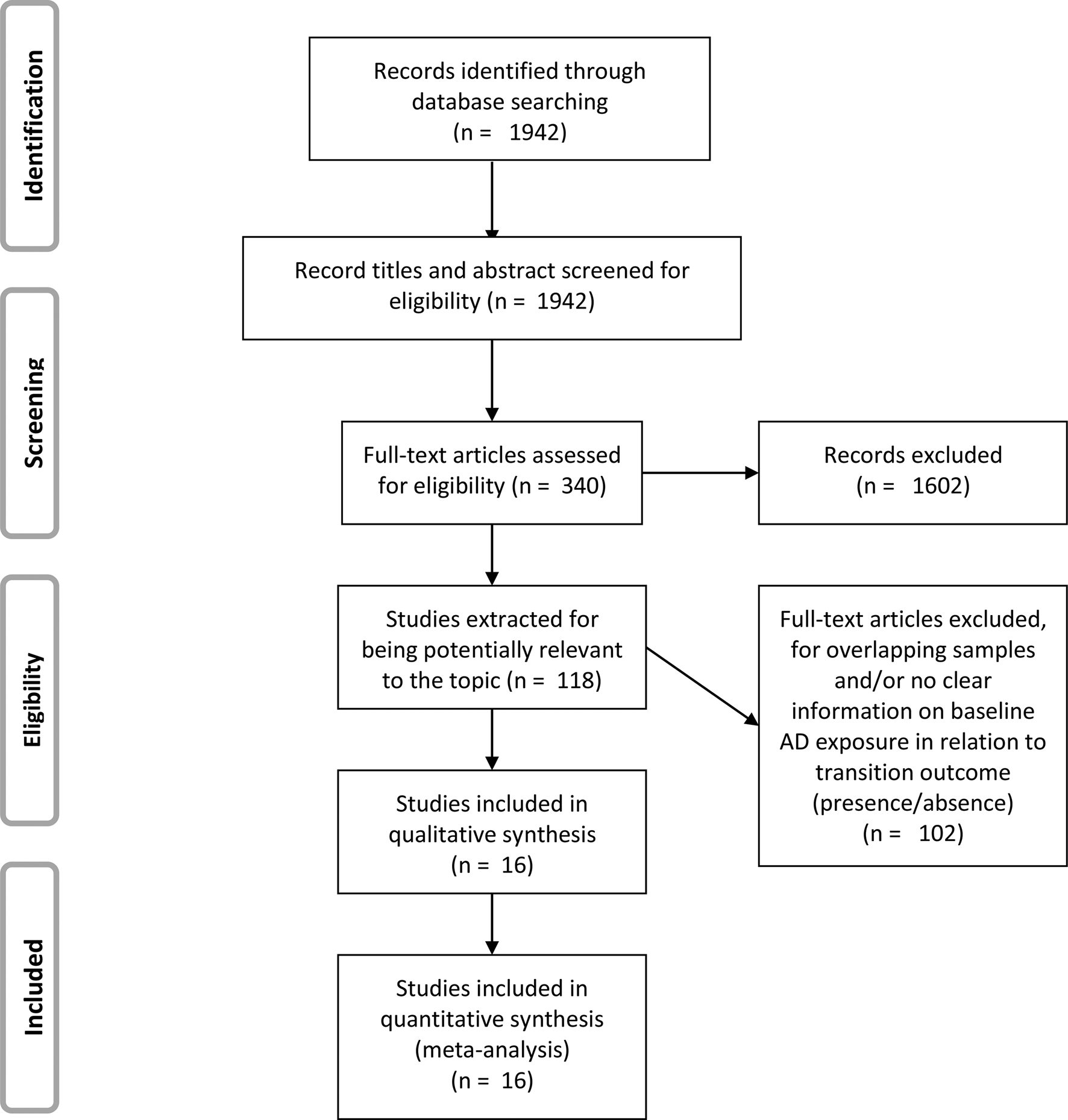
After exclusion of duplicates (including articles repeatedly reporting the results of the same trial or with overlapping samples) and articles that were unrelated to the main topic (i.e. studies on brain imaging or genetic markers), individual studies were included when they matched the inclusion criteria. Discrepancies were resolved consulting a third experienced researcher (AR). The references of the retrieved articles and of the extracted reviews on the topic were scanned to identify potentially missed studies. At the end of this procedure, 16 independent studies were included in the systematic analysis and the subsequent meta-analysis (Fig. 1: PRISMA Flow chart).
PRISMA flowchart of studies reporting conversion to psychosis in CHR-P help-seeking individuals according to antidepressant exposure at baseline (yes or not).

The following variables were extracted from the included studies: authors and year of publication of the study; location of the study; criteria and instrument for diagnosis; criteria for transition to psychosis; sample size at baseline and at follow-up; mean age in the sample; gender ratio in the sample; data on AD exposure (yes/no) on the basis of outcome (transition/no transition); duration of the follow-up; number of cases that transitioned psychosis at the end of follow-up by group; percentage of exposure to AP at baseline.
Quality assessment was rated according to the Quality Assessment Tool for Observational Cohort and Cross-Sectional Studies (nhlbi.nih.gov/health-topics/study-quality-assessment-tools). Discrepancies in the extraction of data were solved by discussion within the research team.
All these procedures were implemented according to an internal protocol.
Data analysis
All analyses were carried out with the ‘meta’ package (Schwarzer, Carpenter, & Rücker, Reference Schwarzer, Carpenter and Rücker2015) and the ‘metafor’ package (Viechtbauer, Reference Viechtbauer2010) running in R version 4.0.2 (R Core Team, 2020).
The outcome of the meta-analysis was the proportion of transition to psychosis. All proportions were estimated with the variance-stabilizing Freeman and Tukey (Reference Freeman and Tukey1950) double arcsine transformation, since there is evidence that it outperforms other proposed methods (e.g. logit transformation) of estimating prevalence: Barendregt, Doi, Lee, Norman, and Vos, Reference Barendregt, Doi, Lee, Norman and Vos2013), especially when the proportion of cases is expected to be small. Thereafter, we compared the binary outcome of transition to psychosis by group. Risk ratio (RR) was calculated, and the inverse variance method was used for pooling (Fleiss, Reference Fleiss1993). Between studies variance and variance of the effect size parameters across the population were estimated with the tau-squared statistics using Empirical Bayes estimator (Veroniki et al., Reference Veroniki, Jackson, Viechtbauer, Bender, Bowden, Knapp and Salanti2016); its 95% CI was calculated by using the Q-Profile method (Viechtbauer, Reference Viechtbauer2010) with Knapp and Hartung (Reference Knapp and Hartung2003) correction. Continuity correction of 0.5 was expected to be applied in studies with zero cell frequencies.
Both fixed- and random-effects summary estimates were reported, along with a corresponding 95% confidence interval (CI) for each outcome in forest plots. In the interpretation of the results, we gave preference to the fixed-effects model. Since all studies had an observational design, our main goal was to make a conditional inference only about the studies included in the meta-analysis (Viechtbauer, Reference Viechtbauer2010), and the estimates that can be drawn from a fixed-effects model provide perfectly valid inferences under heterogeneity when the inference is limited to the investigated studies (Hedges & Vevea, Reference Hedges and Vevea1998). Moreover, the fixed-effects model does not inflate the role of small studies as the random-effects model does (Borenstein, Hedges, Higgins, & Rothstein, Reference Borenstein, Hedges, Higgins and Rothstein2010). Finally, in modeling heterogeneity in the studies, the random-effects model loses power compared to the fixed-effects model (Jackson & Turner, Reference Jackson and Turner2017).
In all analyses, heterogeneity was assessed with Cochran's Q and I 2 statistics (Huedo-Medina, Sánchez-Meca, Marín-Martínez, & Botella, Reference Huedo-Medina, Sánchez-Meca, Marín-Martínez and Botella2006). A low p value (i.e. p < 0.10) of the Q-statistic indicates that variation in the study-specific effect estimates is due to heterogeneity beyond that depending on sampling error (Borenstein, Reference Borenstein2020). The I 2 statistic measures the extent to which the variance in observed effects reflects variance in true effects rather than sampling error (Viechtbauer, Reference Viechtbauer2010). The higher the I 2, the greater the impact of the variance in true effects. According to an agreed rule-of-thumb, I 2 values 0 to 40% might not be important; 30 to 60% may represent moderate heterogeneity; 50 to 90% may represent substantial heterogeneity (Ryan, Reference Ryan2016). The funnel plot, the Egger's test (Egger, Davey Smith, Schneider, & Minder, Reference Egger, Davey Smith, Schneider and Minder1997), and the Begg's test (Begg & Mazumdar, Reference Begg and Mazumdar1994) were used as a proxy index of bias in publication.
We used meta-regression techniques to evaluate the impact of the following clinical variables: gender ratio, mean age of the sample, overall sample size, duration of follow-up, percentage of exposure to AP at baseline, and the quality of the study.
We also planned sensitivity analyses with respect to baseline levels of depression, baseline levels of psychotic symptoms, co-morbidity for depressive and/or for anxiety disorders. However, this information was rarely reported in the studies preventing us from running these analyses.
Results
Search results
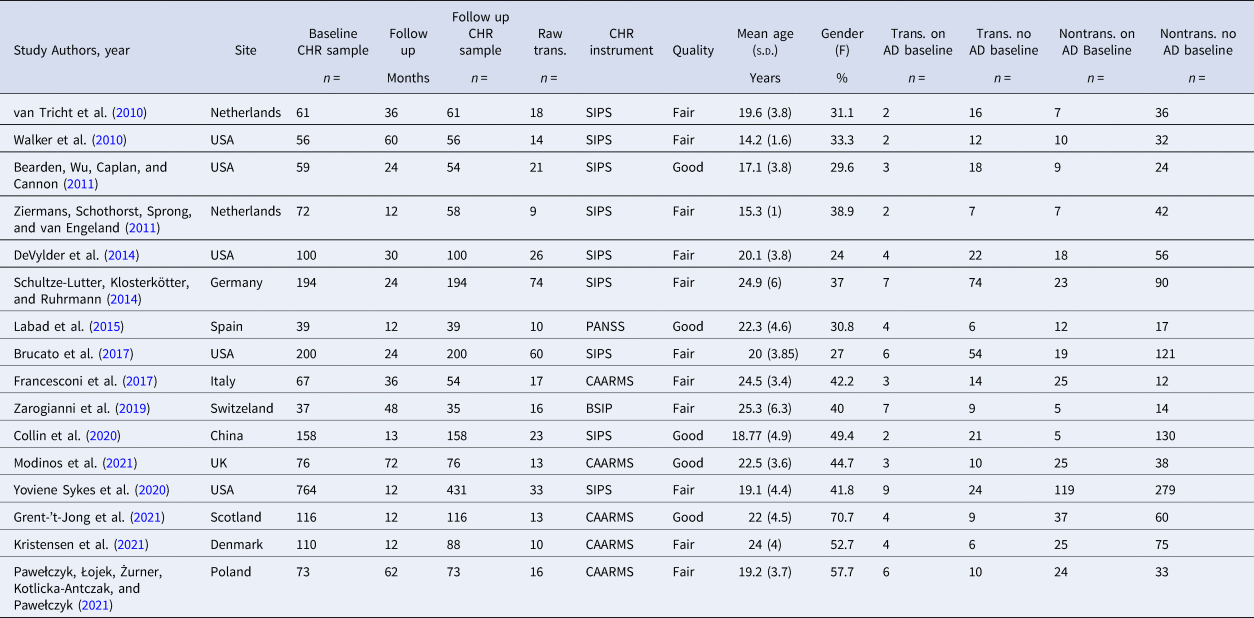
The literature searching process and study identification are summarized in Fig. 1. Briefly, the initial search identified 1942 records, and study selection procedures yielded 16 articles (Table 1) reporting on meta-analyzable information as regards baseline AD exposure in relation to the binary outcome at follow up (transition/no transition).
Studies included in the meta-analysis and reporting raw baseline data on AD exposure in relation to transition to psychosis

Legend: AD, antidepressants; BSIP, Basel Screening Instrument for Psychosis; CAARMS, Comprehensive Assessment of At Risk Mental States; CHR, Clinical High Risk; Nontrans., non-transitioned to psychosis at follow-up; PANSS, Positive and Negative Syndrome Scale; SIPS, Structured Interview for Prodromal Syndromes; s.d., Standard Deviation; Trans., transitioned to psychosis at follow-up.
Overall, 5 studies included participants from the United States, 1 from China and 10 from Europe (2 Netherlands, 1 each from Denmark, Germany, Italy, Poland, Scotland, Spain, Switzerland, UK). All studies included details about age and gender ratio. Studies do vary hugely as far as sample size and time to follow-up, as well as in terms of age and gender ratio were concerned.
Mean age in the 10 studies was 20.5 ± 3.3, ranging from 14.2 to 25.2 years old. Proportion of females was 41% on average, ranging from 24% to 71%. There were 3 studies with a sample including exclusively children or adolescents, 7 studies with only adult participants (aged 18 years old and older) and 6 studies based on mixed samples, with both children/adolescents and adults. Sample size at baseline ranged from 37 to 764, with an average sample size of 136. Sample size at follow up ranged 35 to 431, being on average 112. Time to follow-up was up to 12 months in 5 studies, 13 to 24 months in 4 studies, 30 to 36 months in 3 studies, and 48 months or longer in 4 studies.
As far as the tool for the diagnosis was concerned, there were 5 studies using the Comprehensive Assessment of At Risk Mental States (CAARMS; Yung et al., Reference Yung, Yuen, McGorry, Phillips, Kelly, Dell'Olio and Buckby2005), 1 study using the Positive and Negative Syndrome Scale (PANSS; Kay, Fiszbein, and Opler, Reference Kay, Fiszbein and Opler1987), 1 study using the Basel Screening Instrument for Psychosis: Riecher-Rössler et al., Reference Riecher-Rössler, Aston, Ventura, Merlo, Borgwardt, Gschwandtner and Stieglitz2008), and 9 studies using the Structured Interview for Prodromal Syndromes (SIPS; McGlashan, Reference McGlashan2001). Quality was good in 5 studies and fair in the other 11 studies (see Table 1 and online Supplementary Table S1 for details).
The proportion of participants with exposure to antipsychotics (AP) at baseline ranged from 0% (one study) to 33.6%, with an average of 16.6%. Participants who were already exposed to antidepressants (AD) at baseline (from herein upon, ‘cases’) were, on average, 25.7% (range: 4 to 42% of the whole sample), while those without exposure to AD at baseline (‘controls’) were, on average, 69% (range: 39 to 96% of the whole sample). At the end of the period of observation, i.e., the follow-up as reported in the study, 13.5% (95% CI 10.2–17.1%) participants developed psychosis among the cases (online Supplementary Fig. S2 in supplementary material) against 21.0% (18.9% to 23.3%) among the controls (online Supplementary Fig. S3 in supplementary material).
Risk ratio estimates of transition to psychosis by exposure to antidepressant at baseline
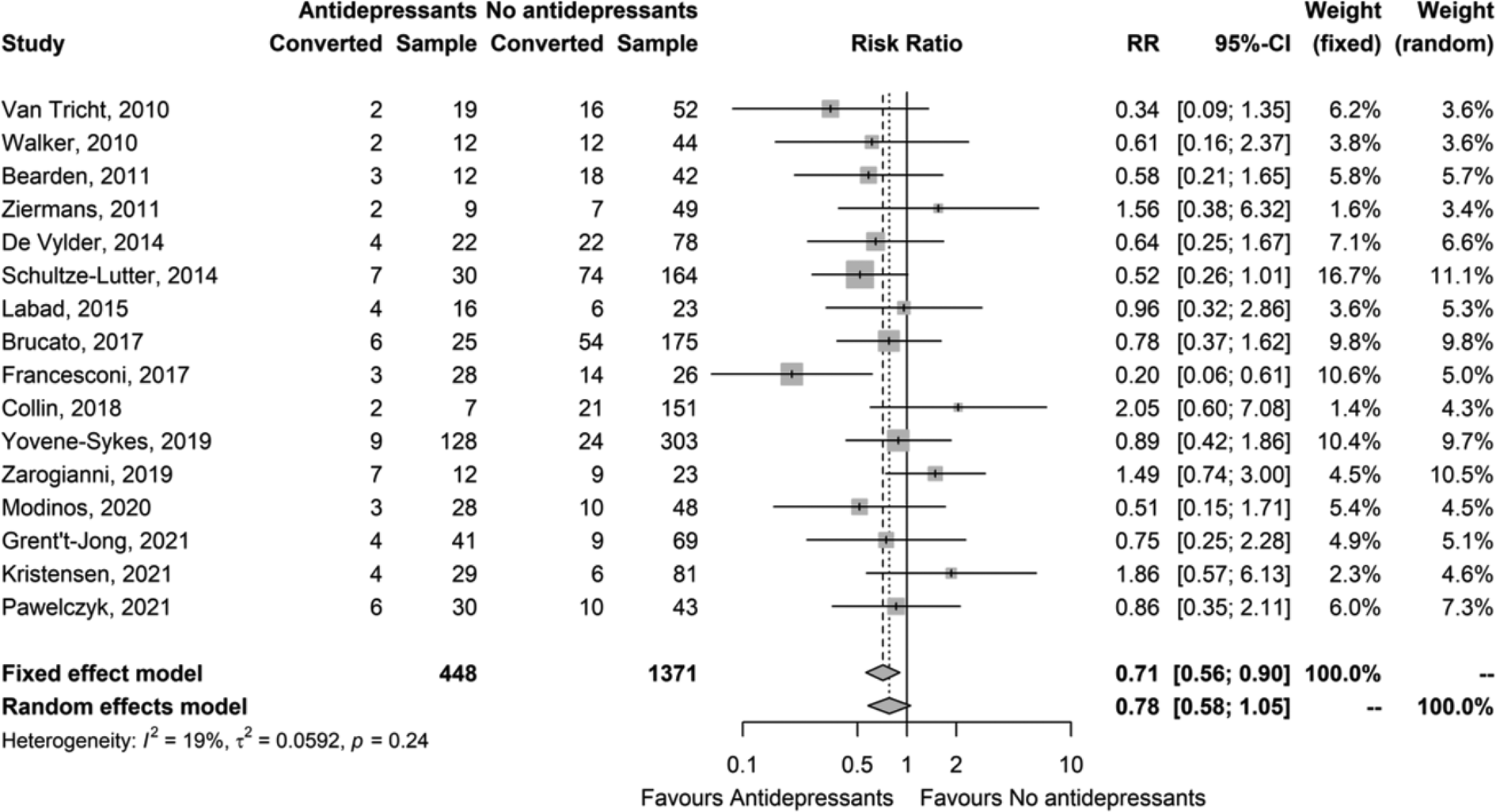
CHR-P participants who were already under AD treatment at baseline had a lower chance of transition to psychosis than CHR-P participants who were AD-naïve. The RR was 0.71 (95% CI 0.56–0.90) in the fixed-effects model (z = −2.79; p = 0.005), and 0.78 (0.58–1.05) in the random-effects model (z = −1.77; p = 0.096; tau-squared = 0.059) (Fig. 2).
Forest plot of comparison in the risk ratio of conversion to psychosis between CHR who were or were not exposed to antidepressants at baseline.

There was no relevant heterogeneity (Cochran's Q = 18.45; df = 15; p = 0.239), with only a modest proportion of the variance reflecting true variance in the effect across studies than sampling error: I 2 = 18.7% (95% CI 0.0–54.9%). Funnel plot was reasonably symmetric (online Supplementary Fig. S4 in supplementary material), with no evidence of publication bias at the Egger's test: t = −0262; df = 14; p = 0.798 or the Begg's test (z = −0.135; p = 0.893). There was no impact of age (beta = −0.011; s.e. = 0.047; t = −0.243; p = 0.811), gender ratio (beta = 0.008; s.e. = 0.012; t = 0.674; p = 0.511), or overall sample size (beta = 0.0002; s.e. = 0.0007; t = 0.214; p = 0.834), neither the quality of the studies had any impact on the RR estimates (F[1;14] = 0.061, p = 0.809).
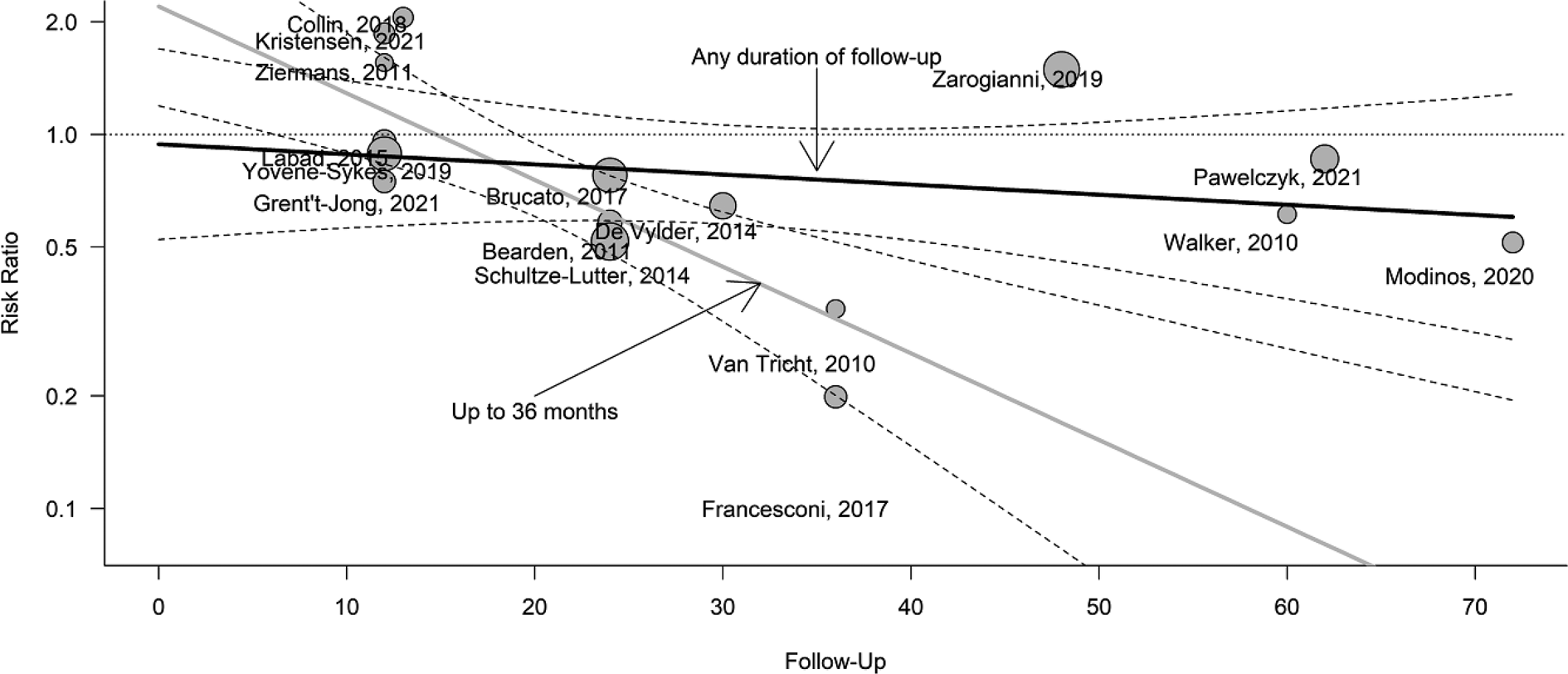
Duration of follow-up was negatively related to RR at 24 months (beta = −0.050; s.e. = 0.019; t = −2.599; p = 0.035), and 36 months (beta = −0.053; s.e. = 0.012; t = −4.34; p = 0.001). In other words: the longer the follow-up, the greater the effect exerted by AD in terms of lowering the transition rates. When longer follow-up was taken into account, this effect of time was lost: beta = −0.006; s.e. = 0.008; t = −0.805; p = 0.434 (Fig. 3).
Scatter plot of the risk ratios of the individual studies about the impact on transition to psychosis of the prescription of antidepressants at baseline in CHR-P help-seekers plotted against the duration of the follow-up in months. The size of the points is proportional to the weight that the studies received in the analysis; larger points correspond to the studies with more weight. The prediction lines for the effect of follow-up up to 36 months (gray color) and with any duration of follow-up (black color) were reported alongside their 95% confidence interval.

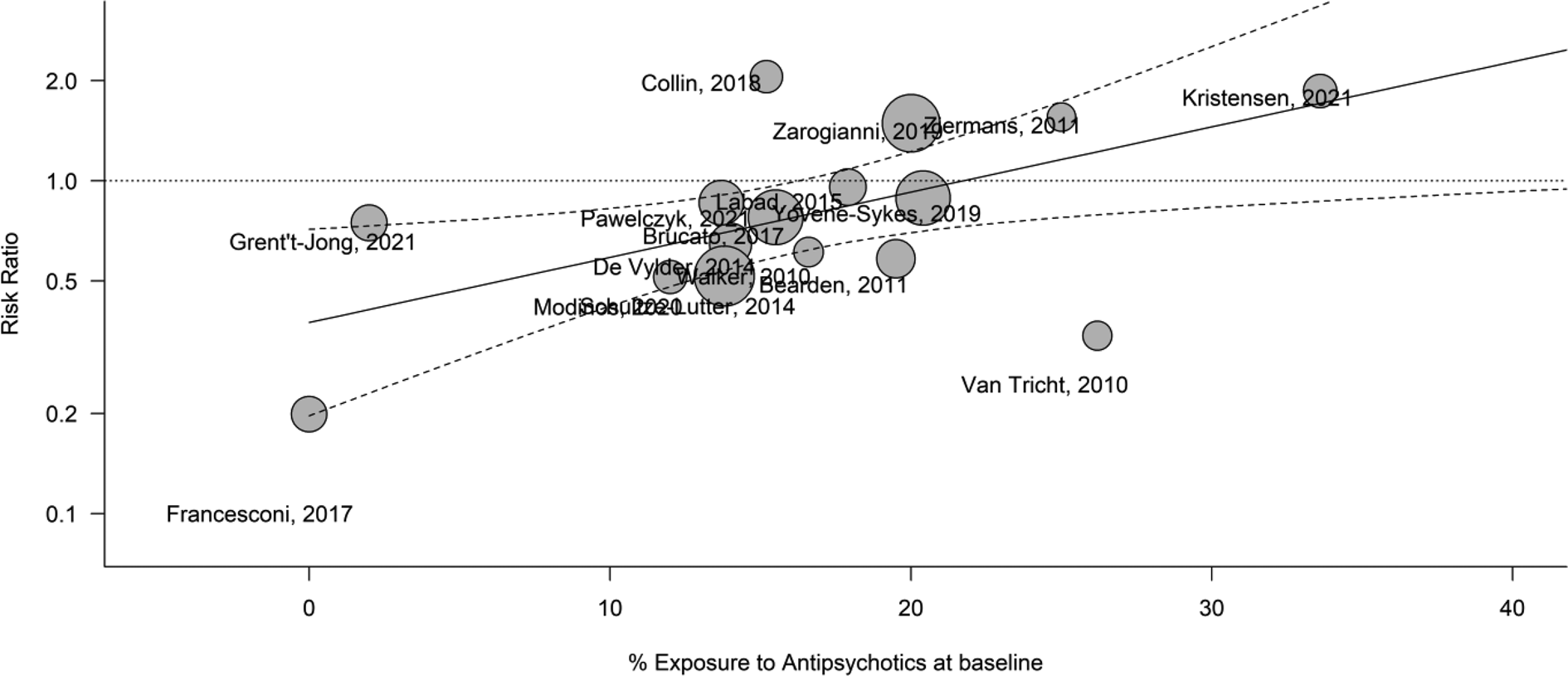
The percentage of exposure to APs at baseline was positively related to RR: beta = 0.045; s.e. = 0.017; t = 2.652; p = 0.019). In other words, the higher the percentage of participants who were under APs at baseline, the lower the effect exerted by AD (Fig. 4).
Scatter plot of the risk ratios of the individual studies about the impact on transition to psychosis of the prescription of antidepressants at baseline in CHR-P help-seekers plotted against the proportion of exposure to AP at baseline. The size of the points is proportional to the weight that the studies received in the analysis; larger points correspond to the studies with more weight.

Discussion
The results of the current study indicate that baseline AD exposure in CHR-P individuals has a prognostic effect on their meta-analytic risk of transition to psychosis at follow up. In particular, AD-exposed CHR-P have a lower rate of transition to psychosis in comparison to CHR-P individuals who were not under AD treatment at baseline. The magnitude of this effect is greater the longer is the temporal extension of the follow-up of the included studies, but only up to 36 months. When studies with a follow-up longer than 36 months were considered, this effect was progressively lost. The finding is evident in the fixed-effects model (which represents the result of the analysis concerning the studies included in the meta-analysis) and less straightforward in the random-effects model [which introduces some biases in the relative weighting of the studies, with the goal of correcting for heterogeneity and providing an estimate that is extensively valid for the purported population from which all the component studies are supposed to be drawn (Viechtbauer, Reference Viechtbauer2005)]. It is known that in the random-effects models, the precision decreases with increasing heterogeneity, and confidence intervals will widen correspondingly. However, heterogeneity in the meta-analysis was low: Cochran's Q didn't reveal heterogeneity, and the I 2 was less than 20%, in the range of ‘not important’ heterogeneity (Ryan, Reference Ryan2016). In the pre-planned sensitivity analyses, age, gender ratio, or overall sample size did not impact estimates, nor the quality of the studies had any impact. Studies were reasonably homogeneous with respect to the procedures for diagnosis (most used SIPS). However, there is no evidence that they have used the same procedure for treatment. In our opinion, the discrepancy between the fixed-effects and the random-effects model plausibly depends more on the bias in the estimates from smaller component studies introduced by the random-effects model rather than on real heterogeneity across studies. Thus, we think that the protective effect of exposure to ADs at baseline in CHR-P is real and should be considered in light of converging lines of research pointing to the fact that medication exposure is relevant for outcomes (Daneault et al., Reference Daneault, Maraj, Lepage, Malla, Schmitz, Iyer and Shah2019; Raballo et al., Reference Raballo, Poletti and Preti2020a, Reference Raballo, Poletti and Preti2021a). Several hypotheses can be brought about to explain this effect of ADs.
Hypotheses on AD-associated lower transition rate
The most likely explanation is that the prescription of ADs in help-seeking CHR-P is a proxy indicator for a condition entailing per se a better prognosis or a lower risk of transition to psychosis. Indeed, it is plausible that in CHR-P samples (as well as in other help-seeking clinical populations), medication prescription is meant to target salient psychopathological features even before the formal ascertainment of a CHR-P state. Thus, baseline AD treatment in CHR-P individuals might be an index for a mental state judged, by the treating staff, as in need of ADs (i.e. of a primarily mood component concomitant with the CHR-P) and not at such higher imminent risk of transition to psychosis as to require immediate antipsychotic treatment (Raballo et al., Reference Raballo, Poletti and Preti2020b; Raballo & Poletti, Reference Raballo and Poletti2019; Yung et al., Reference Yung, Yuen, McGorry, Phillips, Kelly, Dell'Olio and Buckby2005). Such clinical judgement would justify the prescription of a medication class (i.e. ADs) that otherwise, is well-known to increase the risk of a manic switch (Fava, Reference Fava2020) and may rarely induce isolated symptoms of psychosis in young people (Capaldi & Carr, Reference Capaldi and Carr2010; Jacob & Ash, Reference Jacob and Ash2009).
Prescription of ADs could also index a subgroup of individuals with a different profile than individuals with purely attenuated psychotic symptoms. Indeed, CHR-P individuals are allegedly a highly heterogeneous population with high degrees of co-morbidities, including anxiety and depressive disorders (Addington et al., Reference Addington, Piskulic, Liu, Lockwood, Cadenhead, Cannon and Woods2017; Kline et al., Reference Kline, Seidman, Cornblatt, Woodberry, Bryant, Bearden and Addington2018), which may be better captured through a transdiagnostic clinical staging framework (Shah et al., Reference Shah, Scott, McGorry, Cross, Keshavan and Nelson2020). Different profiles of symptoms might benefit from different pharmacologic treatments. For example, it has been suggested that AP should be limited to individuals with severe positive symptoms and mild negative symptoms (Zhang et al., Reference Zhang, Xu, Wei, Tang, Hu, Cui and Wang2021). Conversely, CHR-P individuals with prominent anxiety and depressive symptoms might primarily benefit from AD.
Notably, in the current meta-analysis, exposure to APs at baseline was found to (negatively) modulate the protective prognostic effects of ADs. That is, the meta-analytic protective effect against the transition to psychosis associated to baseline AD exposure was proportionally lower the higher the percentage of participants exposed to APs at baseline. This might suggest that those individuals under AP treatment have a baseline profile of symptoms that is less sensitive to ADs.
Information on the profile of symptoms at baseline by subgroup (with or without ADs) was often lacking in the studies, thus we were unable to specifically test the hypothesis that a different symptom profile at baseline contributes to explain the effects of ADs on the chance of transition to psychosis in CHR-P. We could not transcend this limitation since it strictly depended on the overall poor transparency (or at least in data suboptimal level of detail) in the data reported in the literature on CHR-P. The articles also didn't report whether ADs, which were already prescribed at baseline, were maintained during the treatment. Therefore, it is unknown whether baseline exposure to ADs is merely a red flag for a subgroup of individuals with anxiety and depressive symptoms or if ADs exerted a real therapeutic action during the period of observation of the included studies. In a study concerning Swedish youth aged 16–25 years and receiving AD for common mental disorders, duration of treatment ranged from 3 to 18 months (Taipale et al., Reference Taipale, Niederkrotenthaler, Tanskanen, Cullen, Helgesson, Berg and Mittendorfer-Rutz2021). We can surmise that a similar duration of treatment with AD might have been pursued in the reviewed samples. Indeed, in the North American Longitudinal Prodrome Study (NAPLS) study 2 (NAPLS-2), the average exposure to baseline antidepressants was 18 months long (Woods et al., Reference Woods, Addington, Bearden, Cadenhead, Cannon, Cornblatt and McGlashan2013). This is enough to have an effect that might be lasting.
There is some evidence that in specialized early intervention services, participants receive ADs during the clinical-therapeutic program, but they are not routinely prescribed systematically (Addington et al., Reference Addington, Farris, Liu, Cadenhead, Cannon, Cornblatt and Woods2021). Nevertheless, ADs could exert a therapeutic action in CHR-P. Indeed, AD treatment (often already undergoing at baseline) might modulate the impact of depression on the onset of psychosis. This is in line with the accumulating evidence indicating a putative role of depression in the onset of psychosis (Häfner et al., Reference Häfner, Maurer, Trendler, van der Heiden, Schmidt and Könnecke2005; Upthegrove, Marwaha, & Birchwood, Reference Upthegrove, Marwaha and Birchwood2017). Indeed, the incidence depression is (positively) associated to psychosis-proneness in the general population (Verdoux et al., Reference Verdoux, van Os, Maurice-Tison, Gay, Salamon and Bourgeois1999) and depression is an alleged mediator of progression to full-blown psychosis in people who had shown isolated symptoms of psychosis (e.g. hallucinations) (Krabbendam, Myin-Germeys, Bak, & van Os, Reference Krabbendam, Myin-Germeys, Bak and van Os2005). This also coheres with van Os' broader conceptualization of psychotic experiences as existing on a continuum dynamically intertwined with a network of other symptom dimensions, including affective symptoms (van Os & Reininghaus, Reference van Os and Reininghaus2016). This is consistent with the idea that antidepressant prescription prior to the development of full-blown psychosis (i.e. in CHR-P states) might be prognostically relevant. Furthermore, there is evidence of depression as a maintaining factor for psychotic symptoms, in particular paranoid thinking (Fowler et al., Reference Fowler, Hodgekins, Garety, Freeman, Kuipers, Dunn and Bebbington2012). Similarly, a recent longitudinal study has shown that severe depression at baseline influences poorer treatment response in patients with first-episode psychosis (Drake et al., Reference Drake, Husain, Marshall, Lewis, Tomenson, Chaudhry and Birchwood2020). Overall, these findings point towards the opportunity of early and intensive treatment of depression in people showing incipient signs of psychosis. Decreasing the levels of depression in CHR-P individuals might, indeed, limit the progression of psychotic-like symptoms in this population or diminish their persistence (Addington et al., Reference Addington, Farris, Liu, Cadenhead, Cannon, Cornblatt and Woods2021; Kline et al., Reference Kline, Seidman, Cornblatt, Woodberry, Bryant, Bearden and Addington2018).
Incidentally, the putative protective action of ADs in CHR-P might be even broader than the attenuation or remission of depressive symptoms. Besides monoaminergic pathways, ADs interact with several neuro-hormonal systems (Taylor, Fricker, Devi, & Gomes, Reference Taylor, Fricker, Devi and Gomes2005), ultimately exerting a neurogenetic action (Planchez, Surget, & Belzung, Reference Planchez, Surget and Belzung2020) that might be directly protective against psychosis. Supportive evidence in this direction seem to emerge from recent studies in CHR-P (Bykowsky et al., Reference Bykowsky, Harrisberger, Schmidt, Smieskova, Hauke, Egloff and Borgwardt2019; Merritt, Luque Laguna, Irfan, & David, Reference Merritt, Luque Laguna, Irfan and David2021), which cohere with independent evidence on antipsychotics (Andersen et al., Reference Andersen, Raghava, Svarer, Wulff, Johansen, Antonsen and Ebdrup2020; Li et al., Reference Li, Chen, Deng, He, Wang, Jiang and Li2012).
It is remarkable that the longer was the duration of follow-up, the more evident became the protective effect of the exposure to ADs in CHR-P individuals. This could be related to the fact that ADs require some time to exert their putative protective effect against the transition to psychosis. Such time-dependent effect is well known in the treatment of depression and that could be attributed to a time-dependent influence on neurogenesis (Planchez et al., Reference Planchez, Surget and Belzung2020). It is noteworthy that the effect of follow-up was evident up to 36 months but vanished with longer follow-up. This might be a consequence of the limited time of exposure to ADs, which would have ceased after 12 to 24 months of treatment, or of the accumulation of transitioned cases that have been not exposed to ADs or have received a concomitant prescription of APs [whose negative prognostic effect has been repeatedly observed (Raballo et al., Reference Raballo, Poletti and Preti2020a)]. Unfortunately, the source studies included in the current meta-analysis only reported the crude information on whether a patient was under AD treatment at baseline and not whether and for how long it was maintained during the follow-up, therefore it was not possible to perform subtler analyses on the timing and extension of AD effect. This is a limitation that could be overcome only by a more detailed, comprehensive and transparent description of the samples (Preti et al., Reference Preti, Raballo, Meneghelli, Cocchi, Meliante, Barbera and Percudani2021; Raballo et al., Reference Raballo, Poletti and Preti2020b, Reference Raballo, Poletti and Preti2021b), which is an important prerequisite to support precision psychiatry (Raballo et al., Reference Raballo, Poletti and Preti2021a; Sanfelici et al., Reference Sanfelici, Dwyer, Antonucci and Koutsouleris2020). It is worth noting that in the North American Longitudinal Prodrome Study 2 (NAPLS-2), the lifetime months of exposure to baseline medications was 18 months for antidepressants (Woods et al., Reference Woods, Addington, Bearden, Cadenhead, Cannon, Cornblatt and McGlashan2013), which is enough to produce a tangible therapeutic effect. However, it is not known whether what has been found in the NAPLS-2 can be extended to other studies.
The use of ADs needs also to be weighed against their recognized potential for paradoxical reactions at first prescription, such as the sudden worsening of the symptoms of depression at the first intake, or switch into mania among those with cyclothymic features (Fava, Reference Fava2020). There is also robust evidence for a withdrawal syndrome after long-term use of ADs (Fava, Gatti, Belaise, Guidi, & Offidani, Reference Fava, Gatti, Belaise, Guidi and Offidani2015, Reference Fava, Benasi, Lucente, Offidani, Cosci and Guidi2018), which sometimes may become persistent and difficult to treat (Cosci & Chouinard, Reference Cosci and Chouinard2020). Therefore, the choice of the drug and the timing of the treatment should be chosen with caution, also because there is some sparse evidence for a loss of effectiveness of ADs over time (Fornaro et al., Reference Fornaro, Anastasia, Novello, Fusco, Pariano, De Berardis and Carvalho2019), which may trigger a ‘resistance’ to treatment hard to overcome (Bosman et al., Reference Bosman, Waumans, Jacobs, Oude Voshaar, Muntingh, Batelaan and van Balkom2018). Unfortunately, critical information such as types of AD prescribed, their dosage, relevant comorbidities which required AD prescription (e.g. anxiety, depression, OCD), and duration of AD treatment was lacking in the reviewed studies. Often this information was not even available to the researchers who carried out the studies, since the prescription of ADs was at the discretion of the physician in the community (Addington et al., Reference Addington, Farris, Liu, Cadenhead, Cannon, Cornblatt and Woods2021).
Strengths and limitations
The major strengths of this meta-analysis are the use of state-of-the-art statistics and procedures in conducting the study and the fact that the included studies were not primarily aimed to address the issue of the protective effect of ADs for transition to psychosis, thus the results are partially free from a confirmation bias. However, the naturalistic feature of these studies is also a limitation of the meta-analysis, since the prescription of ADs was at the discretion of the treating physician, and the confounding factors that affect observational studies cannot be ruled out as it happens in the randomized-controlled trials. Although largely secondary to the reporting lacunae of the source literature, several additional limitations have to be considered in interpreting the current results. We were unable to analyze the impact of other non-AD drugs beside APs, since only a few studies reported analyzable information (e.g. on the type and dose of medications as well as on the concomitant use of different medications). As said, in the studies, there was scant or no information on whether the prescribed ADs at baseline were maintained up to the follow-up. We also lacked details about the profile of symptoms at baseline by drug prescription, thus we were unable to determine whether ADs were effectively prescribed to CHR-P help-seekers with higher levels of anxiety or depression symptoms.
Conclusions
Despite the mentioned limitations due to the suboptimal reporting of medication exposure in CHR-P cohorts, this study suggests that baseline exposure to ADs is associated with a reduced risk of imminent transition to psychosis. Future research should try to deconstruct the causal factors leading to this macroscopic meta-analytic effect in order to increase appropriateness and treatment precision and facilitate an overdue step towards precision psychiatry in the field. In particular, it is crucial to discriminate whether the apparent protective effect of ADs is due to: (a) specific action in attenuating anxious-depressive symptoms (that could otherwise facilitate, amplify and/or maintain positive psychotic symptoms), (b) a broad neuroprotective effect, and/or (c) an informal clinical stratification based on concomitant dimensions of psychopathology (i.e. ADs are prescribed to CHR-P with pre-eminent affective symptoms as compared to those with pre-eminent positive symptoms who may be more frequently prescribed AP). CHR-P individuals already undergoing AD treatment at baseline present a more benign longitudinal outcome in terms of fewer transitions to psychosis as compared to AP-exposed CHR-P. Thus, information on AD exposure should be always reported in the description of CHR-P samples. Ultimately, only randomized-controlled studies could prove a real protective effect of ADs as far as the risk of transition to psychosis in CHR-P help-seekers is concerned, at least among those with relevant symptoms of anxiety or depression at inception.
Finally, it is worth emphasizing that despite much attention and devoted resources, the array of clinically relevant predictors of the transition to psychosis that have been translated into widespread practice is still relatively circumscribed. In contrast, information about prior prescription/receipt of relevant medication classes [e.g. antidepressants as well as antipsychotics (see Raballo et al. Reference Raballo, Poletti and Preti2020a, Reference Raballo, Poletti and Preti2021b)] is easily acquired during the course of routine care and of recognizable, immediate clinical relevance for prognostic purposes.
Supplementary material
The supplementary material for this article can be found at https://doi.org/10.1017/S0033291722001428
Acknowledgement
None.
Conflict of interest
The authors have declared that there are no conflicts of interests in relation to the subject of this study.