Introduction
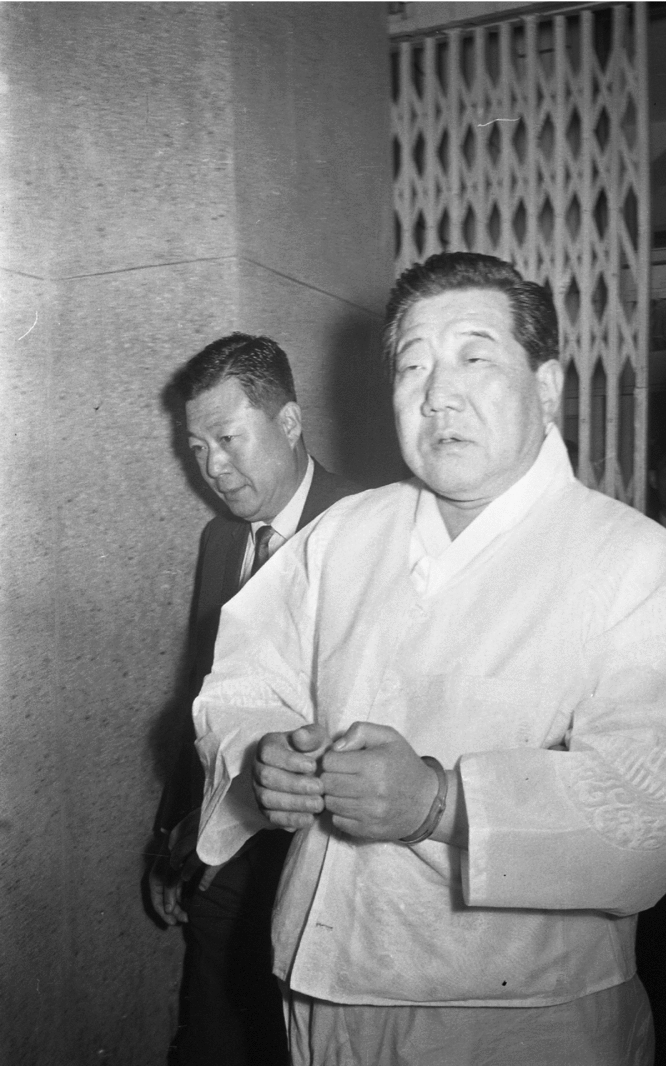
On 22 May 1961, six days after soldiers took control of the South Korean government in a coup, a man named Yi Chŏng-jae headed a procession of alleged hoodlums trudging reluctantly through central Seoul. Hands bound, Yi plodded along the boulevard as a placard hanging from his neck announced his name to onlookers. Above his head, a banner proclaimed him a ‘gangster’. Yi was a gang boss with high political connections—or a political activist with underworld ties, depending on one's perspective. Under a regime that had collapsed the previous year, Yi's gang had served as a paramilitary wing of the ruling Liberal Party. This unit helped the party rig an election and suppress subsequent protests. The administration in power at the time of the coup had prosecuted Yi but the courts failed to hand down a serious sentence. Seeking to shore up its credentials, the junta immediately rounded up Yi, his underlings, his patrons, and other underworld characters who had performed political functions. The parade was a public display but the new rulers meant business. Stiff punishments followed. Yi would hang before the year was out.
The swift, decisive action taken against Yi and figures around him indicates the seriousness with which the military rulers regarded the problem of cooperation between street gangs and political parties. Such cooperation was hardly new. For many years gang bosses had put their organizations at the disposal of party and state actors. In the decade and a half following Korean liberation from Japan in 1945, a category of men prowled Seoul's back alleys and also its halls of power. These figures might be called street leaders, for they were directly linked on one hand to private agents of violence and on the other to the top state and political elites of the country. The most notorious individuals included Kim Tu-han, a gang leader who became an elected politician, and Yi Chŏng-jae, the ‘political gangster’ who helped party politicians with their dirty work. Kim and Yi, whose political careers are the focus of this article, are the stuff of legends in South Korean popular culture. Perhaps because of their status as television and film characters they have not received serious academic treatment.Footnote 1 Yet street leaders like Kim and Yi were on the scene at key moments in the early political development of the Republic of Korea. In the immediate post-liberation period, state officials and party organizers deployed Kim and his gang to fight alleged leftists. This activity put them at the nexus of state-building and party mobilization. The country's first few elections brought the patrons of gang violence into high office, and street leaders also tried their hand in electoral politics. Yi and his group were involved in the excesses of the Liberal Party that led to president Syngman Rhee's downfall and that provided part of the excuse for the military coup of 1961.
On one hand, there should be little surprise that street leaders played a role in the early years of South Korean politics. After 1945 nonstate violence in multiple forms had been a regular feature of politics in Seoul. Parties had paramilitary wings. ‘Youth groups’ brought together specialists in violence who claimed to serve as vanguards for particular politicians or causes. Demobilized soldiers, former guerrilla fighters, and common street thugs put their skills to purported public purpose. Police enlisted the support of violent agents to fight suspected leftists; patrons of militias became elite politicians. Street leaders formed one type of agent of nonstate violence among many. On the other hand, in light of subsequent political regimes, street leaders hardly look like important actors. The junta wiped out street leaders. The parade of May 1961 marked the beginning of the end of a period in which leaders of street gangs cavorted openly with political elites. Such interactions would never happen again. The state that oversaw the country's quick modernization in the decades from 1961 was remarkable for its coercive capacity and for its independence from social forces. Next to this powerful state street gangs appeared pitifully small and insignificant, even if politicians and officials sometimes called on them for help.
Through an investigation of the political careers of two figures, this article draws attention to the significance of street leaders for the building of the South Korean political order. A source of this significance was that alliances between street leaders and political elites altered power relationships. State and party influentials who acted as brokers for nonstate violence expanded their power by calling on gangs to serve political functions. Not only did this calculus strengthen right-wing parties, but it helped launch the careers of many long-serving elite party politicians—most of whom belonged to the opposition under authoritarian rule. The suppression of street leaders also stemmed from these power considerations. The most serious threat to alliances between underworld violence and political activism came not from movements espousing an alternate ideology but from state actors who competed against the patrons of street leaders. When the junta eliminated street leaders, their disappearance came at a cost. The military rulers linked the delegitimation of ‘political gangsters’ to the delegitimation of a wide variety of forms of political activity, including nonviolent and noncorrupt ones. This linking gained articulation in electoral institutions. This cost continued to be borne even after South Korea's transition to democracy. Thus, long after street leaders had been sidelined, their patrons—whom they had helped empower—remained prominent politicians in a system in which the elimination of gang violence from politics was an opportunity to curtail political participation more broadly. The narrative that follows clarifies these legacies.
Ties between the underworld and politics are hardly specific to South Korea. In other parts of East Asia the significance of private violence to public politics is better documented. In China and Japan vigilante groups and coercive organizations participated in mid-twentieth-century struggles to assert authority and subvert enemies. In 1920s and 1930s Shanghai, the Kuomintang or Nationalist Party formed an alliance with the notorious Green Gang, which had extensive networks in labour unions, business circles, and the drug trade, to suppress communists and extort support from businessmen.Footnote 2 In Meiji Japan political activists who specialized in violence made nonstate coercion a common part of political struggle; in the early twentieth century underworld bosses directly entered formal politics.Footnote 3 In post-war Japan, the government and rightists worked with violent societies to decimate labour as a political force.Footnote 4 Seoul's street leaders can be understood alongside these other regional examples.
In Korea, unlike in other parts of the region, the organizations run by street leaders did not draw on deep traditions of secret societies. The Green Gang, as well as other Chinese underworld groups, traced their origins to earlier organizations with religious and political bases. Modern groups borrowed symbols, terminology, and organizational structures from their predecessors, even as they incorporated activities like dealing drugs and running protection rackets.Footnote 5 Older traditions provided these groups with legitimacy, both internally among their members and in the communities in which they operated. While street gangs in Seoul had systems of sworn brotherhood and pledged ‘loyalty’ to the boss, the organizations did not grow out of older traditions. Japan's underworld organizations, yakuza, formed in response to commercial opportunities and the accompanying advances in infrastructure, including new roads and greater transportation.Footnote 6 In Korea, where commerce developed more slowly, there were fewer opportunities for the vice sector to grow until the twentieth century. An examination of the politics of private violence in post-colonial Seoul can reveal more about the similarities and differences across the region in the relationship between public power and private coercion.
Seoul's street leaders and their organizations
Street leaders stood at the intersection of two very different social worlds. Because of this position, they look different depending on how they are viewed. Seen against the broader political landscape, street leaders’ organizations fit among the myriad vigilante groups called upon by individuals connected to the post-colonial state. Sympathetic contemporary actors and later historians referred to these organizations as ‘right-wing youth groups’. When placed in their local contexts, however, street leaders were as much gang bosses as political activists. Their organizations were similar to other Seoul street gangs that possessed hierarchies and engaged in turf battles with each other. The organizations under discussion here need to be seen both in their national political contexts and in their local settings.
The regime that came to power in southern Korea in the autumn of 1945 engaged in a protracted counter-insurgency campaign against popular forces. Those forces had begun to articulate demands in the immediate aftermath of the Japanese departure. The counter-revolutionary project absorbed a massive portion of the early state's energy until tensions between contending forces within Korean society gave way to full-scale war in June 1950. As the Cold War took shape, South Korea's place was as an American satellite state in the fight against communism. The very purpose of the South Korean state was from the beginning to form a bulwark against communism. The regime deployed brutal coercion to suppress local activism in the name of anticommunism. From September 1945 the support and resources of a superpower were channelled through the emerging state and brought to bear on any actors suspected of resisting the state project. In a territory occupying half of a small peninsula, this force was tremendous.
Executing the counter-revolutionary project required building coercive capacity. Japanese colonial institutions offered a good starting point. Another tactic, pursued under American advisers, was to establish political and legal structures that made persecution of possible enemies easy. Besides developing institutions, the regime also turned to sympathetic local actors who already possessed organization and instruments of violence.Footnote 7 These vigilante groups could be co-opted by the state to carry out counter-insurgency activities. Among the vigilante groups mobilized by pro-regime actors were street leaders.
In their local contexts, street leaders looked little like political activists. Seoul's underworld was inhabited by imposing groups of young men who demanded money from shops in exchange for ‘protection’. These men were called ‘fists’ (chumŏk), ‘shoulders’ (ŏggae), or hoodlums (kŏndal). They were organized into gangs with territorial boundaries, leadership structures, and symbolic systems. Even as they became tied up in politics, these gangs remained protection rackets run by figures who were tough, ambitious, and street smart.
A boss and his deputies led each gang. Kim Tu-han was one such boss. Born in 1918, Kim was the son of an independence fighter named Kim Chwa-jin who died in Manchuria in 1930. Young Kim Tu-han grew up in difficult conditions on Seoul's streets.Footnote 8 He rose in the Seoul underworld and in the 1930s, still a teenager, he was a boss in central Seoul. He claimed to fight on behalf of Korean merchants and residents against Japanese police and yakuza imported from Japan to suppress Koreans.Footnote 9 In popular accounts he is portrayed as a sort of folk hero for his resistance to colonial oppression.Footnote 10 Kim was not always the patriot he is made out to be. During the war, he avoided being sent away by assisting the authorities in the creation of a Peninsula Volunteer Youth Association (Pando ŭiyong chŏngsindae, or pando ŭiyong ch’ŏngnyŏndan). Under this organization, his gang stayed in the capital region and did construction work, specifically flattening a hill to make way for a railway intersection.Footnote 11 After liberation Kim was in and out of prison. Even as the political atmosphere changed rapidly, Kim's group continued to be influential on Seoul's streets in the late 1940s.
Yi Chŏng-jae rose to prominence as the head of one of Seoul's main underworld organizations in the 1950s. He was a Korean wrestling (ssirŭm) champion from Yich’ŏn county, outside Seoul. Kim Tu-han claimed Yi was one of his lieutenants before liberation and that he recommended Yi to Japanese police to serve as a detective.Footnote 12 He held leadership positions in market organizations, including as chairman of the Tongdaemun Market Merchants’ Association, the Ch’ŏnggye Mutual Help Association, and the Tongdaemun Market.Footnote 13 Yi Chŏng-jae also had a base in his hometown. He was influential in Yich’ŏn because he sold its goods in Tongdaemun, one of Seoul's largest markets. The county is a traditional rice-growing area and he helped merchants sell in his Seoul market. The funds he raised in Tongdaemun allowed him to increase his prestige at home. He spread his profits in Yich’ŏn. He attended ceremonial events like weddings and funerals for Yich’ŏn natives. According to Yu Chi-gwang, a co-native and Yi's deputy, his number one rule was to ‘help Yich’ŏn people no matter what’. When it was prohibited to sell Yich’ŏn rice in Seoul, Yi convinced police to allow him to bring rice into the city during curfew. These measures made him popular at home.Footnote 14
Bosses displayed fragile egos and short tempers. Yi was once informed that the market could not get a licence for an overpass because of his name. In response, he pulled a gun and said: ‘This is not for hunting birds but for hunting people. Find out whether it's true that the mayor refuses to authorize [a permit] under the name of Yi Chŏng-jae, and if it's not I will kill you.’Footnote 15 Another boss named Yi Hwa-ryong was arrested multiple times in the late 1950s, including once for beating a man who had simply called him a ‘gangster’ (ŏggae).Footnote 16 A third, Im Hwa-su, who worked in the entertainment industry, was known to have burnt a man on the face with a lit cigarette.Footnote 17 Both Yi and Im also moved in political circles.
Chains of loyalty held street gangs together. In court, Yi's deputy Yu Chi-gwang described his group's organization in the late 1950s: ‘At Chongno's fourth section, Seoul youths gather around one person. With Yi Chŏng-jae at the centre, some ten bosses each lead 50 or 60 youths; if conflict breaks out between them, it is the boss's duty to kill the thirst for revenge and make peace and feed them.’Footnote 18 Duty (ŭiri) was the key value for members. Being dutiful, or righteous, meant following one's superiors and it reflected the idea that violence was not random. Yu, again, stated proudly that ‘I decided to become a man (sanai) who lives by duty (ŭiri) and dies by duty.’Footnote 19 Members called themselves ‘men of valour’ (hyŏpgaek). Later gangsters could reminisce on the ‘code of valour’ (hyŏpgaek ron) held by this generation.Footnote 20 Within their gangs, bosses were authority figures who claimed legitimacy on the basis of such codes.
In professing values of duty and claiming to uphold chivalrous codes, Seoul's street gangs followed a pattern observed among bandits and violent organizations in other contexts. Just as bandits have images of never being cruel or excessively violent,Footnote 21 Seoul gangs insisted they used violence only for justified purposes. Their self-characterization as ‘men of valour’ also echoes the label of ‘men of honour’ (uomini d’onore) which southern Italian mafiosi gave themselves.Footnote 22 Shanghai's Green Gang possessed ‘a code of honour and chivalry, which distinguished [members] from the rest of society’.Footnote 23 Indonesian gangsters who were politically active in the late 1940s similarly claimed to have a sense of duty, drawn possibly from Hindu ideas of dharma.Footnote 24 In Thailand godfathers, or nak leng, have also espoused a ‘code of conduct’: ‘a nak leng is someone who is gentle and kind to his friends but at the same time is very tough with his foes’.Footnote 25 At least in how they styled themselves, Seoul's street leaders resembled violent groups found elsewhere in the world.
In Seoul, gangs battled each other. Fights could break out over competition to control territory or because of the personal rivalries of bosses. Kim Tu-han's group in the late 1940s picked fights with neighbouring ones. Gangs in the Chongno, Myŏng-dong, and Sŏdaemun districts waged a war against each other in the late 1950s. Newspapers documented multiple brawls, some in broad daylight, between the gangs. In one incident in this war, 30 of Yi Chŏng-jae's men, brandishing hatchets, launched an assault on a rival gang.Footnote 26
In sum, street leaders commanded groups that had their own parochial interests divorced from high politics. They sought to protect their territory from encroachment by rival groups. Bosses commanded the loyalty of members so long as order was provided. When they entered the realm of public politics, these interests did not disappear.
Operating in multiple social arenas, figures like Kim and Yi had various identities. Because of their complicated positions, giving them a single label is difficult. Referring to them only as right-wing activists glosses over many traits of their organizations. Calling them only mafia bosses would highlight their illicit activities, while also perhaps implying a cultural and historical rootedness that Seoul's street gangs did not possess. These figures led groups that were both gangs and political organizations. The term ‘street leader’ is used here to capture their hinge role in connecting a particular sort of private violence to official uses. The term is also not pejorative. Kim's and Yi's organizations could be helpfully compared with mafias and with vigilante groups—and some of those comparisons are below—but stressing one or the other of their identities means missing the connections between the two. For understanding the political significance of street leaders, it is important to consider the ways positions as gang bosses and as right-wing activists informed each other.
The Taehan Democratic Youth Alliance
Street leaders came onto the political stage soon after Korean independence from Japan. The American Military Government, which ran southern Korea from September 1945 to August 1948, attempted to impose order in the face of post-colonial uprisings by farmers, workers, and other groups. The American Military Government turned to sympathetic nonstate ‘youth groups’ for support fighting people's committees, farmer cooperatives, worker associations, socialist groups, and any other forces deemed threatening by the government. Youth groups were mass organizations that connected political elites to the energies of large numbers of young men. Resembling both pro-state militias and paramilitary wings of parties, they had dual functions of helping the state establish order and helping particular elites build constituencies. Many of these groups started small in the months after liberation but consolidated into larger organizations.Footnote 27
The right-wing youth group label was applied to a wide variety of vigilante organizations. One set of organizations included men who had fled the north after liberation. The most famous of these was the Northwest Youth Association (Sŏbuk ch’ŏngnyŏnhoe), formed in autumn 1946 by Yu Chin-san, a prolific organizer of the period. The Northwest Youth Association built on earlier local and national associations of anticommunist youths who had left the north. Those associations had set up shelters offering food and lodging for people from the same hometowns.Footnote 28 The Northwest Youth Association also infiltrated the military and universities, where they countered alleged leftist activities.Footnote 29
Another set of organizations included men who had been in Manchuria and participated in the Liberation Army (Kwangbokkun), a militia that claimed to fight for the provisional Korean government. The most famous of these was the Chosŏn Minjok Youth Corps (Chosŏn minjok ch’ŏngnyŏndan). The group's head, Yi Pŏm-sŏk, had visited Germany in 1933 to study military affairs and while in China worked with Chiang Kai-shek's Blue Shirts.Footnote 30 In south Korea, the Chosŏn Minjok Youth Corps established centres around the country for training in ‘spiritual’ and political subjects, as well as intellectual and physical ones.Footnote 31 A similar group was the Taedong Youth Corps (Taedong ch’ŏngnyŏndan), established in 1947.
It was in this context that street gangs became connected to politics. Such gangs did, after all, possess the coercive capacity that politicians and state agents found useful. One organization that incorporated a street gang was the Taehan Democratic Youth Alliance (Taehan minju ch’ŏngnyŏn tongmaeng). The coercive arm was the detached force (pyŏldongdae) run by the inspector general, who was the experienced but still youthful Kim Tu-han. The Taehan Democratic Youth Alliance, largely because of Kim's branch, would go on to become the ‘most violent terrorist organization’ of the period.Footnote 32
A gang becomes a youth group
In late 1945 or early 1946 Kim Tu-han joined a leftist group.Footnote 33 The Chosŏn Youth Vanguard (Chosŏn ch’ŏngnyŏn chŏnwidae, or CYV) incorporated Kim and his underlings from the Peninsula Volunteer Youth Association. This unit transformed from a pro-Japanese group to the coercive arm of a communist one. Kim was made captain of the vanguard. The head of the ‘action corps’ (haengdongdae) was a childhood associate of Kim's named Chŏng Chil-lyong.Footnote 34
In April 1946 Kim quit the organization and brought his underlings into a new right-wing youth group—the Taehan Democratic Youth Alliance. The reasons for Kim's flip-flop have been debated. Popular treatments of Kim's life claim that only in spring 1946 did he learn his father had been killed by a Korean communist. Filial piety then turned him against communism.Footnote 35 Another theory is that competition between Kim and Chŏng Chil-lyong led to the break. Chŏng's gang based in Myŏng-dong was apparently poaching Kim's mid-level staff and recruiting from among his followers.Footnote 36 In this interpretation, conflicts between street leaders with private interests drove the shift. Another claim is that Kim, by spring 1946, saw that rightists had the upper hand and he made a pragmatic decision.Footnote 37
Figures at the top of the Taehan Democratic Youth Alliance's organization chart came from the tangle of overlapping leadership networks that ran state-allied groups. Leaders of several major parties, including the Korean Democratic Party, had positions in the Taehan Democratic Youth Alliance.Footnote 38 Syngman Rhee and Kim Ku served as honorary chairs, as they did for many other pro-state youth groups. Yu Chin-san, involved in many groups from the beginning, was head of the Taehan Democratic Youth Alliance and orchestrated its funding.Footnote 39 The patronage of elite politicians lent the organization legitimacy.
Rituals, slogans, and symbols gave the organization solidarity and public purpose. The Taehan Democratic Youth Alliance had its own song and issued uniforms to members, who pledged to regard themselves as the ‘combative vanguard for 30 million’.Footnote 40 In cap and uniform, members strutting the streets resembled Japanese soldiers.Footnote 41 The group was based in Seoul, where it began, and it developed branches across south Korea. Its membership would grow to some 18,000. Its hierarchy put the Seoul headquarters at the top and branches were organized at the ward (ku) or county (kun) level. Kim Tu-han's detached force was connected to the headquarters.
The core of the group's detached force was formed from Kim's subordinates. He brought 470 members of the CYV with him. Much of this organization had remained intact over the years, despite transforming from street gangs, to sanctioned colonial corps, to communist vanguard, and now to right-wing fighters. His subordinates continued to earn their keep by practising extortion.Footnote 42 As a sympathetic writer observed, rank-and-file members knew and cared little for ideology.Footnote 43
The trouble with the category ‘right-wing youth group’, used by contemporary actors and later historians, is that it suggests pro-state mass organizations were the outgrowth of ideological conflict. The groups that fell within this category were varied and had their own histories and interests apart from public politics. Ideology was not the core that held them together, but professed ideology was crucial for official endorsement. The ability of the ‘right-wing’ label to hide diversity was part of its real power. Official actors could label their allies—even street gangs—right-wing and thereby justify their violence. Politicians and state officials supplied the legitimacy for the external violence they needed. Without this legitimacy, Kim Tu-han's group was just another Seoul street gang. Relationships between figures like Kim and Yu Chin-san were important in this period because they facilitated the marriage of national political struggle with local organization of violence. Ideological conflict did not create groups like Kim’s; rather, elites used the language of ideological struggle to sanction specific forms of private, pro-state violence.
Administrators, politicians, and street violence
The Taehan Democratic Youth Alliance also had connections within the state. Two administrators who supported right-wing violence, including the Taehan Democratic Youth Alliance, were Cho Pyŏng-ok and Chang T’aek-sang. Cho and Chang belonged to the clique of conservative elites identified by the Americans as leadership material. Both served in the police under the American Military Government, with Cho as police superintendent and Chang as capital region police chief. Cho and Chang had been advocates of bringing Japanese collaborators into the police force, a policy preferred by the American Military Government. These actors were immensely important in building South Korea's anticommunist order.Footnote 44
Cooperation between police administrators and the Taehan Democratic Youth Alliance was illustrated in the response to the uprisings of September and October 1946. The uprisings began as a strike by rail workers in the southeast, and then spread across the country. Cho Pyŏng-ok and Chang T’aek-sang met with Yu Chin-san to discuss a response to unrest in Seoul. Chang also met directly with Kim Tu-han. Kim took hundreds of underlings to the site of Seoul's rail strike, where 3,000 police were gathered with a total of 2,000 from various youth groups. Chang supplied 300 guns to Kim's men, as well as boxes of grenades. Kim's group wreaked havoc, sending many strikers to hospital.Footnote 45 Police and the Taehan Democratic Youth Alliance worked side by side. Kim's men made arrests on their own and took detained strikers to police stations.Footnote 46 When fighting moved to Taegu, Taehan Democratic Youth Alliance members found themselves in unfamiliar territory. Over three days, 23 Taehan Democratic Youth Alliance activists were reportedly killed and another 20 seriously injured.Footnote 47 These uprisings prompted the formation of new pro-state militias, including Yu Chin-san's Northwest Youth Association and Yi Pŏm-sŏk's Chosŏn Minjok Youth Corps.
Through Cho and Chang, state resources flowed to rightist political mobilization. They helped secure material support for the Northwest Youth Association.Footnote 48 With their assistance, the government provided rice, barley, wheat, cloth, and other basic goods to the organization's boarding homes for distribution to refugees from the north. While a portion of these goods was so used, another portion was sold on the market to generate revenue for the association. As a later leader of the organization admitted, these officials were basically complicit in embezzlement by the group.Footnote 49 Diverting state resources to groups like the Northwest Youth Association helped Cho and Chang further their own political careers because it allowed them to build constituencies outside the state.
The constitutional assembly elections of May 1948 revealed the strength of politicians connected to pro-state mass organizations. The Northwest Youth Association lent support to multiple right-wing parties.Footnote 50 Other youth groups ran directly in the elections. The Taedong Youth Corps fielded 87 candidates and won 12 seats. Six Chosŏn Minjok Youth Corps candidates won seats and became the basis of a bargaining group within the assembly once several independents joined them. Because the assembly lacked major parties, as many independent candidates won, Chosŏn Minjok Youth Corps leader and Hitler enthusiast, Yi Pŏm-sŏk, managed to become the country's first prime minister. Chang T’aek-sang lost his race but was made foreign minister and later prime minister. Cho Pyŏng-ok served as a representative to the UN, then won a seat in the 1950 assembly elections. The Taehan Democratic Youth Alliance's supporters in the state went on to become major politicians of the 1950s.
Linkages between state officials, politicians, and street leaders offer insight into the interplay of state-building and political mobilization in this period. Increasing the capacity of state institutions was not the only mode of state-building. The American Military Government also reached out to nonstate organizations and made deals with them in order to establish order. Brokers of state power, like Cho and Chang, used their positions to enhance their political careers in a way that building state institutions would not have done. Their roles inside and outside the state reinforced each other. They used their connections outside the state to discharge their public duties and they used their connections within the state to develop constituencies. The effect on political struggle was to strengthen leaders of rightist organizations like the Taehan Democratic Youth Alliance, the Northwest Youth Association, and the Chosŏn Minjok Youth Corps. State-building was a process of empowering this set of pro-state elites.
Public purpose versus private agendas
Working with street leaders came at a cost for administrators, who could not always control their allies. Kim Tu-han overreached within weeks of establishing the Taehan Democratic Youth Alliance. In late April 1946, his gang attacked a rally at a Seoul theatre. In May, Kim Tu-han pulled a gun in another encounter with alleged communists. This time he was arrested, convicted of illegally carrying a weapon, and imprisoned until September 1946.Footnote 51
The following year Kim consolidated his reputation as a loose cannon. On 20 April 1947, police raided the Taehan Democratic Youth Alliance's headquarters, where they found a corpse and ten injured people. The deceased was Chŏng Chil-lyong, Kim's childhood friend and former colleague. A second victim died in hospital. The previous day Kim Tu-han had picked a fight with Chŏng and his group near a theatre in Seoul. Then Kim had mobilized his followers to kidnap Chŏng and his men and to beat them.Footnote 52 Although Kim claimed his innocence at court, he later acknowledged that ‘this incident was done by me alone . . . I will take full responsibility’.Footnote 53 Sympathetic chroniclers insist the incident was the result of Kim's concern that Chŏng's group might attack President Rhee on his return from the airport after a trip to the United States.Footnote 54 The fight, though, was not simply between right and left, but between two gangs with histories and private interests. Taehan Democratic Youth Alliance youths did not always act simply on orders from above. Kim's team included people he had brought with him from Chŏng's organization, as well as those who had been with him on the streets of colonial Seoul.
The American Military Government found itself in an awkward spot. To American administrators, Kim was ‘our old friend’Footnote 55 but his actions reflected poorly on the government. The Taehan Democratic Youth Alliance was immediately disbanded. A trial was held and Kim summoned. Thirteen people were convicted of causing injury or injury leading to death. The stiffest punishment went to one of Kim's followers, who was handed a seven-year sentence. Kim, found guilty of accidentally causing injury, was let off with a minor fine of 20,000 hwan.Footnote 56 The American Military Government eventually decided the court was too lenient and in February 1948 a second trial, now by the military authorities, was held for Kim Tu-han. This time he was sentenced to death along with his 13 accomplices. General John Hodge, the top military commander in Korea, changed the sentence: only four, including Kim, were given death sentences and Kim's execution required authorization from General MacArthur before being carried out.Footnote 57 Right-wing groups protested this harsh treatment of ‘patriots’.Footnote 58
By conferring official legitimacy on organizations that were simultaneously street gangs, administrators gave street leaders a cover to hide behind in fighting their battles over turf and personal rivalries. The episodes involving Kim Tu-han illustrate that his organization was driven at least partly by the motive of gang warfare. However, official recognition did not justify any and all violence by street leaders. Kim pushed this boundary. Exactly where the boundary lay is difficult to know. Two features of Kim's attack on Chŏng would suggest that he acted outside of the scope granted him. First, there was very little at stake politically in this attack. No uprising or demonstration prompted the attack. Kim's group engaged in more violent behaviour on other occasions, but in instances such as the strikes of autumn 1946 state actors were concerned about public order. In the 1947 incident he killed a known gang rival who was attached to a leftist group but who was not known to pose an imminent threat. Second, the press covered the episode. With the story splashed in the evening papers, Kim's patrons could not hide what had happened. Given that the attack neither served the state's interests nor could be kept from the public, authorities had reason to stop protecting him. In this instance Kim's brash actions threatened the legitimacy of the state-sanctioned organization to which he belonged.
The consolidation of youth groups
Kim Tu-han cheated death. In April 1948, MacArthur commuted his sentence to life imprisonment.Footnote 59 After the republic's founding he was released, and he set about rebuilding his career. Kim connected with his former patrons Yu Chin-san and Chang T’aek-sang, who were helping the government to establish a new organization that would incorporate the largest right-wing youth groups. In December 1948, five groups were unified under the Taehan Youth Association (Taehan ch’ŏngnyŏndan). The group pledged ‘absolute obedience’ to President Syngman Rhee, who was also made president of the organization.Footnote 60 When the Taehan Youth Association was formed, Kim Tu-han was appointed deputy inspector as well as construction director (kŏnsŏl kukchang). He later served as inspector general (kamch’al kukchang) for the organization. Now his gang was part of a state-sanctioned organization.
The consolidation of youth groups and their incorporation into the state served two functions for Rhee, one explicit and the other implicit. The explicit function was to aid in the process of establishing order. Rhee explained the benefits of this consolidation: ‘A nationally organized militia system can be set up, and [its members] can receive training as qualified soldiers, then when they work for the state they can become a support for the army and protect national power and territory.’Footnote 61 Uprisings in Yŏsu and Sunch’ŏn in autumn 1948 prompted centralization of coercion. One measure was the National Security Law. The National Security Law, which banned communism and empowered the executive over the judiciary, was a step toward institutionalizing state control over local activism. State institutions like the National Security Law did not require making deals with nonstate groups. The consolidation of youth groups was proposed in the context of centralizing violence and incorporating it into the state.
The implicit motive for establishing the Taehan Youth Association was the power struggle between Rhee and other political elites. The Taehan Youth Association's first head was the home minister, whose portfolio included police.Footnote 62 Under the home ministry, there would be centralized coordination of both pro-government youth groups and police. Until this point, cooperation had been informal, through individual police administrators and the political leaders of youth groups. Since the formation of the Taehan Youth Association increased the dependence of youth group patrons on the political centre, the move decreased the leverage of the former over the rank-and-file membership, including the violent wings. While under the American Military Government, bridging figures like Yu Chin-san, Chang T’aek-sang, and Cho Pyŏng-ok could use their discretion in deploying these nonstate forces; they would now need to defer to the home ministry. Because the consolidation of youth groups was a major step in formalizing the relationship between state coercion and agents of violence, it also undermined the political bases of potential challengers to Rhee.
One major target was Prime Minister Yi Pŏm-sŏk, whose Chosŏn Minjok Youth Corps had over one million members and considerable influence in the constitutional assembly. Yi's support in the legislature had helped Rhee become president. Having won the presidency, Rhee no longer needed these politicians. Rhee had mostly indirect contact with youth groups, lending his name to violent rightist groups and sometimes donating funds,Footnote 63 but he otherwise remained uninvolved in these organizations which had certainly helped his cause. Rhee turned against these figures, for fear their mass constituencies could one day threaten him. Yi initially resisted pressure on his Chosŏn Minjok Youth Corps to join the Taehan Youth Association, but he eventually capitulated.Footnote 64
Through the consolidation of youth groups Rhee drove a wedge between the state and parties, which had been developing together. Actors positioned between the state and parties could no longer use resources in one to improve their position in the other. Since the state could directly mobilize youth groups—including street gangs affiliated with them—street leaders and their official sponsors were weakened. No longer could a state representative improve his political credentials by deploying private violence. Such mobilization now occurred in a more institutionalized form. Kim Tu-han adapted to the times, and his old patrons brought him into the state-incorporated organization, but he and his patrons lacked the autonomy they once had. Relationships between street leaders like Kim and patrons like Yu, Cho, and Chang declined in significance for party mobilization and for state-building. The marginalization of street gangs for establishing order continued in the early 1950s. As the central state expanded during the Korean War, nonstate agents became even more peripheral to the state's effort to maintain order. With more coercive resources, the state's need for nonstate agents to project power diminished.
The Liberal Party and ‘political gangsters’
After the Korean War, street leaders found themselves called into politics again. This time, though, the call was to fight in party and electoral politics rather than to help project state power. Rhee had passed a constitutional revision that made the president directly elected from 1952. He now needed an organization for gaining mass support. He founded the Liberal Party for that purpose. Immediately upon founding the party he ejected the group—Yi Pŏm-sŏk and his allies—that lent him the greatest mass support. Instead, he wanted to create an organization that would help him gain power while minimizing dependence on other powerful politicians. Rhee turned to individuals who were personally dependent upon him. These figures, in turn, sought out power brokers who would be dependent. In this way patronage networks were created to support Rhee and the Liberal Party.
One figure who became enmeshed in Liberal Party clientelist networks was street leader Yi Chŏng-jae. He had two main patrons in the political world. The first was Yi Ki-bung, the president's closest ally after the Korean War. Yi had studied in Iowa and met Syngman Rhee in New York in 1921, before returning to Korea in 1934.Footnote 65 When Rhee returned, Yi joined him as a secretary and became a close associate. Their wives were good friends and on Rhee's 82nd birthday in 1957, Yi gave his first son to the childless Rhees. When Rhee became president, Yi became the first chief of staff. By 1949 Yi found himself in the position of Seoul mayor, then in 1950 became minister of national security. With the founding of the Liberal Party, Yi was made chairman. Rhee trusted Yi because he lacked any independent power base. Yi's rise had been dependent nearly entirely upon Rhee, not upon parties, youth groups, or electoral success. He served as a node linking the Liberal Party to other brokers. He received visitors at the ‘West Gate capitol building’ (Sŏdaemun kyŏngmudae), as his residence was called. There he met with party financiers and with gangsters.Footnote 66 Yi Chŏng-jae was among the visitors to his home.
Yi Chŏng-jae's second patron was Kwak Yŏng-ju, a police academy graduate from his home county. Kwak joined the capital region police force and rose quickly until becoming security chief for President Rhee.Footnote 67 As Rhee turned increasingly to coercion, Kwak's role grew so that he became known as the ‘vice vice president’ (pu-but’ongnyŏng). In the late 1950s, some claimed, ‘the “vice vice president” wielded greater authority than Chang Myŏn, the real vice president of the time’.Footnote 68 This connection helped Yi and his men escape police trouble when carrying out their political missions.
Yi Ki-bung and the Liberal Party found a variety of uses for street leaders. One purpose was in managing party affairs. In January 1954 there was a meeting to select the Seoul city chairman of the Liberal Party. Yi Ki-bung wanted the position but another candidate was expected to win the vote. Yi made Yi Chŏng-jae a district party representative, which allowed him to attend the meeting. When Yi Chŏng-jae took his turn to speak, he proposed a simple method of selecting a chairman. Those in attendance should just clap to show their support for a nominated candidate. Yi then gave a menacing glance around the room and announced there was unanimous support for Yi Ki-bung. The organization chief approved the decision and Yi became city chairman. The street leader helped Rhee's ally retain control over the party. He did so on more than one occasion. In mid 1955, at a meeting of party members who were disturbed by Yi Ki-bung's rise, Yi Chŏng-jae showed up with hundreds of followers and made himself the emcee. The subsequent discord provided a pretext for the police to break up the meeting.Footnote 69
Yi Chŏng-jae and his henchmen became better known for their roles in intimidating opponents outside the party. From 1956 the Liberal Party turned to increasingly dubious methods to cling to control. One reason was that in the vice-presidential election of that year, Yi Ki-bung lost to the opposition candidate, Chang Myŏn. The result was a shock to the party leadership. Rhee responded aggressively. The party pushed a local autonomy reform through the National Assembly. Then, in September 1956, police were implicated in an assassination attempt on vice-president Chang, but president Rhee refused to censure the home minister. In this context the Liberal Party turned to street gangs.
On 25 May 1957 the opposition held a rally at Changch’ungdan Park in central Seoul. Two minutes into a speech by Cho Pyŏng-ok, now a leading opposition figure, some 40 or 50 audience members raised a raucous. Some poured petrol on an amplifier and lit it.Footnote 70 Young men climbed on stage with clubs and the audience was thrown into confusion. Police then came in and broke up the rally.Footnote 71 The disturbance had been orchestrated by Yi Chŏng-jae through a group calling itself the Hwarang Club (Hwarang tongjihoe). The group's name was a reference to an elite organization of youths who were recruited to serve the king in the ancient Silla kingdom. Yi's immediate subordinate Yu Chi-gwang directed the action on the scene. The major ‘shoulders’ gathered their underlings at a billiards hall in central Seoul. Some 160 men came together and each was provided with a ‘lunch fee’.Footnote 72 Then they were dispatched to the rally. With help from Kwak Yŏng-ju in the presidential palace, police turned a blind eye to the ruffians and used the disturbance as a pretext for shutting down the rally.
Newspapers labelled Yi's deputy Yu, who gained the most press coverage, a ‘political gangster’ (chŏngch’i kkangp’ae). The term was a new one and it captured well the specialization of these informal agents of violence.Footnote 73 Besides discharging their political duties, these figures continued their battles with other gangs. The Hwarang Club was caught up in underworld conflicts, including the wild hatchet attack. Individuals involved in the Changch’ungdan Park incident were also arrested when a fight broke out involving another neighbouring gang.Footnote 74 The other gang was led by Yi Hwa-ryong, who had served under Kim Tu-han's unit in the state-sanctioned Taehan Youth Association.Footnote 75 These figures gained a degree of official protection in recognition of their political service. For example, when charged once for orchestrating violence, Yi Hwa-ryong was given a suspended sentence because of his past contributions to the anticommunist struggle.Footnote 76
Gangsters into formal politics
Meanwhile, Kim Tu-han broke into electoral politics in his own right. Kim ran as an independent in the 1954 assembly elections, in his stomping grounds in central Seoul, and won. He was able to build on his reputation in the district. His transformation from street thug to politician set an example to which many other gangsters would aspire—and never attain. Rumours had it that his electoral success—he won by just some 500 votes—was due to prostitutes who owed him.Footnote 77 No doubt his status as patron of shifty characters in the neighbourhood helped him, but he also gained from the post-war atmosphere. He was known for his hard anticommunist stance, and just after the war this could help him win votes in Seoul.Footnote 78 In six years Kim had turned from death row inmate, rightfully convicted of murdering a long-time associate, to a national legislator.
Kim was arrested days after winning the election and charged with election law violations. The accusations pressured Kim to join the Liberal Party; upon doing so, the charges were dropped. Months later, in January 1955, Kim announced he was leaving the party.Footnote 79 He went on to support Democratic leader Cho Pyŏng-ok, his patron from American Military Government days, who had become an opposition politician. Both the ruling and opposition parties by the mid-1950s included at their core elites who had led the right-wing movement under the American Military Government. The main division was between those right-wing leaders who succeeded in capturing state power and those right-wing leaders who failed. In opposing Rhee in the National Assembly, Kim continued to find familiar company. When anti-Liberal Party forces worked together against Rhee's extra-legal attempt to revise the constitution in mid-1955, Kim joined another old patron Chang T’aek-sang, now a legislator, who as a police administrator under the Americans had supplied Kim's anticommunist corps with weapons.
Yi Chŏng-jae planned to make his own entry into formal politics in the 1958 general election. He would run in his home constituency, Yich’ŏn, where he had developed a reputation. He had even begun preliminary campaigning. A truck drove through villages in the county and broadcast messages encouraging voters to support him. He even commissioned a children's song to be written about him. Events disrupted Yi's election hopes. In 1958, Yi's patron and the president's trusted ally, Yi Ki-bung, needed to find a safe seat. He found it in Yich’ŏn, where his client Yi Chŏng-jae had already put down a network. Yi Ki-bung, too, had relatives in the county. Yi Chŏng-jae was reportedly reluctant to give up his seat. According to one version, it was only when Kwak Yŏng-ju threatened him with arrest—an important source of leverage politicians and police had over criminals like Yi—that he gave in.Footnote 80 In the end, Yi Ki-bung won the seat, as the Democratic Party candidate pulled out before the election. Yi Chŏng-jae, though, lost his opportunity to follow Kim Tu-han into the assembly.
Kim was not especially important as a legislator, and he failed to win re-election. His example, however, shows how street credibility in this period could transform into electoral support. In 1950s South Korea it was possible for a street leader to make a serious bid for public office. Figures like Kim and Yi had real constituencies, born perhaps partly out of local fear, and those constituencies could make them electable. Moreover, they had links to political elites. That high politicians had stamped them at one point with legitimacy, albeit in different ways, raised their public profiles. Kim could claim publicly to be a patriot because of his service to the right-wing cause. His rise to the National Assembly is partly a reflection of the lingering impact of American Military Government-era cooperation between officials and street gangs.
Street leaders and the demise of the first republic
‘Political gangsters’ were deeply involved in the affairs that led to the collapse of Rhee's regime in spring 1960. In the late 1950s the Liberal Party became increasingly desperate in its measures for holding onto power. Rhee planned over a year in advance for how he and Yi Ki-bung would take the elections of March 1960. He reshuffled his cabinet to appoint new ministers specifically tasked with mobilizing the bureaucracy for his campaign.
One measure the Liberal Party took at this time was the revival of anticommunist youth groups. On 22 January 1959 the party established the Taehan Anticommunist Youth Corps (Taehan pan’gong ch’ŏngnyŏn tan). This ancillary organization was connected to the provincial offices of the Liberal Party and therefore had an organizational structure parallel to the party. The Corps’ president and vice president were, respectively, Syngman Rhee and Yi Ki-bung.Footnote 81 The group's head, Sin To-hwan, was a scholar with legal training who had spent much of the previous two decades in Japan and the United States.Footnote 82
The Taehan Anticommunist Youth Corps was not created from scratch. In fact, the organization incorporated, if not simply legitimized, existing criminal groups that had been working with the party for years, including Yi Chŏng-jae's Hwarang Club. Seoul branch leaders, at various levels, included Yi and Yu Chi-gwang. This part of the organization copied the underworld hierarchy. Yi Chŏng-jae was a lynchpin in the organization. On one hand he had ties to government in presidential security chief Kwak Yŏng-ju and in Yi Ki-bung, and on the other he had ties to Seoul's underworld. He connected top Liberal Party supporters to agents of street violence.Footnote 83 Yi's group was also involved in another pro-government organization established in March 1959. Yi's deputy Im Hwa-su, a lifelong criminal who was proprietor of a downtown cinema and the head of several film associations, led the Anticommunist Artists’ Corps (Pan’gong yesulin tan). In 1959 Im made a big budget production called ‘The Independence Association and Young Syngman Rhee’ (Tongnip hyŏphoe wa ch’ŏngnyŏn Yi Sŭng-man).Footnote 84
The Taehan Anticommunist Youth Corps featured prominently in the rigged elections of 15 March 1960. The Liberal Party employed the Taehan Anticommunist Youth Corps's network to distribute funds to voters. Yi Ki-bung ordered home minister Ch’oe In-gyu to deliver a large sum of cash to the Corps for this purpose.Footnote 85 The group's most memorable contribution came a month after the election in response to protests.
Weeks before the election, the Liberal Party's plans for stealing the election were leaked. Citizens took to the streets in protest even before the election was held. When 15 March came, the election results gave Yi an improbably large margin of victory in the vice presidential race. Demonstrations continued. The discovery that police had killed a teenage protester caused unrest to escalate. On 18 April, some 3,000 Korea University students led a peaceful march in Seoul. Soon after the march began in the afternoon, Taehan Anticommunist Youth Corps boss Sin To-hwan ordered Im Hwa-su to gather his Chongno branch members. After the march had finished and students were returning to campus the Taehan Anticommunist Youth Corps sprung into action. At the order of Yu Chi-gwang, who commanded the Taehan Anticommunist Youth Corps's eastern special sub-branch, 50 Taehan Anticommunist Youth Corps members attacked the students with wooden clubs and iron hooks. Some 30 students were injured. Police immediately arrested several of the Taehan Anticommunist Youth Corps members.Footnote 86 Im contacted Kwak Yŏng-ju, who then called the Tongdaemun police chief. As a court later heard, Kwak's message was angry: ‘You son of a bitch! Who ordered you to arrest gangsters! If you don't release them immediately, even the city police commissioner will be fired!’Footnote 87
The senseless attack on students fuelled indignation, prompting the biggest protests yet the following day. Police fired on protesters and outrage escalated even further. The ‘April 19 Revolution’ led quickly to the regime's demise. Within a week, Rhee fled to Hawaii and Yi Ki-bung committed suicide with his family.
‘Political gangsters’ were not the main force behind the first republic's downfall but they contributed to it. The Taehan Anticommunist Youth Corps's harassment of voters and its efforts to buy votes comprised some of the many ways that the ruling party tried to steal the election. In addition, the Liberal Party's employment of a street gang symbolized the regime's declining legitimacy. The violence enacted by Yi and his cronies was not hidden in back alleys but was out in public. Newspaper photographers captured their disruption of the opposition rally in 1957 as well the violence on 18 April 1960. The regime made no effort to hide the fact that it hired roughnecks to harass citizens. Finally, the actions of Yi and his colleagues on 18 April served as a trigger for the major protests the following day that ultimately brought down the regime.
Street leaders and politics after the first republic
After the first republic's fall, the constitution was rewritten creating a parliamentary system. New elections were held and a segment of the opposition came to power under former prime minister Chang Myŏn. The lost legitimacy of the Liberal Party gave Chang's government an opportunity to draw on popular anger to bolster support for itself. The new administration acted swiftly to bring those responsible for electoral fraud under the Liberal Party to justice. This effort included punishing ‘political gangsters’. Yi Chŏng-jae was charged for his role in the violence of 18 April. In addition, central figures in the Liberal Party including Ch’oe In-gyu and Yi Sŏng-u were also charged. In August 1960, Yi Chŏng-jae and two of his henchmen were sentenced to ten years’ imprisonment; Taehan Anticommunist Youth Corps boss Sin To-hwan received seven years.Footnote 88 However, the regime's weaknesses quickly showed. The sentences were soon overturned and Yi Chŏng-jae found himself a free man within months. The regime was too frail to bring Liberal Party cronies to justice.
The Chang regime's failure to deal with the Liberal Party's partners in excess was central to the justification for the military coup of May 1961. The junta inherited the opportunity to build legitimacy by addressing the outrage expressed in the April Revolution. In explaining the coup, eventual leader Park Chung Hee maintained that Chang's ‘Democratic Party government should have acted, like a responsible government, in bringing to consummation the unaccomplished revolution carried out at the cost of such an extensive sacrifice. It was, however, an anti-revolutionary traitor which neglected its mission.’Footnote 89 The coup and subsequent actions were justified by reference to the democratic ideals of the April Revolution, which the previous regime had proved unable to pursue.
Ensuring that those involved in rigging the March 1960 election were brought to justice was crucial for claiming the spirit of the April Revolution. The attack on Liberal Party cronies included civil servants and ‘illicit profiteers’ (pujŏng ch’ukchaeja), businessmen who had gained by providing kickbacks to politicians. ‘Political gangsters’ were also among the first groups targeted. Immediately after the coup the military rounded up politically-linked gang members and other known agents of violence. In six days 4,000 ‘gangsters’ (kkangp’ae) were detained; military trials for them began a few days later.Footnote 90 Less than a week after the coup, 150 suspected hoodlums, each with a name tag, were paraded through the streets of Seoul. Top street leader Yi Chŏng-jae marched in front of a sign declaring ‘I am a gangster. I accept the people's judgment.’ That judgment was death. Yi, his associate Im Hwa-su, his patron and former presidential security chief Kwak Yŏng-ju, and Rhee's home minister Ch’oe In-gyu were hanged before the end of the year. Other subordinates involved in the Liberal Party's violent youth corps were jailed and frightened away from further political activities. Yi Chŏng-jae's right-hand man Yu Chi-gwang spent the next five years in prison. Rank and file members were sent to construction projects in the provinces for rehabilitation.Footnote 91 The junta proved successful where the Chang regime had failed, and put an abrupt end to the era of ‘political gangsters’.
What made the demise of street leaders a long-term phenomenon was that the post-coup leadership set up the conditions to keep street leaders out of politics. The military government restored the republic in 1963 under a new constitution. The junta rebuilt institutions of governance, including those related to elections. The institutions were established on a new set of ideas about what elections can do. The Rhee regime allowed anything to go in elections. Rhee liked elections because he was willing to do anything, including hiring street gangs, to win them. The cronyism of the Liberals and the ineptitude of the Democrats—whose regime was a ‘democracy in name alone’—had undermined open electoral politics, the junta claimed.Footnote 92 This interpretation of recent history allowed the junta to simultaneously embrace democratic ideals and deride electoral processes for allowing corruption to enter government. Prior regimes had sullied elections as exercises that could be easily manipulated and that failed to guarantee administrations that served the people. The new regime cited the methods of the Liberal Party and the weakness of the Chang regime as reasons for being sceptical about elections. This legitimizing formula was possible partly because of the Liberal Party's alliance with street leaders.
Instead of having open elections and then breaking rules, the regime set the rules so that it could win without breaking them. The Park regime designed a new architecture for running elections and managing competition. The regime abolished local elections, which meant that there were far fewer elections. Adjustments to the electoral system led to a situation in which the translation of votes into legislative seats strongly favoured the ruling party. The regime also placed strict regulations on election campaigning and party organizing. Campaign regulations, for example, were extraordinarily rigid. Opportunities for voter-politician contact were constrained by allowing only brief campaign periods, forbidding door-to-door campaigning, limiting and regulating numbers and lengths of speeches, and stipulating types, formats, and quantities of printed promotional material. These laws had been proposed just after the fall of the Liberal Party, as measures to keep corruption out of politics, but under Park they were combined with effective repressive instruments in a new authoritarian system. Park instituted a new law governing parties, which stipulated how parties must organize. The election commission was renamed and made a constitutional body. Thus, from 1963 the ruling party had multiple instruments for persecuting and marginalizing competitors without violating the law. Elections were fewer, less important, and better monitored. In 1972 elections became even more peripheral to controlling government, as Park eliminated direct presidential elections altogether.
In this environment the rulers and their allies had less need for power brokers, including street leaders. When the formal rules favoured the regime so strongly, it made little sense to turn to nonstate agents of violence. Control over the state was far more significant for retaining power than was mobilizing elements in society. There was hardly an opening for alliances between street gangs and electoral candidates. When the regime did threaten opponents, it mostly used state actors from powerful agencies such as the intelligence service or the police.
Street gangs did not disappear permanently. Underworld activity returned to Seoul in the mid 1960s, as convicts left prison or rehabilitation. Gangs still fought; one such battle in 1975 ushered in an era of new gangs, whose leaders hailed from the southwestern Chŏlla region.Footnote 93 However, gang leaders after 1961 lacked the political connections of their predecessors. News of attacks on politicians or their supporters sometimes surfaced. In 1976, Kim T’ae-ch’on, one of the new underworld bosses, stole into the opposition party's convention to create a disturbance that would help one candidate become the party chief.Footnote 94 In 1979, razor-blade-wielding thugs broke into a meeting to establish an opposition party branch office in Mokp’o.Footnote 95 These episodes were minor and disconnected from serious struggles for power. The transformation from the 1950s was tremendous. Street leaders who had once been real power brokers were now powerless in national politics.
Kim Tu-han, the original street-leader-turned-politician, tried to stay in politics. After his first victory, he lost four consecutive elections. In his successful 1954 bid, he had run as an independent (listed first on the ballot) in an election that saw many independents win. By the next elections in 1958 much had changed. The Liberal Party was more developed, and a coherent opposition had taken shape in the Democratic Party. The latter saw great success in cities that year. Kim failed to gain the Democratic Party's endorsement, so he moved to another Seoul district and ran under the banner of a minor party. He lost. In subsequent elections he continued to shift districts, once running in his father's hometown. His main asset by the 1960s was simply the fame he gained for the earlier part of his career. He had no organizational base and belonged to no community.
In 1965 Kim finally won a by-election in a different Seoul district. A year later his political career ended in scandal. He participated in a hearing on illegal importing of saccharine by Samsung for producing chemical fertilizer. After speaking on the floor, Kim reached down and flung the contents of a box at his colleagues seated nearby. The attendees, who included the prime minister, found themselves doused in shit. The National Assembly has had plenty of scuffles since, but nothing quite as interesting has ever happened. The ‘sewage-throwing incident’ was Kim's swan song. He was detained and thrown out of parliament, never to return. He spent the years until his death in 1972 boasting of his life on a radio programme and in an autobiography.Footnote 96 By then it was clear that a man who put up his fists on the streets of Seoul was nobody in high politics.
Kim Tu-han heading to prison in 1966 after the ‘sewage-throwing incident’. Source: Tonga ilbo 25 September 1966, p. 2. Reprinted with permission from Tonga ilbosa.

Seoul's street leaders might be compared with agents of private violence in other contexts. Scholars of bandits and criminal organization in European history have debated whether such actors represent popular interests or actually serve commercial elites.Footnote 97 Street leaders in post-colonial Seoul fashioned themselves as bandits who served the people. They took on styles and legitimating stories similar to ones which Eric Hobsbawm observes mostly from European contexts.Footnote 98 Kim Tu-han and Yi Chŏng-jae were relentless promoters of their own heroism. Consider their tombs. Kim's lengthy epitaph—composed by a screenwriter—describes him as one ‘who could not endure injustice, who knew to stand with the weak against the powerful, and who lived honourably through many trials and tribulations’. Yi's features just a single character, ŭi, or ‘duty’.Footnote 99 Both figures had stories to tell about themselves as righteous heroes of the people. Depictions of Kim in popular culture have continued this portrayal of him. During their lives, Kim and Yi worked for politicians and officials in suppressing popular activism. They served powerful figures who used state resources to quell uprisings and manipulate elections. As political actors, they were hardly heroes of the people. However, neither were they primarily tools of a business elite, as has been argued for southern Italy's mafiosiFootnote 100 as well as for southern Chinese triads.Footnote 101 While landlords and industrialists were among the pro-state elite in South Korea, Kim's and Yi's patrons were defined above all by their positions in the state's counter-revolutionary project. In the context of the emerging satellite state, Seoul's street leaders were more agents of counter-insurgency terror than henchmen for business.
Legacies
Street leaders lie squarely in democratic South Korea's past. Perhaps that fact explains why a figure like Kim Tu-han can be romanticized in popular culture: his type is so removed from the present that making him a hero threatens nobody.Footnote 102 Yet the period of Kim and Yi was one in which the Republic of Korea state gained shape, an enduring political elite was born, and lasting institutions were developed. Street leaders were involved in those processes that created the contemporary South Korean polity. Both the alliances between gangsters and politicians as well as the destruction of those alliances left deep impressions on South Korean politics.
One set of impacts relates to the profile of the political elite and the formation of parties. The patrons of street leaders remained in high politics well beyond the consolidation of Park's rule. The right-wing movement became the basis for a core of the political elite up to the present. Making linkages to street leaders might not have been the definitive point in the careers of these figures, but this brokering role certainly increased their power. Yu Chin-san, the prolific rightist youth organizer, remained a top leader of the major opposition party until the late 1970s, serving a total of seven terms. Yi Ch’ŏl-sŭng, a seven-time legislator first elected in 1954, writes that in early 1947 he had nearly daily communication with Kim Tu-han.Footnote 103 Many other mid-level members of youth groups would go on to join the ranks of elected politicians as well.Footnote 104 The son of Cho Pyŏng-ok, the police chief turned politician, served as an opposition politician, even becoming a party head in the early 2000s. Sin To-hwan, the head of the Taehan Anticommunist Youth Corps who ordered the attack of 18 April 1960, escaped the fate of his subordinates and became a multiple-term legislator. Other elite politicians had indirect ties to earlier street violence. Chang T’aek-sang, who sponsored Kim Tu-han, was also the first patron of Kim Young Sam—the long-time opposition figure who became president in the 1990s. The street-leader-cum-politician and the future president entered the National Assembly the same year and under Chang joined the opposition to 1955's constitutional reform. All of these figures served in the opposition under authoritarian rule. In other words, a major section of the alternative political elite of the 1960s through the 1980s had earlier been connected to, if not directly involved in, deployment of private violence for pro-regime purposes. This elite, in collaboration with the ruling party, designed the democratic reforms of 1987; successors to the parties it established remain influential today. This legacy is an enduring effect of the earlier linkages between state-building and political mobilization.
The relationship between public power and private violence in the creation of political order in South Korea can be compared with other experiences in East Asia. In post-war Japan and Taiwan—the other American satellite states in the region—rightist or pro-state forces worked with agents of violence to consolidate control. Such efforts weakened the left in Japan and, in Taiwan, kept Hokkien- and Hakka-speaking Taiwanese quiescent in the face of rule by Mandarin-speaking mainlanders. The Kuomintang's cooperation with criminal elements in mainland Chinese cities had long-term implications for how that party operated. On Taiwan the party continued to employ underworld figures. With a history of some depth, though, the Kuomintang was shaped by many other experiences, too. The Kuomintang was by the late 1920s a far more complex and powerful organization than any party operating in Seoul in the late 1940s or 1950s. In mainland China and later on in Taiwan, party and state were profoundly intertwined. South Korea's parties developed more as agents or appendages of the state than as independent actors. Individual patrons of nonstate violence before the Korean War went on to serve as politicians and high-ranking government officials. This linking role—played in South Korea by figures such as Chang T’aek-sang and Cho Pyŏng-ok—was less significant in the Republic of China because the Kuomintang had a much greater organizational capacity. In South Korea, where parties were newer, the experience of mobilizing private coercion for public purpose had an extraordinarily large influence on elite composition and on party-building.
While the incorporation of informal violence into political struggle left one lineage of contemporary politics, the expulsion of street leaders from politics produced another. There are no more ‘political gangsters’ or politicians with backgrounds in the direct exercise of informal violence. Figures like Kim and Yi disappeared from public politics. Industrialization, urbanization, democratization, and decentralization did not revive them. The absence of such figures from public politics is taken for granted in South Korea, as a natural component of progress. A glance around the region, though, suggests that an intensification of gangster-political linkages is the norm rather than the exception in periods of quick economic and political change. Taiwan struggled with ‘black-gold politics’ (heijin zhengzhi) most intensely in the 1990s just as its democracy blossomed.Footnote 105 In Southeast Asia, democratization, development, and decentralization have been identified as causes for increasingly violent politics. One observer of the region writes: ‘It is clear that national electoral systems have unleashed violent and predatory local figures, but these leaders have also relied on rampant capitalism to create bases of power.’Footnote 106 Benedict Andersen has famously argued that rising political murder in 1980s Thailand reflected the intensification of electoral competition among local business elites who were taking elections more seriously.Footnote 107 South Korea took a different path. Two developments contributed to this different path. First, the centralization of violence in the state, between the republic's founding and the end of the Korean War, meant that officials did not need coercive agents outside the state for establishing order. Second, the suppression of linkages between street leaders and politicians after the 1961 coup and the subsequent reform of electoral institutions discouraged the deployment of private violence in electoral struggle.
Of course, organized crime persists in South Korea. Politicians are still rumoured to have underworld connections. Elected politicians have been wrapped up in scandals linking them to criminal syndicates. In 2001–02, for example, legislator Kim Hong-il, the son of then-president Kim Dae Jung, was investigated in connection with lobbying by a crime group. Another National Assemblyman noted that there are people ‘who follow you around’ if you are a politician.Footnote 108 At the same time, the underworld figures who might try to work with politicians are a far cry from the street leaders of old. The nature of criminal organization has changed. Underworld bosses are more like CEOs than street leaders since the real money is in private lending, money laundering, real estate, and other fields.Footnote 109 The corporatization of crime means that the big bosses are not the ones who run local protection rackets, as was the case in the era of Kim Tu-han and Yi Chŏng-jae. Since Kim no known street leader has been elected to public office. The term ‘political gangster’ has few contemporary referents. A similar pattern has been observed in Japan, where after 1960 money replaced physical coercion as a source of yakuza influence.Footnote 110
The exception reveals how peripheral street leaders are to politics. The most infamous aspiring ‘political gangster’ of recent times is Kim Yong-nam, a diminutive provincial gang leader known in the media by his nickname Yongp’ari. In early 1987, on the eve of democratization, two opposition legislators and the national security chief hired Yongp’ari to obstruct the founding of a new political party. The new party would bring together the factions of the two major opposition figures, Kim Dae Jung and Kim Young Sam. Over four days in April, as meetings were held across the country to set up branches of the party, Yongp’ari and 100 followers attacked one meeting after the next. Brandishing clubs, they tried to intimidate participants and break up the proceedings. The episode had no bearing on politics: the Unified Democratic Party was founded, though cooperation between the two Kims faltered for other reasons. When asked later why he had gotten involved, Yongp’ari referred respectfully to the original gangster politician: ‘Since Mr. Kim Tu-han served as a National Assemblyman, I thought I would try once to follow.’Footnote 111 Yongp’ari disappeared but was eventually caught and spent a few years in prison; the official and politicians who hired him also served time. Today, one can find a reformed Kim Yong-nam on Sundays in suit and gloves directing traffic outside the wealthy Church of Love in Seoul's upscale Sŏch’o district, where he also serves as a deacon.Footnote 112 The history of political street leaders repeated itself as farce.
The elimination of street leaders left a profound legacy that goes well beyond issues of violence. To the leadership of the 1961 coup, dealing with ‘political gangsters’ ranked as a high priority. It was necessary for the legitimacy of the coup and the subsequent civilian regime. The architecture of the Park regime was in part a response to the problem of street leaders. The Liberal Party's employment of agents of informal violence was crucial in the Park regime's subversion of the April Revolution and its circumscription of the electoral sphere. Even if most Koreans did not buy into official scepticism about elections, that scepticism infected electoral institutions. These institutions tightened the electoral sphere so that neither street leaders nor less corrupt elements could participate effectively. After democratization began in 1987, these institutions were never fully reformed even as elections became freer and fairer. The party law implemented in 1963 remains in effect. The Central Election Management Commission, renamed and reorganized under Park to control elections, was not reformed after 1987 for a role in an open democracy. Large parts of the election laws remain intact. A common theme in these institutions is the guiding principle that contact between candidates and voters should be limited on the grounds that it breeds corruption. The threat of corruption continues to be cited as the reason for limiting campaign periods, preventing certain modes of campaigning, banning political speech before elections, restricting numbers of activists and campaign offices, and other election-related laws. Of course, these regulations also inhibit noncorrupt political activities. ‘Political gangsters’ helped provide the excuse for this restricting of the electoral sphere. That effect continues to be felt today.
On this count, the contrast with the Kuomintang on Taiwan is striking. Both regimes were American client states with domestic agendas of suppressing popular forces in the name of anticommunism. While the Republic of Korea state eventually absorbed or eliminated agents of private violence, on Taiwan the Kuomintang continued to ally with underworld elements through the authoritarian period and beyond. Observing the persistence of organized crime in post-authoritarian Taiwan, Sonny Lo suggests that ‘[p]erhaps the historical legacy of the Kuomintang prior to its withdrawal from the mainland—the Chiang Kai-shek regime's political coalition with organized crime groups like the Green Gang—is still haunting Taiwan's state institutions’.Footnote 113 In South Korea the impact is at least as deep but the ‘haunting’ takes a different form: politicians do not rely on underworld actors for electoral mobilization, but the expulsion of ‘political gangsters’ and reference to the possibility of their return justified the creation and perpetuation of a narrow electoral arena patrolled vigilantly by the state. In recent years party and state reforms in Taiwan have cleaned up electoral politics considerably. South Korea's electoral institutions, meanwhile, still bear imprints left by the draconian reaction against cooperation between politicians and nonstate violence.