Introduction
National fertility levels reflect fertility behaviour at the individual level. The fertility of women in Australia, as in other developed countries, is typically controlled by contraceptive use: contraception is used to delay and space pregnancy, and limit the number of children born. While many studies of contraceptive use consider age of women and the number of children that have been born, few also consider women's fertility intentions. The focus of this paper is to extend research on contraceptive practice by considering the relationship between reproductive life course stage and contraception.
The most recently published research based on representative samples of women of reproductive age finds that the most commonly used contraceptive method for women is the oral contraceptive, with tubal ligation/hysterectomy and condom use also widely used (Richters et al., Reference Richters, Grulich, de Visser, Smith and Rissel2003; Yusuf & Siedlecky, Reference Yusuf and Siedlecky2007). Results based on the 2001 National Health Survey show that 27% of women aged 18–49 used oral contraceptives, 23% used condoms and 14% reported tubal ligation or hysterectomy (Yusuf & Siedlecky, Reference Yusuf and Siedlecky2007). Findings from the 2001–02 Australian Study of Health and Relationships of women aged 16–59 who used contraception showed that 34% used oral contraceptives, 22.5% used a form of sterilization and 21% used condoms (Richters et al., Reference Richters, Grulich, de Visser, Smith and Rissel2003). As in other developed countries, levels of use of intrauterine devices (IUDs) tend to be low, partly due to the reputation of old-style IUDs being linked to septic miscarriages and pelvic inflammatory disease (INFO project, 2006).
Typically contraceptive use is reported by age with different patterns of use found across different age groups (Caldwell et al., Reference Caldwell, Young, Ware, Lavis and David1973; Santow, Reference Santow1991; Richters et al., Reference Richters, Grulich, de Visser, Smith and Rissel2003; Yusuf & Siedlecky, Reference Yusuf and Siedlecky2007). Although the percentages of women using various methods are not directly comparable due to differences in sample selection, it is evident that there is much variation in use by age: oral contraception is the most commonly used method for women in their twenties; the condom is generally used by younger women; and permanent methods like tubal ligation are predominantly used at later ages, i.e. from aged 35 onwards.
These studies demonstrate that contraceptive practice varies by age. There is obviously a relationship between age and reproductive life stage: as a woman ages, she is more likely to have had children and be restricting her fertility. In this way, age can be used to help distinguish different stages of reproductive life (Foran, Reference Foran2003). However, for analysing contraceptive method use it may be better to consider a woman's reproductive life stage than use age as a proxy.
The life course approach is a useful lens through which to investigate fertility-controlling behaviour. Life course theory emphasizes individual histories, historical time and the impact of significant others (Harevan, Reference Harevan1982; Elder, Reference Elder and Setterson1983; Settersten, Reference Settersten2009). In terms of contraceptive use, this paper considers individual histories: age, the number of children that have been born (parity) and fertility intentions. However, the broader social setting – the ‘historical time’ in which contraceptive use takes place – should not be ignored, as both the methods that are available and who uses them are constrained by government, family and other social institutions. Understanding the social setting can assist in interpreting patterns of use.
Individual trajectories of reproductive behaviour do not follow set age-based paths: people move in and out of life stages at different times and in different sequences. Given that a main reason for using contraception is to control pregnancy, i.e. to control the timing or occurrence of a major life event, considering reproductive life course stage will provide a better understanding of contraceptive practice than using age alone as a proxy for life stage. However, this does not mean that age should be ignored in investigations of contraceptive use. As Settersten argues when discussing age as a determinant in life course research ‘Age becomes a key dimension that societies use in determining rights, responsibilities, and entitlements’ (Settersten, Reference Settersten2009, p. 75). There is no doubt that age will be associated with contraceptive use: there are some contraceptive methods that will be more socially ‘appropriate’ to use at younger ages, compared with others that are recommended nearer the end of reproductive ages.
Very few Australian studies have actually considered the role of reproductive life stage in terms of contraceptive practice, although some have considered parity (Caldwell et al. Reference Caldwell, Young, Ware, Lavis and David1973; Santow, Reference Santow1991). There is important research being done along these lines, but this research tends to focus on developing countries, where it is more likely that data on reproductive careers are collected (Khatun, Reference Khatun2005; Banerjee, Reference Banerjee2006; Hosseini-Chavoshi, Reference Hosseini-Chavoshi2007).
Methods
The investigation focuses on the use of contraceptive method considering the stage of an individual's reproductive life course. Specifically, age, parity and fertility intentions are considered controlling for other socioeconomic factors. The contraceptive methods have been classified by the level of ‘permanency’, that is, how easily reversible each method is. Three levels of permanency are defined: (1) methods that are ‘easily reversed’, which include oral contraception and condoms; (2) ‘medium-term’ methods, which include intrauterine devices and implants; and (3) ‘permanent’ methods such as tubal ligation and vasectomy of the partner.
Due to the different levels of permanency of the main contraceptive measures, it is expected that stage of the reproductive life course influences the use of contraceptive type in the following ways:
• Women at the start of their reproductive life course are more likely to use measures that are easily reversible.
• Women who want to delay their childbearing are more likely to use a medium-term method.
• Women are more likely to use permanent methods at older ages and at higher parity.
In order to analyse the effect of reproductive life course stage on contraceptive practice, data from the Wave 5 collection of the Household, Income and Labour Dynamics in Australia (HILDA) survey conducted in 2005 (MIAESR, 2007) are used. HILDA is a longitudinal household panel survey of the Australian population. Questions on contraceptive use were asked for the first time in the 2005 wave of HILDA as part of an international fertility module. This module is part of the Generations and Gender Programme: an international survey programme coordinated by the United Nations. (Information on the Generations and Gender Programme can be found at: http://www.unece.org/pau/ggp/.)
The fertility module was asked of all females aged 18–44 years and who partnered males aged 18–54. The sample used for this paper is female respondents aged 18–44 (N=3044 weighted). Following the analysis of the use of contraception and contraceptive type, logistic regression models are conducted of the factors associated with the use of the four main contraceptive methods used. In the logistic regression models, the effect of age, parity, fertility intentions, relationship type, education, area of residence, birthplace and Aboriginal or Torres Strait Islander status is examined. Fertility intentions were not asked of women who had, or whose partner had, been sterilized.
As indicated, the primary interest is the influence of reproductive life course stage, as measured by the number of children ever born and fertility intentions, including timing (except for women who use permanent methods), and age on the use of contraceptive methods. The logistic model for the use of permanent methods (N=2354) includes all women except those who are pregnant, have stated that they have physical difficulties in getting pregnant and women who have had a hysterectomy, as it is assumed that they did not choose a hysterectomy for birth control reasons. The logistic models for the use of oral contraception, condoms and medium-term methods are based on only women truly ‘at risk’ of pregnancy, hence they exclude women who have used any permanent method (N=2139).
Results
Of women aged 18–44, 45% were using a non-permanent method of contraception, 13.5% had a partner who had had a vasectomy or they have had tubal ligation, around 2% have had a hysterectomy, 4% were pregnant, 9% stated physical difficulties in getting pregnant and 26% were not using contraception. Women who were pregnant (n=133), had physical difficulties (n=285), had had a hysterectomy (as it was assumed women did not have a hysterectomy for contraceptive reasons, n=88) and did not respond (n=33) were subsequently excluded from further analysis of contraceptive use. A cross-sectional responding person population weight rescaled to sum to the number of responding persons has been used in the calculation of the descriptive statistics. The weight is used to account for the probability of being selected into the sample, and to ensure that the weighted person estimates match several known person-level benchmarks such as sex, state, labour force status and marital status (Goode & Watson, Reference Goode and Watson2007). This results in a weighted sample of 2544 women at risk of pregnancy.
Respondents who did not use permanent methods of contraception, such as tubal ligation or partner vasectomy, could state more than one method of contraceptive use. Those who used permanent methods were not asked about other forms of contraceptive use. Recent research has found that dual protection methods, particularly the combination of oral contraception and condom use, are quite commonly used in Australia (Parr & Siedlecky, Reference Parr and Siedlecky2007).
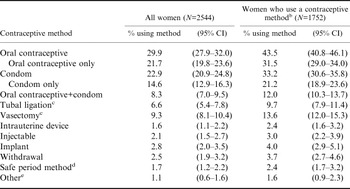
The distribution of the use of different contraceptive methods (Table 1) is similar to that found in other studies (Richters et al., Reference Richters, Grulich, de Visser, Smith and Rissel2003; Yusuf & Siedlecky, Reference Yusuf and Siedlecky2007). The most commonly used form of contraception is oral contraception, which is used by 30% of all women aged 18–44 at risk of pregnancy (this equates to 44% of users of a contraceptive method). Eight per cent (12% of users) of women use oral contraception in combination with condoms.
Use of contraceptive method for all women at risk of pregnancy and women who used a form of contraception (percentage)a

a Data weighted by ehhwtrps (cross-sectional responding person population weight rescaled to sum to the number of responding persons). ‘At risk’ excludes women who are pregnant, have stated physical difficulties in getting pregnant or who have had a hysterectomy.
b Percentages do not add up to 100 because of multiple responses.
c Respondents who answer ‘yes’ to having a tubal ligation or ‘yes’ to partner having a vasectomy were not asked about use of other contraceptive methods.
d Safe period method (rhythm method) or Persona.
e ‘Other’ includes: diaphragm/cervical cap, foam/cream/jelly/suppository, hormonal emergency contraception.
The second most commonly used method is the condom, which is used by 23% of all women and 33% of contraceptors. Permanent methods of contraception are the next most commonly used: around 7% of women aged 18–44 have had a tubal ligation, and 9% have a partner who has had a vasectomy. The use of ‘medium-term’ methods, that is, those who use an intrauterine device or implantation, is just over 6% of contraceptors. Various other methods were only used by small numbers of women.
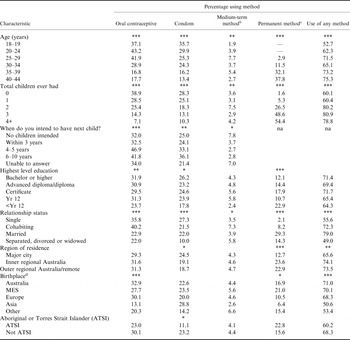
The use of different contraceptive methods varies substantially by parity, age and other characteristics of the woman. The use of any form of contraceptive method increases as the number of children born increases from one child to two children: around 60% of women with no children or one child are using a form of contraception. This percentage increases to over 80% of users for women with two or more children (Table 2). The relationship between age and contraception use is a little different: use increases from age 18 up to 30 and is lower in the 30–34 age group, the peak age group for childbearing. Contraceptive use is highest at ages 35 and over.
Use of contraceptive methods for all women at risk of pregnancy by background characteristics, cross-tabulations (percentages)a

a Data weighted by ehhwtrps (cross-sectional responding person population weight rescaled to sum to the number of responding persons). ‘At risk’ excludes women who are pregnant, have stated physical difficulties in getting pregnant or who have had a hysterectomy.
b Definition of a ‘medium-term method’ includes respondents who use an intrauterine device or implantation.
c Definition of ‘permanent method’ includes respondents who have had a tubal ligation and respondents whose partners have had a vasectomy. Respondents who answer ‘yes’ to having a permanent method were not asked about use of other contraceptive methods.
d The definition of MES is people born in ‘mainly English-speaking countries’. This includes people born in the United Kingdom, New Zealand, Canada, USA, Ireland and South Africa. Asia excludes the Middle East.
N=2544.
* p<0.05;
** p<0.01;
*** p<0.0001.
The pattern of type of contraceptive used varies substantially by characteristics of the woman. Women who have no, or few, children are much more likely to use oral contraceptives or condoms, while women who have three or more children are more likely to use a permanent method. Age shows a similar pattern, with women aged less than 30 more likely to use oral contraceptives or condoms, while women aged 35+ are more likely to use a permanent method. Condoms are most commonly used by women aged 18–19. Those who are single are more likely to use oral contraceptives or condoms than permanent methods. Women who are cohabiting are more likely to use oral contraceptives or medium-term methods than are women who are married or single. These patterns are consistent with the proposition that contraceptive practice is associated with the stage of a woman's reproductive life course.
Multivariate results
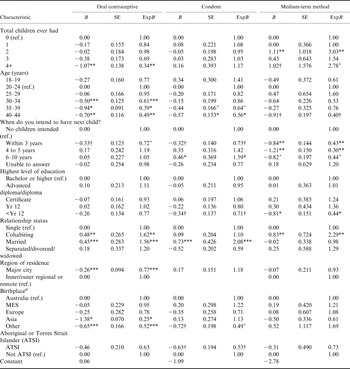
Logistic regression analyses show which factors are important for understanding contraceptive method use controlling for other characteristics. This section presents the findings of the logistic regression models for permanent methods (results shown in the Appendix Table A1), oral contraception, condom use and medium-term methods (Table 3). The model of permanent method use does not include fertility intentions as it is assumed that these women do not intend to have any children in the future.
Logistic regression: use of oral contraceptives, condoms and medium-term methods by women at risk of pregnancy

Excludes pregnant women, women who have stated physical difficulties in getting pregnant and women who use any form of permanent method.
† p<0.10;
* p<0.05;
** p<0.01;
*** p<0.0001.
N=2139.
Permanent methods
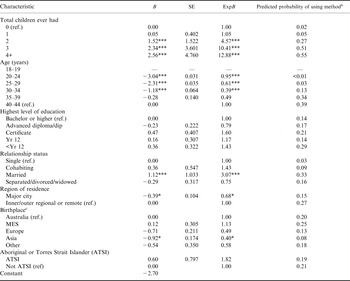
The model of permanent method use does not include fertility intentions, and is discussed first in order to provide context to the use of other contraceptive methods. The permanent methods included here are considered methods to avoid pregnancy and include tubal ligation and vasectomy. As previously explained hysterectomy is excluded from this analysis. The use of these permanent methods of contraception varies substantially by the number of children ever born, but independently, also by age (Appendix Table A1). A negligible percentage of women have used a permanent method of contraception at either low parity or at younger ages. Using a predicted probabilities approach it is estimated that women with two children have a predicted probability of 0.27 of using a permanent method. This increases to a predicted probability of over 0.50 for women who have three or more children using a permanent method. Considering the probability of using a permanent method by age, a probability of 0.13 is estimated for women aged 30–34, and over 0.30 for women aged 35+. Both parity and age are important factors in using a permanent method of fertility control.
Other factors associated with the use of permanent methods include relationship status, where married women are the most likely to use these methods (having a probability of 0.33), region of residence, with women who live in a major city being less likely to use permanent methods, and birthplace, where it is found that women from Asia are least likely to use permanent methods of birth control.
Oral contraception
The analysis looks at the three other main methods of contraception used by women: oral contraception, condoms and medium-term methods. Multiple responses were possible for these questions. This means that women who answered ‘yes’ to using oral contraception may also have responded ‘yes’ to the use of condoms (or other variations of dual-method use). Hence, a model that combines the method type into one dependent variable is not possible.
Results controlling for other factors show that there is very little pattern of variation of oral contraceptive use by the number of children ever born (Table 3). There is no difference by parity in the use of oral contraception except for women with four or more children. These women are the least likely to be using oral contraception. If this pattern is considered in the context of other contraceptive choices, it is evident that women with higher parity (larger numbers of children) are much more likely to use a permanent method of contraception. If fertility intentions are also considered, it is evident that the women who intend to have a child in the next three years are less likely to be using oral contraception as compared with women who do not want children, although the result is only significant at p<0.10.
Further, an extremely strong pattern of oral contraceptive use is found by age. Oral contraception is much more likely to be used by younger women, that is, women aged below 30. Women aged 30–44 are much less likely to be using oral contraception. As this effect is independent of parity and birth intentions, it is not the result of other measures of reproductive life stage. This pattern may reflect some nervousness related to long-term use of hormonal methods, with women reducing pill use from age 30. This would suggest that the pattern is due to an age effect: women use the pill in their 20s and are less likely to use the pill in their 30s and 40s. Alternatively, it could be a cohort effect where women aged 30 and above never had as high use as women currently in their 20s.
In terms of how other factors are related to the use of oral contraception, the analysis finds that women who have a partner (whether cohabiting or married) have a greater propensity to use oral contraceptives, while women who live in a major city and women who are from a birthplace other than Australia, a mainly English-speaking country, or Europe are less likely to use oral contraception.
Condoms
Condom use shows no pattern by children ever born. Like oral contraception, age is associated with condom use and is negatively associated with age. Women in the younger age groups are more likely to use condoms than women aged 35+. In terms of other characteristics, the most striking is the higher odds for women who are married. Controlling for other factors, this method is more likely to be used in a marital relationship than by those who are single or cohabiting. This factor is partly attributable to the use of other methods by cohabiting women: cohabiting women are more likely to use oral contraception and medium-term methods (see below). These results are open to interpretation but could be related to women in cohabiting relationships having a stronger motivation to avoid pregnancy.
In terms of fertility intentions, again it is found that women who plan to have children in the next three years are the least likely to be using this contraceptive method.
Medium-term methods
The use of medium-term methods is relatively low, but the model estimates (Table 3) show distinct patterns of use. Specifically, it is found that women who have two children are much more likely to use a medium-term method than those who have no children, controlling for other factors. There appears to be little pattern by age, although women aged 40–44 seem least likely to use these methods. Women who are cohabiting are much more likely to be using these types of methods than women who are single or married.
What is perhaps most striking is the lesser use of these methods by women who intend to have children. This does not vary by timing, with women who state a time frame for their childbearing intentions being less likely to use a medium-term method than women who do not intend to have children in the future.
Discussion
This paper argues that contraceptive use in developed countries should be investigated using a life course approach: the use of different contraceptive methods varies by age, but also by other factors associated with the stage of a woman's reproductive life course such as parity and fertility intentions. It is noted that these important factors are rarely collected at the same time in surveys of contraceptive use in developed countries, but the Generations and Gender Survey does collect this information. Using the Australian version of these data collected in the HILDA survey in 2005, this paper tests hypotheses related to the effect of the reproductive life course on the use of significant contraceptive methods.
It is found that independent of each other, age, the number of children ever born and fertility intentions are associated with the type of contraceptive method used. Based on multivariate results, age is found to be closely related to using oral contraception, condoms and permanent methods independent of other factors. Women at low parity are more likely to use oral contraception, while women with two or more children are more likely to use medium-term or permanent methods.
The use of oral contraception, condoms and medium-term methods is associated with fertility intentions. Those women who state they intend to have a child in the next three years are least likely to be using oral contraception or condoms, while women who state that they are likely to have a child at some stage in the future are much less likely to be using a medium-term method than women who do not intend to have a child. This supports the proposition that women who intend to have children are less likely to use a method that is not easily reversed, although it was expected that this pattern would be more discernable. While medium-term methods could be considered a suitable method of postponing fertility, the pattern of use did not suggest that medium-term methods were being used to postpone childbearing; instead the emphasis is not on when women plan to have their children but whether or not they plan to have children in the future.
When estimating permanent methods of contraception, it is found that the use of permanent methods is strongly associated with both the number of children a woman has ever had and her age. These factors are both positively associated with the use of a permanent method. As expected, these methods are not used at the beginning of a reproductive life course.
Previous studies have focused on the relationship between age and contraceptive method, with age being used as a proxy for stage in the reproductive history. In this study, direct measures of stage in the reproductive history are used such as parity and fertility intentions as well as age. These direct measures have strong associations in the expected directions with use of contraception and with type of contraception used. Easily reversible methods are used at the start of women's reproductive careers, medium-term methods are mainly used by those women who do not want children (whether they are at the end of their reproductive careers or simply intend to have no children) and permanent methods are left to the end of the reproductive life course.
One intriguing result from the study is the relationship between age and oral contraceptive use independent of the measures of reproductive stage. This result highlights the importance of the life course approach for the measurement of contraceptive method use. The case of oral contraceptive use refocuses the interpretation of method use back to a life course explanation: what are the individual factors, what are the historical factors, and what is the impact of significant others that help us understand the patterns of use? This paper has considered the individual factors, although some of these factors can only be untangled by taking a longitudinal approach. The age pattern is one example: is the lower use of oral contraception at older ages an age or a cohort effect? Another example is that of individual preferences for contraceptive method choice: controlling for unobserved factors must be done by following the same individuals over time.
The historical factors and the impact of significant others also have an important role in contraceptive method use. In Australia, one example of a historical pattern is related to the low use of IUDs, but other methods will also go in and out of favour. There is no doubt that the impact of significant others also plays a major role in contraceptive method use. Aside from condoms, which are available on supermarket, pharmacy and convenience store shelves, all the other methods are medically regulated. Oral contraception, medium-term and permanent methods of birth control can only be obtained through medical services. An article published in 2003 by Therese Foran, the Medical Director of FPA Health, advocated the use of particular types of contraceptive methods depending on the age of the woman. For adolescents and younger adults, condoms, oral contraception, implants and injectables were recommended. In the 20–40 age group a number of different methods were recommended depending on fertility intentions, breast-feeding and spacing desires of the woman: easily reversed methods were recommended for those planning pregnancies, new-generation IUDs and implants were recommended for spacing, and IUDs, vasectomy of the partner and tubal ligation were recommended for those women who want no further children. This highlights that the results presented in the current paper reflect what is recommended by medical professionals to women deciding on contraceptive methods.
This paper demonstrates that life course factors are important in understanding contraceptive use, and that where possible age, parity and fertility intentions, together with other socio-demographic factors, should be used to measure patterns of contraceptive method use.
Acknowledgments
Previous versions of this paper were presented at the HILDA Survey Research Conference 2007, Melbourne, Australia, and the 2008 Annual Meeting of the Population Association of America, New Orleans, USA. This paper uses a confidentialized unit record file from the HILDA survey. The HILDA project was initiated and is funded by the Department of Families, Housing, Community Services and Indigenous Affairs (FaHCSIA) and is managed by the Melbourne Institute of Applied Economic and Social Research (MIAESR). The findings and views reported in this paper, however, are those of the authors and should not be attributed to either FaHCSIA or the MIAESR. The authors would like to thank two anonymous reviewers for their helpful comments.
Appendix
Logistic regression: use of permanent method of contraceptiona

a Definition of ‘permanent method’ includes respondents who have had a tubal ligation and respondents whose partners have had a vasectomy. Respondents who answer ‘yes’ to having a permanent method were not asked about use of other contraceptive methods.
b Predicted probabilities calculated using Stata ‘predict’ command.
c The definition of MES is people born in ‘mainly English-speaking countries’. This includes people born in the United Kingdom, New Zealand, Canada, USA, Ireland and South Africa. Asia excludes the Middle East.
N=2354 (excludes respondents aged <20).
Excludes pregnant women and women who have stated physical difficulties in getting pregnant.
† p<0.10;
* p<0.05;
** p<0.01;
*** p<0.0001.