Introduction
Weeds compete with crops for light, water, and nutrients, resulting in a decline in crop yield and quality, which poses a continuing threat to agricultural production (Arif et al. Reference Arif, Ali, Haq and Khan2013; Ekeleme et al. Reference Ekeleme, Akobundu, Isichei and Chikoye2003; Kaur et al. Reference Kaur, Kaur and Chauhan2018; Tauseef et al. Reference Tauseef, Ihsan, Nazir and Farooq2012; Vissoh et al. Reference Vissoh, Gbèhounou, Ahanchédé, Kuyper and Röling2004; Zhu et al. Reference Zhu, Wang, DiTommaso, Zhang, Zheng, Liang, Islam, Yang, Chen and Zhou2020). Herbicides are the main method for weed management in modern intensive agriculture, and their use is likely to increase because they are highly efficient, economical, and labor-saving (Chauhan and Johnson Reference Chauhan and Johnson2010; Fartyal et al. Reference Fartyal, Agarwal, James, Borphukan, Ram, Sheri, Agrawal, Achary and Reddy2018; Ghersa et al. Reference Ghersa, Benech-Arnold, Satorre and Martínez-Ghersa2000; Wyse Reference Wyse1994). However, excessive use and misuse of herbicides has also introduced some problems, such as the emergence of resistant weeds, environmental pollution, residual toxicity, and biodiversity loss (Berg Reference Berg2002; Berg and Tam Reference Berg and Tam2018; Primot et al. Reference Primot, Valantin-Morison and Makowski2006; Wang Reference Wang1999). Therefore, there is a need for more integrated and diverse methods to control weeds.
Soil weed seedbanks are reserves of viable weed seeds in the soil, and they determine the potential weed species and density that subsequently affect crop growth (José-María and Sans Reference José-María and Sans2011; Rahman et al. Reference Rahman, James, Mellsop and Grbavac2003; Thompson and Grime Reference Thompson and Grime1979). The adoption of seed predation to help manage agricultural weeds has received interest in recent years (Navntoft et al. Reference Navntoft, Wratten, Kristensen and Esbjerg2009; Sarabi Reference Sarabi2019). Seed predation can result in substantial weed seed loss in agricultural systems and then contribute to weed management (Baraibar et al. Reference Baraibar, Carrión, Recasens and Westerman2011; Navntoft et al. Reference Navntoft, Wratten, Kristensen and Esbjerg2009; Westerman et al. Reference Westerman, Borza, Andjelkovic, Liebman and Danielson2008). Firbank and Watkinson (Reference Firbank and Watkinson1985) reported that an annual seed loss of 25% to 50% may be sufficient to substantially slow down weed population growth. Rodents, insects, and birds are major seed predators (Dicke and Gerhards Reference Dicke and Gerhards2006; Holmes and Froud-Williams Reference Holmes and Froud-Williams2005; Mills et al. Reference Mills, Gordon and Letnic2018; Reiserer et al. Reference Reiserer, Schuett and Greene2018).
Earthworms are terrestrial invertebrates that belong to the order Opisthopora. They are legless, sightless, hermaphroditic worms that mostly live underground. Earthworms function as “ecosystem engineers” (Jones et al. Reference Jones, Lawton and Shachak1994) and are regarded as reliable indicators of soil health (Elmer Reference Elmer2009). The role of earthworms in improving soil and increasing soil fertility and crop yield has long been known. Earthworms are increasingly recognized as important predators of seeds and seedlings (Eisenhauer et al. Reference Eisenhauer, Schuy, Butenschoen and Scheu2009, Reference Eisenhauer, Butenschoen, Radsick and Scheu2010; Milcu et al. Reference Milcu, Schumacher and Scheu2006; Piearce et al. Reference Piearce, Roggero and Tipping1994; Smith et al. Reference Smith, Gross and Januchowski2005). In urban agriculture in Shanghai, the introduction of Pheretima guillelmi (Kinberg) (a native earthworm species from the study region) into fields has been practiced for more than 10 yr. Zheng et al. (Reference Zheng, Fan, Zhang, Shuang-Xi, Wang, Zhang, Wang, Bin and Wei-Guang2015, Reference Zheng, Lv, Song, Li, Zhang, Bai and Zhang2018) reported that this practice obviously increased the soil microbial metabolic ability of six types of carbon sources and crop yield. However, the impact on weed occurrence and the underlying mechanisms of introducing earthworms into fields have received disproportionately minimal attention.
Studies on earthworm–seed interactions date back to Charles Darwin (Grant Reference Grant and Satchell1983) and have received some attention to date. Previous works have determined that earthworms are able to ingest seeds and seedlings, which subsequently influences the fate of the seeds and seedlings (Eisenhauer et al. Reference Eisenhauer, Schuy, Butenschoen and Scheu2009; Forey et al. Reference Forey, Barot, Decaëns, Langlois, Laossi, Margerie, Scheu and Eisenhauer2011; Grant Reference Grant and Satchell1983; Navntoft et al. Reference Navntoft, Wratten, Kristensen and Esbjerg2009). Eisenhauer et al. (Reference Eisenhauer, Butenschoen, Radsick and Scheu2010) reported that common earthworm (Lumbricus terrestris L.) ingested seeds and seedlings of rough bluegrass (Poa trivialis L.), tall oatgrass [Arrhenatherum elatius (L.) P. Beauv. ex J. Presl & C. Presl], white clover (Trifolium repens L.), and perennial ryegrass (Lolium perenne L.). Another example suggested by Grant (Reference Grant and Satchell1983) was that L. terrestris ingested seeds of several grassland plant species and then gut passage delayed and decreased their seed germination Previous studies on earthworm–seed interactions mainly considered the specific earthworm species L. terrestris and some commercial grassland plant species. However, the effect of earthworms on seeds is earthworm and plant species-specific (Eisenhauer et al. Reference Eisenhauer, Schuy, Butenschoen and Scheu2009). Little is known about the ingestion and digestion of weed seeds and seedlings by P. guillelmi, the impact of P. guillelmi on the survival of weed seeds and seedlings, and the potential of introducing P. guillelmi into crop fields in weed biocontrol.
We selected the earthworm P. guillelmi and 15 main farmland weed species to conduct this study. Our objectives were to determine (1) whether P. guillelmi can ingest and digest weed seeds and seedlings, and (2) whether the survival of weed seeds and seedlings is affected after gut passage through P. guillelmi.
Materials and Methods
Pheretima guillelmi, Weed Seeds, and Soil
This study was conducted at the Shanghai Academy of Agricultural Sciences (SAAS; 30.950°N, 121.467°E), Shanghai, China, from May to October 2019. Pheretima guillelmi (2.3 ± 0.1 g per individual) purchased from Shanghai Yingxi Fruit and Vegetable Professional Cooperation were used. Before the experiment, P. guillelmi were kept in a container filled with soil for 2 wk at 25 C. The P. guillelmi were checked for their physiological status as recommended by Fründ et al. (Reference Fründ, Butt, Capowiez, Eisenhauer, Emmerling, Ernst, Potthoff, Schädler and Schrader2010) before the experiment. Seeds and seedlings from 15 farmland weed species were selected to conduct this study, including large crabgrass [Digitaria sanguinalis (L.) Scop.], green foxtail [Setaria viridis (L.) P. Beauv.], goosegrass [Eleusine indica (L.) Gaertn.], Chinese sprangletop [Leptochloa chinensis (L.) Nees], Malabar sprangletop [Leptochloa fusca (L.) Kunth], barnyardgrass [Echinochloa crus-galli (L.) P. Beauv.], figleaf goosefoot (Chenopodium ficifolium Sm.), livid amaranth (Amaranthus blitum L.), eclipta [Eclipta prostrata (L.) L.], common purslane (Portulaca oleracea L.), redroot amaranth (Amaranthus retroflexus L.), pale smartweed (Polygonum lapathifolium L.), ricefield flatsedge (Cyperus iria L.), variable flatsedge (Cyperus difformis L.), and Asian flatsedge (Cyperus amuricus Maxim.). These 15 species are the main troublesome weeds usually occurring in summer farmland in China. All the seeds were collected from uncultivated fields at SAAS in May 2018. After harvesting, the seeds were cleaned manually, air-dried in the shade, and stored in kraft paper bags at room temperature (20 ± 5 C, 60% to 70% relative humidity) until initiation of the study. The soil used in this study was collected from cornfields of SAAS with a pH of 6.8 and consisting of 35% sand, 40% silt, and 25% clay. After collection, the soil was oven-dried at 180 C for 24 h to kill the seeds and then passed through a 2-mm sieve.
Ingestion of Weed Seeds and Seedlings
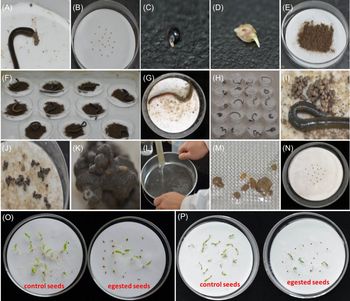
To evaluate the ability of P. guillelmi to ingest weed seeds and seedlings, they were kept on moist filter paper for 48 h to egest their gut contents (25 C, darkness) (Figure 1A). Then, 1 g of sieved soil and 20 seeds or seedlings (in the cotyledon stage) of one weed species were placed in a petri dish (10-cm diameter) containing three sheets of filter paper moistened with 4 ml distilled water for a total of 15 dishes (Figure 1B–E). One P. guillelmi was added to each petri dish (Figure 1F). Soil was added to simulate natural conditions and provide sand particles that could improve the grinding of ingested organic material in P. guillelmi’s gut (Curry and Schmidt Reference Curry and Schmidt2007; Marhan and Scheu Reference Marhan and Scheu2005). To prepare seedlings, seeds of one species were placed on moist filter paper in separate trays (50 cm by 30 cm) and incubated in a versatile environmental chamber (MLR-352H, Sanyo Electric, Osaka, Japan) at 25 C with a 12-h photoperiod. Only the seedlings with a shoot length of less than 2 mm were selected (Figure 1C and D). During the experiment, petri dishes were placed in a versatile environmental chamber (25 C) for 24 h under dark conditions. Thereafter, P. guillelmi were removed, and the number of remaining seeds or seedlings per petri dish was recorded. Seeds or seedlings that had disappeared were considered to be ingested (Aira and Piearce Reference Aira and Piearce2009; Eisenhauer et al. Reference Eisenhauer, Schuy, Butenschoen and Scheu2009; Laossi et al. Reference Laossi, Noguera and Barot2010).
Photographs of the experiment. (A) A Pheretima guillelmi was kept on moist filter paper for 48 h for egestion of its gut contents. (B) Twenty seeds or seedlings of one species were added to a petri dish. (C and D) Seedlings (in the cotyledon stage) with a shoot length of less than 2 mm. (E) One gram of sieved soil was added to a petri dish to cover the seeds (or seedlings). (F) Individual P. guillelmi that egested their gut contents were added to each petri dish. (G) The seeds (or seedlings) and soil were ingested by individual P. guillelmi. (H) After ingestion, individual earthworms were removed from the petri dishes and placed on moist filter paper in fresh petri dishes for 48 h to egest their gut contents. (I and J) Casts egested by individual P. guillelmi. (K) Seeds in P. guillelmi casts. (L) Pheretima guillelmi casts were carefully inspected by elutriation for seeds (or seedlings). (M) Seeds rinsed from P. guillelmi casts. (N) Seeds removed from P. guillelmi casts were sown on moist filter paper in a fresh petri dish for the germination test. (O and P) Germination comparisons of control and egested seeds.

Digestion of Weed Seeds and Seedlings
After removal from the petri dish in the ingestion experiment, individual P. guillelmi were placed on moist filter paper in fresh petri dishes for 48 h to egest their gut contents (25 C, darkness) (Figure 1H–J). Then, P. guillelmi casts were carefully inspected by elutriation for seeds or seedlings (Figure 1K–M). The number of seeds or seedlings elutriated from the casts was counted. The difference between the number of ingested seeds (or seedlings) and the number of egested seeds (or seedlings) was assumed to be the number of seeds (or seedlings) digested by the respective P. guillelmi individual.
Survival of Weed Seeds and Seedlings after Pheretima guillelmi Gut Passage
Seeds or seedlings from P. guillelmi casts were rinsed with distilled water and then evenly sown on moist filter paper in separate petri dishes (Figure 1N). Controls consisted of 20 seeds or seedlings for each species that were not offered to P. guillelmi. All petri dishes were incubated in versatile environmental chambers under alternating temperatures of 30/20 C (day/night) and 12-h photoperiod conditions. The photosynthetic photon flux density produced by fluorescent lamps was 150 μmol m−2 s−1. During the experiment, distilled water was regularly added to keep the filter paper moist. The number of germinated seeds or surviving seedlings was counted after 21 d. The percentage of seed germination (or surviving seedlings) was calculated as the total number of germinated seeds (or surviving seedlings) divided by the total number of seeds (or seedlings) sown in the petri dish.
Data Analysis
All experiments were performed using a randomized complete block design with three replications. Each replication was arranged on a different shelf in a versatile environmental chamber and was considered a block. Each experiment was repeated after termination of the first run.
All the data were checked for a normal distribution and homoscedasticity using the Kolmogorov-Smirnov test and Levene’s test, respectively. If variances were not homogeneous, they were transformed by arcsine square root before analysis. The data from the repeat experiment were pooled for analysis because of the absence of an experiment by treatment interaction. The data presented in the text and figures are means ± SEs of two runs calculated using nontransformed data.
Two-way ANOVA with a general linear model (GLM) was applied to determine the independent and interactive effects of weed species (15 weed species) and seedling stage (seed and seedling in the cotyledon stage) on the ingestion and digestion of seeds and seedlings. To further compare the differences in seeds (or seedlings) ingested (or digested) by P. guillelmi among weed species, we performed one-way ANOVA for seed ingestion, seed digestion, seedling ingestion, and seedling digestion separately using Tukey’s honestly significant difference test.
Two-way ANOVA with GLM was also used to analyze the interactive effects of weed species (15 species) and seed category (control and egested seeds) on seed germination. To further indicate the effect of passage through the P. guillelmi gut on seed germination, a paired-samples t-test was used to compare differences in seed germination between control and egested seeds separately for each species. All statistical analyses were performed using SPSS v. 20 software (SPSS, Chicago, IL, USA). The significance level concerning the difference in relevant factors was set at 0.05 level.
Results and Discussion
Ingestion of Weed Seeds and Seedlings
Pheretima guillelmi ingested the seeds and seedlings of each weed species tested. Two-way ANOVA determined that ingestion of seeds and seedlings by P. guillelmi was affected by both weed species (F 14, 150 = 56.364, P14, 150 < 0.001) and seedling stage (F 1, 150 = 1520.931, P1, 150 < 0.001). The interaction of weed species by seedling stage also showed an influence on the ingestion of seeds and seedlings by P. guillelmi (F 14, 150 = 32.596, P14, 150 < 0.001).
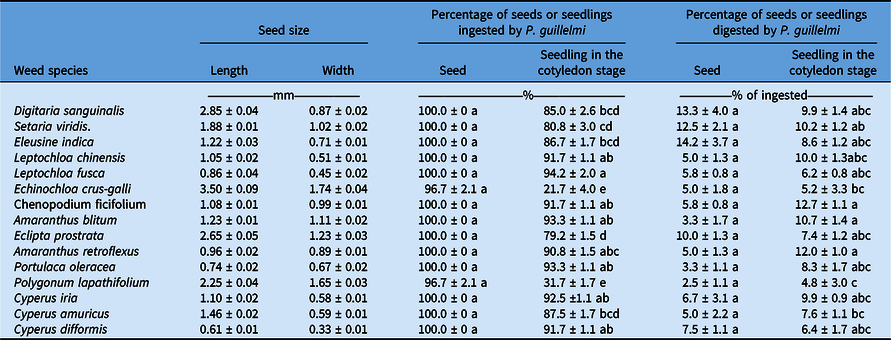
One-way ANOVA on seed ingestion only determined that ingestion of weed seeds by P. guillelmi did not differ among weed species. The percentage of seeds ingested was 96.7% to 100%, while ingestion of seedlings by P. guillelmi varied considerably among weed species. The percentage of seedlings ingested ranged from 21.7% for E. crus-galli to 94.2% for L. fusca. Overall, except for E. crus-galli and P. lapathifolium, the percentage of seedlings ingested by P. guillelmi was close to or greater than 80% (Table 1).
Percentage of weed seeds and seedlings ingested and digested by Pheretima guillelmi. a

a The data presented in the table are means ± SEs. Different lowercase letters in the same column indicate that the means are different at 0.05 level of significance using Tukey’s honestly significant difference test.
Earthworms selectively ingested seeds based on seed size, shape, and surface structure (Eisenhauer et al. Reference Eisenhauer, Schuy, Butenschoen and Scheu2009; McRill Reference McRill1974; Shumway and Koide Reference Shumway and Koide1994). Seed size is one of the most important seed traits affecting the fate of seeds ingested by earthworms (Forey et al. Reference Forey, Barot, Decaëns, Langlois, Laossi, Margerie, Scheu and Eisenhauer2011). Several studies have suggested that seeds longer than 3 mm are too large to be ingested by most earthworm species (Shumway and Koide Reference Shumway and Koide1994; Zaller and Saxler Reference Zaller and Saxler2007). In the present study, P. guillelmi was able to ingest the seeds of each weed species tested. Although the mean length of E. crus-galli seeds reaches 3.5 mm, the percentage of seeds ingested reached as high as 96.7%. Pheretima guillelmi was also able to ingest the weed seedlings to varying extents. For each weed species, the percentages of seedlings ingested by P. guillelmi were all lower than the corresponding values of their seeds, which was due to the much larger size of seedlings compared with seeds. Because most weed seeds and seedlings used in this study were small in size, we can reasonably infer that P. guillelmi is able to ingest most farmland weed seeds and seedlings actively or coincidentally while burrowing.
Digestion of Weed Seeds and Seedlings
Pheretima guillelmi digested the seeds and seedlings of each weed species tested, although the percentage of digestion was low. Two-way ANOVA determined that digestion of seeds and seedlings by P. guillelmi was affected by both weed species (F 14, 150 = 3.472, P14, 150 < 0.001) and seedling stage (F 1, 150 = 7.997, P1, 150 = 0.005). The interaction of weed species by seedling stage also showed an influence on the digestion of seeds and seedlings by P. guillelmi (F 14, 150 = 1.865, P14, 150 = 0.034).
One-way ANOVA on seed digestion only determined that digestion of weed seeds by P. guillelmi did not differ among weed species. The percentage of seeds digested ranged from 2.5% for P. lapathifolium to 14.2% for E. indica. One-way ANOVA on seedling digestion only determined that digestion of seedlings by P. guillelmi did not differ among most weed species. The percentage of seedlings digested ranged from 4.8% for P. lapathifolium to 12.7% for C. ficifolium (Table 1).
Seeds and seedlings after earthworm gut passage may suffer physical damage due to earthworm gizzard contraction and chemical damage by enzymes and microorganisms in the earthworm gut. Eisenhauer et al. (Reference Eisenhauer, Butenschoen, Radsick and Scheu2010) reported that 31% to 100% of ingested seeds and all ingested seedlings are digested during gut passage of L. terrestris. Conversely, some literature has indicated that only a small amount of ingested seeds or seedlings are digested during earthworm gut passage (Grant Reference Grant and Satchell1983). In our study, most of the seeds and seedlings ingested by P. guillelmi were subsequently egested with the casts. The percentage of seeds and seedlings digested by P. guillelmi was less than 15% irrespective of the weed species. This result is consistent with the feeding characteristics of earthworms with a low assimilation rate (Curry and Schmidt Reference Curry and Schmidt2007).
Survival of Weed Seeds and Seedlings after Pheretima guillelmi Gut Passage
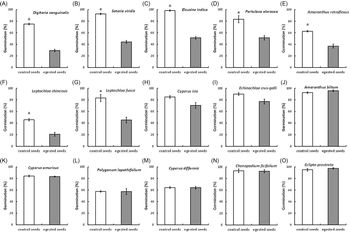
Passage through the gut of P. guillelmi affected seed germination and seedling survival (Figure 2). Two-way ANOVA determined that seed germination was affected by both weed species (F 14, 150 = 48.115, P14, 150 < 0.001) and seed category (F 1, 150 = 152.903, P1, 150 < 0.001). The interaction of weed species by seed category also showed an influence on seed germination (F 14, 150 = 12.357, P14, 150 < 0.001).
Germination comparisons of control and egested seeds of the tested weed species after 21 d. (A) Digitaria sanguinalis (P < 0.001). (B) Setaria viridis (P < 0.001). (C) Eleusine indica (P < 0.001). (D) Portulaca oleracea (P = 0.011). (E) Amaranthus retroflexus (P = 0.002). (F) Leptochloa chinensis (P = 0.003). (G) Leptochloa fusca (P = 0.004). (H) Cyperus iria (P = 0.057). (I) Echinochloa crus-galli (P = 0.058). (J) Amaranthus blitum (P = 0.108). (K) Cyperus amuricus (P = 0.673). (L) Polygonum lapathifolium (P = 0.981). (M) Cyperus difformis (P = 0.970). (N) Chenopodium ficifolium (P = 0.833). (O) Eclipta prostrata (P = 0.076). Asterisks (*) denote a difference (P < 0.05) in germination between control and egested seeds of one species using a paired-samples t-test. Vertical bars denote means ± SEs.

Germination of seeds egested by P. guillelmi decreased for D. sanguinalis (P < 0.001), S. viridis (P < 0.001), E. indica (P < 0.001), L. chinensis (P = 0.003), L. fusca (P = 0.004), A. retroflexus (P = 0.002), P. oleracea (P = 0.011), E. crus-galli (P = 0.058), and C. iria (P = 0.057) (Figure 2). The seeds of the aforementioned species egested by P. guillelmi lost 46%, 49%, 47%, 25%, 38%, 26%, 32%, 13%, and 15% of their germinability, respectively, compared with the respective control seeds. Conversely, the germination of E. prostrata (P = 0.076), C. ficifolium (P = 0.833), A. blitum (P = 0.108), P. lapathifolium (P = 0.981), C. amuricus (P = 0.673), and C. difformis (P = 0.970) seeds was not affected by P. guillelmi gut passage (Figure 2). In contrast to seed ingestion, no seedlings could survive after earthworm gut passage in this study (data not shown).
Many studies have determined that seeds after earthworm gut passage lose some of their germinability. Decaëns et al. (Reference Decaëns, Mariani, Betancourt and Jiménez2003) reported that seeds egested by Martiodrilus sp. lost 70% to 97% of their germinability. Similar results have been reported by Grant (Reference Grant and Satchell1983), who determined that the germination of egested seeds of orchardgrass (Dactylis glomerata L.), P. trivialis, and Kentucky bluegrass (Poa pratensis L.) was decreased compared with control treatments. Eisenhauer et al. (Reference Eisenhauer, Schuy, Butenschoen and Scheu2009), in contrast, reported that passage through the earthworm gut did not affect the germination of T. repens seeds. In the present study, the effect of passage through the gut of P. guillelmi on seed germination was species-specific. Nine of the 15 species showed decreased seed germinability after gut passage of P. guillelmi. The mean germination of the egested seeds was reduced by 13% to 48% compared with the respective control seeds. Conversely, among the 15 weed species, 6 species showed seed germination that was not affected by P. guillelmi gut passage. Passage of seedlings through the gut of P. guillelmi was fatal to the individuals of all tested weed species, which supports the result reported by Eisenhauer et al. (Reference Eisenhauer, Butenschoen, Radsick and Scheu2010).
The role of earthworms in improving soil and enhancing soil fertility is well known (Dobson et al. Reference Dobson, Blossey and Richardson2017; Edwards and Bohlen Reference Edwards and Bohlen1996; García-Pérez et al. Reference García-Pérez, Alarcón-Gutiérrez, Perroni and Barois2014; Li et al. Reference Li, Wang, Lu, Zhang, Chen, Li and Cao2019; Scheu Reference Scheu2003; Subler et al. Reference Subler, Baranski and Edwards1997). The effect of earthworms on the soil seedbank has also received increasing attention (Eisenhauer et al. Reference Eisenhauer, Butenschoen, Radsick and Scheu2010; Forey et al. Reference Forey, Barot, Decaëns, Langlois, Laossi, Margerie, Scheu and Eisenhauer2011). Soil weed seedbanks are the source of future weed infestation. Depleting the soil seedbank is an effective weed management practice. Based on the results of this study, we hypothesize that predation on seeds and seedlings by P. guillelmi may decrease the number of viable seeds and seedlings in the soil seedbank under natural conditions. The overall effect of P. guillelmi on the soil seedbank depends on its population in the soil. The practice of introducing P. guillelmi into fields can enhance its predation on weed seeds and seedlings and subsequently contribute to weed management. Of course, further work is needed to confirm whether it is economically feasible for growers to introduce P. guillelmi into crop fields to manage weeds. In addition to its value in weed management in crop fields, P. guillelmi is an important medicinal material and animal protein. Its market price can reach as high as US$3.5 kg−1 (Zheng et al. Reference Zheng, Lv, Song, Li, Zhang, Bai and Zhang2018). Thus, it is economically feasible for growers to manage weeds by introducing P. guillelmi into fields and then harvesting both crops and P. guillelmi, a practice that has outstanding economic and ecological benefits. In fact, the practice of introducing P. guillelmi into fields is popular in Shanghai urban agriculture.
At present, herbicide-resistant weeds and shifts in weed community pose serious challenges to weed management. Our study suggests that P. guillelmi is likely to deplete the soil seedbank by predation on weed seeds and seedlings and then contribute to managing weeds in farmland. The results of this study provide new insights into the management of weeds in some specific agroecosystems. Future work should be conducted under more natural conditions to assess the actual weed control effect of P. guillelmi.
Acknowledgments
This work was financially supported by the National Key R&D Program of China (2018YFD0200500); SAAS Program for Excellent Research Team (nong ke chuang 2017 [A-03]); Shanghai Agriculture Applied Technology Development Program, China (grant no. T20180414); China National Major Program of Science and Technology (grant no. 2017ZX07202004-004); and CIMMYT-China Specialty Maize Research Center, Shanghai Academy of Agricultural Sciences; Agriculture Research System of Shanghai, China (grant no. 201710). No conflicts of interest have been declared.