Introduction
Understanding the reproductive biology of a species is crucial to providing sound scientific advice for fishery management. This type of investigation plays an important role in determining productivity and therefore a population's resilience to exploitation by fisheries or to perturbation caused by other human activities (Morgan, Reference Morgan2008). Soleidae is one of the main families of Pleuronectiformes, and species of this family have important economic and biological value. Reproductive aspects of flatfish have been studied in the Mediterranean by Ramos (Reference Ramos1982), Jarboui et al. (Reference Jarboui, Ghorbel, Bradai and Elabed1999), Türkmen (Reference Türkmen2003), Ahmed et al. (Reference Ahmed, Sharaf and Laban2010), Tsikliras et al. (Reference Tsikliras, Antonopoulou and Stergiou2010), Mehanna (Reference Mehanna2014) and Saleh et al. (Reference Saleh, Mohammed, Ramadan, Abou-Zied, Allam and Aljilany2016). Le Bec (1985), Lamrini & Diop (Reference Lamrini and Diop2001), Teixeira & Cabral (Reference Teixeira and Cabral2010), Herrera et al. (Reference Herrera, Cruzado, García, Mancera and Navas2011) and Vinăs et al. (Reference Viñas, José, Cañavate and Piferrera2012) studied this species in the eastern Atlantic, Vallisneri et al. (Reference Vallisneri, Tinti, Tommasini and Piccinetti2001) in the Northern Adriatic Sea, Rajaguru (Reference Rajaguru1992) on the Indian coast and Crome (Reference Crome2001) and Narimatsu et al. (Reference Narimatsu, Kitagawa, Hattori and Onodera2005) on the Pacific coast.
Solea aegyptiaca, as currently accepted, is a common species in the Gulf of Gabes. It is endemic to the Mediterranean Sea and is primarily distributed along the North African Mediterranean coast. It is frequent in the eastern Mediterranean (Mehanna, Reference Mehanna2007), and on the coasts of the Adriatic (Quéro et al., Reference Quéro, Desoutter, Lagardere, Whitehead, Bauchot, Hureau, Nielsen and Tortonese1986). It was reported only once in the Gulf of Lyon in the 1980s (She et al., Reference She, Autem, Kotoulas, Pasteur and Bonhomme1987). The northern Tunisian coasts represent the limit of distribution for S. aegyptiaca.
No studies have yet targeted reproductive aspects of the species in southern Tunisian waters. In fact, the species is one of the most important components of benthic fauna in Tunisia. It is therefore essential to determine the reproductive nature of each species in order to obtain a better understanding of its biology, a suitable evaluation of its population dynamics and good management of its fisheries. Thus, the aim of this paper was to study the reproductive cycle, maturity and fecundity of Solea aegyptiaca in the Gulf of Gabes.
Materials and methods
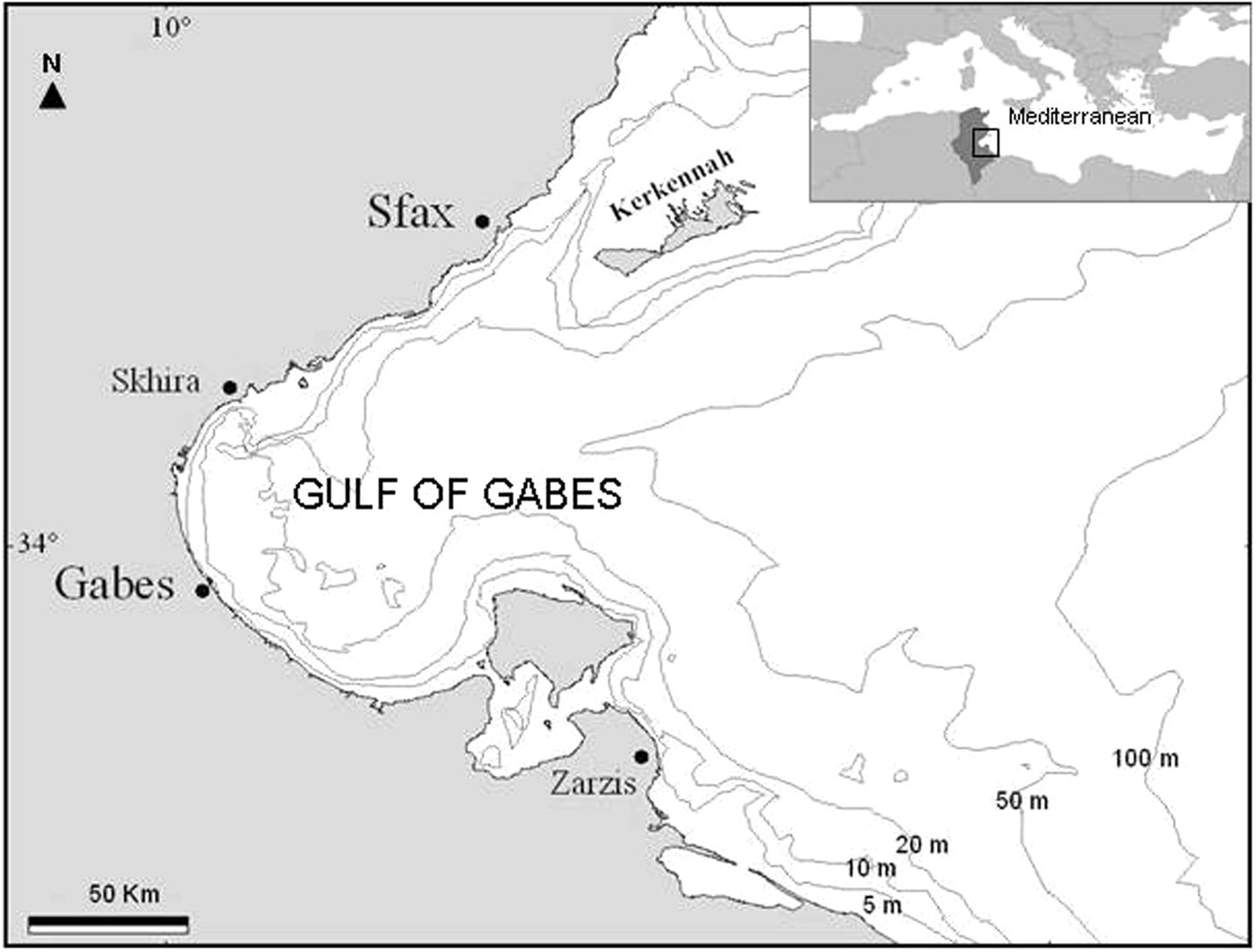
The Gulf of Gabes is located in the southern Mediterranean Sea on the eastern coast of Tunisia (Azouz, Reference Azouz1971; Burrolet et al., Reference Burrolet, Clairefond and Winnok1979), spreading over about 750 km from Cape Kapoudia (35th parallel) to the Tunisian–Libyan border (Figure 1). Fish samples were collected over a period of two years, monthly from April 2013 to March 2015. They originated from commercial catches made along southern Tunisian coasts and by commercial trawls using different types of artisanal fishing gears (seine nets, gill nets, fyke nets). Most fish were examined fresh, shortly after landing. A total of 1638 specimens were collected, ranging in size from 9.7–30.7 cm of total length (TL).
Geographic position of the Gulf of Gabes (Tunisia).

Each specimen's TL was measured to the nearest 1 mm and a total weight was measured using a top-loading digital balance (precision of 0.01 g). Gonad weight was recorded to the nearest 0.001 g. The macroscopic stage of gonad development in the fishes was determined using the classification of maturity stages: immature (I); resting (II); ripe (III); ripe and running (IV); and spent (V) (Holden & Raitt, Reference Holden and Raitt1975). The size distribution of the species between sexes was determined using a two-sample Kolmogorov–Smirnov (K–S) test.
To quantify changes in gonad weight during the annual sexual cycle and to determine the spawning season, we calculated the gonadosomatic index (GSI) for 1589 specimens (821 males and 768 females) using the following formula:
 $${\rm GSI}\,{\rm =} \,{\rm GW}\, \times \,{\rm 100}\,{\rm /}\,{\rm EW}$$
GW: gonad weight (g) and EW: eviscerated weight (g).
Accumulation and depletion of reserves of S. aegyptiaca in the Gulf of Gabes were studied through the analysis of monthly changes of hepatic-somatic index (HSI) and the condition coefficient (K). These indices were calculated as follows:
 $${\rm HSI}\,{\rm =} \,{\rm LW}\, \times \,{\rm 100}\,{\rm /}\,{\rm EW}$$
LW: liver weight (g).
 $$K = {\rm EW} \times {\rm 100}/{\rm T}{\rm L}^3$$
Analysis of variance, followed by Tukey's post hoc test (Zar, Reference Zar1996), was used to confirm critical differences in the indices (GSI, HSI and K) per month. The results are presented as the mean ± confidence interval and the significance level used for the tests was P = 0.05. Total length at first maturity was estimated during the spawning season by the proportion of mature specimens (i.e. in stages III–V). It is defined as the total length at which 50% of fish are mature and was estimated by means of logistic function fitted to the proportion of the mature specimens pooled in 1 cm length class (TL). To estimate the size at first sexual maturity (TL50), we calculated the proportion (P i) of mature individuals by sex and by size class:
 $$P_i = {\rm} M_i \times {\rm 100}/N_i$$
where M i is number of mature individuals in the size class i, and N i is the number of examined individuals in the size class i.
The obtained data were fitted to a logistical function by using the software ‘FSAS’.
The equation used was:
 $$P = {\rm} \displaystyle{1 \over {(1 + {\rm e}^{ - a\,{\rm (TL} - {\rm T}{\rm L}_{50}{\rm )}})}}$$
where P: proportion of mature individuals; TL: total length corresponding to the proportion (P); a: constant and TL50: total length of 50% mature fish. This function (5) has the advantage of estimating with precision the lengths TL25, TL50, TL75 that are required by most fishery science software to carry out fish stock assessments (e.g. Pauly, Reference Pauly1980; Ghorbel et al., Reference Ghorbel, Jarboui, Bradai and Bouain1996).
Ovaries used for fecundity estimates were selected from ripe stage; small pieces from each pair of ovaries were weighed to the nearest 0.1 mg and preserved in a 7% formalin solution. After ~3 months, the ovaries were carefully washed under running water, which helped in separating the oocytes from the tissue. For fecundity estimates, the volumetric method was employed (Dulčić et al., Reference Dulčić, Pallaoro, Matićskoko, Dragičević, Tutman, Grgičević, Stagličić, Bukvić, Pavličević, Glamuzina and Kraljević2010). The ovaries were placed in a beaker with a known volume of water and mixed with a magnetic stirrer. Five subsamples were obtained from the ovaries of each fish, using a 2 mL Stempel pipette and subjected to an analysis of variance to test their homogeneity. Fecundity, defined as the number of ripening eggs in females prior to spawning, was determined in 31 specimens sampled in 2014 and 2015. The number of maturing oocytes for both ovaries was calculated from the sampled ovary. The relationship between fecundity (F) and TL, TW and GW was established.
Results
Sex-ratio
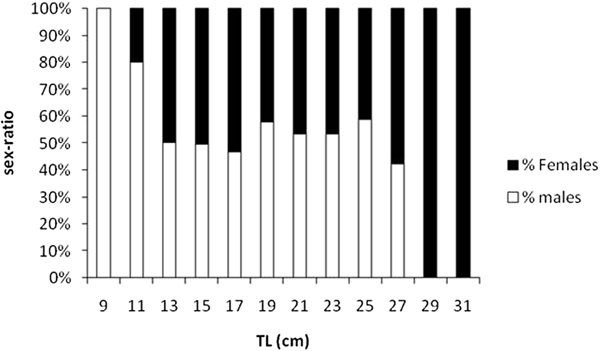
Overall sex ratio (males: females) of S. aegyptiaca was 1.06 : 1. Size distribution was significantly different between males and females (2-sample K–S test: D = 0.075, P < 0.025). Males dominated the length intervals between 9 and 25 cm with the exception of lengths 15, 16 and 17 cm. Females were most abundant in classes >27 cm (Figure 2).
Variation in the sex proportion (%) in accordance with size of Solea aegyptiaca in the Gulf of Gabes.

Sexual cycle and spawning period
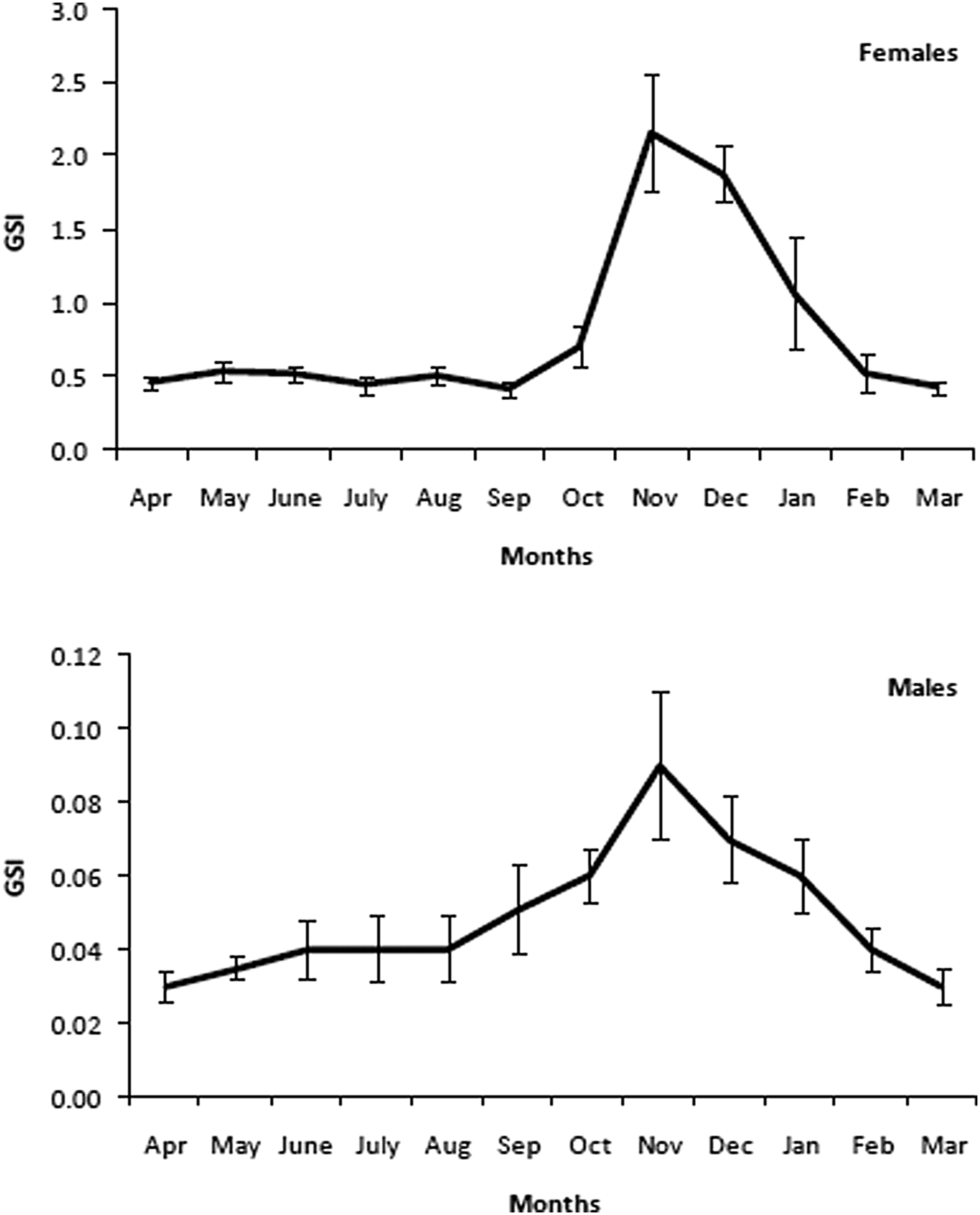
The annual sexual cycle is marked by monthly variations in the activity of genital glands, liver and muscles. For females, the monthly change in the gonadosomatic index (GSI) was almost stable during the period between March (0.42) and September (0.41). Then, a slight increase was noticed in October (0.7) followed by a rapid increase up to a maximum value (2.16) in November. From November to February, there was a sharp drop in the GSI to 0.52, which reflected the phenomenon of spawning. Also, the individuals started to emit gametes from November.
After spawning, females were in a sexual resting stage, extending from March to September while the GSI remained almost constant (Figure 3).
Monthly variation of the gonadosomatic index (GSI) for Solea aegyptiaca in the Gulf of Gabes (mean ± confidence interval).

The change in the GSI in males was very similar to that observed in females (Figure 3). The maturation phase of gametes was between August (0.04) and October (0.06). The maximum value of GSI was observed in November (0.09); afterwards, the values of the GSI started to decrease (0.03 in March). For females, November and December mean GSIs were not significantly different (ANOVA, F = 0.74, P > 0.05).
Generally, the GSI of males was lower than that of females (Figure 3). The sexual cycle of both sexes of S. aegyptiaca was synchronized, the peak of the GSI was observed in November for both females (2.16) and males (0.09).
Hepatic-somatic index and condition coefficient
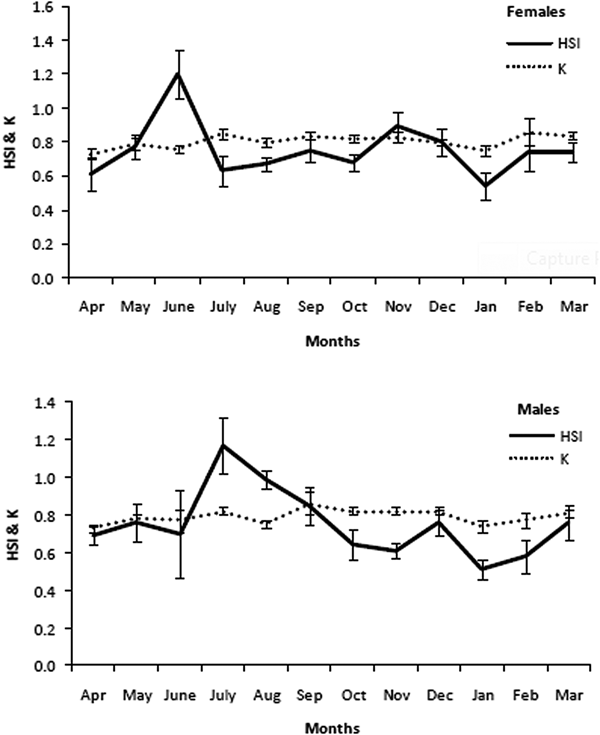
In the Gulf of Gabes, S. aegyptiaca stores some lipid reserves in liver as well as in muscles. The hepatic-somatic index (HSI) and the condition coefficient (K) gradually increased from January to June for females and from January to July for males. For both sexes, in January after spawning of this species, the two indices decrease. However, the HSI reaches its maximum in June and July with 1.2 and 1.17 for females and males respectively and is at its minimum in January (0.54 for females and 0.51 for males). The variations in the coefficient (K) were not perceptible and its decrease had lower importance for both sexes. Hence, it seems that the changes in the HSI and K are associated with the sexual cycle (Figure 4).
Monthly variation of the hepatic-somatic index (HSI) and the condition factor (K) for Solea aegyptiaca in the Gulf of Gabes.

Size at first sexual maturity
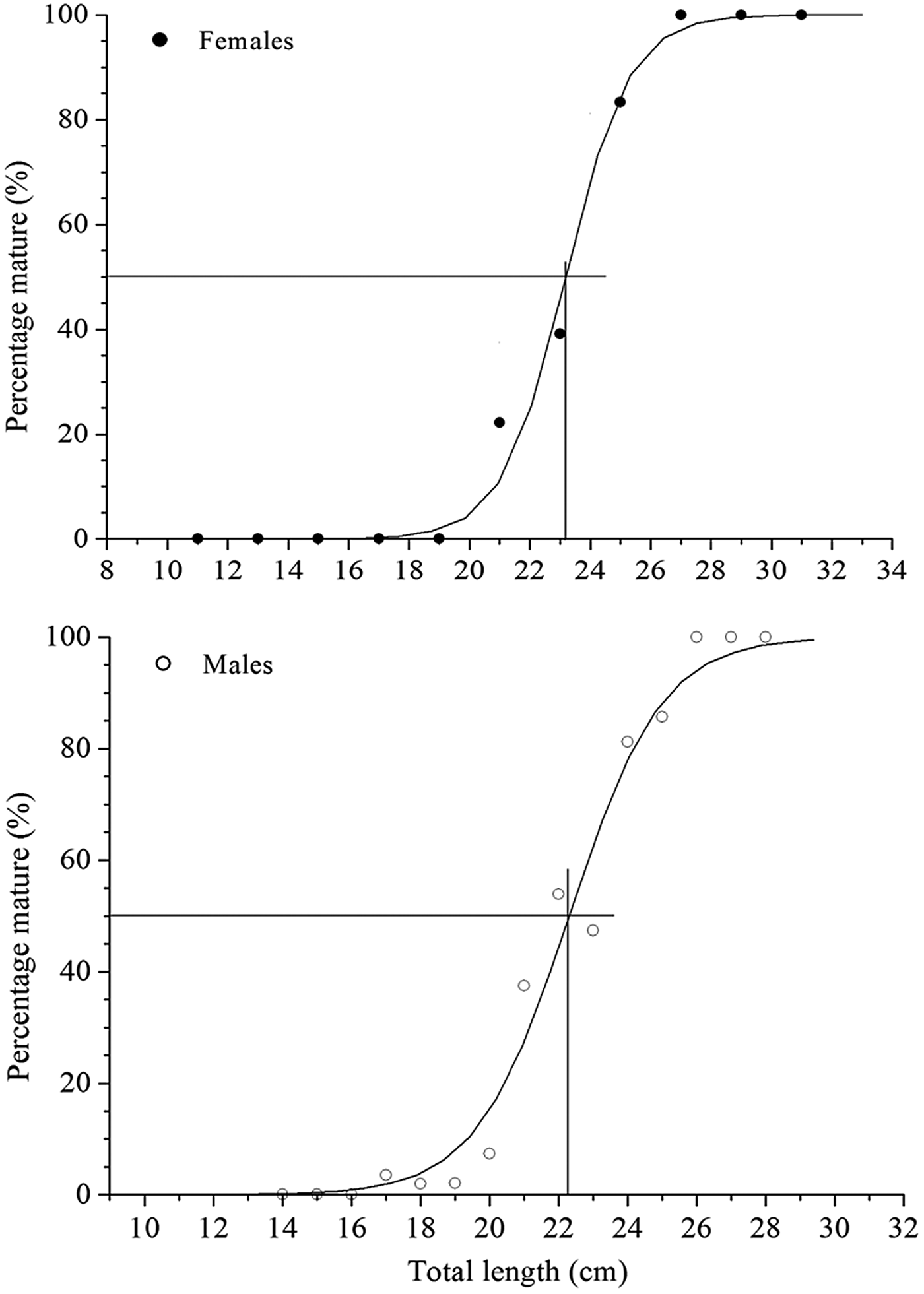
Length at sexual maturity was determined on the basis of 326 females and 361 males sampled during the reproductive period. The relationship between the percentage of mature S. aegyptiaca and total length was examined for both sexes (Figure 5). The smallest mature male was 17 cm L T and the largest mature male was 28 cm, whereas L 50 was estimated to be 22.31 ± 0.41 cm L T. The smallest mature female was 20 cm L T and the largest female was31 cm, whereas L 50 was estimated at 23.19 ± 0.184 cm L T. The statistical test χ2 did not show any significant difference between the theoretical proportions and the observed ones of males and females.
Graphed representation of Solea aegyptiaca maturity of males and females in Gulf of Gabes.

Fecundity
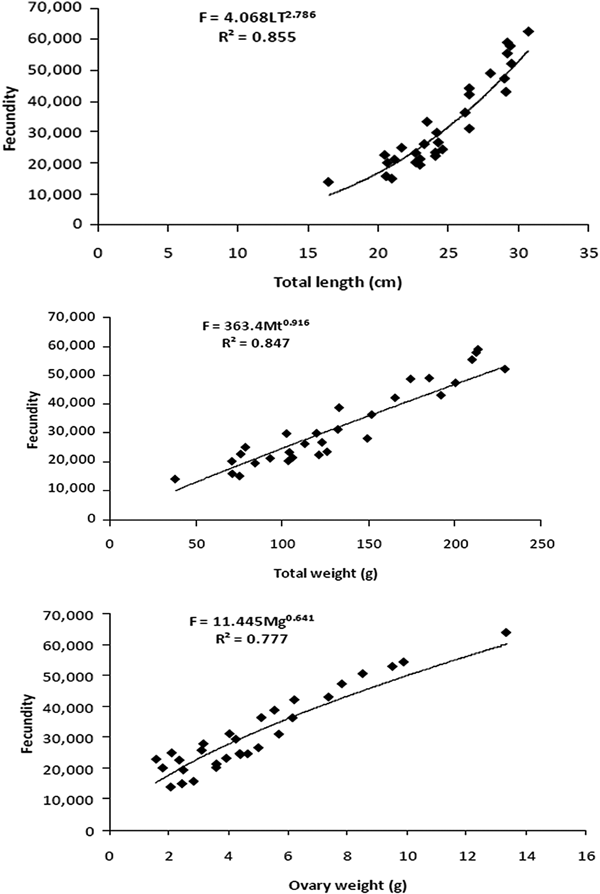
The total lengths of the 31 examined ripe females were 16.5 to 30.7 cm, while the total weights ranged from 38.36 g to 229.15 g. Their potential fecundity varied between 14,160 and 62,700 eggs per fish. Plots of potential fecundity vs total length (L T) (Figure 6A), potential fecundity vs eviscerated fish weight (W E) (Figure 6B) and potential fecundity vs weight of the gonads (W G) (Figure 6C) indicated that fecundity increased with maternal size. The mean potential fecundity obtained for S. aegyptiaca through the direct summation procedure was 33,020 ± 5239 eggs per fish. The diameter of oocytes contained in the ovaries varied between 0.48 and 0.64 mm, with an average of 0.55 ± 0.016 mm.
Fig. 6.

Discussion
It was noticed that females outnumbered males for the larger size classes. Such a discrepancy could be due to a partial segregation of mature forms through habitat preferences (Reynolds, Reference Reynolds1974) or due to migration and/or behavioural differences between sexes, thus allowing one sex to be more easily caught than another. The sex ratio of S. aegyptiaca found in this study is in agreement with that of Türkmen (Reference Türkmen2003) who found a 1.03 : 1 sex ratio of S. solea from Turkey. Also, Ahmed et al. (Reference Ahmed, Sharaf and Laban2010) recorded that the overall ratio of males and females of S. aegyptiaca from Port Said (Egypt) was 1 : 1.15. In the Ebro Estuary (Spain), Molinero et al. (Reference Molinero, Garcia and Flos1991) showed that the sex ratio of S. solea was 1.5 : 1. In contrast, the overall ratio was 1 : 2.11 for common sole of Bardawil Lagoon in north Sinai (Mehanna, Reference Mehanna2014). The differentiation of sex ratio from unity could be the result of several factors including mortality rate (Mazzoni & Caramaschi, Reference Mazzoni and Caramaschi1997), selective capture influence (Hood & Johnson, Reference Hood and Johnson2000), partial segregation by sex (Mejuto et al., Reference Mejuto, De la Serna and Garcia1998), season (Hoey, Reference Hoey1991; Mejuto et al., Reference Mejuto, De la Serna and Garcia1995), migration patterns (Sadovy & Shapiro, Reference Sadovy and Shapiro1987) and change in population structure between inshore and offshore locations (Hyndes & Potter, Reference Hyndes and Potter1997; Sun et al., Reference Sun, Chang, Tszeng, Yeh and Su2009).
The GSI reflects the physiological activity of the gonads, where an increase is an indication of the beginning of the breeding season of the fish. Generally, males’ GSI of S. aegyptiaca in the Gulf of Gabes was lower than females. The monthly changes in GSI of S. aegyptiaca males and females showed a definite breeding season which extends from November to February. Both sexes reached the highest values of GSI in November (0.09 for males and 2.16 for females), while the minimum was in September (0.41) and March (0.03) for females and males, respectively. Previous results in Tunisian waters (Gulf of Gabes) confirmed that spawning occurs in the same period (Jarboui et al., Reference Jarboui, Ghorbel, Bradai and Elabed1999). In Port Said (Egypt), the spawning season has been reported by Ahmed et al. (Reference Ahmed, Sharaf and Laban2010) as January to June. El-Husseiny (Reference El-Husseiny2001) reported that the GSI of female S. aegyptiaca, in Lake Quarun, increased progressively to reach its maximum value in January, while the minimum value was recorded in July. Teixeira & Cabral (Reference Teixeira and Cabral2010) found that the spawning period of both S. solea and Solea senegalensis occurring in sympatry along the Portuguese coast is in winter. Salman (Reference Salman2014) confirmed that the common sole in Bardawil lagoon is a winter spawner and spawned once a year. They all concluded that these flatfish are winter spawners. In contrast, in Iskenderun Bay, spawning of S. solea takes place in April and May with a peak in April. The spawning characteristics of fish vary in respect of species and the ecological characteristics (such as food and temperature) of the water system in which they live.
In the Gulf of Gabes, S. aegyptiaca stores some lipid reserves in liver as well as in muscles. Hence, it seems that the changes in the HSI and K are associated with the sexual cycle. The annual variations in the HSI showed that energy storage decreased after reproduction. Storage of fat within the liver during the reproductive period is a strategy adopted by many species in the Gulf of Gabes such as Diplodus vulgaris (Geoffroy Saint-Hilaire, 1817) (Hadj Taieb et al., Reference Hadj Taieb, Ghorbel, Ben Hadj Hamida and Jarboui2012) and Gobius niger (Linnaeus, 1758) (Hajji et al., Reference Hajji, Ouannes-Ghorbel, Ghorbel and Jarboui2013).
For a sustainable fishery length at first sexual maturity (L50) has great importance in the determination of the optimum mesh size. L50 is an essential factor for sustainable stock management and is an important parameter for fish stock assessment (Wang et al., Reference Wang, Sun and Yeh2003).
The L50 of the S. aegyptiaca population in the Gulf of Gabes was 23.19 ± 0.18 and 22.31 ± 0.41 cm for females and males, respectively. Previous studies (Jarboui et al., Reference Jarboui, Ghorbel, Bradai and Elabed2001) in this area reported lower values (15.5 cm) of length at first maturation than the values obtained in the present work. Studies taking place on the Egyptian coast of S. aegyptiaca have shown that the female's length at first maturity was estimated at 15.0 cm (Ahmed et al., Reference Ahmed, Sharaf and Laban2010).
Natural variation in size at maturity within a population of a species can occur in stable populations but is generally small. Several studies (e.g. Walsh, Reference Walsh1994; Bowering et al., Reference Bowering, Morgan and Brodie1997; Rijnsdorp & Vethaak, Reference Rijnsdorp and Vethaak1997) showed that a large variability in maturation could be related to the decline of populations. Variations in size at maturity may be genetic, or associated with changes in environmental conditions on the nursery grounds or later during the juvenile adult stage (e.g. Stearns & Crandall, Reference Stearns, Crandall, Potts and Wootton1984; Rijnsdorp, Reference Rijnsdorp1993).
Fecundity estimates of S. aegyptiaca in the Gulf of Gabes were higher (33,020 ± 5239 eggs per fish) than in the coast of Egypt. Ahmed et al. (Reference Ahmed, Sharaf and Laban2010) studied the relative fecundity of S. aegyptiaca and found that it ranged between 616.8 and 1270.09 eggs per cm and the absolute fecundity was found to vary between 9898 and 38,505 eggs for the lengths of 15.8 and 30.5. In the present work, there was a significant positive relationship between fecundity and fish length; this result is in agreement with that found by Ahmed et al. (Reference Ahmed, Sharaf and Laban2010). Horwood & Walker (Reference Horwood and Walker1990) found that fecundity of S. solea, from the Bristol Channel, was strongly correlated to total fish length. Rajaguru (Reference Rajaguru1992) pointed out that fecundity in flatfish (Cynoglossus arel, Bloch and Schneider, 1801) was highly correlated with total length, while fecundity in C. lida (Bleeker, 1851) was dependent only on ovary weight.
Acknowledgements
Special thanks to the technical and supporting staff of INSTM (Centre de Sfax) for their laboratory analysis. We thank Kamel Maaloul, Translator and Scientific English editor, for proofreading our manuscript. The authors are also grateful to the anonymous reviewers whose suggestions and comments improved the submitted manuscript.