


1 Introduction
Most elementary grammars of Old English (OE), as well as textbooks on the history of English, state that the digraph <cg> was pronounced as [dʒ], that is, a voiced post-alveolar affricate (Sweet/Davis Reference Davis1983: 4; Quirk & Wrenn Reference Quirk and Wrenn1989: 16; Mitchell & Robinson Reference Mitchell and Robinson1992: 16). Even the reference grammars, however, provide little evidence in support of this claim, beyond (a) a few seeming cases of affrication across OE morpheme boundaries (so, e.g., micgern ‘fat’ from *mid+gern, cf. orceard ‘orchard’ from *ort+geard), and (b) the reflex of this segment as [dʒ] in Present-day English (PDE): so, for example, Campbell (Reference Campbell1959: 173–9), Wright & Wright (Reference Wright and Wright1928: 167), Sievers (Reference Sievers and Cook1968: 143–55). Rather, the assumed development of [dʒ] in OE, along with that of its voiceless counterpart [tʃ], is presented as an outcome of the Anglo-Frisian palatalisations of [k] and [ɡ] in contact with front vowels: this makes it cohere with a larger chapter in the history of OE phonology, on which it then seems to depend. Otherwise, the topic seems to have attracted little further attention, with the exceptions of Weɫna (Reference Weɫna, Kastovsky and Szwedek1986) and Minkova (Reference Minkova2003, Reference Minkova2014, Reference Minkova, Chapman, Moore and Wilcox2016, Reference Minkova, Alcorn, Kopaczyk, Los and Molineaux2019).
Nevertheless, in its own terms the OE digraph <cg> seems remarkably ill-suited as the correspondent of a sound-segment [dʒ]. OE <c> usually corresponds to [k] or its palatalised reflex [tʃ]/[ç]Footnote 2 (as well as, though mainly in early Old Northumbrian in absolute final position in unstressed words, the fricatives [ç] and [x]), whereas OE <g> corresponds to [ɣ] or its palatalised reflex [j], or to [ɡ] or its palatalised reflex [ɟ] (at first only in combination with [ŋ]). The digraph <cg> thus appears to represent a cluster consisting of a voiceless velar or palatal consonant followed by a voiced velar or palatal consonant. The sequence {voiceless+voiced} is hence supposed to represent the {voiced+voiced} sequence of [dʒ], with no trace, moreover, of the affricate's palatoalveolar onset.
Ladefoged & Maddieson (Reference Ladefoged and Maddieson1996: 90) define affricates as ‘stops in which the release of the constriction is modified in such a way as to produce a more prolonged period of frication after the release’. Affricates are thus typically homorganic and are seen as one segment; examples are [pf, ts, dʒ, kx]. I will use the term ‘phonetic affricate’ to refer to any realisation that fits the above definition, and the term ‘phonemic affricate’ to refer to a (phonetic) affricate which is distinctive in a given language.
The primary aim of the present article is to argue that OE <cg> did not correspond to [dʒ], that there is no evidence for a phonetic or phonemic affricate until late Middle English (ME) and that there are better candidates than [dʒ] for the sound correspondence of OE <cg>, which are bisegmental. My findings thus support Minkova's main arguments regarding the development of affricates in English (Reference Minkova2003, Reference Minkova, Chapman, Moore and Wilcox2016, Reference Minkova, Alcorn, Kopaczyk, Los and Molineaux2019), although my conclusions were arrived at independently, were drawn from a very different set of data and take Minkova's conclusions one step further.Footnote 3
The Present-day English (PDE) reflexes of OE words with <cg> testify to two diverging historical developments: (a) /dʒ/ in nouns like edge, bridge, ridge (OE ecg, brycg, hrycg), or (b) /eɪ/ or /aɪ/ in the verbs say, lay, lie, buy (OE secgan, lecgan, licgan, bycgan). The second aim of this article is to determine when and where the diverging developments began.
Until recently, the evidence adduced for the sound correspondence of OE <cg> has been of two kinds: comparative evidence from the prehistory of OE <cg> words in other early Germanic (Gmc) languages, and spellings co-variant with <cg> in OE texts. To the latter group belongs evidence pertaining to the development to /dʒ/ of consonant clusters in words which do not belong etymologically to the OE <cg> words, e.g. micgern, singe ‘to burn lightly’. Additionally, ME spelling evidence has been used to argue for the terminal value [dʒ] in ME, but has not hitherto been used to shed light on the likely OE sound correspondence(s) of <cg>.
With the publication of LAEME (Laing Reference Laing2008), there is now a substantial body of spelling material for early ME, which may be used to infer much about the phonology of early English. The present article seeks to re-examine the available evidence for the sound correspondence of OE <cg> and to offer a new interpretation as to the likely pronunciation of OE <cg>. I examine some 1,500 spellings for OE <cg> words in LAEME, with a view to answering the following questions: (1) Are the ME spellings consistent enough, lexically and diachronically, or in individual texts, for any patterns to be detected? (2) If so, is it possible to establish the likely OE and ME sound correspondences of <cg>? (3) Had the diverging developments of nouns and verbs started in the period investigated? (4) To what extent did the sound development of OE <cg> depend on word-class, analogy, paradigmatic levelling and position within the word?
Section 2 examines the prehistory of OE <cg> words in an attempt to determine the sound cognates of <cg> in the other early Gmc languages. Section 3 gives a summary of the suggested path(s) of change from Gmc *-gj- to PDE /dʒ/ as offered by previous scholars. Section 4 presents and discusses the spellings for OE <cg> in LAEME. I offer my suggestion for the sound correspondence of OE <cg> in section 5, and I outline the path of change to PDE /dʒ/ in section 6. Section 7 gives a summary of the findings of this article.
2 The etymology of OE <cg> words in PGmc
The inferred Proto-Germanic (PGmc) forms of words with OE <cg> seem relatively certain: the cluster goes back to PGmc *-gj- (OED Online), and the sound value was probably [ɡj] or [ɟj] (where [ɟ] is the IPA symbol for the voiced palatal stop; [c] is the IPA symbol for the corresponding voiceless palatal stop). I shall refer to words which have reflexes of Gmc *gj, and which appear with OE <cg>, as ‘<cg> words’. Tables 1 and 2 show the spellings of the cognates of some of the most common OE <cg> words in the other early Gmc languages, as well as their later developments (in italics).
Gmc cognates and PDE reflexes of OE nouns with <cg>a

a Du = Dutch; Fris = Frisian; OS = Old Saxon; LG = Low German; OHG = Old High German; MHG = Middle High German; ON = Old Norse. The spellings are taken from the OED Online and from Laker (Reference Laker, Bremmer, Laker and Vries2007).
b OE secg I: ‘man, warrior, hero’.
c OE secg II: ‘sedge’.
d There is disagreement over the last vowel of the reconstructed PGmc forms, but that is not relevant here. Hedge (<PGmc *hagjō) in all likelihood belongs to this group of words also.
e The NGmc forms are included for comparison: the same words that undergo gemination in WGmc, and which are the topic of investigation here, undergo other processes in NGmc, producing similar consonant clusters. The same applies to the NGmc forms in table 2.
The Gmc cognates and present-day reflexes of OE verbs with <cg>
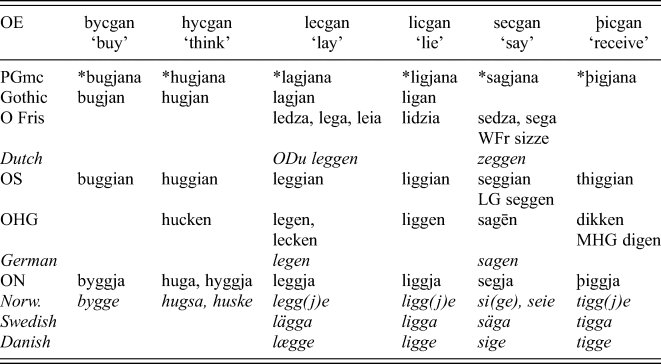
It seems quite clear that <cg> goes back to a geminated *g before *j in WGmc (West-Gmc Gemination, cf. Campbell Reference Campbell1959: §407; Stiles Reference Stiles2013: 15); the *j was subsequently lost, but not before it had caused the palatalisation of the preceding velar stops in OE and Old Frisian.Footnote 4 Hence, the values [ɡɡ(j)] and [ɟɟ(j)] seem probable in the early WGmc languages.
The Gmc velar stops *k and *g palatalised before front vowels in Pre-OE and in Old Frisian (Campbell Reference Campbell1959: §§426–30).Footnote 5 The precise development of the palatalised singletons may have been as in (1). The values [tʃ] and [j] are assumed for Old English by most textbooks, although solid evidence for these terminal stages is much later, in the form of ME <(t)ch> and <y>.
(1) [c] > [cj] > [cç] > [ç] <c> OR
[c] > [cj] > [tj] > [tʃ] <c>Footnote 6
[ɟ] > [ɟj] > ([ʝ]Footnote 7 >) [j] <g>
Thus, the velar stops seem to have gone through processes of ‘lenition’ (cf. Minkova Reference Minkova, Chapman, Moore and Wilcox2016: 56), in addition to palatalisation and potentially other types of assimilation. ‘Lenition’ is a somewhat contentious concept and is traditionally defined as change which involves weakening of segmental strength, such as opening or sonorisation (Honeybone Reference Honeybone2002: 39–43), along typical scales, as in (2).Footnote 8
(2) stop > affricate > fricative > approximant > vowel
When the Roman alphabet was adopted for the writing of English, the Insular hand was used, which means Irish (or British) scribes were probably involved. Alphabetic writing, runic or Roman, entails a broadly phonemic analysis, since the principle of alphabetic writing is that there is one letter for each distinctive/salient sound. This has interesting consequences for our interpretation of OE spelling: The various values which are assumed for <c> ([tʃ/ç] in cirice ‘church’ and [k] in cyning ‘king’) and <g> ([j] in giet ‘yet’, [ɣ] in dagum ‘days’ and [ɡ] in geminates) must either (a) have been perceived as so similar that they could be represented by the same letter, or (b) have been understood as allophonic variants in complementary distribution – or indeed both.
That the Anglo-Saxons learned their Roman script from Irishmen raises another question: what values did <c> and <g> have in Old Irish (OIr) at the time? Thurneysen (Reference Weɫna, Kastovsky and Szwedek1961) states that <c> corresponded to [k] or [ɡ],Footnote 9 and <g> had the values [ɣ] and [ɡ]. The digraph <cg> is used very infrequently in OIr, but is an ‘etymological’ spelling, in e.g. <ecguisti> for <ecuisti> (eg-guisti) (Thurneysen Reference Weɫna, Kastovsky and Szwedek1961: 23). It is worth observing that OIr <cg> is not tautosyllabic, but straddles morpheme boundaries, like the OE clusters in micgern, orceard. Thus, if OE spelling is informed by the spelling practice of OIr, the digraph <cg> in OE may indicate a geminate [ɟɟ], or [ɡɣ]/[ɟj] or [ɟj], or even [ɟʒ], whence it assimilated later to [dʒ].Footnote 10 This in fact agrees both with the Gmc postulated *-gj- and the attested forms in the other early WGmc languages. However, the question is why Anglo-Saxon scribes would adopt a very rare OIr spelling only for this one consonant, and not for any others. Logically, recourse must be had to OIr only if no other reasonable account can be established; but see White (Reference White2017) for a different view of the relation between OIr and OE spelling.Footnote 11
3 Previous accounts of the likely sound value and development of OE <cg>
This section examines previous accounts of the sound value and development of OE <cg> words; for comparison, the assumed development of palatalised *k is sometimes included, although I do not believe that the developments towards the terminal values /tʃ/ and /dʒ/ were exactly parallel (cf. Lass Reference Lass1994; Minkova Reference Minkova, Chapman, Moore and Wilcox2016). Part of the reason is that lenis fricatives were allophonic at best in the old Gmc languages, and their development into distinctive phonemes is generally late. Some structuralists do not like asymmetries in phoneme systems, but asymmetrical systems are not really rare; e.g. Norwegian and Swedish still do not have voiced fricative phonemes.Footnote 12 The very fact that the two velar stops as a result of Pre-OE palatalisation produced sounds that differed in manner of articulation shows that they did not and need not develop along the same paths: *k produced a palatal stop or fricative (ditch, leech), whereas *g produced a palatal approximant [j] which eventually vocalised (day, dry; Minkova Reference Minkova, Chapman, Moore and Wilcox2016: 38).
First, let us consider the OE spellings for <cg> words. Campbell (Reference Campbell1959: 27) states that the oldest spelling found in these words is <gg> (Épinal Glossary, late seventh century), whereas the Moore Bede and the Corpus Glossary (both eighth century) have <cg>, and the Erfurt Glossary (c. 800–50) has both. Other OE variants are <cgc>, <ccg>, <cgg>, <gcg>, <ggc>, <gc>;Footnote 13 <cg> is also used for words with assumed OE [ɡ:], such as dog and shag.Footnote 14 Waxenberger (Reference Waxenberger, Waxenberger, Sauer and Kazzazi2017) finds no <cg> words represented in the limited OE runic corpus, but OE runes sometimes distinguish between velar and palatal reflexes of Gmc *k and *g in initial position, but not so consistently as to make interpretation easy; still, this makes Campbell conclude that there was a clearly perceptible phonetic difference between their realisations (1959: 173, n.1).
The development of OE <ng> in certain contexts may be relevant, as a similar development to PDE /dʒ/ is attested for OE -ng in some words, like singe and cringe; <cg> and <gc> are also found in these. Campbell (Reference Campbell1959: 174) suggests that it is the same process of palatalisation which affected simplex *k and *g that affected these clusters, including <nk> and <ng>, both medially and finally. Normally, however, the development of OE -ng is to PDE /ŋ/ (though it remains [ŋɡ] in W Midl dialects), but it is worth noting that there are OE <cg> or <gc> in words with PDE /ŋ/ also (e.g. <þincg>/<þingc> thing, <cynincg>/<cyningc> king in the Dictionary of Old English Web Corpus).Footnote 15
Previous scholars may be roughly divided into two groups, i.e. those who think OE <cg> corresponded to [dʒ] from an early stage, and those who think an affricate was a later development. To the first group belong Sievers (1895 [1968]), Hempl (Reference Hempl1899), Campbell (Reference Campbell1959), Weɫna (1988), Hogg (Reference Hogg1992) and Lass (Reference Lass1994). To the other group belong Sweet (Reference Sweet1888), Luick (Reference Luick1914–40), Wright & Wright (Reference Wright and Wright1925, Reference Wright and Wright1928) and Moulton (Reference Moulton1954). Some of their arguments are worth considering in detail.
Sievers (Reference Sievers and Cook1968: 143–55) thinks that the palatal and velar geminates originally were plosives; the velar geminate was found in words like dogga dog, and the palatal geminate <cg> [ɟɟ] developed into [dʒ], which stage was reached in OE. The reason why Sievers postulates such an early date for [dʒ] is found in early OE spellings for words like fetian, ortgeard and midgern, which originally had [t#j] and [d#j], but which are occasionally spelt <cc(e)> and <cg>, respectively: ‘The palatal stops ċ and (c)ġ became at a rather early period palatal fricatives,Footnote 16 that is, sounds like Eng. ch and dg. This is shown by forms like orceard, fęccean …, micgern’ (1968: 146). On Sievers’ interpretation, <cg> is thus a back spelling in these words. As the segments in ortgeard, midgern always had a (post-)alveolar first element, the reasoning is that <cc> and <cg> must have corresponded to [tʃ] and [dʒ] in all words in which the digraphs were used, after the appearance of the back spellings c. 900, with the exception of dog and frog words, whose spellings are sometimes <docge> and <frocge>. This is a non sequitur to which I will return. No intermediate stages are suggested: thus, [ɟɟ] > [dʒ]. Sievers’ textbook was published in 1895, so he may well have been the first to suggest that <cg> must correspond to [dʒ] even in OE, and the evidence for this claim is found in the occasional OE <cc(e)> and <cg> for etymological <t#g> and <d#g>.
Even though the other scholars in this group may disagree over details, they agree with Sievers that the occasional OE <cc(e)> and <cg> in orchard, midgern entail the existence of OE affricates, and most of them believe the geminates were originally stops, before they affricated and assibilated between the seventh and ninth centuries (so Hempl Reference Hempl1899; Campbell Reference Campbell1959; Weɫna 1888; Hogg Reference Hogg1992). Lass (Reference Lass1994), however, assumes that the geminates were fricatives; thus, [ɣɣ] > [ɟɟ] > [ddʒ] is the suggested development in the words in question, although this oddly involves the development of a velar fricative [ɣɣ] into a palatal plosive [ɟɟ].
As for the details, Hempl (Reference Hempl1899: 375–83) indicates stages by which what we would now call distinctive features are changed one at a time, in a sequence of changes: velar stop [ɡ] > palatal stop [ɟ] > palatal affricate [ɟʝ] > palatoalveolar affricate [dʒ]. Campbell (Reference Campbell1959: 176) outlines the development [ɡ] > [ɟ] > [ḓ] > [dʒ]. He thinks the reflexes of Pre-OE *g and *k merged, at the di̭ and ti̭ stage, with the reflexes of [d#j] and [t#j] in *midgern, fetian, ortgeard. Weɫna (Reference Weɫna, Kastovsky and Szwedek1986) suggests that the phoneme was /dʒdʒ/, but seems to say (1986: 759) that the realisation was probably [ddʒ]/[d:ʒ] (as it is difficult to pronounce two affricates, [dʒdʒ], in a row, and [d:ʒ] is the pronunciation of geminate affricates in other languages). This was simplified to [dʒ] word-finally and medially after [n], but /dʒdʒ/ was retained intervocalically (1986: 761). Hogg (Reference Hogg1992: §§7.2–7.3, 7.15–7.43) suggests the following paths for Pre-OE *g, as a singleton and as a geminate:Footnote 17 */ɣ/ [ɡ] > [ɟ] > [dʒ]; */ɣɣ/ [ɡɡ] > [ɟɟ] > [ddʒ]. He seems to say that e.g. <licgan> lie had [ɟ] in OE, i.e. a palatalised velar stop rather than a fricative or affricate (1992: §7.15 and fn. 3, §7.17 (3)), but it is not explicitly stated. As Lass (Reference Lass1994: 53–9) assumes a fricative [ɣɣ] in geminates in OE, and thinks palatalisation and affrication and assibilation happened before [ɣ] > [ɡ], the input to palatalisation of OE /g/ was [ɣ], which avoids one or two stages in the development of the voiced velar, because [ɣ] goes straight to [j]. Hence, midge had the development */muɣja/ > [muɣɣja] > [muɟɟja] > [muddʒja] > [myddʒja] > [myddʒ].
In the other group, Sweet (Reference Sweet1888: §§737, 744, 927) seems to think palatalised *k had the value [cç]Footnote 18 in OE and early ME, since <tch> spellings appear only sporadically, even in late ME.Footnote 19 Sweet further believes the digraph <cg> had the value [ɟɟ] in OE and eME (cf. Moulton Reference Moulton1954), and the present value [dʒ] (and [tʃ]) was not reached until ‘the First Modern Period’, i.e. 1500–1600, as shown by forms with <d> and <t>. Words like nature, verdure provide a parallel, since they had ME [tj, dj], but in these it developed to [tʃ, dʒ]. Sweet interestingly finds a parallel for this in [sj] > [ʃ], but he does not refer to the identical earlier development of [tj, dj] in e.g. OE fetian, midgern to [tʃ, dʒ]. Sweet's suggested development is [ɡɡ] > [ɟɟ] > [dʒ].
Luick (Reference Luick1914–40: §§631–3, 637, 640–5, 685–7, 690, 696), like Lass (Reference Lass1994), assumes [ɣɣ] > [ɡɡ] in geminates, but he thinks *j was hardened to [ɡj] in emphatic styles, and that palatalised *g became the same sound. The development was thus [ɡ] > [ɡj] > [dj] > [dʒ], and the last stage took place in early ME. Due to paradigmatic variation and ON influence, Luick believes ME had both the velar stops and the palatalised/affricated consonant; ME <gg> is, however, deemed ambiguous, and Luick interestingly observes that <cg> words are made to rhyme with one another only in ME (Reference Luick1914–40: §690, Anm. 3).Footnote 20 This fact suggests that <cg> corresponded to a consonant or consonant cluster unlike any other.
Wright & Wright (Reference Wright and Wright1925, Reference Wright and Wright1928) note that ‘there is no definite proof that’ the ‘sound-change [to /dʒ/] took place in OE’ (1925: 167); moreover, ‘Medial and final cg was a palatal explosive nearly like the g in N.E. get’ (1925: 10). They do not think the back spelling <cc(e)> in words of the fetian, ortgeard type is sufficient evidence that [tʃ] was reached in OE (1982: 163), but they believe the affricate developed in late OE or early ME (1928: 13–14, 127–8).
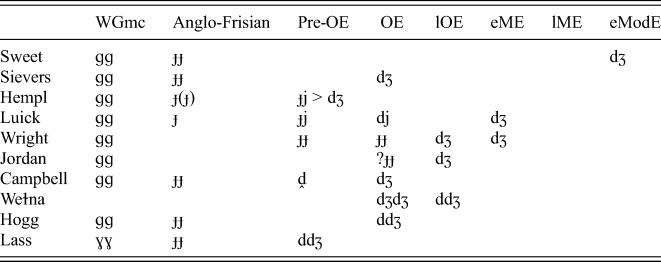
Table 3 summarises previous claims regarding the nature and development of the sound corresponding to OE <cg>. Most of the OE grammars agree with Sievers (1895) that the development of [dʒ] was very early; the exceptions are Sweet (Reference Sweet1888), Luick (Reference Luick1914–40) and Wright & Wright (Reference Wright and Wright1928), who believe [dʒ] was reached at some point between early ME and 1600.
The development of palatalised *gg according to the textbooks
Minkova (Reference Minkova2003, Reference Minkova, Chapman, Moore and Wilcox2016, Reference Minkova, Alcorn, Kopaczyk, Los and Molineaux2019) examines metrical and alliterative OE and ME data to determine the development of the Pre-OE velars in the history of English. She hypothesises that neither /ʃ/ nor /tʃ/ were phonemes until after c. 1000 (Reference Minkova2003: 71, 110), whereas the status of /dʒ/ or [dʒ] remains uncertain (Reference Minkova2003: 134). However, phonetic affricates are indeed assumed for OE, certainly in the fetian, ortgeard set, and also for palatalised *k in lenition positions, from the beginning of the ninth century (2003: 111). In her 2014 study, Minkova seems to think that the reflexes of the palatalised geminate *k and *g may have been phonetic affricates in OE (2014: 77, 81, 85–6; but she also proposes [c/kj] as possible realisations of the palatalised reflex of k on pp. 81–2), and it is only in Minkova (Reference Minkova, Chapman, Moore and Wilcox2016) that she starts to question their existence, proposing other sequences in addition to [dʒ] and [dʒdʒ] for the voiced geminate, i.e. [ɟʝ] and [dj] (2016: 49). Later, she states that in OE, ‘whatever <cg> represents phonetically, it is a sequence, or a geminate, not a phonemic singleton’ (2019: 165). That is, Minkova is adamant that the sound sequences which were the reflexes of OE <cg> and palatalised *k, whatever their nature, remained bisegmental (having the weight of two consonants) far into the ME period, and did not become contour segments, i.e. true phonemic affricates with concomitant reduction of phonetic length and metrical weight, until then (2016: 51). The fact that it is only in late ME that alliterations between words with presumed initial [tʃ] (e.g. <charite> charity) and words with initial /t/ (e.g. <teche> teach) start to appear (2016: 41) corroborates this conclusion.Footnote 21
In other words, what is new in Minkova's model is (1) that there were no phonemic affricates in English until the eleventh century (which is in agreement with Luick, and Wright & Wright), and (2) that OE <cg> may not have corresponded to [dʒ], but to e.g. [dj] or [ɟʝ]. Additionally, Minkova suggests that incipient affrication occurred first in typical lenition positions, e.g. word-internally in syllable codas, and in onsets of weakly stressed or unstressed syllables (2003: 110–11). I will return to all of these issues, but in the next section, I will examine early ME spelling evidence which may throw some light on these topics.
4 The LAEME material
4.1 Forms extracted
ME spelling evidence has not hitherto been investigated systematically with a view to determining the sound correspondence(s) of OE <cg>. As ME spellings have in fact been used to clarify other points of OE phonology (e.g. the three different correspondences of OE <g>), I believe that such investigation should be undertaken: the ME reflexes of OE <cg> may in fact shed light on the pronunciation of OE <cg>. For the present article, therefore, 1,588 tokens were extracted from the LAEME corpus:Footnote 22 all spellings for all nouns with OE <cg> (91 tokens), and all spellings for those parts of the OE verbs bycgan, lecgan, licgan, secgan, hycgan, þicgan which had <cg> (1,497 tokens); i.e. all forms in the present paradigm, except the 2sg. and 3sg. indicative, which had palatal singleton <g>, probably [j] (as did the preterite forms). Some of the verbs, e.g. OE bycgan, secgan and possibly hicgan, had palatal singleton <g> in the imperative singular (i.e. byge, sege), but all forms for the imperative singular were extracted, as the rest of the verbs have OE <cg>.Footnote 23 Table 4 shows the paradigm for secgan, a class III weak verb (Sweet/Davis Reference Davis1983: §74).
The paradigm for OE secgan ‘say’

4.2 The nouns
All the 91 tokens for reflexes of OE nouns with <cg>Footnote 24 have <g(g)>,Footnote 25 except four (table 5). There is one <secg> for OE secg sedge in text no. 173 (1200–50, Worcestershire), but the scribe in question (the archaising Tremulous Hand of Worcester) has <g(g)> otherwise. There is one <echȝe> for OE ecg edge in no. 273 (1225–49, Herefordshire), and two <suhge> for OE sucga in no. 1100 (1275–99, Herefordshire).Footnote 26 Of these, only <echȝe> may show assibilation and affrication, as <ch> may correspond to [tʃ], and the <ȝ> indicates a voiced segment, hence possibly [dʒ]. In the nouns, <g> for OE <cg> in Northern ME (NME) texts could be from Old Norse (ON) and correspond to [ɡ] (cf. Pak Reference Pak1973), but as <g(g)> is found throughout the country, it is difficult to argue either way.Footnote 27
LAEME nouns with the reflex of OE <cg>

a Including all derivatives in -edged.
4.3 The verbs
Of the 1,497 tokens extracted from LAEME for verbs with OE <cg>, 31 per cent do not have a medial or final consonant, but rather <ei> or <ai> (table 6). It is thus very clear that the medial and final consonants had started to vocalise in the earliest ME (c. 1150). However, a retained consonant is also in evidence as late as 1340 (in LAEME text no. 291, The Ayenbyte of Inwyt, and indeed in LALME), and up to the cut-off point for LAEME (around 1350), almost 70 per cent of tokens still have a medial or final consonant. Forms which do have a medial consonant have <g(g)>, and there is not a single example of <dg>.
LAEME verbs with the reflex OE <cg>
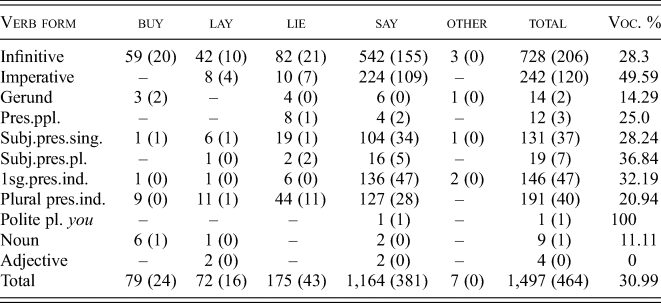
In table 6, the number of vocalised attestations for each verb part is given in parentheses after the total number of attestations for that part; the column other includes OE hycgan and þicgan. The right-most column shows the percentage of vocalised attestations of the total number of tokens for that verb part. It is clear that the imperative has more vocalised attestations than any other verb part, at almost 50 per cent, to which I will return.
Details regarding each verb are given in the following. For buy and buyer, there are 79 tokens in total, of which 55 have <g(g)> (69.62 per cent), and 24 do not have a medial consonant (30.38 per cent), as indicated in table 7. The infinitive is recorded with more ‘bare’ forms (i.e. many different spellings, each of which lacks the medial consonant(s)) than any other verb part. Analogy with the 3sg. pres. ind. may be responsible for the bare forms for the 3sg. subj. The North and NE Midlands stand out as possible loci of change with regard to vocalisation.
LAEME forms without a medial consonant for buy and buyer
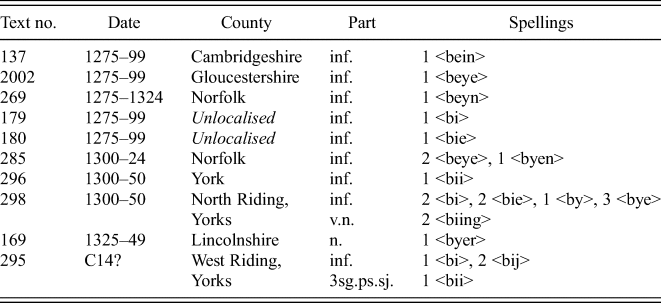
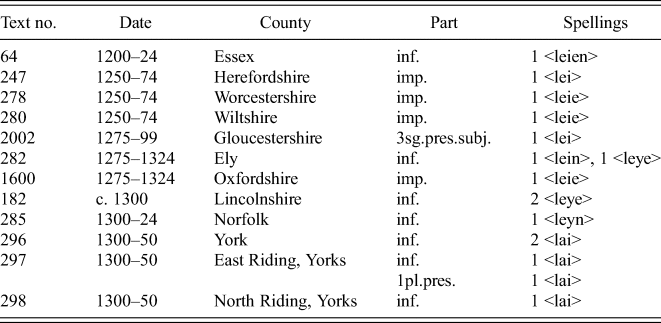
For lay, there are 72 tokens in total, of which 56 have <g(g)> (77.78 per cent), and 16 do not have a medial consonant (22.22 per cent), as indicated in table 8.Footnote 28 The infinitive and imperative have most attestations without a medial consonant, although there are such forms also for the 1pl. pres. ind. and the 3sg. pres. subj. The W Midlands stands out as a locus of vocalisation, but the E Midlands and the North are also represented from the latter half of the thirteenth century.
LAEME tokens without medial consonant for lay
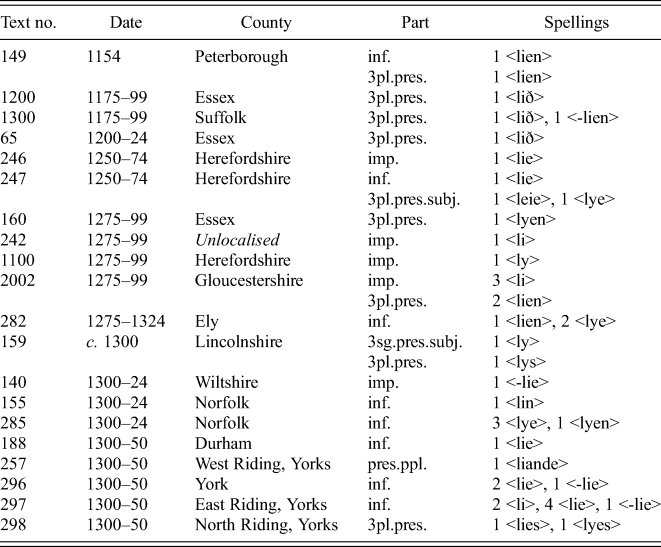
For lie, there are 175 tokens in total, of which 132 have <g(g)> (75.43 per cent), and 43 have no medial consonant (24.57 per cent), as indicated in table 9.Footnote 29 The infinitive and imperative are again attested with many tokens without a medial consonant, but so is the 3pl. pres. ind. There are a few also for the 3pl. pres. subj., the 3sg. pres. subj. and the present participle. Vocalisation of the consonant had spread earlier to more verb parts for licgan than for the other verbs in this group, and the E Midlands seems to have been affected earlier than the rest of the country.
LAEME tokens without a medial consonant for lie
In the category other, all 7 forms for OE hycgan, þicgan have a medial consonant (100 per cent): 5 have <g(g)>, 2 have <h>, and 1 has <cg>; the texts have been localised to Cheshire, Worcestershire, Hampshire and Norfolk.Footnote 30
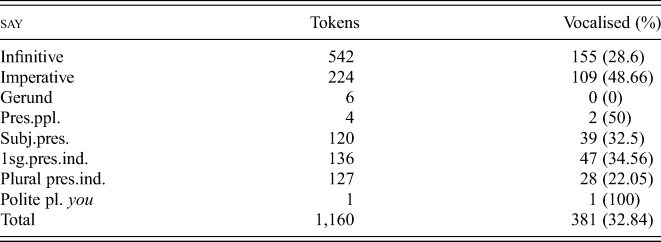
For say, there are 1,160 tokens in total; they are too numerous for all the spellings without a medial consonant to be included in a table here. There are 779 forms with <g(g)> (including 7 <cg>; 67.16 per cent), and 381 forms without a medial consonant (32.84 per cent); the proportions of verb parts with and without a medial consonant are given in table 10.Footnote 31
LAEME forms for say
There are many intermediate forms, e.g. <saiʒe> in no. 249 (1250–74, Herefordshire) and <seyʒe> in no. 282 (1275–1324, Ely), in which there is a medial consonant, but the preceding vowel seems to be diphthongal; these have obviously been counted as having a medial consonant. The intermediate forms indicate the course of change for say: A glide vowel developed between the vocoid and the palatal consonant corresponding to OE <cg>, or the latter vocalised to i. For say, a high number of attestations have <i> for the stressed vowel; it is possible that this is the result of regressive palatalisation (caused by the palatal consonant).
The material for say points in the same direction as that for the other verbs: The infinitive and imperative were affected by vocalisation first, followed by the 1sg. pres. ind. In one of the earliest E Midlands text, palatalized forms are in fact more numerous than forms with a retained consonant (no. 1300, 1175–99, Suffolk). The same is true of no. 118 (1225–49, Cheshire), and of Northern texts from 1300–50. This points to the E Midlands being the locus of the development examined here, although the W Midlands is well represented from quite an early date too; however, this may well be a concomitant of the fact that most early texts come from these areas.
In numerous texts, the scribe uses co-variants with and without a medial consonant, so variant pronunciations must have persisted for a long time,Footnote 32 but it is obvious that complete vocalisation of the medial consonant corresponding to OE <cg> was well under way in the late twelfth century, at least in the eastern part of the country. However, as noted before, a retained medial consonant is attested into late ME (LALME).
The infinitive and imperative singular were clearly vocalised early, but as noted, the imperative singular of bycgan and secgan had a palatalised consonant in OE, and these may have acted as a ‘bridge’ (i.e. an analogical model) in the vocalisation of the imperative singular of the other <cg> verbs. Other forms which were vocalised early are the 3pl. ind. and the 1sg. ind. Obviously, the preterites are believed to have had [j] even in OE; it seems, therefore, that the process that affected the pronunciation of OE <cg> in verbs may have been one involving analogy and paradigmatic levelling rather than sound change as such. This seems also to be the standard position, but I will return to this point in section 4.6. It could also be that the set bycgan, licgan, lecgan, secgan developed in a parallel fashion, due likely to their similar phonetic make-up, as they belong to different classes (bycgan and lecgan are weak class 1, licgan is strong class 5, and secgan is weak class 3); the coherence of the set may be part of the larger picture, somewhat like the PDE spread of -ung/-unk in the past tense of verbs whose infinitives end in -ing/-ink.Footnote 33
At the outset, I assumed that there was no significance in the use of a single <g> vs a double <gg> in the eME texts; <gg> is the dominant spelling by far. However, for the sake of the argument, I have counted occurrences of single <g> separately. Of the nouns, only edge, ridge, sedge and OE wicg have a single <g>, and a single consonant is in fact the dominant form for ridge and wicg,Footnote 34 which both have a close front vowel preceding the consonant. 27 single <g> are attested in East Anglia, Berkshire and the W Midlands (table 11).
Incidence of <g> for OE <cg> in nouns in LAEME
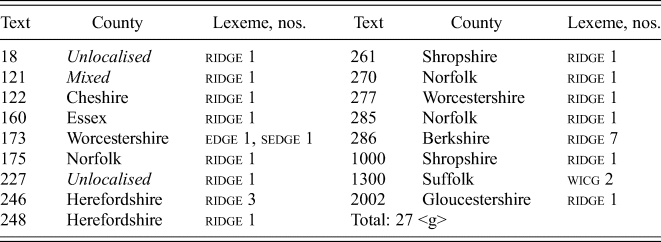
There are a mere 85 single <g> for OE <cg> verbs (out of 1,497 tokens).Footnote 35 The tokens with a single <g> do not appear to pattern in any systematic way, neither regarding areas nor regarding verb parts; they constitute 5.68 per cent of the extracted verb forms in LAEME (excluding three forms with <þ> or <h>), whereas forms with <gg> constitute 94.12 per cent.
4.4 The Orrmulum
In this regard, there is one eME text whose author is outstanding, both in having devised his own spelling system and in being exceptionally consistent in its application. This is of course the Orrmulum. Orm has a system with three different-shaped g’s, all used etymologically.
(a) Insular g <ᵹ> indicates a palatal approximant or fricative [j/ʝ]; the digraph <ᵹh> seems to correspond to a fricative, perhaps retained OE [ɣ].Footnote 36
(b) The flat-topped <ɡ> corresponds to a plosive [ɡ].
(c) The Caroline <g>, new in vernacular usage, is used only and always in OE <cg> words.
This strongly indicates a different sound correspondence for the reflex of OE <cg> than for OE <g>, and it does not follow that it was [dʒ]: it would be very strange if Orm, whose hearing evidently was acute, had analysed it as [dʒ], but then failed to represent the palatoalveolar, or even more so, the palatal approximant/fricative, for which he regularly writes <ᵹ> elsewhere. Orm's consistent <g(g)> for OE <cg> has a set of negative implications, that is, non-[d], non-[ɡ], non-[ɣ], non-[j], and non-[dʒ]; the most economical assumption is that it corresponded to [ɟ],Footnote 37 but it may also indicate something like [ʝ] or [ʒ]. Orm's spelling does not really allow for a bisegmental analysis of the type [ɟj], and phonemic length in consonants had by all accounts been lost at this stage anyway, but the reflex of [ɟɟj] could be an exception, and [ɟɟ]/[ʝʝ]/[ʒʒ] may be intended.Footnote 38
4.5 LAEME spellings for Gmc *k and *g
For comparison, LAEME spellings for simplex palatalised Gmc *k and *g have been considered. For palatalised g, <g>-type spellings remain dominant in the period 1150–1350, but <y-> starts appearing c. 1200–50. For palatalised k, <c>, <k> and <ch> are all frequent, but with clear regional preferences: <k>/<c> are used in the North and NE Midlands, <ch> in the South, West and SE Midlands.
These patterns suggest that spirantisation and/or affrication of simplex Pre-OE *k is in evidence in (early) ME, but not really in OE, counter to what is claimed in the textbooks, which always assume OE [j] for palatalised *g and OE [tʃ] for palatalised *k. In fact, there is no hard evidence for assibilation and affrication until early-ish Middle English, and then only for the voiceless consonant (cf. Wright & Wright Reference Wright and Wright1925: 163); for the voiced palatal geminate gg, there is no unambiguous evidence at all for a palatoalveolar affricate until the mid fourteenth century; see section 5.
4.6 Word class, analogy, paradigmatic levelling and position within the word
There is no doubt that the two different developments are connected to word-class, in that the nouns have PDE /dʒ/, whereas the verbs have a diphthong corresponding to OE <cg>; the difference is apparent from the earliest ME material. However, this may be no more than a reflection of the fact that the two classes had different phonological environments: the verbs were more susceptible to spread of vocalisation in the first place, because there was paradigmatic alternation between <cg> and palatal <g>, whereas no such paradigmatic variation was found in the nouns.
As for position in the word, it is difficult to draw any certain conclusions, but the following points can be made. In hindsight we know that the infinitive was gradually reduced, starting with the loss of the final -n, then of the (now) final unstressed vowel, leaving what had been the medial consonant in final position. It could be that the consonant corresponding to OE <cg> was more susceptible to weakening word-medially, since the infinitive (which had a medial <cg> in OE) was affected by vocalisation very early; all other vocalised verb forms in LAEME had a word-medial consonant in OE, except the imperative singular, in which the consonant was word-final, as indeed it was in the nouns. However, word-medial position may be identical to syllable-final position, and Minkova in fact argues that ‘the palatalized velars became affricated first word-internally, where they could appear in coda position, a prototypical position of neutralization’ (2003: 110).
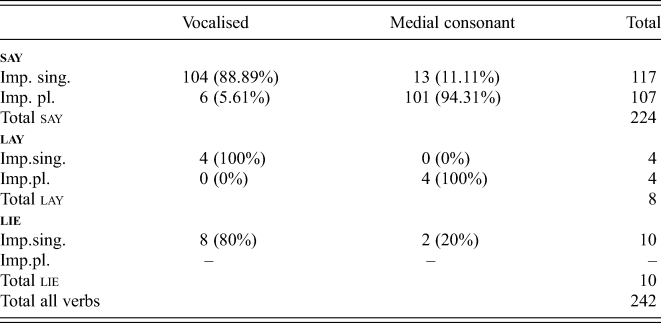
The LAEME material shows somewhat diverging tendencies. The infinitive, which had a medial consonant in OE, accounts for 44.3 per cent of all vocalised forms (and 28.3 per cent of all infinitives show vocalisation). The imperative plural, which also had a medial consonant, however, shows the opposite tendency, with retention of the consonant in 94.6 per cent of cases; the imperative singular, in which the consonant was word-final, shows vocalisation in 88.6 per cent of the relevant forms (table 12). The singular is by far the more frequent, which entails that on average, 49.6 per cent of all imperatives show vocalisation.
LAEME tokens for the imperative of lay, lie, say
It seems rather obvious that analogy played a role for the first-person singular present indicative, which may have vocalised by analogy with the rest of the singular paradigm; so also for the singular present subjunctive, which may have vocalised by analogy with the indicative. Early vocalised forms for the plural present indicative and plural subjunctive are more difficult to explain, but the analogy could have been through the 1sg > 1pl > 2/3pl, although such a scenario remains speculative.
Maiwald (Reference Maiwald2017), who examines the vocalisation of the semivowels [j] and [w] and the voiced velar fricative [ɣ] in ME, concludes that the input consonant is ‘the most potent predictor for the sound change’ (2017: 316), in that words with the reflexes of [j] show the highest frequency of vocalised spellings, whereas words with the reflexes of [ɣ] show the lowest frequency of such forms. The other variables predicting vocalised spellings are (in decreasing order of importance): syllabicity (tautosyllabic semivowels show much higher frequencies of vocalised spellings), time (vocalised spellings increase in frequency over time), the quality of the preceding vowel (front monophthongs induce vocalisation of the following semi-vowel), dialect and word class (2017: 316). Regarding word class, Maiwald finds that adjectives and adverbs have higher numbers of vocalised spellings than nouns, lexical verbs and quantifiers (2017: 269–70), and that nouns and lexical verbs alike show a steady increase in vocalised spellings in the course of eME (2017: 281). Maiwald also notes that ‘Verbs do not seem to show much of an increase of vocalic spelling proportions with lexel frequency’ (2017: 276).Footnote 39 Finally, he finds that open-class lexical items led the change (vocalisation), but that closed-class items ‘seem to have adopted the new spellings at a faster rate’ (2017: 278). Variables which seem not to have affected vocalisation to any great degree are lexeme frequency, the quantity of the preceding vowel and stress (2017: 317–18). For our purposes, Maiwald's most important finding is that tautosyllabicity is a highly significant predictor of vocalisation; besides, his observations that time and dialect correlate with vocalisation, whereas lexeme frequency does not, give some support to the findings reported here. In other words, we both find that spellings indicative of vocalisation increase in frequency with time, and that parts of the E Midlands and W Midlands led the vocalisation examined here.
4.7 The LAEME evidence: summary
We are now in a position to answer, at least tentatively, the four questions posed in the introductory section. (1) Are the ME spellings consistent enough, lexically and diachronically, or in individual texts, for any patterns to be detected? Yes, but in a negative way: eME spellings are very consistent, but it is the complete absence of <d-> spellings for words with OE <cg> (and the absence of <t-> forms for words with palatalised *k) which is most striking. (2) Is it possible to establish the likely OE and ME sound correspondences of <cg>? The orthographic evidence afforded by the Orrmulum precludes an affricate, as does the bulk of eME spellings, but this question will be answered in full in sections 5 and 6. (3) Had the diverging developments of nouns and verbs with OE <cg> started in the period investigated? The diverging developments had certainly started by 1150, and may even have started in OE, but the process was not complete by 1350, which suggests that variant pronunciations persisted for a long time. (4) To what extent did the sound development of OE <cg> depend on word class, position within the word, analogy and paradigmatic levelling? It is obvious that the differential treatments of the reflexes of OE <cg> partly depended on the position of the sound in the word: the word-final consonant in the singular of nouns constituted the coda of a stressed syllableFootnote 40 and was thus prevented from being vocalised and deleted, whereas the consonant was primarily found in word-medial (but syllable-final) position in the verbs and was more vulnerable to weakening and loss; this process was aided by the fact that <cg> in verbs alternated with palatalised g [j], which generally vocalised in other vocabulary as well.Footnote 41 The importance of analogy with such forms cannot be overstated for the verbs.
What is most striking about the LAEME data is the unusual and complete agreement among the scribes as to the spelling of the reflex of OE <cg>: they all use <g(g)> in those cases where a consonant (letter) is retained, for nouns and verbs alike. Consequently, there are no regional patterns either, which again is rare for early ME. It implies (a) that all the scribes thought that the letter <g> provided the best fit for the realisation of the reflex of OE <cg>, and possibly (b) that this realisation, whatever its exact nature, may have been relatively uniform across the country (with the caveat that <g> in the nouns in NME could show ON [ɡ]). The existence of regional (allophonic) variation cannot be ruled out; all that is certain is that the ME spellings do not reflect such variation, unlike what is the case for the reflexes of palatalised singleton *k and *g.
5 The likely sound correspondence of OE <cg>
So far, we have primarily considered earlier accounts of the sound value of OE <cg>, and we have seen that there is no direct evidence for the terminal stage [dʒ] in OE and ME. I do not believe that OE <cg> was [dʒ], for the following five reasons.
1. OE words like frogga frog and dogga dog are also sometimes spelt with <cg> in OE (Luick Reference Luick1914–40: §631; Campbell Reference Campbell1959: 27; Dictionary of Old English Web Corpus, see section 3, footnotes 13 and 14), yet these are always claimed to have a velar plosive [ɡ:] in OE, and still do in PDE. Similarly, there are a fair number of minor spellings, e.g. <cgc>, <ccg>, <gcg>, mostly in OE <cg> words, but also for the final consonant of OE -ing and -ung, for which PDE has /ŋ/ (WMidl /ŋɡ/). This fact does not make sense if <cg> corresponded to OE [dʒ], but it makes sense if <cg> corresponded to a geminate plosive or a cluster containing a plosive.
2. The argument that <cc(e)> and <cg> must be [tʃ] and [dʒ] because earlier <t#g> and <d#g> are sometimes spelt <cc(e)> and <cg> is a non sequitur; they are rather attempts on the scribes’ part to give orthophonic spellings for the new sounds [tç]/[tʃ] and [dʝ]/[dʒ] in ortgeard, fecc(e)an, micgern, developed from [t#j] and [d#j] across syllable and/or morpheme boundaries as a result of what is called ‘yod Coalescence’ in the modern language (Wells Reference Wells1982: 330–1); but it does not follow that <cc(e)> and <cg> must be [tʃ] and [dʒ] always (cf. Wright & Wright 1982: 163). True back spellings are bidirectional, but that is not the case with <cc(e)> and <cg>: earlier <t#g> and <d#g> are sometimes spelt <cc(e)> and <cg>, respectively, but etymological <cc(e)> and <cg> are never spelt <tg> and <dg> in OE. In fact, <cg> in micgern may equally indicate assimilation from [d+j] to [ɟ+j] as a (post-)alveolar affricate; thus, if OE <cg> is [ɟj], as argued below, the occasional <micgern> makes perfect sense. Besides, syllable-initial consonant clusters may develop across morpheme boundaries although the same cluster is not found word-initially.Footnote 42 A consonant cluster straddling a morpheme/syllable boundary is not of itself evidence that the same cluster occurs in free position. In essence, it means that the ortgeard, midgern words may have developed phonetic affricates, which could equally have been [tç] and [dʝ] as [tʃ] and [dʒ], and that the closest spellings in the established orthography, given the limitations of the Roman alphabet, were <cc(e)> and <cg>. It does not follow that the palatalised reflexes of WGmc *k and *g had reached the assibilated stage in OE, although it cannot be stated with absolute certainty that assibilation was not present in OE either; all that is certain is that the realisation of OE <cg> was not a singleton, but rather bisegmental, and that the first element was likely not dentalveolar.
3. If <cg> is indeed evidence of some kind of affricate, it need not be a palatoalveolar one, merely a palatal one, and affrication need not entail assibilation.
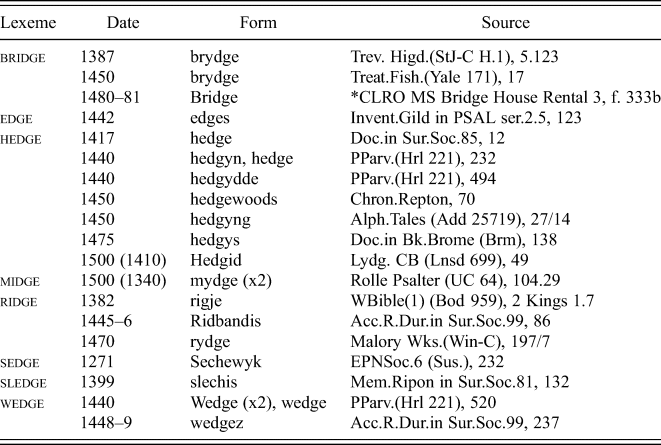
4. Unambiguous spelling evidence for palatoalveolar affricates, i.e. <tch> and <dg>, is very late. The online MED (sub verbis)Footnote 43 reports the following <dg> and a few other irregular spellings for OE <cg> words, the first of which does not appear until 1387 (table 13).
5. It is likely that the developments of the voiced and voiceless sounds were not parallel, either in terms of dates, or of the phonetic stages involved: given the Gmc absence of phonemic voiced fricatives in the early stages of the daughter languages, it is only to be expected that voiced fricatives and affricates should develop later than their voiceless counterparts; see the first paragraph of section 3. Thus, evidence for [tʃ] need not entail [dʒ].
<dg> and other irregular forms for OE <cg> words in the online MED
To determine the likely sound correspondence of OE <cg>, it is worth asking whether OE <cg> always corresponded to the same sound, given the diverging developments in nouns and verbs. Identity of sound in OE is indeed indicated by the scribes’ choice of the same spelling for both parts of speech; etymology supports their analysis, as the words in question all stem from Gmc *gj. The next question then is which development ‘continues’ the OE sound, the nouns or the verbs? The answer must be that the nouns do, as the ME vocalisation of OE <cg> in verbs seems to be the result of analogy rather than of a sound change per se (though sound change cannot be ruled out): palatal <g> vocalises elsewhere too, e.g. in OE <weg> way and <dæg> day (cf. late OE dæi), and when it vocalised in those principal parts of OE <cg> verbs which had palatal <g> (generally those of the preterite paradigm), the non-palatal forms may also have developed variant forms with a vocalised consonant. As there is agreement (supported by the later developments) that OE <c> corresponded to [k] or [tʃ/ç], and OE <g> corresponded to [ɡ] or [j] or [ɣ], depending on the phonetic context, the key to identifying the sound correspondence of OE <cg> lies in just these allophones.
My simple suggestion is that OE <cg> was pronounced [ɟ(ɟ)j],Footnote 44 that is, that Gmc *[ɟj] either was unchanged in (Pr)OE, or that the second element of the geminate later lenited to an approximant; this differs a little from Minkova's [ɟʝ] (Reference Minkova, Chapman, Moore and Wilcox2016: 49; Reference Minkova, Alcorn, Kopaczyk, Los and Molineaux2019: 164, example (9)). In the OE spelling system, <g> may unproblematically correspond to [j], and to indicate the different manner of articulation of the two segments, i.e. plosive vs approximant, <c> was used for [ɟ], as a plosive diacritic. The reason is partly that the Roman alphabet had only two letters for (historically) velar sounds of any kind, <c> and <g>, and <gg> more logically corresponded to a geminate velar plosive [ɡ:] in words like frogga frog than to a cluster [ɟ(ɟ)j], even if both <cg> and <gg> are used quite frequently in OE for both palatal and velar plosive geminates. My suggested pronunciation [ɟ(ɟ)j] agrees not only with the more certain phonetic realisations of Gmc *gj in the other early Gmc languages, which all have [ɡj] or [ɟj], but also with the overwhelming body of spelling evidence for both OE and ME, as well as with the later reflexes of the sound in question. It was noted earlier that OE <cg> alternates with palatalised <g> in the verbal paradigms: It makes sense to have [j] (palatalised singleton) alternate with [ɟj] (palatalised geminate), but not with [dʒ], for reasons of phonetic similarity in two reflexes of what is etymologically the same sound; and it makes sense for this [ɟj], not [dʒ], to have become [j] in ME, whether by analogy with the preterite and other palatalised forms, or by a real sound change, i.e. true vocalisation of the kind [ɟj] > [jj] > [j] > [i].
The other spellings for <cg> words in OE also make more sense if OE <cg> corresponded to [ɟ(ɟ)j]. <gg> is in fact the earliest spelling for <cg> words (seventh century), but seems to have been ‘reallocated’ to [ɡ:], which is logical, given the rationale behind alphabetic writing: a geminate sound should be represented by a geminated letter. It could also be that the phonetic similarity between a velar and a palatal plosive sometimes made scribes use <gg> for both velar and palatal geminates without distinction – after all, the simplex velar and palatalised reflexes of Gmc *k were clearly perceived as allophones for a very long time, given that they alliterate even in ME (Minkova Reference Minkova, Chapman, Moore and Wilcox2016: 40).Footnote 45 When <cg> started to be used for [ɟ(ɟ)j] a little later (eighth century), this may have been an attempt to reflect the difference between a palatal and a velar sound orthographically. Thus, <docga> could simply be a back spelling with the following rationale: If <gg> may be used for both [ɡ:] and [ɟ:(j)], then <cg> for [ɟ:(j)] may be extended to the velar geminate also. Finally, if it is allowed that the <c> in the <cg> cluster represents [ɟ], a spelling like <cynincg> or <cyningc>Footnote 46 king also makes sense: The last <c> simply corresponds to a sound which is both a plosive and palato-velar, i.e. [ɟ], after a palato-velar nasal, i.e. [ɲɟ].
6 From OE [ɟ(ɟ)j] to late ME /dʒ/
It is common for clusters like [cj] and [ɟj] to coalesce or be dissimilated.Footnote 47 Coalescent assimilation is observed in the NGmc palatal reflexes of Gmc *k and *g, as indicated in (3) for Norwegian. Swedish and Danish went through exactly the same process, but in Danish, the process has been reversed (Sandøy Reference Sandøy1991: 183; Papazian & Helleland Reference Papazian and Helleland2005: 53).
(3) ON gj > [ɟj] > /j/ (gjøre ‘to do’, geit ‘goat’ with /j-/)
ON kj > [cj] > /ç/ (kjerne ‘kernel, core’, kinn ‘cheek’ with /ç-/)Footnote 48
In a process of dissimilation, the first element would become post-alveolar ([ɟj]> [dj]), after which the second element would also become post-alveolar, in a process of assimilation ([dj] > [dʒ]). Such a process is attested in Romance, in which [dʒ] had developed already in Gallo-Roman (fifth–ninth centuries) from Latin g and j, and was simplified to [ʒ] in OFr in the thirteenth century, but remains in Italian (Pope Reference Pope1934: §§191–5, 291–2).Footnote 49 However, it seems as if the value [dʒ] was kept in early French loans in English, certainly in initial position in which the reflexes still have /dʒ/, whereas [ʒ] is found in later loans in medial and final positions. What is clear is that the sound corresponding to OE <cg> fell in with this French [dʒ] in later ME, so even if OE <cg> was not [dʒ] in OE or early ME, it had become similar enough to merge with it later. It is even possible that the realisation of the reflex of OE <cg> was affected by French [dʒ]: The realisation of the reflex of OE <cg> was similar enough – perhaps [dj]/[dʝ] by this stage – to French [dʒ] to merge with it, giving /dʒ/. The development of OE micgern, singe and of PDE /dj/ > /dʒ/ (as in due, did you) shows, however, that the last stage [dj] > [dʒ] may certainly also be an entirely native development. Minkova (Reference Minkova, Alcorn, Kopaczyk, Los and Molineaux2019) proposes an even closer link between the development of the affricates in English and French loans: The fact that [tʃ]/[dʒ] and [ʃ]/[ʒ] (both singletons) alternated in French may have provided ‘a structural parallel for the perception of the same native CC-sequences as singletons’ (2019: 176).
In the larger picture, the development sketched out in the preceding entailed that /dʒ/ became a phoneme: it was no longer phonotactically restricted to initial position (French loans), but was now permitted in medial and final positions also.Footnote 50 A relevant (inverse) parallel is seen in the fricatives, for which it is generally accepted that OE had voiced allophones in medial position, although they are not orthographically distinguished; these voiced fricative allophones were not phonemicised until ME, when French loans brought new words into the English vocabulary in which voiced fricatives were found in initial and final positions also.Footnote 51 With the phonemicisation of voiced fricatives, and finally of /dʒ/, the consonant inventory of English had become symmetrical, in that the voiced-voiceless opposition found in the plosives was now also fully operative in the system of fricatives, with the exception of /h/.Footnote 52
As for the date at which the terminal stage [dʒ] was reached, the element [d] must be late; otherwise, it is difficult to account for the two facts that (a) all eME scribes, including Orm, agree on <g(g)>, and (b) there is not a single <d> in sight until c. 1340, which is astonishing, especially for ME, even considering the power of spelling tradition. As we saw in section 3, previous scholarship has suggested different paths of development for the pre-affricates. In my opinion, the most likely path is given in (4a), and is based on OE and ME spellings and sound correspondences, as well as on knowledge of such processes cross-linguistically. (4b) is given to account for Orm's spellings. (4a) probably describes the simplest and most economical path of development from OE [ɟ(ɟ)j] to late ME [dʒ].
(4)
(a) [ɟɟj] > [ɟj] > [dj]/[dʝ] > [dʒ] OR
(b) [ɟɟj] > [ɟj] > [ʝʝ] > [ʒʒ] > [dʒ]
Typological arguments should be used with caution, as they are descriptive and not explanatory, but it might be noted even so that whereas phonemically opposed bilabial, alveolar and velar plosives are very common indeed, palatal plosives are rarer (Maddieson Reference Maddieson1984: 32–3; Schmid Reference Schmid2011: 1762).Footnote 53 The reason could be that a palatal plosive would have similar acoustic and perceptual properties to both alveolar and velar plosives (cf. Minkova Reference Minkova, Chapman, Moore and Wilcox2016: 40, and references cited there), as their places of articulation are very close. Thus, a (pre-)palatal plosive may simply be reinterpreted as a (palato)alveolar plosive. In the case in question and as an alternative to a native development [ɟj] > [dj], it means that [ɟj] may have been reinterpreted or heard as [dj], which was sufficiently similar – as observed in hindsight – to fall in with [dʒ] in words of French origin. However, such a scenario hingeing on perceptual similarity and re-interpretation is hardly necessary to account for the development of OE <cg>, as the articulatory route suggested in (4a) is perfectly adequate.
There are, however, a few analogical spellings in eME texts which may suggest that the affricate stage had been reached around 1250, as argued by Lass & Laing (Reference Lass and Laing2013); their argument is worth detailed consideration, as it has consequences for what kinds of spellings we admit as ‘evidence’ for [dʒ]. Lass & Laing state that ‘Caroline “g” in Middle English is characteristically used for [g] or [dʒ] (usually non-initial) while surviving insular “ᵹ” and its later development “ȝ” are deployed for [j] and dorsal fricatives’ (2013: 103). This statement appears not to hinge on the spelling system of Orm, who uses the Caroline <g> only and always for the reflex of OE <cg>, since they claim that ‘Any “g” in LAEME … not combined in a “gh” cluster most characteristically represents a stop, with its next most common use being for [dʒ]’ (2013: 103). Hence, it is clear that the authors believe Caroline <g> by itself may correspond to [dʒ] in early ME. Their most compelling evidence is found in the work of two early ME scribes, in the form of occasional spellings <ig/yg> for ‘I’, which are not taken as back spellings for [i:] in ME. The argument is that a few early ME texts have spellings which indicate devoicing of etymologically voiced stops, which leads to e.g. <t> for etymological [d], and <c> for [ɡ]; it also leads to back spellings <d> for [t] and <g> for [k]. This is the case in one of the two texts (no. 246, Hrf, 1250–75),Footnote 54 and so <ig> may be for [ik] in the language of this scribe (2013: 109). The other text (no. 263, Wlt, 1275–1300),Footnote 55 on the other hand, has no <c> or <k> for [ɡ] (i.e. no devoicing), but does have <g> for [k] (e.g. <þenge> think).Footnote 56 As devoicing is not in evidence, the rationale for the back spellings is absent, and it is thus less likely that <ig>/<yg> are back spelling for [ik] in this text (2013: 110). Four other forms in the same text, <wrege> wretched, <vezge> fetch, <dregche> OE dreccan and <regche> OE reccan, in rhyming position, are interpreted as indicating [dʒ] for historical [tʃ] (2013: 110). No. 246 also has some <g> for etymological palatalised *k (PDE /tʃ/), in e.g. <euerruge> evereach and <ginke> ‘whooping cough (cf. OE cincung boisterous laughter)’ (2013: 111). Lass & Laing therefore take <ig>/<yg> to represent [idʒ] < [itʃ], and to be examples of a ‘minor change of [tʃ] to [dʒ] in early Middle English, which continued into late Middle English at least in the word church, but apparently did not last’ (2013: 111).Footnote 57
Lass & Laing's interpretation seems logical, and the <g> forms may thus consitute the best circumstantial evidence for the existence of at least a phonetic pre-affricate [dʒ] in the thirteenth century. However, their suggestion that there was a sound change involving the voicing of [tʃ] need not entail that the OE <cg> words also had [dʒ]: phonetic voicing of [tʃ] would necessarily give [dʒ], but that is not to say that etymological <cg> words had [dʒ] at the time. Besides, it is uncertain whether [tʃ] had been reached by this stage; it could equally have been [tj], which, if voiced, would become [dj]. The <g> spellings still need to be explained, and their origin must probably be sought in French, which used <g> and <j> for [dʒ]. Third, even if Lass & Laing's assumption is correct, i.e. that <ig/yg> is unlikely for [ik] because there are no <c/k> for [ɡ] in no. 263, there is also a second interpretation: It could be that the final consonant of ‘I’ was voiced in unstressed position, giving <ig/yg>; voicing may be a type of lenition, and coda lenition/voicing is not unheard of in function words (e.g. in is, was, has, as). In fact, Lass & Laing point out that no. 263 has a few spellings like <fetd> feet, <brytd> bright, <mytd> might, which to them ‘might suggest that original [t] was perceived as having some degree of voicing, perhaps because of possible loss of aspiration’ (2013: 110). Thus, what the spelling system of the scribe of no. 263 may indicate is in fact more general voicing of etymologically voiceless stops in final position. If so, this also explains the <wrege>, <dregche>, <vezge> and <regche> for words with etymological [tʃ] (or its precursor): they simply indicate voicing of a stop consonant. Together with the one <echȝe> edge found in LAEME, they may still indicate phonetic affricates ([tj]/[tç]/[tʃ] and [dj]/[dʝ]/[dʒ]) in the mid-to-late thirteenth century in the (S)W Midlands. Minkova concludes that ‘bisegmental perception and production of the pre-affricates [tʃ] and [dʒ] is an option until at least the end of the fourteenth century’ (2019: 178).
Lass & Laing's most important claim, for our purposes at least, is that any Caroline <g> may correspond to [dʒ] by itself; to deal with this claim properly, all ME texts which use the Caroline <g> should be submitted to close analysis. That is, however, beyond the scope of the present article, but remains a topic to be explored in the future.
7 Conclusions
This article has argued that the traditional assumption that OE had full-blown phonemic affricates /dʒ/ (and /tʃ/) for OE <cg> (and <cc(e)>) is wrong, in that the evidence for any such in OE is conspicuously absent. The argument that occasional OE <cg> and <cc(e)> for earlier <d#g> and <t#g> must imply that <cg> and <cc(e)> always correspond to affricates is tenuous at best, as true back spellings are bidirectional, which is not the case for <cg> and <cc(e)>: There is not a single <d->-type or <t->-type spelling for OE <cg> and <cc(e)> in the entire corpus of OE and early ME texts. It is not until the fourteenth century that <d-> and <t-> for OE <cg> and <cc(e)> make an entrance, and it is also in this period that words with assumed initial [tʃ] <ch> start to be used in alliteration with words with initial etymological /t/ <t> (Minkova Reference Minkova, Chapman, Moore and Wilcox2016: 41).
My suggestion that OE <cg> corresponded to [ɟ(ɟ)j] agrees well with the assumed sound value of Gmc *g(g)j in the other early Gmc languages, and with the spelling system of OE: <c> and <g> had a range of sound correspondences depending on context, which is a reflection of the fact that the Roman alphabet was not particularly well suited to represent the sounds of Gmc. Thus, <gg> and <cg> were both used for geminate velar/palatal plosives; eventually <gg> was settled on for the velar geminate, which left <cg> for the cluster with a geminate palatal plosive and an approximant, in which <g> corresponds to [j], and <c> is used like a plosive diacritic for [ɟ] to indicate the different manner of articulation of the two sounds. The suggested [ɟ(ɟ)j] also makes sense with respect to the large body of OE and ME spellings, in which <cg>, and variants <gc>, <cgc>, <cgg>, <gcg>, <gg>, <ggc> and <cge> are used in OE, and <g(g)> reigns supreme in ME. Clearly, this shows that ME scribes found the letter <g> to be the best fit for the realisation of the reflex of OE <cg>, and it suggests that this realisation was relatively uniform across the country, although uniformity of spelling does not preclude realisational variability; usually in ME, however, realisational variability is expressed through spelling variation.
I take Orm's use of Caroline <g> for OE <cg> only (and always) to indicate that his phonetic realisation of OE <cg> was different from those of the reflexes of singleton Gmc *g, and was thus neither [ɡ], nor [ɣ], nor [j], and certainly not [dʒ]. It may have been [ɟɟ], [ʝʝ] or [ʒʒ] (given that Orm's spellings do not really allow for a bisegmental analysis). As for the path of development from OE [ɟ(ɟ)j] to late ME [dʒ], a process of dissimilation plus assimilation similar to that observed in Romance languages is most likely, i.e. [ɟj] > [dj] > [dʒ]. If Orm's spelling corresponded to [ɟɟ], the same applies; if not, an alternative path [ɟj] > [ʝʝ] > [ʒʒ] > [dʒ] is not entirely improbable.
The LAEME material has <g(g)> for nouns, and either <g(g)> or <ei/ai> for the verbs, which shows that the developments of the sound in the two lexical sets had started to split in the earliest ME. Vocalisation or levelling was under way c. 1150, and may have started in the South-East Midlands (Suffolk) and North-West (Cheshire). The only LAEME spelling that could indicate affrication and assibilation is <chȝ> in edge, in a text whose language has been localised to Herefordshire (no. 273, 1225–49). Lass & Laing (Reference Lass and Laing2013) report a handful of <g> for presumed [tʃ] (also in LAEME), which may indicate voicing to [dʒ] and which stem from the same period and area as the <chȝ> form (i.e. the South-West Midlands of the mid-to-late thirteenth century); these provide possible evidence for phonetic affricates [tʃ] and [dʒ]. Forms with <d> in the words in question are first attested c. 1387, and then in a few tokens in the fifteenth century (MED).
Finally, it seems likely that the affricate stage was reached earlier for the voiceless sound than for the reflex of OE <cg>. The French-influenced <ch> for the reflex of OE <cc(e)> in ME appears very early, and the <h> seems to suggest a fricative realisation of the preceding consonant; indeed, <ch> remains the typical spelling for /tʃ/ in PDE. The story is different for the voiced consonant, for which <dg> makes an entrance only in the fourteenth century. It remains a possibility that the reflex of OE <cg> had indeed merged with that of French [dʒ] at a slightly earlier stage, but that the spelling tradition for French [dʒ] prevented any unambiguous evidence from appearing until later. Phonemicisation of /dʒ/ thus cannot have taken place earlier than the thirteenth century, and was quite possibly even later.



