

AIDSFootnote 1 continues to be one of the most significant causes of death worldwide. The disease however is not evenly spread. By far the largest concentration is in sub-Saharan Africa, home to 67 per cent of all those living with HIV and 90 per cent of children with HIV.Footnote 2 The causes of this pandemic as well as its consequences are social as well as bio-medical. Of particular interest here is the emergence of a consensus in the early years of the last decade that conflict acted as a vector for the spread of HIV (indeed some, such as Stefan Elbe, argued that it represented a new dimension in the ‘landscape of war’).Footnote 3 This linkage between conflict and the spread of HIV appeared especially strong in sub-Saharan Africa: the first major epidemic of HIV and AIDS, in Uganda, coincided with the invasion of that country; and the combination of high HIV prevalenceFootnote 4 with political instability and violence appeared more than coincidental. Perhaps the most significant endorsement of this link came from the UN and especially the Security Council. On 10 January 2000, at its first meeting of the new millennium, the UN Security Council discussed the ‘impact of AIDS on peace and security’ in Africa.Footnote 5 Six months later it passed Resolution 1308, arguing that the spread of HIV was ‘exacerbated by conditions of violence and insecurity’.Footnote 6 This article offers an explanation for the link between conflict and the spread of HIV. It is prompted by a growing dissatisfaction in the literature with orthodox accounts of the link, a dissatisfaction which has led some to begin questioning the existence of such a link.Footnote 7 Central to this dissatisfaction are a series of problems with the ‘risk factors’ which underpin the orthodox account. Dissatisfaction is also apparent in the manner in which the use of risk factors has led the literature to securitise some groups, including disadvantaged groups such as rape victims and refugees, as agents for the spread of HIV on scant or contested evidence. Crucially for the purposes of this article, these risk factors are unable to explain why some conflicts see an increase in HIV prevalence but others do not – in other words, why HIV prevalence in sub-Saharan Africa is not even worse given the number of conflicts there over the past two decades when HIV has been endemic to the region.
The significance of this article is in moving beyond risk factors to offer an explanation as to why conflict might lead to the spread of HIV, and under what circumstances it might not. In so doing it offers support for the argument that HIV is changing the landscape of war in Africa, though perhaps not quite as extensively as at first believed; and attempts to advance our knowledge of the social determinants of HIV. It does this by first discussing the risk factors which underpin the orthodox account of the link between conflict and the spread of HIV. It then develops a new explanation for the link based on ideas of susceptibility and vulnerability drawn from the work of Barnett and Whiteside. It then applies this explanation to four case studies – Angola, Sierra Leone, the DRC and Rwanda. The research was prompted by the question of why some conflicts have not led to an increase in HIV prevalence; these four case studies have therefore been chosen as examples of this phenomenon.
Risk factors in the spread of HIV by conflictFootnote 8
The orthodox account for the link between conflict and the spread of HIV is based on a number of risk factors. Perhaps the most commonly expressed of these concerns HIV and the military. In a widely cited report in 2001, the International Crisis Group (ICG) stated that it had become an ‘accepted assumption […] that the rates of HIV are higher among the military and other uniformed forces than among the general population.’Footnote 9 The figures most often cited for prevalence rates amongst militaries (not least by the UN Joint Programme on HIV/AIDS (UNAIDS)) were between two and five times those of the general population.Footnote 10 In sub-Saharan Africa in particular, infection rates amongst the military were often cited as being especially high, with claims that a number of militaries were experiencing rates above 50 per cent.Footnote 11 Figures are still not available for many rebel groups, but these were generally believed to be similarly high if not higher,Footnote 12 while concern was also expressed over the vulnerability of child soldiers to HIV infection.Footnote 13 However there is no evidence that those militaries engaged in conflict acquire significantly higher HIV prevalence as a consequence,Footnote 14 suggesting that the risk is to populations encountering militaries during conflict rather than to militaries. Conflict can also lead to the mass movement of people as they attempt to flee violence. Since human mobility is a key vector for the spread of HIV, analysts initially drew a straightforward link: conflict can lead to the spread of the disease through human migration.Footnote 15 Refugee camps in particular were highlighted as a key concern for the spread of HIV. Health education, including HIV awareness, and more general support may be lacking in such camps.Footnote 16 People in camps are also usually at a socio-economic disadvantage and women in particular may be forced into sex for food, water or other means of survival (what is sometimes referred to as ‘transactional sex’, often involving multiple partners). Moreover the weak position in which women may find themselves in refugee camps means that they are also vulnerable to rape and other forms of sexual violence.Footnote 17 Conflict can also cause changes in sexual behaviour. One report by the UNAIDS/World Health Organization (WHO) sponsored Global Coalition on Women and AIDS for example stated starkly that sexual violence against women is a ‘feature of all recent conflicts’.Footnote 18 A 2002 Human Rights Watch report on the DRC argued that the conflict there had created a situation where abusive sexual relationships were more acceptable and that men regarded sex as a service obtainable by force.Footnote 19 This has been linked to a growing concern that rape is being used as a weapon of war.Footnote 20 Perhaps the most heavily cited conflict in this respect was Rwanda. In 2003 for example UNICEF reported a study of 2000 women raped during the conflict of whom 80 per cent were HIV positive five years later.Footnote 21
Another commonly cited risk factor concerns health systems. The destruction or degradation of health services is common in conflict, and their reconstruction afterwards is often slow. The result for HIV is a potentially dramatic reduction in HIV education, prevention and treatment.Footnote 22 Conflict may also affect the care of people living with HIV and AIDS. In particular current treatment regimes prescribe a ‘cocktail’ of drugs (anti-retroviral therapies, or ARTs) which need to be precisely sequenced. Vulnerability of supply places those individuals on ARTs at high risk, while drug resistance may develop if treatment programmes are poorly managed.Footnote 23 In their study of the impact of the 2002 conflict in Cote d'Ivoire on health care systems, for example, Betsi and colleagues concluded that the prevention and care of HIV was significantly reduced as a direct result of conflict, further evidenced by the increase in sexually transmitted infections (STIs) after the conflict.Footnote 24 The end of a conflict may also introduce new risk factors. Communities protected from HIV because of isolation during a conflict may be exposed as they are reintegrated; as freedom of movement returns so human mobility may increase, risking the spread of HIV;Footnote 25 refugees may develop high HIV prevalence rates, and bring this back with them on their return; and soldiers may also return with higher rates of infection, as was seen with Ugandan soldiers returning from the DRC.Footnote 26 Probably the greatest focus of interest has been on the relationship between HIV and peacekeeping. Two concerns are prominent: that peacekeepers may be at increased risk from HIV if deployed to regions with a high prevalence; and that peacekeepers may act as vectors for the spread of HIV, as appears to have occurred in both Sierra Leone and Cambodia.Footnote 27 This second concern was exacerbated by allegations of sexual exploitation and abuse by UN peacekeepers in the DRC and elsewhere.Footnote 28
Therefore, by the early years of this decade, a consensus had emerged that conflict led to the spread of HIV and that a number of risk factors could be identified underpinning this. Within a few years however, further research was beginning to suggest that this link was more complex than first imagined.Footnote 29 Some long conflicts demonstrated little change in HIV prevalence, while a number of conflicts saw HIV prevalence reduce suggesting that conflict could act as a braking mechanism.Footnote 30 As more empirical evidence emerged, so commentators such as Alex de Waal began to argue that far from conflict spreading HIV with a number of exceptions, the reverse might actually prove to be the norm.Footnote 31 Further, the risk factors which had formed such an important part of the initial consensus also began to look more complex. Studies on prevalence rates in the military conducted through the decade suggested that they were highly case dependent and subject to a number of variables.Footnote 32 Moreover both national militaries and UNAIDS have been acting to prevent the spread of HIV through awareness programmes,Footnote 33 although the success of such training appears to be case dependent. The picture is also more complicated with regard to conflict induced migration and refugees. In their 2007 study, Spiegel and colleagues argued that out of 12 refugee camps for which high quality data was available across 7 African conflicts, three quarters demonstrated lower prevalence rates than the surrounding hosts.Footnote 34 As regards changes in sexual behaviour, although there seems little doubt that rape occurred on a horrendously large scale in Rwanda, Spiegel and colleagues question the reliability of much of the data linking this to HIV infection,Footnote 35 while the impact of rape on population wide prevalence rates has also been questioned.Footnote 36 Nor is the impact of conflict on health systems straightforward. If there is little or no health care readily available to the majority of people, either because access was limited or because services were simply not present, then conflict is unlikely to have a major impact in this respect.Footnote 37 The link between HIV and peacekeeping is also uncertain: with the exception of Sierra Leone there appears to be little or no linkage between UN peacekeeping missions and high prevalence. Not least in Africa a number of states with long established peacekeeping missions have amongst the lowest HIV prevalence rates (for example, Angola, Eritrea and Somalia).Footnote 38
The link between conflict and the spread of HIV does not therefore appear to be a straightforward causal relationship – neither the empirical evidence nor a closer examination of the risk factors support this conclusion. This does not however mean that the relationship does not exist. Even critics of the orthodox account accept that conflict may lead to the spread of HIV, while the empirical evidence supports some form of link.Footnote 39 Rather, the relationship is increasingly accepted as more complex than originally envisaged.Footnote 40 Despite this acceptance, there still appears to be little explanation as to why in some conflicts HIV prevalence rates have not increased. The following section therefore moves beyond established risk factors to develop an explanation for this.
Conflict and the spread of HIV: an explanation
Key to the explanation offered here is the recognition that it is not conflict but specific types of changes which might occur because of conflict which render a state vulnerable to increased HIV prevalence. If these changes do not occur (or more accurately if they do not occur at a sufficient level of incidence), then HIV prevalence is unlikely to increase significantly as a result of conflict. But even these changes are not sufficient. Rather a number of pre-existing background conditions also need to be in place which makes a population susceptible to increased HIV prevalence. States need to be both susceptible and vulnerable for conflict to be significant in the spread of HIV. In using susceptibility and vulnerability this explanation is drawing upon the work of Tony Barnett and Alan Whiteside, and in particular their ‘Jaipur paradigm’.Footnote 41 In this, Barnett and Whiteside attempt to explain the circumstances under which high HIV prevalence rates might lead to state instability and even failure. Their approach is attractive in that it enables a move beyond risk factors and a simple deterministic model towards an explanation which encompasses greater nuance. Susceptibility and vulnerability are adapted here from Barnett and Whiteside's work to operate as intervening variables, both of which have to be satisfied for conflict to lead to increased HIV prevalence. Susceptibility and vulnerability are in turn governed by a number of additional factors which do not themselves constitute intervening variables but rather contribute to the intervening variables. Crucially therefore, it is not whether one or all of these additional factors are present, but rather the extent to which these factors create susceptibility and/or vulnerability that is important in the explanation.
Five factors contribute to susceptibility. The first of these is the current HIV prevalence rate. If prevalence is low then it is unlikely that conflict will lead to a significant spread of the disease simply because there are insufficient numbers of HIV positive people to spread the disease. Second, there is considerable epidemiological data linking population density to the spread of infectious diseases, and HIV is no exception here.Footnote 42 Thus if a conflict is conducted in a remote, rural area with low population density then susceptibility is unlikely to be high. Third, since HIV is spread by human-to-human contact, then human mobility is an important factor. The transport and communication infrastructure is therefore a factor in determining susceptibility because it may facilitate or hinder human mobility: good infrastructure will facilitate the movement of people during conflict while poor transport links will allow remote communities to remain isolated from the epidemic.Footnote 43 However as refugee flows have shown, good transport infrastructure is not essential to widespread movement of people during emergencies, which suggests that this is a relatively weak factor in determining susceptibility.Footnote 44 Fourth, the scale and nature of conflict may prove to be significant. If a conflict is limited in geographic scale and in numbers involved, then it may lack the effective mass to generate the spread of the disease. But if the nature of a conflict is one of identity within states rather than a war of acquisition between states, then this may generate a heightened level of antipathy between communities which renders acts of sexual violence more likely. The duration of a conflict may also prove to be an important factor, allowing time for vulnerabilities to manifest. The final and perhaps weakest factor in terms of susceptibility is poverty. Infectious diseases often attack the poor disproportionately, but there is growing evidence to suggest that this is not the case for HIV in Africa.Footnote 45 However poverty may have an impact on susceptibility in three ways: it may force increasing numbers of women into prostitution for economic survival; there is some evidence from South Africa that poorer women are more vulnerable to rape from HIV infected men;Footnote 46 and malnutrition has a well established detrimental impact on the immune system and resistance to HIV might therefore be lower.Footnote 47
The second intervening variable, vulnerability, consists of four changes which may occur as a result of conflict. The first of these is dissasortive mixing. One of the striking features of conflict is the potential for different groups to mix. For example, refugees flee to new areas; militaries will encounter new groups of civilians and may be expanded with new recruits; and new sexual networks may emerge, consensual, casual, commercial, transactional or violent. What is crucial for the spread of HIV is not so much the movement of people but the degree to which they mix with new communities. If communities do not mix, then changes in HIV prevalence are less likely. But when communities mix, especially those with differential prevalence rates, then vulnerability is higher.Footnote 48 Second, since the major means by which HIV is spread remains unprotected sex, changes in sexual behaviour as a consequence of conflict represents an important factor. Casual sexual encounters, infidelity, sexual predation and numbers of partners can all increase during conflict for a variety of reasons – for example, stress, changing norms over acceptable sexual behaviour, peer group pressure and hypermasculinity. Changes in social perceptions and interactions through conflict can also influence patterns of aggression, not least in respect of sexual violence and rape of women, all of which may increase vulnerability to the spread of HIV.Footnote 49 A second major cause of HIV infection is unsafe injections of drugs, usually associated with drug abuse. There is considerable evidence that drug abuse (including narcotics) may increase in conflict situations. Although attention has focused upon the sexual transmission of HIV in Africa, this may need to change with the emergence of injecting drug abuse in sub-Saharan Africa. Finally changes in health support, including education, can affect vulnerability. HIV awareness, availability of diagnostic kits, supply (and use) of condoms as well as the care and treatment of people living with HIV may all suffer as health services are interrupted by conflict or resources diverted within the health services from primary to secondary and tertiary care.
What follows is an examination of this explanation using four case studies from sub-Saharan Africa. The four were chosen because all have experienced some of the established risk factors, but none saw a significantly heightened HIV epidemic as a consequence of conflict. Each case study follows a similar pattern. The first part briefly describes the conflict, its intensity and identifies the traditional risk factors present. The second part discusses susceptibility and the third vulnerability to increases in HIV prevalence levels. To provide a common basis for comparison, a number of multi-country datasets were used. These include the Uppsala Conflict Data Program (UCDP) on conflict intensity; UNAIDS and WHO data on the spread of HIV;Footnote 50 reports produced by states for the UN General Assembly Special Session on HIV/AIDS (UNGASS); WHO data on epidemiology and country health systems; UN Development Programme (UNDP) data on poverty and development; the UN Refugee Agency (UNHCR) data on refugees; and data from the World Bank on transport infrastructure. In addition searches of online abstracts and databases using a limited number of key words identified a number of relevant country specific studies.
Sierra Leone
The conflict
The conflict in Sierra Leone ran from 1991 to 2000. For most of this period it was classified by the Uppsala Conflict Data Program as a ‘minor conflict’, but in 1998 and 1999 violence escalated to the level of ‘war’. Initially the conflict was based in the diamond rich south and east of the country, with the rebel Revolutionary United Front (RUF) based in Liberia. No part of the country appears to have been wholly immune however, with the conflict spreading to the northern province in 1994 and the capital Freetown being the site for a two week ‘killing spree’ by the RUF in 1999.Footnote 51 Three risk factors can be identified. First, sexual violence and rape was widespread during the conflict, especially but not exclusively by the RUF who also forced young women into becoming ‘bush wives’. Second, perhaps half of Sierra Leone's population of over 4 million were forced to leave their homes at some time. One report estimated that even in 2001 there were still 300,000 registered internally displaced persons (IDPs) and between 500,000 and 1 million unregistered IDPs.Footnote 52 Third, a large number of foreign troops were based in Sierra Leone, usually as peacekeepers. These included at various times Economic Community of West African States (ECOWAS) troops (mainly from Nigeria and Guinea), two UN missions, the use of a South African private security firm and a ‘humanitarian intervention’ by the British military. In 1999 alone, there were some 17,500 UN peacekeepers in Sierra Leone from 30 countries.Footnote 53 All of these are traditionally considered to be major risk factors for the spread of HIV in conflict; but although Sierra Leone does have significant levels of HIV, they fall below both the regional norm and epidemic proportions. Crucial in explaining this is Sierra Leone's low susceptibility to conflict driven HIV increases.
Susceptibility
A key element in susceptibility is existing HIV prevalence. Although no large scale assessments of HIV prevalence were conducted until after the conflict,Footnote 54 both the Word Bank and UNAIDS estimate that in the early 1990s prevalence rates were low. The first cases of HIV were reported in 1987 in the southern and eastern provinces, the regions where early fighting also occurred.Footnote 55 The World Bank estimated that in 1991 when the fighting began prevalence rates were 0.4 per cent, while UNAIDS estimates were even lower. Although UNAIDS figures suggest a gradual increase in prevalence through the 1990s, by the end of the conflict HIV prevalence amongst the key 15–49 age group was still significantly lower than the regional average (in 2003, 1 per cent compared to a regional average of 7 per cent and well below the 3 per cent threshold for ‘high prevalence’). By 2007, UNAIDS' estimate was a prevalence rate of 1.7 per cent, suggesting a possible acceleration post-conflict but still well below the regional average.Footnote 56 Although prevalence appears to be higher in urban compared to rural areas (especially the capital Freetown), this is a fairly standard phenomenon, though some small scale studies of commercial sex workers (CSWs) and the military suggest significantly higher prevalence rates in these sub-groups post-conflict.Footnote 57 No data exists for these groups prior to the conflict.
Other factors identified as affecting susceptibility are population density, transport infrastructure, the scale of the conflict and levels of poverty. Average population density in 1990 was 57 people per square kilometre, increasing in 1995 to 58 and in 2000 to 63.Footnote 58 Although regional variations exist, in rural areas which make up most of the country population density appears to have been consistently low.Footnote 59 Transport similarly was poor for the duration of the conflict. In the early 1990s only 11 per cent of the roads were paved, reducing to 8 per cent in the late 1990s.Footnote 60 Although the figures cited above on IDPs suggest considerable movement of people, it is not clear how far and how quickly they moved. The geographic scale of the conflict was considerable, eventually affecting the whole country. But it was only in 1998 and 1999 that the UCDP changed its classification from ‘minor conflict’ to ‘war’. Although the army of Sierra Leone was initially only 3,000, this was bolstered by ECOWAS, private security contractors and eventually one of the largest UN peacekeeping forces in Africa. These numbers are especially significant given Sierra Leone's comparatively small population. As significant is the nature of the conflict, where violence against civilians and human rights abuses was commonplace.Footnote 61 Finally Sierra Leone was and remains one of the poorest nations on earth, with over 70 per cent of the population living below the poverty line and over one quarter unable to meet basic food needs.Footnote 62 This is reinforced by the UNDP's annual reports on human development, which consistently place Sierra Leone near the bottom of its human poverty index.Footnote 63
Overall Sierra Leone's susceptibility to increased HIV prevalence as a result of conflict appears to have been low. Crucially pre-existing prevalence rates were low, population density was low, transport infrastructure was poor (although conflict-induced migration was high), and although the conflict spread widely and despite human rights abuses, for much of its duration the UCDP rated it as ‘minor’. The one clear factor suggesting susceptibility was the high level of poverty, but as suggested above this appears to be a comparatively weak factor in determining overall levels of susceptibility.
Vulnerability
One of the key factors in increasing vulnerability during conflict is mixing between different communities, especially between communities with different prevalence rates. Data on this however is difficult to obtain, although a number of inferences can be drawn. Although there was very significant movement because of the conflict, much of this was internal to Sierra Leone limiting the potential to mix with other communities.Footnote 64 The major opportunity for disassortive mixing therefore appears to have been with foreign troops, especially peacekeepers. One estimate claims that 32 per cent of peacekeepers came from states with HIV prevalence rates of over 5 per cent, while the Nigerian military (which formed a very significant part of the ECOWAS force) had an estimated HIV prevalence of 10–20 per cent.Footnote 65 Peacekeepers were the primary clients for CSWs, which by the end of the conflict had a significantly higher prevalence of HIV than the general population. One report estimated prevalence amongst CSWs in 2005 at 8.5 per cent compared to 1.5 per cent for the general population, while another report suggested that over 70 per cent of CSWs in Freetown were HIV infected.Footnote 66 If this abnormally high rate is explained by increased exposure to HIV infected militaries from outside Sierra Leone, then the comparatively low prevalence in the general population implies low dissasortive mixing between foreign militaries and the general population. One may therefore tentatively conclude that disassortive mixing was low. Levels of injecting drug abuse also appear to have been low. Again data for the conflict is unavailable, but in the US Centers for Disease Control and Prevention (CDCs) 2002 survey, only 0.4 per cent of respondents between 12 and 49 reported injecting drugs within the previous 12 months, although 50–60 per cent of these had shared needles.Footnote 67 As regards sexual behaviour, rape appears to have been commonplace as a result of the conflict – the UCDP commenting for example that rape was ‘rampant when RUF attacked villages and cities, which it did more often than attacking regular troops’.Footnote 68 Moreover the 2005–06 UNGASS country report on Sierra Leone identifies a pattern of high risk sexual behaviour including low condom use, high numbers of sexual partners, high levels of sexual violence and the breakdown of the extended family structure.Footnote 69 Despite this there is no evidence of a sharp increase in prevalence rates amongst women which might be expected as result of this, and especially as a result of violent sexual behaviour during the conflict. At a population level there is little difference in prevalence rates between men and women, while crucially in a post war survey women in the 15–24 age group showed the highest prevalence rates, rather than those in older age groups who would presumably have been most at risk during the conflict.Footnote 70 Finally, Sierra Leone's health system was devastated by the conflict so that by the end of the conflict comparisons with regional norms indicated severe weaknesses.Footnote 71 Unsurprisingly given this, knowledge about HIV, including transmission of the disease, was poor in the early years of the last decade and condom use low. Post-conflict interventions have however seen signs of improvement especially in terms of both awareness and condom use.Footnote 72
In summary then, although it is difficult to determine the level of disassortive mixing, the indications are that this was low; intravenous drug abuse was also low; although rape, sexual violence and high risk sexual behaviour appears to have been common, this does not seem to have translated into dramatic increases in prevalence amongst the general population; and HIV awareness and prevention was low, a result of Sierra Leone's poor health system. Overall therefore vulnerability appears to be mixed with some factors registering strongly but others much less so.
Angola
The conflict
Angola became independent from Portugal in November 1975 and immediately entered into an internal conflict between rival independence groupings, principally between the Cuban backed Popular Movement for the Liberation of Angola (MPLA) government and South African/US backed National Union for the Total Independence of Angola (UNITA) rebels. The conflict lasted until 2002, with only brief periods of ceasefire. For much of the period since 1989 (when the UCDP database begins) the conflict was classified as ‘war’, the exceptions being 1995 (after the UN brokered peace agreement of 1994) and 2002, the year the conflict ended, when it was classified as ‘minor’. The conflict affected most of the country at various times, though the MPLA government held most of the major towns throughout while for long periods UNITA actions were largely in rural areas.Footnote 73 In terms of traditional risk factors, the conflict was protracted and widespread with a significant percentage of the population mobilised to fight.Footnote 74 Although research conducted after the conflict indicated that Angolan soldiers engaged in risky sexual practices,Footnote 75 the prevalence rate of 3.9 per cent amongst military in urban areas in 2003 was identical to that of the general adult population.Footnote 76 Reports of widespread sexual violence during the conflict are scarce. Although the UNDP in its 2007/08 Human Development Report cited data from IDMC that in 2006 there were still some 62,000 IDPs, suggesting that refugees were a feature of the conflict, they make it clear that these figures have a high level of uncertainty attached to them.Footnote 77 Foreign involvement was limited after the withdrawal of Cuban and South African forces in the late 1980s until the involvement of Namibia in December 1999. Communications seem to have been particularly affected by the conflict, with transport internally and externally severely affected. Overall then risk factors appear to suggest that Angola would be at some but not high risk. This is supported by the available data on HIV prevalence, although such data is limited especially for the period of the conflict; some sentinel surveillance data of women reporting to ante-natal clinics (ANC) is available, although sometimes patchily so, while no general population survey is available for the conflict period. The best available estimates are that by the end of the 1980s prevalence rates were extremely low, but that through the 1990s there was a steady increase to just under 2 per cent of the population by the end of the conflict (3.9 per cent of the adult population in 2003, compared to a regional average of 7.1 per cent). Since the end of the conflict there has been a levelling off of prevalence rates measured as a percentage of the population, though numbers of people living with HIV have almost doubled this decade.Footnote 78
Susceptibility
As the Angolan conflict pre-dated the emergence of HIV, pre-existing prevalence rates are zero. Population density is also very low, the median variant in 1975 being 5 people per square kilometre, rising to 11 in 2000 and 13 in 2005.Footnote 79 The conflict is widely seen as limiting human mobility rather than prompting large refugee flows,Footnote 80 while the percentage of paved roads was virtually zero for the 1980s and 1990s suggesting poor transport infrastructure.Footnote 81 And although the conflict lasted the best part of three decades and at various times affected large parts of the whole country, at other times it was largely confined to the extremely lowly populated rural areas, while there are no reports of widespread sexual violence. All of these suggest a very low level of susceptibility to the spread of HIV during conflict. The only factor running against this trend is poverty. Angola is one of the poorest nations on earth. By the end of the war well over half of its population lived below the poverty line and one quarter in extreme poverty.Footnote 82
Vulnerability
Assessing disassortive mixing during the conflict is extremely difficult. There are no indications that the conflict led to increased disassortive mixing, though this may be a product of the difficulties involved in obtaining evidence. It is also difficult to gauge how behaviour has changed given both a lack of data and the length of the conflict. Although recent data identifies the mean age of sexual debut as 16 and a high rate of multiple sexual partners, it is unclear whether or not the conflict has had any significant impact on this or on levels of sexual violence. Although the military have been identified as engaging in particularly risky behaviour with regard to HIV transmission, prevalence rates are roughly the same as the general population.Footnote 83 There is also a lack of data on injecting drug abuse in Angola, though the indications are that this is not a factor in increasing vulnerability.Footnote 84 Similarly, although there is data on the health service in Angola after the conflict – below regional average numbers in most key health service professions and in life expectancy – there is considerable difficulty in determining the extent to which this deteriorated as a result of the conflict. Interestingly though, although life expectancy is considerably lower than the regional norm (by c.20 per cent) the percentage who die of AIDS related causes is less than half the regional norm. This suggests that the poor health system did not contribute to a significant increase in HIV.Footnote 85 Overall therefore it is extremely difficult to gauge how vulnerable Angola was to HIV spreading as a result of conflict, though the indications are that it was not particularly vulnerable.
Rwanda
The conflictFootnote 86
Although most attention has focused on the 1994 genocide of the Tutsis by rival Hutus, the Rwandan conflict lasted from October 1990 to March 2002 with two main phases (1990–94 and 1997–2002). The first of these phases was mainly internal, though with foreign involvement. The second was fought largely outside Rwanda in the eastern DRC, though its origins lie heavily with the Rwandan refugees who fled there. UCDP categorises 1991–92, 1998 and 2001 as ‘war’ and the remaining years as ‘minor’ conflict.Footnote 87 In terms of traditional risk factors, Rwanda appears to have been vulnerable to the spread of HIV for three reasons. First, the conflict was ethnic in nature with considerable hate propaganda culminating in the 1994 genocide. Stories of widespread rape during the genocide are commonplace.Footnote 88 Second, there was considerable external involvement in the Rwandan conflict, including troops from Zaire, Uganda and Burundi as well as a UN peacekeeping force, while the second phase of the conflict took place largely on Congolese territory. Third, refugee flows were considerable, not least in 1994 when first one million fled with the fall of the Hutu-led government, and then two million more as a consequence of the genocide.Footnote 89
Susceptibility
Rwanda suffered an ‘explosive’ outbreak of HIV in the mid-late 1980s immediately prior to the conflict, similar to that of neighbouring countries.Footnote 90 Prevalence rates appear to have been especially high in urban areas, though the outbreak was also widely spread throughout rural areas as well. Of the other factors contributing to susceptibility, Rwanda has one of the highest population densities in the world, albeit with a significant dip in the mid-1990s after the genocide.Footnote 91 It is also one of the poorest countries in the world: in 2006, over half the country was living below the poverty line (compared with a regional average of 44 per cent), while the UNDP placed it at 161 on its development index.Footnote 92 All of these factors suggest a high degree of susceptibility. The scale and nature of the conflict is perhaps a less clear cut factor, though again on balance suggestive of susceptibility. Through the early 1990s, ethnic tensions escalated and violence against civilians was commonplace culminating in the 1994 genocide. Although large areas of the country were involved at various points during the conflict, including the capital Kigali where the highest HIV prevalence rates were recorded, the degree of violence varied. Of the years between 1990 and 2002, the UCDP only cite 4 as crossing the threshold into ‘war’, and two of these were periods where much of the conflict was fought outside Rwanda.Footnote 93 Also less clear cut is transport. Infrastructure was poor throughout the conflict with a very low percentage of roads paved, small numbers of buses and the Ministry of Transport and Communications declared ‘defunct’ in 1997. This suggests that for much of the conflict mobility was hindered by the poor level of transport although the refugee flows, especially the two major exoduses of 1994, suggests the ability of large numbers of people to move in extremis.Footnote 94
Overall it is difficult to avoid the conclusion that Rwanda was highly susceptible to a further increase in HIV prevalence as a result of conflict. Prevalence rates were high at the beginning of conflict, population density was high and so were levels of poverty. The conflict was widespread with high levels of ethnic tensions and extensive reporting of rape, especially during the genocide, while the refugee flows suggest a degree of human mobility. However, during the period of conflict in the 1990s and into the twenty-first century, prevalence rates fell consistently. In 1990 adult HIV prevalence was c. 9 per cent with an estimated 250,000 HIV positive adults; in 2001 this had fallen to 190,000 and in 2007 to 150,000 with a prevalence rate of less than 3 per cent.Footnote 95
Vulnerability
Of the four factors contributing to vulnerability, the most difficult to assess is the level of disassortive mixing as a result of the conflict. The potential for such mixing clearly existed, not least as a result of the two major refugee flows of 1994, the widespread rape of Tutsi women by Hutus during the genocide, and the involvement of external militaries. But there are also reasons to suspect that the actual extent of disassortive mixing may not have been high. The refugee flows were along ethnic lines and communities may well have retained a degree of coherence as a consequence; the numbers of foreign militaries were not high and the second part of the conflict was fought almost entirely outside Rwanda; and although Tutsi women suffered terribly during the genocide, the impact on wider prevalence rates appears to have been limited. At present, there is no evidence of extensive disassortive mixing as a consequence of the conflict.
As regards changes in sexual behaviour, despite a relatively late age of sexual debut and low levels of multiple partnerships, risky sexual behaviour prior to the conflict appears to have been high, as implied by the high national prevalence rate. In particular social restrictions on the use of condoms persisted, as did a low level of knowledge on how HIV was transmitted. HIV prevalence amongst commercial sex workers appears to have been very high – two surveys in Butare in 1983 and 1984 revealed prevalence rates of 75 per cent and 88 per cent respectively – while in 2000 only 26 per cent of CSWs could demonstrate a comprehensive knowledge of how HIV was transmitted.Footnote 96 Crucial to any discussion of this however are the events of the genocide. Reports of systematic rape during the genocide are commonplace, as are claims that rape was used as a weapon of war with deliberate attempts to infect Tutsi women with HIV. A typical example of this view is from Paula Donovan:
Integral to the plan to annihilate the Tutsi population was the systematic sexual molestation, mutilation, and rape of women and girls […] Most survivors describe the genocide as a bloodbath during which rape was inevitable for practically all females […] Eyewitnesses recounted later that marauders carrying the virus described their intentions to their victims: they were going to rape and infect them as an ultimate punishment that would guarantee long-suffering and death.Footnote 97
While there is little doubt that the genocide represented one of the most appallingly brutal acts of the twentieth century, the impact on HIV prevalence is less clear cut. Donovan herself admits that it is impossible to calculate how many women who were raped were subsequently killed; while how many of the rapists who stated they were HIV positive actually were is difficult to know – not least because testing was not extensive within Rwanda until the introduction of voluntary counselling and testing (VCT) in 1997.Footnote 98 Although Donovan claims that the rape of Tutsi women contributed to a subsequent increase in HIV prevalence in Rwanda,Footnote 99 UNAIDS data shows not only that the national prevalence rate continued to decline throughout the 1990s, but that HIV prevalence amongst pregnant women in urban areas of Rwanda declined in the years after the genocide.Footnote 100 Moreover the impact of rape on population wide HIV levels appears to be less significant than some initially believed.Footnote 101 This is not to say that rape did not occur in Rwanda, nor that women were not infected as a consequence. Rather what it suggests is that at a population level, rape as a weapon of war is not a sufficient change in sexual behaviour to significantly increase vulnerability, and that this appears to have been the case in Rwanda.
Of the two final factors in assessing vulnerability, injecting drug abuse appears to have been rare in Rwanda during the conflict, although data is limited.Footnote 102 A more important issue therefore is the health system and in particular those elements focused on HIV and AIDS. In the mid-1980s the Rwandan Ministry of Health together with the Red Cross initiated a series of developments to combat the spread of HIV, including blood screening and AIDS awareness campaigns. Although the genocide had a devastating effect on these services, the impact appears to have been relatively short lived. During the second phase of the conflict a series of major programmes were begun, including voluntary counselling and testing, prevention of mother to child transmission and access to anti-retroviral therapies. By the end of the conflict Rwanda was already experiencing a ‘rapid scale-up of HIV prevention, care, and treatment programmes.’Footnote 103
Overall therefore, vulnerability appears to have been low. There is no evidence of increased disassortive mixing; despite the evidence of rape during the genocide, changed sexual practices do not appear to have been a significant factor given the high level of risky behaviour already apparent; injecting drug abuse was not an issue; and the health services, especially those focused on HIV, improved during the second phase of the conflict despite the devastation of the genocide.
The DRC
The conflict
Although low level violence was fairly common in Zaire from the early 1960s on, in the 1990s this escalated as the Zairean army and local population began to attack the ethnic Tutsi Banyamuleges in the eastern part of the country. The large number of Hutu refugees from Rwanda after the 1994 genocide added a further dimension to the violence against the Banyamuleges, as well as beginning a series of cross-border raids with Rwanda. The conflict however is usually dated from October 1996, with rebels overthrowing the Mobutu government in May 1997. In August 1998 however, violence broke out once more as former allies turned on each other, with Mobutuist and external involvement adding to a complex mix of often fractious groupings. This phase of the conflict ended in 2001, only for violence to re-emerge in 2006 with a splinter grouping from the Banyamuleges. The presence of fleeing elements of the Lord's Resistance Army from Uganda has also added a further dimension to the conflict. The UCDP describes the four years 1997–2000 as ‘war’, with the other years ‘minor conflict’. It identifies seven foreign governments as providing troops to the conflict as well as UN peacekeepers and a number of rebel groups from other states. The second phase of the conflict also saw the emergence of militia groups consisting of disaffected youths from the eastern part of the country increasingly involved in the violence.Footnote 104
In terms of traditional risk factors, the conflict in the DRC would appear to be vulnerable to an increase in HIV prevalence, not least as a result of the high level of violence for four years, the ethnic dimension to the conflict, allegations of extensive rape especially in the eastern parts of the country, and the involvement of foreign militaries. In addition there was a large influx of refugees from Rwanda in the 1990s as well as internally displaced people (1.1 million in 2006).Footnote 105 But the available dataFootnote 106 suggests that after a steep initial rise in HIV prevalence during the early 1980s, by the mid-late 1980s this had levelled off and has remained fairly constant since, despite the decade long period of conflict. In 2003, just after the second phase of the conflict, prevalence levels amongst 15–49 year olds was at 4.2 per cent (compared to 7.1 per cent for the region), roughly the same as it had been in the late 1980s and early 1990s.Footnote 107 Prevalence rates amongst vulnerable groups are predictably higher but again fail to show a significant increase during the conflict. Female sex workers in Kinshashe for example demonstrated HIV prevalence rates of 27 per cent in 1985 rising to 38 per cent in 1989, but dropping to 29 per cent in 1997 and to 22 per cent in 2002.Footnote 108 However there are two significant exceptions to this general trend. The first is with pregnant women outside urban areas. In 1993 and again 1997, HIV prevalence for this group was in the order of 4 per cent, but this more than doubled in 1999 to 8.5 per cent, dropping to just under 6 per cent the following year and to just over 4 per cent in 2003.Footnote 109 That this corresponds to the peaking of the conflict may be significant, but it fails to translate into a more general population-wide increase. Second, Spiegel identifies a significant increase in HIV prevalence in the eastern part of the DRC (between 15 per cent and 24 per cent), where the violence was at its worst.Footnote 110 Spiegel's source for this however appears to be a single report from Save the Children based on a part of the region of North Katanga, while other reports suggest little regional variation in the epidemic.Footnote 111
Susceptibility
With a generalised HIV epidemic present since the mid-1980s, it would appear that pre-existing prevalence created significant susceptibility to an increase in HIV. However, levels had been relatively stable for a decade prior to the conflict, and remained so during the conflict. This might suggest that factors outside the conflict had already limited the scale of the epidemic in the DRC, and that the onset of conflict was a less important variable than these other factors; however the fact that HIV prevalence in the DRC is lower than the regional average alternately suggests that higher prevalence levels might have been possible. Population density is relatively low, at 19 per square kilometres in 1995 rising to 22 in 2000. Between 30–40 per cent of these live in urban areas however, leaving the extensive rural areas (where much of the conflict was fought) with a significantly lower population density.Footnote 112 Transport infrastructure is similarly poor with less than 2 per cent of roads paved.Footnote 113 Although the conflict had a strong ethnic dimension and significant external involvement, both suggesting heightened susceptibility, the focus was frequently limited to the rural east of the country. Interestingly, there appears to be no significant regional differences in prevalence levels, despite this focus.Footnote 114 Finally, levels of poverty are high, with the DRC ranked 168th on the UNDP's Human Development Index in 2007 and 88th on its Human Poverty Index, just above Angola and 10 places below Rwanda.Footnote 115
The DRC's susceptibility to conflict-induced increases in HIV prevalence is difficult to assess. Population density and poor transport infrastructure both suggest low susceptibility, and although poverty levels were high this is the weakest of the factors involved in determining susceptibility. The impact of the scale and nature of the conflict is mixed. On the one hand the ethnic dimension and involvement of external powers would seem to suggest that this would contribute significantly to susceptibility, but these are mitigated by the fact that the conflict was not solely inter-ethnic and that its focus was often limited geographically to the rural east. Existing HIV prevalence levels would also seem to indicate high susceptibility, but the fact that the epidemic seems to have reached a stable plateau is suggestive of other limiting factors in place.Footnote 116
Vulnerability
The potential for disassortive mixing in the DRC during the conflict was clearly high. Not least the large number of states and other groups providing soldiers, and the large number of refugees (from Rwanda as well as IDPs), both suggest the possibility of disassortive mixing. Gauging the extent of such mixing however is difficult and there is little directly available evidence either way. Indirectly the drop in HIV prevalence amongst sex workers may suggest that foreign militaries (and others) did not engage in risky sexual behaviour with this group during the conflict, though the rise in HIV prevalence amongst pregnant women in rural areas may imply some mixing. Neither of these phenomena however lead to firm conclusions.
As regards changes in behaviour, risky sexual practices appear to have been commonplace in the DRC prior to the conflict, as implied by the existence of a generalised HIV epidemic. Significant indicators of this are the relatively low age of sexual debut, low condom use with non-regular partners (even by 2005, only one fifth of young men used condoms with non-regular partners while in 2001 overall condom use was 2.3 per cent), high incidence of multiple sexual partnerships, and the high HIV prevalence rates amongst female sex workers (38 per cent in Kinshasa in 1989).Footnote 117 Reports of rape during the conflict in the DRC are commonplace, especially in the eastern part of the country, as well as reports of women being used as sexual slaves by the military.Footnote 118 Although Spiegel notes that these reports are anecdotal,Footnote 119 it is difficult not to conclude that rape occurred as a result of conflict, especially in the eastern part of the DRC. The extent of this however is difficult to gauge, while as Anema and colleagues note, the linkage between rape and an increase in generalised HIV prevalence is not robust.Footnote 120 Mulanga and colleagues also note that conflict may have caused behavioural changes which reduced the likely spread of HIV. In particular they note that reduced purchasing power by professionals may have led to a decrease in their use of commercial sex workers, while reduced movement and social life may also have had a limiting effect on risky behaviour.Footnote 121 As with other sub-Saharan states, injecting drug abuse appears to have been extremely low and not a significant factor in increasing the DRC's vulnerability.Footnote 122 The health system however does appear to have been badly affected by the conflict. Although it is difficult to find data on access to health care prior to the conflict, there seems to be little doubt that the system has suffered and that the density of health care professionals is very low.Footnote 123
In conclusion then, although a case may be made that the DRC was more vulnerable to an increase in HIV prevalence as a result of conflict, the degree is not great and equally the reverse may be argued. The extent of disassortive mixing is unclear; some changes in sexual behaviour may have added to the degree of vulnerability, but this is limited by the risky sexual behaviour already commonplace in the country prior to the conflict and changes introduced as a result of conflict which reduced risk; injecting drug abuse appears not to have been an issue; but the health system does appear to have suffered considerably, though again health care was poor prior to the conflict.
Conclusion
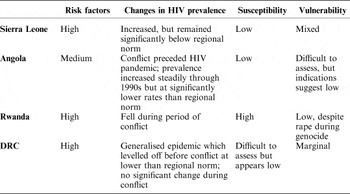
This article was prompted by the problem of why, if conflict acts as a vector for the spread of HIV, the situation in Africa is not even worse given the high number of conflicts there. Specifically, why did some conflicts demonstrate increased prevalence of HIV, but others did not? To answer this, the article moved beyond a reliance on risk factors to offer a new explanation using susceptibility and vulnerability as intervening variables. This was then examined with reference to four case studies. The results of the case studies are summarised in Table 1 (see end of article). In all of them, risk factors fail to explain what occurred in terms of HIV prevalence rates. In three of the cases, risk factors were high, but in Rwanda prevalence fell, in the DRC prevalence remained the same while in Sierra Leone it increased albeit remaining significantly lower than the regional norm. In the fourth case study, Angola, conflict preceded the HIV pandemic; although risk factors were low, HIV did emerge and prevalence rates increased, but at levels far lower than those elsewhere in the region. In conclusion then, risk factors demonstrate poor predictive and explanatory ability. In particular they are unable to distinguish when a conflict will lead to increased HIV prevalence and when it will not. In contrast the explanation offered above appears much more satisfactory. None of the four cases demonstrate both susceptibility and vulnerability, although some may demonstrate one of these while in the case of the DRC the results for both are mixed. What this appears to suggest is that, despite the fears of a few years ago, conflict does not readily act as a vector for HIV, though the potential for this to occur does still exist under certain circumstances. Moreover the distinction between background factors and conflict induced changes (susceptibility and vulnerability) opens the way for a more nuanced understanding of the relationship between conflict and increased HIV prevalence.
Summary of case studies

This result nevertheless needs to be qualified. First, cases often demonstrated local factors at work which may be significant in affecting HIV prevalence. Second, interpretations of the available data need to be nuanced and treated with care. Data is also often missing (not least in assessing disassortive mixing, which is accomplished largely by inference), is patchy or is of varying reliability. Third, the impact of rape in war on HIV prevalence appears to be an uncertain contributory factor. Recent work suggests, counter-intuitively, that rape in war does not translate into significantly higher HIV prevalence amongst the general population, an assessment somewhat borne out by the above analysis (especially in Rwanda). But data on rape is notoriously difficult to establish, while the number of women raped who were subsequently killed may also be a major factor in explaining the limited transmission of HIV into the general population. Also it is not clear whether the threat of infection is used by men who do not know whether they are HIV infected or not, simply because of the terror this may induce. The impact upon women who have been raped in this manner cannot be anything other than traumatic, but may also lead to a belief that HIV has been widely transmitted when in fact it has not. Fourth, other changes in sexual behaviour are also difficult to assess. This is partly because of lack of data during conflict – often because the dangers involved in conflict interrupts surveys. But it is also because a generalised HIV epidemic prior to conflict may be associated with risky sexual behaviour. Gauging the extent of change during conflict when risky sexual behaviour is already prevalent, and whether such changes are meaningful in terms of increasing the risk of HIV transmission is difficult. Fifth, injecting drug abuse does not appear to have been an issue in sub-Saharan Africa, but it may prove to be elsewhere. In particular, changing patterns of drug routes during the last decade coupled to conflicts in Iraq and Afghanistan may prove significant factors in the spread of HIV in those areas. There is also growing evidence of injecting drug abuse emerging in sub-Saharan Africa, including Sierra Leone, which may suggest that in the future this may be more of a factor than it appears to have been over the last two decades.Footnote 124 And sixth, because those most directly involved in conflict are also those in the age group most at risk from HIV it is possible that transmission rates were higher than the data suggests but a significant proportion of those with HIV were killed before the disease was identified. Data on HIV prevalence – especially population wide surveys – is often collected after a conflict with the result that prevalence rates amongst those killed in conflict – including civilians – remains unknown.
Finally there are two broader considerations. First, this research was prompted by the specific problem of why HIV prevalence rates had not increased in certain conflicts, despite the presence of well established risk factors. In addressing this it has offered a general explanation of the relationship between conflict and the spread of HIV, but has only examined this with reference to cases where HIV prevalence rates did not significantly increase. Having offered an explanation for the negative (which prompted the research), work is now required with cases where HIV prevalence did increase during conflict. Second, this work supports the argument that HIV and AIDS are new features in conflict and contribute to what Elbe refers to as the ‘changing landscape of war’ especially in Africa.Footnote 125 But one of the principle factors in this – the relationship between conflict and the spread of HIV – is less strong and more complicated than initially imagined.